Deorowicz and GrabowskiAlgorithms for Molecular Biology2013,8:25 http://www.almob.org/content/8/1/25
R E V I E W A R T I C L E
Open Access
Data compression for sequencing data
Sebastian Deorowicz
1†and Szymon Grabowski
2†*Abstract
Post-Sanger sequencing methods produce tons of data, and there is a general agreement that the challenge to store and process them must be addressed with data compression. In this review we first answer the question “why compression” in a quantitative manner. Then we also answer the questions “what” and “how”, by sketching the fundamental compression ideas, describing the main sequencing data types and formats, and comparing the specialized compression algorithms and tools. Finally, we go back to the question “why compression” and give other, perhaps surprising answers, demonstrating the pervasiveness of data compression techniques in computational biology.
Background
In the first decade of the century, the cost of sequenc-ing a ssequenc-ingle human genome fell from about 30 million to about 10 thousand dollars (here and later we mean U.S. dollars). The second generation sequencing platforms by 454 Life Sciences, Illumina, and Applied Biosystems cost less than one million dollars [1] and are available in many institutes. The promised third generation (3G) technology (including Ion Torrent Systems, Oxford Nanopore Tech-nologies, and Pacific Biosciences equipment) should be even cheaper, which rapidly moves us closer to the day of personalized medicine available to the masses.
In mid-2013, the world-biggest sequencing institute, Beijing Genomics Institute, used 188 sequencers, of which 139 were the top-of-the-line Illumina HiSeq 2000 and 2500 sequencing machines. Their total theoretical throughput is over 1.2 Pbases per year, which is equiva-lent to about 3 PB of raw sequencing read files. Including the additional output space for mapping to the reference genomes, the total amount of necessary storage is on the order of 10 PB per year. The statistics of high-throughput sequencers in the world (http://omicsmaps.com) show that the storage necessary for the instruments’ output is in the range 50–100 PB per year. Kahn [2] presents the genomic data growth until 2010, pointing out that the progress in computer hardware lags behind.
*Correspondence: [email protected] †Equal contributors
2Institute of Applied Computer Science, Lodz University of Technology, Łód´z, Poland
Full list of author information is available at the end of the article
Interestingly, recently the Million Veteran Program (MVP), led by the US Department of Veterans Affairs, was announced. With at least 30-fold coverage (100 bp reads) the number of reads per genome sample will be about 1 billion [3]. This means about 250 PB of raw data (in FASTQ format) in total, when the sequencing program is finished (the enrollment of volunteers is expected to last 5 to 7 years).
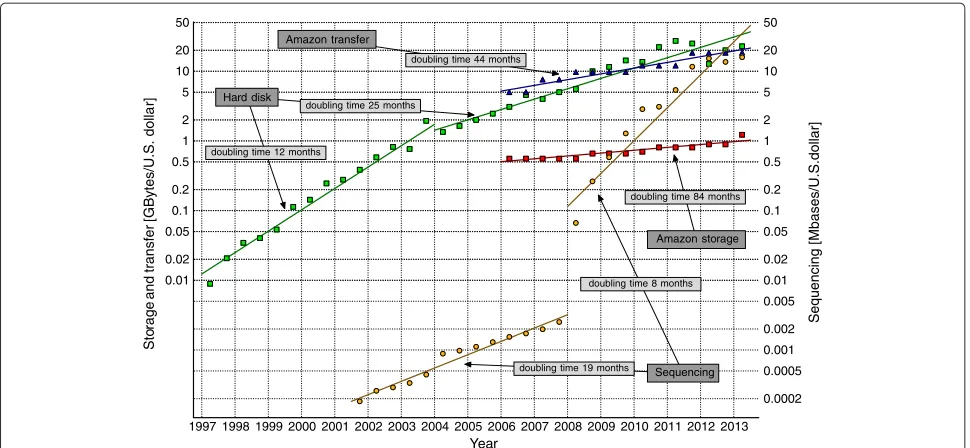
Those numbers are very large, but we need to remem-ber that they refer to July of 2013. As can be seen in Figure 1, the cost of sequencing a single base has been halving roughly every 8 months in 2008–2013, while the cost of hard disk space has been halving every 25 months in 2004–2013. Even if the most recent NHGRI data sug-gest some stagnation (see also the comment [4]), it may be a temporary slowdown, as 3G instruments are becoming available (PacBio RS and Heliscope).
On the other hand, the prices of low-end hard disks are rather misleading, since the amount of data necessary in sequencing projects is so huge that data centers are much better places to store the files. The growing popu-larity of cloud storage can be attributed to several reasons. Generally, data management may be cheaper if run by IT professionals (not always available in smaller centers, like hospitals), centralization may reduce data replication costs, and access to really huge repositories (at least of terabyte scale) is easier or even only possible with large arrays of disks. The disk drives in large storage arrays are usually enterprise-class ones of increased reliability and better performance, so they are several times more expen-sive than standard (SATA) HD drives. Taking these factors together we should not be surprised that storing a file in a
Deorowicz and GrabowskiAlgorithms for Molecular Biology2013,8:25 Page 2 of 13 http://www.almob.org/content/8/1/25
1997 1998 1999 2000 2001 2002 2003 2004 2005 2006 2007 2008 2009 2010 2011 2012 2013 0.01
0.02 0.05 0.1 0.2 0.5 1 2 5 10 20 50
0.0002 0.0005 0.001 0.002 0.005 0.01 0.02 0.05 0.1 0.2 0.5 1 2 5 10 20 50
Year
Sequencing [Mbases/U.S.dollar]
Sto
rage
and
transfer
[GBytes/U.S.
dolla
r] Hard disk
doubling time 12 months
doubling time 25 months
Sequencing
doubling time 19 months doubling time 8 months
Amazon storage
doubling time 84 months
Amazon transfer
doubling time 44 months
Figure 1Trends in storage, transfer, and sequencing costs.The historic costs of low-end hard disk drives were taken from http://www.jcmit. com/diskprice.htm. They had been halving every 12 months in the 1990s and around 2000–2004. Then, the doubling time lengthened suddenly, to about 25 months. The real costs of sequencing, taken from the NHGRI Web page [5], reflect not only reagent costs like some studies show, but also include labor, administration, amortization of sequencing instruments, submission of data to a public database, etc. The significant change in sequencing costs around 2008 was caused by the popularization of the second generation technologies. The prices of the Amazon storage and transfer reflect the real market offers from the top data centers. It is interesting that the storage costs at data centers drop very slowly, mainly because the costs of blank hard disks are only a part of the total costs of maintenance. The curves were not corrected for inflation.
large data center may cost about 5–10 times more than on a plain HD; this is the price we pay for ubiquitous access to reliable data collections.
What is more, these files must be transferred over the Internet, which is not free. One of the largest data centers and cloud computing centers are Amazon S3 and Amazon EC2. Their charges for storage has been halving every 84 months and the charges for transfer has been halv-ing every 44 months in 2006–2013. In January 2013 the real cost of sequencing human-size genome (according to NHGRI data) was about 5,700 dollars, while the cost of one-year storage at Amazon S3 and 15 downloads of raw reads and mapping results (225 GB of reads with 30-fold coverage and 500 GB of mapped data) was close to 1,500 dollarsa.
The trends show clearly that the costs of storage and transfer will become comparable to the costs of sequenc-ing soon, and the IT costs will be a significant obstacle for personalized medicine, if we do not face this problem seriously.
When choosing the compression algorithm to apply (if any), one should consider the specific use of the data. Two, in a sense extreme, scenarios are: (i) the data are to be transferred over a network (and then decompressed),(ii)
the data are to be accessed in real-time, either in a sequen-tial or random fashion. Let us take a closer look at both. In the case(i), a reasonable cost measure is the time to
compress the given data (preferably using some “standard” computer), transfer it, and decompress on the receiver side. Concerning sequencing reads (FASTQ), it is possible to obtain (at least) 4.5-fold compression at about 30 MB/s both compression and decompression speed, on a single CPU core. Let us assume a link speed of 50 Mbit/s and that the input files have 450 GB in total. Without any compres-sion the files will be transferred in exactly 20 hours. On the other hand, the compression, transfer and decompression times sum up to about 10.5 hours. Even if a faster con-nection is available (when the gain diminishes), we note that the compression and decompression may also be sped up (using threads or separate processes to utilize multi-ple CPU cores, and also by overlapping the compression, transfer and decompression phases). We point out that the ratio of 4.5, used in this example, is rather modest; signifi-cantly more is possible with lossy compression and also for some other biological data types (like genome collections). Let us now estimate the monetary savings for trans-ferring (downloading) these files from Amazon S3. The transfer charge depends on the volume of data, but let us assume 9 cents/GB. Without compression, we will pay 40.5 dollars for downloading these 450 GB of data, but only 9 dollars if compression is applied.
Deorowicz and GrabowskiAlgorithms for Molecular Biology2013,8:25 Page 3 of 13 http://www.almob.org/content/8/1/25
and flexibility, storage system for biosequences was pre-sented by Steinbiss and Kurtz [6]. Their GtEncseq solu-tion accepts several common sequence formats (FASTA, GenBank, EMBL, FASTQ), compresses the input, pro-vides fast random access to FASTA data, stores metadata, etc. Accessing single bases from random locations is not much slower than from the uncompressed equivalent rep-resentation, with over 3 million queries per second. In case of FASTQ, however, extracting a single read from an arbitrary location is not that fast, as it takes, e.g., more than 100 μs, which is less than the access time of a hard disk drive, but not necessarily faster than the SSD. A space-time tradeoff exists, so this time may be reduced, but consequently compression ratio drops quite severely. Anyway, if only sequential access to FASTQ is needed (which is often the case), GtEncseq may be a good choice.
As new large-scale sequencing projects are frequently announced (the mentioned MVP project is probably the most ambitious at the moment), the storage concerns are of high priority. It is no wonder then that many ideas of selective storage (or lossy compression) are dis-cussed in the community (cf. [7,8]). While we agree that some forms of lossy compression seem to be a neces-sity, the radical approach of discarding old data (in the hope of reproducing them later, when needed) raises major methodological doubts, as far as research appli-cations are considered. More precisely, discarding raw data is hazardous, since their reproduction later will not be exact, due to inherent “randomness” in sequenc-ing process, even if the same hardware and possibly identical procedure are used. This clashes with one of the main principles of the scientific method, which is reproducibility.
The area of data compression techniques in compu-tational biology has been surveyed by Giancarlo et al. [9,10], with more focus on the theory and data compres-sion applications in sequence analysis than storage and indexing of data from high-throughput technologies. One aspect of data compression in genomics, index structures for sequencing data, is thoroughly discussed by Vyverman et al. [11]. We hope our review complements earlier efforts by paying attention to versatile applications of data compression in the age of data flood in bioinformatics.
The paper is organized as follows. The next section contains a brief introduction to widely used data compres-sion algorithms. The section “Sequencing data” outlines the popular compression techniques and file formats to store various bioinformatics data: base calls annotated with quality scores, genome alignment data, single and multiple genome data. Making data smaller is not only for reducing their space and facilitating their distribu-tion, as it is reflected in the name of the next secdistribu-tion, “Beyond storage and transfer”. Here, applications of data
compression ideas in indexing, read alignment and other vital problems are discussed. The last section concludes.
Data compression in brief
Compression techniques are the traditional means of han-dling huge data. Those methods reduce the space for storage and speed up the data circulation (e.g., among research institutes). With its origins yet in the 19th cen-tury and first theoretical works just after the WW2, nowadays data compression is used almost everywhere as the amount of stored and transmitted data is huge. There are several major concepts that are used in com-pression programs, but the two mentioned below are the most important in bioinformatics. Here we give only a very short description of them, with more details in the Additional file 1 or the monograph [12].
The Huffman coding [12,13], invented in 1952, is a statistical method, which assigns a sequence of bits (a codeword) to each alphabet symbol. The codewords are of different length, and in accordance to the golden rule of data compression, rarer symbols are represented by longer codewords. The given sequence is then encoded by replacing each symbol with its corresponding code-word. What makes Huffman coding important is its opti-mality, i.e., no other code leads to a shorter encoded sequence.
In 1977–78 Ziv and Lempel [12,14] invented dictio-nary methods. They process the sequence from left to right and encode possibly long repetitions of consecu-tive symbols as references to the already compressed part of data. Such an approach allows for higher compression ratios than sole Huffman coding as it looks for another type of redundancy, common not only in natural language (e.g., repeating word phrases), but also in multiple genome sequences or overlapping sequencing reads. Even better results are possible with combining dictionary methods and Huffman coding. The very popular gzip program serves as a successful example.
Deorowicz and GrabowskiAlgorithms for Molecular Biology2013,8:25 Page 4 of 13 http://www.almob.org/content/8/1/25
Sequencing data
Raw sequencing data
The raw reads from sequencing are usually stored as records in textual FASTQ format. Each record is com-posed of a read ID, base calls, and quality scores for all base calls [16]. These files are often compressed with gzip, to obtain about 3-fold size reduction. While significant, such a gain is not quite satisfactory. A better choice is to use a FASTQ-dedicated compressor, e.g., DSRC [17], which shrinks the data about 5 times. The algorithm finds overlaps in the base calls from the reads placed at very long distances in the file (in Ziv–Lempel fashion), as well as takes care of various ID format conventions. It also uses multiple statistical models to better compress qual-ity values by the Huffman coding. In particular, qualqual-ity scores in different read positions are compressed in dif-ferent models (i.e., based on difdif-ferent statistics) because it is well-known that the quality deteriorates towards the read end, hence this design improves the prediction of the scores. DSRC is quite fast, as it compresses at 30–40 MB/s speed, and handles alphabets of size beyond 5 (IUPAC ambiguity codes) as well as variable-length reads.
Most newer proposals [18,19] focus mainly on compres-sion ratio and either the speeds are of secondary impor-tance or are not examined at all. For example, the solution by Bholaet al.[18] follows essentially the same direction as DSRC, but handles also approximate and palindromic repeats. The byproducts are compressed with an adaptive arithmetic coder [12]. While the reported compression ratios are usually higher than the DSRC’s by a few percent, it is unclear if the solution can be scalable. Remarkably, doubts are expressed by the authors themselves.
A more radical attempt to improve compression ratio is to group the reads with suffix-prefix overlaps close together. Unfortunately, the algorithms following this line [20,21] are not fully functional tools, e.g., they ignore the read IDs and quality scores, and achieve processing speeds on the order of 1 MB/s or less. A more interesting solution along these lines, SCALCE [22], is a FASTQ preprocessor helping to improve the compression ratio with gzip twice. As argued earlier, the rapid growth of data from sequencing experiments demands even better compres-sion ratios, and switching to a lossy mode seems to be the only chance for a breakthrough [23]. The natural candi-dates for lossy compression are quality scores. It has been shown [22,24-26] that rounding the quality scores to a few values (instead of about 60) can be acceptable. E.g., the fraction of discrepant SNPs grows slowly with diminishing number of quality scores in Illumina’s CASAVA package [27] while the benefit in compression is clearb. On the other hand, some (re)assemblers ignore these data [23], so if the reads are to be processed by such tools, the qual-ity scores can be removed. Another option is to use the
scores to prefilter the reads and discard the ones with unacceptably low quality.
SeqDB [28] is a notable exception from the shown tendency. Here the focus was put on compression and decompression speed, not compression ratio. On a machine with 12 CPU cores SeqDB reaches the speeds of about 500–600 MB/s ([28], Section 4.4), but the compres-sion ratio is at best at gzip’s level.
Recently, two very interesting algorithms were pre-sented. One of them is Quip [29], which uses higher-order modelling [12] with arithmetic coding in its more “traditional” mode, and also an assembly-based approach in its stronger mode. The idea is to form contigs from the first (by default 2.5 million) reads, which then are used as a reference for the following reads. The compression improvement due to this idea is moderate however, so the standard mode (faster and using half of the memory) seems to be more practical, with compression significantly better than DSRC and 10 MB/s to 20 MB/s compression/ decompression speed.
In [30] two FASTQ compressors were presented. Now we briefly describe the more interesting of them, Fqz-comp. It achieves better compression ratios thanks to a carefully chosen context mixing modelcand other original ideas. Fqzcomp belongs also to faster solutions, (partly) due to multi-threading. In the same paper, yet another strong FASTQ compressor was tested, SeqSqueeze1 (described only in [30]). This algorithm, also based on context mixing, is sometimes even better than Fqzcomp in respect of compression ratio, but its compression and decompression speed is less than 1 MB/s.
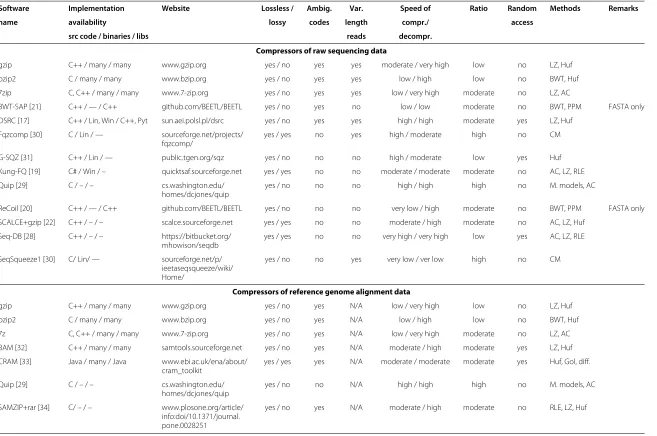
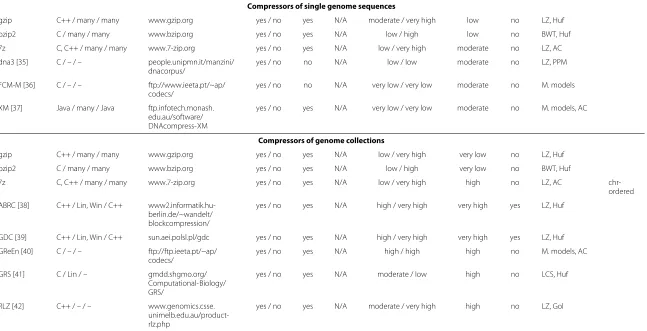
In Table 1 we compare the existing tools for compress-ing sequenccompress-ing data. They belong to four different kinds described in the following four subsections. We did our best not to miss any relevant tool for which the sources or (at least) binary executables for a popular operating systems were available. There are several reasons why we do not present experimental (comparative) tests of the presented tools. They are, in the order of decreasing importance:
(i ) limitations of many tools (e.g., accepting sequences with only the ACGT or only ACGTN alphabet, support for fixed-width reads only, assumptions on the ID format in FASTQ files, restriction to only selected fields of the SAM format);
(ii ) significant problems with running some of the existing tools (which we have experienced in earlier work, on FASTQ and genome collection
compression);
(iii ) not quite compatible outputs (e.g., DSRC for FASTQ supports random access, which cannot be turned off, while many others do not, hence comparing
Deorowicz
a
nd
Grabowski
Algorithms
for
M
olecular
B
iology
2013,
8
:25
Page
5
o
f
1
3
http://www.almob.org/content/8/1/25
Table 1 Summary of the most important compressors of sequencing data
Software Implementation Website Lossless / Ambig. Var. Speed of Ratio Random Methods Remarks
name availability lossy codes length compr./ access
src code / binaries / libs reads decompr.
Compressors of raw sequencing data
gzip C++ / many / many www.gzip.org yes / no yes yes moderate / very high low no LZ, Huf
bzip2 C / many / many www.bzip.org yes / no yes yes low / high low no BWT, Huf
7zip C, C++ / many / many www.7-zip.org yes / no yes yes low / very high moderate no LZ, AC
BWT-SAP [21] C++ / — / C++ github.com/BEETL/BEETL yes / no yes no low / low moderate no BWT, PPM FASTA only
DSRC [17] C++ / Lin, Win / C++, Pyt sun.aei.polsl.pl/dsrc yes / no yes yes high / high moderate yes LZ, Huf
Fqzcomp [30] C / Lin / — sourceforge.net/projects/ fqzcomp/
yes / yes no yes high / moderate high no CM
G-SQZ [31] C++ / Lin / — public.tgen.org/sqz yes / no no no high / moderate low yes Huf
Kung-FQ [19] C# / Win / – quicktsaf.sourceforge.net yes / yes no no moderate / moderate moderate no AC, LZ, RLE
Quip [29] C / – / – cs.washington.edu/ homes/dcjones/quip
yes / no no no high / high high no M. models, AC
ReCoil [20] C++ / — / C++ github.com/BEETL/BEETL yes / no no no very low / high moderate no BWT, PPM FASTA only
SCALCE+gzip [22] C++ / – / – scalce.sourceforge.net yes / yes no no moderate / high moderate no AC, LZ, Huf
Seq-DB [28] C++ / – / – https://bitbucket.org/ mhowison/seqdb
yes / yes no no very high / very high low yes AC, LZ, RLE
SeqSqueeze1 [30] C/ Lin/ — sourceforge.net/p/ ieetaseqsqueeze/wiki/ Home/
yes / no no yes very low / ver low high no CM
Compressors of reference genome alignment data
gzip C++ / many / many www.gzip.org yes / no yes N/A low / very high low no LZ, Huf
bzip2 C / many / many www.bzip.org yes / no yes N/A low / high low no BWT, Huf
7z C, C++ / many / many www.7-zip.org yes / no yes N/A low / very high moderate no LZ, AC
BAM [32] C++ / many / many samtools.sourceforge.net yes / no yes N/A moderate / high moderate yes LZ, Huf
CRAM [33] Java / many / Java www.ebi.ac.uk/ena/about/ cram_toolkit
yes / yes yes N/A moderate / moderate moderate yes Huf, Gol, diff.
Quip [29] C / – / – cs.washington.edu/ homes/dcjones/quip
yes / no no N/A high / high high no M. models, AC
SAMZIP+rar [34] C/ – / – www.plosone.org/article/ info:doi/10.1371/journal. pone.0028251
Deorowicz
a
nd
Grabowski
Algorithms
for
M
olecular
B
iology
2013,
8
:25
Page
6
o
f
1
3
http://www.almob.org/content/8/1/25
Table 1 Summary of the most important compressors of sequencing data(Continued)
Compressors of single genome sequences
gzip C++ / many / many www.gzip.org yes / no yes N/A moderate / very high low no LZ, Huf
bzip2 C / many / many www.bzip.org yes / no yes N/A low / high low no BWT, Huf
7z C, C++ / many / many www.7-zip.org yes / no yes N/A low / very high moderate no LZ, AC
dna3 [35] C / – / – people.unipmn.it/manzini/ dnacorpus/
yes / no no N/A low / low moderate no LZ, PPM
FCM-M [36] C / – / – ftp://www.ieeta.pt/~ap/ codecs/
yes / no no N/A very low / very low moderate no M. models
XM [37] Java / many / Java ftp.infotech.monash. edu.au/software/ DNAcompress-XM
yes / no yes N/A very low / very low moderate no M. models, AC
Compressors of genome collections
gzip C++ / many / many www.gzip.org yes / no yes N/A low / very high very low no LZ, Huf
bzip2 C / many / many www.bzip.org yes / no yes N/A low / high very low no BWT, Huf
7z C, C++ / many / many www.7-zip.org yes / no yes N/A low / very high high no LZ, AC chr-ordered
ABRC [38] C++ / Lin, Win / C++ www2.informatik.hu-berlin.de/~wandelt/ blockcompression/
yes / no yes N/A high / very high very high yes LZ, Huf
GDC [39] C++ / Lin, Win / C++ sun.aei.polsl.pl/gdc yes / no yes N/A high / very high very high yes LZ, Huf
GReEn [40] C / – / – ftp://ftp.ieeta.pt/~ap/ codecs/
yes / no yes N/A high / high high no M. models, AC
GRS [41] C / Lin / – gmdd.shgmo.org/ Computational-Biology/ GRS/
yes / no yes N/A moderate / low high no LCS, Huf
RLZ [42] C++ / – / – www.genomics.csse. unimelb.edu.au/product-rlz.php
yes / no yes N/A moderate / very high high no LZ, Gol
Deorowicz and GrabowskiAlgorithms for Molecular Biology2013,8:25 Page 7 of 13 http://www.almob.org/content/8/1/25
(iv) different targets (by design, some of the tools are supposed to be run on a commodity PC, while others require powerful servers, or never were tested on mammalian-size data, since it would take days or even weeks. For example, many top single genome sequence compressors work at the rate of several Kbase/s only, on a standard computer).
Reference genome alignment data
The reads are usually assembled or reassembled.De novo assembling is the most challenging, but resequencing, in which the reads are aligned to some reference genome, is much cheaper and thus widely used.
The results of mapping the reads onto the reference genome are usually stored in the SAM/BAM format [32]. SAM files augment the reads data with mapping quality and several other fields. BAM is a gzip-like compressed binary equivalent of textual SAM and is about 3–4 times smaller. Due to the additional data SAMs are more than twice as large as FASTQ files.
The reads in SAM files are mapped to a known ref-erence genome and the diffref-erences between the reads and the reference sequence, resulting from variation and sequencing errors, are small. Thus, it is efficient to rep-resent the base calls of a read as the mapping coordinate and the differences. These reads are usually ordered by the mapping coordinate and thus the coordinates can be stored in a differential manner, which results in a sequence of small and thus well compressible numbers. The old-est scheme [44] for compressing mapping data with the described idea cannot however be considered mature, since quality scores are ignored and there is no support for unaligned (i.e., those that failed to map onto a reference) reads.
Fritz et al. [33] handle both aligned and unaligned reads. The aligned reads are stored basically as described above together with the quality scores. To obtain better compression ratios, the authors advocate using a lossy mode and refrain from storing some quality scores, e.g., the ones related to perfectly matched positions. To com-press the unaligned reads (usually 10–40% of raw reads) better, they propose to build some artificial reference sequences. To this end, unmapped reads from many sim-ilar experiments are processed by an assembler to obtain contigs, built only for the compression process. Finally, the remaining sequences are matched to the bacterial and viral databases. Some of the byproducts in the algorithm are encoded with the Huffman (or other) codes. Most of the described techniques, excluding artificial reference as well as bacteria and viral sequences, are implemented in the CRAM compressor. In a highly lossy setting, it can produce archives smaller by an order of magnitude than corresponding BAM files. Similar approaches for compressing reads by mapping them onto an reference
genome are used in SlimGene [25] and SAMZIP [34] algorithms.
Generally the use of a reference sequence can help a lot for the compression ratio but we should remember that a reference might not be available in some cases, e.g., for metagenomic datasets or for organisms with high polymorphism [20].
The most recent SAM compressor [45], apart from highly configurable lossy compression settings, introduces a novel idea to exploit common features of reads mapped to the same genomic positions. Quip [29], published slightly earlier, is not as flexible as CRAM and works only losslessly. However, if aligned reads in the SAM or BAM format and a reference sequence are given, it wins with CRAM in compression ratio and needs less memory to operate.
The tabix program [46] is a more general solution, pop-ular in sequencing centers. It was designed to allow fast random access to compressed (gzip-like) textual files, in which the data are stored in rows containing tab-delimited values. The basic idea is to sort the input rows accord-ing to the sequence name and coordinate. Then the file is split into a series of blocks of maximum size of 64 KB. These blocks are compressed. Finally, an index to support random access queries is built.
Single genome sequences
Raw and annotated sequencing data are nowadays the greatest challenge for storage and transfer today. Never-theless, consensus DNA sequences (e.g., complete bac-terial genomes) used to be historically the first object of compression in bioinformatics. In a sense, however, the genome sequences for a single individual are almost incompressible. If the sequence contains only the symbols
A,C,G, andT, then the trivial 2 bits per symbol encoding is often more efficient than a general-purpose compressor, like gzip!
Specialized DNA compressors appeared in mid-1990s, but most solutions from the literature are impractically slow. For example, one of the strongest of them, the highly-acclaimed XM [37], can squeeze a genome up to about 5 times, but compression speed of the order of 20 KB/s on a modern machine is clearly disappointing. Some other notable compressors in this area are dna3 [35] and FCM-M [36]. The standard input format for genome sequences is FASTA, in which the file starts with a single-line description, followed by lines of sequence data.
Collections of genome sequences
Deorowicz and GrabowskiAlgorithms for Molecular Biology2013,8:25 Page 8 of 13 http://www.almob.org/content/8/1/25
have more than 99% of their content in common [47]), so a collection can be very efficiently compressed. Dic-tionary methods, from the LZ family, constitute the most obvious and actually most successful approach, consid-ering high-speed decompression with moderate memory requirements. The compression phase is more demand-ing, both in time and space, because the repetitions (matches) in a collection of genomes are typically giga-bytes apart. For these reasons, most general-purpose LZ-style compressors (e.g., gzip, rar) are useless for those data, and a few years ago the first specialized algorithms emerged.
In their seminal work, Christleyet al.[48] compressed a single human (James Watson’s) genome, but with the vari-ation data relative to a reference genome being provided. Variation data were comprised of single nucleotide poly-morphisms (SNPs) and so-called indels, i.e., insertions or deletions of multiple nucleotides. Additionally, they used a readily-available SNP database. The assumed sce-nario, augmented with standard compression techniques, made it possible to represent the whole human genome in about 4 Mbytes only. Recently, Pavlichinet al.[49] fol-lowed the lines pioneered in [48], compressing the JW genome to 2.5 MB, with very similar average results on 1092 human genomes from the 1000 Genomes Project. The introduced novelties are partly biologically-inspired, e.g., making use of the tag SNPs characterizing haplo-types. In another recent achievement, Deorowicz et al. [50] compressed the variant call files from 1092 diploid H. sapiens(1000 Genomes Project) and 775A. thaliana (1001 Genomes Project) individuals, together with a vari-ant database, squeezing the former collection to about 432 MB and the latter to 110 MB (which translates to 395 KB and 142 KB per individual, respectively).
Other research did not assume access to a knowledge base (i.e., a reference genome), hence most of them did not yet achieve the mentioned levels of compression. Most of these works [39,40,42,51] encode one of the genomes in a collection with simple means, spending about 2 bits per base, and then apply very efficient differential LZ-like encoding for the remaining genomes. The pioneering algorithm of this kind, RLZ [42,52], looks for LZ-matches in the reference genome (the one encoded naïvely, with 2 bits per base), and encodes their positions compactly, with reference to the previous match. This handles typ-ical differences in genomes of the same species (short insertions or deletions, SNPs) in an efficient manner. Such an approach is successful: the related compressor, GDC [39], obtains in its strongest mode the compression ratio of 1,000 for relatively encoded genomes in a collection of 70 human individuals, with decompression speed of 150 MB/s. The key ideas in GDC include looking for long approximate matches in the whole collection and the Huffman coding.
Some of the specialized compressors (GDC, LZ-End [53]) allow for fast access to an arbitrary substring of the compressed collection. Unfortunately, this comes at a price: some loss in compression ratio (which still remains competitive, though).
Yet another differential genome compressor was pre-sented by Wandelt and Leser [38]. Implementation-wise its original trait is searching for matches via a compressed suffix tree [54] (in blocks). This solution reaches the com-pression ratio of about 400 for the collection of 1000 human genomes. The match-finding speed of a parallel implementation is rather high (85 MB/s with large blocks). The real bottleneck is, however, building the compressed suffix tree.
Interestingly, also 7zip, a well-known advanced general-purpose LZ compressor, achieves quite competitive results, but for mammalian-size genomes the collections must be reordered by chromosomes, otherwise it can-not find inter-genome LZ-matches and its compression then is not much better than gzip’s. This behavior can be explained by its LZ-buffer limited to 1 GB, which is less than the size of, e.g., the human genome. On the other hand, chromosomes are already small enough and several of them fit its buffer.
Currently, public repositories often store large genomes as variant databases (e.g., in VCF format). This ten-dency should help significantly in developing new efficient compression algorithms, since all input sequences are perfectly aligned and the (otherwise hard and resource-consuming) task of finding repetitions in data becomes almost trivial. Thus, we expect the work by Christleyet al. [48], Pavlichinet al.[49] and Deorowiczet al.[50] to be only the first steps in this direction.
Beyond storage and transfer
So far, we have discussed how compression can alleviate the burden of storing and transmitting various genomic data. It can, however, help in less obvious aspects as well.
Deorowicz and GrabowskiAlgorithms for Molecular Biology2013,8:25 Page 9 of 13 http://www.almob.org/content/8/1/25
other hand, standard approaches to the de Bruijn assem-bly graph construction are plagued with pointers (location addresses in the memory), which are dominant part of the data structure in RAM.
Compact data structures not always make use of “typical” compression techniques (like statistical coding or LZ-matches), yet they serve the same purpose, which is (in the currently discussed application) reducing the memory requirements for building or querying a large graph. The Bloom filters [57], the well-known idea for compact approximate subset representation, were recently used with success for the de Brujin graph con-struction [58,59]. In particular, the work of Salikhovet al. [59] is a refinement of the technique of Chikhi and Rizk [58]. Their graph built for 564M human reads of length 100 bp usingk=23 occupies only about 2.5 GB. Another succinct (but not exactly compression) technique was pro-posed by Ye et al. [60]. They store only a small subset of the observedk-mers as nodes, with their neighboring chains of bases as edges. Some care is taken to remove low-coverage edges, which normally result in tips, loops or bubbles in the assembly graph, undesirable in the graph for a few reasons, including very high memory require-ments. The compact structure of SparseAssembler from the cited work was built in less than 2 hours for the human chromosome 14 with the peak memory use of 3 GB. The memory requirement for the whole human genome was below 30 GB. While the result from [59], cited above, seems clearly better, they are not directly comparable, unfortunately, due to different coverages and used values ofk.
An alternative to the de Bruijn graph is the assembly string graph [61], not working on k-mers, but requiring fast and memory efficient algorithms for the computa-tion of suffix-prefix overlaps of arbitrary length among reads. In a string graph, as opposed to the de Bruijn graph, each path represents a valid assembly of the reads (because the reads are not “decomposed” into many inde-pendentk-mers). Although this approach seems harder, in the SGA string assembler [62] error correction and assem-bling were performed with satisfactory accuracy on 125 Gbp of human genome reads using 54 GB of memory. This was achieved thanks to a compressed data struc-ture, the FM-index [63], which will be mentioned also later. Interestingly, another practical string graph assem-bler, Readjoiner [64], which can process 115 Gbp short reads dataset in 52 GB of RAM, does not make use of com-pressed data structures, but its space effectiveness comes from an ingenious partitioning approach applied to the array of a relevant subset of all suffixes of all reads. Read-joiner also confirms that compact data structures may be fast because of locality of accesses to data.
Another compression example concerns dataindexing. Computational biology is mostly about data analysis,
which in turn involves pattern search. If the data over which patterns are sought do not change over time, we talk about a static scenario. This is quite common, e.g., an already sequenced genome of a given individual is usually not updated for a long period. In such a case it may be worth to build an index structure for given data since its construction time, even if significant, is likely to be paid off during multiple subsequent pattern searches. A classic text indexing data structure is thesuffix tree(ST) [43]. It is powerful and useful, but unfortunately requires up to 28n bytes of space, wherenis the sequence length. Thus, it is hard to store an ST in the main memory even for a sin-gle mammalian genome. Thecompressed indexidea is to support all (or main) functionalities of its classic counter-part (e.g., returning the locations of all occurrences of the pattern in the text), but using much less space. The area of compressed indexes, initiated only around 2000, has been marked by tens of significant papers [65]. Unfortu-nately, those “general-purpose” text indexes are not a good choice for a collection of genomes of individuals of the same species. In these cases, LZ-based indexes are much more efficient in removing the specific (and very large) redundancy. Several works with LZ-style indexes designed for genomic data appeared in the recent years. Most of the solutions for the exact [66-68] and approximate pattern search [69] are rather theoretical as for only some of them implementations are available.
Deorowicz and GrabowskiAlgorithms for Molecular Biology2013,8:25 Page 10 of 13 http://www.almob.org/content/8/1/25
A special case of mapping sequence reads to genomes concerns RNA-Seq experiments, in which a ‘snapshot’ of RNA molecules in the cell is sequenced. The RNA-Seq [79] is a relatively new approach that proved highly suc-cessful especially for determination of gene expression. The main problem here is that we must deal with reads at exon-exon boundaries (without the introns present in the reference genome), so spliced mappings must be looked for, which is unusual for standard DNA reads mapping. Some mappers for this problem also make use of the FM-index, e.g., TopHat [80] and CRAC [81]. A compre-hensive list of RNA-Seq mapping approaches can be found in [82].
The FM-index searches for a pattern finding its suc-cessive letters, from right to left, which can be called backward extension of a string. Recently, Li [83] pre-sented a simple modification of the FM-index for forward-backward extension of DNA strings. Hisde novo assembler, fermi, shows that the assembly based variant calling can achieve an SNP accuracy close to the stan-dard mapping approach, being particularly strong in indel calling.
It is worth noting that BWT-based alignment can be implemented on a massively parallel graphics process-ing unit (GPU). Recent tools SOAP3 [84] and SOAP3-dp [85], being about an order of magnitude faster than their CPU-based counterparts, are prominent examples.
One could ask if the FM-index, or another compressed index, is useful for searching DNA strings in a genome, e.g., given as FASTA input. The answer is positive; thanks to the small alphabet the search times (thecountquery, in which we return the number of matches only) of the FM-index, in the best current implementation, may be comparable with the suffix array ([86], Table Six and Seven). The space use, however, is only about 0.3n(in con-trast to 5nneeded by the suffix array). On the other hand, the locate query, in which the positions of all matching substrings are returned, is at least an order of magnitude slower, and needs some extra space.
In some cases, however, searching directly in the com-pressed data may be faster than in the straightforward rep-resentation. Lohet al.[87] compress a sequence database so that if an inserted sequence is similar enough to one from the database, it is represented as the reference plus a list of differences (edit script). The search algorithm they propose, based on BLAST, takes care of the differ-entially encoded sequences, and only rarely requires to bring them back to their “full” form. Their Compressive BLAST / BLAT algorithm was found to be about 4 times faster than classic BLAST / BLAT tools [88,89]. Other examples where data compression reportedly speeds up processing concern the k-mer counting task, especially in I/O-constrained scenarios ([90], Table Two–Four). We note that reading compressed input is nowadays a
con-venient feature of many tools (e.g., de novo assemblers Velvet [91] and ABySS [92]), but not always it brings improvements in speed.
Compression methods were used also for other pur-poses, in which the goal was not the reduction of space or processing speed-up, but rather better understanding of genomic data. Caoet al.[93] used the XM algorithm [37] to align eukaryotic-size genomes in a few hours on a workstation. The idea is to teach the expert models on one of the sequences and use the knowledge to properly align the second one by measuring the information content and the mutual information content of the sequences.The resulting aligner is shown experimentally to be superior (at least in quality, not in speed) to conventional alignment methods based on character matching.
Bhaduriet al.[94] proposed a somewhat related idea of using a compression algorithm from the LZ family to fil-ter low-complexity reads in a project on identification of nonhuman sequences, such as viruses, in deep sequencing datasets.
A measure of sequence similarity, that is both accurate and rapidly computable, is highly desirable. Ferraginaet al. [95] advocated that classic alignment methods do not scale well for huge data. They focus on the Universal Simi-larity Measure (USM) [96]. As USM is rather a theoretical concept, the authors experiment with its three approx-imations based on data compression. They validate the possibility of using these approximations for classification of sequences by UPGMA and NJ methods.
Freschi and Bogliolo [97] proposed a lossy compres-sion scheme to eliminate tandem repeats from a sequence. Thanks to that, no repeat masking is necessary before performing pairwise alignment of sequences.
Conclusions
Data deluge in computational biology has become a fact. A vast majority of gathered data is “temporary” in nature and could be discarded as soon as the analysis is done. The problem is, however, that current sequence analysis algo-rithms are imperfect, and storing lots of data only in the hope to squeeze out more of them in the future is a rea-sonable strategy. To put it in other words, lossy storage is an interesting option for bioinformatics, but it should be used judiciously.
Deorowicz and GrabowskiAlgorithms for Molecular Biology2013,8:25 Page 11 of 13 http://www.almob.org/content/8/1/25
and transfer, but also of data center services. The latter should bring the vision of ubiquitous cloud computing closer.
Let us make two predictions at the end. First, we note that some objects of interest in computational biology, like a human genome, do not grow. Hence, with growing amount of memory even in our home laptops, it per-haps no longer pays to apply strong compression for some tasks, if less compact but faster solutions are known. Read alignment onto a reference genome is a prominent exam-ple of this sort. We anticipate that in 1–2 years solutions processing a 1 billion 100 bp reads collection in a few hours on a PC will appear, but their main data structure may be the good old suffix array rather than, e.g., the FM-index.
Second, we predict that the turbulent period of new compression ideas for sequencing data representations will slowly give way to industry-oriented solutions, with more stress on robustness, flexibility, ease of use, and compression and decompression speed (in sequential and parallel/distributed regimes). Ideas are exiting, but rou-tine jobs require standards. We believe that powerful, versatile and thus widely used formats in bioinformatics will emerge soon, proving the maturity of the field.
Endnotes
a There are, of course, many alternative cloud storage
solutions and it is hard to tell “typical” fees for storage and transfer, as opposed to retail disk media prices which can be monitored rather easily. As a reference, however, we note that Microsoft Windows Azure and Google Cloud Storage charges in the same scenario are similar (about 1,350–1,500 dollars), and all these providers charge more for the assumed 15 downloads than for one-year storage.
b Illumina software for their HiSeq 2500 equipment
contains an option to reduce the number of quality scores [98]. Its effect on overall sequencing is shown in a technical support note [99].
c Statistical methods often encode symbols with regard
to the gathered statistics of occurrences in their respectivecontexts, which are formed with, e.g., several proceeding symbols. This approach can be made even more sophisticated with considering several contextual models running in parallel, in order to improve the estimation of symbols’ probability and, in result, the obtained compression ratio. The name of “context mixing” refers to this approach, in which the statistics from different contexts are “mixed” (weighted, blended).
Additional file
Additional file 1: Description of selected compression methods.
Competing interests
The authors declare that they have no competing interests.
Authors’ contributions
SD and SG contributed equally to the paper. Both authors wrote, read and approved the final manuscript.
Acknowledgments
This work was supported by the Polish National Science Centre under the project DEC-2012/05/B/ST6/03148. We wish to thank Agnieszka Debudaj-Grabysz and Witold Grabysz for their constructing remarks after reading the preliminary version of the paper.
Author details
1Institute of Informatics, Silesian University of Technology, Gliwice, Poland. 2Institute of Applied Computer Science, Lodz University of Technology, Łód´z, Poland.
Received: 25 April 2013 Accepted: 25 September 2013 Published: 18 November 2013
References
1. Metzker ML:Sequencing technologies–the next generation.Nat Rev Genet2010,11:31–46.
2. Kahn SD:On the future of genomic data.Science2011,331:728–729. 3. Roberts JP:Million veterans sequenced.Nat Biotechnol2013,31(6):470. 4. Hall N:After the gold rush.Genome Biol2013,14(5):115.
5. National Human Genome Research Institute, DNA Sequencing Costs.[http://www.genome.gov/sequencingcosts/] (accessed February 14, 2013).
6. Steinbiss S, Kurtz S:A new efficient data structure for storage and retrieval of multiple biosequences.IEEE/ACM Trans Comput Biol Bioinformatics2012,9(2):345–357.
7. Kodama Y, Shumway M, Leinonen R:The sequence read archive: explosive growth of sequencing data.Nucleic Acids Res2012, 40(Database issue):54–56.
8. Cochrane G, Cook CE, Birney E:The future of DNA sequence archiving. GigaScience2012,1(1). article no. 2.
9. Giancarlo R, Scaturro D, Utro F:Textual data compression in computational biology: A synopsis.Bioinformatics2009, 25(13):1575–1586.
10. Giancarlo R, Scaturro D, Utro F:Textual data compression in
computational biology: Algorithmic techniques.Comput Sci Rev2012, 6(1):1–25.
11. Vyverman M, De Baets B, Fack V, Dawyndt P:Prospects and limitations of full-text index structures in genome analysis.Nucleic Acids Res 2012,40(15):6993–7015.
12. Salomon D, Motta G:Handbook of data compression. London: Springer; 2010.
13. Huffman D:A method for the construction of minimum-redundancy codes.InProceedings of the Institute of Radio Engineers.1952:1098–1101. 14. Ziv J, Lempel A:A universal algorithm for sequential data
compression.IEEE Trans Inf Theory1977,IT-23:337–343.
15. Burrows M, Wheeler D:A block sorting lossless data compression algorithm.Technical Report 124, Digital Equipment Corporation 1994, http://www.hpl.hp.com/techreports/Compaq-DEC/SRC-RR-124.pdf. 16. Cock PJA, Fields CJ, Goto N, Heuer ML, Rive PM:The Sanger FASTQ file
format for sequences with quality scores, and the Solexa/Illumina FASTQ variants.Nucleic Acids Res2010,38(6):1767–1771.
17. Deorowicz S, Grabowski Sz:Compression of DNA sequence reads in FASTQ format.Bioinformatics2011,27(6):860–862.
18. Bhola V, Bopardikar AS, Narayanan R, Lee K, Ahn T:No-reference compression of genomic data stored in FASTQ format.InProceedings of the IEEE International Conference on Bioinformatics and Biomedicine. Edited by Wu F-X, Zaki M, Morishita S, Pan Y, Wong S, Christianson A, Hu X. Atlanta, USA: IEEE Computer Society; 2011:147–150.
19. Grassi E, Di Gregorio F, Molineris I:KungFQ: A Simple and Powerful Approach to Compress Fastq Files.IEEE/ACM Trans Comput Biol Bioinformatics2012,9(6):1837–1842.
Deorowicz and GrabowskiAlgorithms for Molecular Biology2013,8:25 Page 12 of 13 http://www.almob.org/content/8/1/25
21. Cox AJ, Bauer MJ, Jakobi T, Rosone G:Large-scale compression of genomic sequence databases with the Burrows-Wheeler transform. Bioinformatics2012,28(11):1415–1419.
22. Hach F, Numanagi´c I, Alkan C, Sahinapl SC:SCALCE: boosting Sequence Compression Algorithms using Locally Consistent Encoding. Bioinformatics2012,28(23):3051–3057.
23. Miller JR, Koren S, Sutton G:Assembly algorithms for next-generation sequencing data.Genomics2010,95(6):315–327.
24. Wan R, Anh VN, Asai K:Transformations for the compression of FASTQ quality scores of next generation sequencing data.Bioinformatics 2011,28(5):628–635.
25. Kozanitis C, Saunders C, Kruglyak S, Bafna V, Varghese G:Compressing genomic sequence fragments using SlimGene.J Comput Biol2011, 18(3):401–413.
26. Ochoa I, Asnani H, Bharadia D, Chowdhury M, Weissman T, Yona G: QualComp: a new lossy compressor for quality scores based on rate distortion theory.BMC Bioinformatics2013,14:187.
27. Illumina:Casava v. 1.8.2 Documentation.2013. [http://support.illumina. com/sequencing/sequencing_software/casava.ilmn]
28. Howison M:High-throughput compression of FASTQ data with SeqDB.IEEE/ACM Trans Comput Biol Bioinformatics2013,10(1):213–218. 29. Jones DC, Ruzzo WL, Peng X, Katze MG:Compression of
next-generation sequencing reads aided by highly efficient de novo assembly.Nucleic Acids Res2012,40(22):e171.
30. Bonfield JK, Mahoney MV:Compression of FASTQ and SAM format sequencing data.PLoS ONE2013,8(3):e59190.
31. Tembe W, Lowey J, Suh E:G-SQZ: compact encoding of genomic sequence and quality data.Bioinformatics2010,26(17):2192–2194. 32. Li H, Handsaker B, Wysoker A, Fennell T, Ruan J, Homer N, Marth, Abecasis
G, Durbin R, 1000 Genome Project Data Processing Subgroup:The sequence alignment/map (SAM) format and SAMtools.Bioinformatics 2009,25(16):2078–2079.
33. Fritz MH-Y, Leinonen R, Cochrane G, Birney E:Efficient storage of high throughput DNA sequencing data using reference-based compression.Genome Res2011,21:734–740.
34. Sakib MN, Tang J, Zheng WJ, Huang C-T:Improving transmission efficiency of large sequence alignment/map (SAM) files.PLoS ONE 2011,6(12):e28251.
35. Manzini G, Rastero M:A simple and fast DNA compressor.Softw Pract Exp2004,34(14):1397–1411.
36. Pinho AJ, Ferreira PJSG, Neves AJR, Bastos CAC:On the representability of complete genomes by multiple competing finite-context (Markov) models.PLoS ONE2011,6(6):e21588.
37. Cao MD, Dix TI, Allison L, Mears C:A simple statistical algorithm for biological sequence compression.InProceedings of the Data Compression Conference. Washington, DC, USA: IEEE Computer Society Press; 2007:43–52.
38. Wandelt S, Leser U:Adaptive efficient compression of genomes.Algo Mol Biol2012,7:30.
39. Deorowicz S, Grabowski Sz:Robust relative compression of genomes with random access.Bioinformatics2011,27(11):2979–2986. 40. Pinho AJ, Pratas D, Garcia SP:GReEn: a tool for efficient compression
of genome resequencing data.Nucleic Acids Res2012,40(4):e27. 41. Wang C, Zhang D:A novel compression tool for efficient storage of
genome resequencing data.Nucleic Acids Res2011,39(7):e45. 42. Kuruppu S, Puglisi SJ, Zobel J:Optimized relative Lempel-Ziv
compression of genomes.InProceedings of the ACSC Australasian Computer Science Conference. Edited by Reynolds M. Sydney, Australia: Australian Computer Society, Inc. 2011:91–98.
43. Gusfield D:Algorithms on strings, trees and sequences: Computer science and computational biology.Cambridge, UK: Cambridge University Press; 1997.
44. Daily K, Rigor P, Christley S, Hie X, Baldi P:Data structures and compression algorithms for high-throughput sequencing technologies.BMC Bioinformatics2010,11:514.
45. Popitsch N, von Haeseler A:NGC: lossless and lossy compression of aligned high-throughput sequencing data.Nucleic Acids Res2013, 41(1):e27.
46. Li H:Tabix: fast retrieval of sequence features from generic TAB-delimited files.Bioinformatics2011,27(5):718–719.
47. Levy S, Sutton G, Ng PC, Feuk L, Halpern AL, Walenz BP, Axelrod N, Huang J, Kirkness EF, Denisov G, Lin Y, MacDonald JR, Pang AWC, Shago M, Stockwell TB, Tsiamouri A, Bafna V, Bansal V, Kravitz SA, Busam DA, Beeson KY, McIntosh TC, Remington KA, Abril JF, Gill J, Borman J, Rogers YH, Frazier ME, Scherer SW, Strausberg RL, Venter JC:The diploid genome sequence of an individual human.PLoS Biol2007,5(10):e254. 48. Christley S, Lu Y, Li C, Xie X:Human genomes as email attachments.
Bioinformatics2009,25(2):274–275.
49. Pavlichin D, Weissman T, Yona G:The human genome contracts again. Bioinformatics2013,29(17):2199–2202.
50. Deorowicz S, Danek A, Grabowski Sz:Genome compression: a novel approach for large collections.Bioinformatics2013,29(20):2572–2578. 51. Chern BG, Ochoa I, Manolakos A, No A, Venkat K, Weissman T:Reference
based genome compression.Publicly available preprint arXiv:1204.1912v1 2012.
52. Kuruppu S, Puglisi SJ, Zobel J:Relative Lempel–Ziv compression of genomes for large-scale storage and retrieval.InProceedings of the 17th International Symposium on String Matching and Information Retrieval (SPIRE). Edited by Chávez E, Lonardi S. Springer-Verlag, Berlin-Heidelberg: Springer, LNCS 6393; 2010:201–206.
53. Kreft S, Navarro G:LZ77-like compression with fast random access.In Proceedings of the Data Compression Conference. Washington, DC, USA: IEEE Computer Society; 2010:239–248.
54. Ohlebusch E, Fischer J, Gog S:CST++.InProceedings of the 17th International Symposium on String Matching and Information Retrieval (SPIRE). Edited by Chávez E, Lonardi S. Springer-Verlag, Berlin-Heidelberg: Springer, LNCS 6393; 2010:322–333.
55. Compeau PE, Pevzner PA, Tesler G:How to apply de Bruijn graphs to genome assembly.Nat Biotechnol2011,29(11):987–991.
56. Conway TC, Bromage AJ:Succinct data structures for assembling large genomes.Bioinformatics2011,27(4):479–486.
57. Bloom BH:Space/time trade-offs in hash coding with allowable errors.Commun ACM1970,13(7):422–426.
58. Chikhi R, Rizk G:Space-efficient and exact de Bruijn graph representation based on a Bloom filter.InProceedings of the 12th International Workshop on Algorithms in Bioinformatics (WABI). Edited by Raphael BJ, Tang J. Springer-Verlag, Berlin-Heidelberg: Springer, LNCS 7534; 2012:236–248.
59. Salikhov K, Sacomoto G, Kucherov G:Using cascading Bloom filters to improve the memory usage for de Brujin graphs.InProceedings of the 13th International Workshop on Algorithms in Bioinformatics (WABI). Edited by Darling A. E., Stoye J. Springer-Verlag, Berlin-Heidelberg: Springer, LNCS 8126; 2013:364–376.
60. Ye C, Ma ZS, Cannon CH, Pop M, Yu DW:Exploiting sparseness inde novogenome assembly.BMC Bioinformatics2012,13(Suppl 6):S1. 61. Myers EW:The fragment assembly string graph.Bioinformatics2005,
21(suppl 2):ii79–ii85.
62. Simpson JT, Durbin R:Efficient de novo assembly of large genomes using compressed data structures.Genome Res2012,22:549–556. 63. Ferragina P, Manzini G:Opportunistic data structures with
applications.InProceedings of the 41st Annual Symposium on Foundations of Computer Science (FOCS). Redondo Beach, California, USA: IEEE Computer Society; 2000:390–398.
64. Gonnella G, Kurtz S:Readjoiner: a fast and memory efficient string graph-based sequence assembler.BMC Bioinformatics2012,13:82. 65. Navarro G, Mäkinen V:Compressed full-text indexes.ACM Computing
Surv2007,39:2.
66. Kreft S, Navarro G:On compressing and indexing repetitive sequences.Theor Comput Sci2013,483:115–133.
67. Gagie T, Gawrychowski P, Kärkkäinen J, Nekrich Y, Puglisi SJ:A faster grammar-based self-index.InProceedings of the 6th International Conference on Language and Automata Theory and Applications (LATA). Springer-Verlag, Berlin-Heidelberg: LNCS 7183; 2012:240–251. 68. Do HH, Jansson J, Sadakane K, Sung W-K:Fast relative Lempel-Ziv
self-index for similar sequences.InProceedings of the Joint International Conference on Frontiers in Algorithmics and Algorithmic Aspects in Information and Management (FAW-AAIM).Springer-Verlag, Berlin-Heidelberg: LNCS 7285; 2012:291–302.
Deorowicz and GrabowskiAlgorithms for Molecular Biology2013,8:25 Page 13 of 13 http://www.almob.org/content/8/1/25
International Symposium on Algorithms and Computation (ISAAC). Springer-Verlag, Berlin-Heidelberg: LNCS 7074; 2011:653–662. 70. Ahmadi A, Behm A, Honnalli N, Li C, Weng L, Xie X:Hobbes: optimized
gram-based methods for efficient read alignment.Nucleic Acids Res 2012,40(6):e41.
71. Langmead B, Trapnell C, Pop M, Salzberg SL:Ultrafast and
memory-efficient alignment of short DNA sequences to the human genome.Genome Biol2009,10(3):R25.
72. Langmead B, Salzberg SL:Fast gapped-read alignment with Bowtie. Nature Methods2012,9:357–359.
73. Li H, Durbin R:Fast and accurate short read alignment with Burrows–Wheeler transform.Bioinformatics2009,25(14):1754–1760. 74. Li H, Durbin R:Fast and accurate long-read alignment with
Burrows–Wheeler transform.Bioinformatics2010,26(5):589–595. 75. Li R, Yu C, Li Y, Lam T-W, Yiu S-M, Kristiansen K, Wang J:SOAP2: an
improved ultrafast tool for short read alignment.Bioinformatics2009, 25(15):1966–1967.
76. Marco-Sola S, Sammeth M, Guigó R, Ribeca P:The GEM mapper: fast, accurate and versatile alignment by filtration.Nat Methods2012, 9(12):1185–1188.
77. Kärkkäinen J:Fast BWT in small space by blockwise suffix sorting. Theor Comput Sci2007,387:249–257.
78. Ferragina P, Gagie T, Manzini G:Lightweight data indexing and compression in external memory.Algorithmica2012,63(3):707–730. 79. Wang Z, Gerstein M, Snyder M:RNA-Seq: a revolutionary tool for
transcriptomics.Nat Rev Genet2009,10(1):57–63.
80. Trapnell C, Pachter L, Salzberg SL:TopHat: discovering splice junctions with RNA-Seq.Bioinformatics2009,25(9):1105–1111.
81. Rivals E:CRAC: an integrated approach to the analysis of RNA-seq reads.Genome Biol2013,14(3):R30.
82. Alamancos GP, Agirre E, Eyras E:Methods to study splicing from high-throughput RNA Sequencing data.Publicly available preprint arXiv:1304.5952v1.
83. Li H:Exploring single-sample SNP and INDEL calling with whole-genome de novo assembly.Bioinformatics2012, 28(14):1838–1844.
84. Liu C-M, Wong TKF, Wu E, Luo R, Yiu S-M, Li Y, Wang B, Yu C, Chu X, Zhao K, Li R, Lam TW:SOAP3: ultra-fast GPU-based parallel alignment tool for short reads.Bioinformatics2012,28(6):878–879.
85. Luo R, Wong T, Zhu J, Liu C-M, Zhu X, Wu E, Lee L-K, Lin H, Zhu W, Cheung DW, Ting H-F, Yiu S-M, Peng S, Yu C, Li Y, Li R, Lam TW:SOAP3-dp: Fast, accurate and sensitive GPU-based short read aligner.PLoS ONE2013, 8(5):e65632.
86. Gog S, Petri M:Optimized succinct data structures for massive data. Softw Pract Exp2013, doi: 10.1002/spe.2198.
87. Loh P-R, Baym M, Berger B:Compressive genomics.Nat Biotechnol2012, 30(7):627–630.
88. Altschul SF, Gish W, Miller W, Myers EW, Lipman DJ:Basic local alignment search tool.J Mol Biol1990,215(3):403–410. 89. Kent WJ:BLAT–the BLAST-like alignment tool.Genome Res2002,
12(4):656–664.
90. Deorowicz S, Debudaj-Grabysz A, Grabowski Sz:Disk-based k-mer counting on a PC.BMC Bioinformatics2013,14:Article no. 160. 91. Zerbino DR, Birney E:Velvet: algorithms for de novo short read
assembly using de Bruijn graphs.Genome Res2008,18(5):821–829. 92. Simpson JT, Wong K, Jackman SD, Schein JE, Jones SJM, Birol I:ABySS: A
parallel assembler for short read sequence data.Genome Res2009, 19(6):1117–1123.
93. Cao MD, Dix TI, Allison L:A genome alignment algorithm based on compression.BMC Bioinformatics2010,11(1):599.
94. Bhaduri A, Qu K, Lee CS, Ungewickell A, Khavari P:Rapid identification of nonhuman sequences in high throughput sequencing data sets. Bioinformatics2012,28(8):1174–1175.
95. Ferragina P, Giancarlo R, Greco V, Manzini G, Valiente G:
Compression-based classification of biological sequences and structures via the universal similarity metric: experimental assessment.BMC Bioinformatics2007,8:252.
96. Li M, Chen X, Li X, Ma B, Vitányi PMB:The similarity metric.IEEE Trans Inf Theory2004,50(12):3250–3264.
97. Freschi V, Bogliolo A:A lossy compression technique enabling duplication-aware sequence alignment.Evol Bioinformatics2012, 8:171–180.
98. Illumina:HiSeq 2500 system user guide.2012. [http://supportres. illumina.com/documents/myillumina/223bf628-0b46-409f-aa3d-4f3495fe4f69/hiseq2500_ug_15035786_a_public.pdf]
99. Illumina:New algorithms increase computing efficiency for IGN whole-genome analysis.2013. [http://res.illumina.com/documents/ products/technotes/technote_ign_isaac_software.pdf]
doi:10.1186/1748-7188-8-25
Cite this article as: Deorowicz and Grabowski: Data compression for sequencing data.Algorithms for Molecular Biology20138:25.
Submit your next manuscript to BioMed Central and take full advantage of:
• Convenient online submission
• Thorough peer review
• No space constraints or color figure charges
• Immediate publication on acceptance
• Inclusion in PubMed, CAS, Scopus and Google Scholar
• Research which is freely available for redistribution