International Journal of Emerging Technology and Advanced Engineering
Website: www.ijetae.com (ISSN 2250-2459, ISO 9001:2008 Certified Journal, Volume 3, Issue 7, July 2013)
244
Development and Performance Evaluation of a Groundnut
Extracting Machine
Onwuka, Onyebuchi, M.Sc.
11Department of mechanical Engineering, Michael Okpara University of Agriculture, Umudike
Abstract—The performance and modeling of a groundnut extracting machine was designed and fabricated for market oriented production as reported in this paper. This project involves the design and testing of groundnut oil extractor. The formal procedure of designing was adopted which involves synthesis, design and specification of components and material selections which includes mild steel sheet, galvanize sheet, copper tubes, brass taps.
The operations involved including folding, cutting, welding, brassing, e.t.c. the construction was carried out in the Michael Okpara University of Agriculture, mechanical workshop. The testing of this model produced followed, and the result showed good agreement with performance prediction.
I. INTRODUCTION
In the heart of satisfying the general need for oil extraction from different species of grains, nuts and leaves (vegetable) and supporting the country’s ordeal to encourage indigenous technology and in a bid to conserve our foreign exchange.
One of the objectives of a nation is to ensure that her inhabitants enjoy a high standard of living at a relatively low and affordable cost. Undoubtedly, this will go a long way in creating a sound economy.
One way of achieving this objective is to embark upon manufacture of products of better quality design that will satisfy the basic home needs, and sell competitively at the international market.
To this effect, throughout the complicated evolutionary history, evidence of the impact oil, keep coming up, the slogan no oil no food is the first commandment in home management (cookery). Beside the world demand for vegetable oil, is considered to be growing at the rate of 3-4% per annum and this trend renders on expansion in the extraction of oil for a greater yield from the oil seed within the country essential. Consequently, this project aims at design and construction of groundnut oil extractor using steam for a greater percentage yield of oil, and avoiding chaff mixing with the oil thereby increasing the quality of the extracted oil to meet comparatively both industrial , clinical and domestic needs.
The value of oil from oil seed as a foodstuff was recognized by the ancients which led to their method of extraction of oil, from the oil seed are as follows:-
Crushing and squeezing
Screw pressing or hydraulic press
Solvent extraction A. Crushing and Squeezing
In this method of oil extraction, the extracting system is made up of crushing machine will crush already dispelled oil seed into flakes. The crushed flakes then feed the squeezing machine which will squeeze out the oil by the application of pressure.
B. Screw Pressing or Hydraulic Press
In screw pressing or hydraulic press, the oil is extracted from the oil seeds by the action of the screw which resolve inside the box squeezing out oil from the cells of the oil seed. The oil extraction leaves through the perforations.
C. Solvent Extraction
This is the method by which oil from plant material are extracted by volatile solvent such as petroleum ether or benzene.
In all these designs, the basic problems are as follows:- in hydraulic press, the desired output is high pressure, but this high pressure is not normally easy to achieve, there is always pressure losses due to leakages. Likewise, in the screw pressing or hydraulic press, the basic problems are that of the chaff mixing with oil extracted and low percentage oil recovery. And also in the solvent extraction, the problem is that such extraction removes not only most of the perfuming materials but also waxes, coloring matter and resinous materials.
However, to overcome most of this basic problem, an extraction machine was designed by me for the extraction of oil from groundnut using steam (steam distillation). Groundnut (Arachis hypogaes) ia an oil seed crop, cultivated predominantly in west Africa and Nigeria in particular. The cultivation purpose ranges from consumption as cooking oil, making of margarine used in bread making and eating, to an ingredient in soaps. They are energy producers and insulate the body from cold.
International Journal of Emerging Technology and Advanced Engineering
Website: www.ijetae.com (ISSN 2250-2459, ISO 9001:2008 Certified Journal, Volume 3, Issue 7, July 2013)
245
In order to recover the maximum amounts of oil, the groundnut seed is either crushed or comminuted.II. MATERIAL SELECTION
A number of factors have been considered in selecting materials for the fabrication of this project. The functional fulfillment and the reliability of the equipment have been given careful attention. The economy of production, appearance and durability were also given consideration.
Other factors considered includes mechanical and physical properties of the materials, availability of the chosen materials were not overlooked
The densities of copper, aluminum and steel are tabulated below:
TABLE 1
Material Density kg/
Copper 900
Aluminum 2700
Steel 8500
Aluminum has the least density of the above materials with a corresponding low weight. It was not very much available in the form I needed it and very expensive. The strength need in the boiling chamber cannot be reached with aluminum sheet.
Copper is used to produce the copper tubing in the condenser because of its good thermal conductivity.
Steel sheet which was used in most of the components is locally available in any form and relatively cheap. From table of tensile strength, it’s found to posses the highest of the three metals listed above
After the above considerations the materials areas of application and reasons for their selections is tabulated below:
TABLE 2.0
S/N Component
Part
Material
Reason
1. Main housing Mild steel 1.2mm plate
Most available and cheep. Weldable, formable, and has the strength to carry the whole arrangement including the condenser 2. Boiling
chamber
Mild steel 1.2mm gas container
Weldable and strong enough to withstand the extraction pressure. 3. Condenser Galvanize
1.2mm steel
Corrosion resistance, resistance to oxidation and scaling.
It can also reflect radiant beat. 4. Extracting
tube
16mm steel Good conduction of best, corrosion resistance. Can be bent to any direction and shape. Does not contaminate food. 5. Extracting pot Aluminium
sheet
Can be folded that is formability corrosion resistance, does not contaminate food. 6. Lag Glass wool Poor conductor of beat light weight, minimizes heat losses in order to keep the heat extraction chamber. 7. Cover Flat steel
bar
Strong enough to give a good seal in order not for the steam to escape (leakages). Cheap and available. 8. Tape Brass Resistance to
corrosion, good appearance and gives tight fittings can brazed. 9. Ball valve Brass with
plastic ball
Available in the market. Easy to float and very functional. 10. Rubber seals Plastics Light weight, cheap,
International Journal of Emerging Technology and Advanced Engineering
Website: www.ijetae.com (ISSN 2250-2459, ISO 9001:2008 Certified Journal, Volume 3, Issue 7, July 2013)
246
A. Design Consideration
While designing the machine, consideration included: high oil yield, high extraction efficiency,
low extraction loss, quality of oil, quality, availability and cost of construction materials. Other considerations included the desire to design the cylindrical barrel to accommodate the require quantity of raw materials (groundnut seed). Also considered is to design the worm shaft to ensure maximum conveyance, crushing, grinding and pressing of the groundut seed. Consideration was also given for a strong main frame to ensure structural stability and strong support for the machine. Groundnut oil expelling machine is an important device for oil recovery from groundnut seeds by crushing seed in a roller mill, direct firing of barrel and pressing with an engine driven oil expeller.
Generally, the barrel behaves like a simple pressure vessel – the cylindrical shell, computed on the assumption that the stress is uniform throughout the wall thickness. Thus, circumferential or hoop stress and longitudinal stress by
f = hoop five (N), t = thickness of the cylindrical wall (m), l = length of the cylindrical wall (m), P = intensity of the internal pressure (N/ ), r = internal radius of the cylindrical wall (m).
The torque T (in Nm) transmitted by wave action and the angular speed (in rad/s) is given by
and
P = power transmitted by wave action (W) Nω = No. of rev/min of wave action (rev/min)
N1D1 = N2D2
v= π N1D1
√
III. PRINCIPLES OF OPERATION OF THE OIL
EXTRACTING MACHINE
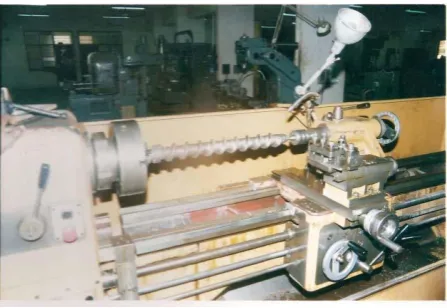
[image:3.595.320.544.248.402.2]The machine component parts include speed reduction gear, drain collector, driver and driven pulleys, and the hopper. The expeller is driven by a 3HP electric motor via a reduction gear. The expelling unit consists of a screw expellant shaft, shown in Figure 1 below. The heating of groundnut seeds is achieved by generated heat, which heats the surrounding of seeds passage.
Figure 1. Lathe machining of Screw Extracting Shaft
IV. DESIGN ANALYSIS
A. Extraction Chamber
The extraction chamber (see fig 2.0) was assumed to be a cylinder of diameter 235mm and length 280mm. it was also assumed to operating at a pressure of about 0.56mpa. In the extraction chamber, we have to consider failure due to hoop stress and longitudinal stress because of that it is a thin wall pressurized cylinder.
Hope Stress
International Journal of Emerging Technology and Advanced Engineering
Website: www.ijetae.com (ISSN 2250-2459, ISO 9001:2008 Certified Journal, Volume 3, Issue 7, July 2013)
247
Fig 2.0
Upward forces = Pressure x Area = P x 1 x d
Fy = P(D1) – 2fT = 0
Balanced by downward force fT of stress x Area = H x 2 (1 X t)
fT = H Aw and Aw = Tl Fy = P(2rl) – 2(H(tl) = 0
H = 2Prl = Pr 2t t
H = PP 2t
Where P = operating pressure D = diameter of the cylinder t = thickness of the cylinder
Thus, thickness of the cylinder can be calculated
t = PD
[image:4.595.46.529.91.746.2]2t
FIG. 3.0.FREE BODY SHOWING HOO P STRESS
V. RESULTS AND DISCUSSION
Oil is a valuable product with universal demand, and the possible income from oil extraction is therefore often enough to justify the relatively high cost of setting up and running a small scale oil milling business.
The cell walls of oil seeds encapsulating the oil are characterized by cellulosic and non-cellulosic materials like hemicelluloses, pectin etc. They in general protect the constituents of the cell. In the extraction process the cell wall is ruptured by grinding in order to release oil. Incomplete rupture due to process constraints results in reduced yield.
The testing result suggests that the performance of the machine is highly depended on the speed of the electric motor and the quantity of material passing through the machine with expelling operation probably better at around 60 revolutions per minute.
Preliminary test carried out on the machine without heating of the groundnut gave no oil yield and only paste was observed passing through the cake outlets. This implies that for oil to be extracted from groundnut heating is necessary. However, when the groundnut was roasted before extracting oil from it, oil was produced because of the breaking of oil bearing cells during heating. The fabricated groundnut oil expelling machine and its schematic diagram is shown in Figure 2 below.
28
0
235
HPd
HInternational Journal of Emerging Technology and Advanced Engineering
Website: www.ijetae.com (ISSN 2250-2459, ISO 9001:2008 Certified Journal, Volume 3, Issue 7, July 2013)
[image:5.595.65.271.142.269.2]248
[image:5.595.58.281.330.761.2]Figure 2. Groundnut Oil Extracting Machine and the Schematic Diagram
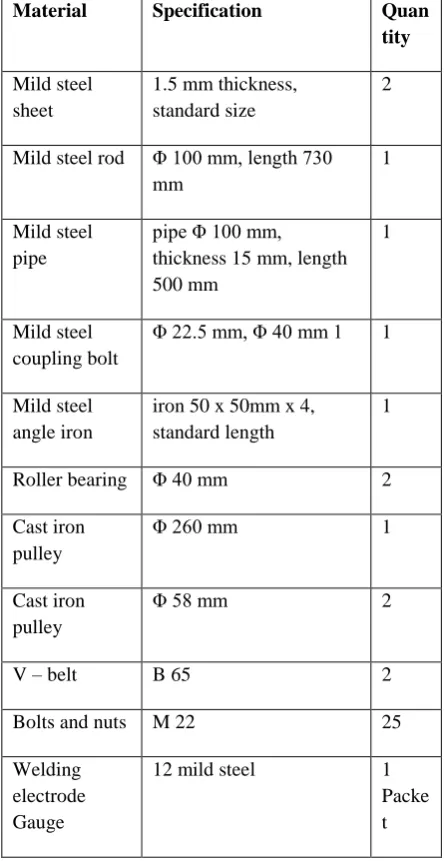
Table 3
Materials for Construction of the Screw Press Expeller and their Specifications
VI. CONCLUSION
A groundnut oil extracting machine was developed. Preliminary evaluation of the machine gave a better performance at the speed of 60 revolutions per minute. Without heating of the groundnut no oil yield was observed with only paste observed through the cake outlet.
When the groundnut seeds were roasted before extraction of oil, reasonable oil was extracted. However, improvement in the design by incorporation a heating chamber along the Expeller barrel is expected to greatly improve the performance efficiency of the machine.
REFERENCES
[1] Hans-Jurgen, W. and Frans, W.K “Small Scale Processing of Oil Fruits and Oilseeds” Publication of German Appropriate Technology Exchange (GATE), D-65726, Eschborn, Federal Republic of Germany,1989
[2] Shankarappa T., Robert E. R. and Virginia N. “World Geography of Groundnut: Distribution, Production, Use and Trade”.
Available at
http://www.lanra.anthro.uga.edu/peanut/knowledgedatabase (accessed April 2, 2009)
[3] Olaomi, J. “Design and Construction of a Motorized Groundnut oil Expelling Machine” B. Eng Thesis, Department of Mechanical Engineering, University of Ilorin, Nigeria, 2008
[4] Hammos, R.O. “The Origin and History of Groundnut” In: Smartt, J. (Ed.),The Groundnut Crop: A Scientific Basis for Improvement, Chapman and Hall, New York, 1994
[5] Gerald L. “The Application of Fluid Mixers in Edible Oil Processing”. Available at: www.emimixers.com (accessed on 9th April, 2009)
[6] Mrema, G. C. and McNulty, P. B. “Mathematical Model of Mechanical Oil Expression from Oilseeds” Journal of Agricultural Engineering Research, Vol. 31 No. 5, pp. 361-370. 1985 [7] Bamgboye, A.I and Adejumo, A.O “Development of a Sunflower
Oil Expeller” Agricultural Engineering International: the CIGR E-journal, Vol. IX, pp. 1-7, 2007
[8] Khurmi, R.S. and Gupta, J.K. ( “Theory of Machines”, Eurasia Publishing house, New Delhi, India. 2004
[9] Olaniyan, A. M., & Oje, K. Development of model equations for selecting optimum parameters for dry process of shea butter extraction. Journal of Cereals and Oilseeds, 2 (4), 47-56.2011 [10] Olawepo-Olayiwole, O. S., & Balogun, L. Performance
evaluation of a palm kernel oil extracting machine. Proceedings of the 5th International Conference and 26th Annual General Meeting of the Nigerian Institution of Agricultural Engineers, 26, 308-311, 2004
[11] Onwualu, A. P., Akubuo, C. O., & Ahaneku, I. E. Fundamentals of engineering in agriculture. (1st ed.). Lagos: Immaculate Publications Ltd., (Chapter 9), 2006
[12] Ryder, G. H. Strength of materials. (3rd ed.). London: Macmillan Publishers Ltd.,(Chapter 15),1985
[13] Shigley, J. E., & Mischke, C. R. Mechanical engineering design. (6th ed.). New York:McGraw-Hill Companies, Inc., (Chapter 18),2001
[14] Sivakumaran, K., Goodrum, J. W., & Bradley, R. A. Expeller optimization of peanut oil production. Transactions of the American Society of Agricultural Engineers, 316-320, 1985
Material Specification Quan
tity
Mild steel sheet
1.5 mm thickness, standard size
2
Mild steel rod Φ 100 mm, length 730 mm
1
Mild steel pipe
pipe Φ 100 mm, thickness 15 mm, length 500 mm
1
Mild steel coupling bolt
Φ 22.5 mm, Φ 40 mm 1 1
Mild steel angle iron
iron 50 x 50mm x 4, standard length
1
Roller bearing Φ 40 mm 2
Cast iron pulley
Φ 260 mm 1
Cast iron pulley
Φ 58 mm 2
V – belt B 65 2
Bolts and nuts M 22 25
Welding electrode Gauge
12 mild steel 1
International Journal of Emerging Technology and Advanced Engineering
Website: www.ijetae.com (ISSN 2250-2459, ISO 9001:2008 Certified Journal, Volume 3, Issue 7, July 2013)