REVI E W
Open Access
Visual programming for next-generation
sequencing data analytics
Franco Milicchio
1, Rebecca Rose
2, Jiang Bian
3, Jae Min
4and Mattia Prosperi
4** Correspondence:[email protected] 4
Department of Epidemiology, College of Public Health and Health Professions & College of Medicine, University of Florida, 2004 Mowry Road, Gainesville 32610-0231, FL, USA
Full list of author information is available at the end of the article
Abstract
Background:High-throughput or next-generation sequencing (NGS) technologies have become an established and affordable experimental framework in biological and medical sciences for all basic and translational research. Processing and analyzing NGS data is challenging. NGS data are big, heterogeneous, sparse, and error prone. Although a plethora of tools for NGS data analysis has emerged in the past decade, (i) software development is still lagging behind data generation capabilities, and (ii) there is a‘cultural’gap between the end user and the developer. Text:Generic software template libraries specifically developed for NGS can help in dealing with the former problem, whilst coupling template libraries with visual programming may help with the latter. Here we scrutinize the state-of-the-art low-level software libraries implemented specifically for NGS and graphical tools for NGS analytics. An ideal developing environment for NGS should be modular (with a native library interface), scalable in computational methods (i.e. serial, multithread, distributed), transparent (platform-independent), interoperable (with external software interface), and usable (via an intuitive graphical user interface). These characteristics should facilitate both the run of standardized NGS pipelines and the development of new workflows based on technological advancements or users’ needs. We discuss in detail the potential of a computational framework blending generic template programming and visual programming that addresses all of the current limitations.
Conclusion:In the long term, a proper, well-developed (although not necessarily unique) software framework will bridge the current gap between data generation and hypothesis testing. This will eventually facilitate the development of novel diagnostic tools embedded in routine healthcare.
Keywords:Next-generation sequencing, High-throughput sequencing, Big data, Template library, Generic programming, Visual programming, Graphical user interface, Software suite
Main text
Background
High-throughput or next-generation sequencing (NGS) technologies have become an established and affordable experimental framework for basic and translational research in biomedical sciences and clinical diagnostics [1–3]. The applications of NGS are almost endless, spanning many‘–omics’fields, such as genomics, transcriptomics, and metabolomics [3–11]. Nowadays, it is possible to sequence any microbial organism or
metagenomic sample within hours and to obtain human genomes in weeks. By sequen-cing the entire genome in targeted patients, it is possible to identify genes and regula-tory elements related to pathophysiological conditions. Genome-wide association studies and analysis of gene expression, usually made via well-established microarray techniques, can now be done via NGS, e.g. RNA-Seq[uencing]. NGS allows for full gen-ome characterization of other organisms besides the human gengen-ome, including known pathogens, and yet-to-be-identified bacterial, viral, or fungal species that may pose a public health threat [12]. Another growing application of NGS is microbial community analysis. The diverse host-associated microbiota has received intense research interests for its potential associations with human health outcomes [13]. With few modifications in sample preparation protocols, a single NGS machine can offer the scientist an abun-dance of data for exploring multi-domain research questions.
Several NGS platforms and sequencing technologies are available [14]. Technology providers include Illumina Inc. [15], Thermo Fisher Scientific [16], Roche [17], and Pacific Biosciences [18]. NGS services are available at a comparable price to estab-lished sequencing methods such as Sanger, although with considerably greater data output [19–21].
Whereas the traditional Sanger [22] approach produces contiguous nucleotide se-quence reads between 400 and 700 bases with a throughput of 50-30,000 kilobases per hour, NGS reaches a throughput of 10-600 gigabases per hour, producing reads up to 700 nucleotide bases long [9], and Pacific Biosciences broke the 10,000+ bases length record. The terabyte-size of nucleotide sequence data per run is becoming a reality, which will further lower per-sample sequencing cost [23, 24]. The fourth-generation of Oxford’s Nanopore-based sequencers have the potential to reduce the cost for sequen-cing an entire human genome from the fairly recent $1,000 target [25] to an astounding $100 [26, 27]. The decreasing trend of the cost-per-base of DNA sequence since 2008 even exceeded Moore’s law [28], i.e. the exponential growth of computing hardware capabilities, where the number of transistors in an integrated circuit doubles approxi-mately every two years.
Ever since the first NGS machine was commercialized in 2004 by 454, the develop-ment of robust, intuitive, and easy to use analytic tools has been behind data generation capabilities. This state was defined with the evocative term“analysis paralysis” in 2010 [29]. A landmark paper in 2012 by Vyverman et al. highlighted the limitations and needs of bioinformatics tools for a variety of complex string problems that are at the base of most NGS analytics [30]. Five years later, analysis is no longer paralyzed. A plethora of NGS data analysis software has emerged, with considerable redundancy. Nevertheless, software development must adapt to handle fast-pace evolving technol-ogy, e.g. further data inflation resulting from the Nanopore platform [31–34].
Most of the current NGS software requires dedicated bioinformaticians with access to comprehensive computational infrastructure. Just a few years ago, there was a bottle-neck between data generation and inference (analyzing and making sense of the data), but nowadays, access to these bioinformatics resources is more common and afford-able. The new bottleneck is the evolution of software in accordance with technological advances and users’needs.
the development of innovative applications that can be handled directly by the investi-gators generating the data. Biological scientists carrying out experiments at times undergo delays and difficulties in analyzing NGS data because tools customized to their needs and abilities are not readily available. Current software for NGS analytics requires medium-to-advanced level of computational proficiency. One reason is the compulsory use of high-performance computing infrastructure for analyzing most NGS data sets. Such computational arrangements should not be necessary when sequencing individual fungal, microbial or viral pathogens or when performing targeted phylogenetic studies (e.g. 16S ribosomal RNA); a desktop computer should be sufficient for analyzing bacter-ial data generated by platforms such as Illumina’s MiSeq. When users need to move onto a high-performance computing infrastructure for projects involving large numbers of human genome sequences, they may benefit from the availability of software they are already familiar with (i.e. the one running on their desktop machine), rather than being required to learn an entirely new set of programs. An example in statistical ana-lytics is the SAS software system (SAS Institute Inc.), which does not require the users to change the programming syntax when migrating across different components or in-stallations (including desktop, server, and distributed editions).
At present, software engineers who develop new algorithms and analytical tools for NGS face a lack of dedicated libraries and interoperable software, and they have to write new tools which in turn cannot be interoperable. From a developer’s perspective, many existing programs could be rewritten to be more efficient or to be parallelized homogeneously, as in hierarchical build of programs, for easy integration across various platforms. With a common software layer that abstracts interactions between data and algorithms, integrating procedures that exploit multithreading or distributed computing may be achieved without in-depth modifications of the algorithms themselves. In addition, the adoption of generic programming template libraries can homogenize pro-grammers’work and permit a more community-engaged software development.
Template libraries and generic programming
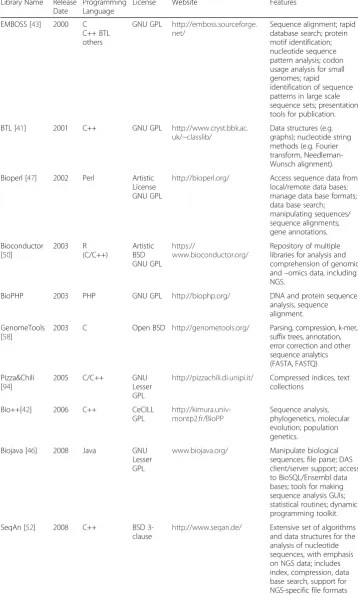
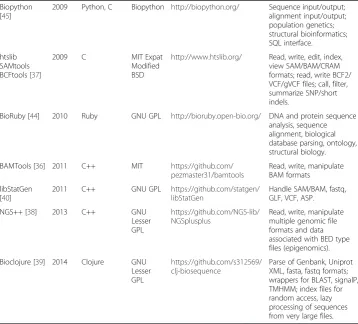
be used seamlessly when writing new code in that language. A toolkit deviates from the rigorous concept of library as it can also include a set of executable programs which can be called and combined internally or externally (like EMBOSS). Lastly, a software tool is a standalone program that has a fixed input/output routine and whose internal functions or data structures cannot be used elsewhere. For instance, the popular BWA program for mapping short reads to a reference is a standalone program, even if it fea-tures internal data strucfea-tures like the Burrows-Wheeler transform, used by other pro-grams, like Bowtie. Table 1 gives a description of the most popular libraries and toolsets for sequence analysis and NGS data processing. One example of a sequence analysis library that evolved successfully to handle NGS data is SeqAn [52, 53]. This was possible because according to SeqAn website:“SeqAn applies a unique generic de-sign that guarantees high performance, generality, extensibility, and integration with other libraries.” The SeqAn library is written in C++ and licensed as an open source. It also employs the Hierarchical Data Format 5, which makes possible the management of large and complex data collections [54] in serial, multithreaded, and distributed environments. The number of tools for NGS that have been released using SeqAn is remarkable and proves how such open programming approach is advantageous [55–57]. Bowtie, Lambda and Fiona are written in SeqAn, the latter of which is one of the fastest local aligners for NGS data and error correction tool, and it may become an alternative to BLAST. Another toolset similar to SeqAn is GenomeTools [58], which is efficient but provides limited functionality and genericity. To our knowledge, SeqAn is the only available NGS-specific library that embraces the generic programming philosophy.
What is template generic programming?
A generic programming framework provides traits classes [59], i.e. an abstract repre-sentation of data types and algorithms [60]. As a real-life example, take the LEGO® toy construction kits. A child (end user) wants a LEGO® model of a brick that resists trampling. A company (developer) may be contracted to produce new stomp-resistant brick types (data structures/functions) that respect the general specification (traits class) of LEGO® bricks (e.g. hole spacing and size), thus ensuring that, before reaching the end-user, the new brick (structure) will work with any other LEGO® toy piece. In essence, a traits class may be seen as a prescription, a specification for data structures or functions: it enforces clients to respect a list of prerequisites. More technically, a traits class is the gateway for calling a function on a generic and a priori unknown data structure, employed at compile time (that is parametric polymorphism). If the given data structure provides types and methods definitions required by the traits, then any algorithm employing such a structure may be applied to any data structure that re-spects the requirements. This allows developers to write algorithms that can be applied at no runtime cost to any data structure, without knowing a priori which data structure will be employed or the types involved in the process.
Table 1Summary of programming libraries/toolkits for analysis of (next-generation) sequencing data
Library Name Release Date
Programming Language
License Website Features
EMBOSS [43] 2000 C
C++ BTL others
GNU GPL http://emboss.sourceforge. net/
Sequence alignment; rapid database search; protein motif identification; nucleotide sequence pattern analysis; codon usage analysis for small genomes; rapid identification of sequence patterns in large scale sequence sets; presentation tools for publication.
BTL [41] 2001 C++ GNU GPL http://www.cryst.bbk.ac.
uk/~classlib/
Data structures (e.g. graphs); nucleotide string methods (e.g. Fourier transform, Needleman-Wunsch alignment).
Bioperl [47] 2002 Perl Artistic
License GNU GPL
http://bioperl.org/ Access sequence data from local/remote data bases; manage data base formats; data base search; manipulating sequences/ sequence alignments; gene annotations.
Bioconductor [50]
2003 R (C/C++) Artistic BSD GNU GPL https:// www.bioconductor.org/
Repository of multiple libraries for analysis and comprehension of genomic and–omics data, including NGS.
BioPHP 2003 PHP GNU GPL http://biophp.org/ DNA and protein sequence
analysis, sequence alignment.
GenomeTools [58]
2003 C Open BSD http://genometools.org/ Parsing, compression, k-mer,
suffix trees, annotation, error correction and other sequence analytics (FASTA, FASTQ)
Pizza&Chili [94]
2005 C/C++ GNU
Lesser GPL
http://pizzachili.di.unipi.it/ Compressed indices, text collections
Bio++[42] 2006 C++ CeCILL
GPL http://kimura.univ-montp2.fr/BioPP Sequence analysis, phylogenetics, molecular evolution; population genetics.
Biojava [46] 2008 Java GNU
Lesser GPL
www.biojava.org/ Manipulate biological sequences; file parse; DAS client/server support; access to BioSQL/Ensembl data bases; tools for making sequence analysis GUIs; statistical routines; dynamic programming toolkit.
SeqAn [52] 2008 C++ BSD
3-clause
instance, when reading molecular sequence files and associated metadata (e.g. fastq files with nucleotides and quality scores), the compiler generates an ad hoc class given a chosen structure (e.g. a list or a suffix tree); no virtual functions and inheritance will be involved, reducing the runtime overhead. One could replace a serial constructor with a distributed one (e.g. reading sequence files in parallel), or change its associated methods (e.g. a sequence corrector based on two different algorithms) without chan-ging the program; since the software employs traits to access a generic data structure, the compiler will ensure that the change will be a valid one. Hence, when a container does not respect the requirements, the software will refuse to compile, allowing devel-opers to assess the interoperability of data types and algorithms without any performance degradation, and to write software libraries that may be applied to any traits-abiding data structure. The advantage of a library on generic programming templates is straightfor-ward: the library can be updated for handling new data types, increase in data size, and technology changes in computing, like a new graphic processing unit chip or a computa-tion accelerator (e.g. Intel® Xeon Phi).
General-purpose software suites and graphical user interfaces
Low-level libraries and command-line toolsets are appropriate for software developers and programming-savvy users; they form the base to develop high-level ensemble Table 1Summary of programming libraries/toolkits for analysis of (next-generation) sequencing data(Continued)
Biopython [45]
2009 Python, C Biopython http://biopython.org/ Sequence input/output;
alignment input/output; population genetics; structural bioinformatics; SQL interface.
htslib SAMtools BCFtools [37]
2009 C MIT Expat
Modified BSD
http://www.htslib.org/ Read, write, edit, index, view SAM/BAM/CRAM formats; read, write BCF2/ VCF/gVCF files; call, filter, summarize SNP/short indels.
BioRuby [44] 2010 Ruby GNU GPL http://bioruby.open-bio.org/ DNA and protein sequence analysis, sequence alignment, biological database parsing, ontology, structural biology.
BAMTools [36] 2011 C++ MIT https://github.com/
pezmaster31/bamtools
Read, write, manipulate BAM formats
libStatGen [40]
2011 C++ GNU GPL https://github.com/statgen/
libStatGen
Handle SAM/BAM, fastq, GLF, VCF, ASP.
NGS++ [38] 2013 C++ GNU
Lesser GPL
https://github.com/NGS-lib/ NGSplusplus
Read, write, manipulate multiple genomic file formats and data associated with BED type files (epigenomics).
Bioclojure [39] 2014 Clojure GNU
Lesser GPL
https://github.com/s312569/ clj-biosequence
software suites that feature a graphical user interface (GUI) with menus and premade workflows or analysis pipelines. Suites bring complex analytical procedures to the gen-eral user. For instance, user-friendly statistical software with powerful GUI includes Statistica (Dell Inc.), SAS Enterprise (SAS Institute Inc.), and SPSS (IBM Corporation). This easily accessible interface is advantageous as it can facilitate the applied and trans-lational aspects of NGS research for those without programming knowledge, but the software must be carefully designed in order to prevent users from making errors due to lack of specialized expertise. In addition to a GUI featuring single functions and pre-made workflows, some high-level suites offer visual workflow builders. Visual builders are different form GUIs because they permit combination (more or less flexibly) of existing program functions into new data processing pipelines, which may not be avail-able as pull-down menus or icons in a GUI.
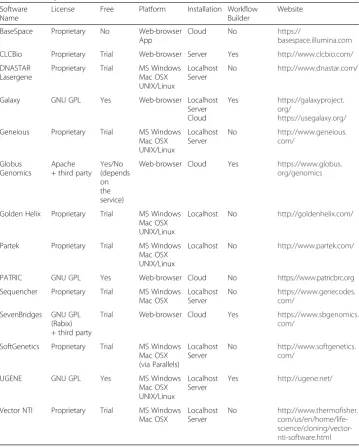
Several high-level tools for NGS analytics are available (see Table 2 for a summary). There are commercial products with closed source code, such as Illumina’s BaseSpace [61], CLCBio [62], DNASTAR’s Lasergene [63], and Geneious [64]. Free and hybrid commercial/free software include Galaxy [65, 66], Globus Genomics [67], PATRIC [68], and UGENE [69, 70]. Most of the software suites can be installed locally or on a server. Illumina’s BaseSpace provides an exclusively cloud-based environment hosted by Amazon Inc., direct integration with sequencing instruments, and workflows as mobile-touch apps.
Galaxy, a web-browser application, is one of the most popular, open source NGS suites and effectively offers a unique developer’s platform, permitting the integration and collation of different programs. Galaxy has a substantial support from the devel-opers’community; both researchers and federal agencies are investing in this promising platform, which also features a visual workflow builder. However, Galaxy does not per-mit development of new algorithms and standalone software by itself, and it must be supported by a proper collection of low-level programs.
UGENE is another free and open source platform. The suite is multiplatform, i.e. it runs on computers with any operating system, such as MS Windows or Mac OSX by using the Qt C++ framework, incorporates multiple pipelines for NGS, and allows vis-ual design of new ones with its built-in workflow builder, as in Galaxy (with similar limitations).
Visual programming
We have highlighted the importance of creating a solid low-level base for NGS pro-gramming and a high-level base to scale up analytics, especially with the usage of visual tools.
In computer science, a visual programming (VP) language is a medium for implementing computer programs that makes uses of graphical operators and elements rather than textual ones. VP is not a new concept [71–74]; it has been envisioned in several ways starting from the early 1960s and has been the object of philosophical debates [75, 76]. VP is different from GUI. A GUI aids users executing programs via visual menu items in contrast to command-line (i.e. terminal) text scripting. In general, GUI menus are premade and users cannot create new programs or combine menu functions within the GUI. Conversely, a VP language has the same power as a textual Table 2Summary of all-purpose software suites for analysis of next-generation sequencing data offered with a graphical user interface option
Software Name
License Free Platform Installation Workflow
Builder
Website
BaseSpace Proprietary No Web-browser
App
Cloud No https://
basespace.illumina.com
CLCBio Proprietary Trial Web-browser Server Yes http://www.clcbio.com/
DNASTAR Lasergene
Proprietary Trial MS Windows
Mac OSX UNIX/Linux
Localhost Server
No http://www.dnastar.com/
Galaxy GNU GPL Yes Web-browser Localhost
Server Cloud
Yes https://galaxyproject. org/
https://usegalaxy.org/
Geneious Proprietary Trial MS Windows
Mac OSX UNIX/Linux Localhost Server No http://www.geneious. com/ Globus Genomics Apache + third party
Yes/No (depends on the service)
Web-browser Cloud Yes https://www.globus.
org/genomics
Golden Helix Proprietary Trial MS Windows
Mac OSX UNIX/Linux
Localhost No http://goldenhelix.com/
Partek Proprietary Trial MS Windows
Mac OSX UNIX/Linux
Localhost No http://www.partek.com/
PATRIC GNU GPL Yes Web-browser Cloud No https://www.patricbrc.org
Sequencher Proprietary Trial MS Windows
Mac OSX
Localhost Server
No https://www.genecodes. com/
SevenBridges GNU GPL (Rabix) + third party
Trial Web-browser Cloud Yes https://www.sbgenomics.
com/
SoftGenetics Proprietary Trial MS Windows
Mac OSX (via Parallels) Localhost Server No http://www.softgenetics. com/
UGENE GNU GPL Yes MS Windows
Mac OSX UNIX/Linux
Localhost Server
Yes http://ugene.net/
Vector NTI Proprietary Trial MS Windows
programming language or a library, if it features the same functional elements (e.g. data structures and methods); therefore, new algorithms and programs can be designed and compiled within a VP, and VP can even be used to implement GUIs. Visual approaches to programming have been explored in diverse environments, including education, multimedia, system simulation and automation, data warehousing, and business intelligence, with probably the most successful example being the computer-aided sign (CAD) software industry. Another extremely popular area for VP is video game de-sign [77, 78]. Although in principle VP can be used to create algorithms starting from the lowest hierarchy of programming language elements, in practice, VP is employed for creating higher-level applications using libraries. This facilitates developers’ work when a large amount of coding (and redundant coding) is required.
How can visual programming benefit NGS software development?
Currently, there are no ‘pure’ VP approaches being developed for NGS applications. Galaxy or UGENE workflow builders can be considered rudimental VP environments, but as discussed previously, they do not offer the same set of functions as the command-line and have limited interoperability (i.e. they work only within their parent environment and cannot build independent programs). However, there is potential for improving the workflow builders using the VP approach.
Visual programming entities
the visual programming interface, without resorting to traditional text-based program-ming. This is a convenient trade-off between black-box and informed design/use.
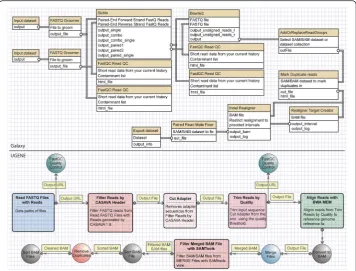
Figure 1 shows an example of pipelines for single nucleotide variant calling from fastq files, using UGENE’s and Galaxy’s workflow builders. Both workflow builders fea-ture block connectors that well represent the aforementioned VP entity. Likewise, one could consider a saved workflow as a meta-block. Building blocks and block engines are inherently fused, and each block corresponds to a program that has been installed in Galaxy or UGENE (e.g. Sickle, CASAVA, Bowtie2, BWA). If any of the workflow could allow access functions of a generic programming library (e.g. SeqAn), with a cor-responding distinction between block hierarchies and functionality, there would be an improvement in expressive power, which would not be limited to the sole ability of pipelining compiled programs. Notably, the UGENE workflow builder is made with the cross-platform Qt C++ Library, which is an ideal development framework for enabling such transition.
Physiognomy of visual programming
By definition, VP facilitates various aspects of the process of software design and brings closer the user and the developer. Development policies for VP should follow the same prerogatives. One way to achieve this can be through the adoption of the Agile meth-odology [81], which implements code and develops user interfaces at the same time, with an adaptive strategy of real-time planning. Agile is an efficient and face-to-face communication between developers, stakeholders, and final users, blending the charac-teristics of different disciplines directly into the final product. We believe the Agile
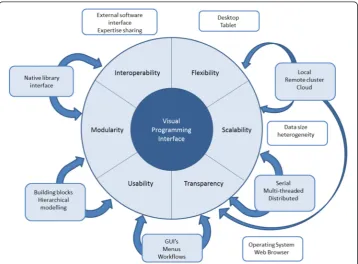
method can be appropriate for development of NGS tools via VP, when a library base is already available (e.g. SeqAn), yet it must be delivered to users with a different expertise and must meet their usage needs. Independently of the chosen development method-ology, a VP framework for NGS should meet the following requirements: flexibility, scalability,transparency, usability, modularity, and interoperability. As summarized in Fig. 2, each of these characteristics affects either a user’s or a developer’s needs. For in-stance, flexibility of a VP product concerns its capacity to be workable on different de-vices such as desktops vs. tablets, or feasible for local/server/cloud installations (which is different from being installable on different operating systems or being usable). Scal-ability refers to the capacity of the software to scale up with data size increase, by fea-turing different solutions, such as switching to multithreaded mode or moving analyses from a localhost to the cloud. Note that there are needs assessments falling in multiple categories. In fact, the dichotomy of multithreading (say, parallelization within graphic processing units or central processing units) vs. distribution (e.g. message parsing inter-face) do relate to scalability, but also to transparency, especially in the case of adoption of a generic template library programming paradigm. As already mentioned, transpar-ency can be associated with multiplatform (any operating system) or web-browser-based implementations. The VP framework and its products must be transparent not only at the operating system level but also at the hosting level (i.e. local host vs. cloud). In particular, security on cloud-based computations plays a major role in the potential applicability of NGS software. In regards to usability, we have already mentioned the potential advantage of employing the user-oriented Agile methodology. Any product developed using VP has to be subject to the same verification, validation, quality assur-ance standards, and common GUI testing schemes [82] like other software, e.g. the
Institute of Electrical and Electronics Engineers (IEEE) standard verification and valid-ation IEEE 1012 or quality assurance IEEE 730 [83]. Within a developer’s VP environ-ment, usability can mean a well-designed set of building blocks and functions. These are also related to modularity, where the availability of a native generic template pro-gramming library can make a difference. Finally, interoperability can be divided into three levels. The first one is software interoperability, which ensures the possibility of using external pieces of software or libraries. The second level is semantic interoper-ability, which is the ability to exchange data with unambiguous, shared meaning; when developing NGS tools this involves keeping track of meta-data information such as li-brary versioning, file formats, and file interchange formats. The third level is expertise interoperability, connecting the stakeholders together efficiently by using an appropri-ate communication infrastructure, such as a users’forum, like SEQanswers [84], or a developers’space, GitHub [85].
As an example, Galaxy has strengths in expertise interoperability (thanks to a nour-ished developers’and users’community), software interoperability (by incorporating a plethora of different software and toolsets), and transparency (through the web-browser interface). There is relevant, yet limited, modularity (graphic workflow builder), and scalability (tool parallelization and server installation). Flexibility is en-abled by the web-browser GUI. Scalability and interoperability, however, are also sub-ject to original tools’capabilities and may not keep up with the pace of the current technology evolution. Recent efforts in interoperability for development and standardization of NGS pipelines (i.e. importable in Galaxy and other frameworks) have been concretized in the open source Rabix toolkit [86] for developing and running portable workflows based on the Common Workflow Language specification [87]. Illumina’s BaseSpace and UGENE are strong in usability and flexibility, but are behind Galaxy in other requisites; none of the available suites has a proper VP interface.
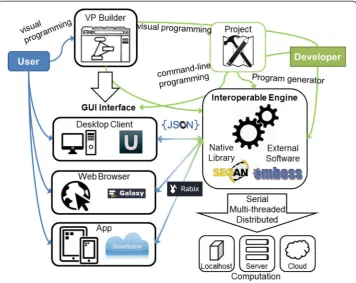
resources become available, leaving the client free to perform other operations. Select-ing a local or remote kernel would require only a minimal user intervention, i.e. login host, user name, and password.
Discussion
NGS data science (or analytics) is an interdisciplinary and critical field of bioinformat-ics research that has gained increased attention and visibility upon the explosion of NGS technology. It is a sector which has to keep up with the tremendous advancement in sequencing yield and‘next-NGS’(future generation) technologies. NGS data science is feasible when proper software is available and can routinely and reliably be used, with reasonable resource spending. The development of software tools for NGS analytics is challenging, given multiple practical hurdles that include the large data sizes, data het-erogeneity, and data errors. Despite the glut of NGS software released in the past years, the toolsets are not yet homogenized as they are in other fields (e.g. statistics, automa-tion). We have reviewed the current panorama of low-level software for NGS (i.e. li-braries and toolsets) used mainly by developers, and high-level suites (i.e. all-purpose programs with GUIs) used by stakeholders, biological scientists performing experi-ments for instance. Among the reviewed software libraries, we have identified a positive effort of the Open Bioinformatics Foundation in promoting the ‘Bio’ extensions to programming languages, such as BioJava, BioPerl, BioRuby, BioPHP, et cetera. However, these toolsets are often not well calibrated for the NGS needs (e.g. scalability of methods). Among the NGS-specific libraries, we have identified SeqAn (open source,
C++) as the most promising one, because on top of its specificity, it is a generic programming template framework that can seamlessly upgrade itself. SeqAn has already been used in many proof-of-concept works providing efficient/optimized re-implementation of existing methods. Still, low-level libraries are instruments for software developers, not for end users. For the latter, high-level software suites with user-friendly GUIs are available. We have reviewed both commercial and free suites, including Galaxy and Geneious. This general-purpose software usually wraps around existing command-line tools, which may not have been programmed using consist-ent libraries or programming languages. The suites offer premade pipelines to analyze specific data sets (e.g. RNASeq) with a simple click, combining different pro-grams together. Usability should be the key feature of these graphical suites. Some of the suites also offer the possibility to create ad hoc workflows, but the functionalities are limited; new programs are hard to develop. At the moment workflow design is bound to existing programs present in the suite, but some workflow builders could be modified to incorporate NGS libraries in the near future.
Visual programming is used in many sectors of software development, such as educa-tion, architecture, and video game design. The visual programming philosophy linked to generic template libraries, seen as a powerful extension of workflow builders, can be a valuable aid for improving NGS tool and workflow development. VisPro is a concep-tual visual programming framework covering a number of requisites that make it appropriate for development of NGS software (in the need of scalability, transparency, usability, interoperability), especially if coupled with a powerful generic template library, like SeqAn. However, instantiating a brand new VisPro for NGS may require a tremendous development effort. On the other hand, existing general-purpose suites are supported by a large community of developers, users, and investors; even so, they have flaws and may be stalled by further technological changes.
In conclusion, visual programming could effectively bridge the gap between software developers and users needing cutting-edge software, making NGS data science fully translational. While an ex novodevelopment of VP software specific for NGS may be unfeasible, trying to improve the visual programming capabilities of existing software and the interoperability with low-level libraries could be a preferred course of action.
Competing interests
The authors declare that they have no competing interests.
Authors’contributions
FM contributed on libraries and visual programming, wrote/reviewed manuscript; RR contributed on graphical tools, wrote/reviewed manuscript; JB contributed on visual programming, reviewed manuscript; JM provided evaluation of software features, workflow comparison and building, reviewed manuscript; MP designed the work, wrote/reviewed manuscript. All authors read and approved the manuscript.
Acknowledgments
The VIROGENESIS project receives funding from the European Union’s Horizon 2020 research and innovation programme under grant agreement No 634650.
Author details
1Department of Engineering, Roma Tre University, Rome, Italy.2Bioinfoexperts, LLC, Thibodaux, LA, USA.3Department
of Health Outcomes and Policy, University of Florida, Gainesville, FL, USA.4Department of Epidemiology, College of Public Health and Health Professions & College of Medicine, University of Florida, 2004 Mowry Road, Gainesville 32610-0231, FL, USA.
References
1. Xuan J, Yu Y, Qing T, Guo L, Shi L. Next-generation sequencing in the clinic: promises and challenges. Cancer Lett. 2013;340(2):284–95.
2. van Dijk EL, Auger H, Jaszczyszyn Y, Thermes C. Ten years of next-generation sequencing technology. Trends Genet. 2014;30(9):418–26.
3. Ohashi H, Hasegawa M, Wakimoto K, Miyamoto-Sato E. Next-generation technologies for multiomics approaches including interactome sequencing. BioMed Res Int. 2015;2015:104209.
4. Beggs AD, Dilworth MP. Surgery in the era of the 'omics revolution. Br J Surg. 2015;102(2):e29–40.
5. Mensaert K, Denil S, Trooskens G, Van Criekinge W, Thas O, De Meyer T. Next-generation technologies and data analytical approaches for epigenomics. Environ Mol Mutagen. 2014;55(3):155–70.
6. Mason CE, Porter SG, Smith TM. Characterizing multi-omic data in systems biology. Adv Exp Med Biol. 2014;799:15–38. 7. Grada A, Weinbrecht K. Next-generation sequencing: methodology and application. J Invest Dermatol.
2013;133(8):e11.
8. Berger B, Peng J, Singh M. Computational solutions for omics data. Nat Rev Genet. 2013;14(5):333–46. 9. Metzker ML. Sequencing technologies - the next generation. Nat Rev Genet. 2010;11(1):31–46.
10. Koboldt DC, Steinberg KM, Larson DE, Wilson RK, Mardis ER. The next-generation sequencing revolution and its impact on genomics. Cell. 2013;155(1):27–38.
11. Hawkins RD, Hon GC, Ren B. Next-generation genomics: an integrative approach. Nat Rev Genet. 2010;11(7):476–86. 12. Azarian T, Cook RL, Johnson JA, Guzman N, McCarter YS, Gomez N, McCarter YS, Gomez N, Rathore MH,
Morris JGJ, Salemi M. Whole-Genome Sequencing for Outbreak Investigations of Methicillin-Resistant Staphylococcus aureus in the Neonatal Intensive Care Unit: Time for Routine Practice? Infect Control Hosp Epidemiol. 2015;FirstView:1–9.
13. Berger G, Bitterman R, Azzam ZS. The human microbiota: the rise of an“empire”. Rambam Maimonides Med J. 2015;6(2):e0018.
14. Buermans HP, den Dunnen JT. Next generation sequencing technology: Advances and applications. Biochim Biophys Acta. 2014;1842(10):1932–41.
15. Illumina Inc. [http://www.illumina.com/]. Accessed 25 Apr 2016. 16. James F. Welles Replies. J Infor Ethics. 2012;21(1):5–6.
17. Roche Sequencing. [http://sequencing.roche.com/]. Accessed 25 Apr 2016. 18. Pacific Biosciences. [http://www.pacb.com/].
19. Facio FM, Lee K, O’Daniel JM. A genetic counselor’s guide to using next-generation sequencing in clinical practice. J Genet Couns. 2014;23(4):455–62.
20. Aronson N. Making personalized medicine more affordable. Ann N Y Acad Sci. 2015;1346(1):81-9. doi:10.1111/nyas. 12614. Epub 2015 Feb 27.
21. Desai AN, Jere A. Next-generation sequencing: ready for the clinics? Clin Genet. 2012;81(6):503–10. 22. Sanger F, Coulson AR. A rapid method for determining sequences in DNA by primed synthesis with DNA
polymerase. J Mol Biol. 1975;94(3):441–8.
23. Niedringhaus TP, Milanova D, Kerby MB, Snyder MP, Barron AE. Landscape of next-generation sequencing technologies. Anal Chem. 2011;83(12):4327–41.
24. el Bahassi M, Stambrook PJ. Next-generation sequencing technologies: breaking the sound barrier of human genetics. Mutagenesis. 2014;29(5):303–10.
25. Service RF. Gene sequencing. The race for the $1000 genome. Science. 2006;311(5767):1544–6.
26. Feng Y, Zhang Y, Ying C, Wang D, Du C. Nanopore-based Fourth-generation DNA Sequencing Technology. Genomics Proteomics Bioinformatics. 2015;13(1):4–16.
27. Ying YL, Zhang J, Gao R, Long YT. Nanopore-based sequencing and detection of nucleic acids. Angew Chem Int Ed Engl. 2013;52(50):13154–61.
28. DNA Sequencing Costs. [http://www.genome.gov/sequencingcosts/]. Accessed 25 Apr 2016. 29. Baker M. Next-generation sequencing: adjusting to data overload. Nat Meth. 2010;7(7):495–9.
30. Vyverman M, De Baets B, Fack V, Dawyndt P. Prospects and limitations of full-text index structures in genome analysis. Nucleic Acids Res. 2012;40(15):6993–7015.
31. Bao R, Huang L, Andrade J, Tan W, Kibbe WA, Jiang H, Feng G. Review of current methods, applications, and data management for the bioinformatics analysis of whole exome sequencing. Cancer Informat. 2014;13 Suppl 2:67–82.
32. Finotello F, Di Camillo B. Measuring differential gene expression with RNA-seq: challenges and strategies for data analysis. Brief Funct Genomics. 2015;14(2):130–42.
33. Yu B. Setting up next-generation sequencing in the medical laboratory. Methods Mol Biol. 2014;1168:195–206. 34. Shyr C, Kushniruk A, Wasserman WW. Usability study of clinical exome analysis software: top lessons learned and
recommendations. J Biomed Inform. 2014;51:129–36.
35. SEQanswers’List of Next Generation Sequencing Software. [http://seqanswers.com/wiki/Software/list]. Accessed 25 Apr 2016.
36. Barnett DW, Garrison EK, Quinlan AR, Stromberg MP, Marth GT. BamTools: a C++ API and toolkit for analyzing and managing BAM files. Bioinformatics. 2011;27(12):1691–2.
37. Li H, Handsaker B, Wysoker A, Fennell T, Ruan J, Homer N, Marth G, Abecasis G, Durbin R, Genome Project Data Processing S. The Sequence Alignment/Map format and SAMtools. Bioinformatics. 2009;25(16):2078–9. 38. Nordell Markovits A, Joly Beauparlant C, Toupin D, Wang S, Droit A, Gevry N. NGS++: a library for rapid
prototyping of epigenomics software tools. Bioinformatics. 2013;29(15):1893–4.
39. Plieskatt J, Rinaldi G, Brindley PJ, Jia X, Potriquet J, Bethony J, Mulvenna J. Bioclojure: a functional library for the manipulation of biological sequences. Bioinformatics. 2014;30(17):2537–9.
40. libStatGen. [https://github.com/statgen/libStatGen/]. Accessed 25 Apr 2016.
42. Dutheil J, Gaillard S, Bazin E, Glemin S, Ranwez V, Galtier N, Belkhir K. Bio++: a set of C++ libraries for sequence analysis, phylogenetics, molecular evolution and population genetics. BMC Bioinf. 2006;7:188.
43. Rice P, Longden I, Bleasby A. EMBOSS: the European Molecular Biology Open Software Suite. Trends Genet. 2000;16(6):276–7.
44. Goto N, Prins P, Nakao M, Bonnal R, Aerts J, Katayama T. BioRuby: bioinformatics software for the Ruby programming language. Bioinformatics. 2010;26(20):2617–9.
45. Cock PJ, Antao T, Chang JT, Chapman BA, Cox CJ, Dalke A, Friedberg I, Hamelryck T, Kauff F, Wilczynski B, et al. Biopython: freely available Python tools for computational molecular biology and bioinformatics. Bioinformatics. 2009;25(11):1422–3. 46. Holland RC, Down TA, Pocock M, Prlic A, Huen D, James K, Foisy S, Drager A, Yates A, Heuer M, et al. BioJava: an
open-source framework for bioinformatics. Bioinformatics. 2008;24(18):2096–7.
47. Stajich JE, Block D, Boulez K, Brenner SE, Chervitz SA, Dagdigian C, Fuellen G, Gilbert JG, Korf I, Lapp H, et al. The Bioperl toolkit: Perl modules for the life sciences. Genome Res. 2002;12(10):1611–8.
48. Open Bioinformatics foundation. [http://www.open-bio.org/]. Accessed 25 Apr 2016.
49. Huber W, Carey VJ, Gentleman R, Anders S, Carlson M, Carvalho BS, Bravo HC, Davis S, Gatto L, Girke T, et al. Orchestrating high-throughput genomic analysis with Bioconductor. Nat Methods. 2015;12(2):115–21. 50. Gentleman RC, Carey VJ, Bates DM, Bolstad B, Dettling M, Dudoit S, Ellis B, Gautier L, Ge Y, Gentry J, Hornik K,
Hothorn T, Huber W, Iacus S, Irizarry R, Leisch F, Li C, Maechler M, Rossini AJ, Sawitzki G, Smith C, Smyth G, Tierney L, Yang JY, Zhang J. Bioconductor: open software development for computational biology and bioinformatics. Genome Biol. 2004;5(10):R80. Epub 2004 Sep 15.
51. Mangalam H. The Bio* toolkits–a brief overview. Brief Bioinform. 2002;3(3):296–302.
52. Doring A, Weese D, Rausch T, Reinert K. SeqAn an efficient, generic C++ library for sequence analysis. BMC Bioinf. 2008;9:11.
53. Gogol-Döring A, Reinert K. Biological sequence analysis using the SeqAn C++ library. Boca Raton: CRC Press; 2010. 54. Mason CE, Zumbo P, Sanders S, Folk M, Robinson D, Aydt R, Gollery M, Welsh M, Olson NE, Smith TM. Standardizing the
Next Generation of Bioinformatics Software Development with BioHDF (HDF5). Adv Comput Biol. 2010;680:693–700. 55. Rahn R, Weese D, Reinert K. Journaled string tree-a scalable data structure for analyzing thousands of similar
genomes on your laptop. Bioinformatics. 2014;30(24):3499–505.
56. Schulz MH, Weese D, Holtgrewe M, Dimitrova V, Niu S, Reinert K, Richard H. Fiona: a parallel and automatic strategy for read error correction. Bioinformatics. 2014;30(17):i356–363.
57. Hauswedell H, Singer J, Reinert K. Lambda: the local aligner for massive biological data. Bioinformatics. 2014;30(17):i349–355.
58. Gremme G, Steinbiss S, Kurtz S. GenomeTools: a comprehensive software library for efficient processing of structured genome annotations. IEEE/ACM Trans Comput Biol Bioinform. 2013;10(3):645–56.
59. Stroustrup B. The C++ Programming Language (4th Edition). Boston, MA, USA: Addison-Wesley Professional; 2013. 60. Pataki N, Porkolab Z. Extension of iterator traits in the C++ Standard Template Library. In: Computer
Science and Information Systems (FedCSIS), 2011 Federated Conference on: 18-21 Sept. 2011. 2011. p. 911–4. 61. Illumina’s BaseSpace. [https://basespace.illumina.com/]
62. CLCBio. [http://www.clcbio.com/] 63. DNASTAR. [http://www.dnastar.com/]
64. Kearse M, Moir R, Wilson A, Stones-Havas S, Cheung M, Sturrock S, Buxton S, Cooper A, Markowitz S, Duran C, et al. Geneious Basic: an integrated and extendable desktop software platform for the organization and analysis of sequence data. Bioinformatics. 2012;28(12):1647–9.
65. Giardine B, Riemer C, Hardison RC, Burhans R, Elnitski L, Shah P, Zhang Y, Blankenberg D, Albert I, Taylor J, et al. Galaxy: a platform for interactive large-scale genome analysis. Genome Res. 2005;15(10):1451–5.
66. Goecks J, Nekrutenko A, Taylor J, Galaxy T. Galaxy: a comprehensive approach for supporting accessible, reproducible, and transparent computational research in the life sciences. Genome Biol. 2010;11(8):R86. 67. Madduri RK, Sulakhe D, Lacinski L, Liu B, Rodriguez A, Chard K, Dave UJ, Foster IT. Experiences Building Globus
Genomics: A Next-Generation Sequencing Analysis Service using Galaxy, Globus, and Amazon Web Services. Concurr Comput. 2014;26(13):2266–79.
68. Wattam AR, Abraham D, Dalay O, Disz TL, Driscoll T, Gabbard JL, Gillespie JJ, Gough R, Hix D, Kenyon R, et al. PATRIC, the bacterial bioinformatics database and analysis resource. Nucleic Acids Res. 2014;42(Database issue):D581–591. 69. Golosova O, Henderson R, Vaskin Y, Gabrielian A, Grekhov G, Nagarajan V, Oler AJ, Quinones M, Hurt D, Fursov M, et al.
Unipro UGENE NGS pipelines and components for variant calling, RNA-seq and ChIP-seq data analyses. PeerJ. 2014;2:e644. 70. Okonechnikov K, Golosova O, Fursov M, Team U. Unipro UGENE: a unified bioinformatics toolkit. Bioinformatics.
2012;28(8):1166–7.
71. Glinert EP. Visual Programming Environments: Paradigms and Systems. Los Alamitos, CA, USA: IEEE Computer Society Press; 1990.
72. Shu N. Visual Programming Languages: A Perspective and a Dimensional Analysis. In: Chang S-K, Ichikawa T, Ligomenides P, editors. Visual Languages. US: Springer; 1986. p. 11–34.
73. Cypher A, editor. Watch what I do: programming by demonstration. Cambridge, MA, USA: MIT Press; 1993. 74. Lieberman H, editor. Your wish is my command: programming by example. San Francisco, CA, USA: Morgan
Kaufmann Publishers Inc; 2001.
75. Brooks R. Watch What I Do - Programming by Demonstration - Cypher,A. Int J Man Mach Stud. 1993;39(6):1054–5. 76. Green TRG, Petre M. Usability analysis of visual programming environments: A‘cognitive dimensions’framework. J
Visual Lang Comput. 1996;7(2):131–74.
77. MacLaurin M. The Design of Kodu: A Tiny Visual Programming Language for Children on the Xbox 360. Acm Sigplan Notices. 2011;46(1):241–5.
78. Busby J, Parrish Z, Wilson J. Mastering Unreal technology. Indianapolis: Sams; 2010.
79. Evans E. Domain-driven design : tackling complexity in the heart of software. Boston: Addison-Wesley; 2004. 80. Nilsson J. Applying domain-driven design and patterns: with examples in C# and.NET. Upper Saddle River:
81. Jain R. Agile Software Development: Adaptive Systems Principles and Best Practices. Inf Syst Manag. 2006;23(3):19–30.
82. Memon AM, Pollack ME, Soffa ML. Using a goal-driven approach to generate test cases for GUIs. In: Proceedings of the 21st international conference on Software engineering; Los Angeles, California, USA. 302632: ACM 1999: 257-266
83. IEEE 1012. [https://standards.ieee.org/findstds/standard/1012-2012.html]. Accessed 25 Apr 2016. 84. SEQanswers. [http://seqanswers.com/]. Accessed 25 Apr 2016.
85. GitHub. [https://github.com/]. Accessed 25 Apr 2016.
86. Rabix: Reproducible Analyses for Bioinformatics. [https://www.rabix.org/]. Accessed 25 Apr 2016. 87. The Common Workflow Language (CWL). [http://www.commonwl.org]. Accessed 25 Apr 2016.
88. Milicchio F, Paoluzzi A, Bertoli C. A Visual Approach To Geometric Programming. Comput-Aided Des Applic. 2005;2:411–20.
89. Bottaro A, Marino E, Milicchio F, Paoluzzi A, Rosina M, Spini F. Visual Programming of Location-Based Services. In: Smith M, Salvendy G, editors. Human Interface and the Management of Information Interacting with Information, vol. 6771. Berlin Heidelberg: Springer; 2011. p. 3–12.
90. Dimou A, Verborgh R, Sande MV, Mannens E, Walle RVd. Machine-interpretable dataset and service descriptions for heterogeneous data access and retrieval. In: Proceedings of the 11th International Conference on Semantic Systems; Vienna, Austria. 2814873: ACM 2015: 145-152
91. Lanthaler M, Gütl C. On using JSON-LD to create evolvable RESTful services. In: Proceedings of the Third International Workshop on RESTful Design; Lyon, France. 2307827: ACM 2012: 25-32
92. Liu HJ, Luo P, Wang DS. A distributed expansible authentication model based on Kerberos. J Netw Comput Appl. 2008;31(4):472–86.
93. Butler F, Cervesato I, Jaggard AD, Scedrov A, Walstad C. Formal analysis of Kerberos 5. Theor Comput Sci. 2006;367(1-2):57–87.
94. Makinen V. Compressed Full-Text Indexes. Acm Comput Surv. 2007;39(1):1–61.
• We accept pre-submission inquiries
• Our selector tool helps you to find the most relevant journal
• We provide round the clock customer support
• Convenient online submission
• Thorough peer review
• Inclusion in PubMed and all major indexing services
• Maximum visibility for your research
Submit your manuscript at www.biomedcentral.com/submit