Abstract— Fire is a process of combustion that brings disaster. It becomes harmful when fire loses control and spreads out. Conventional fire detection systems are generally limited to indoors and they usually fail when detection in open area needed. As Video-based fire detection does not suffer from the space constraints that smoke and heat detection do. The proposed method analyzes the frame-to- frame changes of specific low-level features describing potential fire regions .In this paper we use a combination of techniques to detect fire in video data by means of identifying unique characteristics of fire which are Color, Motion and Flickering of flames as these features are powerful discriminants. This is done by first detecting fire color in an video by making use of YCbCr color space followed by motion detection using background subtraction using thresholding , filtering and finally flicker detection of flames is done by analyzing the video in wavelet domain. All of the above clues are combined to reach a final decision.
Index Terms— Color detection, Flicker detection, Motion detection, Video processing
INTRODUCTION
Motivation for video based fire detection is that conventional point smoke and fire detectors typically detect the presence of certain particles generated by smoke and fire by ionization or photometry. An important weakness of point detectors is that they cannot provide quick responses in large spaces also it has to be carefully placed in various locations. Hence these sensors are not suitable for open spaces. Furthermore, conventional point detectors cannot be utilized to detect smoldering fires in open areas. In essence rapid developments in digital camera technology and video processing techniques, conventional fire detection methods are going to be replaced by computer vision based systems. Also cameras can detect and pinpoint fire from long distances as soon as the fire starts, allowing the fire to be dealt with before it gets out of control.
As fire has distinctive and dynamic feature/texture such as color, motion, shape, growth, and smoke behavior. In this dissertation, we do not attempt to characterize all dynamic textures but we present Fire detection methods by taking advantage of specific properties of Fire.
Dynamic textures are common in natural scenes. Examples of dynamic textures in video include fire, smoke, clouds, volatile organic compound (VOC) plumes in infra-red (IR) videos, trees in the wind, sea and ocean waves, etc. There are several approaches in the computer vision literature aiming at recognition and synthesis of dynamic textures in video independent of their types. Signal and image processing methods are developed for the detection of flames in open and large spaces with a range of up to 30m to the camera in visible-range video.
In this dissertation, we do not attempt to characterize all dynamic textures but we present Fire detection methods by taking advantage of specific properties of Fire such as color , motion and flicker.
But this novel system simulate the existing fire detection techniques with above given new techniques of fire detection and give optimized way to detect the fire in terms of less false alarms by giving the accurate result of fire occurrence.
2. OVERVIEW OF FIRE DETECTION
Since fire is a complex but unusual visual phenomenon, we decided upon a multi-feature-based approach for our algorithm. The hope and the goal of such an algorithm is to find a combination of features whose mutual occurrence leaves fire as their only combined possible cause. As fire has distinctive features such as color, motion, shape/geometry, growth, and smoke behavior. For this project we focused on features such as color, motion and flame flicker.
The paper is organized as follows. An introduction of RGB and YCbCr color spaces and the fire flame color ,motion and flicker detection method used in this system are shown in sections 3,4 and 5 respectively.
3. COLOR DETECTION
The fire has very distinct color characteristics, and
although empirical, it is the most powerful single feature for finding fire in video sequences.
OPTIMIZED FIRE DETECTION USING
IMAGE PROCESSING BASED
TECHNIQUES
Hemangi Tawade , R.D. Patane
3.1. The RGB Color Space
The RGB color space is an additive color model in which the primary colors red, green, and blue light are added together in various ways to reproduce a broad array of colors. The name comes from the initials of the three colors Red, Green, and Blue. The RGB color model is shown in the Figure 1
Figure 1. RGB Color Model
Color pixel can be extracted into the individual elements as R, G and B, which can be used for fire color detection. From Histogram of fire region shown in Fig.2 it is clear that fire region in terms of RGB values is given by inter-relation between R, G and B color channels: R > G and G > B. The combined condition for the fire region in the captured image is R > G > B.
Figure 2. Histogram of a fire region
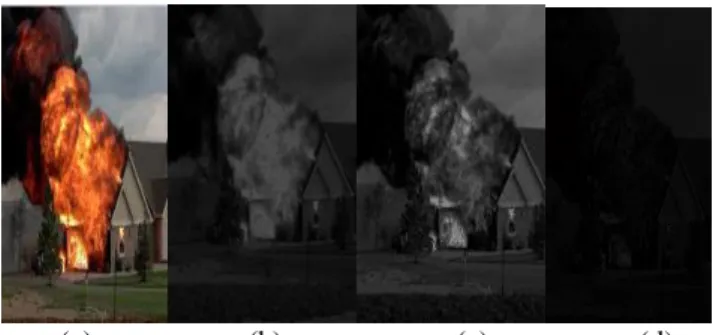
Figure 3 shows an original frame containing fire and contribution of R ,G, and B channel in same . As we observe fire regions are shown differently in different channels of RGB and we cannot extract useful information from all channels which helps us to separate fire regions. Thus we have to consider YCbCr color space.
3.2.
The YCbCr Color SpaceThe YCbCr color space is widely used in digital video, image processing, etc. In this format, luminance information is represented by a single component, Y, and color information is stored as two color-difference components, Cb and Cr. Component Cb is the difference between the blue component and a reference value, and component Cr is the difference between the red component and a reference value.
(a) (b) (c) (d)
Figure 3: Different channels of RGB image, (a) Original
frame, (b) R color channel, (c) G color channel, (d) B color channel.
(a) (b) (c) (d)
Figure 4: Different channels of YCbCr image, (a) Original
frame, (b) Y color channel, (c) Cb color channel, (d) Cr color channel.
The transformation used to convert from RGB to YCbCr color space is shown the following equation.
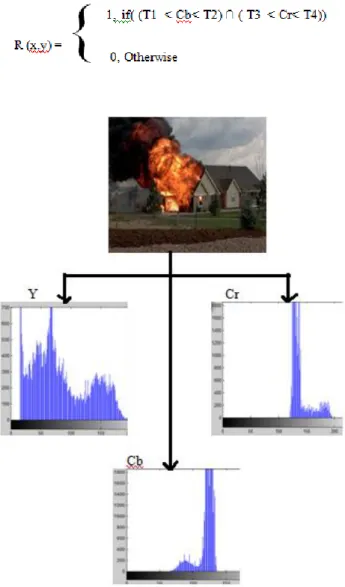
The transformation is simple. Unlike RGB, it has separate luminance and chrominance components which make this color space attractive for color segmentation. As we observe in Fig. 4 in the Y channel, fire regions have larger intensity in comparison with non-fire regions. On the other hand, fire pixels have lower intensity in Cb channel and are shown as dark regions in the image. Also, fire regions in Cr channel are the brightest area in the image similar to Y channel. Therefore, we can specify intervals which contain the values of fire region in every channel. In order to find the characteristics of fire regions, we use more images and frames of fire pixels . First we manually segment the fire regions in each frame and convert them to YCbCr color space. Then a histogram of fire pixels is created for each of the three channels.
Following algorithm is used for deciding the threshold values for detecting fire region in a video:
1. Take a large set of fire images in different environments and locations.
2. Convert images from RGB into YCbCr color plane. 3. Plot histogram of Y,Cb and Cr channels separately as
4. From histogram take average for each channel i.e. for Y, Cb and Cr for fire regions in images and find threshold i.e T1,T2,T3 and T4 for Cb and channels respectively to segment fire region from non fire region accurately.
Using threshold values obtained which are verified over countless experiments as discussed above with images
containing fire regions are formulated as the following rule:
Figure 5: Histogram of Y, Cb and Cr channels
4. MOTION DETECTION
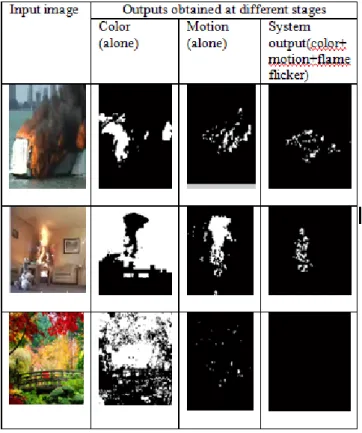
Color alone is not enough to identify fire. There are many things that share the same color as things that are not fire, such as a desert, sun , red leaves and other objects. The key to distinguishing between the fire and the fire colored objects is the nature of their motion. Between consecutive frames (at 30 frames per second), fire moves significantly shown in Figure 6 column (a). The flames in fire dance around, so any particular pixel will only see fire for a fraction of the time.
To date, many motion and change detection algorithms have been developed that perform well in some types of videos, but most are sensitive to sudden illumination changes, environmental conditions (night, rain, snow, air turbulence), background/camera motion, shadows, and camouflage effects (photometric similarity of object and
background). There is no single algorithm today that seems to be able to simultaneously address all the key challenges that accompany real-world (non-synthetic) videos. In fact, no single, realistic, large-scale dataset exists that covers a range of challenges present in the real world and includes accurate ground truths.
To overcome this challenge motion detection is done after detecting color in a video which reduces computation time too. Our motivation of using motion detection algorithm in detecting fire regions is the movement of fire pixels in consecutive frames [7].
In this process of motion detection Main goal is in given a frame sequence from a fixed camera, detecting all the foreground objects. Naive description of the approach is detecting the foreground objects as the difference between the current frame and an image of the scene’s static background.
Frame difference:
| framei – backgroundi | > Th Or
| framei–framei-1 | > Th
The frames used for difference are same that are used in color detection i.e. in YCbCr color plane described initially in order to reduce computation further. Also depending upon the type of area under surveillance i.e. stationary or Dynamic the value of Th can be changed . Generally Threshold is taken 25 for detecting movement in a scene. Figure 6 shows sequence of frames containing combined results obtained after color and motion detection together in a video.
5. FLICKER DETECTION
This is the last but very important step in the proposed fire detection system which contribute in reduction of False positive detection of fire in a given video hence improves the system efficiency further.
This clues used in the fire detection algorithm include irregularity of the boundary of the fire colored region and the growth of such regions in time. All these clues are combined to reach a final decision. The main contribution of the proposed video based fire detection method is the analysis of the flame flicker and integration of this clue with initial results obtain by color and motion is a fundamental step in the fire detection process.
Flicker detection is done by analyzing the signal or video in wavelet domain. By basic definition of images it can be considered as a two-dimensional signal that is a matrix with arranged different rows and columns. The color property of each row or column was considered as a one-dimensional signal. therefore, the wavelet transform on each row or column of the image was done by this method.
Then the one-dimensional wavelet
transformation was
applied on columns the rows of image and down sampled with the rate of two. As shown in Fig. 7 four sub-bands were
achieved as the multiples of wavelet transform.
Figure 7 : Two-dimensional wavelet transform for
an image
As shown in Figure.7, the result of the first stage was four separate sub-bands. LL was the low frequency data of row and column, HL was the high frequency of row and low
frequency of column (horizontal wavelet), LH was the high
frequency of column and low frequency of row (vertical wavelet) and HH was the high frequency of column and high frequency of row (diagonal wavelet). For the second stage of wavelet transforms, the
process was similar to the first stage. Moreover, the total wavelet energy of high frequency items of image was calculated as follow[8]:
Where
I is the value of wavelet energy and is the dimension of motive area.
Furthermore, all items in the mentioned formula were in power two in order to find the small changes of total wavelet energy even for small fire and smoke. Also experiments proves that Energy of wavelet is more for region containing fire than non fire region as Fire depend on the fuel and the airflow.
6. RESULT
Two types of comparisons are carried out; one is for the evaluation of the correct fire detection rate and the other is for the false alarm rate as shown in Table 1. Result shows that when we apply the proposed fire detection system methodology by using all above techniques in combinational manner, the system performance is improved to great extent and also reduces possibility of false positive detection in case of Non fire regions
Table 1 Classification results using the proposed system
7. CONCLUSION
In conclusion, this paper demonstrates a multi-feature
classification approach to detecting fire in video data. Accuracy can also be further increased by applying different efficient algorithm in each phase of detection. In our future work we will endeavor to incorporate Artificial Neural Network (ANN) into our current algorithm for recognizing fire region in order to increased fire detection accuracy further and at the same time reducing False positive rate of detection.
REFERENCES
[1]Early Fire Detection for High Space Based on Video-image Processing by Wang Yuanbin Ma Xianmin School of Electrical & control engineering Xi’an University of Science & Technology Xi’an, China
[2] Optimized Flame Detection using Image processing based Techniques, Gaurav Yadav et al / Indian Journal of Computer Science and Engineering (IJCSE), Vol. 3 No. 2 Apr-May 2012.
[3] Fire And Smoke Detection Without Sensors: Image Processing Based Approach ,Turgay Çelik, Hüseyin Özkaramanlı, and Hasan Demirel, 15th European Signal Processing Conference (EUSIPCO 2007), Poznan, Poland, September 3-7, 2007.
[4] A New Method In Fire Detection Wu Longbiao Deng Chao Fan Weicheng ( State key Laboratory of Fire Science,University of Science and Technology of China, 230026, Hefei).
[5]Vision Based Intelligent Fire Detection System RAGITHA.K, International Journal of Engineering Science Invention ISSN (Online): 2319 – 6734, ISSN (Print): 2319 – 6726 www.ijesi.org Volume 2 Issue 3 ǁ March. 2013 ǁ PP.34-41
[6] Computer Vision Based Fire Detection, Nicholas Tru University of California, San Diego 9500 Gilman Drive, La Jolla, CA 92093
[7]R. Cucchiara, C. Grana, M. Piccardi, and A. Prati, “Detecting moving objects, ghosts, and shadows in video streams,” IEEE Trans on Pattern Anal. and Machine Intell, vol. 25, pp. 1337-1442, 2003.
[8]Fire and Smoke Detection Using Wavelet , Ali Rafiee
BIOGRAPHICS
Hemangi Tawade received the B.E. degrees in Electronics
and Telecommunication Engineering from Smt. Indira Gandhi College Of Engineering of Mumbai university in 2011.
PROF : R. D. Patane, Mumbai University, Department of
Electronics and Telecomunication, Terna Engineering College, Nerul, Navi, Mumbai, Maharashtra, India