may be published without proper acknowledgement. For any other use, or to quote extensively from the work, permission must be obtained from the
Detection of suspicious URLs in online social networks using
supervised machine learning algorithms
Mohammed Fadhil Zamil Al-Janabi
Submitted for the degree of Doctor of Philosophy
December 2018 Keele University
TABLE OF CONTENTS
LIST OF FIGURES ... VII
LIST OF TABLES ...XI
GLOSSARY OF TERMS ... XIII
ACKNOWLEDGEMENTS ... XVII ABSTRACT ... XIX INTRODUCTION ... 21 1.1 Introduction ... 22 1.2 Background ... 23 1.3 Motivations ... 24 1.4 Problem statement ... 25 1.5 Objectives ... 25 1.6 Research questions ... 26
1.7 Main contributions of thesis ... 26
1.8 Structure of thesis ... 28
LITERATURE REVIEW ... 31
2.1 Technical background ... 32
2.2 What is spam content? ... 33
2.2.1 Twitter’s spam rules ... 35
2.3 Spam mechanism ... 37
2.3.1 Sybil attacks and fake accounts ... 39
2.3.2 Fake accounts and the black market ... 40
2.3.3 What are spambots? ... 41
iv
2.4.1 Blacklist ... 42
2.4.2 Introduction to machine learning methods ... 44
2.4.3 Machine learning algorithms ... 49
2.4.4 Ensemble learning algorithms ... 54
2.5 Features used to build spam classifiers ... 58
2.5.1 Twitter accounts and content features ... 59
2.5.2 URL, hosting and web page features ... 63
2.6 Conclusion ... 67
RESEARCH METHODOLOGY ... 69
3.1 Background ... 70
3.2 Data sources and labelling methods ... 73
3.2.1 Data collection process... 74
3.2.2 Data labelling process ... 75
3.2.3 Data preparation and unbalance issue ... 81
3.3 Feature extraction and engineering ... 82
3.3.1 Features used in building classifiers... 84
3.4 Model selection ... 96
3.4.1 Model selection criteria ... 97
3.5 Hyperparameter tuning ... 101
3.5.1 Feature selection methods ... 102
3.6 Discussions ... 103
USING SUPERVISED MACHINE LEARNING ALGORITHMS TO DETECT SUSPICIOUS URLS IN TWITTER ... 106
v
4.2 Model selection ... 108
4.3 Model performance enhancement ... 110
4.3.1 Model enhancement through parameter tuning ... 111
4.3.2 Experiment summary ... 117
4.3.3 Hyper-parameter tuning and overfitting ... 119
4.4 Model enhancement by feature selection ... 120
4.5 Enhance model performance by adding more training data ... 126
4.6 Conclusion ... 127
MORE INFORMATIVE FEATURES AND ENSEMBLE LEARNING METHODS USED TO DETECT MALICIOUS URLS ON TWITTER ... 129
5.1 Introduction ... 130
5.2 New dataset and new features deployed ... 130
5.3 Ensemble learning methods ... 131
5.4 Experiment methodology ... 133
5.5 Results and evaluation ... 135
5.6 More data, better performance ... 140
5.7 Conclusion ... 142
‘SUSPECTRATE’ – A SPAM DETECTION SYSTEM ... 144
6.1 Introduction ... 145
6.2 Design goals ... 146
6.3 System flow and structure ... 147
6.4 Building and training models ... 151
vi
6.6 System data input ... 154
6.7 Feature extraction ... 155
6.8 Decision-making and output presentation ... 156
6.9 Implementation details ... 158
6.10 Conclusion ... 160
CONCLUSION AND FUTURE WORK ... 161
7.1 Conclusion ... 162
7.2 Research limitation ... 164
7.3 Future work ... 165
APPENDIX A EXAMPLE OF A TWEET JSON DATA SAMPLE ... 167
APPENDIX B PYTHON LIBRARIES USED IN BUILDING THE SYSTEM . 171 APPENDIX C EXAMPLE OF A VISUALISED TREE MODEL ... 173
vii
LIST OF FIGURES
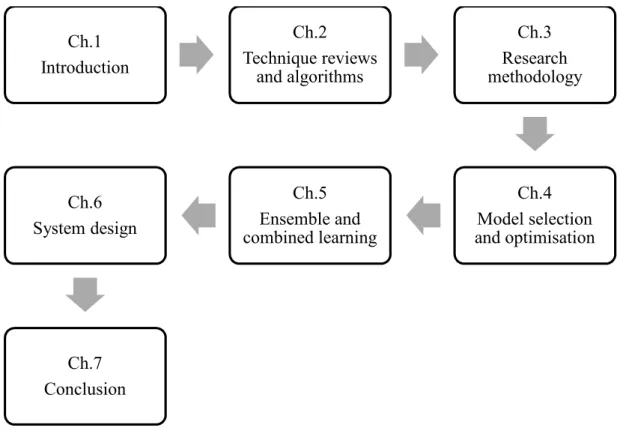
Figure 1.1 Thesis structure ... 29 Figure 2.1 Spamming units and stages [15] ... 36 Figure 2.2 Search results for ‘buy Twitter accounts’ on Google search ... 40 Figure 2.3 Supervised machine learning general scheme [65] Figure consist two main parts training and prediction ... 46 Figure 2.4 Unsupervised machine learning general scheme [65] The coloured boxes
represent the different clusters the dataset is split into ... 47 Figure 2.5 Model complexity against testing and training performance [69] Increasing
complexity could enhance the prediction to a limit where the test sample error gets higher... 48 Figure 2.6 SVM trained with samples from two classes green point are the support
vectors that used to create the hyperplane to separate the two classes. ... 51 Figure 2.7 K-NN example with k=5 As the circle represents unknown class data need
to be predicted. ... 51 Figure 2.8 Random Forest generic mechanism. The whole dataset is divided into n
samples and each sample is used for building a singular DT. Then in the final stage, each model prediction is combined for the final prediction ... 55 Figure 2.9 Boosting general mechanism the whole dataset used in all n iterations of
the training of boosting models ... 56 Figure 3.1 Key phases of the research methodology. The collection phase is where
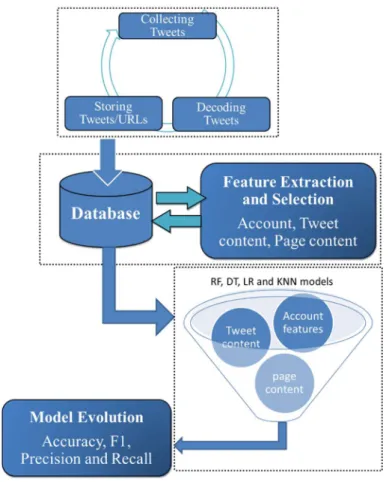
tweets are imported into the database. This is followed by feature extraction and selection, and then building models and evaluating them. ... 72
viii
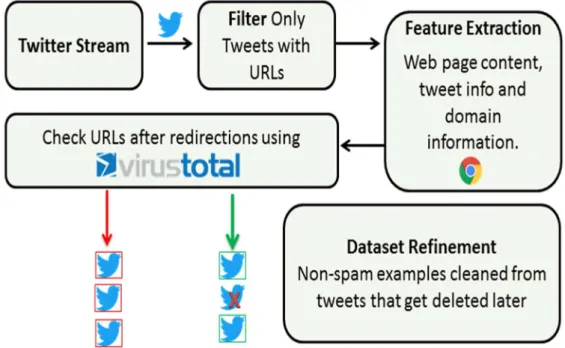
Figure 3.2 General techniques used and their flow the flow represents the sequence of techniques used in processing incoming data till storing it in the database ... 75 Figure 3.3 Data collection and features extraction workflow crossed tweets represents
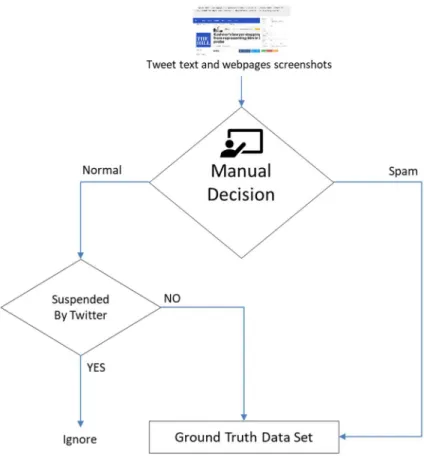
tweet that got deleted by twitter ... 76 Figure 3.4 Labelling method used to build DS2 ground truth dataset, that involved
extra manual validation ... 78 Figure 3.5 Labelling tool developed and used in labelling the dataset In the bottom
right corner of the screen shot image there are three buttons: green (normal), red (spam) and yellow (unsure) ... 79 Figure 3.6 Cross-validation sampling method ... 82 Figure 3.7 Selenium web drivers web browsers logos represents the capability of
selenium to use different software web drivers ... 87 Figure 3.8 Malicious/spam content hidden content behind multiple redirected URLs
starting by un-blacklisted URL and ending with blacklisted one ... 90 Figure 3.9 Example of a popup window used for advertising ... 92 Figure 3.10 Example of ads abusive web page two column web page as both contains ad text and banners ... 94 Figure 3.11 Research methodology key phases ... 104 Figure 4.1 The effect of the number of trees parameter on the performance of the
spam classification ... 113 Figure 4.2 The effect of the tree max depth parameter on the performance of the spam classification ... 115 Figure 4.3 The effect of the leaf size parameter on the performance of the spam
ix
Figure 4.4 RF classification performance based on the selected features. The vertical axis is the performance in Recall and the horizontal axis shows number of features as it is decreasing from left to right. The yellow horizontal line is the model performance using all the features. ... 125 Figure 4.5 RF incremental learning curve according to DS1 random forest
performance according to the size of training data used ... 126 Figure 5.1 Comparison of DS1 and DS2 features importance based on two feature
ranking methods ... 131 Figure 5.2 Models’ performance according to F1 metric model on the left XGB is the
highest model compared with varied combined models groups ... 137 Figure 5.3 Methods used for combining predictions of several machine learning
models ... 138 Figure 5.4 Top models vs top combined model ... 140 Figure 5.5 Learning curves for ensemble learning models using the F1 metric. The
figure shows the classifiers’ performance behaviour as more data is used for training. ... 141 Figure 6.1 System's main components flow starts from system web interface and ends
by sending email to the client, small grey area represents the internal retraining process that conducted periodically ... 148 Figure 6.2 Feature extraction internal processes extracting feature process start by
retrieving URL from the database and ends back with all extracted features to the database. ... 150 Figure 6.3 System’s ability to add new models green box shows a new deep learning
x
Figure 6.4 Input file one column csv file, each row contains a tweet ID ... 154 Figure 6.5 Web form for uploading the dataset three fields required name, email and
dataset file ... 155 Figure 6.6 Output file two columns csv file, first contains tweet id then suspicious rate ... 157 Figure 6.7 Web form to get the status of user order two fields required (email and
LIST OF TABLES
Table 2.1 Examples of distance measurement metrics ... 52
Table 2.2 List of Twitter features adopted by previous studies [90]–[93]... 60
Table 2.3 List of lexical, host-based and page-content features [56][110] ... 64
Table 2.4 Example of phishing URLs [112] ... 65
Table 3.1 Comparison between DS1 and DS2... 80
Table 3.2 Sources of features used in building machine learning models ... 83
Table 3.3 Common features used in literature ... 84
Table 3.4 User information features ... 85
Table 3.5 Tweet features ... 86
Table 3.6 Redirections’ observation features and web page content ... 88
Table 3.7 WHOIS information features ... 95
Table 3.8 Confusion matrix ... 98
Table 4.1 Overall performance (average of ten experiments) using one classifier for all attributes ... 109
Table 4.2 Random forest main hyper-parameters ... 111
Table 4.3 Ranking of features based on information gain, Gini index and mean decrease average ... 123
Table 5.1 Common features and classifiers used in the literature (algorithm with highest performance identified by bold type) ... 132
Table 5.2 Definition of metrics ... 135
xii
Table 5.4 Model sets used in combination methods ... 137 Table 6.1 Models used in first version of SuspectRate system ... 152
GLOSSARY OF TERMS
Term Definition
OSN Online social network, e.g. Twitter, Facebook and LinkedIn
Cybercrime Crime that involves a computer and a network
Spam Unwanted content typically sent to a large number of users for the purposes of advertising, phishing and spreading malware (Oxford Dictionary)
Dataset All the data collected during the study, such as tweets and crawled web pages
ML Machine learning
URL Uniform resource locator
VirusTotal Internet antivirus and internet security checker service
Domain name Examples: microsoft.com and google.com
Web server Where a website is hosted
RF Random forest
XGBoost eXtreme Gradient Boosting
Botnet Network of connected software/devices used for illegal purposes
xiv
Spambot Software hosted on a victim’s computer or a controlling social network account that is owned and controlled by a spam master
IP address Internet protocol address
GitHub Source code storing and version control using Git
SVM Support vector machine
Domain
WHOIS Info
Information about a registered domain name, such as registrants, registrar, registration date, and expiry date
HTML Hypertext markup language
Retweet Twitter term meaning that a user shares another person’s tweet to his followers
Followers (Twitter) They see your tweets in their Home timeline whenever they log in to Twitter1
Following (Twitter) Following someone on Twitter means subscribing to their tweets as a follower
K-NN k-nearest neighbours algorithm
NB classifier Naïve Bayes classifier
Sub-domains A name that could be added to the original domain but separated with a full stop. For example, in scholar.google.co.uk, scholar is a sub-domain
CSS Cascading Style Sheets
xv
Python High-level programming language
Web crawler Software with the purpose of opening URLs and reading and storing opened web pages
Selenium WebDriver
API
Using programming language to automate a web browser (Chrome, Firefox, etc.) as if a normal user is using the browser
Web page A document commonly written in one or several languages such as HTML, CSS and JavaScript. A web page is accessible through the internet or other networks using an internet browser
DS1 Dataset used in training and testing experiments in chapter 4
DS2 Dataset used in training and testing experiments in chapter 5
Twitter account
suspension
Twitter internal detection system that aims to delete accounts that are not following Twitter’s rules. Suspension can be due to spam activities, hate speech, etc.
Ad blocker Web browser extension that works on filtering and denying contents based on predefined lists that mainly block advertisements in the web pages
xvi
Twitter protected
account
Twitter account where their owners do not want to share their tweets and activities with the public, so only approved followers will be able to see the tweets
Twitter verified account A blue badge attached to public interest people account for authentication2
ReliefF Feature ranking algorithm
LightGBM Open source gradient boosting tree algorithms built by Microsoft
CatBoost Open source gradient boosting tree algorithms built by Yandex Technologies
Popup window Window that opens alongside web pages with the loading, unloading or any other actions
MongoDB An open source NoSQL database management system
Tweet ID A unique number that every tweet in Twitter has to have as an identification
xvii
ACKNOWLEDGEMENTS
I would like to thank my country Iraq and my scholarship provider, the Ministry of Higher Education and Scientific Research, Republic of Iraq, for offering me the opportunity to undertake this study.
I would like to express my sincere gratitude to my advisor Prof. Peter Andras for his continuous support during my PhD study and for his patience, motivation and immense knowledge. His guidance helped me throughout the research and the writing of this thesis.
I would also like to thank my co-supervisor Dr Ed de Quincey for his constant support and availability and his constructive suggestions. Special thanks to Mr David Collin for his support, especially during the first year of this research.
I would like to extend my thanks to all the staff and students at Keele University and the School of Computer Science for their advice along the way. Special thanks to Keele IT Services for providing me with a virtual private server.
My deepest gratitude goes to my beloved parents Fadhil and Iman. I would have achieved nothing without their love, support and encouragement. Special thanks to my brother Safaa and my beloved nephews Mustafa and Muwafaq.
To my wife Huda, who will always be a source of support and love, I thank you for being patient and understanding. The most important contribution to my PhD was my daughter Jana, who joined us for the first year of this journey. Thank for your smiles and joy. You will always be my little princess.
xviii
All praise and gratitude are due to Almighty God for everything. Mohammed Al-Janabi
ABSTRACT
This thesis proposes the use of several supervised machine learning classification models that were built to detect the distribution of malicious content in OSNs. The main focus was on ensemble learning algorithms such as Random Forest, gradient boosting trees, extra trees, and XGBoost. Features were used to identify social network posts that contain malicious URLs derived from several sources, such as domain WHOIS record, web page content, URL lexical and redirection data, and Twitter metadata.
The thesis describes a systematic analysis of the hyper-parameters of tree-based models. The impact of key parameters, such as the number of trees, depth of trees and minimum size of leaf nodes on classification performance, was assessed. The results show that controlling the complexity of Random Forest classifiers applied to social media spam is essential to avoid overfitting and optimise performance. The model complexity could be reduced by removing uninformative features, as the complexity they add to the model is greater than the advantages they give to the model to make decisions.
Moreover, model-combining methods were tested, which are the voting and stacking methods. Both show advantages and disadvantages; however, in general, they appear to provide a statistically significant improvement in comparison to the highest singular model. The critical benefit of applying the stacking method to automate the model selection process is that it is effective in giving more weight to more top-performing models and less affected by weak ones.
xx
Finally, 'SuspectRate', an online malicious URL detection system, was built to offer a service to give a suspicious probability of tweets with attached URLs. A key feature of this system is that it can dynamically retrain and expand current models.
21
1.1 Introduction
Online social networks (OSNs) have become one of the main mediums of communication. Statistics show that in the first quarter of 2018, Twitter had around 336 million active users monthly generating more than 500 million tweets per day [1]. This number made it a fertile environment for the dissemination of malicious content and illegal monetary gain by spammers [2]. Social network administrators are responsible for protecting OSN users from being exposed to malicious or spam content in networks. In total, 60 per cent of social network users have received or been exposed to spam content [3]. Spam is the generic term for all types of unsolicited and harmful content, which includes phishing links, malware or links to illegal or fake products [4], that is typically sent to a large number of users. Some additional social network activities could also be described as spamming, such as gaining fake popularity and following or liking a large number of users or content to gain attention.
The ability to distribute content in real time to thousands of recipients has made it difficult to resolve the issue of spreading unwanted content and suspicious links, especially that OSNs dealing with big data [5]. Specifically, the ease of creating accounts on OSN sites and the simplicity of the distribution process make them a perfect environment for the dissemination of spam content. For example, studies show that the proportion of spam in all Twitter content has reached an all-time high that stands at approximately 10 per cent of all content produced [6]. Coupled with the rapidly increasing number of active OSN users, this has emphasised the need for secure OSN platforms whereby operators frequently monitor any ‘abnormal’ activities in their network to detect attacks [7]. However, cybercriminals search continually for attack opportunities, which rely on previously undiscovered vulnerabilities, for which there is
no effective defence. A newly deployed attack technique is called a zero-day attack on the day that it is first applied [8]. Furthermore, the complexity of such activities is exacerbated by the social nature of OSNs, whose users tend to trust content that has originated or emerged from their peers' content [9]. This adds further difficulties to the missions of security administrators and detection systems.
At the heart of the problem is the emergence of black markets, which increasingly facilitate the spreading of illegal services, such as the deployment of spam campaigns and the selling/buying of fake accounts, compromised accounts or even infected computers. An increasingly important way in which cybercriminals engage in illegal activities is through the simple creation of fake OSN accounts [10]. There is a constant war between cybercriminals and security experts, as every time OSN operators detect and block a spamming attack, cybercriminals find a new way to leverage social networks and abuse their services. There is a gap of time which cybercriminals can take advantage of before the OSNs are able to detect new attacks. In particular, due to the real-time nature of social networks, this makes it more difficult to monitor and protect users and content.
1.2 Background
The use of OSNs now exceeds that of email in the propagation of harmful communications (e.g. fake news, advertising for illegal services, unwanted adverts) [11]. The same study shows that between 2013 and 2014, spam content in social networks increased by 658 per cent. Studies indicate that the main vehicle used to propagate malicious attacks in emails is the same attack botnets used by more conventional email attacks [11], [12]. A botnet is a group of compromised computers/accounts that are under the control of a cybercriminal [13].
The ease with which OSNs can be used for malicious activities and the relatively long time needed to detect/suspend them [14] make a compelling business case for such criminals. The consequent profitability has led to the expansion of a new industry catering to the needs of cybercriminals who target OSNs [15]. To protect users’ personal data and privacy, many issues should be considered to address several key challenges in OSNs, including:
Preventing spammers from creating accounts and/or suspending them in the shortest possible time
Detecting spam campaigns and stopping them before they reach a bigger audience
Detecting abuse such as spreading irrelevant content to trending hashtags or accounts
Detecting fake followers which are gained by using illegal methods.
1.3 Motivations
Many studies have attempted to analyse and tackle the high and rapidly increasing spam content in recent years [16]–[18]. Although researchers are seeking to mitigate it, to date, no work has succeeded in eliminating it. According to Nexgate's statistics, OSNs’ spam content increased by six times since mid-2013 [11]. These problems (described in section 1.1) have been the principal motivation for this research, which seeks to reduce or even eliminate spam content in OSNs.
1.4 Problem statement
Based on the discussion in the preceding sections, this research classifies spam from two perspectives: OSN user and operator. Accordingly, this has led to several problems, which are summarised below:
(i) User’s perspective – this refers to unwanted content that is distributed by fake and compromised accounts for commercial reasons or malicious activities. Such content could have Uniform Resource Locator (URLs) that link to harmful software or phishing sites.
(ii) Operator’s perspective – spam increases the load on an OSN platform and creates a significant drain on resources in addition to the loss of trust by its users.
Consequently, this research proposes to resolve these problems by detecting spam content that emerged from both fake and compromised accounts.
1.5 Objectives
The main aim of this research is to develop a computational framework to reduce the spread of spam content by proposing a practical approach to identifying spam tweets in Twitter based on the selected features and characteristics. The main objectives of this research are:
To identify, study and analyse methods and features that enable the identification of spam content on OSN platforms. An important part of this work entails the review of the impact of key parameters on the learning process, with particular attention to avoiding overfitting.
To develop efficient and scalable OSN spam detection framework with predictive data analytics which are capable of summarising and describing
patterns in the collected data. In particular, the objective is to identify data analysis methods that make possible the development of high performance, dynamically adapting spam identification and filtering.
1.6 Research questions
1. What combination of features enables improved detection of spam on social networks compared to current approaches?
2. How can the performance of combinations of classification methods such as random forest and gradient boosting trees classification methods be improved for spam detection in the context of social networks?
3. How can a system be designed using an optimised set of features and an optimised combination of classification algorithms to deliver high usability combined with improved spam detection in the context of social networks?
1.7 Main contributions of thesis
The primary aim of the thesis was to develop a spam detection system based on machine learning models that are adaptable to future spamming tricks and activities. The points listed below are the main contributions of this research:
1. It built two ground truth datasets using different labelling standards that would help researchers’ in training models. These datasets are downloadable on GitHub via the following URL: https://github.com/mohfadhil/suspectrate-datasets. Both datasets were collected through Twitter real-time stream tweets; however, each used a different labelling mechanism. Dataset 1 assumed that all tweets that are deleted are spam tweets with no manual process. Dataset 2 used the previous labelling mechanism but with extra manual validation.
Furthermore, more features were introduced and features were discarded from Dataset 1 due to the pilot study conducted on the effectiveness of the features. (Chapter 3)
2. It developed the first labelling method, which is introduced in chapter 3, where three validation processes used Twitter suspension, VirusTotal blacklists and manual labelling, as this method showed more accurate labelling standards. (Chapter 3)
3. It conducted a systematic analysis of the most important parameters in random forest that could make a difference in the model’s performance and overfitting/underfitting status. (Chapter 4)
4. It applied new algorithms that have been studied and shown good performance compared to traditional algorithms to the datasets. Moreover, it gave details about the algorithms’ hyper-parameters assigned to support the research reproducibility and open science. (Chapter 4)
5. It used stacking and voting methods to automate the process of model selection, so a human decision will not be needed to choose the best model. (Chapter 5) 6. The proposed novel set of features were derived from web page content and
behaviour. The novelty is that the author consider content that appears at the landing web page and while reaching the landing page. (Chapter 3)
7. The system was built from scratch using Python and many other 100 per cent open source libraries. The developed framework applied the main machine learning system components by collecting data and extracting and selecting features. Then the problem of model selection and evaluation was handled by using extra meta classifier. SuspectRate was able to retrieve tweets with URLs
and store them in a database and then perform analysis and use it against a pretrained model or combined models. The system is open source at the researcher GitHub repository: https://github.com/mohfadhil/suspectrate. (Chapter 6)
8. The research experiments have been published in two peer-reviewed conference papers:
o Al-Janabi, M., Quincey, E., & De Andras, P. (2017). Using supervised machine learning algorithms to detect suspicious URLs in online social networks. Proceedings of the 2017 IEEE/ACM International Conference on Advances in Social Networks Analysis and Mining 2017 (pp. 1104– 1111).
o A systematic analysis of random forest based social media spam classification, Mohammed Al-Janabi, P Andras, International Conference on Network and System Security, 427-438.
9. Several talks have been/will be given regarding this research:
o Four talks at postgraduate research (PGR) days from 2014 to 2018 o Three talks at the Keele symposium of postgraduate studies in 2016,
2017 and 2018.
o Posters presented at the Keele symposium of postgraduate studies in 2016, 2017 and 2018.
1.8 Structure of thesis
In chapter 1, the research questions and aims are stated. Chapter 2 outlines in detail the situation of current spam and anti-spam detection mechanisms and the author’s role to reduce the spam percentage in OSNs. Furthermore, all the machine learning models
mentioned in this thesis are described in chapter 2. Several related studies have been reviewed and categorised the models used in building their machine learning models based on their selected features.
Chapter 3 describes the road map of the main experiments that the researcher conducted during this study, how data was collected, and the feature extraction and labelling process. It also describes how the model selection process was conducted. In this chapter, the technical process and tools used in the feature extraction and storing the dataset are also outlined.
Chapter 4 describes the first pilot study conducted using several machine learning algorithms to gain a better understanding of which algorithms would better suit the research classification problem and dataset. It also describes the model enhancement procedures conducted, such as model hyper-parameter tuning and feature selection.
Figure 1.1 Thesis structure
Ch.1 Introduction Ch.2 Technique reviews and algorithms Ch.3 Research methodology Ch.4 Model selection and optimisation Ch.5 Ensemble and combined learning Ch.6 System design Ch.7 Conclusion
Chapter 5 focuses more on ensemble learning algorithms and compares the top algorithms in the field. It describes two experiments on combining boosting and bagging trees in one stacking and bagging model.
Chapter 6 shows the developed system to rate suspicious URLs to help users, researchers and companies to label their data or at least clean it.
The discussion and the limitations of the thesis are presented in chapter 7. The main conclusion of the thesis and suggestions for future work are also presented in chapter 7. The future work offers recommendations for new research studies that have similar research aims.
2.1 Technical background
Generally, the mechanism of posting content and how it reaches other users on the network is quite similar in most OSNs, i.e. following users aggregate the content they produce into a personalised news feed. Furthermore, OSNs have search capabilities that enable a user to search for certain keywords in the content of followed accounts or public content. In addition to the search feature, there is an aproach that has been used in OSNs to make following a certain thread or topic easier, which is called a hashtag. A hashtag is non-separated characters that refer to a certain topic or trending event. It starts with the symbol ‘#’, which is followed by a string of characters. Hashtags were first used on Twitter [19]; however, this technique is now used in most user-generated data websites [20]. In this thesis, Twitter was used as the OSN case study; however, the concept of this work could be used in any other OSN if it has a similar structure for distributing content. The common reason for using the Twitter platform as a data source is that Twitter’s data mostly has public access. However, there are accounts called protected accounts3; their data and tweets are protected and cannot be reached by collection software. These protected accounts make up less than 6 per cent of all accounts, which means that almost 94 per cent of all Twitter data is public [21]. Twitter supports researchers by providing software tools to facilitate the data collection process. Moreover, the openness of Twitter and the huge amount of data that can be accessed
3Public and protected tweets
are vital features that motivate most researchers in this field to use Twitter as a data source.
In this chapter, there will be a review of general threats that OSN users might be exposed to and the current mitigating techniques used, such as blacklists and machine learning-based detection models, to provide a clear understanding of the advantages and disadvantages of each detection technique. Moreover, there will be a review of several relevant studies and techniques/methods used in building spam/malicious URL detection systems.
2.2 What is spam content?
In general, spam is defined as the unwanted content that is sent to a large number of users. This definition is used for spam in emails; however, the main concept of spam is the same in any other messaging or content-sharing platform. In the context of OSNs, spam could be any unwanted content or even duplicated content. Spam content can be in many forms, such as illegal product advertisements, false news, phishing or URLs that lead to drive-by download attacks [22], [23]. To understand why these types of content are considered as spam in OSNs, the following types of content are considered.
Phishing sites: phishing sites are cloned websites of real popular websites such as facebook.com, twitter.com or even the popular banks. Online scammers spread content with URLs attached over OSNs to thousands and sometimes millions of accounts in OSNs to lure the account holders to visit these cloned sites. Many users might notice that there are some suspicious characteristics in these phishing sites, for example, the URL path contains sub-domains such as ‘twitter.com.twt.com/login.php’. Unfortunately, however, a percentage of users will not notice and log their username/password, which goes directly to the spammers/hackers. This attack is one of
the most popular attacks of spammers because of the simplicity of creating cloned sites to obtain users’ account usernames and passwords.
Fake software: like phishing websites, fake software or trojan horse software is software that falsely claims that it will give users services such as boosting the speed of their devices or increasing the RAM or hard disk space. There are even cases where the fake software pretends that it has found some viruses on the user’s devices and cleans the devices. This type of software is usually promoted on sites with a very low reputation that spammers created and advertised using their fake/compromised account to OSN users.
Fake news: fake news is when someone posts on OSNs or publishes on his website partly falsely edited facts or total fake news [24]. This was started by people who lure users to visit their site. They post exaggerated titles and could even attach posts with maniplated photos that attract the user to click on attached URLs. It started as a way to gain more internet traffic to obtain increased website ad earnings; however, it has been used for other reasons as well as to gain profits. Currently, there are investigations relating to whether this unlawful way of spreading news has been used to target a large population on very specific events, such as a presidential election (e.g. the United States presidential election, 2016) [25], [26].
Clickjacking web pages: Clickjacking is one of the new browser attacks that online scammers use to hijack users’ clicks. A scammer can build web pages that have clickbait pictures or links that lure users to click on them, but in reality, they are clicking on some other JavaScript trigger event [27]. This technique is used for ‘likejacking’, which is one of the illegal ways that scammers increase the number of followers of a certain account/Facebook page. There is a black market paid service for increasing
Facebook page likes or Twitter followers, so they take users’ clicks and use them as if the user is clicking to like a page script code or following an account on Twitter.
Illegal advertising: although most OSNs provide a legal channel for promoting content on their network, spammers illegally flood the network with advertisements. The reason for this is either that they want a cheaper method of advertising or that the content they want to promote is not accepted (i.e uncertified medical equipment or medicine).
Pornography, dating and adult content sites in general are among the sites that have a high percentage of spam content distributed over social networks. Social networks have different rules on this type of content; however, in general, there is a restriction on spreading this type of content in OSNs. Pornographic pictures are usually used as click-bait to lures users to click the URL to get more content or watch a full porn video. Moreover, porngraphic content could be hidden as it needs a Flash Player to view it in the user’s browser, so the user is redirected to a phishing website to download a fake Flash Player.
2.2.1 Twitter’s spam rules
None of the spam types mentioned in the previous section are accepted to be posted on Twitter. Furthermore, Twitter monitors users’ behavour to detect any abusive activities in the network, which is metntioned in Twitter rules page4. Consequently, an account could be suspended due to its content or its actions in the networks [28].
According to Twitter’s suspension rules web page, there are three major reasons to suspend a user’s5 account or delete a tweet:
1. breaking copyrights 2. abusive tweeting activity
3. spreading malicious and harmful content.
Twitter has also restricted the spreading of sexual/nude pictures over the network and tried to hide them and give sensitive media warnings to users. Moreover, Twitter does not allow users to use nude pictures as profile or cover images, and users are not allowed to send messages containing pornographic content to people. If nude pictures or sexual text are used as part of click-bait strategies by a spammer, Twitter tries to stop this.
a) Spreading Nodes c) Spamming Goals b) Malicious Activities d) Spamming Results
Figure 2.1 Spamming units and stages [15]
5 There is also the chance that the user deletes the tweet.
Fake Accounts Compromised accounts
External URL Fame/misleading information Hashtag Hijacking
Fake Likes Direct messages SPAM
Follow SPAM Retweet SPAM
1 Fake Software Phishing Site Advertising/ads sites Creating or buying … (a) (b) (c) (d)
2.3 Spam mechanism
To understand these activities and the measures used to counter them, a definition of the key terms used in relation to social networks needs to be provided and the most common practices need to be explained. An explanation of how fake accounts are created and how accounts are compromised will be provided. Figure 2.1 [15] illustrates how fake accounts play a key role in spam content distribution and describes the main spamming elements.
Spreading Nodes: Every account in an OSN is considered as a node, and every node has a relationship with others [29]. The more nodes spammers have, the more spam content they can spread [30]. Therefore, spammers are one of the major causes of the increase in fake/compromised accounts in OSNs. Due to detection systems that OSNs have developed to prevent spam content spreading, many associated accounts are suspended every day [31]. The illicit industry of creating and selling accounts is still active to recover suspended accounts and help spammers to have enough active accounts for their spam campaigns [32]. As shown in Figure 2.1, compromised accounts also play a role in spreading spam content although they have originated in a different way. Compromised or infected accounts are legitimate; they are created by normal users, but somehow spammers have the ability to control them. In the spamming industry, infected accounts are more valuable than fake ones [32], as it is more difficult for OSNs’ detection systems to detect and suspend compromised accounts compared to fake ones. Therefore, spammers tend to focus their effort on infecting legitimate accounts with the aim of increasing the number of compromised accounts under their control.
Spammers often also use fake accounts, which are cheap to buy in online black markets, to conduct their spam campaigns. Several studies show that about 10 per cent of all OSN accounts are fake accounts [33]. Cybercriminals control these fake accounts using computer programs to perform automated operations using bots, which act as legitimate users. Bots employed in this way have become known as social bots. They are essentially programs which simulate the activity of a typical user on a social network [4], [7], [34]. For example, they are able to post, message, vote and share [35].
Malicious Activities: Spammers have various techniques and tricks to increase their audience in OSNs; one of the most commonly used techniques is known as hashtag hijacking [35]. Spammers exploit trending topics by posting/tweeting using these trending keywords or hashtags, giving them a wider audience who follow those trending topics [36]. Furthermore, many malicious activities could be conducted by spammers to lure users to click on their malicious URLs.
Spamming Goals: Deliver spam content to the targeted users is the primary task, which is done by redirecting the user to a suspicious source outside the OSN site. The URL usually used had been shortened once or several times. This link can refer to a phishing page, scam or drive-by download attacks.Recently, a study has shown that the high number of URLs that are spread by a Twitter account can often be under the control of a spambot [35],[37]. The high percentage of spam tweets that contain external links or URLs gives an indication that spreading URLs is a major task for spammers. Moreover, some OSN activities that can come under the classification of spam are fake likes, fake followers, and spam retweets. Some spammers also use spamming services to get more attention or to increse their followers number (fake fame) on OSNs or spread misinformation [38].
Spamming Results: The primary objective of spam campaigns is not only to let users see spam, but also to get them to click on the attached links. Encouraging users to click on those URLs requires several tricks by spammers to deceive them by luring them with pornography, celebrity scandals, free software, discounts codes or bargains deals [6]. These links may point to web pages that lead to drive-by download malware attacks to steal users’ information using fraud or phishing sites [37][2][39].
There are several method that spammers can use to create new URLs with no historical profile, such as:
URL-shortening services: these are web services that after submitting a URL to the services, provide a new short URL that points to the same original URL [20]. These short URLs are mainly used in social networks with a limited content length such as Twitter. Currently, many shortening services, for example, bit.ly and tinyurl.com, are commonly used in OSNs [40].
Cheap domain and hosting services [41]: creating new websites requires two main elements, which are a domain name and online space to host websites files. Domain names are cheap nowadays, and spammers can buy a domain name for less than £10 [42], [43].
The above services are responsible for a high percentage of the spam content distributed over social networks. Although Twitter uses blacklists, which are suitable for real-time detection, unwanted content still finds its way into the network [44].
2.3.1 Sybil attacks and fake accounts
Spam industry based on the number of accounts controlled by spammers, these account as stated could be either compromised or fake accounts [45]. The method that
attackers use to create fake accounts in OSNs using fake identities is called a Sybil attack. This type of attack is very common in OSNs, in which a single user can have thousands of fake accounts so they gains higher visibility by spreading more content in the network [46]. According to a previous study that focused on the Sybil accounts in Twitter, it was found that out of the total accounts monitored, around 2 million or 9 per cent get suspended as they are considered to be Sybil accounts [47]. This is close to the 10 per cent that Twitter officially announced as the spam percentage in the content [48].
2.3.2 Fake accounts and the black market
As discussed in the previous section, in general, the spamming industry relies entirely on the nodes (accounts) used to spread spammers’ content. As OSNs suspend accounts that are involved in spamming activities, the spamming industry needs to generate enough accounts for their spam campaign. Creating accounts and offering them for sale in the black market has reinforced the spam industry. Thomas [15] conducted a study on the impact of the black market and how it facilitated the process of spreading spam content using fake accounts.
The researcher studied the value of fake Twitter accounts and found that its market worth was between US$0.01 and US$0.20 [15] for one account. He also reported that it has become increasingly easy to purchase fake accounts in bulk (generally thousands) online. The continuity and availability of fake accounts have contributed to spamming activities in social networks. Figure 2.2 is a screenshot of Google search results using the term ‘buy Twitter accounts’ in April 2015, showing many web sites that promise to sell verified twitter fake accounts as a service.
2.3.3 What are spambots?
What makes the problem of the high percentage of Sybil/fake accounts in OSNs more complicated is the smart programs (bots) that control those fake accounts. In general, bots are computer programs that can automate actions and responses based on certain rules prespecified by the person who controls the bots, who is referred to as a ‘botmaster’. Bots are assigned to control the thousands (sometimes millions) of fake accounts that belong to the spammer who is the botmaster of those spambots. Bots are also used for different attacks such as botnet attacks by controlling infecting machines and deploying attacks such as distributed denial of service (DDoS) and or use them as email servers for spamming.
A spambot in Twitter is a computer program that is used to perform in a similar way to a normal OSN user to perform normal activities such as tweet, retweet, favourite, and follow/unfollow accounts. Automating these actions has helped many spammers to control their large number of fake accounts. Moreover, the near to normal behaviour that the current smart bots use to mimic normal users is making it difficult for them to get caught by the Twitter suspension system. Later in this chapter, some evading tricks
that spambots use to make it less likely that they will be detected by current detection methods will be discussed.
2.4 Countermeasures
Historically, countermeasures have gone through a similar evolution to that which has occurred in attempting to deal with email spammers. As the attacks become more sophisticated, new countermeasures need to be adopted to address such attacks. Two general methods are used to reduce or stop malicious content spreading through email and OSNs, which are knowledge engineering and machine learning [49]. Knowledge engineering is described as a group of predefined rules and limits for allowing and denying content [50]. The blacklist technique is a common example of knowledge engineering methods that are used in OSNs. OSNs use blacklists to accept or discard any content that does not follow the rules. These rules need to be regularly updated to cover all the new evading techniques that spammers use. Unlike blacklists, machine learning does not need pre-set rules, as it learns implicitly from the thousands of input samples. The next section will discuss in detail the blacklist and machine learning techniques used in OSNs.
2.4.1 Blacklist
The blacklist-based technique is widely applied in Web 2.0 sites, that is, sites used to facilitate the generation and sharing of users’ content [15]. The spam filtering process requires several methods and layers, and the real-time blacklist technique is used as a first line of defence [51]. In terms of websites and social networks, a blacklist is a simple access control rule that allows user-generated content to be published if it does not contain any blacklisted keywords, text, images or URL [52]. Many products
have been used to detect malicious pages, such as Google Safe Browsing6, AVG Linkscanner, McAfee SiteAdvisor7, PhishingTank, URIBL, SURBL, and Web of Trust8 (WOT). This technique is based on users’ content and account properties, which could be IP addresses, emails, and domain names [53].
The Google Safe Browsing API has more than 600 million users [54]. It is used every day, directly or indirectly, in browsers such as Google Chrome, Firefox, and Safari. Google Safe Browsing is a public blacklist database which has an API that facilitates the process of looking up and verifying URLs. The Google Safe Browsing blacklist is constantly updated with newly detected malicious sites, phishing, and malware pages. If a URL matches an entity in the blacklist, it will give an early warning and prevent the user from clicking on or accessing the site [55]. In addition to Google, several security companies produce blacklist detector products, such as AVG LinkScanner and McAfee SiteAdvisor. Both are free tools provided to protect users based on a blacklist technique. However, WOT depends on the crowd-sourced reputation gathered by internet users’ experience in websites. All the services mentioned are capable of detecting URLs that are already known for malicious activities. This technique offers real-time detection with a low false positive rate. Despite the features mentioned, blacklist techniques cannot detect malicious content that has never been detected before. The blacklist databases vary in terms of sourse of updates, it could be accept users feedback (i.e web of trust) or rely only on their mainter security research centres.
6 Safe Browsing by Google, https://safebrowsing.google.com [accessed May 2018] 7 McAfee WebAdvisor, https://www.siteadvisor.com [accessed May 2018] 8 Web of Trust, https://www.mywot.com/ [accessed May 2018]
Currently, OSNs use blacklist detection systems to check users’ content, such as posts, tweets and links, before publishing any content [56][12]. Conceptually, blacklists are a simple method applicable to all web services that accept users’ content. The blacklist real-time detection feature is vital in the age of high-speed data exchange. However, the false negative rate due to the zero-hour attacks is the main shortcoming of this technique [57]. Blacklist solutions consider any URL that is not blacklisted as benign, but this decision might not be valid permanently. Due to the real-time feature of social networks, spam campaigns achieve 90 per cent of their goal within the first 48 hours [12]. The main shortcoming of the blacklist technique is the time gap between detecting the ‘unblacklisted’ spam content, or the zero-hour threat, and the publishing time.
Due to the critical issue mentioned above, there is a significant need to upgrade this list on a regular basis, daily or hourly [15]. Upgrading the list is the responsibility of researchers or cyber security companies depending on who maintains these blacklist solutions. Blacklists used in all OSNs are useful to remove the content that has already been discovered and listed; however, the real challenge is when the platform’s detection system receives a new unlisted URL/domain with no history. URLs/domains with no history get past the blacklists’ filter and are distributed in real time to thousands of users. The time gap between content with suspicious content attached being distributed through the network and listing it on a blacklist is what security centres and researchers are trying to narrow [58].
2.4.2 Introduction to machine learning methods
The volume and complexity of data exchanged in OSNs and their real-time nature [59] make automated data analysis essential. Therefore, the need has arisen to
apply methods to enable machines to monitor and detect malicious content without any human intervention. The process of making a machine learn how to make decisions on its own is called ‘machine learning’. Machine learning refers to a group of methods focused on designing systems that can learn, predict and make decisions based on the input data [60], for example, discovering patterns in given data or acquiring training models by analysing sample data and then using these models to classify or predict subsequent data [61]. Machine learning methods are divided into supervised, unsupervised and semi-supervised learning [62]. In supervised learning, a training stage is required using predefined (labelled) data for the training stage [63]. Unsupervised learning algorithms are different in that they do not require training with pre-labelled data. These unsupervised learning algorithms attempt to extract insights and patterns often from huge amounts of unlabelled datasets and then cluster datasets into sub-groups. Semi-supervised learning training datasets, however, contain less labelled data and larger amounts of unlabelled data, so the model uses the small labelled data to train a model and then label the rest of the dataset. Each method has its own advantages and disadvantages, so choosing a method need to be after a comprehensive study of the problem and availability of labelled dataset.
Due to the lack of labelled training data, the labelling stage is usually performed manually by the authors [36]. For example, one would [64][36] manually label a portion of the collected data as either normal or spam.
Figure 2.3 Supervised machine learning general scheme9[65]
Figure consist two main parts training and prediction
In this section, several machine learning algorithms are investigated, Figure 2.3 and Figure 2.4 show the two main types, supervised and unsupervised, the main difference being that the first type required a pre-labelled dataset to train on to build the model. Pre-labelled data means an acceptable amount of data is predefined into categories (discreet numbers i.e. spam/non-spam and handwritten digit recognition) if the goal is classification or have a target of continues number (i.e. salary and age) if regression. Training is conducted by finding the best formula from the features and target labelled so that a machine learning model can generalise rules learned from the training phase and apply them to an unseen dataset. The unseen data is data that has never been involved in any of the stages of building and training the model. However, in the unsupervised machine learning method, no labelled dataset required as model built based on how a dataset can be sub grouped into two or more groups each have commonality based on giving features.
9 http://www.nltk.org/book/ch06.html
Figure 2.4 Unsupervised machine learning general scheme10[65]
The coloured boxes represent the different clusters the dataset is split into
Both methods require pre-processing stage on inserted data whether data is labelled or unlabelled. Generally, one of the important aspects of machine learning is feature extraction and selection, which is the process of identifying sensitive characteristics from the input data [66]. So, after all before data inserted into a machine learning model it needed to be transformed into vector of numbers, which is the only format of data that machine learning can handle. Features selection is important stage in building any machine learning models but some models have advantages of handling features selection as a part of the internal model processing. For example, deploying deep learning models would not require feature selection in the pre-processing stage, as it performs the process of extracting and selecting features internally.
The features in the context of machine learning are prominent characteristics that contribute later in the discrimination phase. For this, choosing the best set of features available is an essential process. Selecting the most efficient set of features can
10 http://www.nltk.org/book/ch06.html
have significant impact on the performance of the machine learning algorithm [67]. The common feature selection methods identified in the literature include information gain, the chi-squared, and the F-Score [68][67].
Building a model with less important features has an impact on the model’s simplicity and the time required for training and building. In general, the higher the number of features available, the higher the chance that the model can fall into the problem of ‘overfitting’, which often occurs as a result of the complexity of the model, when the model tries to customise to all the features and data cases in the dataset [66]. Therefore, the model performance will have very low bias and high variance. Although training shows the best performance, in the testing validation, it shows very poor performance.
Figure 2.5 Model complexity against testing and training performance [69]
Increasing complexity could enhance the prediction to a limit where the test sample error gets higher
Underfitting is when the model does not get the maximum discrimination power from features as the model is too simple compared to the dataset. As this model has low variance but high bias, this means that the model performance during training and testing is quite similar and it does not perform well.
2.4.3 Machine learning algorithms
Machine learning algorithms are applied for spam classification and detection. Learning algorithms have proven [70] their ability to enhance the accuracy of spam detection in emails and OSNs. Selecting a suitable learning algorithm for a specific dataset requires study, as algorithms behave differently for different datasets. Much of the recent literature has used supervised machine learning algorithms, which, as will be mentioned later, require a preliminary training stage. Based on the review of the literature, several supervised learning algorithms used in a spam detection context are Naïve Bayes (NB), k-Nearest Neighbours (k-NN), Support Vector Machine (SVM) and Decision Tree (DT) classifications.
The NB classifier is a probabilistic model based on the Bayes rule. ‘Naïve’ refers to the assumption of conditional independence among given vector features X = {𝑥 ,𝑥 ,..,𝑥 }.
𝑷(𝑪𝒊|𝑿) =𝑷(𝑪𝒊) ∗ 𝑷(𝑿|𝑪𝒊 ) 𝑷(𝑿)
(1)
By using Bayes’ law, the probability of x belonging to category ci can be found, which, in the context of this research is C is either spam or not spam by calculating the posterior probability of P(C |X) by knowing P(C ),P(X) and P(X|C), where P(C ) is the prior probability of Ci and P(X) is the probability of finding the feature’s value X, while P(x|Ci) is the likelihood of an existing certain feature X in category Ci. Calculating the
likelihood depends on the probability distribution of X. X as a vector of features could contain variant types such as words, numbers or categorical variables. For this, different models may be used to represent X, for example, a multinomial model for discrete variables and a Gaussian one for continuous variables. The prior probability P(Ci) is calculated by dividing the number of documents D (i.e. tweet, email, web page) that is classified as Ci by the total number of training data.
The assumption that features are independent of each other is not always valid; however, studies [71] generally report that the NB classifier works well with dependent and independent feature sets.
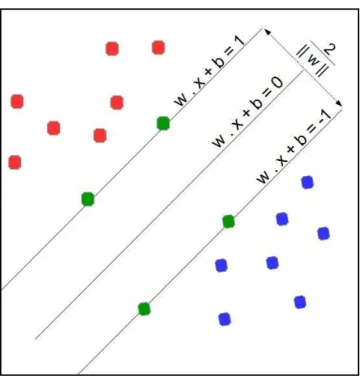
An SVM is a supervised learning algorithm that has been used by researchers on many classification problems. An SVM maps the training dataset vectors in higher dimensional space and then tries to find an optimal separating line (hyperplane) by dividing the vectors into classes. The optimal hyperplane is the hyperplane with the maximum margin; this is done by finding the maximum of (
|| ||) that separates the training data classes. Support vectors are the point in the training data that are needed for determining the maximum margin.
Figure 2.6 outlines SVM determining support vectors, which are the green points. These are needed for finding the maximum margin. As data may not be linearly separable, SVM performs a so-called kernel trick. If SVM cannot find a hyperplane to linearly separate a dataset in R2, it can transform the same data to a higher dimensional space where it can find a separable hyperplane.
Figure 2.6 SVM trained with samples from two classes
green point are the support vectors that used to create the hyperplane to separate the two classes.
K-NN is a simple learning algorithm. It is a supervised learning method used in classification problems. K-NN maps the training input feature vectors X= {𝑥 ,𝑥 ,...,𝑥 } in n-dimensional space, then classifies new data based on the majority class for the k neighbours. k refers to the number of training samples closest to the point of entry.
Figure 2.7 K-NN example with k=5
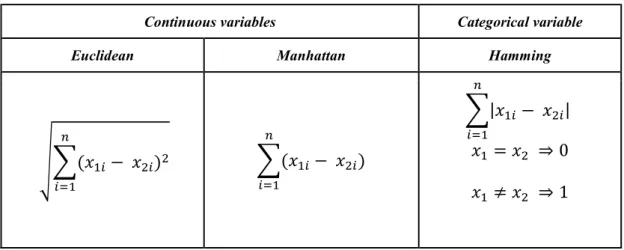
Figure 2.7 shows an example where k=5 K-NN, which means that the K-NN finds five neighbours for the new point. There are multiple metrics for measuring the distance between points X1 = {𝑥 ,𝑥 ,..,𝑥 } and X2 = {𝑥 ,𝑥 ,...,𝑥 }. Choosing the appropriate one is dependent on the type of data. There are multiple metrics to measure distance, such as Euclidean, which is the most commonly used; or the Hamming which is used in the case of categorical data. For example, the distance between 𝑋 𝑎𝑛𝑑 𝑋 can be obtained by the equations in the Table 2.1 below:
Table 2.1 Examples of distance measurement metrics
Continuous variables Categorical variable
Euclidean Manhattan Hamming
(𝑥 − 𝑥 ) (𝑥 − 𝑥 )
|𝑥 − 𝑥 | 𝑥 = 𝑥 ⇒ 0 𝑥 ≠ 𝑥 ⇒ 1
Determining the appropriate k parameter plays a key role in optimising the accuracy of the classifier. Choosing the inappropriate k value could reduce the accuracy of the classifier through data noise or merging group boundaries. Therefore, heuristic techniques are required to obtain an adequate k value. The simplicity of K-NN makes it one of the most common algorithms used in the spam classification problem.
The DT is a classification method that creates a tree structure called a decision tree, appendix C show example of a decision tree model. It breaks down training datasets into smaller groups to produce similarly labelled subsets and determines the most distinctive attributes that can enable the separation of the data into discrete
subsets. DT algorithms commonly rely on entropy and information gain to choose the highest impact to construct the decision tree [72]. Generally, entropy and information gain measure the homogeneity of a subset for each of the candidate’s splitting features. Building a tree requires identifying several key parameters [73], such as the number of features to use, the tree depth [74], and the minimum leaf size. The number of features is given by the dimensionality of the data that is used. The maximum tree depth is the maximum number of consecutive binary decisions that a decision tree is allowed to have. The minimum leaf size is the minimum number of data items that are expected to belong to the data subset associated with any leaf node of the decision tree. If the further splitting of the subset associated with a leaf node results in a leaf node that would have fewer data items associated with it than the minimum leaf size, the splitting does not take place and the node stays as a leaf node.
Each decision tree represents a tree of binary decisions that split subsets of the data into two. At each decision step, the most informative data feature is chosen (according to an informative or importance metric, e.g. information gain) for the subset of the data associated with the corresponding node of the decision tree. The dataset is split into two disjoint subsets according to this feature and two nodes are added to the decision tree, each having one of the two resulting subsets of the data associated with it. When a node is added to the tree, the node is initially a leaf node. If the data subset associated with the node is split further into two subsets, then the node becomes an internal node of the tree. The DT continues to split the training sample until it gets the same labelled dataset or there are no more features left for splitting. The fewer decisions that the model makes the better, as a complex tree could cause overfitting [75].
2.4.4 Ensemble learning algorithms
According to the literature (see Table 5.1), the ensemble learning method is one of the common algorithms and has the best performance. Ensemble learning aims to build machine learning models with better performance by combining several models. In general, researchers [76] have shown that combining several models is more likely to get better prediction than a single model. Many of the recent data science competitions have been won using ensemble method algorithms such as random forest (RF) and XGBoost11 [77], [78].
Bootstrap aggregating (bagging) is an ensemble method that uses a collection of bootstrap data samples to fit multiple models usually from the same algorithm family, such as decision trees [79]. Fitting several models based on different views of the main dataset and then averaging their predictions helps to reduce the instability of the predictions. The bootstrapping method of sampling work involves getting random samples from the original dataset with replacement. Training on different bootstrap samples results in a different learning hypothesis on a certain instance, and by averaging those predictions or opinions, better overall performance can be achieved. This method demonstrates increased effectiveness on noisy data compared to using a singular model because of the random sampling of data [2].
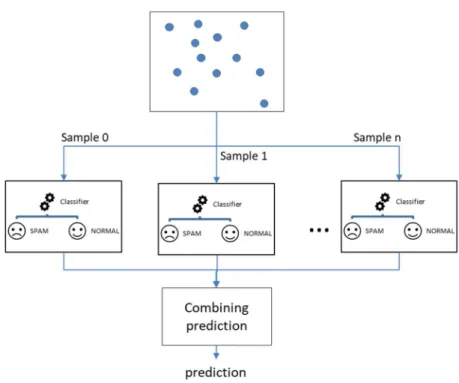
The RF is an ensemble-based classifier, which means that it consists of a collection of sub-models that are used to make a joint decision. RF has several decision tree classifiers. These trees are built using a bootstrapping samples of the full training dataset, which results in potential differences between the trees, as the importance
ranking of features may differ for different trees. The reliance on multiple decision trees to come up with a judgement makes RF classifiers more robust and less prone to overfitting than single decision trees and other non-ensemble methods [80].
Figure 2.8 Random Forest generic mechanism.
The whole dataset is divided into n samples and each sample is used for building a singular DT. Then in the final stage, each model prediction is combined for the
final prediction
RF is one of the well-known examples of a bagging method [79]. Bagging learning methods generally work by having multiple equally weighted base learners, and each learner is trained on a subset of the whole dataset. RF has an additional step to the traditional concept of bagging methods, which is selecting a subset of features instead of using the whole feature list. Predicting new unseen data in the case of RF is conducted by submitting the feature list of the unseen example to all m trees in the forest, getting the prediction results, and then creating a final prediction based on the average of all the trees’ predictions. Compared to a singular decision tree, RF is better at handling noisy data and less prone to overfitting.
Extremely randomised trees [81] is another example of a bagging method. This algorithm has a similar methodology to RF but with some differences in feature set selection and finding the optimal cut-off point. This algorithm differentiates itself from RF as it does not calculate the best feature to be the split node or the split value of the selected features. Therefore, the term ‘extremely random’ refers to the selection of features and the cut-off point.
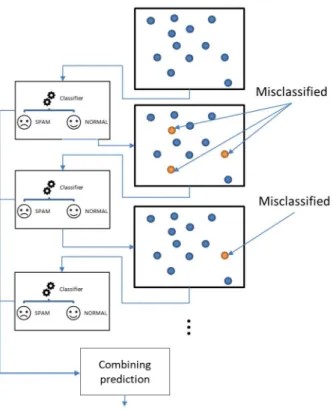
Figure 2.9 Boosting general mechanism
the whole dataset used in all n iterations of the training of boosting models Boosting is an ensemble learning method that aims to improve the performance of a weak model by giving weight to the misclassified instances [82]. A weak model in the context of boosting learning means a model that has no previous guides about the data, so its performance more likely to be low. Boosting works by repeatedly training this weak model on the same training dataset, but in every iteration, the algorithm adds
![Figure 2.3 Supervised machine learning general scheme 9 [65]](https://thumb-us.123doks.com/thumbv2/123dok_us/9749118.2466141/47.892.145.697.162.408/figure-supervised-machine-learning-general-scheme.webp)
![Figure 2.5 Model complexity against testing and training performance [69]](https://thumb-us.123doks.com/thumbv2/123dok_us/9749118.2466141/49.892.140.697.625.1015/figure-model-complexity-testing-training-performance.webp)