SPIE Real-Time Signal Processing XI Conf. San Diego, CA, Aug. 1988
(Proc. SPIE 977, paper 32)
CCD focal plane array analog image processor E-S. Eid and E.R. Fossum
Columbia University, Department of Electrical Engineering New York, New York 10027
ABSTRACT
A focal plane array designed for real-time, general-purpose, image
preprocessing is described. The analog charge-coupled device-based
array operates in the charge domain and has sensing, storing, and
computing capabilities. It captures the image data and performs local
neighborhood operations. The array is digitally programmable and
various image preprocessing tasks can be implemented. It uses a
single instruction, multiple data parallel architecture with one
processing element serving four pixels. It can be programmed to
perform AID conversion prior to output. The ultra-compact image
processor is currently being fabricated with a 3-um, double-poly,
double-metal process. The 48 X 48 pixel array is projected to achieve
an internal throughput as high as 576 Mops with a 54 dB dynamic range
(9-bit equivalent accuracy) and 180 um detector pitch. The total
power aissipation is estimated to be 12 mW or less. The total size of
2 the 59-pad chip is 9.4 X 9.4 mm .
1. INTRODUCTION
Real-time vision in machines requires the synthesis of imaging
hardware, computing hardware, and image processing software. For
mobile robots, the system must be portable. These mobile robots may
be used in the future for underwater inspection, agriculture, space exploration, and transportation, in addition to obvious defense
applications. Thus, the vision system must be lightweight and
low-power as well as having the high throughput necessary for achieving real-time operation.
Image preprocessing tasks can be performed using local neighborhood
operations on image array picture elements (pixels). Generally, these
preprocessing functions consume the greatest portion of time required
by the vision process. In the course of effecting the preprocessing
tasks, each pixel may undergo as many as 100 to 500 simple arithmetic
operations per frame. The frame rate may range from 1 Hz in low speed
systems, to 100 Hz in systems operating on a par with human vision, to
1000 to 10,000 Hz in high performance systems. The number of
operations required in a 100 Hz frame rate system with a modest array size of 100 X 100 pixels easily could exceed hundreds of Mops (million
operations per sec). Advances in very high speed integrated circuits
(VHSIC) may allow serial computing systems to achieve such high
throughput, but a parallel computing approach can be used to alleviate
the performance requirements. Unfortunately, massively parallel
needs of a mobile robot system. Furthermore, the advantages of
massively parallel systems often are offset by the problem of loading and unloading the parallel data from a serial data stream at
sufficiently high data rates.
It has been proposed to perform the image ~reprocessing functions
in ~arallel on the image plane itself (Fossum and Joseph et
al. ). Since the image data arrives in a parallel manner and is
transduced to an electrical form in parallel, i t seems natural to perform spatially-parallel image preprocessing on the image plane as
well. Charge-coupled device (CCD) structures are well-suited for such
a system. The analog nature of the image data can be compactly
represented in the charge domain, requiring a single electrode for
storage. The image data are refreshed at the frame rate, so the
dynamic nature of CCD signal representation is generally not a
concern. Charge-transfer devices already have established themselves
as the technology of choice for image data readout. The difficulty
lies in the design of the charge-domain circuits.
In this paper, the design of a CCD focal plane array analog image
processor is described. The IRET (in real-lime) chip is designed for
real-time, general-purpose, image preprocessing. IRET is currently
being fabricated and estimated performanc
arra e of
ngements for testing i t are IRET is described as well.
being made. The
2. ARRAY ARCHITECTURE IRET was designed
detector array of 48 processing elements
empl X 48 (PEs)
oying a spatially parallel architecture. pixels and a processor array of 24 X 24 are integrated monolithically on IRET.
A The unit cell of the integrated array consists of one PE and a subarray of
2 X 2 pixels. The PE is a set of various computing and communicating
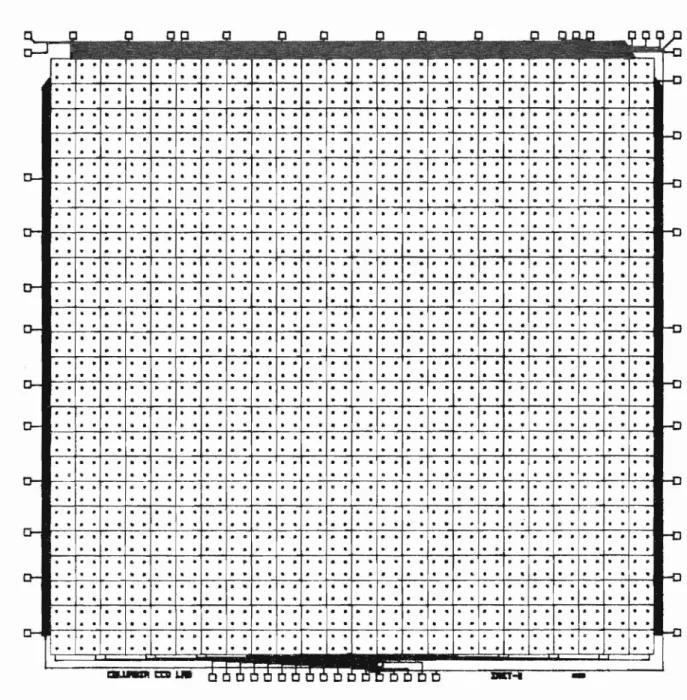
elementE and each PE supports 4 pixels. A partial chip layout
illustrating the array of the p-n junction photodiode detectors is
shown in Fig. 1. The above choices of the sizes of the arrays are of
experimental nature and could be generalized to N X N pixels and M X M
PEs. The size of the subarray of pixels in the unit cell of the
integrated array will be n X n, where n
=
N/M.This architecture has two main features. The first one is the
integration of the sensing and computing elements in the same cell. This makes the otherwise difficult task of communicating between
different elements an easy one. The second main feature is that the
array is desiged with a single instruction, multiple data (SIMD)
architecture. In this approach, each PE in the array carries out the
same instruction, but on a different piece of data depending on the
position of the cell in the array. Each PE does not have to be
ultra-fast to achieve real-time processing as in the case of serial
approaches. A modest clock frequency of 25 MHz and a modest array
size of 24 X 24 PEs achieve a total throughput as high as 576 Mops. The size of the detector subarray supported by each PE, n , is very
significant. Increasing n enhances the "fill-factor", the fraction of
~
.. • • • .. • .. • .. • • • .. • • • II • • • • • • • II • • • • • • • • • • • • • • II • • • • • • • • -.....
...
..·
.
.
..
".
.
...
'" ...
.
...
·
.
.
-0 0 ...
...
.
.
.
.
.
.
0 .
.
.
.
.
.
...
·
..
.
.
.
...
-
"'U ~ o-.~..:.-j"':""_~"':""+=--=+"':""4':""·-4":""-f--.j..:.--=+-·+·':""":"'·+=·-='·+·"':""·~+'-·-='·+=--=+'--+--I"':"""':""t-'--+--+--+--'-t--f-...:...~····
... -~ ...
.
...
·
·
·
kJ
.
.
.
.
.
·
·
·
·
·
....
.
-0 -0 -0 -0Fig. 1. Chip layout (with unit cell circuitry removed) illustrating the detector array.
resolution of the imager. However, n is limited by the throughput of
each PEe A realistic estimate of 1 Mops/PE throughput yields n
=
9with 250 operations per pixel per frame at 50 frames per second. The
unit cell size is estimated to be 495 X 495 um 2 with detector pitch 2
of 55 um and detector area 22 X 22 um . The choice of n
=
2 reducedthe complexity of the design and yielded a unit cell size of 360 X 360 um 2 with detector pitch of 180 um and detector area of 22 X 22
um 2 . A hybrid or "flip-chip" approach can significantly enhance the
fill-factor. The sites of the detectors in Fig. 1 can be viewed as
sites for the flip-chip solder bumps.
CCD technology is the heart of this architecture (Fossum 3 ,4). The capabilities of CCDs enabled integrating sensing, computing, and
storing elements on the same chip. Despite the different functional
orientations of these elements, they are all analog and operate in the
charge domain. There is no need for A/D or D/A conversion between
different stages. CCDs are digitally programmable and so is the array
processor. The compactness of CCDs was essential in achieving high
density layout. The dynamic nature of CCDs is a key factor in the
estimated low power dissipation.
Several tradeoff issues were involved in the design of IRET.
Adopting a spatially-parallel architecture eases the speed requirement for real-time processing but intensifies the real estate requirement. A processor array of practical size has to fit on a single chip, thus
each unit cell has to be ultra-compact. With n
=
9, an array of 250 X2
250 pixels (28 X 28 PEs) will yield a chip size of 14 X 14 mm . The
choice of n
=
2 with a 48 X 48 pixel (24 X 24 PE) array size produced2 a chip size of 9.4 X 9.4 mm .
Another tradeoff issue was connectivity. Programming clock signals
have to reach each unit cell requiring the accommodation of numerous
wires and connections. The requirement of light shielding computing
and communicating elements contributed in making the connectivity
problem more complex. One layer of metal is devoted to light
shielding and the other used for intra-chip wiring. With the help of
two layers of polysilicon, wires and connections occupied as much as 60 % of the chip area.
Read-out was another tradeoff issue. Unlike the array processor,
the output CCD shift register and amplifier interact with a serial
data stream. Real-time read-out requires that the output shift
register and amplifier must be M times as fast as the PEe In case of IRET, the output shift register and amplifier operate at 30 MHz.
Power dissipation was also an issue. High numbers of processors
operate simultaneously and the total power dissipated by the array
must be considered, especially for cooled focal plane arrays. The
choice of a CCD technology, which is capacitive in nature, means that the power scales with operating frequency.
3. UNIT CELL ARCHITECTURE
Each unit cell has a central bus. As shown in Fig. 2, all circuits in the unit cell are connected to the bus through switches.
Communication between different elements in the same unit cell is achieved through the bus by applying a sequence of clock signals to
the switches. Communication between different unit cells is achieved
through a transceiver. The transceiver is a CCD circuit that can be
programmed to transceive signals to or from a horizontal, vertical, or
diagonal nearest neighbor unit cell. A serial-parallel CCD shift
register is used to stack signals coming from the detector subarray. This bidirectional stack can be used for storing purposes.
The unit cell has four CCD computing circuits. Two of them are
differencers similar to that reported by Fossum and BarkerS. One of
them is gated by a magnitude comparator similar to that reported by
Colbeth et al. 6 . The fourth computing circuit in the unit cell is a
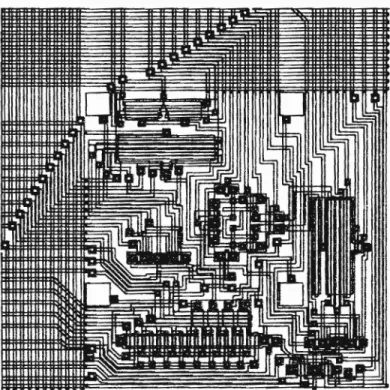
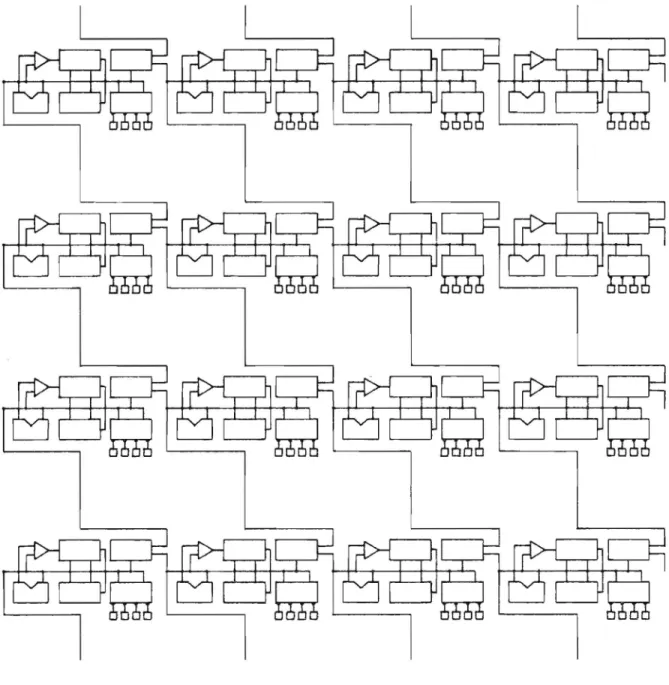
splitter similar to that reported by Bencuya and Steck1 7 . Figure 3
shows the layout of the unit cell and Fig. 4 shows the unit cell interconnect architecture.
4. CAPABILITIES
The basic functions of IRET are: capture of the image data,
performing local neighborhood operations, and output of a serial data
stream that represents the processed image. It performs the local
neighborhood operations using basic arithmetic functions such as
addition, subtraction, splitting, and magnitude comparison. It also
uses conditional addition and subtraction, that is, addition and subtraction conditioned on magnitude comparison.
IRET is a general-purpose image processor. It can be programmed to
implement various image preprocessing tasks, each is a convolution of
the image data array with a kernel. The kernel has a central element
and some surrounding ones. The shape and size of the kernel may
differ depending on the nature of the task.
Level shifting and gain adjustments are examples of simple tasks. In the first task the central pixel of the kernel is shifted
positively or negatively by a fixed level, while in the second one i t
is scaled by a fixed fractional factor. Other examples include
thresholding or bi-level coding, smoothing or weighted averaging, and sharpening or emphasizing the difference between the central pixel and
the surrounding ones. Edge detection is an example of a more
sophisticated task that can be implemented.
Another family of image preprocessing tasks is the frame-to-frame
set of tasks. Frame-to-frame operations can be performed in a similar
manner. An example is a motion detection algorithm which can be
implemented using frame-to-frame difference operation.
IRET can be programmed to perform AID conversion, which is the
generalization of bi-level coding. AID conversion can be performed
.'
OElECTOft SUBARRAY
Fig. 2. Block diagram of the unit cell.
5. PERFORMANCE
IRET is currently being fabricated with a 3-um, double-polysilicon,
double-metal process by a commercial CCD foundry service. The
prediction of the performance of IRET is based on numerical analysis and experimental results of testing a prototype charge-coupled
computer 3 . The assumption that the CCDs will operate with 40 nsec
characteristic clock widths is a conservative one. At most, 25 clock
cycles are needed to execute any of the basic operations. Thus, the
throughput of each PE is estimated to be 1 Mops and the total
throughput of the 24 X 24 PE array is estimated to be 576 Mops. On
the average, 250 operations per pixel per frame are needed to
implement any of the image preprocessing tasks described above. Since each PE supports 4 pixels, 1000 operations per PE per frame are
needed. The 1 Mops per PE throughput yields a frame rate of 1000
frames per sec. This frame rate is high and covers a wide range of
applications. However, IRET will not operate at this high frame rate
because of the relatively limited handling capability of the output
shift register and amplifier. It will operate at a nominal frame rate
of 50 frames per sec, so the nominal clock frequency will be 1.25
MHz. The total throughput at the nominal point of operation will be
28.8 Mops.
The detectors are expected to have a 60 dB dynamic range (la-bit
equivalent accuracy). At 250 operations per pixel per frame, the
total noise associated with computation is of the same order of magnitude as the noise associated with sensing the image data (shot
noise). Thus, the overall dynamic range is estimated to be 54 dB
(9-bit equivalent accuracy).
CCDs are designed to have a maximum signal of one million electrons
per pixel. On the average, they are estimated to consume 0.8 pJ per
transfer at 10 V clock voltage swing. At the nominal operating point,
the clock frequency is 1.25 MHz and the 24 X 24 PEs are expected to
dissipate 0.6 mW. At full operation, the clock frequency is 25 MHz
and total power dissipation is estimated to be 12 mW. 6. CONCLUSIONS
The design of a CCD focal plane array analog image processor chip
(IRET) has been described. The capabilities of IRET to implement
various real-time image preprocessing tasks have been theoretically demonstrated and its performance has been predicted. It features high throughput, programmability, compactness,· and low power dissipation.
7. ACKNOWLEDGMENTS
The authors wish to gratefully acknowledge discussions with R.E. Colbeth, S.E. Kemeny, and J-I. Song of Columbia University and the assistance of Dr. R. Bredthauer of Ford Aerospace, Newport Beach,
California, in the fabrication of IRET. This work was supported by an
NSF Presidential Young Investigator Award and the NSF Center for Telecommunications Research at Columbia University.
8. REFERENCES
1. E.R. Fossum, Charge-Coupled Analog Computing Elements and Their
Application to Smart Image Sensors, Ph.D. thesis, Yale University (1984).
2. J.D. Joseph, P.C.T. Roberts, J.A. Hoschette, B.R. Hanzal, and J.C. Schwanebeck, "A CCD-based parallel analog processor," in
State-of-the-Art Imaging Arrays and Their Applications, K.N. Prettyjohns, ed., Proc. SPIE 501, 238-241 (1984).
3. E.R. Fossum, "Charge-coupled computing for focal plane image preprocessing," Opt. Eng. 26(9), 916-922 (1987).
4. E.R. Fossum, "Charge-domain analog signal processing for detector arrays," to be published in Nuclear Instruments and Methods A.
5. E.R. Fossum and R.C. Barker, "A linear and compact
charge-coupled charge packet differencer replicator," IEEE Trans. Electron Devices ED-31(12), 1784-1789 (1984).
6. R.E. Colbeth, N.A. Doudoumopoulos, E-S. Eid, S.E. Kemeny, A. Montalvo, and E.R. Fossum, "High performance charge packet comparison for analog CCD applications," Columbia University, CTR Tech. Rep.
(1987).
7. S.s. Bencuya and A.J. Steckl, "Charge packet splitting in charge domain devices," IEEE Trans. Electron Devices ED-31(10), 1494-1501