1 2 3 4 5 6 7 8 9 10 11 12 13 14 15 16 17 18 19 20 21 22 23 24 25 26 27 28 29 30 31 32 33 34 35 36 37 38 39 40 41 42 43 44 45 46 47 48 49 50 51 52
Students' Understanding of Astronomical Concepts Enhanced
by an Immersive Virtual Reality System (IVRS)
Heebok Lee*1, Sang-Tae Park1, Hee-Soo Kim1, and Heeman Lee2
1 Institute of Science Education, Kongju National University, Kongju 314-701, Korea
2 School of Computer & Information Communication, Seowon University, Cheongju 361-742, Korea
This study describes that an immersive virtual reality system (IVRS) enhances secondary students' con-ceptual development of the basic astronomical phenomena. Our IVRS is a immersive 3D virtual reality environment based on high resolution spacecraft images of the solar system's planetary objects (i.e. planets, moons, asteroids etc.). These objects revolve in their orbits against the constant background of the Milky Way and the stars. The solar system can be scaled-down and up with great accuracy. The student can change his/her viewpoint using computer mouse. The IVRS has a dynamic frame of reference, which can be altered by choosing different objects. This IVRS system offers a new visual learning experience, which has not been systematically studied yet. Twenty-two undergraduate students participated in the sur-vey. The survey results indicate that many students had positive opinions on VSS for using it in their class; and they thought the teaching methods contributed their understanding more effectively. From the assessment we can infer the IVRS are very useful as teaching materials especially in case of highly inter-active visualization of spatiotemporal concepts such as astronomic definitions.
Keywords astronomical concepts; immersive; virtual reality
1. Introduction
A number of different studies have shown that visual realism in Virtual reality (VR) applications must be used with care especially for education. It is not certain that an increased level of realism will improve learning environment since it may distract the learner from focusing on the subject that is to be learned. However, the motivational value of excessive visual realism is very high, something that the motion picture and computer games industries have been taking advantage of for decades. How to use realism in order to highlight key relations and concepts in educational VR applications is still an open question. VR systems have the potential to allow learners to discover and experience objects and phenomena in ways that they cannot do in a limited learning environment. Since the early 1990s, a large number of educational VR applications have been developed. These include tools for teaching physics [1-2], alge-bra [3], color science [4], cultural heritage objects [5], and the greenhouse effect [6]. There is convincing evidence that one can learn from educational VR systems [7]. However, a number of unresolved issues regarding the efficiency of such systems still remain. Virtual reality (VR) techniques offer immersive environments in which the user has great possibilities of interaction.
This study describes that an immersive virtual reality system (IVRS) enhances middle-school students' conceptual development of the basic astronomical phenomena. Our IVRS is an immersive 3D virtual reality environment based on high resolution spacecraft images of the solar system's planetary objects (i.e. planets, moons, asteroids etc.). These objects revolve in their orbits against the constant background of the Milky Way and the stars. The solar system can be scaled-down and up with great accuracy. As a result, the design of IVRS often encourages students’ free-choice learning and discovery. How-ever, the goal for adapting IVRS is enhancing school educational environment and not intending to re-place the traditional one. This study demonstrates that interacting with a dynamic representation such as solar system might help students to understand spatiotemporal concepts easily without detail explanation.
1 2 3 4 5 6 7 8 9 10 11 12 13 14 15 16 17 18 19 20 21 22 23 24 25 26 27 28 29 30 31 32 33 34 35 36 37 38 39 40 41 42 43 44 45 46 47 48 49 50
2. VRML based learning environment
The most important feature of VR system is the immersion. So the immersive characteristics of virtual reality learning environment (VRLE) utilize role playing and learning by highly interactive experience for study subjects. To enhance immersion, we can wear stereo glasses to see the 3D images shown on the wide polarized screen or we can use 3D head mounted display (HMD).
Several different authors have shown that immersive VR, where the learner is in a CAVE or wears a HMD, can be more efficient than monitor based desktop VR [8]. Unfortunately, these immersive VR systems are expensive, fragile, and can be cumbersome to use. These drawbacks make them hard to utilize for larger groups of learners. It also means that they are hard to integrate into existing school envi-ronments where resources are limited. Desktop VR systems, however, can often run on standard PC hardware, equipment that is increasingly common in homes and in classrooms today. Also, learners us-ing desktop VR systems are less likely to experience motion sickness and fatigue such factors that are known to inhibit learning [9]. It is unclear whether the advantages of desktop VR systems can make up for their lack of immersion.
VRML is a scripting language developed by SGI and its initial 1.0 specification was published in No-vember 1994 [10]. Since it is easy to learn and apply to practical problems, VRML is used by more and more users. And nowadays, VRML has already established itself as the standard for the exchange of 3D format for the distribution of virtual world on the Internet.
VRML describes 3D models in the form of ‘nodes’. Nodes generally define 3D physical descriptions that may be made up of 3D primitives, such as spheres, cube, cones, and cylinders, or of complex poly-hedron composed of polygon facets. In addition to these form descriptions, nodes can also define materi-als, colors, texture maps, lighting, shape transformations, and viewing criteria.
We can rotate and translate the 3D models, or ‘fly’ to any region we are interested in. However, for science education, more interactions involving dynamic models, huge scale objects such as solar system, microscopic world such as organs in humans, and abstractive subjects such as gravitational field are very useful and need to be implemented. In VRML 2.0/X3D, dynamic scenes are supported, and the possibil-ity of more complex methods, such as volume rendering, can be controlled by external and highly port-able scripts.
3. Our system features
Our VRLE is a highly immersive environment supporting VRML with highly immersive 3D surround sound system. The virtual solar system reviewed in our study is an IVRS based on high-resolution space-craft images of the solar system, including the sun and the planetary objects. It was developed as part of a comprehensive astronomy education program aimed at secondary school students or undergraduate students. The objects revolve in their orbits against the constant background of the Milky Way and the stars. The solar system was scaled down and calibrated with great accuracy. A student can use the point-ing device to change his/her viewpoint while ‘flypoint-ing’ in 3D astronomical space. The virtual solar system has a dynamic frame of reference, which can be altered by choosing different objects as an origin. Our main goals were to describe and analyze the conceptual development of secondary school students' un-derstanding of the basic astronomical phenomena during real-time interaction with a virtual solar system. Fig. 1 is our VRLE system structure and specifications. A photo for our VRLE system is shown in Fig. 2.
1 2 3 4 5 6 7 8 9 10 11 12 13 14 15 16 17 18 19 20 21 22 23 24 25 26 27 28 29 30 31 32 33 34 35 36 37 38 39 40 41 42 43 44 45 46 47 48 49 50 51 52
Fig. 1 System structure and specifications
®NOVA Infinity software (Based OpenGL 1.2 )
Provide a full Compatibility with VRML97 Microsoft Window 2000 Professional
1 Master, 2 Slave computer system (®VisionMax)
Intel P4 2.53GHz Geforce4 Ti4600 V8486
3D Sound & Distinguish direction and distance 350 inch Silver screen
4 projectors (for 2(Right, Left) × 2(wide screen)) Overlapped Channel Display for Soft Edge Blending Spacecraft Interior
Vibrating floor
®Dolby surround system
4. Our solar system
Fig. 3 is photos of our virtual solar system (VSS). VSS program was designed by authors for our im-mersive 3D virtual reality system. The 3D planet images were taken by NASA. The planets in VSS fol-low exact their orbits given by an astronomical almanac. The orbits also folfol-low physics law such as Ke-pler's laws regardless of user's inputs.
The VSS enables high levels of interactivity. The computerized frame of reference affords four differ-ent observation modes such as zooming in and out, or flying around the chosen object. Altogether with the ability to alter the points of view, users can navigate from one planet to the other by flying, by taking rocket, or just sitting on one of planet or satellite for observing other planet’s orbits. Additionally, the VSS program provides details of astronomical information whenever students need them during their class activities. Unlike any real environment, the VSS space can be manipulated in numerous ways. Students can play game such as space race, explore other planet in economic way, etc. This dynamic visual frame of reference enables a new learning experience. The students can pretend to be an astrono-mer.
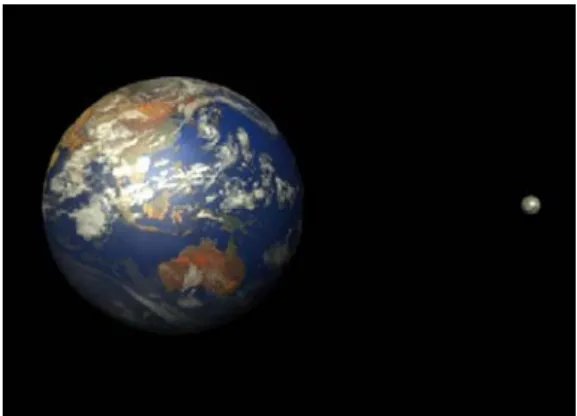
Fig. 2 Our immersive virtual reality. Fig. 3 A scene of the Moon and the Earth in Virtual Solar System.
1 2 3 4 5 6 7 8 9 10 11 12 13 14 15 16 17 18 19 20 21 22 23 24 25 26 27 28 29 30 31 32 33 34 35 36 37 38 39 40 41 42 43 44 45 46 47 48 49 50
5. Survey results
We selected twenty two undergraduate students who are majoring in science education at the college of education in Kongju national university of Korea to survey their opinions of our IVRS system for the pedagogical effectiveness. The subject of the assessment was for our VSS programs. The students were supposed to learn about the Earth and the Moon system and the characteristics of their orbits in the sub-ject of introduction to the earth science. After presenting the VSS and class activity, we tested the stu-dents' knowledge improvement and surveyed the stustu-dents' opinions on the VSS program and IVRS sys-tem.
The survey results of students' responses about the course work are shown in Fig. 4. We asked students the following questions. (a) Do you think the teaching materials were useful in helping you to understand the subject? (b) Do you think the class hours were sufficient? (c) Do you understand the subject? (d) Did you like the teaching methods? The survey results indicate that many students had positive opinions on VSS for using it in their class; and they thought the teaching methods contributed their understanding more effectively. From the assessment we can infer the IVRS are very useful as teaching materials espe-cially in case of highly interactive visualization of spatiotemporal concepts such as astronomic defini-tions. This enriching experience could cause high levels of cognitive load. These findings have signifi-cant bearing on our understanding of the potential and pitfalls of learning via virtual reality environ-ments. 4 3 .2 5 1 .6 5 .2 0 2 0 4 0 6 0 8 0 1 0 0 Agree C o m m o n D isagree 0 8 4 .5 1 5 .5 0 2 0 4 0 6 0 8 0 1 0 0 Agree C o m m o n D isagree (a) (b) 5 0.9 4 2 .4 6 .7 0 20 40 60 80 1 00 Agree C o m m on D isagree 5 7 .7 3 8 .3 6 0 2 0 4 0 6 0 8 0 10 0 Agree C om m o n D isagree (c) (d) Fig. 4 The survey results of students' opinions on the VSS program and IVRS system.
6. Conclusion
This paper presents VSS programs and IVRS system which may enhance students' understanding by providing a high degree of reality within rich interactive learning environments. We have developed
1 2 3 4 5 6 7 8 9 10 11 12 13 14 15 16 17 18 19 20 21 22 23 24 25 26 27 28 29 30 31 32 33 34 35 36 37 38 39 40 41 42 43 44 45 46 47 48 49 50 51 52
our VSS program and IVRS system. The survey results also indicate that many students were satisfied and felt that they can understand better with VSS program. They were more interested in the IVRS sys-tem than any other teaching materials. This new kind of learning environment should be accompanied with suitable pedagogical study on each subject. Moreover, designing virtual environments should in-clude orientation and navigation tools in order to empower learners' perceptual and cognitive system.
Acknowledgements This work was supported by a Korea Research Foundation grant (KRF-2001-005-C00034).
References
[1] Jong-Heon Kim,Sang-Tae Park, Heebok Lee, Keun-Cheol Yuk, and Heeman Lee, Virtual Reality Simulations in Physics Education, IMEJ(Interactive Multimedia Electronic Journal of Computer-Enhanced Learning, http://imej.wfu.edu/articles/2001/2/02/), 2-02 (2001)
[2] C. Dede, MC. Salzman, RB. Loftin, Science Space: Virtual realities for learning complex and abstract scientific concepts. In: Proceedings of IEEE VRAIS ’ 96, March 30.April 3, Santa Clara, CA, USA, 1996, pp. 246. [3] W. Bricken, Spatial representation of elementary algebra. In: Proceedings of 1992 IEEE Workshop On Visual
Languages, September 15.18, Seattle, Washington, USA, 1992, pp. 55.
[4] PA. Stone, BJ. Meier, TS. Miller, Simpson RM., Interaction in an IVR museum of color. In: Proceedings of ACM SIGGRAPH ’ 00 Educators Program, July 23.28, New Orleans, LA, USA, 2000, pp. 42.
[5] N. Terashima, Experiment of virtual space distance education system using the objects of cultural heritage. In: Proceedings of 1999 IEEE International Conference on Multimedia Computing and Systems, vol. 2, June 7.11, Florence, Italy, 1999, pp. 153.
[6] RL. Jackson, Peer Collaboration, virtual environments: a preliminary investigation of multi-participant virtual Reality applied in science education. In: Proceedings of ACM 1999 Symposium on Applied Computing, Febru-ary 28.March 2, San Antonio, TX, USA, 1999, pp. 121.
[7] W. Winn, The impact of three-dimensional immersive virtual environments on modern pedagogy, University of Washington, HITL, Report no. R-97-15 (1997).
[8] P. Cronin, Report on the applications of virtual reality technology to education. HRHC, University of Edinburgh, February http://www.cogsci.ed.ac.uk /Bpaulus/vr.html (1997).
[9] C. Dede, M. Salzman, RB. Loftin, K. Ash, Using Virtual reality technology to convey abstract scientific con-cepts. In: Jacobson MJ, Kozma RB, editors. Learning the sciences of the 21st century: research, design, and implementing advanced technology learning environments. London: Lawrence Erlbaum (1997).
[10] G. Bell, A. Parisi, M. Pesce, The virtual reality modeling language. Ver 1.0 specification. Available at http://www.web3d.org/x3d/specifications/vrml (1994).