Abstract
This toolkit is intended to provide a concise but thorough resource for social protection practitioners on how to minimize error, fraud and corruption in their program(s). It is organized in five sections. The first section introduces the topic, by clarifying the key concepts and spelling out the rationale for this activity. The second section provides a generic framework for combating EFC, developed around four building blocks of prevention; detection; deterrence; and measurement. The third section reviews the instruments, tools and mechanisms used to combat EFC in social protection programs, structured by strategic actions (prevention; detection; deterrence), by level of government and over time (how these tools and instruments can be developed over time). Section four includes generic terms of reference for the assessment of the mechanisms for combating error, fraud and corruption (EFC) in social protection programs. The last section summarizes the main findings for three such diagnostics from the Kyrgyz Republic and the Ukraine.
HUMAN DEVELOPMENT NETWORK
About this series...
Social Protection Discussion Papers are published to communicate the results of The World Bank’s work to the development community with the least possible delay. The typescript manuscript of this paper therefore has not been prepared in accordance with the procedures appropriate to formally edited texts. The findings, interpretations, and conclusions expressed herein are those of the author(s), and do not necessarily reflect the views of the International Bank for Reconstruction and Development / The World Bank and its affiliated organizations, or those of the Executive Directors of The World Bank or the governments they represent. The World Bank does not guarantee the accuracy of the data included in this work.
Toolkit on Tackling Error, Fraud
and Corruption in
Social Protection Programs
Christian van Stolk
Emil D. Tesliuc
S P D I S C U S S I O N P A P E R
March 2010
NO. 1002
Public Disclosure Authorized
Public Disclosure Authorized
Public Disclosure Authorized
Public Disclosure Authorized
Toolkit on Tackling Error, Fraud and
Corruption in Social Protection Programs
CHRISTIAN VAN STOLK
RAND EUROPE
EMIL D. TESLIUC
THE WORLD BANK
Abstract
Because Social Protection (SP) and Social Safety Net (SSN) programs channel a large amount of public resources, it is important to make sure that these reach the intended beneficiaries. Error, fraud or corruption (EFC) reduces the economic efficiency of these interventions by decreasing the amount of money that goes to the intended beneficiaries, and erodes the political support for the program. While no program is immune to EFC, evidence from developed countries demonstrates that such leakage can be brought to negligible levels. In five OECD countries this fraction is between 2-5% for the SP sector as a whole. For SSN programs, which use more complex eligibility criteria and hence are more prone to EFC, this fraction is 10%. To achieve these results, programs have implemented a number of measures
reviewed in this note. In contrast, efforts to combat or even measure EFC are quite rare in developing countries, although some programs are plagued by it.
This toolkit is intended to provide a concise but thorough resource for social protection practitioners on how to minimize error, fraud and corruption in their program(s). It is organized in five sections. The first section introduces the topic, by clarifying the key concepts and spelling out the rationale for this activity. The second section provides a generic framework for combating EFC, developed around four building blocks of prevention; detection; deterrence; and measurement. The third section reviews the instruments, tools and mechanisms used to combat EFC in social protection programs, structured by strategic actions (prevention; detection; deterrence), by level of government and over time (how these tools and instruments can be developed over time). Section four includes generic terms of reference for the assessment of the mechanisms for combating error, fraud and corruption (EFC) in social protection programs. The last section summarizes the main findings for three such diagnostics from the Kyrgyz Republic and the Ukraine.
JEL Classification: I38, H53, H75, H83, G28, D73
Contents
Table of Figures and Tables ... v
CHAPTER 1 Introduction ... 1
1.1 What is the structure of the toolkit? ... 1
1.2 Why focus on error, fraud, and corruption in social protection programs? ... 2
1.3 How are error, fraud, and corruption defined? ... 3
1.4 What is the difference between EFC and targeting error? ... 4
1.5 What is an acceptable level of EFC in social protection programs? ... 4
1.6 What are the main causes of EFC? ... 6
1.7 What is the scope of this toolkit? ... 7
1.8 How should this toolkit be applied? ... 8
1.9 For which social protection programs is this toolkit relevant? ... 8
CHAPTER 2 A framework for combating EFC ... 10
2.1 What are the main elements of a strategy to combat EFC?... 10
2.2 What is needed to implement the strategy? ... 11
2.3 How can the strategy be adapted to country or program circumstances? ... 13
CHAPTER 3 Tools and instruments used to combat EFC ... 15
3.1 What are the main instruments to combat EFC per aspect of the strategy? ... 15
3.2 Are there specific instruments for tackling EFC respectively? ... 20
3.3 How do OECD instruments aimed at mitigating EFC develop over time? ... 20
3.4 How are the OECD instruments to mitigate EFC currently applied in less developed countries? ... 22
3.5 What are the main instruments to combat EFC per level of government? ... 24
3.6 How does this approach on EFC control inform other diagnostic initiatives? ... 24
CHAPTER 4 Terms of references for a diagnostic assessment in client countries ... 27
4.1 What are the key questions to be asked? ... 27
4.2 What type of data collection takes place? ... 27
4.3 Who are the key informants in this diagnosis? ... 28
4.4 How are recommendations arrived at? ... 28
4.5 What should the composition of the team be? ... 28
4.6 What are the costs of the diagnostic mission?... 29
5.1 Ukraine ... 31
5.1.1 What is the problem of EFC? ... 31
5.1.2 What type of EFC mitigation is in existence? ... 31
5.1.3 What can be done to improve EFC mitigation? ... 32
5.1.4 What has been the impact of the diagnosis? ... 33
5.2 The Kyrgyz Republic ... 34
5.2.1 What is the problem of EFC? ... 34
5.2.2 What type of EFC mitigation is in existence? ... 34
5.2.3 What can be done to improve EFC mitigation? ... 35
5.2.4 What has been the impact of the diagnosis? ... 36
5.3 Bangladesh ... 36
5.3.1 What is the problem of EFC in the Employment Generation Program? ... 36
5.3.2 What type of EFC mitigation is in existence? ... 37
5.3.3 What can be done to improve EFC mitigation? ... 37
5.3.4 What has been the impact of the diagnosis? ... 38
5.4 EFC in Conditional Cash Transfer Programs in Latin America and the Caribbean ... 38
Resources ... 41 5.5 United Kingdom ... 41 5.5.1 Australia ... 41 5.5.2 Canada ... 42 5.5.3 France ... 43 5.5.4 Ireland ... 43 5.5.5 The Netherlands ... 44 5.5.6 New Zealand ... 45 5.5.7 Sweden ... 46 5.5.8 USA ... 46 APPENDICES ... 49
Appendix A: Template for case study ... 51
Appendix B: TOR and work program for the World Bank mission in the Kyrgyz Republic ... 55
Appendix C: Program design and management with EFC lenses ... 59
Appendix D: Approach to measuring fraud and error in the United Kingdom ... 61
Appendix E: Job descriptions of officials in the UK ... 62
Table of Figures and Tables
Figure 1: Typology of fraud and error in benefit systems ... 3
Figure 2: A comparison of fraud and error rates in 5 OECD Countries ... 5
Figure 3: A strategic framework to control EFC ... 11
Figure 4: EFC oversight mechanisms per level of government ... 24
Table 1: Main instruments per aspect of the strategy ... 18
Table 2: A view on the development of EFC strategies in OECD countries over time ... 21
Table 3: Good practice of oversight and control mechanisms from the Latin America region ... 23
Table 4: Assessing control and accountability mechanisms in a CCT ... 26
CHAPTER 1
Introduction
1.1
What is the structure of the toolkit?
The report has five main substantive sections based on the terms of references drown up. These are: (i) Introduction to the topic:
• Why it is important to focus on reducing and monitoring EFC • Definitions (error, fraud, corruption, other specialized terms) • What is the difference EFC and targeting error
• What is a reasonable level of EFC
• Scope of the work (what this diagnostic tool includes and excludes) • Type of programs and countries where this toolkit is applicable (ii) Generic framework for combating EFC
• Main elements of the strategy to combat EFC (prevention; detection; deterrence; measurement)
• Set of instruments, tools, mechanism to implement the strategy • Adapting the strategy to country/program circumstances
(iii)Instruments, tools and mechanisms used to combat EFC in social protection programs • What are the tools structured by strategic action (prevention; detection; deterrence) • Are there specific tools for EFC respectively
• How have they developed over time and been used in less developed countries • Structured by level of government (see Annex 1)
(iv)TORs for the Diagnostic toolkit for the assessment of the mechanisms for combating error, fraud and corruption (EFC) in social protection programs. The TORs will include:
• Key questions to be addressed
• Suggested composition of the team (key qualification of the consultants); • Data collection techniques
• Key informants
• Estimated time & costs, based on the work in the Kyrgyz Republic and the Ukraine (v) Examples:
• Thumbnail sketch of the country reports for the Kyrgyz Republic and the Ukraine 1.2
Why focus on error, fraud, and corruption in social protection programs?
Social protection programs channel a large amount of public resources to targeted beneficiaries. Even a small fraction of misappropriated benefits may add up to large sums of money with high opportunity costs. On average, social protection spending represents 15.7% of GDP in developed countries, 7.4% in middle-income countries (MICs) and 3.8% in low-income countries (LICs).1
A 2006 international benchmark study on fraud and error in social security systems written by RAND Europe for the UK National Audit Office (NAO) puts the range of fraud and error in social protection systems where data was available between two to five percent of overall government expenditure on social security.
Each social protection program aims to provide the right amount of benefit to the right recipient on time. However, the evidence shows that no social protection program is immune from error, fraud, and corruption (EFC).
2
In all countries, error, fraud and corruption (EFC) also present significant challenges to the integrity of social protection systems. A higher prevalence of EFC can be associated with:
Thus, losses to the social protection system can be considerable. For instance, in the UK over £2 billion (around US$3.2 billion) of government expenditure is lost on an annual basis due to fraud and error.
• An inefficient use of public resources; • Availability of fewer funds to the poor; • A loss of credibility of the program; • Political manipulation of the funds; and • A decrease in public support for the program.
EFC is likely to be more prevalent in social protection programs of less developed countries as a proportion of overall spending compared to OECD countries due in part to the limited administrative capacity, absence of adequate monitoring of the overall problem and clear evidence-based strategies to combat EFC.
1 World Bank 2007 FEC SSN Primer note.
1.3
How are error, fraud, and corruption defined?
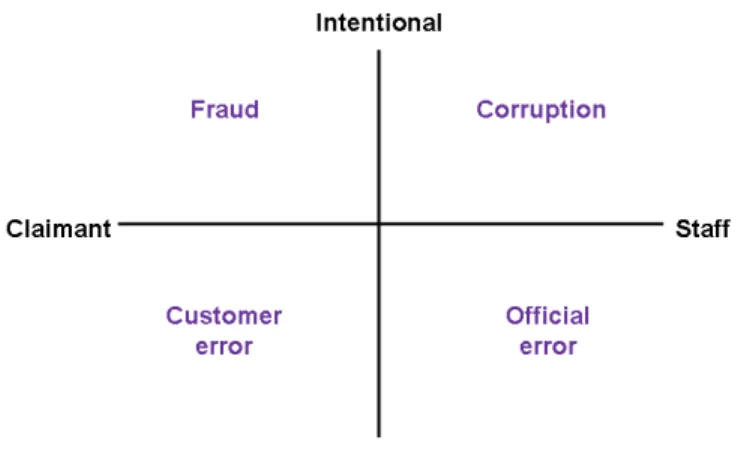
This toolkit looks at misappropriations under the rules of a social protection program. These misappropriations are due to fraud, error or corruption (see Figure 1):3
Figure 1: Typology of fraud and error in benefit systems
Source: RAND Europe
Fraud refers to intentional behaviour on the part of the benefit claimant to defraud the benefit system. The main causes of fraud are benefit claimants being deliberately dishonest on benefit forms, claimants deliberately exploiting the system by providing a false identity and the complexity of the benefit system, which offers opportunities and incentives for claimants to defraud the system.
Error refers to unintentional mistakes on behalf of benefit claimants or staff in the benefit office. Some causes of error are the absence of staff training, the failure of systems to process or pay benefits applications, and again the complexity of the benefit system, which means that customers and staff can make mistakes in dealing with complex or complicated processes.
An intentional attempt by staff to exploit the social protection system is called corruption. In many OECD countries, corruption is seen as a low risk due to the integrity measures built into the system for processing and paying out benefits (for instance separation of functions and IT systems) as well as factors such as proper staff training, results-based management and eligibility requirements for benefit claimants. This risk is likely higher in the middle to low income countries, due to weaker systems for audit, oversight and control, and the relatively low pay of the social protection workers.
For a definition of error, fraud and corruption used in the UK, see Appendix G.
1.4
What is the difference between EFC and targeting error?
The notion of error (and fraud and corruption) used in the toolkit is distinct from the notion of targeting error (as typically used, for example, in the World Bank). The two concepts refer to different aspects of program design and implementation.
Targeting error is often used to indicate the fraction of program funds or beneficiaries of a social protection program that are not reaching the poor. Concerns about targeting errors are important for a subset of social protection programs, i.e. safety net program with anti-poverty objectives, such as last-resort programs, workfare programs or conditional cash transfer programs. The extent of targeting errors indicates whether the program achieves its (poverty alleviation) objective or not. These errors may be due to program design (when, for administrative feasibility, the program uses imperfect poverty proxies to identify poor beneficiaries) and to program implementation (when eligibility decisions diverge from the program rules). The later errors are, in turn, due to error, fraud or corruption.
For other types of social protection programs that have other primary objectives than poverty alleviation (for example, pensions, unemployment insurance or other social insurance programs), targeting errors are less relevant.
In contrast, concerns about error, fraud and corruption apply to all social protection programs, and indicate the extent to which the program is compliant with its own rules.
Consequently, one can find a social safety net program which is well targeted although it has some level of EFC. This is the case of an income-tested program with a lower eligibility threshold (say, $10) than the poverty line (say, 20$). If half of its beneficiaries would have incomes below $10, and the other half between $10 and $20, the program will have perfect targeting (all beneficiaries are poor) but 50% of the caseload will be affected by error, fraud and corruption.
More often, one can find SSN programs with high targeting errors but low levels of EFC. For example, an universal child allowance program may be put in place with the objective of alleviating poverty in a country where there is a strong correlation between the number of children and poverty status, and the Government lacks the administrative capacity to test who is income poor or not. For example, one third of the population may be poor, but two thirds of the children may be living in poor (and larger) families. In this case, a third of the program caseload is targeting error. If the government can test, however, whether those who receive the program are in the correct age brackets, then the level of error, fraud and corruption would be zero.
1.5
What is an acceptable level of EFC in social protection programs?
The evidence in OECD countries shows that some level of fraud and error in the social protection system is unavoidable. A 2006 UK NAO study found that fraud and error rates in five OECD countries – the UK, Canada, Ireland, New Zealand and the USA –ranged between 2% and 5% of overall expenditure on social protection programs (Figure 2). Within the social protection system, means-tested social protection programs had the highest fraud and error rates (5-10%), followed by
unemployment benefit and disability pension programs (1-2%). Old-age pensions had the lowest rates (0.1-1%). These figures should be interpreted as the lower bounds for the amount fraud and error rates, as they come from a small sample of countries and programs with high administrative capacity, with adequate procedures to minimise EFC, including in many cases procedures for estimating the level of fraud and error with reasonable accuracy.
Figure 2: A comparison of fraud and error rates in 5 OECD Countries
As % of expenditure/payments UK Canada Ireland New Zealand USA (2004-2005) (1994, 2003) (2004) (2001) (2003)
Total Fraud and Error 2.3% 3-5% ('94) - 2.7% -
Fraud and Error in Housing Benefit 5.2% - - - 3.6% Fraud and Error in Income Support 5.3% 3.5% ('03) - - 5.07% Fraud and Error Old Age,
Disability 4.9%, 0.1%, 1.9% 2 - 7% - 0.53%
Source: NAO (2006) Notes:
1
Comparisons are difficult as benefit types differ between countries. This table shows rates for the following benefits. The Income Support benefit for Canada and the US is Unemployment Insurance. In the category, Old Age and Disability, the benefit in Ireland is Disability Allowance and in the US Old Age, Survivors and Disability. Also measurements vary. Rates for the UK refer to fraud and error as % of total expenditure. Rates for Canada (‘03) refer to the total savings identified as a percentage of total payments. Ireland measures fraud and error as a percentage of expenditure for specific benefit types. New Zealand estimates this percentage as the number of cases sampled that contained errors, which led to benefits being paid incorrectly. The USA measures the total value of improper payments per benefit type.
2
These rates are for Pension Credit, Retirement Pension, and Disability Living Allowance respectively.
The information from developing countries is scarcer, as only few programs and countries have taken measures to combat and/or measure the incidence of EFC. However, it is plausible to expect the share of funds affected by EFC be larger compared to developed countries. For example, in India a Government audit in 2003 found that 31.6% of IAY (housing programs) and 53.5% of SGSY (credit program) funds did not reach the intended beneficiaries. In the case of the SGRY, an employment program, administrative data report that 31.3 million man-days of work were generated in 2001-02, while the National Sample Survey data for 2002-03 estimate this number as less than 3 million man-days, only 10% of the official figure.
Three points can be made about EFC in developed and developing countries:
(1) Across SP programs, the share of funds affected by EFC is larger in SSN programs, due to their inherent design features. Eligibility for these programs is often based on the economic position of the household, which is more difficult to assess and harder to verify than, for example, for an old-age pension where all you need is proof of past contribution and age. Because SSN programs are more narrowly targeted to poorer households and poverty status changes over time, eligibility also changes over time. The responsibilities for implementing SSN programs are often shared across different departments, agencies, and levels of government. All these factors increase the risk that benefits do not reach intended beneficiaries in time or in the correct amount. Having
the right instruments and tools to minimize EFC is thus more important for SSN programs, although there are economies of scale when the efforts to combat EFC cover the whole set of SP programs.
(2) The level of EFC is likely correlated with the institutional capacity of the country and implementing agency. One would expect to find more EFC in LICs and MICs than developed countries. However, evidence is scarce as very few programs or countries measure the level of EFC using comprehensive, unbiased measurement tools.
(3) In developed countries there is a much greater concern about error and fraud, while developing countries worry more about corruption. For example, none of the 9 OECD countries reviewed in NAO (2006) explicitly reported issues around corruption of departmental staff. It seems a small problem for administrators in these countries. Reasons could include a strict separation of functions (e.g. between payments and assessments, between decision-making and investigations and reviews), staff training and management, effectiveness of internal audit and the integrity of systems processing payments. In contrast, corruption is often the lead concern in developing countries.
1.6
What are the main causes of EFC?
A wide range of causes for fraud are identified in and some of the pilot work. This section highlights some of the main causes. They are presented by main area.
Fraud
• Customer dishonesty: This includes undeclared income and failing to report changes in material circumstances;
• Exploiting the system: This includes multiple program claims and misrepresentation of material circumstances and identity fraud; and
• Complexity of the social protection system: This includes cross-jurisdictional claims and complexity of rules and regulations.
Error
• Staff: This includes excessive staff caseloads, inadequate support and training of case managers and team coaches, breakdown or override of internal control;
• System: This includes the failure of payment system, failure of IT systems, problematic information management, and inadequate monitoring or reporting procedures; and
• Complexity: Complexity of benefits and rules confuse administrators and benefit claimants.
Corruption
Corruption is not reported as a particular problem in OECD countries. The pilot missions in the Kyrgyz Republic, Ukraine, and Bangladesh showed problems around:
• Exploitation of design aspects of the program (e.g. lax eligibility rules and absence of independent monitoring) by staff administering the social protection program;
• Collusion between staff administering social protection programs and the claimant; • Staff taking bribes or favours to enrol individuals in the program; and
• Collusion between staff processing benefit claims and those paying out benefit claims.
1.7
What is the scope of this toolkit?
The main policy objective in EFC reduction in social protection programs is compliance and asks whether the program follows its own rules. In this sense, EFC mitigation can be an input to program design and management, but not a substitute for what is considered good program implementation. In most OECD countries, teams in social protection departments involved in EFC mitigation provide advice on program design and management in order to minimise the occurrence of EFC. As we will see in Chapters 2 and 3, there are overlaps between EFC mitigation interventions and what would be more widely regarded as good program implementation. In essence, EFC control is an element that can strengthen program design and implementation. However, EFC mitigation or the reduction of wasteful spending in a social protection program is only one objective potentially competing with others in program design and implementation.
This toolkit has a twofold purpose in diagnosing the EFC problem in the social protection programs. The toolkit should enable government officials and World Bank staff to:
• assess where data allows the error, fraud and corruption rate of social protection programs in client countries; and
• evaluate the effectiveness of actions taken by administrations to tackle and monitor EFC. The former provides a picture of the extent of the overall EFC problem in the country. It also allows for an assessment of how fraud and error rates and/or targeting in social protection programs compare to more similar countries and OECD good practice. This gives a potential scope for improvement for EFC control in social protection programs. In making comparisons, it is important to compare fraud and error rates and/or targeting of similar social protection programs (e.g. means-tested unemployment benefit, categorical, etc.), as fraud and error and/or targeting benchmarks can be significantly different between types of social protection programs.
The latter looks at the effectiveness of actions taken by client countries to mitigate the problem of EFC in social protection programs. An assessment of effectiveness is made easier by comparing the initiatives of client countries to the evidence base on the effectiveness of initiatives in other countries, particularly in OECD countries.
1.8
How should this toolkit be applied?
In formulating recommendations on how initiatives to mitigate EFC can be improved, it is important to keep the country context in mind. Any recommendation for improvement needs to pass the test of feasibility, suitability, and acceptability. In other words:
• how feasible is a recommendation given the institutional architecture and administrative capacity of the country;
• how suitable or effective are the actions to address the particular EFC problem; and
• how acceptable are these actions likely to be to political decision-makers, administrators, the claimants and wider stakeholders?
These three filters are important as ‘good practice’ is only relevant if it can be applied and effective in tackling the EFC problem. This then leads to a realistic assessment on how the EFC strategy can be improved in the short, medium, and longer term. Ideally, evaluators would form a strong set of assessment criteria in order to understand what is feasible, suitable, and acceptable. A close dialogue with policy makers also informs this assessment.
1.9
For which social protection programs is this toolkit relevant?
This toolkit is designed to look at all social protection programs; however it focuses on those programs with higher risk of EFC. Programs with complex eligibility criteria (like last-resort social assistance programs, or disability programs) tend to have higher rates of EFC than pensions, other social insurance programs, or categorical SSN programs. In general, these types of programs are at a lower risk of EFC, because eligibility is easier to establish and verify in most cases.
The 2006 NAO study found that old-age pensions were at the lowest risk of fraud and error at 0.1-1% (see Figure 2). 4
• Complex eligibility requirements; and
However, the evidence shows that means-tested social protection programs in some OECD countries are at a higher risk of fraud, with a rate of fraud and error to overall expenditure between 5 -10% of total program expenditure, higher than the range of 2-5% for programs overall. There two main reasons for this higher risk:
• Changing eligibility over time due to changes in personal circumstances.
Though we have limited evidence on the rates of fraud and error in less developed countries (MICs and LICs), it appears logical to conclude that the risk of fraud in similar social protection programs is higher in these countries compared to OECD countries for the following, to some extent interrelated, reasons:
• Difficulties in verifying income (e.g. due to problems on how to account for material possessions, income derived from the grey economy, and/or remittances);
• Increased risk of corruption of officials;
• Frequent changes in eligibility requirements and administrative procedures of programs; • Vagueness of eligibility requirements and standard operating procedures;
• Higher reliance on indirect distribution of benefit (rather than direct transfer from government to the beneficiary); and
• Limited administrative capacity to verify eligibility or detect fraudulent or corrupt behaviour. These assumptions are supported by the examples reviewed in Chapter 5: means-tested social protection programs in the Ukraine and the Kyrgyz Republic aimed at poverty alleviation; and the main public works program in Bangladesh, the Employment Generation Program (EGP).
CHAPTER 2
A framework for combating EFC
2.1
What are the main elements of a strategy to combat EFC?
To establish good practice on strategies to tackle EFC, it is useful to look at the EFC control strategies of developed countries. These strategies tend to be the most comprehensive and evidence on their effectiveness exists. Developed countries’ experience shows that reducing EFC is feasible and cost-effective. For example, the US Food Stamps Program reduced its overpayment rate from 10% a decade ago to about 4%. From 1997 to 2006, the UK halved the level of fraud in the social protection sector. To obtain these results, programs invested in developing appropriate procedures, staff and IT support. The 2006 NAO study on fraud and error in international social security systems also outlined that most OECD countries use a basic suite of interventions to control fraud and error in social security systems and to ensure compliance with eligibility requirements.5
There is evidence from the United Kingdom and other OECD countries that the typical strategic framework works. Evidence suggests comprehensive strategies using multiple, interdependent, instruments aimed at prevention, detection and deterrence have a positive impact in reducing EFC.
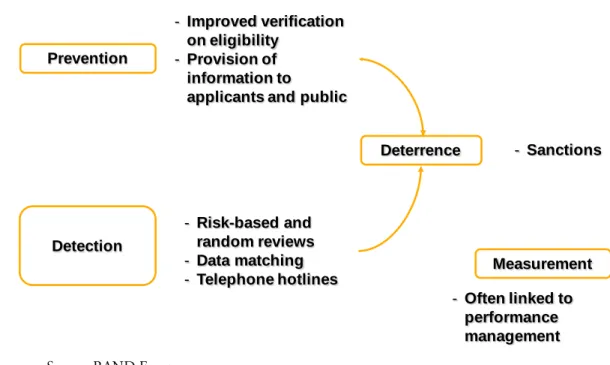
These activities cover the areas of prevention, detection, and deterrence. In this sense, these countries take a similar systematic approach to controlling EFC focusing on keeping fraud and error out of the programs upfront, finding fraud and error in existing claims, and deterring claimants from committing fraud.
6
In addition, OECD countries are increasingly trying to measure the effectiveness of the strategy. Such measurements allow social security administrations to track the volume of fraud and error over time and assess to a degree whether their initiatives to control EFC are having a positive impact. Increasingly, social security administrations are also assessing the cost-effectiveness of specific initiatives in the areas of prevention, detection, and deterrence to establish an optimal portfolio of effective instruments to control EFC.7
For instance, the strategy of the Department of Work and pensions consists of the following elements: Performance assessment increases the accountability for EFC in the social security or benefit administrations, but also them to refine their initiatives to increase the impact over time.
8
•
Preventing fraud. Actions taken include: tighter checks at outset of claim; payments direct tobank accounts instead of by cheque; staff training; and fraud-proofing new policy and operational developments.
5 NAO (2006), International benchmark of fraud and error in social security administrations, (HC 1387, Session 2005-2006) 6 NAO (2008), Progress in Tackling Benefit Fraud, (HC 102 Session 2007-2008).
7 NAO (2008), Progress in Tackling Benefit Fraud, (HC 102 Session 2007-2008).
8 “The United Kingdom’s Experience in Reducing Error & Fraud,” http://web.worldbank.org/WBSITE/EXTERNAL/TOPICS/EXTSOCIALPROTECTION/EXTSAFETYNETSANDTRANSF ERS/0,,contentMDK:21506638~isCURL:Y~menuPK:4159815~pagePK:210058~piPK:210062~theSitePK:282761,00.html
•
Detecting fraud. Actions taken include: data matching (on benefit and other data); investigation; intelligence; risk profiling; telephone hotline for reporting fraud; joint operations with other agencies.•
Deterring fraud. Actions taken include: extended sanctions; measures to influence publicattitudes – public awareness campaign ‘Targeting Benefit Thieves’; and confiscation of assets.
•
End-to-end approach. Proposed action on four fronts:o Getting it right - aiming to get benefit payments correct from the start; o Keeping it right - ensuring payments are adjusted as circumstances change; o Putting it right - detecting when payments go wrong and taking prompt action to
correct them with appropriate penalties to prevent a recurrence;
o Making sure the strategy works - monitoring progress, evaluating the strength of preventive measures and adjusting them in the light of experience.
Figure 3 gives an overview of a typical strategic framework to control EFC. Figure 3: A strategic framework to control EFC
Prevention Detection Deterrence - Improved verification on eligibility - Provision of information to
applicants and public
- Risk-based and random reviews - Data matching - Telephone hotlines - Sanctions Measurement - Often linked to performance management
Source: RAND Europe
2.2
What is needed to implement the strategy?
There are two main factors that affect the implementation of the strategy.
Firstly, for successful implementation of a comprehensive strategy there has to be a political will to tackle the issue of EFC in social protection programs. This political will can also be closely associated with wider political and administrative culture. For instance, in Sweden, the threshold for committing fraud is higher
than in other countries as the state shares much responsibility for getting the right information on benefit claimants. This emphasis has led to what other countries would consider fraud to be categorised as error. In general, Sweden is not as tough on fraud as perhaps Anglo-Saxon countries, which strongly emphasise individual responsibility in supplying the right information to the administration and therefore have a lower threshold for categorising fraud.
This political will can also affect how fraud is measured within the system. Politicians and administrators might be reluctant to publicise the extent of fraud within the social protection system. Such measurement might produce unwelcome news or raise the interests of external accountability bodies such as parliament or supreme audit institutions. In some cases, politicians and administrators might be implicated in some of the EFC occurring in the social protection program.
Several factors can influence the political will to address EFC: • Pressure from external accountability bodies to address EFC; • Public concern over levels of EFC;
• Enlightened political or administrative leadership to combat EFC in social protection programs; and
• The business case: Increasingly benefit administrations take a pragmatic approach and find that investments in anti-EFC measures pay off in terms of the amount of overpayments identified (the investment argument).9
Secondly, administrative capacity plays an important role in whether the strategy can be implemented successfully. A number of aspects of administrative capacity seem particularly important from previous research
10
• Staff: Administrations need the right number of trained and qualified staff to administer benefits and control for EFC. In terms of EFC, these staff need to be trained specifically in terms of detecting EFC within the system. Understaffing was a major issue in the countries visited in the pilot missions.
and missions:
• Results-based management: The example of Canada shows the effectiveness of incentivising line managers through performance assessment to reduce the amount of fraud and error in benefit files across the organisation. In other words, incentivising staff to do a good job and rewarding staff are important.
• Material support: Staff need adequate offices to work in and material support such as transportation and reimbursement of travel expenses. Lack of material support can limit the effectiveness of administration staff but also impact staff morale.
• Resources: Many social protection programs have moderate resources and are limited in size. Extensive EFC controls might not be proportionate to the size of the program.
• IT: IT capacity is important in the effective and efficient processing benefit claims. Moreover, IT is increasingly used to verify data that is submitted by claimants by cross-referencing this data
9 NAO (2008), Progress in Tackling Benefit Fraud, (HC 102 Session 2007-2008).
against other databases held by government or the private sector. Studies have showed that such ‘data-matching’ is a particularly cost-effective way of tackling EFC in some OECD countries. 11 • Networks: Building networks across government is important in fostering cooperation and
information exchange between government departments and agencies. The absence of such cooperation can be a limiting factor in the prevention and detection of EFC and the application of sanctions to fraudulent claims. The pilot missions in the Ukraine and the Kyrgyz Republic showed the importance of cooperation between the benefit administration and the tax authority in sharing information on benefit claimants, as well as the cooperation between the benefit administration and judiciary in applying sanctions.
• Public: The public and wider community is likely to have information that could be helpful in identifying EFC in social protection programs. Having good relations between the administration and community and creating public awareness around the seriousness of EFC can be important in efforts to reduce EFC. In addition, making the public aware of the rules of the program also can create a social control mechanism over who is eligible under the program. Publicising beneficiary lists and the rules of the program are widely regarded as good practice.
2.3
How can the strategy be adapted to country or program circumstances?
In essence, Section 2.1 sketched the basic aspects of an ideal type of strategy covering the main areas of prevention, detection, deterrence, and measurement. The experiences of the OECD countries can hold valuable lessons for LICs and MICs even though these experiences might not all be directly transferable to, or applicable in, their respective contexts. Nonetheless, many of these OECD countries have seen important evolutions of and changes in their anti-fraud strategies and thus offer some insights into how the components of an anti-fraud strategy develop over time. Moreover, in many cases these countries have a solid understanding of what types of interventions are likely to be effective. ‘Value for Money’ reports as those undertaken by the UK NAO add to this understanding of effectiveness.12Thus, these OECD experiences can inform any adjustments and reforms of EFC controls in client countries.
Finally, there is evidence that some of the tools to control the level of error and fraud which are used in OECD countries seem to be “underutilised” in developing countries, though the picture seems to improving in countries such as Brazil, Colombia, and the Ukraine among others.
As stated before, it is clear that significant hurdles in terms of political will and administrative capacity need to be overcome in many LICs and MICs to implement a comprehensive strategy. Therefore, any diagnostic mission needs to work closely with experts and officials from the client country to understand which aspects of the strategy are feasible, suitable, and appropriate for specific national circumstances; and on the basis of this consultation draft short, medium, and longer term recommendations. It is clear that an introduction of every aspect of a comprehensive strategy might not be appropriate for social protection programs in LICs and MICs, which may have limited resources and offer limited coverage. Nonetheless, evidence shows that as the benefit system develops and inevitably increases in size over time, effective
11 NAO (2008), Progress in Tackling Benefit Fraud, (HC 102 Session 2007-2008). 12 NAO (2008), Progress in Tackling Benefit Fraud, (HC 102 Session 2007-2008).
anti-fraud controls become essential in safeguarding the integrity of the benefit system. Therefore, an assessment should focus on recommendations in the:
• Short-term: These can be quick-wins at little cost, which can improve the integrity and targeting of the social protection program (e.g. information campaigns on what is considered fraud and corruption in the Kyrgyz Republic, Bangladesh and the Ukraine);
• Medium-term: These are improvements, which can improve the integrity and targeting of the social protection program but need some resourcing and additional administrative capacity to implement (e.g. the application of existing sanction regimes against offenders in the Kyrgyz Republic); and
• Longer-term: These are aspirational improvements, which likely require substantial political and administrative hurdles to be overcome (e.g. introduction of electronic data-matching between government databases in the Ukraine or direct electronic transfer of benefit to the individual claimant in Bangladesh).
The missions conducted so far show a difference in how recommendations were arrived at in on the one hand the Ukraine and the Kyrgyz Republic and on the other in Bangladesh (see Chapter 5). In the former countries, they had a strategy around prevention, detection, deterrence and monitoring. Thus, the recommendations could look at the effectiveness of what was being done and also at how the existing strategy could be improved and adjusted. In Bangladesh, the EFC strategy of the Employment Generation Program was mostly limited to basic monitoring. Here, recommendations focused on developing a EFC strategy with some basic steps around prevention, detection, deterrence, and performance management.
It is also important to note that a longer-term recommendation in one country might be easier to implement in others. For instance, electronic data-matching would face significant hurdles in Bangladesh but has been implemented in a number of Latin American and Caribbean countries.
CHAPTER 3
Tools and instruments used to combat EFC
3.1
What are the main instruments to combat EFC per aspect of the strategy?
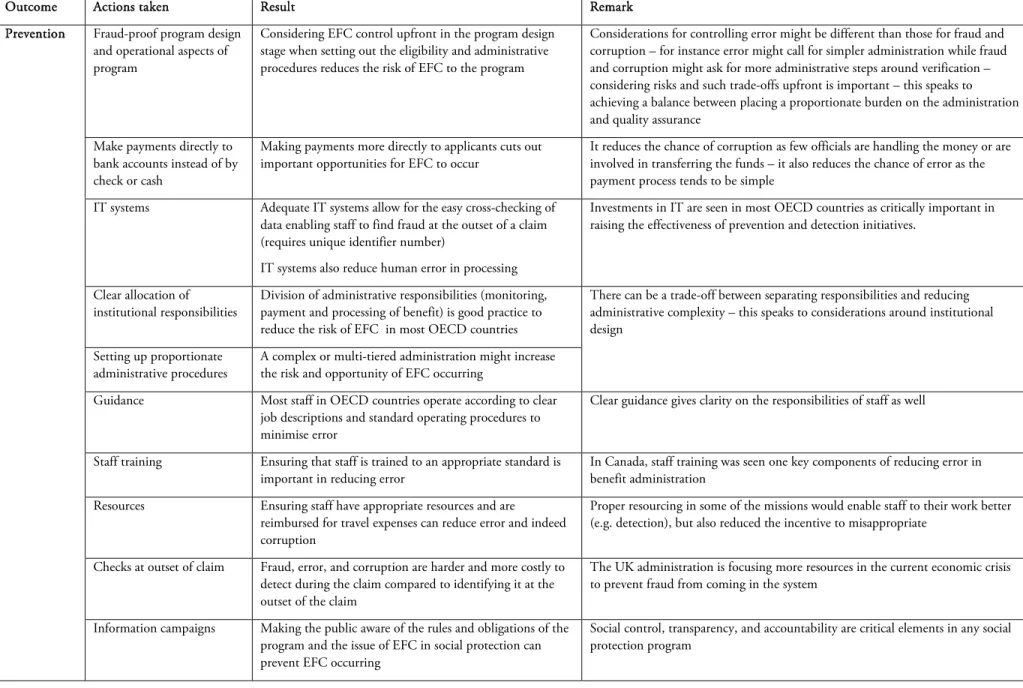
As stated earlier, a strategy consists of prevention, detection, deterrence and measurement initiatives. These initiatives overlap and are often interrelated. This section focuses in more detail on administrative procedures used in several OECD countries to control EFC, in particular compliance of the program with its own rules and regulations.Prevention consists mainly of four categories of initiatives:
• A first focuses on whether EFC issues are considered at the program design and each program implementation stage to ensure that the risk of EFC is manageable in the administration of the program. This speaks to wider considerations of program design and program management, which are important to the World Bank (see Appendix C).
• A second aims to ensure that payment of the benefit to the claimant is as secure as possible, preferably by making payment directly to the claimant.
• A third is centred on whether appropriate administrative procedures and capacity are in place. This ranges from the provision of adequate IT systems and capacity to the training of staff, the clear delineation of administrative procedures in the processing and verification of benefit claims (e.g. having clear job description [see Appendix F for job descriptions in the UK]) and clarity in the allocation of institutional responsibilities across the different levels of government and between government and civil society).
• A fourth looks at the checks undertaken at the outset of the claim. Many OECD countries have tightened the checks at the outset of the claim as fraud tends to be more difficult to identify as the claim is in progress.
• Information campaigns are a fifth initiative. Information campaigns aim to alert claimants on the risks of committing benefit fraud (used in Australia and the United Kingdom) and explaining rights and obligations under the rules of the social protection program to benefit claimants (used in Canada and the Netherlands).
There exists some innovative ‘prevention’ practice in OECD countries.13
• Canada holds claimant information sessions (CIS) with groups at high risk of committing benefit fraud. Since 1999, Canada claims it has saved about US$600 million in overpayments in the benefit system. The Netherlands also uses contracts and campaigns to inform claimants of their rights as a preventative measure. Claimants have to sign a contract with their rights and obligations when claiming benefits. Similarly, the New Zealand government aims to inform about 70% of claimants of rights and obligations. These measures aim to inform and remind claimants of their obligations. For
error, preventative measures include staff training and introducing results-based management. In Canada, error rates have fallen by making line managers more accountable for the errors of their staff. Detection has three main components:
• The first is the generation of intelligence to detect cases of EFC. This generation of intelligence can consist of telephone or online tip-offs from the public about fraudulent cases (used in Australia and the UK), intelligence provided by staff of the social security administration or other government offices, and data-matching. This intelligence then leads to cases being investigated. Telephone hotlines also serve to allow the general public to file grievances and complaints.
• A second is the process of reviews of benefit claims. Reviews can be random, time-based, or risk-based. Most OECD countries use risk-based assessments to organise a review of benefit cases, and some use regular, random or time-based reviews of cases (for instance in Australia and New Zealand). The advantage of risk-based reviews is that it allows the benefit administration to target scarce resources at those claims with the assumed highest risk of fraud. Time-based reviews might be helpful in cases where eligibility requirements have a clear time component (e.g. limits in the duration of the benefit provided).
• A third initiative is joint working between government departments and agencies and different levels of government (joint working is emphasised in the Netherlands and Australia). Joint working leads to improved information exchange and also shared administrative capacity in cases.
There exists some interesting ‘detection’ practice in OECD countries.14
• Data-matching can be highly cost-effective and target ratios are set in Australia and New Zealand for overpayments identified to cost of the program. A normal ratio would be four to one (benefit payment saved to administrative cost expended). Unique identifiers for claimants are also often part of data-matching strategies. The use of identifiers across different databases and departments allows analysts to more effectively match data on claimants held in different databases. Review activities are also instrumental to detection efforts. Different strategies are used in most countries ranging from risk-based reviews (e.g. reviews of certain professions in Canada, scoring in the UK, and profiling in Canada) to random and time-based reviews. In New Zealand, claimants have to re-establish core eligibility after a certain time period.
Deterrence involves sanctions. Several countries have begun to use more severe sanctions and increased levels of prosecutions as a deterrent. Examples are Ireland, the United States, and the United Kingdom. Monitoring can include four main ways of performance assessment in EFC controls:
• Measurement of total volume of EFC in the social protection system: This approach will aim to estimate the total volume of EFC in social protection expenditure on the basis of random reviews of cases (used in the UK);
• Measurement of volume of EFC in particular social protection programs: This approach is similar to the first but used in specific programs (used in the US and Ireland);
• Measurement of accuracy of processing and payments: This approach will focus on the accuracy of processes and will set performance targets for accuracy of payment and processing. Accuracy is
established through an independent review of cases (either random or spot checks) (used e.g. in New Zealand, Sweden, and Australia); and
• Measurement of cost-effectiveness: This approach will seek to establish the return on investment for particular initiatives by comparing the investment in an initiative with the amount of overpayments identified by the initiative.
In monitoring, the measurement of EFC in the social protection system on the basis of random statistically significant sampling is increasingly seen as the gold standard as it gives a clear indication of the total problem of EFC in programs and allows for consistent monitoring over time (see Appendix D).
Table 1: Main instruments per aspect of the strategy
Outcome Actions taken Result Remark
Prevention Fraud-proof program design and operational aspects of program
Considering EFC control upfront in the program design stage when setting out the eligibility and administrative procedures reduces the risk of EFC to the program
Considerations for controlling error might be different than those for fraud and corruption – for instance error might call for simpler administration while fraud and corruption might ask for more administrative steps around verification – considering risks and such trade-offs upfront is important – this speaks to achieving a balance between placing a proportionate burden on the administration and quality assurance
Make payments directly to bank accounts instead of by check or cash
Making payments more directly to applicants cuts out
important opportunities for EFC to occur It reduces the chance of corruption as few officials are handling the money or are involved in transferring the funds – it also reduces the chance of error as the payment process tends to be simple
IT systems Adequate IT systems allow for the easy cross-checking of data enabling staff to find fraud at the outset of a claim (requires unique identifier number)
IT systems also reduce human error in processing
Investments in IT are seen in most OECD countries as critically important in raising the effectiveness of prevention and detection initiatives.
Clear allocation of
institutional responsibilities Division of administrative responsibilities (monitoring, payment and processing of benefit) is good practice to reduce the risk of EFC in most OECD countries
There can be a trade-off between separating responsibilities and reducing administrative complexity – this speaks to considerations around institutional design
Setting up proportionate
administrative procedures A complex or multi-tiered administration might increase the risk and opportunity of EFC occurring Guidance Most staff in OECD countries operate according to clear
job descriptions and standard operating procedures to minimise error
Clear guidance gives clarity on the responsibilities of staff as well
Staff training Ensuring that staff is trained to an appropriate standard is
important in reducing error In Canada, staff training was seen one key components of reducing error in benefit administration Resources Ensuring staff have appropriate resources and are
reimbursed for travel expenses can reduce error and indeed corruption
Proper resourcing in some of the missions would enable staff to their work better (e.g. detection), but also reduced the incentive to misappropriate
Checks at outset of claim Fraud, error, and corruption are harder and more costly to detect during the claim compared to identifying it at the outset of the claim
The UK administration is focusing more resources in the current economic crisis to prevent fraud from coming in the system
Information campaigns Making the public aware of the rules and obligations of the program and the issue of EFC in social protection can prevent EFC occurring
Social control, transparency, and accountability are critical elements in any social protection program
Detection Data matching Comparing data held across a variety data sources is highly cost-effective at detecting cases of suspected fraud and corruption
Typically, a strategy will have a variety of ways to create referrals for further investigation including data-matching and wider intelligence gathering Intelligence gathering and the introduction of a complaints mechanism can also strengthen the accountability within a program
Intelligence Gathering information from the public (tip-offs), telephone hotline for reporting fraud, automatic flags from
Management Information System (MIS), and staff intelligence are critical in producing referrals for further referral
Investigation Random or time-based reviews (controls of the accuracy of the information provided to the program and of the decisions made by staff) are necessary aspects in detecting EFC
Some social security agencies solely investigate referrals – others supplement these reviews by random or time based reviews
Some social security agencies target their scarce administrative resources by profiling (professions or population groups) or by scoring the referrals that they receive - this is seen as good practice15
Risk profiling Risk-based assessments to organise reviews (e.g. select client investigations) using scoring or profiling are particularly cost-effective in detecting fraud
Joint operations with other
agencies Information exchange and joint investigations are useful in detecting and investigating organised crime and high-level fraud and corruption
Joint working remains a challenge even for well-developed administrations, but cases in Australia where information exchange occurs show positive results
Deterrence Sanctions Prosecutions Confiscation of assets
Applying appropriate sanctions consistently serves as an important deterrent for those considering engaging in fraud and corruption
Deterrence is an important complement to prevention – enforcement requires clear definitions on what EFC are, a supportive legislative framework , and appropriate sanctions for each possible case of EFC
Measures to influence public attitudes, such as public awareness campaigns.
See similar point earlier on prevention
Monitoring Regular measurement of the
level of EFC Understanding the overall problem of EFC and particular risks to the program is of critical importance in organising reviews of cases and understanding the effectiveness of the entire strategy
Globally, social security administrations are measuring more rather than less –this speaks to designing the appropriate management information system
3.2
Are there specific instruments for tackling EFC respectively?
Most OECD countries focus on tackling benefit fraud. Indeed, most of the interventions outlined in section 3.1 are applicable to reducing fraud. Nonetheless, error is a significant problem. In the UK, between 40 and 50% of overall fraud and error in benefit program is error. Some interventions in OECD countries have been shown to have positive effect on error. They include:
• The introduction of results-based management and improving the level of management oversight in Canada;
• Improving guidance and communication with benefit applicants in the United Kingdom (errors on application forms can also arise from a lack of understanding);
• Staff training and development in most OECD countries (many errors are caused by staff processing incorrectly); and
• IT improvements (many errors are systemic failures) in Ireland and the United Kingdom.
Corruption is not considered an important problem in the OECD countries. There are a number of reasons for the low prevalence of corruption in OECD social protection programs:
• Clear and transparent eligibility criteria;
• Separation between assessment and payment functions;
• Separation between processing/decision-making and investigations or reviews functions; • Integrity of systems processing payments;
• Staff training and management;
• Investigators/reviewers not assigned cases where familiarity is suspected; and • Strength and independence of internal audit.
3.3
How do OECD instruments aimed at mitigating EFC develop over time?
The instruments applied in selected OECD countries to tackle the problem of EFC in social protection programs developed over time. The way in which these systems generally develop can hold lessons for introducing these types of instruments in less developed countries. This brief section does not aim to provide a definitive overview of how anti-fraud strategies develop across OECD countries, but provide a general indication on how these types of strategies evolve and mature on the basis of observations of developments in OECD countries and lessons learnt in the course of the fieldwork for this toolkit. An overview is given in Table 2. This table is based on a general interpretation of maturation by the authors
and outlines how typically some areas of prevention, detection, deterrence, and monitoring evolve in the short-term, medium-term and longer-term.16
• Increased investment in IT and administrative capacity (Some OECD countries [e.g the UK and Australia] show that the public resources saved through EFC reduction are far more substantial than the investments made in EFC mitigation);
The maturation of strategies is based on three dimensions:
• Improvements in technology (the application of new technologies in terms of communicating with the public, processing of benefits, making payments to beneficiaries, and matching data held on individuals change the general administration of benefits and how EFC mitigation is approached); and
• Learning over time from your actions (a good example is moving to more risk-based reviews as the agency learns what the EFC risks to its operations are through analysis and intelligence gathering).
Table 2: A view on the development of EFC strategies in OECD countries over time
Outcome Type of intervention
Short-term Medium-term Longer-term Prevention Secure
payment -Lower transaction costs in payment (e.g. reduce number of administrators involved)
-Pay directly to beneficiary -Pay directly to beneficiary through secure channel (e.g. bank account)
Improve administrative capacity
-Introduce clear guidance on administrative responsibilities and job descriptions
-Provide adequate administrative resources (e.g. cover expenses )
-Improve staff training to ensure awareness of EFC and how to tackle it
-Move to IT systems to register and process claimants
-Introduce results-based management
-Upgrade IT systems to allow case history to be seen and eligibility checks to occur
Information
campaigns -Make claimants and staff aware of what EFC is and eligibility requirements of program
-Introduce a rights and obligations charter between claimant and social security agency
-Introduce information sessions to inform claimants on rights and responsibilities
-Work with civil society groups to educate wider groups of benefit claimants Detection Intelligence -Empower staff and
beneficiaries to refer cases of EFC for investigation -Undertake paper-based data matching
-Improve joint-working with other government
-Formalise procedures on how to refer cases for investigation -Introduce telephone hotlines for individuals to complain and refer cases
-Improve data-matching to be
-Invest in IT to perform data-matching on electronic databases -Invest in analysis of evidence collected to inform investigations
16 See for instance some discussion on fraud regimes in van Stolk, C. and Wegrich, K. (2010) “Casting light into dark corners. A cross-national comparison of approaches to performance management in fighting fraud in social security and the hidden economy”, Public Management Review, forthcoming.
agencies real-time Investigations -Introduce thorough and
independent reviews of cases that look at all facets of a case
-Introduce and apply guidance on how to conduct investigations
-Introduce time-based investigations
-Introduce spot checks at the outset of a claim
-Introduce a dedicated investigations service
-Perform risk-based investigations on the basis of cases most likely to see EFC (analysis of intelligence)
Deterrence Sanctions -Introduce sanctions to
deter fraud and corruption -Apply sanctions consistently in all cases -Relate severity of sanctions to EFC risks faced by social protection program
Monitoring -Sample selection of cases and monitor outcomes of independent reviews -Monitor outcomes on the basis of categories of EFC
-Sample statistically significant sample of cases in some programs to gauge level of EFC
-Sample statistically significant number of cases to gauge level of EFC in all programs
-Measure cost-effectiveness of interventions used to combat EFC
-Measure accuracy of processing and payments
3.4
How are the OECD instruments to mitigate EFC currently applied in less
developed countries?
In less developed countries, these types of administrative initiatives to control EFC seem underutilised.17
For instance, pilot mission to the Ukraine and the Kyrgyz Republic found a very limited use of deterrence, with administrations quite reluctant or unable to apply sanctions to fraudulent claims. In the pilot mission in Bangladesh, EFC controls did not extend much beyond basic monitoring activities. Evidence from South Asia also shows important limitations in control and accountability mechanisms in conditional cash transfer programs.18
Table 3
However, the World Bank has also found some positive trends emerging. These include greater use of technology, at least in MICs; more explicit thought on transparency; and greater attention to implementation issues (see Box 3 for examples). Better practices in collecting and using program information in developing countries can provide an indication of the scope and nature of the problem, and may even prevent EFC from happening. A number of MICs are making large investment in management information system of the social protection program, a key tool for the development of an effective policy to combat EFC. gives an overview of some good practice in MICs.
17 World Bank 2007 FEC SSN Primer note.
18 See for instance, World Bank (2009), “Control and Accountability Mechanisms in Cash Transfer and Conditional Cash Transfer Programs: A Review of Programs in South Asia”.
Table 3: Good practice of oversight and control mechanisms from the Latin America region19
A number of middle-income countries have made significant steps forward in implementing mechanisms to control the use of funds in social protection programs. Some of these initiatives are more comprehensive than others and include:
• Brazil’s Bolsa Familia Program (BFP) is a large conditional cash transfer (CCT) program implemented in a federal context. At federal level, the program is managed by the Ministry of Social Development (MDS). Most of its implementation, however, is done by the 5,564 municipalities. Consequently, the main pressure points for EFC in Brazil’s decentralized context include political interference, political biases, and administrative errors in the registration process. To manage, monitor and reduce the risk of EFT, the Government has instituted several mechanisms, including: (a) Oversight & Control by Supreme Audit Agencies that undertakes regular random-sample operational audits (also known as quality control reviews); implementation evaluations; annual financial audits, and investigation of at-risk cases; (b) MDS’ own program controls, including internal and external cross-checks of the registry; monitoring municipal implementation quality using the new system of financial incentives (performance-based administrative cost subsidies) and the “Decentralized Management Index”, and; monitoring of the activities of the operating agent for registry and payments, via the new performance-based contract and associated financial penalties, and; (c) Municipal controls (social controls, local contacts). Municipalities serve as first point of contact for complaints or appeals for the beneficiaries. Formal Social Controls Councils have been established in all municipalities, and their roles include: overseeing the registration process; periodically evaluating beneficiary list; monitoring reporting on, and compliance with, conditionalities. Centralized hotlines are used to handle inquiries from general public, beneficiaries, and local program managers.
• The Heads of Household Program in Argentina is a large-scale emergency workfare program set up quickly during 2001-2 economic crisis. The Ministry of Labor is the responsible national agency and registration is decentralized through municipalities and civil society/political organizations. A set of complaint resolution tools has been established, including: (a) Toll free hotlines manned by call centres addressing questions on payment dates, eligibility and for reporting ineligible beneficiaries; (b) a Commission in the Ministry of Labor to handle allegations of program abuse or complaints; (c) Criminal offenses referred to Federal Prosecutor of the Social Security System; (d) monthly cross-checking of databases.
• Colombia’s Familias en Accion is a CCT program under Presidential Executive Agency (Social Action) implemented at municipal level. Spot checks reviewing and monitoring the operational procedures for program implementation in different localities are carried out on a random basis by external firm. These spot checks serve several objectives, such as: checking if operations and procedures of program met objectives in practice; verifying how procedures were being interpreted; validating the accuracy of the data relevant for the program (i.e. verification of fulfilment of conditionalities, inscription of eligible families, payments, etc.).
Source: Lindert et al (2007) and World Bank (2007)
3.5
What are the main instruments to combat EFC per level of government?
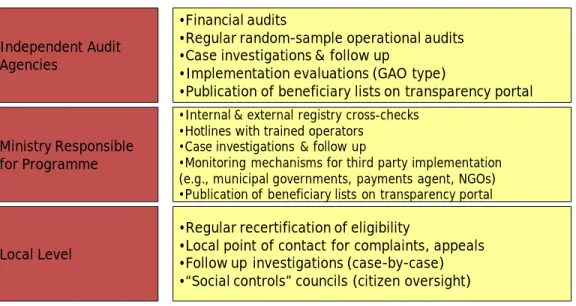
The administration of social protection programs often involves different government actors, levels of government, and cooperation between government and civil society. This is especially true in lesser developed countries where administrative capacity is more limited than in the developed world. This section highlights where some of the responsibilities could lie in lesser developed countries. Gives an overview of responsibilities split between independent audit agencies, the ministry responsible, and local level actors. This split of responsibilities is particularly important in LICs and MICs as policy makers in these countries often involve multiple levels of government to ensure that the program can be delivered. In many OECD countries the administration of benefits ends to be more centralised or is delivered through executive agencies under the direct supervision of the department responsible.
Figure 4: EFC oversight mechanisms per level of government
•Financial audits
•Regular random-sample operational audits •Case investigations & follow up
•Implementation evaluations (GAO type)
•Publication of beneficiary lists on transparency portal Independent Audit
Agencies
Ministry Responsible for Programme
•Internal & external registry cross-checks •Hotlines with trained operators
•Case investigations & follow up
•Monitoring mechanisms for third party implementation (e.g., municipal governments, payments agent, NGOs) •Publication of beneficiary lists on transparency portal
Local Level
•Regular recertification of eligibility
•Local point of contact for complaints, appeals •Follow up investigations (case-by-case) •“Social controls” councils (citizen oversight) Source: Fiszbein, Tesliuc, and Lindert, 2009, World Bank
3.6
How does this approach on EFC control inform other diagnostic initiatives?
It is important to note that the approach taken in this toolkit is broadly compatible or complementary with other diagnostic initiatives undertaken by the World Bank or in countries. A value added of this toolkit is that it provides a structured way of thinking in terms of prevention, detection, deterrence and monitoring of EFC in social protection programs on the basis of the experience of OECD countries, which can inform other, perhaps broader, diagnostic initiatives in the World Bank and contribute to what the World Bank emphasises in overall program design, as exemplified in some recent reports on South Asia and the Latin America Caribbean region.20
20 World Bank (2007), Control and Accountability Mechanisms in Conditional Cash Transfer Programs: A Review of Programs in
Latin America and the Caribbean. Operational Innovations in Latin America and the Caribbean, Vol. 1, No. 1; World Bank (2009), “Control and Accountability Mechanisms in Cash Transfer and Conditional Cash Transfer Programs: A Review of Programs in South Asia”.
These reports focused strongly on effective control and accountability mechanisms to ensure that effective targeting occurs, beneficiaries receive payment, operating procedures in programs are followed, good governance and accountability are present, and
policymakers have the information to improve the program. The EFC toolkit can either serve as an additional checklist to see if recommendations from reports follow conventional wisdom seen in OECD countries (see Table 1) or to design a diagnostic mission with a more exclusive focus on EFC.
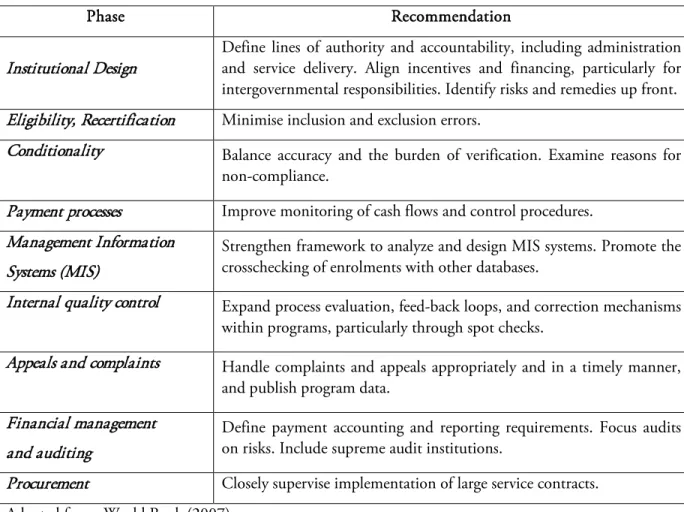
It is useful to give some concrete examples. An example of the latter on how approaches can be merged is given in Table 4 taken from a proposed diagnostic mission in a cash conditional transfer program (CCT). Similarly, Table 5 in Appendix C gives an overview of how to look at program design with EFC lenses.
Table 4: Assessing control and accountability mechanisms in a CCT21
21 World Bank (March 2007), Control and Accountability Mechanisms Conditional Cash Transfer Programs: A Review of Programs in Latin America and the Caribbean
The World Bank proposes a diagnostic mission to look at good governance and EFC control of a CCT in Southeast Asia. This mission merges the approach in this toolkit with the diagnostic approach taken to look at governance in cash conditional transfer programs in the Latin America C