Procedia - Social and Behavioral Sciences 38 ( 2012 ) 114 – 121
1877-0428 © 2012 Published by Elsevier B.V. Selection and/or peer-review under responsibility of Centre for Environment-Behaviour Studies(cE-Bs), Faculty of Architecture, Planning & Surveying, Universiti Teknologi MARA, Malaysia
doi: 10.1016/j.sbspro.2012.03.331
AicE-Bs 2010 Kuching
Asia Pacific International Conference on Environment-Behaviour Studies, Grand
Margherita Hotel, Kuching, Sarawak, Malaysia, 7-9 December 2010
No Girls for Me Mummy: Providing a Positive Language
Learning Environment for Boys in Single Gender Classes
Norshiha Saidin* and Mior Md Firdaus Mior Brahim
Faculty of Education, Universiti Technologi MARA, 40450 Shah Alam, MalaysiaAbstract
National data reveals an alarming pattern of continued underachievement of Malaysian boys in schools and tertiary levels. Research on the single-sex classroom shows improved boys' performance in English and foreign languages, and girls' performance in math and science. This study reports the experiences of 30 secondary students enrolled in single gender schools. The study reveals that in gender separate classroom students have higher motivation and confidence levels, offering better educational opportunities. This paper proposes the introduction of boys’ only language classes using an enhanced curriculum for boys and the addition of brain based differences in teacher training and curriculum development.
© 2011 Published by Elsevier Ltd. Selection and peer-review under responsibility of Centre for Environment-Behaviour Studies (cE-Bs), Faculty of Architecture, Planning & Surveying, Universiti Teknologi MARA, Malaysia. Keywords: Language learning; learning environment for boys; classes
1.Introduction
There has been a resurrection of interest in single-sex education (SSE) or single gender education in many North American, Western Europe and Australasian countries as the nations grapple with apparent
boys’ academic underachievement and self sabotage behaviours in academic settings (Younger and
Warrington 2006). U.S Dept of Education reveals data confirming that the average 11th grade American
* Corresponding author. Tel.: 852 2616 7170; fax: 852 2891 7940.
E-mail address: [email protected]
© 2012 Published by Elsevier B.V. Selection and/or peer-review under responsibility of Centre for Environment- Behaviour Studies(cE-Bs), Faculty of Architecture, Planning & Surveying, Universiti Teknologi MARA, Malaysia Open access under CC BY-NC-ND license.
boy now writes at the same level as the average 8th grade girl (Sax 2005). In Australia, the educational focus of the country has similarly shifted to a concern with boys underachievement (Kenway & Willis, 1998; Martino & Meyenn, 2002). Many single-gender advocates says the existing curriculum and nurturing styles of schools must be reexamined to cater to differences in how boys and girls learn best
(Berliner 2004, Keng 2005, Bowen 2009) . Evidence from a 4 year Raising Boys’ Achievement ( RBA)
Project by University of Cambridge(2000) disclose evidence that the male and female academic gap can be narrowed when boys are taught in single gender classes.
2.Literature Review
2.1. What’s Happening to Boys
This underachievement by boys and inability to ‘cope ‘ with the operational literacy demands of
school curricular and assessment are frequently manifested in boys ‘acting out’ behaviours, low self esteem and disengagement or withdrawal from willing participation in schooling’ (Rowe & Rowe 2000)
Beginning year 2000 large scale experiments and researches were conducted as the western world explored the benefits of single-sex schooling. This was a direct response to the growing concern on the underachievement of boys in literacy and academic achievement. Brain based research and gender studies provides better understanding of the differences in brain function and learning styles of boys and girls. Research based science illustrates gender differences in brain functions and shows earlier maturation in the female brain leads to more complex verbal skills and a higher reliance on verbal communication. Girls also tend to absorb more sensory data than boys. Males however is right brain dominant providing them with better spatial abilities and abstract reasoning. ( Moir & Jessel, 1990, Jensen 2006)This has immense ramification in our present culture and education system that relies heavily on talk, conversation and words.
Profound differences exist in learning styles of boys and girls. Boys veer towards deductive reasoning doing it quicker than girls who favour inductive thinking. (Armstrong 2006, Gurian 2011) Boys generally excel at abstract reasoning preferring abstract arguments, philosophical challenges and moral debates while girls opt for concrete reasoning. Excelling in language, girls on average produce more words than males. During the learning process, girls use words as they learn, while boys often work silently. Even in groups, word users in the male groups are fewer. Conceptualising in everyday language replete with concrete details typifies girls’ communication while boys opt for jargon and coded language. (Gurian & Stevens, 2005, Gurian 2011).Boys are bored easily than girls thus requiring varying stimulants to keep them attentive while girls are better at self-managing boredom in class. This has a profound impact on learning because once the child is bored he would most likely give up on learning, begin misbehaving and thus labelled a behavioural problem. Classroom research reveals that boys tend to be louder, more physically aggressive, thus getting more teacher attention. (Sax 2005)
In Malaysia findings of the 1996-2000 study on the performance of boys and girls in the Malaysian education system ( Zalizan, Khadijah , Mohd Dahan 2001) , clearly shows that at the Ujian Penilaian Sekolah Rendah level, more girls passed Mathematics, Bahasa Malaysia and English. The difference was most obvious in the English paper where there were at least 14 % more passes among girls every year, except in 1999, when the difference was 25.6 %. This trend of boys’ underachievement continues at the tertiary level and data from the Ministry of Higher Education (2005) indicates that a disproportionately high number of female students achieved a CGPA of 3.5 and above in arts as well as pure science subjects that were traditionally the domain of male students. Boys are underrepresented in
education faculties making up only 20 % of the population and 54 % in medicine. In 2009, female students dominated tertiary education intake in Malaysia(62%) compared to males with only 38%. It clearly shows that the traditional educational disadvantage shown by females has largely disappeared and
has been replaced by an emerging male disadvantage” (Aitken, 1999). Underachievement in academic performance is directly linked to the increasing juvenile crimes and social problems. Malaysian authorities, teachers and parents are grappling with the increasing juvenile crime rates and school indiscipline. Juvenile crime rates has increased by 20% from 5114 cases in 2007 to 6048 cases in 2009 ( NST 2010). A large majority of these offenders are boys who are disillusioned and failing in schools and without intervention will drop out.
2.2. Single sex education in Malaysia
The earliest type of education in Malaya, were the pondok schools where Quranic and Islamic studies were conducted under the tutelage of a Khatib or Tok Guru either at his home, a surau or mosque. Later on Christian single sex missionary schools were established during the Portuguese and Dutch occupation .
At present out of the 8,696 schools in Malaysia , only 70 primary and 131 secondary schools are non– coed educational. Both co-educational and non-coeducational schools at all levels offer similar standard of premises, equipment, curriculum, teaching staff and opportunities to the students. Among the single-sex schools in Malaysia, the better known schools are Sekolah Seri Puteri (Cyberjaya), Penang Chinese
Girls’ High School , Penang Free Boys School (Georgetown), Kolej Tunku Kurshiah (Seremban),
Methodist Boys’ School (Kuala Lumpur), St John, Victoria Institution (Kuala Lumpur), Malay College Kuala Kangsar (Kuala Kangsar). Maahad Muhammadi for boys and Maahad Muhammadi for girls. (MOHE, 2010). These single gender schools can be designated into three main categories: missionary founded school, religious Islamic schools or Government funded residential schools.
3.The study
This case study is part of an ongoing research investigating single sex schools in Malaysia. This study focuses specifically on the students’ perspective looking at the personal experience of 30 secondary school students. Interviews were conducted to gather their experience learning in single-sex environment focusing on psychological, affective and socioemotional aspects. Theirs was a unique experience in that they had experienced mixed classes for six years and then proceeded to single gender secondary schools affording them the ability to compare the two systems. Their view provides valuable data about single-sex schools in local settings.
3.1. Setting and subjects
The subjects for this case study were 30 secondary school students enrolled in four different single sex schools in Malaysia. 17 female students and 13 male students participated in this study. In all of the schools we committed ourselves to listening to the many and varied voices of students in search for answers to the following questions:
x What were your experiences in adapting to the change between co-ed to single sex classrooms? x What were the positive and or /negative effects to your study, involvement in activities? x How did it affect you psychologically and emotionally?
3.2. Background of school/institution 3.2.1. Respondent’s school
A purposive sampling procedure was used in the selection of the 30 respondents who all attended
single sex secondary schools in various parts of Malaysia .The two boys’ schools are Malay College
Kuala Kangsar (MCKK) and Penang Free School and the girls schools are Tengku Kurshiah College (TKC) and St Georges Girls School .All are secondary schools established during the British occupation and excelled in academics as well as other fields such as sports, leadership and co-curricular activities. Prior to the move to the single gender school, all subjects were above average students excelling in academic and co curriculum activities.
4.Results and Discussions
4.1. Students’ experience at boys’ school
In the early stages, the male respondents described the change from co-ed to single sex schools as a
‘cultural shock’. Being so usedto the presence of girls in the classroom they expected that a boy’s school
would be chaotic with more disciplinary problems . Based on experience in their previous school, a 50% population of males turned the school upside down and therefore no-lesser was expected in a school where its population was 100% male. Therefore it was shocking that in these single gender schools, the male students behaved in an orderly manner, exuding an image of boys who were neat, organised and academically able.
In class, active participation and daring to be wrong or to disagree became a familiar scene. “I was no longer afraid to give comments, before this I was in a class where the top students were the girls, they often dominated discussions and a wrong opinion would be accompanied by a cynical look. Now in a
class full of boys, I am no longer afraid to give ideas, opinions even if it’s a silly one.” In the co-ed setting Respondent H felt inferior if he gave a wrong answer and the girls almost always excelled over the boys. There was already the expectation that a girl would get it right and a boy would not. This changed in MCKK as he was able to give comments and ideas without the fear of being wrong. When asked about
distractions he explained that “No girls to look at... will also mean less day dreaming”. Many of the boys
like H confessed that on the verge of adulthood, teenagers like him found it hard not to look at attractive girls in the classroom. Even the smell from the use of perfumes can arouse unwanted senses during academic hours. At MCKK he was able to focus more on his study with no girls in sight. Moreover there were less disturbances in single-sex compared to co-ed schools. In his old school, boys tend to tease the girls, make fun of them and try to get their attention. This produced chaos and various disturbances in the school. Whereas in MCKK such nonsense did not exist enabling the boys to be themselves.
In the mixed school the boys said it was easy for them to be selected as a leader, being one of the few brightest males they often got the change to be in charge without putting in much effort. However in MCKK and Penang Free they were pushed to the limit as there were other boys who were much better
and charismatic. “Becoming a leader here is very hard, everybody is capable! And somehow confident to
be a leader, here I must really improve myself”. After coming out of their ‘safe zone’ in the old school
they now realize that they must keep up with the other boys in order to excel. This increased their determination, self-esteem, confidence and motivation.
80% of the male respondents claimed that they really liked their new school as it posed new experience and challenges for them. The absence of the opposite sex is not such a bad thing at all.
Rsepondent S said “I really liked it here, I want to become a great man, I want to be free from the social
problems that involves boys and girls and I want to excel in my studies”. He further explained that even
the teachers are more open- minded and they discuss important issues that sometimes would be sensitive
to be talked about in front of girls. “Even the teacher’s approach are different, being in an all boys school allows us to be more open minded”. This supports the findings from other research that teachers in single sex classrooms adapt and modify their teaching strategies and curriculum materials to the perceived styles and needs of the boys. (Younger & Warrington ,2002)
Respondent S said that he had always liked English and moving to Penang Free, a single sex school allowed him to excel and participate in drama without worrying what the girls would think. He is passionate about drama and theatre ,taking part in numerous school plays and later on took up a TESL
degree. “We never discussed about girls unlike our friends who were in the co ed school, we were interested in music, fashion and all the guys stuff. Even in university now, I see that boys who went to
single sex schools spend a lot of time with other boys ...it’s easy to discuss, do our projects and other guys
stuff like hiking. My other housemate who went to a co ed school... well he’s always busy with his
girlfriend so it’s kind of difficult. 4.2. Students experience at girls school
Respondent A said she did not take long to adapt to the changes in her new school in fact she
expressed that “It wasn’t that hard, I blend in right away! And plus I really, really wanted this! “A
explained that adapting was never a heavy task at TKC because it was her dream to be in one of the best
girl’s school in Malaysia. 86% of the female students explained that being in a girl’s school has allowed
them to become successful well-rounded students. And all this is due to the absence of boys.
One of the most significant changes many of the female respondents experienced in the school was the peace and tranquillity in class during academic sessions. Previously some of the girls were in a kampong
school and “Some of the boys were like dogs that, salivates at our presence, make scenes to get attention,
do pranks, make fun of us and never want to let us girls have a happy day for even once!” Here in Tengku Kurshiah College(TKC) Respondent M said she was able to focus on her studies. No pranks, no stupid jokes no abusing of girls because they were all girls! Hence this improved her attention span in the classroom. More attention, less disturbance means better results for her studies. She believed that,
“Confidence flows in single sex classroom because there are no boys to jeer at you when you are wrong,
in front of the class. By the way in an all girls’ class, we strongly support each other!”
Teachers and students had an easier time learning especially when it came to certain potentially
embarrassing topics such as the reproductive system in Biology. MM said” I can’t imagine learning about the reproductive system and talking about giving birth with boys in the class...ugh they would have teased
us and make all sort of sick jokes “. Instead in single gender classes the focus remained on the subject and
students and teachers could discuss openly without any fear or embarrassment.
In their primary school the girls noted that all the leadership roles in the school’s co-curricular
activities were dominated by boys, “The boys always get to lead, even though sometimes they are not
capable at it!” This is typical stereotyping in schools and reflects the culture where men are perceived as the natural leaders. Opportunities abound for boys to become leaders, manage clubs and become the chairman. Seeing a girl lead is a rare scene in mixed schools due to this stereotyping. Respondent L said
“In a co ed school the head prefect must be male although he’s not perfect and the girl is better” However Respondent A felt that in TKC “I was given a chance to lead and manage events, It helped me to discover
reported that in their new environment they were able to participate actively in co-curricular activities no longer as a follower but instead they got the chance to lead. They were able to develop their confidence,
self esteem leadership skills and break free from the perception of “only men can do this”. The single
gender environment especially in a school like TKC and St George developed independent girls, confident and capable of achieving anything. A and L said they were really thankful they attended a single gender school as it gave them a new perspective and new goals to pursue. The learning environment at the school allowed the girls to develop holistically, discovering their potential and participating in activities they normally would not when boys were around.
Similar to the boys in single gender schools, the girls also mentioned that their focus on learning and interest in other activities increased without the presence of the opposite sex. “My elder sister and I
excelled because in high school we weren’t distracted unlike our younger sister who went to a coed school and she’ s always talking about boys... for example I like this guy but he’s dating someone else ...,
and she kept changing boyfriends. My elder sister and I, we found it strange ‘
The environment in the girls’ only school also promoted a healthy competitive environment,
encouraging the girls to keep up and compare progress. KS compared her experiences and said” ... in co
ed , I wasn’t competitive . In St George we were and we would compare what chapters our friends are reading and we kept track of each other’s grades and the goals we wanted to achieve. Even now in
university I do that”. The 17 subjects all concurred that this healthy competition made them work harder and forged a strong bond among the classmates.
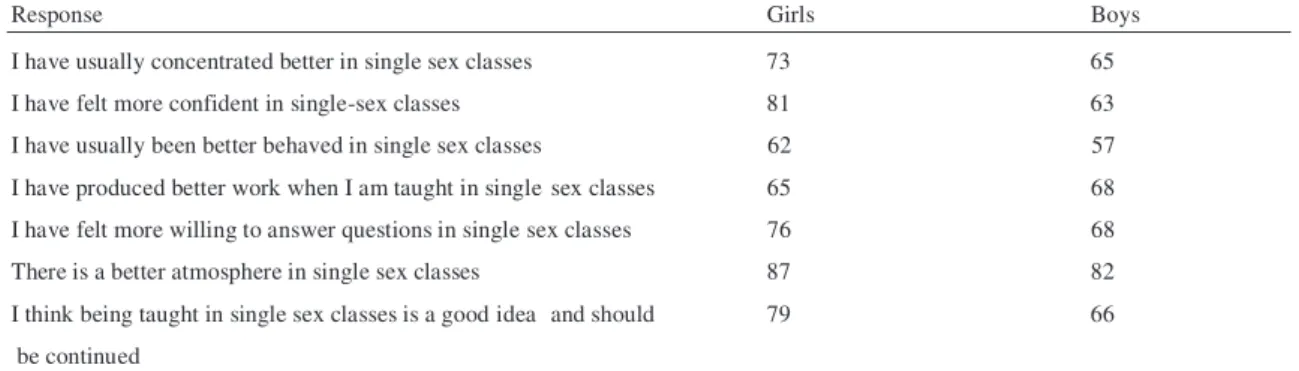
Table 1: Questionnaire responses from students in single sex schools
Percentage of students agreeing / strongly agreeing with statement
Response Girls Boys
I have usually concentrated better in single sex classes 73 65 I have felt more confident in single-sex classes 81 63 I have usually been better behaved in single sex classes 62 57 I have produced better work when I am taught in single sex classes 65 68 I have felt more willing to answer questions in single sex classes 76 68 There is a better atmosphere in single sex classes 87 82 I think being taught in single sex classes is a good idea and should 79 66 be continued
4.3. Findings
The following are the positive effects of the single gender classes discovered in the study
x Single-gender classes are useful for girls because they establish comfortable places in which girls can learn and explore the world.
x Single gender classes may be particularly helpful to both boys and girls at the developmental level of early adolescence helping them cope with the physical and emotional changes of early adolescence. x Gender separate classes improve academic performances of both gender , raising academic
x Gender separate classes improve student’s confidence, self-esteem and willingness to explore and take risks without the embarrassment posed by the opposite sex.
x Gender separate classes provide teachers with the opportunity to employ varying topics and activities
to cater to boys’ high energy level and competitive behaviour necessary to keep them on task.
5.Implication and Conclusion
There are 4 major implications arising from the evidence summarized above that warrant emphasis here. These are:
x The demand for enhanced literacy skills and related verbal reasoning and written communication skills by students throughout their schooling is consistent with the requirement of present day
‘information rich ‘society. Given this, it is vital that curriculum planners and teachers do not ‘dumb down ‘the curriculum or its assessment to meet the differential needs of boys. Rather due consideration must be given to boys particular interests and needs in the existing overcrowded and standardized curriculum, to provide quality teaching and learning in literacy.
x It is crucial that the literacy skills of all students (boys and girls) be maximized at an early age to prevent what is currently an education issue become a major health issue. The increasing number of parents seeking help from health and education experts for their distressed children suffering from learning difficulties and behaviour problems have increased markedly as a consequence of failure to acquire literacy skills.
x Strategically designed teacher training and professional development program in early and later literacy teaching and learning must include modules on brain based differences and gender studies to equip teacher with necessary skills and strategies to reach out to all students , boys and girls.
x The introduction of gender separate language classroom using an enhanced curriculum for boys to cater to the different needs and learning styles of boys thus arresting the problem of male
underachievement. In Gurian’s words (2011) “Literacy in high school can be a secret to decoding
texts, to be sure- but also to decoding adulthood”
In conclusion we propose single gender classes as alternative system worthy of serious consideration as we address the issue of male underachievement .It is imperative that positive actions are taken to provide Malaysian males a fair opportunity to succeed in order for the nation to eliminate gender disparity in educational outcomes. Consequently raising boys’ academic achievement will arrest the alarming problems of male students at risk and juvenile delinquency. We strongly feel that the nation cannot afford
to allow the current trend of boys’ underachievement to continue as the increasing gap in academic performance between males and females will impact society economically, socially and psychologically and therefore hamper the nations’ strategic agenda as well as undermine the sustainability of the family institution.
Acknowledgement
We are most grateful to the Research and Management Institute, Universiti Teknologi MARA for the opportunity and financial support. We wish to extend our sincere gratitude to the Dean of the faculty and to our valued respondents.
References
Ahmad, N., Mohd Jelas, Z. & Mohd Ali, M. (2001) ‘The Relationship between Learning Styles and Strategies with
AcademicAchievement Based on Gender and Type of School’ Graduates Seminar and Prosiding 195 Retrieved 12th march
2010 from pkukmweb.ukm.my/~fpendidikan/.../bil%2015%20gaya%20dan%20strategi.pdf
Armstrong, T. (2009). Multiple Intelligences in the classroom, 3rd edition ; Alexandria, VA: ASCD.
Cole, N. S. (1997). The ETS gender study: How females and males perform in educational settings. Princeton, NJ: Educational Testing Service
Gurian, M. (2011) Boys and girls learn differently: a guide for teacher and parents, San Francisco, Josey Bass
Gurian, M. & Stevens , K. (2005) The Minds of Boys: Saving our sons from falling behind in School and Life. San Francisco : Josey Bass
Jensen, E., (2006) Enriching the Brain: How to Maximize every Learner’s potential . San Francisco: Jossey-Bass.
Kenway, J., & Willis, S., with Blackmore, J., & Rennie, L. (1998). Answering back:Girls, boys and feminism in school. London: Routledge.
Martino, W., & Meyenn, B. (2002). ‘War, guns and cool, tough things’: Interrogating single-sex classes as a strategy for engaging boys in English. Cambridge Journalof Education, 32, 302–324.
Moir, A., Jessel, D. (1990) Brain Sex . New York : Dell.
Norfleet James. A. & Richards, H. (2003) “Escaping Stereotypes: educational attitudes of male alumni of single-sex and coed
schools,”. Psychology of Men and Masculinity, 4:136-148
O’Reilly, J. (2000) "Mixed school hits new heights with single-sex classes." Sunday Times (London),August 20, 2000.
Rowe, K. J. & Rowe, K. S. (2000) Inquiry into the Education of boys. A research and evaluation report commissioned by the Office of Educational Review, Department of Education, Australia
Sax, L. (2005). The Promise and Peril of Single-Sex Public Education: Mr Chips Meets Snoop Dogg. Education Week March 2, 2005 pp. 48,34-35 . Retrieved on 4th May 2010 from http://www.singlesexschools.org/edweek.html
Younger, M. & Warrington, M. Gray, (2005) Raising Boys Achievement , Research Report No 636 DfES, London : University of Cambridge
Younger, M. & Warrington, M. (2006) Would Harry and Hermione Have Done Better in Single-Sex Classes? A Review of Single-Sex Teaching in Coeducational Secondary Schools in the United Kingdom University of Cambridge American Educational Research Journal