DG Taxation and Customs Union Report 21 September 2009
Study to quantify and analyse the VAT gap in the EU-25
Member States
European Commission, Directorate-General for Taxation and Customs Union. It is the result of independent work carried out by Reckon LLP, and does not necessarily reflect the opinions or position of the European Commission or of the national bodies consulted. Any errors are our own.
SECTION 1: INTRODUCTION AND SUMMARY...5
SECTION 2: TOP-DOWN ESTIMATES OF THE VAT GAP...12
Results...12
Sensitivity analysis...16
Full set of results ...22
SECTION 3: ECONOMETRIC ANALYSIS OF THE VAT GAP ...47
Previous econometric studies of the determinants of the VAT gap...47
Empirical modelling of top–down VAT gap estimates...48
Conclusions from the econometric analysis of the VAT gap ...58
SECTION 4: AN OUTLINE OF THE TOP-DOWN APPROACH...59
SECTION 5: DATA SOURCES ...63
Final and intermediate expenditure...63
Gross fixed capital formation ...68
VAT rates ...70
VAT receipts...72
SECTION 6: ASSUMPTIONS...74
Completeness of national accounts...74
Proportion of intermediate consumption on which VAT is not recoverable ...74
Interpreting the data on final consumption ...77
Gross capital formation...78
SECTION 7: ADJUSTMENTS ...84
Business entertainment expenditure ...84
Company cars ...84
“Tank tourism”...84
Exemption granted to small businesses ...85
Supplies in domestic territories with different VAT regimes ...87
Adjustments that have not been carried out ...88
SECTION 8: DEFINITIONS OF THE VAT GAP...90
Possible definitions of the VAT gap...90
Worked examples of the differences between the definitions for the VAT gap ...91
Choice of definition for the study...95
SECTION 9: REVIEW OF PUBLISHED ESTIMATES OF VAT FRAUD AND THE VAT GAP ...96
Published top-down estimates of the VAT gap...96
Bottom-up quantification of the components of VAT fraud...99
Published estimates of MTIC fraud ...102
TABLES
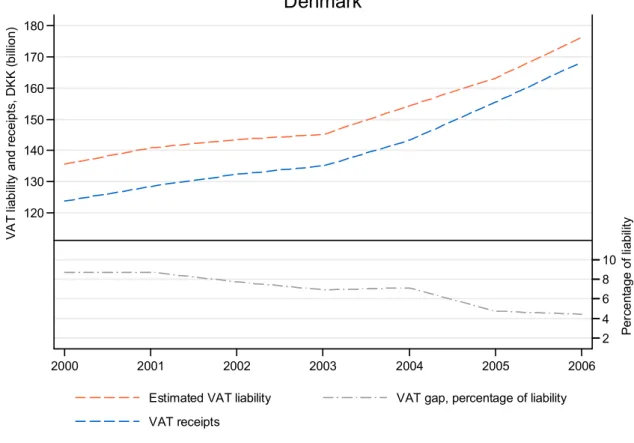
Table 1 Aggregate estimates of the VAT gap, 2000-2006 (EUR billion) ...8
Table 2 Aggregate estimates of the VAT gap as a share of theoretical liability, 2000-2006...9
Table 3 Estimates of the VAT gap, 2006 (EUR million) ...9
Table 4 Sensitivity to assumption on propex of the financial services sector...18
Table 5 Sensitivity to assumption on propex of the education sector...19
Table 6 Sensitivity to assumption on the split of GFCF on dwellings ...20
Table 7 Sensitivity to assumption on the VAT treatment of company cars...21
Table 8 Austria: VAT receipts, theoretical liability and gap, 2000–2006 (EUR million) ...23
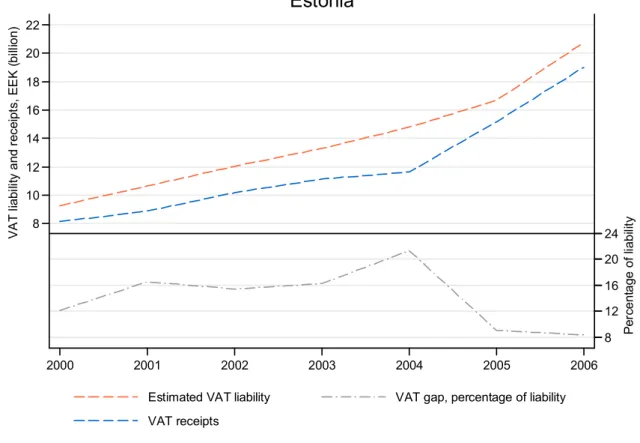
Table 9 Belgium: VAT receipts, theoretical liability and gap, 2000–2006 (EUR million) ...24
Table 10 Czech Republic: VAT receipts, theoretical liability and gap, 2000–2006 (CZK million)...25
Table 11 Germany: VAT receipts, theoretical liability and gap, 2000–2006 (EUR million) ...26
Table 12 Denmark: VAT receipts, theoretical liability and gap, 2000–2006 (DKK million) ...27
Table 13 Estonia: VAT receipts, theoretical liability and gap, 2000–2006 (EEK million) ...28
Table 14 Spain: VAT receipts, theoretical liability and gap, 2000–2006 (EUR million)...29
Table 15 Finland: VAT receipts, theoretical liability and gap, 2000–2006 (EUR million)...30
Table 16 France: VAT receipts, theoretical liability and gap, 2000–2006 (EUR million) ...31
Table 17 Greece: VAT receipts, theoretical liability and gap, 2000–2006 (EUR million)...32
Table 18 Hungary: VAT receipts, theoretical liability and gap, 2000–2006 (HUF million) ...33
Table 19 Ireland: VAT receipts, theoretical liability and gap, 2000–2006 (EUR million)...34
Table 20 Italy: VAT receipts, theoretical liability and gap, 2000–2006 (EUR million)...35
Table 21 Lithuania: VAT receipts, theoretical liability and gap, 2000–2006 (LTL million) ...36
Table 22 Luxembourg: VAT receipts, theoretical liability and gap, 2000–2006 (EUR million) ...37
Table 23 Latvia: VAT receipts, theoretical liability and gap, 2000–2006 (LVL million) ...38
Table 24 Malta: VAT receipts, theoretical liability and gap, 2000–2006 (MTL million) ...39
Table 25 Netherlands: VAT receipts, theoretical liability and gap, 2000–2006 (EUR million)...40
Table 26 Poland: VAT receipts, theoretical liability and gap, 2000–2006 (PLN million) ...41
Table 27 Portugal: VAT receipts, theoretical liability and gap, 2000–2006 (EUR million) ...42
Table 28 Sweden: VAT receipts, theoretical liability and gap, 2000–2006 (SEK million)...43
Table 29 Slovenia: VAT receipts, theoretical liability and gap, 2000–2006 (EUR million) ...44
Table 30 Slovakia: VAT receipts, theoretical liability and gap, 2000–2006 (SKK million) ...45
Table 31 United Kingdom: VAT receipts, theoretical liability and gap, 2000–2006 (GBP million) ...46
Table 32 Candidate explanatory variables...49
Table 33 Random effects model results...52
Table 34 Panel corrected standard error modelling results...53
Table 35 Robust regression modelling results...55
Table 36 Instrumental variable robust regression modelling results ...56
Table 37 Robust regression without VAT burden, with gross capital formation variable...57
Table 38 Eurostat use table availability as of 30 June 2008 ...65
Table 39 Breakdown of “CPA 15 – Manufacture of food and beverages”...71
Table 40 Thresholds for application of special scheme for small businesses, May 2008...86
Table 41 Estimated VAT revenue foregone due to small business exemption...86
Table 42 Calculation of different definitions of the VAT gap in worked examples...94
Table 43 Other published estimates of the VAT gap...97
Table 44 HMCE bottom-up and top-down estimates of VAT losses ...100
Table 45 Swedish VAT tax gap reported in Skatteverket (2008) ...102
Table 46 HMRC estimates of attempted MTIC fraud, 2000/2001-2005/2006...104
Table 47 EU-25 Member States ...107
SECTION 1: INTRODUCTION AND SUMMARY
1. This report is concerned with quantifying and analysing the VAT gap in each EU Member State over the period 2000–2006. It has been prepared by Reckon LLP in the context of a study carried out for the European Commission.
We provide estimates of the VAT gap
2. We provide estimates of the VAT gap based on a comparison of accrued VAT receipts with a theoretical net VAT liability for the economy as a whole. We estimate the theoretical net liability by identifying the categories of expenditure that give rise to irrecoverable VAT and combining these with appropriate VAT rates.
3. The VAT gap is not a measure of VAT fraud. For example:
(a) The VAT gap might include VAT not paid as a result of legitimate tax avoidance measures.
(b) The VAT gap is estimated primarily on the basis of national accounts data, and therefore depends on the accuracy and the completeness of such data. Moreover, it does not take account of taxable activities that are outside the scope of national accounts.
(c) Due to lack of data, we do not adjust our estimates of the VAT gap to remove the VAT that is not collected due to insolvencies arising as a result of regular business activity, yet this portion of VAT that is not remitted is not due to VAT fraud.
4. The estimates presented in this report are of the VAT gap, as defined above, and not of VAT fraud.
We focus on a top-down approach to estimating the VAT gap
5. The main focus of our research is to derive top-down estimates of the VAT gap, obtained by comparing total accrued tax receipts with a theoretical tax liability calculated from general economic data. They can be contrasted with bottom-up estimates, which are derived by extrapolating data relating to individual companies or discovered frauds.
6. Our top-down approach relies on published national accounts. We are only able to develop these estimates for those Member States where relevant national accounts data are publicly available.
7. We are unable to produce similar estimates on the basis of a bottom-up approach that compiles information from surveys or other studies on estimates of particular types of
indeed they are scant — to allow us to piece together an estimate of VAT fraud in the economy as a whole.
(b) There may be a selection bias. Presenting the value of the different types of VAT fraud detected by tax agencies, as reported by some in annual reports, would risk giving a distorted account of the relative importance of different types of VAT fraud as well as of overall level of VAT fraud.
(c) The raw data underlying the estimates of particular types of VAT fraud that we aware of are based, almost invariably, on operational data held by the tax agencies. Generally, these are confidential, as are the methods used to derive them.
8. The top-down approach allows us to estimate the VAT gap in the economy as a whole but it does not allow us to characterise it in terms of identifying what sectors, or trade in what goods, or what types of business are more susceptible to VAT fraud.
9. Our top-down approach is comparable to those that we have found published by national tax agencies. It is also related to the approach followed in the compilation of VAT own resources accounts submitted annually by each Member State to the European Commission.
We draw on national accounts to compute net VAT liability
10. A top-down estimate of the VAT gap is based on comparing accrued VAT receipts with a theoretical net VAT liability for the economy as a whole. We estimate the theoretical net liability by identifying and measuring the categories of expenditure that give rise to irrecoverable VAT.
11. The main categories of relevant expenditure that give rise to irrecoverable VAT are final consumption expenditure by households, non-profit institutions serving households (NPISH) and government, intermediate consumption expenditure on goods and services used in making exempt supplies of goods and services; and gross fixed capital formation on assets and changes in the stock of valuables which can be allocated to exempt supplies of goods and services.
12. National accounts data provide the primary information for our estimates of the value of these transactions that give rise to irrecoverable VAT. Within this, we draw in particular on published use tables which report the use of goods and services by product category and by type of use. Because of this structure, use tables lend themselves to the task of identifying transactions that give rise to irrecoverable VAT. 13. Our analysis is broadly based on Member States’ use tables downloaded from
recovered, it is necessary to apply the appropriate VAT rate. Information on the applicable VAT rates is drawn from national VAT legislation and secondary sources. We adjust our estimate to account for items affecting net VAT liability
15. We make a series of adjustments to the estimates we obtain through the approach outlined above to take account of a number of features common to the VAT systems in most Member States. In particular, we adjust our estimates to reflect the fact that in most Member States an exemption from registration is granted to businesses with a turnover below a certain threshold. We also make adjustments to reflect the limitations relating to the recoverability by corporations of expenditure on entertainment and on the purchase of company cars.
16. In the case of Luxembourg, our estimation makes a further adjustment to capture the contribution to the VAT liability associated with “tank tourism”, the practice of haulage and transport companies from other Member States filling up their trucks with diesel and petrol in Luxembourg, whether for logistical reasons or to benefit from differences in fuel prices.
Limitations of estimating theoretical VAT liability from national accounts
17. There are three main types of limitations in using national accounts data for the purpose of estimating VAT gap. The first relates to the fineness of the data available, the second relates to the coverage of national accounts insofar as they measure taxable activity, and the third to the question of whether the national accounts data accurately measure what they are supposed to. We consider the implication of each in turn. 18. The minutiae of the VAT system in most Member States is such that it would require
unfeasibly detailed information about the pattern of transactions in an economy to ensure that the correct VAT treatment is applied to a given volume of trade. As an example, it would be necessary to know how expenditure by Danish consumers on football matches is divided between games where both teams fielded professionals and games where that is not the case; the former attract a standard VAT rate, the latter are exempt. We are certain that pursuing data that would allow us make this split, and that would allow us to accommodate all of the details of the VAT legislation more generally, is not a feasible exercise.
19. The top-down approach requires instead an exercise of judgement to identify those trades that are thought to have a material impact on the measure of net VAT liability at the economy-wide level. For example, in many Member States, the rates applied to food products are lower than those applied to beverages. Further, expenditure on food products and beverages account for a significant share of household consumption. Based on this, we take a view that it is appropriate to consider the contribution to net VAT liability of the expenditure in these two classes of products separately. Indeed, we take the view that it is appropriate to examine expenditure in these classes of
and those that contribute to national accounts. Some activities fall outside this overlap, as is the case of own house building, or of the exemptions to small businesses. To address this, it is necessary to draw on data outside of national accounts, where such data are available.
21. Our top-down estimation of the VAT gap relies on the premise that the national accounts data, and the use tables in particular, have been compiled in line with the European System of Accounts 95 (ESA 95). An important corollary of this is that national accounts data are deemed to include the contribution of the shadow economy, as ESA 95 requires. An inadequate or inconsistent estimation by statistics offices of this contribution will have a direct impact on our estimates of the theoretical VAT liability.
We have contrasted our approach with that of other institutions
22. Our work has benefitted from contact with national tax authorities, national statistics offices and other relevant government departments in Member States.
23. We shared details of our approach and interim results with relevant institutions from Member States and have used the information and feedback received from them to improve our estimates.
24. At a late stage of the study, for almost all Member States, we were granted access to the VAT own resources accounts that are submitted annually to the European Commission. There is considerable overlap in the methods used in our top-down approach to estimating VAT gap and the approach adopted by Member States in those submissions for the purpose of estimating the weighted average VAT rate. We have not sought to reconcile our estimates with those reported in the own resources accounts, nor have we used data contained within them. Rather, we have used the workings submitted within the own resources accounts to help us identify errors and unjustified assumptions that we might have made in our analysis. Where these were found, we sought to correct them by drawing on alternative, published information or on information obtained directly from national institutions.
Our top-down estimates of VAT gap
25. We have estimated The VAT gap for each of the Member States, other than Cyprus, for each of the years in the period 2000-2006. Table 1 presents our estimates of the VAT gap for the EU-25, the EU-10 and for the EU-15 in value terms. Table 2 reports the gap as a share of the net theoretical liability.
2000 2001 2002 2003 2004 2005 2006
EU-10 20% 22% 20% 19% 19% 16% 14%
EU-15 12% 13% 13% 14% 13% 13% 12%
EU-25 13% 14% 14% 14% 14% 13% 12%
Note: EU-10 and EU-25 exclude Cyprus.
26. We estimate the overall VAT gap in the EU-25 has, in value terms, shown an increase over the period from 2000 to 2005, but a drop from 2005 to 2006. As a share of theoretical liability, we estimate that the VAT gap for the EU-25 remained fairly stable from 2000 to 2004 and that it then fell by two percentage points between 2004 and 2006.
Table 3 Estimates of the VAT gap, 2006 (EUR million)
Member State Theoretical VAT liability VAT receipts VAT gap VAT gap as a share of theoretical liability
AT 22,844 19,735 3,108 14% BE 25,360 22,569 2,791 11% CZ 9,216 7,541 1,675 18% DE 164,115 147,150 16,965 10% DK 23,611 22,560 1,051 4% EE 1,325 1,215 111 8% ES 63,013 61,595 1,418 2% FI 15,176 14,418 758 5% FR 140,817 131,017 9,800 7% GR 21,746 15,183 6,563 30% HU 8,882 6,813 2,070 23% IE 14,043 13,802 241 2% IT 119,197 92,860 26,337 22% LT 2,335 1,826 510 22% LU 1,961 1,941 20 1% LV 1,751 1,374 378 22% MT 463 410 53 11% NL 41,269 39,888 1,381 3% PL 23,784 22,127 1,657 7% PT 14,371 13,757 614 4% SE 29,294 28,487 807 3% SI 2,764 2,647 116 4% SK 4,632 3,320 1,312 28% UK 155,697 128,721 26,976 17%
27. We identified four assumptions in our top-down approach which we expect to have a material impact on the estimated VAT gap and for which we have a limited empirical basis. These concern the assumptions on the proportion of consumption by the education and by the financial sectors on which VAT is not recoverable, on how gross fixed capital formation on dwellings is split between investments in new dwellings and expenditure on major improvements to existing dwellings and on the size of the adjustment to be done to account for the VAT treatment of company cars.
28. We examined the sensitivity of our results to these assumptions and find that they do have some impact on our results. The impact is greatest with regards to the assumption on the proportion of consumption by the financial sector on which VAT is not recoverable.
Comparison with other published estimates of VAT gaps
29. We have found published top-down estimates of the VAT gap relating to the period from 2000 to 2006 for only a handful of Member States, namely for Denmark, Germany, Italy, Sweden and the UK. Other than for Germany, these estimates are computed by the relevant national tax agency or statistics office. The estimates are typically accompanied by only a brief description of the precise data sources and assumptions that underpin the estimation. This limits our ability to interpret the differences between our estimates and those that we have found published. But we are aware of two general points that are likely to explain much of the differences. First, we expect national tax agencies and statistics offices to have access to more detailed or recent national accounts data than that which are published, and therefore available to us in the course of the study. We note too that national accounts data are often revised over time and differences between our set of estimates of the VAT and those published by national tax agencies will also differ where we have drawn on different revisions of the data. Second, we have extracted figures on accrued VAT receipts from Eurostat, and, with the exception of Denmark, these do not match the figures used in the estimates of the Member States mentioned earlier.
30. Not withstanding these differences, we, we find that our estimates of the VAT gap for Germany, Italy and the UK follow a similar trend to the published estimates for these countries that we have come across.
31. We have found even fewer — two — published bottom-up estimates of VAT gaps; one by the UK’s HM Customs and Excise in 2002 and the second by the Swedish Skatteverket in 2008. These studies draw on a range of data sources, including surveys and operational data, to identify the relative importance of different types of VAT losses. Both agencies qualify their findings by noting the significant degree of uncertainty around their estimates. We do not think it reasonable to draw on the
32. We conducted econometric analysis to assist in the understanding of the nature and causes of the VAT gap, and to identify country-specific characteristics that appear related to different levels of the VAT gap.
33. The variable found to have the strongest relationship with the size of the VAT gap was that connected with the perceived level of corruption in the country. The relationship implies that lower perceived corruption is associated with a lower VAT gap.
34. The main difference between our analysis and the results obtained by other studies surrounds the relationship between the VAT gap and the VAT burden. If the VAT burden, characterised by the ratio between the theoretical VAT liability and GDP, is treated as a candidate explanatory variable, then we find that it has a significant positive relationship with the VAT gap. This is in line with the limited literature on this topic, and with the theory that a higher tax burden should lead to higher levels of evasion. We have identified a risk that this estimated relationship may be biased by measurement errors in the estimation of the theoretical liability. Once this risk has been taken into account by using an instrumental variable regression, we find no statistically significant relationship between the VAT gap and the VAT burden.
SECTION 2: TOP-DOWN ESTIMATES OF THE VAT GAP
35. This section sets out, in more detail, the results of our top-down estimation of the VAT gap across Member States in the period 2000-2006. Our analysis draws on an array of assumptions and we present in this section the relative impact of some of these assumptions on the estimated VAT gap. This sensitivity analysis focuses on those assumptions that are of greater materiality and for which we have less evidence underpinning them. Charts and tables reporting the full set of results for each Member State are presented at the end of this section.
36. In this section we refer at times to the EU-25 to mean the set of Member States in our analysis. We do so for convenience, as strictly speaking this is not correct: Cyprus is not included in our analysis because no use tables are available for it, and we have therefore only estimated the VAT gap for 24 Member States. Similarly, we use the term EU-10 to refer to those Member States that joined the EU in 2004 although again Cyprus is not included.
Results
37. The estimates of the VAT gap for each Member State over the period 2000–2006 are set out in a chart and in an accompanying table in the pages at the end of this section. Ahead of presenting those charts, we set out a brief overview and discussion of our estimates.
There is no common trend in VAT gap across Member States
38. There is no common trend in the estimated VAT gap over the period 2000–2006 across the 24 Member States.
39. For most, the estimated VAT gap exhibits a slight downward trend, the decreases tending to be sharper over the period 2003 to 2006. Over the entire period of observations the decreases have been most pronounced in Luxembourg (from 12 per cent in 2000 to 1 percent in 2006), in Poland (from 22 per cent in 2000 to 7 per cent in 2006) and in Slovenia (from 16 per cent in 2000 to 4 per cent in 2006).
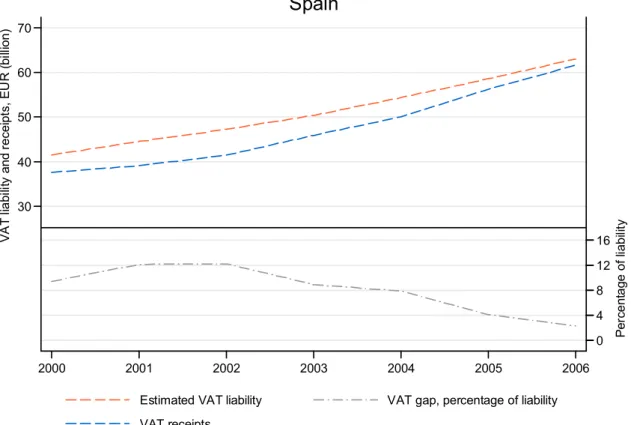
40. The estimated gap for Belgium, Denmark, Spain, Ireland, the Netherlands, Poland, Sweden and Slovenia have shown a steady year-on-year fall for most years, particularly in the latter half of the period analysed.
41. For Austria, Germany, France, Finland and the UK, the VAT gap has been estimated to be relatively stable, fluctuating within a relatively narrow band.
42. For Greece, Hungary and Lithuania, we estimate that the VAT gap has increased from 2000 or 2001 to the later years of our sample period. We have estimated the Greek
fallen over the period, particularly in the second half of the sample period, applies more widely than to the Member States joining the EU in 2004 though it is most noticeable amongst the newer members. In this regard, we note that the VAT gap for Estonia dropped from 21 per cent in 2004 to 8 per cent in 2006 and for Latvia they fell from 31 to 22 per cent over that same period. We have already noted above that for Lithuania we estimated the VAT gap falling between 2004 (28 per cent) and 2006 (22 per cent). The reforms to the VAT legislation and/or the greater effort in gaining fiscal efficiency that may be associated with joining the EU are potential explanations of the remarkable fall in the VAT gap of these Member States. However, the estimates for the Czech Republic and Slovakia are contrary to this interpretation. In those Member States, the estimated gaps have risen between 2004 and 2006: from 24 to 28 per cent in the case of Slovakia and from 13 to 18 per cent in the case of the Czech Republic (although until 2003 the estimated gap for the Czech Republic fluctuates around 16 per cent).
44. Figure 1 provides a summary of the discussion set out above. The figure plots the estimated VAT gap expressed as a share of theoretical net liability in 2006 against the estimate we obtained for 2000. The dashed diagonal line in the figure is a 45 degree line. For those Member States lying above this diagonal line, the VAT gap is estimated to have increased between 2000 and 2006. For those below the line, the VAT gap is estimated to have fallen. As can be read from Figure 1, most Member States are in the latter group.
Figure 1 Comparison of estimated VAT gap in 2000 and 2006
AT BE CZ DE DK EE ES FI FR GR HU IE IT LT LU LV MT NL PL PT SE SI SK UK 0% 10% 20% 30% 2006 VAT gap as a s hare of liability 0% 10% 20% 30%
45. We turn now to an analysis of the evolution of the VAT gap for specific Member States. For many Member States, we find little to comment on with regard to the evolution of the VAT gap between 2000 and 2006 that is not already apparent from the relevant figures and tables presented at the end of this section. In many cases, we have no particular insights to offer on the movement of accrued receipts relative to the estimated VAT liability. Clearly, it could be of interest to understand why receipts may have grown faster or slower than estimated liability — did the tax authority put more resources in the fight against VAT fraud or did it change its mode of operations — but this is beyond the scope of the study.
46. In the light of this, the discussion below focuses on a set of Member States for which we observe movements in the estimated VAT gap which might merit a supplementary comment.
The Czech Republic
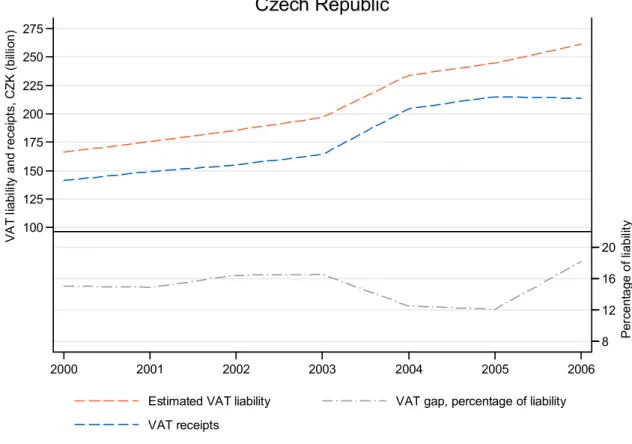
47. As a share of the theoretical net VAT liability, the estimated VAT gap for the Czech Republic remained at around the 16 per cent level from 2000 to 2003 but in 2004 fall to 13 per cent, dropped marginally to 12 per cent in 2005 but then increased to 18 per cent in 2006. Behind this increase between 2005 and 2006 lies the fact that the estimated net VAT liability rose considerably, from CZK 245 to CZK 261 million, whilst accrued receipts fell slightly, from CZK 215 billion to CZK 214 billion in 2006. In turn, the increased liability was driven almost entirely by a significant growth in household final consumption. There were no changes in the standard rates over this period. We note, lastly, that our estimates for the Czech Republic for both 2005 and 2006 are based on extrapolated use tables, as described in Section 5. However, we take comfort from the fact that the Czech total household consumption did register such high levels of growth in this period and so we do not believe that the estimated jump in the VAT gap are driven by the method we have used to extrapolate use tables.
Estonia
48. Our estimates of the Estonian VAT gap show a sharp fall between 2004 and 2005, from 21 per cent to 9 per cent. There was no change to the standard rate in these years nor does it appear to us that that the VAT legislation with regards to the applicability of rates was changed in any other way that would impact significantly on the trend of the net VAT liability. Rather, it has been the trend in accrued receipts which has changed since 2004; whilst this had grown at an average rate of around 9 per cent a year between 2000 and 2004, between 2004 and 2006 receipts grew by around 28 per cent a year.
from 25 to 20 per cent in January 2006. Neither appears to have had an appreciable impact on VAT gap, which remained relatively flat.
Luxembourg
50. Our estimates for Luxembourg show a considerable drop in the VAT gap from 12 per cent in 2000 to 2 per cent in 2004 before increasing to 5 per cent in 2005 and then falling back to 1 per cent in 2006. There is a great margin of uncertainty surrounding our estimate of Luxembourg VAT gap.
51. One source of this uncertainty relates to the sensitivity of the results to the assumption on the value of propex of the financial sector. We reported in Table 6 that changing the value of that parameter from 50 per cent to 25 per cent would cause our estimate of the VAT gap in 2006 to be 10.3 percentage points lower, and if, instead, the parameter had been set at 100 per cent, the gap would have been 8.8 percentage points higher.
52. A second cause of uncertainty relates to the estimation of the net VAT liability associated with “tank tourism”, the practice of foreign haulage and transport businesses filling up their trucks in Luxembourg to take advantage of the price differences. This is a significant activity as may be inferred from the observation in a recent Commission document that “whereas the consumption of diesel per capita is less than 750 litres in other Member States, it amounts to more than 4,200 litres in Luxembourg”. 1 The significance of this activity is also explicitly recognized in the submissions by Luxembourg to the United Nations Framework Convention on Climate Change on its national inventory of greenhouse gases; its 2008 submission reports that, in 2006, 18 per cent of diesel sold in Luxembourg was consumed in the country whereas the remaining 82 per cent was “exported”.2
53. We understand that trade relating to “tank tourism” should be recorded in the Luxembourg use tables as exports of diesel or petrol. Our top–down approach assumes that, in general, no VAT liability arises from exports. In this instance, however, we understand that foreign trucks will pay the VAT due on the diesel or fuel and that those entitled to a VAT refund will not necessarily always apply for a refund from the Luxembourg tax agency. It is necessary, therefore to estimate the contribution to the Luxembourg net theoretical VAT liability that is associated with these “exports”.
1 European Commission (2007) “Accompanying document to the Proposal for a Council Directive amending Directive
2003/96/EC as regards the adjustment of special tax arrangements for gas oil used as motor fuel for commercial purposes and the coordination of taxation of unleaded petrol and gas oil used as motor fuel”, Staff Working Paper {COM(2007) 52 final}, p. 8. HTML version available from
http://eur-the VAT is not recovered. For http://eur-the purpose of our estimation we have assumed, as noted in Section 6 that all of the exports relating to the product category “Coke, refined petroleum products and nuclear fuels” refer to sales of diesel or petrol to “tank tourists” and have further assumed that none of the VAT associated with this is recovered.
Portugal
55. We estimate that there was a fall in the VAT gap as a share of liabilities in Portugal over the sample period as a whole and a sharp drop in particular between 2004 (8 per cent) and 2005 (3 per cent). Use tables are available for the period 2000–2005 implying that the estimated drop is not linked to our forecasting technique. Annual reports from the Portuguese Ministry of Finance and Public Administration on the fight against fiscal fraud and evasion for the more recent years give emphasis to the greater operational effort in targeting VAT fraud, notably MTIC but we are unable to identify specific initiatives as the cause of the observed fall in the VAT gap from 2004 to 2005. We note, however, that the standard rate of VAT did increase in this period, from 19 to 21 per cent on the 1 May 2005.
UK
56. Our estimates for the UK show a relatively stable trend in the VAT liability over the period 2000–2006. The VAT gap as a share of liability has also remained fairly stable at around 17 per cent from 2000 to 2002, then falling to 15 per cent in 2003 and 2004 before increasing to 18 per cent in 2005. We note that the increase between 2004 and 2005 is led by a slowdown in the growth of receipts rather than due an extraordinary increase in estimated liability.
57. This observed trend in the VAT gap share is in keeping with the trends in HMRC’s own estimates of VAT gap.3 HMRC’s estimates of VAT gap also show a decline until 2004 before increasing in 2005. Significantly, HMRC also estimates that there was a sharp rise in MTIC fraud in 2005, which possibly contributed to the rise in the estimated gap.
Sensitivity analysis
58. Of the assumption underpinning our top-down estimation of the VAT gap we identify four which we expect to have a material impact on our estimate of the VAT gap and for which we have limited empirical backing. Because of this, we think it is of interest to examine the impact on our estimates of considering variations to these assumptions. We carry out such a sensitivity analysis on the following:
intermediate consumption of the education sector attracts irrecoverable VAT. (c) For four Member States (Belgium, Italy, Portugal and the UK) we assume that
half of the gross fixed capital formation on dwellings is accounted for by investments in new dwellings and half by expenditure on major improvements to existing dwellings. This assumption is necessary as national VAT legislation accords different VAT treatment to the two categories of expenditure and we have not found data that allow us to make this split for these countries.
(d) Across all Member States, we assume that half of the gross fixed capital formation on products within the CPA category “Motor vehicles, trailers and semi-trailers” attract VAT that is not recoverable.
59. The sensitivity analysis is done by considering other values for the parameter associated with each of the assumptions and, for each, calculating the associated VAT gap. The first two assumptions refer to the share of intermediate consumptions by a given sector on which VAT is not recoverable; we have denoted this parameter as
propex. As an example, and with regard to the first assumption, we examine the sensitivity of our results by computing the change in the estimated VAT gap had we assumed that the propex associated with the financial sector was 100 per cent, and at the other extreme, had we assumed it to be 25 per cent.
60. For each Member State we carry out the sensitivity analysis relating to the first two assumptions and to the fourth listed above using the most recent year for which use tables have been published by Eurostat. This is to ensure that the sensitivity analysis is not vitiated by any possible effects that might arise due to the extrapolation of the use tables we carried out. The exceptions to this are Greece and Latvia as the most recent published use tables refer to years prior to 2000 and we have carried out the sensitivity on the basis of the data for 2000. The sensitivity of our results to the third assumption listed — on the split of GFCF on dwellings — is done on the basis of 2006 estimates as the parameter relating to that assumption is applied to data on GFCF obtained from Eurostat and hence has no interaction with the extrapolation of the use tables.
Sensitivity to the assumption on the propex of the financial sector
61. Our estimates assume that, across all Member States, 60 per cent of the value of the intermediate consumption of the financial sector attracts irrecoverable VAT. That is to say, we assume that the value of propex for the financial sector, as defined by NACE category “J. Financial intermediaries”, is 60 per cent. The grounds for this assumption are set out in Section 6.
62. Table 4 presents the impact on the estimation of the VAT gap for each Member State of changing this assumption. In particular, it reports how the VAT gap would change if rather than assuming a propex of 60 per cent we assumed it to be (a) 25 per cent,
Percentage points change to VAT gap if assume finance propex of Member State Year VAT gap as a share of theoretical
liability (%) 25 per cent 100 per cent
AT 2004 12.5% –1.0 1.0 BE 2004 12.4% –1.4 1.4 CZ 2004 12.5% –1.0 1.0 DE 2004 13.8% –1.2 1.2 DK 2004 7.1% –0.7 0.7 EE 2004 21.3% –0.3 0.3 ES 2004 7.9% –0.7 0.7 FI 2005 3.8% –0.9 0.9 FR 2004 6.7% –1.5 1.4 GR 2000 23.8% –0.5 0.5 HU 2004 23.7% –0.7 0.7 IE 2002 2.6% –2.0 1.9 IT 2004 27.5% –0.7 0.6 LT 2004 27.6% –0.3 0.3 LU 2006 1.0% –10.3 8.8 LV 2000 30.6% –0.6 0.6 MT 2001 15.5% –0.5 0.5 NL 2004 5.6% –1.4 1.4 PL 2003 19.9% –0.9 0.9 PT 2005 3.0% –1.4 1.3 SE 2005 1.9% –0.8 0.7 SI 2004 7.8% –0.7 0.7 SK 2004 23.7% –0.5 0.5 UK 2003 14.3% –2.7 2.6
63. As would be expected, changing the assumption on the propex of the financial sector has greatest impact for those Member State where this sector is particularly important: hence the considerable impact on the estimated VAT gap for Luxembourg and, to a much less but still significant extent, for the UK and Ireland. For most other Member States, the rise or fall in the estimated VAT gap of assuming one of the alternate values for the parameter would be within 1.5 percentage points of our estimate. Sensitivity to the assumption on the propex of the educational sector
Percentage points change to VAT gap if assume finance propex of Member State Year VAT gap as a share of theoretical
liability (%) 50 per cent 100 per cent
AT 2004 12.5% –0.3 0.2 BE 2004 12.4% –0.2 0.1 CZ 2004 12.5% –0.5 0.3 DE 2004 13.8% –0.3 0.2 DK 2004 7.1% –0.6 0.4 EE 2004 21.3% –0.5 0.3 ES 2004 7.9% –0.3 0.2 FI 2005 3.8% –0.5 0.3 FR 2004 6.7% –0.4 0.2 GR 2000 23.8% –0.1 0.0 HU 2004 23.7% –0.4 0.2 IE 2002 2.6% –0.3 0.2 IT 2004 27.5% –0.2 0.1 LT 2004 27.6% –0.2 0.1 LU 2006 1.0% –0.2 0.1 LV 2000 30.6% –0.5 0.3 MT 2001 15.5% –0.2 0.1 NL 2004 5.6% –0.3 0.2 PL 2003 19.9% –0.3 0.2 PT 2005 3.0% –0.3 0.2 SE 2005 1.9% –0.6 0.3 SI 2004 7.8% –0.5 0.3 SK 2004 23.7% –0.2 0.1 UK 2003 14.3% –0.6 0.4
65. The results in Table 5 report that had we assumed the propex of the education sector to have been 50 or 100 per cent rather than 80 per cent, our estimate of the share of the VAT gap would have changed by at most 0.6 percentage points, and for most Member States it would have changed considerably less.
Sensitivity to the assumption on the split of GFCF on dwellings
66. GFCF associated with dwellings is made up of investment in new dwellings and of expenditure in major improvements to existing dwellings. In some Member States, different VAT rates apply to the supply of goods or services relating to these two activities and, for these Member States, it is necessary to identify the contribution of
relating to dwellings account for half of the GFCF on dwellings.
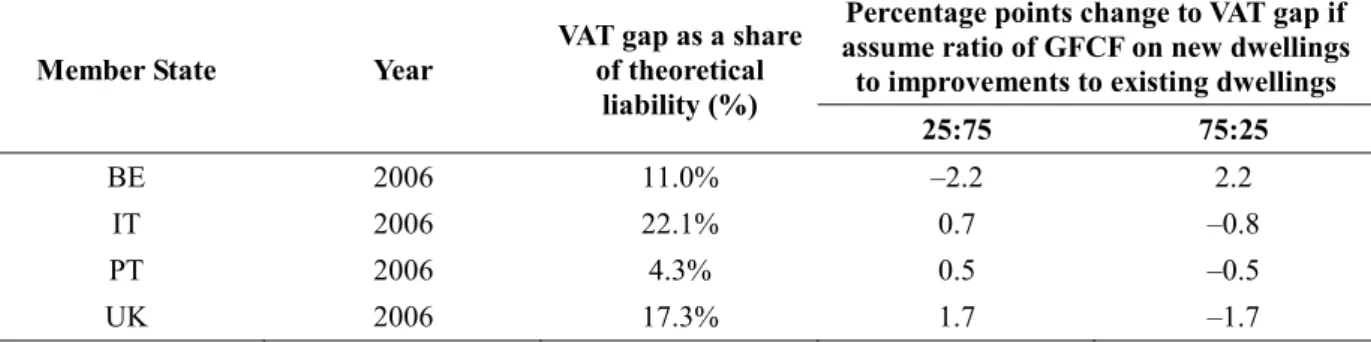
67. For these Member States, Table 6 reports the impact on the estimated VAT gap under two scenarios: first, that the GFCF associated with new dwellings account for 25 per cent of total GFCF on dwellings and, second, that the percentage is 75 percent.
Table 6 Sensitivity to assumption on the split of GFCF on dwellings
Percentage points change to VAT gap if assume ratio of GFCF on new dwellings to improvements to existing dwellings Member State Year
VAT gap as a share of theoretical liability (%) 25:75 75:25 BE 2006 11.0% –2.2 2.2 IT 2006 22.1% 0.7 –0.8 PT 2006 4.3% 0.5 –0.5 UK 2006 17.3% 1.7 –1.7
68. The impact on the estimated VAT gap of changing the assumption about the split of GFCF on dwellings is greatest for Belgium and the UK. For Belgium, our estimate of the VAT gap would be around 2.2 percentage points higher or lower depending on which of the alternative values is assumed. In contrast, the impact of considering the more extreme values of the parameter is relatively small for Italy and Portugal.
Sensitivity to the assumption on the VAT treatment of company cars
69. We examine the sensitivity of our estimates of the VAT gap to the assumption on the share of gross fixed capital formation in the economy on products of the sector “DM34 Motor vehicles, trailers and semi–trailers” on which VAT is recoverable. The estimates reported earlier in Table 3 assume that that share is 50 per cent. Table 7 below reports the changes to those estimates if that share were assumed to be 25 or 75 per cent.
Percentage points change to VAT gap if assume share of GFCF to be not
recoverable of Member State Year VAT gap as a share of theoretical
liability (%)
25 per cent 75 per cent
AT 2004 12.5% –0.7 0.7 BE 2004 12.4% –0.9 0.9 CZ 2004 12.5% –1.4 1.4 DE 2004 13.8% –0.7 0.6 DK 2004 7.1% –0.6 0.6 EE 2004 21.3% –1.3 1.2 ES 2004 7.9% –0.9 0.9 FI 2005 3.8% –0.4 0.4 FR 2004 6.7% –0.6 0.6 GR 2000 23.8% –0.6 0.6 HU 2004 23.7% –0.7 0.7 IE 2002 2.6% –1.3 1.3 IT 2004 27.5% –0.6 0.6 LT 2004 27.6% –0.5 0.5 LU 2006 1.0% –0.8 0.7 LV 2000 30.6% –1.2 1.2 MT 2001 15.5% –0.2 0.2 NL 2004 5.6% –0.8 0.7 PL 2003 19.9% –1.1 1.1 PT 2005 3.0% –0.6 0.6 SE 2005 1.9% –0.8 0.8 SI 2004 7.8% –1.0 1.0 SK 2004 23.7% –0.6 0.6 UK 2003 14.3% –0.3 0.3
70. As reported in Table 7, our estimates of the VAT gap for the Czech Republic, Estonia, Ireland, Latvia, Poland and Slovenia are relatively sensitive to this assumption: in each of these Member States the estimated VAT gap would change by at most 1.4 percentage points, and in most cases less than 1 percentage point, if the more extreme parameter values were chosen.
Conclusions on the sensitivity analyses
71. We have carried out sensitivity analyses for those assumptions which we expect to have a more material impact on our estimates and for which we have relatively limited empirical support. Not surprisingly, the results of the analyses do show that
typically the estimates are affected by less than 1.5 percentage points.
72. We also find that the sensitivity of our results to the assumption on the propex of the financial sector is limited for most of the Member States. The two significant exceptions in this regard are the UK and Luxembourg.
73. As a final comment on the sensitivity analysis, we note that whilst altering the values of the parameters relating to the above assumptions will affect the level of the estimated VAT gap as discussed above, we would not expect the trend in the gap to be similarly affected. Rather, the parameter values assumed for a given assumption will only affect the trend to the extent that the structure of consumption changes over time.
Full set of results
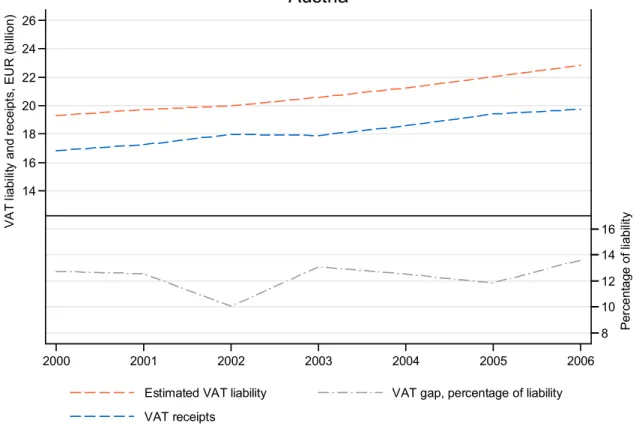
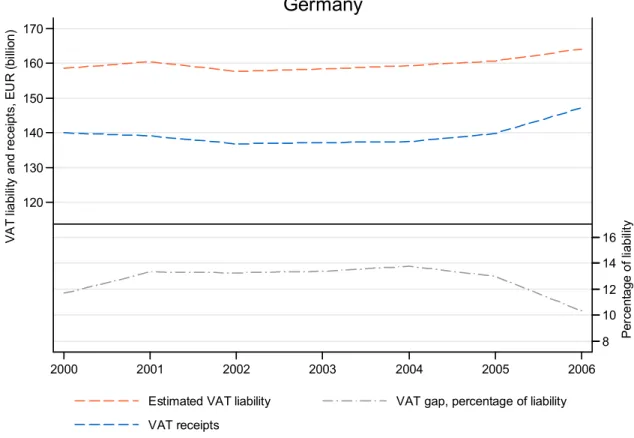
74. Taking each Member State in turn, we set out over the following pages a chart and accompanying table showing the estimates of the estimated VAT liability, receipts and VAT gap over the period 2000–2006.
75. The tables break down the total estimated VAT liability into the liability associated with:
(a) household final consumption; (b) gross fixed capital formation;
(c) other consumption, which covers government intermediate and final consumption and intermediate consumption of other sectors; and
(d) the set of adjustments relating to small business exemptions, company cars and business entertainment and, for Luxembourg, "tank tourism", and changes in valuables.
76. The data sources we have used to compile our estimate do not adopt a common approach to classifying government expenditure. For example, gross fixed capital formation on private dwellings could be classified as being carried out by households in some cases and government or non–financial corporations on others. Consequently, we choose not to separately identify the liability arising from government expenditure.
8 10 12 14 16 P erc e nt a ge o f l ia b ili ty 14 16 18 20 22 24 26 V A T li ab ili ty a n d re ce ip ts , E U R ( b illi o n) 2000 2001 2002 2003 2004 2005 2006
Estimated VAT liability VAT receipts
VAT gap, percentage of liability
Austria
Table 8 Austria: VAT receipts, theoretical liability and gap, 2000–2006 (EUR million)
AT 2000 2001 2002 2003 2004 2005† 2006†
Total theoretical VAT
liability 19,295 19,726 19,978 20,585 21,250 22,020 22,844
Of which Household
consumption 13,038 13,437 13,676 14,067 14,539 15,056 15,654
Gross fixed capital
formation 2,570 2,556 2,464 2,545 2,562 2,630 2,772
Other consumption 3,288 3,317 3,456 3,536 3,702 3,855 3,966
Net adjustments 398 415 381 436 445 479 451
Actual VAT receipts 16,840 17,251 17,972 17,893 18,590 19,414 19,735
VAT gap 2,455 2,475 2,006 2,692 2,660 2,606 3,108
VAT gap as a share of
theoretical liability 13% 13% 10% 13% 13% 12% 14%
8 10 12 14 16 18 P erc e nt a ge o f l ia b ili ty 14 16 18 20 22 24 26 28 V A T li ab ili ty a n d re ce ip ts , E U R ( b illi o n) 2000 2001 2002 2003 2004 2005 2006
Estimated VAT liability VAT receipts
VAT gap, percentage of liability
Belgium
Table 9 Belgium: VAT receipts, theoretical liability and gap, 2000–2006 (EUR million)
BE 2000 2001 2002 2003 2004 2005† 2006†
Total theoretical VAT
liability 20,224 20,764 21,275 21,829 22,959 24,047 25,360
Of which Household
consumption 12,414 13,017 13,245 13,669 14,074 14,769 15,531
Gross fixed capital
formation 2,554 2,568 2,629 2,465 2,828 2,980 3,202
Other consumption 4,341 4,301 4,529 4,823 5,080 5,274 5,530
Net adjustments 915 878 872 872 976 1,025 1,096
Actual VAT receipts 18,130 17,817 18,591 18,730 20,122 21,362 22,569
VAT gap 2,094 2,946 2,684 3,098 2,837 2,685 2,791
VAT gap as a share of
8 12 16 20 P erc e nt a ge o f l ia b ili ty 100 125 150 175 200 225 250 275 V A T li ab ili ty a n d re ce ip ts , C Z K (b ill io n ) 2000 2001 2002 2003 2004 2005 2006
Estimated VAT liability VAT receipts
VAT gap, percentage of liability
Czech Republic
Table 10 Czech Republic: VAT receipts, theoretical liability and gap, 2000–2006 (CZK million) CZ 2000 2001 2002 2003 2004 2005† 2006†
Total theoretical VAT
liability 166,392 175,418 185,630 196,790 233,855 244,671 261,196
Of which Household
consumption 112,156 118,010 121,072 127,426 141,673 140,266 151,190
Gross fixed capital
formation 19,530 20,507 24,030 23,273 32,480 37,219 39,817
Other consumption 28,683 29,709 31,603 36,291 49,057 55,354 56,400
Net adjustments 6,023 7,191 8,925 9,799 10,646 11,832 13,789
Actual VAT receipts 141,341 149,271 155,136 164,250 204,618 215,118 213,728
VAT gap 25,051 26,147 30,494 32,540 29,237 29,553 47,468
VAT gap as a share of
theoretical liability 15% 15% 16% 17% 13% 12% 18%
8 10 12 14 16 P erc e nt a ge o f l ia b ili ty 120 130 140 150 160 170 V A T li a bil ity a nd r e ce ip ts , E U R ( bi lli on ) 2000 2001 2002 2003 2004 2005 2006
Estimated VAT liability VAT receipts
VAT gap, percentage of liability
Germany
Table 11 Germany: VAT receipts, theoretical liability and gap, 2000–2006 (EUR million) DE 2000 2001 2002 2003 2004 2005† 2006†
Total theoretical VAT
liability 158,538 160,460 157,694 158,376 159,352 160,664 164,115
Of which Household
consumption 97,402 101,232 100,174 100,350 102,069 102,464 103,947
Gross fixed capital
formation 30,540 28,309 26,863 26,437 26,060 25,819 27,301
Other consumption 27,670 28,261 28,314 29,108 28,506 29,750 30,042
Net adjustments 2,926 2,657 2,343 2,481 2,717 2,630 2,825
Actual VAT receipts 140,020 139,090 136,810 137,190 137,430 139,810 147,150
VAT gap 18,518 21,370 20,884 21,186 21,922 20,854 16,965
VAT gap as a share of
2 4 6 8 10 P erc e nt a ge o f l ia b ili ty 120 130 140 150 160 170 180 V A T li ab ili ty and re ce ip ts , D K K (b ill io n) 2000 2001 2002 2003 2004 2005 2006
Estimated VAT liability VAT receipts
VAT gap, percentage of liability
Denmark
Table 12 Denmark: VAT receipts, theoretical liability and gap, 2000–2006 (DKK million) DK 2000 2001 2002 2003 2004 2005 2006†
Total theoretical VAT
liability 135,645 140,878 143,523 145,160 154,301 163,228 176,119
Of which Household
consumption 81,768 83,562 86,080 86,885 92,828 96,522 102,746
Gross fixed capital
formation 19,398 20,309 19,089 19,094 19,943 22,139 25,311
Other consumption 29,929 32,368 33,867 34,829 37,047 39,637 42,930
Net adjustments 4,551 4,639 4,487 4,352 4,483 4,930 5,132
Actual VAT receipts 123,777 128,550 132,394 135,088 143,277 155,463 168,276
VAT gap 11,868 12,328 11,129 10,072 11,024 7,765 7,843
VAT gap as a share of
theoretical liability 9% 9% 8% 7% 7% 5% 4%
† Estimates compiled using forecasted use table data. Revised estimates for Denmark calculated with use tables
8 12 16 20 24 P erc e nt a ge o f l ia b ili ty 8 10 12 14 16 18 20 22 V A T li ab ili ty a nd r ec ei pts , E E K ( b ill io n) 2000 2001 2002 2003 2004 2005 2006
Estimated VAT liability VAT receipts
VAT gap, percentage of liability
Estonia
Table 13 Estonia: VAT receipts, theoretical liability and gap, 2000–2006 (EEK million)
EE 2000 2001 2002 2003 2004 2005† 2006†
Total theoretical VAT
liability 9,267 10,652 12,033 13,301 14,790 16,692 20,739
Of which Household
consumption 6,571 7,436 8,272 9,155 10,239 11,364 13,589
Gross fixed capital
formation 1,071 1,347 1,714 1,888 2,216 2,850 4,004
Other consumption 1,482 1,663 1,797 2,001 2,050 2,341 2,748
Net adjustments 143 206 251 257 285 137 399
Actual VAT receipts 8,142 8,892 10,178 11,141 11,638 15,176 19,009
VAT gap 1,125 1,760 1,855 2,160 3,152 1,516 1,731
VAT gap as a share of
0 4 8 12 16 P erc e nt a ge o f l ia b ili ty 30 40 50 60 70 V A T li a bil ity a nd r e ce ip ts , E U R ( bi lli on ) 2000 2001 2002 2003 2004 2005 2006
Estimated VAT liability VAT receipts
VAT gap, percentage of liability
Spain
Table 14 Spain: VAT receipts, theoretical liability and gap, 2000–2006 (EUR million)
ES 2000 2001 2002† 2003† 2004 2005† 2006†
Total theoretical VAT
liability 41,565 44,525 47,265 50,397 54,363 58,599 63,013
Of which Household
consumption 28,804 30,614 32,028 33,698 36,067 38,553 41,028
Gross fixed capital
formation 6,178 6,878 7,431 8,254 8,989 9,885 10,766
Other consumption 5,608 6,042 6,746 7,316 8,094 8,857 9,816
Net adjustments 975 991 1,060 1,130 1,211 1,305 1,403
Actual VAT receipts 37,640 39,117 41,475 45,915 50,084 56,197 61,595
VAT gap 3,925 5,408 5,790 4,482 4,278 2,402 1,418
VAT gap as a share of
theoretical liability 9% 12% 12% 9% 8% 4% 2%
0 2 4 6 8 P erc e nt a ge o f l ia b ili ty 8 10 12 14 16 V A T li a bil ity a nd r e ce ip ts , E U R ( bi lli on ) 2000 2001 2002 2003 2004 2005 2006
Estimated VAT liability VAT receipts
VAT gap, percentage of liability
Finland
Table 15 Finland: VAT receipts, theoretical liability and gap, 2000–2006 (EUR million)
FI 2000 2001 2002 2003 2004 2005 2006†
Total theoretical VAT
liability 11,099 11,599 12,210 13,048 13,589 14,195 15,176
Of which Household
consumption 6,518 6,833 7,128 7,587 7,853 8,149 8,661
Gross fixed capital
formation 1,653 1,663 1,731 1,874 1,990 2,112 2,248
Other consumption 2,816 2,966 3,193 3,387 3,538 3,683 3,967
Net adjustments 111 137 158 199 209 252 300
Actual VAT receipts 10,869 11,118 11,680 12,455 12,949 13,658 14,418
VAT gap 230 481 530 593 640 537 758
VAT gap as a share of
4 6 8 10 12 P erc e nt a ge o f l ia b ili ty 90 100 110 120 130 140 150 V A T li a bil ity a nd r e ce ip ts , E U R ( bi lli on ) 2000 2001 2002 2003 2004 2005 2006
Estimated VAT liability VAT receipts
VAT gap, percentage of liability
France
Table 16 France: VAT receipts, theoretical liability and gap, 2000–2006 (EUR million)
FR 2000 2001 2002 2003 2004 2005† 2006†
Total theoretical VAT
liability 111,119 114,078 117,990 122,180 127,879 133,793 140,817
Of which Household
consumption 71,008 73,075 75,250 77,614 80,661 83,530 86,440
Gross fixed capital
formation 17,780 17,942 18,284 19,416 20,694 22,184 23,896
Other consumption 19,751 20,451 21,854 22,542 23,727 25,149 27,326
Net adjustments 2,579 2,610 2,603 2,608 2,797 2,930 3,154
Actual VAT receipts 105,887 107,465 109,353 112,460 119,294 125,768 131,017
VAT gap 5,231 6,613 8,637 9,720 8,585 8,025 9,800
VAT gap as a share of
theoretical liability 5% 6% 7% 8% 7% 6% 7%
18 22 26 30 34 P erc e nt a ge o f l ia b ili ty 8 10 12 14 16 18 20 22 V A T li a bil ity a nd r e ce ip ts , E U R ( bi lli on ) 2000 2001 2002 2003 2004 2005 2006
Estimated VAT liability VAT receipts
VAT gap, percentage of liability
Greece
Table 17 Greece: VAT receipts, theoretical liability and gap, 2000–2006 (EUR million)
GR 2000† 2001† 2002† 2003† 2004† 2005† 2006†
Total theoretical VAT
liability 12,900 13,737 14,942 16,410 17,666 19,456 21,746
Of which Household
consumption 8,199 8,792 9,381 10,100 10,828 12,229 13,385
Gross fixed capital
formation 2,973 3,169 3,536 4,169 4,569 4,795 5,707
Other consumption 1,501 1,530 1,744 1,809 1,900 2,025 2,165
Net adjustments 226 246 281 332 369 407 490
Actual VAT receipts 9,824 10,960 11,969 12,043 12,573 13,398 15,183
VAT gap 3,076 2,777 2,973 4,367 5,093 6,058 6,563
VAT gap as a share of
14 18 22 26 P erc e nt a ge o f l ia b ili ty 1100 1300 1500 1700 1900 2100 2300 2500 V A T li ab ili ty a nd r ec ei pts , H U F ( bi lli on ) 2000 2001 2002 2003 2004 2005 2006
Estimated VAT liability VAT receipts
VAT gap, percentage of liability
Hungary
Table 18 Hungary: VAT receipts, theoretical liability and gap, 2000–2006 (HUF million) HU 2000 2001 2002 2003 2004 2005† 2006†
Total theoretical VAT
liability 1,366,496 1,584,177 1,780,756 1,941,165 2,399,106 2,483,996 2,347,243 Of which
Household
consumption 916,738 1,036,046 1,118,808 1,258,368 1,559,005 1,584,940 1,467,214 Gross fixed capital
formation 232,003 293,011 363,193 351,705 411,850 414,325 382,406
Other consumption 185,652 219,086 256,641 287,871 385,306 441,378 452,785
Net adjustments 32,103 36,035 42,115 43,222 42,945 43,353 44,837
Actual VAT receipts 1,159,959 1,230,216 1,340,914 1,539,868 1,831,647 1,856,547 1,800,345
VAT gap 206,537 353,961 439,842 401,297 567,459 627,449 546,898
VAT gap as a share of
theoretical liability 15% 22% 25% 21% 24% 25% 23%
0 2 4 6 8 10 P erc e nt a ge o f l ia b ili ty 6 8 10 12 14 16 V A T li a bil ity a nd r e ce ip ts , E U R ( bi lli on ) 2000 2001 2002 2003 2004 2005 2006
Estimated VAT liability VAT receipts
VAT gap, percentage of liability
Ireland
Table 19 Ireland: VAT receipts, theoretical liability and gap, 2000–2006 (EUR million)
IE 2000 2001 2002 2003† 2004† 2005† 2006†
Total theoretical VAT
liability 8,096 8,521 9,415 10,509 11,385 12,750 14,043
Of which Household
consumption 4,526 4,668 5,121 5,716 6,033 6,574 7,091
Gross fixed capital
formation 2,060 2,094 2,324 2,656 3,074 3,637 4,192
Other consumption 1,139 1,413 1,569 1,673 1,783 1,939 2,098
Net adjustments 372 348 400 464 494 600 662
Actual VAT receipts 7,657 7,999 9,168 9,814 10,947 12,364 13,802
VAT gap 440 523 247 694 437 386 241
VAT gap as a share of
20 22 24 26 28 30 P erc e nt a ge o f l ia b ili ty 70 80 90 100 110 120 V A T li a bil ity a nd r e ce ip ts , E U R ( bi lli on ) 2000 2001 2002 2003 2004 2005 2006
Estimated VAT liability VAT receipts
VAT gap, percentage of liability
Italy
Table 20 Italy: VAT receipts, theoretical liability and gap, 2000–2006 (EUR million)
IT 2000 2001 2002 2003 2004 2005† 2006†
Total theoretical VAT
liability 99,869 103,362 106,055 109,046 112,358 115,646 119,197
Of which Household
consumption 73,284 75,101 76,650 78,534 80,889 82,549 85,070
Gross fixed capital
formation 9,552 10,103 10,460 11,058 11,384 11,925 12,309
Other consumption 13,121 14,283 15,086 15,783 16,184 17,327 17,809
Net adjustments 3,913 3,876 3,859 3,671 3,902 3,845 4,009
Actual VAT receipts 77,473 78,056 80,382 79,099 81,515 85,317 92,860
VAT gap 22,396 25,306 25,673 29,947 30,843 30,329 26,337
VAT gap as a share of
theoretical liability 22% 24% 24% 27% 27% 26% 22%
14 18 22 26 30 P erc e nt a ge o f l ia b ili ty 3 4 5 6 7 8 9 V A T li ab ilit y a nd r ec ei p ts , L T L (b ill io n) 2000 2001 2002 2003 2004 2005 2006
Estimated VAT liability VAT receipts
VAT gap, percentage of liability
Lithuania
Table 21 Lithuania: VAT receipts, theoretical liability and gap, 2000–2006 (LTL million) LT 2000 2001 2002 2003 2004 2005† 2006†
Total theoretical VAT
liability 4,105 4,440 4,684 4,989 5,608 6,583 8,063
Of which Household
consumption 3,091 3,365 3,494 3,789 4,267 5,057 6,006
Gross fixed capital
formation 441 468 541 617 763 828 1,215
Other consumption 541 551 602 541 513 623 745
Net adjustments 32 56 47 42 64 74 98
Actual VAT receipts 3,471 3,544 3,843 3,836 4,059 5,138 6,303
VAT gap 635 895 841 1,154 1,549 1,445 1,760
VAT gap as a share of
0 4 8 12 16 P erc e nt a ge o f l ia b ili ty 1 1.2 1.4 1.6 1.8 2 V A T li a bil ity a nd r e ce ip ts , E U R ( bi lli on ) 2000 2001 2002 2003 2004 2005 2006
Estimated VAT liability VAT receipts
VAT gap, percentage of liability
Luxembourg
Table 22 Luxembourg: VAT receipts, theoretical liability and gap, 2000–2006 (EUR million)
LU 2000 2001 2002 2003 2004 2005 2006
Total theoretical VAT
liability 1,397 1,446 1,454 1,526 1,690 1,927 1,961
Of which Household
consumption 730 747 806 811 881 951 962
Gross fixed capital
formation 214 224 219 216 215 215 221
Other consumption 324 356 356 370 446 497 566
Net adjustments* 129 118 73 129 147 264 211
Actual VAT receipts 1,234 1,314 1,383 1,467 1,654 1,838 1,941
VAT gap 163 133 71 59 36 90 20
VAT gap as a share of
theoretical liability 12% 9% 5% 4% 2% 5% 1%
18 22 26 30 34 P erc e nt a ge o f l ia b ili ty 200 400 600 800 1000 1200 1400 V A T li ab ili ty a nd r ec ei pts , L V L ( m ill io n) 2000 2001 2002 2003 2004 2005 2006
Estimated VAT liability VAT receipts
VAT gap, percentage of liability
Latvia
Table 23 Latvia: VAT receipts, theoretical liability and gap, 2000–2006 (LVL million)
LV 2000† 2001† 2002† 2003† 2004† 2005† 2006†
Total theoretical VAT
liability 482 518 562 647 753 949 1,219
Of which Household
consumption 324 358 395 475 548 667 869
Gross fixed capital
formation 48 43 50 51 65 122 150
Other consumption 94 96 91 89 94 91 102
Net adjustments 17 22 26 32 46 69 98
Actual VAT receipts 335 351 384 461 519 704 956
VAT gap 148 167 178 186 235 245 263
VAT gap as a share of
2 6 10 14 18 P erc e nt a ge o f l ia b ili ty 80 100 120 140 160 180 200 220 V A T li ab ili ty a nd r ec ei p ts , M T L ( m ill io n) 2000 2001 2002 2003 2004 2005 2006
Estimated VAT liability VAT receipts
VAT gap, percentage of liability
Malta
Table 24 Malta: VAT receipts, theoretical liability and gap, 2000–2006 (MTL million)
MT 2000 2001 2002† 2003† 2004† 2005† 2006†
Total theoretical VAT
liability 124 132 133 145 166 182 199
Of which Household
consumption 81 87 86 90 109 114 117
Gross fixed capital
formation 18 21 22 27 26 33 37
Other consumption 22 20 23 25 28 33 41
Net adjustments 3 3 2 2 3 3 4
Actual VAT receipts* 103 111 128 117 143 171 176
VAT gap 22 20 5 28 23 12 23
VAT gap as a share of
theoretical liability 17% 16% 4% 19% 14% 6% 11%
† Estimates compiled using forecasted use table data *Eurostat data in EUR converted to MTL using a fixed exchange
0 4 8 12 P erc e nt a ge o f l ia b ili ty 26 30 34 38 42 V A T li a bil ity a nd r e ce ip ts , E U R ( bi lli on ) 2000 2001 2002 2003 2004 2005 2006
Estimated VAT liability VAT receipts
VAT gap, percentage of liability
Netherlands
Table 25 Netherlands: VAT receipts, theoretical liability and gap, 2000–2006 (EUR million) NL 2000 2001 2002 2003 2004 2005† 2006†
Total theoretical VAT
liability 30,873 35,457 36,752 37,163 37,951 39,571 41,269
Of which Household
consumption 16,419 18,928 19,679 19,514 19,945 20,537 20,780
Gross fixed capital
formation 7,565 7,722 7,856 8,272 8,179 8,674 9,380
Other consumption 6,194 7,964 8,451 8,640 9,013 9,534 10,222
Net adjustments 695 843 766 738 815 826 887
Actual VAT receipts 28,849 32,509 33,493 34,754 35,811 36,950 39,888
VAT gap 2,024 2,948 3,259 2,409 2,140 2,621 1,381
VAT gap as a share of
4 8 12 16 20 24 P erc e nt a ge o f l ia b ili ty 50 60 70 80 90 100 V A T li a bil ity a nd r e ce ip ts , P L N (b ill io n) 2000 2001 2002 2003 2004 2005 2006
Estimated VAT liability VAT receipts
VAT gap, percentage of liability
Poland
Table 26 Poland: VAT receipts, theoretical liability and gap, 2000–2006 (PLN million)
PL 2000 2001† 2002 2003 2004† 2005† 2006†
Total theoretical VAT
liability 65,811 69,506 72,820 75,136 81,530 85,643 92,660
Of which Household
consumption 45,498 47,614 50,844 51,281 55,894 58,221 61,789
Gross fixed capital
formation 6,850 6,794 6,492 6,610 7,877 8,393 9,400
Other consumption 11,254 12,983 13,697 14,923 15,526 16,642 18,687
Net adjustments 2,209 2,116 1,787 2,323 2,233 2,387 2,783
Actual VAT receipts 51,615 52,810 58,115 60,212 66,242 75,783 86,203
VAT gap 14,196 16,696 14,705 14,924 15,288 9,860 6,457
VAT gap as a share of
theoretical liability 22% 24% 20% 20% 19% 12% 7%
2 4 6 8 10 P erc e nt a ge o f l ia b ili ty 8 10 12 14 16 V A T li a bil ity a nd r e ce ip ts , E U R ( bi lli on ) 2000 2001 2002 2003 2004 2005 2006
Estimated VAT liability VAT receipts
VAT gap, percentage of liability
Portugal
Table 27 Portugal: VAT receipts, theoretical liability and gap, 2000–2006 (EUR million) PT 2000 2001 2002 2003 2004 2005 2006†
Total theoretical VAT
liability 10,241 10,737 11,549 11,861 12,571 13,403 14,371
Of which Household
consumption 6,759 7,085 7,663 7,927 8,318 8,931 9,540
Gross fixed capital
formation 1,249 1,313 1,401 1,330 1,461 1,382 1,571
Other consumption 1,880 2,005 2,163 2,298 2,464 2,740 2,923
Net adjustments 354 334 323 305 328 350 338
Actual VAT receipts 9,734 10,021 10,690 11,092 11,574 13,006 13,757
VAT gap 508 716 859 769 997 397 614
VAT gap as a share of
0 2 4 6 8 10 P erc e nt a ge o f l ia b ili ty 180 200 220 240 260 280 V A T li ab ili ty a nd r ec ei pts , S E K ( b ill io n) 2000 2001 2002 2003 2004 2005 2006
Estimated VAT liability VAT receipts
VAT gap, percentage of liability
Sweden
Table 28 Sweden: VAT receipts, theoretical liability and gap, 2000–2006 (SEK million)
SE 2000 2001 2002 2003 2004 2005 2006†
Total theoretical VAT
liability 208,030 216,982 225,179 234,229 243,455 256,213 271,100
Of which Household
consumption 121,518 126,116 130,748 136,713 141,294 147,213 153,978
Gross fixed capital
formation 19,575 20,365 22,098 22,880 24,772 28,507 31,458
Other consumption 59,985 63,342 65,356 67,220 69,520 72,357 76,852
Net adjustments 6,952 7,159 6,977 7,415 7,869 8,136 8,812
Actual VAT receipts 194,860 204,629 215,697 225,145 233,966 251,309 263,632
VAT gap 13,170 12,353 9,482 9,084 9,489 4,904 7,468
VAT gap as a share of
theoretical liability 6% 6% 4% 4% 4% 2% 3%
2 6 10 14 18 P erc e nt a ge o f l ia b ili ty 1.4 1.6 1.8 2 2.2 2.4 2.6 2.8 3 V A T li a bil ity a nd r e ce ip ts , E U R ( bi lli on ) 2000 2001 2002 2003 2004 2005 2006
Estimated VAT liability VAT receipts
VAT gap, percentage of liability
Slovenia
Table 29 Slovenia: VAT receipts, theoretical liability and gap, 2000–2006 (EUR million)
SI 2000 2001 2002 2003 2004 2005 2006†
Total theoretical VAT
liability 1,902 2,055 2,268 2,336 2,508 2,699 2,764
Of which Household
consumption 1,242 1,316 1,435 1,513 1,636 1,747 1,763
Gross fixed capital
formation 296 358 405 387 430 478 523
Other consumption 298 309 353 357 361 390 390
Net adjustments 66 72 75 79 81 84 87
Actual VAT receipts 1,599 1,718 1,982 2,140 2,311 2,472 2,647
VAT gap 303 337 287 195 197 227 116
VAT gap as a share of