Placebo effect sizes in homeopathic compared to
conventional drugs – a systematic review of
randomised controlled trials
Tobias Nuhn1, Rainer Lu¨dtke2,*and Max Geraedts3 1
Klinik Roderbirken, Roderbirken 1, 42799 Leichlingen, Germany 2
Karl und Veronica Carstens-Stiftung, Am Deimelsberg 36, 45276 Essen, Germany 3Institut fu¨r Gesundheitssystemforschung, Private Universita¨t Witten/Herdecke gGmbH, Alfred-Herrhausen-Straße 50, 58448 Witten, Germany
Background: It has been hypothesised that randomised, placebo-controlled clinical trials (RCTs) of classical (individualised) homeopathy often fail because placebo effects are substantially higher than in conventional medicine.
Objectives: To compare placebo effects in clinical trials on homeopathy to placebo effects on trials of conventional medicines.
Methods: We performed a systematic literature analysis on placebo-controlled double-blind RCTs on classical homeopathy. Each trial was matched to three placebo-controlled double-blind RCTs from conventional medicine (mainly pharmacological interventions) involving the same diagnosis. Matching criteria included severity of complaints, choice of outcome parameter, and treatment duration. Outcome was measured as the per-centage change of symptom scores from baseline to end of treatment in the placebo group. 35 RCTs on classical homeopathy were identified. 10 were excluded because no relevant data could be extracted, or less than three matching conventional trials could be located.
Results: In 13 matched sets the placebo effect in the homeopathic trials was larger than the average placebo effect of the conventional trials, in 12 matched sets it was lower (P= 0.39). Additionally, no subgroup analysis yielded any significant difference.
Conclusions: Placebo effects in RCTs on classical homeopathy did not appear to be larger than placebo effects in conventional medicine. Homeopathy(2010)99, 76–82. Keywords: Homeopathy; Randomised placebo-controlled trials; Placebo effect; Systematic review
Introduction
Homeopathy, introduced 200 years ago, is a controversial medical system based on the hypothesis that a substance causing certain symptoms in a healthy person is also able to resolve similar symptoms in an ill patient (‘law of simi-lars’, ‘like cures like’). Thus, in classical homeopathy, for each patient a unique, highly diluted medicine is chosen,
which matches the individual patient’s symptom presenta-tion and history.
The process of choosing the right, individually matching medicine needs not only a skilled homeopath but also an open-minded patient willing to present his or her physical and mental symptoms during the case-taking. Classical homeopathy therefore represents individuality and paying great attention to the subjective experience of the patient. Two well-known actuating variables appear to be central aspects of the homeopathic therapy: ‘meaning’ in terms of the patient’s identification with the therapy received1and patient practitioner agreement in terms of the patient’s well respected subjective perspective.2Meaning is regarded by Moerman1as the foundation of placebo response. It thus has been hypothesised that homeopathy is something like
*Correspondence: Rainer Lu¨dtke, Karl und Veronica Carstens-Stiftung, Am Deimelsberg 36, D-45276 Essen, Deutschland, Germany.
E-mail:[email protected]
Received 23 July 2009; revised 20 October 2009; accepted 2 November 2009
a super-placebo, saying that homeopathy has the ability to evoke large nonspecific health effects.
Other aspects of homeopathic treatment, which may corroborate this hypothesis, include:
1. Typical patients of a homeopathic practice usually have a history of conventional treatment, are chronically ill3 probably with a great portion of despair and/or ambition. Despair seems to be an important actuating variable in the placebo response.4
2. Typical patients of a homeopathic practice experience chronic illnesses with cyclic course of severity.3Patients with such illnesses tend to enrol in clinical trials when their disease is at its worst.1,4,5
3. Homeopathy is often not covered by health insurance and therefore a costly and exclusive, self-selected treatment, probably chosen out of a wide range of complementary treatments according to a patient’s belief system. This strengthens the meaning of homeopathic treatment. 4. Classical homeopathy is not restricted to administering
medicines but also includes differing management of conventional therapies and specific life-style recommen-dations. Both must be considered as co-factors enhancing the effects of treatment on the patients’ health.
Homeopathy is becoming increasingly popular and constitutes an important factor of health care systems. For example, in the US the proportion of patients obtaining ho-meopathic care has quadrupled from 1991 to 1997.6In the UK it was estimated that 2% had visited a homeopathic practitioner in the last 12 months7and that annual expendi-tures for homeopathy reached £34.04 million (out-of-pocket £30.74 million, NHS £3.3 million).8 In Germany, the country in which homeopathy originated, a survey dem-onstrated that approximately 10% of men and 20% of women in the general population had used homeopathic medicines during the previous year.9Similar percentages have been reported for Austria,10Norway, and Denmark.11 Meta-analyses of placebo-controlled randomised clinical tri-als (RCTs) show mixed results as to the efficacy of homeo-pathic medicines,12–15with the most recent and controversial study16 finding no proof that homeopathic medicines have any effects beyond placebo.17 Walach however, suggested that these negative results do not necessarily mean that homeo-pathic treatment is a pure placebo, but rather that high placebo response rates may have obscured specific effects of homeo-pathic medicines.18In a hypothetical study he contrasted two placebo-controlled RCTs, one with a conventional, one with a homeopathic verum. In both trials the overall treatment ef-fects could be subdivided into four constituents; (a) statistical artifacts, (b) the natural course of the disease, (c) contextual (unspecific, placebo) effects associated with the treatment under study, and (d) specific effects of the verum.
Based on these arguments, Walach speculated that textual effects in homeopathy are much larger than in con-ventional medicine, but specific effects smaller. In this case the two RCTs would have yielded puzzling results: a proof of efficacy of the conventional verum, no proof of ef-ficacy of the homeopathic verum, but a clinical superiority of the homeopathic to the conventional verum. Moreover, this
could explain why many homeopathic RCTs failed to prove efficacy – they were possibly statistically underpowered because the planning relied on placebo responses from con-ventional RCTs. Walach’s hypothesis has not been empiri-cally studied yet. We therefore aimed at investigating whether contextual effects in classical homeopathy are higher than in conventional medicine. For this we compared the changes in the placebo groups of RCTs from classical homeopathy and matching conventional trials.
For simplicity these changes in placebo groups will be termed ‘‘placebo effects’’, although many other effects may contribute to them, including regression the mean, the natural course of the disease, patient-physician interac-tions, Hawthorne effects, or concomitant treatments.
Methods
Eligibility and matching criteria
Randomised, placebo-controlled, double-blind clinical trials of homeopathy were eligible if they investigated classical homeopathy, i.e. the patients were given a single, individualised, potentised medicine according to the law of similars. We included all trials published as dissertation, abstract, or full publication before the end of 2005.
For each of the homeopathic trials identified, a set of three matching trials of conventional medicines were selected. Conventional trials were eligible if they were randomised, placebo-controlled, double-blind, and investigating chemi-cally defined substances with a known (or hypothesised) mechanism of action. Trials of medications with an oral route were preferred.
The following matching criteria had been defined a priori: an identical general study design (parallel treatment groups or cross-over treatment), a similar study population with re-spect to mean age and mean severity of disease, a clearly comparable outcome measure (if possible identical, other-wise measuring the same parameter or construct), an iden-tical way to allow or disallow for basic and concomitant medication, and an identical (or very similar) length of follow-up.
Homeopathy trials were excluded, if no sufficiently matching conventional trial could be located or relevant data could not be extracted. If the relevant data of a conven-tional trial could not be extracted this trial was dismissed and replaced by another trial (see below).
Study selection
Homeopathic trials were electronically searched in April 2006 in the following databases: MEDLINE, EMBASE, CAMBASE, and our own files, a database specialised in re-search on homeopathy which is regularly updated by an ex-perienced bibliometrician. In addition, the reference lists of systematic reviews and meta-analysis on the effectiveness of homeopathy were searched manually.
Trials of conventional medicines were primarily searched from existing systematic reviews in the Cochrane library. If more than one review was found the most recent was taken. If more than three conventional trials fulfilled all matching criteria, three trials were sampled at random. If less than
three matching trials could be located in systematic reviews, relevant trials were searched in MEDLINE.
Data extraction
All relevant data was extracted by the main investigator (TN). Besides the eligibility and the matching criteria men-tioned above this included details on the main outcome parameter in the placebo group, i.e. mean (and standard deviation) before and after treatment/observation period, mean (and standard deviation) change during treatment/ob-servation period, and rate of patients showing considerable improvement.
All sets of studies were classified according to several subgroup criteria: study population (childrenversusadults), condition treated (acute versus chronic, pain versus non-pain condition), length of follow-up (less than one week, up to eight weeks, up to twelve weeks, over twelve weeks), number of patients included in analysis (at least 20 in each trialversusat least one trial smaller), quality of the homeo-pathic trial report as assessed by the Jadad score: three or more pointsversustwo points, (two was the minimum as only randomised double-blind trials were included).
Outcome measures
The primary outcome measure for each trial was the mean placebo effect, defined as the mean percentage im-provement of the main outcome parameter (in the homeo-pathic trial) from baseline to the end of the study. If continuously scaled this was calculated by dividing the mean pre-post difference by the mean outcome at baseline. Otherwise, reported response rates were taken.
Quality assessments
The reporting quality of each trial was assessed by the Jadad score, which scores a study according to the presence of three key methodological features: randomisation (0–2 score points), blinding (0–2 score points) and accountability of all patients including withdrawals (0 or 1 score point). Higher scores indicate better quality. In addition we as-sessed subjectively how exact the matching criteria were fulfilled (goodversus fair), and how well outcomes were comparable (adequateversusinadequate).
Statistical analysis
The primary statistical analysis was based on all matched sets qualified for inclusion. In each matched set we counted the number of conventional trials in which the placebo
effect was smaller than the placebo effect of the matched homeopathic trial (which results in one of four possible out-comes: 0, 1, 2, and 3). Afterwards these counts were aver-aged. Under the null hypothesis, that placebo effects in classical homeopathy and conventional medicine are iden-tical, this average is expected to be 1.5, values above 1.5 in-dicate that homeopathic placebo effects are larger, values below 1.5 suggest that they are smaller than conventional placebo effects. Moreover, it is easy to compute the exact distribution under the null hypothesis (this follows from the fact that the count in each matched set is binomially distributed), from which we calculated exact one-sided
p-values.
As a supplementary analysis we compared the actual size of the extracted placebo effects, here subtracting the mean conventional placebo effect from the homeopathic placebo effect in each matched set. Assuming normality of these dif-ferences and homogeneity of variances (both rather restric-tive assumptions) we obtained one-sided p-values from a pairedt-test.
Primary and supplementary analyses were not only done for the complete set of matched sets but also for each sub-group separately.
For each test the (one-sided) significance level was set at
a< 0.025. All statistical analysis were performed using SAS"9.1 (Cary, NC, USA).
Results
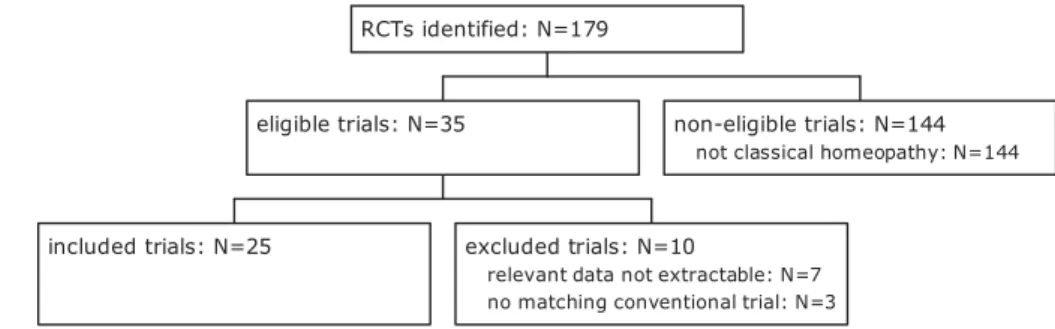
In total, 179 placebo-controlled RCTs of homeopathy were identified, 35 of them on classical homeopathy. Of these 35 trials seven had to be excluded from analyses, be-cause the relevant data could not be extracted. Another three trials were excluded as not enough matching conventional trials could be found (Figure 1). Thus 25 RCTs, each with three matching conventional trials, were included and eval-uated. All homeopathic trials were parallel group studies, none used a cross-over design. For a list of included homeo-pathic trials seeTable 1, a list of all included conventional trials is given as a supplementary file in the internet.
These 25 homeopathic trials covered 16 different health conditions ranging from chronic fatigue syndrome to wis-dom tooth extraction, atopic dermatitis, or acne vulgaris. Four trials were on migraine or tension-type headaches, three trials on childhood diarrhoea and rheumatoid arthritis (Table 1). In these 25 trials a total of 833 patients were treated with placebo, 737 patients were analysed.
Figure 1 Flow chart of study selection. 78
In 13 matched sets the placebo effect in the homeopathic trials was larger than the average placebo effect of the matched conventional trials, in 12 matched sets it was smaller (Figure 2). Considerable differences in placebo ef-fects (defined as a 5% difference at minimum) were found in 10 matched sets in favour of the homeopathic trial, and in 9 matched sets in favour of the conventional trials.
On average 1.6!1.3 homeopathic trials had larger pla-cebo effects than the matching conventional trials. This hardly exceeds the number of 1.5 trials expected under the null hypothesis. Consequently, no difference in placebo effects could be found (p= 0.39).
If the analysis had not primarily been based on the matched sets but on matched health conditions, counting the mean number of conventional trials with smaller pla-cebo effects than the mean plapla-cebo effect of matched
homeopathic trials treating a matching health condition, an essentially identical result would have been obtained.
Similarly, no subgroup analysis showed marked differ-ences in placebo effects between homeopathic and conven-tional RCTs (Table 2). Placebo effects of homeopathy tended to be higher in adults and chronic diseases, but re-spectivep-values were considerably above the 2.5%-level. The same applied to trials with pain as the main outcome measure.
Discussion
To the best of our knowledge this study represents the first systematic attempt to compare placebo effects of ho-meopathic and conventional treatment. Our study shows no evidence of a generally larger placebo effect in RCTs
Table 1 Included RCTs on homeopathy
Reference Indication* Ny Observation period Method. quality Matching quality Placebo effect
McDavid 199419 Acne vulgaris 15/18z 4 months Medium Good 73.3% Jacobs 200120 Acute otitis media 39/39 5 days High Good 69.2%
Siebenwirth 200221 Atopic dermatitis 14/14 12 weeks Medium Good 14.5%
Jacobs 200522 ADHD 21/21 18 weeks High Fair 12.4%
Weatherley-Jones 200423 Chronic fatigue syndrome 43/50 7 months High Good 7.3%
Jacobs 200014,24 Childhood diarrhoea 52/57 5 days High Fair 39.5%
Jacobs 199414,25 Childhood diarrhoea 41/44 5 days High Fair 30.9%
Jacobs 199314,26 Childhood diarrhoea 17/17 5 days High Fair 45.5% Bonne 200327 Anxiety disorder 20/22 5 weeks Medium Good 33.6%
Carlini 198728 Insomnia 15/19z 45 days Medium Fair 66.7% Straumsheim 200029 Migraine 33/36
z 3 months Medium Good 32.7%
Walach 199730 Migraine 37/37 12 weeks High Fair 8.3% Whitmarsh 199731 Migraine 30/31 3 months Medium Good 16.5%
Brigo 198732,33 Headache 30/30 8–16 weeks Medium Good 20.2%
Jacobs 200534 Lack of oestrogen 27/27 12 months High Good 9.2%
Thompson 20055 Lack of oestrogen 25/25 4–16 weeks High Good 14.8%
Chapman 199435 Premenstrual syndrome 19/21 1–2 cycles High Good 47.4% Yakir 199436,37 Premenstrual syndrome 8/10 3 months Medium Good 10.5%
de Lange
de Klerk 199438 Recurrent URTIs 84/84 12 months High Good 25.0%
Fisher 200139 Rheumatoid arthritis 58/112 3 months Medium Good 23.4% Gibson 198040 Rheumatoid arthritis 21/23 3 months Medium Good 0.9%
Andrade 199141 Rheumatoid arthritis 16/21 6 months Medium Good 25.0% Kainz 199642 Verrucae vulgaris 30/33 8 weeks Medium Good 3.3%
Lo¨kken 199543 Wisdom tooth extraction 24/24 3 days High Fair 80.0%
Kuzeff 199844 Well-being 18/18
z 1 week Medium Fair 2.4%
* Abbreviations: ADHD – Attention Deficit and Hyperactivity Disorder.
yNumber of analysed/included patients.
zPatient numbers were not unambiguously extractable.
-10 10 30 50 70 pl acebo effect [% ]
conventional trials (average) homeopathic trials
Figure 2 Placebo effects in 25 matched sets of RCTs on classical homeopathy and conventional medicine.
Table 2 Subgroup analyses
Subgroup Number of
matched sets
Effect size p-value Children only* 6 0.83 0.21 Adults only* 10 1.90 0.33 Chronic diseases 19 1.84 0.22 Acute diseases 5 0.80 0.24 Trials measuring pain 7 2.00 0.18 Trial duration >12 weeks 12 1.67 0.70 Patient numbers >20 in all 4 trials 12 1.67 0.70 High methodological quality 12 1.37 0.65
High matching quality 17 1.77 0.28 * Trials with mixed populations of adults and children excluded.
in classical homeopathy than in standardised conventional medicine. As a result, we cannot support the hypothesis that homeopathic RCTs are statistically underpowered due to overoptimistic placebo effect assumptions. This however does not necessarily mean that all RCTs of classi-cal homeopathy are adequately powered, nor does it mean that classical homeopathy is a placebo therapy. Such conclusions would go far beyond the scope of our analysis.
Originally, Walach’s hypothesis was not formulated for homeopathy alone but for a wide range of procedures in complementary and alternative medicine. To our knowl-edge, our study is the first to approach this hypothesis in the context of classical homeopathy. It has however, been researched in acupuncture: Several RCTs indicate that an individualised acupuncture treatment has larger health ef-fects than a conventional standard therapy, as has a sham acupuncture. These include large German acupuncture tri-als on migraine,45 osteoarthritis of the knee,46 and low back pain.47Standard therapies were complex in these stud-ies, but most components had already been shown to be ef-fective beyond placebo. Consequently, one might conclude that sham (placebo) acupuncture has larger effects than a conventional placebo in the same disease.
Such studies are rare in homeopathy. We are aware of only two RCTs which systematically investigated context effects in homeopathy. Both did not directly compare pla-cebo effects in homeopathy and conventional medicine. Steinsbekk’s RCT compared four groups of patients with upper respiratory tract infections (URTIs).48–50 Its core was a placebo-controlled trial on three different homeo-pathic medicines, which were individually chosen by the patients themselves according to a pre-defined symptom list. Two further groups served as controls, a classical ho-meopathic treatment delivered by a trained homeopath, and a routine care treatment without any homeopathic med-ication. As measured by an overall disease severity score there was no difference between the verum and the placebo homeopathic self medication in this trial, suggesting no spe-cific effect of the homeopathic medicine. However, the clas-sical homeopathy group performed significantly better than the conventional care group suggesting considerable con-textual effects of classical homeopathic treatment.
In a similar study, Fisher randomly allocated 75 dermati-tis patients to four treatment groups.51Two groups formed a double-blind placebo-controlled RCT of classical home-opathy. A third group received open homeopathic treatment with the individually chosen homeopathic verum, and the last group was awaiting list control. In this trial the patient numbers were small, leaving the interpretability of the re-sults rather limited. Its message however seems to contra-dict Steinsbekk’s results: the biggest improvements were observed in the standard care group, the smallest in the open verum group.
Although these differences were not statistically signifi-cant, and drop-out rates varied significantly (with the lowest drop-out rate in the waiting list control) this challenges the hypothesis that additional homeopathic treatment has bene-ficial contextual effects.
Several systematic reviews and meta-analyses inten-sively studied the effects in placebo groups of conventional medicine trials, and the extracted data may serve as an ex-ternal validation to ours. Choet al. for example found the mean placebo response in trials on chronic fatigue syn-drome surprisingly low at 19.6%,52 an estimate which was even larger than ours (7.9%, 16.7%, and"21.6% for conventional trials and 7.3% for the homeopathic trial). In general however, the data from such reviews was not di-rectly comparable to our data, simply because placebo ef-fects were defined on different scales. For example, Macedoet al. found the mean placebo effect to be 21%,53 but this was defined as the number of patients who im-proved and cannot be compared to our data, where the pla-cebo effect was defined as the percentage improvement on a continuous scale. The major conclusions from all these re-views were that the placebo effect varied considerably be-tween different health conditions, and that trial design and type of intervention were major factors influencing the size of the placebo effect. This conclusion again validates our study, which was designed to control for these factors by matching.
Our study has several limitations. First, the rather small sample size: as only 25 homeopathic RCTs were included, the statistical power of our comparison is small and relevant effects may have been overlooked. Several other factors may have further decreased this statistical power. For exam-ple, we cannot exclude the possibility that a poor matching quality has affected our results. When we tried to match conventional to homeopathic trials we found substantial dif-ferences in study design even in the same diagnosis. This included duration and intensity of treatment, duration and severity of diseases, age and gender distributions, comor-bidity, chosen outcome measures, allowances for concom-itant treatments, and length of follow-up.
This heterogeneity of trials forced us to make more com-promises in the matching process than planned, making the extracted placebo effects less comparable. Moreover, most of the included trials (homeopathic and conventional) were small and included only few patients in the placebo groups. Thus, the extracted placebo effects were rather crude and vague, which again affects the variability of results and the statistical power of our study.
The severest limitation derives from the calculation of the placebo effects itself. We defined placebo effects as per-centage improvements from baseline, but this was a rather arbitrary definition, made to ensure that all effects were measured on an identical scale independent of the chosen outcome measure. Percentage changes however are ex-tremely sensitive to the denominator (the baseline value in our study). In our study we took great efforts to match tri-als with similarly affected patients and comparable baseline values. Consequently, the extracted placebo effects should not be interpreted across but only within the matched sets. Our assessments of methodological quality differs from others. Shang,17 for example, rated Jacob’s first trial on childhood diarrhoea14,26as of medium quality (they used the term ‘low quality’). However, randomisation and blinding procedures in this trial were identical to those in
the subsequent trials24,25 of the same author on the same topic, which persuaded us to rate this trial as of high meth-odological quality. Similar deviations in assessing trial methodology are not uncommon for homeopathic trials, as has been shown by Rutten,54who compared respective assessments for several meta-analyses.
Walach’s hypothesis is not the only theory attempting to explain why placebo-controlled RCTs on classical homeop-athy might have failed. Others argue that homeopaths often need several attempts until they find the best matching med-icine. Hence, the problem with homeopathic trials would be the wrong choice of an individualised medicine that does not provoke the desired reaction. Our study however does not address this point, and therefore it should simply be in-terpreted as a test of Walach’s hypothesis rather than an ex-haustive analysis of why placebo-controlled homeopathic RCTs might have failed.
There is a great need for further research regarding the ef-ficacy of classical homeopathy, particularly research em-ploying trial designs that allow for differentiating treatment effects into specific and unspecific (context) ef-fects. Theories have been developed that these aren’t addi-tive, but rather entangled similarly to what is described by the entanglement theory, which is practically used in quan-tum physics.55,56Current literature emphasises that the phe-nomenon of specific and unspecific effects is far from fully understood and needs to be described by a more differenti-ating vocabulary.1,55 Although the placebo effect doesn’t appear to differ between trials of homeopathy and conven-tional medicine in a consistent and therefore significant de-gree, the placebo effect as we know it is everything but a gauged measure. Its indication to judge the effectiveness of treatments may be limited.
Conflictofinterest
Rainer Lu¨dtke is employed by the Karl and Veronica Carstens-Foundation, a non-profit organisation dedicated to research in homeopathy and natural medicine. Tobias Nuhn and Max Geraedts declare no potential conflicts of interest.
Acknowledgements
Tobias Nuhn was supported by the Karl and Veronica Carstens-Foundation, Essen, Germany.
References
1 Moerman D. Meaning, medicine and the ‘placebo effect’. Cam-bridge University Press, 2002.
2 Starfield B, Wray C, Hess K. The influence of patient-practitioner agreement on outcome of care. Am J Public Health 1981; 71: 127–131.
3 Witt CM, Lu¨dtke R, Baur R, Willich SN. Homeopathic medical practice: long-term results of a cohort study with 3981 patients.
BMC Public Health2005;5: 115.
4 Uexku¨ll von T.‘‘Psychosomatische Medizin’’ Modelle a¨rztlichen
Denkens und Handelns. Mu¨nchen, Jena: Urban&Fischer, 2003.
5 Thompson E, Oxon B, Montgomery A, Douglas D, Reilly D. A Pi-lot, randomized, double-blinded, placebo-controlled trial of individ-ualized homeopathy for symptoms of estrogen withdrawal in breast-cancer survivors.J Altern Complement Med2005;11: 13–20. 6 Eisenberg DM, Davis RB, Ettner SL,et al. Trends in alternative
medicine use in the United States, 1990–1997: results of a follow-up national survey.J Am Med Assoc1998;280: 1569–1575. 7 Thomas K, Coleman P. Use of complementary or alternative
medicine in a general population in Great Britain. Results from the national omnibus survey.J Public Health (Oxf)2004;26: 152–157. 8 Thomas KJ, Nicholl JP, Coleman P. Use and expenditure on comple-mentary medicine in England: a population based survey.
Comple-ment Ther Med2001;9: 2–11.
9 Ha¨rtel U, Volger E. Inanspruchnahme und Akzeptanz klassischer Na-turheilverfahren und alternativer Heilmethoden in Deutschland – Er-gebnisse einer repra¨sentativen Bevo¨lkerungsstudie.Forsch
Komple-mentarmed Klass Naturheilkd2004;11: 327–334.
10 Haidinger G, Gredler B. Bekanntheitsgrad, Anwendungsha¨ufigkeit und Erfolg alternativer Heilmethoden in O¨ sterreich – Ergebnisse einer Bevo¨lkerungsbefragung.Offentl Gesundheitswes 1988; 50: 9–12.
11 Hanssen B, Grimsgaard S, Launso L, Fonnebo V, Falkenberg T, Rasmussen NK. Use of complementary and alternative medicine in the Scandinavian countries. Scand J Prim Health Care2005; 23: 57–62.
12 Linde K, Clausius N, Ramirez G,et al. Are the clinical effects of ho-moeopathy placebo effects? – a meta-analysis of placebo-controlled trials.Lancet1997;350: 834–843.
13 Ernst E. Homeopathic prophylaxis of headaches and migraine? a sys-tematic review.J Pain Symptom Manage1999;18: 353–357. 14 Jacobs J, Jonas WB, Jimenez-Perez M, Crothers D. Homeopathy for
childhood diarrhea: combined results and metaanalysis from three randomized, controlled clinical trials.Pediatr Infect Dis J 2003; 22: 229–234.
15 Lu¨dtke R, Hacke D. Zur Wirksamkeit des homo¨opathischen Arznei-mittels Arnica montana.Wien Med Wochenschr2005;155: 482–490. 16 Lu¨dtke R, Rutten AL. The conclusions on the effectiveness of home-opathy highly depend on the set of analyzed trials.J Clin Epidemiol 2008;61: 1197–1204.
17 Shang A, Huwiler-Muntener K, Nartey L,et al. Are the clinical ef-fects of homoeopathy placebo efef-fects? comparative study of pla-cebo-controlled trials of homoeopathy and allopathy.Lancet2005; 366: 726–732.
18 Walach H. Das Wirksamkeitsparadox in der Komplementa¨rmedizin.
Forsch Komplementarmed Klass Naturheilkd2001;8: 193–195.
19 McDavid GM.The homoeopathic treatment of acne [dissertation]. Durban, South Africa: Technikon Natal, 1994.
20 Jacobs J, Springer DA, Crothers D. Homeopathic treatment of acute otitis media in children: a preliminary randomized placebo-con-trolled trial.Pediatr Infect Dis J2001;177–183.
21 Siebenwirth J. A randomized, placebo controlled, double-blind study testing the effectiveness of classical homeopathic therapy of atopic dermitis (AD). In: Walach H (ed). Future Directions and Cur-rent Issues of Research in Homeopathy; 2002. Freiburg.
22 Jacobs J, Williams A, Girard C, Njike V, Katz D. Homeopathy for attention-deficit/hyperactivity disorder: a pilot randomised-con-trolled trial.J Altern Complement Med2005;11: 799–806. 23 Weatherley-Jones E, Nicholl JP, Thomas KJ,et al. A randomised,
controlled, triple-blind trial of the efficacy of homeopathic treatment for chronic fatigue syndrome. J Pschychosom Res 2004; 56(2): 189–197.
24 Jacobs J, Jime´nez LM, Malthouse S,et al. Homeopathic treatment of acute childhood diarrhea – results from a clinical trial in Nepal.J
Al-tern Complement Med2000;6(2): 131–139.
25 Jacobs J, Jime´nez LM, Gloyd SS, Gale JL, Crothers D. Treatment of acute childhood diarrhea with homoeopathic medicine: a randomized clinical trial in Nicaragua.Pediatrics1994;93(5): 719–725.
26 Jacobs J, Jiminez LM, Gloyd S, Carares FE, Gaitan MP, Crothers D. Homoeopathic treatment of acute childhood diar-rhoea – a randomized clinical trial in Nicaragua.Br Homeopath J1993; 82(2): 83–86.
27 Bonne O, Shemer Y, Gorali Y, Katz M, Shalev AY. A randomized, double-blind, placebo-controlled study of classical homeopathy in generalized anxiety disorder. J Clin Psychopharmacol 2003; 64(3): 282–287.
28 Carlini EA, Braz S, Landfranco RP. Efeito hipno´tico de medicaca˜o homeopa´tica e do placebo – Avaliaca˜o pela te´cnica de ‘‘duplo-cego’’ e ‘‘cruzamento’’.Rev Assoc Med Bras1987;33: 83–88.
29 Straumsheim P, Borchgevink C, Mowinckel P, Kierulf H, Hafslund O. Homeopathic treatment of migraine: a double blind, placebo controlled trial of 68 patients.Br Homeopath J2000;89: 4–7.
30 Walach H, Haeusler W, Lowes T,et al. Classical homeopathic treat-ment of chronic headaches.Cephalalgia1997;17: 119–126. 31 Whitmarsh T, Coleston-Shields DM, Steiner TJ. Double-blind
rand-omised placebo-controlled study of homoeopathic prophylaxis of migraine.Cephalalgia1997;17: 600–604.
32 Brigo B, Serpelloni G. Homoeopathic treatment of migraines – a double-blind controlled study of sixty cases (Homoeopathic
Rem-edyversusPlacebo).Berlin J Res Hom1991;1(2): 98–106.
33 Brigo B: Le traitement home´opathique de la migraine – Une e´tude de 60 cas controˆle´e en double aveugle – Reme`de home´opathique vs Pla-cebo. In 42nd Congress of LMHI. 1987.
34 Jacobs J, Herman P, Heron K, Olsen S, Vaughters L. Homeopathy for menopausal symptoms in breast cancer survivors: a preliminary randomized controlled trial. J Altern Complement Med2005;11: 21–27.
35 Chapman EH, Angelica J, Spitalny G, Strauss M. Results of a study of the homoeopathic treatment of PMS.J Am Inst Homeopath1994; 87: 14–21.
36 Yakir M, Kreitler S, Oberbaum M, Bzizinsky A, Vithoulkas G, Bent-wich Z: Homoeopathic treatment of premenstrual syndrome – a pilot study. In 8th GIRI Meeting. Jerusalem, Israel, 1994.
37 Yakir M, Kreitler S, Brzezinski A, Vithoulkas G, Oberbaum M, Bentwich Z. Effects of homeopathic treatment in women with pre-menstrual syndrome – a pilot study. Brit Hom J 2001; 90(3): 148–153.
38 de Lange-de-Klerk ESM, Blommers J, Kuik DJ, Bezemer PD, Feenstra L. Effects of homoeopathic medicines on daily burden of symptoms in children with recurrent upper respiratory tract infec-tions.BMJ1994;309: 1329–1332.
39 Fisher P, Scott DL. A randomized controlled trial of homeopathy in rheumatoid arthritis.Rheumatology2001;40: 1052–1055. 40 Gibson RG, Gibson SLM, MacNeill AD, Buchanan WW.
Homoeo-pathic therapy in rheumatoid arthritis – evaluation by double-blind clinical therapeutic trial.Br J Clin Pharmacol1980;9: 453–459. 41 Andrade LEC, Ferraz MB, Atra E, Castro A, Silva MSM. A
random-ized controlled trial to evaluate the effectiveness of homeopathy in rheumatoid arthritis.Scand J Rheumatol1991;20: 204–208.
42 Kainz JT, Kozel G, Haidvogl M, Smolle J. Homoeopathicversus placebo therapy of children with warts on the hands – a randomized, double-blind clinical trial.J Dermatol1996;193: 318–320. 43 Lo¨kken P, Straumsheim PA, Tveiten D, Skjelbred P, Borchgrevink CF.
Effect of homoeopathy on pain and other events after acute trauma: pla-cebo controlled trial with bilateral oral surgery. BMJ 1995; 310: 1439–1442.
44 Kuzeff RM. Homeopathy, sensation of well-being and CD4-levels – a placebo-controlled, randomized trial.Complement Ther Med1998; 6(1): 4–9.
45 Diener HC, Kronfeld K, Boewing G,et al. Efficacy of acupuncture for the prophylaxis of migraine: a multicentre randomised controlled clinical trial.Lancet Neurol2006;5: 310–316.
46 Scharf HP, Mansmann U, Streitberger K,et al. Acupuncture and knee osteoarthritis: a three-armed randomized trial. Ann Intern Med2006;145: 12–20.
47 Haake M, Muller HH, Schade-Brittinger C,et al. German acupunc-ture trials (GERAC) for chronic low back pain: randomized, multi-center, blinded, parallel-group trial with 3 groups. Arch Intern Med2007;167: 1892–1898.
48 Steinsbekk A, Bentzen N, Fonnebo V, Lewith G. Self treatment with one of three self selected, ultramolecular homeopathic medicines for the prevention of upper respiratory tract infections in children. A double-blind randomized placebo controlled trial.Br J Clin Pharma-col2005;59: 447–455.
49 Steinsbekk A, Lewith G, Fonnebo V, Bentzen N. An exploratory study of the contextual effect of homeopathic care. A randomised controlled trial of homeopathic care vs. self-prescribed homeopathic medicine in the prevention of upper respiratory tract infections in children.Prev Med2007;45: 274–279. discussion 280–271. 50 Steinsbekk A, Fonnebo V, Lewith G, Bentzen N. Homeopathic care
for the prevention of upper respiratory tract infections in children: a pragmatic, randomised, controlled trial comparing individualised homeopathic care and waiting-list controls.Complement Ther Med 2005;13: 231–238.
51 Fisher P, McCarney R, Hasford C, Vickers A. Evaluation of specific and non-specific effects in homeopathy: feasibility study for a rand-omised trial.Homeopathy2006;95: 215–222.
52 Cho HJ, Hotopf M, Wessely S. The placebo response in the treat-ment of chronic fatigue syndrome: a systematic review and meta-analysis.Psychosom Med2005;67: 301–313.
53 Macedo A, Banos JE, Farre M. Placebo response in the prophylaxis of migraine: a meta-analysis.Eur J Pain2008;12: 68–75. 54 Rutten AL, Stolper CF. The 2005 meta-analysis of homeopathy: the
importance of post-publication data. Homeopathy 2008; 97: 169–177.
55 Linde K. Der spezifische placeboeffekt. Bundesgesundheitsblatt 2006;49: 729–735.
56 Milgrom L. Are randomized controlled trials (RCTs) redundant for testing the efficacy of homeopathy? A critique of RCT methodology based on entanglement theory.J Altern Complement Med2005;11: 831–838.