Industry analysis #5 2014
Early upgrade plans:
Sweet now. Turns sour?
The equipment instalment plan has proven capable of substituting the prevailing subsidy model in mobile – even in traditional subsidy markets like the USA and the UK. It’s a financing setup and at the end of the plan, a customer will have paid the full price of a phone or tablet.
While the equipment instalment plan opens for more competitive service pricing (now that equipment subsidy doesn’t need to be covered with service revenue), it also opens for flexibility when it comes to equipment upgrades: Pay remaining instalments – and upgrade. Some operators go further than this, though.
Realising that customers aren’t particularly interested in obtaining the ownership of (aged) equipment, pioneering operators have introduced a variant of the equipment instalment plan – based on an early return of equipment: The early upgrade plan.
It’s a recurring upgrade promise – often without any additional fee. Take-up has been good, but it’s only now the pioneering operators need to start delivering on this promise.
Starting point: The subsidy model
A premium smartphone or tablet costs at least 300 EUR. To fuel the take-up (which drives consumption of mobile data), operators in mature markets have traditionally used the subsidy model in which the customer pays an upfront price for the equipment which is well below the operator’s purchase price. In turn, the customer is bound to a long service contract, typically 24 months. The monthly service fee is elevated since it needs to recover the equipment subsidy before the contract period is over. The service fee normally continues on its high level also after the end of the binding period which means that a customer not replacing his/her equipment starts to pay for it over again.
Typically, operators have not been transparent when it comes to how much of the monthly fee is related to
equipment and how much is the true service fee. It’s been an easy to communicate “total per month” price.
We regard the subsidy model as a driver of churn and a driver of acquisition and retention cost. To
save space here, we left the motivations out of this analysis, but recommend reading The art of balancing
SAC and SRC and Why operators should refrain from handset sales.
Step 1: Equipment instalment plan
At the height of the smartphone boom, some operators felt the need to address the growing sales costs and the questionable customer loyalty associated with the subsidy model.
In order to still achieve some of the take-up benefits brought by the subsidy model, operators realised that
they still needed to provide customers with equipment financing, though. One such example is
Telefónica (Movistar) in Spain who couldn’t afford to continue subsidising equipment given the dire
economic situation in Spain and its impact on Telefónica. Subsidies were abolished altogether in March 2012.
But Telefónica introduced an instalment plan to help customers to finance their equipment1.
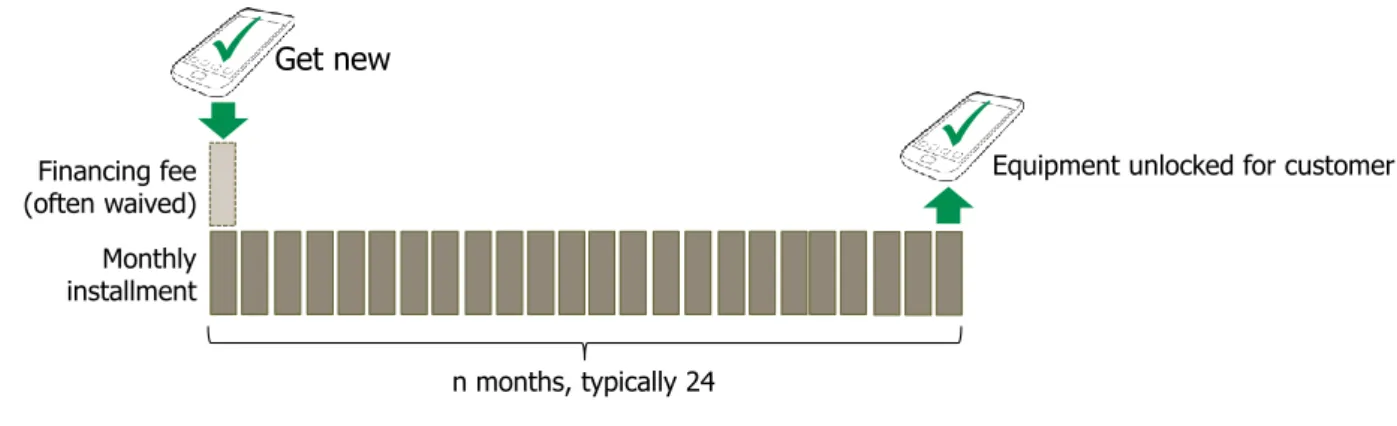
An instalment plan generally works along the principles of Figure 1.
Figure 1. The principle of an equipment instalment plan (EIP)
1 Later on they also launched a converged mobile-fixed multi-play proposition, Fusión, using multi-service discounts as primary usp
n months, typically 24
Equipment unlocked for customer
Monthly installment Financing fee (often waived)
Get newThe equipment price is split into e.g. 24 equally large monthly instalments2. When all instalments have been
paid, the customer has paid the full price of the equipment – but deferred. Originally, some operators
charged a financing fee for this, but in reality this is today always waived. This means that the operator does not change any interest (which should be seen as a kind of subsidy). Compared to the subsidy model, in which a 300 EUR device is sold for 99 EUR, this cost is low, though.
The instalment model, on the other hand, puts pressure on operators to lower the monthly service fee (now that it doesn’t need to cover equipment subsidy). It’s not obvious that this happens overnight, though. Many operator executives have expressed that equipment instalment plans are helpful in creating a more “rational” market behaviour overall indicating that the change is not just about the money.
One positive side effect of the change is that customers – in order to take up an instalment plan – need to
turn to the sales channels of the operator. This typically means the operator’s own shops or e-channels
– but not independent retailers. And in own channels, operators can set the price of the equipment.
Equipment retailers normally work with just a few % of margin – but now operators don’t need to offer the same price to be able to compete: Since the instalment plan is exclusive to their own channels, the price of a device can be a bit higher. The benefit of being able to finance the equipment outweighs a small price differential for many customers.
Telefónica O2 in the UK called it:
“a vehicle to improve distribution dynamics in the market
towards more efficient direct channels”
Another benefit of the instalment plan is that equipment cost recognition doesn’t have to be upfront
(as long as also associated revenue is recognised at the same time). With the subsidy model, full equipment cost is recognised immediately which typically means that fourth quarter EBITDA margins of operators using the subsidy model are significantly lower due to seasonal high sales volumes. It’s a short term benefit during a transition period to the instalment model, though. Costs are simply delayed and the effect will eventually disappear.
Step 2: Equipment instalment plan with early termination
The regular equipment instalment plan just described doesn’t solve one problem of the subsidy model, however: The equipment is expected to have a long lifetime, e.g. 24 months.
Most smartphones don’t survive 24 months. Customers damage them. And even if they don’t, they are often
deemed outdated since the technology development is continuous. So when a customer eventually paid
off and owns the smartphone, it’s either broken or not wanted.
With an equipment instalment plan, it’s easy to handle upgrades: Allow early termination.
Figure 2. The principle of an equipment instalment plan with early termination
Our customer in Figure 2 doesn’t want to wait the full 24 months for a chance to upgrade his/her
smartphone, but buys a new one in month 22. By paying the balance due (the remaining two instalments), the customer is out the equipment instalment plan and can pick up any phone he or she likes (while still paying for it, of course). At any time, it’s transparent to the customer how much it would be to terminate the instalment plan.
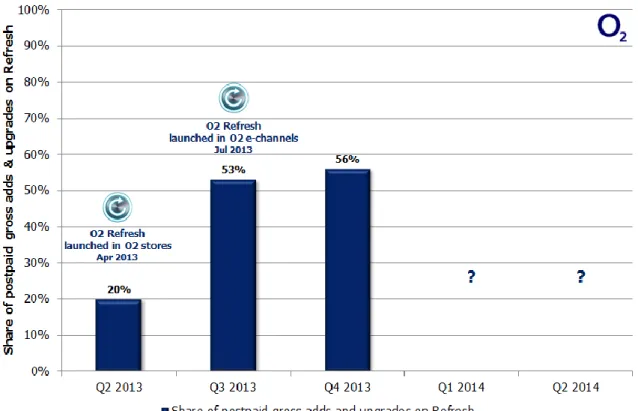
Operators who have implemented this model have in their marketing focused on the flexibility of being able to upgrade whenever – see the O2 Refresh example from the UK to the left.
O2 Refresh was launched in April 2013 in O2’s stores and was followed by a launch in O2’s e-channels in July 2013.
Figure 3 shows how the O2 Refresh proportion of postpaid gross adds and
upgrades since launch. In Q4 2013, an impressive 56% of postpaid sales
activity was on O2 Refresh clearly indicating that many customers immediately saw the potential benefit in the upgrade flexibility offered by O2 Refresh.
Equipment unlocked for customer
Paying off the balance n months, typically 24 Monthly installment Financing fee (often waived)
Get new
Regretfully, Telefónica has not followed up the reporting of this metric in 2014, suggesting that the sales on O2 Refresh might have levelled out.
Figure 3. Reported postpaid sales proportion in O2 Refresh since launch
O2 in Germany has since many years had a similar setup with O2 My Handy. The focus in Germany is less on early upgrades and more on financing; in Germany there’s also a 12 months option.
Step 3: Early upgrade plan
But even if O2 has been successful with its propositions, the general model3 is still based on the customer
obtaining the ownership of the equipment. As said earlier, to own an ageing (or even broken) device is not particularly interesting for all customers.
An early upgrade plan (EUP), based on the return of the equipment, is therefore an innovative variant of the equipment instalment plan.
Isn’t this leasing, you might ask? It is similar, but without all legal and contractual complexity surrounding a
general leasing plan. In telecoms, earlier attempts to introduce regular leasing contracts have failed: KPN’s
introduction of several leasing plans in several different brands in the Netherlands in March to July 2012
didn’t have any positive impact and leasing plans were consequently discontinued in July 2013. Also O2 UK
made an attempt with O2 Lease – a plan which later was replaced with O2 Refresh4.
Even though an early upgrade plan attempts to take most of the complexity in a leasing deal away, it is still
quite a complicated matter for a sales agent to explain – and for a customer to understand.
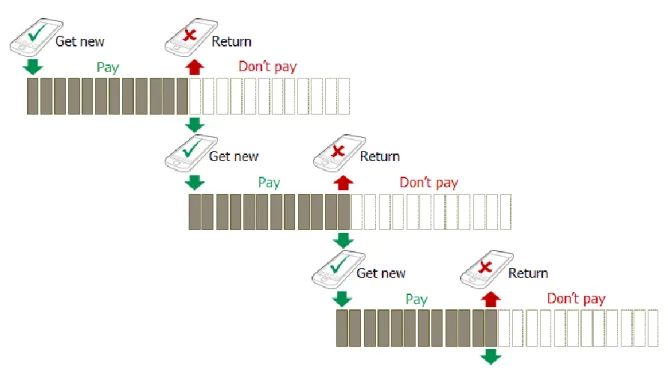
The principle is shown in Figure 4.
Figure 4. The principle of an early upgrade plan
A customer buys a new device on an equipment instalment plan. After a certain time (or after having paid a certain percentage of the price), the customer can return the aged device and pick up a new. The
3 O2 UK allows customers to trade in any equipment as part of O2 Recycle, but it an option for anybody and for any equipment and not
an integral part of O2 Refresh. Compared to an early upgrade plan, customers can’t predict what they might get for their equipment.
requirement is that he or she starts on a new equipment instalment plan (and of course continues to have a service plan with the operator in question). After a certain time (or payment), the customer can return also this device and pick up a new, etc.
With an early upgrade plan, the customer will never own the equipment. But it is potentially always quite
up to date.
What’s the catch? Some operators (but not all) will charge you a monthly fee as long as you want to
remain eligible for future upgrades. The equipment must be returned in a fully working condition. To
repair a damaged device can be costly. You might also lose it. But all operators offer insurance (included in the fee or separately) which would cover this.
But generally speaking, the early upgrade plan is a good and rather risk-free proposition for
consumers. Operators who have launched it see rapid take-up (we’ll come to this). The risks are rather on the operator side (we’ll come to this as well).
History of the early upgrade plan
Who invented the early upgrade plan?
It might well have been Phones4U – an independent retail chain in the UK trading the
EE, Orange, T-Mobile, Virgin and Vodafone brands. In February 2012, they launched
JUMP (“Just Upgrade My Phone”) under which a customer pays a monthly fee to be able
to change (or trade in) their smartphone as often as every six months. The monthly fee depends on the smartphone and contract chosen but was 3-4 GBP at launch.
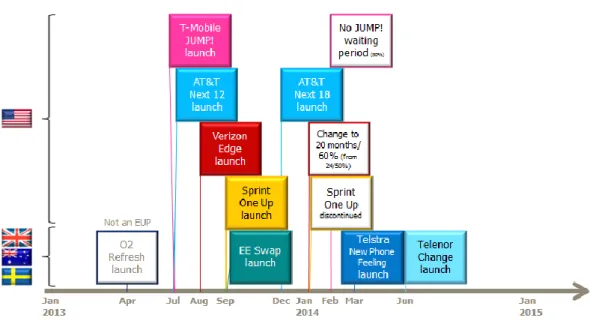
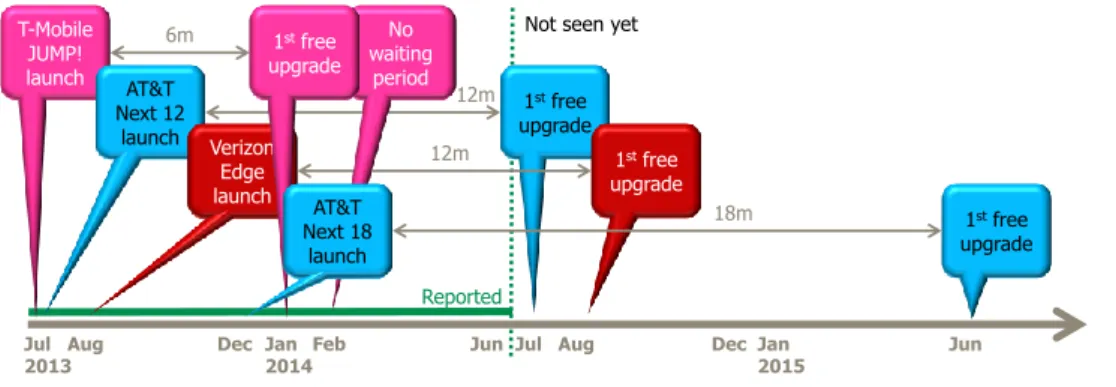
The first early upgrade plan launched by an operator was likely the JUMP! plan from
T-Mobile USA. As one of the un-carrier initiatives, it became available in July 2013. Not only the name (again said to be read as “Just Upgrade My Phone”), but the setup resembled Phones4U: A monthly fee (10 USD but now including insurance) and a 6 months waiting period; smartphones only, but now with mandated return.
It only took AT&T twelve days to come up with their response: AT&T Next.
Contrary to T-Mobile, this plan comes without any additional fee – but then without insurance included. And the AT&T Next customer had to wait 12 months before a free upgrade.
A month after AT&T, Verizon responded with Edge. Sprint waited another
month before launching One Up, the first (and so far only) early upgrade
plan to have been discontinued (less than four month after launch).
Also UK operator EE has launched an early upgrade plan, called Swap. Telstra in Australia
launched their New Phone Feeling in March this year whereas Telenor in Sweden
launched Change as late as June.
Figure 5. Chronology of early upgrade plan5 launches (and major changes)
A summarised comparison of the different operators’ early upgrade plans is shown in Figure 6.
Figure 6. Comparison of early upgrade plans
5 O2 Refresh is not an early upgrade plan as described here, but is put in since it likely influenced EE’s launch of Swap 5 months later Plan
duration Waiting period for free upgrade (if new installment plan started) Equipment returned? (if new installment plan started) Service plan require-ment Waiting period/fee for accelerated upgrade Equipment covered by plan Equipment return channels Equipment insurance? (no damage required) Also for business? T-Mobile JUMP! 14 Jul 2013 24 months +10 USD per month Nonejust 50% credited 6m to 23 Feb 2014 not 50% Yes Simple
Choice None50% just credited
Smart-phones, tablets
T-Mobile
stores IncludedInsurance & security stand-alone 12 USD Yes AT&T Next 12 26 Jul 2013 20
months 12months Yes Mobile Share Value 2 months +12m installments Smart-phones Tablets to 20 Nov 2013 AT&T shops, mail Optional Yes AT&T Next 18 8 Dec 2013 24
months 18months 2 months + 18m installments Verizon Edge 25 Aug 2013 20 months 24m/50% to 6 Jan 2014 12
months Yes More Everything 30 days 60% paidif Phones, tablets
Tablets from 7 Jul 2014 Verizon shops, authorised retailers (perhaps mail) Optional Yes EE Swap
17 Sep 2013 24months 6monthsor 9
+fee
Yes No plan down-grade
Not
available A few smart-phones EE stores Optional No Telstra New Phone Feeling 4 Mar 2014 24 months +10 AUD per month 12 months Yes Mobile Accelerate, Data Share Noneif 100% paid +50 AUD fee Transfers ownership A few smart-phones Telstra stores, mail Optional No Telenor Change 17 Jun 2014 24 months 12 months Yes Existing plans 30 days if 50% paid A few smart-phones Telenor shops Optional No
Whereas most of the plans solely are smartphone focused, T-Mobile and Verizon also cover tablets. AT&T did as well, but removed that possibility in November 2013. Verizon, on their hand, opened that possibility only recently (July 2014).
Telstra chose to follow the T-Mobile model with an additional fee per month. Whereas T-Mobile include insurance and security protection in the fee (worth of 12 USD if purchased stand-alone), Telstra does not, though.
EE Swap introduces another, more complex, model where a customer will pay a one off fee varying based on two factors: when the return happens – after 9 months or after 6 months – and what service contract the customer has: The more expensive contract, the lower swap fee. EE has not reported anything about the progress of Swap since launch and it appears as if Swap hasn’t had the same impact as O2 Refresh in the UK market.
Just previous week (5 September), Telekom in Germany replaced their existing contracts with a
new set of mobile contracts, called MagentaMobil. In the Premium option, a customer will be given a new smartphone once a year (if renewing the service contract for another 24 months). But it is quite costly; 30 EUR extra per month on top of either a 49,95 or a 79,95 service contract. Since the smartphone is not to be returned, we don’t categorise the plan as a comparable early upgrade plan. We also believe the annual fee of 360 EUR isn’t very attractive.
Operator benefits and drawbacks
The customer benefit of an early upgrade plan is obvious – but what benefits are there for an operator?
Early retention: An early upgrade plan encourages the customer to renew his/her contract wellahead of the end of it – e.g. 12 months into a 24 months plan. It should be good for churn.
Equipment sales directed to own channels: Since the early upgrades happen in operatorchannels only, operators’ channel mix can be made more favourable and with a higher margin on equipment sales as head-on competition with independent retailers is avoided
Pre- to postpaid migration: Since a postpaid contract is a prerequisite, early upgrade plans can fuel pre- to postpaid migration further
Subsidisation can still happen: Even if the point with instalment plans is to avoid subsidisation, campaigns from competitors might mean that it’s necessary from time to time. Even though officially subsidy-free, early upgrade plans can include subsidisation effects if an operator adjusts theminimum waiting period until free upgrade or the price level on the equipment.
These benefits – where the first two are the most important – should be weighed against the operator drawbacks:
Credit checks will limit adoption: Early upgrade plans will effectively only be available to people with good credit rating or payment history. A large part of the population – including youth – will notpass the credit check required. An early upgrade plan is not a proposition that fits all.
Complicated sell: Explaining how the early upgrade plan works will take even a good sales agent quite a lot of time. The communication need to be crystal clear in order not to createmisunderstandings which later cause dissatisfaction.
Load on shops: The plan will encourage large volumes of customers to upgrade and many of these upgrades might well happen at the same time (e.g. 12 months after holiday season adding to thealready high load during the new holiday season). Shops staff must also be able to perform “in good
working order” tests of returned equipment. Not only does this require new competence and test equipment (or alternatively a delay-incurring process where equipment is shipped to a test lab) but
it will also increase the load on the shops even further. This is a really risky part of the early
upgrade plan: It’s easy to imagine how waiting times followed by a possible non-acceptance of a returned device will create customer dissatisfaction. To avoid all this, we recommend including insurance as a mandatory element in the early upgrade plan – like T-Mobile.
Bad debt: With an equipment instalment plan, operator receivables will grow if a large share of customers let the operator finance their equipment. And with high receivables follow the risk of bad debt.
Residual value of returned equipment: The early upgrade plans are based on that the returned equipment has residual value. A refurbished one year old iPhone is perhaps worth half of its price when it was new. The residual value is based on supply and demand, though. If many operators are successful with early upgrade plans, tons of used equipment will suddenly be on the market. Even if operators might be able to resell some of the returned equipment through their own channels, national or even international markets might not be interested in the surplus volumes. If so, a critical assumption behind the early upgrade plan – the residual value of returned equipment – might no longer hold.Considering the three last drawbacks, it’s fair to say that we haven’t seen these yet – simply because most
early upgrade plans aren’t old enough to be in the phase where customers can upgrade for free.
Figure 7 shows why.
Figure 7. Comparison of early upgrade plans Jul
2013 Jan2014 Jun Jul Dec Jan2015 Jun
T-Mobile JUMP! launch AT&T Next 12 launch 1stfree upgrade Verizon Edge launch Aug 1stfree upgrade Aug No waiting period Feb Dec 1stfree upgrade 1stfree upgrade AT&T Next 18 launch Reported 6m 12m 18m 12m
AT&T’s first free upgrade happened in July – 12 months after the launch of AT&T Next. Verizon’s first free upgrade happened in August. Even though the calendar at the point of writing shows September, the Q3 results of AT&T and Verizon are only reported in October. Even then, this quarterly result might not show the long term effect either since AT&T Next uptake didn’t accelerate until 2014 (possibly driven by the launch of AT&T Next 18 for which the first free upgrade is happening in June 2015).
To balance this, AT&T said that they had 1,1 million “accelerated upgrades” in Q1 2014. This suggests that quite many Next customers aren’t waiting out the 12 months, but upgrade earlier. Figure 6 shows that AT&T penalises customers with an extra 2 months of instalments for such an accelerated upgrade. There is, in other words, a revenue boost for AT&T if many customers choose not to wait.
Returning to Figure 7, T-Mobile’s first JUMP! customers could upgrade already in January 2014, so here we should see the long term effect already. But have in mind that T-Mobile charges an extra 10 USD per month for JUMP! customers. Neither AT&T nor Verizon have that – partly compensating – revenue.
It’s quite clear that with early upgrade plans there are few – if any – drawbacks for the customer. But there
are, as shown, a few potentially significant drawbacks for the operator. It’s therefore critical to assess the
risks involved while looking at the sales potential with early upgrade plans. For this purpose, an
analysis framework has been built by tefficient. It includes a before/after analysis for the parameters
listed in Figure 8 for the operators who have launched early upgrade plans. It provides a fact-based view on what to expect (and the do and don’ts of early upgrade plans). This framework, which is kept up-to-date, is
available to customers as part of an analysis or consulting project6.
Actual effects of early upgrade plans – examples
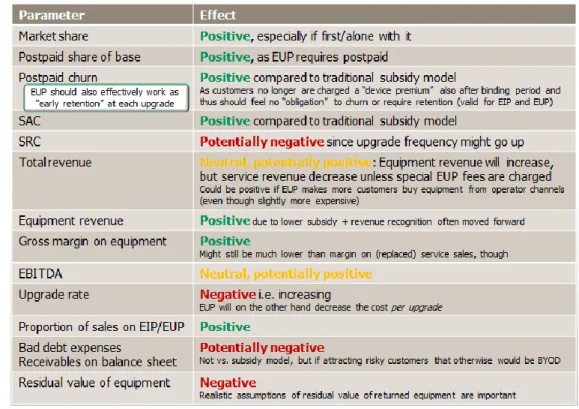
Figure 8 shows the theoretical effect of early upgrade plans on each of the parameters. tefficient’s analysis
framework shows that reality sometimes is different. In the following graphs, we show a few examples from the full analysis framework.
Example 1: Does an early upgrade plan lower postpaid churn?
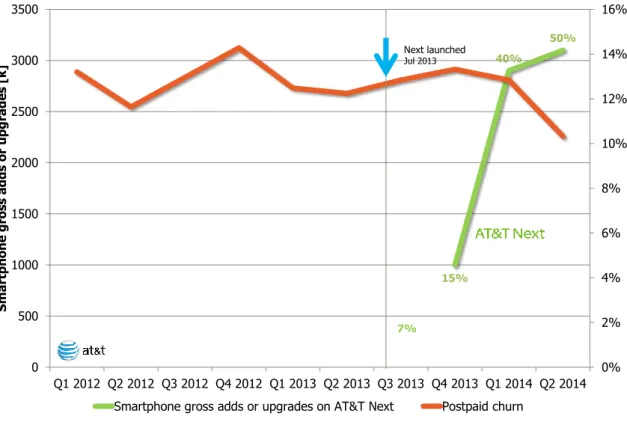
In theory, it should – based on the reasons given in Figure 8. In Figure 9, we can see that the launch of AT&T Next didn’t have any immediate positive impact on postpaid churn.
Figure 9. Development of AT&T’s postpaid churn before/after the Next launch – compared to the number of smartphone gross adds or upgrades on Next7
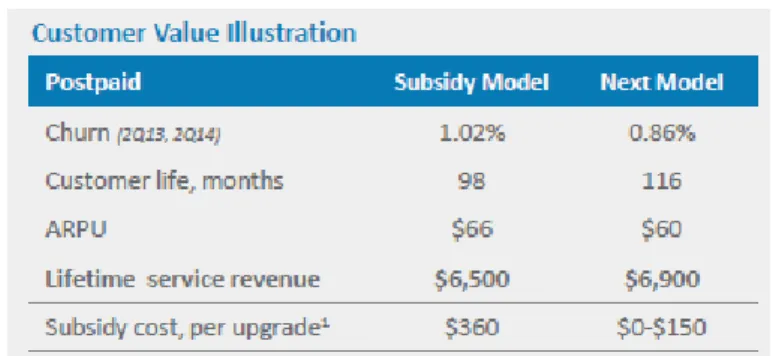
As said, Next sales didn’t take off until 2014, though. In Q1, 40% of smartphone sales activity was on Next and in Q2 it was raised to 50% (or more than 3 million smartphones). And during those two quarters, AT&T’s postpaid churn fell overall. The following table from AT&T suggests that this is regarded fully attributable to the “Next model”:
7 No total number of gross adds/upgrades was reported for Q3, but Next proportions were indicated per month (7% being the average)
15% 40% 50% 0% 2% 4% 6% 8% 10% 12% 14% 16% 0 500 1000 1500 2000 2500 3000 3500 Q1 2012 Q2 2012 Q3 2012 Q4 2012 Q1 2013 Q2 2013 Q3 2013 Q4 2013 Q1 2014 Q2 2014 Smar tp hone g ross add s or upg rad es [k ]
Smartphone gross adds or upgrades on AT&T Next Postpaid churn Next launched
Jul 2013
Figure 10. “Customer Value Illustration” as reported by AT&T Q2 2014
With the Next model, AT&T says that the overall AT&T postpaid churn is lower, which of course means a
longer customer lifetime. ARPU is lower since there has been a shift from the combination low equipment
but high service revenue to higher equipment but lower service revenue. The lifetime service revenue is still higher due to the lower churn rate, though. But also the last line is important: AT&T’s subsidy per upgrade has gone down from 360 USD to 150 USD or less (including zero). With the new model, there is
consequently some room for more frequent upgrades.
Example 2: Does an early upgrade plan increase equipment revenue?
Let’s again turn to AT&T and compare their second quarter 2013 (when Next wasn’t launched) to their latest reported quarter (Q2 2014). Driven by the sales growth in Next (see Figure 9), the postpaid upgrade rate has gone down from 7,5% of base to 6,3% (see Figure 10). Remember that the Next plan requires a customer to wait 12 or 18 month until first free update. Even with less upgrades, AT&T earned significantly
more revenue from equipment (+45%)8.
Before Next, AT&T’s equipment revenue was clearly coupled to the upgrade rate. Since the launch of Next,
these two parameters have decoupled.
Figure 10. Year-on-year development of AT&T’s equipment revenue and postpaid upgrade rate
Also here, it will be interesting to follow the development and see if AT&T’s equipment revenue is
sustainable over a longer period – and to see how future upgrade rates will be affected by the early upgrade plan.
8 Total revenue went up 4% showing that equipment revenue substitutes service revenue to a high degree
1921 2782 7,5% 6,3% 0% 1% 2% 3% 4% 5% 6% 7% 8% 0 500 1000 1500 2000 2500 3000 Q2 2013 Q2 2014 Post p aid up g rad e rat e Eq uipm ent reve nue [M U SD ]
Equipment revenue [MUSD] Postpaid upgrade rate
Example 3: Does early upgrade plan adoption increase equipment revenue? Figure 11 compares the three US operators with active early upgrade plans.
Figure 11. Q2 2014 status for T-Mobile, AT&T and Verizon
T-Mobile reported 5,3 million customers on JUMP! in March 20149. That’s a high 22% of postpaid base.
T-Mobile’s equipment sales represented 22% of total revenue, driven by T-Mobile’s expansion of customer
base, but also its success with equipment instalment plans. Noticeably, the 10 USD monthly fee to participate in JUMP! is not classified as equipment revenue, but service revenue. An indication of how
important the equipment instalment plan and the early upgrade plan is for T-Mobile is that 84% of
equipment revenue was financed on instalment plans in Q2.
AT&T reported 7 million – or 9% of postpaid base – on AT&T Next in Q2. Equipment revenue stood for 16%
of total revenue.
Verizon, last of the three operators with an early upgrade plan, have so far not reported a customer number for Edge. It is likely that Verizon is behind T-Mobile and AT&T in this area – perhaps even intended as some of Verizon’s communication has been focused on defending the subsidy model. Regardless of which, it’s obvious that a higher proportion of Verizon’s equipment sales is subsidised (and not on instalment plans)
as just 11% of Verizon’s revenue comes from equipment.
Looking at Figure 11, it appears as if a high adoption of early upgrade plans increases equipment revenue. At the same time regular service revenue is lower (compared to the subsidy model), but in T-Mobile’s case, the monthly JUMP! fee partly compensates as being classified as service revenue.
22%* 9% 22% 16% 11% 84% 0% 10% 20% 30% 40% 50% 60% 70% 80% 90% 100%
T-Mobile AT&T Verizon
Q2
2
0
1
4
Share of postpaid base on early upgrade plan Share of revenue from equipment Share of equipment revenue on installment plans
not reported not reported not reported
*) Figure for Q1 2014; Q2 not reported
5.3M*
7M
Example 4: Does an early upgrade plan increase receivables and bad debt?
Figure 12 below shows how T-Mobile’s equipment instalment plan receivables have grown since the
introduction of the Simple Choice plans in March 2013 and the following introduction of JUMP! in July 2013. The graph should be read with caution since these figures aren’t available pro forma including MetroPCS – an acquisition which took place in Q2 2013. The inclusion of MetroPCS into T-Mobile’s figures might have affected EIP receivables.
Figure 12. Development of T-Mobile’s receivables for equipment instalment plans
Still, it’s clear that T-Mobile’s receivables grow quickly. They are reported net of deferred interest and allowances for credit losses, but it is still a risk to depend on receivables of course. T-Mobile has also commented:
“total bad debt expense increased 10% year-over-year from the growth of EIP receivables”10
“an increase in bad debt expense related to growth in EIP receivables”11For an operator like T-Mobile who had less exposure to the subsidy model (due to a choice to rather work in
BYOD and SIM-only segments), the successful introduction of an equipment instalment plan, later accompanied by an early upgrade plan, has led to an increase in receivables and bad debt.
10 Q4 2013 11 Q2 2014 0 500 1000 1500 2000 2500 3000 3500 4000 Q3 2012 Q4 2012 Q1 2013 Q2 2013 Q3 2013 Q4 2013 Q1 2014 Q2 2014 Re cei vable s [M U SD ]
EIP receivables (net) [MUSD] JUMP! launched Jul 2013
Simple Choice launched Mar 2013
Conclusion
The equipment instalment plan has proven capable of substituting the prevailing subsidy model in mobile – even in traditional subsidy markets like the USA and the UK.
While the equipment instalment plan opens for more competitive service pricing (now that equipment
subsidy doesn’t need to be covered with service revenue), it also opens for flexibility when it comes to
equipment upgrades: Pay remaining instalments – and upgrade. Some operators go further than this, though.
Realising that customers aren’t particularly interested in obtaining the ownership of (aged) equipment, pioneering operators introduced a variant of the equipment instalment plan – based on an early return of
equipment: The early upgrade plan.
It’s a recurring upgrade promise – often without any additional fee. Take-up has in some cases been
great: T-Mobile and AT&T have been able to use it to defend and win market share. Operators around the world have started to follow and introduce their variants of early upgrade plans.
But before throwing yourself into it: Realise that it’s only about now the pioneering operators need to
start delivering on this promise. Most early upgrade plans aren’t old enough to be in the phase where customers can upgrade for free yet.
We see risks relating to operators’ ability to handle the return of equipment. We think that the choice most
operators have done – to not include insurance as a mandatory element – could backfire into dissatisfaction
when customers can’t return equipment which isn’t deemed fully operational. The up-front revenue
recognition that many operators have started to use in conjunction with equipment instalment plans is also leading to higher bad debt if receivables grow. We also think that there is a risk related to the residual value of the returned equipment: What happens if the early upgrade plans became so popular that tons of used devices hit the second hand market at the same time?
Is it like The Beatles sung: “But what is sweet now, turns so sour”?
tefficient has built an analysis framework including a before/after analysis covering many parameters for the operators who have launched early upgrade plans. It provides a fact-based view on what to expect (and the do and don’ts of early upgrade plans). This framework, which is kept up-to-date, is available to customers as part of an analysis or consulting project.
International telco efficiency specialist providing operators and suppliers with analysis, benchmarks and consulting. Expertise in quad-play, data monetisation methods, customer loyalty, acquisition vs. retention balancing, Wi-Fi business models (incl. offload and homespots) and methods for higher margin equipment sales.