Rent
Calculation
Guide
Housing Provider Kit
Contents
RENT CALCULATION HELP DESK 1
CHAPTER 1 OVERVIEW 1.1
Introduction 1.1
BC Rent Scale 1.2 Relationships 1.2 Tenant Rent Contribution 1.3 Required Forms 1.3 When to Calculate Tenant Rent
Contributions 1.4
Review Process 1.7
Housing Provider Responsibilities 1.7 Resident Responsibilities 1.9 BC Housing Responsibilities 1.9
Rent Calculation Process Overview 1.11
CHAPTER 2 TENANT RENT
CONTRIBUTION 2.1
Introduction 2.1
Determining Household Composition 2.2 Family Groups and Dependents 2.2 Age of Resident 2.4 Proof of Student Status 2.4 Co-Parenting Arrangements 2.5 Change in Household Composition 2.5 Caregivers for Disabled Residents 2.7
Determining Income Sources
and Amounts 2.7
Important Considerations 2.8 Income Assistance 2.10 Regular Employment Income 2.10 Self-Employment Income 2.12 Employment Insurance Income 2.14 Seasonal or Fluctuating Employment
Income 2.16 Child Support Income 2.19 Pension Income 2.20 Family and Other Support 2.21
Rental Income 2.21 Other Income Sources 2.21 No Income 2.22 Income from Assets 2.22 Asset Disposal 2.24
Calculating Tenant Rent Contribution 2.25
CHAPTER 3 ONLINE RENT
CALCULATION 3.1
CHAPTER 4 VERIFICATION AUDIT 4.1
Audit Selection 4.1
CHAPTER 5 WHEN ELIGIBILITY FOR
SUBSIDY ENDS 5.1
Residential Tenancy Act 5.1
Housing Co-ops 5.1
Over-housed 5.2
When Income Exceeds the Housing
Income Limits 5.2
CHAPTER 6 FREQUENTLY ASKED
QUESTIONS 6.1
GLOSSARY G.1
APPENDIX APP.A
A. Online Links App.A
B. Flat and Minimum Rent Tables App.B
C. Imputed Rate of Return App.C
D. Monthly Heat Allowance Rates App.D
E. Income Sources App.E.
F. Asset Types App.F
G. Rent Form App.G.
H. Case Studies — Determining the
Tenant Rent Contribution App.H.
RENT CALCULATION GUIDE
For rent calculation questions, please contact:
Applicant Services — Rent Calculation Help Desk
100 — 4555 Kingsway Burnaby, BC V5H 4V8
Phone: 604-439-4167 | Toll free: 1-800-257-7756, local 4167 Email: [email protected]
Hours of Operation
8:30 am to 4:30 pm
Monday — Friday (Excluding statutory holidays)
For questions regarding your operating budget or the operation of your development, please contact your Non-Profit Portfolio Manager (NPPM).
Chapter
1
Overview
Introduction
This guide helps housing providers calculate the Tenant Rent Contribution (TRC) for residents living in subsidized ‘rent-geared-to-income’ (RGI) units (including co-op members paying housing charges geared to income).
The TRC is the amount an RGI resident contributes towards rent whether they are living in non-profit housing, a housing co-operative, or housing managed by BC Housing.
This guide will help:
> Non-profit society staff and volunteers responsible for calculating rent contributions for residents in RGI units
> Co-op members or management staff responsible for calculating housing charges for residents in units where the housing charge is based on income
> BC Housing staff responsible for calculating rent contributions for residents in RGI developments managed by BC Housing and portable rent supplement units in the private market
For convenience:
> “Resident” refers to people living in each type of housing
> “Rent” refers to the rent or housing charge residents pay in any rental accommodation
> “Housing provider” includes all providers of subsidized housing
This guide does not apply to:
> Units with a fixed rent on the door
> Units where residents pay market rent
> Residents receiving subsidy from the Shelter Aid for Elderly Residents (SAFER) program or the Rental Assistance Program
> Residents in assisted living developments funded by the Independent Living BC (ILBC) program
> Rent supplements funded by the Homeless Outreach Program (HOP)
> Tenant Service Rent Supplement Programs (TSRSP)
> Units under the federal rent scale
All websites listed in this guide are included in the appendix, with additional websites of interest.
BC Rent Scale
The BC Rent Scale ensures that TRCs are calculated consistently for all households in RGI units, and lists what income and assets to include in the rent calculation.
The BC Rent Scale forms part of your operating agreement. If you are unsure whether the BC Rent Scale and rent calculation process outlined in this guide apply to you, refer to your operating agreement or contact your BC Housing Non-Profit Portfolio Manager.
Relationships
1) Residents in Non-Profit or Co-op Housing
Residents living in housing managed by non-profit societies or housing co-ops submit the Application for Rent Subsidy form and Tenant Rent Contribution directly to the housing provider, and BC Housing pays
the rent subsidy to the provider. ProviderHousing BC Housing Resident
While the Application for Rent Subsidy Form creates a legal relationship between the resident and BC Housing, it is not a landlord and tenant relationship. The resident’s primary relationship is with their housing provider as landlord; you are responsible for addressing any resident concerns regarding rent calculation. If necessary, you may contact BC Housing on behalf of the resident.
2) Residents in Directly Managed BC Housing Buildings
Residentsin these buildings submit the Declaration of Income and Assets form directly to BC Housing, and contact BC Housing with questions about rent calculation.
Resident BC Housing
3) Portable Rent Supplements in Private Market Units
BC Housing provides a limited number of rent supplements to residents in private market units. Generally, BC Housing has no relationship with the landlord. Instead, the resident enters into a tenancy agreement with the private market landlord, which
is governed by the Residential Tenancy Act (RTA). Private Market Landlord BC Housing Resident
BC Housing enters into an agreement with the resident to provide a rent supplement to help pay the market rent. Usually BC Housing pays the rent supplement to the resident, who is responsible for paying the full market rent to the landlord. However, BC Housing may arrange to pay the rent supplement directly to the landlord in certain cases, and the resident is responsible for paying the landlord the balance (their TRC).
S p a c i n g b e t w e e n paragraphs is different because of anchoring the graphic to the text.
Tenant Rent Contribution
The TRC is not the actual market or economic rent for the unit, but is based on:
1) Household Composition — The number of people living in the unit and their relationship to
each other. TRC is not based on the number of bedrooms in the unit.
2) Income Sources and Amount — The gross household income of all adults age 19 or older.
Subsidy Payments
Economic rent is the overall operating cost for each RGI unit. When a resident’s TRC is less than the economic rent, BC Housing will provide a subsidy to make up the difference between the TRC and the operating cost for that unit.
BC Housing will adjust the subsidy payment as residents move in and out, or experience a change in TRC (as outlined in your operating agreement). Housing providers need to advise BC Housing whenever you calculate a TRC to ensure we pay the correct subsidy for the unit.
Section 43 of the Residential Tenancy Act governing rent increases does not apply when calculating a TRC. Consequently, if a resident’s income or household composition changes, the TRC may increase beyond the annual limit prescribed by the Residential Tenancy Branch for traditional market tenancies. While all residents should be given as much notice as possible of any rent increase, 90 days’ notice is not required for rent increases among residents paying RGI.
Required Forms
1) Non-Profit and Co-op Housing Providers
Application for Rent Subsidy (Rent Form) — Gathers relevant information from RGI households on family composition and total household income and assets. This information is used to determine eligibility for a rent subsidy and to calculate the TRC.
Notification of Tenancy/Membership Change (Change Form) — Summarizes the reasons why Rent Forms are being submitted, provides the date any units are being vacated, and includes the effective date for each change.
BC Housing sends these forms to housing providers each year with the Annual Review package. If additional forms are required, please contact the Rent Calculation Help Desk.
Online Rent Calculation
Housing providers using online rent calculation can download pre-populated Rent Forms, eliminating the need for the Notification of Tenancy/Membership Change form. See Chapter 3 — Online Rent Calculation for more information.
2) BC Housing
Directly Managed Developments
Declaration of Income and Assets (Rent Form) - Gathers the same information as the Application for Rent Subsidy form.
Private Market Rent Supplements
Application for Rent Subsidy Form (Rent Form).
Rent Form
For the purpose of rent calculation, Rent Form refers to both the Application for Rent Subsidy and the Declaration of Income and Assets.
BC Housing is committed to ensuring all residents can access our forms. For example, visually impaired residents can receive an electronic version of the form to use with a screen-reading program. Please contact the Rent Calculation Help Desk if someone requires an electronic form.
When to Calculate Tenant Rent Contributions
Housing providers have to calculate a TRC in each of the following situations:
1) New Residents — Calculate the TRC and submit the Rent Form to BC Housing each time a new
household moves into a subsidized unit.
2) Transfers — The amount of subsidy is tied to the resident living in a unit. If a resident moves to
a different RGI unit, complete and submit a new Rent Form to BC Housing to tie the resident to the new unit and calculate the new subsidy.
3) Change in Income — Residents can apply to have their TRC reduced if they experience a
permanent reduction in their income (e.g., in wage or hours worked). It is the resident’s responsibility to inform the housing provider if their income has permanently decreased. The recalculated TRC will take effect on the first of the month following when the change occurred or the first of the month following when the resident advised of the change, whichever is later.
Before the TRC can be recalculated, the resident must provide proof of all current income sources and amounts. If proof is not provided at the time that the resident advises of the change of circum-stances please explain that a recalculation cannot be completed without proof. It is recommended that the provider provide the resident with a reasonable timeframe in which to produce the proof (a maximum of 30 days is recommended).
If proof is not received within the specified timeframe, the housing provider should notify the applicant, preferably in writing, that the deadline has passed. The letter should clearly outline the information that is outstanding and include an additional period for the information to be received (e.g., 2 weeks or another 30 days). As it is the resident’s responsibility to provide information in a timely manner, the letter can advise that if the information is not received before the deadline no retroactive adjustment can be made and any subsequent recalculation of the TRC would be effective the first of the month following when proof is provided. The letter should also include information on who the resident should contact if they have any questions or if they require an extension due to extenuating circumstances.
A retroactive adjustment is not usually made if a resident is late in advising of a decrease in income or has not provided proof of the reduced income in a timely manner. However, exceptions can be made where there are mitigating circumstances that resulted in the resident being unable to notify or provide the information in a timely manner (e.g., the resident was hospitalized). If a retroactive adjustment is justified, include the reason on the Rent Form.
No minimum decrease is required: an adjustment to the TRC can be made for any permanent re-duction in income. However, an adjustment to the TRC is not processed for a temporary decrease in income such as:
> A temporary reduction in hours
> Sick time
> Vacations
> A strike or lock-out during a labour dispute
Strike or lock-out
While no reduction in the TRC should be processed due to a temporary reduction of income during a labour dispute, the housing provider may elect to allow the resident to pay a reduced amount, permitting the household to accumulate arrears. The resident will need to enter into a repayment agreement with the provider to clear the arrears once the labour dispute is over.
A retroactive adjustment is not usually made if a resident is late in providing proof of a decrease in income. However, exceptions can be made in circumstances where the resident was unable to notify the housing provider in a timely manner (e.g., the resident was hospitalized). If a retroactive adjustment is justified, include the reason on the Rent Form.
Required documentation for acceptable proof will vary based on individual circumstances, and may include, but is not limited to:
> Three consecutive pay stubs that indicate a permanent decrease in income
> A letter from the employer stating a permanent reduction in income, including the effective date
> A copy of the Record of Employment indicating a job has ended
Increase in Income
If a resident receives an increase in income between Annual Reviews, the TRC is usually not adjusted until the next scheduled review.
4) Change in Household Composition — It is the resident’s responsibility to advise you when
an occupant moves into or leaves the unit. If someone 19 or older joins or leaves the household, the resident must complete a new Rent Form and submit proof of current income for all household members. If a child under 19 joins or leaves the household, a new Rent Form is not required; unless the change results in a decrease in household income, no TRC adjustment is needed.
5) Short Term Review — Rent calculation reviews are required for shorter periods than usual —
three or six months, for example — when:
> A change in income is expected or an income source is temporary in nature (e.g., currently in receipt of Employment Insurance (EI) or Worker’s Compensation)
> The resident is unable to provide all required documents (e.g., waiting for confirmation of student status)
> The resident declares no income (the housing provider may elect to set a short-term review if a resident declares very little income)
When a short-term review is due to be completed, the resident has to submit a new Rent Form and provide updated proof of income for all household members to determine if they remain eligible for subsidy. Ideally, the new Rent Form should be completed no more than a month before the short-term review period ends.
6) Annual Review — Once a year, residents who receive rent subsidies must declare their current
income and household composition to determine if they remain eligible for subsidy.
Non-profit and co-op housing developments: The Annual Review takes place at the same time
for all RGI residents in the development, typically on the anniversary of the initial occupancy of the development.
Housing developments managed by BC Housing: The Annual Review typically occurs on the
anniversary of the resident’s move-in date.
When processing an Annual Review, compare proof of income and assets to the previous year’s application. This may reveal discrepancies—for example, missed income from Canada Pension Plan (CPP), asset disposal, a significant increase in assets—or other trends such as seasonal EI income.
Exceptions to Annual Review Requirements
Residents are not required to complete the Annual Review under the following circumstances:
New Residents — Residents who move into an RGI unit within three months of the Annual Review
date. In this situation, include a photocopy of the original Rent Form and a notation with the Annual Review package.
Automatic Rent Calculations — BC Housing may set the TRC automatically for the coming year for
residents with predictable incomes; e.g., single residents under age 65 whose only income source is Income Assistance, and seniors over 65 receiving only Old Age Security (OAS)/Guaranteed Income Supplement (GIS).
BC Housing will advise you if any residents in the development qualify for an automatic rent calculation for the coming year and the amount of their TRCs.
You are responsible for advising the resident of the TRC amount for the upcoming period and the effective date. Use this opportunity to have the resident verify their income source(s) and household composition have not changed.
If a resident with an automatic rent calculation has a change in income or household composition, they must complete a new Rent Form and provide proof of all income and assets.
Review Process
Housing Provider Responsibilities
1) Prepare the Rent Forms
Enter the name of the primary resident, unit number, building address, and BC Housing file number (block number or project reference number). See Appendix G for a sample Rent Form showing which sections to complete.
Online Rent Calculation
Users can download and print Rent Forms pre-populated with the resident’s name and address. See Chapter 3 — Online Rent Calculation for more information.
2) Distribute Rent Forms to Residents
Send the Rent Form to each resident to complete. Some providers schedule times for residents to come to their office if they need help completing the Rent Form.
3) Review the Rent Form
When a resident returns the Rent Form, verify that:
> All sections of the Rent Form are complete (see Appendix G for a sample)
> The family composition is accurate to the best of your knowledge
> Proof of income and assets has been provided for each household member age 19 or older
> Proof of full time enrollment in school has been provided for a household member age 19 or older who wishes to be considered a dependent for the rent calculation (see Proof of Student Status for more information)
> Each household member 19 or older has signed the form
If any information is incomplete or missing, return the form to the resident to complete before calculating the TRC.
Cross reference information provided on the Rent Form with the income sources, assets, and household composition declared on the previous Rent Form to check for reasonableness:
• Are all income sources declared on the previous Rent Form declared on the current form?
• Has the resident been receiving EI benefits for an unusual period of time? If so, this might signify seasonal or fluctuating employment.
Note and consider any significant changes when calculating the new TRC.
4) Calculate the Tenant Rent Contribution
See Chapter 2 — Calculating Tenant Rent Contribution.
5) Complete the Forms
Rent Form — Complete the remaining sections of the Rent Form and sign the form verifying that proof of income and assets is on file. Refer to Appendix G for guidance.
Change Form — Complete a Change Form any time a resident moves in or out, transfers to a new unit, or has a change in income or family composition.
Important note: If the staff responsible for performing rent calculation lives in a subsidized unit, they cannot sign the Rent Form verifying their own income and assets. Another authorized staff or board member must review and sign the Rent Form; if no other staff or board member can do this task, submit the Rent Form to BC Housing along with proof of income and assets and an explanation of the situation.
6) Notify Resident of the Tenant Rent Contribution
Send a copy of the Rent Form to the resident, advising them of the new TRC and effective date.
7) Submit Rent Calculation to BC Housing
Forward two copies of each Rent Form to BC Housing, attached to the Change Form.
Online Rent Calculation
Users enter the information from the Rent Form directly into the system. See Chapter 3 — Online Rent Calculation for more information.
8) File the Rent Forms and Supporting Documents
Place a copy of the Rent Form in the resident’s file with proof of income, assets and any other supporting documentation. (Refer to the Administration Guide for information on storing and maintaining records.)
Provincial Housing Program (HOMES BC) Developments and Index Linked Mortgage (ILM) Co-ops
In Provincial Housing Program (HOMES BC) developments, if an RGI resident’s income increases enough to make them ineligible for a subsidy, the household can remain in the unit provided the designation is changed to non-RGI. This will change the overall number of RGI versus non-RGI units in the development. You can restore the overall mixture of unit types when the next non-RGI unit becomes vacant, by converting it to an RGI unit and renting it to a household requiring subsidy. The ability to transfer households and their subsidy from one unit to another in ILM co-ops gives flexibility in selecting new members. For example, a household receiving a rent subsidy may wish to move into a different unit once it becomes available. If you permit the move, the subsidy can be transferred to the new unit along with the household. In other cases where a household may no longer require a subsidy, you can transfer the subsidy designation to a vacant market unit or to an existing market member who requires subsidy.
When calculating TRCs, ensure you advise BC Housing of any changes to subsidy or unit designation by submitting the required form (Homes BC Change of Unit Designation or ILM Co-op Request to Transfer Subsidy Designation). Online rent calculation users will advise BC Housing of these changes directly through the system.
Housing providers are responsible for ensuring the overall mixture of unit types satisfies the requirements of your operating agreement. See the Program Guide for more information on the transfer of PHP unit designations and ILM co-op subsidy transfers.
Resident Responsibilities
1) Complete the Rent Form
The resident completes the Rent Form, declaring income and assets for all household members age 19 years and older. All household members 19 years or older sign and date the form. Refer to the Rent Form in Appendix G for guidance. Residents should contact their housing provider for help completing the form.
2) Submit the Rent Form and Supporting Documentation
Residents in non-profit or co-op housing submit the completed Rent Form and supporting documentation to their housing provider.
Residents in BC Housing directly managed buildings, or receiving a private-market rent supplement, submit the completed Rent Form and supporting documentation directly to BC Housing. Proof of income and assets for all household members 19 years of age or older must be included with the form.
BC Housing Responsibilities
1) Send the Annual Review Package
BC Housing sends an Annual Review package to housing providers, directly managed residents, and residents receiving private market rent supplements three-and-a-half months before the Annual Review date.
Non-profit and co-op housing providers — BC Housing sends a supply of blank Rent Forms and a list of all residents along with the Annual Review package. The list identifies residents who are eligible for an automatic rent calculation.
Online Rent Calculation
Users are notified electronically that a rent review is due, and can print Rent Forms pre-populated with the resident’s name and address.
BC Housing conducts random checks of data entered into this system. See Chapter 3 — Online Rent Calculation for more information.
BC Housing directly managed residents and private-market rent supplements — BC Housing sends a blank Rent Form to each resident.
2) Review Submitted Rent Calculations
BC Housing reviews rent calculation information for completeness and:
> Returns incomplete Rent Forms for completion before processing them
> Enters completed Rent Forms into the system
> Sends confirmation of the approved TRC to the housing provider or resident
3) Notify the Housing Provider of any Changes to the TRC
If BC Housing needs to change a TRC calculated by a housing provider, we will return one copy of the Rent Form showing the changes:
For example, in September BC Housing revises a rent calculation with an effective date of August 1st, resulting in a decrease to the TRC. Because the revision results in a lower TRC, the adjustment is retroactive to August 1st.
> Revisions resulting in an increase to a TRC will come into effect on the latter of the:
• Effective date on the Rent Form, or
• First of the month following the revision, provided the resident receives at least two weeks’ notice
For example, in September BC Housing revises a rent calculation with an effective date of August 1st, resulting in an increase to the TRC:
• If the revision is made between September 1st and 15th, the revised TRC will come in to effect on October 1st
• If the revision is made between September 16th and 30th, the revised TRC will come in to effect on November 1st
This process gives the provider time to notify the resident of the revision without creating undue hardship by putting them into arrears.
Rent Calculation Process Overview
Housing Pr ovider R esiden t B C HousingRent Calculation Process
Complete the Rent Form
Submit the Rent Form and
supporting documentation to the Housing Provider Provide more information or supporting documents if requested Prepare the Rent Forms Distribute the Rent Forms to residents Review the Rent Form Complete the Forms Calculate the Tenant Rent Contribution (TRC) Notify tenant of TRC Submit Rent Calculation to BC Housing File Rent Forms and supporting documents Notify Housing Provider of upcoming Review Verify the Rent Form is complete Enter data into Housing Connections Notify Housing Provider of any changes to TRC
CHAPTER
2
Tenant Rent Contribution
Introduction
Housing providers need to follow three steps to determine the Tenant Rent Contribution:
1) Determine household composition
2) Determine income sources and amounts
3) Calculate the Tenant Rent Contribution
For each family group
Determine Household Composition Add together rent calculation for each family group Apply surcharges/ allowances Determine Income Sources and Amounts NO income from Income Assistance
ANY income from Income Assistance
Use 30% of income or minimum
rent
Use flat rent
= Basic Rent
Contribution = Tenant RentContribution
Determining Household Composition
The primary resident is the person who signed the tenancy agreement and is listed as the tenant on the Rent Form. Anyone living in the unit who is not a spouse or dependent of the primary resident is considered a separate family group and requires a separate rent calculation.
If you encounter a situation that is not covered by this section, please contact the Rent Calculation Help Desk for assistance.
For each family group
Determine Household Composition Add together rent calculation for each family group Apply surcharges/ allowances Determine Income Sources and Amounts NO income from Income Assistance
ANY income from Income Assistance
Use 30% of income or minimum
rent
Use flat rent
= Basic Rent
Contribution = Tenant RentContribution
Family Groups and Dependents
Review household composition to determine if there is more than one family group in the unit using the following criteria:
1) Family Group Member - A married or common-law spouse (of any gender) 2) Dependent — A dependent for the purposes of rent calculation is:
• A child, stepchild, adopted child, or legal ward under age 19, or
• A child over the age of 19 who has provided proof of attending school full time, and
Examples of Family Groups
Household Members
Family Groups
Family groups in the unit
A single resident 1 family group of one
A mother with a child 1 family group of two
A mother with a child and the mother’s 32-year-old brother
+
1 family group of two and
1 family group of one
A couple (married or common-law) 1 family group of two A couple (married or common-law),
the wife’s 18-year-old niece and the
niece’s two-year-old daughter* +
1 family group of two and 1 family group of two
* Although the niece is under 19, she is considered a separate family group because she has a dependent of her own.
Complete a rent calculation for each family group and add them together to determine the Basic Rent Contribution for the unit.
Examples of Rent Calculation for Households with Multiple Family Groups
Household Members
Family Groups
Basic Rent Contribution
Example 1
Mother with three children, ages 15, 16, and 17, and their grandmother
Grandmother is not a dependent, and requires a separate rent calculation
+ = Calculation A + Calculation B A 1 family group of four B 1 family group of one Example 2
Mother with two children, ages 10 and 14, and 18-year-old niece with one-year-18-year-old child
Because the niece has a dependent of her own, she and her child are considered a separate family group and require a separate rent calculation + = Calculation A + Calculation B A 1 family group of three B 1 family group of two
Example 3
Couple with two children, a daughter age 4, and a son age 19
Scenario #1
The 19-year-old is a full-time student and is considered a dependent, so any income would be included with the parents’ for the rent calculation = Calculation A A 1 family group of four Scenario #2
The 19-year-old is not a student, and is considered a non-dependent, and a separate rent calculation is required + = Calculation A + Calculation B A 1 family group of three B 1 family group of one
Age of Resident
When determining if someone is a dependent, use their age at the effective date of the rent calculation.
Proof of Student Status
For an adult child to be considered a dependent student, they must provide proof of full-time attendance at an educational institution. To qualify as full-time, a student must be:
> Registered for a minimum of nine units of study, equaling a minimum of nine hours per week
> The program of study must have a minimum duration of six months in a twelve-month period If you need help determining whether a household member qualifies as a full-time, dependent student, contact the Rent Calculation Help Desk.
What if the primary resident or spouse is a student?
If the primary resident or their spouse is a student, proof of student status is not required. In this case, student status will not affect how you calculate the rent or a primary resident’s family group. Required Documentation:
A class schedule indicating the educational institution, student’s name, course name, and duration of courses, or a completed Student Verification Form. If a student is unable to provide proof of enrollment during the summer months, a verbal declaration is acceptable, but the rent calculation will be subject to a short-term review.
If proof of enrolment is not provided by mid-September, the TRC must be recalculated for the household, with the student as a separate family group. In this case, the student will be charged 30 per cent of income, subject to the Minimum Rent, beginning October 1st.
Examples of Student Status
Household Members
Family Groups
Proof of Student Status
A couple with a 20-year-old son who is not a full-time student + n/a A 1 family group of two B 1 family group of one
A couple with a 20-year-old son who is a full-time student
Required A
1 family group of three A single mother who is
a full-time student, with two children ages 7 and 10
Not required A
1 family group of three
Co-Parenting Arrangements
A child who resides with his/her parent(s) a minimum of 40 per cent of the time qualifies as a permanent member of the household, and the TRC is calculated as if the child is in the unit full-time. A child who lives in the unit less than 40 per cent of the time is not included in the rent calculation.
Change in Household Composition
Residents are required to advise the housing provider immediately, if someone who does not meet the definition of a spouse or dependent joins or leaves the household. Always re-calculate the TRC when anyone 19 years of age or older joins or leaves the household.
Generally, no adjustment is required if a dependent joins or leaves the household, unless the change results in a decrease in household income. However, it is good practice to require residents to notify you of any change in household composition for your records.
Examples of Change in Household Composition Scenario 1
Household Members
Family Groups
Basic Rent Contribution
A couple with a 21-year-old child who is not a full-time student + = Calculation A + Calculation B A 1 family group of two B 1 family group of one
Child moves out = Calculation A
A
1 family group of two
In this scenario, the rent calculation has changed and the household income may have changed as well, if the child had income. Because a person 19 years or older moved out of the unit, the resident is required to report a change in family composition.
Scenario 2
Household Members
Family Groups
Basic Rent Contribution
A couple = Calculation A
A
1 family group of two
The couple’s 21–year-old child who is a student moves in
= Calculation A A
1 family group of three
In this scenario, the household income may have changed if the student has employment income. Because a person 19 years or older moved into the unit, the resident is required to report a change in family composition.
Caregivers for Disabled Residents
Some disabled residents require a live-in caregiver to provide care throughout the night. Caregivers are not required to contribute toward the rent if the resident has:
> A series of different overnight caregivers, none of whom live in the unit full-time
> One caregiver whose primary residence is the RGI unit and whose sole source of income comes from working as a caregiver for the resident
However, a live-in caregiver who is employed elsewhere during the day is required to contribute to the rent. In this case, calculate their portion of the TRC based on any income from other employment; income earned while acting as the caregiver to the resident is exempt, as are any of the caregiver’s assets. Written verification of the need for a live-in caregiver is required from a qualified professional: a doctor, nurse, home care worker, social worker, or occupational therapist. If the resident has submitted verification from another type of professional, please obtain approval from BC Housing.
Determining Income Sources and Amounts
Determine gross monthly income from all sources for each household member 19 years of age and older. See Appendix E — Income Sources for a list of what to include and exclude when calculating gross monthly income.
The TRC is always based on gross monthly income, never net income. Net income is the amount of pay after deductions like taxes, Canadian Pension Plan and Employment Insurance premiums, taxable benefits, and garnished wages.
For each family group
Determine Household Composition Add together rent calculation for each family group Apply surcharges/ allowances Determine Income Sources and Amounts NO income from Income Assistance
ANY income from Income Assistance
Use 30% of income or minimum
rent
Use flat rent
= Basic Rent
Contribution = Tenant RentContribution
When determining income, it is good practice to check the previous Rent Form to compare all declared income sources. If any income sources declared previously are not on the current Rent Form, confirm with the resident the income from that source has ended.
For example, if the resident previously declared CPP, but it is not listed on the current Rent Form, the resident likely forgot to include the CPP. Or if the resident declared employment income last year and has not listed any income this year, ask if they have applied for Employment Insurance.
Important Considerations
1) Documentation
Proof of income should be no more than three months old. If a resident has seasonal, fluctuating, or self-employment income, use the most recent Income Tax Return (ITR) and Notice of Assessment (NOA). If the proof of income appears incomplete or invalid, take steps to verify the information.
Pay Stubs
For employment income, pay stubs are generally the best proof of income as they provide the gross income, number of hours worked, and taxable benefits.
Bank Statements
Bank statements are typically used to determine assets and are not generally acceptable as proof of income, as they usually show the net income deposit and not the gross amount. Determine the adequacy of bank statements as proof of income on a case-by-case basis. If using bank statements as proof of income, it is advisable to obtain at least three consecutive months of bank statements. Downloaded online bank statements must clearly indicate the account number, name on the account, and all transactions. The URL should also be on the page to indicate the statement is from the original source. Exports of bank statements to software are not acceptable. When reviewing bank statements check:
• What name(s) is on the bank account?
• Is the address on the statement the same as the rental unit?
• Are there any unexplained transactions or inter-account transfers?
• Is rent being paid from this account?
• Does the cash flow into the account reflect the income declared?
If there are unexplained transactions or other inconsistencies you may need to request other information such as additional bank statements or an Income Tax Return and Notice of Assessment to reconcile the situation.
Income Tax Return (ITR) and Notice of Assessment (NOA)
The ITR and NOA are not acceptable proof of income for regular employment. However, some housing providers have adopted a policy of asking residents to provide the most recent tax return before the TRC is calculated. This approach allows the housing provider to cross-reference information on the tax return to income declarations from previous years.
Under certain circumstances—such as someone with seasonal, fluctuating, or self-employment income— it is acceptable to use the most recent ITR and NOA as proof of income, as the TRC will be based on the previous year’s income.
The ITR must always be accompanied by the NOA: the ITR provides the details and the NOA proves the Canada Revenue Agency accepted the ITR as submitted.
Letters
If accepting a letter as proof of income, the letter must contain the:
• Contact information for the person who signed the letter and, whenever possible, company letterhead should be used
• Signature of the person writing the letter
• Date the letter was signed
• Gross income, number of hours worked, taxable benefits, and frequency of pay
2) Gratuities
Residents working in the service industry (restaurant servers, taxi drivers, hair stylists, etc.) usually receive tips, which are included in gross monthly income. You can estimate the monthly income from tips by asking:
• How much do you make in tips on an average shift?
• How many shifts do you work per week?
Multiply the average tips per shift by the number of shifts per week and then multiply by 52. Divide this number by 12 to get an average monthly amount.
3) Frequency of Pay
You need to determine the frequency of pay for any source of income before you can calculate gross monthly income, as frequency affects the income calculation.
Example
Gross pay per period = $300
Frequency of pay: Weekly Bi-weekly Semi-monthly Monthly
Calculation: $300 x 52 pay periods ÷ 12 months $300 x 26 pay periods ÷ 12 months $300 x 24 pay periods ÷ 12 months n/a
Gross monthly income: = $1,300 = $650 = $600 = $300
If the paystub does not specify frequency of pay, the most accurate way to determine frequency is to use the Canadian Pension Plan Payroll Deduction Tables. These tables indicate the CPP contribution amount based on income and frequency of pay.
Compare the CPP deduction amount from the paystub to each of the tables. The table with an amount matching the deduction will show the frequency of pay. For assistance, please contact the Rent Calculation Help Desk.
To order a copy of the CPP Payroll Deduction Tables, visit the Canada Revenue Agency website.
4) Student Income
Students 19 years or older are required to declare all income from regular part-time or full-time employment. The following types of income are exempt for students:
• Income from a temporary job or increase in hours during the summer months (generally May through August, however if a student can show you that they are on a different semester system with a break elsewhere in the year, those increased hours can also be exempted)
• Equalization payments, scholarships and grants
However, training allowances are not exempt because they are not repayable.
Calculate gross monthly income for students according to the directions in the Regular Employment Income section.
Income Assistance
When any member of a family group receives Income Assistance, or top up from Income Assistance on other income sources, no income calculation is necessary. The rent contribution for the family group will be a Flat Rent based on family size.
There is an important exception to this rule for seasonally employed residents who also receive Income Assistance. See the Seasonal or Fluctuating Employment section for more information. Required Documentation:
• A copy of the cheque stub indicating the Income Assistance rate, or
• Written verification from the Income Assistance office
Regular Employment Income
You can calculate gross monthly income for household members employed full or part-time using either year to date (YTD) income or a series of consecutive paystubs.
Important note: When calculating gross monthly income from regular employment, it is never acceptable to use the Notice of Assessment or T4s divided by twelve (12) months.
Required Documentation:
• At least three most recent paystubs (more may be required if the resident indicates the three most recent are not typical), or
• Under certain circumstances, a letter from the employer declaring gross monthly income may be acceptable, if paystubs do not accurately reflect current income. The letter must clearly indicate the gross monthly income, include the employer’s business address and contact information (letterhead is preferred), and be signed and dated. In this case, a calculation is not required to determine gross monthly income.
If a resident works overtime every week or receives a substantial annual bonus, include these amounts in the calculation and on the Rent Form.
1) Year to Date (YTD) Income
This is the most accurate method to calculate employment earnings, because it gives an average over time that takes into account any periods where income was high or low. Some employers include YTD income on each paystub.
Ensure you verify the employment start date before using this method. Generally, a verbal declaration is acceptable; however, written confirmation from the employer may be warranted if the start date is in the current calendar year. Record the employment start date on the Rent Form:
1) Record the YTD gross earnings from the paystub.
2) Deduct any overtime and vacation pay, unless received on a regular, ongoing basis (check the three most recent pay stubs to determine if this is the case).
3) Deduct any taxable benefits such as a uniform allowance, meal allowance or bus fare. If taxable benefits are paid each pay period, deduct the benefits after calculating the gross income per pay period. See Canada Revenue Agency Employers’ Guide — Taxable Benefits and Allowances for details.
4) If the resident started employment in the current year, confirm the start date and record it on the Rent Form.
5) Calculate the number of pay periods from the beginning of the year or employment start date to the date on the paystub.
6) Divide the YTD income by the number of pay periods. This gives the average gross income per pay period.
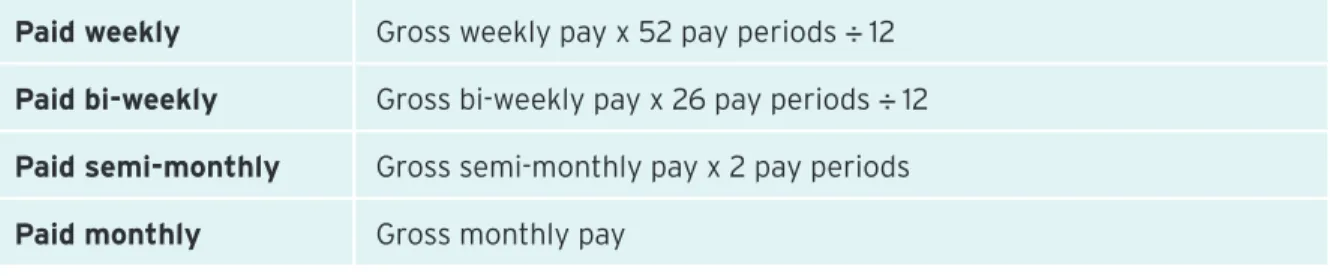
7) Use the correct formula to determine gross monthly pay using Table 1 below.
Table 1 - Formulas to Determine Gross Monthly Pay
Paid weekly Gross weekly pay x 52 pay periods ÷ 12 Paid bi-weekly Gross bi-weekly pay x 26 pay periods ÷ 12 Paid semi-monthly Gross semi-monthly pay x 2 pay periods Paid monthly Gross monthly pay
Example of Year to Date Income
A resident works full-time and submits a series of three consecutive pay stubs. The most recent paystub is dated May 26th and shows the YTD income. The paystub also shows a $10.00 uniform allowance each pay period, as a taxable benefit. The employee is paid bi-weekly, and began work on February 5th of the current calendar year.
YTD earnings from pay stub = $7,458.26
Divide YTD earnings by number of pay periods (Feb 5 to May 26, bi-weekly pay) ÷ 8
Equals average gross income per pay period = $ 932.28
Deduct uniform allowance of $10.00 per pay period – 10.00
Adjusted average gross income per pay period = $922.28
Apply correct formula to calculate average gross monthly income:
Multiply by frequency of pay x 26
Equals annual income = $23,979.28
Divide by 12 months ÷ 12
2) Series of Consecutive Paystubs
This method takes the average income from at least three of the most recent consecutive paystubs to determine gross monthly income:
1) Record the gross pay from each paystub.
2) Deduct any overtime and vacation pay unless received on a regular, ongoing basis.
3) Deduct any taxable benefits such as a uniform allowance, meal allowance or bus fare from each paystub. See Canada Revenue Agency Employers’ Guide — Taxable Benefits and Allowances for details.
4) Add the amount from each paystub together, after deductions for overtime, vacation and taxable benefits.
5) Divide the total by the number of paystubs to get the average gross income per pay period.
6) Use the correct formula to determine gross monthly pay (see Table 1- Formulas to Determine Gross Monthly Pay).
Example of Consecutive Pay Stubs
A resident who works part-time has provided five consecutive pay stubs, has not received any overtime, vacation pay or taxable benefits, and is paid semi-monthly.
Total gross pay from all pay stubs = $4,115.00
Divide by total number of pay stubs ÷ 5
Equals average gross income per pay period = $823.00
Apply correct formula to calculate average gross monthly income:
Multiply by frequency of pay x 2
Average gross monthly income = $1,646.00
Self-Employment Income
The procedures below explain how to calculate gross monthly income for self-employed household members according to the type of business.
Important note: If the net income from self-employment is a negative amount (even after adding back wages, rent or capital cost allowance), record the self-employment income as $0.00. Losses from self-employment cannot be used to reduce income from other sources.
1) Sole Proprietorship or Partnership
This type of self-employment may be referred to as “doing business as” a sole proprietorship or partnership. You can determine which type of ownership by looking at the Statement of Business or Professional Activities (T2125 of the Personal Tax Return) or financial statements. If the business is a sole proprietorship, the resident will have 100 per cent of the company earnings. If it is a partnership, the resident will have a percentage of the earnings (e.g., being a 50 per cent partner equals 50 per cent of the earnings).
Use the Business Income Calculation Worksheet to calculate the gross monthly income from these types of self-employment.
Required Documentation:
• T2125 Statement of Business or Professional Activities from the Personal Tax Return, and Notice of Assessment, or
• Financial statements if the business is in the first year of operation and a tax return has not yet been filed, as determined on a case by case basis
To calculate gross monthly income for a self-employed resident, use the net business income (line 9946 of the T2125 form) and add back the following expenses:
• Capital Cost Allowance (line 9936, prorated to the percentage of ownership)
• Management fees/salaries/wages paid to any household members (lines 8871 and 9060)
• Rent, if the business is being operated in the RGI unit (line 8910)
• Business-use-of-home expenses (line 9945)
Review each of the claimed expenses for reasonableness. Receipts or business bank account statements may be required to verify expenses. For example:
• Determine why expenses are rounded to the nearest dollar, if this occurs.
• If no or limited vehicle expenses are coming from personal account(s), determine the average weekly percentage of personal use of the business vehicle. Add this back to the income.
• If no or limited grocery purchases are coming from the personal account, ask whether personal grocery purchases are being expensed under meals and entertainment and/ or advertising for the business. Add back to the income any amount of declared grocery expenses you cannot link to the personal bank account(s).
2) Limited or Incorporated Company
If the business name is followed by Limited (Ltd.) or Incorporated (Inc.), the business is a separate legal entity required to submit a corporate tax return each year. The resident may receive income from the company in the form of dividends, management fees, salary and bonus, which will be reported on their personal Income Tax Return. As such, the company income is not the income of the resident who owns the company: the resident is paid as an employee of the company.
In addition to receiving employment income from the company, the resident will be a shareholder. As a result, the company value is considered an asset and income must be calculated from this asset (see Income from Assets).
Report personal income declared by the resident and income from the asset on the Rent Form. Required documentation:
• Corporate Notice of Assessment, and
• T1178 General Index of Financial Information short form, and
• T2 Schedule 1, and
• T2 Corporate Tax Return, and
• Financial statements if the business is in the first year of operation and a tax return has not yet been filed, as determined on a case by case basis
Calculate income from this type of self-employment using the same steps as Regular Employment Income. If the resident is unable to provide copies of cheque stubs, you can calculate average gross monthly income using the Income Tax Return and Notice of Assessment from the previous year. Use the Self-Employed — Limited (Ltd.) or Incorporated (Inc.) Worksheet to calculate the value of the tenant’s assets in the company.
If the resident and/or spouse are the only shareholders in the company, consider the retained earnings and/or shareholder loan as an asset when calculating the TRC. If there are other shareholders, identify the percentage of shares the resident and/or spouse hold, and include a proportionate amount of the retained earnings. Also check the corporate tax return to determine whether any portion of the shareholder loan belongs to another shareholder.
Employment Insurance Income
Calculate gross monthly income from Employment Insurance (EI) based on:
1) EI as the sole source of income
2) EI plus employment income
3) A new application for EI
Any rent calculation involving EI income is subject to a short-term review, usually six months or when EI ceases, whichever is less.
Required Documentation:
• EI payment stub showing gross weekly rate, or
• Letter from Service Canada stating the gross weekly rate, or
• Print out from a Service Canada online account stating the gross weekly rate (this must show the URL, date and time printed)
Housing providers must determine how long a resident has been receiving EI. If someone declared EI on the previous year’s Rent Form, this may indicate seasonal or fluctuating employment. See Seasonal or Fluctuating Employment Income for more details.
1) EI as the Sole Source of Income
EI is considered the sole source of income if a resident has not received any other income during the calendar year.
1) Determine the gross weekly EI rate.
2) Multiply the gross weekly rate by 52 (weeks), and divide by 12 (months) to calculate the gross monthly income.
Example of Employment Insurance
Gross weekly rate = $345
Multiply by 52 weeks x 52
Equals total gross annual EI income = $17,940
Divide by 12 months ÷ 12
Average gross monthly income = $1,495
2) EI plus Employment Income
People receiving EI can earn up to 25 per cent of their weekly rate without affecting their benefits. In this case, the payment stub will list “deductions for employment.” Perform the following calculation only if the deduction is 25 per cent or greater and is shown on the EI payment stub. Otherwise, perform separate calculations for EI and regular employment income.
1) Determine the gross weekly rate of EI from the payment stub or letter/print out from Service Canada.
2) Multiply the gross weekly rate by 125 per cent (regardless of per cent earned) to determine the maximum allowable weekly income from EI and employment.
3) Multiply this amount by 52 (weeks) to get the gross annual income.
4) Divide by 12 (months) to arrive at the gross monthly income.
Example of EI plus Employment Income
Gross weekly rate = $345
Multiply by 125 per cent x 125%
Maximum allowable weekly income = $431.25
Multiply by 52 weeks x 52
Gross annual income =$22,425
Divide by 12 months ÷ 12
Gross monthly income = $1,868.75
3) New Application for EI
A resident may have applied for Employment Insurance, but documentation showing the benefit rate is not yet available. In this case, you can calculate an estimated weekly EI rate based on the Record of Employment or a series of consecutive pay stubs from the resident’s last employer.
When you use this method to estimate income for new EI applicants, you need to re-calculate gross monthly income once a resident receives the first EI cheque. If the EI payment is higher than estimated, adjust the TRC for the first of the month following the date the payment was received. If the EI payment is lower than estimated, adjust the TRC retroactively to the effective date of the first calculation.
Estimating EI gross monthly income from a Record of Employment:
1) Determine the frequency of pay.
2) Determine how long the resident was employed at this job.
3) Find the total insurable earnings.
4) Calculate the average gross pay per period using the following formulas:
Paid weekly Total insurable earnings ÷ 27 (or number of weeks worked if fewer than 27)
Paid bi-weekly Total insurable earnings ÷ 14 (or number of bi-weekly periods the resident worked if fewer than 14)
Paid semi-monthly Total insurable earnings ÷ 13 (or number of semi-monthly periods the resident worked if fewer than 13)
Paid monthly Total insurable earnings ÷ 7 (or number of months the resident worked if fewer than 7)
5) Use the correct formula to determine gross monthly pay as outlined in Table 1 — Formulas to Determine Gross Monthly Pay.
6) Multiply the gross monthly income by 55 per cent to get the estimated gross monthly income from EI.
Estimating gross monthly income from paystubs:
1) Follow the steps outlined under Regular Employment Income to determine gross monthly income.
2) Multiply the gross monthly income by 55 per cent to get the estimated gross monthly income from EI.
EI Waiting Period
Individuals who apply for EI typically encounter a waiting period of up to two weeks during which no income is received. No adjustment to the TRC is made because of this wait.
Seasonal or Fluctuating Employment Income
A person who has seasonal or fluctuating employment may work in an industry that offers employment for only a portion of the year. Examples include:
> Employment in seasonal industries such as tourism, fishing, or forestry
> Employees of a board of education (i.e., caretakers, teacher’s aides)
> On-call workers
> Commissioned salespeople whose income varies from one month to the next
> Employment in the construction industry where employees often have multiple employers during the year, periods with no income, or periods involving EI
As a result, the employee’s annual income may be a combination of regular employment income and Employment Insurance or Income Assistance.
You can eliminate the need for multiple adjustments to the TRC during the year by using either the previous year’s ITR and NOA or year-to-date income for residents with seasonal/fluctuating employment:
> If the resident worked in the same seasonal/fluctuating employment situation the previous year, calculate average gross monthly income using the previous year’s ITR and NOA
> If the resident started seasonal or fluctuating employment during the current calendar year, calculate average gross monthly income using year-to-date income
Required Documentation:
> ITR and NOA from Canada Revenue Agency for the most recent tax year, and proof of the number of months employed during the tax year (Record of Employment or letter from employer), or
> A series of at least three consecutive pay stubs and proof of any income from EI/IA
1) Previous Year’s ITR and NOA
Use this method when monthly income regularly changes, but results in approximately the same annual income:
1) Verify the number of months the resident was employed.
2) If applicable, verify the number of months the resident received Employment Insurance or Income Assistance.
3) Calculate the annual gross income from all sources, including employment income, Employment Insurance and Income Assistance.
4) Divide the amount by 12 months to get the average gross monthly income.
2) Year-to-Date Income
Use this method if a resident recently began working in seasonal or fluctuating employment, or if the previous year’s ITR does not accurately reflect the current year’s earnings:
1) Calculate the average gross monthly income from employment using the year-to-date method outlined in the Regular Employment Income section.
2) If the resident also received Employment Insurance, calculate the gross monthly income from EI using the EI plus Employment Income method, and add this amount to the gross monthly income from employment.
Example of Income Calculation for a Resident with Fluctuating Employment
The resident is employed in a new on-call position and the previous year’s ITR does not accurately reflect current income. Consequently, the resident submitted three consecutive
pay stubs. The most recent pay stub is dated May 26th and shows the YTD gross income.
The resident is paid bi-weekly and commenced employment on February 5th of the current
calendar year.
YTD gross earnings from pay stub = $6,500.00
Divide by number of pay periods (Feb 5 to May 26, bi-weekly pay) ÷ 8
Average gross income per pay period = $812.50
Apply correct formula to calculate average gross monthly income:
Multiply by frequency of pay x 26
Annual pay = $21,125.00
Divide by 12 months ÷ 12
Average gross monthly income = $ 1,760.42
Seasonally Employed Residents Receiving Income Assistance
Seasonally employed residents who also receive Income Assistance are not automatically charged the Flat Rent for Income Assistance recipients. First, calculate 30 per cent of gross monthly income for the family group for the period the resident received Income Assistance:
> If Income Assistance was received for more than six months, compare 30 per cent of income to the Flat Rent and charge the higher of the two
> If Income Assistance was received for less than six months, compare 30 per cent of income to the Minimum Rent and charge the higher of the two
Example of Income Calculation for a Seasonally Employed Resident
A seasonally employed resident worked for four months and collected Income Assistance for eight months. The resident’s family group is six people, and no other family member earned income.
Employment income = $9,560.00
Income Assistance + $7,586.00
Total income = $17,146.00
Divide by 12 months ÷ 12
Average gross monthly income = $1,428.83
In this scenario, 30 per cent of income is compared to the Flat Rent for the family size because Income Assistance was received for more than six months of the year, and the family group is charged the higher of the two amounts. See Calculating Tenant Rent Contribution.
Child Support Income
Child support is money a non-custodial parent pays to the parent with custody to help support their child. A child support order or agreement specifies how much one or both parents need to pay in child support. It may be a separate order or agreement, or may form part of a larger divorce order or separation agreement.
Include child support as income and convert the amount to gross monthly income. Required Documentation:
• Confirmation of child/spousal support from the Family Maintenance Enforcement Program, or
• Court order, agreement or other legal documentation, or
• Three consecutive bank statements showing deposits, or
• If the resident is declaring child support on the tax return, the Income Tax Return and Notice of Assessment from the most recent tax year
It may not be possible for the resident to provide proof if child support is not court ordered and the parent paying child support is unwilling to provide documentation. In this case, a review of bank statements and a written declaration from the resident is acceptable.
The Family Maintenance Enforcement Program (FMEP) is available to anyone who needs assistance collecting child support.
Residents on Income Assistance while receiving child support are required to take part in FMEP and may remain on the program even if they no longer require Income Assistance. FMEP deposits are clearly marked on bank statements.
FMEP statements can be used as proof of child support income, and also to show there has been a reduction in the amount of child support or the payments/amounts are inconsistent.
If child support payments are sporadic or vary in amount from month to month, you can calculate a monthly average by adding the support payment amounts received over the past three to twelve months (use the maximum available) and dividing by the total number of months.
Example of Child Support Calculation
Child support payments are sporadic and vary in amount. A court order is not in place, and the applicant has provided three consecutive bank statements and a verbal declaration as proof of income.
Child support payments:
Month 1 $ 275
Month 2 $ 0
Month 3 $ 190
Total for all months: = $ 465
Divide by number of months: ÷3
Make a note on the Rent Form if child support has ended, and obtain acceptable proof to keep on file. Proof that child support has ended:
• An FMEP statement showing child support has ended, or
• Six months of bank statements showing no child support deposits and a self-declared letter stating child support benefits ended (which must be noted on the Rent Form), or
• Evidence that the child is no longer a dependent, or
• Evidence that the non-custodial parent is deceased
Pension Income
There are many types of pension income, including:
> Old Age Security (OAS), Guaranteed Income Supplement (GIS), Allowance, and Allowance for the Survivor (formerly Spousal Allowance)
> Canada Pension Plan, including retirement, disability, orphans, widows, etc.
> War Veterans Allowance (WVA) and Disability Allowance from War Veteran’s Affairs Canada
> Senior’s Supplement
> Private pension plans including Registered Retirement Income Funds (RRIF)
> Foreign pensions
List all sources of pension income separately on the Rent Form.
1) Pensions from Canadian Sources
Public pension plans such as OAS, GIS and CPP will not usually have taxes deducted, but many private pension plans will. It is important to use the gross monthly pension income whenever possible. Required Documentation:
> Current letter of entitlement from each pension provider. For public pensions, the applicant has to request a Pension Rate Letter from the federal government, showing all pension income including OAS, GIS and CPP, and submit this letter, or
> Copy of the pension cheque or cheque stub showing the gross amount, or
> Copy of bank statements or bank book showing pension deposits. This is the least desirable form of proof, as it will show net amounts, and should only be accepted when other forms of proof do not exist due to the nature of the pension; for example, a private pension that does not provide cheque stubs or statements.
Follow the steps in the Regular Employment Income section to calculate the gross monthly income from pensions.
When a resident turns 65 and starts receiving pension income, a review of the TRC is not necessary unless income decreases.