Bridging the Digital Disconnect
Exploring Parents’ Views on Using Technology to Promote Young People’s Mental
Health
Dr. Aleisha M Clarke
Health Promotion Research Centre National University of Ireland Galway, Ireland
Ms. Tuuli Kuosmanen
Health Promotion Research Centre National University of Ireland Galway, Ireland
Mr. Derek Chambers
Inspire Ireland Foundation Ireland
Professor Margaret M Barry
Health Promotion Research Centre National University of Ireland Galway, Ireland
ISBN: 978-0-9871179-5-3
Suggested citation: Clarke, AM, Kuosmanen, T, Chambers, D & Barry, MM 2013, Bridging the Digital Disconnect: Exploring Parents’ Views on Using Technology to Promote Young People’s Mental Health, A report produced by the Health Promotion Research Centre, National University of Ireland Galway and Inspire Ireland Foundation in collaboration with the Young and Well Cooperative Research Centre, Melbourne, Australia.
Acknowledgements
The authors wish to acknowledge the parents who completed the Parents’ Needs Assessment Survey and took part in focus groups; and the cooperation of the schools involved in distributing the questionnaire to parents. Finally, the authors wish to acknowledge Ms Tara Hubbard for her contribution to the data collection, analysis and write-up of the parent focus groups findings.
This project was funded by Inspire Ireland Foundation and Young and Well Cooperative Research Centre.
Health Promotion Research Centre, National University of Ireland Galway
The Health Promotion Research Centre (HPRC) at the National University of Ireland Galway produces high quality research, of national and international significance, that supports the development of best practice and policy in the promotion of health. As the only research centre in Ireland dedicated to Health Promotion, the Centre collaborates with regional, national and international agencies on the development and evaluation of Health Promotion initiatives. The Centre has an active multidisciplinary research programme in place and is a designated World Health Organization Collaborating Centre for Health Promotion Research.
nuigalway.ie/hprc/
Young and Well Cooperative Research Centre
The Young and Well Cooperative Research Centre is an Australia-based, international research centre that unites young people with researchers, practitioners, innovators and policy-makers from over 75 partner organisations. Together, we explore the role of technology in young people’s lives, and how it can be used to improve the mental health and wellbeing of young people aged 12 to 25. The Young and Well CRC is established under the Australian Government’s Cooperative Research Centres Program.
youngandwellcrc.org.au
Inspire Ireland
The Inspire Ireland Foundation was incorporated in 2009 to deliver ReachOut.com in Ireland. While independent, Inspire Ireland retains strong connections and has a close working relationship with Inspire in Australia and the United States. Most importantly, Inspire Ireland shares the mission of helping young people get through tough times. Our work is focused on service delivery through ReachOut.com, mental health promotion and research.
Table of Contents
EXECUTIVE SUMMARY ..1
INTRODUCTION 3
METHODS ... ...4
PARENTS’ QUESTIONNAIRE RESULTS .7
FOCUS GROUP RESULTS ..21
DISCUSSION 32
IMPLICATIONS .35
CONCLUSION ..35
List of Tables
Table 1: Parent questionnaire study sample .4
Table 2: Demographic profile of parents.. ..7
Table 3: Parents’ use of computers and the internet ...8
Table 4: Parents’ use of the internet in previous month .. 9
Table 5: Parents and feeling equipped to promote wellbeing and deal with youth mental health problems ...9
Table 6: Sources of support for parents if their child was going through a tough time .10
Table 7: Mental health organisations parents reported being aware of .10
Table 8: Percentage of parents that heard of and visited online mental health websites 11
Table 9: Development of online resources for parents ..13
Table 10: Topics parents were interested in receiving information on 15
Table 11: Parents’ views on whom the resource should provide information and support to .16
Table 12: Parents’ views on the role of computers and the internet in supporting youth mental health 19
Table 13: Demographic information of parents who attended focus group 21
Table 14: Mean parent scores for key sections of ReachOut.com website 26
Table 15: Parent focus groups: Topics parents would like to receive information on ...31
Table 16: Parent focus groups: What the online resource should look like 31
List of Figures
Figure 1: Parents’ preferences for how they would like to receive youth mental health information...12Executive Summary
Bridging the Digital Disconnect is a three-year program of research that aims to develop online mental health and digital literacy resources for adults – including parents, teachers, youth workers, social workers, general practitioners and mental health professionals – who wish to support the mental health of young people aged 12 to 25. This program of research is being carried out by the Health Promotion Research Centre at the National University of Ireland Galway and Inspire Ireland Foundation in collaboration with Young and Well Cooperative Research Centre, Australia. The first online resource to be developed is designed to meet the needs of parents. This report will outline key findings from a needs assessment carried out with parents in Ireland. The specific aims of this study were to:
determine parents’ current use of online technologies; examine parents’ needs in relation to youth mental health;
explore parents’ views regarding the use of online technologies to assist them in supporting young people’s mental health and wellbeing; and
explore parents’ needs in relation to using online technologies to support young people’s mental health. A total of 355 parents of second and fifth year students (young people aged between 14 and 17) from randomly selected secondary schools across Ireland completed a postal questionnaire. In addition to this, four focus groups were carried out with 32 parents nationally in order to further explore their views.
Overall, the results from this study reveal important findings regarding parents’ needs in terms of youth mental health and the use of online technologies to assist them in supporting young people. In relation to mental health, parents endorsed the association between positive youth mental health and the development of coping skills, confidence, communications skills and supportive peer and adult relations. Parents frequently referred to the pressures (academic, peer, societal) young people currently experience and the impact this has on their mental health.
Over two thirds of parents (69.8%) stated they were likely / very likely to look for help on the internet if their child was going through a tough time. Parents with second or third level education, females and younger parents (>45 years) were significantly more likely to use online supports. Receiving mental health information through a website was the second most frequently requested information source after a leaflet. In addition, 22.1% of parents stated they had used the internet to search for mental health information in the past month. These findings, coupled with the finding that one quarter of parents (24.6%) disagreed / strongly disagreed that they could help their child through a tough time points to A) the need for mental health resources and training for parents, and B) the potential of developing an online youth mental health resource to meet parents’ needs.
Regarding the types of online resources parents requested, there was a strongly expressed need for youth mental health information, specifically:
information about local services available to support young people;
reliable information provided on mental health issues concerning young people; guidelines about what to do if a young person is experiencing mental health problems;
guidelines about how to promote wellbeing in young people and develop their communication skills, self-efficacy and coping skills; and
resources to support parents’ own mental health, in particular, stress management skills.
Parents who took part in the parent focus groups reviewed an Irish youth mental health website (ReachOut.com) and expressed a desire for the development of a website with similar content for parents. In addition to youth mental health information, parents repeatedly spoke about the need for training in relation to young people’s use of technology, specifically the use of social networking sites. Information around online safety was frequently requested. Analysis of the parents’ findings according to level of education revealed that parents with a second or third level education were significantly more likely to A) indicate a need for youth mental health resources, and B) view the role of technology as important in providing these resources.
Potential barriers that would prevent parents from using online resources included: lack of confidentiality; over-complicated style; uncertainty about the reliability and source of information provided; lack of IT skills; and lack of awareness of the online resource. Parents referred to the need for a transparent, joined-up approach for parents, teachers, youth workers, general practitioners, health and mental health professionals. Over 80% of parents felt that the online resource should also cater for adults working with young people and young people themselves, thus indicating their preference for an all-inclusive online resource that addresses multiple needs. Related to this, parents requested the variety of online resources already available be brought together in a coherent manner to assist parents in their awareness and use of reliable online information and resources. In addition to receiving information through an online resource, parents also emphasised the need for face-to-face training in relation to youth mental health, developing parents skills and enhancing parents’ use of technologies.
Overall, the results from this study highlight the positive response from parents regarding the development of online parent resources to support youth mental health. In interpreting the findings, the limitations of this study should be taken into account, including the non-representative sample who participated in the study and the low response rate (16.7%) to the parent survey. The majority of participants that took part in this needs assessment study were female, aged 44 to 55, had completed third level education, and were in employment. Despite these limitations, the findings underscore parents’ need for guidance in relation to youth mental health and the potential of online technologies in providing support to parents.
1. Introduction
The Health Promotion Research Centre at the National University of Ireland Galway in collaboration with Inspire Ireland Foundation is undertaking a three-year program of research working with young people and adults to determine how best to use technology to improve the mental health and wellbeing of young people. This initiative is part of an international research project being led by Young and Well Cooperative Research Centre in Australia. Bridging the Digital Disconnect seeks to develop online mental health and digital literacy resources for adults, including parents, teachers, youth workers, social workers, general practitioners, health promotion and mental health professionals, who wish to support the mental health of young people aged 12 to 25 years.
For most young people, online technologies are a part of their everyday lives. In Ireland, young people aged 16 to 24 years are the most frequent users of the internet. Data from the European Commission highlights the steady increase in young people’s use of the internet over the past seven years with 34% of young people reporting they had accessed the internet in 2005; In 2011, 92% of 16 to 24 year olds reported having accessed the internet. Of this group, 78% of young people accessed the internet on a daily basis (European Union, 2012). Similar figures have been reported in Australia, with 91% of 12 to 17 year olds reporting the internet as a ‘highly important aspect of their lives’ (Australian Communications and Media Authority, 2009).
Results from the recent My World Survey (Dooley & Fitzgerald, 2012) carried out with over 14,306 young people aged 12 to 25 in Ireland highlight the importance of the internet as a source of support for young people’s mental health and wellbeing. For young people aged 12 to 19 years in secondary school, the internet was the third most frequently reported source of support after friends and parents. For young adults aged 17 to 25 years (post-second level), the internet was the most frequently reported source of support for mental health and wellbeing, followed by friends and parents (Dooley & Fitzgerald, 2012). The findings from this study provide evidence that for young people the internet can be seen as a ‘tool and a setting for action’ (Blanchard et al, 2011) in improving their mental health and wellbeing.
The evidence regarding internet-delivered mental health interventions has been accumulating. A recent systematic review of online mental health promotion and prevention interventions available for young people aged 12 to 25 highlights the potential role of the internet for the delivery of mental health interventions for young people (Clarke et al, 2013). A total of 18 web-based interventions were identified. Interventions included structured online modules, mental health information resources, online gaming interventions, blogging and online therapy. Findings from the mental health promotion interventions indicated that there is moderate evidence regarding their impact on young people’s mental health literacy skills, support seeking behaviour and wellbeing. In terms of the mental health prevention interventions, there is medium to strong evidence that computerised cognitive behavioural therapy (cCBT) interventions can have a significant and lasting impact on anxiety and depression among young people identified at risk of developing a disorder, with the MoodGYM intervention providing the most consistent positive findings. There is also some promising evidence regarding the potential of online group support interventions.
The growing demand and expansion of online mental health resources has significant implications for adults and the role they play in supporting young people. Little is known, however, about adults’ views on the role technologies can play in supporting youth mental health and adults’ needs in relation to mental health and digital literacy. Given that the first online resource to be developed as part of the Bridging the Digital Disconnect study will be designed for parents, a needs assessment survey was conducted with parents in Ireland in order to determine how best to support parents in using technologies to promotion young people’s mental health.
1.1 STUDY AIMS
The specific aims of this study were to:
determine parents’ current use of online technologies; examine parents’ needs in relation to youth mental health;
explore parents’ views regarding the use of online technologies to assist them in supporting young people’s mental health and wellbeing; and
2. Methods
This study was conducted in two phases – phase one consisted of a parent questionnaire, with phase two featuring in-depth focus groups with parents.
2.1 PARENT QUESTIONNAIRE
A parent questionnaire was devised examining parents’ A) current use of technologies, B) needs in relation to youth mental health, C) attitudes regarding the use of technologies to promote and improve young people’s mental health and wellbeing. A questionnaire was chosen over other approaches as it was deemed the most appropriate method to obtain the views of a large sample of parents nationally. mmmmmmmmmmmmmmmmmm
2.1.1 Sample
Parents of students in first year (ages 13 to 14) and fifth year (ages 17 to 18) in secondary schools were chosen to take part in the first phase of this study. The sample of parents was recruited based on a random selection of schools in Ireland. Five percent of the schools across each region were randomly chosen to be contacted. Principals in 37 schools, (17 schools in Leinster, five schools in Ulster, 10 schools in Munster, and five schools in Connaught) were contacted regarding permission to send the parents questionnaire home with students in first and fifth year. A total of 12 schools agreed to distribute the survey, resulting in 2121 parent questionnaires being distributed across the 12 schools (Table 1).
Table 1: Parent questionnaire study sample Total number of schools Number of schools contacted (5%) Number of schools agreed to distribute survey Number of parents received questionnaire Ulster 50 5 1 78 Munster 213 10 4 762 Leinster 355 17 6 1146 Connaught 103 5 1 135 2.1.2 Measure
The questionnaire was informed by current literature and a similar questionnaire that has been used with mental health professionals in Australia (Blanchard et al, 2011). It was composed of fixed-choice and open ended questions, the majority of which were fixed choice. The questionnaire was divided into two main sections. Section one explored parents’ current use of computers and the internet. Section two explored parents’ sources of support in relation to youth mental health and their awareness of local, national and online mental health organisations. This section also presented ideas around the development of an online resource to help parents support their children’s mental health. Parents were asked to rate how strongly they agreed / disagreed that the resources should be made available to parents. They were also asked to identify topics on which they would be most interested in receiving information on. In addition, parents were asked about factors that would prevent and/or facilitate their use of the online resource. The final section of the questionnaire collected demographic information on the respondents. On completion of the questionnaire, parents were asked to return the questionnaire in the post using the free-post envelope provided.
2.1.3 Data Analysis
The data from the parents’ questionnaire were entered into SPSS, and a summary of descriptive statistics was produced. The data were subject to univariate analysis with some bivariate analysis carried out to determine relationships between parental demographics and the respective variables.
2.2 PARENT FOCUS GROUPS
Following the completion of phase one, focus groups were carried out with parents across the country. The purpose of these focus groups was to explore in detail parents’ needs in relation to youth mental health, and the use of technologies to promote and improve youth mental health and wellbeing.
2.2.1 Sample
The sample of parents for the focus groups was obtained through purposive sampling. A sample of parents from the four provinces in Ireland was selected. All parents that took part in the focus groups had at least one child aged 12 to 25. One group of parents were known to each other through work (N = 8). Another group of parents attended a family support service that is designed to promote positive parenting by empowering and supporting parents to identify and improve their skills and abilities (N = 12). Another still lived in a disadvantaged urban area (N = 5). The final group of parents were involved in training young people in computer programming (N = 7). The four groups of parents were recruited with the assistance of Health Promotion Officers in the local area and Inspire Ireland.
2.2.2 Measure
Focus groups were conducted to explore parents’ views in greater detail. Parents were asked a set of key questions that were designed to:
explore parents’ understanding and views on youth mental health and wellbeing, the supports that young people need, and risk factors that affect youth mental health;
examine parents’ views on training they would like to receive in relation to youth mental health; determine parents’ use of technology and concerns with using technology;
examine parents’ impression of a youth mental health website (ReachOut.com); and
explore parents’ views on what an online resource designed to assist parents in supporting young people’s mental health should provide.
As a result of findings from the parent questionnaire, which indicated parents’ lack of familiarity with online mental health resources, parents were asked to review an Irish youth mental health website (ReachOut.com). The purpose of reviewing the youth mental health website was A) to provide parents with a concrete example of an Irish-based mental health website; B) to determine parents’ views of an online youth mental health resource; and C) to ascertain parents’ views on what a similar online resource could provide for parents. As part of reviewing the website, parents were asked to complete a questionnaire. The questionnaire asked participants to review five sections of the website: Inform Yourself, Getting Help, Real Stories, Ask the Expert, and Blog. Each section is designed to provide young people with relevant information through the use of education text (Inform Yourself and Getting Help), case study examples (Real Stories), short presentations from professionals in the field of mental health (Ask the Expert), and a youth blog. Parents were asked to choose a topic within each section, review it based on its content, appearance and appeal, and rate it on a likert scale from 1–10 (1 being poor and 10 being excellent).
2.2.3 Data Analysis
The focus group review sessions were recorded using digital recorders. All four focus groups were transcribed verbatim and analysed using inductive thematic analysis approach (Braun & Clark, 2006). This method means the themes identified are strongly linked to the data themselves, thus providing a rich and detailed account of the entire data set. Using Braun and Clark’s six phases of thematic analysis, after reading and re-reading the data, the data was coded and collated. Following this, the codes were sorted into potential themes, gathering all data relevant to each potential theme. The themes were checked by two researchers (AC and TH) in relation to the coded extracts (Level 1) and the entire data set (Level 2). Further analysis was carried out to refine the specifics of each theme and the final step of analysis involved selecting compelling extract examples. An inter-coder reliability test was carried out, with two researchers (AC and TH) analysing the data separately in order to
examine the reliability of the coded and themed data. The level of correspondence across the researcher analysis was high (inter-coder reliability 97.4%).
Data from the demographic questionnaire and the ReachOut.com questionnaire were entered into SPSS and analysed using univariate analysis.
3. Parents’ Questionnaire Results
3.1 DEMOGRAPHICS
A total of 355 parents returned the postal questionnaire. This represents 16.7% of the total number of parents that received the questionnaire (N = 2121). The demographic profile of the parents is shown in Table 2.
Table 2: Demographic profile of parents
N % Gender Male 42 11.8 Female 293 82.5 Missing 20 5.6 Age 26 to 35 14 3.9 36 to 45 139 39.2 46 to 55 174 49.0 56+ 9 2.5 Missing 19 5.4 Nationality Irish 302 85.1 Other European 22 6.2 Non-EU National 10 2.8 Missing 21 5.9
Province live in Munster 151 42.5
Leinster 162 45.6
Connaught 21 5.9
Ulster 0 0
Missing 21 5.9
Urban / Rural Urban (town +1500) 82 23.1
Dublin city 71 20
City other than Dublin 6 1.7
Rural 177 49.9
Missing 19 5.4
Highest level of education Primary or equivalent 4 1.1
Intermediate / Junior Certificate 21 5.9
Leaving Certificate 90 25.4
Diploma / Certificate 113 31.8
Primary degree 45 12.7
Postgraduate / higher degree 58 16.3
Missing 24 6.8
Current work status Employee 178 50.1
Self-employed outside farming 43 12.1
Farmer 4 1.1
Student full time 2 0.6
On state training scheme 6 1.7
Unemployed 12 3.4
Long-term sickness or disability 7 2.0
Home duties 80 22.5
Retired 2 0.6
Missing 21 5.9
The majority of parents that completed the questionnaire were female (82.5%). Almost half of the parents (49.0%) were aged 46 to 55. The majority of parents were Irish (85.1%) and from the provinces of Munster or Leinster (42.5% and 45.6% respectively). No parents from Ulster returned the questionnaire. There was an even rural / urban divide with 49.9% of the parents living in a rural area. In terms of education, a high proportion of parents completed third level education (60.8%), of this group 29% had a degree or postgraduate qualification. Just under a third of all parents (31.3%) had a second level education and four parents (1.1%) reported completing primary school only. Chi-square tests for independence indicated that there was no significant association between level of education (primary, secondary and third level) and age, gender, nationality, rural / urban location. Regarding employment, the majority of parents (63.3%) were in employment. Just under a quarter of parents (22.5%) reported working in the home, and 3.4% were unemployed.
Comparing these demographic data with demographic information from the 2007 Survey of Lifestyle, Attitudes and Nutrition (Barry et al, 2009), which had a national representative sample of 10,364 respondents aged 18 and over, there are notable demographic differences across the two samples. Unlike the SLAN survey which had a 49.% male response rate, 11.8% of participants that responded to the parent questionnaire were male. The age profile of the SLAN sample was younger with 25.2% aged 18 to 29 and 31.1% aged 30 to 44. In addition, there was a significant difference in education profile across the two samples. While 55% of parents that completed the parent survey had third level education, 36.3% of the sample in SLAN survey had completed a third level education, 44% had post-primary education and 19% had primary education. In terms of working situation, the results were similar, with just over 60% in employment.
3.2 USE OF TECHNOLOGY
Figures related to parents’ access to a computer and the internet at home and their level of confidence using computers are shown in Table 3. Only two of the 355 parents (0.6%) reported not having a computer at home. The majority of parents (>80%) reported being confident or very confident using a computer, with 16.6% stating they could use some help and 3.7% stating they were not confident at all. Chi-square analysis indicated a significant association between level of education and level of confidence using a computer [ ²(1, n = 330) = 6.78, p = .034], indicating parents with a primary or secondary school education were significantly less confident using a computer than parents with a third level education. Of those that reported having a home computer, almost all parents had internet connection (98.3%). Half of the parents stated they had access to the internet on their mobile phone (50.7%). Over 90% of parents reported using the internet on a weekly basis with almost two thirds of parents (65.7%) reporting using it on a daily basis.
Table 3: Parents’ use of computers and the internet
N %
Computer at home Yes 353 99.4
No 2 0.6
Confidence using computer Very confident 109 30.9
Confident 176 49.9
Could use some help 55 16.6
Not confident at all 13 3.7
Computer with internet access Yes 349 98.6
No 5 1.4
Access to internet on mobile phone Yes 177 50.7
No 171 49.0
Don’t have a mobile phone 1 0.3
Use of internet Every day 232 65.7
Once or twice a week 90 25.5
Once or twice a month 20 5.7
Less often 11 3.1
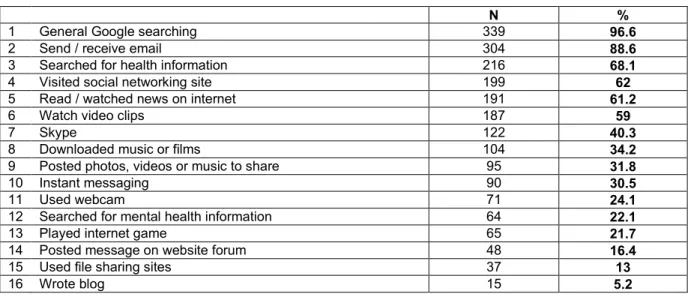
Parents were asked to indicate what they had used the internet for in the past month (Table 4). The most frequently reported uses of the internet were general Google searching and sending / receiving email. Just over one fifth of parents (22.1%) stated they had searched for mental health information on the internet over the past month. There were no significant associations between searching for mental health information and age, gender or education. Searching for health information was the third most frequently reported use of the internet (68.1%). These results are comparable with a recent ehealth literacy survey conducted with a sample of 321 primary care service users in Ireland (age range 18 to 82, mean age 40.9 years) (Fox, 2011). Results from this survey showed 59.5% of respondents had previously engaged with health information seeking online. Additional analyses revealed that those with lower ehealth literacy were more likely to be male, living in a rural area, less educated, in poorer health, and older (45 years+). Results from the parents’ needs assessment revealed that respondents living in a rural area were significantly less likely to use the internet to search for health information than respondents living in a rural area [ ²(1 n=301) = 3.95, p<0.05].
Table 4: Parents’ use of the internet in the previous month
N %
1 General Google searching 339 96.6
2 Send / receive email 304 88.6
3 Searched for health information 216 68.1
4 Visited social networking site 199 62
5 Read / watched news on internet 191 61.2
6 Watch video clips 187 59
7 Skype 122 40.3
8 Downloaded music or films 104 34.2
9 Posted photos, videos or music to share 95 31.8
10 Instant messaging 90 30.5
11 Used webcam 71 24.1
12 Searched for mental health information 64 22.1
13 Played internet game 65 21.7
14 Posted message on website forum 48 16.4
15 Used file sharing sites 37 13
16 Wrote blog 15 5.2
3.3 YOUTH MENTAL HEALTH
Parents were asked about how equipped they felt in relation to youth mental health (Table 5). The majority of parents (>80%) agreed that they felt equipped to promote wellbeing in their child’s life and to determine if their child needs help. Significantly fewer parents (57.4%) agreed that they felt equipped to help their child if they had a mental health problem. Chi-square analysis indicated a significant association between gender and feeling equipped to help a child with mental health problems [ ²(1, n = 330) = 6.1, p = .048], with females feeling significantly less equipped than males.
Table 5: Parents and feeling equipped to promote wellbeing and deal with youth mental health problems
I feel equipped to...
Strongly disagree / Disagree Neither agree nor disagree Agree / Strongly agree N % N % N %
Promote wellbeing in my child’s life 14 3.9 35 9.9 303 86.2
Determine if my child needs help 17 4.8 41 11.6 295 83.6
Help my child if they had a mental health problem
86 24.6 63 18 201 57.4
3.4 PARENT SUPPORTS
Parents were asked about what they were likely to do if their child was going through a tough time (Table 6). A family member was the most likely point of contact for parents, with 89.8% stating they were likely / very likely to talk to a family member. This was followed by talking to a friend (82.1%), talking to a health professional (79.9%) and talking to a teacher (77%). Just under 70% of parents stated they were likely or very likely to look for help on the internet, while 63.8% said they were likely / very likely to look for help on a mental health website. Females were significantly more likely than males to look for help on the internet [ ²(1, n = 320) = 5.63, p = .018]. Analysis according to education level revealed that parents with a second or third level education were significantly more likely to A) look for help on the internet [ ²(1, n = 316) = 8.31, p = .016], B) look for help on a dedicated mental health website [ ²(1, n = 294) = 6.76, p = .034], and C) look for help in books / magazines [ ²(1, n = 314) = 6.81, p = .033]. Regarding age differences, parents aged 45 years or younger were significantly more likely to look for help using a social networking tool than parents aged 46 years or older [ ²1, n = 315) = 4.36, p = .037].
Table 6: Sources of support for parents if their child was going through a tough time Very unlikely / unlikely Likely / very likely Not sure N % N % N % Talk to a friend 52 15.1 284 82.1 10 2.8
Talk to a family member 32 9.1 315 89.8 4 1.1
Talk to the child’s teacher 70 19.9 271 77 11 3.1
Talk to a health professional 54 15.5 278 79.9 16 4.6
Talk to someone on telephone helpline 249 71.8 69 19.9 29 8.3
Talk to someone through email support 271 78.3 48 13.9 27 7.8
Look for help on the internet 96 27.6 243 69.8 9 2.6
Look for help on mental health website 95 27.5 220 63.8 30 8.7
Look for help in books / magazines 126 36.0 211 60.3 13 3.7
Look for help by using a social networking tool 297 85.9 35 10.1 14 4.0
Additional sources of support that parents said they might use included: Parent with a child of similar age / parents of class friends;
Good friend of my child; Talk to my child;
School chaplain / school support service / school counselling; Priest / religious organisation / prayer; and
Parenting support groups.
3.5 AWARENESS OF YOUTH MENTAL HEALTH
ORGANISATIONS
Parents were asked if they were aware of local / national mental health organisations that support young people’s mental health. Just under 30% of parents (N = 105) said they were aware of such organisations, with the majority of parents (69.3%) stating they were not aware of any. The organisations that parents were most familiar with (unprompted) are listed in Table 7. Aware (a voluntary organisation to assist those affected by depression) was the most frequently cited organisation, followed by the Samaratins (N= 21), Health Service Executive (HSE) Psychological Services (N= 13), Headstrong, (N = 11), and Bodywhys (N = 9). These results highlight the range of mental health organisations / websites / campaigns that parents thought of, not all of which were mental health organisations (e.g. Foróige – Irish youth organisation, Aspire – support organisation for Asperger’s Syndrome, ISPCC – Irish Society for the Protection of Cruelty to Children, Alateen – support for friends and family of problem drinkers, Barnardos – children’s charity, Brainwave – UK charity working with children with brain injury or developmental delay, Belongto - national organisation for lesbian, gay, bisexual and transgender youth).
Table 7: Mental health organisations parents reported being aware of (unprompted) Organisation and number of times cited
Aware – voluntary organisation to assist those
affected by suicide 49 Private Counselling 2 Samaratins – voluntary organisation to assist those
in despair or suicidal 21 Cura – crisis pregnancy support service 1 Headstrong – national centre for youth mental
health 11 Aspire – support organistion for Aspergers Syndrome 1 Health Service Executive Psychological Services 13 1 life.ie – national suicide helpline 1 Bodywhys – voluntary organisation supporting
people affected by eating disorders
9 ISPCC – Irish Society for the Protection of Cruelty to Children
1 Grow – international organisation assisting those
with mental health problems
5 Console – national suicide charity 1 ReachOut – online service providing health and
mental health information for young people
4 Teenline – phone service for young people in distress
1 Jigsaw – community based projects across Ireland
developed to spport youth mental health
4 St Patrick’s University Hospital – Ireland’s largest mental health hospital
Yourmentalhealth.ie – HSE online mental health information site
4 Willow Grove Adolescent Unit – adolescent unit within St Patrick’s Hospital
1 Pieta House – organisation providing treatment
programme for attempted suidide or self harm
3 Cluan Mhuire / St John of Gods – outpatient adult mental health service
1 Foroige – Irish youth organisation 3 Family support clinic 1 Walk in my shoes campaign – campaign to support
mental health in Ireland 2 Belong – national organisation for lesbian, gay, bisexual and transgender youth 1 Mymindmatters – online mental health and
wellbeing portal for third level students in Ireland 2 Alateen – support for friends and family of problem drinkers 1 Spunout – youth led national charity providing online
information to support youth wellbeing
2 Barnardos – children’s charity 1 Shine – national organisation supporting people
affected with mental disorders 2 Brainwave – charity working with children with brain injury or developmental delay 1 Childline – provide telephone support for children in
distress 2 Turn2me – online mental health service providing support for people in distress 1
3.6 AWARENESS OF MENTAL HEALTH WEBSITES
In addition to identifying youth mental health organisations, parents were asked to indicate if they had heard of or visited a range of mental health related websites designed to provide support for young people and adults. The number and percentage of parents that had heard of and visited the sites are shown in Table 8.
Table 8: Percentage of parents that have heard of and visited online mental health websites Have heard of website but
have not visited (N = 355)
Have visited website (N = 355) InspireIreland.ie 16.3% 1.1% ReachOut.com 33.8% 2.8% Letsomeoneknow.ie 10.7% 0.3% SpunOut.ie 3.4% 2.0% Yourmentalhealth.ie 43.1% 4.2% Turn2me.org 3.7% 0.5% Headsup.ie 9.0% 0.3% Samaratins.org 81.7% 5.6% Aware.ie 76.1% 9.9% Bodywhys.ie 15.2% 2.5% Mymindmatters.ie 16.9% 0.8% Headstrong.ie 23.1% 3.4% Beatingtheblues.co.uk 2.5% 0.3% Moodgym.anu.edu.au 2.3% 0% Mindyourmind.ca 4.2% 0.6%
The majority of parents had heard of two websites: Samaratins.org and Aware.ie. Just over 40% of parents had heard of the Health Service Executive’s mental health website (Yourmentalhealth.ie), and one third of parents had heard of the youth mental health website ReachOut.com. Parents were least familiar with the Australian computerised CBT resource Moodgym.anu.edu.au (2.3% heard of it), the UK online depression prevention resource Beatingtheblues.co.uk (2.5%), the youth health website SpunOut.ie (3.4%) and Turn2me.org, the online resource providing peer and professional support to those in need (3.7%). The majority of parents had not visited these mental health websites, with 11 websites being visited by less that 3% of the sample. The most visited websites included Aware.ie (9.9%), Samaratins.org (5.6%) and Yourmentalhealth.ie (4.2%).
3.7 RECEIVING YOUTH MENTAL HEALTH INFORMATION
Parents were asked how they would prefer to receive information on youth mental health. Figure 1 shows the number of parents that choose each option. Receiving information through a leaflet was the most preferred method for parents (49.6%), followed by receiving information through a website (45.4%) and a professional association (42.3%). Over 30% of parents said they would like to receive information through email, a training workshop / seminar, or through family members. The least preferred options included receiving information through a conference (13.2%) and an online newsletter / ebulletin (19.4%).
Parents’ suggestions for other ways they might like to get information included: Through schools – teacher meetings, talks run through parent associations; Medical profession – parents’ own GP;
Young people hosting workshops; Books;
Television – including advertisements;
Website providing list of available facilities / organisations; and Online recorded lectures by professions.
Figure 1: Parents’ preferences for how they would like to receive youth mental health information
3.8 DEVELOPMENT OF ONLINE RESOURCE FOR PARENTS
Regarding the development of an online resource to help parents support young people’s mental health, Table 9 shows the number of parents that agreed or disagreed with the development of suggested resources. Overall, the results indicate that the parents responded positively to the development of these online resources. The resources that received the highest percentage of agree / strongly agree responses included:
directory of relevant local services available to support young people;
reliable information provided on mental health issues concerning young people; guidelines about what to do if your child is experiencing a mental health problem; guidelines about how to promote wellbeing in young people; and
reliable information on how parents can support their own mental health and wellbeing.
104 150 112 123 114 47 106 176 95 161 94 0 20 40 60 80 100 120 140 160 180 200
Chi-square analyses indicated a significant association between level of education and the development of certain resources. The analyses revealed parents with a second or third level education were significantly more likely than parents with a primary education to request the need for:
reliable information provided on mental health issues concerning young people [ ²(1, n = 330) = 14.04, p = .007]
guidelines about how to promote wellbeing in young people [ ²(1, n = 330) = 10.55, p = .032]
guidelines about how to identify mental health problems in young people [ ²(1, n = 329) = 23.91, p = .000] guidelines about what to do if your child is experiencing a mental health problem [ ²(1, n = 328) = 14.1, p = .007]
list of relevant books that support young people’s mental health [ ²(1, n = 329) = 12.61, p = .013]
Table 9: Development of online resources for parents: number and percentage of parents that strongly disagree/disagree and agree/strongly agree
Strongly Disagree / Disgree
Agree / Strongly Agree
N % N %
Reliable information provided on mental health issues concerning young people
6 1.8% 343 98.2%
Guidelines about how to promote wellbeing in young people 7 2% 337 98%
Guidelines about how to identify mental health problems in young people
15 3.4% 436 96.6%
Guidelines about what to do if your child is experiencing a mental health problem
6 1.8% 341 98.2%
Directory of relevant local services available to support young
people 5 1.5% 338 98.5%
‘Ask the expert’ – parents email in problem situation / concern and
will receive guidance from a mental health professional 16 5.0% 302 95% Discussion forum, parents can discuss youth wellbeing tips,
concerns with other parents
24 9.4% 231 90.6%
Short online training course that teaches positive parenting skills
to support young people 14 4.7% 284 95.3% Directory of online self-help material that young people can use to
support their own mental health 13 4.2% 295 95.8% List of relevant books that support young people’s mental health 7 2.2% 283 97.8%
Examples of real life situations concerning youth mental health followed by questions and answers about how to deal with the situation
10 3.2% 306 96.8%
Reliable information on how parents can support their OWN mental health and wellbeing
6 1.8% 328 98.2%
Parents were asked if they had any suggestions regarding what else could be provided as part of the online resource for parents. Thematic analysis was used to assess the parents’ responses, six main themes emerged:
Connection with Schools
The most frequently reported suggestion related to schools. Parents suggested the need for training for school teachers: ‘Support system in the schools – staff are not trained to deal with mental health issues or even given direction hence family feel isolated’ (Parent 90). Another parent wrote: ‘Yes, would recommend teacher training on these subjects. Starting in primary schools. It’s too late to address this when they are in secondary school’ (P293). Parents suggested the need for ‘a link between school, teachers and parents’ (P134). Several parents suggested mental health should be part of the school program through Social Personal and Health Education (SPHE) curriculum, and that pupils should receive regular classes on mental health. Parents also suggested the need for a trained counsellor in schools that young people could talk to.
Parent Face-to-Face Training Sessions
Some parents spoke about the need for parents’ awareness evenings and / or parenting courses. One parent wrote: ‘Often just getting together with other parents gives you a sense of your own abilities with regard to parenting, a sense of solidarity, a sense of “yes, I’m doing ok”!!’ (P20). Another parent suggested the need for a parenting course which included mental health for parents of children who leave primary school and enter secondary school. One parent suggested the need for training for young people: ‘I often wish there was some course to help teenagers to communicate with their parents, our son can’t seem to as much as we try’ (P245).
Information on Mental Health Topics
Several parents requested information in relation to mental health and related topics, examples of which include: ‘Signs / symptoms of wellbeing and mental ill-health’ (P34)
‘How to identify if an issue exists and what to do about it’ (P241) ‘Advice on how to communicate with young people’ (P81) ‘How to improve young people’s self confidence’ (P44) ‘How to promote a positive self-image’ (P102)
‘Differences between “normal” behaviour and “abnormal” mental health behaviour’ (P143) ‘General health advice, physical activity, nutrition, sport, community work’ (P301)
‘Advice on food that would help mental health’ (P107)
‘Information about the link between alcohol / drug use with mental health issues in young people’ (P10) ‘Examples of real life situations for adults concerning their wellbeing while rearing teenager’ (P231)
Local Resources
Several parents reported the need for services to be set up locally and for information to be provided about these local services. Parents’ comments included:
‘Local services that can deal with crisis situations with children. Parents often feel alone in their homes when dealing with difficult situations with children’ (P177)
‘Names of local youth clubs, drama, musical society, sports clubs/summer camps etc’ (P257)
‘Local classes maybe once a month or so’ (P316) and ‘A discussion group to be help in each parish’ (P136)
Website
Suggestions related to the website included the need for a more joined up approach: ‘There are so many websites and resources going to different organisations. Could organisations come together and have fewer, more focused websites?’ (P110). Another parent wrote a similar comment: ‘My daughter and I are very fortunate to have good health but if that were to change I would love one site to visit that was reliable. Too much time can be spent trawling through the internet’ (P154). Other parents suggested the need for online resources for their children: ‘To have a site for kids to log-on for support and questions also with stories and situations and video clips to help them in bad situations and to advertise it on Facebook, Youtube etc’ (P205). One parent suggested the need for a website that included parent content and youth content. Parents also suggested the need to advertise and market the resource through advertisements on television, the radio, in schools and in church bulletins. One parent recommended involving ‘...celebrities that have experienced mental health issues as this would show that it could happen to anyone and no one is exempt’ (P256).
3.9 YOUTH MENTAL HEALTH TOPICS
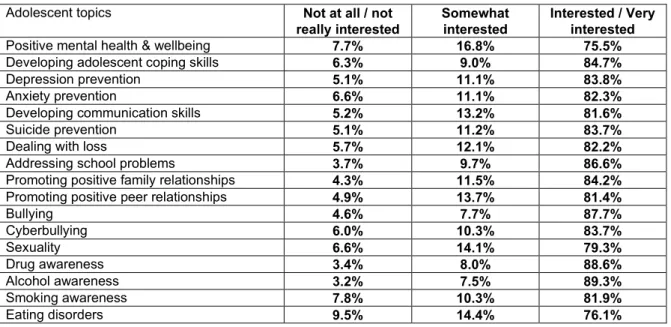
Parents were asked how interested they would be in receiving information on a range of mental health related topics. The number and percentage of parents that stated they were interested / not interested in the topics is show in Table 10. These results indicate there was a high level of interest from parents in receiving information on the suggested youth mental health topics. The four topics the parents were most interested in receiving information on included: alcohol awareness (89.3% interested / very interested); drug awareness (88.6%); bullying (87.7%); addressing school problems (86.6%); and developing adolescent coping skills (84.7%). Chi-square analyses revealed a significant association between level of education and parents’ interest in certain
topics. Parents with a secondary or third level education were significantly more interested than parents with a primary education in receiving information on:
depression [ ²(1, n = 327) = 10.45, p = .034]
developing communication skills [ ²(1, n = 326) = 11.96, p = .018] alcohol awareness [ ²(1, n = 325) = 10.59, p = .032]
eating disorders [ ²(1, n = 327) = 11.4, p = .022]
Table 10: Topics parents were interested in receiving information on
Adolescent topics Not at all / not really interested
Somewhat interested
Interested / Very interested
Positive mental health & wellbeing 7.7% 16.8% 75.5%
Developing adolescent coping skills 6.3% 9.0% 84.7%
Depression prevention 5.1% 11.1% 83.8%
Anxiety prevention 6.6% 11.1% 82.3%
Developing communication skills 5.2% 13.2% 81.6%
Suicide prevention 5.1% 11.2% 83.7%
Dealing with loss 5.7% 12.1% 82.2%
Addressing school problems 3.7% 9.7% 86.6%
Promoting positive family relationships 4.3% 11.5% 84.2%
Promoting positive peer relationships 4.9% 13.7% 81.4%
Bullying 4.6% 7.7% 87.7% Cyberbullying 6.0% 10.3% 83.7% Sexuality 6.6% 14.1% 79.3% Drug awareness 3.4% 8.0% 88.6% Alcohol awareness 3.2% 7.5% 89.3% Smoking awareness 7.8% 10.3% 81.9% Eating disorders 9.5% 14.4% 76.1%
Additional topics that parents reported interest in receiving information on centered around four main themes:
Technology
Parents suggested the need for information around young people’s use of the internet and in particular social networking sites. Parents requested information about the dangers of these sites and how to supervise young people. Some of the parents’ comments included:
‘Dangers of mobiles and internet – social networking sites allowing people to say and do things which would not be said in a face-to-face situation. Not just bullying but all matters’ (P10)
‘Facebook, how to supervise teenagers on it, how to discuss appropriate and inappropriate topics, pictures, how to get teenagers to think / reflect on what they say or upload’ (P302)
Building Self-Esteem and Confidence
Parents requested information and guidance on how to develop their children’s self-confidence and self-esteem. Parents’ comments included:
‘Thinking positively / improving self-esteem’ (P32)
‘Tips on increasing children’s self confidence and self-esteem especially when going through puberty’ (P169) ‘How to ensure your child has good self-esteem and issues to help with shyness etc’ (P205)
School Issues
Parents suggested the need to address school issues such as exam stress, how to communicate with the school / teachers. Parents wrote:
‘Exams and pressure children find themselves under’ (P243)
‘Dealing with teacher, school, Board of Management and other professionals who input into young people’s mental health’ (P215)
Stress Management
Suggestions around the topic of stress management included: ‘Stress, management, problem solving skills’ (P305) ‘Stress management – work (study) life balance’ (P336)
‘Work/job/financial security and /or independence even as students. How parents and children cope’ (P319) Other topics included:
meditation, mindfulness practice; sexual abuse;
teenage pregnancy; miscarriage; abortion; diet;
children living in separated homes; and
interaction for parents or children with existing mental, behavioural problems gambling
One parent wrote ‘I feel 12 years of age is too late for a lot of the above issues. Need to be addressed sooner’ (P293).
3.10 USE OF ONLINE RESOURCE
Parents were asked if the online resource should be restricted for use among parents only, if it should provide resources for adults working with young people, and if it should provide mental health resources for young people to use. The number and percentage of parents that agreed / disagreed is shown in Table 11. Less than one quarter of parents thought that the resource should be restricted for use among parents only. In addition to providing resources for adults, the majority of parents agreed that the website should provide resources for adults working with young people (86% agreed / strongly agreed) and young people themselves (81.7% agreed / strongly agreed).
Table 11: Parents’ views on whom the resource should provide information and support to
The online resource should Strongly disagree / Disagree
Neither agree not disagree
Agree / Strongly agree
N % N % N %
be restricted for use among parents only 168 48.2 94 26.9 87 24.9
provide mental health resources for adults
working with young people 25 7.1 23 6.6 302 86.3 provide mental health resources for young
people to use 27 7.7 37 10.6 286 81.7
3.11 BARRIERS TO USING THE ONLINE RESOURCES
A total of 63 parents said nothing would prevent them from using the online resource. One parent wrote: ‘Anything at all which would help me to understand, support and encourage my child would be greatly appreciated. Knowledge, the right knowledge, is empowering’ (P162). Thematic analysis was used to analyse the remainder of the parents’ responses to this open question. Seven main themes emerged:
Lack of Confidentiality
Lack of confidentiality was the most frequently reported barrier by parents. Parents said there was a need to ensure confidentiality: ‘Would have to be confidential otherwise would not use it’ (P11). Some parents raised issues about having to register their personal details: ‘If the site was looking for too much personal information’ (P134); ‘Having to register with log-on ID and password etc’ (P8). Some parents expressed concerns about
details being passed on to a third party: ‘Fear of data being shared with parties who may exploit information, watertight data protection has to be given’ (P177). Related to this, parents were also concerned with the amount of information they might receive as a result of registering with a site: ‘Bombardment of emails after visiting the site’ (P185). Other parents wrote about the importance of privacy: ‘Privacy is a major factor’ (P161); ‘Being known or identified, this is the problem with sites and with forums etc. nothing is private on the internet’ (P160); ‘People knowing that you visited the site’ (P193).
Complicated Style of Content
A complicated, difficult to navigate website was the second most frequently reported barrier for parents. Some comments included: ‘If it was too complicated and didn’t use every day language’ (P18); ‘Website that was difficult to follow’ (P43); ‘Difficult to navigate’ (P288). Parents talked about the importance of the language used: ‘Keep the advice simple and in plain English’ (P302); ‘If it comes across as moralistic, judgemental and overly prescriptive. If it were sponsored by any medical pharmaceutical companies’ (P15); ‘Excessive jargon, too many buzz words’ (P350). One parent explained they would not use the website if ‘it was too technical, not user-friendly e.g. design and information needs to be parent and adolescent friendly. Include links to other organisations’ (P319). Other parents said the website needed to be practical ‘Needs to be practical and have the ability to be implemented easily’ (P332). Another commented that the ‘website not being updated regularly’ would pose as a barrier (P263).
Reliability of Information
Parents being unsure about who developed the website and the reliability of the information provided were reported barriers in using the website and resource. Parents’ comments included: ‘Not knowing who developed the website’ (P79); ‘Reliability of information given’ (P102); ‘Not sure if it’s from a reliable source’ (P169); ‘If the website was not based on scientific research results’ (P320). Parents wrote about the need for the website to be overseen by a professional organisation: ‘If it is not run by professional body, if the information is not reliable or anyone can post information that is not screened’ (P219).
Person-to-Person
Some parents felt an online resource was not sufficient and that there was a need for face-to-face communication. Parents’ comments included: ‘It may not be enough, a professional consultation may also be required’ (P90); ‘I feel that reading a lot of information can confuse you. I personally think that all issues dealing with mental health need to be dealt with by people talking to each other. I don’t agree with the use of the internet for these problems’ (P289). Another parent wrote: ‘Time! But just also a feeling that a person-to-person chat can be more beneficial in terms of talking. I don’t want to depend on technology to solve my issues. Too impersonal’ (P20). Other parents felt that an online resource was not something they would use: ‘Would prefer person-to-person contact’ (P192); ‘Totally imperson-to-personal, not for me’ (P145); ‘Options to make contact with a human, I guess I’m old fashioned! Computers are after all, just machines!’ (P285).
Lack of IT Skills
Lack of computer skills and uncertainty about using the internet / lack of comfort with using the internet were reported as barriers by a small group of parents. Parents’ comments included: ‘Not confident enough to use the laptop confidently’ (P128); ‘Not very good on the computer’ (P210); ‘Unsure how to use the internet properly’ (P277).
Lack of Awareness of Website
Some parents commented on the issue of not knowing that the resource is available: ‘Not knowing about it’ (P169); ‘Lack of knowledge and awareness of resource being available’ (P214).
Poor Internet Connection
Poor internet connection, lack of access to the internet and not having broadband were reported as barriers by a minority of parents.
3.12 HOW TO OVERCOME BARRIERS
After reporting the barriers, parents were asked to suggest what was needed to overcome these difficulties / barriers. Thematic analysis was again used to analyse the parents’ responses and seven main themes emerged. These themes directly mapped on to the barriers that parents identified.
Confidentiality
Parents reported the need to ensure confidentiality and general peace of mind around privacy. Comments included: ‘Guarantee / promise of confidentiality security’ (P85); ‘Knowing that personal details would be private and not shared’ (P177). Anonymity was mentioned repeatedly: ‘Need to be assured that everything is done in confidence and is anonymous’ (P328).
Clear Concise Online Resource
The need for a clear, well-laid out, easy to use site that provides clear, concise information was identified. One parent wrote: ‘Once it would be written in a way that we can understand’ (P158). Another suggested the need to: ‘Keep data simple and clear, user-friendly. Avoid registration / log-in, requirement for personal information, emails etc’ (P319). Another parent requested: ‘An easy to follow, step-by-step guide to using the online resource, well balanced format, also age-related options’ (P350). One parent suggested the need to combine all the information already available into one user-friendly resource: ‘I feel that if there was one resource with the difference agencies feeding into it, would be more user-friendly, a one stop shop, where one could find the issue that concern him/her and then see what different agencies are out there to help’ (P138).
Reliable Information and Sources
Parents requested that information be provided on the contributors to the website, how the site is regulated and monitored: ‘Knowing that the site is properly regulated’ (P79); ‘Up-front information on contributors’ (P254). Parents also requested that all information would come through professionals / a professional organisation: ‘An assurance publically that this was coming from professionally qualified people’ (P107).
Face-to-Face
Some parents stated there was a need for face-to-face interaction or to provide the option to speak with professionals. One parent suggested the need for a ‘local workshop that informs you of options’ (P152). Another wrote: ‘Access to professional support’ (P260).
Computer Course
Several parents suggested the need for a computer course or a course on how to use the internet.
Advertising
Regarding the issues of resource awareness, parents suggested advertising through ttelevision, radio, leaflets and advertising through schools. Parents’ comments included: ‘Advertising campaigns, especially through radio ads’ (P206); ‘Maybe adverts or leaflets reminding me of the existence of the website’ (P300). ‘Being informed through school of the address of the website’ (P169).
Internet Connection
3.13 ROLE OF TECHNOLOGY IN ASSISTING PARENTS
The final set of questions that parents were asked were related to the role computers and the internet play in helping parents support youth mental health, parental mental health, and linking parents with professionals working with young people. The results from these questions are shown in Table 12. Overall, the majority of parents viewed computers and the internet as having an important role to play in terms of supporting young people and themselves as parents. Parents were most likely to agree with the statement ‘Computers and the internet have a role to play in helping me identify services available for young people in need of help’ (86.9% agreed / strongly agreed). Three quarters of parents agreed that ‘Computers and the internet have a role to play in helping parents link in with professionals working with young people.’ Chi-square analysis revealed a significant association between level of education and the number of parents that agreed that computers and the internet have a role to play in helping them support and enhance their child’s mental health and wellbeing [ ²(1, n = 330) = 14.9, p = .005]. Significantly more parents with a second or third level education agreed / strongly agreed with this statement when compared with parents with a primary education.
Table 12: Parents’ views on the role of computers and the internet in supporting youth and parental mental health
Computers and the internet have a role to play in helping me...
Strongly disagree/disagree
Neither agree nor disagree
Agree / Strongly agree
N % N % N %
support and enhance my child’s mental health and wellbeing
27 7.7 79 22.6 244 69.7
support and enhance my own mental health and wellbeing
35 10 90 25.7 225 64.3
identify services available for young people in need of help
13 3.7 33 9.4 304 86.9
link in with professionals working with young people (teachers, youth workers, GPs, mental health professionals)
22 6.3 64 18.4 261 75.3
3.14 ADDITIONAL COMMENTS
To conclude the questionnaire, parents were asked if they had any additional comments to make. Thematic analysis revealed three key themes:
Training
Parents consistently raised the issue of the need to train professionals working with young people, in particular teachers: ‘More training for teachers to help support young people in second level education’ (P25); ‘Some public health professionals can be difficult to deal with and unhelpful when parents are experiencing problems with children’ (P44). Another parent wrote: ‘My personal experience in regard to my children in primary / secondary and third level is that there is not enough information / support / training for staff in regards to the above and I strongly feel that it should be a compulsory part of teacher training, as children spend most of their youth in an education facility’ (P339). Another parent suggested the need for multidisciplinary work: ‘HSE staff should work with teachers to identify stress, depression among young people. Help teachers to build children’s resilience’ (P352).
Person-to-Person
Similar to the barrier mentioned in a previous question, parents called on the need for face-to-face support for young people: ‘Totally relying on the internet and computers for support and help would be a mistake. Nothing replaces the human interaction in all events in our lives. Our younger generation may forget that this is most vital resource and should never be excluded from mental health issues’ (P177). ‘Face-to-face advice and confidence in whom I’m talking to are paramount to any health problem including mental health’ (P213). One parent wrote about the gap between what young people and their parents would do in terms of looking for support: ‘The internet is all very well but at the end of the day I prefer the written word and speaking to a person either
face-to-face or on the telephone. I realise for young people this is not the case and I realise this is a generational thing. I’d pick up the phone faster than I would access websites, but for teenagers it’s different’ (P309). Another parent stressed the importance of parents talking to their children: ‘Unfortunately the computer and internet have become such a huge part of our young people’s lives, but I still think that it is very important that home/school should continue to have talks/discussions so that we/our children can continue to communicate’ (P33).
Type of Parent Training Needed
Some parents commented on the type of training and support that parents need:
‘Advice as to when to contact or go to other professionals as to when problems overtake the mind’ (P136) ‘For me it’s knowing what is normal behaviour in a teenager and what’s not – how strict to be and when to go with the flow’ (P152)
‘Internet and social media sites are no longer a “fad” but fundamental to the development of our children’s lives. I strongly agree that to serve them and the next generation we need to focus on how they communicate, which is the internet’ (P270).
Other parents mentioned causes of problems for young people today:
‘I believe Facebook is responsible for a lot of bullying and development of social skills are affected by time spent on social network sites. Alcohol needs to be addressed. Binge drinking is contagious and definitely alters young people’s minds’ (P160)