12-1
deals with the Department of Transportation, and the
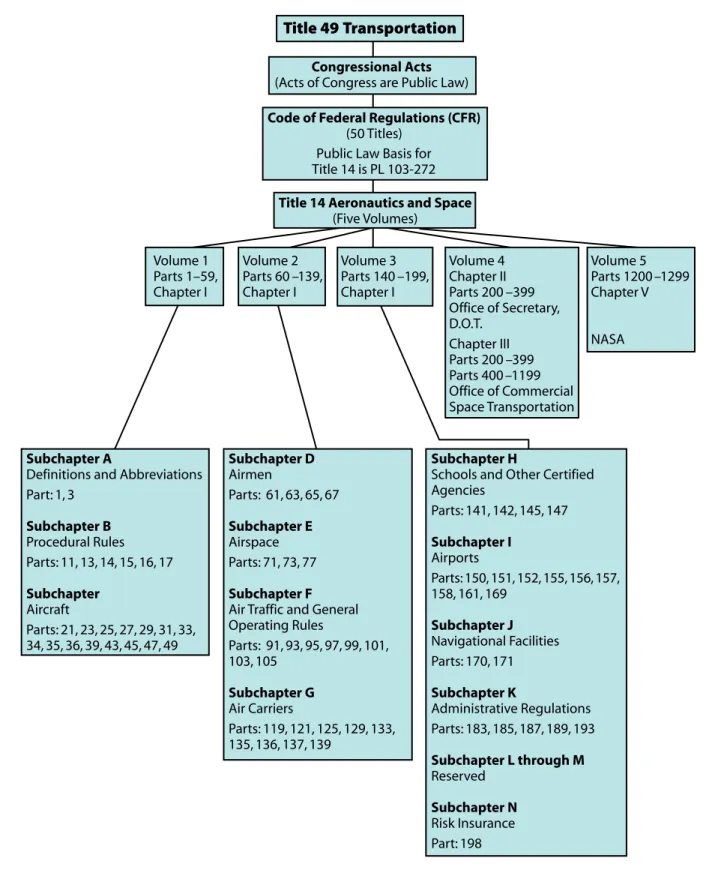
fifth volume is focused on NASA.
These 68 regulations can be separated into the follow
-ing three categories: 1. Administrative
2. Airworthiness Certification 3. Airworthiness Operation
Since 1958, these rules have typically been referred to as “FARs,” short for Federal Aviation Regulations. However, another set of regulations (Title 48) is titled Federal Acquisitions Regulations,” and this has led
Overview — Title 14 of the Code of
Federal Regulations (14 CFR)
Figure 12-1 reflects the changes in aviation related regulations, which have occurred during the time frame indicated in the left column. Just as aircraft continue to evolve with ever improving technology, so do the regulations, publications, forms, and records required to design, build, and maintain them.
The Federal Aviation Administration (FAA) regulations that govern today’s aircraft are found in Title 14 of the Code of Federal Regulations (14 CFR). [Figure 12-2] There are 68 regulations organized into three volumes under Title 14, Aeronautics and Space. A fourth volume
Figure 12-1. FAA historical background of aviation related regulations.
Active Failure Assertiveness Asynchronous Communication Authoritarian Leader Communication Complacency
Crew Resource Management Dirty Dozen** Egalitarian Ergonomics Human Factors Inter-team Intra-team
Instructional Systems Design
Human Factors
Based upon the AC120-72 Definiton
“Human Factors is the scientific study of the interaction between people and machines.” Latent Failure
Leadership
Maintenance Resource Management Mental Model Norms Participatory Leader Safety Culture Situational Awareness Stressor Synchronous Communication Team
Team Situational Awareness Teamwork
Human Factors
Proper Actions Improper Actions HF
applies to both
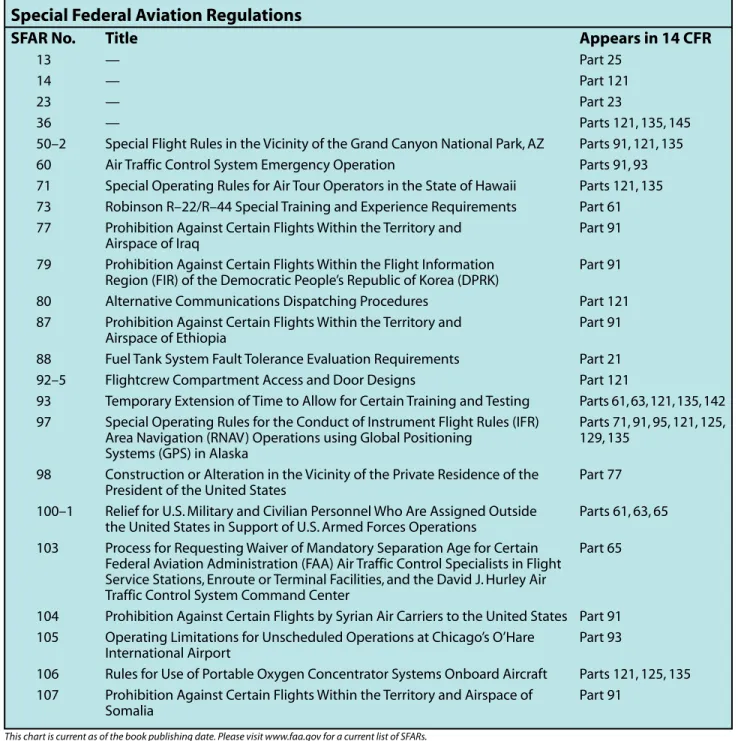
[Figure 12-3] These are frequently focused very spe
-cifically on a unique situation, and are usually given a limited length of time for effectiveness. Note that the SFAR number is purely a sequential number and has no relevance to the regulation it is addressing or attached to.
The remainder of this text focuses only on those regulations relative to airworthiness certification. There are 20 of these listed in Figure 12-4, and they are shown graphically in Figure 12-5, along with five Figure 12-3. Appendix 3 of Advisory Circular (AC) 00-44, Status of Federal Aviation Regulations.
to confusion with the use of the acronym “FAR.” Therefore, the FAA began to refer to specific regula
-tions by the term “14 CFR part XX.” Most regula-tions and the sections within are odd numbered because the FAA realized in 1958 when the Civil Aeronautics Regulations were recodified into the Federal Aviation Regulations, that it would be necessary to add regula
-tions later.
Over the years, the FAA has sometimes seen the need to issue Special Federal Aviation Regulations (SFAR).
Only recently did the FAA actually define the term “airworthy” in a regulation. (Refer to the 14 CFR part 3 excerpt following this paragraph.) Prior to this defini
-tion in part 3, the term could be implied from reading part 21, section (§) 21.183. The term was defined in other non-regulatory FAA publications, and could also be implied from the text found in block 5 of FAA Form 8100-2, Standard Airworthiness Certificate. This certificate is required to be visibly placed on board each civil aircraft. (Refer to “Forms” presented later in this chapter.)
Part 3 General Requirements
Sec. 3.5 Statements about products, parts, appliances and materials.
(a) Definitions. The following terms will have the stated meanings when used in this section:
Airworthy means the aircraft conforms to its type design and is in a condition for safe operation.
Product means an aircraft, aircraft engine, or aircraft propeller.
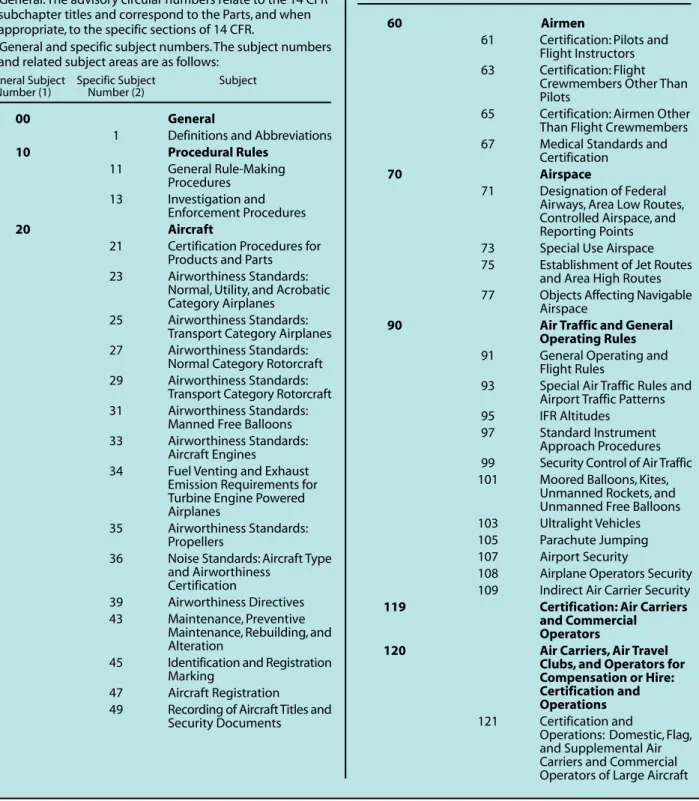
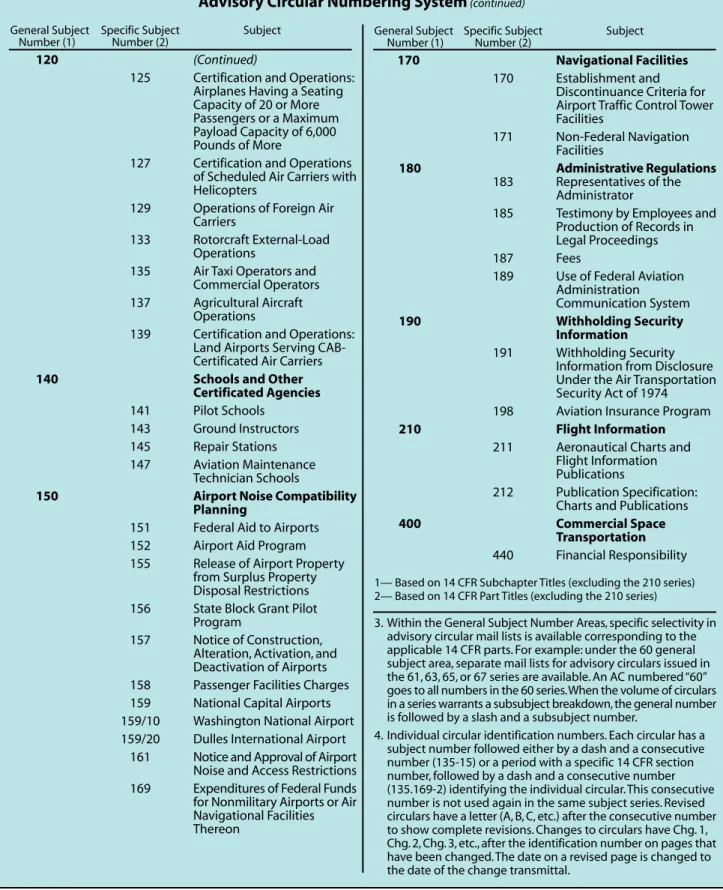
There are three primary regulations that govern the airworthiness of an aircraft. The “Big Three” are: 1. 14 CFR Part 21 — Certification Procedures for
Products and Parts
2. 14 CFR Part 43 — Maintenance, Preventive Maintenance, Rebuilding, and Alterations
3. 14 CFR Part 91 — General Operating and Flight Rules
Note that the chart in Figure 12-5 shows most of the other airworthiness certification regulations link to one of these regulations. Note also the solid line located in the center of the chart. This line represents the separation between an aircraft or aircraft parts obtain
-ing Original Airworthiness (left side of the line) and Recurrent Airworthiness (right side of the line). Although the history section that opens this chapter dis
-cusses “The FAA” as if it was a single unit, it is impor
-tant to understand that there are various subgroups within the FAA, which have differing responsibilities of oversight in the aviation industry. These may vary by organizational chart or geographic location. additional regulations that will not be addressed in this
chapter. (Part 31 — Airworthiness Standards, Manned Free Balloons; Part 34 — Fuel Venting and Exhaust Emission Requirements for Turbine Engine Powered Airplanes; Part 36 — Noise Standards: Aircraft Type and Airworthiness Certification; Part 61 — Certifica
-tion: Pilots, Flight Instructors, and Ground Instructors; and Part 63 — Certification of Flight Crew Members Other Than Pilots.) A significant benefit of this chart is the visual effect showing the interaction of the regula
-tion with other regula-tions and the placement of the regulation relative to its impact on airworthiness. It is fundamentally important that the definition of the term “airworthy” be clearly understood.
Figure 12-4. List of FAA regulations relative to airworthiness certification.
inspection and maintenance actions necessary to main
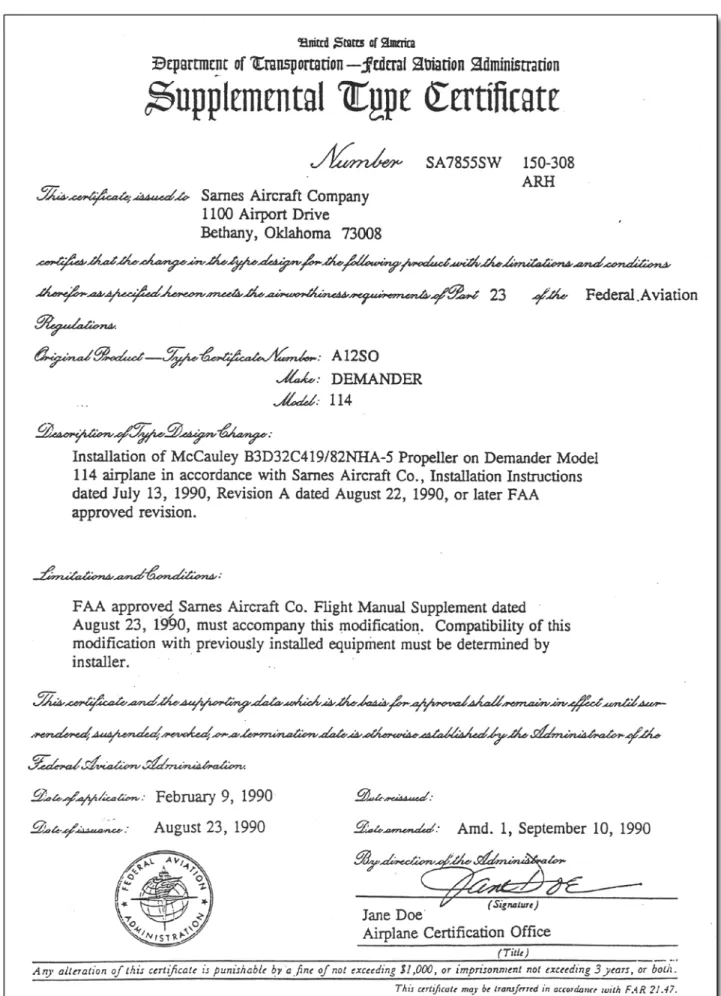
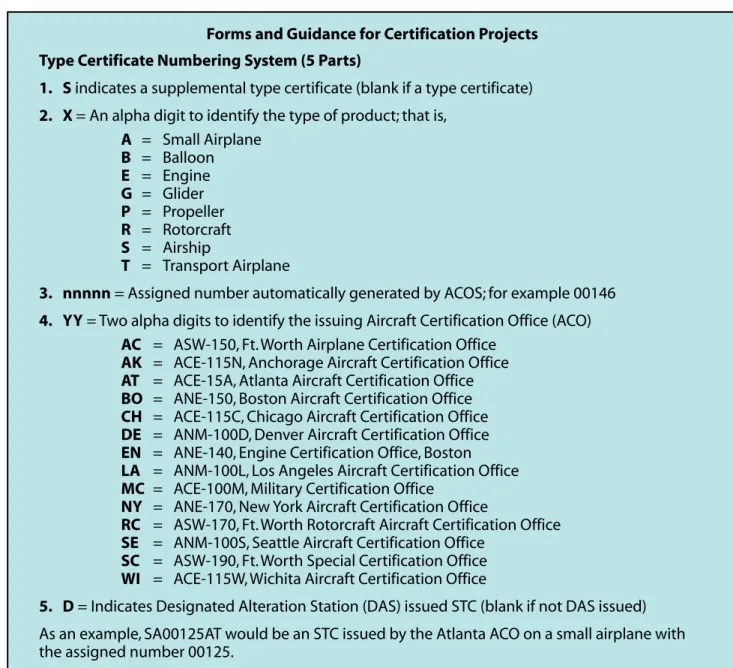
-tain the aircraft in airworthy condition. Also any STC modification that was developed after 1981 must have, as part of the STC documentation, a complete set of instructions for continued airworthiness (ICA). This ICA contains inspection and maintenance information intended to be used by the technician in maintaining that part of the aircraft which has been altered since it was new. This ICA is comprised of 16 specific subjects. [Figure 12-6.] An ICA developed in accordance with this checklist should be acceptable to the ASI review
-ing major alteration.
14 CFR Part 23 — Airworthiness Standards: Normal, Utility, Acrobatic, and Commuter Category Airplanes
Aircraft certificated under part 23 represent the greatest portion of what the industry refers to as “general avia
-tion.” These aircraft vary from the small two-place pis
-ton engine, propeller-driven trainers that are frequently used for flight training, to turbine powered corporate jets used to transport business executives. Seating capacity is limited to nine or less on all aircraft except the commuter aircraft where the maximum passenger seating is 19, excluding the pilot and copilot seats. This part specifies the airworthiness standards that must be met in order for a manufacturer to receive a type cer
-tificate and for the aircraft to receive an airworthiness certificate. Part 23 aircraft are those aircraft that have a maximum certificated takeoff weight of 12,500 pounds or less, except for those aircraft in the commuter cat
-egory. The maximum certificated takeoff weight limit rises to 19,000 pounds or less for these aircraft. Part 23 has seven subparts, six of them providing detailed criteria for the design of these aircraft. The first, Subpart A, defines the applicability of this regula
-tion. The others are: • Subpart B — Flight • Subpart C — Structure
• Subpart D — Design and Construction • Subpart E — Powerplant
• Subpart F — Equipment
• Subpart G — Operating Limitations and Information
Within each of these subparts are numerous sections that specify details, such as center of gravity, gust load factors, removable fasteners, the shape of certain cockpit controls, engine and propeller requirements, fuel tank markings, cockpit instrumentation mark
-The maintenance technician will interact mostly with FAA personnel from the Flight Standard Service (AFS) but may also have some interaction with FAA personnel from the Aircraft Certification Service (AIR).
Since regulations change over the years, it should be noted that not every aircraft currently flying meets the current design regulations as printed this year. When regulations are revised, they are printed in the Federal Register and released with an “Amendment number” that ties them to the regulation being revised. Aircraft are required to meet only the specifications in force at the time the aircraft is built. (Note: The preceding statement does not apply to the mandatory require
-ments imposed by Airworthiness Directives (AD), which usually have a compliance date included in the text of the AD note.)
Maintenance Related Regulations
14 CFR Part 1 — Definitions and Abbreviations
This section is a very comprehensive, but certainly not all inclusive, list of definitions that both pilots and mechanics should become familiar with. Many regu
-lations often provide additional definitions, which are unique to their use and interpretation in that specific part.
The Abbreviations and Symbols section (§1.2) tends to be highly focused on those abbreviations related to flight.
14 CFR Part 21 — Certification Procedures for Products and Parts
This regulation (the first of the “Big Three” identified earlier) identifies the requirements of and the proce
-dures for obtaining type certificates, supplemental type certificates, production certificates, airworthiness certificates, and import and export approvals. Some of the other major areas covered in this part are the authorization procedures for obtaining a delegation option authorization, becoming a designated altera
-tion sta-tion (DAS), or obtaining a Part Manufacture Approval (PMA) or an authorization related to produc
-ing a Technical Standard Order (TSO) part are also included in this regulation. Note that most of the part 21 triangle lies to the left of the vertical line reflecting its significance in the original airworthiness phase. [Figure 12-5] One of the most important sections of this regulation is §21.50, Instructions for continued airworthiness and manufacturer’s maintenance manu
-als having airworthiness limitations sections. When an aircraft is delivered new from the manufacturer, it comes with maintenance manuals that define the
also used to transport cargo. This chapter is subdivided into the same design subpart categories and the same sequence as the requirements specified in part 23. 14 CFR Part 27 — Airworthiness Standards: Normal Category Rotorcraft
This regulation deals with the small rotor wing aircraft and is consistent to part 23 with limiting the passenger seating to nine or less. However, the maximum certifi
-cated weight is limited to 7,000 pounds. It contains the same six design subparts identified in part 23, which provides the details for developing the aircraft. ing and placards, cabin aisle width, and flammability
resistant standards.
14 CFR Part 25 — Airworthiness Standards: Transport Category Airplanes
The standards in this part apply to large aircraft with a maximum certificated takeoff weight of more than 12,500 pounds. This segment of aviation is usually referred to as “commercial aviation” and includes most of the aircraft seen at a large passenger airport, except for the commuter aircraft included in part 23. However, the ability to carry passengers is not a requirement for aircraft certified to part 25. Many of these aircraft are
Administrative Regulations Subchapters A and B 14 CFR Part 1: Definitions and Abbreviations
1.1 General Definitions
1.2 Abbreviations and Symbols
1.3 Rules of Construction
14 CFR Part 11: General Rulemaking Procedures Subpart A – Rulemaking Procedures
Subpart B – Paperwork Reduction Act Control Numbers 14 CFR Part 13: Investigative and Enforcement Procedures
Subpart A – Investigative Procedures Subpart B – Administrative Actions Subpart C – Legal Enforcement Actions Subpart D– Rules and Practice for FAA Hearings Subpart E – Orders of Compliance Under the Hazardous
Materials Transportation Act
Subpart F – Formal Fact-Finding Investigation Under an Order of Investigation
Subpart G – Rules of Practice in FAA Civil Penalty Actions Subpart H – Civil Monetary Penalty Inflation Adjustment Subpart I – Flight Operational Quality Assurance
Programs
Acceptable Data: methods, techniques, and practices used in the absence of current manufacturer’s maintenance instructions or Instructions for Continued Airworthiness [see 14 CFR §43.13(a) and AC 43.13-1B(1)]
Airworthiness: that condition of an aircraft, airframe, engine, propeller, appliance, or component part where it conforms to its approved type design and is in a condition for safe operation [see 14 CFR §3.5(a)]
Approved Data: unless used with reference to another person or entity, means data approved by the Administrator [required for major repairs or alterations, see 14 CFR §65.95(a), 14 CFR §145.201(c)(2)]
Repair: a procedure, executed in accordance with data, to restore an aircraft, airframe, engine, propeller, appliance, or component part to at least equal its original or properly altered condition.
This chart is intended to be used as a template for discussions relating to the regulatory issues surrounding the certification of airworthiness. It is by no means all inclusive, but intended to be used as an educational tool in conjunction with complete and current regulatory and related materials. When considering the airworthiness status of an aircraft, airframe, aircraft engine, propeller, appliance, or component part, first consider how it originally crossed the fence [red vertical line, from left to right] and gained its airworthiness identity. For used components/materials, you must then determine how that airworthiness status has been maintained or restored.
Created by C. Rayner Hutchinson III, Aviation Consulting [email protected] © 1999–2007 From a concept developed by Wyman Shell, Manager FAA MIDO-VNY
14 CFR 65.9ca) to 14 CFR 65.95(a)
145.51 to: 145.201(c)(2)
Active Failure Assertiveness Asynchronous Communication Authoritarian Leader Communication Complacency
Crew Resource Management Dirty Dozen** Egalitarian Ergonomics Human Factors Inter-team Intra-team
Instructional Systems Design
Human Factors
Based upon the AC120-72 Definiton
“Human Factors is the scientific study of the interaction between people and machines.”
** 1. Lack of Communication 2. Complacency 3. Lack of Knowledge 4. Distraction 5. Lack of Teamwork 6. Fatigue 7. Lack of Resources 8. Pressure 9. Lack of Assertiveness 10. Stress 11. Lack of Awareness 12. Norms
Latent Failure Leadership
Maintenance Resource Management Mental Model Norms Participatory Leader Safety Culture Situational Awareness Stressor Synchronous Communication Team
Team Situational Awareness Teamwork
Human Factors
Proper Actions Improper Actions HF
applies to both
contained within part 43 provide the standard for maintaining all 185,000 civilian aircraft currently reg
-istered in the United States. Note that the entire part 43 triangle lies to the right of the vertical line, indicating its relationship to maintaining continued airworthi
-ness. A more detailed explanation of this regulation is presented later in this text. [Figure 12-5]
14 CFR Part 45 — Identification and Registration Marking
Part 45 identifies the requirements for the identification of aircraft, engines, propellers, certain replacement and modification parts, and the nationality and registra
-tion marking required on U.S.-registered aircraft. All type-certificated products must have the following information on a fireproof dataplate or similar approved fireproof method.
1. Builder’s name 2. Model designation 3. Builder’s serial number
4. Type certificate number (if any) 5. Production certificate number (if any) 6. For aircraft engines, the established rating. 7. Reference to compliance or exemption to14 CFR
Part 34, Fuel Venting and Exhaust Emission Requirements for Turbine Engine Powered Airplanes
8. Any other information that the FAA determines to be appropriate
Replacement and modification parts, which are produced in accordance with a parts manufacturing approval (PMA) (14 CFR §21.303), must have the fol
-lowing information permanently and legibly marked: 1. The letters “FAA-PMA.”
2. The name, symbol, or trademark of the holder of the PMA.
3. The part number.
4. The name and model designation for each type-certificated product on which it can be installed. If a part has a specified replacement time, inspection interval, or other related procedure specification in the maintenance manual or Instruction for Continued Airworthiness (ICA), that part must have a part number and a serial number (or the equivalent of each). 14 CFR Part 29 — Airworthiness Standards:
Transport Category Rotorcraft
This part (section) specifies those standards appli
-cable to rotorcraft with a maximum certified weight greater than 7,000 pounds. However, it also includes additional parameters based upon seating capacity and an additional weight limit. Those parameters are pas
-senger seating, (nine or less, ten or more) and whether the rotorcraft is over or under a maximum weight of 20,000 pounds. The same six design subparts exist in this part as are in parts 23, 25, and 27.
14 CFR Part 33 — Airworthiness Standards: Aircraft Engines
Each of the four preceding 14 CFR regulations require that the engine used in the aircraft must be “type cer
-tificated.” Part 33 details the requirements for both reciprocating and turbine style aircraft engines. It not only specifies the design and construction require
-ments, but also the “block test” requirements that subject the engine to extremely demanding testing in order to prove its capability of enduring the stresses of powering the aircraft.
14 CFR Part 35 — Airworthiness Standards: Propellers Just as each engine used on an aircraft must have a type certificate, the propeller must also be type certificated. This part is arranged the same way that part 33 is, in that subpart B specifies design and construction and subpart C covers tests and inspections.
14 CFR Part 39 — Airworthiness Directives
In spite of all the emphasis on proper design and cer
-tification testing, sometimes the actual day-to-day use of the aircraft causes unanticipated wear or failure to occur. When that happens, if the FAA determines that the wear or failure represents an unsafe condition, and that the condition is likely to exist in other products of the same type of design, it will issue an AD. Actual AD notes are not included in part 39, but rather are printed in the Federal Register and are linked to this part as amendments to part 39, §39.13. AD notes are legally enforceable rules that apply to aircraft, aircraft engines, propellers, and appliances.
14 CFR Part 43 — Maintenance, Preventive Maintenance, Rebuilding, and Alteration
This regulation represents the heart of aviation mainte
-nance, and is the second of the “Big Three” regulations previously identified. The 13 rules and six appendices
The manufacturer of a life-limited part must either provide marking instructions for that part, or state that the part cannot be marked without a compromise to its integrity.
Exceptions are made for the identification of parts that are too small to be practical to mark the required data.
Nationality and registration marks (commonly known as the N-number for U.S.-registered aircraft) can vary in size, depending on the year that the aircraft was built, and whether or not the aircraft has been repainted. The most common size is at least 12 inches in height. Small aircraft built at least 30 years ago or replicas of these, or experimental exhibition or amateur-built aircraft may use letters at least 2 inches in height. Only a few aircraft are authorized to display registration mark
-ings of at least 3 inches. Note that this regulation sits directly on the vertical line in Figure 12-5 indicating that it applies to both original and recurrent airworthi
-ness. [Figure 12-5]
14 CFR Part 47 — Aircraft Registration
This regulation provides the requirements for register
-ing aircraft. It includes procedures for both owner and dealer registration of aircraft.
14 CFR Part 65 — Certification: Airmen Other Than Flight Crewmembers
Note: SFAR 100-1. Relief for U.S. Military and Civil
-ian Personnel who are assigned outside the United States in support of U.S. Armed Forces Operations is a good example of the specific nature and limited time frame that are part of an SFAR.
Pilots, flight instructors, and ground instructors are cer
-tificated under part 61; flight crew other than pilots are certificated under part 63. However, many other people are also required to be certificated by the FAA for the U.S. aviation fleet to operate smoothly and efficiently. Part 65 addresses many of those other persons.
• Subpart B — Air Traffic Control Tower Operators
• Subpart C — Aircraft Dispatchers • Subpart D — Mechanics
• Subpart E — Repairmen • Subpart F — Parachute Riggers
A more detailed discussion of this chapter with a spe
-cial emphasis on mechanics is included in Chapter 13, The Mechanic Certificate.
14 CFR Part 91 — General Operating and Flight Rules This is the final regulation of the “Big Three” identi
-fied earlier in this chapter. Notice that most of this icon is located to the right of the central vertical line in Figure 12-5, which visually indicates its “operational” involvement or “recurrent airworthiness.” (Although it is an operational regulation that is focused toward the owner, operator, and/or pilot of the aircraft, the maintenance technician must have an awareness of this regulation.) Two examples of these maintenance related issues are:
1. §91.207 — Emergency locator transmitters Paragraph (c)(2) — battery replacement interval
and requirement for a logbook entry indicating the expiration date of the new battery.
2. §91.213 — Inoperative Instruments and Equipment
Paragraph (a)(2) — a letter of authorization from the Flight Standards District Office (FSDO), authorizing the operation of the aircraft under a minimum equipment list (MEL) constitutes a supplemental type certificate (STC) and must be carried in the aircraft during flight.
Subpart E — Maintenance, Preventive Maintenance, and Alterations (sections 91.401 through 91.421) is the section of most interest to the technician. He or she should be familiar with it, because it does carry some (indirect) responsibility for the technician. Note that the part 91 icon in Figure 12-5 has a direct line to part 43. This is because §91.403(b) states “No person may perform maintenance, preventive maintenance, or alterations on an aircraft other than as prescribed in this subpart and other applicable regulations, including part 43 of this chapter.”
A more complete discussion of this regulation, especially Subpart E — Maintenance, Preventive Maintenance, and Alterations is presented later in this chapter.
14 CFR Part 119 — Certification: Air Carriers and Commercial Operators
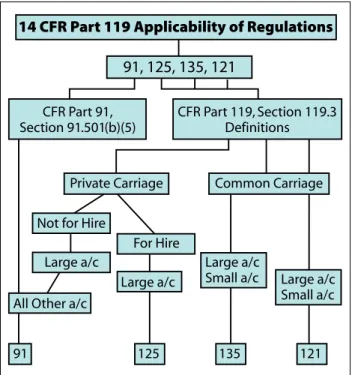
In order to better understand the next three regulations discussed here (parts 121, 125, and 135) a brief over
-view of part 119 will be beneficial. See Figure 12-7, 14 CFR part 119 Applicability of Regulations. There are more than 50 Advisory Circulars in the 120 series alone, providing additional non-regulatory information concerning the variety of procedures involved with these operations. There are basically three different
criteria which must be analyzed in order to properly determine which regulation applies. These are: 1. Is the service provided for private carriage or
common carriage?
2. Is the aircraft for hire or is it not for hire? 3. Is it a large or small aircraft?
AC 120-12, as revised, provides the following defini
-tion regarding the above criteria:
“A carrier becomes a common carrier when it “holds itself out” to the public, or to a segment of the public, as willing to furnish transportation within the limits of its facilities to any person who wants it. There are four elements in defining a common carrier; (1) a holding out of a willingness to (2) transport persons or prop
-erty (3) from place to place (4) for compensation. This “holding out” which makes a person a common carrier can be done in many ways and it does not matter how it is done. Signs and advertising are the most direct means of “holding out” but are not the only ones… Carriage for hire which does not involve “holding out” is private carriage. Private carriers for hire are sometimes called “contract carriers,” but the term is borrowed from the Interstate Commerce Act and legally inaccurate when used in connection with the Federal Aviation Act. Private carriage for hire is carriage for one or several selected customers, generally on a long term basis. The number of contracts must not be too great; otherwise, it implies a willingness to make a contract with any
-body. A carrier operating pursuant to 18 to 24 contracts has been held to be a common carrier because it held itself out to serve the public generally to the extent of its facilities. Private carriage has been found in cases where three contracts have been the sole basis of the operator’s business.”
Operations that constitute common carriage are required to be conducted under 14 CFR part 121 or 135. Private carriage may be conducted under part 91 or 125.
The term “for hire” is not defined in any of the FAA documents, but is generally understood to mean that compensation for both direct and indirect expenses associated with the flight, as well as a profit margin for the operator are collected from the person or persons benefiting from the flight operation.
The determination of whether the aircraft is large or small is based upon the definition provided in 14 CFR part 1 (i.e., if the aircraft has maximum certifi
-cated takeoff weight of 12,500 pounds or more, it is a large aircraft. All aircraft less than 12,500 maximum certificated takeoff weight are considered to be small aircraft).
It may also help the reader understand when 121, 125, and 135 regulations apply, by taking a brief look at a list of flight operations to which part 119 does not apply. 1. Student instruction
2. Nonstop sightseeing flights with less than 30 seats and less than 25 nautical miles from the departure
airport
3. Ferry or training flights
4. Crop dusting or other agricultural operations 5. Banner towing
6. Aerial photography or surveying 7. Fire fighting
8. Powerline or pipeline patrol
9. Parachute operations on nonstop flights within 25 nautical miles form the departure airport
10. Fractional ownership in accordance with part 91, subpart K
14 CFR Part 121 — Operating Requirements: Domestic, Flag, and Supplemental Operations
Part 121 establishes the operational rules for air carriers flying for compensation or hire. A domestic operation is any scheduled operation (within the 48 contiguous states, the District of Columbia, or any territory or Figure 12-7. Applicability of Regulations.
possession) being conducted with either a turbo-jet aircraft, an airplane having 10 or more passenger seats, or a payload capacity greater than 7,500 pounds. A “flag” operation means any scheduled operation (operating in Alaska or Hawaii to any point outside of those states, or to any territory or possession of the United States, or from any point outside the United States to any point outside the United States) being conducted with either a turbo-jet aircraft, an airplane having 10 or more passenger seats, or a payload capac
-ity greater than 7,500 pounds.
“Supplemental” operation means any common car
-riage operation conducted with airplanes having more than 30 passenger seats (if less than 30, the airplane must also be listed on the operations specifications of domestic and flag carriers), with a payload capacity of more than 7,500 pounds.
Part 121 operators are required by part 119 to have the following personnel: • Director of Safety • Director of Operations • Director of Maintenance • Chief Pilot • Chief Inspector
There are 23 subparts and 15 appendices in this regu
-lation; however, only two subparts (J and L) are of concern for the mechanic. Subpart J — Maintenance, Preventive Maintenance, and Alterations, identifies Special Airworthiness Requirements, which deals with many of the mechanical aspects of a passenger or cargo aircraft. Subpart L — Maintenance, Preven
-tive Maintenance, and Alterations, requires that a part 121 operator must have an operational manual which contains the following information:
• Organizational chart.
• List of persons who may perform required inspection.
• Company maintenance, preventive maintenance, or alterations.
• A system to both preserve and retrieve
maintenance and inspection related information. There is also a section (§121.368) added in 2002 that establishes the requirement for conducting inspections on aging aircraft. Additional §121.370 lists various transport category commercial aircraft that require FAA-ACO approval to operate beyond a specified
number of flights. Both of these regulations came about following FAA and NTSB review of various commercial airline accidents.
14 CFR Part 125 — Certification and Operations: Airplanes Having a Seating Capacity of 20 or More Passengers or a Maximum Payload Capacity of 6,000 Pounds or More; and Rules Governing Persons on Board Such Aircraft
This regulation applies to private and noncommon carriage when such operations are conducted in air
-planes having 20 or more seats (excluding crewmem
-bers) or having a payload capacity of 6,000 pounds or more. There must also be “operations specifications” issued to the operator which include the following information:
• Kinds of operations authorized
• Types of aircraft and registration numbers of the airplanes authorized for use
• Approval of the provisions of the operator’s manual relating to airplane inspections, together with the necessary conditions and limitations • Registration numbers of the airplanes that are to be
inspected under an approved airplane inspection program (AAIP) under §125.247
• Procedures for the control of weight and balance
of airplanes
• Any other item that the administrator determines is necessary
Just as in part 121, subpart (E) identifies special airworthiness requirements dealing mostly with the mechanical devices of the aircraft.
14 CFR Part 135 — Operating Requirements: Commuter and On Demand Operations and Rules Governing Persons on Board Such Aircraft
As the title of this section states, this regulation is appli
-cable to short distance commercial aircraft operations or “commuters” and nonscheduled carriers that operate “on demand.” These aircraft are frequently referred to as air taxi or air charter aircraft.
Preceding the regulation are several SFARs. One of these, SFAR 36, is of interest to the technician because, although it is linked here directly to part 135, it is also linked in the text to parts 121 and 145. The signifi
-cance of SFAR 36 is that it allows for a company with sufficient engineering and certification personnel to perform major repairs on products it is authorized to work on, without having the technical data approved by the FAA Administrator.
The records must include the following information: 1. Total years in service of the airplane
2. Total time in service of the airframe
3. Date of the last inspection and records review required by this section
4. Current status of life-limited parts
5. Time since the last overhaul of all structural components required to be overhauled on a specific time basis
6. Current inspection status of the airplane, including the time since the last inspection required by the inspection program under which the airplane is
maintained
7. Current status of applicable airworthiness directives, including the date and methods of compliance, and, if the AD involves recurring action, the time and date when the next action is required
8. A list of major structural alterations
9. A report of major structural repairs and the current inspection status of those repairs
14 CFR Part 145 — Repair Stations
This regulation underwent a major rewrite released in 2004 and was the most comprehensive change in nearly 20 years.
It may be of interest to note that one does not need
to hold an airframe and powerplant (A&P) certificate to be employed at a repair station. The repair station may employ both certified technicians (repairman — in accordance with the requirements of part 65, subpart E) and noncertified personnel. All work that is signed off is done so using the repair station certificate num
-ber, and must be done only by persons authorized by part 65 to approve an article for return to service. Just as other certificate holders must have an operations manual, the repair station must have a “repair station manual” which must contain:
• An organizational chart.
• Procedures for maintaining rosters. • Description of housing, facilities, and
equipment.
• Procedures for revising the capability list and conducting a self-evaluation (audit).
• Procedures for revising the training program. • Procedures governing work done at another
location. Aircraft operated under part 135 must be operated and
maintained in accordance with the certificate holder’s operations manual. This manual, when accepted by the FAA, specifies how the flight crew, ground person
-nel, and maintenance technicians will conduct their operations.
A pivotal portion of this regulation is §135.411, Applicability, which is the first section in subpart J. This section specifies that having a type certificated passenger seating configuration of nine or less may be maintained in accordance with the maintenance manual provided by the aircraft manufacturer. Those aircraft having a type certificated passenger seating configuration of 10 or more seats must be maintained in accordance with a maintenance manual written by the air carrier, which must then be submitted to the FAA for review and approval. The requirements for the maintenance manual are specified in §135.427. Sec
-tions 135.415 through 135.417, and 135.423 through 135.443 specify additional maintenance requirements. It should be noted that sections (§§)135.415, 135.416 and 135.417 are applicable regardless of the number of seats in the aircraft.
A major change in the “nine or less” aircraft mainte
-nance requirements occurred in February of 2005 when §135.422 regarding aging aircraft was incorporated into part 135.
This new subpart (note the even number) to 14 CFR part 135 specifically prohibits a certificate holder from operating certain aircraft unless the Administrator has completed the aging aircraft inspection and records review. This inspection requires the certificate holder to show the FAA that the maintenance of age-sensitive parts and components has been adequate to ensure safety.
This section applies only to multiengine aircraft in scheduled operation, with nine or fewer passenger seats. It does not apply to aircraft operating wholly, or even partly, in Alaska.
The required record review start date varies depending on the age of the aircraft. However, once initiated, the repetitive inspection intervals are not to exceed seven years.
The certificate holder must make both aircraft and records available to the FAA for inspection and review. The certificate holder must notify the Administrator at least 60 days in advance of the availability of the aircraft and the records for review.
can become “pilot examiners,” and frequently main
-tenance school instructors serve as “technical person examiners” to administer the oral and practical portion of the FAA testing. Other lesser known designees are the designated engineering representatives (DER), the designated manufacturing inspection representatives (DMIR), and the designated airworthiness representa
-tives (DAR).
• DERs approve data based upon their engineering training and their knowledge of FAA regula
-tions.
• DMIRs make conformity inspections only at
their employer. They are similar to “designated repairmen” because they are only authorized to inspect parts at their employers’ facility.
• DARs conduct conformity inspections whenever they are authorized to do so by the FAA. They can do this for either manufacturing or maintenance facilities depending on their specific authorization.
Detailed Explanation of Primary
Regulations (Parts 43 and 91)
14 CFR Part 43 — Maintenance, Preventive Maintenance, Rebuilding, and Alteration
§43.1 Applicability
Paragraph (a) states quite clearly that aircraft (whether U.S.- or foreign-registered operating under part 121 or 135) and component parts thereof, must be maintained in accordance with the rules set forth in this part. However, although paragraph (b) states quite clearly the type of aircraft for which this part does not apply, it seems to have led to considerable confusion within the aviation industry. If an aircraft is flying with a Special Airworthiness — Experimental certificate (FAA Form 8130-7, Special Airworthiness Certificate — pink color certificate) and that is the only airworthiness
certificate this aircraft has ever had, then part 43 does not apply.
Conversely, sometimes during maintenance (espe
-cially Supplemental Type Certificate (STC) modifica
-tion — the STC will be addressed later in this chapter) it becomes necessary to temporarily place the aircraft into Special Airworthiness — Experimental. This is done to show compliance with federal regulations. These aircraft must still be maintained in accordance with part 43 because the aircraft had a different kind of airworthiness (in this example a Standard) prior to being issued the Special.
• Procedures for working on air carrier aircraft. • Description of the required records and record
keeping.
• Procedures for revising the repair station manual.
• Description of the system to identify and control the sections of the manual.
All records from repair station maintenance activity must be kept a minimum of 2 years.
Domestic repair station certificates are effective until they are surrendered, suspended, or revoked. The cer
-tificates of foreign repair stations expire, usually after 1 or 2 years, and must be renewed.
14 CFR Part 147 — Aviation Maintenance Technician Schools
Part 147 defines the requirements for obtaining a maintenance training certificate. This certificate may be for either airframe, or powerplant, or a combination of the two. The minimum number of curriculum hours for conducting either airframe or powerplant training independently is 1,150.
If both airframe and powerplant ratings are offered, the combined total curriculum hours are 1,900. This is because of the 1,150 hours specified to obtain either the Airframe or the Powerplant rating; 400 hours are devoted to general studies. Only one set of general stud
-ies hours is applicable to the combined total. Therefore, 400 hours can be subtracted from the implied total of 2,300 hours (1,150 × 2) to obtain the reduced figure of 1,900 hours. Requirements are detailed as follows:
• Appendix A lists Curriculum Requirements • Appendix B lists General Curriculum Subjects • Appendix C lists Airframe Curricular Subjects • Appendix D lists Powerplant Curriculum
Subjects
14 CFR Part 183 — Representatives of the Administrator
As the aviation industry grows and the design, manu
-facture, and testing of aircraft gets more complex, the FAA faces both budget constraints and personnel short
-ages. As early as 1962, the FAA began a program to allow private sector persons in various areas of indus
-try to be “designees” or “representatives of the FAA Administrator.” These people are not FAA employees, but rather are designated by the FAA to act on their behalf. Most people are aware that regular doctors may serve as “aviation medical examiners,” skilled pilots
§43.2 Records of overhaul and rebuilding
These terms are not defined in part 1, and are given full explanation in this subpart. Each term states that it may not be used to describe work done on an aircraft, airframe, aircraft engine, propeller, appliance, or com
-ponent part unless that item has been: • Disassembled, • Cleaned, • Inspected, • Repaired as Necessary, • Reassembled, and • Tested,
The key difference between the two terms is in deter
-mining how the item will be tested. If it will be “tested in accordance with approved standards acceptable to the Administration which have been developed and documented by the manufacturer, the item is said to be overhauled.” This is basically another way of describ
-ing “service limits,” which is a term frequently used to describe manufacturer specified acceptable limits for used parts. A “rebuilt” item, on the other hand, must be tested to the same tolerances and limits as a new item.
§43.3 Persons authorized to perform maintenance, preventive maintenance, rebuilding, and alterations There are nine different persons who may perform maintenance: (Reminder: Per part 1, the FAA defini
-tion of a person is “an individual, firm, partnership, corporation, association, joint-stock association, or governmental entity. It includes a trustee, receiver, assignee, or similar representative of any of them.”) 1. Certified mechanic per part 65.
2. Certified repairman per part 65.
3. Person working under the supervision of a certified mechanic or repairman.
4. Holder of repair station certificate. 5. Holder of an air carrier certificate.
6. Holder of pilot certificate (other than a sport pilot certificate) may perform preventive maintenance on an aircraft he or she owns or operates. This does not apply to aircraft operated under part 121, 129, or 135. (Note: Preventive maintenance is identified in appendix A, paragraph C of this part.)
7. Pilot of a rotorcraft (when operated under part 135 and in remote areas) may perform specific preventive maintenance actions. These actions
may only be accomplished under the following conditions:
• The mechanical difficulty or malfunction occurred enroute to or in the remote area.
• The pilot has been satisfactorily trained and is authorized in writing by the certificate holder to perform the required maintenance.
• There is no certificated mechanic available. • The certificate holder has procedures to evaluate the
work performed when a decision for airworthiness is required.
• The work done is listed in paragraph (c) or Appendix A of this chapter.
8. Holder of part 135 certificate may allow pilots of aircraft with nine or less passenger seats to remove and reinstall cabin seats and stretchers, and cabin mounted medical oxygen bottles.
These actions may only be accomplished under the following conditions:
• The pilot has been satisfactorily trained and is authorized in writing by the certificate holder to perform the required maintenance
• The certificate holder has written procedures available to the pilot to evaluate the work
performed
9. Manufacturer may inspect and rebuild any item it has manufactured.
§43.5 Approval for return to service after
maintenance, preventive maintenance, rebuilding, or alteration
Returning an aircraft component of an aircraft to service after maintenance, preventive maintenance, rebuilding or alteration must be done by creating an appropriate maintenance record entry as required by either §43.9 or 43.11. This may include the use of FAA Form 337, Major Repair and Alteration, if the maintenance action was a major repair or a major alteration.
Whenever a maintenance action is being planned, it is critical that the technician understands exactly: 1. What he/she is going to do,
2. How that work is classified by the FAA, and 3. What type of documentation will be required to
The first question to consider is “Is this a repair or an alteration?” This should be a relatively simply decision since a repair basically returns the aircraft to its previ
-ous or unaltered condition (i.e., replacing magnetos, an exhaust system, tires, or brakes). Even replacing an entire engine (although it is a big job) is still a repair if it is the one properly specified for that aircraft. An
alteration, on the other hand, always changes or modi-fies the aircraft from its previous state (i.e., installing winglets, new avionics, or an engine that is NOT listed in the aircraft TCDS). Please refer to part 1 and part 43, appendix A, for additional clarification and examples.
The second question to consider is whether or not the work that will be performed constitutes a major or a minor maintenance action. A “major” action is typi
-cally one that might appreciably affect weight, balance, structural strength, performance, powerplant operation, flight characteristics, or other qualities affecting air
-worthiness, and that are not done according to accepted practices or cannot be done by elementary operations. (The reader is again requested to refer to part 1 and part 43, appendix A, for additional clarification and examples.) This is a much more complex question, but it is extremely important as it drives the final question concerning the substantiating documentation.
The third question deals with the type of documentation required to substantiate the work performed. Minor repairs and alterations need only to refer to “accept
-able” data, such as manufacturers’ maintenance manu
-als or AC 43.13-1, the maintenance action can simply be recorded in the maintenance record as a logbook entry. Major repairs and alterations require “approved data” Some examples of approved data are: AD Notes, STCs, TCDS’s, DAS specific authorizations, DER specific delegations, and FAA-approved manufacturer Service Bulletins.
Sometimes the repair or alteration being performed does not have previously approved data. In that case the technician may request that the FAA accomplish a “Field Approval.” In this procedure, the technician completes the front side of Form 337 through block 6 (leaving block 3 open for later FAA approval) and then indicates in block 8 on the back what work is to be done, and what the substantiating reference data is. Form 337 is then submitted to the local FAA FSDO office for review and approval by an ASI. If necessary, this ASI may seek input from other ASIs or FAA specialists to assist in the review of the data. If the data is found to comply with FAA regulations, the ASI will enter one of the following statements in
block 3, depending on whether the ASI has performed a review of the data only, or has physically inspected the aircraft:
• “The technical data identified herein has been found to comply with applicable airworthiness requirements and is hereby approved for use only on the above described aircraft, subject to conformity inspection by a person authorized in part 43, section 43.7.”
or
• “The alteration or repair identified herein complies with the applicable airworthiness requirements and is approved for use only on the above described aircraft, subject to conformity inspection by a person authorized in part 43, section 43.7.” §43.7 Persons authorized to approve aircraft, airframes, aircraft engines, propellers, appliances, or component parts for return to service after
maintenance, preventive maintenance, rebuilding, or alteration
There are seven different persons listed in this section who may sign return to service (RTS) documentation: 1. Certified mechanic or holder of an inspection
authorization.
2. Holder of a repair station certificate. 3. Manufacturer.
4. Holder of an air carrier certificate. 5. Certificated private pilot.
6. Repairman certificated with a maintenance rating for light sport aircraft only.
7. Certificated sport pilot for preventive maintenance on an aircraft owned and or operated by him or her.
Note that although a certificated repairman is autho
-rized to work on a product undergoing maintenance, preventive maintenance, rebuilding, or alterations (refer to §43.3), he or she is not authorized to approve that product for return to service. He or she must make the appropriate maintenance record entry per the requirements of §43.9 or 43.11.
§43.9 Content, form and disposition of maintenance, preventive maintenance, rebuilding, and alteration records (except inspections performed in accordance with parts 91 and 125, and §§135.411(a)(1) and 135.419 of this chapter).
The first observation is that this section specifically excludes inspection entries (those are covered in
§43.11). This section deals exclusively with mainte
-nance record entries.
The next observation should be that the list of main
-tenance actions includes “preventive main-tenance.” As stated in the explanation of §43.3, a certificated pilot is authorized to perform preventive maintenance on the aircraft he or she owns or operates. Therefore, remember that the pilot must make a record entry of the preventive maintenance he or she has accomplished. There are three distinct issues to be addressed in the maintenance entry, and they answer the questions of “what? when? and who?”
What — a description of the work performed. When — the date the work was completed.
Who — the name of the person who did the work if other than the person who approves the Return to Service
— the signature, certificate number, and type of certificate of the person who is approving the work for return to service.
Note: Frequently, logbooks have a statement entered that ends something like this: “ … and is hereby returned to service. Joe Fixer A&P, Certificate #123456789.” As this section of the regulation currently reads, that part of the record entry is not required, since §43.9 clearly states that “the signature constitutes the approval for return to service only for the work performed,” which also leads to another point. The technician is only sign
-ing off the work he or she has done. We will see later in the explanation of §43.11 that an inspection write-up usually carries a broader scope of responsibility. This section is very clear that the entry completed in accordance with this section only holds the technician responsible for the service maintenance action he or she entered.
If the maintenance accomplished was a major repair or alteration (both of which require supporting approved data), the work must be documented on FAA Form 337. If the maintenance action was a major repair and it was done by a certificated repair station, a signed copy of the completed customer work order accompanied by a signed maintenance release may be used in lieu of the FAA Form 337.
§43.10 Disposition of life-limited aircraft parts (Note the even number again; this regulation became part of 14 CFR part 43 in 2002.)
This section presents two terms not previously defined in 14 CFR:
1. Life-limited part means any part for which a mandatory replacement limit has been specified. 2. Life status means the accumulated cycles, hours, or
any other mandatory limit of a life-limited part. This section then goes on to specify what to do with parts that are temporarily removed from and then reinstalled on a type-certificated product.
1. With parts that are removed from a type certified product and not immediately reinstalled.
2. How to transfer life-limited parts from one type-certificated product to another.
When a life-limited part is removed, the person remov
-ing it from the type-certificated product must control the part and assure proper tracking of the life-limiting factor. This is to prevent the installation of the part after it has reached its life limit.
There are seven possible methods the technician or repair facility may choose from to comply with this requirement. 1. Recordkeeping. 2. Tagging. 3. Non-permanent marking. 4. Permanent marking. 5. Segregation. 6. Mutilation.
7. Any other method approved or accepted by the FAA.
When a life-limited part is transferred, the information
concerning the life status of that part must be trans
-ferred with it. (Although regulations already did exist which required the tracking of life-limited parts when they were installed on an aircraft, this regulation was generated to govern the disposition of such parts when they were removed from the aircraft.)
§43.11 Content, form, and disposition of records for inspections conducted under parts 91 and 125, and §135.411(a)(1) and 135.419 of this chapter.
Although this section deals exclusively with inspection record entries, the requirements are similar to §43.9 in that information of what, when, and who is required. 1. What — type of inspection, including a brief
description.
2. When — date of the inspection and the total time in service
3. Who — the signature, certificate number, and kind of certificate of the person approving or disapproving the return to service.
Since this is an inspection write-up and not a main
-tenance entry, it is quite possible that the inspecting technician could reject or disapprove the item being inspected for the return to service. When that situa
-tion occurs, the regula-tion states in paragraph (b) that a list of discrepancies must be given to the owner. A reference to this list and its delivery to the aircraft owner must be reflected in the record entry. Although the regulation neither specifies how those discrepan
-cies can be cleared, nor who may do them, it should be noted that any appropriately rated repair station or certificated technician can perform the required maintenance actions. When they are completed and the proper maintenance record entries are generated in accordance with §43.9, the aircraft is approved for return to service. It is neither necessary to have an additional inspection, nor is it necessary to contact the disapproving inspector.
If the aircraft is on a progressive inspection program, the inspection statement changes slightly from the statement referenced earlier by adding the reference to both a “routine inspection” and a “detailed inspection.” (Refer to explanatory text of §43.15 for a definition of these terms.)
Inspections accomplished in accordance with other inspection program requirements must identify that particular program and which part of the program the inspection completed.
§43.12 Maintenance records: Falsification, reproduction, or alteration
The aviation community relies heavily on trust and honesty in both oral and written communication. The maintenance log entries described in §§43.9 and 43.11 provide the documentation trail relied upon by aircraft owners, pilots, and technicians regarding the aircraft’s
maintenance history. Falsification of these records is potentially dangerous to the personnel who rely on the accuracy of these records.
This section identifies that fraudulent entries are unacceptable. If someone commits such an act, that action is the basis for suspension or revocation of the appropriate certificate, authorization, or approval. A technician who is encouraged by his or her employer, or by anyone else, to falsify records in any way should remember this comment: “Companies come and go, but my signature lasts a lifetime. I will not use it inap
-propriately.”
§43.13 Performance rules (general)
This section deals with the specific requirements for conducting maintenance. (Note: This section is probably the best to reflect the relationship between the FAA’s numbering of ACs and the regulations they are related to.) Paragraph 3 on the cover page of AC 43.13-1B, Acceptable Methods, Techniques, and Practices — Aircraft Inspection and Repair (dated 9/8/98) states:
“3. Reference: Title 14 of the Code of Federal Regula
-tions part 43, §43.13(a) states that each person perform
-ing maintenance, alteration, or preventive maintenance on an aircraft, engine, propeller, or appliance shall use the methods, techniques, and practices prescribed in the current manufacturer’s maintenance manual or Instructions for Continued Airworthiness prepared by the manufacturer, or other methods techniques or practices acceptable to the Administrator, except as noted in §43.16.” [Figure 12-8]
Although not all ACs are this directly linked, there is a definite relationship. (Refer to the text in this chapter on advisory circulars for additional information.) Aircraft maintenance technicians are highly skilled personnel because aviation maintenance work requires a great attention to detail. The complexity of technol
-ogy on today’s aircraft demands a significant level of communication to properly accomplish maintenance, preventive maintenance, rebuilding, or alteration. This communication frequently comes in written form, i.e., manufacturer’s maintenance manuals or instructions for continued airworthiness. If neither of these docu
-ments provides the guidance the technician needs, it is possible that the information found in AC 43.13 may be sufficient.
In addition to the documentation, the technician must also use the proper tools, equipment, and test apparatus
that will ensure that the work complies with accepted industry practices. If the test equipment specified by the manufacturer is not available, equipment that is determined to be equivalent and acceptable to the Administrator may be used. The technician should be cautious, however, as “proving” the equivalence of test equipment may not be as simple as it seems.
Air carriers (commercial — “scheduled” airlines oper
-ating under part 121 and the “commuter/on demand” aircraft operating under part 135, and foreign air carri
-ers and operators of U.S.-registered aircraft under part 129) may use the maintenance manual required by the operations specifications to comply with the require
-ments of this section. The operator must provide a continuous airworthiness maintenance and inspection program acceptable to the Administrator.
§43.15 Additional Performance Rules for Inspections This section presents a general comment concerning the responsibility of conducting an inspection and then provides details of three separate conditions.
1. If a rotorcraft is being inspected, specific items, such as rotor transmissions and drive shafts, must be inspected.
2. When performing an annual or 100-hour inspection, a checklist must be used. This checklist may be a personal one or one from the manufacturer; either way, it must include the scope and detail of the inspection in appendix D. Specific engine performance is also required to be tested (or monitored) as part of RTS for an annual or 100-hour inspection. This applies whether the aircraft is reciprocating or turbine powered.
3. If a progressive inspection is being conducted, it must be preceded by a complete aircraft inspection. (Note: A progressive inspection is the result of breaking down the large task of conducting a major inspection into smaller tasks which can be accomplished periodically without taking the aircraft out of service for an extended period of time.) Two new definitions are also presented here, “routine” and “detailed.” A routine inspection is a visual examination or check of the item, but no disassembly is required. A detailed inspection is a thorough examination of the item including disassembly. The overhaul of a component is considered to be a detail inspection.
Any inspection work that is conducted away from the normal work location must be performed as if it were
occurring at the maintenance facility, including using the same forms and procedures.
§43.16 Airworthiness limitations
The technician performing inspection or maintenance actions on an aircraft must be certain he/she has all appropriate data available. This includes manufactur
-ers’ maintenance manuals, operations specifications approved by the FAA under part 121, 123, or 135, or an inspection program approved under §91.409. Instructions for Continued Airworthiness, as required by §21.50 must also be consulted when available. (Since 1998 the FAA has required ICAs to be gener
-ated for all major alterations which are accomplished by the field approval process.) This section specifies that the technician is responsible to perform inspection or maintenance in accordance with all the preceding instructions.
§43.17 Maintenance, preventive maintenance, or alterations performed on U.S. aeronautical products by certain Canadian persons
This section was significantly revised in 2005 as the result of a Bilateral Aviation Safety Agreement (BASA) between the United States and Canada. The two countries have enjoyed a long and professional relationship with respect to reciprocal aviation main
-tenance activity. This section of part 43 both defines some terms and gives specific limitations as to what an Aviation Maintenance Engineer (AME is the Canadian equivalent to the U.S. A&P) may do to maintain U.S.-registered aircraft located in Canada. It also provides similar limitations for an Approved Maintenance Organization. (AMO is the Canadian equivalent to the U.S.-certified repair stations.)
Appendix A — Major Alterations, Major Repairs, and Preventive Maintenance
This appendix provides a comprehensive, but not exclusive, list of the subjects stated. Paragraph (a) is titled Major Alteration, and is further subdivided as follows:
• Airframe • Powerplant • Propeller • Appliance
That same subdivision is used in paragraph (b), which is titled Major Repairs.
Paragraph (c) is titled Preventive Maintenance and identifies those maintenance actions, which are defined
the aircraft for return to service following the inspection.) Refer to §65.95(a)(2), which states that an IA must perform an annual inspection. 2. The aircraft and engine must be cleaned prior to
conducting the inspection.
3. Any miscellaneous item not covered in the detailed list provided must also be inspected for improper installation and operation.
4. There are eight specific areas identified for detail inspection. They are the fuselage hull group, cabin/cockpit group, engine/nacelle group, landing gear group, wing/center section group, empennage assembly, propeller group, and the radio group.
Appendix E — Altimeter System Test and Inspection
This is commonly referred to as “the 411 test.” (Refer to §91.411, which requires that no person may oper
-ate an aircraft in controlled airspace under IFR unless the aircraft has had this test completed successfully within the preceding 24 months.) This section, which requires detailed testing of the static pressure system, the altimeter, and the automatic pressure altitude reporting equipment, also requires that the test infor
-mation be recorded in the maintenance logs and on
the altimeter.
Appendix F — ATC Transponder Tests and Inspections
This is commonly referred to as “the 413 test.” (Refer to §91.413, which requires that no person may use a transponder unless it has had this test completed successfully within the preceding 24 months.) This section specifies an extremely complex set of tests, which may be accomplished either as a bench test, or by using portable test equipment. Major categories of the testing required are radio reply frequency, sup
-pression, receiver sensitivity, radio frequency peak output power, and mode S (when applicable). Upon completion of testing, proper entries must be made in the maintenance record.
14 CFR Part 91 — General Operating and Flight Rules
Subpart A — General
As mentioned in the brief overview of the regulation portion earlier in this chapter, this part is actually addressing the operation of the aircraft. For example, §91.7(a) states “no person may operate a civil aircraft unless it is in an airworthy condition.” We learned earlier that this term means that the aircraft conforms to its approved type design and is in condition for safe as preventive maintenance (provided the maintenance
does not involve complex assembly operations). Pre
-ventive maintenance work may be accomplished by the holder of at least a private pilot certificate provided he or she is the owner or operator of that aircraft, and it is not operated under part 121, 129, or 135.
Appendix B — Recording of Major Repairs and Major Alterations
In most cases when a major repair or alteration is accom
-plished, FAA Form 337, Major Repair or Alteration, is completed at least in duplicate with the original going to the aircraft owner and a copy sent to the FAA Aircraft Registration Branch in Oklahoma City where all civil aircraft information is compiled and retained. Note: Historically the second copy was sent to the local FAA Flight Standards District Office (FSDO) within 48 hours after RTS. This copy is reviewed by an ASI and then forwarded by the FSDO to FAA records on OK City. However, in the fall of 2005 the FAA made a significant change to this submittal process and now requires the technician to submit the Form 337 directly to the Air
-craft Registration Branch in Oklahoma City. (Although a third copy is not required, it makes good business sense for the technician or certified repair station to keep a copy of the work that was accomplished.)
However, if a certificated repair station completes a major repair, it may provide the customer with a signed copy of the work order and a maintenance release signed by an authorized representative of the repair station, instead of the FAA Form 337.
If the major repair or alteration was done by an autho
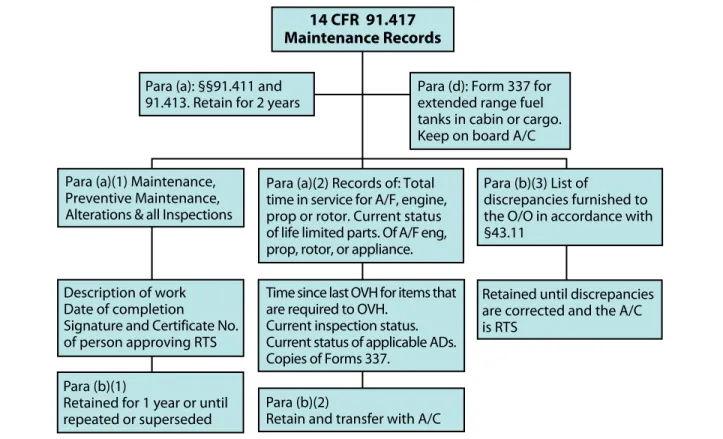
-rized Canadian maintenance person (AME or AMO), the copy normally provided to the FAA-FSDO is sent directly to the FAA Aircraft Registration Branch. Finally, if extended range tanks are installed in either passenger or cargo compartments, the technician must generate a third FAA Form 337 for the modification. This copy must be placed and retained in the aircraft. (Refer to §91.417(d).)
Appendix C is reserved for future use and therefore currently contains no information. Appendix D — Scope and Detail of Items To Be Included in Annual and 100-Hour Inspections
Some important items to consider in this appendix are:
1. The list of items and areas to be inspected are exactly the same for an annual as a 100 hour. (The only difference is who is authorized to approve