MARKETERS’ PERCEPTIONS OF NEGOTIATION BEHAVIOUR IN A GLOBAL FIRM
By
Ahmad Mtengwa Burhan
Submitted in fulfilment of the requirements for the degree Doctor of
Business Administration at the Nelson Mandela Metropolitan University
December 2012
Promoter: Prof NE Mazibuko
DECLARATION
I, Ahmad Mtengwa Burhan, hereby declare that this thesis entitled: ‘Marketers’ Perceptions of Negotiation Behaviour in a Global Firm” is my own research work, which has not been previously submitted for a degree at any university. I also declare that all authors, whose studies have been cited and reported here, have been acknowledged by means of complete references.
Signature:
7 December 2012
Language editing declaration:
I hereby declare that I have performed the language editing of the thesis entitled “‘Marketers’ Perceptions of Negotiation Behaviour in a Global Firm”.
FC Geel
7 December 2012
ACKNOWLEDGEMENTS
I earnestly thank my God (ALLAH) for providing a wonderful environment from which I have managed to complete my studies.
Furthermore, I wish to express my sincere gratitude for all the loving support and assistance I have received from the following persons and institutions during the completion of my thesis:
- Firstly my supervisor, Professor N.E. Mazibuko, at NMMU who held my hand and encouraged me throughout the difficult stages of the research.
- Professor Cecil Arnolds and Ms Nas Adams for lending guidance and assistance with the statistical analyses.
- The Department of Higher Education and Traning – publication subsidiary
incentive funding, and Prof H. LLoyed of the RTI committee at NMMU for making funds available to complete my studies.
- My mother Kijakazi Mtengwa Rajabu for all her love and support as well as my brother Burhan Mtengwa;
- The prayers and moral support from family members: Christina Moyo, Athuman, Ally, Fatuma and Kole Mtengwa;
- His Excellence President Dr Jakaya Mrisho Kikwete of United Republic of Tanzania for financial support and Mr Kassimu Mtawa for his assistance;
- I would like to thank my late father Mtengwa Burhan Mtengwa for the early education he gave me; and
- Finally, thank you to all students, staff and management of Foreign Relations Centres for their encouragement and support, even during my absence when attending studies at NMMU.
ABSTRACT
The success of international business depends on effective negotiations. Such negotiations do no happen in a vacuum, but usually in a specific environment that includes; time, surrounding, place, culture and people. The business environmental setting includes legal and political pluralism, currency fluctuations, foreign exchange, foreign government controls, bureaucracy, instability, change, ideological and cultural differences, as well as the influence of external stakeholders. These business negotiations environments can influence the behaviour of negotiation in global firms, impacting firms internationally. The reasons to negotiate on an international level may include considerations such as: choice of venue, culture to observe; and the outcome of the negotiation process.
The aim of this study was to determine the influence of the international marketing environment, awareness of negotiation skill, interest groups and negotiation atmosphere on behaviour of marketers in a global firm. The study assessed the impact of negotiation behaviour on business agreements based on trust and certainty and level of commitment. The purpose of the study was to gauge the impact of negotiations behaviour pertaining to failure of business negotiations in Tanzania. In addition, the study endeavoured to determine the impact of environmental variables on the negotiation behaviour of marketers. The questionnaires used in the study comprised seven variables with statements linked to a five-point Likert-type interval scale varying from “strongly agree” to “strongly disagree. Self-administered questionnaires were used for data collection from global firms’ marketers and their management representatives; 323 questionnaires were collected from respondents.
This study contributed to the literature on negotiation behaviour in a global firm and the perceptions of such global marketers in Tanzania. Many international companies in Tanzania find it difficult to formulate and implement a comprehensive business strategy; therefore, this study intends to equip international business managers with the leadership skills required. Based on the findings of this study, the negotiators and government are expected to play a major role in business negotiations to promote effective trade agreements despite limitations of political influence in the negotiation process. Political stability in a country enhances foreign business which in turn improves negotiation behaviour. A just legal system, with clear and unambiguous business guidelines and policies would benefit and promote local businesses and government
representatives and negotiators in respect of international business negotiation behaviour. Reasonable tax and interest rates and fair business policies should improve international trade negotiations and business practices.
In order to conduct successful international negotiations aspects such as culture, language differences, customs and traditions are important and should enjoy high priority. Aspects such as these mentioned influence the conducting and atmosphere and outcome of negotiations. The study reveals that the use of specialists and interpreters are imperative to guarantee understanding and successful outcomes.
According to the findings negotiators should possess good negotiating skills to be able to steer the negotiation process through the different phases of negotiation that requires different negotiating skills at each stage of negotiation. It is clear that to have successful win-win negotiation outcomes the leading negotiator should put together a good team, with expert knowledge of product or conditions and negotiating skill, as well as possessing the attributes mentioned in the previous paragraph. The negotiator should also be able to determine authority limits, patience and observe negotiation ethics. No team disagreements concerning the business/project matters should be aired in front of counterparts during negotiations and professional conduct must prevail at all times.
The findings of the study indicated that awareness of the practice of offering concessions regarding government tariff laws and price discounts that is in line with traditions in Tanzania. Concessions should not be made until all issues have been discussed, to avoid granting unnecessary benefits during negotiation that might be interpreted as bribery.
This study concluded that it is important that marketers meet the requirements of business practices by sharing clear guidelines and policies regarding business practices, as this will lead to fruitful decisions. It was also found that negotiation behaviour improves when negotiators are willing to share information and agree that all communication must be in writing; marketers are more comfortable when there is a clear understanding of matters agreed upon, the choice of trading partners and that all trading agreements are written and a contract signed by all the parties, including governments where necessary.
Marketers’ intentions are derived from the common interests of both parties and the negotiations should always take place in avenue that is suitable to both parties,
conducted in fairness and offers must be reasonable and attainable with a positive outcome as the ultimate aim for both parties.
This study reveals that negotiators insist on the use an agent or agents and sub-contractors to ensure mutually beneficial strategic business partnerships. However, when the role of the interest groups is explained to all participants, negotiation behaviour improves. It can also be concluded that negotiators allow interest groups to participate as team leaders and their number should be equal to the number of foreign negotiators, to ensure that marketers feel more at ease and comfortable to participate. An atmosphere based on bargaining power exerts a positive influence on the level of commitment among negotiating partners; and can be a predictor of the range of agreement as well as shape limits and priorities among dimensions of rivalry. However, it is important for marketers to express willingness to accept the terms of their counterpart’s bargaining zone regardless of non-profitable quotas at stake; identify areas of bargaining from foreign traders even if they are not attractive enough for local traders and are comfortable with the counterparts’ bargaining zone regarding fixed rates on exporting and importing quotas between trading partners to build trust among negotiators.
In conclusion, it was found that negotiation behaviour has a positive influence on the level of commitment of trading partners. A positive business relationship is created on trust and a high-level of commitment which should be of great satisfaction to negotiating parties for future prospective negotiations.
TABLE OF CONTENTS
Page
DECLARATION I
ACKNOWLEDGEMENTS Ii
ABSTRACT Iii
LIST OF TABLES Xiii
LIST OF FIGURES Iv
CHAPTER ONE
INTRODUCTION AND THE BACKGROUND OF THE STUDY
1.1 INTRODUCTION 1
1.2 BACKGROUND OF THE STUDY 1
1.3 THEORETICAL FRAMEWORK OF THE STUDY 4
1.3.1 Negotiation and international business negotiations concept 4
1.3.1.1 Negotiation behaviour styles 4
1.3.2 International marketing environment 5
1.3.3 Awareness of negotiation skills 6
1.3.4 Interest Groups 6
1.3.5 The negotiation atmosphere 7
1.3.5.1 Negotiation atmosphere characteristics 7
1.3.6 Business agreements and the level of commitment 8
1.4 STATEMENT OF THE PROBLEM 9
1.5 RESEARCH OBJECTIVES 11
1.5.1 Primary research objective 11
1.5.2 Secondary research objective 11
1.5.3 Research questions 12
1.6 RESEARCH HYPOTHESES 12
1.7 THEORETICAL MODEL OF NEGOTIATION BEHAVIOUR IN A GLOBAL FIRM
13
1.8 DEFINITIONS OF THE KEY TERMS 15
1.9 RESEARCH METHODOLOGY 18
1.9.1 The pilot study 19
1.9.2 Population and sampling procedure 19
1.9.3 Data collection 20
1.9.4 Data Analysis 21
1.10 PURPOSE OF THIS RESEARCH 21
1.11 SCOPE AND DELIMITATION OF THE RESEARCH 23
1.12 PRIOR RESEARCH 23
1.13 DEMARCATION OF THE STUDY 24
1.14 PLAN OF THE RESEARCH 26
CHAPTER TWO
INTERNATIONAL BUSINESS ENVIRONMENT
2.1 INTRODUCTION 27
2.2 IMPORTANCE OF THE INTERNATIONAL BUSINESS ENVIRONMENT
27
2.2.1 Controllable forces in international business environment 30 2.2.2 Uncontrollable forces of international business environment 32
2.3 TANZANIAN BUSINESS ENVIRONMENT 43
2.3.1 Historical growth of international business in Tanzania 43 2.3.2 Globalisation of international business in Tanzania 44 2.3.3 Trade liberalisation and World Trade Organisation (WTO) 47
2.3.4 Trade blocks and trade partners 48
2.3.5 Tanzania’s competitive and comparative advantage 49 2.3.6 Challenges of Tanzania’s business environment 54
2.4 THE ROLE OF THE FIRM IN THE BUSINESS ENVIRONMENT 56
2.5 SUMMARY 58
CHAPTER THREE
BUSINESS BEHAVIOUR OF THE GLOBAL FIRM
3.1 INTRODUCTION 59
3.2 BEHAVIOUR OF THE FIRM 59
3.2.1 Confrontation 59
3.2.2 Cooperation 63
3.2.3 Cooperation and entry market modes 65
3.3 BEHAVIOUR OF THE FIRM IN INTERNATIONALISATION PROCESS
66
3.3.1 Entry mode theory 67
3.4 BUSINESS RULE 71
3.4.1 Business rule forms 73
3.4.2 Types of Business Rule 74
3.5 SUMMARY 75
CHAPTER FOUR
GLOBAL BUSINESS NEGOTIATION PRACTISES IN TANZANIA
4.1 INTRODUCTION 76
4.2 NATURE OF NEGOTIATION 76
4.3 NEGOTIATION APPROACHES 77
4.3.1 Creating value 78
4.3.2 Claiming value 79
4.4 GLOBAL BUSINESS NEGOTIATOR’S DILEMMA 80
4.5 GLOBAL BUSINESS NEGOTIATION ENVIRONMENT 83
4.5.1 Components of global business negotiations 83
4.5.2 Business environment and global firm negotiations 83 4.5.3 Inter culture and global business negotiations 84
4.5.4 Scanning the business environment and 4Cs 84
4.5.5 Global firm negotiator styles 87
4.6 GLOBAL BUSINESS NEGOTIATION PROCESS 91
4.7 SKILLS OF THE NEGOTIATOR 93
4.7.1 The role of the negotiator in the negotiation process 98
4.7.2 Role of the third party 98
4.8 GLOBAL FIRM NEGOTIATION PLANNING STAGES 99
4.8.1 Strategic preparation stage 99
4.8.2 Strategic negotiation 100
4.8.3 Strategic agreement and assessment 103
4.9 BUSINESS NEGOTIATIONS IN TANZANIA 103
4.9.1 Success of trading negotiations in Tanzania 103 4.9.2 Failure of trading negotiations in Tanzania 105 4.9.3 Challenges of international business negotiations 107
4.10 SUMMARY 109
CHAPTER FIVE
A MODEL OF MARKETERS’ PERCEPTIONS OF NEGOTIATION BEHAVIOUR IN A GLOBAL FIRM
5.1 INTRODUCTION 110
5.2 AN OVERVIEW OF THE FOUNDATION OF THE MODEL OF
INTERNATIONAL BUSINESS NEGOTIATION 110
5.3 THE MODELLED INFLUENCES OF NEGOTIATION BEHAVIOUR IN A GLOBAL FIRM
113
5.3.1 International marketing environment 114
5.3.2 Awareness of negotiation skills 117
5.3.3 Interest group 118
5.3.4 Negotiation Atmosphere 119
5.3.4.1 Interest Group 119
5.3.4.2 Negotiation behaviour in global firms 119
5.3.5 Negotiation approaches 121
5.4 THE MODELLED OUTCOMES OF NEGOTIATION BEHAVIOUR IN
A GLOBAL FIRM 122
5.4.1 Negotiation behaviour and business agreements 122 5.4.2 Negotiation behaviour and level of commitment 123
5.4.3 Negotiation atmosphere and agreements 124
5.4.4 Negotiation atmosphere and level of commitment 124
5.5 SUMMARY 125
CHAPTER SIX
RESEARCH METHODOLOGY OF THE STUDY
6.1 INTRODUCTION 126
6.2 RESEARCH METHODOLOGY AND RESEARCH DESIGN 126
6.2.1 Research Paradigm of the study 126
6.2.2 Research design 127
6.2.3 Sampling Method 128
6.2.3.1 Identification of the target population 129
6.2.3.2 Identification of the Sample frame 129
6.2.3.3 Sample size 129
6.2.4 Questionnaire design 133
6.3 STATISTICAL METHODS USED IN THE STUDY 133
6.3.1 Reliability 134
6.3.1.1 Stability and consistency of measurement 134
6.3.2 Validity 134
6.3.2.1 Factor Analysis 136
6.3.2.2 Regression Analysis 138
6.4 THE MEASURING INSTRUMENT 138
6.4.1 International marketing environment 138
6.4.2 Awareness of negotiation skills 139
6.4.3 Interest groups 139
6.4.4 Negotiation behaviour perceptions 140
6.4.5 Negotiation atmosphere 140
6.4.6 Agreement 140
6.4.7 Level of commitment 141
6.4.8 Instruments used for the demographic profile of the
respondents 141
6.5 SUMMARY 144
CHAPTER SEVEN
EMPIRICAL REVIEW OF MARKETERS’ PERCEPTIONS OF NEGOTIATION BEHAVIOUR IN A GLOBAL FIRM
7.1 INTRODUCTION 145
7.2 HYPOTHESES AND OBJECTIVES OF THE STUDY 145
7.3 DATA EVALUATION FINDINGS 146
7.3.1 Descriptive statistics 147
7.3.2 Reliability of the Instruments 149
7.3.3 Validity of the measuring instruments 150
7.4 FACTOR ANALYSIS 152
7.4.1 Perceptions of marketers towards international marketing environment, awareness of negotiation skills and interest groups
153
7.4.2 Perceptions of marketers towards negotiation approaches and
negotiation atmosphere with regard to negotiation behaviour 155 7.4.3 Outcomes of negotiation behaviour: Level of agreement and
level of commitment 156
7.4.4 Cronbach alpha values of latent variables based on the results
of factor analysis: Theoretical model 158
7.5 REGRESSION ANALYSIS 164
7.5.1 The influence of marketers’ perceptions on the negotiation
behaviour 164
7.5.1.1 The influence of business negotiation environment, requirements of
business practise and awareness of negotiation skills 164
7.5.1.2 The influence of negotiation atmosphere on the negotiation behaviour
165 7.5.2 The influence of negotiation atmosphere on outcomes of
negotiation behaviour 166
7.5.2.1 The influence of negotiation atmosphere related to bargaining power
on agreement based on level of trust and certainty 166
7.5.2.2 The influence of negotiation atmosphere related to behaviour on x
agreement based on level of trust and certainty 167 7.5.2.3 The influence of negotiation atmosphere related to bargaining power
on level of commitment 167
7.5.2.4 The influence of negotiation atmosphere related to behaviour on
level of commitment 168
7.5.3 The influence of negotiation behaviour on agreements and level
of commitment 169
7.5.3.1 The influence of negotiation behaviour on agreement based on level
of trust and certainty 169
7.5.3.2 The influence of negotiation behaviour on level of commitment 169
7.6 FINDINGS ON HYPOTHESISED RELATIONSHIPS 171
7.6.1 Findings on the first set of hypotheses 171
7.6.2 Findings on the second set of hypotheses 172
7.7 SUMMARY 175
CHAPTER EIGHT
MANAGERIAL IMPLICATIONS, SUMMARY, CONCLUSIONS AND RECOMMENDATIONS
8.1 INTRODUCTION 176
8.1.1 Brief synopsis of research 176
8.2 SUMMARY OF EMPIRICAL RESULTS 183
8.3 THE MANAGERIAL IMPLICATIONS AND EMPIRICAL FINDINGS
OF THE STUDY 184
8.3.1 Empirical findings and implications based on the perceptions of
marketers towards negotiation behaviour 184
8.3.1.1 Awareness of negotiation skills 184
8.3.1.2 Requirements of business practices 185
8.3.2 Negotiation behaviour perceptions 186
8.3.2.1 Negotiation atmosphere based on bargaining power and the
negotiation behaviour 186
8.3.2.2 Negotiation atmosphere based on marketers’ behaviour and the
negotiation behaviour 187
8.3.3 The empirical findings based on outcomes of negotiation
behaviour 187
8.3.3.1 Negotiation atmosphere and agreement based on trust and certainty 187 8.3.3.2 Negotiation behaviour and agreements based on trust and certainty 188
8.3.3.3 Negotiation behaviour and level of commitment 189
8.4 RECOMMENDATIONS REGARDING NEGOTIATION BEHAVIOUR
IN A GLOBAL FIRM 190
8.4.1 Awareness of negotiation skills 190
8.4.2 Requirements of business practices 190
8.5 NEGOTIATION BEHAVIOUR PERCEPTIONS 191
8.5.1 The negotiation atmosphere 193
8.5.2 The empirical findings based on outcomes of negotiation
behaviour 193
8.5.3 Level of commitment 194
8.6 CONTRIBUTION OF THE STUDY 195
8.7 LIMITATIONS OF THE STUDY AND FUTURE RESEARCH 197
8.8 CONCLUSION 198
LIST OF TABLE
Table Page
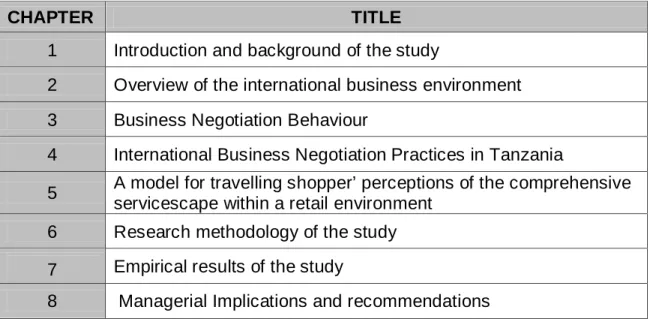
1.1 Structure of the study 26
2.1 Socio-cultural components 41
2.2 Tanzania’s trade balance with EAC, SADC and the world,
2003-2010 44
2.3 Foreign direct investment (FDI) 45
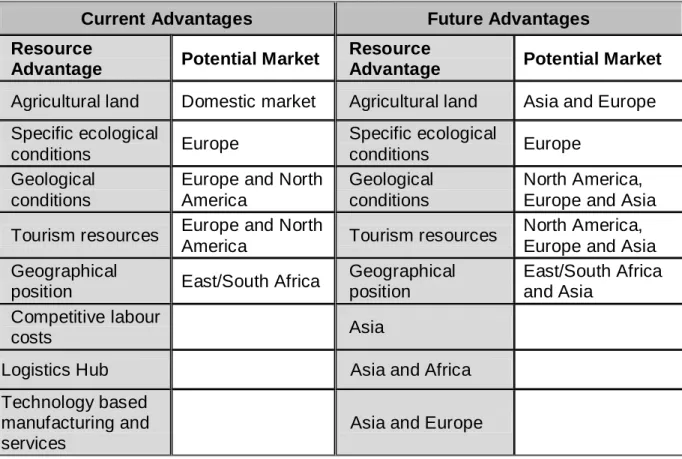
2.4 Current and future comparative and competitive advantages in Tanzania
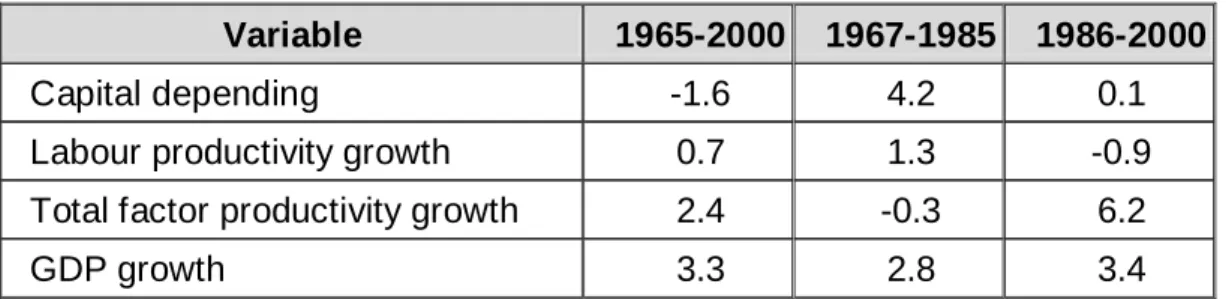
50 2.5 Change in the growth of GDP and source of growth in Tanzania 56
3.1 Market entry mode theory 67
3.2 Business rule forms 74
4.1 4.2
Global business negotiation matrix Negations skills model
80 97 6.1 Distinction between qualitative and quantitative research 128 6.2 Composition of the respondents in demographic terms 131
7.1 Abbreviations of variables 147
7.2 Descriptive statistics for each variable: general sample
response per category 149
7.3 Cronbach alpha values of measuring instruments: theoretical
model 150
7.4 Factor loadings: perceptions of marketers towards international marketing environment, awareness of negotiation
skills and interest groups 154
7.5 Factor loadings: perceptions of marketers towards negotiation approaches and negotiation atmosphere with regard to
negotiation behaviour 156
7.6 Factor loadings: outcomes of negotiation behaviour 157 7.7 Factor loadings: Cronbach alpha coefficients of the latent
variables based on the comprehensive exploratory factor
analysis 158
7.8 Empirical factor structure for regression analysis for latent
variables 159
7.9 Regression analysis: the influence of business negotiation environment, requirements of business practise and awareness
of negotiation skills. 165
7.10 Regression analysis: the influence of negotiation atmosphere
on negotiation behaviour 166
7.11 Regression analysis: the influence of negotiation atmosphere related to bargaining power on agreement based on level of
trust and certainty 166
7.12 Regression analysis: the influence of negotiation atmosphere related to behaviour on agreement based on level of trust and
certainty 167
7.13 Regression analysis: the influence of negotiation atmosphere
related to bargaining power on level of commitment 168
7.14 Regression analysis: the influence of negotiation atmosphere
related to behaviour on level of commitment 168 7.15 Regression analysis: the influence of negotiation behaviour on
agreement based on level of trust and certainty 169 7.16 Regression analysis: the influence of negotiation behaviour on
level of commitment 170
LIST OF FIGURES
Figure Page
1.1 The modelled relationships among variables measuring influences and outcomes of the negotiation behaviour in a global firm
15
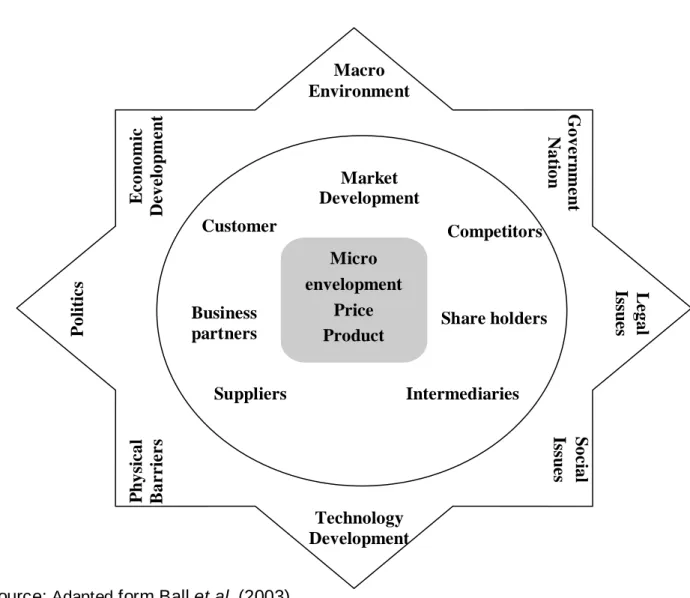
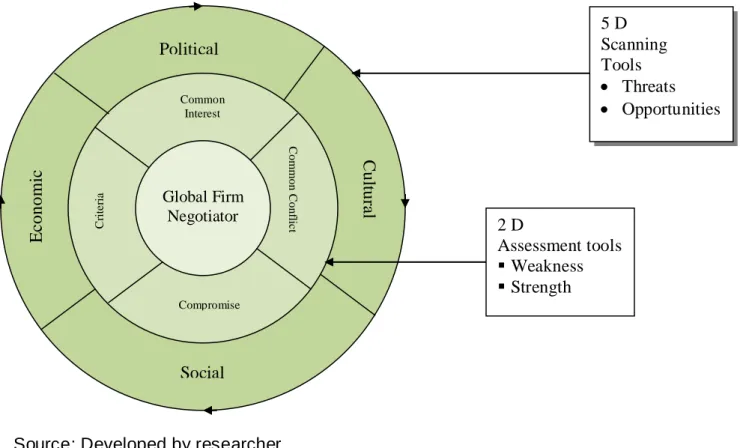
2.1 Framework of the international business environment 29 2.2 GDP distribution of Sub-Saharan Regional Integration 34 4.1 Scanning procedures for context 4Cs and environment 86
4.2 Global business negotiation styles 90
4.3 Global Business Negotiation Value Chain 101
5.1 The modelled influences and outcomes of the negotiation
behaviour in a global firm 114
7.1 Theoretical model of negotiation behaviour in a global firm 146 7.2 The adapted model of the relationships among variables based
on perceptions of marketers and effects of the negotiation behaviour
160
7.3 The hypothesised model of marketers’ perceptions regarding
negotiation 163
7.4 Summary of the regression analysis results 174 8.1 Empirical evaluation of the proposed influences and outcomes
of perceptions of marketers on negotiation behaviour 183
CHAPTER ONE
INTRODUCTION AND BACKGROUND OF THE STUDY
1.1 INTRODUCTIONNegotiation is a complex phenomenon, but in this study the focus is on negotiation in a global firm or an international business negotiation. International business negotiation can be defined as the deliberate interaction of two or more social units, originating from different nations. The aim of this interaction is to define or redefine their interdependence in a business context. The nature of interaction could be company-company, company-government, or solely interpersonal interactions over business matters such as sales, licensing, joint ventures, and acquisitions (Weiss 1993:270).
A firm has to negotiate with various parties. These negotiations can end successfully or unsuccessfully. The parties used their various models to explain how a firm can be successful when negotiating, by studying these negotiations with a global firm in an international business context. It is possible to conceptualise the output of marketing planning in international markets in terms of mutual agreements that have to be negotiated, by using the ideal of negotiation and interpersonal interaction (McCall & Warrington 1989:3-9). McCall and Warrington (1989) further suggested that global firms’ negotiation is the basis of problem solving, conflict resolution, change agent and decision making skills within negotiations interaction. 1.2 BACKGROUND OF THE STUDY
The process of international business negotiations was developed by Ghauri (Fjellstrom 2005:26). According to Ghauri (2003:5) the process of negotiations needs to serve as an overall framework for global firm negotiations taking into consideration the background factors, the process and atmosphere (Ghauri 2003:5). The process of international business negotiation is divided into three different stages namely pre-negotiations stage, face-to-face pre-negotiations and post pre-negotiations. Fjellstrom (2005) explained that, a stage of the process refers to a specific part of the process and includes all actions and communications by any party pertaining to negotiations made during that part. In each stage parties communicate and exchange information with each other. When a particular stage ends, parties decide to continue on to the
next stage or to abandon the communication if they see no point in further negotiations. But in the pre-negotiation stage, parties attempt to understand each other’s needs and demands, which are done through information gathering and informal meetings. According to Ghauri (2000) the negotiation stage is where parties have agreed on most of the issues, and are to agree on contract language and format and signing the contact. Furthermore, each stage has two dimensions, namely, cultural and strategic dimensions which play different roles at different stages. These dimensions occur in the business environment.
Fjellstrom (2005) explained that since the international business environment variables on negotiation process and its different stages vary in intensity, it is possible that one of these variables may influence one stage positively and another negatively. This means that, the process saves time or continues smoothly if the influence is positive but if negative the process can be delayed of experience obstacles that can cause further delays. When parties enter into the negotiation, they have their own objectives which can create a conflict of interest which the parties have to resolve by hosting the negotiations. The business environmental factors refer to political, social and cultural environment which tend to hinder the progress (process and the outcome) of negotiations.
According to McCall and Warrington (1989), the environment influences negotiation and it also has an impact on the results. In the domestic country, it is the business culture as well as the executives’ objectives and guidelines that affect the behaviour of the global firm’s negotiators. If the negotiation manoeuvring freedom is limited, it might have an impact on the final outcome of the negotiations. McCall and Warrington (1989) further argued that, when negotiations take place between parties from different countries in a global firm negotiating context, there are additional factors that influence the negotiating parties’ possibilities to act on the final outcome. It can be specific business trade barriers or special market entry barriers, and/or cultural factors of different kinds that the negotiators are expected to consider and adapt to. The market position at a particular time, position of the parties in the market, and the number of sellers and buyers also influence the negotiation process. Moreover, most of the international business negotiations involve third parties other
than the seller and buyer. These could be the government or consultants who have an influence on negotiations (Ghauri 2002:190).
Since the attainment of independence in 1961, and the formation of the United Republic of Tanzania in 1964, Tanzania has tried to improve its social economic welfare by promoting trade and investment. In the 1960s, and in the late 1980s, the trade and investment policy was based on a socialist approach, which meant that the government was the major owner of the means of the economy. In the early 1990s, Tanzania started to implement policies in favour of liberalising the economy. This resulted in the withdrawal of the government from trade and investment activities. Therefore, government reaction to the liberalisation of the economy was to develop new policies and strategies which were expected to improve the social welfare of Tanzanians (ESAURP1996:217).
The Tanzanian investment policy was launched in 1996, aiming at promoting and attracting investors. Since that period, Tanzania has made considerable progress towards establishing an open, transparent and consistent legal framework for foreign direct investment (FDIs). The trend of FDIs flowed to Tanzania; during the period 1995 to 2002, it was US$1billion compared to the less than US$2 million during 1986-1991 (UNCTAD 2005). Conversely, the Trade policy, which was launched in 2003, aimed at ensuring effective participation in the rule-based multilateral trading system (URT: Trade Policy 2006).
The existence of these two policies made Tanzania attractive for investment and trade in the Great Lakes Region. The main issue on the operationalisation of these new policies, and engagement of Tanzania in various negotiations, resulted in concluding contracts either on trade or investment issues both in the private and government sectors.
1.3 THEORETICAL FRAMEWORK OF THE STUDY
1.3.1 Negotiation and international business negotiations concept
(Saner 2000) referred to negotiation as a process whereby two or more parties seek an agreement to establish what each shall give and take, or perform and receive in a transaction between them. Alternatively, it is an act of discussing an issue between two or more parties with competing interests, with the aim of identifying acceptable trade-offs for coming to an agreement (Raihan 2004). The negotiation process may be distinguished from the structures in which it takes place. The process includes which strategies negotiators choose, how markets and negotiators influence each other, whether negotiators add tactics to detect joint gains, to what extent do they use tactics to guard against their own biases, and how they go about forming and splitting coalitions. The process includes how the negotiators’ moves interact with domestic politics.
The success of international business relations depends on effective business negotiations. Business negotiations may be understood as encounters between firms or economic organisations with the goal of reaching agreements to derive at economic benefits. Numprasertchai and Swierczek (2006) defined international business negotiations as the deliberate interaction of two or more social units (at least one of them a business entity) originating from different nations, and attempting to define or redefine their interdependence in a business matter. The business unit which establishes mutual relations could be a company–company, company-government and solely interpersonal interactions over business matters such as sales, licensing, venture and acquisitions (Weiss 1993:270).
1.3.1.1 Negotiation behaviour styles
According to Saner (2000) negotiation behaviour is based on the following choices and Bhattacharya (2005) Adler (1997) and Dupont (1986) supported this notion:
• Compromise behaviour
Parties in the negotiation may come to a compromise in order to achieve a satisfactory alternative that might be partially acceptable to both of them.
• Collaborative behaviour
Collaboration requires the parties to familiarise themselves thoroughly with the conflict and its causes in order to seek a constructive joint approach.
• Avoidance behaviour.
This behaviour combines non-cooperative behaviour with a lack of assertiveness, generally leading to a no-win outcome in which the interests of none of the parties are met. This strategy could be used to defer or postpone awkward issues that might not be amenable.
• Accommodative behaviour
This behaviour gives the highest priority to cooperation and reaching an agreement. Negotiator is willing to adjust most self-interest objectives in order to satisfy the interests of the other party.
• Competitive behaviour.
The essence of this power-oriented behaviour lies in its effort to achieve goals by trying to persuade the other party to make concessions.
1.3.2 International marketing environment
According to Kapoor (1975) the environmental context consists of variables such as, political, social and economic factors relevant to both parties. These forces are beyond the control of either of the parties involved in the negotiations.
According to Worthington and Britton (2006) these forces are acting on global firms from different nations which are not familiar to each other and can affect global business activity in a variety of ways. On the other hand, international negotiations in a global firm influence marketing environment for example, variation of the parties with respect to the environment often hinders the international business negotiation process. Ghauri (2003) postulated that when unfamiliar parties coming from different backgrounds, interact with one another the risks of interaction interference are greater. Some of the characteristics directly influence the process while others directly influence the atmosphere.
1.3.3 Awareness of negotiation skills
Robin and Foster (2002) suggest that negotiation skills are skills that impose to make a negotiator capable to negotiate effective deals across a variety of contexts such as different industries, products and services. Furthermore, a negotiation skill is proficiency, facility, or openness that is acquired or developed through training or experience. It is an embodied personal capacity partly inborn and partly acquired through experience and training (Ghauri 2002:45). Negotiators influence the negotiation process with their own experience and negotiation skills. They operate within two limits. Firstly, they act to increase common interests and to expand cooperation among the parties; secondly they act to minimize their own interests and to ensure an agreement valuable to themselves. The personalities of the negotiators are also important, especially when information about the other party is lacking. A good personality is defined as an individual with the ability to make others understand his position, to approach strangers with ease and confidence and to appreciate the other person’s position. However, the skills of negotiators are related to different objectives and motivations, pertaining to different people and professionals. Negotiators with a technical background may place more emphasis on technical issues, while those with a business background might consider other issues to be more important.
1.3.4 Interest Groups
Interest groups represent the third parties that have an immediate impact on the outcomes of negotiations. Third parties are people other than the buyer and the seller who have a significant influence on the negotiations, depending on their interests and objectives in the negotiation process. Interest groups are measured by determining their level of interference, for instance the government, agents, consultants and subcontractors in the global firm negotiations (Braithwalte & Drahos 2000; and Wilson 1988). Ghauri (2002), argued that governments are often involved and they influence the buyer towards complementary objectives, such as infrastructure, employment opportunities, foreign exchange considerations and any other prospective relationship between the countries involved. This means, parties other than the buyer and the seller have a significant influence on negotiations, depending on their interests and objectives in the negotiations process. Monning and Feketekuty (2004) explained that interests are at the core of what drives parties in a
negotiation. Therefore, Interest groups could be government, agents, consultants and subcontractors.
1.3.5 The negotiation atmosphere
According to Ghauri (2003), atmosphere is the perceived milieu around the interaction. This means the manner in which the parties view each other’s’ behaviour and the properties of the process, that is, perception and progress. The more parties understand each other, the more positive the atmosphere around the process and the more the parties are willing to compromise and see common benefit. Therefore, atmosphere is of fundamental importance to the negotiation process as a whole, for it clears confusion and uncertainties during the negotiation process between the parties. These characteristics are common interest, conflicting interest, willingness to co-operate, willingness to compromise, power and avoidance. Some characteristics are dominant at one stage, others at another stage. Common interest and willingness to co-operate for instance are dominant in the pre-negotiation stage since parties look for mutual solutions.
1.3.5.1 Negotiation atmosphere characteristics
The following are some of the important characteristics of negotiation atmosphere according to Ghauri (2003):
• Common interest and conflicting interest is a basic characteristic of the negotiation process. Parties always have some common interests in finding solutions that fit both parties. However, that interest may develop into a conflicting interest between parties. The magnitude of a conflicting interest and common interest in the atmosphere depends on the objectives of the negotiating parties.
• Willingness to co-operate and willingness to compromise, is a characteristic arising in the face-to-face negotiation stage. After identifying their objectives, parties have to adopt the behaviour which leads to the mutual solution. When one part is willing to cooperate that means negotiator is willing to adjust most self-interest objectives in order to satisfy the interests of the other party. The parties are persuaded to compromise in order to achieve a satisfactory alternative that might be partially acceptable to both of them.
• Power-dependence and avoidance behaviour are other basic characteristic of all negotiation processes. Power-dependence relationship is closely related to the actual power relations, which is influenced by the value of the relationship to the parties and their available alternatives. The ability to control a relationship is related to the perceived power of two parties, their relative expertise and access to information. Fjellstrom (2005) further argued that, power is the property of the relationship and not an attribute of the actor. Therefore the power relationship is in balance if both parties perceive equal power. The power relations could unbalance negotiations if one of the parties perceives more power (Ghauri 2003).
If power relations become unbalanced a party may choose avoidance behaviour. This behaviour combines non-cooperative behaviour with a lack of assertiveness, generally leading to a no-win solution where the interests of none of the parties are met. Furthermore, this strategy could be used to defer or postpone awkward issues that might not be amenable to an agreement until a more favourable moment. It is a position that is extremely versatile and possibly useful, but it should be used in a focused and targeted manner, since frequent avoidance of conflict reduces the chances of satisfactory results in the future.
1.3.6 Business agreements and the level of commitment
The review of literature on negotiations also shows that the end–result of negotiation processes has been defined using a wide variety of indices. It may be possible that end-results include an agreement, a deadlock, a non-agreement, a mutually satisfactory agreement for both side, an agreement that represents victory for one side or an agreement in which both sides have, to some extent, modified some of their objectives (De Dree, Harink & Van Vianene 1999:376-405). The end result or outcome of negotiations exist in such diversity, but due to the purpose of this study, the end-result of negotiation is considered as an agreement based on trust and certainty as well as the level of commitment. Saorin-Ibora (2006: 14-16) suggest that generally, there are imbalances of information in negotiations that favour the existence of the opportunistic behaviour. Therefore, any relationship that has trust,
reduces costs associated with such imbalances that are typical of cooperate exchange.
An agreement is a satisfactory end-result for both sides. It reflects the perception of the relationship created between negotiators. Achieving a positive relationship and a long term commitment must constitute the main objective for parties. Therefore, being satisfied with the relationship that has been created will enable the correct implication for the agreement and achieve a better performance later on. All relationships created between the parties are determined by the level of trust and uncertainty. Both parameters provide information on satisfaction with aspects related to the development of the negotiation process (Fisher, Ury & Patan 1983).
The level of trust can be defined as the expectations of good faith on behalf of the other party as well as the fulfilment of those expectations (Ring & Van de Ven 1994:90-118). Trust can be viewed as the expectation of fair negotiation in a situation in which opportunism may creep in. It is true that in all negotiations, there are imbalances of information that favour the existence of opportunistic behaviour. Therefore, any relationship that has trust, reduces costs associated with such imbalances that are typical of co-operate exchange (Saorin-Ibora 2006:14-16).
Therefore, if the level of trust is higher, long term commitment of the parties on agreements will be created. The perception of satisfaction has repercussions on resolving future conflict by avoiding opportunism which helps to establish and maintain a long-standing relationship. The created relationship should not only be based on an essential degree of trust but also on a minimum degree of uncertainty about the basis of the business relationship. A negotiator has to reduce the degree of uncertainty in order to create a high-level of commitment in the form of positive relationship of significant satisfaction for both parties.
1.4 STATEMENT OF THE PROBLEM
International business negotiations have become one of the main instruments to reach consensus on business transactions between two parties, for example between the government and other parties. Negotiation can also be between the government and foreign investors most of which concentrate on the privatisation of
public enterprises and mining. Lastly, negotiation can also concern the government and regional organisations or multinational organisations (Kweka 2004:2-4).
According to McCall and Warrington (1989), the basic question in business negotiation concerns how the parties strategically use the information in order to influence each other. Moreover, the behaviour of the negotiators influences the outcome of the negotiation, particularly in international contexts where the parties have different experiences, knowledge and backgrounds as well as different perspectives on life. These factors govern the negotiators’ behaviour and thus influence their reactions to the different steps and situations of a negotiation process.
Many negotiations attempts on trade and investment in Tanzania, resulted in agreement and signing of contracts. This meant that all parties had their intentions fulfilled. Trade and investment negotiations are not new to Tanzania. For example, in 1972 Tanzania, Zambia and China signed an agreement after negotiations to construct the Tazara railway line, from Dar es Salaam to Kapirimposhi (Chokoti 2008:26-31). The purpose of the negotiations was the issue of tax exemption on imported raw materials.
During the liberalisation period, public and private sectors held negotiations either with the government or among themselves. Various negotiations that took place were observed between companies. The international business negotiations to which Tanzania has subscribed can be categorised into the following conventional levels; multilateral, regional, bilateral and foreign direct investment (Kweka: 2004). Despite the participation of Tanzania in various international business negotiations the outcomes after the implementation of the agreement in most cases have become unfavourable to the Tanzanians. Most of the contracts have been terminated. As observed by Kweka (2004), a number of international trade agreements and negotiations, in both the multilateral and regional framework, have been rather limited in performance by a number of constraints. Questions that now arise are: • Whether negotiation behaviour has an impact on the failure of trading
negotiations in Tanzania?
• Whether business environment variables have an impact on negotiation behaviour of marketers?
1.5 RESEARCH OBJECTIVES
1.5.1 Primary research objective
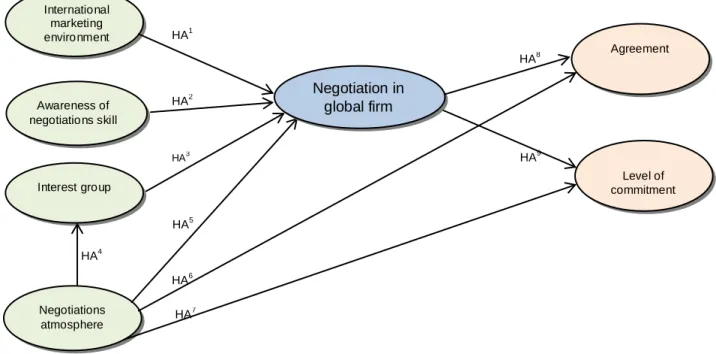
This research will investigate and analyse the impact of the international marketing environment, awareness of negotiation skills and atmosphere on negotiation behaviour in a global firm. The study will also assess the impact of negotiation behaviour on agreements based on trust and certainty and level of commitment as depicted in Figure 1.1. It is theoretically possible that Tanzanian marketers may have different perceptions of the negotiation outcome. Thus, the primary research objective is to canvass opinions regarding relationships, analyse these opinions and report on the opinions of marketers on negotiation behaviour in a global firm and the impact of negotiation behaviour of marketers on agreements based on certainty and trust and as well as level of commitment among marketers. These concerns are indicated in the conceptual model in Figure 1.1.
1.5.2 Secondary research objective
This study identified eight secondary research objectives, which will form the basis of the research programme:
• To investigate the effects of the legal, political, cultural, technological variables of the marketing environment on the negotiation behaviour of marketers in a global firm.
• To investigate the impact of negotiation approaches on trading agreements amongst international marketers.
• To investigate the impact of awareness of negotiation skills on negotiation behaviour in a global firm.
• To investigate the effect of interest group participation on negotiation behaviour in a global firm.
• To determine whether negotiation behaviour does have an impact on
agreements and level of commitment among the negotiators.
• To determine whether bargaining power does have an impact on agreements and level of commitment among the marketers
• To determine whether negotiation atmosphere does have an impact on the negotiation behaviour of marketers
• To determine whether negotiation atmosphere does have an impact on interest groups during the negotiation process.
1.5.3 Research questions
Given the purpose and objectives of the study, the following research questions are posed:
• What is the impact of the international marketing environment on negotiation behaviour?
• What is the impact of awareness of negotiation skills in negotiation on a global firm?
• What is the impact of interest groups on negotiation behaviour in a global firm? • Does negotiation behaviour influence better agreements and levels of
commitment of negotiators?
• Does negotiation atmosphere impact negotiation approaches in a global firm? • Does atmosphere impact interest groups?
• Does negotiation atmosphere have an impact on trust and certainty of
agreements in a global firm?
1.6 RESEARCH HYPOTHESES
Figure 1.1 shows nine sets of hypotheses to be tested empirically, as substantiated by secondary sources (literature) on international business negotiation. The alternative hypotheses that will be addressed in this study are:
Hypothesis HA1: There is a relationship between the international marketing environment and negotiations in a global firm.
Hypothesis HA2: There is a relationship between awareness of negotiation skills and negotiations in a global firm.
Hypothesis HA3: There is a relationship between interest groups and negotiations in a global firm.
Hypothesis HA4: There is a relationship between negotiation atmosphere and interest groups.
Hypothesis HA5: There is a relationship between negotiation atmosphere and negotiations in a global firm.
Hypothesis HA6: There is a relationship between negotiation atmosphere and agreement based on trust and certainty regarding international marketers
Hypothesis HA7: There is a relationship between negotiation atmosphere and commitment of international marketers.
Hypothesis HA8: There is a relationship between negotiations in a global firm and agreement based on trust and certainty regarding international marketers.
Hypothesis HA9: There is a relationship between negotiations in a global firm commitment of international marketers.
1.7 THEORETICAL MODEL OF NEGOTIATION BEHAVIOUR IN A GLOBAL FIRM
Saorin-Iborra (2006) suggested that negotiation outcome is the end-result of the whole process of negotiations or bargaining process. However, the outcome can be an agreement or non-agreement and can also be the level of commitment that will lead to marketing strategies for the negotiators. In this modified model, the three variables identified to have influence on negotiation in the global firm are the international marketing environment, awareness of negotiation skills and interest groups. The negotiation atmosphere plays a significant role in influencing the negotiation behaviour in the global firm and interest groups. Negotiations in the global firm should have results from which a marketer can expect to obtain an agreement and level of commitment. According to the reviewed literature on negotiation’s atmosphere, the negotiation atmosphere can influence the end result of negotiations as shown in Figure 1.1.
Since the research aims to study the behaviour of marketers on global firm negotiations, informative models were studied and used to develop a modified model which will be used in this study. McCall and Warrington’s model (1989) of international business negotiation variables such as environmental influence, negotiation approach (situational influence) influence strategies and skills will be
adopted to develop a modified model for the study. The other model is the international business negotiations model of Ghauri (2003), indicating variables such as environment, atmosphere and third party processes in the model, will be used to develop a modified model. Three independent variables that impact on the moderating (interaction) variable are listed in Figure 1.1. The moderating variables, negotiation behaviour in a global firm and negotiation atmosphere are presented as key drivers of end results of negotiation behaviour, which affects dependent variables as well. This construction reflects the objective of assessing the perceptions of marketers on the negotiation behaviour of global firms in Tanzania. Furthermore, nine sets of hypotheses, which will be tested empirically, are shown in Figure 1.1.
Figure 1.1: The modelled relationships among variables measuring influences and outcomes of the negotiation behaviour in a global firm
Independent variables Dependent variables
1.8 DEFINITIONS OF THE KEY TERMS
Business environment of global firms
Business environment is defined as forces acting on global firms from different nations which are not familiar to each other. These forces affect global business activity in a variety of ways and which can impinge not only on the transformation process itself, but also on the process of resource acquisition and on the creation and consumption of output (Worthington & Britton 2006:5).
Interest group
In this study an interest group is defined as a third party who in one way or another have impact with negotiation process, thus they will enter in a negotiations process to try to protect their interest (Braithwaite & Drahos 2000; and Wilson 1988). Monning and Feketekuty (2004) explained that interests are at the core of what drives parties in a negotiation.
International marketing environment Awareness of negotiations skill Interest group Negotiations atmosphere HA4 Level of commitment Agreement Negotiation in global firm HA1 HA2 HA3 HA5 HA6 HA7 HA9 HA8 15
Negotiation approaches
Negotiation approaches is defined as strategies marketers and negotiator can choose, for attaining an optimal solution, which is minimising conflicts and maximising gains. Walton and McKenzie (1965) identified two approaches negotiators can choose to adopt; distributive and integrative approaches. The distributive approach can be described as a set of behaviours for dividing a fixed pool of resources. In this regard, negotiators come with attitudes based on zero-sum or win-lose to the negotiation. Conversely, the integrative approach is a set of behaviours of a co-operative nature. It is an agreement-oriented approach. Negotiators come with an attitude based on win-win or mutual-gain outcomes.
Negotiation skills
A negotiation skill is proficiency, facility, or ability that is acquired or developed
through training or experience, it is an embodied personal capacity partly inborn
(born negotiator) and partly acquired through experience and training (Ghauri 2002:45).
Agreement
Agreement is an end-result or outcome of negotiations, but in view of the purpose of this study, the end-result of negotiation is considered an agreement (De Dree, Harink & Van Vianene 1999:376-405). An agreement is defined as satisfaction end-result for both sides. It reflects the perception of the relationship created between negotiators.
Trust
Trust can be defined as the expectations of good faith on behalf of the other party as well as the fulfilment of those expectations (Ring & Van de Ven 1994:90-118). Trust can be viewed as the expectation of fair negotiation in a situation in which opportunism may creep in.
Commitment
Schemerhorn, Hunt and Osborn (1997) defined commitment in relation to employees as the psychological attachment between the employee and an organisation. Negotiations commitment can be viewed as willingness of the parties to exert effort on implementing that what has been agreed upon.
Negotiations
For the purpose of this study, negotiation may be defined as a process whereby two or more parties seek an agreement to establish what each shall give and take, or perform and receive in a transaction between them (Saner 2000). In addition for this study, a modern definition of negotiation is considered which is two or more parties with common (and sometimes conflicting) interests who enter into a process of interaction with the goal of reaching an agreement (preferably to mutual benefit).
Negotiations behaviour
Saner (2000) defined negotiations behaviour as a range of mannerism adopted by negotiators in order to affect the negotiations process. For parties to choose the behaviour to use it may be particularly useful to rank the issues related to the negotiation according to their importance and relevance to the problem. In this study, negotiator behaviour and negotiation style mean the same.
Negotiations atmosphere
According to Ghauri (2003), atmosphere is the perceived milieu of the interaction. This means the manner in which the parties view each other’s behaviour and the properties of the process, that is, perception and progress. The better parties understand each other, the more positive the atmosphere around the process and the more the parties will be willing to compromise and seek common benefit. Therefore, atmosphere is of fundamental importance to the negotiation process as a whole, for it clears confusion and uncertainties during the negotiation process between the parties.
1.9 RESEARCH METHODOLOGY
There is a range of research approaches or methodologies available for inquiry. The philosophy of research focuses on two dimensions of research which are: Ontological and epistemological assumptions, as the primary steps in determining the choice available from which to select a methodology for use in the investigation (Burrell & Morgan 1979:1-37).
Ontology refers to the nature of social reality. It represents a particular view or reality held about the situation in question. The methodological inquiry on ontological assumption, as suggested by Burrell and Morgan (1979) could be either by observing the reality, through inquiry, as to how little, or if any impact on the object of the study has been observed, or the reality which consists of an individual’s mental constructions of the objects with which to engage, and that the engagement impact on the observer and situation has been observed (Roberts 2001).
Conversely, epistemology relates to how assumptions of ontological nature can be known. The relation between the knower and what is known or being sought to be known is what we call epistemology. The nature of knowing and the construction of knowledge can be either objective or subjective. Barrell and Margon (1979) suggested that the relationship can derive from accepting that knowledge can be either viewed as objectively knowable and predictable. The debate on epistemological assumption comprises two dimensions of understanding reality as knowledge which are: anti-positivism and positivism. These are two main research paradigms or philosophies.
The positivistic paradigm advocates for one to seek to explain and predict what happens in the social world by searching for patterns and relations between people or objects. In this paradigm one can develop hypotheses and test them and that knowledge delivery is what is called “Cumulative process” (Burrell & Morgan 1979). Positivism is based on realism through which it searches for trust for truths out there; perceptions and opinions for example, of marketers in negotiations in a global firm in Tanzania, as noted above. The truth, in this paradigm, can be recognised in two ways, either by adopting a deductive approach (hypothesis) or by recognising that it is supported by empirical evidence (Jonkowicz 2005:110).
In this study, based on ontological assumptions, assumptions can be made that the external reality does not deny the reality of a marketer’s behaviour in negotiations of global firms in Tanzania; it has to be viewed by externalists. Externalists are people who do not engage in the negotiations; and those who do, engage so as to have their own perceptions and interpretations of what is occurring, which will be the reality of situations. Epistemologically an assumption can be made, that while some information can come from others, it is only by experience that valuable knowledge is generated at a personal level. Consequently, the positivism paradigm will be used in this study.
Given the nature of the research problem the positivism paradigm seems most appropriate to gauge the perceptions of marketers on negotiations in global firms in Tanzania.
1.9.1 The pilot study
Prior to the data collection and the distribution of the questionnaire stage, a pilot study was conducted. The main purpose was to detect any possible oversights and to gather any pertinent observations or suggestions regarding the study. Twenty copies of the questionnaire were distributed to interest groups and private individuals who owned firms that are engaged in international marketing trading activities. Interest groups and international marketers located in various areas in Tanzania (Dar Es Salaam) and with businesses ranging in size from medium to large businesses were given an opportunity to complete the questionnaire in order to identify any problem areas and to offer ideas. The pilot study identified the problems of marketers who were selling their products through other large businesses. Clarification was provided with regard to these marketers as they were not considered in respect of negotiation behaviour in global firms and also did not qualify as international marketers. Generally, respondents were willing to assist but complained about the length of the questionnaire.
1.9.2 Population and sampling procedure
In this study, a cross sectional survey design will be applied, so as to study samples of a population at a point in time. The study population comprises two main sectors,
the Government and the private sector institutions involved in negotiations. For the purpose of this study, the sampling method is based on purposive and stratified sampling. The actual sampling frame is limited to marketers in private and government sectors in Tanzania. This limitation is based solely on practical considerations in sourcing the required data. Non-probability (convenience) samples were drawn by administering the research instrument to the identified sampling frames. The desired sample size was a function of the number of statements in the research instrument times five (5) in order to perform the required statistical analysis. Questionnaires were distributed to Interest groups and international marketers located in various geographical areas in Tanzania (Dar Es Salaam, Arusha, Mwanza, Dodoma and Morogoro). Four hundred and fifty (450) questionnaires were distributed to marketers and interest groups. The number of questionnaires to be posted was stratified according to the size of each of these firms. All interest groups and marketers were reminded telephonically and the researcher and fieldworkers had to visit various firms of each area to motivate respondents to complete the questionnaires. In total three hundred and twenty three (323) usable questionnaires were returned which indicated a seventy two per cent (72%) response rate.
1.9.3 Data collection
The study of negotiation behaviour of global firms makes use of the survey method for data collection. According to Gupta (1999:12), the survey method is appropriate to gather data from a relatively large number of cases at a particular time. A sample of a large population is used in the survey, as resources in terms of funding and time to study every member are limited. In this study, a survey method is employed.
Based on the literature study, a questionnaire was constructed and used in the empirical investigation to gather information concerning the international marketing environment, interest groups, awareness of negotiation skills, perceptions of negotiation behaviour, negotiation atmosphere, agreements, and level of commitment. The empirical investigation made use questionnaires that were distributed to selected respondents that were readily available. A survey descriptive instrument, specifically, a “questionnaire” was designed. The instrument comprises two sections, Section “A” consisted of statements, which was linked to a five point Likert response scale secured by parameters of “strongly agree” (5) and “strongly
disagree” (1). The purpose was to measure interval levels, between values, since it makes sense to compute an average of an interval variable. Therefore, it enabled researchers to perform a statistical data analysis. The designed instrument begins with a theoretical review. Section “B” of the questionnaire deals with the biographical data of the respondents, which include the respondent’s gender, status and position in the firm. The new instrument was however, first tested in a pilot study to ensure reliability, validity and generalisation of the research findings. The questionnaire was administered using a printed copy of the questionnaire.
1.9.4 Data Analysis
Data analysis is the activity of evaluating information gathered in order to obtain answers to the research questions. It is therefore, the process of making sense out of the data Merrian (1998:178). In this study, data analysis was conducted in four phases and statistical analysis was carried out to appraise the internal reliability of measuring instruments used and validity of the various instruments used to measure the bases of variable relationships and alternative hypotheses under consideration. The multiple regression analysis method was used to measure the strength of the theories on the relationship between negotiation behaviour and independent variables to the dependent variable which is an international business negotiation outcome as illustrated in Figure 7.1. The method will measure the magnitude of the association between variables in hypotheses according to Siegel and Castellan (1988).
1.10 PURPOSE OF THE RESEARCH
In the early 1990s, Tanzania started to implement policies in favour of liberalising the economy. This resulted in the withdrawal of the government in trade and investment activities. Therefore, the government reaction to the liberalisation of the economy was to develop new policies and strategies which were expected to improve the social welfare of Tanzanians.
In 2002, the government proposed many strategies including the one called Vision 2025. Its main purpose was to enable all Tanzanians to have a better life by 2025. In order to successfully implement the Vision 2025, the government started to promote investment and trade. This was done by launching three policies namely, Investment