INSPIRE
Infrastructure for Spatial Information in
Europe
INSPIRE Metadata Implementing
Rules: Technical Guidelines based
on EN ISO 19115 and EN ISO 19119
Title INSPIRE Metadata Implementing Rules: Technical Guidelines based on
EN ISO 19115 and EN ISO 19119
Creator Drafting Team Metadata and European Commission Joint Research
Centre
Creation date 2007-10-26
Date of last revision 2013-10-29
Subject INSPIRE Implementing Rules for Metadata
Status V. 1.3
Publisher European Commission Joint Research Centre
Type Text
Description Guidelines based on EN ISO 19115 and EN ISO 19119 for Commission
Regulation (EC) No 1205/2008 of 3 December 2008 implementing Directive 2007/2/EC of the European Parliament and of the Council as regards metadata
Contributor See Acknowledgements
Format Pdf
Source European Commission Joint Research Centre
Rights Public
Identifier MD_IR_and_ISO_20131029.doc
Language EN
Relation Not applicable
Table of Contents
Acknowledgements ... 4
Introduction ... 5
Changes from Version 1.2 of 2010-06-06 ... 7
Normative references ... 8
Verbal forms for expression of provisions ... 8
1 INSPIRE profile of ISO 19115 and ISO 19119 ... 10
1.1 ISO Core Metadata Elements ... 10
1.1.1
Spatial dataset and spatial dataset series ... 10
1.1.2 Services ... 12
1.1.3 Conclusion ... 13
1.2 INSPIRE specific constraints (SC) ... 13
1.3 Extensions ... 14
1.3.1 Spatial data service type ... 14
1.3.2 Classification of spatial data services ... 15
2 Basic mapping ... 15
2.1
Introduction ... 15
2.1.1 Xpath expression ... 16
2.1.2 ISO Schemas Location ... 16
2.2 Identification ... 17
2.2.1
Resource title ... 17
2.2.2
Resource abstract ... 18
2.2.3 Resource Type ... 20
2.2.4 Resource locator ... 21
2.2.4.1 Resource Locator for data sets and dataset series ... 21
2.2.4.2 Resource Locator for Services ... 23
2.2.5 Unique resource identifier ... 24
2.2.6 Coupled resource ... 25
2.2.7
Resource language ... 26
2.3 Classification of spatial data and services ... 27
2.3.1 Topic category ... 27
2.3.2 Spatial data service type ... 29
2.4
Keyword ... 30
2.4.1
Keyword value ... 31
2.4.2 Originating controlled vocabulary ... 33
2.5 Geographic location ... 35
2.5.1 Geographic bounding box ... 35
2.6 Temporal reference ... 37
2.6.1 Temporal extent ... 37
2.6.2 Date of publication ... 38
2.6.3
Date of last revision ... 40
2.6.4 Date of creation ... 41
2.7 Quality and validity ... 42
2.7.1 Lineage ... 42
2.7.2 Spatial resolution ... 44
2.8
Conformity ... 47
2.8.1 Degree ... 48
2.8.2 Specification ... 49
2.9 Constraints related to access and use ... 51
2.9.1 Limitations on public access ... 51
2.9.2 Conditions applying to access and use ... 53
2.10 Responsible organisation ... 55
2.10.1
Responsible party ... 55
2.10.2 Responsible party role ... 57
2.11 Metadata on metadata ... 58
2.11.1 Metadata point of contact ... 58
2.11.2 Metadata date ... 60
2.11.3
Metadata language ... 60
3 Detailed mapping ... 62
3.1 Introduction ... 62
3.3 Identification Section ... 63
3.3.1
Sub-elements for spatial dataset and spatial dataset series ... 63
3.3.2 Sub-elements for service resources ... 64
3.4 Data Quality Section ... 65
3.4.1 Lineage ... 65
3.4.2 Conformity ... 65
3.5 Responsible Organisation ... 66
3.5.1 Resource responsible organisation ... 66
3.5.2
Metadata point of contact ... 66
3.6
Constraint section ... 66
3.7 Abbreviations ... 67
Annex A – ISO/TS 19139 encoding of the INSPIRE metadata elements ... 68
A.1 Introduction ... 68
A.2
From the conceptual schema to XML File instances ... 68
A.3 Polymorphism ... 68
A.4 Management of polymorphism ... 68
A.4.1 Management of community extensions ... 68
A.4.2 Parsing of metadata files ... 68
A.5 Management of containment by reference ... 69
A.6 ISO 19139 and multilingual metadata ... 69
A.6.1
The default language ... 70
A.6.2
Alternate languages ... 71
A.6.3 Embedded translations ... 71
A.6.4 Use of translation files ... 72
A.7 Contexts of use ... 73
A.7.1
Use of ISO 19139 in the context of a Catalogue Service ... 73
A.7.2 Use of ISO 19139 in the context of the standard interchange by transfer ... 73
A.8 Character encoding ... 73
A.9 Temporal extent encoding ... 73
A.10 Spatial resolution encoding ... 75
A.11 Codelists ... 76
A.12 Example of ISO 19139 XML Metadata Sets ... 77
A.12.1 Dataset ... 77
A.12.2
Dataset series ... 86
A.12.3 Service ... 86
Annex B (informative) Metadata elements for interoperability ... 95
B.1. Metadata elements required by the INSPIRE Implementing Rules on the Interoperability of Spatial Datasets and Services ... 95
B.2. Metadata elements recommended in the INSPIRE Data Specifications Technical Guidelines ... 96
Acknowledgements
Many individuals and organisations have contributed to the development of these Guidelines. The original Drafting Team on Metadata (2006-08) included: Marcel Reuvers (Netherlands), Nicolas Lesage (France), Kristian Senkler (Germany), Michael Gould (Spain), Gil Ross (UK), Stefano Nativi (Italy), Jan Hjelmager (Denmark), Franz Daffner (European Environment Agency), Per Ryghaud (Norway), Thomas Vögele and Fred Kruse (Germany), David Danko (USA).
We are grateful for the comments received during the consultation (28th May-15th June 2010) with the Member States via their Points of Contact.
We also wish to acknowledge the contribution of Jesus Barrera and his team at GeoSpatiumLab who have provided editorial assistance in preparing this new version of the guidelines, as well as the precious contribution of Angelo Quaglia at JRC in checking the final draft.
This version 1.3 of the Technical Guidelines clarifies some aspects of the implementation of the discovery metadata elements based on the experience built during the period of implementation 2010-13. It also includes an overview of the Metadata elements for Evaluation and Use defined in the INSPIRE Implementing Rules for the Interoperability of Spatial Datasets and Services
Contact information Massimo Craglia (Editor)
European Commission Joint Research Centre Institute for Environment and Sustainability Digital Earth and Reference Data Unit TP262, Via Fermi 2749
I-21027 Ispra (VA) ITALY E-mail: [email protected] Tel.: +39-0332-786269 Fax: +39-0332-786325 http://ies.jrc.ec.europa.eu/ http://www.jrc.ec.europa.eu/
Introduction
According to Article 5(1) of Directive 2007/2/EC, Member States shall ensure that metadata are created for the spatial data sets and services corresponding to the themes listed in Annexes I, II and III, and that those metadata are kept up to date. According to Article 5(4) of Directive 2007/2/EC, Implementing Rules shall be adopted taking account of relevant, existing international standards and user requirements. In the context of metadata for spatial data and spatial data services, the standards EN ISO 19115, EN ISO 19119, and ISO 15836 (Dublin Core) have been identified as important standards.
Commission Regulation (EC) No. 1205/2008 implementing Directive 2007/2/EC of the European Parliament and of the Council as regards metadata was adopted on of 3rd December 2008, and published on the Official Journal of the European Union on 4th
December (OJ L 326, 4.12.2008, p. 12–30). Any reference in this document to “Implementing
Rules for Metadata” refers to the above-mentioned Regulation.
The Regulation sets out the requirements for the creation and maintenance of metadata for spatial data sets, spatial data set series and spatial data services corresponding to the themes listed in Annexes I, II and III to Directive 2007/2/EC. It defines a number of metadata elements, their multiplicities and the value domains to be used in the metadata.
NOTE 1 The metadata elements defined in the Implementing Rules for Metadata are usually called discovery metadata.
In addition to these requirements, Commission Regulation (EU) No 1089/2010 of 23 November 2010 implementing Directive 2007/2/EC of the European Parliament and of the Council as regards interoperability of spatial data sets and services (OJ L 323, 08/12/2010, p. 11–102) and its sub-sequent amendments1,2 define six additional metadata elements for interoperability as well as some theme-specific requirements for the discovery metadata elements. Any reference in this document to “Implementing Rules for interoperability of spatial data sets and services” refers to the above-mentioned Regulation.
NOTE 2 The metadata elements defined in the Implementing Rules for interoperability of spatial data sets and services are also sometimes referred to as evaluation and use metadata.
The aim of this document is to define how the requirements of the Implementing Rules for Metadata can be implemented using EN ISO 19115 and EN ISO 19119. The following subsections describe for each element of the Implementing Rules its relation with the mentioned European standards. Furthermore, Annex B provides an overview of the additional metadata elements and requirements defined in the Implementing Rules for interoperability of spatial data sets and services as well as pointers to the INSPIRE Data Specifications, which provide guidance and recommendations for their implementation.
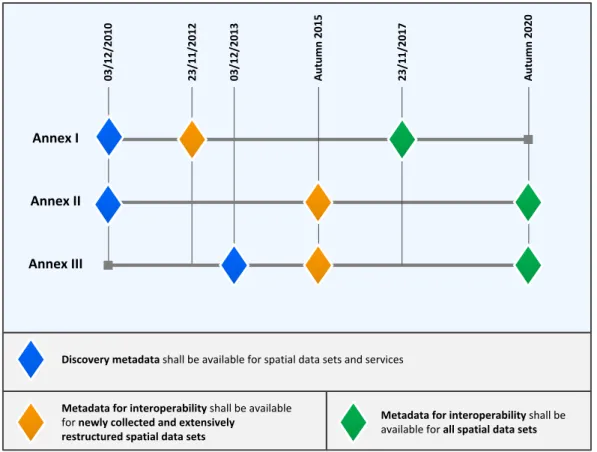
The timelines relevant for the provision of discovery metadata are different from those for metadata for interoperability. The former need to be provided according to the deadlines specified in the INSPIRE Directive for the Implementing Rules for Metadata (2 years after adoption for Annex I and II and 5 years after adoption for Annex III), while the latter need to be provided according to the deadlines specified in the INSPIRE Directive for the Implementing Rules for interoperability of spatial data sets and services (2 years after adoption for newly created or extensively restructured data sets, and 7 years for all other data sets). Figure 1 gives an overview of the dates at which the requirements included in the two Implementing Rules for data sets related to Annex I, II or III have to be met.
1 Commission Regulation (EU) No 102/2011 of 4 February 2011 amending Regulation (EU) No 1089/2010
implementing Directive 2007/2/EC of the European Parliament and of the Council as regards interoperability of spatial data sets and services (OJ L 31, 05/02/2011, p. 13–34)
Annex I Annex II Annex III 03 /1 2/ 20 10 03 /1 2/ 20 13 23 /1 1/ 20 12 23 /1 1/ 20 17 Au tu m n 20 15 Au tu m n 20 20
Discovery metadata shall be available for spatial data sets and services
Metadata for interoperability shall be available
for newly collected and extensively
restructured spatial data sets
Metadata for interoperability shall be
available for all spatial data sets
Figure 1. Illustration of Implementation Roadmap for discovery metadata and metadata for interoperability3
Note on Corrigenda to the Implementing Rules for Metadata
Regulation 1205/2008 has been amended with the corrigenda published in the OJ L 328/83 of 15.12.2009 as follows:
On page 12 delete the subtitle “Text with EEA relevance” (European Economic Area) On page 20, Annex D, point 1.3 replace “Spatial data services (services)” with
“Spatial data services (service)”.
PLEASE NOTE that in the course of this revision, another typing error has come to light in the Regulation 1205/2008 which will need a further amendment. In Part D 4, the language neutral name for element 501: Geoparameter calculation service should be
(thematicGeoparameterCalculationService) and not
(thematicGoparameterCalculationService) (part in bold is added to put in evidence the typing error). Still in Part D 4, a number of typos have been detected in the language-independent values when comparing the English version with those in other languages. These will be corrected in an amendment of the Regulation.
Legal Notice
This document will be publicly available as a ‘non-paper’, as it does not represent an official position of the Commission, and as such can not be invoked in the context of legal
procedures.
Neither the European Commission nor any person acting on behalf of the Commission is responsible for the use that might be made of this publication.
3 Dates in this figure are accurate at the time of publication and are based on the assumption that the Annex II+III
amendment of the Implementing Rules for interoperability of spatial data sets and services will be adopted in autumn 2013. For definitive dates refer to the roadmap published on the INSPIRE website (http://inspire.jrc.ec.europa.eu/index.cfm/pageid/44).
Changes from Version 1.2 of 2010-06-06
This document is Version 1.3. The changes introduced since Version 1.2 includes rewording to make the text clearer, inclusion of examples of good practice, recommendations on Conformity to include also conformity to INSPIRE Network Service, and an overview table of the elements of metadata for evaluation and use defined in the INSPIRE Implementing Rules for the Interoperability of Spatial Datasets and Services.
Throughout the document we have also corrected a typo from the previous version that referred to:
http://standards.iso.org/ittf/PubliclyAvailableStandards/ISO_19139_Schemas/resources/Codel ist/gmxCodelists.xml
Whereas the live path is:
http://standards.iso.org/ittf/PubliclyAvailableStandards/ISO_19139_Schemas/resources/codeli st/gmxCodelists.xml
Normative references
The following referenced documents are indispensable for the application of this document. For dated references, only the edition cited applies. For undated references, the latest edition of the referenced document (including any amendments) applies.
[ISO 19108] EN ISO 19108:2005, Geographic Information – Temporal Schema
[ISO 19108-c] ISO 19108:2002/Cor 1:2006, Geographic Information – Temporal Schema, Technical Corrigendum 1
[ISO 19115] EN ISO 19115:2005, Geographic information – Metadata (ISO 19115:2003) 4 [ISO 19119] EN ISO 19119:2005, Geographic information – Services (ISO 19119:2005) [ISO 639-2] EN ISO 639-2:1998, Codes for the representation of names of languages – Part 2: Alpha-3 code
[ISO 8601] EN ISO 8601:2004, Data elements and interchange formats – Information interchange – Representation of dates and times
[ISO 19139] ISO/TS 19139:2007, Geographic information – Metadata – XML schema implementation
[CSW2 AP ISO] OpenGIS Catalogue Services Specification 2.0.2 - ISO Metadata Application Profile, Version 1.0.0, OGC 07-045, 2007
[ISO 10646-1] ISO/IEC 10646-1:2000, Information technology ― Universal Multiple-Octet Coded Character Set (UCS) ― Part 1: Architecture and Basic Multilingual Plane
[IR MDTG] INSPIRE Metadata Implementing Rules. Guidelines based on EN ISO 19115 and EN ISO 19119 for Commission Regulation (EC) No 1205/2008 of 3 December 2008 implementing Directive 2007/2/EC of the European Parliament and of the Council as regards metadata
[INSPIRE Directive] INSPIRE, Implementing Directive 2007/2/EC of the European Parliament and of the Council as regards interoperability of spatial datasets and services
[Regulation 1205/2008/EC] Regulation 1205/2008/EC implementing Directive 2007/2/EC of the European Parliament and of the Council as regards metadata
Verbal forms for expression of provisions
In accordance with the ISO rules for drafting, the following verbal forms shall be interpreted in the given way:
• “shall” / “shall not”: a requirement, mandatory to comply with the technical guidance • “should” / “should not”: a recommendation, but an alternative approach may be
chosen for a specific case if there are reasons to do so • “may” / “need not”: a permission
Technical Guideline Requirements and Recommendations notation
Requirements and the recommendations for INSPIRE Metadata Implementing Rules within this technical guideline are highlighted and numbered as shown below:
TG Requirement #requirements are shown using this style
TG Recommendation #recommendations are shown using this style.
It is important to note that, implementation requirements and implementation recommendations may refer to either data or services.
Note: It is worth noting that requirements as specified in the INSPIRE Regulations and Implementing Rules are legally binding, and that requirements and recommendations as specified in INSPIRE Technical Guideline are not legally binding. Therefore, within this technical guideline we have used the terms ‘TG requirement’ and ‘TG recommendation’ to indicate what is technically required or recommended to conform to the Technical Guidance. XML Example notation
XML Examples are shown using Courier New on a grey background with yellow for emphasis as below:
<inspire:example>
<inspire:highlight>
Highlighted Text for emphasis </inspire:highlight>
</inspire:example>
Note: XML Examples are informative and are provided for information only and are expressly not normative.
1 INSPIRE profile of ISO 19115 and ISO 19119
1.1 ISO Core Metadata Elements
1.1.1 Spatial dataset and spatial dataset series
The table below compares the core requirements of ISO 19115 (see Table 3 in 6.5 of ISO 19115:2003) to the requirements of INSPIRE for spatial dataset and spatial dataset series as defined in the Implementing Rules for metadata.
ISO 19115 Core INSPIRE Implementing
Rules for Metadata
Comments Dataset title (M) Part B 1.1 Resource Title -
Dataset reference date
(M) Part B 5 Temporal Reference ISO 19115 is more demanding. The metadata shall contain a date of publication, revision or creation of the resource, while in INSPIRE the Temporal Reference can also be expressed through Temporal Extent. Dataset responsible party
(O)
Part B 9 Responsible organisation
INSPIRE is more demanding by mandating both the name of the organisation, and a contact e-mail address
Geographic location of the
dataset (C) Part B 4.1 Geographic Bounding Box INSPIRE is more restrictive. A Geographic bounding box is mandated Dataset language (M) Part B 1.7 Resource
Language
ISO 19115 is more demanding. It mandates the dataset language, even if the resource does not include any textual information. The ISO 19115 Dataset language is defaulted to the Metadata language.
Dataset character set (C) - ISO 19115 is more demanding. The dataset
character set has to be documented in ISO 19115 when ISO 10646-1 is not used. The ISO 19115 element maps to the conditional “Character Encoding” metadata element defined in Art. 13(5) of the Implementing Rules on interoperability of spatial data sets and services. This element is mandatory only if an encoding is used that is not based on UTF-8 (the dominant encoding of ISO 10646-1).
Dataset topic category (M) Part B 2.1 Topic Category - Spatial resolution of the
dataset (O)
Part B 6.2 Spatial Resolution
- Abstract describing the
dataset (M) Part B 1.2 Resource abstract -
Distribution format (O) - The ISO 19115 element maps to the
mandatory “Encoding” metadata element defined in Art. 13(3) of the Implementing Rules on interoperability of spatial data sets and services.
Additional extent
information for the dataset (vertical and temporal) (O)
Part B 5.1 Temporal extent INSPIRE is more demanding. A temporal reference is mandated, and can be expressed as a temporal extent.
ISO 19115 Core INSPIRE Implementing Rules for Metadata
Comments Spatial representation
type (O)
- The ISO 19115 element maps to the
mandatory “Spatial Representation Type” metadata element defined in Art. 13(6) of the Implementing Rules on interoperability of spatial data sets and services5.
Reference system (O) - The ISO 19115 element maps to the
mandatory “Coordinate Reference System” and the conditional “Temporal Reference System” metadata elements defined in Art. 13(1) and (2) of the Implementing Rules on interoperability of spatial data sets and services set.
Lineage (O) Part B 6.1 Lineage INSPIRE is more demanding. A general
lineage statement is mandated. On-line resource (O) Part B 1.4 Resource
Locator -
Metadata file identifier (O) - -
Metadata standard name
(O) - -
Metadata standard version (O)
- -
Metadata language (C) Part B 10.3 Metadata Language
INSPIRE is more demanding. The metadata language is mandated even if it is defined by the encoding.
Metadata character set
(C) - ISO 19115 is more demanding. The metadata character set has to be documented in ISO 19115 when ISO 10646-1 is not used.
Metadata point of contact (M)
Part B 10.1 Metadata point of contact
INSPIRE is more demanding by mandating both the name of the organisation, and a contact e-mail address.
Metadata date stamp (M) Part B 10.2 Metadata Date ISO is more restrictive because this element shall contain the “date that the metadata was created” and INSPIRE may contain the “date when the metadata record was created or updated
- Part B 1.3 Resource Type INSPIRE is more demanding
Part B 1.5 Unique Resource Identifier
INSPIRE is more demanding
Part B 3 Keyword INSPIRE is more demanding
- Part B 7 Conformity INSPIRE is more demanding
- Part B 8.1 Conditions for
access and use INSPIRE is more demanding
- Part B 8.2 Limitations on
public access INSPIRE is more demanding
1.1.2 Services
The table below compares the core requirements of ISO 19115 (see Table 3 in 6.5 of ISO 19115:2003) to the requirements of INSPIRE for services as defined in the Implementing Rules for metadata. The greyed lines correspond to core metadata elements not applicable to services.
ISO 19115 Core INSPIRE Comments
Dataset title (M) Part B 1.1 Resource Title - Dataset reference date
(M) Part B 5 Temporal Reference ISO 19115 is more demanding. Despite its name, this ISO 19115 Core metadata element applies to services. A reference date of the service (date of publication, revision or creation …) is mandated. Dataset responsible party
(O) Part B 9 Responsible organisation -
Geographic location of the
dataset (C) - See INSPIRE Geographic Bounding Box
- Part B 4.1 Geographic
Bounding Box The Geographic Bounding Box is handled in ISO 19119 with a different metadata element from the one corresponding to “Geographic location of the dataset”
Dataset language (M) - Not applicable to services
Dataset character set (C) - Not applicable to services
Dataset topic category (M) - Not applicable to services
Spatial resolution of the
dataset (O) Part B 6.2 Spatial Resolution In the current version of ISO 19119, it is not possible to express the restriction of a service concerning the spatial resolution Abstract describing the
dataset (M) Part B 1.2 Resource abstract -
Distribution format (O) - -
Additional extent
information for the dataset (O)
-
-Spatial representation type (O)
- -
Reference system (O) - -
Lineage (O) - -
On-line resource (O) Part B 1.4 Resource Locator
-
Metadata file identifier (O) - -
Metadata standard name
(O) - -
Metadata standard version (O)
- -
Metadata language (C) Part B 10.3 Metadata Language
INSPIRE is more demanding. The metadata language is mandated.
ISO 19115 Core INSPIRE Comments Metadata character set
(C) - ISO 19115 is more demanding. The metadata character set has to be documented in ISO 19115 when ISO 10646-1 is not used.
Metadata point of contact
(M) Part B 10.1 Metadata point of contact -
Metadata date stamp (M) Part B 10.2 Metadata Date ISO is more restrictive because this element shall contain the “date that the metadata was created” and INSPIRE may contain the “date when the metadata record was created or updated
- Part B 1.3 Resource Type INSPIRE is more demanding
- Part B 1.6 Coupled
Resource
Optional in INSPIRE
- Part B 2.2 Spatial Data
Service Type INSPIRE is more demanding
Part B 3 Keyword INSPIRE is more demanding
- Part B 7 Conformity INSPIRE is more demanding
- Part B 8.1 Conditions for
access and use INSPIRE is more demanding
- Part B 8.2 Limitations on
public access INSPIRE is more demanding
1.1.3 Conclusion
• The conformance of an ISO 19115 metadata set to the ISO 19115 Core does not guarantee the conformance to INSPIRE;
• The use of these guideline to create INSPIRE metadata ensures that the metadata is not in conflict with ISO 19115. However, full conformance to ISO 19115 implies the provision of additional metadata elements which are not required by the INSPIRE Implementing Rule on Metadata. Additional metadata elements are required by the INSPIRE Implementing Rules for the Interoperability of Spatial Datasets and Services. An overview list of these additional elements is provided in Annex B.
Over the structural requirements formalised through the mappings, the conformance to INSPIRE is also a matter of semantic of the information provided. If it is acceptable that the ISO 19115/ISO 19119 contain information which are not strictly bounded to the definition of the corresponding INSPIRE metadata elements, the minimum requirements expressed in the implementing rules have also to be met semantically, i.e. with metadata contents strictly satisfying the INSPIRE requirements.
1.2 INSPIRE specific constraints (SC)
Here is an initial list of INSPIRE Regulation 1205/2008/EC constraints applicable to an ISO 19115/ISO 19119 metadata set (i.e. an instance of MD_Metadata) describing a resource: SC1. MD_Metadata.language is mandatory;
SC2. MD_Metadata.hierarchyLevel is mandatory;
SC3. INSPIRE only considers the first instance of MD_Metadata.hierarchyLevel (i.e. MD_Metadata.hierarchyLevel[1]) when there are many;
SC4. If the value of MD_Metadata.hierarchyLevel[1] is not service, dataset or series, the metadata set is out of scope of the directive;
SC5. When there are many instances of MD_Metadata.identificationInfo, only the first one (i.e. MD_Metadata.identificationInfo[1]) concerns the current INSPIRE Resource; SC6. INSPIRE only considers the instance of MD_Metadata.dataQualityInfo applicable to the
whole resource;
SC7. There shall not be more than one instance of
MD_Metadata.identificationInfo[1].MD_Identification.citation.CI_Citation.date declared as a creation date (i.e. CI_Date.dateType having the creation value);
SC8. MD_Metadata.identificationInfo[1].MD_DataIdentification.citation.CI_Citation.identifier is mandatory for metadata sets related to spatial dataset and spatial dataset series; SC9. The data type of MD_Metadata.identificationInfo.MD_DataIdentification.language is the
codelist LanguageCode from ISO/TS 19139; SC10. There is at least one instance of
MD_Metadata.identificationInfo[1].MD_DataIdentification.extent defining the geographic location of the resource as a geographic bounding box (i.e. an instance of
EX_GeographicBoundingBox or one of its subclasses).
SC11. MD_Metadata.identificationInfo[1].SV_ServiceIdentification.operatesOn shall be instantiated by reference
SC12. There shall be at least one instance of
MD_Metadata.identificationInfo[1].MD_Identification.resourceConstraints
SC13. The coordinates of the bounding boxes (instance of EX_GeographicBoundingBox) shall be expressed in any geodetic coordinate reference system with the Greenwich Prime Meridian
SC14. For datasets and series:
MD_Metadata.identificationInfo[1].MD_DataIdentification.pointOfContact[1].CI_Respon sibleParty.organisationName and
MD_Metadata.identificationInfo[1].MD_DataIdentification.pointOfContact[1].CI_Respon sibleParty.contactInfo.CI_Contact.address.CI_Address.electronicMailAddress are mandatory.
For services these elements are also mandatory but they are referred as follows: MD_Metadata.identificationInfo[1].SV_ServiceIdentification.pointOfContact[1].CI_Resp onsibleParty.organisationName and MD_Metadata.identificationInfo[1].SV_ServiceIdentification.pointOfContact[1].CI_Resp onsibleParty.contactInfo.CI_Contact.address.CI_Address.electronicMailAddress. SC15. MD_Metadata.contact[1].CI_ResponsibleParty.organisationName and MD_Metadata.contact[1].CI_ResponsibleParty.contactInfo.CI_Contact.address.CI_Add ress.electronicMailAddress are mandatory.
SC16. The value of MD_Metadata.contact[1].CI_ResponsibleParty.role.CI_RoleCode shall be pointOfContact.
SC17. For datasets and series at least one keyword of GEMET thesaurus shall be documented using
MD_Metadata.identificationInfo[1].MD_DataIdentification.descriptiveKeywords. SC18. For services at least one keyword of Part D.4 of Commission Regulation (EC) No.
1205/2008 shall be documented using
MD_Metadata.identificationInfo[1].SV_ServiceIdentification.descriptiveKeywords
1.3 Extensions
1.3.1 Spatial data service type
For spatial data service types, the INSPIRE Metadata Regulation 1205/2008/EC mandate the use of the value domain of Part D 3. This information is handled using the serviceType attribute (See 2.3.2) of the class SV_ServiceIdentification (See ISO 19119).
The Table below defines the values of the serviceType property. In brackets are the language neutral names to be used.
SPATIAL DATA SERVICE TYPE
Discovery Service (discovery) View Service (view)
Download Service (download)
Transformation Service (transformation) Invoke Spatial Data Service (invoke) Other Services (other)
1.3.2 Classification of spatial data services
For classification of spatial data services, the Implementing Rules mandate the use of the value domain of Part D 4 of Regulation 1205/2008/EC. In order to ensure a language independent expression of the classification of spatial data services, the language neutral name is to be used as the value of the ISO 19115 keywords (See 2.4).
2 Basic mapping
2.1 Introduction
The following tables describe the mapping between the metadata elements of INSPIRE, as defined in the INSPIRE implementing rules for metadata, and ISO 19115/ISO 19119. For each of the INSPIRE Metadata element, the mapping is composed of the main characteristics of the metadata element as they are defined6 in the INSPIRE implementing rules (IR) for metadata and the main characteristics of the corresponding metadata element of ISO 19115 or ISO 19119:
• The metadata element name as used in the INSPIRE implementing rules;
• The reference to the paragraph of the INSPIRE implementing rules describing the metadata element;
• The definition, which gives the current ISO 19115 or ISO 19119 terms for describing the metadata element (Annex B of ISO 19115 standard: Data Dictionary for geographic metadata or Annex C of ISO 19119: Data dictionary for geographic service metadata);
• The number and the name that identifies the metadata element inside tables in ISO 19115 (or ISO 19119) published standard;
• An XPath expression indicating the metadata element within the ISO 19115 / ISO 19119 UML model (see 2.1.1);
• The INSPIRE obligation/condition applicable to the metadata element; • The INSPIRE multiplicity of the metadata element;
• The Data Type and the Domain required by the metadata element;
• An example that illustrates the description of the metadata element by providing a concrete case
• Some comments, which give more information about the metadata element
Apart from the tables collecting the main significant aspects, additional information is provided regarding: the description of the metadata element, advices on its fulfilment and important requirements and recommendations, as well as an example of XML encoding, i.e. a fragment of the XML of a metadata record created and validated with the INSPIRE Metadata Editor available from the EU Geoportal (http://inspire-geoportal.ec.europa.eu).
The overall structure of an ISO 19115/ISO 19119 metadata set supporting the requirements expressed in the INSPIRE Implementing rules for metadata is defined in Section 3 of this document.
2.1.1 Xpath expression
This compact notation allows many defaults and abbreviations for common cases. The simplest XPath takes a form such as /A/B/C which selects C elements that are children of B elements that are children of the A element that forms the outermost element of the model. More complex expressions can be constructed by specifying an axis other than the default 'child' axis, a node test other than a simple name, or predicates, which can be written in square brackets after any step. The main rules are the following ones:
• * selects all element children of the context node; • text() selects all text node children of the context node;
• @name selects the name attribute of the context node;
• @* selects all the attributes of the context node; • . selects the context node;
• .//para selects the para element descendants at any level of the context node; • .. selects the parent of the context node.
Hereafter, the root element of the XPath expression is an instance of MD_Metadata or one of its subclasses. The possible subelements of a class are its properties. The possible subelement of a property is its data type or a subtype of its data type. In order to manage the polymorphism, the XPath expression deals with the data type in a generic way (e.g., property_element_name/*/datatype_property_name).
2.1.2 ISO Schemas Location
Official ISO schemas (ISO AP or ISO 19139) are currently found in two separate locations: 1) ISO repository for public available standards. The ISO 19139 schemas can be found here: http://standards.iso.org/ittf/PubliclyAvailableStandards/ISO_19139_Schemas/
Date of schemas: 2007-08-11.
2.) OGC Schema repository. The ISO 19139 schemas are located here: http://schemas.opengis.net/iso/19139/20070417/
Date of schemas: 2007-04-17.
and here: http://schemas.opengis.net/iso/19139/20060504/ Date of schemas: 2006-06-04.
ISO AP schemas are located here: http://schemas.opengis.net/csw/2.0.2/profiles/apiso/ Date of schemas: 2007-07-19.
The ISO AP schemas are bound to http://schemas.opengis.net/iso/19139/20060504/
The difference in the schemas located in the OGC repository is the GML version. The version dated "2007-04-17" uses GML 3.2.1, the version dated "2006-06-04" use GML 3.2.0. The version "2006-06-04" provides gml in a separate directory (/gml) whereas the version "2007-04-17" directly refers to http://schemas.opengis.net/gml/3.2.1/. The major difference is that GML 3.2.0 schemas are defined in the namespace http://www.opengis.net/gml whereas GML 3.2.1 schemas are defined in the namespace http://www.opengis.net/gml/3.2.
The schemas located in the ISO repository for public available standards are comparable to OGC schemas located here: http://schemas.opengis.net/iso/19139/20070417/.
In conclusion:
To Validate XML against ISO AP 1.0:
http://schemas.opengis.net/csw/2.0.2/profiles/apiso/1.0.0/apiso.xsd To Validate XML against ISO 19139 with GML 3.2.0:
http://schemas.opengis.net/iso/19139/20060504/gmd/gmd.xsd To Validate XML against ISO 19139 with GML 3.2.1:
http://standards.iso.org/ittf/PubliclyAvailableStandards/ISO_19139_Schemas/gmd/gmd.xsd or http://schemas.opengis.net/iso/19139/20070417/gmd/gmd.xsd
INSPIRE Validator Service: A RESTful Web service that can be invoked by http request to validate INSPIRE Metadata. The purpose of the INSPIRE Metadata Validator is to test compliance of INSPIRE metadata with the INSPIRE Metadata Regulation. The validator accepts metadata that follow the Metadata Technical Guidance encoded in EN ISO 19139 schema. The INSPIRE Metadata Validator is implemented by ISO Schematron (2006).
The web application and service are provided for testing. Please report any issues you find so that they can be improved at [email protected]
End point: http://inspire-geoportal.ec.europa.eu/validator2/ Supported method: POST
Supported response formats: XML, HTML (The response format is returned according to the Accept value of the http request header)
Request parameter: dataFile (This is the name of the parameter associated with the metadata record xml file that should be added to the request)
PLEASE NOTE: The validator is a proof of concept that has been developed to test these guidelines. It is not intended to be an operational tool, and at the present time works in English only. All the files of the Validator including documentation are available under EU Public License from the JoinUp Platform
(https://joinup.ec.europa.eu/software/validator/home). Interested stakeholders are welcome to adapt the current Validator to their own language, and contribute it back through JoinUp to enrich the collective portfolio of tools supporting the
implementation of INSPIRE, currently being explored by the ISA Action A Reusable INSPIRE Reference Platform (ARE3NA:
https://joinup.ec.europa.eu/community/are3na/description). A new validator is being developed and will also be added to JoinUp.
2.2 Identification
2.2.1 Resource title
This is a characteristic, and often unique, name by which the resource is known. The title is the most informative element of a metadata record and usually the highest priority as search engines go to this element.
TG Recommendation 1 The Resource Title has to be concise and to the point. It should not contain unexplained acronyms or abbreviations. It is recommended a maximum length of 250 characters and keeping the similarity with the original title of the resource, in the sense of the ‘official naming’.
TG Recommendation 2 If the data or service is part of a larger project, it is recommended to indicate the Project at the end of the title, in brackets. In case of Project names, abbreviations are allowed, as long as the rest of the title follows the guidelines above and the abbreviation is spelled out immediately in the abstract.
Metadata element name Resource title
Reference Part B 1.1
Definition Name by which the cited resource is known ISO 19115 number and name 360. title
ISO/TS 19139 path identificationInfo[1]/*/citation/*/title INSPIRE obligation / condition Mandatory
INSPIRE multiplicity [1]
Data type (and ISO 19115 no.) CharacterString
Domain Free text
Example SPI: Standardized Precipitation Index Comments Example of XML encoding: <gmd:MD_Metadata … ... <gmd:identificationInfo> <gmd:MD_DataIdentification> <gmd:citation> <gmd:CI_Citation> <gmd:title> <gco:CharacterString>SPI: Standardized Precipitation Index</gco:CharacterString> </gmd:title> </gmd:CI_Citation> </gmd:citation> </gmd:MD_DataIdentification> </gmd:identificationInfo> ... </gmd:MD_Metadata>
2.2.2 Resource abstract
This is a brief narrative summary of the content of the resource. The abstract provides a clear and concise statement that enables the reader to understand the content of the data or service
Metadata element name Resource abstract
Reference Part B 1.2
Definition Brief narrative summary of the content of the resource(s) ISO 19115 number and name 25. abstract
ISO/TS 19139 path identificationInfo[1]/*/abstract INSPIRE obligation / condition Mandatory
INSPIRE multiplicity [1]
Data type (and ISO 19115 no.) CharacterString
Domain Free text
Example The Standardized Precipitation Index (SPI-n) is a statistical indicator comparing the total precipitation received at a particular location during a period of n months with the long-term rainfall distribution for the same period of time at that location. SPI is calculated on a monthly basis for a moving window of n months, where n indicates the rainfall accumulation period, which is typically 1, 3, 6, 9, 12, 24 or 48 months. The corresponding SPIs are denoted as SPI-1, SPI-3, SPI-6, etc. In order to allow for the statistical comparison of wetter and drier climates, SPI is based on a transformation of
the accumulated precipitation into a standard normal variable with zero mean and variance equal to one. SPI results are given in units of standard deviation from the long-term mean of the standardized distribution. In 2010 WMO selected the SPI as a key meteorological drought indicator to be produced operationally by meteorological services
Comments
TG Recommendation 3 The resource abstract is a succinct description that can include: - A brief summary with the most important details that summarise the data or service
- Coverage: linguistic transcriptions of the extent or location in addition to the bounding box
- Main attributes - Data sources - Legal references - Importance of the work
TG Recommendation 4 Do not use unexplained acronyms.
TG Recommendation 5 Summarise the most important details in the first sentence or first 100 characters. Example of XML encoding: <gmd:MD_Metadata … ... <gmd:identificationInfo> <gmd:MD_DataIdentification> ... <gmd:abstract>
<gco:CharacterString>The Standardized Precipitation Index (SPI-n) is a statistical indicator comparing the total
precipitation received at a particular location during a period of n months with the long-term rainfall distribution for the same period of time at that location. SPI is calculated on a monthly basis for a moving window of n months, where n indicates the rainfall
accumulation period, which is typically 1, 3, 6, 9, 12, 24 or 48 months. The corresponding SPIs are denoted as SPI-1, SPI-3, SPI-6, etc.In order to allow for the statistical comparison of wetter and drier climates, SPI is based on a transformation of the accumulated precipitation into a standard normal variable with zero mean and variance equal to one. SPI results are given in units of standard deviation from the long-term mean of the standardized distribution. In 2010 WMO selected the SPI as a key meteorological drought
indicator to be produced operationally by meteorological services. </gco:CharacterString> </gmd:abstract> ... </gmd:MD_DataIdentification> </gmd:identificationInfo> ... </gmd:MD_Metadata>
2.2.3 Resource Type
This is the type of resource being described by the metadata and it is filled in with a value from a classification of the resource based on its scope. The choice of Resource Type will be probably the first decision made by the user and it will define the metadata elements that should be filled.
Metadata element name Resource type
Reference Part B 1.3
Definition Scope to which metadata applies ISO 19115 number and name 6. hierarchyLevel
ISO/TS 19139 path hierarchyLevel INSPIRE obligation / condition Mandatory INSPIRE multiplicity [1]
Data type (and ISO 19115 no.) MD_ScopeCode
Domain CodeList (see annex B.5.25 of ISO 19115)
Example dataset
Comments
TG Requirement 1 The hierarchyLevel property is not mandated by ISO 19115 but is
mandated for conformance to the INSPIRE Metadata Regulation 1205/2008/EC (See SC2 in 1.2).
TG Requirement 2 The values of MD_ScopeCode in the scope of the INSPIRE Directive
(See SC4 in 1.2) are:
- dataset for spatial datasets; - series for spatial dataset series; - service for spatial data services
TG Recommendation 6 The choice between the values should follow these recommendations
- dataset: is an identifiable data that can be accessed separately. A dataset can be a part of a whole (series) or a segregate resource - series: is a collection of resources or related datasets that share the same product specification
- service: technologies providing availability and access to spatial information, for example, web map services, web feature services, web coverage services, web processing services, catalogue web services, etc
Example of XML encoding: <gmd:MD_Metadata … ... <gmd:hierarchyLevel> <gmd:MD_ScopeCode codeList="http://standards.iso.org/ittf/PubliclyAvailableStandards/IS O_19139_Schemas/resources/codelist/gmxCodelists.xml#MD_ScopeCode" codeListValue="dataset">dataset</gmd:MD_ScopeCode> </gmd:hierarchyLevel> ... </gmd:MD_Metadata>
2.2.4 Resource locator
2.2.4.1 Resource Locator for data sets and dataset series
The Resource Locator is the ‘navigation section’ of a metadata record which point users to the location (URL) where the data can be downloaded, or to where additional information about the resource may be provided.
Setting up the correct resource locators is important for the connection between the data and the services that provide access to them or for providing additional information concerning the resource.
Metadata element name Resource locator
Reference Part B 1.4
Definition Location (address) for on-line access using a Uniform Resource Locator address or similar addressing scheme
ISO 19115 number and name 397. linkage
ISO/TS 19139 path distributionInfo/*/transferOptions/*/onLine/*/linkage
INSPIRE obligation / condition • Conditional for spatial dataset and spatial dataset series: Mandatory if a URL is available to obtain more information on the resources and/or access related services.
INSPIRE multiplicity [0..*] Data type (and ISO 19115 no.) URL
Domain URL (IETF RFC1738 and IETF RFC 2056)
Example http://edo.jrc.ec.europa.eu/chm/ows.php?VERSION=1.3.0&SE RVICE=WMS&REQUEST=GetCapabilities
Comments A Resource Locator could be described, moreover, by other additional elements as a Title, a Description and a Function. In that case, the Title and the Description shall be free text and the Function shall be filled by the CI_OnLineFunctionCode (ISO 19115 codelist).
Example of Resource Locator with these additional elements: • Linkage:
http://edo.jrc.ec.europa.eu/chm/ows.php?VERSION=1.3.0&SE RVICE=WMS&REQUEST=GetCapabilities
• Title: JRC EDO (European Drought Observatory) - Drought Indexes WMS
• Description: WMS delivering maps of drought indexes provided by the European Drought Observatory (EDO). • Function: information
TG Requirement 3 If a linkage for data is available, the Resource Locator shall be a valid URL providing one of the following:
- a link to a web with further instructions - a link to a service capabilities document
- a link to the service WSDL document (SOAP Binding)
- a link to a client application that directly accesses the service
TG Recommendation 7 If no direct link to a resource is available, provide link to a contact point where more information about the resource is available.
Example of XML encoding: <gmd:MD_Metadata … … <gmd:distributionInfo> <gmd:MD_Distribution> … <gmd:transferOptions> <gmd:MD_DigitalTransferOptions> <gmd:onLine> <gmd:CI_OnlineResource> <gmd:linkage> <gmd:URL>http://edo.jrc.ec.europa.eu/chm/ows.php?VERSION=1.3.0&SER VICE=WMS&REQUEST=GetCapabilities</gmd:URL> </gmd:linkage>
<!—Name and description are optional elements not required by INSPIRE -->
<gmd:name>
<gco:CharacterString>JRC EDO (European Drought Observatory) - Drought Indexes WMS</gco:CharacterString>
</gmd:name>
<gmd:description>
<gco:CharacterString>WMS delivering maps of drought indexes provided by the European Drought Observatory (EDO)</gco:CharacterString> </gmd:description> <gmd:function> <gmd:CI_OnLineFunctionCode codeList="http://standards.iso.org/ittf/PubliclyAvailableStandards/IS O_19139_Schemas/resources/codelist/ML_gmxCodelists.xml#CI_OnLineFunct ionCode" codeListValue="information">information</gmd:CI_OnLineFunctionCode> </gmd:function> </gmd:CI_OnlineResource> </gmd:onLine> </gmd:MD_DigitalTransferOptions> </gmd:transferOptions> </gmd:MD_Distribution> </gmd:distributionInfo> … </gmd:MD_Metadata>
2.2.4.2 Resource Locator for Services
The Resource Locator for Services, if available, provides the access point of the service, that is an Internet address containing a detailed description of a spatial data service, including a list of endpoints to allow an automatic execution.
Metadata element name Resource locator
Reference Part B 1.4
Definition Location (address) for on-line access using a Uniform Resource Locator address or similar addressing scheme
ISO 19115 number and name 397. linkage
ISO/TS 19139 path distributionInfo/*/transferOptions/*/onLine/*/linkage
INSPIRE obligation / condition • Conditional for services: Mandatory if linkage to the service is available
INSPIRE multiplicity [0..*] Data type (and ISO 19115 no.) URL
Domain URL (IETF RFC1738 and IETF RFC 2056)
Example http://www.dinoservices.nl/geo3dmodelwebservices-1/Geo3DModelService
Comments
TG Requirement 4 If a linkage for a service is available, the Resource Locator shall be a
valid URL providing one of the following: - a link to a web with further instructions
- a link to a service capabilities document
- a link to the service WSDL document (SOAP Binding)
- a link to a client application that directly accesses the service
TG Recommendation 8 If no direct link to a resource is available, provide link to a contact point where more information about the resource is available.
Example of XML encoding: <gmd:MD_Metadata … … <gmd:distributionInfo> <gmd:MD_Distribution> … <gmd:transferOptions> <gmd:MD_DigitalTransferOptions> <gmd:onLine> <gmd:CI_OnlineResource> <gmd:linkage> <gmd:URL> http://www.dinoservices.nl/geo3dmodelwebservices-1/Geo3DModelService /</gmd:URL> </gmd:linkage> </gmd:CI_OnlineResource>
</gmd:onLine> </gmd:MD_DigitalTransferOptions> </gmd:transferOptions> </gmd:MD_Distribution> </gmd:distributionInfo> … </gmd:MD_Metadata>
2.2.5 Unique resource identifier
This element is a value uniquely identifying the resource.
Metadata element name Unique resource identifier
Reference Part B 1.5
Definition Value uniquely identifying an object within a namespace ISO 19115 number and name 365. identifier
ISO/TS 19139 path identificationInfo[1]/*/citation/*/identifier INSPIRE obligation / condition Mandatory for dataset and dataset series INSPIRE multiplicity [1..*] for dataset and series
Data type (and ISO 19115 no.) 205. MD_Identifier Domain See B.2.7.3 of ISO 19115
Example (unique identifier with code + codeSpace) code: lakes
codeSpace: urn:eu:europa:ec:jrc:rdsi:id:dataset:ccm2.1 Comments
TG Requirement 5 The code property is required (see B.2.7.3 of ISO 19115).
TG Requirement 6 If a value for codeSpace is provided, then the data type for the
identifier shall be RS_Identifier, which is substitutable for the usual MD_Identifier.
TG Recommendation 9 Never delete an existing identifier for a resource. If a change in resource identification is needed, add a new identifier but also keep the old one.
Example of XML encoding: <gmd:MD_Metadata … … <gmd:identificationInfo> <gmd:MD_DataIdentification id="lakes" > <gmd:citation> <gmd:CI_Citation> … <gmd:identifier> <gmd:RS_Identifier> <gmd:code> <gco:CharacterString>lakes</gco:CharacterString> </gmd:code> <gmd:codeSpace> <gco:CharacterString> urn:eu:europa:ec:jrc:rdsi:id:dataset:ccm2.1</gco:CharacterString> </gmd:codeSpace> </gmd:RS_Identifier> </gmd:identifier> </gmd:CI_Citation> </gmd:citation> … </gmd:MD_DataIdentification> </gmd:identificationInfo> … </gmd:MD_Metadata>
2.2.6 Coupled resource
If the resource is a spatial data service, this metadata element refers to, where relevant, the target spatial data set(s) of the service. It is implemented by reference, i.e. through a URL that points to the metadata record of the data on which the service operates. It helps therefore linking services to the relevant datasets.
Metadata element name Coupled resource
Reference Part B 1.6
Definition Provides information about the datasets that the service operates on.
ISO 19119 number and name 9 of table C.1. operatesOn ISO/TS 19139 path identificationInfo[1]/*/operatesOn
INSPIRE obligation / condition • Not applicable to dataset and dataset series
• Conditional to services: Mandatory if linkage to datasets on which the service operates are available.
INSPIRE multiplicity [0] for datasets and series [0..*] for services
Data type (and ISO 19115 no.) 36. MD_DataIdentification
Domain A unique resource identifier or locator (URL) of the MD_DataIdentification object Example http://vap-xgeodev.jrc.ec.europa.eu/geonetwork/srv/eng/csw?SERVICE= CSW&VERSION=2.0.2&REQUEST=GetRecordById&ID=f9ee66 23-cf4c-11e1-9105-0017085a97ab&OUTPUTSCHEMA=http://www.isotc211.org/20 05/gmd&ELEMENTSETNAME=full#lakes Comments
TG Requirement 7 The property shall be implemented by reference (see SC11 in 1.2). Example of XML encoding: <gmd:MD_Metadata … … <gmd:identificationInfo> <srv:SV_ServiceIdentification> …
<srv:operatesOn xlink:href="
http://vap-xgeodev.jrc.ec.europa.eu/geonetwork/srv/eng/csw?SERVICE=CSW&VERSI ON=2.0.2&REQUEST=GetRecordById&ID=f9ee6623-cf4c-11e1-9105-0017085a97ab&OUTPUTSCHEMA=http://www.isotc211.org/2005/gmd&EL EMENTSETNAME=full#lakes"/>… </srv:SV_ServiceIdentification> … </gmd:identificationInfo> … </gmd:MD_Metadata>
2.2.7 Resource language
It refers to the language(s) used within the resource (dataset, series, or service if relevant).
Metadata element name Resource language
Reference Part B 1.7
Definition Language(s) used within the datasets ISO 19115 number and name 39. language
ISO/TS 19139 path identificationInfo[1]/*/language
INSPIRE obligation / condition • Conditional for spatial dataset and spatial dataset series: Mandatory if the resource includes textual information. • Not applicable to services
INSPIRE multiplicity [0..*] for datasets and series [0] for services
Data type (and ISO 19115 no.) LanguageCode (ISO/TS 19139)
Domain Codelist (See ISO/TS 19139) based on alpha-3 codes of ISO 639-2. Use only three-letter codes from in ISO 639-2/B (bibliographic codes),
The list of codes for the 24 official EU languages is: Bulgarian – bul Irish – gle
Croatian – hrv Italian – ita Czech – cze Latvian – lav Danish – dan Lithuanian – lit Dutch – dut Maltese – mlt English – eng Polish – pol Estonian – est Portuguese – por Finnish – fin Romanian – rum French – fre Slovak – slo German – ger Slovenian – slv Greek – gre Spanish – spa Hungarian – hun Swedish – swe The list of all the codes is defined at
http://www.loc.gov/standards/iso639-2/
Regional languages also are included in this list.
Example eng
Comments There are two ways of inserting the language (see example XML encoding):
• most compliant: the element value is the name of the codeListValue expressed in the default language of the metadata (ej: if the metadata is filled in English, the values should be English, Spanish, French…)
most interoperable: the element value repeats the codeListValue (ej: eng for English, spa for Spanish, fre for French…)
TG Requirement 8 The resource language is mandated by ISO 19115.
TG Requirement 9 The resource language has to be filled with a value from the codelist
ISO/TS 19139 based on alpha-3 codes of ISO 639-2.
TG Recommendation 10 If the resource does not contain any textual information (e.g. only codes and digits), the language should be defaulted to the value of the metadata language.
Examples of XML encoding:
1) Most interoperable: the element value repeats the codeListValue <gmd:language>
<gmd:LanguageCode codeList="http://www.loc.gov/standards/iso639-2/" codeListValue="eng">eng</gmd:LanguageCode> </gmd:language>
2) Most compliant: the element value is the name of the codeListValue expressed in the default language of the Metadata
<gmd:language>
<gmd:LanguageCode codeList="http://www.loc.gov/standards/iso639-2/ " codeListValue="eng">English</gmd:LanguageCode> </gmd:language>
2.3 Classification of spatial data and services
2.3.1 Topic category
The topic category is a high-level classification scheme to assist in the grouping and topic-based search of available spatial data resources.
A correct categorization is very important to help users to search and find the resources they are looking for.
Metadata element name Topic category
Reference Part B 2.1
Definition Main theme(s) of the dataset ISO 19115 number and name 41. topicCategory
ISO/TS 19139 path identificationInfo[1]/*/topicCategory
INSPIRE obligation / condition • Mandatory for datasets and dataset series • Not applicable to services
INSPIRE multiplicity [1..*] for datasets and dataset series [0] for services
Data type (and ISO 19115 no.) MD_TopicCategory
Domain Enumeration (See B.5.27 of ISO 19115 or Part D 2 of the INSPIRE Metadata Regulation 1205/2008/EC)
Example climatologyMeteorologyAtmosphere
Comments The topic categories defined in Part D 2 of the INSPIRE Metadata Regulation 1205/2008/EC are derived directly from the topic categories defined in MD_TopicCategoryCode (B.5.27 of ISO 19115)
TG Requirement 10 The topic category has to be filled with a value from the enumeration
MD_TopicCategoryCode (ISO 19115).
TG Requirement 11 The value saved in the XML metadata element shall be a language
neutral name (see the value appearing in the “name” column of the table in B.5.27 of ISO 19115). Example of XML encoding: <gmd:MD_Metadata … … <gmd:identificationInfo> <gmd:MD_DataIdentification> … <gmd:topicCategory> <gmd:MD_TopicCategoryCode>climatologyMeteorologyAtmosphere </gmd:MD_TopicCategoryCode> </gmd:topicCategory> … </gmd:MD_DataIdentification> </gmd:identificationInfo> … </gmd:MD_Metadata>
2.3.2 Spatial data service type
This is a classification to assist in the search of available spatial data services. The list of language-neutral values as in Part D3 of the INSPIRE Metadata Regulation 1205/2008/EC includes: discovery, view, download, transformation, invoke and other.
If the service is also an INSPIRE Network Services, then it is necessary to include in the Metadata element 2.8.2 Specifications, reference to the relevant INSPIRE Network Service Implementing Rule or amendment (see also 2.8.2)
Metadata element name Spatial data service type
Reference Part B 2.2
Definition A service type name from a registry of services ISO 19119 number and name 1 of table C.1. serviceType
ISO/TS 19139 path identificationInfo[1]/*/serviceType
INSPIRE obligation / condition • Not applicable to datasets and dataset series • Mandatory for services
INSPIRE multiplicity [1] for services
[0] for datasets and dataset series Data type (and ISO 19115 no.) GenericName
Domain List of values. See section 1.3.1 in this document
Example view
Comments
TG Requirement 12 Use language neutral name from table in 1.3.1.
Example of XML encoding: <gmd:MD_Metadata … … <gmd:identificationInfo> <srv:SV_ServiceIdentification> … <srv:serviceType> <gco:LocalName>view</gco:LocalName> </srv:serviceType> … </srv:SV_ServiceIdentification> </gmd:identificationInfo> </gmd:MD_Metadata>
2.4 Keyword
An INSPIRE Keyword is defined by:
• a keyword value (see 2.4.1), which in ISO standard is referred to as “Keyword”; • an optional originating controlled vocabulary (see 2.4.2), which in ISO standard is
referred to as “Thesaurus”.
• It is possible to add as many keywords as relevant to the resource.
TG Requirement 13 The INSPIRE Metadata Regulation 1205/2008/EC mandate the
presence of at least one keyword.
TG Requirement 14 If only one keyword is used, then for spatial dataset or spatial
dataset series, the keyword:
- shall describe the relevant INSPIRE Spatial Data Theme (as defined in Annex I, II and III of the INSPIRE Directive)
- shall be expressed in the language of the metadata for the 34 INSPIRE Spatial Data Themes (please use the terms in each of the official languages in which the INSPIRE Directive has been
translated) or a neutral language values such as a URI.
The titles and definitions of all 34 INSPIRE Spatial Data Themes have been integrated into a dedicated branch of the General Environmental Multilingual Thesaurus (GEMET) in the 24 official Community languages (see http://www.eionet.europa.eu/gemet/inspire_themes). This special branch is known as “GEMET - INSPIRE themes”.
TG Requirement 15 For spatial services, the keyword:
- shall at least define the category or subcategory of the service using its language neutral name as defined in Part D 4 of the INSPIRE Metadata Regulation 1205/2008/EC
- shall be expressed as neutral language values such as the neutral language values defined in Part D.4 of the INSPIRE Metadata Regulation 1205/2008/EC for spatial data services)
In addition to the mentioned thesaurus also other keywords might be added. These may be described as a free text or may originate from any Controlled Vocabulary.
TG Requirement 16 If other keywords are added and they originate from a Controlled
Vocabulary (thesaurus or ontology), for example GEMET - Concepts, EUROVOC or AGROVOC, then the citation of the originating Controlled Vocabulary shall be provided.
For example, a keyword that comes from GEMET - Concepts shall be cited as follows: • keyword: freshwater
• thesaurus title: GEMET - Concepts, version 2.4 • thesaurus date: 2010-01-13
Or a keyword that comes from AGROVOC shall be cited as follows: • keyword: water springs
• thesaurus title: AGROVOC • thesaurus date: 2008-04-14 • thesaurus date type: publication
2.4.1 Keyword value
The keyword value is a commonly used word, formalised word or phrase used to describe the subject. While the topic category is too coarse for detailed queries, keywords help narrowing a full text search and they allow for structured keyword search
Metadata element name Keyword value
Reference Part B 3.1
Definition Commonly used word(s) or formalised word(s) or phrase(s) used to describe the subject
ISO 19115 number and name 53. keyword
ISO/TS 19139 path identificationInfo[1]/*/descriptiveKeywords/*/keyword INSPIRE obligation / condition Mandatory
INSPIRE multiplicity [1..*]
Data type (and ISO 19115 no.) CharacterString
Domain Free text
Example Atmospheric conditions (INSPIRE Spatial Data Theme)
humanCatalogueViewer (spatial data service subcategory)
water springs (AGROVOC)
rain water (GEMET Concepts)
Comments Each instance of ISO 19115 keyword may originate from a controlled vocabulary described through the thesaurusName property of the instance of descriptiveKeywords to which the keyword pertains
TG Recommendation 11 It is better to select keyword values from a collection of terms linked and predefined (controlled vocabularies).
TG Recommendation 12 It is suggested to choose a minimum of two keywords in addition to the required keyword from the GEMET - INSPIRE themes (for dataset and dataset series) or the categories from part D 4 of the INSPIRE Metadata Regulation 1205/2008/EC (for services).
TG Recommendation 13 Ideally, both a code (neutral language value) and a human-readable label (in any language) should be included in the metadata.
Here is an example of XML encoding of the keyword value for a spatial data services category or subcategory as defined in Part D.4 of the INSPIRE Metadata Regulation 1205/2008/EC.
<gmd:MD_Metadata … … <gmd:identificationInfo> <srv:SV_ServiceIdentification > … <gmd:descriptiveKeywords> <gmd:MD_Keywords> <gmd:keyword> <gco:CharacterString> humanCatalogueViewer </gco:CharacterString> </gmd:keyword> <gmd:thesaurusName> …(see 2.4.2) </gmd:thesaurusName> </gmd:MD_Keywords> </gmd:descriptiveKeywords> </srv:SV_ServiceIdentification > </gmd:identificationInfo> … </gmd:MD_Metadata>
An INSPIRE aware tool is expected to manage the neutral language values (e.g. humanCatalogueViewer), of the service category or subcategory and eventually display the corresponding value in a language chosen by the user (e.g. Visualiseur de catalogue in French).
Here is an example of XML encoding for a keyword referring to a spatial data set. Whether the keyword refers to an INSPIRE spatial data theme or not, is defined by the originating controlled vocabulary (see 2.4.2)
<gmd:MD_Metadata … … <gmd:identificationInfo> <gmd:MD_DataIdentification> … <gmd:descriptiveKeywords> <gmd:MD_Keywords> <gmd:keyword> <gco:CharacterString>Atmospheric conditions </gco:CharacterString> </gmd:keyword> <gmd:thesaurusName> …(see 2.4.2) </gmd:thesaurusName> </gmd:MD_Keywords> </gmd:descriptiveKeywords> </gmd:MD_DataIdentification> </gmd:identificationInfo> … </gmd:MD_Metadata>