Anchoring Number Talks
Katie Biro,Milton Area School DistrictLara K. Dick,Bucknell University
Abstract:The authors describe how Anchor Charts can be used to support the implementation of Number Talks with early elementary students. The authors note that Number Talks encourage students of all ability levels to engage in critical thinking about numbers and counting. Recommendations on the use of Anchor Charts as a supplement to Number Talks are included.
Keywords:Number Talks, Anchor Charts, number sense, mental mathematics, early elementary students, literacy strategies
1 Introduction
Number Talks (Parrish, 2010) have become a popular strategy for many teachers interested in establishing a culture of classroom discourse for developing number sense in their mathematics classrooms. Number Talks are traditionally a five- to fifteen-minute classroom discussion that follows a problem that children are asked to solve mentally. According to Berger (2017), when students are engaged in Number Talks, teachers “facilitate discourse among students about their thinking, help students build connections among strategies, and present students with opportunities to put their knowledge into practice as they solve problems” (p. 6). While it is known that Number Talks are a useful strategy, much of the published work for teachers about implementing Number Talks has been focused on upper elementary and beyond. Both books in the Making Number Talks Matter Series (Humphreys & Parker, 2015; Parker, Ruth & Humphreys, 2018) state that they are for grades 4-10 and 3-10 explicitly. While there may be more of a variety of the types of problems that can be posed to upper elementary students, there is a need for early elementary teachers to implement Number Talks. Yet we acknowledge that establishing a classroom culture of discourse and norms for classroom discussions looks different with six-year olds than with twelve-year olds. As a first-grade teacher who was initially skeptical that my students could engage in meaningful conversations during Number Talks, I will share how I used a literacy strategy to successfully implement Number Talks in my classroom.
2 Ms. Biro’s Background
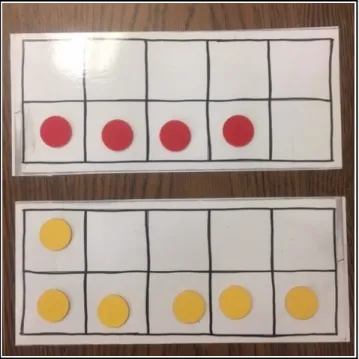
Two years ago, I made a commitment to try teaching math without directly telling my students how to solve problems. I sought out a local mathematics teacher educator (my co-author) who suggested I read Parrish’sNumber Talks(2010) book. The book and associated videos helped me to understand different ways students approach and think about addition problems. I figured the grade-based examples would be a good place to start, so I choose a first-grade addition problem (shown in Figure 1): Show two “tens” frames—4 red counters on the top frame and 6 yellow counters on the bottom frame (Parrish, 2010, p. 115).
Fig. 1:First-grade addition problem.
I had doubts that my students would come up with any strategies other than either counting all the counters or “counting on,” which is a method of counting by starting from the largest number and adding the second number onto it, to solve the problem because those were the only two strategies I had “taught” them. I teach at a small, rural, low-income school with students at very different levels of mathematical understanding. This disparity was one of my hesitations about facilitating Number Talks. I was concerned that only my “high-ability” students would be able to develop and use strategies. I was even more skeptical that I would be able to facilitate a conversation about different strategies. Yet, the risk-taker in me was willing to give it a shot. The following script illustrates the very first Number Talk I implemented. (All names are pseudonyms.)
MS. BIRO: Thumbs up when you can tell me the total number of counters.I mumbled. One thumb shot up, then another, then another, then another.
MS. BIRO: Noah, what did you get? NOAH: Ten.
MS. BIRO: How did you get ten?
NOAH: Well, you see, if you take one from the six and give it to the four you could change the numbers. You would have five and five and that makes ten.
MS. BIRO: What did you say?I asked him, a bit amazed.
NOAH: Here, I’ll show you, Ms. Biro.Noah walked up to the front of the room.
NOAH: See this yellow counter? Take it away from the six and slide it over to the four. Now you have five and five. That equals ten,he carefully modeled and explained.
MS. BIRO: Wow, I didn’t think of that strategy. So, are you saying that if I take one away from one number and add it to the other number, it can help me solve the problem?
NOAH: Yes, exactly. . . .
MS. BIRO: Does anyone have a different way? Emma?
EMMA: Well, mine is kind of like Noah’s. If you move that one counter, you make a double— five plus five. I know my doubles and five plus five is ten.
ABBY: I have another way.
MS. BIRO: Okay, what did you do?
ABBY: It’s like what you taught us before. You can count on. Say six, then count the four more. So, six, seven, eight, nine, ten. So it’s ten.
MS. BIRO: Yes, you are right, Abby. Counting on is another strategy to use to add the six and the four together.
MADISON: Ooh, ooh! I have another way.Madison called out waving her hand frantically in the air.
MS. BIRO: You do?
MADISON: We found a ten! Six and four—that makes ten.
MS. BIRO: Yes, you are right. We found a ten. Mathematicians, you all blew me away with these strategies for adding two numbers together. I think we better make an Anchor Chart, just like we do in Reader’s and Writer’s Workshop (Calkins, 2015), so we can refer back to these strategies again. What do you think?
STUDENTS: Yeah!
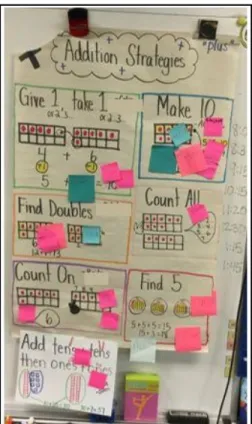
I created an Anchor Chart that illustrated each strategy the students shared: Give 1, Take 1, Make 10, Find Doubles, Count All & Count On (Figure 2). I had not planned to create an Anchor Chart, but it seemed like my students would benefit from naming their Number Talk strategies and having them recorded on an Anchor Chart for future use. My impromptu decision ended up guiding all future Number Talks and benefited both myself and my students as we worked to establish a classroom culture of math discourse. In what follows, I will share information on Anchor Charts, discuss how I use them as a way to facilitate our first-grade Number Talks and share tips for using Anchor Charts to implement Number Talks.
3 Anchor Charts
My impromptu decision to create an Anchor Chart in my classroom that day stemmed from my work with Anchor Charts in Reader’s and Writer’s Workshop, a curriculum popularized by Teacher’s College Reading and Writing Program (TCRWP) at Columbia University. In Reader’s and Writer’s Workshop (TCRWP), Anchor Charts play a key role in allowing students to access strategies they have learned and make connections with previous strategies (Calkins, 2015). Anchor Charts are used in workshop classrooms to help students discuss their reading and writing work. In addition, teachers talk about, refer to, and revise Anchor Charts often with students in whole group, small group, and partnership settings (Calkins, 2015). Often, these Anchor Charts become interactive. For example, students can use sticky notes with their names written on them to show which strategies from the Anchor Chart they have tried (Calkins, 2015). This idea of sticky notes was exemplified in Figure 1, which will be discussed more later.
Others have utilized Anchor Charts in mathematics classrooms, but not in association with Number Talks (Mraz & Martinelli, 2014). Brown (2014) shares how Anchor Charts provide “a permanent record of learning and a referent for future teaching” (p. 51) with the goal of helping students develop a growing repertoire of skills and strategies. In her article, Brown discussed different situations in which Anchor Charts can be used in mathematics and acknowledged that the appli-cations are limitless. For this article, the focus is on how Anchor Charts can play a crucial role in implementing Number Talks for early elementary students.
4 How Anchor Charts Support Number Talks
The first way I use Anchor Charts for Number Talks is during my planning as I choose which Number Talk to implement. I refer to the Anchor Charts to think through my problem choice to ensure that multiple strategies can be applied. As I plan, I also think about new strategies I hope my students will discover during the Number Talk that can then be added to the Anchor Charts. Spending this time anticipating strategies assists me as I facilitate our Number Talk discussions. The second way I use Anchor Charts for Number Talks is as Brown (2014) suggested—to publicly record multiple strategies for solving problems as a means to facilitate discourse. Humphreys & Parker (2015) explain Number Talks’ benefits to classroom discourse.
As students learn together that there are multiple ways to solve problems, and as they learn that they can make sense of mathematics in their own ways, mathematical dis-course in the classroom is enhanced. Students find themselves regularly using the Standards for Mathematical Practice (NGA/CCSSO, 2010): learning to reason mathe-matically, making mathematically convincing arguments, and critiquing the reasoning of others. (p. 66)
For first graders, an Anchor Chart’s public record provides students with a visual reference of different addition strategies and common language to guide our conversations about their thinking. The third way I use Anchor Charts for Number Talks is to develop students’ beliefs in them-selves as mathematicians. I find that publicly recording students’ strategies and naming them not only provides a future reference point, but perhaps more importantly, it teaches my students that everyone has a strategy and that all strategies are valued. The use of sticky notes for students to claim their strategy provides access for all students to be viewed as a mathematician. The National Council for Teachers of Mathematics’ (NCTM) publication,Principles to Action, claims that access and equity practices “empower all students to participate meaningfully in learning mathematics”
(2014, p. 60). If I implemented Number Talks without Anchor Charts, I do not believe I would be providing all students with a toolbox of where they might begin. More importantly, excluding Anchor Charts would inhibit students from developing their views of themselves as competent learners of mathematics.
The following example from my classroom during my first year teaching with Number Talks illustrates these three ways I use Anchor Charts to implement Number Talks. My goal for the Number Talk was for my students to focus on adding two two-digit numbers in a method that “ones adds tens and tens, ones and ones” (NGA/CCSSM, 2010, p. 16). Number choice was particularly important, so I looked back at other problems we had solved and decided to use the numbers 17 and 19 since we had been working on two-digit addition, but had not yet added two numbers so close to 20. To anticipate my students’ strategies, I looked at our addition Anchor Chart (see Figure 2) and thought about how students might use our posted strategies. Give 1 and Take 1 could work to make the 19 into a 20. Students might look at the values in the ones place and Make 10 by thinking of the nine as a three and six so the three could be combined with the seven to “make-a-ten.” For Find Doubles, my students had not doubled larger teen numbers, so I did not expect the strategy to be used. While doubles of 20 + 20 would be amazing to behold, I also did not anticipate my students would come up with a compensation method. I knew I would have some students draw tens and ones and Count All to solve, while I expected others would Count On, also with tens and ones drawings. I did not anticipate students would use the Find 5 method (it had been added to our Chart earlier in the year). I was hopeful that during our classroom discussion, someone would come up with a new strategy involving tens and tens, and ones and ones so I could add it to the Chart.
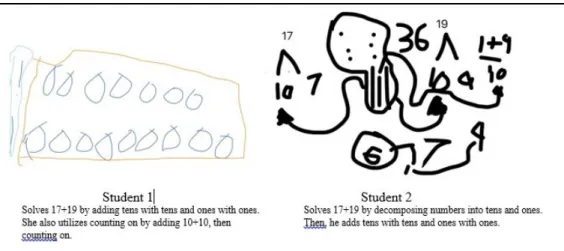
For this Number Talk, I chose a story problem for my students that required them to add 17 and 19. While not a traditional Number Talk in the sense that the students were not presented with a naked number problem, the norm of sitting together at the carpet with their iPads using the app Nearpod to solve problems individually and then share solutions during Number Talks was in place. While the students worked, I was able to monitor and then select who shared their solution (Smith & Stein, 2010). I first asked Emma (Student 1 in Figure 3) to share how she solved the story problem. She proceeded to tell the class that she “saw two tens and she knew that ten plus ten was 20.” Then, she counted on the rest, saying, “Twenty... 21, 22, 23, 24,” and so forth until she had counted all the ones. When I asked Emma to tell the class what strategy she used from our Anchor Chart, she immediately stated, “Count On.”
Next, I asked Jacob to share his ideas (Student 2 in Figure 3). I knew that Jacob’s strategy was advanced for several of the students in my class, but I also knew that it should help advance a class conversation of adding tens and tens, ones and ones. Jacob began by explaining how he broke the 17 and the 19 into tens and ones. Jacob continued to explain that after he broke the numbers into tens and ones, he put all of the tens together and then all of the ones together. At first, he got two tens, or 20. He knew that he could take a one from the seven ones (in 17) and add it to the nine ones (in 19). This would give him another 10. So now he had three tens, or 30 and six ones. Thus, his total was 36.
I displayed Jacob’s work using Nearpod and asked the class to turn and talk about which strategy from our Anchor Chart Jacob used. The ensuring discourse shows the depth of understanding of the different publicly recorded strategies that the class as a whole was developing through using the Anchor Charts as a reference point for different strategies.
MICHELLE: I think he did Noah’s strategy [Give 1, Take 1] because he took one from the seven and gave it to the nine to make a ten.
HENRY: Yeah, so he did Make 10.
THOMAS: I’m not really sure because he said he added the tens together and then the ones but that’s not a strategy on our chart.
ABBY: Count On. He said 30 then counted on the six, like 30... 31, 32, 33, 34, 35, 36.
After several minutes of debating and discussing what strategy Jacob used, the class decided that he used several of the strategies from the Anchor Chart, but that he also came up with a new one—Add Tens and Tens, Ones and Ones. I also asked the students to turn and talk about whether or not Emma broke her numbers into tens and ones. After a few minutes of comparing Emma’s and Jacob’s strategies, the class came to the consensus that Emma, like Jacob, broke the numbers into tens and ones. As I had hoped, we added that strategy onto our Anchor Chart (see bottom of Figure 2).
To end our discussion, I had my 15 students write their names on a sticky note and put it on our Anchor Chart to indicate the strategy they used (see the sticky notes on the Anchor Chart in Figure 2). I find that this serves as a means of formative assessment for myself, but also, as I mentioned before, claiming their strategy helps my students find agency for themselves as young mathematicians. Our new strategy was claimed by both Emma and Jacob. While Emma’s method of adding tens and ones was less sophisticated then Jacob’s, her method was reachable for most of my students and thus they could believe that they could solve a problem with similar thinking even though they may not yet be ready for Jacob’s strategy.
5 Conclusion
Anchor Charts are a useful tool for facilitating mathematical discourse when implementing Number Talks. For early elementary students, Anchor Charts serve not only as a reminder of different strategies to utilize when problem solving, but also as a means to increase discourse through creating a common language. Anchor Charts help facilitate the Number Talk discourse to focus on making connections between different strategies and how strategies can be represented in a variety of ways. Because Anchor Charts helped drive my class’s mathematical discussions during Number Talks, the students in my classroom came to view mathematics as something that they could do, and most importantly, as something they should and could discuss with each other.
6 Tips for Using Anchor Charts to Support Number Talks
To assist you as you think about bringing Anchor Charts into your Number Talks and mathematics classroom, or if you’re thinking through different ways to incorporate Anchor Charts you have already created, we recommend the following:
• Use Anchor Charts as a means to record students’ strategies.
• Encourage students to name the Anchor Chart strategies they used as you facilitate Number Talks.
• Refer to the Anchor Charts during planning to anticipate different strategies your students may use.
• Add additional strategies to Anchor Charts as students develop them.
• Have students place sticky notes with their names on the Anchor Chart to indicate which strategies they used to solve a particular problem for formative assessment for you and agency for themselves.
• Keep the Anchor Charts centrally located and refer to them often, not just during Number Talks.
References
Berger, A. M., County, H., & Service, E. (2017). Using number talks to build procedural fluency through conceptual understanding.Ohio Journal of School Mathematics, 75,1-7.
Brown, J. (2014). Hook and hold.Teaching Children Mathematics, 21(1), 46-54. Calkins, L. (2015).A guide to the reading workshop.Heinemann.
National Governors’ Association Center for Best Practices, Council of Chief State School Officers (NGA/CCSSO) (2010).Common Core State Standards Mathematics. Washington, DC: Author. Humphreys, C., & Parker, R. (2015).Making number talks matter: Developing mathematical practices and
deepening understanding, grades 4-10.Portsmith, NH: Stenhouse Publishers.
Mraz, K. & Martinelli, M. (2014).Smarter charts for math, science & social studies.Portsmouth, NH: Heinemann.
National Council of Teachers of Mathematics (2014).Principles to actions: Ensuring mathematical success for all.Reston, VA: Author.
Parker, R., & Humphreys, C. (2018).Digging deeper: Making number talks matter even more, grades 3-10.Portsmith, NH: Stenhouse Publishers.
Parrish, S. (2010).Number talks: Helping children build mental math and computation strategies, K-5. Sousalito, California: Math Solutions.
Smith, M., & Stein, M. K. (2011).5 practices for orchestrating productive mathematics discussions.Reston, VA: National Council of Teachers of Mathematics.
Katie Birois a first grade teacher in the Milton Area school district with a Master of Education in Special Education from Lesley University. Her research interests include curriculum design, specifically around developmentally ap-propriate instruction and assessment, and building autonomy within teachers and students through choice and language.
Lara K. Dick,[email protected], is an Assistant Professor of Mathe-matics in the Department of MatheMathe-matics at Bucknell University. Her research interests include development of K-12 preservice and practicing teachers spe-cialized content knowledge (SCK) and how SCK development relates to their noticing of childrens mathematical thinking.