
Middleware and Management
Standard Bodies and Standards
Dr. Sven van der Meer
Telecommunication Software and Systems Group
Waterford Institute of Technology
Table of Contents
1 Distributed Management Task Force ...3
1.1. Common Information Model...3
1.2. Directory Enabled Networks ...4
1.3. Web-based Enterprise Management ...4
2 Internet Engineering Task Force ...4
2.1. Simple Network Management Protocol...4
3 International Telecommunication Unit ...5
3.1. Reference Model for Open Systems Interconnection ...6
3.2. The OSI Directory ...6
3.3. Framework for the Management of Open Systems...7
3.4. Telecommunication Management Network ...9
3.5. Reference Model for Open Distributed Processing ...10
3.6. Intelligent Network...11
4 Object Management Group ...12
4.1. Object Management Architecture ...12
4.2. Joint Inter-Domain Management...13
4.3. Model Driven Architecture...14
5 TeleManagement Forum...15
6 TINA Consortium...16
7 World Wide Web Consortium...18
1
Distributed Management Task Force
The Distributed Management Task Force (DMTF) is an industry organization that has a clear mission: to lead the development of management standards for distributed desktop, network, enterprise, and Internet environments. The DMTF can be understood as an umbrella organization that tries to accelerate the adop-tion of management standards, unifies industry management initiatives, and promotes interoperability among management solution providers.
The work of the DMTF is divided into marketing and technical issues. Each area is accompanied with its own committee that oversees the operations of the DMTF working groups. Those working groups are established by contributing members.
1.1.
Common Information Model
The Common Information Model (CIM) applies the basic structuring and conceptualisation techniques of the object-oriented paradigm for the management of systems and networks. A uniform modelling formal-ism and the basic repertoire of object-oriented constructs support the cooperative development of an ob-ject-oriented schema across multiple organizations. [DMTF-CIM]
CIM Meta Model Content of CIM Realization of CIM
Class
Core Schema, Common Schema, Extension Schemas has instances realization
Objects
Repository Application DBMS Application Objects Exchange Parameter
Figure 1-1: CIM – Four Ways of Use [DMTF-CIM]
CIM provides a management schema with respect to classification and association. This enables the es-tablishment of a common framework for the description of the managed environment. The schema com-prises conceptual layers. The Core Model represents an information model that captures notions that are applicable to all areas of management. The Common Model is an information model that captures no-tions, which are common to particular management areas. The common areas are system, application, database, network, and devices. Extension schemas represent technology-specific extensions of the Common Model for specific environments such as operating systems.
CIM provides a set of legal statement types or syntax to capture representation and a collection of actual expressions necessary to manage common aspect of a domain in form of an information model. Manage-ment schemas are building blocks for platforms and applications. CIM is structured in a way that the managed environment can be seen as a collection of interrelated systems. Each system is composed of a number of discrete elements.
The conceptual model of CIM can be implemented in various ways. Figure 1-1 shows four different alter-natives. A repository is used to store meta model information for program access. A Database Manage-ment Server (DBMS) can be used to transform conceptual definition into to physical schema for particu-lar database technology. A set of data-oriented application objects can be instantiated and extended in the target technology. Finally, the content of CIM is used to structure instances passed between applications. [DMTF-CIM]
1.2.
Directory Enabled Networks
A Directory Enabled Network (DEN) provides building blocks that map users to network services and business criteria to the delivery of network services. Applications and services are able to transparently leverage network infrastructure on the behalf of the user, on base of a network-wide service creation, provisioning, and management. The central information repository of a DEN is a directory. Here, rela-tionships of users and applications to network services are defined. The management of networked appli-cations is done by associating users and appliappli-cations according to a consistent and rational set of policies. The definition of the repository is based on CIM enabling cross-domain solutions.
1.3.
Web-based Enterprise Management
The Web-based Enterprise Management (WBEM) initiative was originally founded by seven companies with the primarily focus to provide web access to enterprise management information and systems. Fol-lowing the goal of the DMTF to tie industry organizations and standards together, WBEM is now a part of the overall DMTF strategy.
2
Internet Engineering Task Force
The Internet Engineering Task Force (IETF) is an international community of network designers, opera-tors, vendors, researchers, and any interested individual. This organization is concerned with the evolu-tion of the Internet architecture and the smooth operaevolu-tion of the Internet. The technical work is done by working groups covering topics like operation & management, routing, and security. Standards are called Request for Comment (RFC). An RFC is developed through publication of several draft documents.
2.1.
Simple Network Management Protocol
The Simple Network Management Protocol (SNMP) defines a framework for the management of Internet Protocol (IP) based data communication network devices. The basic principle of SNMP is simplicity. This results in small, simple, and (mostly) cheap agent software, applicable for devices like modems, bridges, hubs, routers, printers, etc. [IETF-RFC1157]
get get-next set Management Station MO Proxy Agent Managed Node trap get get-next set NE NE NE MO MO AE PE PE AE PE AE
Figure 2-1: Simple Network Management Protocol [Badach94]
All versions of SNMP share the same basic structure and components, and follow the same architecture. The framework consists of a data definition language, a definition of management information, a protocol definition, security, and administration. It articulates a solution for network management in terms of the scope of the management information communicated by the protocol, the representation of the manage-ment information communicated by the protocol, operations on managemanage-ment information supported by the protocol, the form and meaning of exchanges among management entities, the definition of
adminis-trative relationships among management entities, and the form and meaning of references to management information. [IETF-RFC1157]
With the different versions of SNMP (v1, v2), the functions added are becoming more complex. SNMPv3 solves this problem. Version 3 is driven by the goal to define an architecture that allows for the longevity of the SNMP framework enabling to move portions of the architecture forward in the standards track, even if consensus has not been reached on all pieces. It keeps the simplicity of the prior SNMP versions that enables a relatively inexpensive deployment of minimal conform implementations. [IETF-RFC3411] The new framework separates the SNMP management logic from the actual transport network. This is realized with a number of sub systems. A dispatcher offers access to any transport network, a message processing subsystem is responsible for the processing of SNMP messages of all known version [IETF-RFC2572], and a security sub system performs security checks and data encryption. A special focus was set on security. This resulted in an enhanced security model [IETF-RFC2574]. The access to SNMP man-aged objects is regulated by a view based access model. [IETF-RFC2575]
The SNMP framework provides the basis of all management standards within the Internet. Based on SNMP, Management Information Bases (MIB) have been specified, such as the application MIB [IETF-RFC2564]. The actual number in June 2001 was 139.
SNMP Standards
SNMP Version Standards
HEMS RFC 1021 (High-level Entity Management System), RFC 1022 (Protocol), RFC 1023 (Control Language), RFC 1024 (Variable Definitions)
SGMP RFC 1028 – A Simple Gateway Monitoring Protocol
Intermediate RFC 1052 – Recommendations for Internet Network Management Standards Version 1 RFC 1155 (SMI1), RFC 1157 (SNMP), RFC 1212 (Concise MIB), RFC 1213 (MIB) Version 2 RFC 1441 (Framework), RFC 1445 (Administrative Model), RFC 1446 (Security
Protocols), RFC 1447 (Party MIB), RFC 1451 (Manager-to-Manager MIB) Version 2
Community
RFC 1901 (Community), RFC 1905 (Protocol Operations), RFC 1906 (Transport Mappings), RFC 1907 (SNMP MIB), RFC 2576 (Coexistence between v1 and v2), RFC 2578 (SMI), RFC 2579 (Textual Conventions), RFC 2580 (Conformance) Version 2 USEC RFC 1909 (Administrative Infrastructure), RFC 1910 (User-based Security) Version 3 RFC 3411 (Architecture), RFC 3412/2572 (Message Processing and Dispatching),
RFC 3413/2573 (Applications), RFC 3414/2574 (Security), RFC 3415/2575 (Ac-cess Control), RFC 3416 (Protocol Operation), RFC 3417 (Transport Mappings), RFC 3418 (SNMP MIB)
Table 2-1: SNMP Request for Comments
3
International Telecommunication Unit
The International Telecommunication Unit (ITU) is a worldwide organization within which governments and the private sector co-ordinate the establishment and operation of telecommunication networks and services. The ITU regulates, standardizes, co-ordinates, and develops international telecommunication as well as the harmonization of national policies. The ITU, now responsible for former CCITT2 activities, is an agency of the United Nations. The standards of the ITU are called recommendations.
1 Structure of Management Information
Several ITU standard tracks are of interest for this work. The ITU X-series has defined a number of widely known and well-accepted architectures and frameworks collected under the item of Open Systems Interconnection (OSI). This series covers a reference model for open systems, a global directory service, management within open systems, and a reference model for the development of distributed systems. Furthermore, this work recognizes parts of the Q-series that define a model for advanced telecommunica-tion services and parts of the M-series that specify a methodology for telecommunicatelecommunica-tion management.
3.1.
Reference Model for Open Systems Interconnection
The Reference Model for Open Systems Interconnection (RM-OSI) offers a common basis for the coor-dination of standards development within an OSI environment. Today, the reference model is used among several communities as a common terminology for the description of open systems. The term OSI quali-fies standards for the exchange of information among systems that are ‘open’ to one another, but does not imply any particular system implementation.
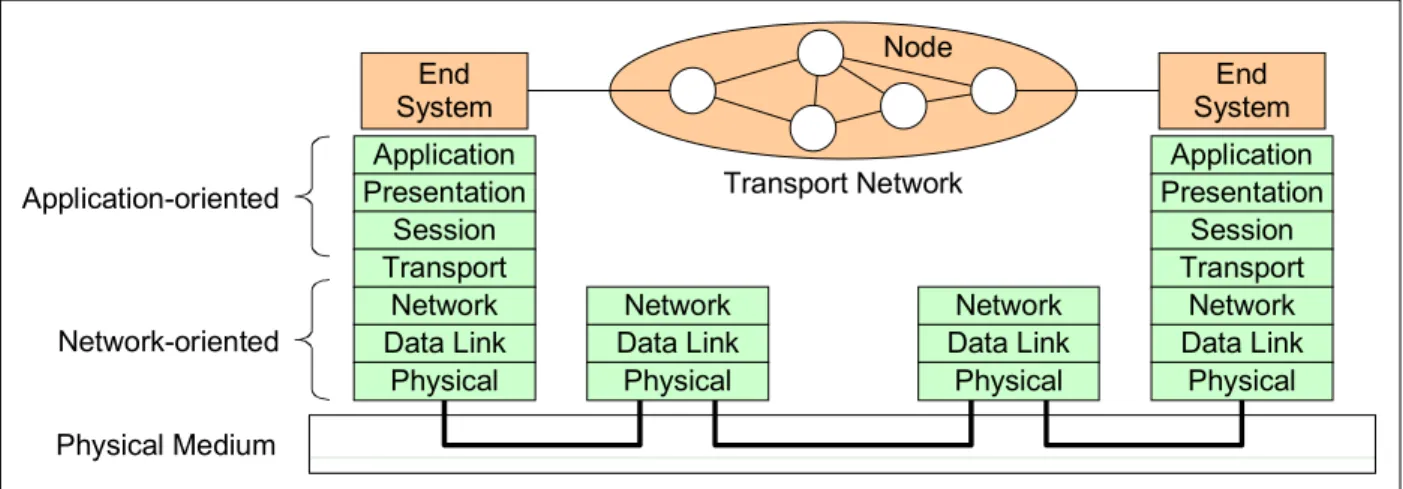
End System Node Transport Network Physical Medium Application-oriented Network-oriented Application Presentation Session Transport Network Data Link Physical Application Presentation Session Transport Network Data Link Physical Network Data Link Physical Network Data Link Physical End System
Figure 3-1: OSI Reference Model The idea of a layered view to communication systems is shown in Figure 3-1. Communication networks consist of hardware and software components. Relationships among those components are described by a network topology. The logical architecture of the RM-OSI describes the structure of communication pro-tocols and software components. Each open system is viewed as logically composed of an ordered set of (N)-subsystems. Subsystems communicate with adjacent subsystems through common boundaries. There exists only one subsystem for each of the seven identified layer. A subsystem consists of one or more entities. Entities of the same layer are termed peer entities. [ITU-X200]
RM-OSI Recommendations
Standard Definitions Standard Definitions
X.200 The basic model X.210 Conventions for the definition of OSI services Table 3-1: RM-OSI Recommendations
3.2.
The OSI Directory
The OSI Directory is specified in the X500 series. The Directory represents a global database with a uni-form and user-friendly name space. It supports uniuni-form management of inuni-formation about organizations, persons, services, etc. available via directories of addresses of every type of information. Within the Di-rectory, a name-to-address mapping allows the binding between objects and their locations to be dynamic. The Directory is not intended to be a general-purpose database system, although it may be built on such systems. It is assumed that there is a considerably higher frequency of queries than of updates. The rate of
updates is expected to be governed by the dynamics of people and organizations, rather than the dynamics of networks. There is also no need for instantaneous global commitment of updates; transient conditions where both old and new versions of the same information are available are quite acceptable. [ITU-X500] It is a characteristic of the Directory that, except because of differing access rights or un-propagated up-dates, the results of directory queries will not be dependent on the identity or location of the inquirer. This characteristic renders the Directory unsuitable for some telecommunications applications, for example some types of routing. [ITU-X500]
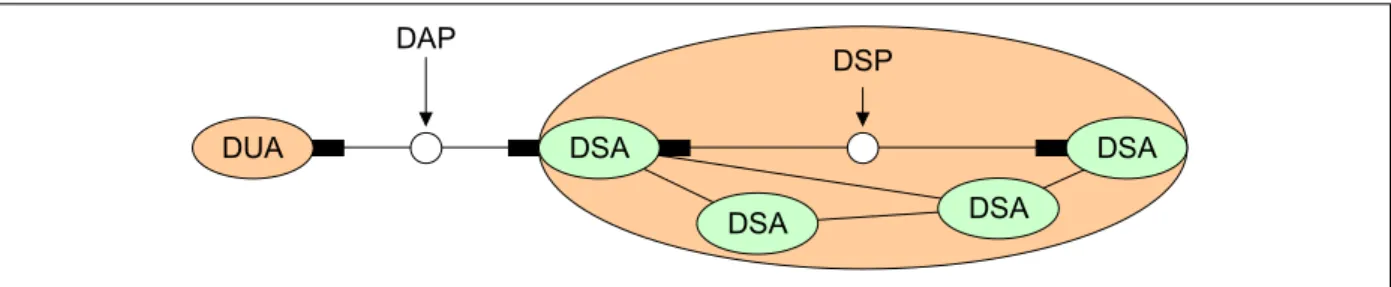
DUA DAP DSP DSA DSA DSA DSA
Figure 3-2: The OSI Directory Information is stored in the Directory Information Base (DIB) in form of objects. The DIB is composed of entries where each entry consists of a collection of information objects. Entries contain attributes, which are a combination of a type and one or more values. The entries in the DIB are arranged in form of a tree that is called the Directory Information Tree (DIT). All directory services operate on this DIT. The Directory is a combination of Directory System Agents (DSA) where each of them is responsible for a certain part of the directory tree. The services of the directory are provided to Directory User Agents (DUA) acting on behalf of users. This structure is shown in Figure 3-2. The directory provides its services in form of directory operations. The read operation interrogates a single entry. The search operation al-lows interrogating potentially several entries at once. The modify operation can be used to alter the values of attributes of an entry. The DUA can access any DSA with the Directory Access Protocol (DAP) while DSAs inside of the directory communicate with the Directory System Protocol (DSP).
Access to Directory information is determined by an administratively controlled security policy. Two aspects of the security policy that affect access to the directory are the authentication procedures and the access control scheme.
OSI Directory Recommendations
Standard Definitions Standard Definitions
X.500 Overview of Concepts, Models and Services
X.501 Information and Administration Models, Directory Schema
X.509 Authentication Framework X.511 Abstract Service Definition
X.518 Procedures for Distributed Operation X.519 Protocol Specifications
X.520 Selected Attribute Types X.521 Selected Object Classes
X.525 Replication X.530 Administration of the Directory
Table 3-2: OSI Directory Recommendations
3.3.
Framework for the Management of Open Systems
The OSI network management concentrates on the administration of resources in an OSI environment. Three areas of concern are outlined for a network management system: a management concept, a model for management functions, and an object-oriented data model. The OSI management standards define
concepts and rules the four management models: information, functional, communication and organisa-tion.
Resources are viewed as managed objects with defined properties. Information required for systems man-agement may be provided through local input, may result from input from other open systems through systems management (application layer) communication, or may be a result of lower layer protocol ex-changes. The requirements for management activities are grouped into the five areas known as FCAPS: fault, configuration, accounting, performance, and security. [ITU-X700] [ITU-X703]
Three forms of management information exchange are defined within the OSI management architecture (cf. Figure 3-3). Systems management is the preferred form. It provides mechanisms for the exchange of information relating to monitoring, control, and coordination of resources.
(N)-layer management is used to carry information related to the operation of a layer, for instance the Network Connection Management Sub-protocol (NCMS). It is not compliant with RM-OSI to duplicate functionality with this form of management. Recommendations are available for the layers 2, 3, and 4. (N)-layer operation is the set of facilities which control and manage a single instance of communication. These facilities can be embedded within an existing protocol or they are a special element of a protocol.
Application Presentation Session Transport Network Data Link Physical Application Presentation Session Transport Network Data Link Physical
System Management Protocol
Layer Management Protocol
Communication Protocol
Figure 3-3: Management of Open Systems [ITU-X700]
The ITU has recognized early that middleware as getting a significant opportunity for management. It has developed the Open Distributed Management Architecture (ODMA), which is a combination of middle-ware and the X.700 management paradigms. This architecture has not had the promised impact in state-of-the-art management systems, although it has influenced other standards.
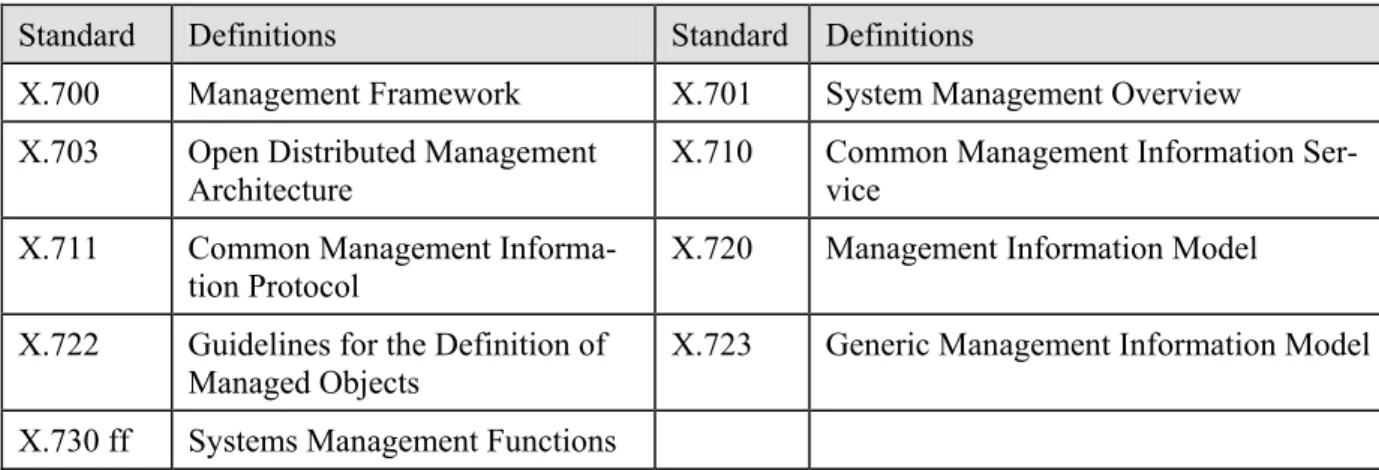
OSI Management Recommendations
Standard Definitions Standard Definitions
X.700 Management Framework X.701 System Management Overview
X.703 Open Distributed Management Architecture
X.710 Common Management Information Ser-vice
X.711 Common Management
Informa-tion Protocol
X.720 Management Information Model
X.722 Guidelines for the Definition of Managed Objects
X.723 Generic Management Information Model X.730 ff Systems Management Functions
3.4.
Telecommunication Management Network
The purpose of the Telecommunication Management Network (TMN) is to support administration in managing telecommunication networks and services. It represents a framework to achieve interconnection of operation systems and telecommunication equipment through an agreed architecture with standardized protocols and standardized interfaces. TMN claims to support public, private, and mobile networks as well as Intelligent Networks, Public Switched Telephone Network (PSTN), Asynchronous Transfer Net-work (ATM), and Synchronous Digital Hierarchy (SDH) netNet-works. The TMN standards define three ar-chitectures. [ITU-M3000] [ITU-M3010]
to other TMNs Operations System Exchange P 7085 2 Transmission Systems Exchange Transmission Systems Exchange TMN Workstation Data Communication Network
Operations System Operations
System
Figure 3-4: TMN General Overview [ITU-M3010]
The Information Architecture is based on an object-oriented approach. It gives the rationale for the application of OSI systems management paradigms to TMN principles. TMN standardization activities are not going to develop a specific paradigm but build upon industry recognized solutions. Based on the specifications of OSI Management, the information architecture describes a model for network informa-tion and the concept for shared management knowledge. Both are used to realize cascaded interacinforma-tions among management applications that act in manager and agent role simultaneously.
The Functional Architecture describes the distribution of functionality by means of functional blocks and reference points. The creation of functional blocks allows the implementation of a TMN of any com-plexity. The reference points among those blocks leads to TMN-recommended interface specifications. The functional architecture supports the modular design of management applications.
The Physical Architecture focuses on physical blocks, interfaces, and components that are derived from the functional architecture. It also provides examples for the physical realization of a TMN system and enables the implementation of management applications with standardized interfaces and protocols. In addition, the Logical Layered Architecture contributes a logical reference model for the partitioning of management functionality into groups called logical layers. The layers are defined to model an entire telecommunication company starting with business processes and services up to networks and single net-work elements. This enables to deal with the complexity of telecommunication management.
TMN Recommendations
Stan-dard
Definitions Standard Definitions
M.3010 Principles M.3400 Management Functions
M.3020 Interface Specification Methodology M.3180 Catalogue of Management Information M.3200 Overview of Management Services M.3100 Generic Network Information Model
3.5.
Reference Model for Open Distributed Processing
The Reference Model for Open Distributed Processing (RM-ODP) consists of four parts: object model-ling, viewpoints, distribution transparencies, and framework. Together they form an architecture integrat-ing support for distribution but also for interworkintegrat-ing (between ODP systems), interoperability, and port-ability (independence from hardware and software platforms).
The major part of the reference model is the definition of five viewpoints as shown in Figure 3-5. Each of them makes consideration of an ODP system from a different perspective. A viewpoint serves as an ab-straction to a particular set of concerns. The viewpoints are independent of each other. However, key elements of one viewpoint may be related to items of other viewpoints. [ITU-X901]
Computational ODP System Enterprise Engineering Technology
Information RequirementsAnalysis Functional Specification Design Implementation Computational Viewpoint Information Viewpoint Enterprise Viewpoint Technology Viewpoint Engineering Viewpoint
Figure 3-5: Reference Model for Open Distributed Processing [Raymond95]
Viewpoints, viewpoint specifications, and distributed transparencies form the architectural framework of the reference model. A corresponding language is defined for each viewpoint. A viewpoint language consists of definitions of concepts and rules. RM-ODP defines five viewpoints to be both simple and complete, covering all the domains of architectural design [ITU-X901] [ITU-X903].
The enterprise viewpoint is concerned with the purpose, scope, and policies governing the activities within an organization. The information viewpoint deals the information handled by the system, con-straints on the use, and interpretation of that information. The computationalviewpoint focuses on the functional decomposition of the system into a set of objects. The engineering viewpoint identifies the infrastructure required to support system distribution. The technology viewpoint covers the choice of technology to support system distribution.
A number of concerns appear regarding distribution. Components can be heterogeneous, they can fail independently, and their location can vary. Transparencies are the standard solution that enables the de-signer to work in a transparent world. The reference model introduces transparencies for access, failure, location, migration, relocation, replication, persistence, and transaction.
[ITU-X902] states that the reference model is concerned with overall systems management. This type of management is similar to the definitions of OSI management.
RM-ODP Recommendations
Standard Definitions Standard Definitions
X.901 Overview X.902 Foundations
X.903 Architecture X.904 Architectural semantics
X.910 Naming Framework X.920 Interface Definition Language
X.930 Interface References / Binding X.950 Trader Function Specification Table 3-5: RM-ODP Recommendations
3.6.
Intelligent Network
The Intelligent Network (IN) is a telecommunications network service control architecture providing an open platform supporting the uniform creation, introduction, control, and management of services beyond the basic telephone services. The platform should scale to an unknown number of users and a multitude of services offered at different locations and at different service qualities by different service providers. In principle, IN addresses three major goals for the defined architecture: [Magedanz99a]
• service independence through the definition of generic service building blocks;
• network independence through the definition of functional network elements; and
• vendor independence through the definition of unique interfaces and protocols.
The IN architecture allows a variety of different services to be provided independent of network tech-nologies. It defines a service-oriented functional architecture, which enables the provision of generic vice components. These service components can be combined to construct new services. Although ser-vices can be realized equally within existing network environments, the most attractive advantage IN is the uniformity of service creation, provision, and management. [ITU-Q1201]
Network Resources (PSTN, PLMN, B-ISDN) IN Architecture (SSP, SCP) Service Independence Network Independence SIB SIB SIB Service A Service B IN Platform
Figure 3-6: Intelligent Network [Magedanz96]
IN is more than just a network architecture. It represents a complete framework for the uniform creation and provision of telecommunication services. In particular, the IN concept can be regarded as a step to-wards an integration of different network technologies, where the IN provides a generic programming interface for network transparent service provision. IN turns the network into a programmable entity. The IN standards develop an IN Conceptual Model (INCM). The basic idea is to define a top-down ap-proach for the definition of IN architectures. The INCM defines four planes addressing service design aspects, global and distributed service provisioning functionality, and physical aspects of an IN-structured network. These are called service plane, global functional plane, distributed functional plane, and physical plane. It has to be stressed, that the INCM represents only a modelling tool for describing the capabilities and characteristics of an IN-structured network and not an IN architecture in itself.
IN Recommendations Definitions Standards Conceptual
Model
Q.1200 (Series Structure), Q.1201 (Principles of the Architecture), Q.1202 (Service Plane), Q.1203 (Global Functional Plane), Q.1204 (Distributed Functional Plane), Q.1205 (Physical Plane), Q.1208 (Application Protocol), Q.1209 (Glossary) Capability Sets for each Capability Set x, the IN Recommendations are structured in accord to the
Conceptual Model: Q.12x0 (Structure of CS x), Q.12x1 (Introduction to CS x), Q.12x2 (Service Plane for CS x), Q.1203 (Global Functional Plane for CS x), Q.12x4 (Distributed Functional Plane for CS x), Q.12x5 (Physical Plane for CS x), Q.12x8 (Interfaces for CS x), Q.12x9 (User’s Guide for CS x)
4
Object Management Group
The Object Management Group (OMG) was founded in April 1989. The main goal of this organization is the definition of a run-time system for distributed, object-oriented applications. This is achieved by adopt-ing interface specifications and protocol specifications, supportadopt-ing inter-operable applications based on interoperating objects. Objectives of the development are portability, reusability, interoperability, modu-lar productions, incremental implementation, design portability, and reuse of code.
One objective of the OMG is to reach a consensus on interoperability, because there will be no consensus on hardware platforms, operating systems, network protocols, or application formats. This is done by interworking of developers, operating system vendors, and hardware vendors within the OMG. In this concept, heterogeneity is referenced to different applications, different operating systems, different net-work technologies, and different hardware platforms.
4.1.
Object Management Architecture
The Object Management Architecture (OMA) (Figure 4-1) embodies OMG’s vision for the component software environment. It shows how the standardization of component interfaces influences application objects in order to create a plug-and-play software environment. Application objects are not standardized by the OMG.
However, applications are able to access common object services (CORBAservices) and facilities (COR-BAfacilities) through standard interfaces. Each service and each facility is standardized within a service definition by interfaces in the Interface Definition Language (IDL) and semantic in normal text. The final architecture is the Common Object Request Broker Architecture (CORBA).
Externalization Security Time, Query Property Licensing Life-cycle Event, Naming Persistence Transaction Concurrency
Object Request Broker
General Service Interfaces
Common Object Services (CORBAservices)
Vertical Facilities Horizontal Facilities
Domain-specific Interfaces Common Facility Interfaces
Common Facilities (CORBAfacilities)
Application Objects
Non-standardized Application-specific
Interfaces
Figure 4-1: OMG – General Service Interfaces [OMG-OMA]
CORBAservices provide a set of services to objects that. Most of the identified services are listed in Figure 4-1. Where CORBAservices provide services for objects, CORBAfacilities provide services for applications. Two parts can be clearly separated: horizontal and vertical domain facilities. The horizontal facilities can be used to virtually every business.
The vertical facilities standardizing management of information specialized to particular industry groups. They are oriented on market domains like finance, electronic, healthcare, telecommunications, transport, manufacturing, utilities, and space.
4.2.
Joint Inter-Domain Management
The Joint Inter-Domain Management (JIDM) provides a mapping scheme between TMN3/SNMP4 and CORBA to introduce mechanisms handling protocol and behaviour conversions. The realization of mechanisms for the interworking with different management systems depends on the successful settle-ment of two major issues [CORBA-TMN]: the translation of specifications and the translation of interac-tions.
The provision of a translation scheme between the different object models of both management architec-tures also referred to as specification translation. This means that translation algorithms for both TMN and SNMP based systems need to be defined. For TMN, translations from ASN.15 to IDL and vice versa are needed. For SNMP, translations from SMI6 to IDL and vice versa are needed.
The translation of interactions focuses on the provision of a dynamic conversion mechanism between the protocols and behaviours. A set of CORBA facilities is required to support the interworking between different management environments.
Two levels of interfaces can be identified for the CORBA facilities based on the different level of abstrac-tion. Management model independent interfaces provide a generic framework to access a managed do-main, independently from the management reference model that is being used.
Management model dependent interfaces provide a lower level interface to existing information models of TMN and SNMP based systems. In this way, the generic interface is extended to support the specific interactions of the two reference models.
Managing System CORBA-based Managing System OSI-based Managing System CORBA-based Managing System CORBA-based Managed System CORBA-based Managed System OSI-based Managed System Managed System CMIP interface CMIP/CORBA Gateway CMIS Manager IDL interface CORBA/CMIP Gateway CORBA Manager Manager CORBA Manager using OSI Management Model IDL interface CORBA MOs CORBA
Agent CORBA Agent using OSI Management Model GDMO MOs CMIS Agent MOs Agent
CMIP interface IDL interface Protocol
2
1 3 4
Figure 4-2: Scenarios of CORBA Usage for Management Systems [Magedanz99a]
The possible scenarios for the interworking of CORBA and management systems are shown in Figure 4-2. This figure demonstrates also possible migration steps from a classical management system (1), via gateways for the interworking between middleware and management systems (2, 3), and towards an
3 Telecommunication Network Architecture 4 Simple Network Management Protocol 5 Abstract Syntax Notation 1
tire CORBA-based management (4). All four scenarios assume an interworking with OSI/TMN manage-ment systems. Nevertheless, interworking with SNMP managemanage-ment systems can be done in the same way. Case 2 and 4 depict a CORBA-based management system with CORBA managers. In case 2, this system manages an OSI system including OSI Agents and managed objects. The CORBA manager exchanges information via a CORBA/CMIP7 gateway. Case 4 reflects the management of a CORBA system that implements CORBA agents that can handle the OSI management model.
The OSI agents in scenario 2 need not to be changed (they are not aware of being managed by a CORBA manager) thus enabling a smooth transition from scenario 1 towards scenario 2. On the other, the CORBA manager communicates in both cases with IDL interfaces with its agents. This enables a seamless migra-tion from scenario 2 towards scenario 4 at least for the CORBA manager implementamigra-tion.
The case 3 depicts the opposite scenario. The managing system is based on conventional OSI manager and the managed system is changed CORBA agents and managed objects that are modelled with IDL. The protocol is based on the IDL object definition and therefore the existence of a CMIP/CORBA gate-way in the managing system is essential. This case changes both, the managing and the managed system.
4.3.
Model Driven Architecture
The Model Driven Architecture (MDA) is an approach to the full lifecycle integration and interoperability of enterprise systems comprised of software, hardware, humans, and business practices. It provides a systematic framework to understand, design, operate, and evolve all aspects of such enterprise systems, using engineering methods and tools. The framework is based on modelling different aspects and levels of abstractions of the systems, and exploiting interrelationships between these models.
The MDA is a generic framework that builds upon common modelling techniques such as the Unified Modeling Language (UML) and the Meta Object Facility (MOF), and software infrastructures like CORBA and Enterprise Java Beans (EJB). Of special importance is the realization of a common reposi-tory where the information on components stemming from the different modelling steps is held in.
Component Bus (CORBA/CCM, Java RMI/EJB, .NET, XML/XMI/HTTP)
Distributed Component Services Application
Models / Interfaces Domain / BusinessModels Models (I/F)Technology
Component Repository MOF XMI XML APIs APIs APIs defined
Trading, Transactions, Agents... Component and Application Management
Figure 4-3: OMG E-Business Architecture MOF standardizes a model repository facility. The information in the repository includes meta-data on components, their interfaces, how they interact, and how they are configured. This information is essen-tial for the subsequent phases in the software lifecycle, mainly deployment and operation. With this meta-data on components, the configuration steps in the deployment and operation phases are drastically eased.
OMG Standards
Track Standards
OMA A discussion of the Object Management Architecture. OMG Modeling
Specifications
OMG Unified Modeling Language Specification, Version 1.3 Meta Object Facility (MOF) Specification, Version 1.3
OMG XML Metadata Interchange (XMI) Specification, Version 1.1
CORBA The Common Object Request Broker: Architecture and Specification, Version 2.4.2 CORBA
Services and Domain Specifications (selected items)
Event Service Specification, Version 1.0
Internationalization, Time Operations, and Related Facilities Interoperable Naming Service Specification.
Life Cycle Service Specification, Version 1.1 Notification Service Specification, Version 1.0 Telecom Log Service Specification, Version 1.0
Interworking Between CORBA and TMN Systems Specification, Version 1.0 MDA White Papers and other draft documents under www.omg.org/mda
Table 4-1: OMG Standards
5
TeleManagement Forum
The TeleManagement Forum (TM Forum) is a non-profit global organization that focuses on the im-provement of management and operation of communication services. The members are service providers, computing and network equipment suppliers, software solution suppliers, and customers of communica-tion services. The TM Forum organizes technical programs, market centres, and catalyst projects that shall enable market-based solutions for the integration of Operations Systems and Software (OSS) and business automation.
The key areas of the TM Forum are the New Generation Operations Systems and Software (NGOSS), Business Process Modelling and Automation, Managing Next Generation Network Technologies, Sys-tems Integration and Implementation, Service Management, Web-Based Customer Care (E-Care), Cus-tomer Relationship Management (CRM), and Managing E-Commerce.
The NGOSS initiative aims to provide a framework of principles and procedures that can be used to iden-tify business needs in a more effective way. Furthermore, the framework should be applicable to model enterprise solutions and realize software system-based implementations. This goal should be achieved by providing the process methodologies needed for developing, deploying, and modifying OSS components in a plug and play fashion. The defining characteristics of the NGOSS architecture include:
• A framework for loosely coupled distributed components with well-defined contract interfaces;
• business functionality partitioned across components according to a standard reference model;
• the separation of business process control from component operation with a separate entity to orches-trate the operation of the components;
• shared information services used across components; and
• technology independence, i.e. capable of being implemented in various distributed systems tech-nologies.
As part of the NGOSS initiative, the TM Forum is enhancing its existing Telecom Operations Map (TOM) into a Business Process Framework (eTOM) for the service provider enterprise in the market. The eTOM is an essential element of the Business Framework Services of the NGOSS program as it provides a business process model that aids in the development of the NGOSS system specification and implemen-tation work.
In addition, the TM Forum intends to develop a methodology using an NGOSS knowledge base, whereby the business view can be transformed into a system view, implementation view, and finally run-time view so that implementable NGOSS contracts can be derived from business requirements.
The plug and play concept implies the availability of some type of back plane in order to plug the compo-nents to OSS and the definition of the connectors (or interfaces) to be included in each component. TM Forum standards are only available for consortium members.
6
TINA Consortium
The Telecommunication Information Networking Architecture Consortium (TINA-C) was an interna-tional organization of major network operators, telecommunication provider, and computer vendors. The consortium has stopped its work at the end of 2001. Most of the recommendations of TINA-C (collected in the TINA 1.0 specification series) have been adopted by other standardization organizations like the OMG and by the TM Forum.
TINA by itself is an architecture developed by this consortium. It represents a software architecture for information networking, which is based on distributed computing technologies. TINA designed to enable rapid and flexible introduction of new telecommunication services.
Network Architecture TINA-C Overall Architecture Service Architecture Computing Architecture Management Architecture Session Model Subscription Model DPE Architecture Configuration Management Fault Management Network Resource Model
Figure 6-1: TINA Architectures [TINA-OCP]
The outcome is an integration of well-known computer technologies into future telecommunication ser-vices as well as in traditional telecommunications. Using the advantage of distributed computing, soft-ware engineering, object-oriented methodologies, and network management leads to heterogeneous envi-ronments, hiding the distribution of information objects. In order to handle this complexity, TINA is di-vided into four areas [TINA-OCP]:
• The Computing Architecture defines a set of concepts for the design of distributed software using object-oriented principles based on ODP.
• The Service Architecture introduces a set of rules and concepts for the design, the specification, the implementation, and the management of telecommunication services. The three fundamental con-cepts are: session, access, and management.
• The Network Architecture investigates in the area of network management. The outcome of this architecture is the definition of a generic Network Resource Information Model (NRIM), a Connec-tion Graph (CG) model, and the ConnecConnec-tion Management (CM).
• The Management Architecture formulates standards for the design and for the implementation of software systems used for managing services, resources, software, and underlying technology. In addition, the overall architecture explains guidelines for the design and for the implementation of sys-tems in a TINA consistent way. A layered platform is given on which TINA software is intended to be built upon. This platform consists of a telecommunication hardware layer, a Native Computing and
Communication Environment (NCCE) as basic software for the hardware layer, and a Distributed Proc-essing Environment (DPE).
Service Architecture Computing Architecture Network Architecture Management Architecture
Figure 6-2: Relationship between TINA Architectures TINA conform systems can be expressed by some separations. The transfer service has to be separated from the control and from management of the service. End user interfaces are out of scope. The core of a service is separated from the access to the service, and the partitioning of local and global coordination is important. The TINA Object Definition Language (ODL) supports this concept to achieve TINA compli-ant specifications. TINA systems should incorporate aspects of access, core, management, and resources. The most important concept introduced by the service architecture is the session concept. A session repre-sents the purpose of a service that is achieved by performing a collection of activities during a temporal period. The following types of sessions have been defined:
• The Access Session is the entrance to TINA services for the users (access, request, and retrieve the set of available services). It is service independent and can maintain multiple Service Sessions.
• The Service Session represents the actual usage of a service. It is divided into the User Service Ses-sion and the Provider Service SesSes-sion, to model information from each perspective. It depends on the actual service and can use multiple Communication Sessions.
• The Communication Session provides an abstract view of connection related resources and supports the activities needed to establish the communication between users. It is service independent.
Purpose of the session concept is to separate different concerns and to promote distribution processing. Partitioning of the Access Session and of the Service Session gives the possibility of different access methods and technologies for different users. It further supports users when they change they’re location while a service session is still active, i.e. session mobility.
TINA 1.0 Specifications (available documents only)
Standard Version Standard Version
TINA Business Model and Ref-erence Points
4.0, 05/1997 A Framework for Connectivity Service Delivery Process
1.0, 04/2000 Service Architecture 5.0, 06/1997 Computational Modeling Concepts 3.2, 05/1996 The ConS Reference Point 1.0, 02/1997 Information Modeling Concepts 2.0, 04/1995 Network Resource Information
Model Specification
3.0, 12/1997 IN Access to TINA Services & Connection Management
11/1999 Network Resource Architecture 3.0, 02/1997 The TCon Reference Point 1.0, 11/1996 Object Definition Language 2.3, 07/1996 Overall Concepts and Principles 1.0, 02/1995
7
World Wide Web Consortium
The World Wide Web Consortium (W3C) was created in October 1994 to lead the World Wide Web (WWW) to its full potential by developing common protocols that promote its evolution and ensure its interoperability. The W3C has more than 500 Member organizations from around the world. It has earned international recognition for its contributions to the growth of the WWW. [W3C]
The W3C has published a number of standards that have been initially created for the WWW. However, those standards are used nowadays within many other areas, too. This development is driven by the busi-ness need for WWW access to other resource than just WWW documents. The W3C acknowledges this new situation and cooperates with many industry forums. Table 7-1 lists the W3C recommendations that are recognized by this work.
W3C Standards
Standard Definitions Standard Definitions
DOM Document Object Model HTML Hypertext Transfer Language
HTTP Hypertext Markup Protocol RDF Resource Description Framework
SOAP Simple Object Access Protocol URI/URL Uniform Resource Identifier / Locator
XML eXtensible Markup Language XSLT eXtensible Stylesheet Language
Trans-formation
References
References in this document are constructed by the main authors name and the year of publication. For documents that are produced by an organization, the reference contains the organizations acronym and an abbreviation of the document title. Documents of project milestones are a combination of an acronym of the project name and an acronym describing the deliverable number.
References from the World Wide Web (WWW) are accompanied with the Uniform Resource Locator (URL) that points to the actual document in the WWW. Additionally, each WWW reference is provided with information when the author of this document has last visited the related document. It is most likely, that the content of the WWW document has changed since this last visit or that the WWW document is no longer available at all. All referenced documents from the WWW can be requested from the author. [Badach94] Badach, A., Hoffmann, E., Knauer, O.: High Speed Internetworking: Grundlagen und
Konzepte des FDDI- und ATM-Einsatzes. Addison Wesley, Reading, Massachusetts, 1994
[CORBA-TMN] OMG: Interworking between CORBA and TMN Systems Specification. Version 1.0, OMG Document 00-08-01, OMG, August 2000
[DMTF-CIM] DMTF: Common Information Model (CIM) Specification. DMTF, Version 2.2, June 14, 1999
[IETF-RFC1157] J.D. Case, M. Fedor, M.L. Schoffstall, C. Davin: Simple Network Management Proto-col (SNMP). IETF RFC 1157, May 01, 1990
[IETF-RFC3411] Wijnen,, B., Harrington, D. and R. Presuhn: An Architecture for Describing SNMP Management Frameworks. IETF RFC 3411, December 2002.
[IETF-RFC2564] Kalbfleisch, C., Krupczak, C., Presuhn, R. and J. Saperia: Application Management MIB. IETF RFC 2564, May 1999.
[IETF-RFC2572] Case, J., Harrington D., Presuhn R. and B. Wijnen: Message Processing and Dis-patching for the Simple Network Management Protocol (SNMP). IETF RFC 2572, April 1999.
[IETF-RFC2574] Blumenthal, U. and B. Wijnen: User-based Security Model (USM) for version 3 of the Simple Network Management Protocol (SNMPv3). IETF RFC 2574, April 1999. [IETF-RFC2575] Wijnen, B., Presuhn, R. and K. McCloghrie: View-based Access Control Model
(VACM) for the Simple Network Management Protocol (SNMP). IETF RFC 2575, April 1999.
[ITU-M3000] ITU-T Recommendation M.3000 (02/00): Telecommunications management network – Overview of TMN Recommendations.
[ITU-M3010] ITU-T Recommendation M.3010 (02/00): Telecommunications management network – Principles for a telecommunications management network.
[ITU-Q1201] ITU-T Recommendation I.312/Q.1201 (10/92): Principles of the Intelligent Network Architecture. Geneva, Switzerland, October, 1992
[ITU-X200] ITU-T Recommendation X.200: Information Technology – Open Systems Intercon-nection – Basic Reference Model: The Basic Model. International Telecommunication Unit, Geneva, Switzerland, July 1994
[ITU-X500] ITU-T Recommendation X.500 (1993): Information technology – Open Systems Inter-connection – The Directory: Overview of concepts, models and services. International Telecommunication Unit, Geneva, 1993
[ITU-X700] ITU-T Recommendation X.700: Management Framework for Open Systems Intercon-nection (OSI) for CCITT Applications. International Telecommunication Unit, Ge-neva, September 1992
[ITU-X703] ITU-T Recommendation X.703: OSI management – Systems Management framework and architecture. International Telecommunication Unit, Geneva, October 1997 [ITU-X901] ITU-T Recommendation X.901 (1997): Information technology – Open Distributed
Processing – Reference model: Overview.
[ITU-X902] ITU-T Recommendation X.902 (1995): Information technology – Open Distributed Processing – Reference model: Foundations.
[ITU-X903] ITU-T Recommendation X.903 (1995): Information technology – Open distributed processing – Reference Model: Architecture.
[Magedanz96] Magedanz, T., Popescu-Zeletin, R: Intelligent Networks. Basic Technology, Standards and Evolution. Int. Thomson Computer Press, London, 1996
[Magedanz99a] Thomas Magedanz: Intelligent Network Evolution – Middleware Technologies for Open Service Architectures. Habilitationsschrift, Technische Universität Berlin, Fachbereich Informatik, Fachgebiet für Offene Kommunikationssysteme (OKS), October, 1999
[OMG-OMA] Object Management Group: A discussion of the Object Management Architecture. OMG Document 00-06-41, OMG, January, 1997
[Raymond95] Raymond, K: Reference Model of Open Distributed Processing (RM-ODP): Introduc-tion. Proc. of the International Conference on Open Distributed Processing, ICODP’95, Brisbane, Australia, 20 - 24 February, 1995
[TINA-OCP] TINA-C: Overall Concepts and Principles of TINA. TINA-C Deliverable, TINA 1.0, Version 1.0, Document Label TB_MDC.018_1.0_94, TINA-C, February 17, 1995
[W3C] World Wide Web Consortium Home Page
![Figure 1-1: CIM – Four Ways of Use [DMTF-CIM]](https://thumb-us.123doks.com/thumbv2/123dok_us/9619999.2449530/5.892.106.807.514.760/figure-cim-ways-use-dmtf-cim.webp)
![Figure 2-1: Simple Network Management Protocol [Badach94]](https://thumb-us.123doks.com/thumbv2/123dok_us/9619999.2449530/6.892.84.792.770.996/figure-simple-network-management-protocol-badach.webp)
![Figure 3-4: TMN General Overview [ITU-M3010]](https://thumb-us.123doks.com/thumbv2/123dok_us/9619999.2449530/11.892.107.806.303.539/figure-tmn-general-overview-itu-m.webp)
![Figure 3-5: Reference Model for Open Distributed Processing [Raymond95]](https://thumb-us.123doks.com/thumbv2/123dok_us/9619999.2449530/12.892.86.788.331.573/figure-reference-model-open-distributed-processing-raymond.webp)
![Figure 3-6: Intelligent Network [Magedanz96]](https://thumb-us.123doks.com/thumbv2/123dok_us/9619999.2449530/13.892.104.813.446.655/figure-intelligent-network-magedanz.webp)
![Figure 4-1: OMG – General Service Interfaces [OMG-OMA]](https://thumb-us.123doks.com/thumbv2/123dok_us/9619999.2449530/14.892.81.788.616.910/figure-omg-general-service-interfaces-omg-oma.webp)
![Figure 4-2: Scenarios of CORBA Usage for Management Systems [Magedanz99a]](https://thumb-us.123doks.com/thumbv2/123dok_us/9619999.2449530/15.892.107.810.557.934/figure-scenarios-corba-usage-management-systems-magedanz-a.webp)
