CHAPTER 2:
CONCRETE MATERIAL MODEL
2.1 IntroductionThe response of a reinforced concrete structure is determined in part by the material
response of the plain concrete of which it is composed. Thus, analysis and prediction of
structural response to static or dynamic loading requires prediction of concrete response to
variable load histories. The fundamental characteristics of concrete behavior are
estab-lished through experimental testing of plain concrete specimens subjected to specific,
rel-atively simple load histories. Continuum mechanics provides a framework for developing
an analytical model that describe these fundamental characteristics. Experimental data
provide additional information for refinement and calibration of the analytical model.
The following sections present the concrete material model used in this investigation
for finite element analysis of reinforced concrete beam-column connections. Section 2.2
presents the experimental data considered in model development and calibration. Section
2.3 presents several concrete material models that are typical of those proposed in
previ-ous investigations. Section 2.4 discusses the material model implemented in this study.
Section 2.5 presents a comparison of observed and predicted concrete behavior for plain
concrete laboratory specimens subjected to several different load histories.
2.2 Concrete Material Properties Defined by Experimental Investigation
In developing an analytical model to predict material response, consideration of the
physical mechanism of behavior may facilitate the development process and simplify the
model formulation. The physical mechanisms of response are most evident in the
qualita-tive and quantitaqualita-tive data collected during material testing with simple load histories.
However, given the concrete composition and mechanisms of response, there are
Standardized tests may be used to define material parameters such as compressive
strength, elastic modulus, tensile strength, and fracture energy. Available experimental
data describe the response of concrete subjected uniaxial cyclic compression and tensile
loading as well as uniaxial reversed-cyclic loading. Experimental testing of plain and
rein-forced concrete elements may be used to characterize the response of plain concrete
sub-jected to loading in shear. Additionally, data define the stiffness and strength of concrete
subjected to multi-dimensional loading. The results of these experimental investigations
define a data set that may be used in model development and calibration.
2.2.1 The Composition and Behavior of Plain Concrete
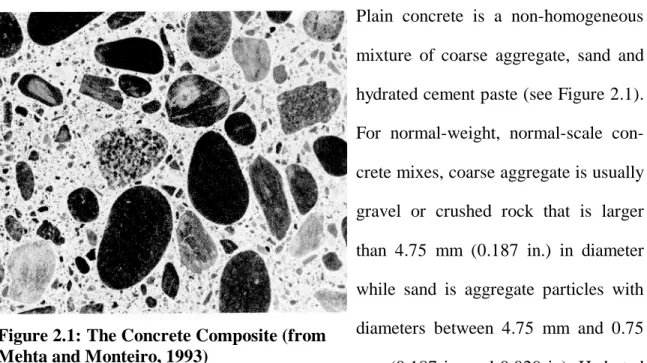
Plain concrete is a non-homogeneous
mixture of coarse aggregate, sand and
hydrated cement paste (see Figure 2.1).
For normal-weight, normal-scale
con-crete mixes, coarse aggregate is usually
gravel or crushed rock that is larger
than 4.75 mm (0.187 in.) in diameter
while sand is aggregate particles with
diameters between 4.75 mm and 0.75
mm (0.187 in. and 0.029 in). Hydrated
cement paste (hcp) refers to the hydration product of portland cement and water. The tran-sition zone refers to the hcp located in the immediate vicinity of the coarse aggregate par-ticles. Because the transition zone typically has a slightly higher water to cement ratio than
is observed in the entire hcp and because of the physical boundary between the different materials, the transition zone is weaker than the remainder of the hcp.
Figure 2.1: The Concrete Composite (from Mehta and Monteiro, 1993)
The initiation and propagation of cracks is the dominant mechanism of concrete
material response. Under moderate general loading, the response of the concrete mixture
is controlled by microcracking in the transition zone between the aggregate and the hcp.
Under increased loading, microcracks in the transition zone grow and merge and
microc-racks initiate in the hcp. Eventually, a continuous crack system forms that traverses the transition zone and the hcp, resulting in the loss of load capacity. Under compression type loading, the continuous crack system may include cracks that transverse the coarse
aggre-gate. Under tensile loading, increased load acts directly to increase the stress at the crack
tip and drive crack propagation. As a result, for tensile loading, the sequence of cracking
leading up to the development of a continuous crack system and loss of strength occurs
very rapidly. Increased compressive loading indirectly increases stress at the crack tip,
driving crack propagation at a much slower rate. For compressive loading, the stages of
crack initiation and propagation are readily identified in the observed concrete response,
and loss of load capacity occurs more slowly.
2.2.2 Criteria for Experimental Investigation of Concrete Behavior
The composition of concrete and the mechanisms of concrete response, require
par-ticular consideration in assessing the experimental investigation of plain concrete
behav-ior.
2.2.2.1 Consideration of the Analytical Model
Given that concrete is a non-homogeneous composite and that the primary
mecha-nism of response is the development and propogation of discrete cracks, it is necessary to
consider the general framework of the model in establishing the experimental data set.
The response of plain concrete can be modeled at the scale of the coarse aggregate
transition zone material as independent elements or as components of a composite [see
Ortiz and Popov, 1982]. However, while there may be available experimental data that
defines the response of aggregate and hcp to general loading, characterization of the tran-sition zone must be accomplished indirectly. Further, the random nature of the component
material properties and distribution adds complexity to models that are developed at this
scale. In modeling the response of a reinforced concrete structural element, it is reasonable
to incorporate both the microscopic response as well as the random nature of the concrete
into a macromodel. The macromodel describes the response of a body of concrete that is
many times the size of individual pieces of aggregate or of continuous zones of hcp. It is assumed that initially the concrete within the body is homogenous and that the material
response of the components is represented in the global response of the concrete
compos-ite. For this investigation, plain concrete is idealized as an initially homogenous material.
The idealization of concrete as a homogeneous body requires additional
consider-ation for the case of concrete subjected to moderate through severe loading. At these load
levels, the response of concrete is determined by the formation of continuous crack
sys-tems. Some researchers have proposed models in which the idealization of concrete as a
continuum is abandoned in the vicinity of a the crack, and crack systems are modeled
dis-cretely [e.g., Ayari and Saouma, 1990; Yao and Murray, 1993]. Development and calibra-tion of such a model requires experimental data defining the rate of crack propagacalibra-tion
under variable stress states and load histories. Currently, there are few data available
char-acterizing the concrete fracture process under multi-dimensional stress states.
Addition-ally, such a model requires special consideration within the framework of a finite element
program. Other researchers have shown that it is possible to maintain the idealization of
concrete as a continuum in the presence of discrete cracks. In these models, the material
crack-ing is distributed over a continuous volume of the material. Such models include the
ficti-tious-crack model [Hillerborg et al., 1976], smeared-crack models [de Borst and Nauta, 1984], and the crack-band model [Bazant and Oh, 1983]. Modeling of concrete as a
con-tinuum results in a model that is compatible with many existing computer codes as well as
provides a basis for application of existing continuum constitutive theory in developing
models. For these reasons, in this investigation concrete is considered to be a continuum.
Modeling concrete as an initially homogeneous material and assuming that the
dis-crete cracking is incorporated into a continuum model of condis-crete, it is necessary that the
experimental data set on which the analytical model will be developed and calibrated be
compiled from investigations that meet several criteria. The concrete specimens must have
critical zones that are sufficiently large that the concrete composite in the vicinity is
approximately a homogenous mixture. For load cases in which the material response is
determined by a global mechanism (e.g., microcracking) experimental measurement must define the deformation of the entire concrete body to ensure that the deformation is
repre-sentative of the composite. For load cases in which the material response is determined by
a local mechanism (e.g., formation of a continuous crack surface), it is necessary that experimental measurement define the global deformation of the concrete body as well as
the deformation associated with the localized mechanism. This allows for appropriate
cal-ibration of the continuum model.
2.2.2.2 Consideration of Experimental Methods
Under severe loading, concrete exhibits a softening response. In order to characterize
concrete response through experimental testing, it is necessary that the experimental
equipment and procedure meet particular criteria. These criteria are more complete than
those required for testing of hardening materials. Specifically, it is necessary that the
1. Loading must be conducted using displacement control with a closed-loop system in order to maintain a uniform rate of loading.
2. The applied rate of loading must be representative of that which the actual speci-men will experience in the field, or results must be adjusted to account for the effects of load rate.
3. The reaction frame must be sufficiently stiff that the frame deformation does not contribute to the prescribed deformation path of the material specimen.
4. It is necessary that the testing apparatus not contribute to undesirable loading of the specimens. For the tests introduced here, it may be sufficient to increase specimen size so that boundary conditions do not contribute to the stress state at the critical section. However, for some tests, it may be necessary to apply loads using brushes or to lubricate the contact surface of the specimens in order to reduce the undesir-able stresses introduced at the specimen-load frame interface.
2.2.3 Concrete Material Parameters Defined through Standardized Testing
The prolific use of concrete in the construction industry has led to the development
of a series of standardized testing procedures for determining concrete material properties.
A concrete material model may be calibrated on the basis of material parameters
deter-mined using these standard procedures.
The response of a reinforced concrete structural element is determined in part by the
response of plain concrete in compression. As a result, standard practice in the United
States [ACI, 1992] recommends characterizing the response of concrete on the basis of the
compressive strength of a 6 inch diameter by 12 inch long (150 mm by 310 mm) concrete
cylinder. For typical concrete mixes, the standard cylinder is sufficiently large that the
material is essentially homogeneous over the critical zone. Additionally, while the
stan-dard procedure (ASTM C39) does not require efforts to reduce frictional confinement
induced during testing at the ends of the specimen, the specimen is considered to
compres-sion. Thus, this method is appropriate for determining the uniaxial, compressive strength
of concrete.
Following from the test for compressive strength, ASTM C469 establishes a
proce-dure for determining concrete elastic modulus. This method requires loading of the
stan-dard cylinder in uniaxial, cyclic compression at relatively low load levels. Some
researchers have suggested that the elastic modulus for concrete may be different under compression and tension type loading. While it is possible that differences in microcrack
patterns and distribution may affect material stiffness under compression and tension
load-ing, it is likely that some difference in concrete response under compression and tension
loading is due to the difference in boundary conditions under variable loading. For this
investigation, concrete elastic material response, in tension and compression, is defined by
a single set of material parameters established by standard material testing. In the absence
of experimental data, the concrete elastic modulus may be estimated on the basis of the
compression strength:
(2-1)
where Ecis the elastic modulus (psi), wc is the weight density of the concrete (lb/ft3) and fc
is the compressive strength (psi) [ACI, 1992].
Poisson’s ratio characterizes the elastic response of concrete. Poisson’s ratio can be
determined experimentally by measuring the radial or circumferential expansion of a
dard concrete cylinder subjected to compression loading. ASTM C469 establishes a
stan-dardize procedure for determination of Poisson’s ratio from compression testing of
standard cylinders. Most research suggests that Poisson’s ratio for concrete is between
0.15 and 0.20 [e.g., Mehta and Monteiro, 1993] and that there is little correlation between Poisson’s ratio and other material properties. Mehta and Monteiro [1993] suggest that
Poisson’s ratio is generally lower with high strength concrete and lower for saturated and
dynamically tested concrete. However, Klink [1985] proposes, on the basis of extensive
experimental testing, that an average value of Poisson’s ratio appropriately is estimated on
the basis of concrete compressive strength:
(2-2)
where νcis the elastic Poisson’s ratio, wc is the unit weight of the concrete (lb/ft3) and fc is the compressive strength (psi). The value of Poisson’s ratio predicted by Equation (2-2)
varies between 0.16 and 0.20 for normal-weight, average-strength concrete. Given the
observed variation in concrete composition and in experimental data, in the absence of
experimental data a value of Poisson’s ratio between 0.15 and 0.20 is appropriate for
char-acterizing elastic material response.
Direct tension testing of concrete requires specialized equipment, procedures and
consideration of boundary conditions. As a result, it is rarely performed. Instead, either the
third-point flexural test (ASTM C78) or the splitting tension test (ASTM C496) is used to
estimate concrete tensile strength. The flexural test consists of loading a plain concrete
beam (150 by 150 by 500 mm) at the third points in flexural. The concrete tensile strength
determined from this test, fctfl, is known to overestimate the direct tensile strength, fct, and is not appropriate for model calibration. However, the CEB-FIP Model Code (1993)
rec-ommends the following relationship for use in estimating the direct tensile strength, fct, on the basis of the flexural tensile strength, fctfl:
(2-3)
where h is the depth of the beam in mm and ho is 100 mm. The splitting cylinder test con-sists of applying a distributed line load to opposite long sides of a standard cylinder. The
result of this loading is the development of an approximately uniform tensile stress
distri-bution along the diameter of the cylinder between the applied loads. The tensile strength νc = 4.5×10⁻⁷w1.75fc0.5 fct fctfl 2.0(h h⁄o) 0.7 1+2.0(h h⁄o)0.7 ---=
as computed from this test has been found to overestimate the results of direct tensile
test-ing by about 10 to 15 percent [Mehta and Monteiro, 1993]. This discrepancy may be
cor-rected by reducing the tensile strength as defined by the splitting tensile test for use in
model calibration. In the absence of experimental data, concrete splitting tensile strength
may be predicted from the concrete compressive strength using the following relationship:
[Oluokun, 1991] (2-4)
where fctspis the concrete splitting tensile strength (psi) and fc is the concrete compressive strength (psi). Also, direct concrete tensile strength may be estimated on the basis of the
concrete compressive strength using the following relationship:
[CEB-FIP Model Code, 1993] (2-5)
where fct is the concrete direct tensile strength in MPa, fc is the concrete compressive strength in MPa and fco is 10 MPa. Energy dissipated during the brittle failure of concrete may be considered a material property and used in the calibration of material models. This
energy, referred to as the concrete fracture energy, defines the energy required generate a
unit area of crack surface. A commonly accepted procedure for experimental
determina-tion of concrete fracture energy is that proposed by RILEM 50-FMC Committee [1985].
In this procedure a notched concrete beam is subjected to three-point bending to failure
and the applied load is controlled to produce a constant rate of crack width opening. It is
assumed that all deformation of the beam in excess of that at the maximum load results
from crack opening. Thus, the concrete fracture energy is defined as the integral of the
stress versus deformation history for deformation is excess of that corresponding to the
strength. For normal-weight, normal-sized concrete mixes, fracture energy as determined
in accordance with the standard procedures varies from 0.090 MPa-mm to 0.230 MPa-mm
[Monteiro et al., 1993; Kozul and Darwin, 1997]. There is no apparent correlation
fctsp = 1.38( )fc 0.69 0.95 fc fco --- 2 3⁄ fct 1.85 fc fco --- 2 3⁄ ≤ ≤
between fracture energy and compression or tension strength, although the data presented
by Kozul and Darwin shows concrete mixtures with basalt coarse aggregate to have
sig-nificantly higher fracture energy than those with limestone.
2.2.4 Concrete Subjected to Uniaxial Compression
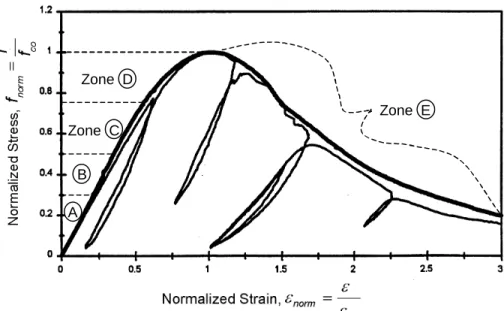
The complete stress-strain history for concrete subjected to uniaxial compression
provides data for use in characterizing the response of concrete to general loading. Figure
2.2 shows a plot of the stress-strain response of a typical concrete mix subjected to
mono-tonically increasing compressive strain. Important characteristics of this response include
the following outlined by Mehta and Monteiro [1993] (see Figure 2.2):
1. The response of the plain concrete under increasing strain is essentially linear-elas-tic until the load reaches approximately 30 percent of the peak compressive strength (Zone A). This linear-elastic response corresponds to minimal, stable crack growth within the transition zone. Note that a stable crack does not continue to grow under constant load.
2. Loading to compressive stress between 30 and 50 percent of peak compressive stress, results in some reduced material stiffness (Zone B). Reduction in the
mate-Zone C Zone D
B
Zone E
A
Figure 2.2: Concrete Response to Monotonic and Cyclic Compression Load (Data from Bahn and Hsu, 1998)
rial stiffness results from a significant increase in crack initiation and growth in the transition zone. Crack growth is stable.
3. Loading to compressive stress between 50 and 75 percent of peak compressive stress results in further reduction in material stiffness (Zone C). Here the reduced stiffness is partly a result of crack initiation and growth in the hcp. Additionally, reduced material stiffness results from the development of unstable cracks that continue to grow when subjected to a constant load.
4. Concrete loaded to more that 75 percent of the peak compressive load responds with increased compressive strain under constant loading (Zone D). This results from spontaneous crack growth in the transition zone and hcp and well as from the consolidation of microcracks into continuous crack systems.
5. Loading to compressive strains beyond that corresponding to the compressive strength results in reduced compressive strength (Zone E). This response is a result of the development of multiple continuous crack systems.
For model development, this behavior may be simplified into three levels of response.
Concrete initially responds as an elastic material. Under increased loading, global
microc-racking results in reduced material stiffness. Eventually, further increase in compressive
strain demand results in the development of multiple continuous crack systems and
reduced strength.
Figure 2.2 also shows the typical response of plain concrete subjected to uniaxial,
cyclic compression loading. Important characteristics of this response include the
follow-ing:
1. Under increasing compressive strain, the stress developed follows the monotonic stress-strain response.
2. At moderate strain levels, the stiffness of the unload-reload cycles is approximately equal to the elastic modulus; however, the stiffness deteriorates with increased strain demand.
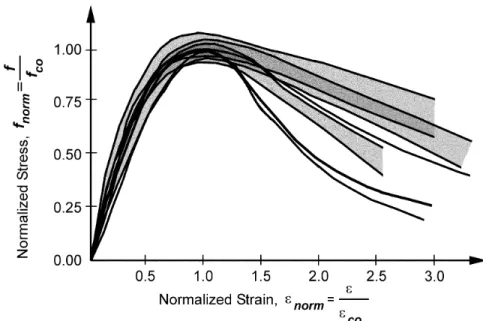
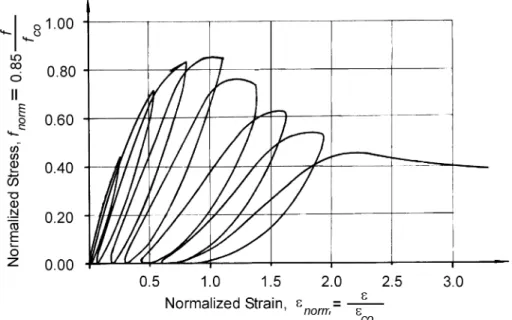
Figure 2.3 shows the normalized stress-strain response for a number of plain
data for concrete subjected to cyclic loading. Previous research suggests that the post-peak
compressive stress-strain response is dependent on specimen height, implying that
com-pression failure is a localized phenomenon [van Mier, 1986]. The data presented in Figure
2.3 are for specimens with gage lengths that vary from 3.5 inches to 6.5 inches and this
accounts somewhat for the variability of the results. The data presented in Figure 2.5 show
the response of plain concrete prisms (3.0 by 5.0 by 6.5 inches) subjected to cyclic
com-pression loading. For this configuration, it was found that peak compressive strength was
approximately 85 percent of that determined using the standard compression tests. While
this test program does not predict the compression strength as defined by the standardized
test procedure, the results are representative of concrete subjected to cyclic compression
loading.
Figure 2.6 shows a plot of normalized unloading stiffness as a function of normalized
plastic compressive deformation. Plastic deformation is defined as the deformation that is
not recovered upon unloading to zero compressive stress and this deformation is
normal-ized with respect to the deformation at approximately zero compressive strength. This
Figure 2.3: Normalized Stress-Strain Histories for Concrete Subjected to Compres-sion Loading (Data from Bahn and Hsu [1998], Karson and Jirsa [1969], Kosaka et al. [1984] and Sinha et al. [1964])
applies to unload-reload cycles that occur at initial strains in excess of that corresponding
to peak load. These data reflect the material damage associated with the development of
continuous crack systems under severe loading. These data will be used to develop an
ana-lytical model that characterizes the deterioration of concrete stiffness under increased
compressive strain demand.
2.2.5 Concrete Subjected to Uniaxial Tension
The response of plain concrete subjected to uniaxial tension may determine the
response of reinforced concrete structural elements that are inadequately reinforced.
Addi-tionally, the deterioration of concrete tensile strength results in accelerated activation of
reinforcing steel in all reinforced concrete structures. Thus, it is necessary to include
rep-resentation of the deterioration of concrete tensile strength in a concrete constitutive
model.
Figures 2.7, 2.8 and 2.9 show the typical stress-deformation response of plain
con-crete prisms subjected to uniaxial tensile deformation under monotonically increasing,
Figure 2.4: Stress-Strain History for Concrete Subjected to Uniaxial, Cyclic Com-pression Loading (Data from Sihna et al. [1964] as Presented by Chen and Han [1988])
loading, cyclic loading and reversed cyclic loading. The response of plain concrete in
ten-sion is characterized by initiation, opening and propagation of cracks, thus it is
inappropri-ate to consider tensile strain, since strain measurement depends entirely on the gage length
Figure 2.5: Stress-Strain History for Concrete Subjected to Uniaxial, Cyclic, Com-pression Loading (Data from Karson and Jirsa [1969])
Figure 2.6: Normalized Stiffness versus Normalized Plastic Deformation (Data from Lee and Willam, 1997)
associated with the investigation. Important characteristics of these material responses
include the following:
1. Concrete responds in an essentially linear-elastic manner until the tensile strength is achieved. This response corresponds to the initiation of a small number of stable microcracks within the transition zone.
2. Loading of the concrete to tensile strains in excess of that corresponding to the peak tensile strength results in loss of load capacity. This response corresponds to the development of continuous crack systems in the transition zone and the hcp. 3. Unload-reload cycles that initiate at strains in excess of that corresponding to the
peak tensile strength occur at a material stiffness that is significantly less than the original material modulus. This reduced material stiffness is a result of cracks that formed under peak tensile load remaining open as long as the prism is carrying tensile stress.
2.2.6 Concrete Subjected to Shear
Plain concrete subjected to monotonically increasing shear will exhibit tensile
crack-ing perpendicular to the orientation of the principal tensile stress. In this case, material
behavior may be predicted on the basis of the established concrete response to tensile
Figure 2.7: Tensile Monotonic Concrete Tensile Stress-Strain History (Data from Yankelevsky, 1987)
loading. This implies that shear load and material response most appropriately is modeled
on the basis of the combined compression and tension stress state. However, in a
rein-forced concrete system subjected to a general load history, regions of plain concrete may
be subjected to shear loading along previously formed crack surfaces. This mechanism of
Figure 2.8: Stress-Deformation History for Concrete Subjected to Cyclic Tensile Loading (Data from Reinhardt, 1984)
Figure 2.9: Stress-Deformation History for Concrete Subjected to Reversed Cyclic Loading (Data from Reinhardt, 1984)
response is distinct from the response of a continuum subjected to multi-dimensional
ten-sion and compresten-sion loading. Thus, it is necessary to consider the capacity for shear
transfer across a cracked concrete surface.
Shear transfer in cracked concrete has been the subject of many previous
experimen-tal investigations. Typically these investigations utilize a specimen shape that allows for
the application of shear load along a well-defined cross section. Of interest to this
investi-gation are the studies in which laboratory specimens are pre-cracked (along the
appropri-ate cross section) under one load distribution and then subjected to shear load across the
established crack surface. Also of interest to this study are the investigations in which the
presence of reinforcing steel outside of the crack zone isolates concrete damage to the
ini-tial crack zone. For relatively small crack widths, load transfer across the crack plane is
achieved primarily through aggregate interlock, the development of bearing forces between pieces of aggregate. Given this mechanism of load transfer, it is reasonable that
the capacity of the system is determined by the width of the crack opening. Of particular
interest to this investigation are studies in which a constant crack opening width is
con-trolled. However, consideration of the behavior of systems in which reinforcement
cross-ing the crack plane allows for increascross-ing but moderate crack width is also appropriate.
Results of a few particular investigations provide insight into shear transfer in
cracked concrete. An investigation conducted by Paulay and Loeber [1977] considers
shear transfer in reinforced concrete specimens with pre-cracked, unreinforced,
constant-width crack zones. The results of this investigation show that for small crack constant-widths the
shear stress versus slip relationship is linear to peak strength of approximately 0.20fc. For increased crack width, the shear stress versus slip exhibits some loss of stiffness at low
load levels, but maintains a peak capacity of approximately 0.20fc. Results of an investiga-tion presented by Laible et al. [1977] shows low shear transfer capacity (0.06fc to 0.09fc)
for larger crack widths (greater than 0.03 inches [0.8 mm]). Hofbeck et al. [1969], on the basis of an investigation of shear transfer across reinforced crack planes, propose that
shear strength and stiffness increase with increasing volume of reinforcement crossing the
crack plane and that the peak strength of the system is limited to 0.30fc. The results of this study also show that for systems in which crack width is controlled by the tensile response
of steel reinforcement crossing the crack plane, the shear stress versus slip relationship
exhibits deteriorating stiffness up to the peak load and then softening. This behavior may
be attributed to increased crack width up to peak capacity. It is important to note that for
these systems in which reinforcement crosses the crack plane, the direct contribution of
steel reinforcement to shear capacity and stiffness (dowel action) is minimal at moderate slip levels. Similar results for systems in which steel reinforcement crosses the crack plane
are presented by Walraven and Reinhardt [1981]. Here peak shear strength, achieved with
high volumes of reinforcement crossing the crack plane, varies between 0.26fc and 0.32fc. The results of these investigations are summarized for use in developing and
calibrat-ing a concrete material model:
1. The capacity for shear transfer across a concrete crack plane as well as the stiffness of the shear stress versus slip relationship increases with increasing concrete strength and decreases with increasing crack width.
2. Concrete aggregate size and shape have relatively little effect on shear strength and stiffness.
3. Typically, under monotonically increasing slip across the crack plane, shear resis-tance increases up to a maximum strength of approximately 0.20fc to 0.30fc and then begins to decrease.
2.2.7 Concrete Subjected to Multi-Dimensional Loading
Since plain concrete in a reinforced concrete element is subjected to
cali-brated solely on the basis of the uniaxial response. A number of researchers have
investigated the response of concrete subjected to two- and three-dimensional loading.
Results of these investigations include analytical models characterizing the
multi-dimen-sional compressive yield/failure surface and the evolution of this yield surface under
increased loading as well as experimental data defining the concrete strain history under
multi-axial loading.
2.2.7.1 Concrete Strength under Multi-Dimensional Loading
Kupfer et al. [1969] completed a series of tests to investigate the response of plain concrete subjected to two-dimensional loading. Yin et al. [1989] completed a similar investigation. In these investigations concrete plates (approximately 200 mm by 200 mm
by 50 mm in dimension) were loaded to failure at prescribed ratios of σ1:σ2 with σ3 equal to zero (where is the ith principal stress). Loads were applied using steel brushes to minimize stresses introduced through friction at the specimen boundaries. The failure
sur-faces developed through these investigations are presented in Figure 2.10. The result of
the investigation conducted by Yin et al. show a failure surface that is slightly stronger than that developed by Kupfer. The difference in the failure surfaces may be due to a
num-ber of factors including load rate, conditions of the specimens during testing, preparation
of the specimens, properties of the mixes or size effects. Yin et al. propose that the dis-crepancies are due in part to differences in the type of coarse aggregate used in the two
studies and in part to the use by Kupfer of a slower rate of loading than is currently
stan-dard.
These two-dimensional failure surfaces are extended by data presented by Van Mier
[1986] (see Figure 2.10). Van Mier investigated the effect on the two-dimensional
con-crete failure surface of applying low levels of confining pressure in the third dimension.
Two series of tests were completed in which concrete specimens were loaded at prescribed σi
ratios of σ1:σ2:σ3, with the stress in the one out-of-plane direction maintained at 5 or 10 percent of one of the in-plane stresses. The results of these tests show that a relatively
small confining pressure in the out-of-plane reaction can significantly increase the
strength of concrete in the plane of the primary loading.
The results of these two- and three-dimensional studies can be compared with results
of other investigations of the response of concrete subjected to three-dimensional load
his-tories. Figure 2.11 shows a plot of versus where is the second invariant of the
deviatoric stress tensor and I1 is the first invariant of the stress tensor defined by the fol-lowing relationships: 0.0 0.5 1.0 1.5 2.0 2.5 3.0 0.0 0.5 1.0 1.5 2.0 2.5 3.0
Normalized Principal Stress,
Normalized Principal Stress,
Kupfer - Biaxial Loading Yin - Biaxial Loading VanMier - 5% confining stress VanMier - 10% confining stress c n o rm f 3 σ σ = c norm f 2 σ σ =
Figure 2.10:Biaxial Compressive Yield Surface for Concrete with Low Confining Pressure (Data from Kupfer et al. [1969], Yin et al. [1989] and Van Mier [1986])
(2-6)
(2-7)
where sij are the deviatoric components of the stress tensor defined as follows:
(2-8)
and is the Kroneker delta (Einstein summation notation convention is assumed).
In Figure 2.11 data collected from experimental investigations completed by Kosaka
et al. [1984], Salami et al. [1990], and Imran et al. [1996] are presented in addition to the previously discussed data. The Kosaka study looks at the response of concrete loaded to
failure in compression along one axis while subjected to relatively low levels of confining
pressure in the perpendicular plane. For this study, the confining pressure was applied first
in one plane and then the specimens were loaded to failure in compression along the
per-pendicular axis. Lateral confining pressure was maintained manually during the test and
data show some increase as testing progressed. The presented lateral confining loads
cor-respond to peak compressive strength. Friction along the specimen boundaries was
reduced by placing greased pads between the specimen and loading frame. In the Salami
and Imran studies, the initial load sequence consisted of applying an increasing
hydro-static pressure up to a specified level. Following application of hydrohydro-static pressure, the
specimens were loaded to failure along one of the following load paths: maintain the
applied pressure in two directions and increase load in the third direction, alternate a
rela-tively large load increase in one direction with smaller load increases in the other two
directions, alternate load increase in one direction with load reduction in the other two
directions or simultaneously vary the load in one direction and the load in the remaining
J2 1 2 ---sijsij = 1 6 --- σ 1–σ2 ( )2 σ 2–σ3 ( )2 σ 3–σ1 ( )2 + + = I1 = σ1+σ2+σ3 sij σij 1 3 ---σmmδij – = δ
two directions at some prescribed ratio. As with the two-dimensional testing, boundary
conditions minimized frictional loads on the specimens.
The data presented in Figure 2.11 indicate several characteristics of the concrete
compressive failure surface. First, the data show that concrete subject to moderate levels
of confining pressure along two principal stress axes can exhibit tremendous compressive
strength along a third principal stress axis. Also, the data show that the failure surface is a
function of and . However, the data show that the failure surface for concrete
sub-jected to general three-dimensional loading is not uniquely defined by and .
Instead, the data presented in Figure 2.11 indicate that the relationship between and
is a function of the ratio of the principal stresses. This is evident in the comparison of
the data presented by Kupfer et al., Yin et al. and Van Mier with that presented by Salami. Within each of the first four data sets, most of the data points represent approximately the
Figure 2.11:Deviatoric Stress versus Pressure at Concrete Compressive Strength
0.0 0.5 1.0 1.5 2.0 2.5 0.0 1.0 2.0 3.0 4.0 5.0 6.0
Kupfer - Biaxial Loading Yin - Biaxial Loading
VanMier - 5% confining stress VanMier - 10% confining stress
Kosaka Imran - Path A
Imran - Path B Imran - Path C
Salami - Extension Path Salami - Shear Path Salami - Compression Path
N o rm a li z e d D e v ia to ri c S tr e s s , c f J2 Normalized Pressure, c f I1 J2 I1 J2 I1 J2 I1
same loading in two dimensions and variable loading in the third dimension. For example,
most of the data points in the data set presented by Van Mier for 5 percent confinement
stress represent a stress state in which , and
. On the other hand, the data presented by Salami for compressive
loading represents stress states in which the ratio between the principal stresses is
approx-imately constant and thus the confining pressure in two dimensions varies with the
com-pressive strength achieved in the third dimension. The non-uniqueness of the and
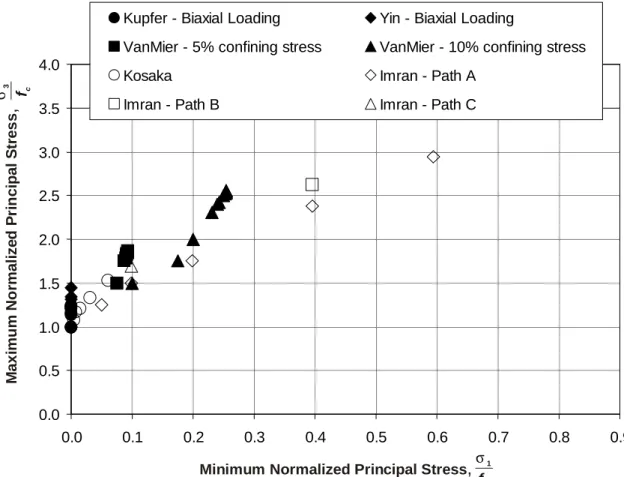
relationship is further supported by the data presented in Figure 2.12. Here the data
indi-cate that there is a linear relationship between minimum and maximum normalized
princi-pal stress at peak compressive load.
σ3≅1.80fc σ1 = 0.05σ3 0.6fc> σ2> 1.75fc J2 I1 0.0 0.5 1.0 1.5 2.0 2.5 3.0 3.5 4.0 0.0 0.1 0.2 0.3 0.4 0.5 0.6 0.7 0.8 0.9
Kupfer - Biaxial Loading Yin - Biaxial Loading
VanMier - 5% confining stress VanMier - 10% confining stress
Kosaka Imran - Path A
Imran - Path B Imran - Path C
Figure 2.12:Maximum Versus Minimum Normalized Principal Stress (Data from Sources Identified in Figure 2.11)
c f
1 σ
Minimum Normalized Principal Stress,
M a x im u m N o rm a li z e d P ri n c ip a l S tr e s s , c f 3 σ
2.2.7.2 Evolution of the Yield Surface Under Multi-Dimensional Loading
There are few investigations that have considered the evolution of the concrete
multi-dimensional yield surface from the initial inelastic response through complete loss of
strength. A thorough investigation of the topic requires a coordinated effort between
experimental and analytical research since the evolution is unique to the plasticity model.
Kupfer et al. [1969] propose that the shape of the biaxial yield surface for concrete loaded in compression maintains the same shape throughout the loading process. Lubliner et al.
[1989] propose that the limit of the elastic domain for concrete loaded in multi-dimensions
appropriately is defined on the basis of the uniaxial stress-strain response. Conversely,
Salami and Desai [1990] propose some moderate modification to the yield surface for
concrete loaded in three dimensions. The most extreme variation in the concrete yield
sur-face is that proposed by Chen and Han [1988]. In this model, the researchers propose a
model that is consistent with experimental observation that while the initial elastic domain
excludes extreme loading of concrete in hydrostatic pressure, the ultimate yield surface
does not.
2.2.7.3 Concrete Strain History Under Multi-Dimensional Loading
In experimental investigations concrete exhibits variation in volumetric strain as a
function of deviatoric stress. This dilatant response is revealed explicitly in the data
pre-sented by Stankowski and Gerstle [1985] (Figure 2.13). However, concrete dilatancy is
also revealed in the more commonly presented volumetric strain versus compression load
for concrete tested in uniaxial compression (Figure 2.14). Here dilatancy contributes to the
volumetric expansion observed near peak load capacity. In reinforced concrete structural
elements, volumetric expansion activates transverse reinforcement and thus may
deter-mine the mechanism of response. This characteristic of concrete response properly is
2.2.8 The Effect of Load Rate on Concrete Response
Time represents the fourth dimension for concrete loading, and a number of
research-ers have investigated the effect of load rate on concrete material response. Since the focus
of this study is the analysis of reinforced concrete members subjected to earthquake load-0 1 2 3 4 5 6 0 0.005 0.01 0.015 0.02 0 2 4 6 8 10 12 14 16 0 2 4 6 8 10 12 14 σ1 = σ2 (ksi) σ 3 (ksi) 2 J D e v ia to ri c S tr e s s , (k s i)
Volumetric Strain,εvol(in./in.)
Figure 2.13:Deviatoric Stress Versus Volumetric Strain (Data from Stankowski and Gerstle [1985])
Figure 2.14:Concrete Compressive Stress Versus Volumetric Strain (Data from Kupfer, 1969 as Presented by Chan and Han, 1988)
ing, it is necessary to consider the response of concrete subjected to the moderately rapid
load rates associated with earthquake ground motions.
Load rate for materials is most appropriately considered in terms of applied strain
rate. Numerical modeling [e.g., Wakabayashi et al., 1984] and experimental, dynamic test-ing of full-scaled models [e.g., Hosoya et al., 1997] has been used to investigate the strain rate associated with earthquake loading of reinforced concrete structures. This research
indicates that the strain rate is a function of the period of the structure, the earthquake
ground motion and the ductility demand on the structural elements. This research and the
investigations of others [Mahin and Bertero, 1972] identify the maximum strain rate in
reinforced concrete structures subjected to severe earthquake ground motion to be
between 0.001 per second and 0.25 per second.
An appropriate range for maximum strain-rates for plain concrete in a bridge frame
subjected to earthquake loading can be estimated on the basis of the typical period range
for these structures. Here we will assume that the period, Tbridge, is not the purely elastic period but includes some softening of the system due to cracking of concrete under service
level and environmental loading. For the case of a brittle failure of a bridge connection
due to overloading of plain concrete in tension, it is reasonable to assume that maximum
tensile strength will be reached at the point of maximum displacement. This will
corre-spond to loading during an time interval equal to 0.25Tbridge. A plausible range for the period of a reinforced concrete bridge is 0.25 sec. to 1.0 sec. Thus, concrete strength is
assumed to be achieved during a minimum time interval of 0.0625 sec. For
average-weight, normal-strength concrete, tensile strength is achieved at a strain of approximately
10-4. This implies a maximum strain rate of approximately 0.002 per second.
An appropriate maximum strain-rate for the case of crushing of plain concrete, is
the bridge. For this case, peak flexural demand is assumed to developed during a load
increment equal to 0.25Tyield. Here Tyield defines the effective period of the bridge for the case of some inelastic deformation. A reasonable estimate for Tyield is 2Tbridge assuming an average ductility demand of 4. The compressive strain corresponding to crushing of
plain concrete is approximately 0.006 for average-weight, normal-strength concrete. On
the basis of these assumptions, it follows that a maximum strain rate for consideration of
concrete crushing strength is 0.05 per second.
In considering the effect of load rate of concrete response it is appropriate to consider
variation in compressive and tensile strength and material stiffness. Additionally, since
concrete material response is controlled by damage mechanism, it is necessary to consider
the effect of load rate on concrete fracture energy.
A number of researchers have investigated the response of concrete subjected to
loading at strain rates up to 10 percent strain per second. Material testing at these strain
rates requires an experimental test set-up in which it is possible to record data at very high
rates and for which it is possible to determine the loads applied to the test specimen as
well as the loads transferred back into the test frame.
Figure 2.15:Effect of Strain Rate on Concrete Tensile Strength
0 1 2 3 4 5 6 7 8 9 10
1.00E-03 1.00E-02 1.00E-01 1.00E+00 1.00E+01 1.00E+02 1.00E+03
Strain Rate (1/sec.)
Ratio of Dynamic to Static Tensile
Strength
Yon 1992 Ross 1995 Ross 1996
Figure 2.15 shows two proposed relationships between the dynamic to static tensile
strength ratio and strain rate, as well as additional experimental data. The relationship
pro-posed by Ross et al. [1996] is derived on the basis of fracture mechanics and calibrated to fit experimental data provided by the authors and by Ross et al. [1995]. The relationship proposed by Yon [1992] is developed to fit empirical data. The data provided by Ross
[1995, 1996] follow from dynamic split-cylinder testing of 51 diameter by 51
mm-long (2.0 by 2.0 inches) concrete specimens that were cut from 300 mm square concrete
cubes (12 inch cube). Yon determined concrete tensile strength from three point bending
tests of 16.0 by 3.75 by 2.00 inch (407 by 95.4 by 50.9 mm) plain concrete beams. The
data presented in Figure 2.15 indicate that for the strain rates of interest to this
investiga-tion, there is an increase in tensile strength over the static strength. The extent of this
increase varies for the different experimental data sets. However, at these strain rates, the
increased strength is not as significant as is found for strain rates in excess of 100 percent
per second.
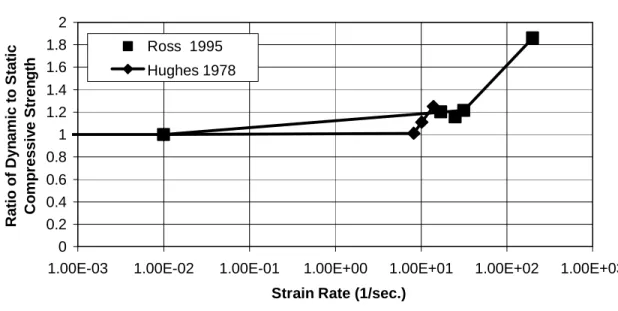
Figure 2.16 shows two proposed relationships between the dynamic to static
com-pressive strength ratio and strain rate. The relationship proposed by Ross et al. [1995]
fol-Figure 2.16:Effect of Strain Rate on Concrete Compressive Strength
0 0.2 0.4 0.6 0.8 1 1.2 1.4 1.6 1.8 2
1.00E-03 1.00E-02 1.00E-01 1.00E+00 1.00E+01 1.00E+02 1.00E+03 Strain Rate (1/sec.)
Ratio of Dynamic to Static Compressive Strength
Ross 1995 Hughes 1978
lows from material testing of the 51 mm-diameter by 51 mm-long (2 inch by 2 inch)
concrete specimens in compression. The authors note that the compression specimens fail
through the development of cracks along the axis of loading, apparently indicating that the
compressive strength is actually determined by the tensile strength in the direction
perpen-dicular to the applied loading. The data provided by Hughes and Gregory [1978] is from
impact tests in which a steel hammer was dropped on 102 mm (4.01 inch) concrete cubes.
For the compression specimens, the transition between dynamic and static response occurs
at a strain rate of approximately 10.0 per second, Ross et al. [1996] note that this corre-lates with their proposed relationship for dynamic concrete tensile strength. The data
appear to indicate that the compressive strength increases at most 10 to 15 percent within
the strain rate in the range of interest to this study. This correlates well with experimental
testing of reinforced concrete specimens in which the nominal strength of the members
increases by approximately 10 percent under dynamic loading [Hosoya, 1997].
The experimental investigations also considered the effect of strain rate on various
other concrete material parameters including elastic modulus and fracture energy. All
con-clude that concrete fracture energy is independent of strain rate. Additionally, with the 0 1 2 3 4 5 6 7 8 9 10
1.00E-03 1.00E-02 1.00E-01 1.00E+00 1.00E+01 1.00E+02 1.00E+03
Strain Rate (1/sec.)
Ratio of Dynamic to Static Elastic
Modulus
Modulus in Tension - Yon 1992 Modulus in Compression - Yon 1992
exception of Yon, all of the presented investigations consider elastic modulus to be
inde-pendent of strain rate. Yon does propose a relationship in which there is an increase in
elastic modulus within the strain rate of interest to this study (Figure 2.17).
2.2.9 Concluding Remarks About Concrete Material Properties
The previous sections present data that characterize the response of plain concrete to
various specific load histories. The data indicate that this response is characterized in part
by a number of material parameters including uniaxial compressive strength, uniaxial
ten-sile strength, elastic modulus, poison ratio and fracture energy. Additionally, the data show
that the concrete response is determined by damage mechanisms that are reflected in
reduced material modulus following severe loading as well as by plastic mechanisms that
are reflected in accumulated, unrecoverable plastic strain upon unloading. The data show
that the concrete response is a function of the multi-dimensional stress-state, the load
his-tory, and the rate of loading.
Experimental data also show significant variability in measured response. This
vari-ability results in part from variation in the test set-up and procedure utilized by various
researchers. However, this variability is also a result of variation in testing conditions
(e.g., temperature and humidity) and concrete component properties (e.g., cement, sand, aggregate and add mixtures) that cannot explicitly be incorporated into a material model
because of insufficient data. This variation in experimental data suggests that an
appropri-ate concrete constitutive model predicts the fundamental characteristics of concrete
response rather than the results of specific experimental test programs.
Finally, the experimental data suggest that a highly sophisticated analytical model is
required to characterize concrete response under all possible load histories. Such a model
may be impractical and computationally infeasible. For this reason, Gerstle et al. [1980] propose that the simplicity of the model should be considered in addition to the accuracy
of model prediction. An appropriate approach for this study is to develop a constitutive
model that predicts the fundamental characteristics of response within the range of loading
that is expected for reinforced concrete beam-column joint subjected to earthquake
load-ing.
2.3 Concrete Constitutive Models
In recent years there has been a tremendous effort aimed at developing analytical
models that accurately predict the response of plain concrete to variable loading. Early
models relied on elasticity theory. More recently proposed models utilize general theories
of solid mechanics including plasticity theory, damage theory and fracture mechanics.
The majority of these proposed models predict particular aspects of concrete
response with an acceptable level of accuracy and efficiency. However, in considering
these models as a first step toward development of a constitutive model for this particular
investigation, it is necessary to consider a number of particular issues including the
fol-lowing:
• Evolution of the failure surface for both one-dimensional and multi-dimensional loading and particularly for two-dimensional loading with minimal confining pressure in the third dimension.
• Representation of material damage exhibited under both compression and tension loading.
• The manner in which softening is incorporated and calibrated. • Dilatancy associated with compressive failure.
• Representation of concrete shear response.
• Representation of loading from compression into tension and the reverse.
2.3.1 Elasticity Theory Applied to Modeling Concrete Behavior
Some of the first proposed constitutive models were developed on the basis of
con-crete under multi-dimensional, reversed-cyclic loading. One approach was to follow a
Hookean formulation with non-linear functions representing the concrete material
response:
(2-8a)
(2-8b)
Here defines the secant material stiffness. This approach is suggest by Ahmed and
Shah [1982]:
Such a model may be used to represent the response of concrete subjected to
moder-ate loading. However, because this model implies a one-to-one correspondence between
stress and strain, such a model is not appropriate for predicting the response of concrete
subjected to severe loading in which case load reversals and monotonic loading past peak
result in multiple strain states being associated with a single stress state.
A second approach is to characterize the tangent material stiffness and to define the
stress and strain states incrementally:
(2-9)
Here defines the tangent material stiffnesses. This approach is presented by Gerstle
[1981].
Such an approach can be used to characterize the response of concrete subjected to
variable load histories. However, without additional criteria, determining appropriate
val-ues for the tangent material stiffness may not be practical.
2.3.2 Plasticity Theory Applied to Modeling Concrete Behavior
The defining characteristic of material plasticity is the accumulation of
unrecover-able deformation upon loading beyond the yield limit. The previously presented data show
σij = Fij( )εkl σij = Dijkls (σpq)εkl Dijkls σ· ij Dijkl t σpqεkl ( , )ε·kl = Dijklt
that concrete exhibits this characteristic when loaded in compression and, to a lesser
extent, when load in tension (see Figures 2.3, 2.5, 2.8 and 2.9). Thus, it is appropriate that
a constitutive model for plain concrete incorporate plasticity theory.
Development of a plasticity-based constitutive model requires defining a rule for
decomposition of the total strain, the elastic material constitutive relationship, the yield/
failure surfaces that bound the elastic domain and the flow rules that define the evolution
of the internal variables. Traditionally, the total strain, ε, is assumed to be the sum of the elastic strain, εe, and the accumulated plastic strain, εp:
(2-10) It is reasonable to assume that concrete is a homogenous material; thus, the elastic
mate-rial properties are readily defined on the basis of data collected from standard matemate-rial
tests and the elastic constitutive relationship follows Hooke’s Law:
(2-11)
where Cijkl is the rank four material stiffness tensor. The yield surface or surfaces bound the elastic domain. Following classical plasticity theory, the elastic domain is defined in
stress space. For concrete, the available material data facilitated definition of the yield
sur-face in stress space and it is most appropriate to consider a yield sursur-face that evolves as a
function of the load history. A hardening rule defines the evolution of the yield surface.
The flow rules define the evolution of a set of internal variables that uniquely define the
material state. In particular a flow rule defines the orientation of plastic strain which may
be associated, defined as normal to the yield surface, or non-associate. Proposed models
for concrete vary in the definition of the yield surface, the hardening rules and the flow
rules.
ε εe εp + =
2.3.2.1 Yield Surfaces for Concrete Plasticity Models
A variety of yield surfaces have been proposed to characterize the response of plain
concrete. Two of the first were the Mohr-Coulomb (dating from 1800) and the
Drucker-Prager [1952] criterion. These criteria were developed to describe the response of material
such as rock, sand and concrete for which hydrostatic pressure affects the material yield
and failure strengths. The Mohr-Coulomb criterion is defined as follows:
(2-12)
In Equation (2-12) I1 and J2 are invariants of the stress states as previously defined, and c are material parameters and θ is also an invariant of the stress state defined as follows:
(2-13)
where is the third invariant of the deviatoric stress, defined as follows:
(2-14)
Equations (2-12) and (2-13) represent a straight line of variable slope in the meridian
plane and an irregular hexagon in the -plane (see Figure 2.18). The Mohr-Coulomb
crite-rion rarely is utilized in current concrete models in part because of the discontinuity of the
surface hinders numerical implementation and in part because recent investigations show
the Mohr-Coulomb criterion to be only a moderate fit to experimentally observed material
response.
The Drucker-Prager criterion represents moderately well the response of plain
con-crete subjected to multi-axial compression and provides a smooth yield surface (Figure
2.18). This criterion is incorporated into some currently proposed concrete material
mod-els and is defined as follows:
f I( 1, ,J2 θ) 1 3 ---I1sinφ J2 θ π 3 ---+ sin J2 3 --- θ π 3 ---+
cos sinφ–ccosφ
+ + = φ θ 1 3 --- 3 3 2 --- J3 J23 2⁄ --- acos = J3 J3 1 3 ---sijsjkski = π
(2-15)
In Equation (2-15) α and y are material parameters that in the original formulation are considered to be constant but that vary with load history in more recent implementations.
Figure 2.19 shows the Drucker-Prager criterion for several values of α and y com-pared with experimental data. As indicated in Figure 2.19, Imran and Pantazopoulou
[1996] propose for characterizing the response of concrete subjected to triaxial
compression. The response of concrete subjected to biaxial compressive loading (Kupfer
et al. [1969] and Yin [1989]) is characterized well by . All of the presented yield criteria are calibrated to predict the observed uniaxial compressive strength.
Comparison of the Drucker-Prager criterion with experimental data shows that while
the criterion may be used to represent the response of concrete subjected to multi-axial
compression, the model over-estimates the capacity of concrete subjected to
compression-tension or compression-tension-compression-tension type loading. Variation in concrete response under various load
regimes has been addressed by a number of researcher through the use of multi-surface
plasticity models. Murray et al. [1979] propose a three surface model to characterize the response of plain concrete subjected to biaxial loading (Figure 2.20). This approach was
extended to concrete loaded in three-dimensions by Chen and Chen [1975], and Lubliner
et al. [1989] (see Figure 2.21). It is interesting to note that the Lubliner model uses the
Figure 2.18:Mohr-Coulomb and Drucker-Prager Failure Criteria
J2+αI1+y = 0
α = 0.3
Drucker-Prager criterion to characterize the response of concrete subjected to triaxial
compression. While the introduction of multiple, intersecting failure surfaces may
facili-tate definition of the entire yield surface, it may complicate determination of flow
equa-tions as will be discussed in the following paragraphs.
Data indicate that concrete subjected to severe hydrostatic pressure loading does not
respond elastically as is implied by some models [e.g., Drucker-Prager 1952; Murray et al, 1979; Vermeer et al., 1984] in which the failure surface is linear in space. This issue has been addressed in a number of models that limit the elastic range under severe
hydrostatic pressure. Some of the models introduce a non-linear relationship between
and [e.g., Han and Chen, 1985; and de Boer and Dresenkamp, 1989] and some actually “cap” [Drucker et al., 1975; Schofield and Wroth, 1968; Sandler et al., 1976] concrete capacity under hydrostatic pressure [e.g., Salami and Desai, 1990].
Figure 2.19:Drucker-Prager Failure Criterion Compared with Experimental Data (Data as Presented in Figure 2.11)
0.0 0.5 1.0 1.5 2.0 2.5 0.0 1.0 2.0 3.0 4.0 5.0 6.0
Normalized Nominal Pressure,
Normalized Deviatoric Stress,
= 0.1, = 0.48 (represents data from Kupfer et al. [1969] and Yin et al. [1989]) = 0.2, = 0.38
= 0.3, = 0.28 (proposed by Imran et al. [1996])
c f J2 c f I1 α α α y y y J2–I1 J2 I1
Also of interest is the evolution of the failure surface as a function of increased
load-ing. This evolution is typically defined by a hardening rule. Some models assume that the
shape of the yield surface remains the same with the elastic region expanding and
con-tracting as a function of load history [Kupfer et al., 1969; Chen and Chen,; Murray et al., 1979]. In this case the hardening function is a scalar and the yield surface takes the
follow-ing form:
Figure 2.20:Multi-Surface Plasticity Model for Concrete Subjected to Biaxial Load-ing [Murray et al. 1979]
Figure 2.21:Multi-Surface Plasticity Model for Concrete Subjected to Triaxial Load-ing [Lubliner et al., 1989]
Zone 1: (σ1,σ2 < 0) Failure Criterion 1 Zone 2: (σ1 < 0, σ2 > 0) Failure Criterion 2 Zone 3: (σ1 > 0, σ2 > 0) Failure Criterion 3 Zone 2: (σ1 > 0, σ2 < 0) Failure Criterion 2 σ1 σ2 Composite Failure Surface
(2-16) where y defines the yield strength and λ is a function of the load history. There are few data defining the rate at which the concrete elastic domain expands and contracts under
multi-axial loading, as a result it is reasonable to calibrate the hardening function on the
basis of the well-defined uniaxial concrete response [Murray et al., 1979; Lubliner et al., 1989]. Many models account for variation in the shape of the yield surface that occurs as
concrete is loaded from the point of initial inelasticity to the point of maximum load and
beyond to the point of minimal capacity. Models that propose variable shaped yield
sur-faces include that proposed by Han and Chen [1985], Ohtani and Chen [1988], de Boer
and Dresenkamp [1988], Zama et al. [1993]. For these models the yield surface takes the following form:
(2-17) where the hardening rule y is a function of the load history as represented by λ as well as the current stress state, σ, thereby allowing for variation in the shape of the yield surface.
The model proposed by Chen and Han [1988] incorporates many of the techniques
currently used in development of a concrete yield surface that evolves under a variable
load history. This model proposes that at the maximum load, the yield surface
appropri-ately may be defined following the recommendations of any of several researchers
[Ottosen, 1977; Hsieh et al., 1982; Willam and Warnke, 1975]. The complete surface pro-posed by Ottosen [1977] is compro-posed of two similar surfaces as follows:
(2-18a)
whereλ is a function of cos3θ: f( )σ = ˜f( )σ –y( )λ = 0
f( )σ = ˜f( )σ –y(λ σ, ) = 0
(2-18b)
For this model, the initial elastic domain is closed (concrete subjected to hydrostatic
pres-sure responds inelastically) and defined by the yield surface at maximum loading. For the
Ottosen surface the initial yield surface is defined as follows:
(2-19a) where
(2-19b)
(2-19c)
(2-19d) and where λ is a shape function that maps between the initial yield surface and the yield surface defining peak strength and is defined as in Equation (2-18b). The yield surface
defined by this model is depicted qualitatively in Figure (2.22). λ k1 1 3 ---acos(k2cos3θ) cos k1 π 3 --- 1 3 ---acos(–k2cos3θ) – cos = for 3cos θ≥0 for 3cos θ≤0 f( )σ = ρ–kρf = 0 ρ = J2 ρf 1 2a ---[– 2λ+ 2λ2–8a bI( 1–1)] = k = k I( )1
Figure 2.22:Evolution of Concrete Yield Surface as Proposed by Chen and Han [1988]
2.3.2.2 Flow Rules for Concrete Plasticity Models
Definition of a plasticity-based constitutive model requires establishing flow rules
that define the evolution of a set of internal variables. Of particular interest is the plastic
flow rule that defines the orientation of the plastic strain. The plastic strain rate is defined
as follows:
(2-20)
where is the rate of plastic strain, λ is a positive scalar, q is the set of internal variables and g(σ, q) is the plastic potential function. Typically it is assumed that the orientation of plastic flow is normal to the yield surface in which case the plastic potential function is the
yield function. Following this assumption of associated flow the increment of plastic strain is defined as follows:
(2-21)
It has been shown that the assumption of associated flow assures a unique solution
for a given boundary-value problem in which the material stress-strain relationship is
per-fectly plastic or exhibits work hardening1. Additionally, this assumption results in a sym-metric algorithmic tangent that greatly enhances the efficiency of numerical solution
methods. Thus, the assumption of associated flow is both theoretically and numerically
desirable. A number of plasticity models have been developed assuming associated flow
[e.g., Ohtani and Chen, 1988; Salami, 1990]. These models characterize moderately well the response of concrete over a range of load histories (Figure 2.23).
Experimental data, however, indicate that associated flow may not be the most
appropriate assumption for characterizing the response of concrete. Researchers have
noted that concrete displays shear dilatancy characterized by volume change associated
1. A discussion of uniquenss theorems applied to plasticity theory is provided by Lubliner [1990].
ε·p λ σ ∂∂g(σ,q) = ε·p ε·p λ σ ∂∂f(σ,q) =


![Figure 2.13:Deviatoric Stress Versus Volumetric Strain (Data from Stankowski and Gerstle [1985])](https://thumb-us.123doks.com/thumbv2/123dok_us/9622854.2449918/25.918.162.802.139.424/figure-deviatoric-stress-versus-volumetric-strain-stankowski-gerstle.webp)