BaRT: A Bayesian Reasoning Tool
for Knowledge Based Systems
Lashon B. Booker, Naveen Hota'", and Connie Loggia Ramsey
Navy Center for Applied Research in Artificial IntelligenceCode 5510 N a. val Research Laboratory Washington, DC 20375-5000
Abstract
As the technology for building knowledge based systems has matured, important lessons have been learned about the relationship between the architec ture of a system and the nature of the problems it is intended to solve. We are implementing a knowledge engineering tool called
BART that is designed with
these lessons in mind.BART is
a Bayesian reason ing tool that makes belief networks and other prob abilistic techniques available to knowledge engineers building classificatory problem solvers.BART
has already been used to develop a decision aid for clas sifying ship images, and it is currently being used to manage uncertainty in systems concerned with analyzing intelligence reports.This paper discusses
how state-of-the-art probabilistic methods fit nat urally into a knowledge based approach to classifi catory problem solving, and describes the current capabilitiesof BART.
1. Introduction
As the technology for building knowledge based sys tems has matured, many important lessons have been learned about how to apply this technology to real world problems. One of the most impor tant of these lessons is that methods for representing and manipulating uncertainty must be considered an integral part of the overall design. Early sys tem designers mistakenly assumed that uncertainty could simply be "added on" to rule based represen tations, treating uncertain inferences just like log ical ones. The essential idea was that uncertain
inferences could
always be modularized.An
infer ence of the form A ==} B is modular in the sense that belief in B is updated no matter how our be lief in A was derived, and no matter what else is• Author is employed by JAYCOR, 1608 Spring Hill Roa.d, Vienna, VA 22180
in the knowledge base (Pearl, 1988
)
. This point of view has recently been questioned, however, as the implications of the modularity assumption are more clearly understood(
Henrion, 1986;Heckerman&
Horvitz, 1987;Pearl, 1988)
. The problem is that uncertain reasoning often must handle dependencies among hypotheses that are inherently not modular. Accounting for these dependencies requires reason ing capabilities which can be difficult to implement using a collection of modular rules. An alternative approach to this problem is to abandon the modu larity of rule-based updating and represent the rela tionships among hypotheses explicitly. This type of representation is available in computational schemes that use belief networks of various kinds(
Pearl-86;Shachter,
1988; Shenoy&
Shafer, 1986)
. Belief net works provide an economical summary of the rela tionships among hypotheses as well as an axiomaticcomputation of uncertainty.
In addition to their systematic treatment of uncer tainty, belief networks also comply with other lessons learned about knowledge based systems. For exam ple, it is now widely agreed that inference strate gies should be tailored to work well with the knowl edge representations they reason about; and, that a causal or functional model of a problem can provide more reasoning power than a collection of empirical associations (Davis,
1982).
Belief networks provide a qualitative model of the inherent causal structure of a problem in uncertain reasoning. The many de pendencies and implicit relations that must be�
isted exhaustively in a rule-based approach are efficiently summarized by the paths between nodes in a belief network . Moreover,belief networks
can be used as inference engines. The information needed to update the belief distribution at a node is available locally from that node's neighbors. This makes it possible to use distributed, message-passing computations to propagate the effects of changes in belief. Since thecomputation only examines interactions among se mantically related variables, each step in the process has a meaningful interpretation.
Because of these many advantages, it is not sur prising that software tools have been developed to make belief networks and related techniques more accessible to knowledge engineers
(
eg.(
Shachter,1988),
(
Chavez&
Cooper,1988)).
While these tools have already proven to be useful in many appli cations, this paper contends that they do not go far enough in meeting the requirements of current knowledge based systems. In particular, these tools force the user to represent all of the knowledge relevant to a problem in the same knowledge represen
tation. The use of a single uniform knowledge repre sentation is incompatible with two current trends in knowledge based system design: the use of multiple specialized representations for each kind of knowl edge
(
Davis,1982),
and an overall system architec ture that integrates these representations in a way that reflects the inherent structure of the problem being solved(
Chandrasekaran,1986).
The Navy Center for Applied Research in AI(
NCARAI)
is implementing a knowledge engineering tool calledBART that is designed with these lessons in mind.
BART is a Bayesian reasoning tool that makes belief networks and other probabilistic techniques available to knowledge engineers building classifi catory problem solvers. This paper discusses how state-of-the-art probabilistic methods fit naturally into a knowledge based approach to classificatory
problem solving, and describes the current capabili ties of BART.
2. Classificatory Problem Solving
Because many knowledge based systems accomplish some form of classification, a considerable amount of
work has been done to analyze classificatory prob lem solving as a generic phenomenon
(
Clancey,1984;
Chandrasekaran,1986).
S
uchan understanding can
provide insights about the kinds of knowledge struc
tures and control regimes that are characteristic of these problem solving tasks in general. This, in turn, aUows researchers to develop system building tools that reflect the inherent structure
of
classificatory problem solving, facilitating system design, knowl edge acquisition, and explanation. In this sectionwe briefly
discuss the generic view of classificatory problem solving and describe how uncertainty cal culations play a crucial role.2.1.
Generic tasks
Chandrasekaran
(1986)
argues that the inherent structure of any problem solving task can be re vealed by decomposing it into elementary organiza tional and information processing strategies called generic tasks. A generic task analysisof
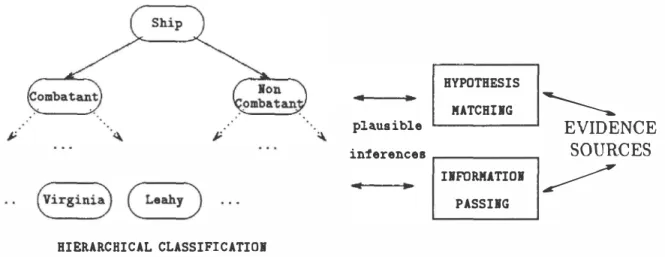
classifica tory problem solving can be gleaned from the ba sic elements shown in Figure1.
Chandrasekaran uses the term hierarchical classification to describe the primary generic task associated with classifica tory problem solving. Hierarchical classification in herently involves selecting from a pre-enumerated set of solutions, hierarchically organized in terms of class-subclass relationships. The problem solving process resolves the impact of evidence, and estab lishes which hypotheses are most strongly confirmed. Those hypotheses are then refined by gathering addi tional evidence, when available, that might confirm or refute hypotheses lower in the hierarchy. In this way, the process tries to establish the most specific solution possible.In very simple situations, hierarchical classifica tion is the only generic task required for classifica tory problem solving. In most cases, though, the extent to which the available data constitutes evi dence for establishing or rejecting a hypothesis can not be known directly and must be inferred. Two kinds of generic tasks are available to support such inferences. The first is called knowledge-directed in formation passing. This task accomplishes simple categorical inferences that exploit conceptual rela tionships in the data. Examples of these inferences include definitional abstractions
(
eg. x lower than y implies y is higher than x), database retrieval, and simple property inheritance.When the data available is uncertain, incomplete or only partially matches a hypothesis, straightfor ward categorical inferences are no longer adequate. The fit between data and hypotheses must then be determined by another generic task called hypothesis matching. As the name implies, hypothesis match ing is the process of computing the extent to which evidence confirms, rejects or suggests a hypothesis. The emphasis is on managing the uncertainty asso ciated with both the data and the knowledge needed to relate it to the hypotheses of interest. Several fa miliar methods are available for implementing this task: statistical pattern classification algorithms, in
ference
networks, heuristic rules, and so on.This generic view of classificatory problem solving makes it clear that several kinds of inferences and relationships among hypotheses might be required. In the hierarchical classification task, evidence must
HYPOTHESIS .. •
�
MATCHIIG ·� � plausibleEVIDENCE
interencesSOURCES
IIFORM!TIOI�
... .. PASSIIG HIERARCHICAL CLASSIFICATIOIFigure
1: Ageneric view of classificatory problem solving
be combined at a level of abstraction commensurate
with the available data, in a manner consistent with
the object-class relationships in the hierarchy. The
knowledge-directed information passing task could
require a set of logical rules to characterize prop
erty inheritance relationships. Hypothesis matching
might involve inferences based on object-part rela
tionships, causal relationships, geometric relation
ships, or temporal relationships. Since the reason
ing associated with each task may be hierarchical,
the overall classification process can involve several
levels of abstraction, each perhaps having its own
reasoning mechanism, all integrated by the primary
hierarchical classification task.
Note that the need to refine confirmed hypothe
ses points to an important control problem: decid
ing when additional evidence should be acquired and
processed, and deciding which inferences should be
computed. The efficiency of classificatory problem
solving obviously depends on making cost-effective
use of both the available evidence and computational
resources.
2.2.
The
CSRLApproach
The Conceptual Structures Representation Lan
guage (CSRL) (Bylander
&
Mittal, 1986) is designed
to facilitate the construction of classificatory prob
lem solvers in a way commensurate with the generic
task point of view. Language constructs are pro
vided for all aspects of classificatory problem solv
ing: defining classification hierarchies, delineating
problem solving strategies, and calculating a degree
of certainty for each classificatory hypothesis.
The basic unit of representation in CSRL is the
specialist
that designates a particular hypothesis or
concept related to the problem. Each specialist
is a knowledge based problem solving agent that
can make local decisions about how well it fits the
data available. Once a specialist has been estab
lished as a relevant hypothesis, it can decide which
other specialists should be invoked. Specialists in
CSRL are organized into a classification tree reflect
ing the class-subclass relationships most important
to the problem. Hierarchical classification proceeds
according to a hypothesis refinement scheme called
establish-refine.
When a hypothesis is established as
relevant, it refines itself by invoking its subhypothe
ses and other hypotheses indicated by the data so
that they can try to establish themselves. Specialists
communicate with each other by passing messages,
and each specialist has local procedures specifying
how it responds to each kind of message.
Uncertainty calculations in CSRL are used to de
termine when a hypothesis has been established.
The key unit of representation here is the
knowl
edge group. A
knowledge group is a collection of
production rules that map problem data into a dis
crete scale of qualitative confidence values. This
mapping implements either the hypothesis matching
task, or the knowledge-directed information passing
task. Each knowledge group corresponds to an ev
idential abstraction needed to
establisha hypothe
sis.
Ahypothesis is established once it achieves cer
tain distinguished levels of confidence. The evidence
used by a knowledge group to make this determina
tion can range from low level raw data or database
queries to the abstract evaluations made by other knowledge groups. This gives a hierarchical organi zation to the uncertainty calculation. Hierarchical relationships among knowledge groups correspond to levels of conceptual abstraction, and the informa tional dependencies between knowledge groups cor respond to the evidential relationships underlying a classificatory hypothesis.
Two points about the CSRL framework should be noted. First, each classificatory hypothesis
is
asso ciated with its own hierarchy of knowledge groups dedicated to computing its confidence value. Each knowledge group is therefore aspecialized
body of knowledge that is brought to bear only when its as sociated hypothesis tries to establish itself. More over, whenever a hypothesis is rejected, all of its subhypotheses are also ruled out along with their knowledge group hierarchies. This is an important wayto
exercisedomain dep
endent control over theproblem solving process. Second, it
is
important to note that qualitative scales are used to measure con fidence levels. The basic premise is that the conditions
for applying most numeric uncertainty calculi usually do not hold in practice (Chandrasekaran&
Tanner,
1986).
Tran
sla
ting expert knowledge into anonnative calculus therefore becomes a step that un necessarily introduces uncertainty into the problem solver.
The CSRL approach attempts to model as closely
as possible the judgements and conceptual struc tures used by a human expert. CSRL hopes to avoid the need for normative methods by using the inher ent organization of the problem solving task to make the determination of plausible solutions tractable. There is no experimental evidence, however, that the qualitative uncertainty methods of CSRL are really a better descriptive model of human judgement than numeric methods. Moreover, no
th
eoryis pr
ovided
to justify the way confidence values are combined or to give confidence values a clear semantic interpre tation.
2.3.
Managing Uncertainty
The CSRL qualitative approach to uncertainty man agement assumes that plausible inferences do not have to be precisely correct or complete (Bylander
&
Chandrasekaran, 198
7). Indeed, correctness andcompleteness are viewed as issues that can detract
from more important considerations like choosing a reasoning strategy that matches the problem at
hand,
or determining which inferences are really im portant in a given situation. Bylander and Chan drasekaran(1987,
p.242)
argue thatIn diagnosis, for example, there is much more to be gained by using abduction ... than by independently calculating the degree of certainty of each hypothesis to several decimal places of accuracy.
While we agree that the generic task idea is a pow erful construct for organizing problem solving and domain knowledge, we reject the implicit assertion that this approach is incompatible with normative methods for calculating uncertainty.
State of the
artapproaches to probabilistic infer
ence offer a wide range of representations and prob lem solving capabilities (Pearl,1988;
Shachter,1988;
Spiegelhalter, 1986). Pearl
(1987),
for example, hasshown how
a Bayesian beliefnetwork
can efficiently compute a categorical interpretation of a body of ev idence that constitutes a composite explanatory hy pothesis accounting for all observed evidence. This technique is one way to implement the abductive task that provides a clear semantics for what is com puted. Similarly, there is no reason why a probabilis tic inference has to be complete and exhaustive. In fact, decision theory can be used as a framework forrigorously and explicitly identifying the factors un derlying a decision about what to compute (Horvitz,
Breese,
&
Henrion,1988).
The CSRL approach also seems to underestimate the importance of special constraints on classifica tory inferences that might arise in a given domain.
In
th
e kinds of target classification problems the Navyis
interested in, for instance, the problem solv ing environment is unstructured in the sense that there is often little control over what evidence will be availableor when
itwill become
avai
l
abl
e(Booker,
1988).
Control strategies must therefore be flexi ble and opportunistic. Work on a target hypoth esis must be suspended if the evidence needed to definitively establish or reject it is not available, orif evidence arrives that makes some other hypothesis more attractive. Uncertainty management schemes that insist on relatively rigid strategies like establish refine are not well suited to handle this situation. Target classification problems also tend to involve many inherently ambiguous relationships between features and objects. This gives rise to some sub tle dependencies among hypotheses about those ob jects. Maintaining consistent beliefs for several ex planations of a given feature requires careful atten tion to the way alternative causal hypotheses inter act. Most rule-based formalisms for uncertain infer ence either handle this problem awkwardly or cannot handle it at all (Henrion,
1986).
Given the many kinds of inferences involved in classificatory problem solving, it is
especially
im-portant that uncertain beliefs about hypotheses are managed with representations and techniques based on explicit assumptions, sound theory, and clear se mantics. Otherwise there is little reason to expect
that the disparate belief computations can be com
bined into a coherent result. Moreover, if the various reasoning activities are to be orchestrated into an ef
fect
i
ve pr
obl
em solving
process, there must be someframework available that allows beliefs to be sys tematically converted into decisions that take cost benefit considerations into account.
3. A Bayesian Reasoning Tool
The major thrust of target classification research
at NCARAI
is
the design and implementation ofa tool for hierarchica) Bayesian reasoning called
BART (Booker,
1988;
Hota, Ramsey,&
Booker,1988).
BART facilitates the construction of knowl edge based systems that reflect the generic structure of classificatory problem solving. Just a.s im
portant, BART computes axiomatic and normative inferences. In this section we describe BART's ca pabilities and indicate how these capabilities fulfill the requirements of classificatory problem solving.
3.1.
Overall System Architecture
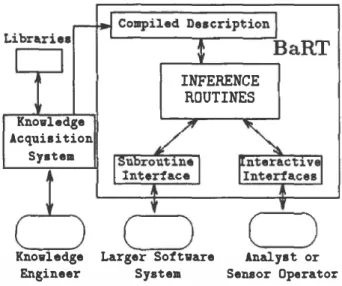
Figure
2
shows the overall BART architecture.There are three major components of BART: the knowledge acquisition system, the network com piler, and the core inference routines. The knowl edge acquisition system has capabilities similar to those found in other interactive tools of this kind
(eg. KNET (Chavez
&
Cooper,1988),
andDAVID
(Sha.chter,
1986)).
It takes advantage of the network structure to focus knowledge acquisition on a. single node at a time, quantifying the relationship between that consequent node and its immediate an tecedents. BART also provides a collection of canon ical descriptions of probabilistic interactions that the user can instantiate for any node in the network. It is important that the user is not forced to use the same canonical model to describe all joint interac tions. BART currently offers the standard "noisy
OR" (Henrion,
1986)
and "noisyAND",
generalizedto be used with non-binary variables by identifying dominance relationships associated with the conse
quent node (Kim,
1983).
Work is underway to include conjunctive and disjunctive models for binary variables that specify patterns of dependent relation
ships {Bonissone
&
Decker,1986).
Note that BARTallows users to maintain a library of their own pre defined subnetworks and canonical interactions that
Knowledge .lcquis i tion System
6
Knowledge EngineerINFERENCE
ROUTINES
C)
Larger Software System0
Analyst or Sellaor OperatorFigure
2:
BART system architecture.can be described once and stored until needed. The BART compiler takes descriptions generated
by
the knowledge acquisition system and convertsthem into the form required by the core inference routines. The important point about the compiler is
that
it
can identify conditions like loops that requirespecial processing. The compiler can also identify canonical interactions like the OR gate for binary
variables where fast methods (Pearl,
1988)
can besubstituted for general ones to make updating more efficient.
The inference methods in BART can be invoked using either a subroutine interface or an inter
active window interface. The subroutine inter
face is used when BART performs inferences for some larger knowledge based system that selectively makes use of various belief maintenance capabilities
(eg. Morawski (1989)). The
interactive interface
is used when BART itself is the primary problem
solver (eg. Booker
&
Hota(1988)).
BART is written in Common Lisp using the
CLOS
object-oriented programming standard. For
Lisp
environments that do not support CLOS,
BART
provides a
mini-CLOS
package that uses defstructsto simulate the functionality BART requires. This means that BART can be run with the subroutine
interface in any Common Lisp
environment.
Graphics interfaces have been developed for the Symbol
ice Lisp machine and the Sun workstation.
An
Xwindow interactive interface will be
developed to
3.2.
Knowledge Representation
The current version of BART supports three knowl edge representations: Bayesian networks, influence diagrams, and taxonomic hierarchies. We are cur rently implementing a method for default reasoning and property inheritance that is based on a prob abilistic semantics (Geffner,
1988).
This will give BART the capability to represent many kinds of conceptual relationships and make categorical in ferences in an axiomatic way. The fourth type of knowledge representation supported by BART willbe databases containing this kind of information. The basic inference procedure used in Bayesian networks is Pearl's (1986) distributed message pass ing algorithm for singly connected networks. We have implemented this algorithm using tensor prod ucts in a manner that is efficient and does not de pend on any special properties of the link matrices (Booker, Rota,
&
Hemphill, 1989). An important advantage of Pearl's algorithm is that it is read ily implemented on parallel hardware. A version of BART that exploits this property has been im plemented on the Butterfly Plus Parallel Proces sor (Ramsey&
Booker, 1988). Another advantage of this algorithm is that, with slight modification, it also computes a categorical belief commitment (Pearl, 1987) for every node in the network. This is useful for explanations and for making abductive inferences. BART converts networks with loops into singly connected networks using Chang and Fung's (1989) node aggregation algorithm.BART solves influences diagram problems by us ing Cooper's method (1988) to convert the influence diagram into a belief network. Cooper's algorithm recursively constructs and evaluates all paths in the
decision tree that corresponds to the influence dia
gram. The efficiency of the BART implementation is enhanced with a simple branch and bound tech nique. Before any path is explored, BART makes an optimistic assumption about the expected value that will be computed for that path. Whenever this optimistic bound is worse than the expected value of some fully expanded alternative, the candidate path
is
pruned.Belief in taxonomic hierarchies is updated using
another algorithm devised by Pearl
(1986).
BART implements the weight distribution/normalization version of this procedure in which the belief of each hypothesis is the sum of the beliefs of its constituent singleton hypotheses. This means that BART can propagate evidence in any class-subclass hierarchy.Several auxiliary computations are also available in BART: auxiliary variables to compute Boolean
constraints and queries, a.nd an error-based measure of impact to gauge the potential effect an uninstan tiated node might have on the uncertainty of a given target hypothesis (Pearl, 1988).
3.3.
Relationship to CSRL
The relationship between BART's capabilities and the generic task view of classificatory problem solv ing is straightforward.
A taxonomic hierarchy is the
counterpart to the classification tree used in CSRL. The BART implementation has the advantage of al lowing arbitrary su bclass-superclass hierarchies to be defined. This avoids the knowledge engineering task of having to simplify the set of classificatory hypotheses into a tree, and allows more than one perspective on the hierarchical classification task to be considered at the same time.Several methods are available to implement the function of knowledge groups. The data abstrac tions and categorical inferences required in the knowledge-directed information passing task can be managed with probabilistic techniques for default reasoning (Geffner, 1988). Hypothesis matching can be accomplished using taxonomies, influence dia grams, and Bayesian networks.
It is important to note that the qualitative rule based computations used in CSRL's knowledge groups are really just a shorthand for describing the joint interaction between an evidential hypothesis and its specializations. In fact, the original formu lation of knowledge groups used tables with qual
itative entries to specify these interactions
(
Chandrasekaran
&
Tanner, 1986). BART will be aug mented with a simple rule-based language for de scribing the local probabilistic interactions of nodesin a network. Each rule is an expression that can re
fer to the values of hypothesis variables and to qual itative terms having some predefined probabilisticinterpretation. Once invoked, a rule assigns values
to some subset of elements in the joint conditional probability matrix quantifying a network link. This is directly analogous to the CSRL knowledge group procedure, but it is accomplished without sacrificing semantic rigor.
Since all inferences computed by BART are prob abilistic, the communication between a classificatory hypothesis and its knowledge group is also straight forward. The hypothesis
simply instructs its associ
ated knowledge group to acquire evidence and up date itself. At present, the only control mechanism available for this evidence gathering activity is the impact measure for belief networks cited previously.and computes the resulting posterior beliefs, it re
turns a likelihood vector to the classificatory hypoth
esis. The likelihood vector then initiates an update
of beliefs
in the classification taxonomy. The variety
of representations available in
BART,
coupled with
a knowledge-based view of classification and the ca
pability to explicitly model dependencies between
hypothesis variables, distinguish
BART
from other
Bayesian approaches to classification (eg. AutoClass
(Cheeseman et al.,
1988)).
An important area for further research is the
de
velopment of control strategies for evaluating hy
potheses in the taxonomy. It is easy to implement
a strategy like simple establish-refine. What is
de
sired is a method that takes cost-benefit considera
tions into account and allows for a wide variety of
strategies to be specified. Influence diagrams have
been proposed
asa way to exercise decision-theoretic
control of problem solving in other systems (Breese
&
Fehling,
1988).
A similar approach might be suit
able in
BART.
4. Conclusion
The
primary goal of
the
BART
project
isto
make
state
of the art techniques for uncertain reasoning
available to researchers concerned with classificatory
problem solving. The thrust of our research has
therefore been to
design and implement
a
generic
tool
for hierarchical
Bayesian reasoning.
BART
brings
together several theoretical ideas about plau
sible inference in a way that appears to be effi
cient andpr
a
ct
ic
al
for real applications. Prelimi
nary versions of
BART
ha
ve
been used as a
d
eci
sion
aid for classifying
ship
images
(Booker
&
Ho
ta
,1988),
and as the reasoning component of a sys
tem concerned with analyzing intelligence reports
(M
or
a
ws
k
i,
1989).
When completed, BART will provide
extensive
facilities for
building classificatory problem solvers.
Specialized representations are available
to
handle
each
of the reasoning
tasks associated
with classi
ficatory
problem solving:
taxonomic hierarchies
for
hi
er
arch
i
c
al classification, Bayesian networks and in
fluence diagrams for hypothesis matching, and prob
abilistic default rules for knowledge-directed in
f
o
r
mation
passing. BART
iscomparable to
a
system
like CSRL
in
that
it allows a knowledge engineer
to
think in terms of
the
inherent, qualitative structure
of a problem. Because
all of
BART's capabilities
are based on sound probabilistic semantics, however,
BART
has
the added advantage of computing nor
mative and axiomatic inferences.
Acknowledgements
The mini-cLOS package was written by Dan
Hoey.
References
Binford,
T., Levitt, T.
and Mann, W.
(1987).
Bayesian inference in model-based machine vi
sion.
Proceedings of the Third Workshop on Un certainty in Artificial Intelligence(pp. 86-92),
Seattle, Washington.
Bonissone, P.P. and Decker, K.S.
(1986)
Selecting
uncertainty calculi and granularity: an experi
ment in trading off precision and complexity. I
n
L.N.
Kanal and
J.Lemmer
(Eds.)
Uncertaintyin Arhficial Intelligence.
Amsterdam:
North
Holland.
Booker, L.
(1988).
Plausible reasoning in classi
fication problem solving. In Chen, S. (Ed.)
Image understanding in unstructured environ ments.
Teaneck,
N J:World Scientific.
Booker, L.
and Hota, N. (1988). Probabilistic rea
soning
about
ship
images. In J.
Lemmer and
L.
Kanal (Eds.)
Uncertainty in Artificial Intelli gence 2.Amsterdam:
North-Holland.
Booker, L., Hota,
N. and Hemphill, G. (1989).
Computing belief commitments using tensor
products. In L. Kanal, T. Levitt and J.
Lemmer
(Eds.)
Uncertainty in Artificial Intelligence 3.Amsterdam:
North-Holland.
Breese, J.
S.
and Fehling, M. R. (1988).
Decision
theoretic
control
of problem
solving: P
r
i
n
c
i
ples
and architecture.
Proceedings of the FourthWorkshop on Uncertainty in Artificial Intelli gence (pp. 30-37), Minneapolis, MN.
Bylander, T.
and
M
itt
a
l
, S. (1986).
CSRL: A lan
guage
for classificatory
problem
solving and un
certainty
handling.
The AI Magazine,7{3),
66-77.
Chandrasekaran, B. (1986).
Generic tasks in
knowledge-based reasoning: High-level building
blocks for expert system design.
IEEE Expert,7{3},
23-30.
Chandrasekaran, B. and Tanner, M. C. (1986). Un
certainty handling in expert systems: Uniform
vs.
task-specific
formalisms. In
L.N. Kanal and
J.
Lemmer (Eds.)
Uncertainty in Artificial In telligence.A
m
ste
r
d
am
:North-Holland.
Chang, K. C. and Fung, R. (1989) Node aggre
g
ation for distributed inference in bayes
i
an networks. Proceedings of the Eleventh Interna tional Joint Conference on Artificial Intelli gence. Detroit, MI: Morgan Kaufmann.
Chavez, R. M. and Cooper, G. F. (1988). KNET:
Integrating
h
ypermedi
a and bayesian modeling.Proceedings of the Fourth Workshop on Un certainty in Artificial Intelligence
(
pp. 49-54), Minneapolis, MN.Cheeseman, P., Kelly, J ., Self, M., Stutz, J ., Taylor, W., and Freeman,
D.
(1988). AutoClass: Abayesian classi
fi
cati
on system. Proceedings ofthe Fifth International Conference on Machine Learning
(
pp. 54-154). Ann Arbor, MI: MorganKaufmann.
Clancey, W. (1984). Cla
ss
ifi
cation problem solving.Proceedings of the Fourth National Conference on Artificial Intelligence
(
pp. 49-55). Austin,TX:
Morgan Kaufmann.Cooper, G. F. (1988). A method for using belief networks as influence diagrams. Proceedings of
the Fourth Workshop on Uncertainty in Artifi cial Intelligence
(
pp. 55-153), Minneapolis, MN.Davis, R. (1982). Expert systems: Where are we?
And where do we go from here? The AI Maga zine, 9(2), 3-22.
Geffner, H. (1988) . On the logic of defa
ult
s. Pro ceedings of the Seventh National Conference on Artificial Intelligence(
pp. 449-454). St. Paul, MN: Morgan Kaufmann.Heckerman, D. and Horvitz,
E.
(1987). On the expressiveness of rule-basedsystems
for reason ing w ith uncertainty. Proceedings of the Sixth National Conference on A rtijicial Intelligence(
pp. 121-126). Seattle, WA: Morgan Kaufmann.
Henrion, M. (1986). Should we use probability in uncertain inference systems?
Proceedings of
the Eighth Annual Conference of the Cognitive Science Society (pp. 320-330). Amherst, MA: Lawrence Erlbaum.Horvitz, E., Bree
se
, J., and Henrion, M. (1988). Decision theory in expertsystems
and artificial intelligence. InternationalJournal of
Approxi mate Reasoning, 2, 247-302.Hota, N., Ramsey, C.L., and Booker, L.B. (1988).
BaRT manual: Preliminary version 2.0. NRL Memorandum Report 6243, Naval Research Laboratory, Washington, D.C.
Kim, J. (1983). CONVINCE: A conversational in ference consolidation engine. Doctoral disserta tion, Department of Computer Science, Univer sity of California, Los Angeles.
Morawski, P. (1989). A hybrid approach to target trackin
g
. Proceedings of the Annual AI Systemsin Government Conference
(
pp. 80-87). Washington, D.C.: IEEE Computer Society.
Pearl, J. (1986) Fusion, propagation and structur
ing in belief networks. Artificial Intelligence, 29' 241-288.
Pearl, J. (1987). Distributed revision of composite
beliefs. Artificial Intelligence, 99, 173-215. Pearl, J. (1988). Evidential reasoning under uncer
tainty. Technical report R-107, Cogni
t
ive Sys tems Laboratory, University of California, Los Angeles, CA.Pearl, J. (1988). Probabilistic reasoning in intelli gent systems: Networks of plausible inference.
San Mateo, CA: Morgan Kaufmann.
Ramsey, C. L. and Booker, L. B. (1988). A parallel
implementation of a belief maintenance system. Presentation at AAAI Workshop on Parallel Al
gorithms for Machine Intelligence and Pattern Recognition, St. Paul, MN.
Shachter, R. (1988). DAVID: Influence diagram processing system for the Macintosh. In J. Lem mer and L. Kana! (Eds.) Uncertainty in Artifi cial Intelligence 2. Amsterdam: North-Holland.
Shenoy, P. and Shafer, G. (1986). Propagating be
lief functions with local computations. IEEE Expert,
1(3),
43-51.Spiegelhalter, D.J. (1986). A statistical view of un certainty in expert systems. In W. Gale (ed.),
A rlijicial intelligence and statistics. Reading, MA: Addison.