processes
M´
elina Bec, Claire Lacour
To cite this version:
M´elina Bec, Claire Lacour. Adaptive pointwise estimation for pure jump L´evy processes. 2013. <hal-00583221v3>
HAL Id: hal-00583221
https://hal.archives-ouvertes.fr/hal-00583221v3
Submitted on 12 Feb 2013HAL is a multi-disciplinary open access archive for the deposit and dissemination of sci-entific research documents, whether they are pub-lished or not. The documents may come from teaching and research institutions in France or abroad, or from public or private research centers.
L’archive ouverte pluridisciplinaire HAL, est destin´ee au d´epˆot et `a la diffusion de documents scientifiques de niveau recherche, publi´es ou non, ´emanant des ´etablissements d’enseignement et de recherche fran¸cais ou ´etrangers, des laboratoires publics ou priv´es.
ADAPTIVE POINTWISE ESTIMATION FOR PURE JUMP L´EVY PROCESSES
M´ELINA BEC*, CLAIRE LACOUR**
Abstract. This paper is concerned with adaptive kernel estimation of the L´evy density
N(x) for bounded-variation pure-jump L´evy processes. The sample path is observed atn
discrete instants in the ”high frequency” context (∆ = ∆(n) tends to zero whilen∆ tends to infinity). We construct a collection of kernel estimators of the functiong(x) =xN(x) and propose a method of local adaptive selection of the bandwidth. We provide an oracle inequality and a rate of convergence for the quadratic pointwise risk. This rate is proved to be the optimal minimax rate. We give examples and simulation results for processes fitting in our framework. We also consider the case of irregular sampling.
Keywords. Adaptive Estimation; High frequency; Pure jump L´evy process; Nonpara-metric Kernel Estimator.
February 12, 2013
1. Introduction
Consider (Lt, t≥0) a real-valued L´evy process with characteristic function given by: (1) ψt(u) =E(expiuLt) = exp (t
Z R
(eiux−1)N(x)dx).
We assume that the L´evy measure admits a densityN and that the functiong(x) =xN(x) is integrable. Under these assumptions, (Lt, t ≥0) is a pure jump L´evy process without drift and with finite variation on compact sets. Moreover E(|Lt|) < ∞ (see Bertoin
(1996)). Suppose that we have discrete observations (Lk∆, k= 1, ..., n) with sampling
interval ∆. Our aim in this paper is the nonparametric adaptive kernel estimation of the function g(x) = xN(x) based on these observations under the asymptotic framework n tends to ∞. This subject has been recently investigated by several authors. Figueroa-L´opez and Houdr´e (2006) use a penalized projection method to estimate the L´evy density on a compact set separated from 0. Other authors develop an estimation procedure based on empirical estimations of the characteristic function ψ∆(u) of the increments (Zk∆ =
Lk∆−L(k−1)∆, k= 1, . . . , n) and its derivatives followed by a Fourier inversion to recover
the L´evy density. For low frequency data (∆ is fixed), we can quote Watteel and Kulperger (2003), or Jongbloed and van der Meulen (2006) for a parametric study. Still in the low frequency framework, Neumann and Reiß (2009) estimate ν(x) = x2N(x) in the more general case with drift and volatility, and Comte and Genon-Catalot (2010b) use model selection to build an adaptive estimator. An adaptive method to estimate linear functionals
* UMR CNRS 8145 MAP5, Universit´e Paris Descartes, ** Laboratoire de Math´ematiques d’Orsay, Universit´e Paris-Sud.
is also given in Kappus (2012). Belomestny (2011) addresses the issue of inference for time-changed L´evy processes with results in term of uniform and pointwise distance.
In the high frequency context, which is our concern in this paper, the problem is simpler since, for any fixed u, ψ∆(u) → 1 when ∆→ 0. This implies that ψ∆(u) need not to be
estimated and can simply be replaced by 1 in the estimation procedures. This is what is done in Comte and Genon-Catalot (2009). These authors start from the equality:
(2) EhZ∆
k eiuZ ∆
k
i
=−iψ∆′ (u) = ∆ψ∆(u)g∗(u),
obtained by differentiating (1). Here g∗(u) = R eiuxg(x)dx is the Fourier transform of g, well defined since we assume g integrable. Then, as ψ∆(u) ≃ 1, equation (2) writes
EhZ∆
keiuZ ∆
k
i
≃∆g∗(u). This gives an estimator of g∗(u) as follows:
1 n∆ n X k=1 Zk∆eiuZk∆.
Now, to recover g, the authors apply Fourier inversion with cutoff parameter m. Here, we rather introduce a kernel to make inversion possible:
1 n∆ n X k=1 Zk∆K∗(uh)eiuZk∆
which is in fact the Fourier transform of 1/(nh∆)Pnk=1Zk∆K((x−Zk∆)/h). At the end, in the high frequency context, a direct method without Fourier inversion can be applied. Indeed, a consequence of (2) is that the empirical distribution:
ˆ µn(dz) = 1 n∆ n X k=1 Zk∆δZ∆ k(dz)
weakly converges to g(z)dz (note that the idea of exploiting this weak convergence is already present in Figueroa-L´opez (2009b)). This suggests to consider kernel estimators of g of the form (3) gˆh(x) =Kh⋆µˆn(x) = 1 n∆ n X k=1 Zk∆Kh(x−Zk∆)
where Kh(x) = (1/h)K(x/h) andK is a kernel such that RK = 1. Below, we study the quadratic pointwise risk of the estimators ˆgh(x) and evaluate the rate of convergence of this risk asntends to infinity, ∆ = ∆(n) tends to 0 andh=h(n) tends to 0. This is done under H¨older regularity assumptions for the functiong. Note that a pointwise study involving a kernel estimator can be found in van Es et al. (2007) for more specific compound Poisson processes, but the estimator is different from ours, as well as the observation scheme. In Figueroa-L´opez (2011) a pointwise central limit theorem is given for the estimation of the L´evy density, as well as confidence intervals. Still in the high frequency context, we can cite Duval (2012) for the estimation of a compound Poisson process with low conditions on ∆, but for integrated distance.
In this paper, we study local adaptive bandwidth selection (which the previous au-thors do not consider). For a given non-zero real x0, we select a bandwidth ˆh(x0) such
convergence corresponding to the unknown regularity of the function g. The method of bandwidth selection follows the scheme developped by Goldenshluger and Lepski (2011) for density estimation. The advantage of our kernel method is that it allows us to estimate the L´evy density at a fixed point, with a local adaptive choice. This method is easy to implement, and we show its good numerical performance on different examples. Moreover our contribution includes an alternative proof for a lower bound result (see Figueroa-L´opez (2009a)) which proves the optimality of the rate for this pointwise estimation. We also study the framework of irregular sampling.
In Section 2, we give notations and assumptions. In Section 3, we study the pointwise mean square error (MSE) of ˆgh(x0) given in (3) for g belonging to a H¨older class of
regularity β and we present the bandwidth selection method together with both lower and upper risk bound for our adaptive estimator. The rate of convergence of the risk is (log(n∆)/n∆)2β/2β+1 which is expected in adaptive pointwise context. Examples and simulations in our framework are discussed in Section 4. The case of irregular sampling is addressed in Section 5 and proofs are gathered in Section 6.
2. Notations and assumptions
We present the assumptions on the kernel K and on the function g required to study the estimator given by (3). First, we set some notations. For any functionsu, v, we denote by u∗ the Fourier transform of u, u∗(y) = R eiyxu(x)dx and by kuk, < u, v >, u ⋆ v the quantities kuk2 = Z |u(x)|2dx, < u, v >= Z
u(x)v(x)dxwith zz=|z|2 and u ⋆ v(x) =
Z
u(y)v(x−y)dy.
For a positive real β,⌊β⌋ denotes the largest integer strictly smaller than β. Let us also define the following functional space:
Definition 2.1. (H¨older class) Let β > 0, L > 0 and let l = ⌊β⌋. The H¨older class
H(β, L) on R is the set of all functions f :R −→ R such that derivative f(l) exists and
verifies:
|f(l)(x)−f(l)(y)| ≤L|x−y|β−l, ∀x, y∈R.
We can now define the assumptions concerning the target function g: G1: g∈L2
G2: g∗ is differentiable almost everywhere and its derivative belongs to L1
G3(p): Forp integer, R|x|p−1|g(x)|dx <∞
G4(β): g∈ H(β, L)
G5: g′ exists and is uniformly bounded
The first assumption is natural to use Fourier analysis, as well as G3(1). Assumption G3(p) ensures thatE|Z∆
1 |p <∞. G4 is a classical regularity assumption in nonparametric
estimation; it allows to quantify the bias (see Tsybakov (2009)). Note that G5 implies that g∈ H(1, L′) so we can assumeβ ≥1.
Now let us describe which kind of kernel we choose for our estimator. For m ≥ 1 an integer, we say that K : R → R is a kernel of order m if functions u 7→ ujK(u), j =
0,1, ..., m are integrable and satisfy Z K(u)du= 1, Z ujK(u)du= 0, j∈ {1, ..., m}. (4)
Let us define the following conditions
K1: K belongs to L1∩L2∩L∞and K∗ ∈L1
K2(β): The kernelK is of order l=⌊β⌋ and R |x|β|K(x)|dx <+∞
These assumptions are standard when working on problems of estimation by kernel methods. Note that there is a way to build a kernel of order l. Indeed, letube a bounded integrable function such that u ∈ L2, u∗ ∈ L1 and R u(y)dy = 1, and set for any given
integer l, K(t) = l X k=1 l k (−1)k+11 ku t k . (5)
The kernelKdefined by (5) is a kernel of orderlwhich also satisfies K1 (see Kerkyacharian et al. (2001) and Goldenshluger and Lepski (2011)). As usual, we define Kh by
∀x∈R Kh(x) = 1 hK x h . In all the following we fix x0∈R,x06= 0.
3. Risk bound
3.1. Risk bound for a fixed bandwidth. In this subsection, the bandwidthhis fixed, thus we omit the subscript hfor the sake of simplicity: we denote ˆg= ˆgh. The usual bias variance decomposition of the Mean Squared Error yields:
M SE(x0, h) :=E[(bg(x0)−g(x0))2] =E[(bg(x0)−E[g(xb 0)])2] + (E[bg(x0)]−g(x0))2.
But the bias needs further decomposition:
b(x0)2 := (E[bg(x0)]−g(x0))2 ≤ 2b1(x0)2+ 2b2(x0)2
with the usual bias,
b1(x0) =Kh⋆ g(x0)−g(x0),
and the bias resulting from the approximation of ψ∆(u) by 1,
b2(x0) =E[g(xb 0)]−Kh⋆ g(x0).
We can provide the following bias bound:
Lemma 3.1. Under G3(1), G4(β), G5 and if the kernel K satisfies K1 and K2(α) with
α ≥β
|b(x0)|2 ≤ c1h2β+c′1∆2
with c1 = 2 L/⌊β⌋!R|K(v)||v|βdv2 and c′1 = 2(2kg′k∞kgk1kKk1)2.
Lemma 3.2. Under G1 and G2, and if the kernel satisfies K1, we have Var[bg(x0)]≤ 1 nh∆ kKk22 2π (k(g∗)′k1+kg∗k 2 2∆)≤c2 1 nh∆+c′2 1 nh with c2 =k(g∗)′k1kKk22/(2π) and c′2 =kKk22kgk22.
Lemmas 3.1 and 3.2 lead us to the following risk bound:
Proposition 3.1. Under G1, G2, G3(1), G4(β), G5 and ifK satifies K1 and K2(α) with
α ≥β, we have M SE(x0, h)≤c1h2β+c2 1 nh∆+c′2 1 nh +c′1∆ 2. (6)
Recall that ∆ = ∆(n) is such that limn→+∞∆ = 0, thus 1/nh is negligible compared
to 1/nh∆. For the two first terms the optimal choice ofh is hopt ∝((n∆)− 1
2β+1) and the associated rate has orderO(n∆)−2β2+1β
. Next, a sufficient condition for ∆2 ≤(n∆)−2β2β+1 for all β is
∆ =O(n−1/3). (7)
Proposition 3.2. Under the assumptions of Proposition 3.1 and under condition (7), the choice hopt ∝((n∆)−
1
2β+1) minimizes the risk bound (6) and gives M SE(x
0, hopt) = O((n∆)−2β2β+1). As a consequence E[(bg(x0)/x0−N(x0))2] =O((n∆)−2β2β+1).
We can link this result to the one of Figueroa-L´opez (2011) who proves that his projec-tion estimator Nb is such that (Nb(x0)−N(x0))(n∆)α tends to a normal distribution for
any 0< α < β/(2β+ 1).
The rate obtained in Proposition 3.2 turns out to be the optimal minimax rate of convergence over the classH(β, L). This result is proved in Figueroa-L´opez (2009a) in the more general case of estimators based on the whole path of the process up to time n∆. In our case of discrete sampling, another proof is given in Section 6.3, where we prove the following result:
Theorem 3.1. Assume∆ =O(1)and∆−1 =O(n). Letx
0 6= 0. There existsC >0such
that for any estimator gˆn(x0) based on observations Z1∆, . . . , Zn∆, and for n large enough, sup
g∈H(β,L)
Eg(ˆgn(x0)−g(x0))2≥C(n∆)−2β2β+1.
Obviously, the result is also true replacing g by the L´evy density N.
3.2. Bandwidth selection. As β is unknown, we need a data-driven selection of the bandwidth. We follow ideas given in Goldenshluger and Lepski (2011) for density esti-mation. We introduce a set of bandwidth of the form H = {Mj ,1 ≤j ≤M} withM an integer to be specified later. Actually it is sufficient to control Ph∈Hh−w for some w so that more general set of bandwiths are possible. We set:
V(h) =C0
log(n∆) nh∆
withC0 to be specified later. Note thatV(h) has the same order as the variance multiplied
by log(n∆). We also define ˆgh,h′(x0) =Kh′⋆ˆgh(x0) =Kh⋆ˆgh′(x0). This auxiliary estimator can also be written
ˆ gh,h′(x0) = 1 n∆ n X k=1 Zk∆Kh′⋆ Kh(x0−Zk∆).
Lastly we set, as an estimator of the bias, A(h, x0) = sup h′∈H |ˆgh,h′(x0)−ˆgh′(x0)|2−V(h′) +.
The adaptive bandwidthh is chosen as follows: ˆ
h= ˆh(x0)∈arg min
h∈H{A(h, x0) +V(h)}. We can state the following oracle inequality.
Theorem 3.2. We use a kernel satisfying K1 and a set of bandwidth H={Mj ,1≤j ≤ M} with M =O((n∆)1/3). Assume that g satisfies G1, G2, G3(5) and take
(8) C0 =C0(c) = c 2πkKk 2 k(g∗)′k1+kg∗k22
with c≥16 max(1,kKk∞). Then, for ∆≤1,
E[|g(x0)−ˆgˆ h(x0)|2]≤C inf h∈H kg−E[ˆgh]k2 ∞+V(h) + log(n∆) n∆
Thus our estimator ˆgˆh has a risk as good as any of the collection (ˆgh)h∈H, up to a logarithmic term.
Note that the theorem is valid for c large enough, sayc≥ c0. In the proof, we obtain
the upper bound 16 max(1,kKk∞) forc0, unfortunately we can conjecture that this bound
is not the optimal one. To obtain a sharper bound we have tuned c0 in the simulation
study.
The definition of the estimator uses k(g∗)′k1 and kg∗k22, but these quantities can be
estimated with a preliminar estimator of g∗. More precisely, we set K∗
0 =1[−1,1] and \ k(g∗)′k1 =Z 1 n∆ n X k=1 (Zk∆)2K0∗(uh1)eiuZ ∆ k du withh1 = (n∆) −1/3, \ kg∗k2 2 =kgˆh2∗ k22= Z 1 n∆ n X k=1 Zk∆K0∗(uh2)eiuZ ∆ k 2 du with h2 = (n∆)−1/3.
We introduce the following regularity condition: a fonction ψ belongs to the Sobolev space Sob(α) if R |ψ∗(u)|2|u|2αdu <∞. Then, reinforcing the conditions on g, we obtain a similar theorem with an empirical C0.
Theorem 3.3. We use a kernel satisfyingK1andK2(α)withα≥1, andM =O((n∆)1/3).
Assume that gsatisfies G1, G2, G3(32), G4(1), G5. Assume also that g andxg(x) belong to Sob(1). Take C0 = c 2πkKk 2 \ k(g∗)′k1+\kg∗k2 2
with c≥32 max(1,kKk∞).Then, for n−1≤∆≤Cn−1/3, E[|g(x0)−gˆˆ h(x0)| 2] ≤C inf h∈H kg−E[ˆgh]k2 ∞+E(V(h)) + log(n∆) n∆
Let us now conclude with the consequence of this theorem in term of rate of convergence. As already explained, as we need assumption G5 to control the bias, we can assumeβ≥1. Then hopt∝(log(n∆)/n∆)1/(2β+1) ≥(n∆)−1/3 belongs to H as soon asM is larger than a constant times (n∆)1/3. Hence we can state the following corollary.
Corollary 3.1. Assume that g satisfies G1, G2, G3(5), G4(β) with β ≥1 and G5. We choose a kernel satisfying K1 and K2(α) with α ≥ β, and M = ⌊(n∆)1/3⌋. Take C0 as
in Theorem 3.2 (or as in Theorem 3.3 with assumptions of this latter theorem). Then, if
n−1 ≪∆≤Cn−1/3, E[|g(x0)−gˆˆ h(x0)|2] =O (log(n∆)/n∆)−2β2β+1 .
Then the price to pay to adaptivity is a logarithmic loss in the rate. Nevertheless this phenomenon is known to be unavoidable in pointwise estimation (see Butucea (2001)). Thus ˆgˆh(x0) (resp. ˆgˆh(x0)/x0) is an adaptive estimator forg(x0) (resp. N(x0)).
4. Examples and Simulations
We have implemented the estimation method for four different processes (listed in Ex-amples 1-4 below) with the kernel described in (5) (withl= 2 anduthe Gaussian density). The bandwidth set has been fixed to H ={2jM,1≤j≤M} withM =⌊2(n∆)−1/3⌋. For
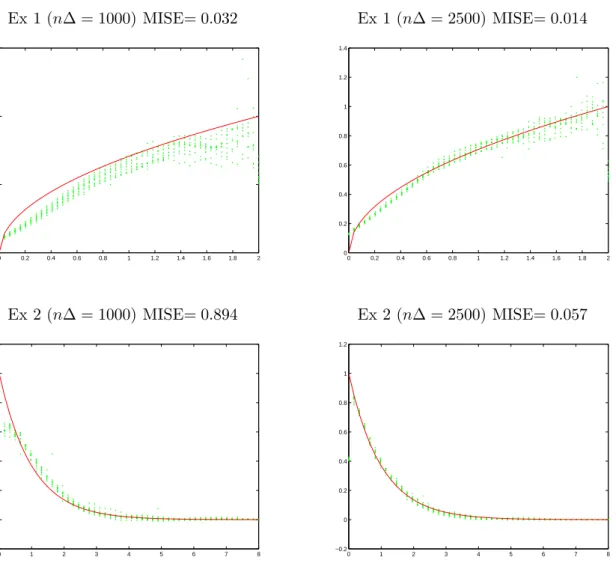
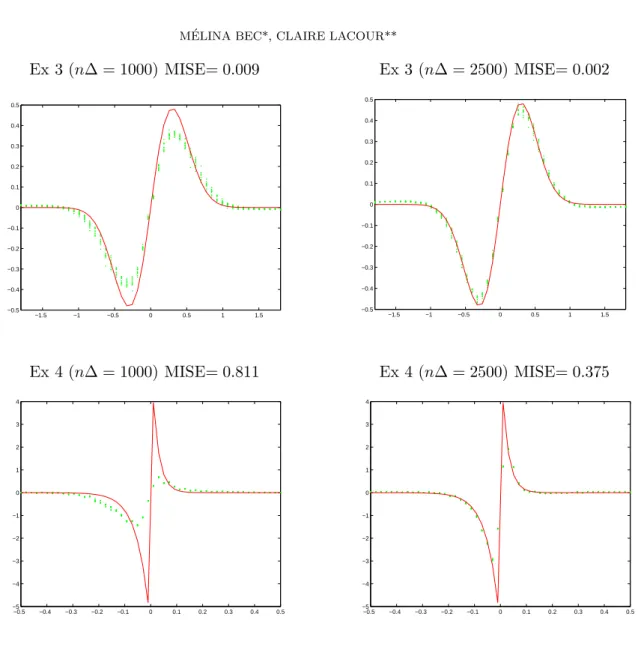
the implementation, a difficulty is the proper calibration of the constant c in (8). This is usually done by a large number of preliminary simulations. We have chosen c = 0.1 as the adequate value for a variety of models and number of observations. The estimation and adaptation are done for 50 points x0 on the abscissa interval. For clarity, we have
computed the Mean Integrated Square Error (MISE) of the estimators. Figures 1 and 2 plot ten estimated curves corresponding to our four examples with in the first column ∆ = 0.02, n = 5.103, and in the second ∆ = 0.05, n = 5.104. This values of parameters
can be interpreted as around hourly observations during few years.
Example 1. LetLt=PNt
i=1Yi,where (Nt) is a Poisson process with constant intensity
λand (Yi) is a sequence of i.i.d random variables with densityf independent of the process (Nt). Then, (Lt) is a L´evy process with characteristic function
(9) ψt(u) = exp λt Z R (eiux−1)f(x)dx .
Its L´evy density is N(x) = λf(x) and thus g(x) = λxf(x). For our first example, we choose λ= 2 andf such that g(x) =xf(x) = (1/2)px/2 for 0< x≤2. Then assump-tion G4(1/2) holds (on (0,2)), but not G4(β) for other β. Since β is small, the rate of convergence is slow. The discontinuity in 2 damages the estimation as it can be seen in Figure 1.
Example 2. Letα >0,γ >0. The L´evy-Gamma process (Lt) with parameters (γ, α) is such that, for all t > 0, Lt has Gamma distribution with parameters (γt, α), i.e the
density:
αγt Γ(γt)x
γt−1e−αx
1x≥0.
The L´evy density isN(x) =γx−1e−αx1
x>0so thatg(x) =γe−αx1x>0satisfies assumptions
G1, G2 and G3(p). Here we choose α = γ = 1. This example allows to study the role of the discontinuity in 0, which invalidates assumptions G4-G5. We can observe that the estimation become very good if we move away from 0.
Example 3. For our third example, we also choose a compound Poisson process, but withf the Gaussian density with varianceδ2.Thusg(x) =λxf(x) =λxe−x2/(2δ2)/(δ√2π) and g∗(u) =iλδue−δ2u2/2
. Assumptions G1, G2, G3(p),G5 hold forg. Moreovergbelongs to a H¨older class of regularity β for all β >0. Thus the rate is close to (n∆/log(n∆))−1, and the good performance of our estimator is visible on Figure 2. Note that is the so-called Merton model used for describing the log price in financial modeling. Here we chooseλ= 2 and δ = 0.3.
Example 4. Our last example is the Variance Gamma process, as described in Madan et al. (1998). It is used for modeling the dynamics of the logarithm of stock prices. The process is obtained in evaluating a Brownian motion at a time given by a L´evy-Gamma process. Denoting (Bt) a standard Brownian motion, and (Xt) a L´evy-Gamma process with parameters (1/ν,1, ν) independent of (Bt), we set Lt = θXt+σBXt. ThenLt is a
L´evy process, with
g(x) = xexp(θx/σ 2) ν|x| exp − 1 σ r 2 ν + θ2 σ2|x| ! .
As in example 3, there is a discontinuity in 0. Here we choose θ =−0.1436, σ = 0.1213, ν = 0.1686: these are estimates of parameters for the S&P index option prices studied in Madan et al. (1998).
5. Irregular sampling
For high frequency data, it is frequent that the sampling is irregular, i.e. the interval ∆ is not necessarily the same at each time. In this section we consider the following framework. The observations are (Ltk, k= 1, ..., n) where (Lt) is still a L´evy process with characteristic
function (1). For each k ≥ 1, we denote ∆k =tk−tk−1 the sampling intervals. Notice
that it includes the previous case when for each k, ∆k= ∆. The increments are denoted by Zk =Ltk −Ltk−1. In this context of irregular sampling, they are still independent but with non-identical distribution: Zk has the same law than L∆k. To define an estimator,
we observe that EZkeiuZk= ∆
kψ∆k(u)g∗(u), and then
E " 1 Pn k=1∆k n X k=1 ZkeiuZk # = Pn k=1∆kψ∆k(u) Pn k=1∆k g∗(u).
Thus, denoting ¯∆ = n1Pnk=1∆k, we introduce
(10) ˆgh∗(u) = 1 n∆¯ n X k=1 ZkeiuZkK∗(hu), gˆh(x) = 1 n∆¯ n X k=1 ZkKh(x−Zk)
Ex 1 (n∆ = 1000) MISE= 0.032 Ex 1 (n∆ = 2500) MISE= 0.014 0 0.2 0.4 0.6 0.8 1 1.2 1.4 1.6 1.8 2 0 0.5 1 1.5 0 0.2 0.4 0.6 0.8 1 1.2 1.4 1.6 1.8 2 0 0.2 0.4 0.6 0.8 1 1.2 1.4 Ex 2 (n∆ = 1000) MISE= 0.894 Ex 2 (n∆ = 2500) MISE= 0.057 0 1 2 3 4 5 6 7 8 −0.2 0 0.2 0.4 0.6 0.8 1 1.2 0 1 2 3 4 5 6 7 8 −0.2 0 0.2 0.4 0.6 0.8 1 1.2
Figure 1. Functiong (solid line) and estimators ˆgˆ
h (dotted lines).
Additionally, for all real δ, we denote ∆δ = 1
n
Pn
k=1∆δk. We can bound the Mean Squared Error of this estimate:
Proposition 5.1. Under G1, G2, G3(1), G4(β), G5 and ifK satifies K1 and K2(α) with
α ≥β, we have M SE(x0, h)≤c1h2β+c2 1 nh∆¯ +c ′ 2 ∆2 nh∆¯2 +c′1 ∆2 ¯ ∆ !2 (11) withc1 = 2 L/⌊β⌋!R |K(v)||v|βdv2,c′1= 2(2kg′k∞kgk1kKk1)2,c2 =k(g∗)′k1kKk22/(2π), c′2 =kKk22kgk22.
Ex 3 (n∆ = 1000) MISE= 0.009 Ex 3 (n∆ = 2500) MISE= 0.002 −1.5 −1 −0.5 0 0.5 1 1.5 −0.5 −0.4 −0.3 −0.2 −0.1 0 0.1 0.2 0.3 0.4 0.5 −1.5 −1 −0.5 0 0.5 1 1.5 −0.5 −0.4 −0.3 −0.2 −0.1 0 0.1 0.2 0.3 0.4 0.5 Ex 4 (n∆ = 1000) MISE= 0.811 Ex 4 (n∆ = 2500) MISE= 0.375 −0.5 −0.4 −0.3 −0.2 −0.1 0 0.1 0.2 0.3 0.4 0.5 −5 −4 −3 −2 −1 0 1 2 3 4 −0.5 −0.4 −0.3 −0.2 −0.1 0 0.1 0.2 0.3 0.4 0.5 −5 −4 −3 −2 −1 0 1 2 3 4
Figure 2. Functiong (solid line) and estimators ˆgˆ
h (dotted lines).
In this section, we are still interested in the high frequency context: the asymptotic framework is ¯∆→0 andn∆¯ → ∞ whenn→ ∞. We shall also assume that
(∆2)2
¯
∆ =O(n
−1).
(12)
Condition (12) is verified for instance if ∆k =Ck−α with α∈ [1/3,1]. Then we find the same rate of convergence replacing ∆ by ¯∆:
Proposition 5.2. Under the assumptions of Proposition 5.1 and under condition (12), the choice hopt∝((n∆)¯ −
1
2β+1) minimizes the risk bound (11) and gives M SE(x
0, hopt) = O((n∆)¯ −2β2β+1).
As already noticed in Comte and Genon-Catalot (2010a), other estimation strategies than (10) are possible. For each real δ, we obtain an estimator by setting
ˆ gh(x) = 1 n∆δ+1 n X k=1 ∆δkZkKh(x−Zk).
Under suitable conditions, this estimate has a MSE bounded by a constant times (n∆δ+12/∆2δ+1)−2β2β+1. But, for all δ, by the Schwarz inequality, ∆δ+12/∆2δ+1 ≤∆. That is why we prefer esti-¯
mator (10).
To build an adaptive estimator, we use the same method of bandwidth selection. The set of bandwidth is still H={Mj ,1≤j≤M}. We also define
ˆ gh,h′(x0) =Kh′⋆gˆh(x0) = 1 n∆¯ n X k=1 ZkKh′ ⋆ Kh(x0−Zk)
and we set as previously A(h, x0) = suph′∈H
|gˆh,h′(x0)−ˆgh′(x0)|2−V(h′) + with V(h) =C0 log(n∆)¯ nh∆¯ .
Then the estimator is ˆghˆ(x0) with ˆh= ˆh(x0)∈arg minh∈H{A(h, x0) +V(h)}.
We can state the following oracle inequality (the proof is very similar to the one of Theorem 3.2 and is therefore omitted).
Theorem 5.1. We use a kernel satisfying K1 and M = O((n∆)¯ 1/3). Assume that g
satisfies G1, G2, G3(5) and take
(13) C0 = c 2πkKk 2 k(g∗)′k 1+kg∗k22
with c≥16 max(1,kKk∞).Then, if(∆2)2/∆¯ ≤1,
E[|g(x0)−ˆgˆ h(x0)|2]≤C inf h∈H kg−E[ˆgh]k2 ∞+V(h) + log(n∆)¯ n∆¯
Moreover, if g satisfies G5, G4(β) with β ≥ 1 and the kernel satisfying K1 and K2(α) with α≥β, and M =⌊(n∆)¯ 1/3⌋, ∆¯ ≪n−1 and (∆2)2/∆ =¯ O(n−1), then
E[|g(x0)−gˆˆ h(x0)|2] =O (log(n∆)/n¯ ∆)¯ −2β2β+1 .
Thus the rate of convergence in this case of irregular sampling is (log(n∆)/n¯ ∆)¯ −2β2β+1 provided that (∆2)2/∆ =¯ O(n−1).
6. Proofs
Let us first state two useful propositions (see Proposition 2.1 in Comte and Genon-Catalot (2010b) and Proposition 2.1 in Comte and Genon-Genon-Catalot (2009) for a proof). Proposition 6.1. Denote byP∆the distribution ofZ1∆and defineµ∆(dx) = ∆−1xP∆(dx).
If RR|x|N(x)<∞, the distribution µ∆ has a densityh∆ given by
h∆(x) =
Z
Proposition 6.2. Letp≥1an integer such thatRR|x|p−1|g(x)|dx <∞. ThenE(|Z∆ 1 |p)<
∞ and E[(Z∆
1 )p] = ∆
R
Rxp−1g(x)dx+o(∆). Moreover, if g is integrable, E(|Z1∆|) ≤
2∆kgk1.
6.1. Proof of Lemma 3.1. First, we studyb2(x0) using Proposition 6.1:
b2(x0) = 1 h∆E Z1∆K x 0−Z1∆ h −h1 Z K x 0−u h g(u)du = 1 h Z K x0−u h E[g(u−Z∆ 1 )−g(u)]du.
Now, applying the mean value theorem to g, we get
|b2(x0)| = 1 h Z K x0−u h E[−Z∆ 1 g′(uZ1)]du withuZ1 ∈[u−Z1∆, u] ≤ kg′k∞kKk1E Z1∆. From the results of Proposition 6.2 we obtain
|b2(x0)| ≤ 2kg′k∞kKk1kgk1∆.
(14)
To study b1(x0) =Kh⋆ g(x0)−g(x0), it is sufficient to use Taylor’s theorem andG4(β)
(this is a classic computation, see Tsybakov (2009) for details) and we obtain
|b1(x0)| ≤ h βL l! Z |K(v)||v|βdv. (15)
Gathering (14) and (15) completes the proof of Lemma 3.1. 6.2. Proof of Lemma 3.2. As theZk∆are i.i.d., we have:
Var[bg(x0)] = Var " 1 nh∆ n X k=1 Zk∆K x0−Zk∆ h # = 1 n(h∆)2Var Z1∆K x0−Z1∆ h . Thus, Var[bg(x0)]≤ 1 n(h∆)2E (Z1∆)2K2 x0−Z1∆ h . Writing K2 x0−Z1∆ h = 1 2π Z K∗(u)e−i(x0−Z ∆ 1 )u h du 2 , we obtain with v=u/h
Var[bg(x0)] ≤ 1 n∆2E " (Z1∆)2 1 2π Z K∗(vh)e−i(x0−Z1∆)vdv 2# ≤ 1 n∆2(2π)2E ZZ Z1∆eiZ1∆vK∗(vh)e−ix0vZ∆ 1 eiZ ∆
1uK∗(uh)e−ix0udvdu
. Using Fubini and E[(Z∆
1 )2eiZ ∆ 1 (v−u)] =−ψ′′ ∆(v−u) we find Var[bg(x0)] ≤ 1 n∆2(2π)2 Z Z
Now the following formula
ψ∆′′=i∆ψ∆′g∗+i∆ψ∆g∗′=−∆2ψ∆g∗2+i∆ψ∆g∗′.
gives Var[bg(x0)]≤T1+T2 with
T1=
1 n∆2(2π)2
Z Z
|∆2ψ∆(v−u)(g∗)2(v−u)K∗(vh)K∗(uh)|dvdu
T2 =
1 n∆2(2π)2
Z Z
|∆ψ∆(v−u)(g∗)′(v−u)K∗(vh)K∗(uh)|dvdu.
We first bound T2: T2 ≤ 1 n∆(2π)2 sZZ |ψ∆(v−u)||(g∗)′(v−u)||K∗(vh)|2dvdu × sZZ |ψ∆(v−u)||(g∗)′(v−u)||K∗(uh)|2dvdu ≤ 1 n∆(2π)2 Z |K∗(vh)|2dv Z |ψ∆(z)||(g∗)′(z)|dz ≤ 1 nh∆(2π)2 Z |K∗(u)|2du Z |(g∗)′(z)|dz, because |ψ∆(z)| ≤1 ≤ kKk 2 2 2πnh∆ Z |(g∗)′(z)|dz
where (g∗)′ exists and is integrable by G2. Following the same line for the study ofT1, we
get T1 ≤ k Kk22 2πnh Z |(g∗)2(z)|dz≤ kKk 2 2kgk22 nh , This completes the proof of Lemma 3.2.
6.3. Proof of the lower bound. Here we prove Theorem 3.1 The essence of the proof is to build two functions g0 and g1 which are far in term of pointwise distance but with
close associated distribution. Let
g0(x) =xfλ(x) = 1 π
λx 1 + (λx)2
wherefλ is the density of the Cauchy distributionC(0, λ) with scale parameterλ. Hereλ is a positive and small enough real (it will be made precise later). Now let K a infinitely differentiable and even function such that RK = 0, K(0) 6= 0 and K(x) = |x|−2 for |x| large enough (say for |x|> B). Using this auxiliary function K, we can define
g1(x) =g0(x) +chβnK x−x0 hn x where cis a constant to be specified later and
We denote N0(x) = g0(x)/x and N1(x) = g1(x)/x. Remark that if L0,t = PNi=1t Yi is a compound Poisson process with Nta Poisson process of intensity 1 andYi CauchyC(0, λ) variables, then its characteristic function is
ψ0,t(u) = exp (t
Z R
(eiux−1)N0(x)dx)
and Zk0,∆=L0,k∆−L0,(k−1)∆ has distributionP0(dx) =e−∆δ0(dx) +ϕ0(x)dxwith
ϕ0(x) = ∞ X k=1 e−∆∆ k k!f∗ k λ (x).
Moreover N1 is a density. Indeed the definition of K guarantees that R N1(x)dx =
R N0(x)dx+chβnR K x−x0 hn
dx= 1. And to ensure the positivity ofN1, it is sufficient to
prove that |N1−N0| ≤N0. But, if |x|>|x0|+Bhn ,
N0−1(x)|N1(x)−N0(x)| ≤Cchnβ+2x2|x−x0|−2 ≤1
for csmall enough, and if |x| ≤ |x0|+Bhn,
N0−1(x)|N1(x)−N0(x)| ≤Cchβn(1 + (λ(|x0|+Bhn))2)kKk∞≤1
forcsmall enough. Then, ifL1,t=PiN=1t Yi withNta Poisson process of intensity 1 andYi random variables with density N1, it is a L´evy process with L´evy measureN1(x)dx. We
denote ψ1,∆ the characteristic function of L1,∆ with distribution P1, andϕ1 the function
such that P1(dx) =e−∆δ0(dx) +ϕ1(x)dx.
Now let us denote for two probability measuresP andQ,χ2(P, Q) =R (dP/dQ−1)2dQ. In the sequel we show that
1) g0, g1 belong to H(β, L),
2) |g1(x0)−g0(x0)| ≥C(n∆)−
β
2β+1,
3) χ2(P1n, P0n) ≤ C < ∞ where P1n (resp. P0n) is the distribution of a sample Z1∆, . . . , Zn∆ s.t the associated L´evy process L0 (resp. L1) has L´evy measure
N0(x)dx (resp. N1(x)dx).
Then it is sufficient to use Theorem 2.2 (see also p.80) in Tsybakov (2009) to obtain The-orem 3.1. In the following we denote all constants byC, even if it changes from line to line.
Proof of 1). Belonging to the H¨older space
To prove that our hypotheses belong to H(β, L), it is sufficient to show that, fori= 0,1, kgi(k+1)kp ≤L wherek=⌊β⌋ and p−1= 1 +k−β. Indeed H¨older inequality gives
|gi(k)(x)−g(ik)(y)|= Z g(ik+1)(v)1[x,y](v)dv ≤ kgi(k+1)kp|x−y|β−k for all x, y. When x goes to infinity, g(0k+1)(x) = Cλ−1x−k−2+o(x−k−2) so it belongs to Lp since p(k+ 2) = (k+ 2)/(k+ 1−β)>1. Choosingλsmall enough ensureskg(0k+1)kp ≤L/2≤L.
Now to study g1, we can write
(g1−g0)(k+1)(x) =cxK(k+1) x−x0 hn hβn−k−1+c(k+ 1)K(k) x−x0 hn hβn−k.
Let us see if this two terms are in Lp.Writing x=x−x
0+x0 and changing variables
Z xK(k+1) x−x0 hn p dx≤2p−1hpn+1 Z |vK(k+1)(v)|pdv+ 2p−1|x0|phn Z |K(k+1)(v)|pdv.
These integrals are finite since vK(k+1)(v) = v−(2+k) for v large enough and p(k+ 2) = (k+ 2)/(k+ 1−β)>1. In the same way
Z K(k) x−x0 hn p dx≤hn Z |K(k)(v)|pdv. Thus k(g1−g0)(k+1)kpp ≤Ccp(hnhpn(β−k−1)+hnhnp(β−k))≤Ccphnp(1/p+β−k−1) ≤Ccp ≤(L/2)p for suitable c. Theng1−g0 belongs toH(β, L/2) andg1 belongs to H(β, L).
Proof of 2). Rate
By assumption,x0 6= 0 and we can see that|g1(x0)−g0(x0)|=chβn|K(0)x0|withK(0)6= 0.
Since hn= (n∆)− 1
2β+1, this quantity has the announced order of the rate: (n∆)−
β
2β+1 .
Proof of 3). Chi-square divergence
Since the observations are i.i.d., χ2(P1n, P0n) = (1 +χ2(P1, P0))n−1. Thus, it is sufficient
to prove that χ2(P1, P0) =O(n−1) where
χ2(P1, P0) = Z x6=0 ϕ1(x) ϕ0(x) − 1 2 ϕ0(x)dx.
Indeed P1({0}) =e−∆=P0({0}). Now let us remark that for nlarge enough
ϕ0(x) = ∞ X k=1 e−∆∆ k k!f ∗k λ (x)≥e−∆∆fλ(x)≥∆e−Cλπ−1/(1 + (λx)2)
since ∆ is bounded. Thenϕ0(x)≥C−1∆x−2for|x|large enough, say|x| ≥Aandϕ0(x)≥
C−1∆ for|x| ≤A. Next we writeχ2(P
1, P0) =Rx6=0(ϕ1(x)−ϕ0(x))2(ϕ0(x))−1dx=I1+I2
where I1 is the integral for |x|< A and I2 for |x| ≥ A. We will bound these two terms
separately.
Since ϕ0(x)≥C−1∆ for|x|small
I1 = Z |x|<A (ϕ1(x)−ϕ0(x))2(ϕ0(x))−1dx≤C∆−1 Z |x|<A (ϕ1(x)−ϕ0(x))2dx.
For i= 0,1, the Fourier tranform of ϕi is ψi,∆(u)−Pi({0}). Thus Parseval equality gives
I1 ≤C∆−1
Z
|ψ1,∆(u)−ψ0,∆(u)|2du.
In order to get a bound on |ψ1,∆−ψ0,∆|, we apply the mean value theorem:
|ψ1(u)−ψ0(u)| ≤ sup
z∈Iu
|ez||∆
Z
where Iu is the segment in C between au = ∆R(eiux−1)N0(x)dx and bu = ∆R(eiux− 1)N1(x)dx. But Z (eiux−1)(N1(x)−N0(x))dx=chβn Z (eiux−1)K x−x0 hn dx=chβn+1eiux0K∗(hnu).
Note that this quantity is well defined since K belongs to L1. Thus
|ψ1(u)−ψ0(u)| ≤ (supz∈Iue
R(z))∆chβ+1
n |K∗(hnu)|
where R(x) means the real part of x. We can compute R(au) = au = ∆(N∗
0(u)−1) =
∆(exp(−|u/λ|)−1)≤0 and
R(bu) =R(∆(N0∗(u)−1 + (N1−N0)∗(u))) = ∆(N0∗(u)−1 +chnβ+1R(K∗(hnu)eiux0)). Since K is even, R(bu) = ∆(exp(−|u/λ|)−1 +chβ+1 n K∗(hnu) cos(ux0))≤c∆hnβ+1kK∗k∞≤C so that |ψ1(u)−ψ0(u)| ≤ eC∆chβn+1|K∗(hnu)|. (16) Then I1 ≤C∆−1 Z ∆hβn+1K∗(hnu) 2du≤C∆h2nβ+1. (17)
Let us now bound the term I2, using thatϕ0(x)≥C−1∆x−2 for|x|large enough
I2 = Z |x|≥A (ϕ1(x)−ϕ0(x))2 ϕ0(x) dx≤C∆−1 Z (ϕ1(x)−ϕ0(x))2x2dx.
But F =ϕ1−ϕ0 has Fourier transform
F∗ =ψ1,∆−ψ0,∆= exp(∆(e−|u/λ|+chnβ+1K∗(hnu)eiux0−1))−exp(∆(e−|u/λ|−1)) and this function is differentiable everywhere exept at u= 0, with derivative
F∗′= ∆γ1ψ1,∆−∆γ0ψ0,∆
where
γ0(u) =−sign(u).e−|u/λ|/λ, γ1(u) =γ0(u) +chnβ+1eiux0(ix0K∗(hnu) +hnK∗′(hnu)). Let us now prove that the Fourier transform of F∗′ is −2πixF(−x). Let us write the
factorization
(18) ∆−1F∗′=γ1ψ1,∆−γ0ψ0,∆= (γ1−γ0)ψ1,∆+γ0(ψ1,∆−ψ0,∆)
with |ψ1,∆| ≤ 1. Since K∗ and K∗′ are uniformly bounded, γ1 −γ0 is bounded as well.
In the same way, the inequality (16) entails that kψ1,∆−ψ0,∆k∞ < ∞, so that F∗′ is
bounded. ThusF∗ is Lipschitz and absolutely continuous. Moreover, using again (18), we can see that F∗′ is integrable (we can choose K such that K∗ is integrable, for example
take for K the difference between the Cauchy density and the normal density). Then, according to Rudin (1987), the Fourier transform ofF∗′is−ixF∗∗(x) (it is in fact a simple integration by parts). Since F∗ is integrable, F∗∗(x) = 2πF(−x) almost everywhere, and
we have proved that (F∗′)∗(x) = −2πixF(−x) a.e.. Next, the Parseval equality provides
R
|xF(x)|2dx= (2π)−1R|F∗′
(u)|2du. Thus
I2 ≤C∆−1R |xF(x)|2dx≤C∆(2π)−1R |γ1ψ1,∆−γ0ψ0,∆|2.
Hence, using the factorization (18) we can split I2 ≤π−1C∆(I2,1+I2,2) with
(
I2,1=R|γ1−γ0|2,
I2,2=R|γ0(ψ1,∆−ψ0,∆)|2.
Using the definition of γ1, we compute
I2,1 = c2h2nβ+2 Z |ix0K∗(hnu) +hnK∗′(hnu)|2du ≤ 2c2h2nβ+1 x20 Z |K∗|2+h2n Z |K∗′|2 ≤ 4πc2h2nβ+1 x20 Z |K|2+h2n Z |xK(x)|2 ≤Ch2nβ+1. (19)
Now, in order to deal with I2,2, we use the previous bound (16) on |ψ1,∆−ψ0,∆|
I2,2 ≤ Cc2∆2h2nβ+2 Z |γ0(u)K∗(hnu)|2du ≤ Cc2∆2h2nβ+2kK∗k∞kγ0k22≤Ch2nβ+1 (20) since ∆ is bounded.
Finally, by gathering (17), (19) and (20), we get
χ2(P1, P0) ≤ C∆hn2β+1 =O(n−1). This ends the proof of Theorem 3.1.
6.4. Proof of Theorem 3.2. The goal is to bound E[|g(x0)−gˆˆ
h(x0)|2]. To do this, we fix h∈H. We write |g(x0)−ˆghˆ(x0)| ≤ |ˆgˆh(x0)−ˆgh,hˆ(x0)|+|ˆgh,hˆ(x0)−ˆgh(x0)|+|ˆgh(x0)−g(x0)|. So we have |g(x0)−gˆˆh(x0)|2≤3|gˆˆh(x0)−ˆgh,ˆh(x0)|2+ 3|ˆgh,ˆh(x0)−ˆgh(x0)|2+ 3|gˆh(x0)−g(x0)|2. Define B :=|gˆˆh(x0)−gˆh,ˆh(x0)|2 and C :=|gˆh,ˆh(x0)−ˆgh(x0)|2.
We have A(h)≥ |gˆˆh(x0)−gˆh,ˆh(x0)|2−V(ˆh)≥B−V(ˆh). SoB ≤A(h) +V(ˆh).
Moreover, A(ˆh)≥ |ˆgh,hˆ(x0)−ˆgh(x0)|2−V(h)≥C−V(h). SoC ≤A(ˆh) +V(h).
Therefore,
|g(x0)−ˆgˆh(x0)|2 ≤3(A(h) +V(ˆh)) + 3(A(ˆh) +V(h)) + 3|gˆh(x0)−g(x0)|2.
Now, by definition of ˆh,A(ˆh) +V(ˆh)≤A(h) +V(h). This allows us to write |g(x0)−ˆgˆh(x0)|2 ≤6A(h) + 6V(h) + 3|ˆgh(x0)−g(x0)|2.
Let us denote bh(x0) =E[ˆgh(x0)]−g(x0) andbh,2(x0) =E[ˆgh(x0)]−Kh⋆ g(x0) (these are
the same notation as in Lemma 3.1, but with subscripth). Thus
E[|g(x0)−gˆˆ h(x0)| 2] ≤ 6E[A(h)] + 6V(h) + 3b2 h(x0) + 3Var(ˆgh(x0)) ≤ 6E[A(h)] + 3b2 h(x0) +C2V(h).
It remains to bound E[A(h)]. Let us denote by gh,h′ =E[ˆgh,h′] andgh =E[ˆgh]. We write (21) gˆh,h′−ˆgh′ = ˆgh,h′ −gh,h′ −ˆgh′+gh′+gh,h′−gh′,
and we study the last term of the above decomposition. We have |gh,h′(x0)−gh′(x0)| = |E[ˆgh,h′(x0)−ˆgh′(x0)]|
= |E[Kh′⋆gˆh(x0)−gˆh′(x0)]|
= |Kh′⋆E[ˆgh(x0)−g(x0)] +Kh′⋆ g(x0)−E[ˆgh′(x0)]|. This can be written:
|gh,h′(x0)−gh′(x0)| = |Kh′ ⋆ bh(x0) +bh,2(x0)| ≤ Z K x0−u h′ bh(u) du h′ +|bh,2(x0)|. Now |bh,2(x0)| ≤ |bh(x0)| ≤ kbhk∞ so that |gh,h′(x0)−gh′(x0)|2 ≤ 2kbhk2∞ Z |K(v)|dv 2 + 2|bh,2(x0)|2 ≤ 2(kKk21+ 1)kbhk2∞. (22)
Then by inserting (22) in decomposition (21), we find: A(h) = sup h′ {| ˆ gh,h′(x0)−gˆh′(x0)|2−V(h′)} + ≤ 3 sup h′ {| ˆ gh,h′(x0)−gh,h′(x0)|2−V(h′)/6}+ +3 sup h′ {| ˆ gh′(x0)−gh′(x0)|2−V(h′)/6}++ 6(kKk12+ 1)kbhk2∞. (23)
We can prove the following concentration result:
Proposition 6.3. Assume thatgsatisfies G1, G2, G3(5) ,Ksatisfies K1,M =O((n∆)1/3)
and take c in (8) such that c≥16 max(1,kKk∞).Then
E sup h′ {| ˆ gh′(x0)−gh′(x0)|2−V(h′)/6}+ =O log(n∆) n∆ (24) E sup h′ {| ˆ gh,h′(x0)−gh,h′(x0)|2−V(h′)/6} + =O log(n∆) n∆ . (25)
Inequalities (24) et (25) together with (23) imply
E[|g(x0)−ˆgˆ
h(x0)|2]≤C1kbhk2∞+C2V(h) +C3
log(n∆) n∆ . This completes the proof of Theorem 3.2.
6.5. Proof of Theorem 3.3. In all this proof, we shall use the following notation: ˆ θ∆(u) = 1 n n X k=1 Zk∆eiZk∆u, ηˆ∆(u) = 1 n n X k=1 (Zk∆)2eiZk∆u,
and θ∆(u) = Eθˆ∆(u), η∆(u) = Eηˆ∆(u). We also denote f(x) = xg(x), so that f∗(u) =
i(g∗)′(u) is estimated by ˆfh1∗ = ˆη∆(u)K∗(uh1). Now, let
Ω ={kg∗−ˆgh2∗ k2≤ kg∗k2(1−1/
√
2) and kf∗−fˆh1∗ k1 ≤ kf∗k1/2}.
The proof is decomposed in three steps. First we shall prove that the inequality is true on Ω, i.e. E[|g(x0)−ˆgˆ h(x0)| 2 1Ω]≤C inf h∈H kg−E[ˆgh]k2 ∞+E(V(h)) + log(n∆) n∆ . The second step is to show the rough upper bound
E[|g(x0)−gˆˆ
h(x0)|4]≤C(n∆)2/3. Finally we will show that P(Ωc)≤C(n∆)−8/3. Consequently
E[|g(x0)−gˆˆ
h(x0)|21Ωc]≤
q
E[|g(x0)−ˆgˆ
h(x0)|4]P(Ωc)≤C(n∆)−1 and the theorem is proved.
• First step:
Following the proof of Theorem 3.2, we can obtain
E|g(x0)−gˆˆ
h(x0)|
2
1Ω≤6E[A(h)1Ω] + 3b2h(x0) +C2E(V(h)).
Using the definition of A(h), it is then sufficient to prove
E sup h′ {| ˆ gh′(x0)−gh′(x0)|2−V(h′)/6}+1Ω =O log(n∆) n∆ (26) E sup h′ {| ˆ gh,h′(x0)−gh,h′(x0)|2−V(h′)/6}+1Ω =O log(n∆) n∆ (27)
to obtain the result. Now, let us remark that on Ω 1 2kg ∗k2 2 ≤ kgˆ∗h2k22 and 1 2kf ∗k 1 ≤ kfˆh1∗ k1 with kf∗k1 =k(g∗)′k1, so that C0 ≥ c/2 2πkKk 2 k(g∗)′k1+kg∗k22 . Then, using Proposition 6.3, since c/2≥16 max(1,kKk∞),
E sup h′ {| ˆ gh′(x0)−gh′(x0)|2−V(h′)/6}+1Ω ≤E sup h′ {| ˆ gh′(x0)−gh′(x0)|2− 1 6 c/2 2πkKk 2 k( ˜g∗)′k1+kg˜∗k22log(n∆) n∆ }+ =O log(n∆) n∆
and we prove (27) in the same way. • Second step:
First, using Lemma 3.1, |ghˆ(x0)−g(x0)|2 ≤suph∈H c1h2+c′1∆2
≤C. Then the bias term is uniformly bounded. Let us now study the variance term. We can write
ˆ gh(x0) = 1 2π Z e−ix0uK∗(uh)1 ∆θˆ∆(u)du
and, since all h∈H is larger than 1/M, |ˆghˆ(x0)−gˆh(x0)| ≤ 1 2πhsup∈H Z |K∗(uh)| ˆ θ∆(u)−θ∆(u) ∆ du ≤ M2π X h∈H Z |K∗(u)| ˆ θ∆(u/h)−θ∆(u/h) ∆ du.
With a convex inequality
|gˆˆh(x0)−gˆh(x0)|4 ≤ M7 (2π)4 X h∈H Z |K∗(u)| ˆ θ∆(u/h)−θ∆(u/h) ∆ du !4
Next, we use the following inequality (obtained with two uses of the Schwarz inequality):
E ( Z φ(u)du)4 = ZZ ZZ E[φ(u1). . . φ(u4)]du1. . . du4 ≤ Z ZZ Z E1/4φ(u1)4. . .E1/4φ(u4)4du1. . . du4= Z E1/4φ(u)4du 4 . Thus, E|gˆˆ h(x0)−gˆh(x0)| 4 ≤ M 7 (2π)4 X h∈H Z |K∗(u)|E1/4 ˆ θ∆(u/h)−θ∆(u/h) ∆ 4 du 4
But, according to Proposition 2.3 in Comte and Genon-Catalot (2009), under G3(2p), for p≥1, ∆−2pEθˆ∆(v)−θ∆(v)2p ≤C(n∆)−p.Hence, under G3(4), E|gˆˆ h(x0)−gˆh(x0)| 4 ≤ CM7 X h∈H Z |K∗(u)|(n∆)−1/2du 4 ≤ CkK∗k41M8(n∆)−2 ≤CkK∗k41(n∆)2/3. • Third step: P(Ωc) = P(kg∗−gˆ∗ h2k2 >kg∗k2(1−1/ √ 2) or kf∗−fˆh1∗ k1 >kf∗k1/2) ≤ (kg∗k2(1−1/ √ 2))−8Ekˆg∗ h2 −g∗k82+ (kf∗k1/2)−16Ekfˆh1∗ −f∗k161 ≤ CEkˆg∗ h2−gh2∗ k82+Ekgh2∗ −g∗k82+Ekfˆh1∗ −fh1∗ k161 +Ekfh1∗ −f∗k161 . Thus we have four terms to upperbound.
First term: Since ˆg∗
h2(u) =K0∗(uh2)ˆθ∆(u)/∆,
kˆgh2∗ −gh2∗ k22 = 1 h2 Z |K0∗(u)|2 ˆ θ∆(u/h2)−θ∆(u/h2) ∆ 2 du. Then, under G3(8), Ekˆg∗ h2−gh2∗ k8 ≤ 1 h42 Z E1/4 |K0∗(u)|8 ˆ θ∆(u/h2)−θ∆(u/h2) ∆ 8 du 4 ≤ h14 2 Z |K0∗(u)|2(n∆)−1du 4 ≤ kK0∗k82M4(n∆)−4≤16(n∆)−8/3. Second term: Since g∗h2 =K0∗(uh2)g∗(u)ψ∆(u), we can decompose the bias into
g∗(u)−g∗h2(u) =g∗(u)(1−K0∗(uh2)) +g∗(u)K0∗(uh2)(1−ψ∆(u)) =b1+b2
Using that R|g∗(u)|2u2du <∞,
kb1k2 = Z |g∗(u)(1−K0∗(uh2))|2du= Z |g∗(u)|21|uh2|>1du ≤ Z |g∗(u)|2|uh2|2du≤Ch22.
On the other hand, using that|1−ψ∆(u)| ≤ |u|∆kgk1 (see Proposition 2.3 in Comte
and Genon-Catalot (2009))
kb2k2 =
Z
|g∗(u)K0∗(uh2)(1−ψ∆(u))|2du≤C∆2
Z
|g∗(u)u|2du ≤ C∆2≤C(n∆)−1.
Thus, takingh2 = (n∆)−1/3 gives kg∗−g∗h2k8 ≤Ch82+C(n∆)−4≤C(n∆)−8/3.
Third term: Since ˆfh1∗ (u) =K0∗(uh1)ˆη∆(u)/∆,
kfˆh1∗ −fh1∗ k1 ≤ 1 h1 Z |K0∗(u)| ˆ η∆(u/h1)−η∆(u/h1) ∆ du
Next, we use the following inequality
E ( Z φ(u)du)16 ≤ Z E1/16φ(u)16du 16 .
Exactly as in Comte and Genon-Catalot (2009), using the Rosenthal inequality, we can prove under G3(4p), for p ≥ 1, ∆−2pE|ηˆ∆(v)−η∆(v)|2p ≤ C(n∆)−p. Then, underG3(32), Ekfˆ∗ h1 −fh1∗ k161 ≤ 1 h16 1 Z E1/16 " |K0∗(u)|16 ηˆ∆(u/h1)∆−η∆(u/h1) 16# du !16 ≤ 1 h161 Z |K0∗(u)|(n∆)−1/2du 16 ≤CkK∗k1(n∆)−8/3
sinceh1= (n∆)−1/3.
Fourth term: Sinceη∆=−ψ′′∆= ∆f∗ψ∆+ ∆2(g∗)2ψ∆, we can decompose the bias
into
f∗(u)−fh1∗ (u) = f∗(u)−K0∗(uh1)f∗(u)ψ∆(u)−∆K0∗(uh1)(g∗(u))2ψ∆(u)
= f∗(u)(1−K0∗(uh1)) +f∗(u)K0∗(uh1)(1−ψ∆(u))
−∆K0∗(uh1)(g∗(u))2ψ∆(u)
= b1+b2+b3 Since R|f∗(u)|2u2du <∞, kb1k1 ≤ Z |f∗(u)(1−K0∗(uh1))|du= Z |f∗(u)|1|uh1|>1du ≤ Z |f∗(u)|2|uh1|2du Z |uh1|−21|uh1|>1du 1/2 ≤Ch11/2
On the other hand, using that |1−ψ∆(u)| ≤ |u|∆kgk1
kb2k1 ≤
Z
|f∗(u)K0∗(uh1)(1−ψ∆(u))|du≤C∆
Z |f∗(u)uK0∗(uh1)|du ≤ C∆ Z |f∗(u)u|2du Z |K0∗(uh1)|2du 1/2 ≤ C∆h−11/2≤C(h1n∆)−1/2 and kb3k1 ≤ ∆ Z
|K0∗(uh1)(g∗(u))2ψ∆(u)|du
≤ ∆
Z
|(g∗(u))2|du≤C∆≤C(n∆)−1/2
Thuskf∗−fh1∗ k161 ≤Ch81+C(h1n∆)−8+C(n∆)−8 ≤C(n∆)−8/3.
This completes the proof of Theorem 3.3.
6.6. Proof of Proposition 6.3. Note that
ˆ gh′(x0)−gh′(x0) = 1 n n X k=1 Zk∆ ∆ Kh′ x0−Zk ∆−E Zk∆ ∆ Kh′ x0−Zk ∆ . (28)
In order to apply a Bernstein inequality, since the Zk∆’s are not bounded, we truncate these variables and consider the following decomposition:
{|Zk∆| ≤µn}and {|Zk∆|> µn} where
(29) µn=µn(h′) =k
Kk22(k(g∗)′k1+kg∗k22)
We then decompose (28) as follows ˆ gh′(x0)−gh′(x0) = 1 n n X k=1 Wk(h′) +Tk(h′)−E Wk(h′) +Tk(h′) = Sn(W(h′)) +Sn(T(h′)) where Sn(X) means (1/n)Pni=1[Xi−E(Xi)] and
Wk(h) = Zk∆ ∆ Kh x0−Zk ∆1 {|Zk∆|≤µn(h)} (30) Tk(h) = Zk∆ ∆ Kh x0−Zk ∆ 1{|Zk∆|>µn(h)}. (31) Thus E sup h′ {| ˆ gh′(x0)−gh′(x0)|2−V(h′)/6}+ ≤ 2 X h′∈H ESn(W(h′))2−V(h′)/12 ++ 2 X h′∈H ESn(T(h′))2.
Then we use the two following lemmas
Lemma 6.1. Assume thatgsatisfies G1, G2,Ksatisfies K1, andc≥16, M =O((n∆)1/3). Then there exists C >0 only depending on K and g such that
X h∈H ESn2(W(h))−V(h)/12 +≤C log(n∆) n∆ . Lemma 6.2. Under assumptions K1, G3(5) and if M =O((n∆)1/3),
X h∈H ES2 n(T(h)) ≤C′ 1 n∆. Lemmas 6.1 and 6.2 yield
E sup h′ {| ˆ gh′(x0)−gh′(x0)|2−V(h′)/6}+ ≤C′′ 1 n∆+ log(n∆) n∆
Inegality (25) is obtained by following the same lines as for inequality (24) with Kh replaced by Kh′⋆ Kh. This ends the proof of Proposition 6.3.
6.7. Proof of lemma 6.1. First, note that
ES2 n(W(h))−V(h)/12 + ≤ Z ∞ 0 P(S2 n(W(h))≥V(h)/12 +x)dx ≤ Z ∞ 0 V(h)P|Sn(W(h))| ≥pV(h)(1/12 +y)dy.
Next, we recall the classical Bernstein inequality (see e.g. Birg´e and Massart (1998) for a proof):
Lemma 6.3. Let W1, ..., Wn n independent and identically distributed random variables
and Sn(W) = (1/n)Pni=1[Wi−E(Wi)]. Then, forη >0,
P(|Sn(W)| ≥η) ≤ 2 exp −nη2/2 ν2+bη ≤2 max exp −nη2 4ν2 ,exp −nη 4b ,
where V ar(W1)≤ν2 and|W1| ≤b.
We apply this form of Bernstein inequality toWi(h) defined by (30) andη=p(1/12 +y)V(h). Using Lemma 3.2 and ∆≤1, it is easy to see that
Var(Wi)≤ν2 := k Kk22(k(g∗)′k1+kg∗k22) 2π∆h and|Wi| ≤b:= kKk∞µn(h) ∆h . We find exp −nη2 4ν2 = exp − π(1/12)V(h)n∆h 2kKk2 2(k(g∗)′k1+kg∗k22) ×exp − πyV(h)n∆h 2kKk2 2(k(g∗)′k1+kg∗k22) = (n∆)−c/48×(n∆)−cy/4 and exp −nη 4b ≤ (n∆)−c/48×(n∆)−c√y/192. Then we deduce ES2 n(W(h))−V(h)/12 + ≤ Z ∞ 0 V(h)(n∆)−c/48max(n∆)−cy/4,(n∆)−c√y/192dy ≤ V(h)(n∆)−c/48 Z ∞ 0 (n∆)−cy/4dy+ Z ∞ 0 (n∆)−c√y/192dy ≤ 4cV(h)(n∆)−c/48 1 log(n∆) + 96 clog(n∆)2
using that R0∞e−y/λ =λand R∞
0 e−
√y/λ
= 2λ2. Replacing V(h) by its value, it gives
X h∈H ESn2(W(h))−V(h)/12 + ≤ 4C0 c (n∆)− 1−c/48 1 + 96 clog(n∆) X h∈H 1 h. Recall that H ={Mk,1≤k≤M}. Then
X h 1 h = M X k=1 M k ≤log(M)M ≤ 1 3log(n∆)(n∆) 1/3. Finally X h∈H ES2 n(W(h))−V(h)/12 + ≤ 4C0 3c (n∆) −2/3−c/48 log(n∆) + 96 c ≤ 4C3c0(n∆)−1 log(n∆) + 96 c
6.8. Proof of lemma 6.2. For a fixed bandwidthh inH, we can establish the following bound: E|Sn(T(h))|2 = Var " 1 n n X k=1 Zk∆ ∆hK x0−Zk∆ h 1{|Z∆ k|>µn} # ≤ n1kKk 2 ∞ (∆h)2E[(Z ∆ 1 )21{|Z∆ 1 |>µn}] ≤ n∆1 kKk 2 ∞ h2 E[|Z∆ 1 | w+2 /∆] µnw
for any w >0. Recall that, according to Proposition 6.2,E[|Z∆ 1 |
w+2
/∆] is bounded under G3(w+ 2). We search conditions for Phh−2µn−w ≤ constant. The following equalities hold up to constants: X h∈H 1 h2µ nw =X h V(h)w/2 h2 = log(n∆)w/2 (n∆)w/2 X h 1 h2+w/2.
Since h=k/M, this provides
X h 1 h2+w/2 = M X k=1 M k 2+w/2 =M2+w/2 M X k=1 1 k2+w/2 =O(M 2+w/2).
Finally, as M =O((n∆)1/3), we have
X h 1 h2µ nw ≤ CM 2+w/2log(n∆)w/2 (n∆)w/2 ≤Clog(n∆) w/2(n∆)1 3(2+ w 2)− w 2.
We need that (2 +w/2)×1/3−w/2 < 0, so we need the Zi admit a moment of order w+ 2≥5. This completes the proof of lemma 6.2.
Acknowledgement
The authors thank Fabienne Comte and Valentine Genon-Catalot for enlightening dis-cussions and helpful advices.
References
Belomestny, D. (2011). Statistical inference for time-changed L´evy processes via composite characteristic function estimation. Ann. Statist., 39(4):2205–2242.
Bertoin, J. (1996). L´evy processes, volume 121 of Cambridge Tracts in Mathematics. Cambridge University Press, Cambridge.
Birg´e, L. and Massart, P. (1998). Minimum contrast estimators on sieves: exponential bounds and rates of convergence. Bernoulli, 4(3):329–375.
Butucea, C. (2001). Exact adaptive pointwise estimation on Sobolev classes of densities.
ESAIM Probab. Statist., 5:1–31 (electronic).
Comte, F. and Genon-Catalot, V. (2009). Nonparametric estimation for pure jump L´evy processes based on high frequency data. Stochastic Process. Appl., 119(12):4088–4123.
Comte, F. and Genon-Catalot, V. (2010a). Non-parametric estimation for pure jump irregularly sampled or noisy L´evy processes. Stat. Neerl., 64(3):290–313.
Comte, F. and Genon-Catalot, V. (2010b). Nonparametric adaptive estimation for pure jump L´evy processes. Ann. Inst. Henri Poincar´e Probab. Stat., 46(3):595–617.
Duval, C. (2012). Adaptive wavelet estimation of a compound Poisson process.
arXiv:1203.3135.
Figueroa-L´opez, J. E. (2009a). Nonparametric estimation of L´evy models based on discrete-sampling. InOptimality, volume 57 ofIMS Lecture Notes Monogr. Ser., pages 117–146. Inst. Math. Statist., Beachwood, OH.
Figueroa-L´opez, J. E. (2009b). Nonparametric estimation of time-changed l´evy models under high-frequency data. Adv. Appl. Probab., 41(4):1161–1188.
Figueroa-L´opez, J. E. (2011). Sieve-based confidence intervals and bands for L´evy densi-ties. Bernoulli, 17(2):643–670.
Figueroa-L´opez, J. E. and Houdr´e, C. (2006). Risk bounds for the non-parametric esti-mation of L´evy processes. In High dimensional probability, volume 51 of IMS Lecture Notes Monogr. Ser., pages 96–116. Inst. Math. Statist., Beachwood, OH.
Goldenshluger, A. and Lepski, O. (2011). Bandwidth selection in kernel density estimation: oracle inequalities and adaptive minimax optimality. Ann. Statist., 39(3):1608–1632. Jongbloed, G. and van der Meulen, F. H. (2006). Parametric estimation for subordinators
and induced OU processes. Scand. J. Statist., 33(4):825–847.
Kappus, J. (2012). Nonparametric adaptive estimation of linear functionals for low fre-quency observed L´evy processes. SFB 649 discussion paper, No. 2012-016.
Kerkyacharian, G., Lepski, O., and Picard, D. (2001). Nonlinear estimation in anisotropic multi-index denoising. Probab. Theory Relat. Fields, 121:137–170.
Madan, D. B., Carr, P. P., and Chang, E. C. (1998). The variance gamma process and option pricing. Eur. Finance Rev., 2(1):79–105.
Neumann, M. H. and Reiß, M. (2009). Nonparametric estimation for L´evy processes from low-frequency observations. Bernoulli, 15(1):223–248.
Rudin, W. (1987). Real and complex analysis. McGraw-Hill Book Co., New York, third edition.
Tsybakov, A. B. (2009). Introduction to nonparametric estimation. Springer Series in Statistics. Springer, New York. Revised and extended from the 2004 French original, Translated by Vladimir Zaiats.
van Es, B., Gugushvili, S., and Spreij, P. (2007). A kernel type nonparametric density estimator for decompounding. Bernoulli, 13(3):672–694.
Watteel, R. N. and Kulperger, R. J. (2003). Nonparametric estimation of the canonical measure for infinitely divisible distributions. J. Stat. Comput. Simul., 73(7):525–542.