(will be inserted by the editor)
Automated Bug Assignment: Ensemble-based
Machine Learning in Large Scale Industrial Contexts
Leif Jonsson · Markus Borg · David
Broman · Kristian Sandahl · Sigrid
Eldh · Per Runeson
Received: date / Accepted: date
Abstract Context: Bug report assignment is an important part of software maintenance. In particular, incorrect assignments of bug reports to develop-ment teams can be very expensive in large software developdevelop-ment projects. Several studies propose automating bug assignment techniques using machine learning in open source software contexts, but no study exists for large-scale proprietary projects in industry. Objective: The goal of this study is to eval-uate automated bug assignment techniques that are based on machine learn-ing classication. In particular, we study the state-of-the-art ensemble learner Stacked Generalization (SG) that combines several classiers. Method: We collect more than 50,000 bug reports from ve development projects from two companies in dierent domains. We implement automated bug assignment L. Jonsson
Ericsson and Department of Computer and Information Science Linköping University Torshamnsgatan 42
SE-16480, Stockholm, Sweden Tel.: +46-107147215
E-mail: [email protected] M. Borg
Department of Computer Science, Lund University E-mail: [email protected]
D. Broman
University of California, Berkeley E-mail: [email protected] K. Sandahl
Department of Computer and Information Science Linköping University E-mail: [email protected]
S. Eldh Ericsson AB
E-mail: [email protected] P. Runeson
Department of Computer Science, Lund University E-mail: [email protected]
and evaluate the performance in a set of controlled experiments. Results: We show that SG scales to large scale industrial application and that it outper-forms the use of individual classiers for bug assignment, reaching prediction accuracies from 50% to 90% when large training sets are used. In addition, we show how old training data can decrease the prediction accuracy of bug as-signment. Conclusions: We advice industry to use SG for bug assignment in proprietary contexts, using at least 2,000 bug reports for training. Finally, we highlight the importance of not solely relying on results from cross-validation when evaluating automated bug assignment.
1 Introduction
In large projects, the continuous inow of bug reports1challenges the
develop-ers' abilities to overview the content of the Bug Tracking System (BTS) (Bet-tenburg et al, 2008; Just et al, 2008). As a rst step toward correcting a bug, the corresponding bug report must be assigned to a development team or an individual developer. This task, referred to as bug assignment, is normally done manually. However, several studies report that manual bug assignment is labor-intensive and error-prone (Baysal et al, 2009; Jeong et al, 2009; Bhattacharya et al, 2012), resulting in bug tossing (i.e., reassigning bug reports to another developer) and delayed bug corrections. Previous work report that bug tossing is frequent in large projects; 25% of bug reports are reassigned in the Eclipse Platform project (Anvik and Murphy, 2011) and over 90% of the xed bugs in both the Eclipse Platform project and in projects in the Mozilla foundation have been reassigned at least once (Bhattacharya et al, 2012). Moreover, we have previously highlighted the same phenomenon in large-scale maintenance at Ericsson (Jonsson et al, 2012).
Several researchers have proposed improving the situation by automating bug assignment. The most common automation approach is based on classi-cation using supervised Machine Learning (ML) (Anvik et al, 2006; Jeong et al, 2009; Alenezi et al, 2013) (see Section 2 for a discussion about machine learning and classication). By training a classier, incoming bug reports can automatically be assigned to developers. A wide variety of classiers have been suggested, and previous studies report promising prediction accuracies rang-ing from 40% to 60% (Anvik et al, 2006; Ahsan et al, 2009; Jeong et al, 2009; Lin et al, 2009). Previous work has focused on Open Source Software (OSS) development projects, especially the Eclipse and Mozilla projects. Only a few studies on bug assignment in proprietary development projects are available, and they target small organizations (Lin et al, 2009; Helming et al, 2011). Al-though OSS development is a relevant context to study, it diers from propri-etary development in aspects such as development processes, team structure, and developer incentives. Consequently, whether previous research on auto-1 Other common names for bug report include issues, tickets, fault reports, trouble reports, defect reports, anomaly reports, maintenance requests, and incidents.
mated bug assignment applies to large proprietary development organizations remains an open question.
Researchers have evaluated several dierent ML techniques for classifying bug reports. The two most popular classiers in bug assignment are Naive Bayes (NB) and Support Vector Machines (SVM), applied in pioneering work by Cubranic and Murphy (2004) and Anvik et al (2006), respectively. Previ-ous work on bug assignment has also evaluated several other classiers, and compared the prediction accuracy (i.e., the proportion of bug reports assigned to the correct developer) with varying results (Anvik et al, 2006; Ahsan et al, 2009; Helming et al, 2011; Anvik and Murphy, 2011; Bhattacharya et al, 2012). To improve the accuracy, some authors have presented customized solutions for bug assignment, tailored for their specic project contexts (e.g., Xie et al (2012) and Xia et al (2013)). While such approaches have the potential to outperform general purpose classiers, we instead focus on a solution that can be deployed as a plug-in to an industrial BTS with limited customization. On the other hand, our solution still provides a novel technical contribution in re-lation to previous work on ML-based bug assignment by combining individual classiers.
Studies in other domains report that ensemble learners, an approach to combine classiers, can outperform individual techniques when there is di-versity among the individual classiers (Kuncheva and Whitaker, 2003). In recent years, combining classiers has been used also for applications in soft-ware engineering. Examples include eort estimation (Li et al, 2008), fault localization (Thomas et al, 2013), and fault classication (Xia et al, 2013). In this article, we propose using Stacked Generalization (SG) (Wolpert, 1992) as the ensemble learner for improving prediction accuracy in automated bug assignment. SG is a state-of-the-art method to combine output from multiple classiers, used in a wide variety of applications. One prominent example was developed by the winning team of the Netix Prize, where a solution involving SG outperformed the competition in predicting movie ratings, and won the $1 million prize (Sill et al, 2009). In the eld of software engineering, applications of SG include predicting the numbers of remaining defects in black-box test-ing (Li et al, 2011), and malware detection in smartphones (Amamra et al, 2012). In a previous pilot study, we initially evaluated using SG for bug assign-ment with promising results (Jonsson et al, 2012). Building on our previous work, this paper constitutes a deeper study using bug reports from dierent proprietary contexts. We analyze how the prediction accuracy depends on the choice of individual classiers used in SG. Furthermore, we study learning curves for dierent systems, that is, how the amount of training data impacts the overall prediction accuracy.
We evaluate our approach of automated bug assignment on bug reports from ve large proprietary development projects. Four of the datasets origi-nate from product development projects at a telecom company, totaling more than 35,000 bug reports. To strengthen the external validity of our results, we also study a dataset of 15,000 bug reports, collected from a company devel-oping industrial automation systems. Both development contexts constitute
large-scale proprietary software development, involving hundreds of engineers, working with complex embedded systems. As such, we focus on software engi-neering much dierent from the OSS application development that has been the target of most previous work. Moreover, while previous work address bug assignment to individual developers, we instead evaluate bug assignment to dierent development teams, as our industrial partners report this task to be more important. In large scale industrial development it makes sense to assign bugs to a team and let the developers involved distribute the work in-ternally. Individual developers might be unavailable for a number of reasons, e.g., temporary peaks of workload, sickness, or employee turnover, thus team assignment is regarded as more important by our industry partners.
The overall goal of our research is to support bug assignment in large pro-prietary development projects using state-of-the-art ML. We further rene this goal into four Research Questions (RQ):
RQ1 Does stacked generalization outperform individual classiers?
RQ2 How does the ensemble selection in SG aect the prediction accuracy? RQ3 How consistent learning curves does SG display across projects?
RQ4 How does the time locality of training data aect the prediction accuracy? To be more specic, our contributions are as follows:
We synthesize results from previous studies on automated bug assignment and present a comprehensive overview (Section 3).
We present the rst empirical studies of automated bug assignment with data originating from large proprietary development contexts, where bug assignments are made at team level (Section 4).
We conduct a series of experiments to answer the above specied research questions (Section 5) and report the experimental results and analysis from a practical bug assignment perspective (Section 6), including analyzing threats to validity (Section 7).
We discuss the big picture, that is, the potential to deploy automated sup-port for bug assignment in the two case companies under study (Section 8). 2 Machine Learning
Machine learning is a eld of study where computer programs can learn and get better at performing specic tasks by training on historical data. In this section, we discuss more specically what machine learning means in our con-text, focusing on supervised machine learningthe type of machine learning technique used in this paper.
2.1 Supervised Machine Learning Techniques and their Evaluation
In supervised learning, a machine learning algorithm is trained on a training set (Bishop, 2006). A training set is a subset of some historical data that is
collected over time. Another subset of the historical data is the test set, used for evaluation. The evaluation determines how well the system performs with respect to some metric. In our context, an example metric is the number of bug reports that are assigned to correct development teams, that is, the teams that ended up solving the bugs. The training set can, in turn, be split into disjoint sets for parameter optimization. These sets are called hold-out or validation sets. After the system has been trained on the training data, the system is then evaluated on each of the instances in the test set. From the point of view of the system, the test instances are completely new since none of the instances in the training set are part of the test set.
To evaluate the predictions, we apply cross-validation with stratication (Kohavi, 1995). Stratication means that the instances in the training sets and the test sets are selected to be proportional to their distribution in the whole dataset. In our experiments, we use stratied 10-fold cross-validation, where the dataset is split into ten stratied sets. Training and evaluation are then performed ten times, each time shifting the set used for testing. The nal estimate of accuracy of the system is the average of these ten evaluations.
In addition to 10-fold cross-validation, we use two versions of timed evalu-ation to closely replicate a real world scenario: sliding window and cumulative time window. In the sliding window evaluation, both the training set and the test set have xed sizes, but the time dierence between the sets varies by selecting the training set farther back in time. Sliding window is described in more details in Section 5.5.4. The sliding window approach makes it possible to study how time locality of bug reports aects the prediction accuracy of a system.
The cumulative time window evaluation also has a xed sized test set, but increases the size of the training set by adding more data farther back in time. This scheme is described in more details in Section 5.5.5. By adding more bug reports incrementally, we can study if adding older bug reports is detrimental to prediction accuracy.
2.2 Classication
We are mainly concerned with the type of machine learning techniques called classication techniques. In classication, a software component, called a clas-sier, is invoked with inputs that are named features. Features are extracted from the training data instances. Features can, for instance, be in the form of free text, numbers, or nominal values. As an example, an instance of a bug report can be represented in terms of features where the subject and descrip-tion are free texts, the customer is a nominal value from a list of possible customers, and the severity of the bug is represented on an ordinal scale. In the evaluation phase, the classier willbased on the values of the features of a particular instancereturn the class that the features correspond to. In our case, the dierent classes correspond to the development teams in the organi-zation that we want to assign bugs to. The features can vary from organiorgani-zation
to organization, depending on which data that is collected in the bug tracking system.
2.3 Ensemble Techniques and Stacked Generalization
It is often benecial to combine the results of several individual classiers. The general idea to combine classiers is called ensemble techniques. Classiers can be combined in several dieret ways. In one ensemble technique, called bag-ging (Breiman, 1996), many instances of the same type of classier are trained on dierent versions of the training set. Each classier is trained on a new dataset, created by sampling with replacement from the original dataset. The nal result is then obtained by averaging the results from all of the classiers in the ensemble. Another ensemble technique, called boosting, also involves training several instances of the same type of classier on a modied training set, which places dierent weights on the dierent training instances. The clas-siers are trained and evaluated in sequence with subsequent clasclas-siers trained with higher weights on instances that previous classiers have misclassied. A popular version of boosting is called Adaboost (Freund and Schapire, 1995). Both bagging and boosting use the same type of classiers in the ensemble and vary the data the classiers are trained on.
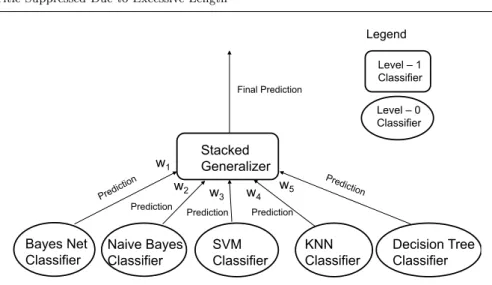
Stacked Generalization (SG) (Wolpert, 1992) (also called stacking or blend-ing) is an ensemble technique that combines several level-0 classiers of dier-ent types with one level-1 classier (see Figure 1) into an ensemble. The level-1 classier trains and evaluates all of the level-0 classiers on the same data and learns (using a separate learning algorithm) which of the underlying classiers (the level-0 classiers) that perform well on dierent classes and data. The level-1 training algorithm is typically a relatively simple smooth linear model (Witten et al, 2011), such as logistic regression. Note that in stacking, it is completely permissible to put other ensemble techniques as level-0 classiers. In this study (see Sections 5 and 6), we are using stacked generalization because this ensemble technique meets our goal of combining and evaluating dierent classiers.
Stacked Generalizer Decision Tree Classifier SVM Classifier KNN Classifier Naive Bayes Classifier Bayes Net Classifier w1 w2 w 3 w4 w5 Final Prediction Level – 1 Classifier Level – 0 Classifier Prediction Prediction Prediction Legend
Fig. 1: Stacked Generalization
3 Related Work on Automated Bug Assignment
Several researchers have proposed automated support for bug assignment. Most previous work can either be classied as ML classication problems or In-formation Retrieval (IR) problems. ML-based bug assignment uses supervised learning to classify bug reports to the most relevant developer. IR-based bug assignment on the other hand, considers bug reports as queries and developers as documents of various relevance given the query. A handful of recent studies show that specialized solutions for automated bug assignment can outperform both ML and IR approaches, e.g., by combining information in the BTS with the source code repository, or by crafting tailored algorithms for matching bug reports and developers. We focus the review of previous work on applications of o-the-shelf classication algorithms, as our aim is to explore combinations of readily available classiers. However, we also report key publications both from IR-based bug assignment and specialized state-of-the-art tools for bug assignment in Section 3.2.
3.1 Automated Bug Assignment using General Purpose Classiers
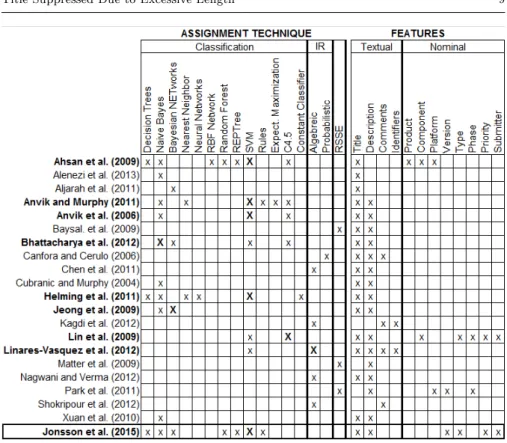
Previous work on ML-based bug assignment has evaluated several techniques. Figure 2 gives a comprehensive summary of the classiers used in previous work on ML-based bug assignment. Cubranic and Murphy (2004) pioneered the work by proposing a Naive Bayes (NB) classier trained for the task. Anvik et al (2006) also used NB, but also introduced Support Vector Machines (SVM), and C4.5 classiers. Later, they extended that work and evaluated also rules-based classication and Expectation Maximization (EM) (Anvik, 2007), as well as Nearest Neighbor (NN) (Anvik and Murphy, 2011). Several other
researchers continued the work by Anvik et al by evaluating classication-based bug assignment on bug reports from dierent projects, using a variety of classiers. Ahsan et al (2009) were the rst to introduce Decision Trees (DT), RBF Network (RBF), REPTree (RT), and Random Forest (RF) for bug assignment. The same year, Jeong et al (2009) proposed to use Bayesian Networks (BNet). Helming et al (2011) used Neural Networks (NNet) and Constant Classier (CC). In our work, we evaluate 28 dierent classiers, as presented in Section 5.
Two general purpose classication techniques have been used more than the others, namely NB and SVM (cf. Figure 2). The numerous studies on NB and SVM are in line with ML work in general; NB and SVM are two standard classiers with often good results that can be considered default choices when exploring a new task. Other classiers used in at least three previous studies on bug assignment are Bayesian Networks (BNET), and C4.5. We include both NB and SVM in our study, as presented in Section 5.
Eight of the studies using ML-based bug assignment compare dierent classiers. The previously largest comparative studies of general purpose clas-siers for bug assignment used seven and six clasclas-siers, respectively, (Ahsan et al, 2009; Helming et al, 2011). We go beyond previous work by compar-ing more classiers. Moreover, we propose applycompar-ing ensemble learncompar-ing for bug assignment, i.e., combining several dierent classiers.
Figure 2 also displays the features used to represent bug reports in previous work on ML-based bug assignment. Most previous approaches rely solely on textual information, most often the title and description of bug reports. Only two of the previous studies combine textual and nominal features in their solutions. Ahsan et al (2009) include information about product, component, and platform, and Lin et al (2009) complement textual information with component, type, phase, priority, and submitter. In our study, we complement textual information by submitter site, submitter type, software revision, and bug priority.
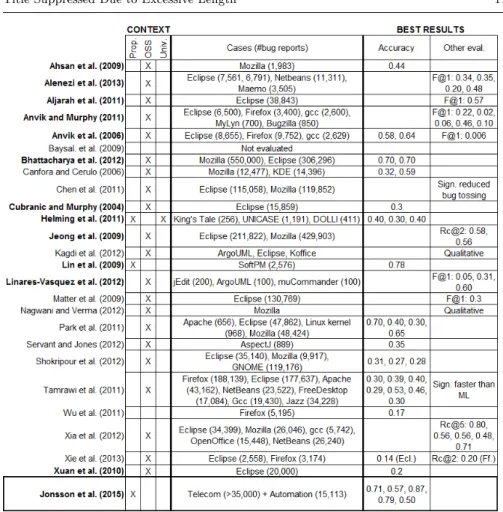
Figure 3 shows an overview of the previous evaluations of automated bug assignment (including studies presented in Section 3.2. It is evident that pre-vious work has focused on the context of Open Source Software (OSS) de-velopment, as 23 out of 25 studies have studied OSS bug reports. This is in line with general research in empirical software engineering, explained by the appealing availability of large amounts of data and the possibility of replica-tions (Robinson and Francis, 2010). While there is large variety within the OSS domain, there are some general dierences from proprietary bug management that impact our work. First, the bug databases used in OSS development are typically publicly available; anyone can submit bug reports. Second, Paulson et al (2004) report that defects are found and xed faster in OSS projects. Third, while proprietary development often is organized in teams, an OSS development community rather consists of individual developers. Also, the management in a company typically makes an eort to maintain stable teams over time despite employee turnover, while the churn behavior of individual developers in OSS projects is well-known (Asklund and Bendix, 2002; Robles
Fig. 2: Techniques used in previous studies on ML-based bug assignment. Bold author names indicate comparative studies, capital X shows the classier giving the best results. IR indicates Information Retrieval techniques. The last row shows the study presented in this paper.
and Gonzalez-Barahona, 2006). Consequently, due to the dierent nature of OSS development, it is not clear to what extent previous ndings based on OSS data can be generalized to proprietary contexts. Moreover, we are not aware of any major OSS bug dataset that contains team assignments with which we can directly compare our work. This is unfortunate since it would be interesting to use the same set of tools in the two dierent contexts.
As the organization of developers in proprietary projects tend to be dif-ferent from OSS communities, the bug assignment task we study diers ac-cordingly. While all previous work (including the two studies on proprietary development contexts by Lin et al (2009) and Helming et al (2011)) aim at supporting assignment of bug reports to individual developers, we instead ad-dress the task of bug assignment to development teams. Thus, as the number of development teams is much lower than the number of developers in nor-mal projects, direct comparisons of our results to previous work can not be
made. As an example, according to Open HUB2 (Dec 2014), the number of
contributors to some of the studied OSS projects in Figure 3 are: Linux kernel (13,343), GNOME (5,888), KDE (4,060), Firefox (3,187), NetBeans (893), gcc (534), Eclipse platform (474), Bugzilla (143), OpenOce (124), Mylyn (92), ArgoUML (87), Maemo (83), UNICASE (83), jEdit (55), and muCommander (9). Moreover, while the number of bugs resolved in our proprietary datasets is somewhat balanced, contributions in OSS communities tend to follow the onion model (Aberdour, 2007), i.e., the commit distribution is skewed, a few core developers contribute much source code, but most developers contribute only occasionally.
Bug reports from the development of Eclipse are used in 14 out of the 21 studies (cf. Figure 3). Still, no set of Eclipse bugs has become the de facto benchmark. Instead, dierent subsets of bug reports have been used in previous work, containing between 6,500 and 300,000 bug reports. Bug reports origi-nating from OSS development in the Mozilla foundation is the second most studied system, containing up to 550,000 bug reports (Bhattacharya et al, 2012). While we do not study bug repositories containing 100,000s of bug re-ports, our work involves much larger datasets than the previously largest study in a proprietary context by (Lin et al, 2009) (2,576 bug reports). Furthermore, we study bug reports from ve dierent development projects in two dierent companies.
The most common measure to report the success in previous work is ac-curacy3, reported in 10 out of 21 studies. As listed in Figure 3, prediction
accuracies ranging from 0.14 to 0.78 have been reported, with an average of 0.42 and standard deviation of 0.17. This suggests that a rule of thumb could be that automated bug assignment has the potential to correctly assign almost every second bug to an individual developer.
3.2 Other Approaches to Automated Bug Assignment
Some previous studies consider bug assignment as an IR problem, meaning that the incoming bug is treated as a search query and the assignment op-tions are the possible documents to retrieve. There are two main families of IR models used in software engineering: algebraic models and probabilistic models (Borg et al, 2014). For automated bug assignment, four studies used algebraic models (Chen et al, 2011; Kagdi et al, 2012; Nagwani and Verma, 2012; Shokripour et al, 2012). A probabilistic IR model on the other hand, has only been applied by Canfora and Cerulo (2006). Moreover, only (Linares-Vasquez et al, 2012) evaluated bug assignment using both classication and IR in the same study, and reported that IR displayed the most promising results. 2 Formerly Ohloh.net, an open public library presenting analyses of OSS projects (www.openhub.net).
3 Equivalent to recall when recommending only the most probable developer, aka. the Top-1 recommendation or Rc@1
Fig. 3: Evaluations performed in previous studies with BTS focus. Bold author names indicate studies evaluating general purpose ML-based bug assignment. Results are listed in the same order as the systems appear in the fourth column. The last row shows the study presented in this paper, even though it is not directly comparable.
Most studies on IR-based bug assignment report F-scores instead of accu-racy. In Figure 3 we present F-scores for the rst candidate developer suggested in previous work (F@1). The F-scores display large variation; about 0.60 for a study on muCommander and one of the studies of Eclipse, and very low values on work on Firefox, gcc, and jEdit. The variation shows that the potential of automated bug assignment is highly data dependent, as the same approach evaluated on dierent data can display large dierences (Anvik and Murphy, 2011; Linares-Vasquez et al, 2012). A subset of IR-based studies reports nei-ther accuracy nor F-score. Chen et al (2011) conclude that their automated bug assignment signicantly reduces bug tossing as compared to manual work. Finally, Kagdi et al (2012) and Nagwani and Verma (2012) perform qualitative
evaluations of their approaches. Especially the former study reports positive results.
Three studies on automated bug assignment identied in the literature present tools based on content-based and collaborative ltering, i.e., techniques from research on Recommendation Systems (Robillard et al, 2014). Park et al (2011) developed an RS where bug reports are represented by their textual description extended by the nominal features: platform, version, and devel-opment phase. Baysal et al (2009) presented a framework for recommending developers for a given bug report, using a vector space analysis of the history of previous bug resolutions. Matter et al (2009) matched bug reports to devel-opers by modelling the natural language in historical commits and comparing them to the textual content of bug reports.
More recently, some researchers have showed that the accuracy of auto-mated bug assignment can be improved by implementing more advanced al-gorithms, tailored for both the task and the context. Tamrawi et al (2011) proposed Bugzie, an automated bug assignment approach they refer to as fuzzy set and cache-based. Two assumptions guide their work: 1) the textual content of bug reports is assumed to relate to a specic technical aspect of the software system, and 2) if a developer frequently resolves bugs related to such a technical aspect, (s)he is capable of resolving related bugs in the future. Bugzie models both technical aspects and developers' expertise as bags-of-words and matches them accordingly. Furthermore, to improve the scalability, Bugzie recommends only developers that recently committed bug resolutions, i.e., de-velopers in the cache. Bugzie was evaluated on more than 500,000 bug reports from seven OSS projects, and achieved an prediction accuracies between 30% and 53%.
Wu et al (2011) proposed DREX, an approach to bug assignment using k-nearest neighbour search and social network analysis. DREX recommends performs assignment by: 1) nding textually similar bug reports, 2) extracting developers involved in their resolution, and 3) ranking the developers expertise by analyzing their participation in resolving the similar bugs. The participa-tion is based on developers' comments on historical bug reports, both man-ually written comments and comments automatically generated when source code changes are committed. DREX uses the comments to construct a social network, and approximated participation using a series of network measures. An evaluation on bug reports from the Firefox OSS project shows the so-cial network analysis of DREX outperforms a purely textual approach, with a prediction accuracy of about 15% and recall when considering the Top-10 recommendations (Rc@10, i.e., the bug is included in the 10 rst recommen-dations) of 0.66.
Servant and Jones (2012) developed WhoseFault, a tool that both assigns a bug to a developer and presents a possible location of the fault in the source code. WhoseFault is also dierent from other approaches reported in this sec-tion, as it performs its analysis originating from failures from automated test-ing instead of textual bug reports. To assign appropriate developers to a failure, WhoseFault combines a framework for automated testing, a fault localization
technique, and the commit history of individual developers. By nding the likely position of a fault, and identifying the most active developers of that piece of source code, WhoseFault reaches a prediction accuracy of 35% for the 889 test cases studied in the AspectJ OSS project. Moreover, the tool reports the correct developer among the top-3 recommendations for 81.44% of the test cases.
A trending technique to process and analyze natural language text in soft-ware engineering is topic modeling. Xie et al (2012) use topic models for auto-mated bug assignment in their approach DRETOM. First, the textual content of bug reports is represented using topic models (Latent Dirichlet Allocation (LDA) Blei et al (2003)). Then, based on the bug-topic distribution, DRETOM maps each bug report to a single topic. Finally, developers and bug reports are associated using a probabilistic model, considering the interest and expertise of a developer given the specic bug report. DRETOM was evaluated on more than 5,000 bug reports from the Eclipse and Firefox OSS projects, and achieved an accuracy of about 15%. However, considering the Top-5 recommendations the recall reaches 80% and 50% for Eclipse and Firefox, respectively.
Xia et al (2013) developed DevRec, a highly specialized tool for automated bug assignment, that also successfully implemented topic models. Similar to the bug assignment implemented in DREX, DevRec rst performs a k-nearest neighbours search. DevRec however calculates similarity between bug reports using an advanced combination of the terms in the bug reports, its topic as extracted by LDA, and the product and component the bug report is related to (referred to as BR-based analysis). Developers are then connected to bug reports based on multi-label learning using ML-KNN. Furthermore, DevRec then also models the anity between developers and bug reports by calculat-ing their distances (referred to as D-based analysis). Finally, the BR-analysis and the D-based analyses are combined to recommend developers for new bug reports. Xia et al (2013) evaluated DevRec on more than 100,000 bug reports from ve OSS projects, and they also implemented the approaches proposed in both DREX and Bugzie to enable a comparison The authors report aver-age Rc@5 and Rc@10 of 62% and 74%, respectively, constituting considerable improvements compared to both DREX and Bugzie.
In contrast to previous work on specialised tools for bug assignment, we present an approach based on general purpose classiers. Furthermore, our work uses standard features of bug reports, readily available in a typical BTS. As such, we do not rely on advanced operations such as mining developers' social networks, or data integration with the commit history from a separate source code repository. The reasons for our more conservative approach are vefold:
1. Our study constitutes initial work on applying ML for automated bug as-signment in proprietary contexts. We consider it an appropriate strategy to rst evaluate general purpose techniques, and then, if the results are promising, move on to further rene our solutions. However, while we
ad-vocate general purpose classiers in this study, the way we combine them into an ensemble is novel in automated bug assignment.
2. The two proprietary contexts under study are dierent in terms of work processes and tool chains, thus it would not be possible to develop one specialized bug assignment solution that ts both the organizations. 3. As user studies on automated bug assignment are missing, it is unclear to
what extent slight tool improvements are of practical signicance for an end user. Thus, before studies evaluate the interplay between users and tools, it is unclear if specialized solutions are worth the additional development eort required. This is in line with discussions on improved tool support for trace recovery (Borg and Pfahl, 2011), and the dierence of correctness and utility of recommendation systems in software engineering (Avazpour et al, 2014).
4. Relying on general purpose classiers supports transfer of research results to industry. Our industrial partners are experts on developing high quality embedded software systems, but they do not have extensive knowledge of ML. Thus, delivering a highly specialized solution would complicate both the hand-over and the future maintenance of the tool. We expect that this observation generalizes to most software intensive organizations.
5. Using general purpose techniques supports future replications in other com-panies. As such replications could be used to initiate case studies involving end users, a type of studies currently missing, we believe this to be an important advantage of using general purpose classiers.
4 Case Descriptions
This section describes the two case companies under study, both of which are bigger than the vast majority of OSS projects. In OSS projects a typical power-law behavior is seen with a few projects, such as the Linux kernel, Mozilla etc, having large number of contributors. We present the companies guided by the six context facets proposed by Petersen and Wohlin (2009), namely product, processes, practices and techniques, people, organization, and market. Also, we present a simplied model of the bug handling processes used in the companies. Finally, we illustrate where in the process our machine learning system could be deployed to increase the level of automation, as dened by Parasuraman et al (2000)4.
4.1 Description of Company Automation
Company Automation is a large international company active in the power and automation sector. The case we study consists of a development organization managing hundreds of engineers, with development sites in Sweden, India, 4 Ten levels of automation, ranging from 0, for fully manual work, to 10, when the com-puter acts autonomously ignoring the human.
Germany, and the US. The development context is safety-critical embedded development in the domain of industrial control systems, governed by IEC 615115. A typical project has a length of 12-18 months and follows an iterative
stage-gate project management model. The software is certied to a Safety Integrity Level (SIL) of 2 as dened by IEC 615086mandating strict processes
on the development and maintenance activities. As specied by IEC 61511, all changes to safety classied source code requires a formal impact analysis before any changes are made. Furthermore, the safety standards mandate that both forward and backward traceability should be maintained during software evolution.
The software product under development is a mature system consisting of large amounts of legacy code; parts of the code base are more than 20 years old. As the company has a low sta turnover, many of the developers of the legacy code are still available within the organization. Most of the software is written in C/C++. Considerable testing takes place to ensure a very high code quality. The typical customers of the software product require safe process automation in very large industrial sites.
The bug-tracking system (BTS) in Company Automation has a central role in the change management and the impact analyses. All software changes, both source code changes and changes to documentation, must be connected to an issue report. Issue reports are categorized as one of the following: error corrections (i.e., bug reports), enhancements, document modication, and in-ternal (e.g., changes to test code, inin-ternal tools, and administrative changes). Moreover, the formal change impact analyses are documented as attachments to individual issue reports in the BTS.
4.2 Description of Company Telecom
Company Telecom is a major telecommunications vendor based in Sweden. We are studying data from four dierent development organizations within Company Telecom, consisting of several hundreds of engineers distributed over several countries. Sta turnover is very low and many of the developers are senior developers that have been working on the same products for many years. The development context is embedded systems in the Information and Communications Technology (ICT) domain. Development in the ICT domain is heavily standardized, and adheres to standards such as 3GPP, 3GPP2, ETSI, IEEE, IETF, ITU, and OMA. Company Telecom is ISO 9001 and TL 9000 certied. At the time the study was conducted, the project model was based on an internal waterfall-like model, but has since then changed to an Agile development process.
5 Functional safety - Safety instrumented systems for the process industry sector 6 Functional safety of Electrical/Electronic/Programmable Electronic safety-related sys-tems
Various programming languages are used in the four dierent products. The majority of the code is written in C++ and Java, but other languages, such as hardware description languages, are also used.
Two of the four products are large systems in the ICT domain, one is a middleware platform, and one is a component system. Two of the products are mature with a code base older than 15 years, whereas the other two products are younger, but still older than 8 years. All four products are deployed at customer sites world-wide in the ICT market.
Issue management in the design organization is handled in two separate repositories; one for change requests (planned new features or updates) and one for bug reports. In this study we only use data from the latter, the BTS. Customer support requests to Company Telecom are handled in a two layered approach with an initial customer service organization dealing with initial requests, called Customer Service Requests (CSR). The task of this organization is to screen incoming requests so that only hardware or software errors and no other issue, such as conguration problems, are sent down to the second layer. If the customer support organization believes a CSR to be a fault in the product, they le a bug report based on the CSR in the second layer BTS. In this way, the second layer organization can focus on issues that are likely to be faults in the software. In spite of this approach, some bug reports can be conguration issues or other problems not directly related to faults in the code. In this study, we have only used data from the second layer BTS, but there is nothing in principle that prevents the same approach to be used on the rst layer CSR's. The BTS is the central point in the bug handling process and there are several process descriptions for the various employee roles. Tracking of analysis, implementation proposals, testing, and verication are all coordinated through the BTS.
4.3 State-of-Practice Bug Assignment: A Manual Process
The bug handling process of both Company Automation and Telecom are substantially more complex than the standard process described by Bugzilla (Mozilla, 2013). The two processes are characterized by the development con-texts of the organizations. Company Automation develops safety-critical sys-tems, and the bug handling process must therefore adhere to safety standards as described in Section 4.1. The standards put strict requirements on how soft-ware is allowed to be modied, including rigorous change impact analyses with focus on traceability. In Company Telecom on the other hand, the sheer size of both the system under development and the organization itself are reected on the bug handling process. The resource allocation in Company Telecom is complex and involves advanced routing in a hierarchical organization to a number of development teams.
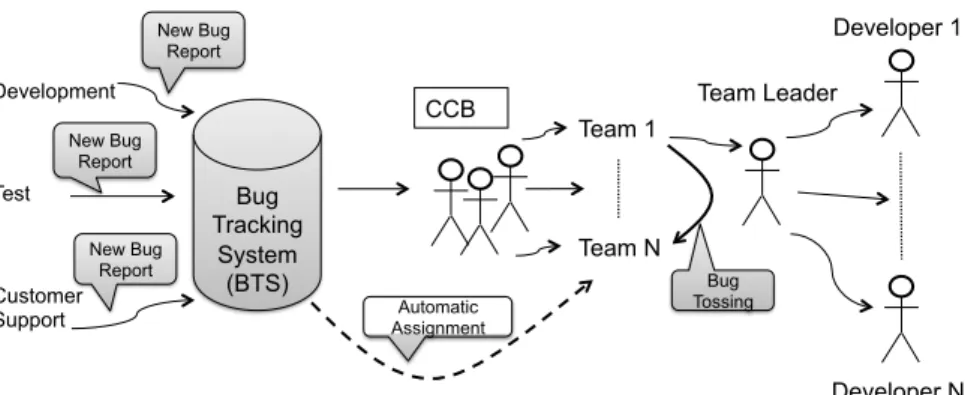
We generalize the bug handling processes in the two case companies and present an overview model of the currently manual process in Figure 4. In general, three actors can le bug reports: i) the developers of the systems,
ii) the internal testing organization, and iii) customers that le bug reports via helpdesk functions. A submitted bug report starts in a bug triaging stage. As the next step, the Change Control Board (CCB) assigns the bug report to a development team for investigation. The leader of the receiving team then assigns the bug report to an individual developer. Unfortunately, the bug reports often end up with the wrong developer, thus bug tossing (i.e., bug report re-assignment) is common, especially between teams. The BTS stores information about the bug tossing that takes place. As a consequence, we can estimate the classication accuracy of the manual bug assignment process.
Development Test Customer Support Bug Tracking System (BTS) Team 1 Team N Developer 1 Developer N Team Leader CCB New Bug Report New Bug Report New Bug Report Automatic Assignment Bug Tossing
Fig. 4: A simplied model of bug assignment in a proprietary context.
4.4 State-of-the-Art: Automated Bug Assignment
We propose, in line with previous work, to automate the bug assignment. Our approach is to use the historical information in the BTS as a labeled training set for a classier. When a new bug is submitted to the BTS, we encode the available information as features and feed them to a prediction system. The prediction system then classies the new bug to a specic development team. While this resembles proposals in previous work, our approach diers by: i) aiming at supporting large proprietary organizations, and ii) assigning bug reports to teams rather than individual developers.
Figure 4 shows our automated step as a dashed line. The prediction system oers decision support to the CCB, by suggesting which development team that is the most likely to have the skills required to investigate the issue. This automated support corresponds to a medium level of automation (the computer suggests one alternative and executes that suggestion if the human approves), as dened in the established automation model by Parasuraman et al (2000).
5 Method
The overall goal of our work is to support bug assignment in large propri-etary development projects using state-of-the-art ML. As a step toward this goal, we study ve sets of bug reports from two companies (described in Sec-tion 4), including informaSec-tion of team assignment for each bug report. We conduct controlled experiments using Weka (Hall et al, 2009), a mature ma-chine learning environment that is successfully used across several domains, for instance, bioinformatics (Frank et al, 2004), telecommunication (Alshammari and Zincir-Heywood, 2009), and astronomy (Zhao and Zhang, 2008). This sec-tion describes the denisec-tion, design and setting of the experiments, following the general guidelines by Basili et al (1986) and Wohlin et al (2012).
5.1 Experiment Denition and Context
The goal of the experiments is to study automatic bug assignment using stacked generalization in large proprietary development contexts, for the pur-pose of evaluating its industrial feasibility, from the perspective of an applied researcher, planning deployment of the approach in an industrial setting.
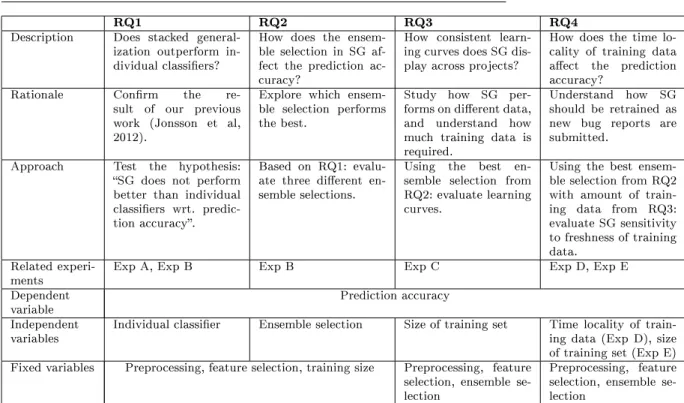
Table 1 reminds the reader of our RQs. Also, the table presents the ra-tionale of each RQ, and a high-level description of the research approach we have selected to address them. Moreover, the table maps the RQs to the ve sub-experiments we conduct, and the experimental variables involved.
5.2 Data Collection
We collect data from one development project at Company Automation and four major development projects at Company Telecom. While the bug tracking systems in the two companies show many similarities, some slight variations force us to perform actions to consolidate the input format of the bug reports. For instance, in Company Automation a bug report has a eld called Title, whereas the corresponding eld in Company Telecom is called Heading. We align these variations to make the semantics of the resulting elds the same for all datasets. The total number of bug reports in our study is 15,113 + 35,266 = 50,379. Table 2 shows an overview of the ve datasets.
We made an eort to extract similar sets of bug reports from the two com-panies. However, as the companies use dierent BTSs, and interact with them according to dierent processes, slight variations in the extraction steps are in-evitable. Company Automation uses a BTS from an external software vendor, while Company Telecom uses an internally developed BTS. Moreover, while the life-cycles of bug reports are similar in the two companies (as described in Section 4.3), they are not equivalent. Another dierence is that Company Automation uses the BTS for issue management in a broader sense (incl. new feature development, document updates, and release management), Company
RQ1 RQ2 RQ3 RQ4
Description Does stacked
general-ization outperform in-dividual classiers?
How does the ensem-ble selection in SG af-fect the prediction ac-curacy?
How consistent learn-ing curves does SG dis-play across projects?
How does the time lo-cality of training data aect the prediction accuracy?
Rationale Conrm the
re-sult of our previous work (Jonsson et al, 2012).
Explore which ensem-ble selection performs the best.
Study how SG per-forms on dierent data, and understand how much training data is required.
Understand how SG should be retrained as new bug reports are submitted.
Approach Test the hypothesis:
SG does not perform better than individual classiers wrt. predic-tion accuracy.
Based on RQ1: evalu-ate three dierent en-semble selections.
Using the best en-semble selection from RQ2: evaluate learning curves.
Using the best ensem-ble selection from RQ2 with amount of train-ing data from RQ3: evaluate SG sensitivity to freshness of training data.
Related
experi-ments Exp A, Exp B Exp B Exp C Exp D, Exp E
Dependent
variable Prediction accuracy
Independent
variables Individual classier Ensemble selection Size of training set Time locality of train-ing data (Exp D), size of training set (Exp E) Fixed variables Preprocessing, feature selection, training size Preprocessing, feature
selection, ensemble se-lection
Preprocessing, feature selection, ensemble se-lection
Table 1: Overview of the research questions, all related to the task of auto-mated team allocation. Each question is listed along with the main purpose of the question, a high-level description of our study approach, and the experi-mental variables involved.
Dataset #Bug reports Timespan #Teams
Automation 15,113 July 2000 Jan 2012 67
Telecom 1 > 9,000 > 5 years 28
Telecom 2 > 8,000 > 5 years 36
Telecom 3 > 3,000 > 5 years 17
Telecom 4 > 10,000 > 5 years 64
Total > 50,000
Table 2: Datasets used in the experiments. Note: At the request of our industry partners the table only lists lower bounds for Telecom systems, but the total number of sums up to an excess of 50,000 bug reports.
Telecom uses the BTS for bug reports exclusively. To harmonize the datasets, we present two separate ltering sequences in Sections 5.2.1 and 5.2.2. 5.2.1 Company Automation Data Filtering
The dataset from Company Automation contains in total 26,121 bug reports submitted between July 2000 and January 2012, all related to dierent
ver-sions of the same software system. The bug reports originate from several development projects, and describe issues reported concerning a handful of dierent related products. During the 12 years of development represented in the dataset, both the organization and processes have changed towards a more iterative development methodology. We lter the dataset in the following way: 1. We included only CLOSED bug reports to ensure that all bugs have valid team assignments, that is, we lter out bug reports in states such as OPEN, NO ACTION, and CHANGE DEFERRED. This step results in 24,690 remaining bug reports.
2. We exclude bug reports concerning requests for new features, document updates, changes to internal test code, and issues of administrative nature. Thus, we only keep bug reports related to source code of the software system. The rationale for this step is to make the data consistent with Company Telecom, where the BTS solely contains bug reports. The nal number of bug reports in the ltered dataset is 15,113.
5.2.2 Company Telecom Data Filtering
Our rst step of the data ltering for Company Telecom is to identify a time-span characterized by a stable development process. We select a timetime-span from the start of the development of the product family to the point in time when an agile development process is introduced (Wiklund et al, 2013). The motiva-tion for this step is to make sure that the study is conducted on a conformed data set. We lter the bug reports in the timespan according to the following steps:
1. We include only bug reports in the state FINISHED. 2. We exclude bug reports marked as duplicates.
3. We exclude bug reports that do not result in an source code update in a product.
After performing these three steps, the data set for the four products contains in total 35,2667bug reports.
5.3 ML Framework Selection
To select a platform for our experiments, we study features available in various machine learning toolkits. The focus of the comparison is to nd a robust, well tested, and comparatively complete framework. The framework should also in-clude an implementation of stacked generalizer and it should be scalable. As a consequence, we focus on platforms that are suitable for distributed computa-tion. Another criterion is to nd a framework that has implemented a large set of state-of-the-art machine learning techniques. With the increased attention of 7 Due to condentiality reasons these numbers are not broken down in exact detail per project.
machine learning and data mining, quite a few frameworks have emerged dur-ing the last couple of years such as Weka (Hall et al, 2009), RapidMiner (Hof-mann and Klinkenberg, 2014), Mahout (Owen et al, 2011), MOA (Bifet et al, 2010), Mallet (McCallum, 2002), Julia (Bezanson et al, 2012), and Spark (Za-haria et al, 2010) as well as increased visibility of established systems such as SAS, SPSS, MATLAB, and R.
For this study, we select to use a framework called Weka (Hall et al, 2009). Weka is a comparatively well documented framework with a public Java API and accompanying book, website, forum, and active community. Weka has many ML algorithms implemented and it is readily extensible. It has several support functionalities, such as cross-validation, stratication, and visualiza-tion. Weka has a built-in Java GUI for data exploration and it is also readily available as a stand alone library in JAR format. It has some support for par-allelization. Weka supports both batch and online interfaces for some of its algorithms. The meta facilities of the Java language also allows for mechanical extraction of available classiers. Weka is a well established framework in the research community and its implementation is open source.
5.4 Bug Report Feature Selection
This section describes the feature selection steps that are common to all our data sets. We represent bug reports using a combination of textual and nominal features. Feature selections that are specic to each individual sub-experiment are described together with each experiment.
For the textual features, we limit the number of words because of memory and execution time constraints. To determine a suitable number of words to keep, we run a series of pilot experiments, varying the method and number of words to keep, by varying the built in settings of Weka. We decide to rep-resent the text in the bug reports as the 100 words with highest TF-IDF8 as
calculated by the Weka framework. Furthermore, the textual content of the titles and descriptions are not separated. There are two reasons for our rather simple treatment of the natural language text. First, Weka does not support multiple bags-of-words; such a solution would require signicant implementa-tion eort. Second, our focus is not on nding ML conguraimplementa-tions that provide the optimal prediction accuracies for our datasets, but rather to explore SG for bug assignment in general. We consider optimization to be an engineering task during deployment.
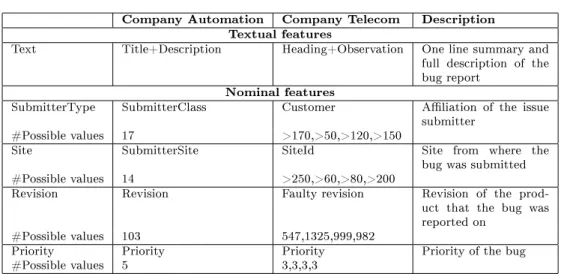
The non-textual elds available in the two bug tracking systems vary be-tween the companies, leading to some considerations regarding the selection of non-textual features. Bug reports in the BTS of Company Automation con-tain 79 dierent elds; about 50% of these elds are either mostly empty or have turned obsolete during the 12 year timespan. Bug reports in the BTS of 8 Term Frequency-Inverse Document Frequency (TF-IDF) is a standard weighting scheme for information retrieval and text mining. This scheme is common in software engineering applications (Borg et al, 2014).
Company Automation Company Telecom Description Textual features
Text Title+Description Heading+Observation One line summary and
full description of the bug report
Nominal features
SubmitterType SubmitterClass Customer Aliation of the issue
submitter
#Possible values 17 >170,>50,>120,>150
Site SubmitterSite SiteId Site from where the
bug was submitted
#Possible values 14 >250,>60,>80,>200
Revision Revision Faulty revision Revision of the
prod-uct that the bug was reported on
#Possible values 103 547,1325,999,982
Priority Priority Priority Priority of the bug
#Possible values 5 3,3,3,3
Table 3: Features used to represent bug reports. For company Telecom the elds are reported for Telecom 1,2,3,4 respectively.
Company Telecom contain information in more than 100 elds. However, most of these elds are empty when the bug report is submitted. Thus, we restricted the feature selection to contain only features available at the time of submis-sion of the bug report, i.e., features that do not require a deeper analysis eort (e.g., faulty component, function involved). We also want to select a small set of general features, likely to be found in most bug tracking systems. Achieving feasible results using a simple feature selection might simplify industrial adap-tation, and also it limits the ML training times. Based on discussions with involved developers, we selected the features presented in Table 3. In the rest of the paper, we follow the nomenclature in the leftmost column.
A recurring discussion when applying ML concerns which features are the best for prediction. In our BTS'es we have both textual and non-textual fea-tures, thus we consider it valuable to compare the relative predictive power of the two types of features. While out previous research has indicated that in-cluding non-textual features improves the prediction accuracy (Jonsson et al, 2012), many other studies rely solely on the text (see Figure 2). To motivate the feature selection used in this study, we performed a small study comparing textual vs. non-textual features for our ve datasets.
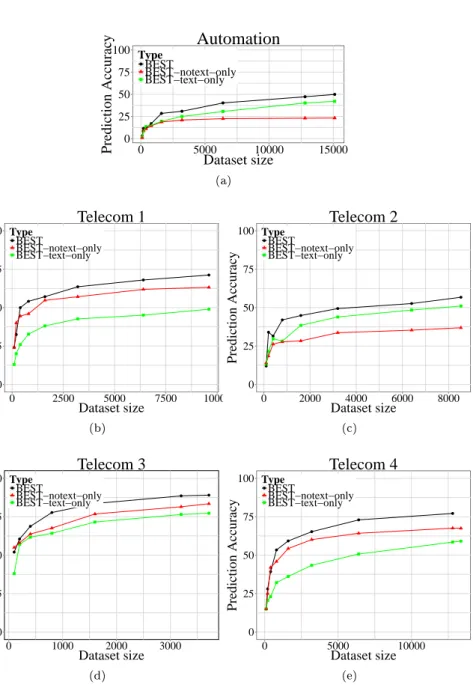
Figure 5 shows the results from our small feature selection experiment. The gure displays results from three experimental runs, all using SG with the best individual classiers (further described in Section 6.1). The three curves represent three dierent sets of features: 1) textual and non-textual features, 2) non-textual features only, and 3) textual features only. The results show that for some systems (Telecom 1, 2 and 4) the non-textual features performs better than the textual features alone, while for some systems (Telecom 3 and Automation) the results are the opposite. Thus, our ndings strongly suggest that we should combine both non-textual features and textual features for bug
assignment. Note that with more sophisticated text modeling techniques, such as LDA (Blei et al, 2003), we suspect that the textual features may have a higher impact on the nal result.
● ●● ● ● ● ● ● ● 0 25 50 75 100 0 5000 10000 15000 Dataset size Prediction Accurac y Type ●BEST BEST−notext−only BEST−text−only
Automation
(a) ● ● ● ● ● ● ● ● 0 25 50 75 100 0 2500 5000 7500 10000 Dataset size Prediction Accurac y Type ●BEST BEST−notext−only BEST−text−onlyTelecom 1
(b) ● ● ● ● ● ● ● ● 0 25 50 75 100 0 2000 4000 6000 8000 Dataset size Prediction Accurac y Type ●BEST BEST−notext−only BEST−text−onlyTelecom 2
(c) ● ● ● ● ● ● ● 0 25 50 75 100 0 1000 2000 3000 Dataset size Prediction Accurac y Type ●BEST BEST−notext−only BEST−text−onlyTelecom 3
(d) ● ● ● ● ● ● ● ● 0 25 50 75 100 0 5000 10000 Dataset size Prediction Accurac y Type ●BEST BEST−notext−only BEST−text−onlyTelecom 4
(e)Fig. 5: The prediction accuracy when using text only features (text-only) vs. using non-text features only (notext-only)
5.5 Experiment Design and Procedure
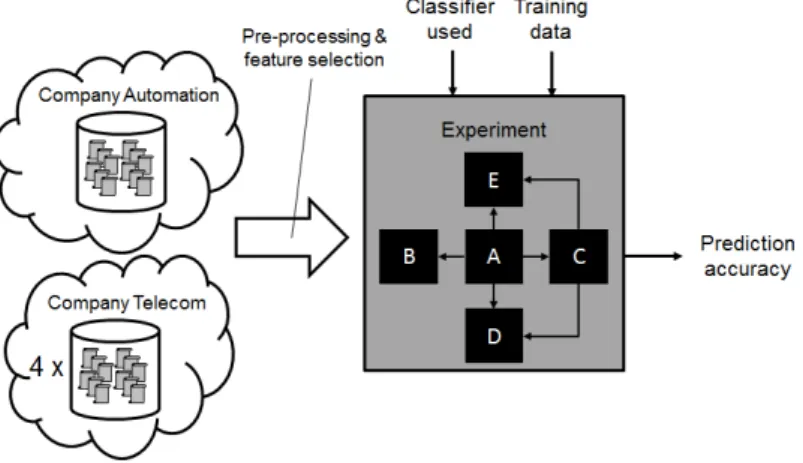
Figure 6 shows an overview of our experimental setup. The ve datasets orig-inate from two dierent industrial contexts, as depicted by the two clouds to the left. We implement ve sub-experiments (c.f. AE in Figure 6), using the Weka machine learning framework. Each sub-experiment is conducted once per dataset, that is, we performed 25 experimental runs. A number of steps implemented in Weka are common for all experimental runs:
1. The complete dataset set of bug reports is imported.
2. Bug reports are divided into training and test sets. In sub-experiments AC, the bug reports are sampled using stratication. The process in sub-experiments DE is described in Sections 5.5.4 and 5.5.5.
3. Feature extraction is conducted as specied in Section 5.4.
We executed the experiments on two dierent computers. We conduct experiments on the Company Automation dataset on a Mac Pro, running Mac OS X 10.7.5, equipped with 24 GB RAM and two Intel(R) Xeon(R) X5670 2.93 GHz CPUs with six cores each. The computer used for the ex-periments on the Company Telecom datasets had the following specication: Linux 2.6.32.45-0.3-xen, running SUSE LINUX, equipped with eight 2.80 GHz Intel(R) Xeon(R) CPU and 80 GB RAM.
Fig. 6: Overview of the controlled experiment. Vertical arrows depict indepen-dent variables, whereas the horizontal arrow shows the depenindepen-dent variable. Arrows within the experiment box depict dependencies between experimental runs AE: Experiment A determines the composition of individual classiers in the ensembles studied evaluated in Experiment B-E. The appearance of the learning curves from Experiment C is used to set the size of the time-based evaluations in Experiment D and Experiment E.
As depicted in Figure 6, there are dependencies among the sub-experiments. Several sub-experiments rely on results from previous experimental runs to
select values for both xed and independent variables. Further details are pre-sented in the descriptions of the individual sub-experiments AE.
We evaluate the classication using a top-1 approach. That is, we only consider a correct/incorrect classication, i.e., we do not evaluate whether our approach correctly assigns bug reports to a set of candidate teams. In IR evaluations, considering ranked output of search results, it is common to assess the output at dierent cut-o points, e.g., the top-5 or top-10 search hits. Also some previous studies on bug assignment present top-X evaluations inspired by IR research. However, our reasons for a top-1 approach are three-fold: First, for fully automatic bug assignment a top-1 approach is the only reasonable choice, since an automatic system would not send a bug report to more than one team. Second, a top-1 approach is a conservative choice in the sense that the classication results would only improve with a top-k approach. The third motivation is technical; to ensure high quality evaluations we have chosen to use the built-in mechanisms in the well established Weka. Unfortunately, Weka does not support a top-k approach in its evaluation framework for classiers.
5.5.1 Experiment A: Individual Classiers
Independent variable: Choice of individual classier
Experiment A investigates RQ1 and the null hypothesis SG does not perform better than individual classiers wrt. prediction accuracy. We evaluate the 28 available classiers in Weka Development version 3.7.9, listed in Table 4. The list of possible classiers is extracted by rst listing all classes in the corresponding .jar le in the classier package and then trying to assign them one by one to a classier. The independent variable is the individual classier. For all ve datasets, we execute 10-fold cross-validation once per classier. We use all available bug reports in each dataset and evaluated all 28 classiers on all datasets. The results of this experiment is presented in Section 6.1.
Table 4: Individual classiers available in Weka Development version 3.7.9. Column headings show package names in Weka. Classiers in bold are excluded from the study because of long training times or exceeding memory constraints.
bayes. functions. lazy. rules. trees. misc.
BayesNet Logistic IBk DecisionTable DecisionStump InputMappedClassier
NaiveBayes MultilayerPerceptron KStar JRip J48
NaiveBayesMultinomial SimpleLogistic LWL OneR LMT
NaiveBayesMultinomialText SMO ZeroR PART RandomForest
NaiveBayesMultinomialUpdateable RandomTree
NaiveBayesUpdateable REPTree
net.BayesNetGenerator net.BIFReader net.EditableBayesNet
5.5.2 Experiment B: Ensemble Selection Independent variable: Ensemble selection
Experiment B explores both RQ1 and RQ2, i.e., both if SG is better than individual classiers and which ensemble of classiers to choose for bug as-signment. As evaluating all combinations of the 28 individual classiers in Weka is not feasible, we restrict our study to investigate three ensemble selec-tions, each combining ve individual classiers. We chose ve as the number of individual classiers to use in SG at a consensus meeting, based on experiences of prediction accuracy and run-time performance from pilot runs. Moreover, we exclude individual classiers with run-times longer than 24 hours in Ex-periment A, e.g., MultiLayerPerceptron and SimpleLogistic.
Based on the results from Experiment A, we select three ensembles for each dataset (cf. Table 4). We refer to these as BEST, WORST, and SELECTED. We chose the rst two ensembles to test the hypothesis combining the best in-dividual classiers should produce a better result than if you choose the worst. The BEST ensemble consists of the ve individual classiers with the highest prediction accuracy from Experiment A. The WORST ensemble contains the ve individual classiers with the lowest prediction accuracy from Experiment B, while still performing better than the basic classier ZeroR that we see as a lower level baseline. The ZeroR classier simply always predicts the class with the largest number of bugs. No classier with a lower classication accuracy than ZeroR is included in any ensemble, thus the ZeroR acts as a lower level cut-o threshold for being included in an ensemble.
The SELECTED ensemble is motivated by a discussion in Wolpert (1992), who posits that diversity in the ensemble of classiers improves prediction results. The general idea is that if you add similar classiers to a stacked generalizer, less new information is added compared to adding a classier based on a dierent classication approach. By having level-0 generalizers of dierent types, they together will better span the learning space. This is due to the fundamental theory behind stacked generalization, claiming that the errors of the individual classiers should average out. Thus, if we use several similar classiers we do not get the averaging out eect since then, in theory, the classiers will have the same type of errors and not cancel out. We explore this approach by using the ensemble selection call SELECTED, where we combine the best individual classiers from ve dierent classication approaches (the packages in Table 4). The results of this experiment is presented in Section 6.1. Some individual classiers are never part of a SG. This depends on either that the classier did not pass the cut-o threshold of being better than the ZeroR classier, this case occurs for instance for the InputMappedClassier (see Table 4). Alternatively the classier was neither bad enough to be in the WORST ensemble nor good enough to be in the BEST or SELECTED, this is the case with for instance JRip.
In all of the ensembles we use SimpleLogistic regression as the level-1 clas-sier following the general advice of Wolpert (1992) and Witten et al (2011) of using a relatively simple smooth linear model.
We choose to evaluate the individual classiers on the whole dataset in favor of evaluating them on a hold-out set, i.e., a set of bug reports that would later not be used in the evaluation of the SG. This is done to maximize the amount of data in the evaluation of the SG. It is important to note that this reuse of data only applies to the selection of which individual classiers to include in the ensemble. In the evaluation of the SG, all of the individual classiers are completely retrained on only the training set, and none of the data points in the test set is part of the training set of the individual classiers. This is also the approach we would suggest for industry adoption, i.e., rst evaluate the individual classiers on the current bug database, and then use them in a SG.
5.5.3 Experiment C: Learning Curves
Independent variable: Amount of training data
The goal of Experiment C is to study RQ3: How consistent learning curves does SG display across projects? For each dataset, we evaluate the three en-sembles from Experiment B using xed size subsets of the ve datasets: 100, 200, 400, 800, 1600, 3200, 6400, 12800, and ALL bug reports. All subsets are se-lected using random stratied sampling from the full dataset. As the datasets Telecom 1-3 contain fewer bug reports than 12800, the learning curves are limited accordingly. The results of this experiment is presented in Section 6.2. 5.5.4 Experiment D: Sliding Time Window
Independent variable: Time locality of training data
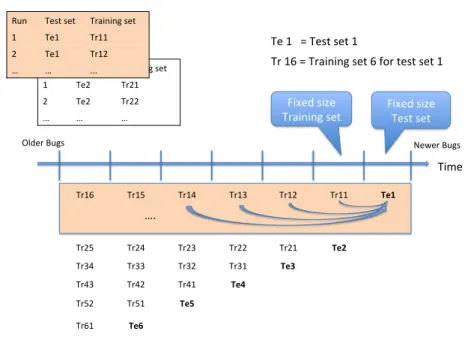
Experiment D examines RQ4, which addresses how the time locality of the training set aects the prediction accuracy on a given test set. Figure 7 shows an overview of the setup of Experiment D. The idea is to use training sets of the same size increasingly further back in time to predict a given test set. By splitting the chronologically ordered full data set into xed size training and test sets according to Figure 7, we can generate a new dataset consisting of pairs (x,y). In this dataset, x represents the time dierence measured in
number of days (delta time) between the start of the training set and the start of the test set. They variable represents the prediction accuracy of using the
training setxdays back in time to predict the bug assignments in the selected
test set. We can then run a linear regression on the data set of delta time and prediction accuracy samples and examine if there is a negative correlation between delta time and prediction accuracy.
We break down RQ4 further into the following research hypothesis formu-lation: Is training data further back in time worse at predicting bug report
assignment than training data closer in time? We test this research hypoth-esis with the statistical method of simple linear regression. Translated into a statistical hypothesis RQ4 is formulated as:
Let the dierence in time between the submission date of the rst bug report in a test set and the submission date of the rst bug report in the training set be the independent variablex. Further, let the prediction accuracy
on the test set be the dependent variable y. Is the coecient of the slope of
a linear regression t onxandy statistically dierent from 0 and negative at
the 5 %αlevel?
To create the training set and test sets, we sort the complete dataset in chronological order on the bug report submission date. To select suitable sizes to split the training set and test sets, we employ the following procedure. For the simple linear regression, we want to create enough sample points to be able to run a linear regression with enough power to detect a signicant dierence and still have as large training and test sets as possible to reduce the variance in the generated samples. Green (1991) suggests the following formula :N ≥50 + 8mas a rule of thumb for calculating the needed number
of samples at α level of 5 % and β level of 20 %, where m is the number
of independent variables. In our case we have one independent variable (delta time) so the minimum number of samples in our case is 58 = 50 + 8 * 1. We use a combination of theoretical calculations for the lower and upper bounds on the number of training samples given that we want an 80/20 ratio of training to test data. We combine the theoretical approach with a program that calculates the number of sample points generated by a given training and test set size, by simulating runs. This combination together with Green's formula let us explore the most suitable training and test sets for the dierent systems.
We also know from Experiment C that the elbow where the prediction accuracy tends to level out is roughly around 1,000-2,000 samples, this together with the calculations for the linear regression guided our decision for the nal selection of sample size.
We arrived at the following dataset sizes by exploring various combinations with the simulation program, the theoretical calculations and the experience from Experiment C. For the smallest of the systems, the maximum sizes of training and test sets that gives more than 58 samples amounts to 619 and 154 bug reports respectively. For the larger systems, we can aord to have larger data sets. For comparison we prioritize to have the same sized sets for all the other systems. When we calculate the set sizes for the smallest of the larger systems, we arrived at 1,400 and 350 bug reports for the training and test set sizes, respectively. These values are then chosen for all the other four systems. The results of this analysis is presented in Section 6.3.
5.5.5 Experiment E: Cumulative Time Window Independent variable: Amount of training data
Time Fixed size Test set Fixed size Training set Te1 Tr11 Tr12 Tr13 Tr14 Tr15 Tr16 Te2 Tr21 Tr22 Tr23 Tr24 Tr25 Te3 Tr31 Tr32 Tr33 Tr34 Te4 Tr41 Tr42 Tr43 Te5 Tr51 Tr52 Te6 Tr61
Tr 16 = Training set 6 for test set 1 Te 1 = Test set 1
Run Test set Training set 1 Te2 Tr21 2 Te2 Tr22 … … … Run Test set Training set 1 Te1 Tr11 2 Te1 Tr12 … … ...
….
Older Bugs Newer Bugs
Fig. 7: Overview of the time-sorted evaluation. Vertical bars show how we split the chronologically ordered data set into training and test sets. This approach gives us many measurement points in time per test set size. Observe that the time between the dierent sets can vary due to non-uniform bug report inow but the number of bug reports between each vertical bar is xed.
Experiment E is also designed to investigate RQ4, i.e., how the time local-ity of the training set aects the prediction accuracy. Instead of varying the training data using a xed size sliding window as in Experiment D, we x the starting point and vary the amount of the training data. The independent vari-able is the cumulatively increasing amount of training data. This experimental setup mimics realistic use of SG for automated bug assignment.
Figure 8 depicts an overview of Experiment E. We sort the dataset in chronological order on the issue submission date. Based on the outcome from Experiment C, we split the dataset into a corresponding number of equally sized chunks. We used each chunk as a test set, and for each test set we vary the number of previous chunks used as training set. Thus, the amount of training data was the independent variable. We refer to this evaluation approach as cumulative time window. Our setup is similar to the incremental learning that Bhattacharya et al (2012) present in their work on bug assignment, but we conduct a more thorough evaluation. We split the data into training and test sets in a more comprehensive manner, and thus conduct several more experimental runs. The results of this experiment is presented in Section 6.4.