Optimisation based on High Performance
Computing
A thesis submitted in fulfillment of the requirements for the degree of
Doctor of Philosophy
Chen Jin
BEng(ElecEng), Beihang University, China
MEng(ElecEng), Beihang University, China
School of Science
College of Science, Engineering, and Health
RMIT University
I certify that except where due acknowledgement has been made, the work is that of the author alone; the work has not been submitted previously, in whole or in part, to qualify for any other academic award; the content of the thesis is the result of work which has been carried out since the official commencement date of the approved research program; any editorial work, paid or unpaid, carried out by a third party is acknowledged; and, ethics procedures and guidelines have been followed.
Chen Jin
School of Science
College of Science, Engineering, and Health RMIT University
I would like to express my special appreciation and thanks to my supervisors Dr. Jeffrey Chan and Dr. Kai Qin, not only for their tremendous support to my thesis writing, but also for the enlightenment on academic thinking which is the lifelong benefit. Without their consistent and illuminating instruction, this thesis could not have reached its present form.
I want to say thanks to my wife Bichen Ni, who has been doing the utmost to support me in all these years since she has come to Australia. I owe her everything. I am also hugely appreciative to my beloved dad and mum for their loving considerations and great confidence in me all through these years.
I also want to say thanks to Dr. Xiaodong Li and Dr. Andy Song, who gave me plenty of precious advice on my research. I also learn a lot from the weekly ECML meeting organised by them. Moreover, I owe my sincere gratitude to my friends Pengfei Li, Boyu Zhang, Youhan Xia, Hui Song, Pei-Wei Tsai, Tsz Ho Wong, Wei Shao, Steven Wu and Xiaolu Lu. They gave me their help and time in listening to me and helping me work out my problems during the difficult course of the thesis.
I acknowledge the support of powerful computing facilities by National Computational Infrastructure (NCI). I also acknowledge the RMIT School of Graduate Research and RMIT School of Science for their support in the form of scholarship, research support and grants.
Portions of the materials used in this thesis have previously appeared or under consideration in the following scientific publications:
• Chen. Jin, A. K. Qin and Ke Tang, “Local ensemble surrogate assisted crowding differ-ential evolution,” in Evolutionary Computation (CEC), 2015 IEEE Congress on. IEEE, 2015, pp. 433-440.
• Chen Jin and A. K. Qin, “A GPU-based Implementation of Brain Storm Optimization,” in Evolutionary Computation (CEC), 2017 IEEE Congress on. IEEE, 2017, pp. 2698-2705.
Evolutionary algorithms (EAs) have been successfully applied to solve various challenging op-timisation problems. Due to their stochastic nature, EAs typically require considerable time to find desirable solutions; especially for increasingly complex and large-scale problems. As a result, many works studied implementing EAs on parallel computing facilities to accelerate the time-consuming processes. Recently, the rapid development of modern parallel computing facilities such as the high performance computing (HPC) bring not only unprecedented com-putational capabilities but also challenges on designing parallel algorithms. This thesis mainly focuses on designing scalable parallel evolutionary optimisation (SPEO) frameworks which run efficiently on the HPC.
Motivated by the interesting phenomenon that many EAs begin to employ increasingly large population sizes, this thesis firstly studies the effect of a large population size through comprehensive experiments. Numerical results indicate that a large population benefits to the solving of complex problems but requires a large number of maximal fitness evaluations (FEs). However, since sequential EAs usually requires a considerable computing time to achieve extensive FEs, we propose a scalable parallel evolutionary optimisation framework that can efficiently deploy parallel EAs over many CPU cores at CPU-only HPC. On the other hand, since EAs using a large number of FEs can produce massive useful information in the course of evolution, we design a surrogate-based approach to learn from this historical information and to better solve complex problems. Then this approach is implemented in parallel based on the proposed scalable parallel framework to achieve remarkable speedups.
Since demanding a great computing power on CPU-only HPC is usually very expensive, we design a framework based on GPU-enabled HPC to improve the cost-effectiveness of parallel
EAs. The proposed framework can efficiently accelerate parallel EAs using many GPUs and can achieve superior cost-effectiveness. However, since it is very challenging to correctly implement parallel EAs on the GPU, we propose a set of guidelines to verify the correctness of GPU-based EAs. In order to examine these guidelines, they are employed to verify a GPU-based brain storm optimisation that is also proposed in this thesis.
In conclusion, the comprehensively experimental study is firstly conducted to investigate the impacts of a large population. After that, a SPEO framework based on CPU-only HPC is proposed and is employed to accelerate a time-consuming implementation of EA. Finally, the correctness verification of implementing EAs based on a single GPU is discussed and the SPEO framework is then extended to be deployed based on GPU-enabled HPC.
Declaration ii
Acknowledgement iii
Credits iv
Abstract v
Contents vii
List of Figures xii
List of Tables xiv
1 Introduction 1
1.1 Research Scope . . . 1
1.2 Motivations . . . 4
1.3 Objectives . . . 6
1.4 Contributions . . . 9
1.5 Organisation of the Thesis . . . 11
2 Background and Literature Review 14 2.1 Evolutionary Algorithms (EAs) . . . 14
2.1.1 Overview . . . 14
2.1.2 Representative EAs . . . 15
2.1.3 Brain Storm Optimisation . . . 19
2.2 Population Sizes in EAs . . . 20
2.2.1 EAs with a Large Population . . . 20
2.2.2 EAs with a Small Population . . . 27
2.3 Parallel EAs . . . 30
2.3.1 Overview . . . 30
2.3.2 Island Model . . . 31
2.3.3 GPU-based Parallel EAs . . . 36
2.4 Modern High Performance Computing (HPC) . . . 39
2.4.1 Overview . . . 39
2.4.2 CPU-only HPC . . . 40
2.4.3 GPU Computing . . . 41
2.4.4 GPU-enabled HPC . . . 45
3 Study on the Effect of Large Population Size in EAs 47 3.1 Introduction . . . 47
3.2 Methodology . . . 49
3.2.1 Selection of Highly Complex Optimisation Problems . . . 49
3.2.2 Selection of Representative EAs . . . 50
3.3 Experimental Results . . . 51
3.3.1 Experimental Settings . . . 51
3.3.2 Effectiveness of EAs with a large population . . . 52
3.3.3 Efficiency of EAs with a large population . . . 58
3.4 Conclusions . . . 60
4 SPEO based on CPU-only HPC (SPEOHPCcpu) 61 4.1 Introduction . . . 61
4.2 The Proposed Method . . . 62
4.2.1 Framework . . . 62
4.3 Experimental Results . . . 68
4.3.1 Test Problems . . . 68
4.3.2 Experimental Settings . . . 69
4.3.3 Scalability Analysis . . . 70
4.3.4 Performance Analysis on Diversity Preserving Buffer . . . 73
4.3.5 Performance Analysis on Topology Density . . . 73
4.3.6 Performance Comparison with State-of-the-art Parallel EAs . . . 75
4.4 Conclusions . . . 77
5 Local Ensemble Surrogate Assisted Crowding DE and its Parallel Im-plementation based on the SPEOHPCcpu Framework 79 5.1 Introduction . . . 79
5.2 Background . . . 81
5.2.1 Extreme Learning Machine (ELM) . . . 81
5.2.2 Online Sequentially Extreme Learning Machine (OS-ELM): . . . 82
5.3 The Proposed Method . . . 82
5.3.1 LES-CDE Algorithm . . . 82
5.3.2 Parallel Implementation of LES-CDE based on the SPEOHPCcpuFramework 84 5.4 Experiments . . . 86
5.4.1 Experiments Setup . . . 86
5.4.2 Study on Parametric Sensitivity . . . 87
5.4.3 Performance Comparison of Solution Quality with CDE . . . 88
5.4.4 Performance Comparison of Computing Speed . . . 89
5.4.5 Analysis on Chunk and Volume of Online Training Data . . . 90
5.5 Conclusions . . . 92
6 Correctness Verification for Implementing Parallel EAs based on a Sin-gle GPU 93 6.1 Introduction . . . 93
6.2.1 Build-in Functions and Libraries . . . 97
6.2.2 Numerical Precision of Floating Point . . . 99
6.2.3 Race Condition . . . 101
6.3 The Proposed Guidelines . . . 102
6.3.1 Obtaining Correct CPU-based EAs as the Reference . . . 103
6.3.2 Unifying GPU-inherent Issues . . . 103
6.3.3 Collecting Results . . . 105
6.3.4 Evaluating Correctness . . . 105
6.4 A Working Example: Implement and Verify GPU-based MBSO . . . 106
6.4.1 Implementation of GPU-based MBSO . . . 108
6.4.2 Numerical Analysis . . . 110
6.5 Conclusions . . . 115
7 SPEO based on Multiple GPUs at GPU-enabled HPC (SPEOHPCgpu) 116 7.1 Introduction . . . 116
7.2 The Proposed Method . . . 117
7.2.1 Framework . . . 117
7.2.2 Implementation of SPEOHPCgpu . . . 121
7.3 Experiments . . . 127
7.3.1 Test Problems . . . 128
7.3.2 Experimental settings . . . 129
7.3.3 Scalability Analysis . . . 130
7.3.4 Performance Analysis on Dual Control Mode . . . 133
7.3.5 Performance Analysis on Dynamic Regrouping Strategy . . . 135
7.3.6 Discussion on Cost-effectiveness . . . 136
7.4 Conclusions . . . 138
8 Conclusions and Future Work 141 8.1 Conclusions . . . 141
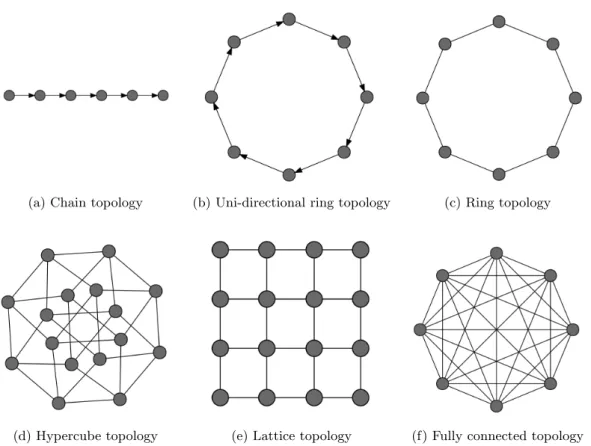
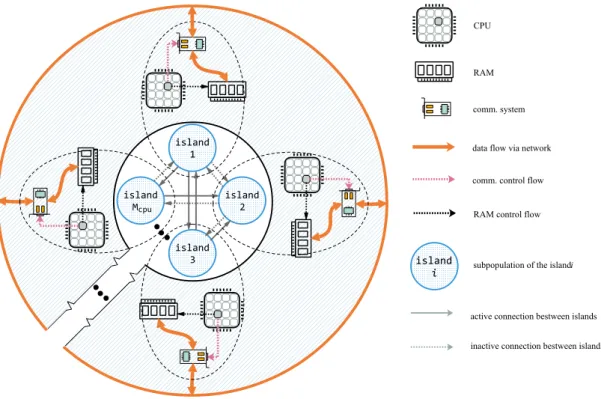
2.1 Common migration topologies in the island model. . . 33
2.2 The architecture of HPC. . . 40
2.3 CPU-only HPC infrastructure. . . 41
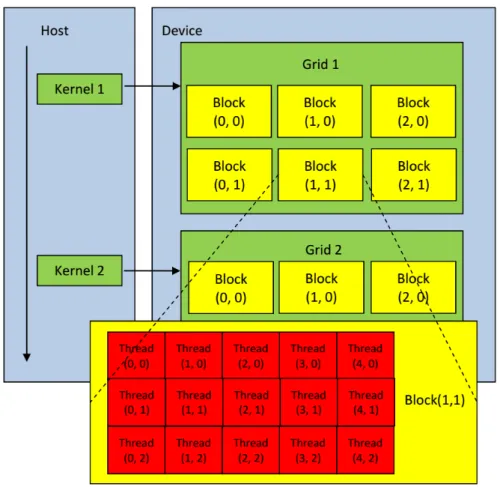
2.4 Threads batching in CUDA. . . 42
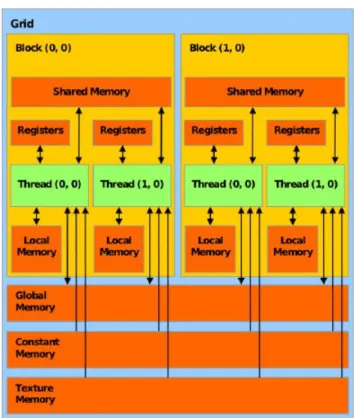
2.5 CUDA device memory model. . . 43
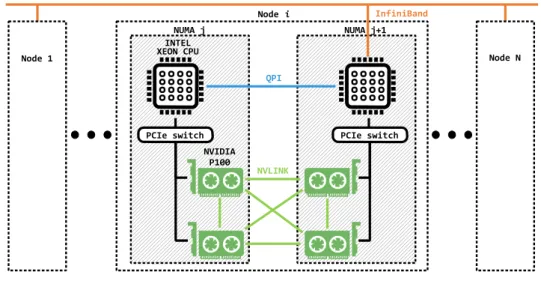
2.6 Infrastructure of GPU-enabled HPC (NCI). . . 46
3.1 Mean convergence characteristics of DE with N P = 64, 256, 1024 and 4096 on f30 forD = 30. . . 56
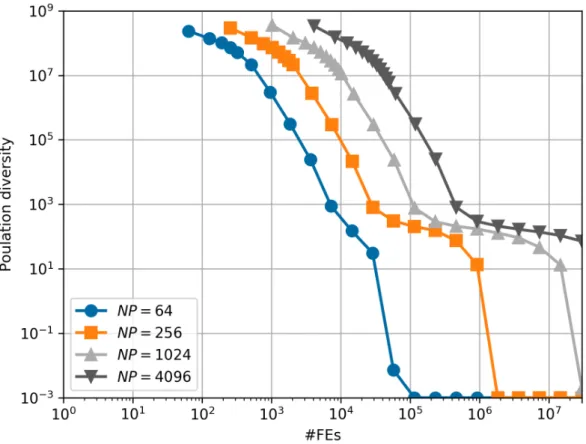
3.2 Mean population diversity of DE withN P = 64, 256, 1024 and 4096 on f30forD = 30 (Population diversity smaller than 10−3 is recorded as 10−3). . . 57
4.1 Deployment of SPEOHPCcpu on CPU-only HPC. . . 63
4.2 Framework of SPEOHPCcpu. . . 65
4.3 Average speedups of SPEOHPCcpu with asynchronous or synchronous migration on 8 test problems for D= 10,30 and 50 on up to 512 CPU cores. . . 71
4.4 Example of diversity curve of different buffers onf28 forD= 10. . . 74
4.5 Computational time of SPEOHPCcpu and a state-of-the-art island-based parallel EA (CloudDE). . . 76
6.1 Different outcomes of sorting function by C++ and CUDA. . . 98
6.2 Example of arithmetic operation associations. . . 100
6.3 Runtime flowchart of asynchronous sequential PSO based on CPU. . . 101 xii
6.4 Runtime flowchart of asynchronous parallel PSO based on GPU. . . 101 6.5 Guidelines of correctness verification of GPU-based EAs. . . 103 6.6 Flow chart of GPU-based MBSO. . . 107 7.1 The deployment of SPEOHPCgpu on the infrastructure of GPU-enabled HPC. . . 119
7.2 Framework of SPEOHPCgpu with the dual control mode. . . 120
7.3 Implementation of parallel DE on GPU. I represents the interval for active mi-gration andG is the current generation. . . 126 7.4 Scalability test of SPEOHPCgpu with different island sizes on increasing GPUs. . . 131
1.1 The top 10 HPC in TOP500 site at November 2018. . . 2
1.2 The algorithms and their population sizes that win at CEC competitions from 2014 to 2018. . . 3
3.1 Selected algorithms and configurations. . . 51
3.2 Mean FEVs of L-SHADE with a consistent population and LPSR. . . 52
3.3 Mean FEVs of jSO with a consistent population and LPSR. . . 53
3.4 Mean FEVs of DE withN P=64, 256, 1024 and 4096. . . 53
3.5 Mean FEVs of GA with N P=64, 256, 1024 and 4096. . . 54
3.6 Mean FEVs of PSO withN P=64, 256, 1024 and 4096. . . 54
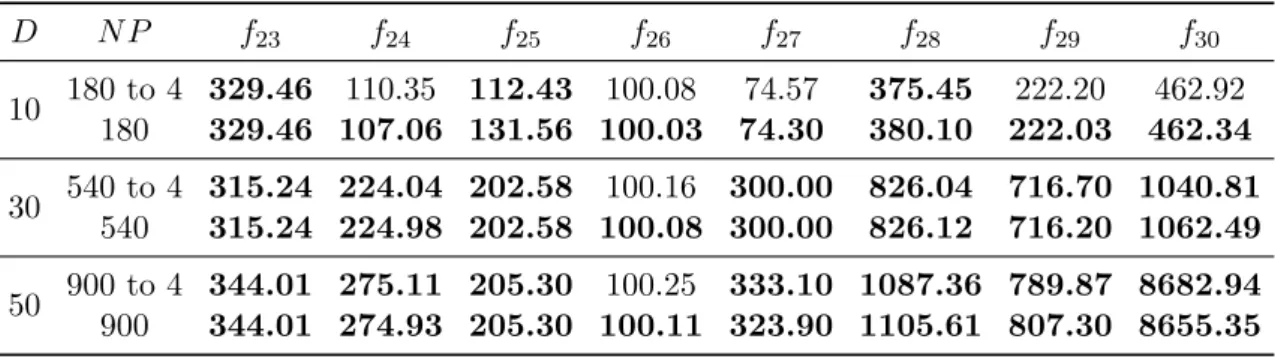
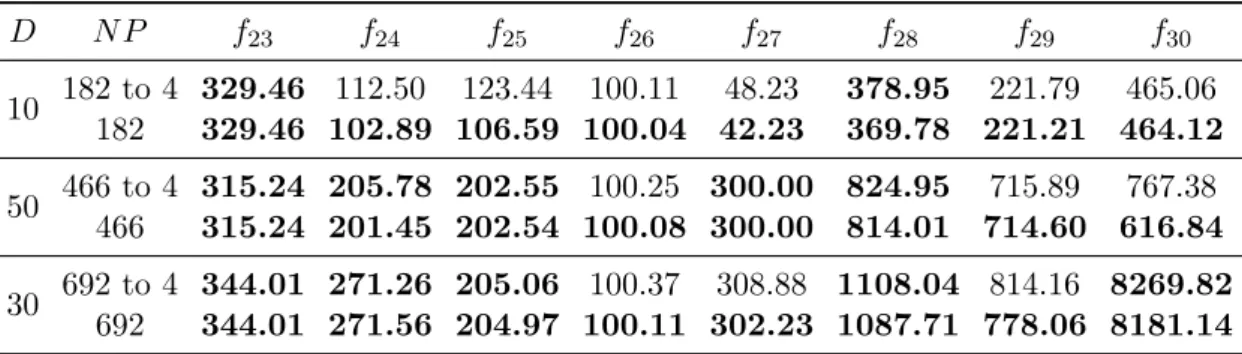
3.7 Summarised statistical tests(+/≈/-) indicate thatN P = 4096 performed signifi-cantly better (+), similarly (≈) or worse thanN P = 64, 256 and 1024, respectively. 55 3.8 Computation speed of sequential and parallel DE measured by time (hh:mm:ss) and the speedup of parallel DE withN P = 64, 256, 1024 and 4096 onf24andf26 forD = 10, 30 and 50. . . 59
4.1 Configurations of SPEOHPCcpu. . . 69
4.2 Mean FEVs of diversity preserving and 3 simple buffer managements. Summarised statistical tests (+/≈/-) indicate basic buffers perform significantly better (+), worse (-), or similarly (≈) than the diversity preserving buffer. . . 72
4.3 Mean FEVs of SPEOHPCcpuwith connection ratesRc= 0.1%,1%,2%,10%,25%,50% and 100%. . . 74
4.4 Mean FEVs of SPEOHPCcpu with improved dynamic and three common migration
topologies for D = 10. Summarised statistical tests(+/≈/-) indicate common topologies perform significantly better (+), similarly (≈), or worse (-) than the improved dynamic topology. . . 75 4.5 Mean FEVs of SPEOHPCcpu and state-of-the-art parallel EAs atD= 10,30 and 50. 77
5.1 Performance comparison of LES-CDE with differentntand kusing the Iman and Davenport test with the Hochberg post-hoc procedure over 8 test functions at dimension 10, 30 and 50, respectively. . . 87 5.2 Comparisons of mean FEVs between standard CDE and LES-CDE using D∗104
total FEs on 8 test problems for D = 10,30 and 50. Statistical tests (+/≈/-) indicate LES-CDE performs significantly better (+), similarly (≈), or worse (-) than CDE based on Wilcoxon rank-sum test over 15 independent runs. . . 88 5.3 Average computational time (hh:mm:ss) required by sequential CDE, LES-CDE
and SPEO-LES-CDE to solve 8 test problems for three dimensions (D = 10,30 and 50). The execution time presented use a small (D∗104) and large (D∗106) number of FEs, respectively. The sequential CDE and LES-CDE are conducted on a single CPU core and the SPEO-LES-CDE is conducted on 128, 256 and 512 CPU cores. The cost for demanding 512 CPU cores to conduct the entire experiments (8 test problems with 15 runs) are presented at the brackets. . . 89 5.4 Comparisons of mean FEVs of SPEO-LES-CDE using different data chunk and
volume. Statistical tests (+/≈/-) indicate SPEO-LES-CDE performs significantly better (+), similarly (≈), or worse (-) than basic configuration (Rm = 0.1 and
Cb = 64) based on 15 independent runs. . . 91
5.5 Average computational time (hh:mm:ss) that is required by SPEO-LES-CDE with different buffer capacities (Cb = 64,128 and 256) and migration rates (Rm =
0.1,0.5 and 1) to solve 8 test problems for D= 10. TotallyD∗106 FEs are used herein over 512 CPU cores at CPU node at NCI HPC. . . 91
6.1 Mean FEVs of four implementations of PSO withdifferent RNGson four func-tions. . . 96 6.2 Mean FEVs of four implementations of PSO with the identical RNG on four
functions. . . 96 6.3 Mean FEVs of GPU-MBSO and CPU-MBSO and their biases before applying
correctness verification guidelines. . . 111 6.4 Mean FEVs of GPU-MBSO and CPU-MBSO and their biases after applying
cor-rectness verification guidelines. . . 111 6.5 The average computing time (seconds) of based MBSO (denoted as
CPU-MBSO) and GPU-based MBSO (denoted as GPU-CPU-MBSO) on 30 test functions with three dimensions (D = 10,50 and 100) and four population sizes (N P = 50,100,500 and 1000). Total FEs are D∗104. . . 113 7.1 Configurations of SPEOHPCgpu. . . 128
7.2 Average computational time (hh:mm:ss) of SPEOHPCgpu on 8 test problems with
increasing GPUs (Mgpu = 2,4,8,16,32 and 64) and various island sizes (Ns =
64,128,256,512,1024,2048 and 4096). Total FEs areD∗107 = 109. . . 130 7.3 Comparisons of mean FEVs with different island sizes on 64 GPUs. Significantly
better value is typed in bold. . . 132 7.4 Comparisons of mean FEVs on different GPUs (2 GPUs to 64 GPUs) with a fixed
island sizeNs= 4096. Mgpu= 2 and Ns= 64 is also shown to represent DE with
a normal population size. Significantly better value is typed in bold. . . 133 7.5 Comparison of computing time (T) and communication cost (comm.%) between
SPEOHPCgpu and its variant with the single control mode (denoted as
Single-SPEOHPCgpu). Aggregative statistical tests (+/≈/-) indicate SPEOHPCgpu
7.6 Comparisons of mean FEVs of SPEOHPCgpu with its variant without dynamic
regrouping (denoted as Static-SPEOHPCgpu). They are executed on 64 GPUs with
three island sizes (Ns = 1024,2048 and 4096). Statistical tests (+/≈/-) indicate
Static-SPEOHPCgpu performs significantly better (+), similarly (≈), or worse (-)
than SPEOHPCgpu. . . 135
7.7 Unit price and maximal computing time with different budgets (1, 10, 50 and 100 USD) on AWS EC2. . . 136 7.8 Comparison of mean FEVs of SPEOHPCgpu(2, 16 and 64 GPUs) with SPEOHPCcpu
(32, 128 and 512 cores) and CloudDE (32 cores) with 1 USD budget. . . 138 7.9 Comparison of mean FEVs of SPEOHPCgpu(2, 16 and 64 GPUs) with SPEOHPCcpu
(32, 128 and 512 cores) and CloudDE (32 cores) with 10 USD budget. . . 139 7.10 Comparison of mean FEVs of SPEOHPCgpu(2, 16 and 64 GPUs) with SPEOHPCcpu
(32, 128 and 512 cores) and CloudDE (32 cores) with 50 USD budget. . . 139 7.11 Comparison of mean FEVs of SPEOHPCgpu(2, 16 and 64 GPUs) with SPEOHPCcpu
Introduction
1.1
Research Scope
Evolutionary algorithms (EAs) [1–4] are a broad class of meta-heuristic optimisation algo-rithms that use mechanisms inspired by biological evolution, such as reproduction, mutation, recombination, and selection. As population-based searching methods, EAs first generate the initial population in the solution space and then iteratively update it by applying the above evolutionary operators until it converges or a certain number of generations is reached. Since EAs ideally do not make any assumption about the underlying fitness landscape, they have been successfully used to solve various real-world optimisation problems [5–10]. However, due to the nature of the stochastic search, EAs usually need a long computational time to find satisfactory solutions [5–8,10].
Intrinsically, EAs are highly parallel owing to the data-parallel algorithmic structure in which each individual performs genetic operations independent of each other. Thus, this time-consuming process of EAs can be highly accelerated by distributing the considerable computa-tional effort on multiple machines. First introduced in the 1980s, parallel EAs [11–14] deploy the massive computational load onto many machines for parallel processing. Specifically, the existing parallel models of EAs can be divided into population-distributed and dimension-distributed [15–18]. The population-dimension-distributed model that includes master-slave [19–22], is-land [14,23–25] and cellular model [26–29] distributes the global population to parallel
Table 1.1: The top 10 HPC in TOP500 site at November 2018.
Rank System CPU Cores GPUs Rpeak (TFlop/s)
1 Summit (United States) 2,282,544 26,136 (Nvidia V100) 187,659.30 2 Sunway TaihuLight (China) 10,649,600 - 125,435.90 3 Sierra (United States) 1,572,480 17,280 (Nvidia V100) 119,193.60
4 Tianhe-2A (China) 4,981,760 - 100,678.70
5 ABCI (Japan) 391,680 4,352 (Nvidia V100) 32,576.60 6 Piz Daint (Switzerland) 361,760 5,320 (Nvidia V100) 25,326.30 7 Titan (United States) 560,640 18,688 (Nvidia K20x) 27,112.50
8 Sequoia (United States) 1,572,864 - 20,132.70
9 Trinity (United States) 979,968 - 43,902.60
10 Cori (United States) 622,336 - 27,880.7
ing facilities and achieves parallelism between individuals. The dimension-distributed model such as coevolution model [30–33] distributes the entire problem to parallel computing facilities and achieves parallelism between elements of solutions. However, limited accelerations were achieved by parallel EAs in the past because scientists can not easily access or afford parallel computing facilities even though they were backward.
With the increasing scale and complexity of real-world optimisation problems, higher com-puting power has become a necessity. Therefore, high performance comcom-puting (HPC), which can scale to extensive computing resources, has become increasingly important in research and engineering fields in recent years. Accordingly, Table 1.1 from the Top500 site (November 2018)1 indicates that the top 10 HPCs in the world assemble many processors. Furthermore, dynamically provisioned and pay-as-you-go computing resources of HPC are now offered by some cloud computing providers such as Amazon Web Services (AWS), Google Cloud Platform, and Microsoft Azure. Consequently, many compute-intensive tasks, which were impractical in the past, can now be efficiently completed on HPC. Moreover, inspired by the unprecedented computational power of modern HPC, parallel EAs have become popular again and justify a new presentation of the state-of-the-art in the field [34–37]. Real et al. [38] distributed 1,000 individuals onto 250 CPU cores to automatically design a deep neural network structure for image classification. Furthermore, Salimans et al. [39] solved the MuJoCo 3D humanoid task
1
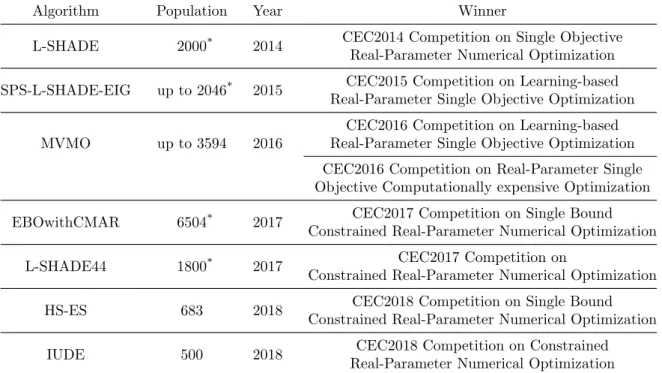
Table 1.2: The algorithms and their population sizes that win at CEC competitions from 2014 to 2018.
Algorithm Population Year Winner
L-SHADE 2000* 2014 CEC2014 Competition on Single Objective
Real-Parameter Numerical Optimization SPS-L-SHADE-EIG up to 2046* 2015 CEC2015 Competition on Learning-based
Real-Parameter Single Objective Optimization MVMO up to 3594 2016
CEC2016 Competition on Learning-based Real-Parameter Single Objective Optimization CEC2016 Competition on Real-Parameter Single Objective Computationally expensive Optimization EBOwithCMAR 6504* 2017 CEC2017 Competition on Single Bound
Constrained Real-Parameter Numerical Optimization L-SHADE44 1800* 2017 CEC2017 Competition on
Constrained Real-Parameter Numerical Optimization HS-ES 683 2018 CEC2018 Competition on Single Bound
Constrained Real-Parameter Numerical Optimization IUDE 500 2018 CEC2018 Competition on Constrained
Real-Parameter Numerical Optimization
*The algorithm employs a population reduction strategy that gradually reduces a large population
during the period of evolution.
by employing evolution strategies (ES) with a population size of 1,440 as an alternative way of reinforcement learning (RL). The proposed method required 11 hours if only 18 CPU cores were being utilised while being reduced to 10 minutes if 1440 CPU cores were demanded.
In recent years, various dedicated computing facilities which have been optimised for power efficiency, compute-intensive, and throughput-intensive scenarios–have entered mainstream computing. Therefore, general-purpose computing on graphics processing units (GPGPU) is one of the most important heterogeneous solutions. The GPU, which was designed for ad-dressing highly computational graphics tasks since its inception, has many computational cores and can provide massive parallelism at a reasonable price. Moreover, the high performance of floating-point arithmetic and memory operations on GPUs makes them particularly well-suited to several similar scientific and engineering workloads that occupy CPUs. Inspired by the in-credible computing capability, many HPCs evolve from traditional clusters of homogeneous nodes (CPU-only) to clusters of heterogeneous nodes (CPU + GPU) (a half of top 10 HPCs
at Table 1.1 are GPU-enabled). Apart from the powerful computing capability, GPU-enabled HPC also has better cost-effectiveness (price/performance ratio) than traditional CPU-only HPC. As a result, GPU-enabled HPC has become an ideal platform for scientific computing and has remarkably accelerated many existing EAs that were sequentially implemented on CPU [40–45].
1.2
Motivations
The increasingly complex and large-scale problems bring the rapidly rising solution spaces and quickly exceed the searching capabilities of traditional EAs. As a result, the approach of using EAs to address these difficult problems is currently attracting significant attention [5– 10]. An interesting phenomenon observed in recent works is that many state-of-the-art EAs have started to employ a population that is significantly larger than the size suggested by classic EAs [46–48]. For example, many winners at the famous CEC competitions since 2014 have employed a large population (up to 6504) to achieve satisfactory solutions (see Table 1.2) and many real-world problems [49–53] also employ a large population to achieve satisfactory solutions.
Although large populations have been widely employed, researchers in the domain of EAs have not reached a consensus on the benefits of this approach. Two opposing theoretical views exist, and solid numerical evidence is still lacking. Specifically, some works [54–59] have theo-retically proven that a large population can eventually improve the solution quality of problems with complex landscapes if sufficient fitness evaluations (FEs) are provided. Conversely, other studies [60–62] have indicated that a large population does nothing to improve the solution quality. Since most theoretical findings are based on problems and algorithms that can be represented by simple mathematical models (e.g., discrete problems and simple EAs without crossover), it is necessary to examine both opinions by numerical experiments in practice.
On the other hand, EAs with a large population require a significantly long computational time. Although researchers do not yet agree on the benefits of a large population, it is a common view [58,59,61] that EAs with a large population usually require significantly large FEs. Therefore, designing parallel EAs with a large population based on modern powerful
HPC facilities may make it possible to achieve numerous FEs in a short time. Since the use of parallel EAs based on HPC is not a new topic in the field of EAs, this thesis mainly focuses on the following aspects that have not been perfectly addressed yet.
Firstly, the scalability is essential in parallel computing and determines whether parallel EAs can efficiently utilise extensive computing resources. As the optimisation problems are increasingly complicated and time-consuming, efficiently utilising more computing resources to employ an even larger population or to achieve better speedup is necessary. However, it is not an easy task because communication and synchronisation costs increase rapidly with the use of more computing resources. To avoid significant deterioration of computational efficiency, most existing parallel EAs [63–66] are designed to use only a small number of CPU cores efficiently. Although a few studies [35, 37,67–70] have achieved scalability by using many devices, these approaches have had to employ sparse and light communication schemes, which unavoidably sacrifice the solution quality proven by works [66,71,72].
Secondly, EAs are intrinsically a class of iterative generate-and-test procedures, which iteratively create new populations based on their previous populations. In such a process, a significantly large number of FEs are employed by a large population, but only a small proportion of candidate solutions are superior and may enter new populations (most candidate solutions will be discarded). In fact, any previously evaluated candidate solutions, whether superior or inferior, may carry some useful information about the search landscape. The landscape can facilitate the search process by producing more superior candidate solutions if the evaluated solutions are properly learnt and used. Therefore, if these evaluated solutions can be reused rather than abandoned as inferior solutions, parallel EAs may provide better solution accuracy for solving difficult real-world problems.
Thirdly, CPU-only HPC with numerous CPU cores is a common platform to accelerate various parallel EAs. Since a single CPU core offers limited computing capability, many CPU cores are necessary to generate and evaluate sufficient candidate solutions in a short time. As a result, the high expense for demanding considerable computing resources is unavoidable. Currently, GPU devices shows the prospect in the field of EA research because even a single GPU can provide similar computing power to a large number of CPU cores with less expense.
For instance, if the work of Liu [69] is executed on the Amazon EC2 CPU instance2, it will cost USD 696.2 on 16,384 CPU cores for 1 hour; however, executing the same number of floating point operations on the AWS GPU instance would save around 80% of the cost. However, there are also some challenges when utilising GPUs to accelerate parallel EAs:
• Modern GPUs are characterised by inexpensive prices, general-purpose parallel comput-ing infrastructures, and easy-to-use programmcomput-ing models, which have intensified common personal computers (PCs), i.e., desktops and laptops. So far, GPUs have accelerated many time-consuming EAs [73–78] and offered remarkable speedups. However, program-ming on a single GPU is much more difficult than programprogram-ming in a serial-oriented order on a single CPU. Parallel programming based on GPU involves many challenges which are not typically encountered in conventional serial-oriented programming. In other words, implementing correct GPU-based EAs is not straightforward, resulting in a high risk that GPU-based EAs may output incorrectly. So far, all existing studies neglect the correctness of GPU-based EAs, making the significant speedups potentially unreliable.
• Although a single GPU is capable of offering considerable computing power, the scala-bility is still limited because each GPU has a maximal number of GPU processors and cannot offer further more computing power. Therefore, it is ideal to utilise a GPU-enabled HPC that can increase GPU computing power by allocating on-demand GPU devices. However, existing works on GPU-based EAs have been designed for a single GPU [79–82] or a small fixed number of GPUs [83–87] without scalability. As a result, existing parallel EAs are not able to efficiently utilise the unprecedented computing power offered by a large number of GPUs.
1.3
Objectives
Based on the above discussion, several objectives can be summarised as follows.
Objective 1: Comprehensively study the impact of a large population by nu-merical experiments
2
The benefits of a large population have been studied by many theoretical works based on some simplified mathematical models. In this thesis, we tend to examine these theoretical find-ings by conducting a comprehensive investigation using numerical experiments. The challenge of this work is how to design experiments to comprehensively investigate the impacts of a large population. Specifically, the selected algorithms should range from classic to state-of-the-art or from simple to complex. Moreover, the ideal selected problems should be famous and difficult because supporting theoretical works admit that a large population mainly benefits to solve difficult or complex problems.
Objective 2: Utilise many CPU cores at CPU-only HPC to achieve remarkable improvements on both the computing speed and the solution quality
Currently, CPU-only HPC has become a common parallel computing platform in the scien-tific computing area. In this thesis, we target at utilising many CPU cores at CPU-only HPC to improve both the computing speed and the solution quality of traditional sequential EAs. The two sub-objectives are as follows:
• We intend to design a scalable parallel evolutionary optimisation (SPEO) framework that can efficiently utilise on-demand computing resources on CPU-only HPC. The proposed framework can be easily employed to significantly accelerate common classic and state-of-the-art EAs by efficiently using a large number of CPU cores. The main challenge of this work is accomplishing the essential scalability, which requires the expertise in parallel computing and is not a straightforward task. Specifically, utilising more devices and maintain adequate information exchange usually significantly increase the commu-nication/synchronisation cost which rapidly occupies the majority of the computational budget.
• We intend to improve the search capability of EAs by learning from the extensive histor-ical information. Due to the significant computing power offered by CPU-only HPC, the proposed framework can create far more candidate solutions than traditional sequential EAs. Therefore, the searching capability of parallel EAs can be highly improved when the extensive historical information carried by these solutions is utilised properly. The main challenge of this work is to find a proper approach to take advantage of this historical
and effectively improves the searching capability of EAs; otherwise, the search process may be misled to an even worse result.
Objective 3: Utilise GPU devices to achieve both reliable solutions and re-markable accelerations
GPU-enabled HPC is a modern parallel computing platform that can offer a significantly large computing power. In this thesis, we target at utilising GPU devices to achieve both reliable solutions and remarkable accelerations. The two sub-objectives are as follows:
• We intend to propose guidelines for researchers to correctly implement parallel EAs based on a single GPU. Such guidelines can assist EA researchers in guaranteeing the correctness of parallel GPU-based EAs. The challenge of this work is the complexity of implementing parallel EAs based on GPU. Specifically, many GPU-inherent factors may bring unexpected outcomes compared to traditional CPU-based EAs and the stochastic searching nature of EAs even aggravates this issue.
• We intend to extend the above SPEO framework from CPU-only HPC to GPU-enabled HPC. The proposed framework can accomplish outstanding scalability to efficiently utilise on-demand GPU devices and requires a lower cost when compared to CPU-based parallel EAs. The two main challenges of this work are as follows.
– CPU and GPU work cooperatively in a heterogeneous architecture, thus computing tasks can be assigned to either GPU or CPU or a combination of both. There-fore, the mapping choice has a great impact on the computational efficiency of the framework because the CPU and GPU are suitable for different jobs.
– Compared to traditional CPU-based parallel computing, information sharing be-tween GPU devices is more complex and inefficient. Since each CPU of the existing multi-GPU EAs is in charge of both communication and GPU control, the increas-ing communication workload rapidly occupies the CPU’s computincreas-ing power, which results in the waiting of launching GPU kernel functions. Therefore, it is challeng-ing but essential to design a proper scheme that can avoid the impacts of extensive communication workload on computing efficiency.
1.4
Contributions
Based on the above objectives and their corresponding challenges, the research contributions are summarised as follows:
Contribution 1: We experimentally study and investigate the impacts of a large pop-ulation on EAs. Specifically, we select five representative EAs including two state-of-the-art and three classic EAs. We also choose eight complex composition functions from the famous CEC2014 benchmark [88] as test problems. In this work, we examine different population sizes ranging from small (64) to large (4096) using a very large FEs. As an experimental supplement to the theoretical findings, this work confirms the universal benefits of a large population to solve difficult problems. Compared to some complex methods that are carefully designed for specific algorithms, employing a large population is a feasible and simple option to significantly improve the solution quality of various EAs if researchers can access to a large computing power.
Contribution 2: We study utilising many CPU cores at CPU-only HPC to achieve re-markable improvements on the computing speed and the solution quality. We firstly propose a generic scalable parallel evolutionary optimisation (SPEO) framework based on many CPU cores at CPU-only HPC. Based on this framework, we also design and implement a local en-semble surrogate scheme to improve the searching capability of the traditional crowding DE algorithm. The two sub-contributions are described as follows:
• We propose the SPEO on CPU-only HPC (SPEOHPCcpu) which achieves outstanding
scalability by employing the island model with a buffer-based asynchronous migration strategy. The proposed SPEOHPCcpu is designed to be able to execute common sequential
implementations of EAs on each CPU core. Based on this framework, EA researchers can significantly accelerate their novel sequential EAs without worrying about the issues related to parallel computing.
• The SPEOHPCcpucan produce unprecedented candidate solutions that carry useful
histor-ical information and improve the search capability of EAs. In this thesis, we design a local ensemble surrogate crowding DE (LES-CDE) algorithm that significantly improves the
solution quality by learning from the extensive historical information. We also implement LES-CDE based on the SPEOHPCcpu and achieve remarkable speedups. It demonstrates
that the SPEOHPCcpu framework is very ideal to accelerate such data-driven algorithms
that require a unprecedented computing budget to learn from historical data.
Contribution 3: We utilise GPU devices to further accelerate parallel EAs and achieve reliable solutions meanwhile. We firstly propose a set of guidelines to assist in correctly imple-menting GPU-based EAs. Then we extend the SPEO framework onto GPU-enabled HPC so that a correct implementation of parallel EAs based on a single GPU can be simply deployed over multiple GPUs for further speedups. The two sub-contributions are described as follows:
• We firstly figure out some GPU-inherent factors that may bring difficulties when imple-menting parallel EAs based on a single GPU. Then, we propose a set of guidelines to assist EA researchers in verifying the implementation of GPU-based EAs against these factors. Benefiting from this work, EA researchers can guarantee that parallel GPU-based EAs are correctly implemented. In order to examine the proposed guidelines, we employ them to correctly implement a complex EA called modified brain storm optimisation (MBSO) based on GPU.
• We design an extended SPEO framework (SPEOHPCgpu) based on many GPUs at
GPU-enabled HPC. In order to efficiently utilise many GPUs and achieve outstanding scal-ability, the above proposed SPEOHPCcpu needs to be adjusted based on the characters
of GPU-enabled HPC. Similar to the SPEOHPCcpu, the buffer-based island model is still
applied by SPEOHPCgpu to run EAs independently on many GPUs, which avoids
time-consuming synchronisation between GPUs. Furthermore, a dual control mode is addition-ally introduced to improve the efficiency of CPU-CPU and CPU-GPU communication. Three contributions of this work are listed as follows:
– The SPEOHPCgpu is the first solution that can deploy EAs over a large number
of GPUs. It is now possible for EAs to solve some extremely large-scale or time-consuming problems that were impractical in the past.
– The SPEOHPCgpu does not limit the GPU-based implementations of EAs, thus
re-searchers who already have implemented a specific EA on a single GPU can easily deploy it over many GPUs without worrying about the essential interactions between GPUs.
– The proposed framework is an ideal option for researchers who have a limited budget because it costs significantly less than CPU-based parallel EAs to achieve similar or better performance.
1.5
Organisation of the Thesis
The remainder of this thesis is organised as follows:
In Chapter 2, the basic concepts of the topics related to this research are introduced. Firstly, The basic knowledge of EAs and three representative EAs including genetic algorithm (GA), differential evolution (DE), particle swarm optimiser (PSO) and brain storm optimisation (BSO) are briefly described. Then we survey the existing works on the population sizing. After that, the basic concepts of parallel EAs and some population topology models are briefly introduced. As a representative population topology model, the island model which works as the foundation of this thesis is described in this chapter. The GPU-based parallel EAs are surveyed then. Finally, we give a brief introduction of the modern HPC facilities and some basic knowledge of GPU computing.
In Chapter 3, we conduct the first comprehensively experimental study to investigate the impacts of a large population on the performance of EAs in terms of the solution quality and computing speed. Specifically, we present that a large population improves the solution quality of two state-of-the-art and three generic EAs on eight difficult benchmark functions. Moreover, we also demonstrate that a large population can bring better parallelism and speedups when implemented in parallel.
In Chapter 4, We propose the SPEO framework on CPU-only HPC (SPEOHPCcpu). The
proposed framework is implemented based on a standard DE algorithm and its performance is evaluated on eight composition functions of CEC2014 benchmark at the Australian National
Computational Infrastructure (NCI) platform using up to 512 CPU cores. Experimental results demonstrate that SPEOHPCcpu is very scalable because approximately linear speedups are
achieved. The results also present that SPEOHPCcpu not only increases the computational
efficiency but also improves the solution quality when compared to a state-of-the-art parallel EA.
In Chapter 5, we proposed the LES-CDE which can use historical search information to improve the searching capability. Specifically, we design an ensemble of several neighbouring local models that are trained by historical information to guide the generation of promising trial vectors. In this work, an online sequential extreme learning machine (OS-ELM) is used to construct and update these models in an online manner. After that, we implement the LES-CDE in parallel based on the SPEOHPCcpu framework. The numerical results demonstrate that
sequential LES-CDE can achieve significantly better solutions than the original CDE regardless that it requires a very long computing time to train the model. Benefiting from the SPEOHPCcpu
framework, the parallel LES-CDE can be remarkably accelerated and only requires a very short computing time to achieve extensive FEs. Finally, we provide a recommendation on configuring the chunk and volume of online training data for LES-CDE to achieve both satisfactory solution quality and computing speed.
In Chapter 6, a comprehensive procedure for verifying the correctness of GPU-based EAs is proposed to address the difficult but necessary correctness verification problem. An example of migrating the PSO from CPU based coding to the GPU environment is given as an example. In addition, some GPU-inherent issues, which influence the output of GPU-based EAs including the library functions, the numerical precision, and the race condition, are examined one by one. To cope with the issues mentioned above, a set of guidelines are proposed to verify the correctness of the GPU-based EAs. Finally, we present a working example that applies these guidelines to correctly implement the GPU-based MSBO.
In Chapter 7, we propose the SPEO framework on GPU-enabled HPC (SPEOHPCgpu) that
works efficiently with many GPUs. The SPEOHPCgpu introduces a dual control mode to
im-prove the scalability when an increasing number of GPUs are utilised. The performance of SPEOHPCgpu is evaluated on eight composition functions of CEC2014 benchmark at NCI using
up to 64 GPUs. Experimental results demonstrate that SPEOHPCgpu scales well by obtaining
linear speedups and achieves 3,000x speedups compared to its sequential counterpart. Re-sults also demonstrate that the SPEOHPCgpu outperforms SPEOHPCcpu and a state-of-the-art
CPU-based parallel EA with the same computational budget of USD 1, 10, 50 and 100. Chapter 8 concludes the thesis with some recommended further research directions.
Background and Literature Review
In this chapter, some concepts of the topics related to this research are introduced. Firstly, The basic knowledge of EAs and three representative EAs including GA, DE and PSO are briefly described. Then we survey the existing works on the population sizing. After that, the basic concepts of parallel EAs and some population topology models are briefly introduced. We detailedly describe the island model which is a representative population topology model and works as the foundation of this thesis. The GPU-based parallel EAs are surveyed then. Finally, we give a brief introduction of the modern HPC facilities and some basic knowledge of GPU computing.2.1
Evolutionary Algorithms (EAs)
2.1.1 Overview
EAs [1–4] are a broad class of meta-heuristic optimisation algorithms which use mechanisms inspired by biological evolution, such as reproduction, mutation, recombination, and selection. As population-based searching methods, EAs firstly generate the initial population in the solution space and then iteratively update it by applying above evolutionary operators until it converges or a certain number of generations are reached. Since EAs ideally do not make any assumption about the underlying fitness landscape, they are successfully used to solve various real-world optimisation problems [5–10]. DE [47], PSO [89] and GA [90] are some well-known
representatives.
2.1.2 Representative EAs
2.1.2.1 Differential Evolution
The DE algorithm [91–97] is a simple yet powerful population-based stochastic search tech-nique, which is an efficient and effective global optimiser in the continuous search domain. There are also many popular DE variants [98–101] that offer excellent searching capabil-ity. In the D-dimensional search space, DE evolves a population of N P individual vectors XG={x1,G,· · ·,xN P,G}, where xi,G={x1i,G,· · · , xDi,G},i= 1· · ·N P in quest of globally
opti-mal solutions. The initial population at generationG= 0 is randomly generated in the search space. From a certain generation to the next, DE employs several operators, i.e. mutation and crossover, to produce N P trial vectors. Then the trial vectors are evaluated and the target vectors are updated by the selection operator.
2.1.2.1.1 Mutation
At generation G, a mutant vector vi,G = {vi,G1 ,· · · , vDi,G}, i = 1· · ·N P is produced from a
target vectorxi,G by mutation operation. The five frequently used strategies are as follows:
• DE/rand/1: vi,G=xr1,G+F·(xr2,G−xr3,G) • DE/best/1: vi,G=xbest,G+F ·(xr1,G−xr2,G)
• DE/rand-to-best/1: vi,G=xr1,G+F·(xbest,G−xr1,G) +F·(xr2,G−xr3,G) • DE/current-to-best/1: vi,G=xi,G+F·(xbest,G−xi,G) +F·(xr1,G−xr2,G) • DE/rand/2: vi,G=xr1,G+F·(xr2,G−xr3,G) +F ·(xr4,G−xr5,G)
• DE/best/2: vi,G=xbest,G+F ·(xr1,G−xr2,G) +F·(xr3,G−xr4,G)
Where the distinct integer indicesr1, r2, r3, r4andr5are randomly selected in the range [1, N P] and are also different from the target vector’s indexi. The scaling factor is a positiveF control
parameter for scaling the difference vector. xbest,G is the best member in the population at
generationG.
2.1.2.1.2 Crossover
Crossover operator generates the i-th trial vector ui,G = {u1i,G,· · · , uDi,G} from the mutant
vectorvi,G and its corresponding target vectorxi,G
udi,G=
vi,Gd if(randj[0,1]≤CR)or(j=jrand)
xdi,G otherwise
d= 1,2,· · ·D
WhereCR∈[0,1) is set by users as the crossover rate parameter andjrand is a random
in-teger in the range [1, N P] to ensure that the trial vectorui,Gis different from its corresponding
target vectorxi,G
2.1.2.1.3 Selection
After generating a trial vector, the constraint checking will be applied to ensure that this newly generated trial vector is a feasible candidate solution. We will apply random re-initialisation or some other schemes to repair an infeasible trial vector to make the repaired one to satisfy the constraints. Then, a set of generated trial vectors UG = {u1,G,· · · ,uN P,G} are evaluated in
terms of their objective function values denoted by F(UG) ={f(u1,G), . . . , f(uN P,G)}, Each
trial vectorui,G will compare its function valuef(ui,G) , with the function valuef(xi,G) of its
corresponding target vector xi,G. If the trial vector performs better than the target vector, it
will replace the target vector and enter the next population. Otherwise, the target vector will be retained in the next population. This operation is described as follows:
xi,G+1 =
ui,G f(ui,G)< f(xi,G)
xi,G otherwise
2.1.2.2 Particle Swarm optimisation
PSO [89,102–111] is a family of swarm intelligence algorithms inspired by the bird’s creative problem-solving process, which has achieved successes in various applications. It does not use
evolution operators such as crossover and mutation; instead, the particle in the swarm adapts its search behaviour by learning from knowledge not only obtained from its own but also from other particle in the whole swarm. These phenomena are studied by mathematical models. In PSO, each particle has a position and a velocity which are adapted based on the best knowledge of each individual and the global best knowledge from the entire swarm as follows [89]:
vdi,G←vdi,G+c1∗rand1∗(pbestdi −xdi,G) +c2∗rand2∗(gbestd−xdi,G)
xdi,G←xdi,G+vdi,G
wherexi,G= (x1i,G, x2i,G, . . . , xDi,G) is the position of thei-th particle;vi,G= (vi,G1 , v2i,G, . . . , vDi,G)
represents velocity of particlei. pbesti = (pbest1i, pbest2i, . . . , pbestDi ) is the best position that has been found by the particlei; andgbest= (gbest1, gbest2, . . . , gbestD) is the best position discovered by all particles in the whole swarm. c1 and c2 are the two parameters that control the weight how much each particle learns to pbest and gbest, respectively. rand1 and rand2 are uniform random numbers ranging [0,1] to avoid that all particles have the same behaviour. If the absolute speed of any particle exceeds a maximum value vmax, the velocity of that
dimension is assigned to sign(vdi )vmaxd .
2.1.2.3 Genetic Algorithm
GA [112–116] is a metaheuristic technique that simulates the natural selection and genetic mechanism of Darwin’s theory of natural evolution. GA initialises and evolves a population withN P chromosomesXG={x1,G,· · · ,xN P,G}at generationG, wherexi,G={x1i,G,· · ·, xDi,G},
i = 1· · ·N P. In each generation G, based on a certain selection strategy, several promising parents are selected from the current population to generate offspring based on genetic opera-tions including crossover and mutation. The bestN P chromosomes are selected among current population and all newly generated offspring as the new population for generationG+ 1.
2.1.2.3.1 Selection
GA is usually designed to select the solutions with better quality to inspire the entire population evolve towards a better quality. Specifically, the chromosomes with high fitness values have a
larger chance of being selected. One common selection is roulette wheel selection [117] which is also known as fitness proportionate selection. In roulette wheel selection, each chromosome is selected according to the probability which is calculated as follows:
pi =
fi
PN P
j=1fj
where fi is the fitness value of chromosome i. Accordingly, chromosome with a higher fitness
value will be less likely to be eliminated.
2.1.2.3.2 Crossover and mutation
The crossover operation, also known as recombination, combines parents to creates new off-spring. Here we review and list some popular crossover schemes which are available for binary representation and real parameter optimisation respectively.
• Single point crossover [118] first randomly select a certain gene of parents’ chromosomes a crossover point. Two parents swap their chromosome based on this point. Specifically, the genes at the left side of crossover point is kept the same as the original parent and the genes at right side of chromosome are swapped between two parents.
• Linear crossover [119] generates three candidate offspring based on two randomly selected parents xi,G and xj,G as follows, where i and j are two different indices selected from
[1, N P]. Linear crossover selects the two best candidate offspring as the new offspring. x01 = 0.5∗xi,G+ 0.5∗xj,G
x02 = 1.5∗xi,G−0.5∗xj,G
x03 = 1.5∗xj,G−0.5∗xi,G
The mutation operation changes some genes of chromosome to explore in searching space where may not be searched before. to improve the diversity of population. Each gene is selected to be mutated based on a regulated mutation rate M R and the value of this gene randomly changes if it is selected. For example, if the k-th gene is selected as the mutation point, the original chromosome xi,G ={x1i,G, . . . , xki,G, . . . , xDi,G} changes to {x1i,G, . . . ,xˆki,G, . . . , xDi,G},
2.1.3 Brain Storm Optimisation
The brain storm optimization [120] algorithm works as a kind of search space reduction algo-rithm, theN ideas are grouped intoM clusters eventually and the best idea in each cluster is denoted as the representation. Then, the new idea is generated based on selected ideas from one or two clusters. The two important operators are as follows.
• Convergent operator: the convergent operator groups all the current ideas into several clusters based on their difference in solution space. k-means clustering algorithm is applied in this operator, and the best idea in each cluster is set as the centre of this group whenk-means finishes.
• Divergent operator: the new ideas are created by current ideas which are randomly selected from one or two clusters and added by a random noise. In Shi’s work, a uniform random number from [0,1] is used in random selection and Gaussian random noiseN(0,1) is used for random noise addition.
Although these implementations can make the BSO algorithm able to work, it would be faced with the time-consuming problem when solve high dimension problems. However, con-sidering that an accurate clustering is not necessary for BSO, various variants are designed to reduce the computation time on convergent operator. Modified BSO (MBSO) [121] that is a promising variant shares the same architecture with original BSO.
• Convergent operator: A simple grouping method (SGM) is introduced to group all the current ideas instead of k-means. The new method separates all the ideas based on randomly selected cluster centres, which avoids iteration of distance calculation.
• Divergent operator: In stead of using a fixed logarithmic sigmoid transfer function based on the generation and without feedback information from the search process, MBSO introduces idea difference strategy (IDS) to generate new ideas. IDS taking account of the difference of current ideas when creating new ideas.
2.2
Population Sizes in EAs
As population-based optimisation algorithms, EAs search for good solutions by updating the population and converging to the optima by generations. Specifically, the initial population is randomly generated in the solution space at the beginning of process; then the new population is iteratively reproduced by applying evolutionary operators (e.g. crossover and mutation) until it converges or a certain number of generations are reached. Consequently, the characters of population impact on how the quality of the solutions is and how long it takes to find them, for example, a smaller population may converge more efficiently [122–124] but a larger population may have a greater global search capability [54–59,61]. In this section, we provide a brief survey on two views 1) a large population can improve the solution quality, especially for complex problems 2) a large population is unhelpful and a small population is sufficient.
2.2.1 EAs with a Large Population
2.2.1.1 Theoretical Analysis
Due to the significant impacts of population size on performance of EAs, the ideal size of a population is studied in many theoretical works. Goldberg [125] studied the optimisation accuracy achieved by GA with a large-enough population regardless of the computing budget. They stated that GA makes many errors of decision and buffeted by the vagaries of chance when a small population size is employed; while GA becomes reliably discriminate between good and bad building blocks if a large population is used. Summarily, if enough computing resources are provided, GA with a large population can be more reliable than a small population to find the global optima. In 2013, to figure out the relationship between optimisation accuracy, reliability and population size, Goldberg [126] further theoretically analysed the impacts of population size on GA and claimed that stochastic effects on performance by a small population can be improved by a sufficient large population size. It is affirmed the benefits of a large population by providing an equation of a conservative population bound. The equation indicates that a increasing population size is required when 1) probability of error is decreased, 2) noise increases, 3) cardinality of the schema increases and 4) signal difference decreases.Additionally,
he also analysed the multiple building block cases and indicated that the population sizes must increase exponentially in number of building blocks to guarantee the converge to the global optima if a complex problem has multiple difficult building blocks. Summary, this work proved that GA requires exponentially large population sizes to ensure convergence to good solutions reliably and + that GA with a sufficiently large population size was able to find one of the 32 global solutions (among the 5.2∗106 local optima).
Jansen et al. [127] pointed out that for a simple problem, a small population can also have a high probability of successfully finding the global optima; while for a complex problem, a large population is required to find global optima with high probability. Specifically, it is pointed out that an increasingly large population can improve the quality of solutions by avoiding falling into local optima when solving a difficult and complex problem. They used empirical analyses to verify their findings and presented that (1+λ) EA can always find the global optima even with a small λ when the dimension n of complex problem SUFSAMP is small (n < 24). It is because the landscape of SUFSAMP with a small n is not complex enough. When the dimension becomes large (24< n <90), the solution quality of EA with an increasingλ∈[1, n] can be improved significantly. Authors also inferred that sufficient function evaluations are very necessary for large aλbecause they observed that a large population size may not further improve the solutions if function evaluations are insufficient. Summary, a large
λis necessary and beneficial for EAs when solving complex problems.
Thomas et al. [58] presented that smaller populations yield better results at the beginning of the process but are outperformed by the larger populations eventually. Witt [59] figured out that an EA with a large population size outperforms the same EA with a small population because a large population can provide sufficient exploration and avoid trapping into local optima.
Rowe and Sudholt [128] extended the theory of non-elitist evolutionary algorithms (EAs) by considering the offspring population size in the (1,λ) EA. They pointed that the (1,λ) EA needs exponential time on every function that has only one global optimum if population size is small. They also studied arbitrary unimodal functions and investigated the threshold for offspring population size. They found that this threshold is preferred to be shifted towards a
larger value. Finally, they conducted an experimental study and demonstrated that a large λ
requires less generations to solve OneMax, LeadingOnes, and Ridge problems.
Gieben and Witt [129] obtained the theoretical results by a careful study of order statistics of the binomial distribution and variable drift theorems for upper and lower bounds. Based on OneMax problem, they figured out that a large population makes the algorithm more robust with respect to the choice of the mutation probability.
Qi and Palmieri [130] established fundamental theoretical properties of population size for GA in continuous space. They let the population size go to infinity and deriving the consequent limiting behavior of selection, mutation, and crossover. They pointed put that population members tend to cover the entire solution space continuously as the population size gets large. After that, they showed that the probability density function (PDF) of the population will be narrowly concentrated around the global maximum after sufficiently long computing time.
Apart from these works which are regardless of considerations of computational cost, some works [58, 59, 61] pointed out that sufficient fitness evaluations are necessary to converge a large population to an optima.
2.2.1.2 Empirical Analysis
Although theoretical analyses claim that a large population benefits to the exploration of EA with sufficient computing budget, it is necessary to employ experiments to examine whether EAs with a large population is practical to solve optimisation problems.
Costa et al. [131] investigated an empirical comparative study of EAs with the different population size (50, 100, 512 and 1000). It is observed that GA perform best with a population size 512 on on several problems. According to authors’ view, population size 1000 performs worse than 512 due to the shortage of function evaluations.
Hu and Banzhaf [132] tested the Genetic Programming with different population sizes (200, 2000 and 20000). Results indicated that a larger population is better at searching and maintaining a high quality of solutions than smaller population. However, since the authors measured the evolutionary speed by the number of generations which results in more fitness
evaluations are a large population to reach the same generation as a small population.
Tung and Yu [133] investigated the performances and behaviors of convergence in optimal mixing evolutionary algorithms and examined the performance of population bound equation proposed by Goldberg [125, 126]. Experiments indicated that the success rate increases from 0 to 1 with an increasing population size from 50 to 300. They also studied the convergence time with one mask of size 5 of OMEA with different population sizes and observed that the time increases when population increase from 1200 to 10000 but keeps stable from 10000 to 204800. It is very interesting to see when solving problems withl= 100 with masks of size 5, the convergence time of population 100000 is even shorter than 200 which is also match some theoretical findings by [125,126].
Friedrich et al. [134] analysed and compared various diversity-preserving mechanisms for global exploration including crowding, fitness sharing and so on. A simple bimodal test function for 30 dimension and rigorous runtime analyses are employed in this study and the population size increases from 2 to 1024. Results show that a larger population always has a higher success rate than a small rate for all diversity-preserving mechanisms.
Hansen and Kern [53] studied the impacts of the population size λon the performance of CMA-ES. They found that CMA-ES, which is designed for a small population size, can be remarkably improved with a large population size. In this work, CMA-ES with population size from 5 to 1000 are compared on eight numeric test functions. Results shows that a large population can always achieve higher success rate compared to a small population.
Belkhir et al. [52] also investigated the effects of a large population on performance of CMA-ES and employed a self-CMA-ES to better utilise a large population size. They tested the CMA-ES on BBOB benchmark which containing 24 functions and set the λ from 10 to 1000. Results indicated that the self-CMA-ES with a large population outperform a CMA-ES with default parameters.
De Jong and Spears [135] presented some theoretical and empirical results on the interacting roles of population size and crossover in genetic algorithms. They firstly proved that the crossover productivity effects are much less dramatic if a large population is used. They tested population sizes ranging from 20 to 1000 and demonstrated that a larger population results in
better solutions, although the GA must be run for a greater number of generations.
Zhang et al. [136] examined effects of genetic fluctuations on the performance of GA calcu-lations. They considered the roles of mutation by using the stochastic schema theory within the framework of the Wright-Fisher model of Markov processes. The success probability of obtain-ing the optimum solution was investigated experimentally and theoretically. They conducted the experiments using population from 10 to 500 and noticed that the numerical calculations approaches the theoretical result when the population is large. On the contrary, there will be little change for the convergence of average fitness the small population.
Mallipeddi and Suganthan [137] investigated the effect of population size on the quality of solutions and the computational effort required by the DE Algorithm. The experiments are conducted on various population sizes ranging from 2D to 10D, where D is problem di-mension (10 and 30). From these experiments, they observed that a large population with a strategy having good exploration capacity reduces the probability of premature convergence and stagnation effects, but the convergence speed can be slower.
Oda et al. [138] dealt with the effect of changes in population size and number of genera-tions for node placement problem in Wireless Mesh Networks (WMNs). They considered two population sizes 8 and 512 and for every population size the number of generation are 200 and 20,000. Thus, the increase of the population size results in better performance behaviour. However, when the number of generation is also increased, the computation time is increased. Sarkers and Kazi [139] investigated the effect of population sizes on the quality of solutions to be obtained, the computational time to he required and the size of search spaces of the problems under consideration. They selected a two-stage transportation problem as a test case and also used a well-known conventional optimization technique to compare the solutions. The experimental results are performed on population sizes ranging from 50 to 2000. The results state that the population sizes may need to increase for improving the quality of solutions for a two stage transportation problem, and it may need further increasing for higher dimensional models. In summary, they concluded that the quality of solutions is highly dependent on the population size specifically when the search space is larger.
verified the impact of the population size on the performance of DE algorithms. Ten DE algorithms with fixed population size, each with at least five different population size settings, and four DE algorithms with flexible population size are tested on CEC2005 benchmarks and CEC2011 real-world problems. According to the numerical results, a large population size is useful when the problem is very hard and multimodal. Moreover, too low population sizes may diminish the number of available moves and prevent convergence within the specified number of function calls, even in case of unimodal problems. Moreover, they also stated that some variants of DE with flexible population size do not outperform the variants with fixed population size, if the fixed population is configured properly.
Zhan et al. [141] studied the population size how to impact on convergence rate, convergence time and global search capability of the genetic algorithm for the typical benchmark functions. According to their work, the increase of population size will reduce the evolution generation numbers if the total fitness evaluations are fixed and the global search capability still enhance. Hernhdez-Aguirre et al. [142] used the Probably Approximately Correct (PAC) framework to derive the size of a GA population. Their experiments used population sizes ranging from 66 to 2518 and demonstrated that small populations converge quickly without finding the solution. On the contrary, large populations have greater chances to find the solution but the consequences are paid in long processing time.
Belmont-Moreno [143] selected a particular set of test problems make an empirical study of a standard algorithm observing general trends when used with the set of test problems. In this work, the behavior of two particular parameters in GA is analyzed. In the experiments, the various population size that are up to 3000 are tested with various total numbers of fitness evaluations that are up to 300,000. It can be observed that if a big number of evaluations is necessary, the optimum population size moves into a bigger number. If a small or moderate number of evaluations are used, there exists a favored population size.
Dong and Yao [144] studied the impacts of population size on performance of Estimation of distribution algorithm (EDA). They figured out that classical EDAs with a small popu-lation that use maximum likelihood to estimate Gaussian usually fail because the exploring effectiveness will be fast deteriorating and premature convergence will arise. The performance
of different population sizes ranging from 100 to 2000 are compared by experiments on sev-eral test functions. Results shows that sufficiently large population sizes assist the maximum likelihood estimates to be precise and reliable, while a insufficient population performs poor and unstably. Summary, authors concluded that if more efforts are devoted into tunning and algorithm design, the population size can be reduced to save computing budget; however, it is very difficult for EDA to solve difficult problems with with a too small population.
Currently, benefiting from the modern parallel / distributed computing facilities (e.g., GPGPU, cloud computing and HPC), the impacts of population are also studied based on these parallel computing platforms. Folino et al. [67] proposed a scalable cellular parallel GP and employ population sizes ranging from 800 to 6400 on up to 64 computing nodes. Results shows that parallel GP with a larger population converges faster and achieve better solu-tions than a smaller population when executing on parallel computing platform. Tatsukawa et al. [145] used a many-objective EA designed for massive parallelisation (CHEETAH) on the K supercomputer. They compared the performances of different population sizes from 100 to 1,000,000 on test problems DTLZ1, DTLZ2, DTLZ3 and DTLZ4 at up to 4000 cores on super computer. Results showed that a larger population can achieve significantly better solutions than a smaller population.
2.2.1.3 Applications
So far, there are many applications which employ EAs with a large population to solve dif-ficult optimisation problems especially for some complex real-world problems such as protein structure prediction and neural network design.
Li et al. [50] proposed a novel graph-based EDA and employ reinforcement learning (RL) to enhance the performance in terms of fitness values, search speed, and reliability. The proposed EDA employed a large population 1800 and achieve significantly better solutions compared to genetic network programming (GNP) or GP with a relatively small population size of 300. Valdez et al. [49] proposed a Boltzmann based EDA and showed that different problems require different population size. In the experiments, population sizes are set ranging from 200 to 2400 for 2 to 80 variables. Hans-Georg and Sendhoff. [51] proposed two evolutionary strategies (ES)
for the optimisation of problems with actuator noise as encountered in robust optimisation. they stated that a large population does improve the final solution quality if strong noise exists and examined this idea by employing a (320,800) ES on Sphere function.
Since many works indicated that a large population may result in very slow computing speed, parallel computing becomes increasingly popular on applying a large population. Thus, effective utilizing a large population and processing a large number of fitness evaluations in a reasonable time is no longer impossible. Consequently,