Realistic Workload Characterization and Analysis for
Networks-on-Chip Design
Paul V. Gratz
Department of Electrical and Computer Engineering
Texas A&M University
Email: [email protected]
Stephen W. Keckler
Department of Computer Sciences
University of Texas at Austin
Email: [email protected]
Abstract
As silicon device scaling trends have simultaneously increased transistor density while reducing component costs, architectures incorporating multiple communicat-ing components are becomcommunicat-ing more common. In these systems, networks-on-chip (NOCs) connect the compo-nents for communication and NOC design is critical to the performance and efficiency of the system. Typ-ically, in NOC design traditional synthetic workloads are used to characterize the performance of the sys-tem. Previous work shows, however, that these tradi-tional synthetic workloads do not accurately represent the characteristics of realistic network traffic. In this paper we propose the analysis of realistic traffic via a set of new workload characteristics. We show that these characteristics more accurately correlate with network congestion in realistic workloads than traditional met-rics.
1
Introduction
Over the past 40 years silicon device scaling, as characterized by Moore’s law [1], has simultaneously increased transistor density while reducing compo-nent costs. Moore’s law has recently led to architec-tures that incorporate multiple communicating compo-nents, such as systems-on-chip (SOC) and chip multi-processors (CMP) designs. Examples include the CMP Intel Core 2 Quad [2], and the SOC IBM Cell proces-sor [3]. In the past, ad-hoc interconnect and bus pro-tocols were used to convey information within a chip. The scaling of these interconnects with frequency and greater numbers of components motivates a shift to on-chip interconnection networks to take an analogous role to off-chip interconnection networks seen in large scale multiprocessor systems.
Networks-on-chip (NOCs) are used in several con-texts. Some, such as the Tilera Tile64 processor’s “Static Network” (STN) [4], serve as a replacement for the bypass bus found traditional superscalar
proces-sors, carrying operands between producing and con-suming instructions. Others, such as the TRIPS OCN [5], interconnect processors with their second-level cache and primarily carry cache blocks between the first- and second-level caches. Chip multiprocessor (CMP) NOCs are another important class of on-chip interconnection network. CMP NOCs primarily carry cache coherency traffic, as well as first- and second-level cache block transfers. As each of these different NOCs must be designed to accommodate the traffic that traverses them, an understanding of the typical workload characteristics of each network will have is of paramount importance in producing a well balanced network design.
Typical network design is informed by a combina-tion of broad aggregate characteristics of the expected workloads, such as the average injection rate of a given benchmark, and network performance under a small set of synthetic workloads in simulation. Prior work shows these aggregate characteristics, combined with typi-cal synthetic workloads, inaccurately model the perfor-mance of the network under realistic workloads [5, 6].
This paper makes the following contributions: 1. We introduce a new set of metrics for the
evalu-ation of realistic NOC workloads. Metrics which characterize the temporal and spatial imbalances in network traffic distribution.
2. We show traditional synthetic workloads driven by broad aggregate workload characteristics do not accurately model the diversity of realistic work-loads.
3. We evaluate the correlation between the new work-load metrics and NOC packet latency, validating their effectiveness in predicting workload perfor-mance on a given network.
This paper is organized as follows, Section 2 dis-cusses several commonly used realistic and synthetic workloads. This is followed by a discussion of the work-loads examined and the methodology of their capture in Section 3. Section 4 introduces several new workload
characteristics and uses them to contrast the various workloads. Section 5 explores the correlation between individual workload characteristics and packet latency within each suite of benchmarks. Section 6 describes the prior work in NOC workload characterization, and contrasts it with the work presented here and Section 7 concludes.
2
Background
2.1
Synthetic Workloads
Balanced network-on-chip (NOC) design requires the network accommodate the traffic traversing it with-out over-provisioning the network and wasting re-sources such as power or area. Traditionally the ability to accommodate a given traffic load has been evaluated under synthetic traffic workloads. In synthetic traffic, the source and destination node patterns are typically driven by a stochastic uniform random injection pro-cess. The spatial characteristics of the source and des-tination node patterns and the temporal characteristics of the uniform random injection process are intended to model the characteristics of realistic workloads. Syn-thetic traffic patterns used in NOC research and design include the following [7]:
Bit-complement: In bit-complement traffic, the destination coordinates are the bit-wise inversion of the source coordinates. This load stresses the horizontal and vertical network bisections. Under this load, DOR statically spreads traffic across all of the bisection links, providing a perfectly balanced network load.
Uniform Random: In uniform random traffic, source and destination nodes are chosen via a uni-form random process. The load is balanced because the source and destination coordinates are uniformly distributed, although the random process that gener-ates the coordingener-ates may cause transient hotspots.
Transpose: Intranspose traffic, the destination co-ordinates are the transpose of the source coco-ordinates. Under this load the network’s diagonal bisection is a bottleneck as all packets must cross it. Transpose traf-fic, in combination with the dimension order routing (DOR) algorithm commonly found in NOCs, produces a highly imbalanced network load. In transpose traf-fic, the links counter-clockwise about the center of the mesh are utilized while the clockwise links are unused. While these three synthetic workloads may provide some insight into a network’s performance bottlenecks, prior work has shown them to be ineffective in pre-dicting the performance of realistic workloads [5, 6]. As we will show, this is because the static, evenly dis-tributed source and destination patterns and the
ag-gregated mean injection rate do not characterize the variance in injection rate from node to node in locale and over the course of the benchmark in time seen in realistic workloads.
Other synthetic workloads exist, includingtornado, bit-reversal, and shuffle. These other synthetic work-loads either do not apply to the mesh topologies typi-cally found in NOCs (tornado), or produce traffic with similarities to the three listed above (bit-reversal and shuffle). The remainder of this paper will utilize bit-complement,uniform random, andtranspose as repre-sentative of typical synthetic workloads.
2.2
Realistic Workloads
One way to ensure the network design matches its intended use is to perform design exploration experi-ments using realistic workload traces. Three realistic, application-driven workload suites commonly used in NOC design research include:
SPEC CPU2000: The SPEC CPU2000 bench-mark suite is a standardized, uniprocessor benchbench-mark suite designed to provide a measure of CPU-intensive performance [8]. Researchers use uniprocessor bench-mark suites, like the SPEC CPU2000 suite, to generate memory system request traffic representing the traf-fic seen when independent programs are executed on shared memory multiprocessors [5, 9].
SPLASH-2: The SPLASH-2 benchmarks repre-sent a traditional HPC-centric, shared-memory mul-tiprocessor scientific workload [10], and is frequently used in NOC research [11, 12, 13, 14].
PARSEC:The PARSEC benchmarks represent an emerging, shared-memory multiprocessor workload fo-cused on chip-multiprocessing environments [15]. The PARSEC benchmarks have only recently been intro-duced, as a result a limited amount of published re-search has incorporated their analysis [16, 17].
It should be noted the term “realistic workload” has different meanings for different NOC designs. Each of the above benchmark suites is intended to model a completely different portion of the overall application space for current and future NOCs. It would be ef-fectively impossible to cover the entire space in any meaningful way. As the benchmarks suites we have chosen are quite divergent from one-another, we feel that it reinforces the commonalities we find in traffic characteristics between.
Ideally, application-driven workload suites would provide the best means of evaluating a network’s per-formance. In practice, however, realistic workload traces are not easily generalizable to a wide range of network sizes and often require a great deal of simula-tion time, making them too cumbersome to use during
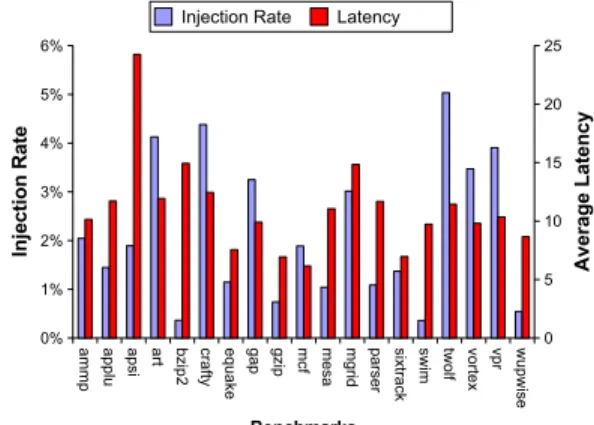
(a) Uniform random synthetic traffic on the TRIPS OCN network.
(b) SPEC CPU2000 traffic on the TRIPS OCN net-work.
Figure 1. Injection rate and latency for synthetic and realistic traffic on the TRIPS OCN network. the design exploration phase of NOC design.
3
Workload Simulation
The remainder of this paper will focus on the syn-thetic workloads described in Section 2.1 and on traces from the realistic workloads described in Section 2.2. The synthetic workloads contain statistically generated traffic, therefore the simulation of a full system is not required. Realistic application-driven workload traces were simulated and captured as follows:
SPEC CPU2000 on the TRIPS OCN: The TRIPS OCN network interconnects the TRIPS proces-sor core with the individual banks that form the sec-ond level cache [5]. The TRIPS OCN is an Y-X DOR routed, 4x10, 2D mesh network. A TRIPS full proces-sor simulator executing the subset of SPEC CPU2000 benchmarks currently supported by the TRIPS simu-lation infrastructure captured all OCN traces. In each case the MinneSPEC [18] reduced input data set was used in conjunction with SimPoint checkpoints [19] to approximate the application behavior.
SPLASH-2: The Bochs full-system functional sim-ulator was used to obtain traces for a forty-nine node, shared memory multiprocessor system arranged in a 7x7 2-D mesh topology simulating a subset of the SPLASH-2 benchmarks [11]. In the simulated system each processor node contains a private L2 cache bank of 2MB. Cache banks are kept coherent via a MSI directory based protocol. The traffic in the start-up phases of these benchmarks is much greater than traf-fic during the remainder of the benchmark causing the benchmark performance to be dominated by the start-up phase. For this reason the results in the remainder of this paper will focus on the first two million cycles of each SPLASH-2 benchmark.
PARSEC:The M5 full-system functional simulator was used to obtain traces for a sixty-four node, shared memory multiprocessor system arranged as a 8x8 2-D mesh topology simulating a subset of the PARSEC benchmarks [16]. The simulated system implements a fully shared, S-NUCA style L2 cache of 16MB. Only benchmarks currently supported by our simulation in-frastructure were included. The “simmedium” input data set was used for all benchmarks with the excep-tion of x264 where “simlarge” was used.
In each case, the traces were captured from differ-ent processor types and in differdiffer-ent simulation envi-ronments. Each benchmark suite trace was taken from previously published works (as cited above), having thereby been vetted by the submission process asso-ciated with each publication. We chose to use traces from published works rather than recreating our own, even if that meant that the simulation environment was not consistent, because we felt it was important that we showed that our analysis would hold regardless of simulation setup.
4
Workload Characteristics
Networks-on-chip are implemented in many different contexts and have diverse workloads. Understanding a network’s expected workload characteristics is im-portant in producing a well balanced network design. Typically network design is informed by broad aggre-gate characteristics of the expected workloads, such as the average injection rate of a given benchmark. In this section we will examine this traditional workload char-acteristic as well as several new charchar-acteristics we in-troduce. These improved workload characteristics have applications both in directly identifying imbalances in the network that may lead to poor performance as well as informing the generation of generalizable
syn-thetic workloads that more accurately represent realis-tic application-driven workloads.
Figure 1(a) shows the average packet latency of a uniform random synthetic workload on the TRIPS OCN network for various injection rates. In the figure, packet latencies are low for low injection rates, approx-imately 7 cycles on average. As the load is increased, packet latencies gradually increase until a tipping point occurs at injection rates of approximately 30%, where latencies increase exponentially with injection rate. By convention the injection rate at which the packet la-tency is three times the low-load lala-tency is labeled the saturation point for the network under that load.
Figure 1(b) shows the injection rate and latency for the TRIPS OCN under the SPEC CPU2000 workload. These realistic workloads show great variance between the injection rate of each benchmark and its corre-sponding average packet latency. For example, apsi exhibits a low injection rate, less than 2%, while it has the highest packet latency at 25 cycles. Conversely, twolf has the highest injection rate, at 5% while it has an average packet latency of only 11 cycles. In each case the realistic workload injection rates are well be-low the saturation point for the synthetic workload, yet all of the realistic benchmarks exhibit latencies that are above the low-load latency for the synthetic workloads. These results imply a disconnect between the average aggregate injection rate of a realistic workload and its average packet latency.
In the remainder of this section we examine the workloads from TRIPS and multiprocessor NOCs with respect to their variance in injection rate with respect to time and source-destination location. We will show that these benchmark characteristics are key in deter-mining the network’s behavior over the course of those benchmarks. In each case we contrast the realistic workload traffic against the typical synthetic workloads introduced in Section 2.1.
4.1
Injection Rate Variance in Time
In most synthetic workloads, including bit-complement,uniform random and transpose, injection time of individual packets is determined by a uniform or Poisson random process. Prior work, however, shows that many realistic workloads exhibit periodic behav-ior characterized by a high variance in their injection rates over time [5, 6]. The periodic variance in injec-tion rate creates bursts and troughs of injecinjec-tions over a wide range of timescales. Rather than largely ho-mogeneous execution, as modeled by synthetic bench-marks, programs typically have phases or periods in which characteristics such as memory references, and instructions per cycle are radically different from other
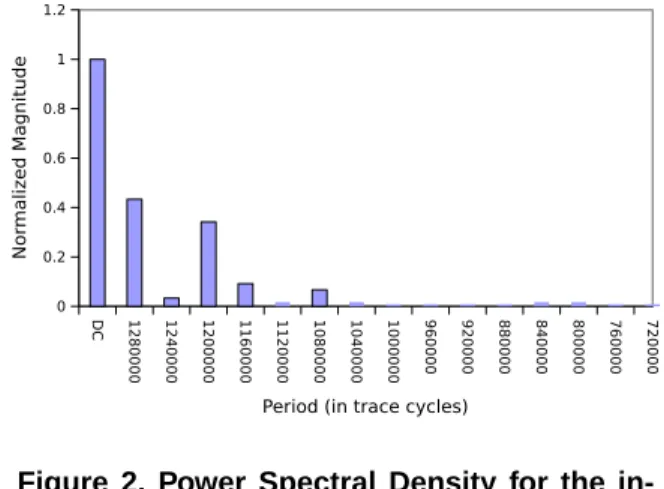
Figure 2. Power Spectral Density for the in-jection rate of the OCNmesabenchmark.
phases [19, 20].
The exponential relationship between packet latency and injection rate during saturation, combined with phase based traffic’s periodic high injection rates can produce packet latencies that dominate simulation per-formance. The wide range of offered rates caused by program phases include very high offered rates dispro-portionately affecting the average packet latency by placing the network in saturation for certain phases. Understanding the magnitude and frequency of pro-gram phase behavior within a given workload informs the need to over-provision the network at design time. A measure the frequency composition of a given sig-nal is its Power Spectral Density (PSD). The PSD of a time series is calculated as two times the square of its Fourier coefficients and provides an estimate of the magnitude of the frequency components of a given sig-nal [21]. Figure 2 shows the PSD of the injection rate of the OCNmesa benchmark. The PSD values shown are normalized against the magnitude of the DC com-ponent (the first element in the figure). In the figure the X axis denotes the frequency component’s period, in OCN network cycles. The height of the bar denotes the magnitude of periodic phase behavior at that fre-quency. In this diagram the DC component of the jection rate is equivalent to the aggregate average in-jection rate over the course of the entire benchmark.
The diagram shows significant magnitudes at sev-eral low frequencies, in particular those with periods of 1.28 million cycles and 1.2 million cycles. These peaks indicate the presence of program phases which repeat with a period of 1.28 to 1.2 million cycles, that strongly effect the injection rate. We found that the dominant injection rate variances occurred with peri-ods larger than 40000 cycles, therefore the injection
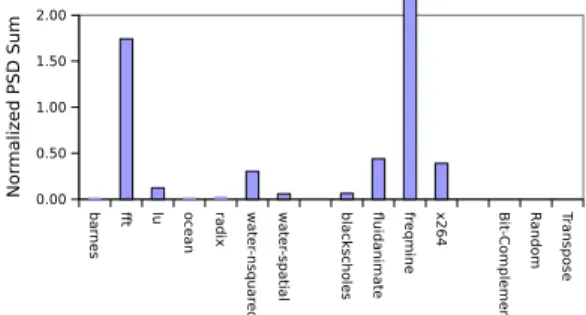
(a) OCN SPEC CPU2000 normalized PSD. (b) Multiprocessor SPLASH-2, PARSEC and synthetic trace normalized PSD.
Figure 3. Normalized power spectral density of injection rate for TRIPS and multiprocessor traces. rate was sampled every 20000 cycles to highlight the
low frequency program phase components.
Figure 3 shows the sum of the PSD’s non-DC fre-quency components of the injection rate of SPEC CPU2000 benchmarks in the TRIPS OCN, SPLASH-2 benchmarks and PARSEC benchmarks as well as the three synthetic benchmarks. In these diagrams the PSDs were summed and normalized against the DC component to provide a relative measure of the pres-ence or abspres-ence of non-DC, periodic components within each benchmark’s injection rate over time. The intu-ition behind this metric is that the individual periodic components of the injection rate are less important to network performance than the sum of the magnitudes of the periodic components because injection rates with greater numbers of measurable frequency components are likely to express more highly variable injection rates having a much larger impact upon performance than those with fewer measurable frequency components.
Figure 3(a) shows the normalized sum of the PSD for the OCN traces. The figure shows a great diver-sity in phase behavior from benchmark to benchmark. In the figure several benchmarks standout with signif-icant periodic components in their injection rate over time due to phase based behavior. In particularapplu and mesa show spectral components larger than the DC component, indicating the presence of very large swings in injection rate over time that are not cap-tured in the average aggregate injection rate. Many other benchmarks show small normalized PSD sums, indicating little variation in their injection rate over time.
Similarly Figure 3(b) shows the the normalized sum of the PSD for the multiprocessor and synthetic traces. Here two benchmarks in particular show very high nor-malized PSD sums, SPLASH-2’s fft and PARSEC’s freqmine. The other multiprocessor benchmarks show much less phase-based, periodic behavior. By contrast, all of the synthetic benchmarks show normalized PSD
sums near zero, as would be expected from a uniform random injection rate. In the design of a network to carry one of the benchmark driven workload suites ex-amined, simply ensuring that the network was capable of carrying a load equal to the average injection rate over the course of the trace would not be sufficient be-cause cycle program phase behavior would create times where the injection rate would be much higher than the average. It should however be possible to design a synthetic workload with a periodic injection rate that would be a better model for the traffic the network would carry.
4.2
Injection Rate Variance in Locale
Network hot-spots, locations within the network that have over-committed resources, can have a dispro-portionate effect on network performance similar to in-jection rate bursts. Two places hot-spots often form are around over-committed destination or source nodes. In these cases, either the injection or ejection rate for a subset of nodes is significantly higher than the average injection rate across all nodes. As with injection rate variability, detection of source or destination node hot-spots within a given workload gives important informa-tion about the expected performance of that workload. One way to detect source or destination hot-spots is to examine the variance in source injection or destina-tion ejecdestina-tion rates. While the mean source injecdestina-tion and destination ejection rates will be a static fraction of the overall injection rate, the variance or standard deviation of these rates indicates the degree of skew in rate from node to node and the likelihood of hot-spots. We will examine two forms of source or destination node injection rate variance, transient andstructural. Transient node rate variances persist for a limited time and cause hot-spots which vary over the course of the benchmark. Transient node injection rate variances are caused by program phase behavior in the bench-marks, creating temporary resource hot-spots.
Struc-(a)Structuralandtransientstandard deviation of source injection and destination ejec-tion rates normalized against the mean rates for OCN traces.
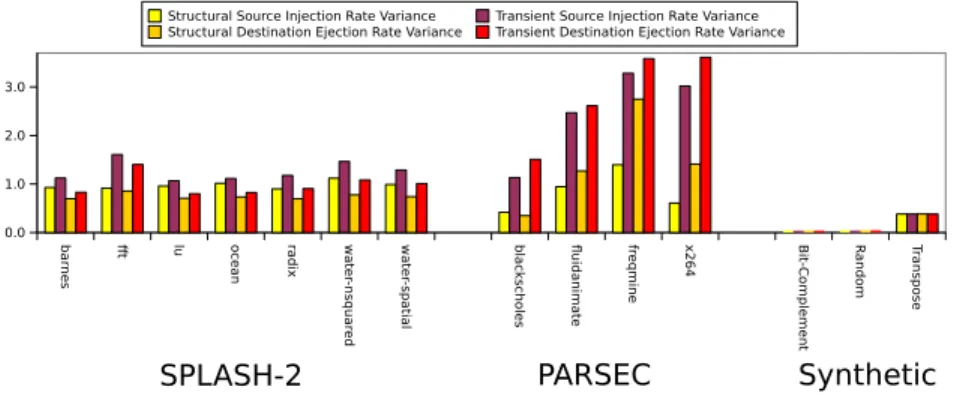
(b)Structural andtransient standard deviation of source injection and destination ejec-tion rates normalized against the mean rates for multiprocessor and synthetic traces.
Figure 4.Structuralandtransient source and destination rate variance for TRIPS, multiprocessor and synthetic traces, normalized against the mean rate for each benchmark.
tural node rate variances persist over the entire course of the benchmark causing permanent hot-spots. Struc-tural node rate variances are caused by functional dif-ferences from node to node. Understanding the de-gree of injection rate variance between source nodes or destination nodes within a workload can inform need to over-provision the network at design time, poten-tially toward heterogeneous topologies (i.e. topologies in which some network links have greater bandwidth than others), if common workloads are structurally skewed.
The traditional synthetic workloads vary by the function used to determine the source and destination node for each packet, however in many synthetic work-loads each source node injects packets destined for one and only one destination. In these synthetic work-loads the variance in per-node injection and ejection rate is very low, meaning that each node injects and ejects packets at approximately the same rate. Syn-thetic workloads driven by uniform random injection processes also show little difference in the node rate variance over time because uniform processes tend to-wards the mean for large enough sample sizes. Realistic workloads that do not match these source or
destina-tion rate characteristics may cause network hot-spots at the nodes which have higher injection or ejection rates.
Figure 4 shows the structural and transient stan-dard deviation of source injection and destination ejec-tion rates for the TRIPS OCN, multiprocessor and syn-thetic traces normalized against the mean rate for each benchmark. In this figure the structural rate variance is calculated by measuring the standard deviation in the aggregate average injection rate for each node over the course of the entire benchmark. By contrast, the transient rate variances are calculated by sampling the standard deviation in injection rate for each node once every 1000 cycles then performing a flit-count weighted average of these samples across the entire benchmark. The source injection rate is the rate at which pack-ets are injected from a particular source. The desti-nation ejection rate is the rate at which packets are injected destined for a particular destination. While the mean source injection and destination ejection rates will reflect a simple fraction of the overall injection rate, the standard deviation of these rates when normalized against the mean rate indicates the degree of injection rate skew from node to node, orthogonal to the
injec-tion rate itself. For example if one particular source node injects most of the packets within a trace, its in-jection rate will be much higher than the rest of the nodes in the network for that trace and the standard deviation of the node injection rate for that trace will be greater than a trace where all sources inject packets equally. Generally a larger spread in rates indicates a greater likelihood of injection or ejection hot-spots.
Across the all traces in Figure 4, the transient rate variances are greater than thestructural rate variances. This is to be expected, as the method used to capture the transient rate variances encapsulates both vari-ances due to structural differences as well as varivari-ances that are transient in nature, while the structural vari-ance shown will have the transient varivari-ances normal-ized out due to aggregation of the injection rates over the course of the benchmark.
Figure 4(a) shows the OCN network has a rela-tively large structural variance for injection and ejec-tion rates. In these traces, only one processor and its associated cache banks are legal nodes for injection or ejection, structurally skewing the source and destina-tion rate standard deviadestina-tions in the OCN traces. This extreme structural skew in network source and desti-nation node rates causes severe hot-spots and conges-tion for benchmarks with an injecconges-tion rate of any sig-nificance. In the TRIPS OCN, the primary injectors and ejectors are known a priori, and are unchanging across all workloads. These results argue for a het-erogeneous network design, possibly taking advantage of the available wire bandwidth to over-provision the network links near the primary sources or destinations. For most benchmarks, thetransient rate variances are only slightly higher than thestructural rate variances indicating that, in these workloads, differences due to program phases do not have a large effect on the dis-tribution of injection or ejection rates.
Interestingly, the SPLASH-2 and PARSEC multi-processor benchmarks in Figure 4(b) show significant structural rate variances despite the homogeneous de-sign of the multiprocessors execute on. These differ-ing rates indicate multi-threaded load imbalances be-tween processors which persist over time or hot, shared-memory locations, leading to source and destination hot-spots in the network. Unlike the OCN, it is un-likely that the source and destination rates occur in the same nodes from benchmark to benchmark, so a heterogeneous network design is not called for. The PARSEC benchmarks also show a great deal of tran-sient rate variance, much larger than transient rate variance seen in the SPLASH-2 benchmarks. These re-sults indicate the PARSEC benchmarks exhibit more skewed injection and ejection due to program phases
than the SPLASH-2 benchmarks and nodes have het-erogeneous network usage during those phases. In both cases, some amount of over-provisioning of all network nodes would be a fruitful approach to hot-spots.
The synthetic traces, also in Figure 4(b) show little deviation in rate from node to node, as expected be-cause of the uniform random injection process deter-mining source and destination for each packet. Trans-pose traffic shows a slightly higher deviation in source and destination rates primarily because nodes along the diagonal bisection of the network, where the X co-ordinate is equal to the Y coco-ordinate, do not inject traffic. Even in the case of transpose, the source and destination node rate variances are not as high as in the other workload suites, highlighting the difference between realistic and synthetic loads.
Analysis shows that even though average offered rate is low, applications can easily create network injection hot-spots that may approach local saturation, produc-ing higher than expected transmission latencies. The operating system schedules threads to more evenly dis-tribute the network traffic; however such optimizations must be balanced against the effect of increasing the average source to destination hop count.
This section examined the TRIPS NOC and mul-tiprocessor network workload traces with respect to their variance characteristics along several axes. We have shown that these benchmark characteristics can provide useful indications of types of workloads those networks can expect to encounter. We also found that the synthetic workloads traditionally used in intercon-nection network evaluation do not match the charac-teristics of realistic benchmark driven workloads.
Based upon these observations one potential use for workload characteristic information is to inform the de-sign of the network under examination. For example, workload characteristics could be used to determine the networks that may need to be over-provisioned to avoid potential network congestion, and what form of over-provisioning would be most beneficial. With this in mind, the next section examines how sensitive each network’s performance is to workload characteristics.
5
Network Performance Sensitivity to
Workload Characteristics
In Section 4 we established a new set of workload characteristics based upon spatial and temporal vari-ances injection rate. While we have shown how these characteristics differentiate realistic benchmark driven workloads from traditional synthetic workloads, the relevance of the characteristics to network design is dependent upon their correlation with network
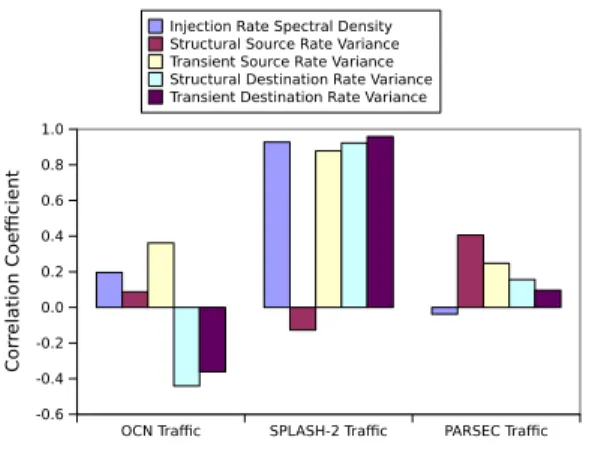
perfor-Figure 5. Correlation between workload char-acteristics and average packet congestion. mance. This section explores the relationship between the workload characteristics of each network’s bench-mark suite and the performance of the network. In particular the section examines the correlation between workload characteristic and network performance in terms of the packet congestion of that network. Packet congestion in this context is measured as the packet’s latency beyond the static, zero-load latency caused by hop distance and serialization delay.
In this section, packet latency is measured for each of the benchmarks via a trace driven network simula-tion configured to match the parameters of the orig-inal system from which the traces were captured. In each case the simulated network used YX-DOR rout-ing. The SPLASH-2 and PARSEC benchmarks used virtual channel flow control with four virtual channels each eight flits deep, emulating a heavy-weight CMP NOC. The TRIPS OCN used worm-hole flow control with two-flit-deep input FIFOs, to mimic the design of the actual TRIPS OCN.
The Pearson product-moment correlation coefficient is commonly used as a measure of the strength and di-rection of a linear relationship between two random variables. Correlation coefficients range from -1 to 1, where a correlation value of 1 indicates a positive-sloped, perfectly linear relationship between two vari-ables, while a correlation coefficient of -1 indicates a negative-sloped, linear relationship. Generally, corre-lation coefficients greater than 0 indicate that the two variables have some positive relationship, stronger as the correlation coefficient goes to 1.
Figure 5 shows the statistical correlation coefficient between the characteristics discussed in this section and packet congestion. Figure 5 indicates great diver-sity across the benchmark suites and networks.
In the figure, the TRIPS OCN trace results are mixed. While a significant positive correlation is shown
with packet congestion and injection rate spectral den-sity and transient source rate variance there is little correlation shown with structural source rate variance. These benchmarks show a significant negative correla-tion with both transient and structural destinacorrela-tion rate variance with packet congestion. The OCN traffic is predominately first-level to second-level cache system traffic. The second-level cache of the TRIPS proces-sor was partitioned such that applications with small second-level cache footprints can be cached entirely in the top half of the cache, close to the processor in use. Applications in need of more second-level cache are more evenly spread across both the top and bottom halves of the cache. This leads to the counter-intuitive result that applications which evenly spread traffic out across the full OCN are those which also have greater packet congestion because more of the traffic must cross the north-south bisection, a bottleneck due to OCN network’s skewed aspect ratio.
The SPLASH-2 traces and to a lesser extent the PARSEC traces show correlations between packet con-gestion and injection rate spectral density as well as transient source rate variance and both transient and structural destination rate variance. These results indi-cate network performance in these workloads depends upon the presence or absence of source and destination node hot-spots as well as program phases. Benchmarks that have diversity in their source or destination nodes injection rates or injection rate with time tend to have greater latencies than those which do not. In the mul-tiprocessor workloads, high source or destination rate variance is indicative of either multi-threaded load im-balances or hot memory in those benchmarks.
Generally, the correlation results between the new workload characteristics and congestion corroborate the influence that spatial and temporal imbalances in injection rate have upon the performance of NOCs. Interestingly, the characteristics which correlate best with performance vary greatly from network to net-work. The characteristics which most strongly corre-late with performance for a particular network’s traces are indicative of potential weaknesses of those networks under those loads. For example, the SPLASH-2 bench-marks appear to be sensitive to phase behavior in the injection process, while the performance of the PAR-SEC benchmarks are dominated by source node hot-spots. Results that point toward design improvements that could be made in each network to improve perfor-mance on these workloads.
6
Related Work
While much work exists in statistical modeling of realistic workloads and synthetic traffic generation in
the WAN/LAN literature [22, 23, 24], there are rela-tively few such works for NOCs. Varatkar and Mar-culescu examined the self-similarity of MPEG-2 video applications on a system-on-chip NOC and used this information to develop a simple model for the pairwise communication of this application [25]. Soteriou, Wang and Peh examined the self-similarity, packet hop count and injection rate variance of realistic workloads [26]. More recently Bahn and Bagherzadeh developed a traf-fic model based upon packet hop count, aggregate in-jection rate combined with the self-similarity of each node’s injection rate individually to capture the spa-tial distribution of packet injection separately from the temporal distribution [27]. Although somewhat or-thogonal to this work, also of interest are several recent efforts which have begun to improve benchmark suites and simulation environments for NOCs more gener-ally [28, 29, 30].
In contrast to prior work, the characteristics devel-oped here evaluate the temporal distribution of traf-fic in terms of the frequency domain impact caused by cyclic program phase behavior. Program phase be-havior is largely missed in self-similar traffic analysis because self-similarity metrics do not capture events that are cyclic in nature. Also unlike prior work, these characteristics are evaluated in terms of their correla-tion between traffic characteristics and their effect on packet latency.
7
Conclusions
Networks-on-chip (NOCs) are used in several con-texts, from replacements for buses in uniprocessors to cache coherence networks in chip multiprocessors. Each of these different NOCs must be designed to accommodate the traffic that traverses them, there-fore, understanding the characteristics of typical work-loads is of paramount importance in producing a well balanced network design. This paper examined the benchmark suite driven workloads from TRIPS OCN and multiprocessor NOCs with respect to the follow-ing key characteristics, (1) Injection rate spectral den-sity, (2) Transient source node injection rate variance, (3) Structural source node injection rate variance, (4) Transient destination node ejection rate variance and variance and (5) Structural destination node ejection rate variance and variance. These characteristics were shown to have a stronger correlation with network per-formance than traditional aggregate measures of traffic load.
We showed that, viewed through the workload char-acteristics examined, the synthetic benchmarks do not appear to model realistic benchmarks such as
the TRIPS and multiprocessor benchmarks very well. Based upon these observations one potential use for workload characteristic information is to inform the de-sign of the network under examination. For example, workload characteristics could be used to determine the networks that may need to be over-provisioned to avoid potential network congestion, and what form of over-provisioning would be most beneficial.
Interestingly, the characteristics which correlate best with performance vary greatly from network to network. The characteristics which most strongly correlate with performance for a particular network’s traces are indicative of potential weaknesses of those networks under those loads. For example, the SPLASH-2 benchmarks appear to be sensitive to phase behavior in the injection process, while the perfor-mance of the PARSEC benchmarks are dominated by source node hot-spots. Results that point toward de-sign improvements that could be made in each network to improve performance on these workloads.
Surprisingly, the characteristics developed in this paper are network independent workload characteris-tics. Network independent workload characteristics can be determined solely through an examination of a trace of network activity listing source, destination, packet size and injection time. This result implies that one can determine the potential network bottle-necks before the network topology and routing algo-rithm have been defined, simply through an off-line examination of sample workload traces, and use that information to assist in the selection of topology and routing algorithm.
8
Future Work
We are currently pursuing two avenues to extend the work presented here:
Heterogeneous Network Design The existence of structural, and to a lesser extent transient, injec-tion and ejecinjec-tion rate imbalances indicates the po-tential for workload characteristic driven hetero-geneous network design. For example the exis-tence structural destination node ejection rate im-balances which correlate with performance for a given network can be used to inform the need for increased bandwidth for the ejection ports of those nodes which see increased traffic. By provisioning the extra bandwidth only to those nodes which form performance bottlenecks in the system, im-proved performance can be achieved while mini-mizing impact on power and area consumption.
work, existing synthetic workloads are poor prox-ies for network performance under realistic work-loads. We are investigating the generation of syn-thetic network traffic based upon the characteris-tics developed here. This new synthetic workload would allow performance testing of networks at an early development stage, in simulation, with-out the requisite extremely long simulation times required by realistic workload traces.
References
[1] G. Moore, “Cramming more components onto integrated cicuits,”Electronics, pp. 114–117, April 1965.
[2] “World’s first quad-core processors for desktop and mainstream servers.” http://www.intel.com/quad-core/index.htm.
[3] T. Ainsworth and T. Pinkston, “On Characterizing Perfor-mance of the Cell Broadband Engine Element Interconnect Bus,” inThe 1st ACM/IEEE International Symposium on Networks-on-Chip (NOCS), pp. 18–29, 2007.
[4] S. Bell, B. Edwards, J. Amann, R. Conlin, K. Joyce, V. Le-ung, J. MacKay, M. Reif, L. Bao, J. Brown, M. Mattina, C.-C. Miao, C.-C. Ramey, D. Wentzlaff, W. Anderson, E. Berger, N. Fairbanks, D. Khan, F. Montenegro, J. Stickney, and J. Zook, “TILE64 - Processor: A 64-Core SoC with Mesh Interconnect,” in IEEE International Solid-State Circuits Conference (ISSCC), pp. 88–598, Feb. 2008.
[5] P. Gratz, C. Kim, R. McDonald, S. W. Keckler, and D. Burger, “Implementation and Evaluation of On-Chip Network Architectures,” inIEEE International Conference on Computer Design (ICCD), 2006.
[6] P. Gratz, K. Sankaralingam, H. Hanson, P. Shivakumar, R. McDonald, S. W. Keckler, and D. Burger, “Implemen-tation and Evaluation of a Dynamically Routed Processor Operand Network,” in The 1st ACM/IEEE International Symposium on Networks-on-Chip (NOCS), pp. 7–17, 2007. [7] W. Dally and B. Towles,Principles and Practices of Inter-connection Networks. Morgan Kaufmann Publishers Inc., first ed., 2004.
[8] J. L. Henning, “SPEC CPU2000: Measuring CPU Perfor-mance in the New Millennium,”IEEE Computer, vol. 33, no. 7, pp. 28–35, 2000.
[9] V. Soteriou, N. Eisley, and L.-S. Peh, “Software-Directed Power-Aware Interconnection Networks,” inThe 2005 In-ternational Conference on Compilers, Architectures and Synthesis for Embedded Systems (CASES), pp. 274–285, 2005.
[10] S. C. Woo, M. Ohara, E. Torrie, J. P. Singh, and A. Gupta, “The SPLASH-2 programs: characterization and method-ological considerations,” SIGARCH Compututer Architec-ture News, vol. 23, no. 2, pp. 24–36, 1995.
[11] A. Kumar, L.-S. Peh, P. Kundu, and N. K. Jha, “Express Virtual Channels: Towards the Ideal Interconnection Fab-ric,” in The 13th International Symposium on Computer Architecture (ISCA), pp. 150–161, 2007.
[12] K. Strauss, X. Shen, and J. Torrellas, “Flexible Snooping: Adaptive Forwarding and Filtering of Snoops in Embedded-Ring Multiprocessors,” inThe 33rd International Sympo-sium on Computer Architecture (ISCA), pp. 327–338, 2006. [13] N. Eisley, L.-S. Peh, and L. Shang, “In-Network Cache Co-herence,” in The 39th IEEE/ACM International Sympo-sium on Microarchitecture (MICRO), pp. 321–332, 2006.
[14] P. Gratz, B. Grot, and S. W. Keckler, “Regional Conges-tion Awareness for Load Balance in Networks-on-Chip,” in
The 14th International Symposium on High-Performance Computer Architecture (HPCA), pp. 203–215, 2008. [15] C. Bienia, S. Kumar, J. P. Singh, and K. Li, “The
PAR-SEC Benchmark Suite:Characterization and Architecutural Implications,” in Technical Report TR-911-08, Princeton University, January 2008.
[16] B. Grot, J. Hestness, O. Mutlu, and S. W. Keckler, “Express Cube Topologies for On-Chip Interconnects,” inThe 15th International Symposium on High-Performance Computer Architecture (HPCA), 2009.
[17] T. Mattson and M. Wrinn, “Parallel programming: can we PLEASE get it right this time?,” inThe 45th annual con-ference on Design automation (DAC), pp. 7–11, 2008. [18] A. J. KleinOsowski and D. J. Lilja, “MinneSPEC: A New
SPEC Benchmark Workload for Simulation-Based Com-puter Architecture Research,”Computer Architecture Let-ters, vol. 1, 2002.
[19] T. Sherwood, E. Perelman, and B. Calder, “Basic Block Distribution Analysis to Find Periodic Behavior and Simu-lation Points in Applications,” inThe International Sympo-sium on Parallel Architectures and Compilation Techniques (PACT), 2001.
[20] T. Sherwood, S. Sair, and B. Calder, “Phase Tracking and Prediction,” inThe 30th annual international symposium on Computer architecture (ISCA), pp. 336–349, 2003. [21] M. P. Norton and D. G. Karczub, Fundamentals of noise
and vibration analysis for engineers. Cambridge University Press, second ed., 2003.
[22] W. E. Leland, M. S. Taqqu, W. Willinger, and D. V. Wilson, “On the self-similar nature of Ethernet traffic (extended version),”IEEE/ACM Transactions on Networking, vol. 2, no. 1, pp. 1–15, 1994.
[23] C. L. Williamson, “Network Traffic Measurement and Mod-eling,” inThe 1995 ACM SIGMETRICS joint international conference on Measurement and modeling of computer sys-tems, pp. 56–57, 1995.
[24] V. J. Ribeiro, R. H. Riedi, M. S. Crouse, and R. G. Bara-niuk, “Simulation of nonGaussian Long-range-dependent Traffic using Wavelets,”SIGMETRICS Performance Eval-ulation Review, vol. 27, no. 1, pp. 1–12, 1999.
[25] G. Varatkar and R. Marculescu, “On-chip Traffic Model-ing and Synthesis for MPEG-2 Video Applications,”IEEE Transactions on VLSI Systems, vol. 12, pp. 108–119, Jan. 2004.
[26] V. Soteriou, H. Wang, and L.-S. Peh, “A Statistical Traffic Model for On-Chip Interconnection Networks,” inThe 14th IEEE International Symposium on Modeling, Analysis, and Simulation (MASCOTS), pp. 104–116, 2006.
[27] J. H. Bahn and N. Baherzadeh, “A Generic Traffic Model for On-Chip Interconnection Networks,” inThe First In-ternational Workshop on Network-on-Chip Architectures, 2009.
[28] C. Grecu, A. Ivanov, P. Pande, A. Jantsch, E. Salminen, U. Ogras, and R. Marculescu, “Towards Open Network-on-Chip Benchmarks,” inThe First International Symposium on Networks-on-Chip (NOCS), p. 205, 2007.
[29] S. Mandal, N. Gupta, A. Mandal, J. Malave, J. Lee, and R. Mahapatra, “NoCBench: a Benchmarking Platform for Network on Chip,” inWORKSHOP on UNIQUE CHIPS and SYSTEMS (UCAS), 2009.
[30] E. Salminen, C. Grecu, T. Hamalainen, and A. Ivanov, “Ap-plication Modelling and Hardware Description for Network-on-Chip Benchmarking,”IET Computers & Digital Tech-niques, vol. 3, no. 5, pp. 539–550, 2009.