Cahsai, Atoshum Samuel (2020) Scaling kNN queries using statistical
learning. PhD thesis.
http://theses.gla.ac.uk/81523/
Copyright and moral rights for this work are retained by the author
A copy can be downloaded for personal non-commercial research or study,
without prior permission or charge
This work cannot be reproduced or quoted extensively from without first
obtaining permission in writing from the author
The content must not be changed in any way or sold commercially in any
format or medium without the formal permission of the author
When referring to this work, full bibliographic details including the author,
title, awarding institution and date of the thesis must be given
Enlighten: Theses
https://theses.gla.ac.uk/ [email protected]
S
CALING
k
NN Q
UERIES
U
SING
S
TATISTICAL
L
EARNING
A
TOSHUM
S
AMUEL
C
AHSAI
SUBMITTED IN FULFILMENT OF THE REQUIREMENTS FOR THE DEGREE OF
Doctor of Philosophy
S
CHOOL OF
C
OMPUTING
S
CIENCE
C
OLLEGE OFS
CIENCE ANDE
NGINEERINGU
NIVERSITY OFG
LASGOW09 2018
c
Abstract
Thek-Nearest Neighbour (kNN) method is a fundamental building block for many sophis-ticated statistical learning models and has a wide application in different fields; for in-stance, in kNN regression, kNN classification, multi-dimensional items search, location-based services, spatial analytics, etc. However, nowadays with the unprecedented spread of data generated by computing and communicating devices has resulted in a plethora of low-dimensional large-scale datasets and their users’ community, the need for efficient and scalablekNN processing is pressing. To this end, several parallel and distributed approaches and methodologies for processing exactkNN in low-dimensional large-scale datasets have been proposed; for example Hadoop-MapReduce-basedkNN query processing approaches such as Spatial-Hadoop (SHadoop), and Spark-based approaches like Simba. This thesis contributes with a variety of methodologies for kNN query processing based on statistical and machine learning techniques over large-scale datasets.
This study investigates the exactkNN query performance behaviour of the well-known Big Data Systems, SHadoop and Simba, that proposes building multi-dimensional Global and Local Indexes over low dimensional large-scale datasets. The rationale behind such methods is that when executing exactkNN query, the Global and Local indexes access a small subset of a large-scale dataset stored in a distributed file system. The Global Index is used to prune out irrelevant subsets of the dataset; while the multiple distributed Local Indexes are used to prune out unnecessary data elements of a partition (subset).
The kNN execution algorithm of SHadoop and Simba involves loading data elements that reside in the relevant partitions from disks/network points to memory. This leads to signif-icantly high kNN query response times; so, such methods are not suitable for low-latency applications and services. An extensive literature review showed that not enough attention has been given to access relatively small-sized but relevant data usingkNN query only. Based on this limitation, departing from the traditionalkNN query processing methods, this thesis contributes two novel solutions: Coordinator With Index (COWI) and Coordinator with No Index(CONI) approaches. The essence of both approaches rests on adopting a coordinator-based distributed processing algorithm and a way to structure computation and index the stored datasets that ensures that only a very small number of pieces of data are retrieved from the underlying data centres, communicated over the network, and processed by the co-ordinator for everykNN query. The expected outcome is that scalability is ensured andkNN queries can be processed in just tens of milliseconds. Both approaches are implemented us-ing a NoSQL Database (HBase) achievus-ing up to three orders of magnitude of performance gain compared with state of the art methods -SHadoop and Simba.
It is common practice that the current state-of-the-art approaches for exactkNN query pro-cessing in low-dimensional space use Tree-based multi-dimensional Indexing methods to
prune out irrelevant data during query processing. However, as data sizes continue to in-crease, (nowadays it is not uncommon to reach several Petabytes), the storage cost of Tree-based Index methods becomes exceptionally high, especially when opted to partition a dataset into smaller chunks. In this context, this thesis contributes with a novel perspective on how to organise low-dimensional large-scale datasets based on data space transformations deriving a Space Transformation Organisation Structure (STOS). STOS facilitates kNN query pro-cessing as if underlying datasets were uniformly distributed in the space. Such an approach bears significant advantages: first, STOS enjoys a minute memory footprint that is many orders of magnitude smaller than Index-based approaches found in the literature. Second, the required memory for such meta-data information over large-scale datasets, unlike related work, increases very slowly with dataset size. Hence, STOS enjoys significantly higher scal-ability. Third, STOS is relatively efficient to compute, outperforming traditional multivariate Index building times, and comparable, if not better, query response times.
In the literature, the exactkNN query in a large-scale dataset was limited to low-dimensional space; this is because the query response time and memory space requirement of the Tree-based index methods increase with dimension. Unable to solve such exponential dependency on the dimension, researchers assume that no efficient solution exists and propose approx-imationkNN in high dimensional space. Unlike the approximatedkNN query that tries to retrieve approximated nearest neighbours from large-scale datasets, in this thesis a new type of kNN query referred to as estimated kNN query is proposed. The estimatedkNN query processing methodology attempts to estimate the nearest neighbours based on the marginal cumulative distribution of underlying data using statistical copulas. This thesis showcases the performance trade-off of exactkNN and the estimatekNN queries in terms of estimation error and scalability. In contrast, kNN regression predicts that a value of a target variable based onkNN; but, particularly in a high dimensional large-scale dataset, a query response time ofkNN regression, can be a significantly high due to the curse of dimensionality. In an effort to tackle this issue, a new probabilistickNN regression method is proposed. The pro-posed method statistically predicts the values of a target variable ofkNN without computing distance.
In different contexts, akNN as missing value algorithm in high dimensional space in Pytha, a distributed/parallel missing value imputation framework, is investigated. In Pythia, a dif-ferent way of indexing a high-dimensional large-scale dataset is proposed by the group (not the work of the author of this thesis); by using such indexing methods, scaling-out of kNN in high dimensional space was ensured. Pythia uses Adaptive Resonance Theory (ART) -a machine learning clustering algorithm- for building a data digest (aka signatures) of large-scale datasets distributed across several data machines. The major idea is that given an input vector, Pythia predicts the most relevant data centres to get involved in processing, for ex-ample,kNN. Pythia does not retrieve exactkNN. To this end, instead of accessing the entire
dataset that resides in a data-node, in this thesis, accessing only relevant clusters that reside in appropriate data-nodes is proposed. As we shall see later, such method has comparable accuracy to that of the original design of Pythia but has lower imputation time. Moreover, the imputation time does not significantly grow with a size of a dataset that resides in a data node or with the number of data nodes in Pythia. Furthermore, as Pythia depends utterly on the data digest built by ART to predict relevant data centres, in this thesis, the performance of Pythia is investigated by comparing different signatures constructed by a different clustering algorithms, the Self-Organising Maps.
In this thesis, the performance advantages of the proposed approaches via extensive exper-imentation with multi-dimensional real and synthetic datasets of different sizes and context are substantiated and quantified.
Acknowledgments
I would like to express my sincere appreciation and gratitude to many people who so gener-ously contributed to the work presented in this thesis. Special mention goes to my enthusi-astic supervisors, Peter Triantafillou and Christos Anagnostopoulos. Similar, profound grat-itude goes to Nikos Ntarmos. My PhD has been a wonderful experience, and I thank Peter, Christos and Nikos wholeheartedly, for their academic guidance and enthusiastic encourage-ment throughout the research. They stimulated and directed me in publishing conference and journal papers. During these projects, they were always there to provide necessary assistance and academic resources. Without their support, I could not have done what I was able to do. I have very fond memories of my time working with them.
I am also hugely appreciative to Vincent Macaulay, especially for sharing his professional knowledge so willingly.
Special mention goes to Fotis Savva and Wei Ma for their feedback and support.
Finally, but by no means least, lots of thanks go to my family, particularly to my little daugh-ter Christianne for their almost unbelievable support. However, my highest appreciation goes to my late wife Lili, who sacrificed dearly and through thick and thin stood by my side. Sadly, she did not live to celebrate the final submission of my thesis. She was the most important person in my world, and I dedicate this thesis to her loving memory.
Contents
Abstract Acknowledgments 1 Introduction 1 1.1 Thesis Rationale . . . 1 1.2 Thesis Statement . . . 7 1.3 Summary of Contributions . . . 81.3.1 Origins of the Materials . . . 10
1.3.2 Thesis Structure . . . 10
2 Background & Preliminaries 11 2.1 Multi-dimensional Data Indexing Methods . . . 11
2.1.1 Uniform decomposition . . . 11
2.1.2 Non-disjoint decomposition . . . 12
2.1.3 Disjoint decomposition . . . 12
2.1.4 kNN Query Processing . . . 12
2.2 Parallel & Distributed Big Data Systems . . . 13
3 Scaling exactkNN Queries: with & without in-Memory Index Tree 16 3.1 Introduction . . . 16
3.2 Contribution . . . 19
3.3 Related Work . . . 20
3.4 Definitions . . . 22
3.5.1 Cell Size Determination . . . 24
3.5.2 Candidate Cells Determination . . . 25
3.6 First Solution: Coordinator With In-Memory Index Tree . . . 27
3.6.1 Overview . . . 27
3.6.2 Quad-Tree Index Construction . . . 30
3.6.3 Loading Data in HBase . . . 32
3.6.4 kNN Query Processing in COWI . . . 32
3.7 Second Solution: Coordinator without In-Memory Index Tree . . . 34
3.7.1 Determination of the Value ofα . . . 36
3.7.2 Uniform Grid as Index to the Meta-Table . . . 37
3.7.3 kNN Query Processing in CONI . . . 37
3.8 Updates . . . 38 3.9 Updates . . . 38 3.10 Performance Evaluation . . . 40 3.10.1 Experimental Set-up . . . 40 3.10.2 Performance Assessment . . . 42 3.11 Conclusions . . . 48
4 ScalingkNN Queries via Probabilistic Data Space Transformations 49 4.1 Introduction . . . 49
4.2 Contribution . . . 52
4.3 Background & Related Work . . . 53
4.3.1 Related Work . . . 53
4.4 Data Space Transformation Organization . . . 56
4.4.1 Statistical Copulas . . . 58
4.4.2 Data Clustering Methodology . . . 60
4.4.3 Removing Statistical Correlation . . . 61
4.4.4 Transforming to Uniform Data Space . . . 62
4.4.5 Goodness of Fit . . . 64
4.5 Data Space Transformation Approach . . . 65
4.5.2 Distance in The Three Domain Spaces . . . 66
4.5.3 Data Preservation in the Corresponding Cells . . . 68
4.5.4 Computation of ExactkNN . . . 69
4.6 Data and Query Processing . . . 70
4.6.1 Creation of the STOS . . . 70
4.6.2 Query Processing . . . 72
4.7 Performance Evaluation . . . 73
4.7.1 Performance Assessment: STOS vs. Index Overheads . . . 74
4.7.2 Performance Assessment: Query Performance . . . 76
4.7.3 Performance Assessment: STOS in High Dimensions . . . 79
4.8 Conclusions . . . 79
5 EstimatedkNN and Probabilistic Self-OrganisingkNN Regression 82 5.1 Introduction . . . 82 5.2 Contribution . . . 84 5.3 Related Work . . . 85 5.4 Methodology . . . 86 5.4.1 EstimatedkNN . . . 86 5.4.2 ProbabilistickNN Regression . . . 89
5.4.3 Methodology of ProbabilistickNN Regression . . . 92
5.5 Experiments . . . 93
5.5.1 Experimental setup . . . 93
5.5.2 Datasets . . . 94
5.5.3 Accuracy Assessment: Estimated vs. ActualkNN . . . 94
5.5.4 Performance Assessment: Estimated vs. ActualkNN . . . 98
5.5.5 Prediction Assessment: ProbabilistickNN Regression Versus kNN Regression . . . 99
6 The Pythia Framework 105
6.1 Introduction . . . 105
6.2 Contribution . . . 109
6.3 Background and Related Work . . . 110
6.3.1 Missing Value Imputation Problem & Algorithms . . . 110
6.3.2 Other missing value imputation algorithms . . . 115
6.4 Definitions . . . 115
6.4.1 Notations . . . 115
6.4.2 Missing value algorithms in the Pythia framework . . . 116
6.5 The Pythia Framework Functionality . . . 116
6.5.1 Signatures . . . 117
6.5.2 Cohort prediction process . . . 122
6.5.3 On accessing only the relevant clusters . . . 124
6.5.4 The effect of distance metrics onkNN in high dimensional space . 125 6.6 Performance Evaluation . . . 125
6.6.1 Experimental Setup . . . 125
6.6.2 Performance Metrics . . . 126
6.6.3 Imputation Efficiency . . . 128
6.6.4 Imputation Accuracy . . . 129
6.6.5 When accessing only relevant clusters . . . 133
6.6.6 The effect of different distance metrics onkNN in high dimensional space . . . 135
6.7 Conclusions . . . 137
7 Conclusions 140 7.0.1 The need for accessing small part of a dataset . . . 140
7.0.2 Coordinator with and without in-Memory Index Tree . . . 141
7.0.3 STOS . . . 142
7.0.4 EstimatedkNN and ProbabilistickNN regression . . . 143
7.0.5 kNN as missing value imputation algorithm in high dimensional space145 7.1 Lessons Learned . . . 145
List of Tables
4.1 Pros and cons of mv data partitioning methods in parallel/distributed systems 55 4.2 p-values of bi-variate Independence copula tests . . . 65
List of Figures
1.1 Thesis structure . . . 10
3.1 Asβincreases,αdecreases exponentially. . . 28
3.2 Query response time (in milliseconds) vs. radiusρ. . . 29
3.3 Correlation radius (ρ) with (a) query response time and (b) number of ac-cessed data points. . . 30
3.4 Overview of the system forkNN query processing. . . 30
3.5 Three rows with different values ofαandk. . . 34
3.6 Conceptual nodes are connected by dotted lines. . . 36
3.7 Dataset: 600 Million data points (20GB) . . . 42
3.8 Dataset: 1 Billion data points (35GB) . . . 43
3.9 Dataset: 7.3 billion data points (250 GB) . . . 43
3.10 Dataset: 29.1 billion data points (1 TB). . . 44
3.11 Dataset: 100 billion data points (3.5 TB). . . 44
3.12 Dataset: Multi-modal distribution. . . 45
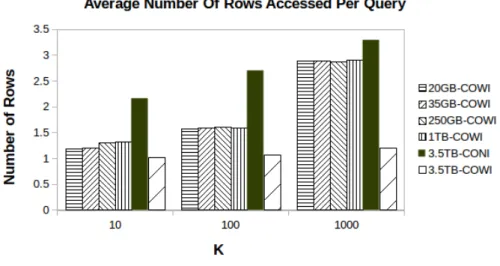
3.13 Average number of rows accessed per query. . . 46
3.14 Average number of rows accessed per query for multi-modal datasets. . . . 46
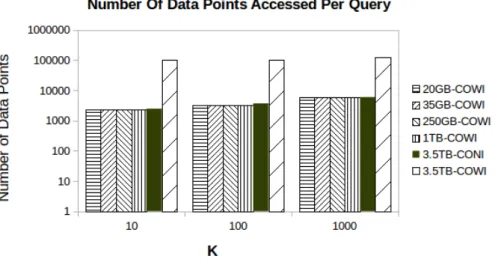
3.15 Average number of data points accessed per query. . . 47
3.16 Average number of data points accessed per query for multi-modal datasets. 47 3.17 Coordinator processing time. . . 48
3.18 Coordinator processing time for multi-modal datasets. . . 48
4.1 Data Transformation Overview . . . 57
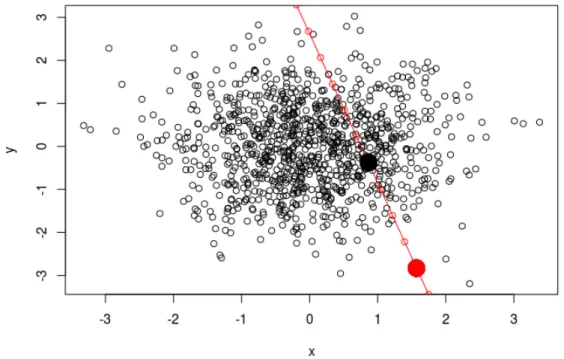
4.2 Original and Copula based Distributions . . . 59
4.4 The Uniform Space and CDF . . . 64
4.5 Data Domain Spaces . . . 66
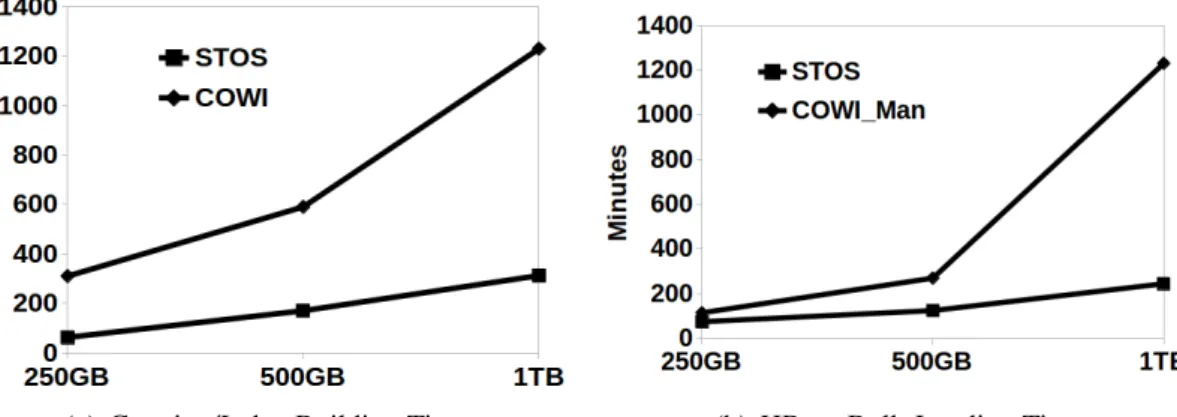
4.6 STOS vs COWI Creation/Index Building/Storing – AReM datasets . . . 75
4.7 STOS vs COWI Loading – AReM datasets . . . 75
4.8 STOS vs COWI Creation/Index Building/Storing – Istanbul datasets . . . . 76
4.9 STOS vs COWI Loading – Istanbul datasets . . . 76
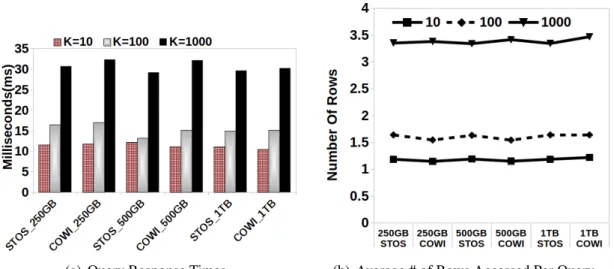
4.10 Query Processing Times and Accessed Data (Rows) – AReM datasets . . . 77
4.11 Query Processing Costs – AReM datasets . . . 77
4.12 Query Processing Costs: Query Processing Times and Accessed Data (Rows) – Istanbul datasets . . . 78
4.13 Average # of Data Points Accessed per Query – Istanbul Datasets . . . 78
4.14 STOS vs High-dimensional Data – Istanbul (9-d) and AReM (6-d) . . . 81
5.1 Original Space . . . 89
5.2 Independent Space Time . . . 90
5.3 Uniform Space . . . 91
5.4 RMSE of AReM 6-dimensional dataset – 250GB. . . 95
5.5 Average Distance between Actual and Estimated NN of AReM Six-Dimensional dataset – 250GB. . . 96
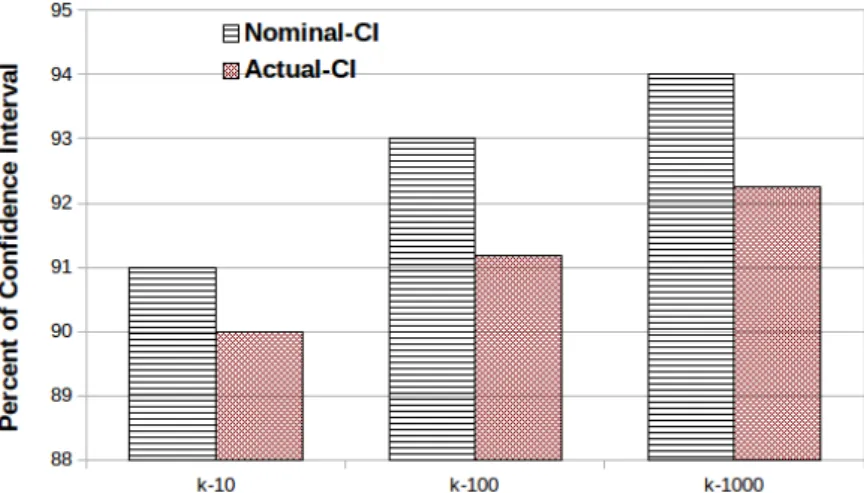
5.6 Nominal CI and coverage probability of the actual and estimated NN of AReM 6-dimensional dataset – 250GB. . . 97
5.7 Dataset AReM: Size 1 TB . . . 98
5.8 Dataset Istanbul: Size 1 TB . . . 99
5.9 Query Response Time . . . 100
5.10 RMSE Dataset CCPP . . . 100
5.11 MAE Dataset CCPP . . . 101
5.12 CV Dataset CCPP . . . 101
5.13 Abalon . . . 102
5.14 Air Quality . . . 103
6.2 Speedup vs. number of cohortsmfor ART and SOM signatures using EM. Dataset: Physical activity monitoring features . . . 129 6.3 Speedup vs. number of cohortsmfor ART and SOM signatures using KNN,
K = 10. Dataset: Physical activity monitoring features. . . 129 6.4 Speedup vs. number of cohortsmfor ART and SOM signatures using EM.
Dataset: Gas sensor array temperature modulation. . . 130 6.5 Speedup vs. number of cohortsmfor ART and SOM signatures using KNN,
K = 10. Dataset: Gas sensor array temperature modulation. . . 130 6.6 Latency in milliseconds vs. different number of cohorts based on EM. Dataset:
Physical activity monitoring features. . . 131 6.7 Latency in milliseconds vs. different number of cohorts based on KNN.
Dataset: Physical activity monitoring features. . . 131 6.8 Latency in milliseconds vs. different number of cohorts based on EM. Dataset:
Gas sensor array temperature modulation. . . 132 6.9 Latency in milliseconds vs. different number of cohorts based on KNN.
Dataset: Gas sensor array temperature modulation. . . 132 6.10 RMSE vs. number of cohortsmfor Pythia ART, Pythia SOM and Godzilla
using KNN. Dataset: Physical activity monitoring features . . . 133 6.11 RMSE vs. number of cohortsmfor Pythia ART, Pythia SOM and Godzilla
using EM. Dataset: Physical activity monitoring features. . . 133 6.12 RMSE vs. number of cohortsmfor Pythia ART, Pythia SOM and Godzilla
using KNN. Dataset: Gas sensor array temperature modulation. . . 134 6.13 RMSE vs. number of cohortsmfor Pythia ART, Pythia SOM and Godzilla
using EM. Dataset: Gas sensor array temperature modulation. . . 134 6.14 RMSE, accessing the best cohort vs the relevant clusters. Dataset: Physical
activity monitoring features. . . 135 6.15 Latency in milliseconds, accessing the best cohort vs. the relevant clusters.
Dataset: Physical activity monitoring features . . . 136 6.16 RMSE, accessing the best cohort vs the relevant clusters. Dataset: Gas
sen-sor array temperature modulation. . . 136 6.17 Latency in milliseconds, accessing the best cohort vs. the relevant clusters.
Dataset: Gas sensor array temperature modulation. . . 137 6.18 RMSE, Euclidean distance vs. Manhattan distance. Dataset: Physical
6.19 RMSE, Euclidean distance vs. Manhattan distance. Dataset: Gas sensor array temperature modulation. . . 138
1
Chapter 1
Introduction
1.1
Thesis Rationale
Thek-Nearest Neighbours (kNN) algorithm is alazy-learner and a non-parametric method. It is one of the most straightforward Machine Learning (ML) algorithms and yet has robust application across many research and application fields. kNN is used to search for the k
most similar elements to a given item within a finite collection. Often an item (element) is represented by a multi-dimensional vector, and hence similarity between vectors is defined by an appropriate distance metric, for instance, Euclidean distance, Manhattan distance, Ma-halanobis distance, cosine similarity, etc.
The kNN has been widely used in academy and industry. For example kNN has been at-tracted a vast research community such as [5, 35, 63, 44, 91, 7, 87]. In industry, kNN has been widely used for concept search (documents containing similar topics), e.g. in lawsuit companies; recommender systems (recommending advertisement to display to a user); in face recognition (Herta Security) 1 using Deep Learning generates features of vectors that represent people’s faces and adoptskNN for matching similar faces; in predicting economic events, e.g., predicting companies’ financial distress and many more.
Due its relatively easy and straightforward implementation, easy interpretation and good performance, the kNN method is considered- by some researchers- as one of the top-10 Data Mining algorithms [85]. WhenkNN is used for classification, despite its simplicity, it is surprisingly versatile and works incredibly well in many applications [85]; [28] showed that under certain assumptions, the error of thenearest neighbourrule is bounded above by twice the Bayes error. kNN is particularly well suited for multi-modal classes as well as applications in which an item can have many class labels; for the assignment of functions to genes based on expression profiles.
1.1. Thesis Rationale 2
Traditionally, thekNN algorithm was designed to run in a centralised computation system. To retrieve the top k-NN from a collection (dataset), the kNN algorithm scans the whole dataset sequentially. However, nowadays, as the unprecedented spread of data generated by computing and communicating devices has resulted in a plethora of large-scale datasets, sequentially scanning such massive dataset becomes infeasible as the kNN query response time might take hours, if not days.
In general, the ever increasing datasets impose a significant limitation on scalability- cop-ing and performcop-ing well under the expandcop-ing data- of the traditional off-the-shelf tools and Data Mining algorithms. To tackle this problem, a body of research has focused on parallel & distributed Big Data systems such as Hadoop/MapReduce [31] and Spark [92] . In dis-tributed & parallel systems, a large-scale dataset is stored in a disdis-tributed file system (DFS) in a cluster of commodity hardware. When akNN algorithm particularly runs in a vanilla Hadoop/MapReduce or Spark, it benefits from theintra-query parallelism, i.e. scalability of thekNN query significantly improves as a result of parallel execution of the query over many machines of the cluster. The more machines added to the cluster, the higher the scalability gain is achieved. Nonetheless, in spite of the intra-query parallelism, executingkNN queries using the vanilla Hadoop/MapReduce or Spark has two main drawbacks as the whole dataset is scanned even in parallel:
• it has high query response time;
• it wastes precious resources by being occupied all machines thatdo not contributing
to the final result.
For example, assume that all topk-NN data points to a query reside in one machine of the cluster. Then, during the query execution, accessing the entire dataset, including parts of the dataset that reside in the other machines that do not contain the answer, has nothing to con-tribute to the final result. It only wastes precious resources that would have otherwise been used for processing the next kNN queries in a queue, particularly in a streaming environ-ment where the queries are not batch-able. Consequently, the vanilla Hadoop/MapReduce and Spark do not support inter-query parallelism: cannot support execution of more than one
kNN queries at a given time, thus degrading the throughput of the decentralised and parallel system.
To this end, scaling-out exact kNN query processing, by indexing low-dimensional large-scale datasets that reside in a DFS, has recently attracted many researchers [5, 35, 7, 63, 45, 44, 87, 91]. During the index building process, a dataset is divided into several small-sized subsets (partitions); and hence, irrespective of the size of the whole dataset, at query time, only small but relevant data partitions are retrieved and processed. In the perspective of query scalability and performance, such a design has been proven superior compared with systems
1.1. Thesis Rationale 3
that access the entire dataset (even in parallel). But, in spite of the incredible advantages, even state-of-the-art approaches [35, 87] have a significant limitation as will be evidenced in the following sections of this thesis.
Before explaining how the state-of-the-art approaches work, it is crucial to clarify that the above-listed methods index only low-dimensional dataset in order to scale exactkNN queries, but not high-dimensional data. This is because tree-based multi-dimensional index ap-proaches (that will be defined later in detail) that are used in the literature for indexing multi-dimensional dataset are not suitable in high-dimensions. After all, the performance of such indexing methods significantly deteriorates with the dimension of a dataset. A linear increase in dimension has an exponential increase in query response time and memory space requirements; thus in high-dimensional spaces, tree-based multi-dimensional methods give no performance gain compared to that of linear search [47]. However, the recent explosion of mobile devices produces a plethora of low dimensional large-scale datasets; so many re-searchers show interest in efficiently processing exact kNN in large-scale low dimensional datasets.
Arguably, SHadoop [35] Hadoop MapReduce (MR) based approach is one of the most scal-able exact kNN approach. During the query execution process, SHadoop retrieves only relevant data partition from the DFS. At the indexing process, however, the lower size of a partition in SHadoop is determined by the minimum block size of Hadoop Distributed File System (HDFS), in which SHadoop operates. Consequently, in SHadoop, the minimum size of a partition is at least 128MB (default HDFS block size). Regrettably, though, by setting the minimum partition size to such large values has a negative impact on overall query pro-cessing time because in spite of onlyk data points are required to answer akNN query, at least 128MB -it could be millions of data points- are retrieved from HDFS and load to a memory.
On the other hand, according to the authors, Simba [87] is the best kNN query processing method that operates in the Spark system. Similar to SHadoop, during the query execution process, Simba accesses only relevant data partition to a query. However, Simba defines the lower size of a partition, β, as β = λ((1 − α)M/c), where λ is a system parameter (usually 0.8) capturing run-time memory overheads,cis the number of cores,M is the total memory reserved for Spark on each worker node, and α is the fraction of M reserved for RDD caching (RDD is a fundamental data structure of Spark). Thus, β is usually in the hundreds of MBs, if not GBs. As the design philosophy of Simba is not meant to optimise disk I/O, during query execution, Simba accesses too many data points, and hence such a design has a negative impact on overall query processing time.
Neither Simba nor can SHadoop set a size of a partition below the default lower size of HDFS block; this constraint is enforced by a design pattern of HDFS and will be discussed
1.1. Thesis Rationale 4
in chapter 3 in detail. At this point, it should be noted that the performance of both state of the art methods is adversely affected by the limitations of the platform in which they operate; thus, when running over HDFS, neither Hadoop MR nor Spark, is suitable for high performancekNN query processing.
Departing from the existing systems that link the size of a partition to the DFS block size, as part of the contribution of the thesis, a coordinator-basedkNN query processing method is proposed. The proposed method has two solutions: coordinator with index (COWI) and co-ordinator with no index (CONI). Both solutions differ from the existing approaches because the way the proposed methods organise, structure, and store a large-scale dataset is entirely different by design. The core foundation of the two solutions rests upon: (i) partitioning a dataset into the smallest possible data partitions that can optimise akNN query to be effi-cient, effective and scalable; and (ii) accessing the relevant data partition quickly. To this end, a large-scale dataset is divided into very small-sized chunks (cells) using a well-known multi-dimensional indexing approach, Quad-Tree (QT) [39]; and in both solutions, those cells are stored in No SQL key-value data store HBase table [41].
Dividing a large-scale dataset into small cells produces a very large-sized tree-like data struc-ture that supposed to be served as an index and to be stored in memory. When there is enough space in the coordinator to store the index in memory, the first approach COWI is employed forkNN query processing. But when the size of the index exceeds the available free mem-ory in the coordinator, there are two options: either (i) to increase the size of cells or (ii) to store part of the index in disk. However, as increasing the size of a cell has an adverse effect on query performance, the second approach, CONI, is proposed. CONI stores part of the index in HBase table so that a large-scale dataset can be divided into small cells without any restriction imposed by the amount of free available memory in the coordinator.
Intuitively, accessing an index stored in HBase is more expensive (w.r.t query response time) than that of stored in memory. Accordingly, if enough memory is available in coordinator, COWI has better query response time than CONI, as will be shown later. But, in general, the proposed approaches have achieved up to three orders of magnitude performance gain compared with SHadoop and Simba.
Considering the limitation of COWI, its performance depends on the available free memory in the coordinator, and the limitation of CONI, where access to the index stored in HBase is relatively expensive, it would be better to come up with a new approach that (i) has better or comparable performance comparing to COWI; (ii) does not require to keep space hun-gry index either in memory or disk; and (iii) is able to partition a large-scale dataset into small-sized cells. To this end, a novel approach, coined Space Transformation Organisation Structure (STOS), is proposed. Departing from the traditional way of indexing a dataset by employing tree-based multi-dimensional indexing methods, a design philosophy of STOS is
1.1. Thesis Rationale 5
grounded upon well-known statistical theories and principles.
STOS by employing statistical learning methods, such as Gaussian Mixture Models, Inde-pendence Statistical Copula, and Probability Integral Transformation, an unknown arbitrary distribution of a dataset is transformed to a standard joint uniform distribution. Afterwards, the simplest indexing method, i.e. uniform-grid [16], is used to index the dataset based on the transformed data. STOS has a minute memory footprint that does not grow with the ever-growing data. After all, uniform-grid index method only requires to store in memory a width/height of the equal-sized cells in order to retrieve relevant cells to a query. More-over, as uniform-grid works incredibly well with uniformly distributed data [73], STOS has the following advantages: (i) quick indexing time, (ii) better space utilisation, (iii) high ap-plicability in higher dimensions (in this context higher dimensions means less than 10-15 dimensions), (iv) minute memory footprint, and (v) better or comparable query response time compared to COWI and up to three order better performance compared to Simba and Shadoop.
In STOS, the dependency of memory space requirement on dimensions is successfully re-moved; however, query response time depends on dimension. Unable to solve the exponen-tial dependency of query response time on the dimension, researchers assume no efficient solution exists [60] and propose approximatedkNN in high dimensional space. But in this thesis, a new method, estimatedkNN, is proposed to tackle the dependency of query response time on dimension.
The same statistical parameters to that of STOS are used for space transformation in order to compute estimatedkNN. Unlike approximatedkNN, the proposed method, without access-ing a dataset, tries to estimate values of the actualkNN with high accuracy. Furthermore, the proposed method provides circles (or spheres) centred at eachkthestimated result; thus, the actual value of a correspondingkthNN is expected to be found within the circle with some degree of confidence. Similarly, a user can provide a radius (difference in distance between the estimated and actual results that the user willing to tolerate); hence, the proposed method can notify the user of the degree of confidence that the actual results can be located within the user-defined distance from the estimated results.
Similar to the estimatedkNN, probabilistickNN regression is proposed. A vanillakNN re-gression predicts the value of a target random variable (RV) by averaging values of a target RV ofkNN to a query. However, as stated earlier, in high dimensional data, time elapsed to retrievekNN increases with dimensions of the data. To this end, probabilistickNN regres-sion is proposed to predict a value of a target RV by averagingkplausible values of the target RV. Thek possible values are probabilistically determined using space transformation tech-nique. Hence the statistical parameters of STOS can be used directly applied in probabilistic
1.1. Thesis Rationale 6
In contrast, Pythia [8] is a parallel/distributed framework designed for Missing Values (MVs) Imputations. In Pythia, a dataset is distributed across several data nodes. Pythia imputes MVs on the basis ofkNN, i.e. kNN is used as a missing value imputation algorithm (MVA) in high dimensional space. The principal idea was that given an input vector with MVs, Pythiapredictsthe most appropriate (relevant) data centres to get involved in the processing of imputing MVs. As Pythia avoids engaging all machines while imputing MVs, only a relevant subset of the entire dataset is accessed. Therefore, in this thesis, the performance ofkNN in Pythia, in high dimensional data space, attracts interest. Considering that Pythia does not guarantee to retrieve exactkNN, but experimental results show that the estimation error of Pythia is comparable to that of exactkNN [8].
Each data node in Pythia uses Adaptive Resonance Theory [20](ART), a member of unsu-pervised machine learning algorithms, to quantise dataset that stores locally. The general process consists the following steps: (1) each data node clusters data, stored locally, us-ing ART and send the cluster heads as a data digest (aka signatures) to a central machine called Pythia. (2) By exploiting the signatures received from all data nodes, Pythia main-tains global knowledge regarding the distribution of a dataset across the data-nodes. When an input vector with MVs arrives at the system, using the signature, Pythia predicts the ap-propriate data-nodes that contains relevant data to the impute vector. Then, Pythia sends the input vector to the selected (appropriate) data-nodes only. Each of the selected data nodes independently execute an MVA - for example,kNN - and estimates values of the MVs; af-terwards, Pythia receives estimated values from the selected data nodes and computes the final estimated values by aggregating the estimates received from the data nodes. As Pythia accesses only relevant data partitions while imputing MVs, thekNN algorithm, in high di-mensional data space, scales exceptionally well in Pythia.
As Pythia utterly depends on signatures created by ART to identify relevant cohorts (which is very important for the accuracy of akNN based estimation), in this thesis, the performance of Pythia (w.r.t estimation accuracy and imputation time) is investigated by adopting sig-natures created by a different clustering algorithm: the Self-Organising Maps (SOM) [51]. Furthermore, the estimation accuracy of kNN in high dimensional space is compared to a more sophisticated MVA: the Expectation-Maximization (EM) [68]. Even though kNN gains slightly better accuracy than EM, in general, both MVA have comparable accuracy. In contrast, even when accessing only one data-node, Pythia accesses the whole dataset that resides in the data-node. As nowadays a typical disk size is hundredth of Gigabytes if not Terabytes, accessing such huge dataset, even in parallel, might take considerable time and resources particularly when processing large-scale datasets. To alleviate such a problem, more data nodes can be added to Pythia ; but keep adding data nodes with the ever-growing dataset is not economically viable. To this end, instead of accessing the entire dataset that resides in a data-node, a new method that accesses only relevant clusters that reside in
appro-1.2. Thesis Statement 7
priate data-nodes is proposed in this thesis. The proposed method has a better or comparable estimation error to that of original Pythia. Imputation time of the proposed method is consid-erable small than that of the original Pythia; moreover, the imputation does not significantly grow with a size of a dataset that resides in a data node or with the number of data nodes in Pythia.
Last but not least, in case of high dimensional data, previous study [17] noted that the relative contrast of the distance of an input vector iwith another vector c depends heavily on the adopted Lf distance metric where Lf = (
Pd
i=1(ii−ci)f)
1/f
; this provides considerable evidence that the meaningfulness of the Lf worsens faster with increasing dimensionality
for higher values off. To this end, in order to study how Pythia (kNN) can be affected by
Lf, two distance metrics, the Euclidean distance vs Manhattan distance, are compared.
1.2
Thesis Statement
The rationale of this study is thatkNN in very large-scale datasets can and should be com-puted swiftly. This can be achieved by avoiding irrelevant data access and retrieving only a small and relevant part of a dataset at query time. In order to ensure this, a low dimen-sional large-scale dataset must be partitioned (indexed) into small chunks or cells using multi-dimensional indexing methods. Furthermore, scarcity of memory can compromise the creation of small partitions as there might not be sufficient memory for storing a large index created by the ever-growing data; thus, using statistical methods, the dependency of an index size on memory can and should be removed. In the case where exactkNN cannot be computed efficiently as a query response time of the multi-dimensional indexing methods increase exponentially with a linear increase in the dimension (the curse of dimensionality), using statistical methods,kNN can be estimated swiftly and with high accuracy as we shall see later.
The main aim of this study consists of:
• studying the effect of accessing small but relevant data partition on the scalability and performance ofkNN queries over large-scale data;
• investigating the limitation on indexing, storing and processing of massive dataset of existing methods and identifying the reason why such methods do not access a tiny data partition when executingkNN queries;
• applying statistical learning methods and appropriate big data framework to overcome the limitation of the existing techniques to ensure high scalability and performance of
1.3. Summary of Contributions 8
In particular, by observing the importance of intra-query and inter-query parallelism, access-ing only small and relevant partitions increases the overall system throughput. By driftaccess-ing away from the existing related works that define the lower size of a partition based on the size of a DFS block, No-SQL datastore (HBase) is used for data storage. HBase allows access to a small data partition. Furthermore, a new indexing method that transforms an arbitrary distribution of a dataset into a joint uniform distribution is proposed. Unlike the traditional tree-based indexing approaches, the proposed method has a very tiny memory footprint and does not significantly grow with the size or dimension of a dataset. The new indexing method along with the HBase datastore allow for partitioning a large-scale dataset into small chunks (cells) and accessing a tiny subset of a massive dataset at query time. Finally, due to the fact that query response time ofkNN increases exponentially with dimension, methods that provide estimated results are proposed; the estimated values have high accuracy and can be computed in a few milliseconds irrespective of the number of dimensions of a dataset.
1.3
Summary of Contributions
One of the main issues with distributed/parallel systems is that executing a query usually involves scanning very large amounts of data that can lead to high response times; not enough attention has been devoted to addressing this issue in the context of low dimensional data [7]. The main contribution of the study lies in (i) the practical contribution of improving scalability and performance ofkNN query running over parallel/distributed systems, and (ii) the theoretical contribution of showing how statistical learning methods can be adapted to scalekNN query in such setting. In more details, the contributions are:
C1 In state-of-the-art methods, the adverse effect on query performance of accessing a relatively large amount of data is theoretically discussed and practically demonstrated by running extensive experiments.
C2 The design philosophy that underpinskNN query processing over very large datasets is revised; thus, a new way of organising, structuring and indexing multi-dimensional data is proposed. The proposed method, coordinate-based approach, accesses only very small subsets of the datasets; consequently it achieves up to three orders of mag-nitude lower query processing times than that of state of the art systems.
C3 Especially when opting to access a small subset of a very large-scale dataset, the limi-tation of traditional tree-based multi-dimensional data indexing approaches is studied comprehensively. Since an index storage space increases with the ever-growing data, the idea of storing and managing part of the index in a No-SQL data store is proposed.
1.3. Summary of Contributions 9
C4 Away from the traditional tree-based multi-dimensional data partitioning methods, a new way of indexing large-scale dataset is proposed on the basis of statistical learning methods. The proposed method ensures: several orders of magnitude lower index-storage space, index-storage space does not significantly grow with the dataset size and does not grow exponentially with a linear increase in dimension, several orders of magni-tude better index building time, easy and fast to recover, and access to a tiny subset of a large-scale data during execution time.
C5 The query response time of all the state-of-the-art approaches, including methods posed in this thesis, increase with dimension. To this end, a new approach for pro-cessing kNN is proposed. The proposed method estimates kNN data points. The estimated kNN are located within a short distance from actual kNN data points and orders of magnitude lower query response time than exactkNN methods, especially in high dimensional data.
C6 As akNN regression predicts a value of a target RV by averaging values of target RV of kNN to a query, a new probabilistic kNN regression is proposed. The proposed approach has high prediction accuracy and low query response time.
C7 The estimatedkNN and probabilistickNN regression can be used either as stand-alone solutions or in conjunction with an exactkNN processing method, which is proposed in this thesis. Hence, a user can enjoy the flexibility of choosing either estimated results with high accuracy in a short time or exact results with relatively longer time. This can be done without any extra overhead cost of learning additional statistical parameters, that means, only parameters that are needed for computing exactkNN are required for estimatingkNN.
C8 kNN as MVA in high dimensional space in Pythia, the framework of missing value imputation, is studied thoroughly. Different space quantisation (some sort of index-ing) methods are compared: accuracy of kNN when data is partitioned by the self-organising maps (SOM) is compared to the accuracy ofkNN when data is partitioned by adaptive resonance theory (ART). The scalability and performance ofkNN under the two space quantisation techniques have no significant difference. Furthermore, the accuracy ofkNN as MVA in high dimensional space is studied by comparing to a more sophisticated MVA, the expectation maximisation (EM). As the cost of accessing an entire dataset that resides in a data node of Pythia can be considerably expensive, even in parallel, a new method is proposed. The proposed method, instead of accessing entire data that reside in relevant data nodes, it accesses only few and relevant clusters; this ensures that the scalability of thekNN is achieved without adding data nodes to Pythia.
1.3. Summary of Contributions 10
C9 Last but not least, the effect of distance metrics in the high dimensional space ofkNN as MVA is studied in Pythia by comparing the accuracy of kNN algorithms on the basis of the Euclidean vs Mahnabolis distance metrics.
1.3.1
Origins of the Materials
The corresponding publications in peered-review journals and international conferences de-rived and published from this research are listed below:
• Cahsai, A., Anagnostopoulos, C. , Ntarmos, N. and Triantafillou, P. (2017) Scaling k-Nearest Neighbors Queries (The Right Way). In: 2017 IEEE 37th International Con-ference on Distributed Computing Systems (ICDCS), Atlanta, GA, USA, 5-8 June 2017, pp. 1419-1430.
• Cahsai, A. Anagnostopoulos, C., Ntarmos, N., and Triantafillou, P. (2018), Revis-iting Exact kNN Query Processing with Probabilistic Data Space Transformations, IEEE International Conference on Big Data [submitted Aug 2018]. The paper was awarded Best Student Paper.
• A. S. Cahsai, C. Anagnostopoulos (2018)Scaling-outkNN Regression via Probabilis-tic and EstimatedkNN Query Processing, 2020-21 IEEE International Conference on Big Data (IEEE BigData 2020-21] )[will be submitted Oct 2020-21]
• Cahsai, A., Anagnostopoulos, C. and Triantafillou, P. (2015) Scalable data quality for big data: the Pythia framework for handling missing values. Big Data, 3(3), pp. 159–172.
1.3.2
Thesis Structure
The proposed methods are further discussed in the coming chapters as shown in fig. 1.1.
11
Chapter 2
Background & Preliminaries
2.1
Multi-dimensional Data Indexing Methods
Indexes are used for locating relevant data in a given query without accessing a whole dataset that might have sheer volume. Traditional data indexing methods that have been used for indexing one-dimensional data are obviously not suitable for indexing multidimensional data (m-d for multidimensional), giving rise to several m-d indexing solutions [15, 16, 39, 43, 71, 61].
Those m-d indexing methods can be categorised into four major groups based on how they partition a data space [73]: (1) Uniform decomposition, (2) Non-disjoint decomposition, and (3) Disjoint decomposition.
2.1.1
Uniform decomposition
This [16] method decomposes the data domain space intoequal-sizedpartitions (aka cells). Uniform decomposition, also called Uniform grid, divides the domain space intoQd
i=1(n/α)
1/d
i =
(n/α)non-overlapping cells wheredis the number of dimensions,αandnare the average
number of data points stored per cell and the total number of data points in the dataset, respectively.
Uniform grid performs exceptionally well when the distribution of the underlying dataset is
uniform. But when the distribution of the dataset isnon-uniform, some cells might be empty while others will contain a significantly large number of data points. Uniform decomposition has poor load balance across the cells, and hence has inefficient query performance.
2.1. Multi-dimensional Data Indexing Methods 12
2.1.2
Non-disjoint decomposition
Non-disjoint decomposition methods decompose the domain space into overlapping hyper-rectangles; such methods partition data points based on their clustering relationship and in-dex the partitions hierarchically [73]. Arguably, the most popular non-disjoint decomposition method is R-tree [43].
In R-tree, data points that are located close to each other are represented by a minimum bounding (hyper-) rectangle (coined MBR), that is, the smallest hyper-rectangle that encloses the data points. R-tree is a multidimensional version of theB+tree; thus R-tree is a balanced
tree. Query response time in R-tree might be significantly high due to a high number of overlapping MBRs. Especially, when the distribution of the underlying dataset is skewed, more MBRs overlap and hence query performances is adversely affected. The main cause for increasing the number of overlapping MBRs is that MBRs created from the early-inserted data might not efficiently represent the current data; hence several splitting and re-insertion methods were proposed to address the problem.
TheR∗ tree [14] improves the insertion mechanisms of R-tree and reduces the overlapping MBRs. It introduces forced reinsertion to redistributed data points more evenly. R∗ tree has better query performance than R-tree because it has fewer overlapping MBRs.
2.1.3
Disjoint decomposition
Disjoint decomposition, such as Quad tree[39] and K-d tree[15], divide the domain space into non-overlapping disjoint cells. For example, one of the most commonly used space-driven method is Quad tree. At each split, Quad tree divides a dimension of the domain space into two parts; thus, 2d disjoint cells are created, where d is the number of dimensions. There
are two variants of Quad tree: trie-tree and point-tree. Trie-tree partitions each dimension at mid-point so that the resulting cells have equal size; whereas point-tree divides a dimension of the domain space into two parts, each of which contains equal number of data elements.
2.1.4
k
NN Query Processing
A naive approach for searching the exact k closest d-dimensional data points with respect to a given query q over a dataset of sizen = |D| requiresO(nd) time. This also implies
O(ndK) time for retrieving the k nearest data points. Nonetheless, one could build a d -dimensional tree over the points ofDto allow to perform efficiently exactkNN search. Such structure isgoodfor searches inlow-dimensional spaces. However, its efficiency decreases as dimensionality grows, and in high-dimensional spaces this structure gives no performance
2.2. Parallel & Distributed Big Data Systems 13
over naive O(ndK) linear search [47]. Thus, it is worth to note that the tree-based m-d indexing approaches are suitable in low -dimensional space.
Bearing in mind that, most tree-based indexing methods have two steps to compute the exact
kNN answer: (Step 1) Computing an initial solution, and (Step 2) Verifying correctness of the said solution. In Step 1, the closest cell (leaf node) to the query point is identified by traversing the index tree. Subsequently, thek-nearest neighbours that reside in that cell are determined. In Step 2, a circle with a specific radius centred at the query point is considered. Any cell that overlaps with the circle is checked to determine if it contains some points, whose distance to the query point is less than any distance of a point that belongs to the initialkNN answer set from Step 1. If such a point exists in any of the candidate cells, then it is inserted into thekNN set and the furthest point is removed.
Many researchers have extensively studied how to compute the optimal radius size. For example [69], also adopted by [7], estimated a radius size through the distance between the query point and the furthest corner of the cell which encompass the query point. This is achieved without accessing the dataset but only utilising the information stored in the index. However, this estimated radius size might be quite larger than it should be, and thus a high number of candidate cells may be accessed at query time. A variant to this approach is discussed in [35], where the radius size is estimated by the distance between the query point and thek-th nearest point that lies within the cell that contains the query point. In this case, the dataset must be accessed to compute the radius size. The radius size could be smaller compared to [69] but several data accesses would be required to compute thekNN list.
2.2
Parallel & Distributed Big Data Systems
Hadoop MapReduce: An Overview
Apache Hadoop MapReduce(MR) [31] is a framework for processing large-scale datasets in parallel over several commodity hardware. In MR, a job is a top-level unit of work and might consist of map and reduce phase - the reduce phase is optional.
During the map phase, an input data is partitioned into several partitions using the map task that runs in parallel in a cluster. The map phase emits a key-value paired data that is used as an input to a reducer phase.
The reduce phase processes the key-value (input data to the reduce phase) in parallel and computes the final results. The final results are then stored in a Hadoop distributed file system (HDFS).
2.2. Parallel & Distributed Big Data Systems 14
HBase: An Overview
Large-scale data can hardly be stored in a centralised server. Even large-scale distributed relational databases are viewed as non-scalable. Thus, typically modern distributed database systems, such as NoSQL databases or DFSs (such as HDFS) are being used. Arguably, HBase [41] is one of the most popular NoSQL databases, offering an implementation of the BigTable[23] model. HBase is highly available and scalable, open source, provides a simple key-value API, and is designed to store large datasets. In this study, HBase has been chosen as the basic data store because it does not need to retrieve the entire DFS block into memory during query execution [79]. A table in HBase is divided horizontally (i.e., at rowkey boundaries) into regions, each of which, in turn, has several HFiles. Additionally, each HFile contains a simple index of the row-keys it contains, and HBase keeps track of which storage nodes and region-servers are responsible for every region. These features enable HBase to support efficient random data access.
Spark: An Overview
Spark [92] is another cluster-based batch-oriented big data-parallel processing platform. The main advantage of Spark is the ability to run computations in memory. Spark defines resilient distributed datasets (RDD) representing a collection of items distributed across many nodes that can be manipulated in parallel. Spark has several extensions that provide different fea-tures: Spark SQL [10] for working with structured data, Spark Streaming [93] for processing of live streams of data, MLlib [59] with machine learning algorithms, and GraphX [88] for manipulating graphs.
Data partitioning Methods in Parallel Distributed Systems
All the state-of-the-art parallel/distributed methods process large-scale data in parallel across a cluster and can effectively solve several complex queries. However, when processing some kinds of queries, such askNN, accessing the whole dataset in parallel to retrieve onlykdata points wastes time and precious resources. Hence, to avoid accessing the entire dataset dur-ing query processdur-ing, m-d index methods are built over a dataset stored in a DFS (distributed file system).
However as most of the m-d index approaches were originally designed to run in a centralised system, to adapt them in the parallel/distributed approaches, several data partitioning meth-ods have been proposed in the literature. The most popular data partitioning methmeth-ods are summarised below as discussed in [73].
2.2. Parallel & Distributed Big Data Systems 15
Uniform Data partitioning: Uniform data partitioning method partitions an input data into non-overlapping equal sized hyper-rectangles (cells) where the user decides the number and size of the cells. The index building time of uniform data partitioning methods is minimal due to the simple process and computations involved [73]. However, uniform data partition-ing, when indexing non-uniformly distributed data, has bad load balancing as some nodes complete their task early and sit idle, waiting for other heavily loaded nodes to finish their work.
cluster-based data partitioning: Arguably, the most popular cluster-based data partitioning method is [21]. This method adopts tries to identify the number of clusters in a dataset using the k-means iterative clustering algorithm and Bayesian-Information Criteria (BIC). Afterwards, the dataset is clusted using the Gaussian Mixture Models. However, unlike the methods proposed in this study that scans a whole dataset only once to partition the data, [21] do multiple scans over the whole dataset using several MapReduce jobs to iteratively cluster the dataset. As the processing cost of such multiple iterations is extremely high, indexing time of this method is high compared to the other indexing methods.
Random-Sampling based data partitioning: Random-Sampling based data partitioning methods initially build an in-memory R-tree based on a small data sample drawn uniformly at random from the input data. Most of the time the default size of the sample is 1% of the input data with a maximum capacity of 100MB to ensure it fits in memory. Afterwards, the sample data bulk-loaded to the in-memory R-tree using a Sort-Tile-Recursive (STR) packaging method [54]. Finally, the whole dataset is partitioned based on the boundaries of the leaf-nodes of the in-memory R-tree. However, according to a recent survey [73], such data partitioning methods work fine for uniformly distributed data, but not for non-uniformly distributed data; furthermore, the same observations were noted when running some experiments in this thesis, as we shall see later.
Quad-tree based data partitioning: Partitioning a dataset in parallel/distributed approaches using QT starts by creating in-memory QT, whose maximum capacity per node is equal to
s/pwhere sis the sample size, andpis a total number of partitions in which a large-scale data has to be divided. Afterwards, the large dataset is partitioned based on the in-memory QT. If any of the resulting leaf nodes of the QT contains more than a user-defined threshold, then the leaf node has to keep splitting until all the resulting leaf-nodes capture the most user-defined threshold. Due to the non-overlapping nature of the QT cells, this method works well even with non-uniformly distributed data.
According to [73], the QT provides better data proximity, efficiency for search queries, and low network transfer overhead as compared to other data partitioning methods. However, QT requires high index storage space, index building time, and has poor applicability in high dimensions ( up to 10-15 dimensions).
16
Chapter 3
Scaling exact
k
NN Queries: with &
without in-Memory Index Tree
3.1
Introduction
Nowadays, modern devices such as smartphones, space telescopes, medical devices, and moving objects are generating a plethora of low-dimensional data; the data of interest either have low dimensionality or can be indexed using few dimensions. For example, 2-3 dimen-sional X-ray images are produced by medical devices at the rate of 50 PB per year [1]; daily around 10 million geotagged tweets are generated on Twitter [2]; and the NASA archive of satellite earth images is more than 500 TB in size and increases daily by 25 GB [62]. An efficient processing of the ever-growing data provides timely and valuable knowledge across different scientific disciplines; for example, epidemiologists use spatial analysis techniques to identify cancer clusters, track infectious diseases, and determine drug addiction, while me-teorologists simulate climate data through spatial analyses, and news reporters detect events on the basis of geotagged tweets.
Unfortunately, the traditional off-the-shelf data processing tools, which are typically de-signed to process much smaller datasets stored in a centralised system, are unable to handle the fast-growing data. To fill this gap, several parallel/distributed data-processing frame-works have been proposed forbig dataanalytics.
Arguably, the two most popular frameworks for big data analytics are Hadoop-MapReduce (MR) [31] and Apache Spark [92]. MR and Spark use a cluster of commodity hardware for the parallel processing of big data analytics. Unfortunately, such frameworks are not a panacea for all ad hoc big data query processing, yet many researchers continue to propose MR- and Spark-based solutions even when they are flawed. For example, assume that one executes aknearest neighbour (kNN) query over large-scale data by using either vanilla MR
3.1. Introduction 17
or Spark SQL [10]. As the value ofkis small (most of the time) and such frameworks access the entire dataset in parallel to retrieve onlyk data elements, accessing a massive part of a large-scale dataset that makes no contribution to the final answer to thekNN query wastes time and resources. Thus, recently, many researchers have become interested in finding an efficient method for processing the exactkNN queries over low-dimensional large-scale datasets.
Arguably, MR-based SHadoop [35] and the Spark-based Simba[87] are among the recent most popular contenders for processingkNN over low-dimensional large-scale datasets. The core design philosophy of both of these approaches are as follows:
• divide a dataset into several partitions (subsets), each of which contains data elements that are located relatively close to each other in the Euclidean space;
• build a global multi-dimensional index over all the partitions to prune out irrelevant partitions at the query time; and
• build a local multi-dimensional index within each partition to avoid a linear scan of data elements that reside in a selected partition when processing a query.
As both the approaches prune out irrelevant partitions and avoid a linear scan of the data elements that reside in a relevant partition, they have a lower query processing cost than vanilla MR or Spark SQL.
However, a lower size of a partition in SHadoop and Simba is dictated by the settings in which a particular method operates. For example, as SHadoop operates within the Hadoop system, the minimum size of a partition is set to the block size of the Hadoop distributed file system (HDFS). The default size of the HDFS block is 128 MB. Similarly, a lower size of a partition, denoted byβ, in Simba is computed as follows: β =λ((1−α)M/c), where
λ is a system parameter (usually 0.8) that captures run-time memory overheads, c is the number of cores,M is the total memory reserved for Spark on each worker node, and αis the fraction ofMreserved for RDD caching. Thus,βis usually in the hundreds of megabytes if not gigabytes. Regrettably, limiting a lower size of a partition to such a large value has an adverse impact on thekNN query processing, as illustrated in the following example.
Motivating Example
Consider that a kNN query is executed over a dataset of spatial points stored in HDFS. A point is represented in a 2-d space by a pair of numbers: a number on thex-coordinate and a number on they-coordinate. Here, the size of a point is 16 bytes as each coordinate has a double-precision floating point number, thus needing2×8 = 16bytes in total. During the
3.1. Introduction 18
kNN query execution, whenk = 10(resp.k = 100ork = 1000), the optimal would be that only 160 (resp. 1600 or 16000) bytes of data is to be retrieved as a final answer to the query. Unfortunately, at least one partition (128 MB), containing≈ 8.4×10⁶ points must be read
from disk. This demonstrates that having such large partitions is highly inefficient because of the following: (i) despite the fact that most of the time, the value ofkis small, a high volume of data is read from disk, transferred over the network, loaded into memory and processed; and (ii) data elements located relativelyfarfrom each other in the Euclidean space might be stored together as members of a partition; as the lower size of a partition increases, the chance of compacting non-neighbours data elements into one partition increases. Consequently, during query processing, it is inevitable for data elements that do not contribute to the final
kNN answer to be read from disk, transferred over the network, and loaded into the memory. The rationale of SHaddop and Simba to trade the performance for maintaining a large par-tition is guided by [5, 48, 95, 94]. These guidelines dictate that creating too many small files (one per a partition) can quickly overload the central node (aka NameNode) of a clus-ter. NameNode stores and manages the meta-data of all the partitions in HDFS; threfore, overloading the NameNode with the meta-data of too many small partitions compromises the overall health of a cluster. Accordingly, a lower size of a block in HDFS (in this case partition) should be at least 128MB.
Contrary to the existing systems, in this part of this thesis, acoordinator-based approachis proposed. The proposed method partitions large-scale data into several small chunks (here-inafter referred to as cells). The small size of thecells is typically designed to reduce ac-cessing data elements that do not contribute to the final answer to a kNN query; thus, the proposed method has a considerably lower overhead cost than SHadoop and Simba, as will be shown later in the chapter. The cells are stored in the HBase key-value data store table. HBase allows storing and accessing of cells without compromising the overall health of a cluster. A Quad-tree (QT) [39] is used to index a dataset, but it is worth to note that any multi-dimension index approach can be used instead. QT is an arbitrary choice.
In contrast, tree-based indexing methods are widely used,[35, 5, 87, 7], for partitioning low-dimensional data and building a multi-low-dimensional index over a dataset. Although tree-based indexes have often been referred to as multi-dimensional indexes in the literature, their per-formance significantly deteriorates with an increase in the dimensionality of the dataset. A linear increase in dimension results in an exponential increase in the query response time and the memory space requirements [47]. For example, for a dataset that has 10 to 20 dimen-sional data (depending on the total number of data elements) the entire dataset is accessed when a tree-based multi-dimensional index is used; the index can not avoid a linear scan of the dataset. For more details, refer to [47].
3.2. Contribution 19
that no efficient solution exists [60] and proposed approximatedkNN in a high-dimensional space. However, approximated kNN is not in the scope of this chapter. Thus, because of the exponential dependency of tree-based indexing approaches on the dimension, this part of the thesis, such as [5, 35, 63, 44, 91, 7, 87], focuses only on processing the exact kNN over large-scale low-dimensional data. Note that to avoid confusion regarding the name, in this thesis, in alignment with the literature, tree-based index methods are referred to as multi-dimensional or multivariate indexing approaches; however, please bear in mind that such methods are appropriate in a low-dimensional space only.
3.2
Contribution
The contributions of the proposed method are as follows:
• Revisit the design philosophy that underpins the exactkNN query processing over very large datasets, going against the grain and the state-of-the-art methods.
• Offer a different method to index and organise the dataset that enables accesses to only very small subsets of the dataset.
• Offer coordinator-based query processing algorithms that exploit the above and which on the whole ensure the following:
– High performance – up to three orders of magnitude lower query processing times than the state-of-the-art methods.
– High scalability – ensuring that compute-storage-network resources are utilised efficiently, for datasets of various sizes, also ensuring high scalability.
• Offer a strategy to handle updates, in case the datasets grow/shrink dynamically.
• Offer an extensive performance evaluation of the proposed approach versus the state-of-the-art methods (Spatial Hadoop and Simba), which substantiates and quantifies the performance and scalability claims of the proposed approach.
This part of the research is published in the International Conference on Distributed Com-puting Systems:
• Cahsai, A., Anagnostopoulos, C., Ntarmos, N. and Triantafillou, P. (2017) Scaling k-Nearest Neighbors Queries (The Right Way). In: 2017 IEEE 37th International Con-ference on Distributed Computing Systems (ICDCS), Atlanta, GA, USA, 5-8 June 2017, pp. 1419-1430.
3.3. Related Work 20
3.3
Related Work
Different methods have proposed for efficiently processing kNN queries over large-scale datasets by using parallel/distributed systems. This section summarises the related works.
Hadoop/MR-Based Approaches
Hadoop GIS [5] is a scalable and high-performance spatial data warehousing system for running large-scale spatial queries in Hadoop. However, Hadoop GIS only supports two-dimensional data. The state-of-the-art SHadoop [35] divides a dataset into equal-sized par-titions: the minimum size of a partition is the same as the smallest recommended size of an HDFS block. SHadoop uses two indexes: a global index and a local index. During query processing, the global index is used to prune out the irrelevant data partitions, whereas the local index is exploited to avoid the linear scanning of data elements that reside in a rel-evant partition. In order to answer kNN queries, SHadoop might require two MR jobs to ensure the correctness of the final kNN answer. Interestingly, even though the academic papers that describe SHadoop do not discuss it, the source code that the authors have made available includes a non-MR approach for computing kNN. This implies that they also re-alise the tension between a distributed operation and high performance: initialising an MR job has a high overhead cost. However, it should be clarified that SHadoop as a whole is a good step forward for scalable spatial queries, offering an overall system for many types of spatial queries and not just kNN queries. The point made in this work is that the SHadoop approach is lacking in terms of performance forkNN query processing and that the proposed approach reconciles the performance-scalability tension better. Nonetheless, to be fair, the performance of the proposed method will be compared to that of both variants of SHadoop (MR and non-MR). The proposed method does not discuss other types of spatial queries, such askNN joins and spatial joins.
AQWA[7] is another recent method for KNN query processing. AQWA splits the dataset into many partitions. Like SHadoop, AQWA sets the minimum size of a partition to a minimum block size of the underlying DFS. Unlike SHadoop, AQWA only has a global index and does not build a local index within partitions. Thus, a linear scan of all the data elements that reside in a relevant partition is required when computing KNN. Therefore, it has a significantly extra CPU time overhead as compared to SHadoop.
Approaches on HBase
Several HBase-based methods have been proposed for efficiently computing the exactkNN queries over large-scale low-dimensional datasets. The MD-HBase system [63] builds
in-3.3. Related Work 21
dexes over a dataset stored in HBase by using k-d trees and Quad-Trees (QTs) and uses Z-ordering to convert multi-dimensional keys into one-dimensional row-keys. Similarly, [45] proposed a novel key-formulation schema using an R+ tree over a dataset stored in HBase. The main focus of these works was on the design of efficient HBase row-keys, and they did not pay much attention to access the smallest relevant data elements as much as possible while processing thekNN queries.
HGrid [44] builds a multi-dimensional composite index over a dataset using QT and a regular grid and stores the indexed data in an HBase table. HGrid adopts QT to partition the domain space of a dataset into several sub-spaces. Each sub-space has a unique corresponding leaf-node in the QT. Each leaf-leaf-node (sub-space), in turn, is further divided into many cells by using a regular grid. At the end of the indexing process, each