CLINICAL SCENARIO
FOCUSSED CLINICAL QUESTION
Does the incorporation of personal digital assistant devices in rehabilitation improve task
performance in clients with memory impairment following traumatic brain injury compared with a standard rehabilitation program?
SUMMARY OF SEARCH
- A comprehensive electronic search resulted in fourteen studies - two systematic reviews (SRs), two randomised controlled trials (RCTs), seven case series/low quality case control studies and three qualitative studies.
- Two studies were selected for appraisal as having the most relevance to the research question. The first is an RCT (Wilson, Emslie, Quirk, Evans and Watson, 2005) evaluating paging systems for people with traumatic brain injuries. The other is a single case design (Stapleton, Adams & Atterton, 2007) evaluating the use of a mobile phone as a memory aid for an individual with TBI. - The SR’s and remaining RCT were not selected for review as they did not specifically address the clinical question.
- The selected RCT found that pagers assist clients with TBI to carry out daily tasks more
efficiently than without the pagers. The single case design found that reminder cues from the phone were of more benefit to those with less cognitive deficits and higher level of independence.
- Overall, there is a lack of high quality studies thus far, to support the use of PDA’s to improve task performance in clients with memory impairment following TBI.
There is insufficient evidence to support that personal digital assistant devices improve task performance in clients with memory impairment following a traumatic brain injury Prepared by: Emma Tan ([email protected])
Tran Vu ([email protected])
Date: 22 May 2012 Review Date: 22 May 2014
Traumatic Brain Injuries (TBI) are insults to the brain caused by external physical forces (Radomski, 2008). This insult may produce a diminished or altered state of consciousness and resultant impairment of cognitive, behavioural, emotional or physical functioning (Centre for Disease Control and Prevention, 2011). Of special interest is memory loss, reported by persons with TBI and/ or their family members to be one of the most challenging residual problems resulting from TBI (Depompei et al., 2008). Memory impairment is a primary factor in the failure to return to work, a predictor of unsuccessful rehabilitation and vocational training and has a detrimental impact on quality of life (Dowds et al., 2011). Memory impairments can also interfere with performance of activities of daily living (ADLs) (Sohlberg, & Mateer, 2001).
It has become increasingly accepted that external memory aids are among the most effective rehabilitation tools available to compensate for prospective memory impairment following TBI (Sohlberg, Kennedy, Avery, Coelho, Turkstra & Ylsvisaker, 2007). In recent years, the use of personal digital assistants (PDAs), handheld computer devices, pager systems and mobile/smart phones have proved generally positive and helpful to prompt performance of occupational tasks (Hart, Buchhofer, & Vaccaro, 2004). This CAT includes handheld computer devices, pager systems and mobile/smart phones in the definition of PDA technology. To date, there is very little evidence to support the efficacy of these devices and for this reason it is proposed that investigating the effectiveness of PDA’s to improve task performance in clients with memory impairment following a TBI is of clinical importance.
CLINICAL BOTTOM LINE
There is insufficient high level evidence that PDAs improve task performance in clients with memory impairment following TBI.
Important note on the limitation of this CAT
This critically appraised topic has been peer-reviewed by one other student and lecturer as part of a university assessment.
SEARCH STRATEGY
• The following databases were searched—Medline, CINAHL, Web of Science, OTseeker, Cochrane library, AMED, Scopus, PsychINFO, PsycBITE.
• Reviews of the reference lists of each of the articles were also carried out to identify other studies that met the inclusion.
• Search terms and inclusion / exclusion criteria are summarised in Table 1. Terms used to guide the search strategy
• Patient/Client Group: Traumatic brain injury and memory impairment
• Intervention: Use of personal digital assistants (PDA’s) or hand held computers or mobile phones or pagers
• Comparison: No intervention or usual care • Outcome(s): Improved task performance
Table 1: Summary of Database Searches Databases and
Sites Searched
Search Terms Limits
Used Cinahl Medline Web of Science Scopus AMED PsychINFO PsychBite OT Seeker Cochrane Databases
- Brain Injury, traumatic brain injury, TBI - Rehabilitation
- Memory, short term memory, long term memory - Computers, hand-held
- Hand held computer
- Personal digital assistant, PDA - Wireless communications - Mobile phone, cellular phone - Pager
Years
2000-2012
INCLUSION and EXCLUSION CRITERIA Inclusion Criteria
- All articles detailing studies related to the use of PDAs/hand held computers/mobile phones/ pagers in memory rehabilitation and improved task performance for clients with TBI. - Studies published from 2000 – 2012
Exclusion Criteria Studies that:
- focussed on Acquired Brain Injury rather than Traumatic Brain Injury
- used technology that did not meet the definition of ‘Personal Digital Assistant’ outlined previously
- focussed on PDA programs rather than PDA effectiveness
RESULTS OF SEARCH
A total of 14 relevant studies were located and categorised as shown in Table 1 (based on Levels of Evidence, Centre for Evidence Based Medicine, 2011)
Table 2: Summary of Study Designs of Articles Retrieved Study Design of
Articles Retrieved
Level Number Located
Author (Year)
Systematic reviews 1 2 • De Joode, van Heugten, Verhey & van Boxtel (2010)
• Gillespie, Best & O’Neill (2012) Randomised
controlled trials 2 2 •• Wilson, Emslie, Quick & Evans (2001) Wilson, Emslie, Quirk, Evans & Watson (2005) Case-series studies /
poor quality case control studies
4 7 • Culley & Evans (2010)
• DePompei, Gillette, Goetz, Xenopoulos-Oddson, Bryen & Dowds (2008)
• Dowds et al. (2011)
• Gentry, Wallace, Kvarfordt & Lynch (2008) • Kirsch, Shenton & Rowan (2004)
• Kirsch et al. (2004)
• Stapleton, Adams & Atterton (2007) Qualitative study N/A 3 • Gillette & DePompei (2004)
• Hart, O'Neil-Pirozzi & Morita,(2003) • Hart, Buchhofer & Vaccaro (2004) • Lynch (2002)
BEST EVIDENCE
The following studies were identified as the ‘best’ evidence and selected for critical appraisal. - Stapleton, S., Adams, M., & Atterton, L. (2007). “A mobile phone as a memory aid for
individuals with traumatic brain injury: A preliminary investigation.”
- Wilson, Emslie, Quirk, Evans & Watson, (2005). “A randomised control trial to evaluate a paging system for people with traumatic brain injury.”
Justification behind selection of these studies:
Ø The papers selected are the highest level of CEBM evidence best addressing the research question.
Ø The systematic reviews were not considered as they did not focus on the research question - the population either did not specifically focus on TBI or the outcome of the study did not address memory/occupational task performance.
Ø The studies selected are both relatively recent (< 7 years old) SUMMARY OF BEST EVIDENCE
Table 3: Description and appraisal of “A mobile phone as a memory aid for individuals with traumatic brain injury: A preliminary investigation”, by Stapleton, Adams & Atterton (2007). Aim/Objective of the Study:
To investigate the use of the ‘reminders’ function on a mobile phone as a compensatory memory aid for five individuals with traumatic brain injury (TBI).
Study Design
This was a series of five single-case ABAB reversal design.
There were two baseline phases (no mobile phone) and two intervention phases (use of a
determined involving the participant and their carers. The total target behaviours met each day were recorded on an individualised questionnaire and formed the measure of everyday success.
The study also used a multiple-baseline-across-participants design; there was randomisation to different lengths of baseline (2, 3 and 4 weeks, with a maximum of 14, 21 and 28 baseline data points respectively) for each participant. The subsequent phases were the same for all participants with the first intervention phase at 7 weeks and the return to baseline phase and the second
intervention phase were 2 weeks in duration. Setting
Participants participated in their standard daily occupations in their normal settings for the duration of the trial (eg. school, work, home).
Participants
Five (5) individuals with TBI were recruited from the Colman Centre for Specialist Rehabilitation and local branches of Headway (an association for individuals with brain injury).
Table 3a. Descriptive information for each participant adapted from Stapleton, Adams & Atterton (2007).
Participant Age/Gender Years Post
Injury 24 hour care? memory successes? Who recorded
P1 45, male 26 No: At home Participant and carer
P2 38, male 13 Yes: Staffed home Carers (staff)
P3 25, male 6 Yes: Staffed home Carers (staff)
P4 39, male 6 Yes: At home Carer (wife)
P5 23, male 5 No: At home Participant and carer
The inclusion criteria included:
- A TBI (at least one year post injury) - At least 16 years of age at time of injury
- Reports of everyday memory problems from the individual or carer - Only individuals who live with a carer
- Able to read a message on a mobile phone screen The exclusion criteria included:
- Individuals already using an appointment function on a mobile phone as a memory aid. - Evidence of degenerative neurological conditions
- Presence of any therapeutic interventions targeting memory problems. Intervention Investigated
At the start of the study, participants determined their ‘target behaviours’. The total of target behaviours achieved independently each day formed the measure of everyday memory successes and were recorded daily.
Following a baseline period, with no phone, participants were provided with a Siemens C45 mobile. These phones were programmed by the researcher with individualised reminder messages using the reminders function on the phone.
The reminder messages would appear at the time and day specified and was followed by a ring tone chosen by each participant. All participants were taught how to respond to the message, read the message and to turn it off by pressing the ‘red button’.
Participant 1 (P1) had an initial baseline of 36 days, Participant 2 (P2) of 18 days, Participant 3 (P3) of 17 days, Participant 4 (P4) of 22 days and Participant 5 (P5) of 14 days. After 7 weeks of
Outcome Measures
The outcome measure was the measure of everyday memory successes of the chosen target behaviours.
The recordings of the successes were made by ticking boxes, and/or writing specific times on the personalised questionnaire.
Main Findings Primary Outcome
The data in this study was analysed via visual analysis. Kendall’s tau test was also used as a measure to ensure the stability of the baseline.
Participant 1
- Visual analyses of the data showed improvements in the first intervention phase compared to the initial baseline.
- There was a decline in performance in the second baseline phase implying a reduction in memory successes upon the removal of the phone. With the reinstatement of the phone in the next intervention phase there was an improvement in memory successes again.
- The statistical results (tau = 0.18, p > 0.05) also indicated that the baseline was stable and that the improved performance in the initial intervention phase represented a real effect Participant 2, 3 and 4
- Visual analyses revealed that memory successes did not change with the intervention. Participant 5
- Visual analyses revealed an improvement in the intervention phase compared to the baseline and there was a slight improvement in the return to baseline phase compared to the
intervention phase. This suggests that there was an increase in memory success during the time the phone was removed.
- The statistical results (tau = 0.03, p > 0.05) indicated that the baseline was stable and that the improved performance in the initial intervention phase represented a real effect rather than a continuation of the baseline.
- This result suggests that the study period of 7 weeks was adequate for P5 to learn his routine and that he no longer required the phone for prompts.
- There was also no difference between the return to baseline phase and the return to intervention phase to indicate that memory successes were sustained.
Original Authors’ Conclusions
The results of this study ‘tentatively suggest that this intervention may be of most benefit to
individuals who score in the moderately impaired range or above on the RBMT and/or have an age scaled score of above 4 on The Tower Test’ (pp.410). This type of intervention may also be less beneficial for individuals who have 24-hour care.
Critical Appraisal Validity
- The validity of the methodology of this paper was critically appraised based on the SCED scale. This paper met 5/10 of the criterion as set out by the SCEDindicating that the study is vulnerable to bias and there is insufficient evidence for generalisation of the results.
- The aetiology was not stated for each participant therefore it cannot be determined how applicable the results of this study may be for another individual.
- Although memory successes were mentioned as the target behaviour, it was not precisely defined to be repeatable and therefore to measure treatment success.
- Adequate sampling (>3) was established for the baseline and treatment/ intervention phases. Therefore the treatment responses were not a mere fluctuation of the baseline response. - Raw data was given and therefore an accurate representation of the variability of the target
behaviour could be analysed.
- Inter-rater reliability could not be established for at least one measure of target behaviour. - The assessors were the participant and/ or their carer and this may have led to bias when
reporting on the target behaviours.
- There were no statistical analyses present in the study. The study relied on visual analyses to determine the results of the study. There were no standard deviations provided and therefore no CI could be performed.
Interpretation of Results
- There were no statistics (other than the tau and p value for baseline stability) available to test for the reliability of the study results. This study relied mainly on visual analysis of results. - There was inconclusive evidence to suggest the viability of the use of a phone as a memory
aid. Only 2 of the 5 participants (P1 and P5) showed significant changes upon the
introduction of the phone. The participants’ cognitive impairments were measured using the RBMT. P2, P3 and P4 had scores of 5, 6 and 0 respectively and this classifies them as severely impaired. However, P1 had a score of 15 (moderately impaired) and P5 had a score of 21(poor memory). This suggests that the low level of cognition will affect the success rate of using the phone as an external memory aid.
- It was also seen that the 2 participants (P1 and P5) who did not receive 24 hour care had greater significant improvements in their memory success rates. It has been said that individuals who have more dependence on carers may have less need to remember to complete tasks as their carers are available to prompt them (Stapleton, Adams & Atterton,2007) as was the case for P2, P3 and P4.
- There was only data available for P1 to show the minutes off the target time set and this again was only available for 2 target behaviours- having dinner ready and giving the dog medication. There was no data available for P5 to show the minutes off the target times set despite the author’s claim that there were significant improvements in the memory success rate for P5. Hence, the benefits of the phone as a memory aid cannot be stated conclusively. - No follow-up was performed and therefore it is unknown if the improvements seen for P1
and P5 were sustained long term.
- This study was also a single-case design and therefore there was only a small sample size. As a preliminary study, there is ground to suggest that there may be benefits to using a mobile phone as an external memory aid however; this may be limited to the client’s level of cognition and independence.No relationship was observed between age at injury/time post injury and improved task performance.
Summary/Conclusion
This study showed that there is a potential for phones to be used as a compensatory memory aid. The study also suggests that people with less cognitive impairments and higher levels of
independence may have greater benefits from using a phone as a memory aid.
Table 4: Description and appraisal of randomised controlled trial, ‘A randomised control trial to evaluate a paging system for people with traumatic brain injury,’ by Wilson, Emslie,
Quirk, Evans and Watson, (2005). Aim/Objective of the Study:
To assess the effectiveness of paging system usage as a compensatory memory aid for clients with traumatic brain injury.
Study Design
This study was a randomised controlled trial with treatment crossover (n= 63) and took place over a 16 week period.
Participants were randomly allocated to two groups, Group A (who received a pager first) or Group B (who were ‘wait listed’ and did not initially receive a pager). After a common 2 week baseline period, Group A participants were issued with pagers to be used over the following seven weeks, while Group B were not. Over the next seven weeks, Group B were allocated with pagers while Group A had their pagers removed.
Setting
Participants participated in their standard daily occupations in their normal community based settings for the duration of the trial (eg. school/work). These settings were both city and rural based. Participants
There were 63 participants in this study ranging in age from 8 to 65 years old. No data were provided on the average age of participants. Fifty-three of the participants were male. The mean time since injury was 5.3 years, no standard deviation data provided. Participants from around the UK were referred to the study by their clinicians.
To be eligible for the study, participants had to fulfil the following inclusion criteria:
- Could read and respond to a test message on a pager screen by pressing a pager button. - Reported to have had difficulties with memory and / or issues with planning
- History of TBI Intervention
The ‘target behaviours’ to be prompted by the pager were selected by participants in consultation with a therapist. Target behaviours included taking of medication, eating/preparing meals and prompts to go to work/school/collect children. Prompts for targets could occur at anytime
throughout the day. Participants self reported the completion of a target. This data was then collated into a percentage of targets achieved by a participant.
- Time 1: included the first two weeks of the trial and established the target achievement percentage at baseline. No pagers were worn at this time.
- Time 2: Group A used the pager as a memory prompt, while Group B continued without a pager. Target measures were recorded over the last two weeks of this period.
- Time 3: Group B was allocated the pager. Pagers were removed from Group A. Target achievement data was measured over the last two weeks of this period.
Achievement of targets was measured during the course of the participants’ days, while the participants were performing their normal daily routines. The average number of messages sent to the participants each day was 8.32 (SD 4.32) for Group A and 8.05 (SD 3.27) for Group B.
No details were provided about the therapists/assessors who conducted the initial interview,
provided training, monitored the participants during the trial and collated the response information. Outcome Measures
The primary outcome was the % of targets achieved. No secondary measures were determined. Few details were reported about how the outcome data were collected. No data were provided about individual scores, the range of scores or the standard deviations, hence confidence intervals could not be calculated. All scores were averaged for Groups A and B. ie. No raw data were supplied. The maximum average score measured was for Group B when allocated a pager (during Time 3), where the mean percentage of targets achieved was 73.6%.
Main Findings
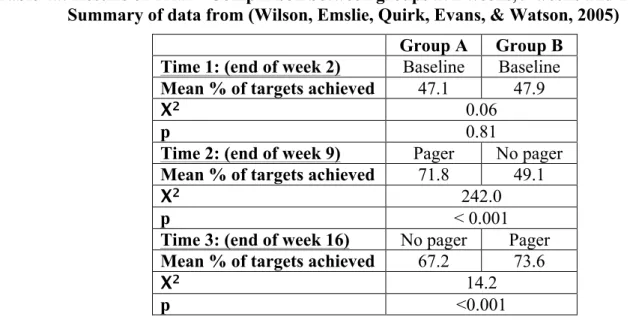
The results of the trial have been summarised in Table 4a below.
Table 4a: Results of Trial – Comparison between groups at 2 weeks, 9 weeks and 16 weeks. Summary of data from (Wilson, Emslie, Quirk, Evans, & Watson, 2005)
Group A Group B Time 1: (end of week 2) Baseline Baseline Mean % of targets achieved 47.1 47.9
Χ2 0.06
p 0.81
Time 2: (end of week 9) Pager No pager Mean % of targets achieved 71.8 49.1
Χ2 242.0
p < 0.001
Time 3: (end of week 16) No pager Pager Mean % of targets achieved 67.2 73.6
Χ2 14.2
p <0.001
The data shows that both Group A and B achieved a higher mean percentage of targets when issued with a pager. The data also indicates that even post pager, target achievement improved compared to baseline. The p values show that these results were not due to chance.
Within-group statistical comparisons were also carried out, as shown in Table 4b.
Table 4b: Results of Trial – Statistical comparisons within groups. Summary of data from (Wilson et al., 2005)
Group A Group B
Χ2 p Χ2 p
Baseline Vs Pager 406.41 <0.001 161.72 <0.001
Pager Vs Post pager 37.15 <0.001 N/A N/A
Baseline Vs Post Pager 174.25 <0.001 N/A N/A
Baseline Vs Waiting list N/A N/A 0.71 0.4
Waiting list Vs Pager N/A N/A 141.44 <0.001
For Group A, the chi squared and p value statistics indicate that statistically significant differences existed between the baseline/pager, baseline/post-pager and pager/post-pager states and that these differences were not due to chance.
For Group B, the chi squared and p value statistics indicate that statistically significant differences also existed between the baseline/pager and waiting list/pager states and that these differences were not due to chance.
Original Authors’ Conclusions
The authors found that this paging system assisted clients with TBI to carry out daily tasks more effectively than without the pagers.
Critical Appraisal Validity
The internal and statistical validity of this RCT were assessed using the PEDro scale. The RCT received an internal validity score of 1/8 and a statistical validity score of 2/2. As a result, this RCT is extremely vulnerable to bias, however the statistical analysis is thorough. Nonetheless, the RCT does bring inherent strengths with the overall design. Eligibility criteria were included in the study. Justification for the PEDro scores is below.
- Random allocation: The participants were randomly allocated to Group A and Group B indicating that there was no selection bias.
- Concealed allocation: No statements were provided indicating that allocation was concealed, hence potentially introducing systematic biases in the randomisation.
- Baseline similarity: Insufficient data were provided for baseline characteristics of Group A and Group B to be compared. As a result, the results for the group may be biased due to differing severity of condition. The statistical t distribution t(61) = 1.8, p=0.08, indicates that the age distribution was not significantly different between the two groups. Similarly, the baseline measurements indicate no significant difference in memory ability between groups. - Subject/therapist/assessor blinding: Due to the nature of the trial, subjects, therapists and
assessors were not be blinded. Therapists were required to train the participants prior to the trial and program the tasks into the PDAs. Participants were required to use the PDAs and rate their own success (thus they were also the assessors, preventing assessor blinding). Hence therapists and participants were aware of their status within the trial. This may cause bias due to increased / decreased client motivation and positive client expectations when using the pager. Similarly, therapists may have been biased when programming the pager (eg. choosing convenient times for reminders) to give positive results. As a result the RCT is vulnerable to bias from lack of participant/therapist/assessor blinding.
- Key outcome measured for > 85% of participants: Could not be verified, as the number of participants initially randomised was not reported.
- No data were provided to indicate that there was ‘Intention to Treat’.
- As discussed in ‘Main Findings’, statistical analysis of the outcome data was carried out. Interpretation of Results
- This CAT focussed on occupational task improvement as a result of PDA usage. This RCT measured the percentage of successful achievement of target activities as an indication of memory improvement. The primary outcome measure was continuous.
- The authors’ assessment of the outcome data indicates that the results were clinically significant. Hence the use of pagers is positive for improving memory compensation in clients with TBI. The PEDro scale score shows that the internal validity is low however, thus the RCT is vulnerable to bias.
- Due to the low internal validity and high level of potential bias of this study the results achieved when applying this intervention to the general population may be less positive than the outcome achieved in this RCT.
Strengths of the study included: - Moderate sample size - Randomisation
- Low attrition rate. Outcome measures were obtained from all of the participants. Weaknesses of the study included:
- No information was provided as to the minimum clinically important difference. Hence replication of the assessment of the data as ‘clinically significant’ or ‘non significant’ could not be carried out.
- No confidence intervals / standard deviations were provided, thus the spread of the data could not be determined. The results could be heavily biased due to outliers.
- No raw data provided, hence 95% confidence intervals could not be calculated.
- Insufficient data reported on how target achievement was assessed. No information was provided as to time limits or required standards for successful target completion or how participants reported data back to the therapist. The study indicates that participants could even falsely report a target as having been completed. As a result, there may be
inconsistencies between how target achievement was assessed by different participants.
- The authors indicate that the general nature of the eligibility criteria was an advantage for the study, as the results could be applied to a broad range of potential clients. However, as no baseline data was presented measuring the severity of condition for the two groups, the outcomes may have been influenced by the participants’ initial conditions. More
comprehensive baseline information is required to allow baseline biases to be eliminated.
- The wide age range of participants may also be a vulnerability of the study. Children and adults recover differently from TBI, hence improvements in task performance attributed to PDA use may have been a result of an individual’s recovery process and the magnitude of the improvement may vary across age groups.
Summary/Conclusion
The statistically significant improvements in outcome post-pager intervention from this randomised controlled trial indicate that use of a pager can improve memory compensation amongst clients with TBI. However the low internal validity and non-transparent determination of clinical significance indicate that results could be more positive due to measurement biases.
To conclusively prove that pager use improves memory compensation amongst clients with TBI, further high level studies (with improved internal validity) must be carried out.
IMPLICATIONS FOR PRACTICE, EDUCATION and FUTURE RESEARCH Practice
- Educate clinicians in the positive results obtained in TBI memory rehabilitation using PDAs and provide information to clinicians on how PDAs can be integrated in TBI rehabilitation programs. Clinicians can then decide whether the intervention is suitable for their specific clients.
- Mobile phones have become increasingly common thus the majority of clients will already have access to PDA technology. As a result, clients’ mobile phones may be adapted to provide prompting/reminders thus reducing costs associated with implementation. - The intervention can be carried out remotely and independently once the PDA has been
programmed, thus this intervention is suitable for both city based and regional clients. - Once the client is trained in the use of the PDA, the additional time required by an OT to
assist the client with the intervention is minimal. OT assistance is only required to update the PDA programming and to monitor/assess the outcome of the intervention.
- PDA technology has already been implemented throughout the UK as part of TBI rehabilitation programs after the positive results of the Wilson, Emslie, Quirk, Evans & Watson (2001) trial. (Wilson et al., 2005)
- Depompei et al. (2008) trialled the use of PDA’s with a population of TBI and intellectually disabled clients to prompt performance of tasks. After positive results from the trial, an intervention plan was devised and a brochure published to guide therapists and patients in the use of PDA’s as part of a memory rehabilitation program. The brochure is titled, ‘PDA Implementation Plan: Implementing Electronic Memory and Organizational Aids.’ (Gilette, DePompei, & Goetz, 2008)
Education
- Development of education resources regarding the use of PDAs as a compensatory memory aid in rehabilitation for clients with TBI is warranted based on emerging evidence.
Education should include which clients are most suitable for PDA assisted rehabilitation, instruction in how to set up and use the PDA, how to set up the intervention and how to assess improvement. The pamphlet referred to above by Gilette, DePompei, & Goetz, (2008) may be used as a guideline.
Future Research
This CAT highlighted other related areas where research is required. These include:
- The effectiveness of clients entering their own reminders into the PDA technology, as this will provide an even higher level of independence to clients.
- Whether PDA’s are effective at an impairment level to improve either executive function or prospective memory
- The long term functional impact of PDA usage
- The effectiveness of PDA use for other conditions with associated memory impairments (eg. ABI, MS and dementia).
- The occupational performance areas best targeted by PDA based interventions. (ie. determine the nature of the activities which the PDA’s had the most improvement). - Whether PDA’s also can be used to improve other cognitive functions. eg. navigation,
communication. REFERENCES
Carr, B., Allaous, J., Mackenzie, B., Lannin, N., Schmidt, J., Irving, I., & Tate, R. (2011). Using a handheld computer to compensate for memory and planning difficulties after brain injury: A randomised controlled trial. Occupational Therapy Australia, 24th National Conference and Exhibition, 29 June-1July 2011. Australian Occupational Therapy Journal, 58(Supplement: 115).
Centre for Disease Control and Prevention (CDC). (2011). Injury prevention and control: Traumatic brain injury. Retrieved May 19th
2012. http://www.cdc.gov/traumaticbraininjury/severe.html
Centre for Evidence Based Medicine (CEBM). (2009). Levels of evidence. Retrieved May 19, 2012. http://www.cebm.net/index.aspx?o=1025
Culley, C., & Evans, J. (2010). SMS text messaging as a means of increasing recall of therapy goals in brain injury rehabilitation: A single-blind within-subjects trial. Neuropsychological Rehabilitation, 20(1), 103-119.
De Joode, E., Van Heugten, C., Verhey, F., & Van Boxtel, M. (2010). Efficacy and usability of assistive technology for patients with cognitive deficits: A systematic review. Clinical Rehabilitation, 24(8), 701-714.
Depompei, R., Gillette, Y., Goetz, E., Xenopoulos-Oddsson, A., Bryen, D., & Dowds, M. (2008). Practical applications for use of PDAs and smartphones with children and adolescents who have traumatic brain injury. NeuroRehabilitation, 23(6), 487-499.
Dowds, M., Lee, P., Sheer, J., O'Neil-Pirozzi, T., Xenopoulos-Oddsson, A., Goldstein, R., Zainea, K., Glenn, M. (2011). Electronic reminding technology following traumatic brain injury: effects on timely task completion. Journal of Head Trauma Rehabilitation, 26(5), 339-347. Gentry, T., Wallace, J., Kvarfordt, C., & Lynch, K. B. (2008). Personal digital assistants as
cognitive aids for individuals with severe traumatic brain injury: A community-based trial. Brain Injury, 22(1), 19-24.
Gillespie, A., Best, C., & O'Neill, B. (2012). Cognitive function and assistive technology for cognition: A systematic review. Journal of the International Neuropsychological Society, 18, 1-19.
Gillette, Y., & DePompei, R. (2004). Potential of electronic organisers as a tool in the cognitive rehabilitation of young people. NeuroRehabilitation, 19(3), 233-243.
Hart, T., Buchhofer, R., & Vaccaro, M. (2004). Portable electronic devices as memory and
organizational aids after traumatic brain injury: A consumer survey study. Journal of Head Trauma Rehabilitation, 19(5), 351-365.
Hart, T., O'Neil-Pirozzi, T. M., & Morita, C. (2003). Clinical Expectations for portable electronic devices as cognitive-behavioural orthoses in traumatic brain injury rehabilitation. Brain Injury, 17(5), 401-411.
Kirsch, N., Shenton, M., & Rowan, J. (2004). A generic 'in-house', alphanumeric paging system for prospective activity impairments after traumatic brain injury. Brain Injury, 18(7), 725-734. Kirsch, N., Shenton, M., Spirl, E., Rowan, J., Simpson, R., Schreckenghost, D., & E, L. (2004).
Web-based assistive technology interventions for cognitive impairments after traumatic brain injury: a selective review and two case studies. Rehabilitation Psychology, 49(3), 200-212.
Lynch, B. (2002). Historical review of computer-assisted cognitive retraining. Journal of Head Trauma Rehabilitation, 17(5), 446-457.
McHugh, M. (2009).The odds ratio: Calculation, usage, and interpretation. Biochemia Medica 2009;19(2), 120-126.
PEDro Physiotherapy Evidence Database. (2011). PEDro Scale Partitioned Rating Sheet. Retrieved May 19, 2012, from http://www.otseeker.com/PDF/PEDroscalepartitionedratingsheet.pdf Radomski, M.V. (2008). Traumatic brain injury. In Radomski, M.V., & Trombly Latham, C.A.
(Eds.), Occupational Therapy for Physical Dysfunction (6th ed.pp. 1042-1078).Philadelphia: Lippincott Williams & Wilkins.
Sohlberg, M., Kennedy, M., Avery, J., Coehlo, C., Turkstra, L., & Ylsvisaker, M. (2007). Evidence- based practice for the use of external aids as a memory compensation technique. Journal of Medical Speech- Language Pathology, 15(1)
Sohlberg, M., & Mateer, C. (2001). Cognitive rehabilitation: An integrative neuropsychological approach. New York: Guildford Press.
Stapleton, S., Adams, M., & Atterton, L. (2007). A mobile phone as a memory aid for individuals with traumatic brain injury: A preliminary investigation. Brain Injury, 21(4), 401-411. Wilson, B., Emslie, H. C., Quick, K., & Evans, J. J. (2001). Reducing everyday memory and
planning problems by means of a paging system: A randomised control crossover study. Journal of Neurology Neurosurgery and Psychiatry, 70(4), 477-482.
Wilson, B., Emslie, H., Quirk, K., Evans, J., & Watson, P. (2005). A randomized control trial to evaluate a paging system for people with traumatic brain injury. Brain Injury, 19(11), 891-894.