1 2 3 4 5 6 7 8 9 10 11 12
Applicability of the
13Security Control Automation Protocol (SCAP)
14to Voice over Internet Protocol (VoIP) Systems
15Version 0.9
16 17
1 2 3 4 5
This publication is for informational purposes and presents a view on how practical it could be to 6
use the Security Content Automation Protocol (defined in NIST Special Publication 800-126) to 7
an implemented Voice over Internet Protocol (VoIP) System. While a view of a hypothetical 8
security assessment of a generic implemented VoIP System is presented in this publication it is 9
presented just as a rough guide, is not a substitute for a rigorous security assessment on a 10
particular VoIP system or implementation. 11
Participation in the development of this publication does not represent an endorsement of 12
the content of this publication on the part of any specific individual, company, or 13
corporation. Any reference made to existing commercial products or services is not 14
intended as, and does not constitute, and endorsement or approval of such products or 15
services. 16
This publication is protected by copyright, all rights reserved. The scanning, uploading and 17
distribution of this book by electronic means, including the Internet, without the permission of 18
the Internet Security Alliance, is illegal and punishable by law. 19
If you wish to acquire printed copies of this publication, or distribute portions of this publication 20
in any media, please contact Internet Security Alliance by calling (703)907-7799. 21
22
© 2010 Internet Security Alliance. All rights reserved. 23
1 2 3 4 5
Applicability of the
6Security Control Automation Protocol (SCAP)
7to Voice over Internet Protocol (VoIP) Systems
8Version 0.9
9 10 11
1 2 3 4 5
Board of Directors
6 Larry ClintonPresident, Internet Security Alliance
Ken Silva
Chief Technology Office, Verisign Ty Sagalow
IS Alliance Board Chair,
Executive Vice-President and Chief Innovation Officer, Zurich North America
Charlie Croom
Vice President, Cyber Security Strategy, Lockheed Martin
Mike Hickey
First Vice Board Chair
VP, Government Affairs & National Security Policy, Verizon
Joe Buonomo
President, Direct Computer Resources, Inc.
Dr. Sagar Vidyasagar Second vice Board Chair
Executive VP, Advanced Technology, Tata Consultancy Services
Jeff Brown
Director, Infrastructure Services and CISO Information Technology, Raytheon
Marc-Anthony Signorino Secretary/Treasurer
Director of Technology Policy, National Association of Manufacturers
Lawrence Dobranski
Leader, Advanced Security Solutions Research & Development Nortel
Bruno Mahlman
Vice President, National Security, Perot Systems Corporation
Eric Guerrino
Managing Director Systems and Technology, Bank of New York Mellon
Tim McKnight
Vice President & Chief Information Security Officer, Northrup Grumman
Dr. Pradeep Kohsla
Dean, School of Engineering and Computer Sciences, Co-Director – Cylab, Carnegie Mellon University
WHAT IS THE INTERNET SECURITY ALLIANCE? 1
Virtually every corporation integrates use of the Internet into their business 2
plan. However, the use of the Internet also exposes corporations to continuing 3
and persistent threats, putting at risk corporate intellectual property, business 4
operations, and overall enterprise security. These risks confront any business, 5
as well as all of their respective suppliers, business partners and customers. 6
The Internet Security Alliance (ISAlliance) is a non-traditional trade association that serves to 7
understand, integrate and help manage the multi-dimensional and international issues that 8
operating in the Internet creates. The ISAlliance website is www.isalliance.org. 9
WHAT DOES THE INTERENT SECURITY ALLIANCE DO? 10
ISAlliance provides tangible benefits to its membership by creating cutting edge services and 11
applicable publications useful across the various industry sectors that use the Internet. 12
ISAlliance was conceived in conjunction with Carnegie Mellon University to integrate 13
technological issues with the membership’s pragmatic business concerns and align public policy 14
to facilitate business growth and resilience. 15
The ISAlliance provides a broad range of ongoing technological, business and policy services to 16
its membership, all of which can be reviewed in more detail at the ISAlliance web site. In 17
addition, the ISAlliance Board identifies a select set of priority projects each year for intensive 18
work. 19
This report is a new contribution to a continuing series of publications produced by ISAlliance 20
that address the substantive issues that arise at the intersections of business, law and information 21
security. Previous titles include: 22
Navigating Compliance and Security for Unified Communications 23
The Cyber Security Social Contract: A Twenty-First Century Model for Protecting and 24
Defending Critical Technology Systems and Infrastructure. 25
The Financial Impact of Cyber Risk: 50 Questions Every CFO Should Ask 26
Contracting for Information Security in Commercial Transactions, Volume I: An 27
Introductory Guide 28
Contracting for Information Security in Commercial Transactions, Volume II: Model 29
Contract Terms for Certified Information Management Systems 30
Common Sense Guide for Senior Managers: Top Ten Recommended Security Practices 31
1
2 3
About the Editor
45
Paul Sand is the President and CEO of Salare Security LLC. Salare Security is committed to 6
providing products and services that prevent covert channel communications that are exploited to 7
propagate malware and that are used to exfiltrate information from an enterprise. Salare was 8
founded to commercialize technology licensed from the Illinois Institute of Technology (IIT) 9
developed as the result of IIT’s involvement in the National Security Agency’s Academic Center 10
of Excellence in Information Assurance program. 11
Paul Sand is a member of the Board of Directors of the Chicago Infragard Members Alliance 12
Chapter, a member of the US Secret Service’s Electronic Crimes Task Force, a senior member of 13
the IEEE, a member of the Information Systems Security Association, and an adjunct faculty 14
member at the Keller Graduate School of Management. He has previously worked at Bell 15
Laboratories, AT&T Network Systems, and Lucent Technologies. He holds 21 awarded US 16
Patents in the areas of voice and data communications and public safety. 17
Paul is a frequent industry speaker and may be reached at [email protected] or 18
312.994.2336. 19
Special Thanks
12
Special thanks are given to all of the SCAP Applicability Working Group for the ISAlliance 3
VoIP Security Project. This paper presents the results of a year long effort that would not have 4
been possible with out the countless hours of contributions and efforts these individuals have 5
made to this effort. 6
In particular, special thanks are given to the authors of the each of the individual sections of this 7
whitepaper: 8
Chapter 1 – History & Background of the ISAlliance Voice Security Project 9
Lawrence Dobranski, Nortel Networks 10
Chapter 2 – ISAlliance Voice Security Project Goals and Objectives 11
Lawrence Dobranski, Nortel Networks 12
Chapter 3 – Scope of the SCAP Applicability Working Group Project 13
Paul R. Sand, Salare Security 14
Chapter 4 – VoIP Architecture 15
Matt Trainor, Nortel Networks 16
Chapter 5 – VoIP Threat Risk Assessment 17
Tom Grill, Verisign 18
Ken Stavinoha, Microsoft 19
Chapter 6 – VoIP Security Checklist and Mapping to SP 800-53 R3 20
Dawn Adams, EWA-Canada 21
Peter Thermos, Palindrome Technologies 22
Chapter 7 – Use of Security Content Automation Program (SCAP) for VoIP 23
Security 24
Scott Armstrong, Gideon Technologies 25
The entire group consisted of 50 individuals representing 43 organizations. 26
AJ West, Boeing 27
Alex Fielding, Ripcord Networks 28
Allie Larman, Oklahoma Office of State Finance 29
Andrew Bove, Secure Acuity Networks, LLC 30
Andriy Markov, VoIPshield Systems Inc. 31
Barry Wasser, Department of Homeland Security 32
Blake Frantz, Center For Internet Security 33
Bob Moskowitz, ICSAlabs, an Independent Division of Verizon Business Systems 34
Bogdan Materna, VoIPshield Systems Inc. 35
Carl Herberger, Evolve IP 1
Cheri Sigmon, Department of Defense 2
Cynthia Reese, Science Applications International Corporation (SAIC) 3
David Lukasik, Department of Veterans Affairs 4
Dawn Adams, EWA-Canada 5
Denise Walker, DBA, Lone Star College System 6
Ed Stull, Direct Computer Resources 7
Ed White, McAfee 8
Edward Cummins, Raytheon 9
Gary Gapinski, National Aeronautics and Space Administration 10
Imran Khan, Consultant 11
James Mesta, Agilent Technologies, Inc. 12
Jeffrey Ritter, Waters Edge Consulting 13
Jim Meyer, Institute for Defense Analyses 14
John Fulater, HSBC North America 15
Joseph Dalessandro, Withheld 16
Ken Fee, Firefly Communications 17
Ken Stavinoha, Microsoft 18
Kenneth Kousky, Salare Security, LLC 19
Kevin Watkins, McAfee 20
Laurie Hestor, Defense Information Systems Agency 21
Linda Kostic, eTrade Financial 22
Lorelei Knight, ICSAlabs, an Independent Division of Verizon Business Systems 23
Lynn Hitchcock, Raytheon 24
Mark Humphrey, Boeing 25
Matt Trainor, Nortel Networks 26
Paul Salva, HSBC North America 27
Pete Eisele, Northrop Grumman 28
Peter Thermos, Palindrome Technologies 29
Rick Mellendick, Food and Drug Administration 30
Robert Smith, Global UniDocs Company 31
Ronald Rice, Defense Information Systems Agency 32
Scott Armstrong, Gideon Technologies 33
Shawn Dickson, Raytheon 34
Sheila Christman, National Security Agency 35
Steve Carver, FAA (Retired) 36
Steven Draper, National Security Agency 37
Terry Rimmer, Oklahoma Office of State Finance 38
Tom Grill, VeriSign 39
Table of Contents
12
Chapter 1 - History & Background of the ISAlliance Voice Security Project ... 10 3
Chapter 2 - ISAlliance Voice Security Project Goals and Objectives... 13 4
Chapter 3 -- Scope of the SCAP Applicability Working Group... 14 5
Chapter 4 - VoIP Architecture ... 15 6
Chapter 5 - VoIP Threat Risk Assessment ... 18 7
Chapter 6 - VoIP Security Checklist and Mapping to SP 800-53 R3 ... 49 8
Chapter 7 – Use of Security Content Automation Program (SCAP) for VOIP Security ... 108 9
10 11
Executive Summary
1 2
This white paper presents the findings of efforts in 2009 of the Security Content Automation 3
Protocol (SCAP) Applicability Working Group of the Internet Security Alliance’s VoIP Security 4
Project. This VoIP Security Project was initiated by the ISAlliance in 2007 after the weakness of 5
cyber security around VoIP and the potential critical impact of the exploitation or those 6
weaknesses was understood. The project has received support from both by the National Institute 7
of Standards and Technology (NIST) and the Department of Homeland Security (DHS) as well 8
as many private sector companies. 9
The SCAP Applicability Working Group has been focused on determining the practicality of 10
using SCAP to automate evaluation of security controls in a VoIP Network. Taking SCAP, 11
which was designed for the evaluation of desktop computer’s configuration compliance with the 12
Federal Desktop Core Configuration (FDCC), and applying it to non-desktop components spread 13
across a large network to implement a complex service is a significant undertaking. VoIP was a 14
challenging service to attempt such automation because it is still an evolving technology and that 15
no clear, universally accepted security controls has yet emerged. As a result, the project was 16
carefully scope to address the challenging technological challenges without having to develop an 17
encompassing and complete view of appropriate VoIP security controls. 18
A security assessment was conducted on a reference voip system (the Reference Architecture) 19
that led to the definition of a set of security controls for VoIP. The security assessment was not 20
complete, did serve to define a set of security controls for a VoIP system. Then, the use of 21
SCAP was studied to evaluate that set of controls. 22
This whitepaper concludes that much of SCAP can easily be extended to a VoIP system. 23
Specifically, Common Vulnerabilites and Exposures (CVE), Common Configuration 24
Enumeration (CCE), and the Common Vulnerability Scoring System (CVSS) are those parts that 25
are easily extended. The Extensible Configuration Checklist Description Format (XCCDF) and 26
the Open Vulnerability and Assessment Language (OVAL) will be much harder to extend, 27
though probably not impossible to extend. The challenge for XCCDF is that commonality and 28
diversity of devices in a VoIP system begs for an object oriented approach that allows for 29
checklist to be developed from a high-level class down toward a specific device model and 30
firmware version. The challenge for OVAL is that the language is not functional enough to 31
handle the multitude of devices and their corresponding controls. 32
Chapter 1 - History & Background of the ISAlliance Voice Security Project
1 2
The proliferation of network enabled devices has exploded. Unified Communication (UC) 3
networks likely face the greatest challenge today in managing a diverse, large set of mobile and 4
fixed devices. Ensuring that all of these numerous devices have the most up to date patches, 5
present no known security vulnerabilities, and are configured to represent the organization’s 6
security policy, is a significant and growing challenge for the operational security leaders 7
responsible for managing the risk in a UC Network. 8
UC Networks can be attacked via the notoriously old and well known data network exploits as 9
well as via new exploits targeting VoIP vulnerabilities. A large U.S. retailer’s VoIP system was 10
successfully compromised via a simple password cracking attack because of a failure to validate 11
compliance with the retailer’s security policy. This compromise took place after an operator 12
inadvertently mis-configured the VoIP PBX. The operator attempted to increase the password 13
complexity setting on the PBX, but instead mistakenly turned off all password complexity rules. 14
As can be expected, within hours the PBX was compromised, resulting in the lost of VoIP 15
service to all the retailer’s locations. This resulted in a significant financial loss due to the 16
inability to process credit card and debit transactions. An automatic, periodic validation of the IP 17
PBX configuration could clearly have detected and allowed correction before the IP PBX was 18
compromised. 19
The Internet Security Alliance’s Board of Directors acknowledged that this incident represented 20
the significant potentials for malicious activity that exist within the VoIP solutions deployed or 21
planned in many private and public sector organizations. The National Institute of Standards and 22
Technology “Security Content Automation Protocol” (SCAP) program was developed to provide 23
patch and configuration management for desktop computers. The IA Alliance Board 24
immediately then raised the question: Would SCAP help address this and other security issues 25
identified with enterprise VoIP deployments? 26
SCAP is a recommended approach for U.S. Federal Government Organizations to demonstrate 27
compliance with security requirements in mandates such as the Federal Information Security 28
management Act (FISMA). SCAP consists of two elements. First, SCAP is a protocol: it 29
consists of six specifications that standardize how security software communicates information 30
about software flaws and security configurations. These standards are the SCAP components. 31
Second, SCAP provides software vulnerabilities and security configuration reference data. 32
These are the SCAP content. 33
SCAP can be used for security configuration verification, requirements traceability, standardized 34
security enumerations, and vulnerability measurement. From an enterprise voice perspective 35
management of security vulnerabilities, the management of corrective content (patches), and the 1
management of security configuration. 2
The ISAlliance reached out to NIST and DSH seeking their support of an ISAlliance lead 3
program to assess the applicability of the SCAP program to enterprise VoIP solutions, and 4
develop the appropriate SCAP content. NIST and DHS expressed extreme support of the 5
proposal and encouraged the ISAlliance to continue with the incubation of their idea. 6
ISAlliance continued their work and presented their VoIP SCAP proposal to the The Fourth 7
Annual Information Security Automation Conference in Gaithersburg, MD in September, 2008. 8
In addition, a daylong workshop was proposed to further develop the ISAlliance’s proposal and 9
solicit feedback and approaches on how to assess the applicability of the SCAP approach to real-10
time systems such as enterprise VoIP solutions, and how to develop reference SCAP content to 11
establish a minimum baseline for appropriate VoIP configurations. 12
The result of the workshop was the realization to properly assess the applicability of SCAP to 13
VoIP required an industry-working group. ISAlliance established such a group in early 2009 14
with the primary objectives of assessing the appropriateness of the SCAP Program to enterprise 15
voice solutions and, if appropriate, the development of appropriate benchmark SCAP content. 16
17 18 19
Chapter 2 - ISAlliance Voice Security Project Goals and Objectives
1 2
Originally, the initial goal of the ISAlliance VoIP Security Project was to develop SCAP 3
baseline content to enable VoIP developers to develop product specific SCAP content. This goal 4
was the distillation of the realization that with the proliferation of network enabled devices in the 5
enterprise, there was s need to ensure that the network enabled devices introduce no known 6
vulnerabilities, are properly patched, and are securely configured. These activities are critical; 7
this is especially so with enterprise voice services. The ability to do these automatically on a 8
periodic basis will improve the overall assurance of the organizations’ voice solution, and 9
provide an increase in security posture of voice services. 10
The SCAP for VoIP workshop held at the Fourth Annual Security Automation Conference was 11
very successful. One of the most important conclusions that was reached was to properly assess 12
the applicability of SCAP to VoIP would require a detailed review of SCAP from a voice 13
perspective by an industry working group. ISAlliance established such a group in early 2009 14
with the primary objectives of assessing the appropriateness of the SCAP Program to enterprise 15
voice solutions and if appropriate, the development of appropriate benchmark SCAP content. To 16
achieve the objective of providing a report on the ISAlliance VoIP Security Project at the fifth 17
Annual Security Automation Conference, the working group was split into two sub groups. The 18
first was charged with determining the applicability of the SCAP program to VoIP; the second 19
was assigned to develop a list of applicable VoIP Security standards that could be used as 20
references to developed baseline SCAP content for VoIP security. This whitepaper represents 21
the findings of the first working group: Applicability of SCAP To VoIP. 22
Chapter 3 -- Scope of the SCAP Applicability Working Group
1
Accomplishing the objectives and goals of the VoIP Security Project required strict consideration 2
of challenges from two very distinct directions. First, application of SCAP from a desktop 3
environment to a network-wide, complex application is a challenge in and of itself. Second, 4
defining a complete, comprehensive, broadly applicable set of VoIP Security controls is a 5
challenge in its own right. VoIP continues to evolve as a technology and security approaches 6
have not yet converged to the point that a single view of the architecture, threats and risks can be 7
reasonably asserted to lead to a common set of controls. As a result, there is tremendous conflict 8
in moving a project aimed at automating validation of security controls of a VoIP system using 9
SCAP in a relatively short amount of time. Firmly fixing the scope of work is our solution to 10
working through these conflicts. 11
The most important outcome of this project is an assessment of the viability and ease of use of 12
SCAP to automate a network wide application. Secondly, it is to specifically judge the viability 13
and ease of use of SCAP to automate the verification of security controls implemented on a VoIP 14
system. Thirdly, it is to define a reasonably comprehensive set of security controls required by 15
VoIP systems commonly deployed today. 16
In order to complete our work within 6 months of our kick-off, much thought was given to what 17
comprised a “reasonably comprehensive set of security controls required by VoIP systems 18
commonly deployed today.” We arrived at the following approach: define a reference VoIP 19
reference architecture, conduct a threat risk analysis, develop a list of security controls, and then 20
examine use of SCAP to validate the controls. To reduce the effort, but still achieve that primary 21
goal of examining the use of SCAP to validate VoIP security controls, the logical and physical 22
architecture was limited. In particular, we chose to focus on SIP deployments exclusively, to 23
ignore the use of SIP trunks (external VoIP connections are always assumed to be through a 24
media gateway), and to ignore the existence of voice mail systems and audio conferencing 25
systems. While we readily admit that this position reduces the utility of the reference VoIP 26
system, this was necessary to constrain the work effort to an achievable level while not making 27
the reference architecture too simple and thereby potentially skewing results. Additional 28
functionality, signaling and network interconnect are important considerations and are 29
considerations we expect to address in a subsequent effort as this project continues in more 30 phases. 31 32 33 34
Chapter 4 - VoIP Architecture
1 2
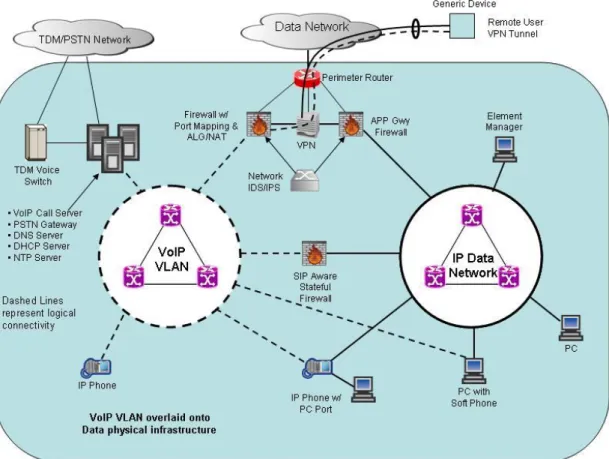
Our chosen Reference VoIP Architecture (RA) is shown in Figure 1 and represents a typical 3
single-site generic enterprise VoIP deployment. This RA establishes a common terminology and 4
sets the groundwork for the discussions and analysis that follows later in this paper. This RA is 5
closely based on the VoIP Architecture documented in the DoD/DISA document titled “Internet 6
Protocol Telephony & Voice Over Internet Protocol – Security Technical Implementation Guide 7 Version 2, Release 2”. 8 9 10 11
Figure 4.1 – The Reference VoIP Architecture 12
13
A typical VoIP deployment makes use of the existing IP infrastructure for business and 14
economic reasons. VoIP services overlay onto the IP network already in place, with special 15
consideration given to Quality of Service (QoS), Availability, and Security. The convergence of 16
Voice and Data onto a single IP network to form a UC network has blurred the division between 17
traditional telephony and data services from both operations and support perspectives. However, 18
because of the special needs of a real-time service such as VoIP, there are additional 19
Duplication of physical networking components would make the business case for VoIP 1
uneconomical. But, separate networks for voice and data are required to deliver the substantially 2
different Quality of Service (QoS) Requirements of voice. For this reason, the Switch Routers 3
depicted as part of the IP Data Network and the Core VoIP Virtual LAN (VLAN) could very 4
well the same physical devices, with logical separation between traditional data services and 5
VoIP services being provided using VLAN technology. The dashed lines in the RA are used to 6
depict network element connectivity to the VoIP VLAN. 7
The VoIP Servers, VoIP Clients, traditional data devices, and servers that provide Network 8
Services (DNS, DHCP etc.) are all logically separated into Security Zones to provide differing 9
treatment. Using different Security Zones for devices that share common functionality provides 10
a coarse level of protection and enables the application of specific policies and procedures 11
specific to the common functionality. All of the VoIP elements are connected to a VLAN 12
configured to support the QoS, Security, and Availability requirements for VoIP traffic. 13
A TDM Gateway provides connectivity to and from the VoIP domain to support PSTN calls and 14
calls to/from traditional telephony sets, potentially deployed in the same Enterprise. Also 15
depicted in the RA is a Session Border Controller that, although out of scope for this paper, 16
would secure SIP trunks to a VoIP Service Provider. 17
Also included in the RA is a Generic Device that makes use of VPN Tunneling to connect to 18
the Enterprise, since this is a very common deployment for teleworkers and “road warriors”. 19
The VPN tunnel is terminated as usual in the data network and the VoIP specific traffic is 20
routed though a VoIP aware firewall. 21
Throughout this paper the various Security Controls will be discussed as they relate to Security 22
Planes. The requirements at the various planes can differ and this will be evident in the 23
upcoming Chapter 5 - Threat Risk Assessment. The three Security Planes are (1) Media Plane 24
(also called End-User Plane or Bearer Plane), (2) Signaling & Control Plane, and (3) 25
Management Plane. These Security Planes are well defined in a document titled “Draft ITU-T 26
Recommendation X.805 (Formerly X.css), Security architecture for systems providing end-to-end 27
communications” and in the ATIS Standard ATIS-1000007.2006 – Generic Signaling and 28
Control Plane Security Requirements for Evolving Networks1. 29
The Media Security Plane addresses the user data flows. Specifically, in a VoIP 30
deployment this would be the RTP/RTCP media flows. Other generic Protocols of 31
concern are HTTP/HTTPS, POP, IMAP, TCP, UDP, FTP, IPSec, and TLS. 32
The Signaling & Control Security Plane typically involve the security of machine-to-machine 33
communications and call set-up and teardown. In the context of this paper, the primary 34
protocol for consideration is SIP. Other generic Protocols to be considered at this plane are 35
BGP, OSPF, IS-IS, RIP, PIM, RSVP, H.323, SS7, IKE, ICMP, PKI, DNS, DHCP, SMTP. 36
1
© Copyright 2009 by the Alliance for Telecommunications Industry Solutions, Inc. ATIS publications are available from the ATIS Document 37
The Management Security Plane involves the protection of Operations, Administration, 1
Management and Provisioning of network elements and back-office systems. Generic 2
Protocols of concern are SNMP, Telnet, S/FTP, TFTP, and HTTP/S. 3
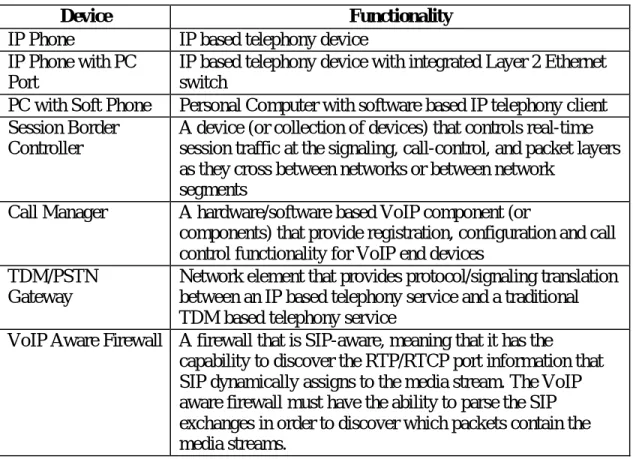
The major VoIP specific elements are identified in Table 1, along with basic information 4
regarding functionality. 5
Device Functionality
IP Phone IP based telephony device IP Phone with PC
Port
IP based telephony device with integrated Layer 2 Ethernet switch
PC with Soft Phone Personal Computer with software based IP telephony client Session Border
Controller
A device (or collection of devices) that controls real-time session traffic at the signaling, call-control, and packet layers as they cross between networks or between network
segments
Call Manager A hardware/software based VoIP component (or
components) that provide registration, configuration and call control functionality for VoIP end devices
TDM/PSTN Gateway
Network element that provides protocol/signaling translation between an IP based telephony service and a traditional TDM based telephony service
VoIP Aware Firewall A firewall that is SIP-aware, meaning that it has the
capability to discover the RTP/RTCP port information that SIP dynamically assigns to the media stream. The VoIP aware firewall must have the ability to parse the SIP exchanges in order to discover which packets contain the media streams.
6
Table 4.1 Major VoIP Elements 7
8 9 10
Chapter 5 - VoIP Threat Risk Assessment
1 2
Overview
3
This section discusses security threats and vulnerabilities encountered in the VoIP Reference 4
Architecture and a high level overview of security controls to mitigate the risk of such threats 5
which adversely impact the operations, assets and overall voice services of the organization. 6
Numerous approaches have been used by information security personnel to evaluate the security 7
risk of an organization and its IP communication infrastructure. Security risk assessments range 8
from strictly a technical evaluation of the infrastructure to an all encompassing assessment from 9
a technical, organizational and business perspective. In general, such assessments are comprised 10
of: 11
(i) identification of information-related assets that are critical to the organization and 12
infrastructure, in this case the VoIP Reference Architecture 13
(ii) identification of potential threat sources and corresponding risk likelihood against 14
each asset 15
(iii) identification of security controls in place to protect the assets 16
(iv) identification of the presence of vulnerabilities due to missing or insufficient security 17
measures 18
(v) determination of the acceptable level of risk for each asset – threat pair 19
(vi) determination of an organizational defined ranking of its informational assets so that 20
sufficient security controls can be deployed to mitigate against the highest impacts to 21
the organization. 22
Security risk assessment (or threat risk analysis) is typically a very lengthy, detailed process. 23
The assessment described in this chapter will provide a high level examination of threat sources, 24
vulnerabilities and risks that may be encountered in the VoIP Reference Architecture; leading 25
towards guidance on the mitigation of such threats. The assessment is focused on the critical 26
system elements, protocols and applications defined as in scope for this effort. The assessment 27
does not examine the underlying IP network infrastructure except where it directly impacts VoIP 28
services, any specific vendor implementation, operating system, organizational policy and 29
business objectives. Furthermore, the analysis does not develop relative probabilities and 30
priorities among the list of possible threats and vulnerabilities. Rather it is for the reader to rank 31
the probabilities and priorities according to organization and business objectives. 32
Asset Classification
1
A key aspect to the security risk assessment is the identification of assets which define the VoIP 2
Reference Architecture, and in particular selection of those assets which are considered most 3
critical to be protected from compromise, exploitation, interruption or loss. Assets may be 4
physical systems, information, service level agreements, regulatory commitments, staff and any 5
other physical or logical element that is important for the organization to protect. 6
The number of critical assets for an organization may easily exceed one hundred. To make the 7
analysis more manageable, only the most common assets will be reviewed in this document. 8
High level asset groups or asset containers have been defined to categorize the various assets 9
which comprise the basic VoIP architecture. These high-level asset groups are: 10
Hardware systems which include the IP PBX, Call Controller or call manager, media 11
gateway, IP phone handset, desktops, databases, and supplemental servers. 12
Software such as operating systems, VoIP related application software (i.e. soft phone) 13
and third-party security software such as malicious code detection/removal, anti-virus, 14
host based firewall applications. 15
Network infrastructure comprised of routers, switches, firewalls, VPN devices, 16
Intrusion detection / prevention systems. 17
Staff personnel responsible for the architecture, network and security operations, system 18
administration and software development; including the enforcement of policies and 19
processes critical to the security of the organization. 20
21
As noted earlier in the document the only most basic elements of a VoIP service infrastructure is 22
defined in our VoIP Reference Architecture. Platforms such as voicemail, audio conferencing 23
server (or media servers), application servers, fax over IP, email integration for unified 24
messaging, session border controllers, SIP trunks, and other elements present in a comprehensive 25
unified communication solution will be assessed in the future. 26
27
It is important to understand the security requirements of each critical asset so one may 28
understand how a particular threat will adversely impact the VoIP Reference Architecture. The 29
core principles of information security – confidentiality, integrity and availability, are asked 30
upon each critical asset to identify the importance of the requirements on the asset (i.e., low, 31
moderate and critical). This evaluation of each asset will help to identify the security controls to 32
best protect the particular asset described later in the section. The core principles (or 33
requirements) of information security are defined as follows: 34
Confidentiality. The “property of preventing disclosure of information to unauthorized 35
individuals, processed or systems.” Typically some form of encryption is used to satisfy 36
this security requirement. 37
Integrity. The accuracy of information created, modified, stored and delivered within 38
Availability. The property of ensuring the network, information, service or application is 1
accessible when needed by an authorized entity. 2
3
Other well-known security requirements such as authentication, authorization, accountability and 4
non-repudiation are not ranked for its importance on each critical asset in this version of the 5
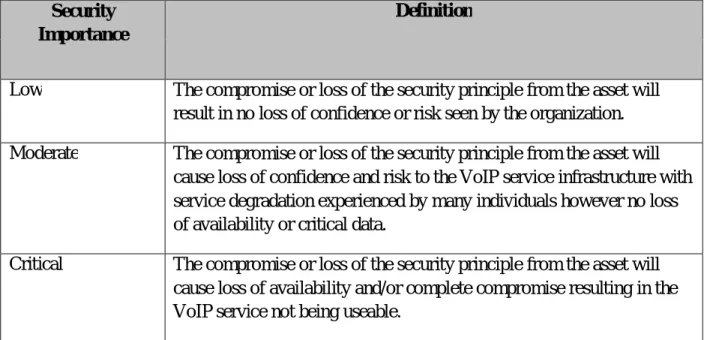
white paper. The following classifications of security importance are used for this assessment: 6
Security Importance
Definition
Low The compromise or loss of the security principle from the asset will result in no loss of confidence or risk seen by the organization. Moderate The compromise or loss of the security principle from the asset will
cause loss of confidence and risk to the VoIP service infrastructure with service degradation experienced by many individuals however no loss of availability or critical data.
Critical The compromise or loss of the security principle from the asset will cause loss of availability and/or complete compromise resulting in the VoIP service not being useable.
Table 5.0 – Security Importance Definition
7
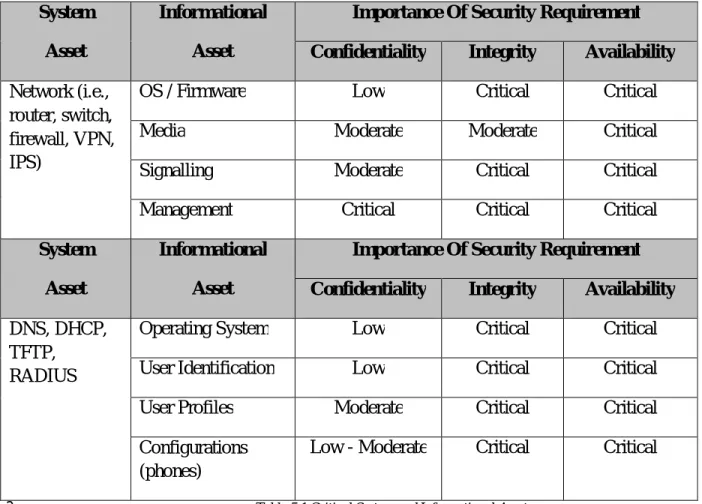
Table 5.1 below identifies system assets and corresponding informational assets which are 8
considered critical to the VoIP Reference Architecture, including the degree of importance each 9
core security requirement or principle has on each asset. 10 11 System Asset Informational Asset
Importance Of Security Requirement Confidentiality Integrity Availability IP Phone
Handset
Operating System Low Moderate Moderate
Configuration Low - Moderate Moderate Moderate
Media Moderate Moderate Critical
Signalling Moderate Critical Critical
Management Critical Critical Critical
1
System Asset
Informational Asset
Importance Of Security Requirement Confidentiality Integrity Availability
Desktop Operating System Low Moderate Moderate
VoIP Application (i.e., Soft phone)
Low Moderate Moderate
Media Moderate Moderate Critical
Signalling Moderate Critical Critical
Management Critical Critical Critical
System Asset
Informational Asset
Importance Of Security Requirement Confidentiality Integrity Availability IP PBX (includes media gateway, Call Controller / call manager) [Note 1]
Operating System Low Critical Critical Configuration Moderate Critical Critical
Dial Plan Moderate Critical Critical
Call Detail Records (and Billing Info)
Critical Critical Critical
Software Licenses Low Moderate Critical
Media Moderate Moderate Critical
Signalling Moderate Critical Critical
Management Critical Critical Critical
System Asset
Informational Asset
Importance Of Security Requirement Confidentiality Integrity Availability Element
Manager
Operating System Low Critical Moderate
Configuration and Management
1
System Asset
Informational Asset
Importance Of Security Requirement Confidentiality Integrity Availability Network (i.e.,
router, switch, firewall, VPN, IPS)
OS / Firmware Low Critical Critical
Media Moderate Moderate Critical
Signalling Moderate Critical Critical
Management Critical Critical Critical
System Asset
Informational Asset
Importance Of Security Requirement Confidentiality Integrity Availability DNS, DHCP,
TFTP, RADIUS
Operating System Low Critical Critical User Identification Low Critical Critical User Profiles Moderate Critical Critical Configurations
(phones)
Low - Moderate Critical Critical
Table 5.1 Critical System and Informational Assets 2
[Note 1] The call processing and media gateway functionality may be composed of a distributed or centralized
3
(appliance) architecture dependent on the specific vendor.
4
Threats on Critical Assets
5
Once critical assets are identified, the next step in a security risk assessment is to identify 6
potential threats and likelihood for the threat to occur in the organization. The security risk 7
assessment reviewed possible threats to the critical assets of our VoIP Reference Architecture by 8
identifying potential threat sources. A security threat is an entity with the capability, intent and 9
method to compromise, damage or alter an information system or information by taking 10
advantage of a weakness or vulnerability inherent to the exploited system or information. The 11
organization must understand how to profile a threat on its network infrastructure, devices and 12
data; and only afterwards can the organization properly develop a security strategy to protect 13
against potential threats. 14
A threat profile is defined by a specific entity or situation as the source of the security risk, 1
method of access into the organization, the entity’s authorized role in the organization, and 2
action taken by the entity to exploit a vulnerability to the asset in the organization. Many threats 3
will be initiated in a malicious and illegal manner however accidental threats will occur and must 4
be considered in the assessment and overall security mitigation strategy. Examples of deliberate 5
threat sources include malicious users residing inside and outside the VoIP service infrastructure, 6
downloadable software with malicious code, and physical disruptions. Accidental threat sources 7
may include power outage, fire, flood, software, hardware and firmware failures, and mis-8
configurations of phones and servers; although these too may be deliberate. Furthermore, such 9
threat sources may access an organization’s network infrastructure via numerous methods from 10
communication channels such as the Internet, LAN, WAN, wireless and modem, to physical 11
access methods such as laptops, USB memory sticks and drives, and third-party software. 12
13
It is threat sources with the possibility to exploit the vulnerabilities of each asset which leads to 14
consequences adversely impacting the organization and business objectives that must be 15
examined in the assessment. The following identifies common threat sources which may 16
compromise and exploit one or more critical assets to an organization. Some of these threat 17
sources are accidental whereas other threat sources are deliberate or intentional. Here are the 18
potential threat sources: 19
Malicious users such as disgruntled employees, contractors, hackers which may establish 20
an attack vector from either inside or outside the organization. 21
Accidental users such as trusted employees and contractors whose actions or inactions 22
may have caused an exploitable vulnerability. 23
Configuration weaknesses and mistakes from trusted actors. 24
Social engineering where confidential/sensitive information on the organization, 25
infrastructure and services is discovered using deception or misrepresentation. 26
Email with embedded Web links and malicious attachments. 27
Software such as flaws in the implementation of an application, protocol or operating 28
system, or delivery of malicious code (i.e., malware, virus, trojan, worm) into the 29
organization. 30
Hardware such as a defect in the hardware or delivery of confidential / sensitive 31
information to unauthorized personnel (i.e., USB memory sticks, used laptops and hard 32
drives). 33
Data leakage where confidential/sensitive information on a laptop and removable media 34
with the possibility of being stolen and/or discovered by malicious actors. 35
Third party providers providing an access conduit into the organization for deliberate 36
and accidental threats. 37
Physical interruption due to accidental or deliberate causes (i.e., power outage, flood, 38
severed Internet or PSTN circuit/cable, system upgrades, etc) 39
Unknown threats – thus risk assessment is an ongoing process. 40
Every organization has limited resource capabilities (i.e., personnel, budget) to implement the 1
ideal security strategy to address all potential threats. It is important to determine the potential 2
risk (or product of likelihood and impact) for a threat to actually exploit a vulnerability and cause 3
damage to the organization. The damage or impact may be qualified as a loss of availability, 4
integrity and confidentiality; including other possible losses. It is not possible to identify all 5
risks, nor is it possible to eliminate all risks. Therefore the organization must develop criteria to 6
prioritize such risks, and apply more resources to protect higher risk assets above lower risk 7
assets. Calculation of the threat likelihood may range from a simple qualitative classification to 8
a more in depth quantitative approach using historical data and trend analysis. Selection of the 9
most appropriate measurement for threat likelihood is out-of-scope for this white paper. The 10
white paper will utilize a coarse qualitative classification to illustrate the assessment performed 11
on our VoIP Reference Architecture. The classification is based on two key factors – time frame 12
of threat occurrence and location of threat source. Other factors such as access method, 13
accidental versus deliberate intention, and other dependencies can provide further granularity to 14
determine the threat likelihood, however, these factors were not used for this assessment. The 15
following scoring (or ranking) criteria should be used to determine the likelihood of a threat on 16
the VoIP Reference Architecture; the criteria is based on the ETSI TIPHON Threat Likelihood 17
Scoring Criteria [2]. 18
Low means (i) threat needs to bypass strong technical controls to exploit an organization, 19
or (ii) motivation for the threat is very low. 20
Medium means (i) threat needs to bypass less than strong technical controls without 21
significant effort, or (ii) motivation for the threat is reasonable. 22
High means (i) there are not sufficient controls to mitigate or prevent the threat, or (ii) 23
motivation for the threat is high. 24
25
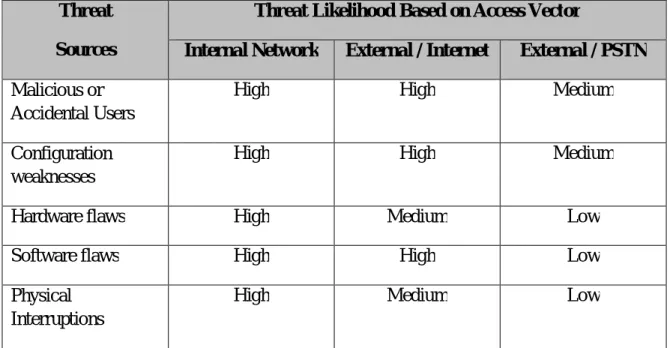
Basic threat sources such malicious users, configuration weaknesses, hardware and software 26
flaws, and physical disruptions were considered in the assessment of our VoIP Reference 27
Architecture and are depicted in Table 5.2 below. Other threat sources were not considered for 28
this whitepaper. 29
With the convergence of voice and data across a common IP network, it is anticipated the 30
likelihood for a threat source to adversely impact the organization is higher from the IP / data 31
network than PSTN (i.e., POTS). Thus the primary focus of this risk assessment will be with 32
LAN/WAN/Internet residing actors attempting to use these threats sources against the 33
organization. However threats from PSTN initiated weaknesses such as modems to gain 34
unauthorized access to systems are common enough that appropriate security controls will be 35
identified later in the document. Furthermore, as IP connectivity to the Public VoIP Network 36
(i.e., SIP trunks) becomes readily available, threats from the Public VoIP Network may certainly 37
increase. For purposes of simplicity, wireless IP access and remote VPN access (i.e., SSH, 38
IPSec) are considered an external method of access with threats similar to attacks from the 39
1
Threat Sources
Threat Likelihood Based on Access Vector
Internal Network External / Internet External / PSTN Malicious or
Accidental Users
High High Medium
Configuration weaknesses
High High Medium
Hardware flaws High Medium Low
Software flaws High High Low
Physical Interruptions
High Medium Low
Table 5.2 Threat Sources and Likelihood
2 3
Threat likelihood and threat impact are not the same. It is possible that a high probability threat 4
(i.e., hardware failure) may have a very low impact to the organization which implements system 5
redundancy. In other circumstances a threat with a smaller likelihood to occur, such as the loss 6
of a PSTN circuit, will have a critical impact to the organization. 7
8
The next step to the security risk assessment is to identify for each critical asset those threats 9
which potentially have a high likelihood and high adverse impact to the organization. The 10
following threat impact criteria have been identified; based on the ETSI TIPHON Threat Impact 11
Scoring Criteria [2]. 12
: 13
Minor (or Low) – impact will result in no loss of confidence seen by the organization. A 14
few individuals may be temporarily impacted. Potential damage will remain low. 15
Major (or Medium) – impact will cause loss of confidence to the VoIP service 16
infrastructure with service degradation experienced by many individuals however no loss 17
of availability or critical data. Potential damage can not be neglected. 18
Critical (or High) – impact will cause loss of availability and/or complete compromise 19
resulting in the VoIP service not useable. Potential damage may be severe. 20
Risk is a product of potential impact of threat on organization and likelihood for threat to occur. 1
Table 5.3 illustrates the threat risk scoring criteria used by ETSI TIPHON [2]. Low is scored 1, 2
Medium scored 2 and High scored 3; and thus a risk from 1 (lowest) to 9 (highest). 3
Countermeasures should always be implemented for higher risk threats before lower risks. 4
5
Threat Impact
Threat Likelihood
Low Medium High
Low Minor Risk Minor Risk Major Risk
Medium Minor Risk Major Risk Critical Risk High Major Risk Critical Risk Critical Risk
Table 5.3 ETSI TIPHON Threat Risk Score
6 7
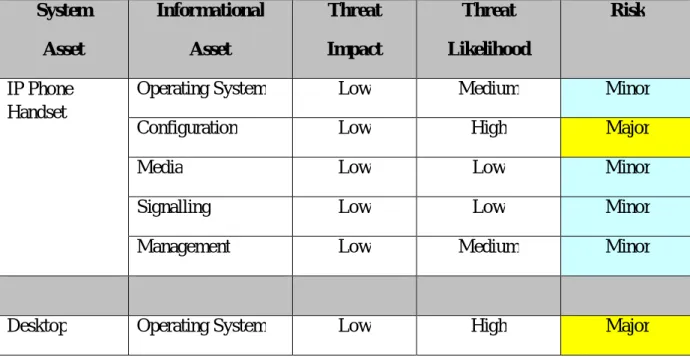
Next is to apply the threat impact, likelihood and risk scoring methodology defined above to the 8
critical assets identified for the VoIP Reference Architecture in Table 5.1. As described earlier 9
certain threat sources are more likely to occur inside the organization as oppose to outside. 10
Table 5.4 illustrates the risk to the assets from threats originating from inside the organization; 11
however risk of exploitation is based on organization’s deployment of security controls. The 12
same methodology may be applied to threats originating from outside. 13 14 System Asset Informational Asset Threat Impact Threat Likelihood Risk IP Phone Handset
Operating System Low Medium Minor
Configuration Low High Major
Media Low Low Minor
Signalling Low Low Minor
Management Low Medium Minor
VoIP Application (i.e., Soft phone)
Low High Major
Media Low Low Minor
Signalling Low Low Minor
Management Low Medium Minor
Call Controller and Media Gateway (or IP PBX)
Note 1
Operating System High High Critical
Configuration High High Critical
Dial Plan High High Critical
Call Detail Records (and Billing Info)
Medium High Critical
Software Licenses Medium High Critical
Media Medium Low Minor
Signalling Medium Low Minor
Management Medium Medium Major
Element Manager
Operating System Low High Major
Configuration and Management
Low High Major
Network (i.e., router, switch, firewall, VPN, IPS)
OS / Firmware High Medium Critical
Media Medium Medium Major
Signalling Medium Medium Major
DNS, DHCP, TFTP,
RADIUS
Operating System High High Critical
User Identification Medium High Critical
User Profiles Medium High Critical
Configurations (phones)
Medium High Critical
1
Table 5.4 Threat Risk Score of Critical Assets From Internal Threats 2
3
Vulnerabilities Exploited By Threats 4
With threats identified for each critical asset, the next step is to identify what possible 5
vulnerabilities may exist for each asset. As performed with threat sources, the exhaustive list of 6
vulnerabilities will need to be prioritized (or ranked) based on the likelihood or risk for the 7
vulnerability to be exploited by a threat and its adverse impact or consequence on the 8
organization. Such consequences include disclosure or viewing of sensitive information, 9
modification of important or sensitive information, loss of important information, and 10
interruption of access to information, applications and services. This section will discuss 11
vulnerabilities which may exist in the VoIP Reference Architecture and its impact to the 12
organization should appropriate security controls not be implement to protect the applicable 13
assets. 14
15
Vulnerability is a weakness or flaw in the design and implementation of the VoIP protocols and 16
applications, operating system, supplemental services (i.e., DNS, DHCP), network, physical 17
infrastructure, policies and procedures which may be exploited. Not only is the risk of a 18
vulnerability specific to the asset and information associated with the asset, the network location 19
of where the vulnerability is exploited is also of importance. Typically, an organization’s 20
network is partitioned into various security zones (i.e. trusted, DMZ and untrusted), each with its 21
unique security requirements. It is part of the security risk assessment to determine what risk the 22
vulnerability has on a specific asset in a particular security zone within the network. 23
24
As a threat gains access into the organization’s network, the threat attempts to discover assets 25
with exploitable vulnerabilities. Fundamentally, this is performed by scanning for specific 26
services and known ports (aka, footprinting), identify the device based on the running services, 27
ports and vendor ID in MAC address, and afterwards attempt to compromise the device based on 1
vulnerabilities known to exist for the device. 2
3
A threat may attempt to exploit numerous logical elements (i.e., module, process) of an asset or 4
focus on a single specific element. From an operational perspective, each element can be viewed 5
in terms of how the asset is involved with the VoIP service. The asset may be involved with the 6
signaling, media or management aspect of the VoIP service. Each type of traffic or ‘plane’ has 7
its own protocols. 8
Media or Bearer Plane is responsible to deliver the voice packets between IP endpoints 9
such as IP phones and media gateways. RealTime Protocol (RTP) and RealTime Control 10
Protocol (RTCP) are the key protocols used for media. 11
Signalling or Control Plane is responsible to deliver the call setup, teardown and mid-12
call information between IP endpoints, Call Controllers/call managers, and supplemental 13
servers such as DNS, DHCP, TFTP. The signalling plane is used to initiate traffic across 14
the media plane. For this assessment Session Initiation Protocol (SIP) is the primary 15
VoIP signalling protocol. 16
Management Plane is responsible to deliver the administration, management and 17
monitoring traffic out-of-band with respect to the actual voice call. The management 18
plane may use the same network as the signalling and media planes, or a separate 19
network may be provided for management purposes only. Various remote terminal (i.e., 20
Telnet, SSH), Web/GUI console (i.e., HTTP/HTTPS), file transfer (i.e., FTP, TFTP, 21
SFTP, SCP), configuration and monitoring (i.e., SNMP) and management user 22
authentication (i.e., RADIUS, TACACS) protocols are used across the management 23
plane. 24
25
The following are common types of vulnerabilities possible in the VoIP Reference Architecture. 26
Configuration weakness of the operating system and VoIP applications results in the use of 27
unnecessary services and open TCP/UDP ports, insecure management and file transfer protocols, 28
default service settings (i.e., use of ‘public’ community string for SNMP), and other vendor 29
assigned default settings simply enabled for ease of deployment. A weak configuration may 30
allow the attacker to exploit other vulnerabilities such as unauthorized access, reconnaissance 31
and denial-of-service. 32
33
Unauthorized access due to weak authentication typically results from use of credentials such as 34
a source IP address, default vendor passwords, simple passwords, and unencrypted (or cleartext) 35
passwords as the sole mechanism for validating identities and providing authorization for a user 36
or device to access resources. Failure to properly authenticate users can allow the realization of 37
additional threats including tampering, fraudulent use of the asset, eavesdropping, denial of 38
service, or compromise of system integrity. 39
Malicious Code is defined in NIST IR 7298 as “Software or firmware intended to perform an 1
unauthorized process that will have adverse impact on the confidentiality, integrity, or 2
availability of an information system. A virus, worm, Trojan horse, or other code-based entity 3
that infects a host.” Malicious code can be used to gather information on system management 4
and/or signalling and control for fraudulent use, denial of service, or further compromise of the 5
system. 6
7
Reconnaissance and Enumeration occur when a potential attacker seeks information about an 8
asset or system to cause an exploit or compromise. IP and MAC addresses, operating system and 9
application versions, open ports, and services used by the assets are some types of information 10
which can be harvested. Information may be gathered using any number of common protocols 11
and services such as BOOTP, TFTP, SNMP, HTTP, and SIP, including social engineering 12
techniques. As the attacker understands the organization’s VoIP deployment, the attacker can 13
probe or enumerate the organization for specific VoIP vulnerabilities. 14
15
Spoofing (or masquerading) involves presenting falsified identity information to gain 16
unauthorized access to a system; including a means to bypass access control measures. The 17
falsified identity may be a MAC or IP address, SIP Uniform Resource Identifier (URI), caller ID, 18
or other form of identity. FIPS 191 notes spoofing involves: (i) the ability to receive a message 19
by masquerading as the legitimate receiving destination, or (ii) masquerading as the sending 20
machine and sending a message to a destination. Attackers can use spoofing to launch further 21
attacks such as unauthorized access, fraudulent calls, denial-of-service, and man-in-the-middle 22
attacks. 23
24
Impersonation involves the pretence of legitimacy using falsified or captured credentials, such 25
as a rogue call server pretending to be the authorized call server. Impersonation relies heavily on 26
spoofing and eavesdropping to acquire the information needed. Impersonation can facilitate 27
registration and media session hijacking, toll fraud, denial of service, and system compromise. 28
29
Eavesdropping occur when an attacker can capture media, signalling or management traffic 30
without authorization. An attacker may use network assets to ‘sniff’ and forward duplicated 31
packets or redirect the signalling and media packets to a rogue device so the attacker may capture 32
the targeted traffic. Eavesdropping affects the confidentiality of a voice conversation delivered 33
across the media plane. When applied against the Signalling and Management planes, 34
eavesdropping can provide the attacker with sensitive information such as credentials (i.e., user 35
ID, password, PIN, telephone number) for use in more complex system intrusions such as 36
unauthorized access, toll fraud and man-in-the-middle attacks. 37
38
Signalling and Media Manipulation can lead to threats to communication integrity. Media 39
manipulation can include deletion, insertion, redirection and replay of media. Signalling 40
manipulation can result in denial of service via the generation of false registration packets which 41
tie up phone operations, the generation of invite packets which cause the phone to ring, and 42
sending “bye” packets which disconnect calls. It can also result in unauthorized redirection of 43
calls and facilitate the implementation of a rogue proxy onto the network. 44
Fuzzing occurs when an attacker sends messages with malformed syntax, incorrect or 1
unexpected message sequence to a system with the intent to crash it. This vulnerability may lead 2
to a type of DoS attack causing buffer overflows without the need for excessive flooding of 3
packets. Fuzzing may impact the availability and possibly the integrity or accountability of 4
organization’s VoIP service. 5
6
Man-in-the-middle attacks use interception, impersonation and spoofing to insert a rogue device 7
into the communications path as a legitimate server or endpoint. The impacts include 8
eavesdropping on a conversation, the deletion, injection or replay of media or signalling content, 9
reconstruction of DTMF tones, and redirection of a conversation. Interception of the traffic may 10
be performed at the network level (i.e., ARP poisoning) or application level (i.e., SIP registration 11
hijacking). 12
13
Denial-of-Service (DoS) attacks result in the disruption to the network, system or service 14
through the use of packets designed to overwhelm it. Packets may be carefully crafted payloads 15
to exploit an operating system or application, or a flood of packets to overburden the target. 16
Impacts range from ability to block legitimate calls, degradation of call quality, to crashing 17
segments of the network, system or application. Types of packet flooding range from ICMP, 18
UDP and TCP packets to application flooding such as various SIP protocol messages (i.e., Invite, 19
Register, Notify, Info, Option, Bye). Some flooding attacks may be unintentional such as SIP 20
endpoints configured with very short registration intervals, problematic software, and high traffic 21
circumstances (i.e., simultaneous reboot). Regardless, DoS attacks against VoIP/IP PBX 22
systems, DHCP, TFTP, DNS, and network-security devices can adversely impact the overall 23
VoIP service. 24
25
Theft of Service/Toll Fraud involves the unauthorized use of assets to place a call without 26
approval or payment. Typically a malicious actor gains access to a VoIP asset due to weak 27
authentication, spoofing, eavesdropping and impersonation. 28
29
VOIP Spam(or Spam over Internet Telephony – SPIT) and Phishing involve the unsolicited 30
use of email messages, voice messages or phone calls to gain credentials or other sensitive data 31
through social engineering. At some point, the volume of VOIP Spam can also degrade system 32
performance. 33
34 35
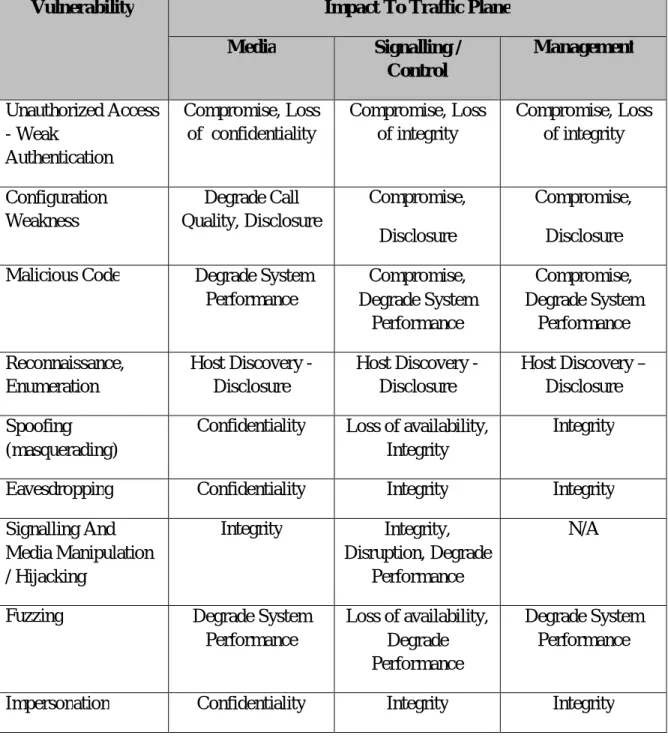
Table 5.5 identifies how each vulnerability classification will typically impact the organization 1
with respect to its signalling, media and management traffic. 2
3
Vulnerability Impact To Traffic Plane Media Signalling / Control Management Unauthorized Access - Weak Authentication Compromise, Loss of confidentiality Compromise, Loss of integrity Compromise, Loss of integrity Configuration Weakness Degrade Call Quality, Disclosure Compromise, Disclosure Compromise, Disclosure Malicious Code Degrade System
Performance Compromise, Degrade System Performance Compromise, Degrade System Performance Reconnaissance, Enumeration Host Discovery - Disclosure Host Discovery - Disclosure Host Discovery – Disclosure Spoofing (masquerading)
Confidentiality Loss of availability, Integrity
Integrity
Eavesdropping Confidentiality Integrity Integrity Signalling And Media Manipulation / Hijacking Integrity Integrity, Disruption, Degrade Performance N/A
Fuzzing Degrade System
Performance Loss of availability, Degrade Performance Degrade System Performance
Impersonation Confidentiality Integrity Integrity 4
1
Vulnerability Impact To Traffic Plane Media Signalling / Control Management Man-In-The-Middle Attacks Intercept and manipulate to impact confidentiality Intercept and manipulate to impact integrity Intercept and manipulate to impact integrity Denial-Of-Service Attacks Degrade Call Quality & System
Performance
Loss of Availability, Resource exhaustion
Loss of Reliable In- band Management Theft of Service / Toll Fraud Unauthorized or fraudulent calls N/A N/A
VoIP Spam And Phishing Degrade System Performance Identity Theft, Disclosure Disclosure
Table 5.5 Vulnerability Impact on Traffic Plane
2 3
A threat which has successfully exploited a vulnerability of a critical asset will have adversely 4
impacted the VoIP Reference Architecture. This impact or consequence will broadly result in 5
the unauthorized disclosure of information, the modification of information or operation for 6
unauthorized purposes, interruption of an asset, service or network without cause, or loss of an 7
asset, service or network. The following vulnerability impact classifications on assets have been 8
identified: 9
Low – impact will result in no loss of confidence or degradation of service seen by the 10
organization. A few individuals may be temporarily impacted. 11
Medium – impact will cause loss of confidence to the VoIP service infrastructure with 12
service degradation experienced by many individuals however no loss of availability or 13
critical data. 14
High – impact will cause loss of availability and/or complete compromise resulting in the 15
VoIP service not useable. 16
17 18
Table 5.6 shows the potential impacts of select vulnerabilities in four consequential areas: 1
disclosure, modification, interruption, and loss. These are average impacts and not necessarily 2
the worst case impact. 3
Vulnerability Impact of Vulnerability on Asset (= Consequence) Disclosure Modification Interruption Loss Unauthorized
Access - Weak Authentication
High High High High
Configuration Weaknesses
Low-Medium High Medium Medium
Malicious Code Low High Medium Low
Reconnaissance Low Low Low Low
Spoofing Low Medium Low Low
Eavesdropping Low Low Low Low
Signalling And Media
Manipulation / Hijacking
Low High Medium Medium
Fuzzing Low Medium Medium Low
Impersonation Medium High Low Low
Man-In-The-Middle Attacks
Low High Medium Medium
Denial-Of-Service Attacks
Low Low High Medium -
High Theft of Service /
Toll Fraud
Low Low Low High
VoIP Spam And Phishing
Medium Low Low Low
Table 5.6 Vulnerability Impact on Asset
Table 5.7 shows the most critical security requirements, most critical impacts, and most likely 1
threat vulnerabilities for selected system assets. 2 System Asset Informational Asset Most Critical Security Req Most Critical Impact
Most Likely Threat-Vulnerabilities
IP Phone Handset
Operating System Integrity Modification Traditional Data Exploits Configuration Integrity Loss of Avail. Weak Authentication
Media Integrity Call Quality
Degradation / Loss of Avail.
DoS Attack
Signalling Integrity Interception Eavesdropping Management Integrity Interception Eavesdropping System Asset Informational Asset Most Critical Security Req Most Critical Impact
Most Likely Threat-Vulnerabilities
Desktop Operating System Integrity Loss of Avail. Malicious Code, Traditionnel Data
Exploits VoIP Application
(i.e., Soft phone)
Integrity Loss of Avail. Configuration Weakness
Media Integrity Call Quality
Degradation / Loss of Avail.
DoS Attack
Signalling Integrity Interception Eavesdropping Management Integrity Interception Eavesdropping 3
1 System Asset Informational Asset Most Critical Security Req Most Critical Impact
Most Likely Threat-Vulnerabilities
Call Controller and Media Gateway (or IP PBX)
Operating System Integrity Modification Malicious Code, Traditionnel Data
Exploits Configuration Integrity Loss of Avail. Configuration
Weakness Dial Plan Integrity Loss of Avail Theft of Service / Toll
Fraud Call Detail Records
(and Billing Info)
Integrity and Confidentiality Loss of Avail., Repudiation Weak Authentication, Configuration Weakness Software Licenses and Operational Service
Availability Loss of Avail. Weak Authentication
Media Integrity Call Quality
Degradation / Loss of Avail.
DoS Attack
Signalling Integrity Interception Eavesdropping Management Integrity Interception Eavesdropping System Asset Informational Asset Most Critical <