•
•
•
•
•
•
•
•
•
•
•
•
•
•
•
•
•
•
•
•
•
•
Volume VII No. 1
A 3M Unitek Publication
Clinical information for the orthodontic professional
Focus on Bonding
•
•
•
•
•
•
•
•
•
•
•
•
•
•
•
•
•
•
•
•
•
•
Our theme for this issue of Orthodontic Perspectives is “Focus on Bonding.” Broadly speaking, to focus means to direct attention toward and to bring into clear vision. It can also mean a purposeful convergence and concentration of activity. For 3M Unitek, our focus is the professional Orthodontic community, and our unrelenting effort to provide those of you in this special group innovative, quality products that make your life easier. Our focus also includes building the best customer relationships through our service and support. We promise that this focus will continue in the years ahead. As I mentioned, bonding is the main subject of this issue. This gives us the opportunity to present and discuss Transbond™ Plus Self Etching Primer, an exciting bonding product that can help increase efficiency and productivity in your practice. There are also articles which share bonding experience and practical insights that we believe will be of interest to you in your work.
In each issue we also like to bring a message to you from a member of our 3M Unitek Leadership (TLC) Committee. For this issue, Kim Fernandes gives you insight on the philosophy behind our global service structure and some recent changes designed to keep our support of you, our valued customers, on a world-class level.
I hope you find the information in our publication valuable in your practice, and I look forward to our continued relationship in the 21st century.
Global Service: Structured for Customer Satisfaction
by Kim S. Fernandes; Manager, 3M Unitek Global Sales/ServiceOur vision at 3M Unitek is to develop and maintain the best customer relationships in the orthodontic industry. I would like to take a moment to share with you how we in the service area are committed to achieving this vision.
As a global company, we know the importance of local support that understands the culture, speaks the native languages, and is available to meet your needs. To meet this challenge we have in-country service support in over 45 countries.
Over the past several years, we have made many changes to ensure that we can continue to exceed your expectations. We have implemented major organizational changes that eliminated traditional departments and are organized under one Global Services organization. By doing this, we are able to implement change quickly and focus on what is important to you. An example of this is when you, our customers, wanted it to be easier to do business with us. In response, we implemented our Single Point of Contact concept. Our Inside Sales Staff are trained to manage inquiries at the point of contact and we have eliminated the transferring of thousands of phone calls. We now consistently manage over 90% of our calls at the point of contact.
We understand that to provide world-class service we must have exceptional employees that are empowered to make decisions. Our staff is highly motivated and operates in a team environment. We continue to invest in training to ensure that we are equipped with the
Message from the President
by Patrick B. FordContents
Message from the PresidentPatrick B. Ford
Transbond™ Plus Self Etching Primer – A No Mix, Unit Dosed Primer That Reduces Bond Failure
Robert A. Miller, D.M.D. – 3 Chemical Processes and Performance Comparisons
of Transbond™ Plus Self Etching Primer
David Cinader – 5 Prescription Full Arch Indirect
Bonding Utilizing Adhesive Precoated Brackets John T. Kalange, D.D.S., M.S. – 7
The Bottom Line® Resident’s Program Terry Sellke, D.D.S., M.S. – 12
Summit in Las Vegas – 14 Continuing Education – 15 3M Enters Agreement to Combine Dental Products
Division and ESPE – 16
Orthodontic Perspectives is published periodically by 3M Unitek to provide infor-mation to orthodontic practitioners about 3M Unitek products. 3M Unitek welcomes article submissions or article ideas. Article submissions should be sent to Editor, Orthodontic Perspectives, 3M Unitek, 2724 S. Peck Road, Monrovia, CA 91016-5097 or call. In the United States and Puerto Rico, call 800-852-1990 ext. 4266. In Canada call 800-443-1661 and ask for extension 4399. Or, call (626) 574-4399. Copyright ©2000 3M Unitek. All rights reserved. No part of this publication may be reproduced without the consent of 3M Unitek.
APC, Clarity, MBT, Sondhi, Transbond and Unitek are trademarks of 3M Unitek.
Have your patients visit our Clarity™ Braces Web Site at
www.3M.com/Clarity
3 Over the years, I have incorporated new bonding agents into my
practice in a never ending quest to find a simple, universal bonding agent that is both easy to use and compatible with Orthodontic adhesives. The new Transbond™ Plus Self Etching Primer has all of the desired properties ideally suited for the application of any orthodontic attachment where speed is of paramount importance, such as in a wet field. The elimination of the etching step can now finally be achieved, even though etching is taking place. Mechanical adhesion is achieved through a unique adhesive chemical process whereby the etchant chemical compound converts to a primer, thus leaving an etched primed surface without rinsing.
No adhesive to date is as simple and as well received among our staff. The unit dosed packaging provides the right amount to etch and prime an entire arch. The unique foil packaging is designed so the material is self mixed when compressed and problems previously associated with inconsistent mixing and evaporation are no longer a problem.
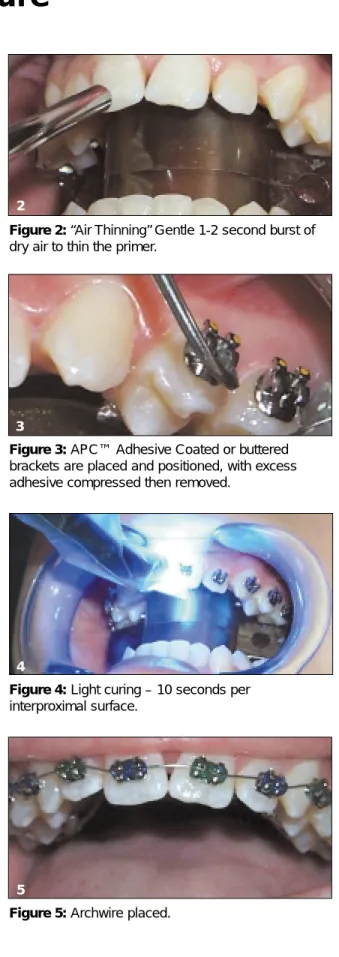
The following series of photographs show how this material is incorporated into a direct bonding technique (Figures 1-5).
Transbond
™Plus Self Etching Primer –
A No Mix, Unit Dosed Primer
That Reduces Bond Failure
by Robert A. Miller, D.M.D.Upon completing his Orthodontic residency at the Medical College of Virginia, Dr. Miller entered the Air Force where he was the Chief of Orthodontics at Clark Air Base in the Philippines. After 3 years he and his family moved to Charlottesville, Virginia where he practiced in a group private practice for 12 years. He currently has a private office located in Culpeper, Virginia. Dr. Miller is a diplomate, American Board of Orthodontics, and has published numerous articles in the JCO on adhesives and Class II Correctors.
Figure 1: Transbond™ Plus Self Etching Primer is applied after pumiced teeth are rinsed and dried (swirl for 3 seconds per tooth).
Figure 3: APC™ Adhesive Coated or buttered brackets are placed and positioned, with excess adhesive compressed then removed.
1
3
Figure 2: “Air Thinning” Gentle 1-2 second burst of dry air to thin the primer.
2
Figure 5: Archwire placed.
5
Figure 4: Light curing – 10 seconds per interproximal surface.
4
Another unique application is bonding to
impacted canines.
(Figures 6-13)Summary
Speed and efficiency are prerequisites for effective bonding of acrylic appliances. The combination etchant/primer is ideally suited for this situation.
The time saved and reduced expenses from fewer bond failures more than offset the cost of this product. We have been using this routinely for all bonding procedures that require etching, and although the reduction in bond failure is not clinically significant, we have noticed fewer failures in the difficult, wet field areas.1
To summarize, the new Transbond™ Plus Self Etching Primer is ideally suited for all bonding procedures that require etching and priming. It works particularly well in a busy practice where multiple assistants are involved in the bonding process and a desire for reducing steps, and minimizing the opportunity for failure exists. ■
Figure 7: 3 weeks, post surgery, ready to bond.
7
Figure 6: Apically repositioned flap for a buccally displaced, impacted canine.
6
Figure 9: 3 month post bonding.
9
Figure 8: Canine etched and bonded with Transbond™ Plus Self Etching Primer and Transbond™ XT Adhesive.
8
Figure 10: 4 month post bonding. 10
Figure 11: Anterior intraoral prior to appliance removal. 11
Figure 12: Anterior intraoral after removal of maxillary appliances.
12
Figure 13: Essix™ retainer with the same pontic teeth for an immediate retainer.
13
Figure 14: Smile with Essix™ retainer 1 hour after appliance removal.
14
REFERENCE
1 Miller R.A. The Laboratory and Clinical Evaluation of a New 6th Generation Self-Etching Primer in Orthodontics, JCO, In Press.
5 Historically, the direct bonding process has been a complicated
task. Practitioners must first prophy the teeth with a pumice slurry, rinse and dry. They must then dry the teeth and etch with a phosphoric acid solution. The etchant is rinsed from the teeth, being careful not to allow any contact with the gingiva. The teeth are then dried and a primer applied. An additional complication is that adhesive systems were notoriously sensitive to recontamination.
Etching and Priming Simultaneously
A self etching primer combines the etching and priming steps. The active ingredient is a methacrylated phosphoric acid ester. Phosphoric acid and a methacrylate group are combined into a molecule that etches and primes simultaneously. One of the advantages to this simultaneous etching and priming is that the primer penetrates to the entire depth of the etch, ensuring an excellent mechanical interlock.
With phosphoric acid, the etching of tooth enamel occurs by a selective dissolution of the calcium from the enamel structure. The calcium is then washed from the tooth surface when rinsing the tooth. This situation can be likened to submerging a honeycomb in water. The water dissolves the sugar-rich honey, leaving the waxy cells of the comb (Figure 1).
Figure 1: Honeycomb.
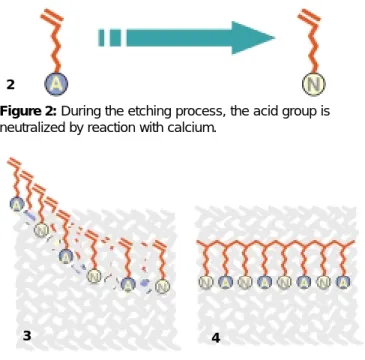
Self etching primer etches in a similar fashion as phosphoric acid. The phosphate group on the methacrylated phosphoric acid ester dissolves the calcium and removes it from the hydroxyapatite. However, rather than being rinsed away, the calcium forms a complex with the phosphate group and is incorporated into the network when the primer polymerizes. In this manner the acid is neutralized (Figure 2). Agitating the primer on the surface of the tooth serves to ensure that fresh primer is transported to the surface of the tooth. Etching and penetration of the exposed enamel rods are simultaneous (Figure 3). In this manner, the depth of the etch and of the primer penetration are identical (Figure 4).
Figure 2: During the etching process, the acid group is neutralized by reaction with calcium.
Figure 3: Primer molecules penetrate the enamel rods concurrent with etching.
Figure 4: Following light cure, primer molecules are polymerized to form a network.
Three mechanisms act to stop the etching process. First the acid groups attached to the etching monomer are neutralized in a similar manner as is phosphoric acid, by forming a complex with the calcium from the hydroxyapatite. Second, as the solvent is driven from the primer during the air burst step, the viscosity rises, slowing the transport of acid groups to the enamel interface. Finally, as the primer is light cured and the primer monomers polymerized, transport of acid groups to the interface is stopped.
Dave Cinader received his Bachelor of Science Degree in Chemical Engineering from Michigan Tech University in 1994. While working on his bachelor's degree, he worked for 3M as a cooperative education student in an abrasives factory and in a polymer processing laboratory. In 1999, he received his Ph.D. in Chemical Engineering from Northwestern University. He joined 3M Unitek Research and Development in September 1999. Since then, he has been involved in orthodontic adhesive development.
Chemical Processes and
Performance Comparisons of
Transbond
™Plus Self Etching Primer
by David Cinader; Senior Product Development Engineer, 3M Unitek
3 4
2
6
Etch Patterns Similar To
Conventional Products
The resulting etch patterns are quite similar to those obtained from a 37% phosphoric acid etch (Figure 5). Both patterns show the exposed enamel rods associated with an acid etch.
Figure 5: Images of enamel etched by: a) 37% phosphoric acid. b) Transbond™ Plus Self Etching Primer.
Performance Comparisons
Bishara et al.(1998) have examined the use of an experimental self etching primer in the bonding of orthodontic brackets. They obtained mixed results, depending on the adhesive used. Comparison of shear/peel bond strength of Transbond Plus self etching primer with Transbond™ XT Light Cure Adhesive and Transbond™ MIP Moisture Insensitive Primer reveals that the bonding performance of Transbond Plus self etching primer is quite good (Figure 6). Transbond Plus self etching primer performs as well as Transbond MIP Primer under dry, wet, and saliva contaminated conditions. It outperforms Transbond XT Light Cure Adhesive under wet and saliva contaminated conditions.
Figure 6: Comparison of bond strengths of Transbond™ primers under dry, wet, and saliva contaminated conditions. Transbond™ XT Adhesive with Miniature Twin brackets.
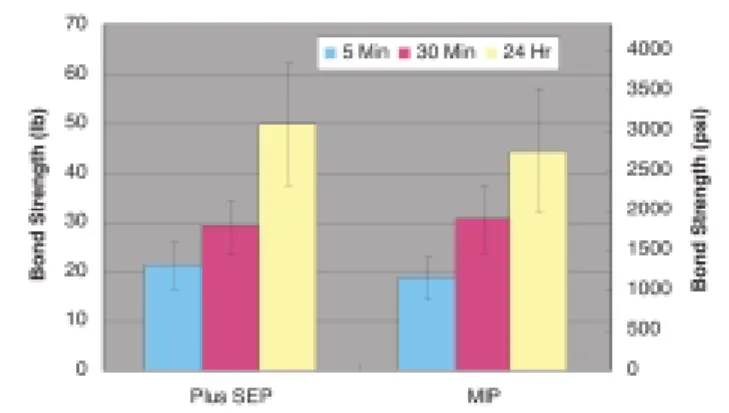
The bond strength builds quickly to ensure that brackets will not come loose while an archwire is being engaged. The shear/peel bond strength of Transbond Plus self etching primer was measured at 5 minutes, 30 minutes, and 24 hours following light cure and compared to that of Transbond MIP Primer at the same intervals. Figure 7 reveals that the self etching primer again performs as well as Transbond MIP Primer.
Figure 7: Comparison of bond strengths of Transbond™ Plus Self Etching Primer and Transbond™ MIP Primer for various time intervals following cure. Transbond™ XT Adhesive with Miniature Twin brackets.
There is no degradation in bond strength over time in the mouth. This ensures that the bond is strong enough to tie in heavier archwires as treatment progresses. Figure 8 shows the shear/peel bond strength as a function of time following cure for periods of 24 hours, 1 month, and 4 months. Again, the bond strength is similar to that of Transbond MIP Primer. More importantly, however, both primers show no signs of weakening with time in the mouth.
Figure 8: Bond strengths as a function of storage time at body temperature. Transbond™ XT Adhesive with Victory Series™ Brackets.
Summary
The results discussed above show that Transbond Plus self etching primer performs as well as current primers yet offers convenience and efficiency by removing steps. It also performs well under dry, wet and saliva-contaminated conditions. This will serve to make the bonding process as problem free as possible. ■
REFERENCE
Bishara, S.E.; Gordan, V.V.; VonWald, L.; and Olson, M. American Journal of Orthodontic
and Dentofacial Orthopedics. 1998. Vol. 114, pp. 243-247.
7 Although I haven’t truly experienced orthodontics from a “wire
benders” standpoint, I can fully relate to the above axiom when I am presented with the option to either bend a wire, or to reposition a bracket if I want to move an individual tooth. My colleagues that routinely direct bond brackets, frequently comment that after bonding, and then initial alignment, they have patients return to reposition errantly placed brackets. My response, with tongue in cheek, is the comment, “Gee, if you positioned those brackets correctly in the first place, you could have saved yourself, and your patient the trouble. Maybe you should consider indirect bonding.” Seriously though, any good orthodontist must reposition brackets in order to achieve optimal tooth positioning. Or alternatively, they must resort to—what may be known as heresy in the world of “straight wire” orthodontics—wire bending!
We all know that irrespective of the philosophy, appliance type, or mechanics used, wire bending simply is, and will always be a part of contemporary orthodontics. The issues at hand then become, what can we do to minimize the need to bend wires, and what can we do to increase our efficiency levels? How can more accurate bracket positioning allow us to achieve better results as a matter of routine? The answers to these questions lie in the concept of indirect bonding, and more specifically, Prescription Full Arch Indirect Bonding. I have been using APC™ Adhesive Precoated Brackets, and full arch indirect bonding for a number of years, and in all clinical situations. And although I admit, reluctantly I must say, to the need to reposition brackets despite my diligent efforts to get them in the ideal position initially (with indirect bonding), I do find infrequent conditions where bracket relocation is needed. However, I would argue that the situations where repositioning is called for, are few and far between compared to the situations faced by those who direct bond.
Given this opportunity, I would like to share what I consider to be a technique that can revolutionize your practice, energize the doctor and staff, and simply make orthodontics easier and more efficient.
To begin the procedure, recontour the anterior teeth to ideal proportions (Figure 1) and obtain accurate alginate impressions, and pour them up in orthodontic stone. Draw vertical lines on the models representing the long axis of the teeth (Figure 2).
Prescription Full Arch Indirect Bonding
Utilizing Adhesive Precoated Brackets
by John T. Kalange, D.D.S., M.S.Dr. John Kalange received his dental degree from Creighton University, and his post graduate certificate and M.S. in Orthodontics from Marquette University. He has maintained a full-time private practice in Boise, Idaho since 1988. Dr. Kalange is a diplomate of the American Board of Orthodontics, and has published in both the AJO and JCO. Dr. Kalange has interests in the area of practice efficiencies and specifically efficiency related to bracket positioning. He has used prescription indirect bonding in his practice for the past 12 years, and lectures on the treatment mechanics related to, and the use of adhesive precoated brackets in indirect bonding.
“In the past, the best results were achieved by the best wire benders. In the future, the best results will come from those
orthodontists who are the best bracket positioners.”
– Dr. Richard P. McLaughlin
1
continued on page 10
At last.
Etching and Priming
in One Simple Step.
Transbond
™Plus
Self Etching Primer.
Your wait is finally over. Now there’s a primer solution that lets you etch, prime and bond easier and more efficiently than ever before. With Transbond Plus Self Etching Primer, you can forget about all the problems associated with separate etchants, primers and applicator brushes.
Transbond Plus Self Etching Primer features a convenient delivery system that’s unlike any you’ve used before. A single-patient use foil pack contains pre-measured etchant and light cure primer that are applied together, using a disposable applicator included with each pack. And its special chemistry works in wet and dry environments, assuring you of outstanding bond strength in the most difficult conditions.
A perfect complement to our APCTMAdhesive Coating
System and TransbondTM Light Cure
Adhesive systems, Transbond Plus Self Etching Primer with fluoride release means fewer steps, less chance for costly bond failures due to moisture contamination, and no more mess.
If you’re looking for higher practice productivity, don’t wait. Call your local 3M Unitek sales consultant today to discover more about Transbond Plus Self Etching Primer.
U.S. and Puerto Rico: 1-800-423-4588 Canada: 1-800-443-1661
APC and Transbond are trademarks of 3M Unitek Corporation. ©2000 3M Unitek. 014-424
10
continued from page 7
On each of the molars and bicuspids, draw a line from one marginal ridge to the other (Figure 3). Mark another line 2-2.5 mm below this line. The second line represents the “slot lines” (Figure 4). Transfer the distance from the cusp tip to the slot line on the first bicuspid to the central incisor. Using this measurement, deduct .5mm for the upper lateral incisor, and add 1mm for the canine (Figure 5 A-D). On the lower arch, add 1mm for the canine. The casts with the markings are used for placing the adhesive precoated brackets (Figure 6 A-B). Using this prescription will align marginal ridges, parallel root arrangement, and place all the esthetic surfaces in the ideal positions.
5a 4 5b 5d 6a 6b 3 5c
Apply two coats of separating agent on the models, and let them dry. An assistant can then place the APC™ brackets on the models. The doctor then checks the brackets and finalizes their position. The models are then placed in a light-curing unit for 4 minutes (Figure 7), or cured using a hand held unit (Figure 8). The custom transfer tray is then constructed using a very heavy viscosity putty (Figure 9), soaked in water for 20 minutes, separated from the casts, and placed back in the light-curing unit with the brackets facing up for an additional 1 minute.
11 14 11 9 10 13 12
Very lightly, microetch the custom bases with 50-micron aluminum oxide, and then rinse the trays in distilled water. Trim the trays with an exacto-knife, and make an index mark to indicate the midline (Figure 10). Clean the teeth using a pumice slurry, and isolate using the Nola Dry Field System™. Etch the teeth using 37% phosphoric acid per the usual protocols (Figure 11). The brackets are then bonded using the transfer trays and Sondhi™ Rapid Set Bonding Adhesive, (Figure 12). Remove the trays, clean the excess flash, and place the initial wires. (Figure 13).
8 7
To test the validity of this prescription, I captured a digital image of one of my treated cases (Figure 14), and used the above described prescription to place lines on the teeth. When we look at this figure, it becomes apparent that if we place the bracket slots on the prescribed positions and then place a straight wire in the slots, the only thing we are left to contemplate to detail the case are some minor in/out corrections, and any individual torque requirements. This approach simply makes treating any case easier!
While traveling recently, I was reminded of the high cost of progress, when an on-flight video illustrated how our streets are being torn up to make room for conduits for the “information super highway.” The price of this change is initially high and comes replete with obstacles. However we have come to realize that change is a necessary and inevitable consequence of progress. We can either embrace the change, and allow it to improve the quality of our lives, or view it with an eye of contempt.
I view Prescription Full Arch Indirect Bonding as a proper analogy to the above-mentioned scenario. Although the learning curve is initially steep in this technique, ultimately the rewards for the patient, doctor and staff are immeasurable. ■
NOTES
1. Some of the figures used are reprints from the September 1999 JCO article and are used by permission of JCO.
2. Dr. Kalange is in the private practice of orthodontics at 136 E. Mallard Dr., Boise, Idaho Telephone: 208-342-0212. He is a Diplomate of the American Board of Orthodontics. He lectures on the use of adhesive precoated brackets and full arch indirect bonding using MBT™ Appliance System mechanics, and also conducts Limited Attendance In-office courses on prescription indirect bonding, MBT Appliance System mechanics, and emerging technologies.
3. Dr. Kalange has an in-house lab available for set-ups and provides this service to other orthodontists.
12
An Open Letter to the Readers of Orthodontic Perspectives:
3M UNITEK asked me to write a short letter about The Bottom Line®program. Teaching practice management and marketing
is nothing new to me, having taught it to my residents at the University of Illinois for over 25 years. The Bottom Line®
program, however, was born a few years ago while walking on the beach in Mexico with my wife, Dee. We were enjoying some quiet time after reviewing the results of the latest revisions of our office scheduling and tracking systems. We were reminiscing about how our staff had become truly empowered and enthusiastic supporters of the “patient centered practice” we had developed over the years. Their enthusiasm and our collective efforts had allowed us to more than double the size of an already large private practice in just three years without adding additional hours. It was a goal that the staff (and my wife) were skeptical about ever achieving. These past several years have truly been the best years of my personal and professional life.
While on the beach, we decided that we could help our colleagues fast track through the learning curve that I experienced over a 27 year career. Residents and recent graduates will benefit the most from this program, no doubt. However, I believe that even veteran orthodontists would benefit from the comprehensive course. It organizes the business aspects of orthodontics in a way never taught before.
Here is how The Bottom Line®works. There are four distinct components.
• Two-day resident’s program.Three noted educators join me to share knowledge with residents as they prepare for the transition into private practice. This course will be offered to all U.S. and Canadian university residents in regional programs supported by 3M UNITEK.
• One-day seminar for practicing orthodontists. This was designed as an overview of real world solutions to a multitude of today’s practice management and marketing issues. This introductory course gives an insight to what you might expect from the comprehensive course. Successful (and not so successful) concepts are discussed. • Comprehensive series.The comprehensive series involves four sessions over a period of 14 months. It will provide
ALL the business tools I have learned from first hand experience and the gurus of the past 27 years. Manuals, practice plans, scheduling templates, reporting and tracking systems, and much more will be supplied to participants on CD-ROMs to allow for easy implementation and customization. Attendance is limited to ensure that I have time to assist each attendee achieve his/her own practice vision.
• Study group.Respected colleagues are invited to share their ideas on practice management and marketing in this rapidly evolving orthodontic climate. Only established practitioners with well-run, successful practices will be allowed to attend. If you are interested, please call (877) ORTHO34 for an application.
If these courses make sense to you, I urge you to talk to your 3M UNITEK representative or call Kelly, my business manager, at (877) ORTHO34. My goal is to help you thrive in the business we call orthodontics and to enjoy your practice as never before! That’s The Bottom Line!
Respectfully,
30 N. Slusser • Grayslake, IL 60030 • (877) ORTHO34
13
For more information or to register for the Comprehensive Series or the Study Group, please contact Ms. Kelly Buchman at 1-877-ORTHO34.
Successful Strategies For Private Practice Orthodontists
Today’s orthodontic residents are well prepared clinically. However, few are adequately trained for the challenges of initiating and managing their practices. The Resident’s Program prepares students for the real world challenges that they will face. Information and guidance on securing financing for a start-up practice, developing and managing a comprehensive marketing program, and developing referral relationships are but a few of the subjects that will be presented. You will learn how to grow at exponential rates while avoiding common graduate mistakes and capitalizing on the opportunities that you may not know exist. This program is a must for every orthodontic resident.
Resident’s Program Dates for 2001 January 5-6, 2001 Chicago, IL February 17-18, 2001 Nashville, TN February 24-25, 2001 Arcadia, CA March 3-4, 2001 Mystic, CT November 3-4, 2001 Dallas, TX
How can you evaluate the value of our comprehensive series or study club? To answer this question we have developed one-day seminars that will highlight the fundamental concepts of The Bottom Line®. Available to individual orthodontists and
interested orthodontic groups, the One-Day Seminars will provide you with new information and new insights on achieving the highest level of personal and practice success. You see, setting goals and seeking excellence in management, marketing, and training, all impact your bottom line. This could very well be the most valuable seminar that you have ever attended. Spend the day with us and prepare to be inspired.
One-Day Seminars Dates for 2001
January 10, 2001 New Jersey Ortho Society
East Windsor, NJ June 8, 2001 San Francisco, CA September 14, 2001 Alexandria, VA September 21, 2001 Charlotte, NC
There are few qualified sources today for an orthodontist seeking information on the business aspects of private practice. Existing practitioners facing important decisions on how to grow, become more efficient, become more profitable, while simultaneously improving excellence are similarly hampered. Recent graduates are forced to learn by unguided research, trial and error, or if lucky, by a mentor. The Comprehensive Series will teach you how to set practice goals and give you the tools to achieve them. It will teach you how to develop a patient-centered practice, driven to excellence that is simultaneously fun and hugely profitable.
Comprehensive Series Dates for 2001/2002
Course I: February 1-4, 2001 Maui, HI
Course II: June, 2001 Chicago, IL Course III: October, 2001
Orlando, FL Course I & IV: January, 2002
St. Thomas, Virgin Islands
Wouldn’t it be nice to belong to a study group of respected colleagues that you could share ideas with on how to excel as practitioners as well as businessmen/women? Imagine a forum where private practice orthodontists could share ideas on staffing, scheduling, management, practice transition, marketing, or achieving financial security. Imagine a forum for sharing new ideas in diagnosis or techniques in treatment that will make your results more stable, your treatment shorter, your treatment more profitable, and your patients happier. If these concepts appeal to you, then The Bottom Line®Study Group is right for you.
The Bottom Line®
Study Group Annual Meeting Dates
March 19-21, 2001 Cancun, Mexico (Mayan Riviera) January, 2002 St. Thomas, Virgin Islands
ummit
2001
S
on’t Miss the 4th Annual Summit
in Las Vegas from 3M Unitek!
D
Seating is limited, so register early
and secure a seat!
To register by phone, call
1-800-852-1990 ext. 4649, or contact
your 3M Unitek representative.
3
Unitek
Products that make your life easier.
Monte Carlo
Las Vegas
Program Outline
“Surgical Orthodontics for the New Millennium”
The following program will feature Dr. Richard McLaughlin and Dr. G. William Arnett. The topics of discussion will be as follows: Dr. McLaughlin will discuss five frequent categories of surgical orthodontic management:
1. Class II mandibular advancement 2. Class II maxillary impaction and maxillary
impaction/mandibular advancement 3. Class III mandibular set-back
4. Class III maxillary advancement and maxillary advancement/mandibular set-back
5. Asymmetrics
Dr. Arnett will discuss the following topics:
1. Criteria for successful occlusal treatment 2. Inadequate occlusal-facial results 3. Quality occlusal-facial results
4. Soft tissue cephalometric treatment planning 5. Orthodontic and surgical tips and tricks
CEO “Clinically Efficient Orthodontics”
Building the Value Added Practice
Setting the Standard
From the Initial Phone Call through Retention Incorporating a “Four Seasons” Atmosphere
Excellence at Every Step
Preparation for Production
Preventing the Unnecessary Emergencies by Going the Extra Mile Capturing the Complete Orthodontic Experience for Patients and Staff
Patient Managing Think Out of the Box
Understanding, Anticipating and Communicating
Maintaining the Standard
Aesthetic Orthodontics Focus on Finishing Work Smart Not Too Hard
Bonding – What’s New? IDB vs. Direct Bonding
Posterior Bonding and the Importance of Bracket Choices Hiring and Staffing
Clinical Pearl Jam
Stress Reducers Solutions Techniques Communication
March 29 ~ April 1, 2001
Las Vegas, Nevada
Monte Carlo Hotel
Lecture Topics:
“Surgical Orthodontics
for the New Millennium”
and
CEO “Clinically
Efficient Orthodontics”
Featuring: Dr. Richard McLaughlin Dr. G. William Arnett Dr. Randy Kunik Ms. Robin Dodson15
Continuing Education
Products that make your life easier.3
Unitek
DATE SUBJECT PRESENTER(S) LOCATION
CE SCHEDULE
1/10/01 The Bottom Line Dr. Terry Sellke NJ State Society Annual Meeting
1/12/01 “Income Tax, Practice Transition Dr. Thomas Ziegler San Diego, CA Estate Tax and Retirement Planning”
1/14/01-1/17/01 In-Office Seminar Dr. Richard McLaughlin San Diego, CA
1/20/01 “Reliable and Consistent Bracket Placement” Dr. Anoop Sondhi Denver, CO
1/28/01-1/31/01 In-Office Seminar Dr. Richard McLaughlin San Diego, CA
2/17/01-2/18/01 The Bottom Line Resident’s Program Dr. Terry Sellke Nashville, TN
Dr. Thomas Ziegler Dr. John McDonald
2/23/01-2/24/01 The Bottom Line Resident’s Program Dr. Terry Sellke Arcadia, CA
Dr. Thomas Ziegler Dr. John McDonald
3/2/01-3/3/01 “New Concepts in Orthodontic Dr. Richard McLaughlin Ohio Treatment Mechanics”
3/3/01-3/4/01 The Bottom Line Resident’s Program Dr. Terry Sellke Mystic, CT
Dr. Thomas Ziegler Dr. John McDonald
3/16/01 In-Office Seminar Dr. Anoop Sondhi Indianapolis, IN
3/17/01 “New Concepts in Orthodontic Dr. Richard McLaughlin Lincoln, NE Treatment Mechanics”
3/29/01-4/1/01 SUMMIT Dr. Richard McLaughlin Las Vegas, NV “Surgical Orthodontics for the New Millennium” Dr. G. William Arnett
“CEO ‘Clinically Efficient Orthodontics’” Dr. Randy Kunik Ms. Robin Dodson
4/21/01-4/22/01 The Bottom Line Resident’s Program Dr. Terry Sellke Midwest (pending)
4/28/01 “Full Arch Prescription Indirect Bonding Employing Dr. John Kalange Boise, ID MBT™ Mechanics”; “Emerging Technologies”
6/27/01 “Income Tax, Practice Transition Dr. Thomas Ziegler St. Thomas, Estate Tax and Retirement Planning” U.S. Virgin Islands
INTERNATIONAL
4/20/01-4/21/01 “Management of the Dentition” Dr. Richard McLaughlin Whistler, Canada
5/5/01; 5/7/01-5/8/01 “Indirect Bonding”; Dr. Anoop Sondhi Toronto, Canada “Efficient and Effective Indirect Bonding”;
“Reliable and Consistent Bracket Placement”
5/7/01 Dentofacial Orthopedics Dr. Terry Sellke Toronto, Canada
STAFF DEVELOPMENT
3/29/01-4/1/01 SUMMIT in Las Vegas Dr. Randy Kunik Las Vegas, NV
Ms. Robin Dodson
For more information, please call the 3M Unitek CE HOTLINE at 1-800-852-1990 ext. 4649 or 626-574-4649.
3M Unitek
3M Dental Products Division 2724 South Peck Road Monrovia, CA 91016 USA
3
Unitek
Products that make your life easier.
Have technical questions?
3M Unitek Technical Hotline, (800) 265-1943
In Canada (800) 443-1661 ext. 4413 012-128 0012
ST. PAUL, MINN. – September 26, 2000 – 3M announced today that it has entered into an agreement to combine its Dental Products Division with ESPE Dental AG, a Munich, Germany-based developer and manufacturer of high quality products and delivery systems for the dental profession. Terms of the transaction will not be disclosed, and the transaction is contingent on regulatory approvals. The combined businesses will operate globally as 3M ESPE, a division of 3M Health Care Markets. “This is a tremendous opportunity for both entities to expand global presence, grow our businesses and deliver a broad array of products and high quality service to the dental profession,” said Dr. Fred Palensky, vice president, 3M Dental Products Division. “Dentists, dental professionals and dental laboratories will benefit from the complementary products this combination will bring to the marketplace.”
“As a strong, innovative company with a high growth rate, this business combination gives us a great opportunity to expand our
presence globally,” said Robert Skogstad, Speaker of the Executive Board, ESPE Dental AG. “It is a perfect match.” 3M has been in the dental business for over 35 years, and has remained on the forefront by applying 3M technologies in such diverse areas as abrasives, adhesives and ceramics to develop improved products for dentistry. Today, the division manufactures and markets more than 1,300 products used by dentists to improve oral health of people around the world. ESPE has been in the dental business for over 50 years by demonstrating a tradition of strong research and development. ESPE Dental AG is one of the world’s leading companies in developing materials for professional use in dentistry. In its 53 years of existence, ESPE has introduced many products that have become known as quality leaders for use in dental treatment outcomes. ■
3M Enters Agreement to Combine
Dental Products Division and ESPE
Bulk Rate U.S.Postage PAID Monrovia, CA 91017 Permit No. 217
necessary skills to meet your ever-changing needs. This year we are working with Fulcrum Learning Systems, a company that designs adventure-based learning programs. They have developed a personalized program for us focusing on our vision, customer needs, and the development of high performance teams. Once a quarter, we participate in an outdoor learning experience that challenges our traditional thinking and teaches us how to harness all of our talents and abilities toward the same objective. Our goal is to continue creating an environment that is a great place to work so we can attract and keep top performers. Technology has played a key role in our ability to be flexible in the services we provide. We understand that you, as our customer, have individualized needs. Something as simple as some customers wanting invoices with their shipments and
others wanting them mailed requires highly customized software allowing us the utmost flexibility. In 1998, our United Kingdom operation was the first to go live on our new global software. They have increased their complete and on-time deliveries to 90%. In 1999, we in Monrovia were the second location to implement this software, and we have reduced our items on back order by over 50%. We will continue to roll out our software throughout Asia Pacific and Europe in 2001.
As you can see, we are constantly changing so we can consistently meet your needs. We love to hear from you on the things we are doing right. But more importantly, we appreciate your suggestions for improvements, because that is what makes us able to provide world-class customer service. ■