Strategy and Change Management:
A case study of Akademiska Hus Väst
Master of Science Thesis in the Master’s program Design and Construction Project Management
JENNY GUSTAFSON
MALIN WIDERLUND
Department of Civil and Environmental Engineering
Division of Construction Management
CHALMERS UNIVERSITY OF TECHNOLOGY Göteborg, Sweden 2010
MASTER’S THESIS 2010:94
Strategy and Change Management:
A case study of Akademiska Hus VästMaster of Science Thesis in the Master’s program Design and Construction Project Management
JENNY GUSTAFSON MALIN WIDERLUND
Department of Civil and Environmental Engineering
Division of Construction Management
CHALMERS UNIVERSITY OF TECHNOLOGY Göteborg, Sweden 2010
Strategy and Change Management: A case study of Akademiska Hus Väst
Master of Science Thesis in the Master’s program Master’s program Design and Construction Project Management
JENNY GUSTAFSON MALIN WIDERLUND
© JENNY GUSTAFSON, MALIN WIDERLUND, 2010
Examensarbete / Institutionen för Bygg- och Miljöteknik, Chalmers tekniska högskola2010:94
Department of Civil and Environmental Engineering Division of Construction Management
Chalmers University of Technology SE-412 96 Göteborg
Sweden
Telephone: + 46 (0)31-772 1000
Cover:
Strategy and change.
Reproservice / Department of Civil and Environmental Engineering Göteborg, Sweden 2010
Strategy and Change Management:Strategy and Change Management: A case study of Akademiska Hus Väst
Master of Science Thesis in the Master’s program Design and Construction Project Management
JENNY GUSTAFSON, MALIN WIDERLUND Department of Civil and Environmental Engineering Division of Construction Management
Chalmers University of Technology
ABSTRACT
The core of strategic work is to determine how the organisation is to create, use and maintain competitive advantages (Skärvad and Olsson, 2006). This thesis investigates the importance of having a well functioning strategy and the right communication skills to be able to make the organisation successful and achieve a competitive advantage.
The thesis is based on a case study that investigates how a comprehensive strategical change is implemented in the second largest property company in Sweden, Akademiska Hus. The case study examines how the change is formulated and implemented by the management and further understood throughout the organisation from a hierarchical point of view. The case study is further limited to a regional level concentrating on the employees’ interpretation of the change in the western region. All information has been gathered through eight semi-structured in-depth interviews with employees of different positions and from different parts of the region.
This study shows that the change has resulted in the organisation creating a new vision of becoming world leading in creating a good environment in the chosen niche. New core values were further created based on how the employees carry out their work, namely being an expert, an active partner and future targeted. The organisation is still in an early stage of the implementation, but some parts of the changes have already been carried out. However some of these changes have not yet landed among the employees. The employees are not completely aware of what exactly is going on in the organisation, but most of them believe that change within the organisation is something positive. It is further believed that this change will bring many good things to the organisation, such as working towards the same goals and working more closely together.
Key words: Strategy, Strategic management, Organisational change, Change management, Communication
Strategi och Förändringsarbete:
En fallstudie av Akademiska Hus Väst
Examensarbete inom Design and Construction Project Management
JENNY GUSTAFSON, MALIN WIDERLUND Institutionen för Bygg- och Miljöteknik
Avdelningen för Construction Management Chalmers tekniska högskola
SAMMANFATTNING
Målet med ett strategiskt arbete är att bestämma hur en organisation ska skapa, använda sig av och bibehålla ett konkurrenskraftigt övertag jämfört med dess konkurrenter (Skärvad och Olsson, 2006). Detta examensarbete undersöker vikten av att ha en väl funktionerande strategi och hur företaget behöver kommunicera förändringar för att uppnå detta försprång över konkurrenterna.
Detta examensarbete är baserat på en fallstudie som undersöker hur en omfattande strategisk förändring är implementerad i det näst största fastighetsbolaget i Sverige, Akademiska Hus. Fallstudien undersöker hur förändringen är formulerad och implementerad av företagsledningen och hur den uppfattas genom organisationen ur ett hierarkiskt perspektiv. Fallstudien är begränsad till Akademiska Hus Väst och är uppbyggd kring åtta semistrukturerade, djupgående intervjuer med medarbetare i olika positioner inom regionen.
Den strategiska förändringen har resulterat i att företaget skapat en ny vision, vilken innebär att Akademiska Hus ska vara världsledande på kunskapsmiljöer. Organisationen har även skapat nya kärnvärden bestående av att vara experter, en aktiv partner och framtidsinriktade. Organisationen är fortfarande i ett tidigt skede av förändringen och vissa delar har inte hunnit landa hos medarbetarna än. Vissa medarbetare uppger att de inte har full insikt i vad förändringen kommer att innebära men de flesta tror att förändringen inom organisationen är positiv. De flesta tror även att den kommer medföra många fördelar, till exempel att företaget kommer att jobba mer mot samma mål och att de kommer jobba närmare varandra.
Nyckelord: Strategi, Strategisk hantering, Kommunikation Förändringsarbete, Organisationsförändring,
Contents
ABSTRACT I SAMMANFATTNING II CONTENTS III PREFACE VI PART I 1 1 INTRODUCTION 3 1.1 Problem identification 5 PART II 72 STRATEGY PROCESS (HOW WHO WHEN) 9
2.1 How 11
2.1.1 Competitive strategy 12
2.2 Who 14
2.3 When 15
3 STRATEGY CONTENT (WHAT) 17
3.1 Five Ps of strategy 21
4 STRATEGY CONTEXT (WHERE) 23
4.1 The industry context 23
4.2 The organisational context 23
4.3 The international context 24
4.4 Strategic history - from war to business environment 24
5 SCHOOLS OF THOUGHT 25
5.1 The prescriptive schools 25
5.1.1 The design school: Strategy formation as a process of conception 25
5.1.2 The planning school: Strategy formation as a formal process 26
5.1.3 The positioning school: Strategy formation as an analytical process 26
5.2 The descriptive schools 27
5.2.1 The entrepreneurial school: Strategy formation as visionary process 27
5.2.2 The Cognitive school: Strategy formation as a mental process 27
5.2.3 The Learning school: Strategy formation as an emergent process 27
5.3 The configuration school: a process of transformation 28
6 DIFFERENT STRATEGIC APPROACHES OR CONNECTIONS 31
6.1 People strategy, business strategy and total rewards 31
6.2 The firm’s strategic archetype 32
6.3 Other approaches 33 7 ORGANISATIONAL CHANGE 35 8 COMMUNICATION 39 8.1 Levels of communication 39 8.2 Types of communication 40 8.3 Communicating change 42
8.4 Eight steps of the change process 44
8.5 Different roles of communication 46
9 CHANGE LEADERSHIP 49
9.1 The Seven S model 49
PART III 51
10 METHOD 53
10.1 Research purpose 53
10.2 Research approach: qualitative versus quantitative approach 53
10.3 Research strategy 54
10.4 Data collection 54
10.5 Validity and reliability 55
11 CASE STUDY 57
11.1 Company analysis 58
11.2 Problem clarification 58
11.3 Formulation of the change 60
11.3.1 Trademark platform 60
11.3.2 Market 64
11.3.3 Business plan, budget and strategy 64
PART IV 67
12 RESULTS 69
12.1 Necessity 69
12.2 Awareness 70
12.3 Visual identity 72
12.4 Communication and Akademiska Hus 72
13 DISCUSSION 75
14 CONCLUSION 79
15 REFERENCES 81
APPENDIX A. INTERVIEW QUESTIONS IN SWEDISH 87
Preface
This master´s thesis was conducted in the spring of 2010 during a five month period. It represents 30 hec and was presented in early June. The thesis was carried out at the master´s programme Design and Construction Project Management at Chalmers University of Technology in Göteborg, Sweden. It was carried out in collaboration with Akademiska Hus region west, which was facing a comprehensive change and wanted help to see how this change had been experienced and understood among the employees.
Many thanks to Ulrica Hammarqvist and Mats Lindahl at Akademiska Hus, who provided us with information and helped us with the interviewee selection. Many thanks also to the employees who willingly shared their opinions in the interviews and making this thesis possible to carry out. Further, we are very thankful for everyone else in the organisation we have come in contact with, who has gladly helped and welcomed us with open arms, showing interest in our work.
Many thanks also to our supervisor Mathias Gustafsson at Chalmers University of Technology for great support throughout the entire writing process and for spending time on us even if the workload has been steep.
Lastly, we have been putting an equal amount of time and effort into this Master’s thesis.
Göteborg May 2010 Jenny Gustafson Malin Widerlund
PART I
1
Introduction
Our world is constantly changing in a rapid pace (Heide and Johansson, 2008) and so is the construction market (Yudelson, 2008). New and higher demands face the organisations every day and innovative and more environmentally friendly solutions have also become necessary in the daily work within the market. The property market is a very large part of the construction business and is therefore also facing the same issues. Today’s property companies are therefore constantly faced with new and higher demands on improved buildings that are environmentally friendly but at the same time modern and desirable. Green buildings and passive houses are examples of such constructions that fulfil today’s demands. To be able to keep up with this rapid pace and constant change, the organisations need to follow and conquer the market development (Heide and Johansson, 2008).
A well structured strategy is the foundation to succeed with massive changes. Strategy is something that can be found everywhere in our society and it is a phenomenon that can be traced back thousands of years (Clegg et al., 2005). Examples of areas where strategy can be found are: within wars, where it is about how to win the war and what actions to take to do so; within sports teams, how the team should play to win the game; and within organisations, how the organisation should play or act in order to win or be successful on the market.
Based on the long history and wide range, strategy is a concept that is very complex and has many different definitions (Mintzberg et al., 1998). The authors compare the field of strategy and all its instigators to the concept in ‘The blind men and the elephant’ written by John Godfrey Saxe in the 1800s. Briefly, six blind men went to see an elephant in spite the fact that none of them could see. Each of the six men approached the elephant and by hand examined the looks of it. All of them approached different parts of the elephant and all of them were convinced that the part they had felt defined what an elephant is. Mintzberg et al. (1998) continue by explaining that the instigators or researchers of strategy are just like the six blind men and the field of strategy or the strategy formation is the elephant. No one knows the whole concept, only a small piece of it and the rest of the concept, they have decided to ignore.
De Wit and Meyer (2004) present the idea of strategy as having three dimensions. These three dimensions can be acknowledged in all strategic problems or situations and are described as:
1. Strategy process: The dimension of strategy process include the way strategies occur and regards the so called how, who and when of strategy that will be further described in Chapter 2. The subjects of how, who and when refers to the questions of: how will the strategy be formulated and implemented; who will be involved in the strategy process; and when will these actions occur. 2. Strategy content: The strategy content can be described as the result of the
previous explained strategy process. It is further including the so called what
of the strategy that is further described in Chapter 3. The question of what generally include what the organisational strategy is and later should be?
3. Strategy context: The third dimension of strategy context refers to the circumstances (organisational and environmental) where the strategy process and the strategy content are established. Strategy context can be referred to the
where of strategy and will be further described in Chapter 4. This matter questions where the strategy process and strategy content will be implanted; both in which company as well as in which environment?
De Wit and Meyer (2004) stress that the three dimensions are only dimensions and not parts of strategy and that each and every strategic problem or situation always consists of all these three dimensions. Further, the three dimensions are interacting with each other and if these relationships are neglected, a complete insight in the subject of strategy will never be reached. This is explained by the reason that the way the strategy process is structured is crucial for the result of the strategy content. At the same time the content of the current strategy is further crucial for the strategy process in the future. It is additionally stressed that if these connections are not seen, the strategy will be handled as a flat concept instead of this solid three-dimensional concept (de Wit and Meyer, 2004).
Communication and strategy is critical within organisational change (Heide and Johansson, 2008). French et al. (2008 p.555), define change as “making things different”. Change is also something that can be found everywhere in our society since new times or new conditions requires new methods or new strategies to be able to handle these new conditions. Change is unavoidable and the sooner organisations understand this, the sooner they can come up with a strategy about how these changes should be handled (Grey, 2005). Organisational change does, according to Mourier and Smith (2001), include all modifications that make the human performance change. They further state that work of change is, just like the field of strategy, highly complex and requires time and commitment to be successful.
Since the world is constantly changing, it is not any doubt that organisations should change. Every organisation must consider why and how they must change to keep up with the environmental changes and requirements (de Wit and Meyer, 2004). Daft (2008) further state that although most change efforts meets some or more resistance, change is essential for any organisation that wants to endure and flourish in this hard environment.Organisations also have to be able to react fast and in the right way to external changes and in the meantime manage the internal changes in an effective way. It is also important to benchmark the organisation against what the customers expect, and against market leaders and competitors (French et al. 2008).
This paper is built upon four parts. The first part contains this introductory chapter. The second part contains the theoretical framework, which is based on the theory of strategy as well as change and communication. Part three contains two chapters, the first of which is methodology and the second illustrates the case study. The final part, four, illustrates the results and discussion that is based upon the case study. The last chapter of this part and the entire paper are conclusions that are based upon the completion of this thesis.
1.1
Problem identification
There is a large quantity of research carried out concerning strategy and work of change. The theoretical framework of this thesis brings up previous research about the importance of using a strategy and how to implement and communicate changes. However, it is one thing to create a successful strategy in theory than to carry it out practically. It is more to it than creating strategic plans; the changes need to be implemented and all organisational members must accept the changes and work towards making the most out of it.
The investigated organisation is positioned in a conservative industry where changes takes time and the demands are high on the organisation due to market requirements on issues such as environmental friendly buildings etc. How does this type of organisation handle such comprehensive work of change that takes a long time to implement? How are the changes planned and carried out, and how well have they succeeded with the strategy work of change? Most importantly, how do the organisational members embrace and have understanding for the change? Is there a difference in understanding between the members at the regional head office and the members working out in the smaller districts where they work closer to the customers? Lastly, have the employees closer to the source of information more understanding for the changes compared to the employees further away?
PART II
2
Strategy Process (How Who When)
Strategy process is, as mentioned in Part I, the first of the three dimensions of strategy. The process of setting a strategy can be described as the way a strategy come into existence, and involves the how, who and when of Strategic management (Price and Newson, 2003).
The strategy process can either be official or unofficial, regular or irregular, all depending on the business environment and the strategic aims of the organisation. The strategic process is often complicated and usually involves activities performed by different people over a long period of time. Examples of activities that are involved in the process can be to: identify and evaluate the competitive position of the organisation; identify the critical success factors of the organisation; develop key performance indicators; perform an in-house inspection of the organisation; and also look at expectations from the stakeholders (Price, 2003).
The strategy process exists of many various viewpoints and can be described in many ways. It can be divided into many different steps and phases, and there is no right way to create and apply a new strategy (Price and Newson, 2003). Instead, it is all about what corresponds with the needs of the organisation (Price, 2003). The importance lies within getting the right balance between the tools and techniques the organisation has chosen; the current culture of the organisation; available skills; the surrounding industry; and the desired outcome (Price and Newson, 2003). However, one quite common way to describe the strategy process is to divide it into three different phases: strategic analysis or strategic thinking; strategy formation; and strategy implementation or strategy change (Price, 2003; Price and Newson, 2003; de Wit and Meyer, 2004).
The strategic analysis or strategic thinking is focusing on the strategist and is questioning how the strategist or strategic managers structure their thoughts to ensure a successful process (de Wit and Meyer, 2004). Strategic analysis means analysing the business idea (Skärvad and Olsson, 2006) and getting an understanding of what current position the organisation has from a strategic point of view.
The organisation needs to be able to answer the questions of how they are doing, where they want to be in the future and what their stakeholders are interested in.An investigation of the business environment and industry therefore needs to be carried out. The organisation also needs to gain insight in the competition of the market. This investigation will, if it is successful, show the external opportunities and threats the business environment can offer. Also the internal strengths and weaknesses of the organisation need to be comprehended,which can be accomplished through analysing current results, skills, and competencies within the organisation. When all these factors have been identified the organisation needs to find out to what extent their current strategy is able to deal with changes within the industry surroundings (Price and Newson, 2003). The strategic analysis is the foundation of the following two steps and needs to be carried out thoroughly (Skärvad and Olsson, 2006).
The strategy formation is focusing on the actual strategy. This is a matter of how the activities of strategy are structured to ensure successful formation (de Wit and Meyer, 2004). It involves an analysis of what strategic options and what choices of actions concerning the future, the organisation have. The strategy formulation must include reflections of what type of competitive strategy is to be adopted. This can either be the cost leadership, differentiation or focus, which will be further described in Section 2.1.1. (Price and Newson, 2003).
Strategy implementation or strategic change is focusing on the organisation and is a matter of how the changes or implementation should be structured to ensure a successful implementation or transformation (de Wit and Meyer, 2004). Strategy implementation is all about translating the meaning of the strategy and turning it into actions. This can be done through design and structure of the organisation, resource planning, and change management. Managing change demands actions that improve the culture of the organisation and the processes the organisation has adopted. Further, the organisation needs to reflect over both physical and behavioural changes when managing change (Price and Newson, 2003).
The outcome of a strategy process is according to Maylor (2005) a strategy. He further state that strategy has been seen as a one way process in the past and this way of seeing it is called the traditional approach. However, there is an alternative approach, the strategic approach, which is a two way process where activities in projects can contribute to the strategy in two ways. These two ways are according to Maylor (p. 54) “through deployment of the strategy and ...through contribution to that strategy”.
Maylor (2005) states that if a traditional approach is used it is quite common that the organisation is satisfied by only minimising the negative consequences of projects, instead of aiming at creating a competitive advantage. In this approach it is the senior management that is responsible for the strategy, which is implemented at the top independently of what is possible at a project level. The strategic approach on the other hand, has various important features that distinguish it from the traditional approach. A two way communication process will make strategy more understandable and easier to adopt for the members of the organisation, who will also be aware of the opportunities and limitations the organisation is facing. In the strategic approach it is still the senior management that is responsible for creating the strategy, but there are strong links between the strategy and activities carried out in the project level. Examples of activities the project level can contribute with can be: progress on the existing work and current workloads; capability limitations and potential new capabilities; and suggestions of how new outcomes from projects can be used and developed to gain advantages (Maylor, 2005).
According to Björnström and Räisänen (2006), it is highly important to ensure the employees’ understanding and sense making of the strategies in order to be able to follow and reach them. They therefore further argue that it is essential to consider sense making in both strategic planning and implementation, but also in the plan for spreading the strategies further down the hierarchy. Sense making is according to Clegg et al. (2008) about making sense of different concepts. Within organisations this refers to the common sense making among all the employees so that they all work towards the same goals and all have the same perception of these goals.
2.1
How
The core of strategic work is to determine how the organisation is to create, use and maintain competitive advantages. Dealing with a business enterprise is all about organising resources and competencies in order to satisfy the needs of the customers. It is also about outperforming the competitors by offering better products and services, with a high value to the customers (Skärvad and Olsson, 2006).
Certain strategic alternatives are more appropriate under certain market conditions. The worst case scenario is for an organisation to fall in between two types of strategies, which often happens within the construction industry. It is crucial for the strategy to reflect the needs of the stakeholders, the capabilities of the organisation and the business environment (Price and Newson, 2003).
According to Porter (2004), no matter in what industry the organisation is positioned there are rules of competition that is represented in the five force model, see Figure 2.1. He further states that the power of the five forces depends on what industry the organisation is situated in and they change when the industry develops. New competitors entering the market, the negotiation power of buyers and suppliers, the threat of substitutes and the already existing rivalry among the competitors are all factors found in the model. The organisation´s profitability depends on their ability to negotiate prices with customers and suppliers. If the organisation possesses a qualified negotiation position compared to the competitors it can pay less to the suppliers and can therefore sell the product or service with a higher profit margin. The market’s job structure determines the negotiation power of organisations represented in the five force model. In a market with a low entry barrier and high profitability, new competitors constantly threat to enter the market. Therefore, an organisation in this type of market could choose a “limit pricing” strategy which means that they keep their profits low in order to avoid competitors (Carter et.al, 2008; Clegg et.al, 2005).
Industry Rivalry Threat of new entry Supplier Buyer Power Power Threat of Substitutes
2.1.1
Competitive strategy
In his book ‘Competitive Strategy’ in 1980, Porter presented three concepts or competitive strategies that organisations can use. These three advantages mean that an organisation can address their strategy to cost management, differentiation or focus (Price, 2003; Tyson, 1997; Price and Newson, 2003). The focus can further be divided into cost focus and differentiation focus (Mintzberg et al., 1998). Porter (1996, p. 64) defines competitive strategy as “being different. It means deliberately choosing a different set of activities to deliver a unique mix of value”. Porter further argues that this is the core of strategy and if an organisation does not differentiate itself their strategy will not allow the organisation to compete in the market.
The point of cost leadership is to be able to sell a product to a lower price compared to the competitors (Tyson, 1997; Price and Newson, 2003). Through a cost leadership strategy the organisation is trying to achieve a competitive advantage through offering the customers these lower product or service prices (Skärvad and Olsson, 2006). This strategy approach will bring benefits like low initial costs, but might result in hostile relationships and not enough respect being given to the value of the product or service life cycle from the perspective of the clients. A simple yet successful strategy is achieved by being able to offer a product that can match the quality of the competitors´ products, but for a lower price. This is possible as long as the organisation is increasing the product quantity in order to decrease the production cost (Clegg et al., 2005).
Through a differentiation strategy the organisation is trying to offer the customers products with unique qualities and values that the competitors cannot achieve, by adding value or creating a brand name. Also, the product or service needs to give the clients something they need but without knowing that they do (Tyson, 1997; Price and Newson, 2003). An organisation in this strategy approach is trying to achieve uniqueness within its industry. The differentiation can be based on the product that is being sold, the system it is delivered through, the chosen approach of marketing and many other factors. This approach brands products and gives them a unique position on the market. All competitors will struggle with the clearness and uniqueness that the product will bring to the potential customers (Porter, 2004).
A focus strategy implies concentrating, on either cost or product differentiation, within a specific market niche (Tyson, 1997; Price and Newson, 2003). This type of strategy differs from the other types since it rests on a narrow application area. It can either be cost focused which achieves a competitive advantage in its targeted areas of interest, or differentiation focused which seeks deviation in its market segments. Both of these focuses build upon differences between the targeted areas of interest of the focuser and other segments in the industry (Porter, 2004).
Feurer and Chaharbahgi (1995) state that a competitive advantage is factors that make an organisation succeeding better than the competitors and the organisation needs to create factors which cannot be easily copied by others. There are different types of competitive advantages but all of them should include: the resources and capabilities of the organisation; a superior strategy implementation; time; quality; and innovation and creativity. It is further argued by Feurer and Chaharbahgi that an organisation should base their strategy on what they are good at, instead of concentrating on the
The resources and capabilities can derive from different areas within the organisation and it is the strategy that will identify what resources and capabilities that can be used to differentiate the organisation from the competitors. This can be resources which can improve the competitive advantages of the organisation through cost advantage; differentiation purposes; by making it difficult for other organisations to enter the market; or to influence the negotiation strength of the industry. Organisations that are successful within the strategic area are those who embrace new concepts, are creative and focus on strategic innovation. However, this requires strategic knowledge and involvement of many employees (Feurer and Chaharbahgi, 1995).
Andrews (1987) state that the mutually dependent relationship of purposes and polices, as well as actions are vital factors to the distinctiveness of the strategy and also its chance to create a competitive advantage. Andrews further state that the factors that positions the company on the market and also identifies the company are ‘unity, coherence, and internal consistency’ in their strategic decisions.
All organisations have to be very innovative if they want to stay competitive and the organisation is dependent on its ability to get the right balance between logic and creativity in order to develop a successful strategy that fits the existing business environment (Price and Newson, 2003).
In order for an organisation to stay competitive it is important for it to be able to respond to the changes that occur in the concerned business industry quickly. According to Atkinson and Barry (2010 p. 26) “speed is everything”, by which the authors mean strategic speed, speed that adds value both from a short and a long term point of view. To be able to accomplish strategic speed, Atkinson and Barry suggests three critical success factors that need to be achieved, namely:
• Clarity. An organisation needs a mutual and clear insight of what their current situation is and where they are heading. In other words ‘where are we going, and why’. The organisation needs to understand the importance of the strategy and also what actions that needs to be made in order to fulfil the strategy. • Unity. It is important for an organisation to have commitment and unity both
internally, teamwork within the organisation; and externally, a good relationship with the stakeholders. The most important driver for unity is collaboration. This is accomplished when the members of the organisation have understanding for a common ground and possess the required skills to be able to make the projects successful and the strategy fulfilled.
• Agility. Agility can be described as the fast response to arising opportunities. However, it is more important to be open to different ways of achieving a specific direction, rather than constantly adapting the direction of the organisation to what seems right at that specific moment.
An organisation that maintains strategic speed is more likely to detect when they are off course and are able to make corrections quickly. Slower organisations, on the other hand, can be less flexible and are less likely to challenge the plan (Atkinson and Barry, 2010).
2.2
Who
Everyone, from football teams to political parties have a strategy, even universities, in order to make themselves accessible when they want someone to be interested in what they have to offer. They can also use a strategy to deal with unavoidable negative consequences. Carter et al. (2008, p.15) also mention that “strategy, like war, is a very masculine activity”. Individuals have strategies for making someone else interested in them by creating availability, and further a strategy is used to deal with the sometimes unavoidable rejection that might follow. Further, organisations have strategies, or at least they should have. Strategy has been more focused upon in the past decades due to the major changes in the business environment. The organisation is dependent of their strategy if the goal is to be market leading; and this is where most organisations want to be (Carter et al., 2008).
Fairholm (2009) argues that an organisation needs both strategic planning and strategic thinking complementing each other as tools to ensure organisational effectiveness. Strategic planning is explained to be a tool that ensures that the organisation’s business goals and strategies are met. Strategic thinking is further clarified as a tool to spread the information out through the entire organisation making sure all the employees understand and work to meet the organisational goals and strategies.
The survival of most large organisations depends on strategic thinking and planning. This is especially important for organisations within the construction industry due to complex projects, high turbulence, instability, and the highly competitive business environment the construction industry has to deal with (Price, 2003; Price and Newson, 2003). Also, the construction industry focuses on production of unique end products (Chinowsky and Meredith, 2000), and is exposed to a multi-project environment (Raiden et al., 2008). It is therefore important for all these construction organisations to maintain skills within strategic management.
A good strategy can distinguish an organisation from other organisations with a less successful strategic plan (Price, 2003). Also, a strategy is especially important within difficult economic periods since many organisations then are forced out of the industry. In these times, strategic management is particularly important and can be a way to avoid failure (Anikeeff and Sriram, 2008). Another reason for why a strategy is important is that the global view on time and distance has changed during the past decades. The boundaries between local, regional, national, and international organisations have been blurred out due to new technology and communication skills. Therefore practically any organisation can, in theory, participate in any project at any location (Chinowsky and Meredith, 2000).
According to Brandenburg et al. (2006), organisations with high levels of strategic thinking, including human resource planning, will result in better performance, higher productivity, better cost effectiveness and better efficiency for the organisation as a whole. Organisations tend to do what other organisations already are doing. They are also continuously using sudden strategies instead of intentional and well planned strategies. Planning, well carried out, and observation to details can lead to the organisation developing better strategies. Further, strategies in wars, as well as in a business environment, is according to Carter et al. (2008) driven by technology which can reduce or eliminate competition.
2.3
When
Dealing with a business enterprise is about organising resources and competences in order to satisfy the needs and demands and offer the customers better products and services compared to the competitors (Skärvad and Olsson, 2006). Strategy deals with differentiating the organisation from other organisations, by carrying out different things, in a different way. Requirements that are needed in order to develop a well functioning strategy are according to Clegg et.al, (2005, p.432) “a well articulated, stable purpose, establishing a difference with regard to one´s competitors, and developing insights about how to create more value than other companies”.
Instead of looking at the strategy structure as a linear process, it should be seen as circular, or in other words as a continuous process with a constant focus on strategic activities and maintaining the purpose of existence of these activities. Fundamental for the strategy structure is to reach an understanding of that the purpose is to provide the organisation with an environment that allows them to formulate strategic ideas (Chinowsky and Meredith, 2000).
Strategy is a crucial tool for reaching a desired outcome and outsmarting the enemy. Strategy is what links the actions together into a final decision which becomes patterns of decisions carried out over a long period of time which focuses the resources on the expected outcomes (Tyson, 1997). The strategy needs to cover the needs of the stakeholders, and the capabilities of the organisation and the business environment (Price and Newson, 2003).
3
Strategy Content (What)
Strategy content is described as the product of the strategy process and is the “what” of strategy (Price and Newson, 2003). This is according to de Wit and Meyer (2004), the ‘strategy itself’ and has to do with what it should be, meaning which course the organisation should chose to best reach its goals and purposes. The word strategy comes from the Greek language, and consists of the words stratos (=army) and agein (= to lead) (Carter et al., 2008).
There are many different definitions of strategy. Carter et al. (2008, p. 8) claim that “there are almost as many definitions of strategy as there are strategists”. There also seem to be an agreement that no true definition exists, and the more definitions there are, the more confusion arises (Price and Newson, 2003). However, Price (2003, pp. 286-287) and Price and Newson (2003, pp.183-184) suggest three definitions that describes strategy quite well.
• The first definition comes from de Wit and Meyer and says that “strategy can be broadly conceived as a course of action for achieving an organisation´s purpose”
• The second definition comes from Quinn and states that “a strategy is the pattern or plan that integrates an organisation´s major goals, policies and action sequences into a cohesive whole”
• The last definition is stated by Johnson to be “the direction and scope of an organisation over the long term: which achieves competitive advantage for the organisation through its configuration of resources within a changing environment, to meet the needs of markets and to fulfil stakeholder expectations.
Even though no true definition exists, Carter et al. (2008) state that there are four characteristics that is included in almost all definitions, namely:
• Strategy is about what is going to happen and how the organisation is about to reach their goals. Strategy can be seen as a roadmap of the future and if there is no goal, there is no possibility to score. Kaplan (2007, p.13) also states that the business strategy functions as a “roadmap” guiding the organisation in the right direction towards its goals and visions.
• Strategy involves the allocation of resources in order for an organisation to get from where they are now, to their desired position in the future.
• Strategy is necessary for being successful in a competitive environment. If there is no competition, a strategy is useless. Since other organisations fight for the same thing, you have to be smarter, faster and better than your competitors.
• Since strategy deals with the future it is very important for the survival of the organisation. Strategy can be seen as the responsibility of the top management, therefore they often consider themselves to be very important for the organisation.
Andrews (1987) presents the concept of corporate strategy and business strategy. Corporate strategy is explained as dealing with the entire organisation and identifies what type of business the company competes in. The business strategy is further explained as dealing with the individual company and the way this is lead, meaning which market, products and services will be used to compete with competitors. These two definitions or concepts are a part of the strategic management process.
Mintzberg (1987, p.11) claims that strategy has in the past been defined as “purposeful action”, “design for action” and “conception preceding action”. He also mentions that there are different definitions of strategy in different business areas.
• In the military strategy concerns drafting the plan of war, deciding on individual input and engagements.
• In game theory strategy can be seen as a complete plan which defines what choices are possible in every feasible situation.
• In management strategy can be described as a united and embracive plan that ensures that the fundamental objectives the organisation has set up are reached.
• In the dictionary strategy is a plan, method, manoeuvres or ploys in order to achieve a specific goal or result.
The purpose of using a strategy can be to reduce uncertainty and avoid miscommunication within an organisation. It demands a mutual understanding and interpretation of primary concepts. In the field of strategic management, these foundational concepts include strategy, strategic management, strategic planning, and strategic plans. A strategy will make it possible for organisations to see what their current strengths and weaknesses are. If the organisation is lacking within a certain area it is important to be aware of this in order to be able to make improvements. If this is the case it is a good thing that the gaps have been discovered so the organisation can move forward, instead of being afraid of what have been found. All organisations can make improvements at all time. An organisation that is destined to be successful will ensure to fill these gaps where it is lacking, as opposed to those who only ride the wave. The organisation needs to be clear on what its priorities are, and what available resources exist, since all improvements needs time, planning and financial assets. The organisation also has to consider that when developing a strategic concept it does not happen by itself. Instead, developing a strategy demands a surrounding that incites strategic thinking. Focus needs to be laid upon establishment, follow-ups and improvements (Chinowsky and Meredith, 2000).
Strategic management has, in comparison to strategy, a rather short history. It was introduced in the 1920s in a business course at Harvard Business School (Carter et al., 2008). They further state that in the 1970s the concepts of policy and business planning was well recognised but in 1979 these concepts were re-labelled as strategy. Strategic management can be seen as an objective; in other words, it can be seen as
gaining competitive advantages. This is achieved by positioning the organisation in the market so it can benefit from managing the competition and attract customers (Tyson, 1997). Porter (1996, p. 62) suggests that strategic positioning “means performing different activities from rivals’ or performing similar activities in different ways”.
Porter (1996), states that the foundation of strategy is not the strategy itself but the services offered by the organisation. The focal point is to either choose a new innovative way to produce their products or execute their services, or to offer different services or products than the competitors. Porter (p. 64) further stresses that the strategy without this focal point is “nothing more than a marketing slogan that will not withstand competition”. Strategy can further be seen as a process of actions from the organisation to manage the aims of the organisation; a way to achieve the desired aims and objectives. From this point of view, strategy can be seen as what links the actions together in order to reach a decision (Tyson, 1997).
Strategic management is, according to Chinowsky and Meredith (2000), about creating a vision, a mission, and organisational goals. These will provide the organisation with a clear way of how to achieve their ambitions. A vision needs to be formulated to explain and reflect upon why the organisation does as it does and why they do it in that way (Clegg et al., 2005). The vision is a possible desired state for the future and is describing where the organisation is heading as well as what it wants to achieve in a long-term perspective (Skärvad and Olsson, 2006; Kaplan, 2007). Daft (2008, p.389) states that the vision is “an attractive, ideal future that is credible yet not readily attainable”, which means that it is a highly possible future state even though it is not applicable in today’s environment. Maylor (2005, p.53) further describes this as “we are standing on this hill here. The vision is that we want to be on that hill over there”.
Since a vision describes where the organisation is heading, knowledge of the organisation’s current position also needs to be possessed (Maylor, 2005). Daft (2008) states that the vision is a link between today and the future, which means that although the vision handles the future it has today’s environment as a starting point. Maylor (2005) also describes that the vision statement shows that the organisation is aware of where it is positioned and also know where it wants to be in the future. The organisation needs to know its market well to have an idea of where it is heading. In order to reach the vision, a strategy is required. A good strategy containing the right tools to achieve the vision is crucial for success in all organisations (Maylor, 2005). A mission statement describes the purpose of the organisation, which means that what, why and how the organisation operates must be clarified (Kaplan, 2007). The Oxford Advanced Learner’s Dictionary (2005, p.979) defines mission statement as “an official statement of the aims of a company or an organisation”. Daft (2008, p.399) further defines it as “the organisation’s core broad purpose and reason for existence”. A mission statement will supply the organisation with a source of motivation. It should act as a guideline for decisions at every level (Clegg et.al, 2005). The corporate mission is, according to de Wit and Meyer (2004), a driver that pushes the organisation in a specified direction. The mission describes what the organisation wants to accomplish in excess of the value that is created by the products or services of the organisation (Skärvad and Olsson, 2006). They further state that the mission does not have any visible finish line; instead it is guiding the organisation until further notice. Daft (2008) further means that the mission defines the core values in the organisation. It is also a prescription of what the organisation stands for as a whole. In excess of the vision and mission the organisation also needs to develop a number of strategic objectives Henderson (2009). These objectives are targets the organisation is trying to achieve in order to improve the organisation´s performance (Maylor, 2005).
The organisation further needs to ensure that the right resources are in place, in order to succeed with the strategic objectives Henderson (2009). The organisation must also establish strategic action plans in order to be able to meet the objectives (Maylor, 2005).
It can often be difficult to draw an obvious dividing line between the business idea, the mission, the vision, strategic intentions and goals. However, the intention is that the business idea should represent the starting position of the organisation; the vision is what the organisation is aiming for; and the mission is what the organisation wants to achieve concerning customers and other job initiators. The strategic intentions and the goals are more physical formulations (Skärvad and Olsson, 2006).
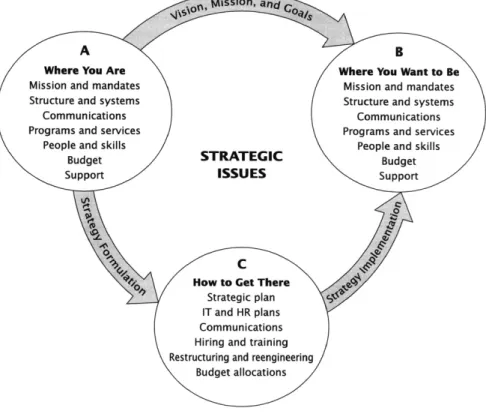
Bryson and Alston (2005, p.3) define a strategically managed organisation as “one that both defines where it wants to be and manages change through an action agenda to achieve that future”. The authors further explain three essential questions for the organisation to ask during their process of strategic planning, which they call ‘the ABCs of strategic planning’. The ABC model is visualised in Figure 3.1 and shows different methods that can be used in the different steps. The first question (A) includes how the organisation’s current state and guidelines are formed and why. It is from this state the new strategic plan or plans are developed. The second question (B) contains the organisation’s future desires and visions. Both the organisation’s and its stakeholders’ needs and visions must be considered. The last question (C) is about how the organisation will achieve the desired future.
Figure 3.1: The ABCs in Bryson and Alston’s ABC strategy planning (Bryson and Alston, 2005)
Even if a vision, a mission and objectives are successfully created, all organisations must understand that strategic initiatives should be continuously focused upon and that there is always room for improvements. Organisations should go through all the steps on a regular basis to guarantee that focus is kept on the right path (Chinowsky and Meredith, 2000).
3.1
Five Ps of strategy
Strategic management is, according to Mintzberg (1987), a field that is complex and can therefore not be based on only one definition of strategy. He further argues that those involved in this field need multiple and also explicit definitions to be able to handle it. Mintzberg introduces five different definitions that all define different parts of strategy, namely: strategy as plan, strategy as ploy, strategy as pattern, strategy as position, and strategy as perspective. Green et al. (2008), state that there are many different perspectives on strategy from the manager’s point of view. They further highlight the five Ps of strategy as possibly being the most influential perspective of all these.
Strategy as plan means, according to Mintzberg (1987), that the strategy is a well-aware planned route or a directive that is used to manage certain situations. Strategies have, according to this aspect, two substantial features: they are created and implemented before they are used for the actions, and they are dedicatedly developed with a high range of awareness. Strategy as plan handles the way leaders are trying to set up the organisation’s path as well as making sure that a destined course of action is followed. This aspect also focuses on understanding how the human brain visualises the intentions and turn it into value. Are people expressing their true feelings, meaning do they really say what they mean, and do the people really mean what they say?
Mintzberg (1987) state that strategy as plan can be either general or specific. In the specific sense a strategy as plan can also be a ploy. In order for a strategy to be a ploy a tactic for outwitting the competitors is required. Mintzberg explains this to be when an organisation is trying to frighten the competitors by threatening to expand their business area. The real intention of strategy as ploy is the threat, not the expansion itself.
Strategy as ploy is functioning in the domain of direct competition, where threats, ploys and other feints are used in order to get a competitive advantage. This aspect of strategy is therefore positioned in a functional setting where provoking moves causes counter-moves. A pretended strategy as a ploy can be established with the purpose of outsmarting the competitors. However, those organisations who establish them will most likely fool themselves. When dealing with this aspect of strategy it is important to really understand the intentions of the strategist.
Strategies can, according to Mintzberg (1987), be either intended or realised. The intended strategy is the plans and ploys discussed above and are explained by Mintzberg et al. (1998) to be looking ahead in the future. The realised strategy is, on the other hand, explained as looking back at old behaviour. This can also be seen as strategy as pattern. When seeing the strategy as a pattern, consistency has a central role. This type of strategy means that all actions taken by an organisation are
Strategy as position is, according to Mintzberg (1987), a way to locate the organisation in a business environment. Mintzberg et al. (1998) put this as a way to locate specific products in markets. The strategy in this aspect is situated between the environment and the organisation and thereby becomes the negotiating force between the external and internal context. This aspect of strategy can be associable with one or all of the previous aspects. Strategy as position inspires to look at an organisation in a context, especially in the competitive environment, how the organisation finds their position and how they protect themselves in order to meet, avoid or weaken competition.
Mintzberg et al. (1998) state that strategy as perspective is the primary way of working that the organisation conducts. This type of strategy is the opposite of strategy as position since strategy as perspective is handling the internal environment of the organisation. In the simplest form the strategy as perspective can be described as strategy being a concept. It is further highlighted that the essential part of the strategy as perspective is that the perspective is joint among all the members and that they in some way thinks in a ‘collective mind’ (Mintzberg, 1987).
Just as intended and realised strategies are opposites, so are the strategy as position and strategy as pers pective. The strategy as position is explained as looking out at the external market, but it can at the same time be explained as looking down to the exact spot where its customers and products encounter. The strategy as perspective is thereby explained as looking in at the internal market or in other words within the organisation, as well as looking up to an imposing vision of the venture (Mintzberg et al., 1998).
Even if there are various relationships between all the aspects, there is not any relationship or aspect that is superior to the others. Since the different aspects can be seen as substitutes there is a competition between them. However it is more essential that the different aspects complement each other (Mintzberg, 1987).
4
Strategy Context (Where)
The strategy context includes the strategy making process. It is containing the formation of the strategy process as well as the strategy content. It is, as mentioned in Chapter 1, concerning the where of strategy; in other words, it is examining in which company or in which environment the strategy is positioned (de Wit and Meyer, 2004).
De Wit and Meyer (2004) state that strategy context is divided in two dimensions, which are industry versus organisation and national versus international. De Wit and Meyer have based on these created three different views of the strategy context, namely: the industry context, the organisational context, and the international context.
4.1
The industry context
MacKay and McKiernan (2004), state that the field of strategy context convulsive and less systematic compared to the fields of strategy process and strategy content. It can therefore be hard to understand the relationship between the strategy context and the other two fields.
The centre piece to the industry context is how development of the industry enacts (de Wit and Meyer, 2004). There are two main questions within this context. First, if one individual organisation has the power to influence the industry it is positioned in. Second, if the industry in some way influences any specific behaviour within the firm. Baden-Fuller and Stopford (1992), state that it is the company and not the industry that really matters. They further highlights that a successful organisation will survive even in unsecure markets, while less successful organisations will go down with the market. De Wit and Meyer (2004) further state that it is important for managers within an industry to figure out how their organisation can be leading within the industry. To be leading the organisation must start to ‘shape’ the industry instead of only ‘adapt’ to it in order to create a competitive advantage for their organisation. If the organisation has a competitive advantage compared to its customers it will be them who set up the rules within the industry, which all the other players will have to adapt to.
4.2
The organisational context
The organisational context is composed of the development of the organisation, or more correctly how this development is established (de Wit, 2004). The development of the organisation is further explained to often be seen as a task for managers, but to include other members could be preferable. The authors also state that inheritance reduce the ability for an organisation to change.
Leadership has, within the organisational context, a central role. It is leadership that will lead to a development in the organisation. De Wit and Meyer (2004) explain that managers who lead organisational developments must have power, which means that the managers must have the capacity to influence.
4.3
The international context
In this context it is the international aspect that is in focus and how this context is developing (de Wit, 2004). More and more organisations globalise and thereby operate in two or more countries. Operating in different countries is hard because different countries do naturally have different conditions and different rules to follow. De Wit and Meyer call these different conditions ‘differing business arenas’.
Levitt (1983), states that organisations operating in global markets impel their organisation steadily, with the stance of the entire world being one large unit. This is carried out at a relative low cost, and it could be summarised as the organisation selling exactly the same products in the exact same way all over the world where the organisation operates.
4.4
Strategic history - from war to business environment
Strategy is often traced back to the time of ancient Greece and China (Carter et al., 2008). Clegg et al. (2005) state that while this is true strategy is divaricated. By this they mean that strategy can be traced back to time immemorial, but that strategy as a managerial tool is a much newer concept. Examples of strategies from the immemorial times are the Trojan horse, the development of warship and fortification of castles. All of these examples represent a solution that countered a threatening situation, foreseeing the future or featuring a method for reaching a goal (Chinowsky and Meredith, 2000).
Even if strategy can be traced back as far as the Trojan horse it does not have the same meaning as the modern strategy. The way it is seen today is according to Carter
et al. (2008, p.2) “a post-Second World War invention”. Strategy has, without question, its roots within military thinking. A competitive environment, such as war, with competitors fighting for market share, all with the ambition to dominate the market has developed into a business environment. This way of operating is now classified as strategy (Carter et al., 2008).
The step from using strategy in wars is not that big from using strategy within a competitive business environment. Competitive advantage plays a large role in both the industry context as well as the international context, which both consist of positioning the organisation in the existing market (de Wit and Meyer, 2004). Strategy started to be used within the business world in the 1950s. There are many similarities between strategy in war and strategy within a business environment; the importance is to win the battle, even if the scene is somehow different (Carter et al., 2008). Carter et al. (2008, p.19), further state that “competition is war by other means and, so the story goes, you need strategy to win”.
Carter et al. (2008, p.1) claim that “strategy is everywhere”. However, they further state that a strategy is only needed if there is competition in the market. An organisation that has monopoly can sell a product or service to whatever quality they want, without thinking about a strategy. If there is a demand for the product, people have to accept the deal if they want the product. When competition is in the picture, the picture is immediately changed. Carter et al. (2008, p.5) state that “competition is the key: wherever similar products are sold in the same market there will be competition.” Strategy can be seen as a response from an organisation, reacting to turbulence within a competitive business environment (Carter et al., 2008).
5
Schools of Thought
There are ten major, so called, strategic schools of thought according to Mintzberg et al. (1998). The ten schools of thought can be categorised into three fields and will all be introduced in this section. Each school of thought constructs a field within strategic management and they have all contributed to the field of strategy, both theoretically and practically (Elfring and Volbreda, 2001). The three fields are called prescriptive schools, descriptive schools and lastly the configuration school.
5.1
The prescriptive schools
The Prescriptive schools include the design school, the planning school, and the positioning school. This field are explained as being more focused on the formulations of the thoughts and how they should be formulated than how they actually are formulated and work in real life (Mintzberg et al., 1998). Mintzberg (1990, p.171), further highlights that the prescriptive schools think that the strategy formation is “a process of conceptual design, of formal planning and of analytical positioning”. The environment within these three schools is seen as constant (Sadler, 2003).
5.1.1
The design school: Strategy formation as a process of
conception
The design school is from the beginning built on the work of two books. The first book is written by Philip Selznick in 1956 and is called Leadership in Administration
and the second book is Strategy and Structure and is written by Alfred Chandler in 1962. However, the General Management Group at the Harvard Business School has also had a large impact on the development of the design school (Mintzberg et al., 1998).
The design school includes analysing the organisation and defining its strengths, weaknesses, opportunities, and threats in a SWOT-analysis (Clegg et al., 2005). The SWOT analysis is an approach that is used to estimate the organisation’s strategic position (Piercy and Giles, 1989). The strengths and weaknesses are seen as internal conditions that should be used to compare and differentiate the organisation from its competitors. The opportunities and threats are, on the other hand, seen as external conditions. The SWOT analysis is the pre-work for establishing successful organisational strategies (Clegg et al., 2005). The fundamental task in this school is to find a solid balance between the internal and external conditions. It is further explained that the thought of the process must be sensible by top management. Additionally, those strategies that are formed must be completely finished and formulated in a simple and unambiguous way before they are implemented (Mintzberg, 1990).
5.1.2
The planning school: Strategy formation as a formal process
The father of the planning school is Igor Ansoff and it all started in 1965 with his book Corporate Strategy (Carter et al., 2008; Clegg et al., 2005). The foundation of the strategic planning school is Ansoff’s ‘Corporate Strategy matrix’ or ‘Product-Market matrix’. It is a two times two matrix that contains two fundamental components, namely Product and Market that are both divided in existing products/markets and new products/markets (Lowy and Hood, 2004). The planning school is in general about developing a clear plan for the organisation that is to be implemented and understood by the employees within the organisation (Elfring and Volberda, 2001).
5.1.3
The positioning school: Strategy formation as an analytical
process
The positioning school is mainly based on Michel Porter’s work of competitive strategy, which started in 1980 with his book Competitive Strategy (Mintzberg et al., 1998). Mintzberg et al. further explain that according to this positioning school (p.83) “only a few key strategies - as positions in the economic marketplace - are desirable in any given industry”. The foundation of the positioning school is said to be built upon three so called ‘waves’, namely:
1. Origins in the military maxims. Generally speaking this wave is about ancient warriors who wrote about their strategies to win their battles in war. Writings from Sun Tzu from 440 B.C. and von Clausewitz from the end of the 18th and beginning of the 19th century are considered as been having a large impact on the positioning school.
2. Search for consulting imperatives. In this wave, the Boston Consulting Group, BCG, had a central role as they came up with two techniques that helped organisations to focus on strategy.
3. Development of empirical propositions. In this wave, Porter is dominant with a number of different books, models and frameworks. It started out, as mentioned earlier, with the book Competitive Strategy in 1980. This book was followed by another book Competitive Advantage in 1985, which became a basis including a number of tools and models. Among these models and tools are the competitive analysis or five force model, his generic strategies and his value chain (Clegg et al., 2005; Mintzberg et al., 1998).
5.2
The descriptive schools
The descriptive schools are explained as being focused on illustrating how the strategy can be used in real life. The descriptive schools are also described as trying to recognise the strategy process as it derives as well as focusing on more than just the individual. The descriptive schools thereby include the other actors in their formation (Mintzberg et al., 1998).
5.2.1
The entrepreneurial school: Strategy formation as visionary
process
Vision is, in the entrepreneurial school, the foundation and focal point. It focuses on the leader and his or her vision for the organisation. It is up to the leader to formulate and implement the vision within the organisation and also to have full control over the process. This leadership, which is based on a personified matter and strategic vision as the central point, is seen as the solution to gaining organisational success (Volberda and Elfring, 2001).
5.2.2
The Cognitive school: Strategy formation as a mental process
Mintzberg et al. (1998), state that the cognitive school is based on strategists and their thoughts and experiences. The cognitive school can be divided into two approaches; one objective and one subjective. The objective approach is stated to (p.170) “flow through all sorts of distorting filters before they are decoded by the cognitive maps”. The subjective approach, however, (p.170) “are merely interpretations of a world that exists only in terms of how it is perceived”.
5.2.3
The Learning school: Strategy formation as an emergent
process
The learning school is based on the thought of strategies being emergent. This means that other people than top management within an organisation also can come up with new strategies. It is further important to enlace the formulation and implementation during the process of learning, where the actions must make sense to those working in the organisation (Volberda and Elfring, 2001).
5.2.4
The Power school: Strategy formation as a process of
negotiation
The power school is, according to Mintzberg et al. (1998), based on the belief that power and politics is the foundation of the strategy formulation. This school believes that the formed strategies will appear as positions or ploys. The power school is based on two approaches; micro power and macro power. The micro power approach visualises the organisation’s development of strategies as being political. The macro power approach, on the other hand, (p.260) “sees the organisation as promoting its own welfare by controlling or cooperating with other organisations, through the use of strategic manoeuvring as well as collective strategies in various kinds of networks and