Determining if Two Documents are by the Same Author
Moshe Koppel (Corresponding Author) Yaron Winter
Dept. of Computer Science Dept. of Computer Science
Bar-Ilan University Bar-Ilan University
Ramat-Gan, Israel 52900 Ramat-Gan, Israel
Abstract
Almost any conceivable authorship attribution problem is reducible to one fundamental problem:
was a pair of (possibly short) documents written by the same author. In this paper, we offer an
(almost) unsupervised method for solving this problem with surprisingly high accuracy. The main
idea is to use repeated feature sub-sampling methods to determine if one document of the pair
allows us to select the other from among a background set of “impostors” in a sufficiently robust
manner.
Introduction
The Internet is replete with documents that are written pseudonymously or anonymously and it is
often of considerable financial or legal importance to determine if two such documents were in fact
written by a single author. For example, we might want to know if several tendentious product reviews
were actually by the same, possibly self-interested, writer or, more portentously, if two threatening letters
were written by the same assailant. In this paper, we propose a solution to the authorship verification
problem: determining if two documents were written by the same author. Importantly, we consider cases
where the two input documents are not necessarily long.
Note that authorship verification is an open-set problem: we ask if an anonymous document was
written by a given candidate author or by anybody else. It is not hard to see that virtually all standard
closed-set authorship attribution problems are reducible to the authorship verification problem, while the
reverse is not true. In the standard case, we are faced with a closed set of candidate authors for each of
whom we have writing samples and are asked to determine which of them is the actual author of some
anonymous text. Plainly, if we can determine if any two documents are by the same author, we can solve
any such standard authorship attribution problem, regardless of the number of candidates. All we need to
do is ask if the anonymous text was written by each of the respective candidates; we will get a positive
answer for the true author and a negative answer for all the others. On the other hand, the verification
problem is strictly harder than the attribution problem: the fact that we solve a closed-set attribution
problem offers no guarantees that we can solve an open-set verification problem. It is thus perhaps not so
surprising that, with a single limited exception (see below), no satisfactory solution has previously been
offered for the verification problem.
The outline of our solution is as follows. Suppose we are asked to determine if the documents X
and Y were written by the same author. We will systematically produce a set of “impostor” documents
the generated impostors. The trick is using the proper methods to select the impostors and, more
importantly, to measure document similarity. Our measurement of document similarity involves
randomly selecting subsets of features that serve as the basis for comparing documents, as will be
explained below. We will see that when executed correctly, this method gives surprisingly strong results
for the verification problem, even when the documents in question contain no more than 500 words.
In the following section, we briefly review previous related work. In Section 3, we describe the
experimental setup and offer two simplistic baseline methods. In Section 4, we define the
many-candidates problem and outline its solution. In Section 5, we introduce the impostors method for reducing
the authorship verification problem to the many-candidates problem, and in Section 6 we offer results.
Related Work
There has been limited work on the open-set authorship verification problem. Koppel and Schler
(2004) introduced the “unmasking” method in which the two input documents are chunked and the
effectiveness of machine learning methods at distinguishing them is measured via cross-validation on the
chunks. Since chunks of text must be reasonably long (at least a few hundred words) to gain any kind of
statistical representativeness, unmasking requires that the input documents be very long. In fact, empirical
studies (Sanderson & Guenter, 2006) have shown that unmasking is ineffective for short input documents
(less than 10, 000 words).
Novak, Raghavan, and Tomkins (2004) considered the case in which the respective writings of
100 authors were each split into two and then needed to be properly matched. They found that using
certain feature sets to represent the texts and clustering into 100 pairs yields very strong results. However,
in their formulation of the problem, it is known in advance that each document has some match in the set.
Furthermore, all 100 matching problems are solved dependently, so that each yields information about the
work in the same spirit is that of Juola and Baayen (2005) and that of Abbasi and Chen (2008) on what
they call the “similarity problem”.
There has also been some work on intrinsic plagiarism detection (Meyer zu Eissen, Stein, &
Kulig, 2007) that is similar, though not identical, to the authorship verification problem.
In this work, we will use large sets of impostor candidates. Previous work on large candidate sets
for authorship attribution is somewhat limited. Madigan et al. (2005) considered 114 authors, Luyckx and
Daelemans (2008) considered 145 authors and Koppel, Schler, and Argamon (2011) considered thousands
of authors. Most recently Narayanan et al. (2012) considered as many as 100,000 authors. A few words
about authorship attribution with large sets are in order here. The standard authorship attribution in which
we need to assign an anonymous document to one of a small closed set of candidates is well understood
and has been summarized in several surveys (Juola, 2008; Stamatatos, 2009). As a rule, automated
techniques for authorship attribution can be divided into two main types. In machine-learning methods,
the known writings of each candidate author (considered as a set of distinct training documents) are used
to construct a classifier that can then be used to classify anonymous documents (Abbasi & Chen, 2008;
Zhao & Zobel, 2005; Zheng, Li, Chen, & Huang, 2006; Koppel, Schler, & Argamon, 2008). In
similarity-based methods, some metric is used to measure the distance between two documents and an anonymous
document is attributed to that author to whose known writing (considered collectively as a single
document) it is most similar (Burrows, 2002; Hoover, 2003; Malyutov 2006; Uzuner & Katz 2006;
Argamon, 2007; Abbasi & Chen, 2008; Brennan & Greenstadt 2009). When there are tens, or possibly
even hundreds or thousands, of candidate authors, standard machine-learning methods – designed for
small numbers of classes – are simply not easily usable. (In principle, one could use machine-learning
methods to learn a separate binary classifier for each candidate author, but this is unwieldy and would in any case require some method for choosing from among multiple positive answers.) In such cases,
similarity-based methods are more appropriate natural than machine-learning methods (Stamatatos,
Experimental Setup
We will use a corpus consisting of the full output of several thousand bloggers taken from
blogger.com. The average blogger in our corpus has written 38 separate blog posts over a period of
several years. We will consider pairs of (fragments of) blog posts, <X,Y>, where X consists of the first
500 words produced by a given blogger and Y consists of the last 500 words (on the date we downloaded)
produced by a given blogger (who might or might not be the same blogger). We choose the first and last
words of bloggers in order to maximize the time gap between the documents we wish to compare; in fact,
for the cases in which X and Y are taken from the same blogger, it is never the case that X and Y belong to
the same blog post. We choose 500 words per blog to show that our methods are effective even for
relatively short document; later we will consider texts of different lengths, both greater and less than 500
words.
We randomly generate a corpus that includes 500 such pairs; for half of them, X and Y are by the
same blogger and for the other half, they are not. (No single blogger appears in more than one pair
<X,Y>.) The task is to correctly identify a given pair as same-author (i.e., X and Y are by a single
blogger) or different-author (i.e., X and Y are by two different bloggers).
Note that our problem is essentially an unsupervised problem. W in the sense that we are not
supplied with labeled examples of any of the authors in the corpus.
Similarity-Based Baseline Method
Let’s first consider two rather simplistic baseline methods for attacking our problem. Given the
pair of documents <X,Y>, the first method is to measure the similarity between X and Y and assign the
pair to the class same-author if the similarity exceeds some threshold. This is essentially the method used
by Abbasi and Chen (2008) for what they call “similarity detection”, though the similarity measures they
To measure the similarity between the documents X and Y, we first represent each document as a
numerical vector containing the respective frequencies of each space-free character 4-gram in the
document. For our purposes, a space-free character 4-gram is (a) a string of characters of length four that
includes no spaces or (b) a string of four or fewer characters surrounded by spaces. We select the 100,000
such features most frequent in the corpus as our feature universe. Character n-grams have long been
known to be effective for authorship attribution (Keselj, Peng, Cercone, & Thomas, 2003; Houvardas &
Stamatatos, 2006) and have the advantage of being measurable in any language without specialized
background knowledge. While other feature sets, such as bag-of-words, function words and
parts-of-speech n-grams, are reasonable choices, recent studies (Grieve, 2007; Plackias & Stamatatos, 2008;
Luyckx & Daelemans, 2010; Escalante, Solorio, & Montes, 2011) suggest that simpler feature sets such
as character n-grams are at least as effective as the alternatives and often even more effective; our
preliminary experiments confirmed this finding. In our case, character n-grams have an additional
advantage: our method works most naturally with a very large and homogeneous feature set, precisely
what is offered by character n-grams. The use of 4-grams, specifically, was found to be effective in
experiments reported in Winter (2012).
Let = <x1,…,xn> and = <y1,…,yn> be the respective vector representations of the documents X and Y, where each xi represents the tf*idf value of a character 4-gram in X and n is the total number of
such 4-grams that we consider. We use two standard vector similarity measures, the cosine measure and
the min-max measure:
sim(, ) = cosine, = */||||*||||
sim(, ) = minmax, =∑ (,)
∑(,)
This baseline method ignores the fact that the similarity of two documents is determined by many
factors – genre, topic, etc. – other than author identity; a single uniform threshold for all pairs is not likely
to work especially well. In fact, using cosine similarity, the threshold that maximizes accuracy on the
threshold that maximizes accuracy on the development set yields accuracy of 74.2% on the test set. We
will return to these numbers in the results section below.
Supervised Baseline Method
Let’s now consider a second baseline method that makes use of a training set. Suppose now that
we have a training set consisting of 1000 pairs <X,Y>, each of which is labeled as a different-author pair
or a same-author pair. (The set of authors that appear in this training set are disjoint from those that
appear in our corpus.) We will use supervised methods to learn to distinguish between same-author pairs
and different-author pairs, as follows. Represent X and Y as vectors, as described above. For a pair <X,Y>,
define diff(X,Y) = 〈|x!− y!|, … , |x− y|〉. For each pair <X,Y> in the training set, assign the vector diff(X,Y) the label same-author if <X,Y> is a same-author pair and assign the vector diff(X,Y) the label
different-author if <X,Y> is a different-author pair. We now use these labeled examples as training
examples for supervised learning and apply the learned classifier to our test set. (Note that our classifier
learns nothing about specific authors, but rather about what differences in n-gram frequency are
characteristic of same-author pairs in general.) Since this is a binary learning problem and SVM has often
been found to perform well for binary authorship problems (Abbasi & Chen, 2008; Zheng et al., 2006),
we choose SVM as our learning algorithm.
Learning a linear SVM classifier on the development set, exactly as just described, we obtain
accuracy of 79.8% on our test set. (This is the strongest result we obtained, using a variety of kernels and
parameter setting and various feature sets, including bag-of-words, function words and others; thus, this is
the most competitive version of the baseline method against which we compare our algorithm.) We will
see below that although our method is almost unsupervised, it performs better even than this supervised
The Many-Candidates Problem
We now consider a new approach to the verification problem. Our approach will be based on the
solution to a closely related problem: Given a large set of candidate authors, determine which, if any, of
them is the author of a given anonymous document. We call this problem the many-candidates problem;
it is sometimes called the open-set identification problem. If we can solve the many-candidates problem,
we can convert the verification problem into the many-candidates problem by generating a large set of
impostor candidates. (Technically speaking, the open-set identification problem is also reducible to the
open-set verification problem so these two problems are equivalent. As we saw earlier, closed-set
identification is reducible to open-set verification; obviously, it is also reducible to open-set
identification.)
Let’s consider then how the many-candidates problem can be effectively attacked (Koppel et al.,
2011).
In keeping with our experimental setup, suppose that we have a candidate set consisting of 5000
bloggers for each of whom we have the first 500 words of their blog. Now we are given the last 500
words (which we’ll call a snippet) of some unspecified blog and are asked to determine which, if any, of
the 5000 candidates is the author of this snippet.
Many-Candidates method
Let’s start with a somewhat naïve information-retrieval approach to assign an author to a given
snippet. Using the feature set and min-max proximity measure defined above, we simply assert that the
author of the snippet is the blogger in the candidate set whose text is most similar to the snippet vector.
(Note that we use min-max rather than cosine as our proximity measure, because it yielded better results
in our similarity-based baseline method above.) Of course, the number of snippets correctly assigned will
depend on the length of the snippets and the number of candidate authors. In Figure 1, we show the
accuracy obtained for 1000 test snippets.) Thus, for example, we find that when there are 5000 author
candidates, each consists of 500 words, 32.5% of the snippets are correctly assigned.
We note that, while 32.5% is perhaps surprisingly high (since the baseline is 0.02%), it is
inadequate for most applications. Moreover, this method necessarily assigns every snippet to some author
in the candidate set, despite the fact that it might be the case that none of the authors in the candidate set
is the actual author. What is required is some criterion by which it can be determined if the best candidate
is the actual author of the snippet.
Insert Figure 1 here
As our earlier baseline results indicate, simply requiring that similarity between the best candidate
and the snippet exceeds some threshold will not work. Rather, the crucial idea is to vary the feature sets
used in representing the texts. If a particular candidate blogger’s known text is more similar to the snippet
than any other candidate for many different feature set representations of the texts, then that candidate is
very likely the author of the snippet. Another candidate’s text might happen to be the most similar for
one or a few specific feature sets, but it is highly unlikely to be consistently so over many different feature
sets.
This observation suggests using the following algorithm (Koppel et al., 2011):
Given: a snippet to be assigned; known-texts for each of C candidates
1. Repeat k times
a. Randomly choose half of the features in the full feature set.
b. Find top known-text match to snippet using min-max similarity
2. For each candidate author A,
a. Score(A) = proportion of times A is top match
The idea is to check if a given author proves to be most similar to the test snippet for many
different randomly selected feature sets of fixed size. The number of iterations, k, is a tweakable
parameter, but, as we shall see shortly, k=100 is sufficient. The threshold σ* serves as the minimal score
an author needs to be deemed the actual author. This parameter can be varied to obtain a tradeoff between
recall-precision tradeoff.
This method is similar to classifier ensemble methods in which different classifiers are learned
using different subsets of features (Bryll, Gutierrez-Osuna, & Quek, 2003).
Many-Candidates Results
We applied this method to the blogger problem described above, using 1000 test snippets, for
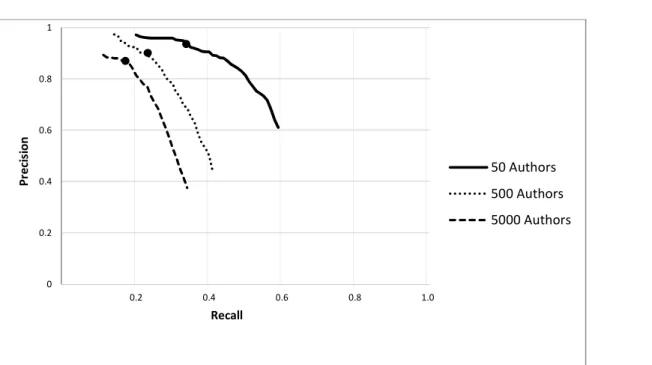
various candidate set sizes: 50, 500 and 5000. In Figure 2, we show recall-precision curves generated by
varying the score threshold σ* (where precision is the proportion of correct attributions among all test
snippets for which some attribution is given by the algorithm and recall is the proportion of test snippets
for which an attribution is given by the algorithm and is correct). As expected, results improve as the
number of candidate authors diminishes. We mark on each curve the point σ*=.80. For example, for 500
candidates, at σ*=.80, we achieve 90.2% precision at 22.2% recall. (Koppel et al. (2011) reported similar
results for different candidate set sizes and snippet lengths.)
For the above experiments, we used k=100 iterations. We note that using more iterations does not
appreciably change results. For example, for the case of 500 candidate authors, recall at 90% precision is
22.3% using 100 iterations; using 1000 iterations it is also 22.3%.
It would be a mistake to conclude, however, that the many-candidates problem is necessarily
easier as the number of candidates diminishes. The above result considered cases in which the actual
author of a snippet is among the candidate authors. Consider now the possibility that none of the
method does not attribute the snippet to any of the candidates. In fact, testing on 1000 snippets that
belong to none of the candidates, we find that at σ*=.80, not many are mistakenly attributed to one of the
candidate authors: 3.7% for 5000 candidates, 5.5% for 500 and 8.4% for 50. Perhaps counter-intuitively,
for snippets by authors not among the candidates, having fewer candidates actually makes the problem
more difficult since the fewer competing candidates there are, the more likely it is that there is some
consistently most similar (but inevitably wrong) candidate. (To take an extreme case, when there are only
two candidates, neither of whom is the author, it is plausible that one of them is more similar to the
snippet than the other for the preponderance of feature sets; for 1000 candidates, it is unlikely that one of
them is consistently more similar than all the others.)
Thus, there is a tradeoff between cases with many candidates (in which case there might be many
false negatives) and cases with few candidates (in which case there might be many false positives). It will
be important to bear this tradeoff in mind in what follows.
Insert Figure 2 here
The Impostors Method
Let’s return now to the verification problem. We are given a pair of documents <X,Y> and need to
determine if they are by the same author. Since we have seen that we have a reasonably effective solution
to the candidates problem, we can use impostors to reduce the verification problem to the
many-candidates problem. The use of impostors as a background set is a well-established practice in the
speaker-identification community (e.g., Reynolds, 1995) and has also been applied to
information-retrieval problems (Zelikovitz, Cohen, & Hirsh, 2007), but, as far as we know, has not been previously
used for authorship attribution.
We proceed as follows:
2. Compute scoreX(Y) = the number of choices of feature sets (out of 100) for which sim(X,Y) >
sim(X,Yi), for all i=1,…,m.
3. Repeat the above with impostors X1,…,Xm and compute scoreY(X) in an analogous manner.
4. If average(scoreX(Y),scoreY(X)) is greater than a threshold σ*, assign <X,Y> to same-author.
The crucial issues that need to be dealt with are how to choose the impostor set and how many
impostors to use. Intuitively, if we choose too few impostors or we choose impostors that are
unconvincing – to take an extreme example, imagine X and Y are in English and the impostors are all in
Turkish – we will get many false positives. Conversely, if we choose too many impostors or we choose
impostors for Y that are in the same genre as X but not in the same genre as Y, we will get many false
negatives.
In short, we seek an optimal combination of impostor quality, impostor quantity and score
threshold. The three are inter-related. To get some intuition for this, consider three methods of generating
a universe of potential impostors for Y:
• Fixed: Use a fixed set of impostor documents having no special relation to the document pair
in question. For this purpose, we used the aggregate results of random (English) Google
queries.
• On-the-fly: Choose a variety of small sets of random (medium-frequency) words from Y and use each such set as a Google query; aggregate the top results of the respective queries. This is
a set of topically “plausible” impostors for Y. (Of course, the identical procedure is used to
generate impostors for X.) The motivation for this method is that it can be applied to any pair
of documents on-the-fly with no prior knowledge regarding their provenance. (For our
purposes, we use 50 sets of 3 to 5 random words and take the top 25 results for each; since we
are satisfied with any plausible impostor set, we make no attempt to optimize these values.)
• Blogs: Choose texts from other bloggers. This is a set of impostors that are at least in the same
genre as both X and Y. Here we assume that we at least know the shared genre of the pair of
In each of these universes, all documents are of length 500 exactly. To illustrate one key point, we
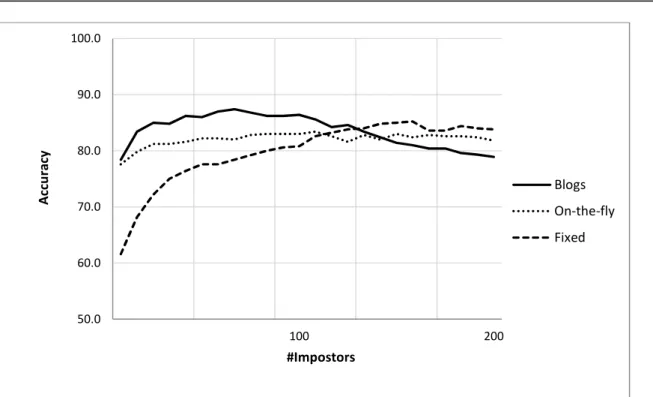
show in Figure 3 the accuracy obtained using the impostors method with varying numbers of impostors
drawn respectively from each of the above three universes. Results are shown for the score threshold
σ*=0.10, but the phenomenon we wish to point out is evident for other threshold values as well.
Insert Figure 3 here
We find that when we choose impostors that are more similar to Y either in terms of genre (Blogs)
or content (On-the-fly), fewer impostors are required in order to achieve the same or better accuracy than
just choosing random impostors. For all impostor universes, the greater the number of impostors, the
more false negatives and the fewer false positives.
In our experiments, we will consider the Blog universe and the On-the-fly universe. In each case,
we wish to use reasonably good impostors (to avoid false positives), though not necessarily the very best
impostors (to avoid false negatives). We thus use the following protocol for generating impostors (for
both On-the-fly and Blogs):
1. Compute the min-max similarity to Y of each document in the universe. Select the m most similar
documents as potential impostors.
2. Randomly select n actual impostors from among the potential impostors.
We will see below that results are not particularly sensitive to the choice of m and n.
Results
Blog Corpus Results
For our first experiment, we are given 500 blog pairs as described above and we need to assign
each of them to the class same-author or to the class different-author. We apply five methods, three
parameter to tradeoff recall and precision. Briefly, the five methods and their respective parameters are as
follows:
1. Thresholding on similarity using cosine.
2. Thresholding on similarity using min-max.
3. Classifying according to an SVM classifier learned on the training set; signed distance from the
boundary is the parameter.
4. The impostors method using the On-the-fly universe; the score threshold is the parameter.
5. The impostors method using Blog universe; the score threshold is the parameter.
Figure 4a shows recall and precision for all methods for the class same-author and Figure 4b
shows recall-precision curves for the class different-author. As can be seen, the impostors method is quite
a bit better than the baseline methods, including the supervised method. Also, the Blog universe gives
better results than the On-the-fly universe for the impostors method.
Note that for the impostors method using the blog universe, recall at precision=0.9 is 82.5% for
the class same-author and 66.0% for the class different-author. The score threshold σ* for which we
obtain precision of 0.9 for same-author is 0.13; for diff-author we obtain precision=0.9 with score
threshold of 0.01. As a practical matter, this means that – assuming a prior probability of 0.5 that X and Y
are by the same author – a score above 0.12 indicates that the chance that X and Y are by different authors
is less than 10% and a score below 0.02 indicates that the chance that X and Y are by the same author is
less than 10%.
Insert Figure 4a here
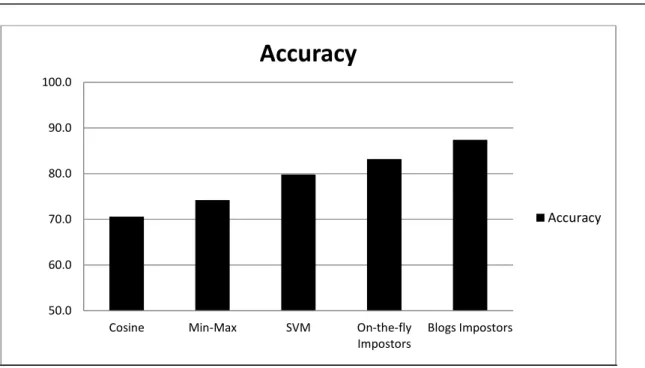
In Figure 5, we show the accuracy obtained at the optimal choice of parameter value for each of
our five methods. (For the impostors method, the optimal parameter values are determined on a separate
development set that is constructed using the exact same methodology used to construct our test corpus,
but on a disjoint set of bloggers. In this sense, our method is technically not completely unsupervised.)
We obtain 87.4% accuracy for the impostors method using the Blogs universe. The fact that we obtain
83.2% for the impostors method using the On-the-fly universe is especially encouraging; it means that
this method can be successfully applied even in cases where we know nothing at all about the pair of
documents, not even their genre.
Insert Figure 5 here
For simplicity, we have shown results for the impostors method using a particular choice of
values for the number of potential impostors (m=250) and the number of randomly chosen impostors
(n=25). However, as we can see in Tables 1a (Blog impostors) and 1b (On-the-fly impostors), results for
both impostor sets are hardly sensitive to the choices of these parameters as long as each is sufficiently
large, although it seems that it is better to randomly choose actual impostors from among the top
impostors than to use all the top impostors.
Insert Table 1a Here
Insert Table 1b Here
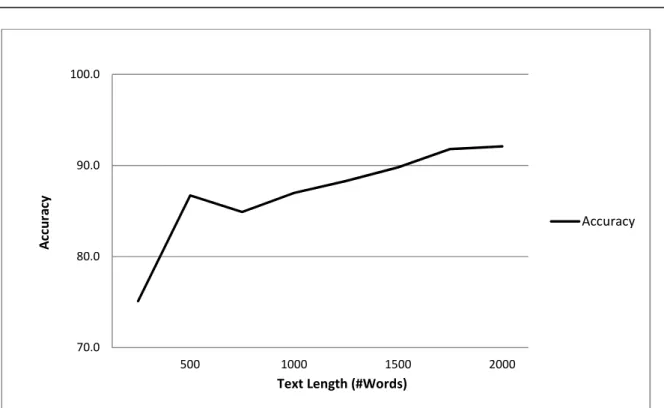
Note that all our results are for pairs of documents that are of length 500. If we have longer
documents, results are even stronger. In fact, as can be seen in Figure 6, accuracy of the impostors method
increases as the length of the input documents increases. For documents of length 1500 or greater,
Insert Figure 6 here
All our results thus far relate to a test corpus in which the same-author pairs and
different-author-pairs are evenly distributed. In the real world, however, it is typically the case that prior probability that a
pair X and Y are by the same author may be very far from 0.5 (in either direction). We therefore show in
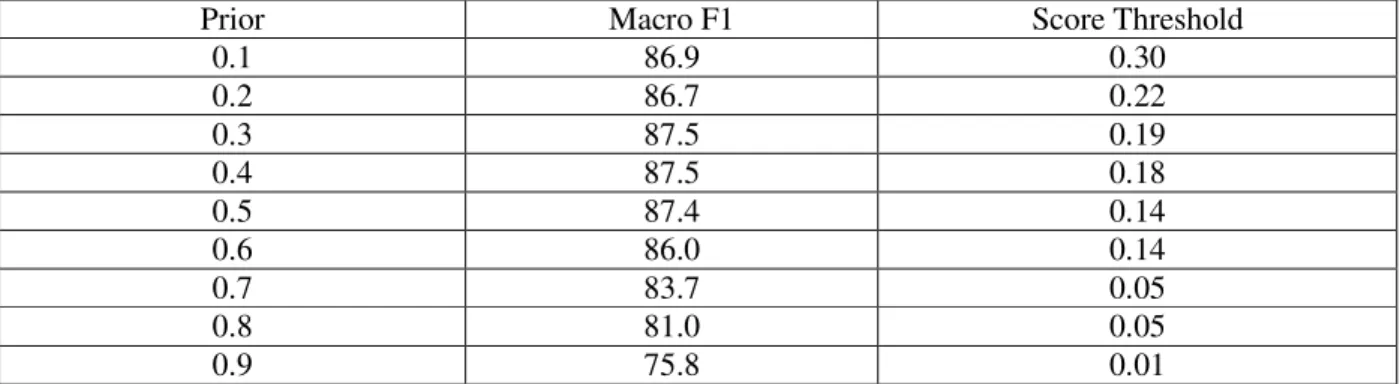
Table 1 the macro-averaged F1 value obtained for various prior probabilities that X and Y are indeed by
the same author. In each case, the score threshold (indicated in the third column of the table) is the one
that optimizes macro-averaged F1 (in a separate development corpus) for that particular distribution of
same-author and different-author pairs. As the prior probability of same-author diminishes, the score we
require for a pair to be classed as a same-author pair increases. As can be seen, as long as the prior
probability of same-author is not too large, macro-averaged F1 results are quite consistent.
Insert Table 2 here
Student Essays Results
The similarity of two documents by the same blogger across different feature sets presumably
results from a common underlying writing style as well as, at least in some cases, the tendency of an
individual blogger to often return to particular favorite topics. How much would results be weakened if
we systematically guarantee that there is no topical stickiness within individual authors?
To investigate this issue, we considered a corpus of student essays1 in which each of 950 students
has contributed four essays: stream of consciousness, reflections on childhood, an assessment of one’s
own personality and a thematic apperception test. Our corpus includes 2000 pairs <X,Y>. (In each case,
we use only the first 500 words of the essay.) The critical point is, however, that in every such pair X is
(and to a lesser extent, the genre issue) is completely neutralized: neither same-author pairs nor
different-author pairs are ever about a single topic or in the same sub-genre.
In this case, we choose our impostors for Y from among all those essays that are in the same
sub-genre as Y. This method of choosing impostors is akin to choosing blog impostors in the previous
problem; we simply leverage what we know about the common nature of a given document pair. In this
case, we know only that both are student essays, so we use student essays as impostors. We also know the
sub-genre of Y, so we use impostors from its sub-genre.
In Figure 7, we show the accuracy obtained at the optimal choice of parameter value (determined
on a separate development set) for each of our four methods on the Student Essay corpus. (There are four
methods rather than five in this case because there is only one impostors universe.) We obtain 73.1%
accuracy for the impostors method using genre-based-impostors. As can be seen, this result is better than
any of the baseline methods, but it is still considerably weaker than the results obtained for the blog
corpus. This reflects the fact that same-author pairs in this corpus differ by design both in terms of
sub-genre and topic, leaving many fewer common features to exploit. In Figure 8, we show recall-precision
curves for each of the four methods. The relative strength of the impostors method is evident.
Insert Figure 7 here
Insert Figure 8 here
Conclusions
In this paper, weWe have found that evenconsidered one of the most fundamental and difficult
authorship problems – determining if a pair of short documents is by the same author.– We have found
considerable practical importance, since many real-life problems – for example, authentication of short documents of questionable authenticity – are of this form.
Our approach is almost unsupervised. The method works in two stages. The first stage is to
generate a set of impostors that will serve as a background set. We have found that in choosing the impostors one must find the proper balance between the quality of the impostors (that is, their similarity to the “suspect”) and the number of impostors chosen: the more convincing the impostors, the fewer need be used. We have further found that best results are obtained when the impostors are selected from the same genre as the input documents, but that strong results can be obtained even when no information regarding the input documents is available. In such cases, a search engine can be used to generate impostors.
The second stage is to use feature randomization to iteratively measure the similarity between pairs of documents, as proposed in Koppel et al. (2011). If, according to this measure, a suspect is picked out from among the impostor set with sufficient salience, then we claim the suspect as the author of the disputed document. The principle idea is to generate an appropriate set of impostors and then check if elements of the pair pick each other out from among the impostors in the sense of Koppel et al. (2011), namely, by being most similar across a sufficiently large variety of feature set representations. The method works even when we have no prior information about the documents.
There are a number of potential limitations of the method that require further investigation. First,
as we have seen, when the two documents in question differ in genre and topic, it is considerably harder
to distinguish same-author and different-author pairs.
Another potential pitfall here is that we need to be fairly certain that our impostor documents
were not themselves written by the author(s) of the pair of documents in question. This danger does not
seem to have adversely affected results in the blog corpus, but it is a potential problem that must be taken
References
Abbasi, A., & Hsinchun CChen, H. (2008). Writeprints: A stylometric approach to identity-level
identification and similarity detection. ACM Transactions on Information Systems, 26 (2).
Argamon, S. (2007). Interpreting Burrows’s Delta: Geometric and Probabilistic Foundations. Literary and
Linguistic Computing, 23 (2), 131-147.
Brennan, M. & Greenstadt, R. (2009). Practical attacks on authorship recognition techniques. Innovative Applications of Artificial Intelligence.
Bryll, R., Gutierrez-Osuna, R., & Quek, F.(2003). Attribute bagging: improving accuracy of classifier
ensembles by using random feature subsets. Pattern Recognition, 36 (6), 1291-1302.
Burrows, J. F. (2002). Delta: a measure of stylistic difference and a guide to likely authorship, Literary
and Linguistic Computing, 17, 267–287.
Escalante, H. J., Solorio, T., & Montes, M. (2011). Local histograms of character n-grams for authorship
attribution. In Proceedings of the 49h Annual Meeting of the Association for Computational
Linguistic(ACL 2011) (pp. 288–298). Portland, Oregon, USA: ACL.
Grieve, J. (2007). Quantitative authorship attribution: an evaluation of techniques, Literary and Linguistic
Computing, 22, 251-270.
Hoover, D. L. (2003). Multivariate Analysis and the Study of Style Variation, Literary and Linguistic
Computing, 18, 341–360.
Houvardas, J., & Stamatatos, E. (2006). N-gram feature selection for author identification. In Proceedings
of the 12th International Conference on Artificial Intelligence: Methodology, Systems, and Applications (ICAI 2006) (pp. 77–86). Varna, Bulgaria: ICAI.
Juola, P. (2008). Authorship Attribution, Foundations and Trends in Information Retrieval, 1 (3),
Juola, P., & Baayen, R. H. (2005). A controlled-corpus experiment in authorship identification by
cross-entropy. Literary and Linguistic Computing, 20, 59-67
Keselj, V., Peng, F., Cercone, N., & Thomas, C. (2003). N-Gram-Based Author Profiles for Authorship
Attribution. In Proceeding of PACLING'03 (pp. 255-264). Halifax, Canada: PACLING.
Koppel, M., & Schler, J. (2004). Authorship Verification as a One-Class Classification Problem. In
Proceedings of 21st International Conference on Machine Learning (ICML 2004) (pp. 489-495).
Banff, Canada: ICML.
Koppel, M., Schler, J., & Argamon, S. (2008). Computational Methods in Authorship Attribution.
JASIST, 60 (1), 9-26.
Koppel, M., Schler, J., & Argamon, S. (2011). Authorship Attribution in the Wild. Language Resources
and Evaluation, 45 (1) (special issue on Plagiarism and Authorship Analysis).
Luyckx K., & Daelemans, W. (2008). Authorship Attribution and Verification with Many Authors and
Limited Data. In Proceedings of the 22nd International Conference on Computational Linguistics
(COLING 2008) (pp. 513-520). Manchester, UK: CONLING.
Luyckx K., & Daelemans, W. (2010). The effect of author set size and data size in authorship attribution.
Literary and Linguistic Computing, 1–21.
Madigan, D., Genkin, A., Lewis, D. D., Argamon, S., Fradkin, D., & Ye, L. (2005). Author Identification
on the Large Scale. InProceedings of the Meeting of the Classification Society of North America,
2005.
Malyutov, M. (2006). Information transfer and combinatories. Lecture Notes in Computer Science 4123, 3.
Meyer zu Eissen, S., Stein, B., & Kulig, M. (2007). Plagiarism detection without reference collections. In
Narayanan, A., Paskov, H., Gong, N., Bethencourt, J., Stefanov, E., Shin, R., & Song, D. (2012). On the
Feasibility of Internet-Scale Author Identification. IEEE S&P.
Novak, J., Raghavan, P., & Tomkins, A. (2004). Anti-Aliasing on the Web. In Proceedings of the 13th
international conference on World Wide Web (ACM 2004). New York, New York, USA: ACM.
Plakias, S., & Stamatatos, E. (2008). Author identification using a tensor space representation. In
Proceedingsof the 18th European Conference on Artificial Intelligence (ECAI) (pp. 833–
834).Greece: ECAI.
Reynolds, D.A. (1995). Speaker identification and verification using Gaussian mixture speaker models.
Speech Communication 17(1-2): 91-108
Sanderson, C., & Guenter, S. (2006). Short Text Authorship Attribution via Sequence Kernels, Markov
Chains and Author Unmasking: An Investigation. In Proceedings Of Int’l Conference on
Empirical Methods in Natural Language Processing (EMNLP 2006) (pp. 482-491). Sydney,
Australia: EMNLP.
Stamatatos, E. (2009). A survey of modern authorship attribution methods. JASIST, 60 (3), 538-556.
Uzuner, U. & Katz, B. (2005). A comparative study of language models for book and author recognition, IJCNLP. 969
Winter, Y. (2012). Determining whether two anonymous short documents are by the same author,
Unpublished M.Sc. dissertation, Dept. of Computer Science, Bar-Ilan University, September
2012
Zelikovitz, S., Cohen, W., & Hirsh,H. (2007). Extending WHIRL with Background Knowledge for
Zheng, R., Li, J., Chen, H., & Huang, Z. (2006). A framework for authorship identification of online
messages: Writing-style features and classification techniques, Journal of the American Society
for Information Science and Technology, 57 (3), 378–393.
Zhao, Y., & Zobel, J. (2005). Effective authorship attribution using function word. In Proceedings of the
Selected(n) \ Potential(m) 100 250 500 1000
10 85.6% 87.7% 87.3% 87.2%
25 85.2% 87.4% 87.7% 87.4%
50 85.7% 87.6% 87.7% 87.5%
100 82.8% 86.9% 87.1% 86.8%
Selected(n) \ Potential(m) 100 250 500 1000
10 81.5% 82.5% 82.4% 82.2%
25 83.1% 83.2% 83.2% 83.0%
50 82.1% 83.1% 83.2% 82.4%
100 80.8% 83.1% 82.4% 82.1%
Prior Macro F1 Score Threshold 0.1 86.9 0.30 0.2 86.7 0.22 0.3 87.5 0.19 0.4 87.5 0.18 0.5 87.4 0.14 0.6 86.0 0.14 0.7 83.7 0.05 0.8 81.0 0.05 0.9 75.8 0.01
Figure 1: Percentage of correctly assigned snippets per author text length, naïve IR algorithm. 0.0 20.0 40.0 60.0 80.0 100.0 500 1000 1500 2000 2500 50 Authors 500 Authors 5000 Authors
Text Length (#Words)
A
cc
u
ra
Figure 2: Recall-precision curves for the many-candidates algorithm for various sized candidate sets. 0 0.2 0.4 0.6 0.8 1 0.2 0.4 0.6 0.8 1.0 50 Authors 500 Authors 5000 Authors Recall P re ci si o n
Figure 3: Accuracy of impostors method (σσσσ*=0.10) for as impostor set increases for three impostor universes. 50.0 60.0 70.0 80.0 90.0 100.0 100 200 Blogs On-the-fly Fixed A cc u ra cy #Impostors
Figure 4a: Recall-precision for the class same-author. 0 0.2 0.4 0.6 0.8 1 0.2 0.4 0.6 0.8 1.0 Blog Impostors On-the-fly Impostors SVM Min-Max Cosine Pr e ci si o n Recall
Figure 4b: Recall-precision for the class different-author. 0 0.1 0.2 0.3 0.4 0.5 0.6 0.7 0.8 0.9 1 0.2 0.4 0.6 0.8 1.0 Blogs Impostors On-the-fly Impostors SVM Min-Max Cosine Recall Pr e ci si o n
Figure 5: Best accuracy of the five verification methods. 50.0 60.0 70.0 80.0 90.0 100.0
Cosine Min-Max SVM On-the-fly Impostors
Blogs Impostors
Accuracy
Figure 6: Accuracy as a function of text length, for the impostors-method with blog impostors. 70.0 80.0 90.0 100.0 500 1000 1500 2000 Accuracy
Text Length (#Words)
A
cc
u
ra
Figure 7: Best accuracy of the various methods on the Student Essays corpus. 50.0 60.0 70.0 80.0 90.0 100.0
Cosine Min-Max SVM Genre-based
Impostors A cc u ra cy
Figure 8: Recall-precision curves for our four verification methods for the Students Essays Corpus for class same-author.
1 We thank Jamie Pennebaker for making the Students-Essay corpus available to us.
0 0.2 0.4 0.6 0.8 1 0.2 0.4 0.6 0.8 1.0 Cosine Similarity Min-Max Similarity SVM Genre Dependent Impostors P re ci si o n Recall