CAG
: Stylometric Authorship Attribution of
Multi-Author Documents Using a
Co-Authorship Graph
RAHEEM SARWAR 1, NORAWIT URAILERTPRASERT 1, NATTAPOL VANNABOOT 1,
CHENYUN YU 3, THANAWIN RAKTHANMANON 1,2, EKAPOL CHUANGSUWANICH 4,
AND SARANA NUTANONG 1
1School of Information Science and Technology, Vidyasirimedhi Institute of Science and Technology, Rayong 21210, Thailand 2Department of Computer Engineering, Kasetsart University, Bangkok 10900, Thailand
3Department of Computer Science, National University of Singapore, Singapore 119077
4Department of Computer Engineering, Faculty of Engineering, Chulalongkorn University, Bangkok 10330, Thailand
Corresponding author: Thanawin Rakthanmanon ([email protected])
This work was supported in part by the Digital Economy Promotion Agency under Project MP-62-0003, and in part by the Thailand Research Fund and Office of the Higher Education Commission under Grant MRG6180266.
ABSTRACT Stylometryhas been successfully applied to performauthorship identification of single-author documents (AISD). The AISD task is concerned with identifying the original author of an anonymous document from a group of candidate authors. However, AISD techniques are not applicable to theauthorship identification of multi-author documents (AIMD). Unlike AISD, where each document is written by one singleauthor, AIMD focuses on handling multi-author documents. Due to the combinatoric nature of docu-ments, AIMD lacks theground truthinformation—that is, information on writing and non-writing authors in a multi-author document—which makes this problem more challenging to solve. Previous AIMD solutions have a number of limitations: (i) the best stylometry-based AIMD solution has a low accuracy, less than 30%; (ii) increasing the number of co-authors of papers adversely affects the performance of AIMD solutions; and (iii) AIMD solutions were not designed to handle thenon-writing authors (NWAs). However, NWAs exist in real-world cases—that is, there are papers for which not every co-author listed has contributed as a writer. This paper proposes an AIMD framework called the Co-Authorship Graph that can be used to (i) capture thestylistic informationof each author in a corpus of multi-author documents and (ii) make amulti-label predictionfor a multi-author query document. We conducted extensive experimental studies on one synthetic and three real-world corpora. Experimental results show that our proposed framework (i) significantly outperformed competitive techniques; (ii) can effectively handle a larger number of co-authors in comparison with competitive techniques; and (iii) can effectively handle NWAs in multi-author documents.
INDEX TERMS Set similarity search, multi-author documents, co-authorship graph, authorship identifica-tion, stylometry, scientometrics.
I. INTRODUCTION
Stylometry has been used extensively to differentiate between the literary styles of authors [1]–[4]. Stylometry relies on the assumption that each individual author exhibits a dis-tinct writing style, and it can be used to differentiate between documents written by different authors [2], [3], [3]–[7]. Stylometry has been successfully applied to solve authorship identificationproblems. Authorship identification
The associate editor coordinating the review of this manuscript and approving it for publication was Wei Liu.
problems aim to identify theoriginal author of an anony-mousdocument from a group of candidate authors [2], [8]. An authorship identification problem is generally solved by (i) computing the writing style markers (i.e., stylomet-ric features) from documents written by candidate authors and (ii) applying a classifier to them to build a model that can identify the original author of an anonymous document [2]–[4], [9]–[11]. There are two main variants of the authorship identification problem. The first variant focuses on handling single-author documents (AISD), and is formally defined as follows [2].
Definition 1.1 (AISD): ‘‘Given a corpus D of single-author documents written by a setA of candidate authors, identify the original author of an anonymous single-author document fromA’’ [2].
The second variant of authorship identification focuses on identifying the authors of a multi-author document, and is formally defined as follows [12].
Definition 1.2 (AIMD): ‘‘Given a corpus D of multi-authordocuments labeled with their co-authors, identify the co-authors of an anonymousmulti-authordocument from a set of authorsAof the givenD’’ [12].
The AISD problem has been extensively investigated by researchers, and most AISD techniques have shown high accuracy levels [2]–[4], [8], [9], [12], [13]. However, little attention has been paid to solving AIMD problems. In this work, we seek to provide an effective and scalable AIMD solution. Note that AISD techniques are not applicable to the AIMD problem because these techniques assume that each document is written by asingleauthor. That is, AISD can be considered amulti-class, single-labelclassification problem in which each author represents a class label. In contrast, in the AIMD problem, each document is associated with mul-tiple authors [12]. That is, AIMD can be considered a multi-class, multi-labelclassification problem (see SectionII-Cfor details).
One of the main challenges associated with AIMD prob-lems is that each document in the corpus is associated with multiple authors. Because of the combinatoric nature of the AIMD problem, the same group of co-authors may not be repeated in the corpus, which makes such prob-lems more challenging to model [12]. Moreover, given a multi-author document (e.g., a scholarly article), we do not know how many authors in a co-author list contributed as writers and how many only provided ideas and feedback. That is, the AIMD problem lacksground truthinformation, which makes it more challenging to solve. Hence, an AIMD predictive solution should be capable of attributing different fragments of thesamecollaborative/multi-author document to different authors on its co-author list without relying on absolute ground truth information [12]. To achieve such an authorship attribution capability, an AIMD solution should be capable of performing the following three main tasks [12]: (i) to capture the stylistic information of each individual author from a corpus of collaborative documents; (ii) to identify the non-writing author(s) from the co-author list; and (iii) to make amulti-labelprediction for a multi-author query document [12].
Due to the rise of internet collaborative writing platforms such as GoogleDrive,1 Wikipedia2 and ShareLaTex,3 the development of new techniques to handle multi-authored text is necessary. In addition, the applications of AIMD
1https://drive.google.com
2https://en.wikipedia.org/wiki/Main_Page 3https://www.sharelatex.com/
have increased in several domains such asbibliometricsand information retrieval[12]. That is, an effective and scalable AIMD framework can be used to greatly improve the pro-cesses of analyzing and measuring thecollaborative natures of a community of researchers [12]. Instead of attributing the entire paper to all the listed authors, it can be used to perform a fine-grainedanalysis of the authorship of a scientific article. Specifically, the AIMD framework can be used to attribute differentfragments of thesamescientific article to different authors on the co-author list [12]. This authorship attribution capability can improve information retrieval systems in the following ways [12]. (i) Author-specific search modules can be developed for scholarly search engines to help researchers find text samples written by a specific author. (ii) Individual authors’ profiles can be constructed to reflect their participa-tion in different scientific areas. In addiparticipa-tion to this, AIMD can be used to identify researchers who were most active in writing the articles and mentors who only provided feedback and ideas [12].
A. LIMITATIONS OF EXISTING STUDIES
1) Constrained Scenarios. Several AIMD studies have reported success using corpora containing collaborative scientific publications [14], [15]. However, these studies were conducted on constrained scenarios. For exam-ple, these studies identify the authors of publications based onself-citationinformation [14], [15]. Formulat-ing citation-based solutions is limited because they are not applicable to corpora without citation information. Payeret al.[16] used authors’research interest informa-tionalong with common stylometric features to perform the AIMD task. The main problem with identifying authors based on their research interests is that multiple authors/researchers may write articles on the same topic. In addition, an author’s research interests may change over time.
To handle the above issues associated with AIMD stud-ies, we propose an AIMD framework that uses the stylis-tic information of authorsonly.
2) Low Accuracy. The performance of previous AIMD solutions needs to be greatly improved. For example, the best existing stylometry-based AIMD method [9] has less than 30% accuracy on a corpus written by more than 360 authors.
3) Number of Co-Authors. Existing AIMD solu-tions drastically decrease in accuracy as the num-ber of co-authors on a paper increases. The best stylometry-based AIMD solution (AICD) [9] drops in accuracy from 25% to 16% as the number of co-authors increases from 2 to 7 [9].
4) Non-writing Authors.Previous AIMD solutions were not designed to handlenon-writing authors [9], [16]. However, non-writing authors exist in real-world cases, as not every author listed on a paper has necessarily contributed as awriter.
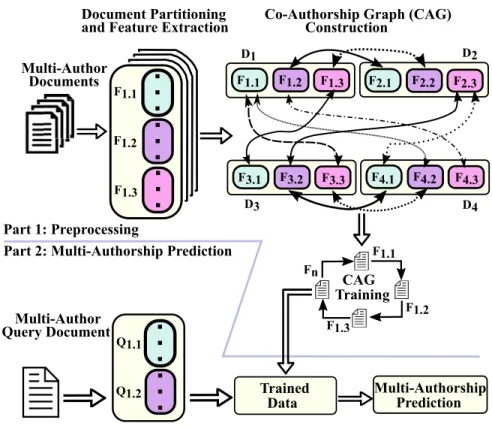
FIGURE 1. Framework Overview: Each vertex represents a fragment, and each edge between two vertices indicates that these vertices are stylistically similar. The dashed and dotted edge patterns are used to only help the distinguish overlapping crossing edges. There are two main parts of the framework: (i) preprocessing; and (ii) multi-authorship prediction. The preprocessing part of our framework is responsible for three main processes: features extraction, co-authorship graph construction (CAG) and CAG training. Once the preprocessing part was completed, we used the trained data to produce a multi-author prediction for any given query document.
B. PRELIMINARY CONFERENCE VERSION
This work is a significant extension of our preliminary con-ference version [12]: ‘‘A Scalable Framework for Stylometric Analysis of Multi-author Documents.’’ We summarize our previously proposed framework with the help of Figure1as follows.
Our previously proposed framework consisted of two main parts: preprocessing andmulti-authorship prediction. The preprocessing part of our framework was respon-sible for three main processes: features extraction, co-authorship graph construction (CAG) and CAG training. For the feature extraction process, we represented each multi-author document as a collection of point sets (i.e., collection of fragments). We calculated each data point from a 1000 tokens4 using 56 stylometric features illustrated in Section AppendixVI.
After completing the feature extraction process, we con-structed the CAG such that each vertex in the CAG rep-resented a fragment, and an edge between two vertices denoted that they werestylistically similar. After completing CAG construction, we trained the CAG so that each fragment reflects its true author(s) only.
4sequences of characters separated by white spaces.
Once the preprocessing part of our solution was completed, we used thetrained datato produce a multi-author prediction for any given query document. To derive a probabilistic pre-diction for a given query sample, we used the probabilistic labels of stylistically similar samples in the query sample. By doing so, we were able to effectively capture the docu-ment’s collaborative nature in both the test and the training samples. Each part is described in more detail in SectionIII.
C. PROPOSED WORK AND OUR CONTRIBUTIONS
In this work, we improve the following aspects of our previ-ously proposed framework [12].
• Accuracy Improvement: Although our proposed framework in the preliminary conference version of this work significantly outperformed the state-of-the-art stylometry-based AIMD solution, it is still necessary to greatly improve the performance of AIMD. The preliminary version of our framework has an accuracy level of 76.92% using a corpus containing 3,600 multi-author documents written by 1,360 multi-authors, where each document was written by 3 authors and the number of non-writing authors (NWAs) was set to 2. To achieve this objective, we use thecharacter n-gramsas the set of features. The usual approach to using charactern-grams
as a set of features is to choose 5-grams, 4-grams or 3-grams [17]–[23], or use the variable length word or character n-grams [24]–[26]. In this work, we use variable lengthcharactern-grams to handle multi-author documents by incorporating them into our previous feature space (see SectionIII-Afor more details). Charactern-grams are a contiguous sequence ofn char-acters from a text sample. For example, the charac-ter 3-grams of the beginning of this sentence would be ‘‘For,’’ ‘‘or [ ,’’ ‘‘r [ e,’’ ‘‘ [ ex,’’ etc. The motiva-tions for incorporating charactern-gram-based features into our existing feature space are five-fold [17]–[23]: (i) Charactern-gram-based features have been proven to perform well in solving authorship identification problems regardless of the length of text samples. Specifically, the character n-gram features can effec-tively capture the stylistic information of the authors from smaller text samples (i.e., 500 tokens) com-pared to vocabulary based features. The character n-gram features provide the best results when the value of n is 5, 4 or 3 [18]–[23]. (ii) Character n-gram features can capture complicated stylistic information about authors on the syntactic, structural and lexi-cal levels [18]. (iii) Character n-grams can tolerate noise in text samples (i.e., ‘‘stilometric’’ and ‘‘stylo-metric’’ have many common character 3-grams) [17]. (iv) Character n-grams require high-dimensional rep-resentation, which is not easy for humans to under-stand. Thus, attempts at deception are likely to fail [17]. (v) Extracting charactern-grams does not require tok-enizers, taggers, parsers or any language-dependent and non-trivial NLP tools, which makes them feasi-ble for performingmulti-lingual authorship attribution tasks.
• Handling Short Documents:Our proposed framework in the preliminary conference version of this work is capable of handling documents of 12,000 tokens or more. Our previous feature space required 1,000 tokens to obtain reliable stylometric information from each chunk (data point) [12]. In this work, we aim to improve our previously proposed framework such that it can also handle short documents, i.e., documents of 6,000 tokens or more, e.g., short scholarly publica-tions (see SectionIII-Afor more details).
• Multilingual AIMD: Most AIMD studies focused on English corpora, mainly because after World War II, English became the lingua franca throughout much of the world. However, bibliometric databases contain significant numbers of non-English scholarly publica-tions. For example, Amano et al. [27] reported that searching for scientific literature on Google Scholar using keywords such as ‘‘biodiversity’’ and ‘‘conserva-tion’’ generated 75,513 publications, of which 35.6% were written in non-English languages. There is clearly a substantial need to formulate multilingual AIMD solutions. The main difference between monolingual
and multilingual NLI techniques is that the former is designed for a specific language. This technique may not be applicable to other languages because of linguistic differences. In contrast, a multilingual AIMD frame-work is a generalized solution that can be applied to dif-ferent languages. That is, a multilingual AIMD frame-work must be able to achieve similar accuracy rates across different languages. To achieve this objective, we formulate amultilingualfeature space which makes our solution applicable to different languages. Specifi-cally, our feature space for multilingual AIMD relies on a minimal linguistic assumption set that includes (i) the ability to tokenize a text sample into words, (ii) the ability to identify sentence boundaries, (iii) the capa-bility of POS tagging and (iv) the use of punctuation. We perform experiments on four languages: English, French, Finnish and German (see Section IV-D.1 for more details).
1) RESEARCH QUESTIONS
In addition to addressing the aforementioned limitations of existing studies and the improvements in the AIMD framework, we answer the following research questions in this paper.
1) Research Question 1.Recall that, we use the char-acter n-grams as the set of features and incorporate them into our previous feature space. Thus, we inves-tigate how important it is to use character n-grams features for authorship identification ofmulti-author documents along with the other stylometric features such as lexical, syntactic and structural features? 2) Research Question 2.Recall that, in order to make
our solution robust and generalizable to other lan-guages, we formulate a feature space that relies on a minimal linguistic assumption set. How robust is our feature space when applied to multilingual settings? To achieve the objective of this study, we improve our framework as follows.
2) SUMMARY OF CONTRIBUTIONS IN THIS WORK
• We use the character n-grams as the set of features. The usual approach to using character n-grams as a set of features is to choose 5-grams, 4-grams or 3-grams [17]–[23], or use the variable length word or character n-grams [24]–[26]. In this work, we use vari-able length character n-grams to handle multi-author documents by incorporating them into our previous feature space.
• We formulate amultilingualfeature space which makes our solution applicable to different languages. We per-form experiments on four languages: English, French, Finnish and German.
• We create new synthetic corpora for the AIMD task which is 100% larger than the existing synthetic corpus
in terms of authors and the number of multi-author documents.
• Our proposed technique in the preliminary conference version of this work was tested on two real-world pora. In this work, we create another new real-world cor-pus and we test our proposed solution on three different real-world corpora.
• We extensively compare the performance of our solution against the baseline method; the best existing AIMD solution and its improved variation; and well-known multi-label classification methods.
For rest of the paper, section 2 reviews the exist-ing studies on the authorship identification problem and its variations. Section 3 elaborates our proposed frame-work. Section 4 reports the findings of this investigation. Section 5 presents concluding remarks and future research directions.
II. LITERATURE REVIEW
A. STYLOMETRY
Stylometryhas been used extensively to differentiate between the literary styles of authors [2]–[4] Stylometry relies on the assumption that each individual author exhibits a dis-tinct writing style, and it can be used to differentiate between documents written by different authors [2]–[4]. and has been used to solve authorship-related problems such as authorship verification, author profiling and authorship identification [2]–[4], [13], [28]–[31].
1) STYLOMETRIC FEATURES
Stylometric features are writing style markers that can be used to differentiate between documents written by different authors. Studies have proposed various stylometric features, including lexical, syntactic, structural and idiosyncratic fea-tures [9], [16], [32]–[34].
• Lexical features can be defined as statistical measures of word-based and character-based lexical variations in the text, such as vocabulary richness [32], word length distributions and charactern-gram-based features [33]. • Examples of syntactic features includefunction words
andpart-of-speechtags [34].
• The structural features are writing style markers based on the presentation of the text, such as the average number of words in a paragraph or in a sentence [33]. • The idiosyncratic features are associated with the errors
in the text samples of an author, such as grammatical mistakes and misspellings [35].
Payeret al.[16] used topic information and common sty-lometric features to perform the AIMD task. They used a set of 10,727 features, of which 7,954 were citation-based, 2,374 were content-based and only 399 were stylometric features. Later, Dauber et al.[9] proposed an AIMD tech-nique using theWriteprints Limited feature set [36]. This set includes five types of features: (i) idiosyncratic, (ii) content-specific, (iii) structural, (iv) lexical and (iv) syntactic features.
2) COMPARISON TO OUR WORK
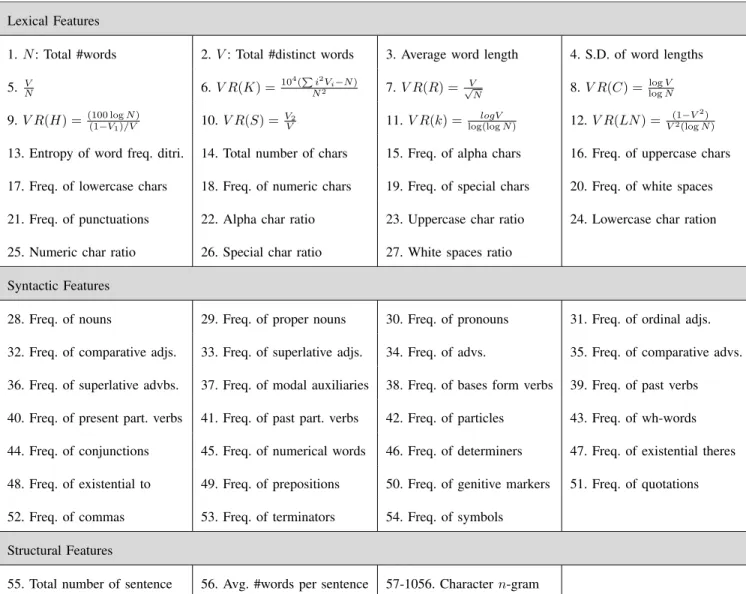
In this work, we used a set of 1,056 writing style markers (stylometric features). These features can be organized into three categories: lexical, structural and syntactic [32]–[34]. Our feature set is described in Section AppendixVI.
One main difference between our solution and the major-ity of previous solutions is that ours uses authors’ stylis-tic information to perform AIMD. The main advantages of formulating a stylometry-based AIMD solution over the majority of previous AIMD solutions are twofold: (i) unlike most previous AIMD studies [14]–[16], our AIMD solution is applicable to themulti-author corpora without the cita-tion informacita-tion, and (ii) our AIMD solucita-tion is capable of handling different authors working on the same topic and authors whose research interests change over time. In addi-tion, our feature space contains a set of 1,056 features, which is smaller than the feature sets used in previous AIMD studies [14]–[16]. Thus, our feature space is computation-ally less expensive and requires less storage than the feature spaces used in past AIMD studies.
B. AIMD
The authorship identification task has two main varia-tions. The first focuses on handling single-author doc-uments (AISD) [2], while the second focuses on han-dling multi-author documents (AIMD) [12], and is formally defined as follows. Given a datasetDofmulti-author docu-ments labeled with theirco-authors, identify the co-authors of an anonymousmulti-authordocument from a set of authors A in a given D [12]. There are several variations of the AIMD problem. These AIMD variations are comparativly easier to solve and have shown promising performance. For example, one AIMD variation usessingle-authordocuments for model training, which makes it easy to solve, as training a model using a set of multi-author documents is challeng-ing because of the lack of ground truth information [12]. When each document is associated with multiple authors, we do not how many of them contributed as writers and how many only provided ideas and feedback. However, this AIMD variation may not be viable when the training samples are also multi-author documents [9], [37] (i.e., most scientific papers have more than one author). Moreover, this variation in AIMD [9] shows a substantial drop in performance when the number of co-authors increases. For example, increasing the number of co-authors from two to three in a test document reduces the accuracy from 50% to 30% [9]. Another AIMD variation assumes that each group of co-authors has a suffi-cient number of documents for model training [9]. However, because of thecombinatoricnature of collaborative patterns in a community of researchers, we consider this assumption to beunrealistic[12].
To evaluate the performance of our proposed framework (Co-Authorship Graph (CAG)), we compare it against: (i) the best existing stylometry-based AIMD technique, AICD [9], (ii) the improved version of AICD, (I-AICD) and (iii) the
baseline technique proposed in the preliminary conference version of this investigation (B-CAG).
On the other hand, the algorithm adaption techniques extend and adopts a specific classification method to handle multi-label classification problem, such as, multi-label k-nearest neighbor (MLkNN), and multi-label decision trees (ML-DT). To evaluate the performance of our proposed framework (Co-Authorship Graph (CAG)), we compare it against the aforementioned multi-label learning methods. Descriptions of all of these competitive methods are given in sectionIV-A.
As mentioned in section Introduction that AIMD can be considered amulti-class, multi-label classification prob-lem. The following subsection reviews multi-label learning techniques.
C. MULTI-LABEL CLASSIFICATION TECHNIQUES AND EXISTING AIMD TECHNIQUES
For single-label classification tasks, each instance in the training data is associated with one class label ‘‘l’’ from a disjoint label set L [38], [39]. When |L| = 2, a learn-ing problem is known as binary classification problem (e.g., the gender identification problem, where the task is to assign an anonymous text to one of two classes, i.e., male or female) [40], [41]. When|L| >2, a learning problem is known as a multi-class classification problem (e.g., author-ship identification of single-author documents) [12].
For multi-label classification tasks, each sample in the training dataset is associated with a set of class labels, and the task is to predict the label set of an unseen test sample. For example, in thescene classification problem, each image may be associated with many semantic classes, e.g., beach and urban [38]. In thefunctional genomics classification problem, where each gene may belong to a set of functional classes, such as transcription, protein synthesis and metabolism [42]. Inauthorship identification of multi-author documents, each document is associated with multiple authors [16]. In these examples, each sample in the training dataset is associated with a set of class labels, and the task is to predict the label set of an unseen test sample. It is clear that this multi-label classification problem fits the AIMD problem definition [12]. The rest of this subsection reviews multi-label learning tech-niques.
Previous multi-label learning techniques can be organized into two categories: (i) problem transformation techniques, and (ii) algorithm adaptation techniques. Problem trans-formation techniques transform a multi-label classification problem into amulti-class, single label classification prob-lem. By doing so, amulti-labelclassification problem can be solved using asingle-labellearning method. The examples of such methods includescopy transformation(CT) [43],binary relevance (BR) [38],ensemble classifier chain(ECC) [44], directed acyclic graph (DAG) based method [45], and a recently proposed method presented in the paper enti-tledleveraging label-specific discriminant mapping features (LSDM) [46].
On the other hand, the algorithm adaption techniques extend and adopts a specific classification method to han-dle multi-label classification problem, such as, multi-label k-nearest neighbor (MLkNN), and multi-label decision trees (ML-DT). To evaluate the performance of our proposed framework (Co-Authorship Graph (CAG)), we compare it against the aforementioned multi-label learning methods. Descriptions of all of these competitive methods are given in sectionIV-A.
D. SET SIMILARITY SEARCH
In this subsection, we briefly review the set similarity mea-sures because our proposed AIMD framework relies on the identification of stylistically similar document fragments, where each fragment is represented as a point set in a real-valued vector space. Thestandard Hausdorff distance (SHD) is a well-known set distance measure that can be used to compute the distance between two point sets in a real-valued vector space. SHD is defined as
H(Q,F)=max{h(Q,F),h(F,Q)}, (1) where h(Q,F)=max qi∈Q min fj∈F d(qi−fj) (2) andd(., .) refers to a distance function for comparing the data points qi and fj. The function h(Q,F) is the directed Hausdorff distance from setQto setF. The functionh(Q,F) identifies the data pointqinQthat is farthest from any data point of setFand calculates the distance fromqto its nearest neighbor in the set F using the distance function d. Thus, the SHD distance,H(Q,F), is used to calculate the degree of mismatch between two point sets because it identifies the distance of the point from setQthat is the farthest of any data point fromF, and vice versa. In other words, the two point setsQandFare considered similariff for every point of setQ, there is at least one point in setF in proximity, and vice versa [2].
We note thath(Q,F) cannot be considered a metric dis-tance function because it does not satisfy the identity of indiscerniblesprinciple and the symmetry property does not hold for it. For brevity, we use the termdistanceto refer to h(Q,F).
Researchers have argued that SHD is sensitive to outliers. That is, a single outlier data point significantly affects the distance value [47], [48]. To mitigate the outlier sensitivity issue associated with SHD, researchers formulated two vari-ants of SHD:modified Hausdorff distance (MHD)[47] and partial Hausdorff distance (PHD)[48]. The MHD can be computed by (i) ranking all data points inQ according to the minimum distance toF; and (ii) computing the average of the minimum distances within a given range, i.e., (50%, 100%] [47]. The difference between MHD and PHD is that, the second parameter is always 100% for MHD. We test these three distance measures and find that MHD performs better
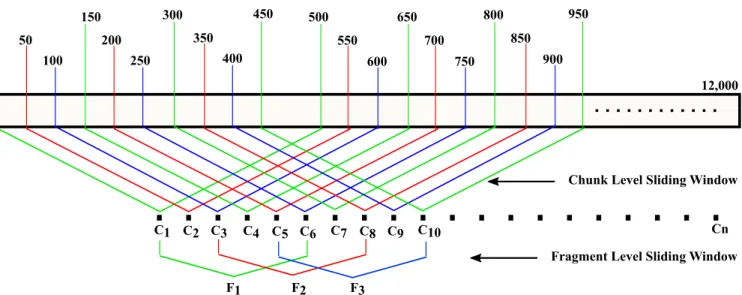
FIGURE 2. The Feature Extraction Process Using Sliding Window: Using 500 tokens as the size of sliding window and 50 tokens as the sliding window increment, we can produce 231 data points for each 12,000-token document. We apply the same principle at the fragment level to obtain a sufficient number of fragments to conduct our analysis.
than PHD and MHD. We thus provide experimental results based on MHD only (see SectionIII-Cfor more details).
E. SUMMARY
This subsection summarizes the main differences between our framework and the majority of other AIMD studies.
• Unlike other AIMD studies, we represent each docu-ment in the corpus as a collection of point sets (see SectionIII-Afor more details).
• Unlike any other AIMD technique, our graph training algorithm is effective at (i) learning the true writer(s) of each fragment and (ii) identifying the NWAs of multi-author documents (see Section III-C for more details).
• Several previous AIMD techniques are not applicable to corpora without citation information or are unable to handle authors whose research interests change over time. In contrast, our framework uses the stylistic infor-mation of authors in performing AIMD. Thus, unlike most previous AIMD studies, our solution is applica-ble to corpora without citation information, to different authors working on the same topic and to authors whose research interests change over time.
• Our solution is applicable to multiple languages. III. PROPOSED SOLUTION
In this section, we discuss the proposed framework, which consists of two main parts: preprocessing and multi-authorship prediction. Thepreprocessing part of our solu-tion is responsible for three main processes: (I) fea-ture extraction, (II)co-authorship graph construction, and (III) co-authorshipgraph training. Once the preprocessing part is finished, we use the trained data to produce a multi-author prediction for any given query document. The following subsections explain each part of our proposed framework in detail.
A. PREPROCESSING: FEATURE EXTRACTION
The preprocessing part of our framework is responsible for three main processes: (i) features extraction, (ii) co-authorship graph (CAG) constructionand (iii)CAG training. In this subsection, we provide a detailed discussion of the feature extraction process.
As explained earlier, we represent each document in the corpus as a collection of fragments (i.e., a collection of point sets) where each fragment is represented as a point set. We calculate each data point from a 500 tokens5using the features illustrated in Section Appendix VI. There are two main motivations for representing each document as a collection of point sets. (i) It allows us to attribute different fragments of the same multi-author document to their original authors in the author list. (ii) It allows us to applyset simi-larity measuresassociated with outlier handling techniques, such as themodified Hausdorff distance[47], which can help improve the performance of our framework.
To obtain reliable stylistic information from each data point, we set the size of each data point to 500 tokens. However, using 500 tokens per chunk results in only 24 data points for a 12,000-tokens document, which are insufficient for our stylometric analysis. To overcome this issue, we apply the concept of the sliding window to generate data points with overlapping token sequences. We explain this process in Figure2. For example, using 500 tokens as the size of sliding window and 50 tokens as the sliding window incre-ment, we can produce 231 data points for each 12,000-token document. We apply the same principle at the frag-ment level to obtain a sufficient number of fragfrag-ments to conduct our analysis. Specifically, by setting the fragment size to 6 data points and the sliding window increment value to 2, we can generate 113 fragments for each 12,000-token document.
Algorithm 1Co-Authorship Graph (CAG) Construction
1: procedureCAGConstruction
2: Vertices←[]
3: Edges←[]
4: forFin Fragmentsdo
5: Neighbors←GetKNN(F, Fragments)
6: forNin Neighborsdo 7: Edges.Append(F,N) 8: end for 9: F.PMF←GenerateUniformPMF(F.AuthorList) 10: Vertices.Append(F) 11: end for
12: returnG(Vertices,Edges)
13: end procedure
As mentioned earlier in Introduction that, in this work, we use variable length character n-grams to handle multi-author documents by incorporating them into our previ-ous feature space. Specifically, we extract 3-grams, 4-grams and 5-grams from a corpus of multi-author documents. Once we measure theirterm frequency-inverse document frequency (tf-idf)scores, we rank them in descending order according to theirtf-idf scores to select the top 1,000n-grams to use as features along with our previous feature space.
Charactern-grams are a contiguous sequence ofn charac-ters from a text sample. For example, the character 3-grams of the beginning of this sentence would be ‘‘For,’’ ‘‘or [ ,’’ ‘‘r [ e,’’ ‘‘ [ ex,’’ etc. The motivations for incorporating char-acter n-gram-based features into our existing feature space are five-fold [17]–[23]: (i) Charactern-gram-based features have been proven to perform well in solving authorship identification problems regardless of the length of text sam-ples. Specifically, the character n-gram features can effec-tively capture the stylistic information of the authors from smaller text samples (i.e., 500 tokens) compared to vocab-ulary based features. The charactern-gram features provide the best results when the value ofn is 5, 4 or 3 [18]–[23]. (ii) Charactern-gram features can capturecomplicated stylis-tic information about authors on the syntactic, structural and lexical levels [18]. (iii) Character n-grams can tolerate noisein text samples (i.e., ‘‘stilometric’’ and ‘‘stylometric’’ have many common character 3-grams) [17]. (iv) Charac-tern-grams require high-dimensional representation, which is not easy for humans to understand. Thus, attempts at deception are likely to fail [17]. (v) Extracting character n-grams does not require tokenizers, taggers, parsers or any language-dependent and non-trivial NLP tools, which makes them feasible for performingmulti-lingual authorship attri-bution tasks.
B. PREPROCESSING: CAG CONSTRUCTION
Recall that one of the main challenges associated with the AIMD problem is that each document is associated with mul-tiple authors. Because of its combinatoric nature, the same author list may not be repeated in a corpus of multi-author
documents, which makes this problem more challenging to model. Moreover, in a multi-author document (e.g., a scien-tific article), some of the authors on the author list may not have contributed as writers [12]. That is, AIMD problems lack ground truth information, which makes this problem more challenging to solve. An AIMD predictive method should therefore be capable of inferring the authorships of a multi-author document without absolute ground truth infor-mation. Our proposed AIMD framework relies on the obser-vation thatthe stylistically similar fragments are likely to have been written by a similar group of authors. To capture the stylistic similaritiesof document fragments we propose a data structure called theCo-authorship Graph (CAG). In addition, we propose an iterative algorithm to identify the original author of each document fragment.
After completing the feature extraction process, we con-struct a co-authorship graph (CAG) in which each vertex rep-resents a fragment and an edge between two vertices shows that they are stylistically similar. Algorithm 1 provides the structure of the CAG construction process. Recall that after the completion of the feature extraction process, each docu-ment in the corpus is represented as a collection of point sets (collection of fragments), where each data point corresponds to a feature vector. As shown in Algorithm 1, we iterate through all of the fragments from all of the documents in the training corpus (Lines 4 to 10). To construct the CAG edges, we identifyk stylistically similar fragments for each fragment, where themodified Hausdorff distance (MHD)[47] is used as the distance between two fragments. Specifically, the GetKNN(F, Fragments) procedure identifies thek frag-ments inFragmentswith the smallest MHDs with respect to F (Line 5). These nearest neighbors are the vertices of the graph, and the MHD distances are the weights of the edges. We assume that each fragmentFof a document is associated with a list of authorsF .AuthorListfrom the document, which might include one or more NWAs [12]. We initialized the authors by assigning the same probability to each author in the author list (Lines 9 to 10). After iterating throughall of the fragments from all of the documents, the CAG is returned (Line 12).
FIGURE 3. CAG: Each vertex represents a fragment, and each edge between two vertices indicates that these vertices are stylistically similar. The dashed and dotted edge patterns are used to only help the distinguish overlapping crossing edges. The adjacent tables of all of the fragments show the initial PMFs.
Algorithm 2CAG Training
1: procedureUpdateCAGVertex 2: NeighborPMFs←[] 3: NeighborDistances←[] 4: V ←ThisVertex 5: forN inV.GetNeighbors()do 6: PMF←ReceivePMF(N) 7: PMF←RemoveNWAs(PMF,V.AuthorList) 8: PMF←Renormalize(PMF) 9: NeighborPMFs.Append(PMF) 10: NeighborDistances.Append(Distance(V,N)) 11: end for 12: V.PMF←ComputeWeightedAvg(NeighborPMFs, NeighborDistances) 13: forN inV.GetNeighbors()do 14: SendPMF(N,V.PMF) 15: end for 16: end procedure
C. PREPROCESSING: CAG TRAINING
Now we explain the CAG training process using the example shown in Figure 3. There are four multi-author documents, where each document is associated with four authors. We set the ground truth information as follows. First, we assume that only the first three authors of each document con-tributed as writers. For example, for the documentD1, only
Authors W, X and Y wrote parts of D1, while author A
was a non-writing author (NWA). Similarly, Authors B, C and D are NWAs of D2, D3 and D4, respectively. We
note that this ground truth information is hidden from the model.
We also illustrate the initial PMF of each document fragment in Figure 3. As the ground truth information about the non-writing authors is hidden from the model, we associate each fragment of a document with all the listed co-authors with an equal probability distributed among them.
For example, the author PMFs ofF1.1,F1.2,F1.3are uniform,
e.g.,{W :0.25,X :0.25,Y : 0.25,Z :0.25}. We derive the initial PMFs of rest of all fragments shown in the figure in the same fashion.
The CAG construction algorithm (Algorithm 1) returns edges that connect stylistically similar fragments. For exam-ple, based on the identified edges, it can be seen that fragmentF1.1 is stylistically similar toF3.3 andF4.2.
Sim-ilarly, F1.2 is stylistically similar to F2.1 andF4.3. Despite
the fact that each fragment in a multi-author document is initialized with an equal probability distributed among all co-authors, they are connected with different sets of stylis-tically similar fragments that are associated with different co-authors.
Next, we show that how these differences in the author lists of fragments can collaboratively identify authors who contributed as writers using Algorithm 2.
Algorithm 3Authorship Identification
1: procedureMulti-AuthorshipPrediction
2: FragmentPMFs←[]
3: QueryFragments←GetDocumentFragments(Q)
4: forQin QueryFragmentsdo
5: Neighbors←GetKNN(Q, Fragments)
6: NeighborPMFs←[]
7: forNin Neighborsdo
8: NeighborPMFs.Append(PMF)
9: NeighborDistances.Append(Distance(Q,N))
10: end for
11: Q.PMF←ComputeWeightedAvg (NeighborPMFs, NeighborDistances)
12: FragmentPMFs.Append(Q.PMF)
13: end for
14: returnGetDocumentPMF(FragmentPMFs)
15: end procedure
There are two main objective of theCo-Authorship Graph (CAG)training algorithm: (i) to alter the PMF of each frag-ment such that it reflects the true author(s) of that fragfrag-ment and (ii) to remove non-writing authors from the author list. The process of updating the PMF of each vertex is given in Algorithm 2. We execute the same algorithm (Algorithm 2) at each vertex in the corpus with multiple iterations called supersteps. Each vertex represents afragmentand each edge between two nodes denotes that they are stylistically similar fragments. In this algorithm, each vertex makes note of the top−k most similar fragments as neighbors. This algorithm consists of three main parts: (i) Receive, (ii)Computeand (iii)Send.
• Receive PMF(Lines5 to 10). The vertex receives the PMFs from its top-kmost similar fragments (neighbors). • Update PMF (Line 12).The vertex PMF is updated as the weighted average of all neighbors’ PMFs. These weights are obtained from the distances of the neigh-bors using theProbabilistic k Nearest Neighbor (PkNN method with theradial basis function (Gaussian) ker-nel[49]. The total weight is assumed to be normalized to 1 [12].
• Send Updated PMF (Lines 13 to 14).The updated PMF is sent to the neighbors.
At each superstep, we apply the same process in Algorithm 2 and repeat the supersteps until all of the PMFs are converged or the number of iterations reaches a specified value, which is 15 in this study. Consider now how Algorithm 2 operates in the context of the example given in Figure 3. The fragment F1.1 receives two PMFs
from its two neighbors F3.3 and F4.2 as {Y : 0.25,Z :
0.25,W : 0.25,C : 0.25}and{Z : 0.25,W : 0.25,X : 0.25,D :0.25}, respectively (Line 6). We then compare the PMF of each fragment (neighbor) against the co-author list [W,X,Y,A] to remove author(s) who do not appear in the co-author list ofF1.1 (Line 7). In this example, the authors
Z and C are discarded from the fragmentF3.3. Similarly,
authorsZandDare discarded from the fragmentF4.2. After
discarding the authors who do not appear in the co-author list ofF1.1, we re-normalize the PMF. The re-normalization
results in {Y : 0.5,W : 0.5} as the PMF for F3.3 and
{W : 0.5,X : 0.5} as the PMFs for F4.2. For ease of
exposition, we assume that the two nearest neighbors are the same distance from the respective fragment and contribute equally to the fragment’s PMF. Hence, the weighted average of the two PMFs is{W :0.5,X :0.25,Y :0.25}after the first superstep.
Following the same process, we obtain • {W :0.25,X:0.5,Y :0.25}forF1.2, • {W :0.25,X:0.25,Y :0.5}forF1.3, • {X :0.5,Y :0.25,Z :0.25}forF2.1, • {X :0.25,Y :0.5,Z :0.25}forF2.2, • {X :0.25,Y :0.25,Z :0.5}forF2.3, • {Y :0.5,Z :0.25,W :0.25}forF3.1, • {Y :0.25,Z :0.5,W :0.25}forF3.2, • {Y :0.25,Z :0.25,W :0.5}forF3.3, • {Z :0.5,W :0.25,X :0.25}forF4.1, • {Z :0.25,W :0.5,X :0.25}forF4.2, and • {Z :0.25,W :0.25,X :0.5}forF4.3.
As can be seen, all of the PMFs become less uniform after only the first superstep. For each document, the PMFs converge to the following values [12].
1) Document D1:
{W :1}forF1.1,{X :1}forF1.2, and{Y :1}forF1.3.
2) Document D2:
{X :1}forF2.1,{Y :1}forF2.2, and{Z :1}forF2.3.
3) Document D3:
{Y :1}forF3.1,{Z :1}forF3.2, and{W :1}forF3.3.
4) Document D4:
{Z :1}forF4.1,{W :1}forF4.2, and{X :1}forF4.3.
The NWAs of each document are not included in the PMFs, and the author lists ofD1,D2 andD3 are correctly
identified as [W,X,Y], [X,Y,Z], [Y,Z,W] and [Z,W,X], respectively.
D. MULTI-AUTHORSHIP PREDICTION
Given a multi-author query document Q, our framework makes a multi-authorship prediction using training fragments from the co-authorship graph training step (cf. Algorithm 2). The structure of the multi-authorship prediction process is given in Algorithm 3. As can be seen in Algorithm 3, we decomposeQinto a set of query fragments (Line 3). For each query fragment Q (Lines 5 to 10), the top-k nearest neighbors are identified using the GetKNN() function intro-duced in Algorithm 1 for CAG construction. Similar to the CAG training process given in Algorithm 2, we compute the weighted average to make a single prediction for each query fragmentQby using the PMFs of the neighboring fragments and their distances with respect to Q. After obtaining the PMFs of all of the query fragments (Line 12), the next step is to combine the PMFs of all of the query fragments to make a final prediction for the entireQ. Specifically, we compute the average PMF to make a final prediction for the entireQ. We realize this concept with the help of Figure3. Assume that a query document Q is decomposed into two query fragmentsQ1.1andQ1.2. We also assume thatF1.1andF3.3
were identified as the two nearest neighbors ofQ1.1and that
F1.3 andF3.1are identified as the two nearest neighbors of
Q1.2. We can then obtain the predictions of these two query
fragments (i.e.,Q1.1andQ1.2) as the PMFs{W : 1.0}and
{Y :1.0}, respectively. The final prediction of the entire query document Qis {W : 0.5,Y : 0.5}; i.e.,W andY are the authors of the query documentQ.
IV. PERFORMANCE EVALUATION
This section describes the competitive methods, provides description of synthetic and real-world corpora, illustrates the experimental setup and reports the findings obtained from extensive experimental studies.
A. COMPETITIVE METHODS
To evaluate the performance of our proposed framework (Co-Authorship Graph (CAG)), we compare its perfor-mance against: (i) the best existing stylometry-based AIMD technique, AICD [9], (ii) the improved version of AICD, (I-AICD) and (iii) the baseline technique proposed in the preliminary conference version of this investigation (B-CAG). In addition, we compare the performance our proposed framework against well-known multi-label clas-sification methods using our feature space: copy transfor-mation (CT) [43], binary relevance (BR) [38], ensemble classifier chain (ECC) [44], directed acyclic graph (DAG) based method [45], recently proposed method presented in the paper entitled leveraging label-specific discriminant mapping features (LSDM) [46], and multi-label k-nearest neighbor (MLkNN). Description of all of these competitive methods are as follows.
1) DESCRIPTION OF EXISTING AIMD COMPETITIVE METHODS
• AICD.Inthis investigation, we abbreviate the best exist-ing stylometry-based AIMD solution to AICD. This
solution is presented in the paper entitled stylomet-ric authorship identification of collaborative docu-ments[9]. AICD uses the linearsupport vector machine (SVM) classification method. For the training data, AICD relies on thecopy transformationtechnique. For each multi-author training sample associated with m labels, the copy transformation technique creates m single-label samples [43], each of which can be associ-ated with one label at a time [43]. For the feature space, AICD extracts theWritePrints Limited feature set [36] from a corpus of multi-author documents using the Jstylotool [50]. In order to make a multi-author predic-tion for a multi-author query document, AICD converts the output of the classifier into a probabilistic distribu-tion and uses the most probablemauthors as a result [9]. • I-AICD. We formulate an improved variation of the best existing stylometry-based competitive technique (AICD), which is abbreviated to I-AICD in this inves-tigation. Similar to our proposed solution, for I-AICD, we also use the sliding window technique to generate chunks from each multi-author document following the same method used for AICD. At this stage, we aggregate the prediction at the chunk level by having each chunk vote for its most likely author.
• B-CAG. We also compare our solution against the baseline technique proposed in the preliminary ver-sion of this work calledBaseline Co-Authorship Graph (B-CAG)[12].
2) DESCRIPTION OF MULTI-LABEL CLASSIFICATION METHODS
• CT.For each multi-label training sample associated with mlabels, the CT method createsmsingle-label samples, each of which can be associated with one label at a time [43]. Then a single-label learning method can be used to predict the label-set of the test instance. • BR. The BR [38] method decomposes a multi-label
classification task into several binary classification tasks (one-vs-rest). The BR technique assumes that all labels are independent, and each classifier is independently learned for each label prediction.
• ECC.The ECC method [44] links L single-label clas-sifiers along a chain, and the inputs of each classifier is extended with the result of the proceeding classifiers in the chain.
• DAG.Leeet al.[45] report than instead of focusing on avoiding bad chain orders, finding an optimal classifiers’ order in a chain help to improve the prediction accuracy. They build a DAG of labels using K2 algorithm with cor-related ancestor set strategy [45] such that the correla-tions between parent and child nodes can be maximized. Specifically, they compute correlation with condition-ally entropy and construct a DAG the maximizes the sum of conditional entropies between all parent-child nodes. Consequently, highly correlated labels are order in a chain obtained from DAG [45].
TABLE 1. Statistics of the corpora.
• LSDM.The LSDM method performs multi-label clas-sification by exploring the most discrimintaive features associated with each class label. At first the LSDM method performs cluster analysis on positive and nega-tive instances of the training data for each class label, and then reconstructs the feature spaces based on distance mapping and linear representation, by querying the clus-tering results for each class label. After that, the LSDM method employs sLDA (simplified linear discriminent analysis) to excavate the best feature space from recon-structed feature spaces of the identical class labels. Finally, the classifiers are learned using the excavated results [46].
• MLkNN. MLkNN is a popular multi-label classi-fier [51]. Similar to the regular k nearest neighbor classifier, MLkNN identifies the k closest neighbors corresponding to a test sample. To make amulti-label prediction, this classifier derives statistical information from the label set of the identifiedkclosest neighbors; that is, the number of neighbors associated with each label. As a final step, MLkNN uses the principle of Maximum A Posteriori (MAP)to determine the label set of the test sample [51].
The parameter settings of each competitive method are as suggested in the corresponding literatures. We have used 5-fold cross-validation in order to evaluate each method.
B. CORPORA
we evaluate each method using one synthetic corpus and three real-world corpora. A detailed description of each corpus is as follows.
1) SYNTHETIC CORPUS
The evaluation of an AIMD solution requires a synthetic corpus of multi-author documents [12]. To generate a syn-thetic corpus, we obtain a collection of 23,096single-author documents from the publicly available Project Gutenberg.6 These documents were written by a set of 8,698 authors. From this set of authors, we select a subsetAof authors who
6https://www.gutenberg.org
TABLE 2.Default parameter values.
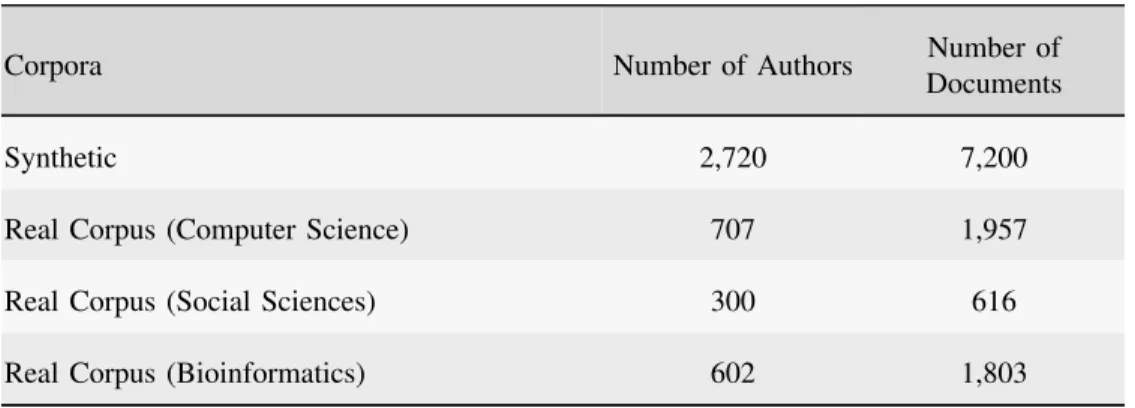
had written 10 or more documents of at least 12,000 tokens each unless stated otherwise. With the subsetAof authors, we generate thesynthetic multi-author documentsas follows. Assume that a multi-author documentDawas written bym authors fromA. We generate Da by randomly choosing m authors{a1, . . . ,am}fromA. For each author ai, we obtain a text sample of lengthL/mtokens, where L denotes the length of the synthetic document. To avoidtraining-testing sample contamination, once a document is used to ate a synthetic document, it is never used again to gener-ate another synthetic document. Moreover, each co-author set{a1, . . . ,am}of a multi-author document is unique. The statistics of the synthetic corpus are given in Table1. By fol-lowing the stated process, we obtain a synthetic corpus con-taining 7,200 multi-author documents from 2,720 authors. This synthetic corpus is 100% larger than the synthetic corpus used in the preliminary conference version of this work. 2) REAL-WORLD CORPORA
To conduct experiments on real corpora, we download three collections of research articles: (i) social science fromscirp.org; (ii) computer science fromarXiv.org
and (iii) bioinformatics from biomedcentral.com. We chose papers from these three collections such that each author has contributed to five or more research papers. The statistics of our real-world corpora are given in Table 1. For thecomputer science research papers, we obtain a set of 1,957 research papers written by 707 authors. For thesocial scienceandbioinformaticsresearch papers, we obtained two sets of research papers with 616 and 1,803 papers written by 300 and 602 authors, respectively.
C. EXPERIMENT METHODOLOGY
In this section, we describe the evaluation measures and parameter settings.
TABLE 3. Synthetic corpus results: Effect of the numbermof co-authors.
1) PARAMETER SETTINGS
To identify the most appropriate value of each parameter, we test different values for each parameter. The following val-ues have the best performance. For brevity, we present only the final parameter values used in this investigation unless stated otherwise. For the synthetic corpus, we fix the length of each synthetic multi-author document (L) to 12,000 tokens. We fix the chunk size (l) and fragment size (f) to 500 tokens and 6 data points, respectively. For the chunk-level sliding window (ω) and fragment level sliding window (θ), incre-ments of 50 tokens and 2 data points, respectively, have the best accuracy. Thekvalue of 10 for top-kretrieval resulted in the best accuracy. For the modified Hausdorff distance (MHD) computation, the average of the ranked minimum distances falling into the (50%, 100%] range results in the best accuracy.
2) EVALUATION MEASURES
We use the following evaluation measures in the experiments. i Accuracy (A):‘‘Accuracy indicates the discrepancy of a prediction with respect to the ground truth, and is defined as the number of correctly predicted authors divided by the size of the true co-author set.’’
ii Guess-one (G): ‘‘A document is considered correct if the prediction contains at least one of the true authors.’’
D. PERFORMANCE EVALUATION
This section reports the findings obtained from our extensive experimental studies of the synthetic corpus. Recall that the main limitations of previous AIMD solutions are as follows: (i) the best existing stylometry-based AIMD solution has low accuracy, (ii) existing AIMD solutions report that increasing the number of co-authors of a paper adversely affects their performance and (iii) existing AIMD solutions cannot handle non-writing authors (NWAs). Our experimental studies are designed such that we can verify whether our framework is capable of (i) effectively handling a larger number of co-authors, (ii) handling non-writing authors (NWAs) and (iii) handling multi-author documents of any length. Finally, we evaluate the proposed framework for four languages. Note that to control the (i) numbermof co-authors, (ii) numberφ of NWAs and (iii) numberL of tokens for each multi-author document, these studies are performed using synthetic datasets. In addition, to show that the proposed solution can handle real-world datasets, we conduct experiments on three real-world corpora. The experimental results from these stud-ies are reported in the following subsections.
1) PERFORMANCE EVALUATION WITH SYNTHETIC CORPUS
a: EFFECT OF THE NUMBER m OF AUTHORS
To study the effect of the number m of co-authors on the performance of each method, we vary the number m of
TABLE 4. Synthetic corpus results: Effect of the numberφof non-writing authors (NWAs).
co-authors between 2 and 5. There are two motivations for doing so: (i) these values conform with the number m of co-authors in the real-word corpora used in this investigation and (ii) previous bibliometric analysis studies of the collabo-ration patterns of different fields report that the average num-ber of co-authors per publication are 5 or fewer [52]–[55]. The experimental results obtained by varying the numbermof co-authors are given in Table3. As can be seen, our proposed method (CAG) outperforms all of the competitive techniques. In addition, increasing the numbermof co-authors increases the performance gap between the proposed technique and the competitive techniques. Thus, the proposed solution can effectively handle larger numbers of co-authors with a higher accuracy than these competitive techniques. In terms of guess-oneaccuracy, the proposed method outperforms all of the competitive techniques.
b: EFFECT OF THE NUMBERφOF NON-WRITING AUTHORS
To investigate the effect of varying the number φ of non-writing authors (NWAs) on the performance of each method, we vary the numberφbetween 0 and 2. The exper-imental results are shown in Table 4. Including NWAs in the actual list of co-authors marginally reduces the accuracy of the proposed framework in comparison to the compet-itive techniques. Because the competcompet-itive methods (except B-CAG) were not designed to handle non-writing co-authors,
the accuracy of these methods decreases drastically as we increase the numberφ of NWAs from 0 to 2. In terms of guess-one accuracy, the experimental results show that the proposed method is the best performer in all cases.
c: EFFECT OF THE NUMBERLOF DOCUMENT SIZE
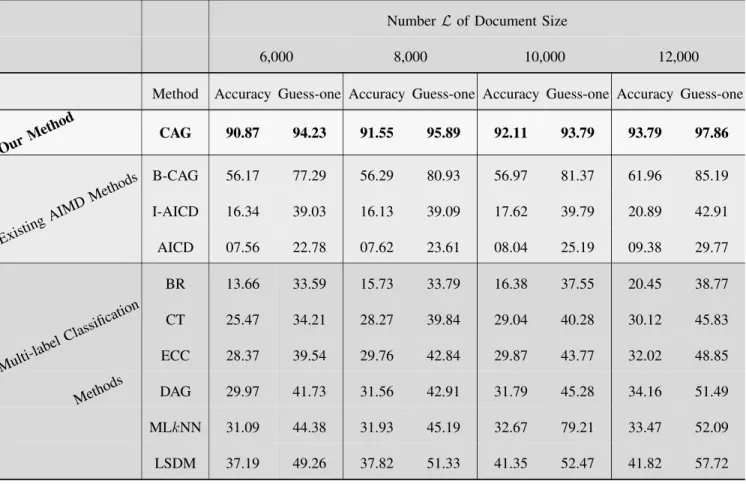
In this study, we investigate the effect of varying the number L of document size on the performance of each method. As mentioned in the Introduction, our previously proposed framework can handle multi-author documents of 12,000 tokens or higher. In this research, we propose a solution that can also handle short publications. To study the effect of document sizeL on the performance of each method, we vary the document lengthLbetween 6,000 and 12,000 tokens.
The experimental results are given in Table5. As can be seen, the proposed method can effectively handle documents of different lengths ranging between 6,000 to 12,000 tokens with better than 90% accuracy. In addition, our solution sig-nificantly outperforms the baseline method (B-CAG) and the competitors.
d: EFFECT OF THE NUMBER l OF CHUNK SIZE
We investigate the effect of chunk size on the perfor-mance of CAG, B-CAG, and I-AICD methods only, because the other methods are not designed to handle the chunk
TABLE 5. Synthetic corpus results: Effect of the numberLof document size.
TABLE 6. Synthetic corpus results: Effect of the numberlchunk size.
size. We vary the chunk size between 500 and 1,250. The experimental results are shown in Table 6. This study has two main findings: (i) the proposed solution sig-nificantly outperforms all competitive techniques and (ii) for the proposed solution, a chunk size of 500 tokens marginally reduces accuracy compared to a chunk size of 1,250 tokens.
e: MULTILINGUAL AIMD
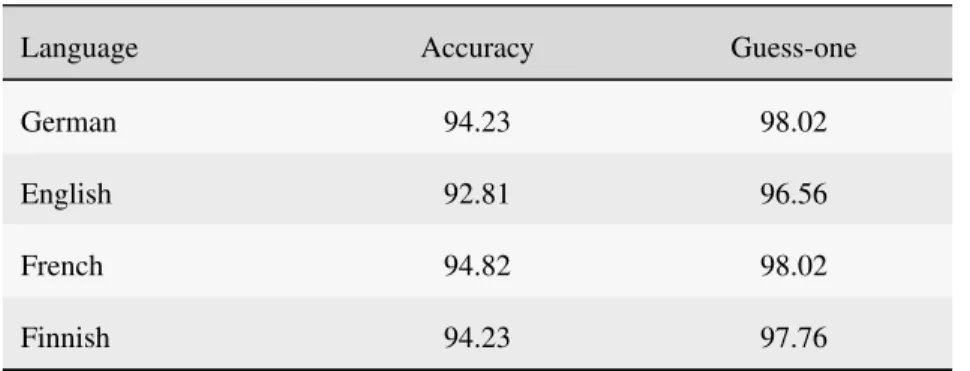
In this section, we present some experimental results in multi-lingual settings. To perform this experiment, we gen-erate four synthetic corpora using the method given in Section IV-B, where each corpus is written in a dif-ferent language: English, French, Finnish and German. We obtain 400 documents written by 100 authors for each
cor-TABLE 7. Multilingual synthetic dataset results.
TABLE 8. Real-world corpora results.
pus. We fix the number of documents and number of authors in each corpus to fairly compare the performance for the different languages. The feature set contains 13 vocabulary richness-based features (feature 1 to feature 13 in Table9), all of the features listed in the structural features in Table9 and 12part-of-speech (POS)-based features extracted using a universal part-of-speech tagger [56].
Note that in monolingual AIMD studies, the POS can be calculated using the best POS tagger available for a particular language. For example, for English, Penn Tree-bank classifies words into 36 linguistic categories [57]. Similarly, for French and German, French Treebank and Stuttgart/Tübinger classify words into 30 and 55 linguistic categories, respectively [57], [58]. However, when design-ing a multildesign-ingual AIMD solution, we need to take into account that the different granularities of the linguistics
categoriesfor different languages—in this case, 36, 30 and 55 linguistic categories for English, French and German, respectively—imply that they are not directly comparable. These different linguistic categories can be converted into a common set of linguistic categories for all languages to make the experimental results comparable across different lan-guages. To perform such a multilingual research, we use the universal POS tagger [56]. Theuniversal POS tagger cate-gorizes words into 12 linguistic categories7that are universal across different languages in our corpora.
7Verb (verbs), Noun (nouns), Adv (adverbs), Adj (adjectives), Det
(arti-cles and determiners), Pron (pronouns), Num (numerals), Adp (prepositions and postpositions), Prt (particles), ’’.’’ (punctuation marks), Conj (conjunc-tions) and X (all other categories, such as punctuation, foreign words or abbreviations.)
TABLE 9. List of stylometric features.
Our feature space for multilingual AIMD relies on a min-imal linguistic assumption set that includes (i) the ability to tokenize a text sample into words, (ii) the ability to identify sentence boundaries, (iii) the capability of POS tagging and (iv) the use of punctuation. The experimental results are given in Table7. Because the competitive techniques were designed for English, we provide the results for the proposed technique only. The experimental results show that our pro-posed framework achieves better than 92% accuracy for each language.
2) PERFORMANCE EVALUATION WITH REAL-WORLD CORPORA
We also evaluate our proposed framework using three real-world corpora. Unlike the synthetic corpus of multi-author documents, where we have the ground truth infor-mation regarding the NWAs of each synthetic document, real-world corpora do not contain ground truth information. Hence, while measuring accuracy for real-world corpora,
we assume that all of the listed authors on a paper contributed to writing the paper. This assumption reduces the measured accuracy values of all techniques in comparison to their actual values. However, it allows us to compare all of the methods for real-world corpora. The experimental results are given in Table8. We can see that our proposed solution significantly outperforms the other methods. Because ground truth infor-mation on the NWAs is not available in real-world corpora, the accuracy of the proposed technique in this study is lower than that for the synthetic corpus (see SectionIV-D.1).
V. CONCLUSION
In this study, we propose an effective and scalable framework for performing authorship identification on multi-author documents. The primary contribution of our proposed frame-work lies in its capability to probabilistically attribute different fragments (parts) of the same multi-author doc-ument to different authors on its author list. Specifically, our proposed Co-AuthorshipGraph (CAG) data structure