A Chat Room Assignment for Teaching Network Security
W. Garrett Mitchener
Applied
&
Computational Math
Princeton University
Princeton, NJ 08544
[email protected]
Amin Vahdat
Department of Computer Science
Duke University
Durham, NC 27708
[email protected]
Abstract
This paper describes a chat room application suitable for teaching basic network programming and security protocols. A client/server design illustrates the struc- ture of current scalable network services while a multi- cast version demonstrates the need for efficient simul- taneous distribution of network content to multiple re- ceivers (e.g., as required by video broadcasts). The sys- tem also includes implementations of two security pro- tocols, one similar to Kerberos and another based on public key encryption.
1 Introduction
As the Internet continues to grow in size and scope, se- curity will be an increasingly important aspect of overall system design. Unfortunately, the principles behind se- cure system design are typically not part of mainstream undergraduate computer science curricula. Reasons for such omission include the complexity of security proto- cols, the mathematical rigor required to understand en- cryption algorithms, and an overall lack of understand- ing of the principals behind secure system design. However, a number of accelerating trends point to a need for better understanding of security concepts. First, an increasing amount of personal information is stored in servers connected to the public network. Ex- amples include bank account information and medical history. Next, businesses, consumers, and the military are relying upon the Internet to carry out important day-to-day activities, often involving sensitive informa- tion. Finally, an increasing number of malicious users are employing widely available software to intercept per-
Permission to m a k e digital or hard copies of all or part of this work for personal or classroom use is granted without fee provided that
copies are not m a d e or distributed for profit or commercial advan- tage and that copies bear this notice and the full citation on the first page.
To c o p y otherwise, to republish, to post on servers or to redistribute to lists, requires prior specific permission and/or a fee.
SIGCSE 2001 2101 Charlotte, NC, USA
© 2001 ACM ISBN 1-58113-329-4/01/0002_.$5.00
sonal information such as passwords and credit card in- formation as well as to mount denial of service attacks on popular network services.
In this context, it is important to train computer science undergraduates in the vast array of issues and technolo- gies associated with building secure systems. In this paper, we describe a first step in this direction, a chat room application that performs authentication and au- thorization of participants and ensures the secrecy and integrity of transmitted messages. Thus, participants must be able to prove their identity before transmit- ting messages preventing anonymous transmission and spoofing of unsuspecting users. Further, a transmit- ted message is not subject to eavesdropping by third parties; it is only readable by the intended recipients. Finally, receiver is able to reliably detect messages that have been altered in flight.
Two different versions of the assignment demonstrate the principals behind public key and secret key encryp- tion techniques. Based upon student experiences with these applications, other popular security technologies such as Pretty Good Privacy, Secure Socket Layer, and Kerberos can be discussed in class with analogy to the developed chat room applications. The chat room will eventually be available at www.cs.duke.edu/~vahdat.
2 Chat Room & Security Specification
In this section, we describe some of the general require- ments of our distributed chat room application. The user interface should have a text field in which incom- ing messages are displayed as they arrive, and a place for the user to type outgoing messages. Each message should have the name of the sender and a small amount of text. Any number of people should be able to join in. The basic chat room is implemented with two under- lying models to show different networking techniques. The first is the client-server model, in which a central server is responsible for distributing messages. Each client opens a T C P / I P connection to the server for send- ing and receiving messages. The server listens to each client with a separate thread of execution to avoid the case where a single poorly-behaved client disrupts all the others. This model illustrates the use of reliable.
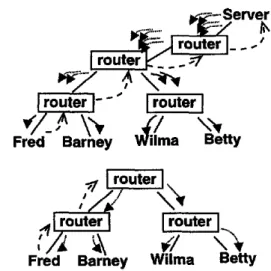
two-way d a t a streams and the client/server architecture which underlies the majority of distributed services. T h e second model uses multicast [2] to, in effect, elim- inate the need for a central server in the architecture. Here, clients efficiently transmit messages directly to each other through a multicast IP address with the routers essentially replacing the server. As shown in Figure 1, a server can become a bottleneck if there are many users chatting at once; a multicast architec- ture avoids this problem and scales more easily. This model illustrates the use of multicast b o t h to increase network efficiency (in terms of latency and consumed bandwidth) and to simplify program structure.
~'~:
Server--(../
Fred Barney Wilma y
F~e
d~~Ba~r~ney
W~ii/m
a~~t y
Figure 1: T h e top shows a server-based chat room. When Fred sends a message, it must be sent to each user individually, so it crosses some network connec- tions multiple times. T h e b o t t o m shows a multicast chat room which avoids this problem.
Although an insecure chat room may be suitable for casual conversation, many users desire some assurance t h a t their conversations are private and cannot be inter- cepted by untrusted third parties. T h e r e are four spe- cific requirements for a security system. First, it must guarantee the identity of each user, a process called au- thentication, which ensures t h a t intruders cannot pose as other users and forge messages in their names. Sec- ond, the system must grant privileges to each user and enforce these privileges, which is called authorization.
Third, the system must ensure the integrity of informa- tion, meaning any alterations made to a message must be detectable, thereby preventing an intruder from se- cretly corrupting a message. Finally, the system must enforce the secrecy of d a t a to ensure t h a t no one can eavesdrop on private conversations.
In designing a security protocol, the network is assumed to be insecure, meaning anyone can break in, read and
alter d a t a packets as they are transmitted. Privacy must therefore be based on encryption. Most termi- nals have only a keyboard and mouse for input devices, so retina scans and other means of user authentication are not considered; only passwords and confidential files are feasible means of authentication. T h e security pro- tocol should also be easy to use and provide interactive performance comparable to insecure alternatives, oth- erwise the rate of adoption of the secure system will be hampered. Finally, the security protocol should be provably secure. In [1], the authors describe a formal notation and set of assumptions which describe a pro- tocol's security. We leverage this logic in our protocols. 3 Security Protocols and Encryption
Encryption can be used to implement a security system. Two kinds of ciphers are commonly used: secret key and public key. Both use a block of d a t a called a key
to transform text in such a way t h a t it is unintelligible to anyone who does not have the means to reverse the transformation. A secret key cipher uses one key for b o t h encryption and decryption. A public key cipher uses two keys; any d a t a encrypted with one key can only be decrypted by the other key. These two types of ciphers provide privacy and authentication in different ways. Entities using encryption for communication are called agents. We use the following notation: {text : K} means text encrypted with key K. K* denotes a public key and K # the corresponding private key.
If a secret key is known only to two agents, they may use it to send encrypted messages to each other such t h a t third parties will be unable to read them. If an agent sees a message encrypted with such a key, she m a y con- clude t h a t either she or her p a r t n e r wrote it. Based on its contents, she should be able t o tell which one of them wrote it, and when. She can therefore detect whether the message is a copy of one sent long ago, per- haps recorded and replayed by a malicious t h i r d - p a r t y agent. Thus, secret key ciphers can b o t h keep a message private and guarantee its origin. T h e secret key must never be revealed and should be impossible to guess. Public key ciphers work differently. Each agent has a pair of keys, one of which is publicly available, the other of which is known only to him. If one agent, Bart, en- crypts a message with the public key of a n o t h e r agent, say Lisa, then only Lisa will be able to read it. If B a r t encrypts a message with his private key, anyone can get his public key and decrypt it, but they will know Bart wrote it because only his private key could con- struct such a message. Thus public key ciphers can also be used for privacy and authentication. Private keys are typically very hard to guess, but must still be kept secret. Mappings between public keys and individual identities must be available from a trusted third p a r t y
whose identity must also be authenticated (e.g., an iden- tity server with a well-known public key).
An alternative means of authentication is a piece of d a t a called a nonce. If only two agents know a nonce, then any message they see which includes the nonce must have been written by one of them. Another property of the message must be used to determine which agent sent it and when. If B a r t and Lisa share a nonce, then B a r t can send a message containing it to Lisa encrypted in her public key, and she may conclude t h a t Bart sent it and no one else could read it. Without the nonce, B a r t would have to encrypt the message with his pri- vate key and again with Lisa's public key to make it b o t h authentic and private. T h e nonce avoids this slow double encryption.
In any protocol, agents must agree to trust certain servers, which are responsible for generating new secret keys and nonces. Messages from these servers must also be authenticated. Both types of ciphers also provide in- tegrity. If an encrypted message is altered in transit, it will decrypt to nonsense, thus alerting the receiver t h a t something has gone wrong.
4 Design and Implementation
T h e chat room demonstrates two security protocols, one based on secret key ciphers, and another based on pub- lic key ciphers and nonces. These two implementations illustrate alternative ways of constructing secure dis- tributed applications and the use of the logic of authen- tication [1] to precisely describe the level of security they provide.
4.1 Secret Key Security Protocol
T h e chat room includes an implementation of a security protocol based on secret key encryption which can be used to give a hands-on illustration of how the popular Kerberos [3] protocol works, and the amount of planning t h a t must go into designing such a protocol. When de- signing a security protocol based on secret key ciphers, there are several things to keep in mind. It is convenient to authenticate agents based on a password. T h e pass- word is hashed to produce a secret key. If this key is known only to the agent and one server, they can send secret authentication messages to each other. For max- imum security, the k e y must not be given to any other agent (including another server), nor can the password ever be sent in plain text over a network. Further, the number of messages encrypted using this key should be minimized. These precautions reduce the chance t h a t a malicious agent will be able to read the password or collect enough d a t a to guess the secret key.
If agents are to communicate securely but with mini- mal use of their password keys, then some other reli-
able source of secret keys must be provided. Once two agents are assured of each others' identities, they can encrypt their messages with a session key, which must be known only to them, come from a trusted server, and be used only for a short time and t h e n replaced. T h e y agree on the key by exchanging a piece of d a t a called a ticket as follows. Consider the example where B a r t and Lisa wish to employ a session key for private communication. T h e y both t r u s t Marge and have secret keys, KB and KL, known only to themselves and her. Lisa asks Marge to generate a session key. Marge con- structs a ticket {Lisa Bart KS time} containing a new secret key KS and the current time. She then makes a two-part message {ticket {ticket : KB} : KL} and gives it to Lisa, who can decipher the message and extract the session key and time stamp from the ticket. Lisa believes the message is indeed from Marge because it was encrypted with KL, which is known only to her- self and Marge. T h e time stamp proves it is fresh and not a replay of an old message. She sends the second part of the message {ticket : KB} to Bart. He reads it and extracts the session key, and believes it was from Marge because it was encrypted with KB. Both B a r t and Lisa now know the session key KS and can use it to communicate securely.
A typical chat session using the secret key protocol, which requires two ticket exchanges, is illustrated in Figure 2. T h e agents are Bart, Lisa, the authentica- tion server, the ticket server, and the chat server. Their password keys are KB, KL, KA, K T , and KC, respec- tively. Marge the administrator starts the authentica- tion server, which has access to all the users' password keys and KT, and distributes session keys for the ticket server. She then starts the ticket server, which has ac- cess to the secret keys of the authentication server and all the other servers such as the chat room, and con- structs session keys for them. T h e s e a r e the two trusted servers used by the protocol. Finally, she starts the chat server.
Bart starts a chat client, which contacts the authenti- cation server and a ticket exchange takes place. T h e authentication server sends B a r t a ticket containing a session key, K1. Bart sends the second copy of the ticket to the ticket server. B a r t and the ticket server can now communicate securely using K1. Next, B a r t asks the ticket server for a ticket to the chat server and another ticket exchange takes place. T h e ticket server sends Bart a ticket with a second session key, K2. He sends the new encrypted ticket to the chat server, which can decipher it to obtain K2. B a r t and the chat server can now communicate securely using K2. Lisa goes through a similar procedure and can communicate se- curely with the chat server. Lisa and B a r t can now chat securely, and only users with passwords to the authenti-
(1)
ITicketServer I -'~Authentication
f
(2)
I{T1
{TI:KT}: KB} I
Bart <
(4)[ChatServer~
Ticket
I{w2
IT2 : KC}: K1} T I =(6)
I{T2 : KC} I {Bart Ticket K1 time} (7)I{ ''Hi
Lisa" :K211
T2=C¼tha
{Bart Chat K2 time} Figure 2: Example session of the secret key protocol.cation server can join in. Since all messages to the chat server are encrypted with session keys, it can authenti- cate them, and relay that information to all clients. The ticket server merits further explanation. The pro- tocol could be designed so that each client receives its session key for the chat server directly from the authen- tication server. A more complicated client such as a network file system may need a session key for each in- dividual file server, which would require the exchange of multiple messages with the authentication server en- crypted with the user's password. With a ticket server, the protocol uses only a single such message, making it less likely that someone can gather enough dat a to guess the password key. In Kerberos, the ticket for the ticket server is stored in a temporary file when the user logs in and all of his client programs use it. The session key used to communicate with the ticket server has a short timeout (e.g., eight hours), requiring the user to period- ically refresh this session key. The presence of a ticket server thus limits the exposure of the user's password. 4.2 Public Key Security Protocol
The chat room also includes an implementation of a sec- ond protocol using public key encryption. It illustrates the flavor of authentication techniques employed by ex- isting Internet services such as e-commerce firms and online brokerages. This protocol requires fewer mes- sages than the secret key protocol because it does not use session keys. Private keys are generally much harder to guess than secret keys, making it less important to prevent private key exposure. On the other hand, pub- lic key cryptography is on the order of ten times slower than corresponding secret-key protocols. Thus, in prac- tice, many Internet services employ a public key ex- change to establish a shared (session) key.
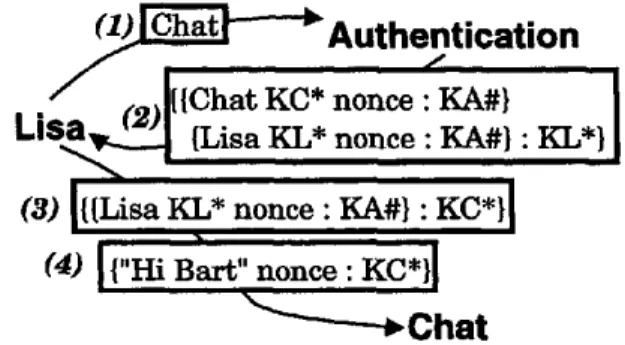
A sample session of the public key protocol is depicted in Figure 3. The agents are Bart, Lisa, the authentication server, and the chat server. Their key pairs are KB, KL, KA, and KC, respectively; * denotes the public key and # denotes the private key. The administrator, Marge, distributes a copy of the authentication server's public key, KA*, to all agents. She then starts the authentica- tion server which has access to all agents' public keys, constructs nonces, and is trusted by all agents. Finally, Marge starts the chat server.
(1) ~
Authentication
{{Chat KC* nonce : IO,.#}
Lis ,~..~
{Lisa KL* nonce : KA#} : KL*}(3)
[{{Lisa KL* nonce : K&#} : KC*}[(4)
I {"I-Ii
Bart" n o n c e :KC*~ I
""-"--~Chat
Figure 3: Example of the public key protocol. Time stamps are omitted.
Lisa starts a chat client, which contacts the authentica- tion server. It constructs a nonce and sends Lisa a re- ply, both parts of which are individually encrypted with K A # (guaranteeing the origin of the message). The en- tire message is encrypted with KL* so only Lisa can read it, keeping the nonce secret. Lisa deciphers the message, reads the nonce and KC* from the first part, encrypts the second part (Lisa KL* nonce : K A # } with KC* and sends it to the chat server. The chat server can reverse both layers of encryption to obtain the nonce and KL*. Lisa and the chat server now share a secret nonce and know each other's public key. They commu- nicate privately by encrypting messages to each other in the recipient's public key; the sender also includes a copy of the nonce to authenticate each message's source. Bart goes through a similar procedure, allowing him to chat securely with Lisa through the trusted chat server. Only users with public keys known to the authentication server can join in.
As an additional refinement to this project, the nonce may be used as a secret key for secure communication, which makes chatting faster as secret key ciphers require less computation than public key ciphers.
4.3 Java Implementation
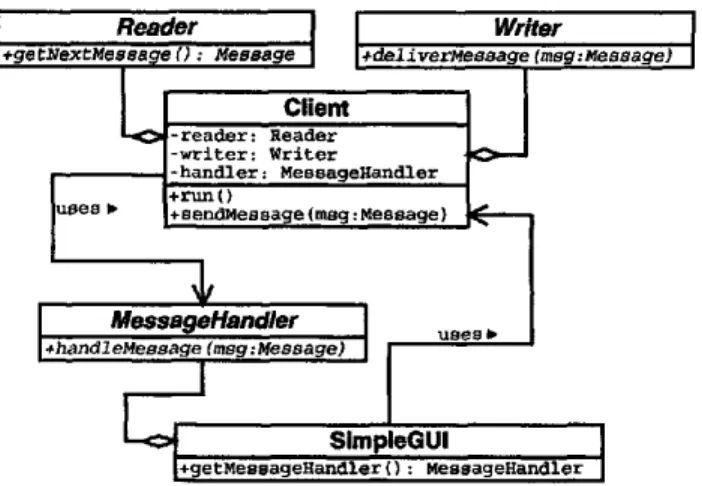
The chat room and security systems are written in Java. Their design is based around several interfaces (see Fig- ure 4). The whole package, including security servers, tools, and client/server and multicast implementations,
all with debugging output, is about 6000 lines of com- mented source code spanning 75 files from 9 to 258 lines in length. The GUI is confined to two files totalling 112 lines. The Client and SimpleGUI classes are used in each client implementation and handle exchange and display of messages. The Reader and Writer interfaces encapsulate the input and output of messages and are implemented by several classes which handle encryption and communication with the network.
I
Reader
]
Writer• getNextMeseager):Message I ,+deliverMessage(msg:t4essage) I
I ,
O'n'
L ~ - reader : Reader l - w r i t e r : W r i t e r ---~ - h a n d l e r : MeseageHandler / + r u n { )uses ~ ] +sendMessage (msg: Message ~
I
MessageHandler
I
+handleMessage (meg:Message) I uses
,I
I
L'¢::l÷gec~essageH2J~rP:~:G
MU:ssa,e.andler
Figure 4: UML class diagram of the chat client. The authentication and ticket servers handle clients sequentially, although they could be re-written to be multi-threaded. Each kind of message in each security protocol is represented by a class, and the Java serial- ization framework is used to transmit them. There are also utility programs for managing passwords and key files. The chat servers are multi-threaded with a sepa- rate thread for each client. The authentication proce- dure and encryption standard are encapsulated so that the code is flexible and re-usable.
5 Educational Use
This project attempts to fulfill a number of pedagog- ical goals at the advanced undergraduate level. First, the architecture of the application allows students to learn basic network programming, including the multi- cast service model and the structure of multi-threaded servers. Students also learn about the detailed archi- tecture and implementation of the Kerberos security in- frastructure. The public key version of the chat room illustrates the techniques employed by Internet services to carry out secure transactions over an insecure net- work. Finally, the performance characteristics of the multiple secure and insecure incarnations of the chat room illustrate the performance challenges faced by the designers of scalable network services. The package in- cludes descriptions of several assignments for basic and secure chat rooms, the source code for sample imple- mentations, and documentation for that code.
Possible programming assignments include asking stu- dents to re-implement the chat room and security sys- tems individually or in groups. Since the security sys- tems require several servers, tools which must work to- gether, and well-defined interfaces, their implementa- tion is well-suited to group work. If all the projects are coded to the protocols defined in the given imple- mentation, they will be compatible. The compatibility and performance characteristics of each incarnation of the chat room can be demonstrated and measured by organizing a large chat session, spanning many com- puter labs, operating systems, implementations, and lo- cations. To facilitate compatibility, the teacher could distribute some existing source code, e.g., the message classes, and make the existing implementation available in compiled form for use in testing.
Written assignments could be based on the logic of au- thentication. Students can be asked to use it to de- termine how the two security protocols work, exactly what level of security they provide, and to design and implement their own protocols. Such assignments could supplement lectures on Kerberos, PGP, and SSL. 6 Conclusions
This paper describes a chat room assignment designed to teach the basics of distributed programming and security protocols. A client/server implementation demonstrates the construction of many current Internet services while a multicast version illustrates the bene- fits of multicast to simplify system design and improve performance. Two different security implementations demonstrate the architecture of popular modern secu- rity protocols, including Kerberos and the public key ar- chitecture underlying the secure transactions provided by modern Internet services.
References