Worcester Polytechnic Institute Worcester Polytechnic Institute
Digital WPI
Digital WPI
Interactive Qualifying Projects (All Years) Interactive Qualifying Projects
2019-12-11
Facilitating Startup Development in Venice
Facilitating Startup Development in Venice
Francesco Joseph De LeoWorcester Polytechnic Institute Mark Gregory Bernardo Worcester Polytechnic Institute Skylar J. O'Connell
Worcester Polytechnic Institute Tyler John Ferrara
Worcester Polytechnic Institute
Follow this and additional works at: https://digitalcommons.wpi.edu/iqp-all Repository Citation
Repository Citation
De Leo, F. J., Bernardo, M. G., O'Connell, S. J., & Ferrara, T. J. (2019). Facilitating Startup Development in Venice. Retrieved from https://digitalcommons.wpi.edu/iqp-all/5645
This Unrestricted is brought to you for free and open access by the Interactive Qualifying Projects at Digital WPI. It has been accepted for inclusion in Interactive Qualifying Projects (All Years) by an authorized administrator of Digital WPI. For more information, please contact [email protected].
FACILITATING STARTUP
DEVELOPMENT IN VENICE
MARK BERNARDO
FRANCESCO DE LEO
TYLER FERRARA
SKYLAR O’CONNELL
2
Facilitating Startup
Development In Venice
An Interactive Qualifying Project submitted to the Faculty of
WORCESTER POLYTECHNIC INSTITUTE in partial fulfilment of the requirements for the degree of
Bachelor of Science
Mark Bernardo Francesco De Leo
Tyler Ferrara Skylar O’Connell
This report represents work of WPI undergraduate students submitted to the faculty as evidence of a degree requirement. WPI routinely publishes these reports on its web site without editorial or peer review. For more information about the projects program at WPI, see http://www.wpi.edu/Academics/Projects
Advisors: Professors Fabio Carrera and William Michalson Date: 13 December 2019
AUTHORSHIP
This final report was written Mark Bernardo, Francesco De Leo, Tyler Ferrara, and Skylar
O’Connell, of the VE19-CROWD team. The report was written and revised as a team, and as
such, every member’s collaboration and teamwork led to the completion of the final report.
Specifics of authorship are as follows:
3
Mark Bernardo
contributed to the “Marketing a Startup”, “Interviews”, and “Assertion VideoDeconstructed” sections. He additionally produced all the videos for the project.
Francesco De Leo
contributed to the “JobDemographics in Venice”, “A Declining Population”, “Making a Startup”, “Venice Project Center”,
“Projects Behind Us”, “SerenDPT”, and “Interviews” sections. He additionally assisted in writing the scripts for the videos.
Skylar O’Connell
contributed to the “Lean Startup Process”, “The Startups are Born”, “Projects Behind Us”, and “Roll-Up Poster Deconstructed” sections. She additionally took a lead role in creation and design of the roll-up posters.Tyler Ferrara
contributed to the background of the report as well as the “Analysis and Next Steps” section. He also contributed to the early-stage production of posters and videos.ACKNOWLEDGEMENT
Our team would like to thank our sponsor SerenDPT in addition to our advisors Professors
Fabio Carrera and William Michalson. In addition to this we would like to acknowledge Luca
Giuman and Nicola Musolino for their advice and guidance throughout the project.
ABSTRACT
We created methodologies for startups to effectively communicate their ideas and
engage targeted audiences. We conducted research into different marketing strategies.
Promotional and informational materials including “roll-up” posters and assertion videos
were created to share the individual ideas of each startup. This was the Venice Project
Center’s first project dedicated to funding for more than one SerenDPT startup.
TABLE OF CONTENTS
6 Introduction
Job Demographics in Venice A Declining Population
Background
Making a Startup
The Lean Startup Process Marketing a Startup
Digital Marketing
The Venice Project Center and SerenDPT
Venice Project Center Projects Behind Us SerenDPT
The Startups are Born
Methodology Interviews 11 12 13 14 15 17 22 23 24 25 26 27 28 32 33
Materials Created For Each Startup Roll-Up Poster Deconstructed Assertion Videos Deconstructed Analysis and Next Steps
Conclusion References 35 36 46 53 54 55
TABLE OF FIGURES
7
Figure 1: Venice Job Demographics
Figure 2: Population of Historical Venice Over Time Figure 3: New venture financing lifecycle
Figure 4: Startup Progression Figure 5: The Lean Startup Process Figure 6: Lean Startup Cycle
Figure 7: VPC Project List Figure 8: VPC Outline
Figure 9: SerenDPT Startups Figure 11: PreserVenice Poster
Figure 12: Open Street Lamp Poster Figure 13: Casa Peota Poster
Figure 14: Marketzquare Poster Figure 15: Re-Lab Poster
Figure 16: SerenDPT Poster Figure 17: PreserVenice Video
Figure 18: Open Street Lamp Video Figure 19: Casa Peota Video
Figure 20: MarketZquare Video Figure 21: Re-Lab Video
Figure 22: SerenDPT Video
12 13 15 16 17 18 25 26 27 37 38 39 40 41 42 47 48 49 50 51 52
MISSION STATEMENT
Create methodologies for startups to
effectively communicate their ideas
and engage their targeted audiences.
OBJECTIVES
1. Conducted research on marketing
strategies.
2. Developed methodologies to
engage the target audiences for
five startups.
EXECUTIVE SUMMARY
The historic city of Venice has been experiencing a sharp population decline over the past six decades. With tourism and service making up a
majority of the job market, locals seeking more lucrative job opportunities migrate elsewhere. In addition to this, jobs available on the island do not provide a livable wage for the city, meaning even some of those who wish to stay on the island can not afford to. If this trend in population decline continues, the
population will sink to fewer than 50,000 residents, which
10
is “too few to have any political weight” (Il Fatato Quotidiano). With the city at risk, the only solution is to diversify the job market with jobs that will provide a living wage for residents of Venice. This can be achieved through creation of technology-based startups, as they will rapidly create jobs as well as provide jobs with higher wages than traditional jobs within Venice.
For our project, we worked with SerenDPT, a startup factory founded by Fabio Carrera with support from the Venice Project Center.
Through meetings and
interviews with employees and upper management, we
created methodologies for the SerenDPT-associated startups to engage consumers and increase awareness.
We decided to work with five early-stage startups in
particular: PreserVenice, Open Street Lamp, Casa Peota,
MarketZquare, and Re-Lab. We Created “assertion videos” and “roll-up” posters for each
startup to be used as
promotional and marketing materials. We also made a “roll-up” poster and video for SerenDPT.
Introduction to Job Demographics, Living
Wage, and Population Decline in Venice
Figure 1: Venice Job Demographics (8milaCensus)
JOB
DEMOGRAPHIC
IN VENICE
The city of Venice has what is known as a “single sector economy”. This term simply means the majority of all jobs in the economy fall into one category. In the case of Venice, the category is the service/tourism sector. With 56.4% of all jobs falling within the service sector, it is the clear majority. Examples of jobs within this sector can include waiters, tour guides, and souvenir shop owners.
12
AVERAGE WAGE
VERSUS COST OF
LIVING
Unfortunately for Venetian citizens, many jobs within the service sector do not Provide a living wage in Venice. The average service job earns a Venetian roughly €20.000 a year (salaryexpert.com). With the cost of living in Venice estimated at €30.200
(Nomadlist), many Venetians struggle to make ends meet financially. Service Commerce Industry Agriculture Avg: 15.000 € / Year Avg: 35.000 € / Year Avg: 50.000€ / Year Avg: 20.000 € / Year
A DECLINING
POPULATION
Since the 1950’s, the historic island of Venice has undergone a major population loss from nearly 180,000 residents to currently under 60,000 (Bloomberg). One major
contributor to this trend is the previously mentioned wage dilemma which creates the inability for Venetians to afford to live on the island. With the island in danger of dropping to a population that negates all political weight, an effective and fast-acting solution is needed.
13
TECHNOLOGY-BASED
JOBS AS A SOLUTION
While service-based jobs (which make up 56% of jobs in Venice) do not meet the living wage, there are other jobs that do. Jobs within the industry sector, which make up only 16.6% of jobs, earn an
average of €50.000 a year (salaryexpert.com). For
instance, a software engineer makes an average of €52.000 yearly. If more of these jobs are available to Venetians, more will be able to live on the island. Figure 2: Population of Historical Venice Over Time (Albansese, 2018)
Background on Startup Development and
Marketing Strategies
MAKING A
STARTUP
All startups begin the same way; they start as an idea. Some will never become anything more than an idea and others will go on to become
companies worth billions of dollars. Unfortunately, 9 out of 10 startups fail (Patel, 2015). In order for a startup to become one of the few successes, they will have to go through years of business development and growth as well as make many crucial decisions along the way. The main aspects of successful startups include a product that
15
is “perfect for the market”, fast growth, and versatile and highly skilled team members (Patel 2015).
In the initial concept stage, the startup is nothing more than an idea or concept. At this point, the goal of the business is to do research and acquire
information on the market they are operating in. In this stage,
no money is being made, and in fact, money is being spent by the company’s founders as they will need to invest money into their business to gain traction. In the next stage or the “seed” stage, the business remains in debt but is now progressing towards profit. The business is no longer just an idea and at the bare minimum, a prototype of the product
Figure 3: New venture financing lifecycle (Patel, 2015)
exists. At this point, the
business should look to mostly acquire funding from grants or friends and family as they still do not have a product ready to sell (Rossi, 2015). The “early” stage is the first stage where the startup is able to offer a product or service. At this point, the startup is making more money than they are spending and they are
experiencing growth both in finance and consumer
engagement. Any startup that makes it to this level is
considered to be successful. Right after that comes the “expansion” stage. In this
16
stage, the company can look to bank loans and venture capitalists for sources of money as they are now profitable and have
demonstrated to the public that they have a successful business model (Rossi, 2015). The final two stages are the “late” and “IPO” stage. These are considered to be the final steps of a startup because after this point the startup is on the public market. At this point, all funding comes from banks and strategic investors and the company is at its peak
(Rossi, 2015). Figure 4: Startup Progression (Vlieger, 2015)
THE LEAN
STARTUP
PROCESS
The Lean Startup
Methodology was first devised by Eric Ries book The Lean
Startup aimed to simplify
product development.
Originally named after "Lean Manufacturing", it introduced a new form of design thinking that directly addresses the difficult process of creating a successful product.
17
idea that "most of our ideas are actually terrible" (Ries). Taking an idea directly to market will most likely fail, as the proper customer
validation is required. Instead of betting on a single product, the framework advises the creation of multiple Minimum Viable Products (MVPs) to test with customers. Once given to the desired users, critical
feedback illustrates the successes and failures of the product. The data is gathered and a new hypothesis for the next iteration is made. This cycle is what helps
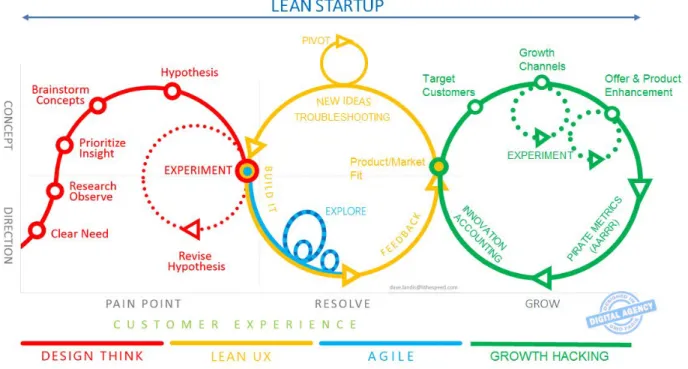
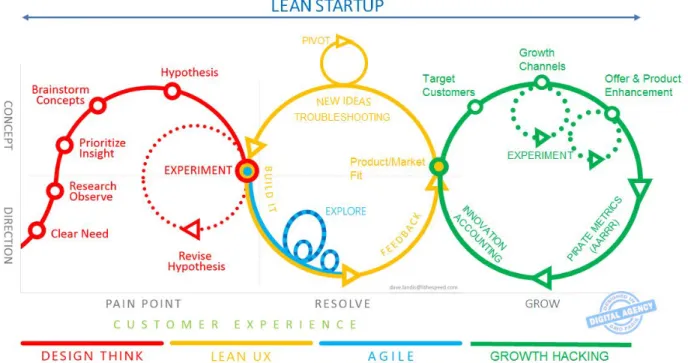
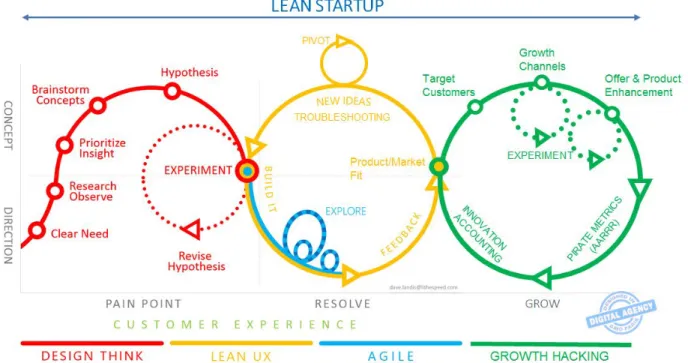
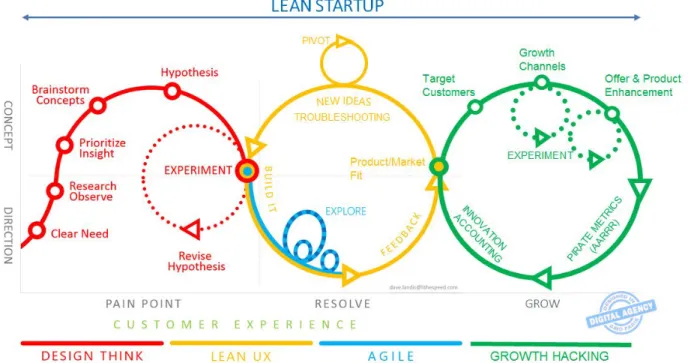
Entrepreneurs gather as much data about the product as fast as possible. DESIGN THINKING LEAN USER EXPERIENCE GROWTH HACKING AGILE DEVELOPMENT
Figure 5: The Lean Startup Process
Tailored especially towards startups, the process is considered the "standard framework" for modern
business to follow (Blank 2013). It's philosophy is based on the
THE LEAN
STARTUP
PROCESS
The Lean Startup Process consists of 4 iterative steps for startup growth. The first step is called “Design Think”, illustrated in red on Figure 6. This step consists of the background research behind the startup. This takes most startups months, or even years, to accomplish. This is also where the need is
identified and the startup idea is brainstormed and
hypothesized.
18
THE LEAN
STARTUP
PROCESS
The second step of the Lean Startup Process is called “Lean User Experience”, illustrated in yellow on Figure 6. In this step, the company “[goes] out and ask potential users,
purchasers, and partners for feedback on all elements of the business model, including product features, pricing, distribution channels, and affordable customer
acquisition strategies”. (hbr.org)
19
THE LEAN
STARTUP
PROCESS
The third step of the Lean Startup Process is called “Agile Development”, illustrated in blue on Figure 6. With the information gathered in the second step, the startup would adjust and grow to perfect their product. This type of development
eliminates time wasted and resources by developing iteratively and incrementally.
20
THE LEAN
STARTUP
PROCESS
The fourth step of the Lean Startup Process is called “Growth Hacking”, illustrated in green on Figure 6. In this step, the startup markets their product for a profit to target customers and offers
enhancements based on feedback. While both steps 2 and 4 require funding, step 4 requires marketing to get the startup’s product to
consumers.
21
“Often, startup teams need to define their audience and find product-market fit, whereas established companies focus on issues such as rebranding or increasing sales” (Sineni, 2014). Marketing a startup has a more experimental
approach than marketing a large company; this gives the startup business flexibility but also uncertainty in what
methods should be utilized to generate a larger customer base.
22
MARKETING
A STARTUP
Samantha Sineni states in
Growth Hacking: A Deep Look into Online Marketing for Startups “The high failure rate
of startups calls for rapid user acquisition and puts growth as the top priority for a startup team”. It is of the utmost importance that startup companies find their target demographic and effectively advertise their product or service in order to grow as a company.
STRATEGIES FOR
MARKETING A
STARTUP
As a startup company, it may not be a good use of time or money to pursue large scale advertisements like billboards or television commercials. There are plenty of simple, effective, and valuable resources for startups to generate publicity and monitor growth.
23
DIGITAL
MARKETING
Digital marketing through the likes of online advertisements and social media gives
businesses immediate feedback when monitoring awareness and engagement through metrics including followers and mentions. In
Growth Hacking: A Deep Look into Online Marketing for Startups, Samantha Sineni
speaks on the role that social media research has on user acquisition.
“Researching potential users allows the growth hacker to choose product features and marketing techniques to deliver to potential customers with measurable and
increased success rates.” The fast-paced landscape of social media gives startups an
environment to experiment with developing a customer base. Feedback from
awareness - follower or
subscriber counts - as well as engagements - mentions on Twitter and comments on platforms like Instagram and Facebook - gives the business a reference for the user
demographic as well as their
VENICE
PROJECT
CENTER
(VPC)
In 1988, Fabio Carrera and a group of six WPI students started the first of the Venice IQP projects.
These projects aimed to better the city of Venice with a
scientific and technological approach.
Over the years, these projects have collected data on
numerous subjects
25
concerning Venice, such as bell towers, tides, pollution, and accessibility.
Since its creation, the Venice project center has become a home to one of the richest databases for Venice.
This database has become the foundation for many of the startups incubated by SerenDPT.
Where as most startups take years to gain this type of background research and knowledge, the VPC has
collected such a vast database for the startups that they are able to surpass this part of the
lean startup flowchart.
Figure 7: VPC Project List
PROJECTS
BEHIND US
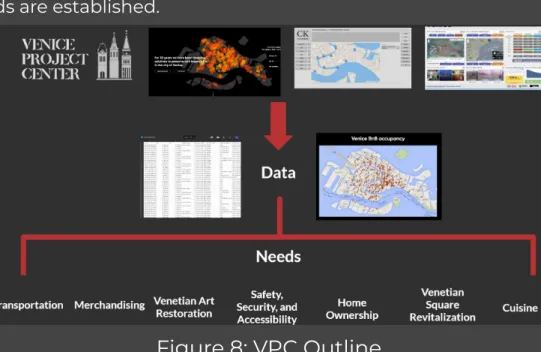
The projects completed by the WPI students during their time with the Venice Project Center helped build the rich databases that the VPC is known for. With projects spanning a variety of topics, the VPC has collected data on pateres, altars, churches, the Venice B&B occupancy, the Venice inner city island, the Venetian canals, fountains, and Venetian green areas. These databases consist of all the open data on the VPC website.
26
From all of this data, many flaws in the city of Venice became apparent. From this, immediate needs were
identified. As seen in the figure below, seven major needs are established.
These seven needs became the current startup ideas for
SerenDPT.
SERENDPT
SerenDPT is a “startup factory” that aims to create
high-paying jobs that allow Venetians to afford the cost of living in Venice. They intend to do this through formation and development of
technology-based startups. The figure to the right, in comparison to Figure 9 on the previous page, plots each startup with its previously identified need. With these needs addressed by the startups, SerenDPT will help Venice solve these problems while also creating
high-paying jobs. 27
THE STARTUPS ARE BORN
28
Part of the focus of this IQP was to look at the AirBnBs in Venice compared to the residential area. The second IQP was called
“Vacation Rentals and Residential Housing in Venice”. It found
“potential initiatives to assist the city in providing affordable housing for its residents.” (serendpt.net) The last, IQP for Casa Peota was called “Staying in Venice: Feasibility Study of
Housing Startup Casa Peota”. The startups have become not
only an important piece of
SerenDPT but also a staple of the Venice Project Center. For
example, PreserVenice, a Venetian owned and led
crowdfunding platform for the restoration and preservation of public cultural artifacts, has had 6 projects dedicated to making it a reality. Another startup with a project dedicated to it is Casa Peota. Casa Peota has 3 different IQP projects behind it. One
project focused on the
“Assessment of the Non-Resident Housing Market in Venice, Italy”.
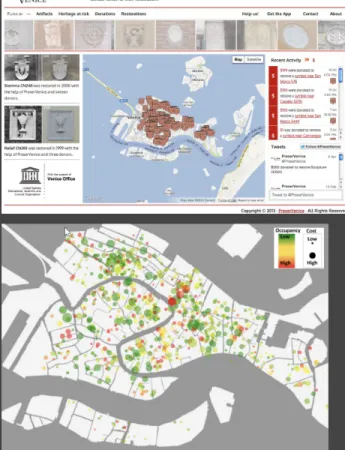
Figure 10: PreserVenice website (SerenDPT, 2018) and VPC Database (SerenDPT, 2017)
THE STARTUPS ARE BORN
29
Casa Peota is just one example of the many projects that have contributed to the startups. Another example is MarketZquare, which has had 4 projects behind it. Along with the projects that were for the startups, there are also hundreds of projects that give the startups a background to work from.
With all of this information, SerenDPT created 10 different startups. Of those 10 startups, our project focused on 5, those 5 being Casa Peota, Open Street Lamp, Re-Lab,
PRESERVENICE
A Venetian owned and led crowdfunding platform for the restoration and preservation of public cultural artifacts. By donating through the website or mobile app, people
interested in restoring the public cultural artifacts would then be able to give a
donation of their choosing to any of the artifacts they wish to restore.
30
OPEN STREET
LAMP
A platform for intelligent street lights using a
subscription for services based on the network of intelligent or pay-per-use street lamps. The subscription would include WiFi, security cameras, and parking spot reservations. This would all be available through an app on smartphones or desktop.
CASA PEOTA
Casa Peota would allow young couples (or individuals) to become owners of their house in Venice by paying a fixed monthly rent-to-own amount, equivalent to a competitive rent. The remainder of the mortgage would be paid by tourists, who would stay in one of the rooms of the apartment, hosted by the young couple (or individual).
MARKETZQUARE
Marketzquare aims to
revitalize town squares that were once lined with mom & pop stores, to reopen the former neighborhood stores as street-facing façades of a single neighborhood
supermarket, managed behind the scenes with the modern logistical systems of a supermarket, but appearing on the town square like individual neighborhood stores with typical products providing competitive prices for hyperlocal and organic
products. 31
RE-LAB
A platform for intelligent street lights using a
subscription for services based on the network of intelligent or pay-per-use street lamps. The subscription would include WiFi, security cameras, and parking spot reservations. This would all be available through an app on smartphones or desktop.
NICOLA MUSOLINO
The group interviewed Nicola Musolino, full-stack developer for SerenDPT. Nicola started in 2016 developing applications such as the first iteration of daAaB. He currently works as the systems administrator for SerenDPT, managing all of their systems and databases. He is also an equity shareholder of the daAaB startup.
Since the SerenDPT team operates in a startup environment, there can often be tasks and operations that cannot be covered by the smaller sized staff. When asked about these tasks and what he feels SerenDPT would find most helpful, Nicola addressed the need for advertising
the startups. 33
“If you can engage more people, there comes the possibility to raise the platform and monetize more.”
With the wealth of intellectual property and associated data within SerenDPT, there is a large growth potential for the advertising and marketing of these ideas. This would allow for business growth and more potential for job creation in the city of Venice and beyond.
LUCA GIUMAN
The group also had the
opportunity to interview and work with Luca Giuman, business
partner of SerenDPT. Luca has extensive experience in the tech startup world as he has been on the constituent board of many startups as well as having worked in the management of companies producing products and services. Luca provides both the team and SerenDPT with a plethora of
knowledge and background when it comes to running and growing a startup. Since our team is not an internal member of SerenDPT, but rather an external one, Luca
34 explained that we have great
value since we bring an outside perspective to the table.
“You cannot sell something that you would not buy yourself.”
Luca’s main message is that we should use our outside
perspective to identify what it is exactly that stands out to us about these startups and then use those findings to fuel our marketing strategies. If we are not passionate about the ideas of these startups then we will not be able to
generate passion in others.
MATERIALS
CREATED FOR
EACH STARTUP
After discussing with Nicola, Luca, and the SerenDPT team, we concluded that the most effective way to help develop the SerenDPT startups was to create promotional material in order to increase consumer engagement. With the knowledge from our background research on funding and startups, we decided that roll-up posters and assertion videos would be the best materials to create.
35
The roll-up posters are a concise informational visual that would allow potential investors or donors to get an idea of the nature of the startup. Each roll-up is different because of each startup functioning differently and having different needs and audiences. However, each roll-up consists of the logo and name at
the top followed by a description of the startup. The posters vary after that due to the different audiences of each of the startups.
The assertion videos, like the ones seen on World Economic Forum, are short videos (less than 2 minutes in length) which give a quick but detailed view of the startups and the challenges the startup solves. The assertion videos evoke emotion from the viewer and then display the startup as a solution to the problem followed by a call to action for the view to support the startup.
ROLL-UP
POSTER
DECONSTRUCTED
Each startup’s poster is constructed differently depending on a few factors. One factor is the product that the startup is developing. Whether it be a smart street lamp like Open Street Lamp or a test kitchen like Re-Lab, the poster’s central theme should be based around the idea of the startup. Another factor is the target audience of the startup. By gearing the roll-up to the target audience,
36
it will entice the audience to support the startup.
One consistent element
between all the roll-ups is that it is meant to be stand alone. The roll-up is meant to give the ideas of the startup without any other support or a person there to explain it. Because of this, the roll-up must have a thorough description of the startup as well as display all the features of the startup. Another
consistency is the SerenDPT logo at the bottom along with the QR code to any important documents or the assertion video which we made. With all of these elements, the roll-ups will be able to display the ideas of the startup.
ROLLUP
POSTERS:
PRESERVENICE
The PreserVenice poster is unique to the other posters in that it is dedicated to a
donation based platform
37
For this poster, we wanted to display the vast amount of data within the
PreserVenice database so that was the main piece of information we wanted to carry throughout the poster. We wanted to convey the disarray of the art as well as the vast amounts of art throughout Venice.
Figure 11: PreserVenice Poster
At the top of the poster we have the logo, name, and description of the startup.
The top of the poster is a photo mosaic, provided by the VE-19 30th team, that displays some of the pieces of art within the database. This aspect was very
important to us when making the poster because we wanted it to be both visually appealing but also meaningful.
In the center of the poster, We also wanted to show the We also wanted to show the accessibility of PreserVenice so we showed both the website as well as the smartphone
application. We want the view to see the different methods of donation.
ROLLUP
POSTERS:
PRESERVENICE
38
Finally, there is a QR code that goes to our assertion video for PreserVenice as well as the URL for the PreserVenice website. We wanted to link the website especially so that people could go and donate to PreserVenice and its many artifacts that are in need of restoration. We also put the PreserVenice and SerenDPT logos at the bottom with the links.
Figure 11: PreserVenice Poster
At the bottom, we wanted to show the the difference between the artifacts that are being destroyed by either weather or other forces and artifacts that had been
restored. We also wanted a call to action at the bottom asking the viewer to support
ROLLUP
POSTERS:
OPEN STREET
LAMP
The Open Street Lamp poster is the best example of an emotional appeal poster from our lineup of posters. Because of this, we wanted to have the focus be emotion.
39
Coming from the street lamp, we wanted to show the specific sensors that would be found within the street lamp. We wanted to use symbols as well as words to visually show the sensors. This is due to either language barriers or if someone is looking over it very quickly.
Figure 12: Open Street Lamp Poster
At the beginning of the poster, we have the name of the startup along with a description of the ideas and function of Open Street Lamp.
ROLLUP
POSTERS:
OPEN STREET
LAMP
40
Along with the sensors, we wanted to show the application features in a similar way. We color coded the
corresponding sensor and application so that viewers could quickly
Figure 12: Open Street Lamp Poster
We then show a person under a Venetian street lamp. We wanted to have someone standing in the light of the street lamp with a dark
background showing that they were safe and secure under the lamp. We chose a Venetian street lamp because it is the lamp being used for the prototype of the Open Street Lamp
see the results of the sensors at a quick glance. We again used symbols for the same reason as the sensors.
At the bottom of the poster, we have a QR code going to our assertion video for Open Street Lamp and the SerenDPT logo.
ROLLUP
POSTERS:
CASA PEOTA
41
We then put a description of the startup after the name. This gives the viewer information about the startup’s ideas. Casa Peota is dedicated to allowing young
couples or individuals to own their own home. We wanted to take this feeling and use it throughout the poster to have a simplistic feel and a feeling of comfort. We used a light, warm tan color to evoke comfort in the viewer, like the viewer was sitting on their own couch at home.
Figure 13: Casa Peota Poster
We started with the logo and name of the startup at the top of the poster. We also chose a Venetian home with a table and two chairs outside it for the top of the poster to put the idea of home in the viewer before going down the rest of the poster.
ROLLUP
POSTERS:
CASA PEOTA
42
We wanted to highlight the ease of use for Casa Peota. We highlighted this by showing the 4 step process with beautiful pictures to evoke passion about the startup. By having a simple dotted line between the steps it shows the simplicity of owning
a home through Casa Peota. Figure 13: Casa Peota Poster
At the end of the poster, we put the QR code to our assertion video on Casa Peota as well as the SerenDPT logo in the corner.
ROLLUP
POSTERS:
MARKETZQUARE
For the MarketZquare roll-up, the main focus was the
Venetian square. 43 MarketZquare, unlike some of the other startups, has a promotional video made by SerenDPT. We
Figure 14: Marketzquare Poster
At the top of the poster, we began with a busy Venetian market with various goods being sold by different shop owners. We also wanted to display this with the tagline
“Revitalizing Venetian Squares One Shop At A Time”. We then gave a longer description of the startup.
wanted to use the visuals from this video as the centerpiece for this poster as it shows the supermarket
connecting to the Venetian square with all the sections of the
supermarket becoming individual stores. The stores would cover a wide array of types of stores from a butcher to dry goods.
We ended the poster with the logos of SerenDPT and MarketZquare with the QR code to our assertion video.
ROLLUP
POSTERS:
RE-LAB
The Re-Lab poster is unique because it revolves around an idea from a chef turning into a restaurant.
44
We wanted to show the different stages of the startup so we had pictures reflecting each of the stages. The first is a chef
Figure 15: Re-Lab Poster
We started the poster with name and description of the startup with the tagline “Dream, Create, Launch”.
At the end of the poster, we have the QR code to the Re-Lab documents and the SerenDPT logo.
with an idea, taken from Re-Lab documentation. The next stage is the space in H3, the SerenDPT headquarters, for Re-Lab. The third stage shows a
restaurant in Venice which is standing as the pop-up restaurant which the chef could test his ideas in before entering the last stage. The last stage shows a proud owner in front of a restaurant. This shows the last step which is opening your very own restaurant. Underneath each of the stages is the time frame for each. Steps two and
three each last for six months. The fourth step lasts forever.
ROLLUP
POSTERS:
SERENDPT
For the SerenDPT roll-up, we wanted it to be more about the startups within the startup factory.
45
Figure 16: SerenDPT Poster We wanted to have the logo at the
top at the picture with Venice in the background. We also wanted to use the SerenDPT colors as the
background so we created a gradient of the three SerenDPT shades of red, orange, and yellow.
We also wanted to show the data and backings of SerenDPT and how all of those then became startups. Because of this, we made a tree using white lines. We had the lines start at the Venice Project Center (VPC), City Knowledge, and the Venipedia website.
From SerenDPT, we had lines coming from a central line that branch off into the different startups. The two lines at the bottom of the tree are left blank to show that there is more room for startups within SerenDPT.
ASSERTION VIDEOS DECONSTRUCTED
By creating an emotional appeal, the viewer is drawn into the video and feels a connection to the product. We use relatable emotions such as fear, hope, and
frustration to engage a large audience.
Next, statistics from reputable sources are used as evidence for the emotion. By including evidence backing up the claims, the audience will understand the
magnitude of the issue we are covering.
After the problem is established, we introduce the startup as a solution. This section of the video showcases the capabilities of the startup and how it addresses the greater problem.
With the viewer now aware of the problem and the startup’s solution, a call to action is made to find investors and donations.
46
EMOTIONAL APPEAL
STATISTICS
PRESERVENICE
For this video we wanted to convey pride and nostalgia that Venetians feel towards their city’s historic public art. Image 4 of the video
quantifies how many public artifacts are documented in Venice. The video progresses to image 7 which reveals the dilapidated state of a majority of the art in Venice. The viewer should feel a passion towards the art and then feel sad when they see the art in disarray.. After conveying this feeling to the viewer, the video proposes PreserVenice
47
as a solution for Venetians who are passionate about the art and want to help save the public art of Venice. After showing PreserVenice as a solution to this problem, image 9 of the video
demonstrates the mechanics of the PreserVenice website and how to donate. After that, the video calls the audience to action in image 12, asserting that the audience can come together and save the public art through PreserVenice.
Figure 17: PreserVenice Video Image 4
Image 7
Image 9
OPEN STREET
LAMP
For Open Street Lamp, we wanted to use a lot of strong emotions to stress the
importance to feel safe in cities. The video begins in image 1 describing the
intimidation of walking alone at night and the crime rates with street lights out. The beginning frames use a lot of dark settings to convey the feeling of being alone in
venice during the night. These feelings are supported in image 2 with the crime statistic from CityLab.
48
The video then precedes the solution with a description of the technology that is being developed for personal safety and security. Image 9
introduces the concept of Open Street Lamp, using footage of Venice to show the quantity of street lamps the city has to offer. When Open Street Lamp is introduced, the video also goes into the many features of the startup and its application to give the viewer a range of options which they could be interested in. Finally, the video concludes in image 15 with a call to action for the viewer to give their support to Open Street Lamp and “help build safer, smarter communities.”.
Figure 18: Open Street Lamp Video Image 1
Image 2
Image 9
CASA PEOTA
For the Casa Peota video, we wanted the main focus to be the struggle to afford a house in the historic city of Venice. With many of the homes becoming tourist
accommodations, such as AirBnBs, we wanted to illustrate the population decline in Venice and make people feel the frustration of expensive mortgage
payments, overtourism, and the resulting population
decline. Images 2 and 4 in this video convey these feelings by showing empty homes and
tourists occupying buildings. 49 After showing the rising tourist population and the sinking resident population, the video shows Casa Peota as a solution to these frustrations.. Casa Peota gives young couples or individuals a chance to live inside the historic city and help restore the dwindling
population. Images 14 and 15 of the video use animations and informational graphics to
illustrate the mechanics of Casa Peota’s rent-to-own mortgage model. Lastly, image 16 is a call to action which acts as a
promise to the audience that with their support, Venice will be repopulated with permanent residents.
Image 2
Image 4
Image 14
Image 16
MARKETZQUARE
The MarketZquare video begins with feelings of
nostalgia, as the script recalls a time when the streets of Venice were full of small shops. The problem is stated in image 4 by showing
examples of the now-empty and unused storefronts that can be found all around the city. To emphasize this point, a statistic from the Chamber of Commerce is utilized to
convey the magnitude of these closings; more than 500 shops in Venice have closed since 1996. To show the proposed solution, image 6
50
utilizes animations of storefront distributions and annotated maps to show how the empty storefronts all around venice will be revitalized and reopened. It is also important to note that these storefronts will be backed by “Zero-Kilometer” local
supermarkets that are
showcased in a graphic list. The call to action in image 11 aims to invoke pride and hope into the audience; with the help of MarketZquare the streets will once again be full of activity.
Image 2
Image 4
Image 6
Image 11
RE-LAB
For the Re-Lab video, we
wanted the central focus to be the test kitchen model and how it will help chefs of all backgrounds and skill levels to push the boundaries and create amazing new dishes. Image 7 of the video
evidences the startup’s feasibility of test kitchens by giving an example of a successful test kitchen. This test kitchen is called La Cocina, located in San Francisco, California. By showing the eye-popping sales that this test kitchen has assisted in its relatively short
life span, we wanted to show 51
the possibility of having a successful test kitchen within Venice, Italy. Re-Lab would allow Venetians to experiment in recipes and restaurant layouts. This is seen in images 12 through 15 by the graphic projections based on the space in SerenDPT’s H3 headquarters. The graphics illustrate the process of a chef or restaurant going through the Re-Lab process. The space allows for experimentation in kitchen and dining room layouts, and even the possibility of expanding to a fully operational pop-up
restaurant. Lastly, we have a call to action in image 18 for
Venetians to help the local cuisine become even better.
Image 3
Image 7
Image 12
Image 18
SERENDPT
For the SerenDPT video, we wanted to first address problems with employment and salary within the historical city of Venice. The first images introduce the population decrease as well as the living wage being too low for most Venetians to afford. Images 5 and 6 then showcases startup companies - mainly
technology startups - as a solution used around the world. This provides an
introduction SerenDPT being a solution for this problem. Image 13 explains SerenDPT’s
mission of using technology 52 to create jobs and solve Venice’s problems is shown through the data examples of city mapping and population. There are also frames that cite the immense research background provided by the Venice Project Center and students from WPI. This creates validity for the startups as well as showcasing all the work put into the company. There is a balance in footage of Venice as well as footage of technology and startups to show how SerenDPT integrates one with the other. Since
SerenDPT is a factory and not a startup, the video does not conclude with a call to action, rather a quote from Fabio Carrera.
Image 1
Image 6
Image 13
Image 15
ANALYSIS AND NEXT STEPS
The next step for these startups are finding the right
entrepreneurs to take over the businesses and grow them. Currently housed in SerenDPT, the startups new owners will facilitate the growth and
direction of each business. Our promotional materials will be used to attract these individuals from the local area.
53
Acquiring "seed round" funding to build and test prototypes will accurately depict the successes and failures of each business model. Partnerships with MIT & WPI can be explored to host a Venetian Venture Fund for the future. Following the Design Thinking framework,
entrepreneurs will have a better chance of sustainability.
Once initial funding needs are met, the startups can begin to employ the next generation of tech-employees in Venice. Their combined employment will meet SerenDPT's goal of 10 jobs over 10 years. Future growth in any of the businesses will promise further hires in the surrounding area, making
Venice a livable city for the local people again.
HIRE
CONCLUSION
54
From seven weeks of
background research and
seven weeks of project
execution, the team was
able to research and
analyze effective
marketing strategies and
then develop their own
methodologies to engage
the target audiences of
five startups. The
methodologies created
were roll-up posters and
assertion videos.
Although this project was
conducted in Venice for
Venetian startups, there is
projectability for these
methodologies to be used
For
startups around the
world with a goal of
increasing awareness and
consumer engagement.
REFERENCES
8milaCensus. (n.d.). Retrieved December 11, 2019, from http://ottomilacensus.istat.it/. Albanese, C., Salzano, G., & Vespignani, F. (2018, June 30). The Long, Slow Death of Venice. Retrieved from
https://www.bloomberg.com/news/features/2019-06-30/venice-is-dying-a-long-slow-death.
Blank, S., & Harvard Business Review. (2018, February 9). Why the Lean Start-Up Changes Everything. Retrieved from https://hbr.org/2013/05/why-the-lean-start-up-changes-everything.
Center, V. P. (n.d.). Venice Project Center - VPC30. Retrieved from
http://www.veniceprojectcenter.org/vpc
Cost of Living in Venice. Prices Updated Dec 2019. (n.d.). Retrieved from
https://nomadlist.com/venice.
ERI Economic Research Institute. (n.d.). ERI: Salary Expert - Job Salaries in Venice, Italy. Retrieved from https://www.salaryexpert.com/salary/browse/jobs/popular/italy/venice.
Institut Lean France. (2015, October 20). Lean Startup as the innovation engine for the Digital Agency at AXA b... Retrieved December 11, 2019, from
https://www.slideshare.net/InstitutLeanFrance/lean-startup-as-the-innovation-engine-for-the-digital-agency -at-axa-by-yves-caseau.
Patel, N. (2015, September 2). 90% Of Startups Fail: Here's What You Need To Know About The 10%. Retrieved from
https://www.forbes.com/sites/neilpatel/2015/01/16/90-of-startups-will-fail-heres-what-you-need-to-know-a bout-the-10/#33b37bb46679.
Pexels: the best free stock photos & videos shared by talented creators. (n.d.). Retrieved December 11, 2019, from https://www.pexels.com/
Rossi, M. (2015). The role of venture capital funds in financing innovation in Italy. Constraints and challenges for innovative small firms. International Journal of Globalisation and Small Business, 7(2), 162
SerenDPT. (2017). SerenDPT. Retrieved from http://serendpt.net/it
SerenDPT. (2018). PreserVenice. Retrieved from http://preservenice.org/
Sineni, S. L. (2014). Growth Hacking: A Deep Look into Online Marketing for Startups (Doctoral dissertation, University of Southern California).
StartitUp. (2014). Lean Marketing Funnel. http://startitup.co/guides/595/lean-marketing-funnel
Unsplash. (n.d.). Beautiful Free Images & Pictures. Retrieved from https://unsplash.com/.. doi: 10.1504/ijgsb.2015.071201
Videvo: Free Stock Video Footage & Motion Graphics Download HD & 4K. (n.d.). Retrieved December 11, 2019, from https://www.videvo.net/.
Vlieger, R. D. (2015, March 12). Build, Measure, Learn Cycle - Lean Startup Examples & Explanation: Call TheONE. Retrieved from
https://www.calltheone.com/en/consultancy/build-measure-learn-cycle-lean-startup.