COMPETITION FOR TRADERS AND RISK
By
Michiel Bijlsma, Jan Boone, Gijsbert Zwart
January 16, 2012
TILEC Discussion Paper No. 2012-003
CentER Discussion Paper No. 2012-008
ISSN 0924-7815
Competition for traders and risk
∗Michiel Bijlsma†, Jan Boone‡and Gijsbert Zwart§
January 16, 2012
Abstract
The financial crisis has been attributed partly to perverse incentives for traders at banks and has led policy makers to propose regulation of banks’ remuneration packages. We explain why poor incentives for traders cannot be fully resolved by only regulating the bank’s top executives, and why direct intervention in trader compensation is called for. We present a model with both trader moral hazard and adverse selection on trader abilities. We demonstrate that as competition on the labour market for traders intensifies, banks optimally offer top traders contracts inducing them to take more risk, even if banks fully internalize the costs of negative outcomes. In this way, banks can reduce the surplus they have to offer to lower ability traders. In addition, we find that increasing banks’ capital requirements does not unambiguously lead to reduced risk-taking by their top traders.
Keywords: optimal contracts, remuneration policy, imperfect competition, financial institutions, risk
JEL classification: G21, G32, L22
∗We benefited from comments from seminar participants at the EARIE 2010 and the Infiniti 2011 conferences, as well
as from discussions with Arnoud Boot, Andrei Dubovik, Martin Hellwig, and Martin Peitz and comments at internal seminars at Tilec and CPB. We thank Fleur van den Bosch for excellent research assistance in the initial stages of this project. Jan Boone gratefully acknowledges financial support from the Netherlands Organisation for Scientific Research (NWO) through a Vici grant.
†TILEC, Tilburg University, and Netherlands Bureau for Economic Policy Analysis, CPB, PO Box 80510, 2508 GM
The Hague, The Netherlands, e-mail: [email protected]
‡CentER, TILEC, Department of Economics, Tilburg University, CPB and CEPR. Email: [email protected].
§TILEC, Tilburg University, and Netherlands Bureau for Economic Policy Analysis, CPB, PO Box 80510, 2508 GM
1. Introduction
The financial crisis has been attributed partly to perverse incentives for traders at banks. High bonuses for above average performance drove traders to engage in riskier trading strategies. Short-term trading gains which in reality were compensation for high downside risk were disguised as profits resulting from above average trader abilities, so it has been argued1.
Policy makers across the world have responded to this observation by calling for restrictions on bankers’ bonus payments. Indeed, bonus payments have come under severe public and political scrutiny, and were at the focus of the September 2009 Pittsburgh G20 meeting. In 2010, the UK government decided to introduce a temporary 50% tax on bankers’ bonuses exceeding 25,000 pounds. French president Sarkozy promptly followed suit. In summer 2010, the EU adopted legislation reining in bankers’ pay. Meanwhile, in the US joint supervisory agencies issued their Guidance on Incentive Compensation, giving them the tools to fight perverse incentives resulting from bankers’ remuneration packages.
The case for reviewing the compensation of bank management is relatively clear: it complements more standard forms of regulation by changing the bank management’s risk-taking incentives. But should legislators also intervene at lower levels in the banks, most notably at the trader level? The answer would be negative if too high-powered incentives for traders could be explained by similarly high-powered incentives for bank managers, resulting for instance from excessive leverage. If this were the sole reason for excessive trader performance pay, regulation of the bank’s top executives’ incentives would suffice to rebalance traders’ incentives. Direct intervention in trader compensation, for example through a ban on high bonus payments, would then not be called for.
This paper explores a different rationale to intervene in traders’ remuneration. It is inspired by claims that, even with value-maximizing bank managers, trader compensation could be excessively high-powered as a result of strong competition on the labour market for traders2. Anecdotal evidence of such competition abounds. In April 2010, Kaspar Villiger, chairman of the Swiss bank UBS, defended the firm’s generous pay plans to angry shareholders by saying that an earlier move to cut compensation had back-fired. “ ‘We cut back too much last year, causing us to lose entire teams, their clients and
1See for instance Kashyap et al. (2008) and Clementi et al. (2009), to mention just some contributions from academics. 2Kashyap et al. (2008) claim that “Retaining top traders, given the competition for talent, requires that they be paid
generously based on performance”. Financial Times commentator Martin Wolf, when discussing the need for banks to reduce perverse incentives to take on risks, writes “Yet individual institutions cannot change their systems of remuneration on their own, without losing talented staff to the competition. So regulators may have to step in.” In a similar vein, Clementi et al. (2009) argue for closer cooperation among banks in revising employee remuneration structure: “Given the fluid market for financial talent, no single firm can get very far on its own”.
the corresponding revenue,’ he said. In the biggest of a series of departures, Mr Villiger revealed an entire team of 60 employees had left UBS investment bank’s equities unit, resulting in the loss of some SFr800m in revenues.”3 As another example, when Warren Buffet stepped in at Salomon Brothers in the 1990s after the firm had gotten into trouble, he tried to realign perverse compensation practises. This resulted in defections of top bankers, and eventually a reversal of the reforms. In his statement for the Financial Crisis Inquiry Commission in 2010 Buffett remarked: ‘I can just tell you, being at Salomon personally, it’s just, it’s a real problem because the fellow can go next door or he can set up a hedge fund or whatever it may be. You don’t, you don’t have a good way of having some guy that produces x dollars of revenues to give him 10% of x because he’ll figure out, he’ll find some other place that will give him 20% of x or whatever it may be.’
The idea, however, raises an immediate question. It is clear that increased competition for traders raises their expected remuneration. But it is less clear why the need to leave a larger part of the rents to traders should lead to a different incentive structure. Independent of competition, the banks would opt for the incentive structure that leads to highest overall gain, as also observed in Inderst and Pfeil (2009).
We show that competition does increase the risk induced by traders’ incentive contracts when there is both trader moral hazard over investment projects and adverse selection on trader abilities. Banks use compensation schemes both to incentivize traders to choose appropriate investment projects and to attract in particular the top traders.4 The latter goal is achieved by increasing rewards for top results, which are more easily achieved by top traders. The downside is that this increases risk profiles sought by these top traders. As competition for top traders increases, the importance of sorting the top traders (and avoiding paying similarly high compensations to traders of average ability) grows, and so the benefit of increasing bonus pay over base wage increases, while the costs of inducing the traders to take excessive risks remains unchanged.
We explore this in a model, assuming that traders protected by limited liability can choose between projects that differ both in expected return and in risk. We consider two types of traders, top traders
3
Financial Times, Chastened UBS board promises ‘sensitivity’, April 14, 2010.
4Evidence for the fact that traders differ in their trading skills (and that their trading results are not merely a matter
of luck) was provided by, for instance, Berk and Green (2004). The difficulty of identifying those talented traders is eloquently described by Michael Lewis in his book “Liar’s poker”. He describes how Salomon Brothers tried to attract new talent through a training program: ‘The class of 1984 was one of a series of human waves to wash over what was then the worlds most profitable trading floor. (...) We were a paradox. We were hired to deal in a market, to be more shrewd than the next guy, to be, in short, traders. (...) Good traders tend to do the unexpected. We, as a group, were painfully predictable. By coming to Salomon Brother we were simply doing what every sane money-hungry person would do.’
and average traders. Top traders are better at making high-risk investments than average traders in the sense that their expected pay-out for such projects is higher. Using this idea, we make the following points. First, when banks are monopolists and fully internalize risk, both top traders and average traders take optimal investment decisions. Second, when banks compete for scarce talent, top traders take excessive risk from society’s point of view, even if banks fully internalize downside risks. Third, this excessive risk-taking by top traders gets worse as competition for such traders intensifies. Fourth, increasing the banks’ capital requirements does not fully resolve this issue (in fact, under some conditions stricter capital requirements can increase the riskiness of top traders’ deals). Finally, our policy implication is that caps on bonuses in addition to stricter capital requirements help to reduce risk-taking by traders.
The mechanism that we propose has two ingredients. First, top traders are better at taking risk than average traders. This allows banks to screen on trader type by offering top traders contracts that reward them more strongly for high outcomes. This gives top traders incentives to invest in riskier projects than would be optimal from the bank’s perspective. Thus, banks reduce the information rents that need to be paid to average traders by distorting the risk incentives for top traders.
Second, intensified competition for top traders means that a unilateral raise in wages allows a bank to win over more traders from its rival. But simply increasing top traders’ wages would result in a leakage of rents to average traders. Because incentive compatibility links the top traders’ and average traders’ contracts, the latter also benefit from the rise in competition, at a cost to the bank. To limit these costs, the bank offers the top traders higher wages in the form of higher rewards for top results (e.g., a bonus). In this way they pay out more to top traders, while limiting the spill-over of these benefits to the average traders.
The fact that high-powered incentives can lead to excessively risky behaviour has been well-established in the corporate finance literature since the seminal contribution by Jensen and Meckling (1976). When corporations issue debt to outsiders, the insiders (managers, entrepreneurs) have strong incentives to exert effort. But as debt holders share in downside risk but do not benefit from upside potential, such a reliance on only debt financing may induce managers to engage in risk shifting. We show that even if banks internalize all downside risks, internal contracting frictions within banks still cause the optimal contracts to top traders to feature excessive incentives to take on risk from a social point of view.
Our paper is related to the literature on optimal contracts when both agents’ efforts and risk choices are unobservable. Hellwig (2009) and Biais and Casamatta (1999) consider optimal outside financing for entrepreneurs who have access to a discrete set of projects that vary in both risk and
return. They show that combinations of financing with outside debt and equity as well as stock options may be called for to induce optimal project choice. Palomino and Prat (2003) address the analytically more challenging question of optimal incentive contracts when there is a continuum of projects, each generating a continuum of outcomes (but with different distributions of outcomes). They observe that in delegated portfolio management, simple bonus contracts (paying a fixed fee when outcomes exceed a certain threshold) are common, and analyse when such contracts are in fact optimal.
Our work adds to these analyses the existence of adverse selection over agent abilities, which causes an additional loss to the principal for low-powered contracts that are required for safer deals. Secondly, we introduce competition between principals in the model, which leads to an endogenous reservation wage impacting on the information rents to be left to the low types. The observation that competition on the labour market generates endogenous reservation wages that in turn influences principals’ decisions was also made in Acharya and Volpin (2009) and Dicks (2009), in their analyses of externalities in the adoption of tighter corporate governance regimes.
Related recent papers studying different market failures in compensation setting within banks, and arguing for regulation in this area, are Inderst and Pfeil (2009), Thanassoulis (2011a), Thanassoulis (2011b), Besley and Ghatak (2011) and Acharya et al. (2011). Inderst and Pfeil (2009) study when it is optimal to defer traders’ bonus payments until more informative signals on the effect of a trader’s deals have become available. The authors show that while postponing deals may improve traders’ incentives to pick good deals, if the costs of such deferral become too high, the policy may backfire and lead banks to focus only on average deals. Relatedly, Thanassoulis (2011b) considers how deferral of bonus payments, necessary to avoid risk shifting, gets more and more costly as a result of rising competition among banks to hire traders. Thanassoulis (2011a) looks at the effect of employee remuneration on bank default risk. Banks prefer large bonus components as these allow efficient risk sharing between bankers and the bank. Increasing competition for traders raises compensation, and increases bank default risk. Besley and Ghatak (2011) analyze how bank bailouts affect trader compensation structures, and explore how regulation may be combined with taxation to restore proper incentives. Finally, Acharya et al. (2011) explore a dynamic model of hidden trader abilities, in which increasing mobility of traders leads to slower revelation of trader types, and skewed incentives on deal risk characteristics.
This paper is organized as follows. The next section introduces the model for the banks and traders. Section 3 characterizes the equilibrium with a monopoly bank. Then we consider the case with competing banks. Section 5 discusses how capital regulation interacts with compensation structures, and looks at the policy implications. Finally, we offer some concluding remarks.
2. The model
This section introduces the investment technologies for top and average traders. We describe the incentive compatibility constraints and describe the banks’ payoffs.
2.1. Projects accessible to traders
We consider banks hiring traders to invest in projects. Traders can choose these projects p from a continuous set of investment opportunitiesP. The projects differ both in expected return and in risk. We model this in a simple way by assuming that all projects yield one of three outcomes5,
x1 > x0>0>−x−1.
One might interpretx0 as the average outcome of the lowest-risk projects. Higher-risk projects have
larger probability of exceptionally positive returns x1, but at the cost of a higher risk of large losses
x−1.
For any project p, the probabilities for each outcome depend on the trader type. Traders can be either of high (H) type (‘top traders’) or of low (L) type (‘average traders’). For a project p, the probabilities for outcomes x1,0,−1 are accordingly denoted byqH,L1 (p), q
H,L
0 (p) and q H,L
−1 (p) = 1−
q0H,L(p)−q1H,L(p).
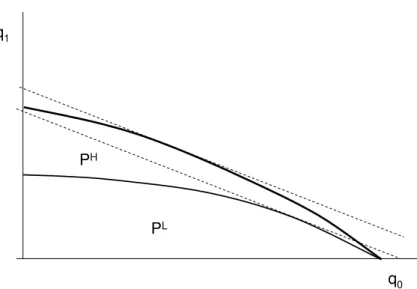
Using the mappings(qH,L0 (p), q1H,L(p))we can plot the space of available projectsP as regionsPH,L
in a diagram with average outcome (x0) probabilityq0 on the horizontal axis, and high outcome (x1)
probabilityq1 on the vertical axis, as in figure 1. Traders will choose projects in the upper boundaries
of the regions PH,L (the bold curves). Such projects maximize q1 for given q0, and hence minimize
failure probability q−1. We assume these boundaries to be smooth and concave. In other words, the
gain in profits due to a higher probability of a good outcome decreases as q0 drops. By assumption,
top traders can achieve higher probabilities for high outcomesq1 for any givenq0 than average traders
do. Average traders are less adept at creating value by moving away from the risk-free project where
q0 = 1. Hence, given some value ofq0 <1, their trades will be less profitable compared to the trades
a top trader would do at that same level of q0.
The pointq0 = 1, which hasq1 =q−1 = 0, represents a risk-free project that is accessible to both
high and low type traders. Moving left on the boundary, projects have a higher probability q1 of the
high outcomes, at the cost of a higher failure probability q−1 = 1−q1 −q0. This increase in failure
risk implies that dq1
dq0 > −1 everywhere on the upper boundary of P. Note, however, that if we move
q 0 1 P H P L
Figure 1: The set of projects for high and low types, PH and PL. The tangent points to the dashed
lines represent the bank-profit maximizing projects.
fromq0 = 1to q0 = 0, risk always increases, and the expected return to societyq1x1+q0x0−q−1x−1
has a maximum.
2.2. The contracts
We assume that there is moral hazard and adverse selection in the model. The bank does not observe the projectpchosen by the trader, it only observes realized outcomes. Alternatively, it has no information on the probability distribution of the outcomes. Nor can the bank observe the trader’s type. The agent, i.e., the trader, knows his type and is fully informed on the outcome probabilities qiH,L(p)
(i∈ {−1,0,1}) associated with each projectp.
Banks can use their contracts with traders to resolve the moral hazard over project choice. The banks offer both high and low type traders take-it-or-leave-it contracts, specifying remunerations con-tingent on observed outcomes (i.e. payments w−1, w0, w1 for outcomes x−1, x0, x1), which the traders
then accept or reject. We assume that traders have limited liability, so that wages under any outcome are non-negative. Without loss of generality we assume that the bank offers wagew−1 = 0when loss
x−1 occurs. Compensations for outcomes x1 and x0 are denoted wH,L1 , w H,L
0 , whereH, L refer to the
contracts designed for the high, low types, respectively. Given these wages, traders will choose the project that optimizes their expected utility,
max p q H,L 1 (p)w H,L 1 +q H,L 0 (p)w H,L 0 . (1)
w0H,L. We identify this ratio with risk and denote it by R = w H 1 w0H, r= w1L w0L
where upper (lower) case refers to high (low) type contract. For given p with q0(p) < 1, as R(r)
increases, the high (low) type trader faces a higher income risk. Further, a larger risk R (or r) will lead the high (low) trader to place a higher weight on the probability of high outcomesx1, relative to
average outcomesx0. In that case, maximum trader utility (1) will be attained at a lower value ofq0,
and a higher value of bothq1 andq−1. HigherR,rwill thus lead traders to choose projects with higher
risk of extreme outcomes, and lower probability of an average outcome.
In what follows, it will be convenient to characterize contracts in terms of the risk parameters,
R and r, and the expected utility (U and u) the contract offers to the trader, instead of the wages
w0L,H, w1L,H;(R, U)thus refers to the high types’ contract, and(r, u)to the contract offered to the low types. The (R, U)contract is the combination of wages(w0H, wH1 )that satisfies:
R= w H 1 wH0 ; U = max p w H 0 q0H(p) +w1Hq1H(p) = maxp wH0 ( qH0 (p) +Rq1H(p)).
A similar expression, withqLi (p) replacingqHi (p) and(r, u) replacing(R, U), obtains for the low type. Since trader type is not observable to the bank, contracts have to respect incentive compatibility. Consider first the low type’s incentive constraint. When confronted with the same(wH0 , w1H) compen-sation contract, the low type will choose the project that, givenR, optimizes his own pay-off. The low type’s utilityuˆ from accepting the high type’s offer is
ˆ u= max p w H 0 ( q0L(p) +RqL1(p)).
Since the utility maximizing project for either type only depends on R, we see that the ratio of the low type’s utility upon accepting the high type’s contract,uˆ, and the high type’s utility from the same contract,U, only depends onR. We will call this ratio
f(R)≡ uˆ U = qL 0(pL(R)) +Rq1L(pL(R)) q0H(pH(R)) +RqH 1 (pH(R)) ≤1.
Because the low type cannot get more utility from a compensation contract than the high type can, who has superior success probabilities for any risk levelR, we have that f(R)≤1.
In terms of parameters(r, u) and (R, U) the incentive compatibility condition then amounts to
We assume that a single crossing property holds for this problem. In particular, we assume that when both types’ indifference curves intersect (in(w0, w1)-space), the curve for the high type is flatter
than the curve for the low type. This translates into
Assumption 1 ∂R∂uˆU =U f′(R)<0.
This assumption says that an increase in R (for given U) lowers the utility derived by the low type from accepting a high-type contract.
Consider next the high type’s incentive compatibility condition. A similar argument shows that if the high type chooses the low type’s r-contract, his utility will equal
ˆ
U = u
f(r).
Combining the two IC constraints, we obtain that an equilibrium should satisfy
U f(r)≥u≥U f(R),
and sincef′ <0, this can only hold ifR≥r. As we will see below, the binding constraint in our model is that low types have no incentive to pose as high types. This is due to the (endogenously) higher outside option of the high type. The high type’s IC constraint will then be slack whenR > r.
Secondly, we assume that the second derivative off is larger than or equal to zero. This assumption will guarantee that we get an interior solution in the sections below.
Assumption 2 ∂R∂2uˆ2
U =U f
′′(R)≥0.
In words, there are decreasing returns for the bank of using riskR to reduce low type’s utilityuˆ. The following example illustrates both assumptions.
Example 1 Suppose that low types cannot get high pay-offs at all, and will therefore execute the riskless project with q0 = 1 for any level of risk r. Low type utility is then independent of the bonus payment
w1,
u=w0,
i.e. in the w1, w0 plane, the low-type’s indifference curves are the verticals, w0 = constant. For the
high types, there is a trade-off betweenw1 andw0, and the high types’ indifference curves are downward
sloping. The functionf(R) is given by
f(R) = 1
q0H(pH(R)) +RqH
1 (pH(R))
,
and its derivatives are (using the envelope theorem)
f′(R) =− q H 1 (pH(R)) (qH 0 (pH(R)) +Rq1H(pH(R)))2 <0, f′′(R) = 2(q H 1 (pH(R)))2 (qH 0 (pH(R)) +Rq1H(pH(R)))3 >0.
2.3. The banks
Banks are the principals of the agent traders. Banks offer(U, R) and(u, r)contracts to optimize their profits. Bank profits will be the sum of profits from all projects, minus utility left to the traders.
We assume that in the bad state, the bank suffers a loss equal toα ≤x−1. That is, α measures a
bank’s liability to losses (x−1 outcomes). Ifα=x−1, banks fully internalize the probability of negative
outcomes. If α < x−1, banks can shift some of the risks to outsiders, such as debt holders, or the
government in case of bail-out guarantees. The parameterα may therefore be interpreted as a reduced form of a capital requirement. We refer to an increase inα as an increase in capital requirements for the bank.
Expected gross profit from a high type trader’s project depends on the high type’s risk parameter
R as well as the bank’s liability to lossesα and is denoted
Π(R, α) = q1H(p(R))x1+q0H(p(R))x0−αqH−1(p(R))
= q1H(p(R))(x1+α) +qH0 (p(R))(x0+α)−α. (3)
To get the bank’s net profits from a top trader, one has to subtract the expected utility left to the trader,U. Similarly, we denote byπ(r, α) the gross profits from low type traders’ projects.
Taking trader utilitiesU, uas given, the optimal projects, from the point of view of the bank, have risk parametersR, rthat maximizeΠ(R, α), respectivelyπ(r, α). The maxima are attained for projects on the project boundaries(q1H,L, q0H,L) with slope
dqH,L1 dqH,L0 =−
x0+α
x1+α
>−1.
Though the optimal project will be a different one for the high trader type than for the low one, for either type the slope of the upper project boundary at the optimal project will be the same. These points are shown in figure 1 at the tangents to the dashed lines.
Traders, when choosing projects to maximize utility in response to a contract of risk level R, r, will opt for the project on the project boundary where
dq1H dq0H =− 1 R, dqL1 dqL0 =− 1 r.
This shows that in the absence of incentive compatibility constraints, the bank could fully resolve moral hazard and induce traders to choose the privately optimal project. To see this, define
r∗(α) =R∗(α) = x1+α
x0+α
, (4)
which solveΠR(R∗(α), α) =πr(r∗(α), α) = 0. Then banks can offer traders contracts withR∗(α)(r∗(α))
Note that R∗α(α) <0, i.e., when banks bear a larger fraction of the downside risk, they will offer traders contracts inducing them to take less risk (if incentive compatibility constraints play no role). Hence in the absence of incentive constraints, increasing capital requirements reduces risk.
The following result6 demonstrates that R∗,r∗ are the unique local maxima of Π and π:
Lemma 1 The functions Π(R, α) and π(r, α) are quasi-concave in R, r.
In the next sections, we show that, when faced with incentive compatibility constraints, the bank may distort the high types’ risk Rto larger values, inducing them to pursue higher risk projects.
3. A monopoly bank
As a benchmark, we consider first the case of a monopoly bank and inelastic labor supply where all traders have the same outside option. We assume unit trader supply. A fraction ϕ of these are low-type traders, 1−ϕ are high-type ones. Reservation wages for low and high-type traders are u¯ = ¯U, respectively. We assume thatΠ, πare high enough that the bank wants to hire both types. The bank does not observe trader types. It solves
max
R,r,U,uϕ(π(r, α)−u) + (1−ϕ)(Π(R, α)−U) (5)
s.t. u≥U f(R)
U ≥U¯ u≥u¯
where the first constraint is the average trader’s incentive compatibility condition, and the other two constraints are participation constraints for the top trader and the average trader, respectively.
Clearly, in the optimum, the low type will be offered a contract with optimal risk, r = r∗(α). The high type will be offered utility equal to his reservation utility, U = ¯U. Because reservation wages of both types are equal, it follows that the incentive compatibility constraintu≥U f(R) is not binding. Hence, the monopoly bank offers the unconstrained profit maximizing contracts, (r∗(α),u¯)
and (R∗(α),U¯). Because of equation (4) and u¯ = ¯U, this is in fact a pooling contract. Hence, both incentive compatibility constraints are satisfied. We have shown the following.
Proposition 1 A monopoly bank offers traders contracts inducing them to take risks that maximize the bank’s profits,R=R∗(α) =r =r∗(α), and leaves them their reservation utilities.
6
When incentive compatibility does not bind, the only distortion of the monopoly bank is that for
α < x−1 the bank does not fully internalize losses. Both the high-type and the low type risk,R andr,
are then excessive from a social point of view, as a result of the bank’s risk-shifting to its debt holders. Ifα=x−1, this distortion is eliminated, and first-best is achieved.
Finally, it follows from equation (4) that in the monopoly case increasing capital requirements α
reduce risks R and r. If α = x−1, banks choose socially optimal contracts and there is no need for
bonus caps. Hence, in this case, capital requirements which align the incentives of the top of the bank with social incentives leads to a first best outcome. There is no need to intervene with traders’ salaries.
As the next section shows, this is different with competing banks.
4. Oligopoly banks
We now turn to competition among banks in hiring traders. Consider two symmetric banks, a and
b, competing imperfectly for both high types and low types. In contrast to the monopoly case, the traders’ reservation utilities now arise endogenously from the model, and reflect the option traders have to accept a contract at the rival bank. That is, traders have two outside options now: (i) doing nothing, which gives an outside option (as above) equal to the reservation wage (u¯= ¯U); (ii) work at the other bank. The latter outside option is considered now.
Bank aoptimizes its profits given the contract offered by bankb, subject to the incentive compat-ibility constraint for the low-type traders
max
u,r,U,Rs(u, ub)(π(r, α)−u) +S(U, Ub)(Π(R, α)−U)
subject to u≥f(R)U
(Pub,Ub)
wheres(ua, ub) represents bank a’s share of low-type traders when banka offers them utility ua and
bankboffers ub. We still assume inelastic supply of traders, so thats(ua, ub) +s(ub, ua) =ϕ. Similar
remarks hold for the high types’ sharesS(Ua, Ub).
The first part of the maximand in (Pub,Ub) represents bank a’s net gains from low type traders’
activities. The second component reflects the contribution from the high-type traders to the bank’s profit. In a symmetric equilibrium, both banks evenly share the amount of top traders as well as average traders.
In the following, we will model competition explicitly by using a Hotelling model,7
s(ua, ub) =ϕ ( 1 2+ ua−ub 2tl ) , S(Ua, Ub) = (1−ϕ) ( 1 2 + Ua−Ub 2th ) , (6) 7
where we allow the competition parameterstl,hto depend on the type. Hence, we consider a Hotelling
beach of length 1 where low (high) traders are distributed uniformly with density ϕ(1−ϕ). Bank a
is located on the far left of the beach and bank bon the far right. Traders face a travel cost per unit distance equal to tl(th) for the low (high) type. Hence the average trader who is indifferent between
working for either bank is a distancexaway from bank awherex solves
ua−tx=ub−t(1−x).
This gives the expression forsabove and similarly forS.
A reduction in th is interpreted as increasing competition on the labour market for high traders.
Throughout the analysis we assume tl, th to be sufficiently low so that in equilibrium all traders
will accept a contract, i.e., the Hotelling beach is fully covered. To guarantee that this happens in equilibrium, we make the assumption
Assumption 3 π(r∗(α), α)−u >¯ 2tl, Π(R∗(α), α)−U >¯ 2th
If banks could ignore the incentive compatibility constraint, they would choose r = r∗(α), R =
R∗(α). It is routine to verify that this results in the following utilities for the low-type and the high-type traders (gross of their travel costs)8
u∗ =π(r∗, α)−tl (7)
U∗ = Π(R∗, α)−th (8)
The incentive compatibility constraint is binding in equilibrium if
f(R∗) (Π(R∗, α)−th)> π(r∗, α)−tl (9)
If this inequality is not satisfied, the analysis here is the same as with a monopoly bank. However, we are interested in the case where the incentive compatibility constraint is binding. In that case, given contract offersR∗(α)andr∗(α)the low type will want to accept the high-type contract. We will henceforth assume this to be the case.
Directly taking into account that the incentive compatibility condition binds, we rewrite optimiza-tion problem (Pub,Ub) as
max
r,U,Rs(f(R)U, ub)(π(r, α)−f(R)U) +S(U, Ub)(Π(R, α)−U) (
ˆ
Pub,Ub)
The first order condition forr implies thatr =r∗, the contract for the average trader is not distorted (’no distortion at the top’), as is to be expected. The first order conditions forU andRcan be written
8
R∗ risk U (R,U) Uic Urc Uuc (R,U) Uic Urc Uuc
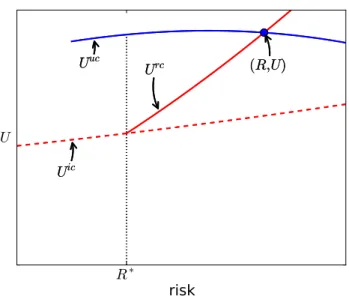
Figure 2: Equilibrium with oligopoly banks.
as f(R) ϕ 2tl (π(r∗, α)−U f(R)−tl) + 1−ϕ 2th (Π(R, α)−U−th) = 0 (Uuc) U f′(R) ϕ 2tl (π(r∗, α)−U f(R)−tl) + 1−ϕ 2 ΠR(R, α) = 0 (U rc)
The solutions to these first-order conditions correspond to curvesU(R). We refer to these curves as the utility curveUuc(R) and the risk curveUrc(R), resp. Note that these curves are continuous functions ofR.
It will also be convenient to use the incentive compatibility curve, which measures (as a function ofR) utility at which the low type is indifferent between his contract and the high-type contract. This curve is defined as Uic(R) = π(r ∗, α)−t l f(R) (U ic)
At all points(U, R)withU ≥Uic(R), the low types’ incentive compatibility constraint will be binding.
An equilibrium is a pair U, R that simultaneously solves both first-order equations (Uuc) and (Urc), and therefore geometrically corresponds to an intersection of the risk and the utility curves,
Uuc(R) = Urc(R). This is illustrated in figure 2. In the following, we will study the nature of such intersections. In particular, we will be interested in comparative statics of the equilibrium with respect to the level of competition for high types, parametrized by th. We interpret quotes like (see
introduction) “you don’t have a good way of having some guy that produces x dollars of revenues to give him 10% of x because he’ll figure out, he’ll find some other place that will give him 20% of x or
whatever it may be” as competition. If 20% becomes 30%, we interpret this as a reduction in th. We
are not aware that banks compete more vigorously for low type traders. Hence we do not consider changes intl.
The following lemmas are useful below.
Lemma 2 With the privately optimal R∗(α), which is defined in equation (4), we have
i) Urc(R∗(α)) =Uic(R∗(α))
ii) Urc(R)> Uic(R) for all R > R∗(α)
iii) Uuc(R∗(α))> Uic(R∗(α))
The lemma states that at the privately optimalR∗(α) the risk curve intersects the incentive com-patibility curve, while the utility curve lies above it. In addition, the utility curve lies above the risk curve for R=R∗(α). This shows that if there is an equilibrium at finite R – characterized by an in-tersection of both curves – the risk curveUrc(R)will cross the utility curve from below. The following lemma gives a sufficient condition for such an intersection point at finiteR to exist.
Lemma 3 A sufficient condition for existence of an intersection of the risk and utility curves is that for someR > R¯ ∗ large enough,
f( ¯R)(Π( ¯R, α)−th) =π(r∗, α)−tl.
The condition says that for high enough risks R, the low type will have no incentive to mimic the high type.
Lastly, we cannot exclude that multiple intersections of both curves exist: although the risk curve is everywhere upward sloping (see equation (10) in the appendix), the utility curve is not necessarily monotonically decreasing. If there are multiple intersections, however, we focus on the one with lowest
R. The following lemma demonstrates that this lowest-R equilibrium is the one that is preferred by both banks, as it maximizes total profits.
Lemma 4 If there are multiple equilibria, and Π(R, α) is concave in R for R > R∗(α), total firm profits are maximized at the equilibrium with lowest R.
In the following, we assume that an equilibrium (at finite R) exists. Assuming concavity of R
(which translates into a condition on the third derivative of q1H(qH0 )), Lemma 4 justifies a focus on the intersection at the lowest R, if multiple intersections exist. As banks make the offers, it is not unreasonable to assume that they manage to coordinate on the equilibrium that is best for them
(coalition proof equilibrium). Hence, from now on the term “equilibrium” refers to the joint solution of the first order conditions with the lowestR.
Our first main result follows from lemma 2.
Proposition 2 In equilibrium R > R∗(α).
Indeed, the intersection of the risk curve and the utility curve must lie above the privately optimal valueR∗(α), because at this value the risk curve intersects the incentive compatibility curve, while the utility curve lies above it. Hence with competing banks, the incentive compatibility constraint leads banks to induce excessive risk for the top traders. Since risk is excessive even when α = x−1, i.e.
when banks internalize all losses, raising capital requirements (increasing α) cannot fully resolve the inefficiency.
The second main result of this paper is that banks incentivize top traders to take more risk as the competition for top traders intensifies, i.e., the risk problem becomes worse.
Proposition 3 If competition for the high-type traders increases (th falls), banks induce these traders
to take more risk by increasing R.
Proof. By lemma 2, the equilibrium corresponds to an intersection of the risk and utility curves where the risk curve intersects the utility curve from below. Only the utility curve depends on com-petitionth. It is straightforward to verify from the definition of the utility curve (Uuc) that
dUuc dth
<0.
Hence a decrease inth causes the utility curve to shift upwards. As a result, the intersection shifts to
the right, to higherR.
The intuition behind this result is the following. As th falls, traders switch banks more easily to
increase their income. In that case, banks experience stronger gains to increasing top traders’ wagesU
to win them over, at the expense of rival banks. In equilibrium, banks do not benefit from this race to higher top trader wages. To the contrary, incentive compatibility also forces banks to increase wages for the low types. In an attempt to keep this leakage of rents to the average traders low, banks prefer to raise R: the marginal benefits to increasing R increase, while the marginal costs (in terms of less efficient top trader projects), remain the same.
5. Policy implications
disputed, the desirability of intervention in wage contracts lower in the bank hierarchy is less obvious. If bank management internalizes the risk of negative outcomes, e.g. through higher equity stakes in the bank, won’t their risk attitude trickle down to the lower trader echelons through the contracts these are offered?
In our analysis of a monopoly bank, we found that as the managers’ risk attitude is brought more in line with social welfare (α increases), the risk level R(α) in top traders’ contracts decreases. However, in the case of competition for traders, this need no longer be true. The following proposition demonstrates that the effect of increasingα on R can be counter-intuitive.
Proposition 4 When banks compete for traders, an increase of capital requirements (i.e., an increase inα) can sometimes increase, rather than decrease, risk in the top traders’ equilibrium contract, dRdα >0.
Proof. We prove the proposition by constructing an example. Consider first the extreme case where top traders can only do one deal. In that case, profit is independent of the risk these traders take and the contract offered by banks simply aims to reduce the rents obtained by low-type traders. This impliesΠR= 0, and the first-order condition forR becomes
π(r∗, α)−U f(R)−tl= 0,
so that the risk curve coincides with the incentive compatibility curve: since there is no cost to the bank of increasingR, it will raiseR to setu to its unconstrained value.
In this case, the first-order condition forU will requireU to be set to its first-best as well,
U = Π(α)−th.
Combining these two first-order equations, we find
(Π(α)−th)f(R) =π(r∗, α)−tl.
From this equation, we can evaluate the dependence ofR on α,
dR dα =
πα−Παf(R)
f′(R)(Π(α)−th)
.
Now recall that
πα=−qL−1<0, Πα =−q−1H <0,
so that if in the optimum, the low type’s risk of negative outcome x−1 is larger than the high type’s
risk, we find dRdα > 0, i.e. high type risk increases with α. While the example of fixed project choice is extreme, the analysis clearly continues to hold if the high type’s project-outcome probabilities,
The intuition for the result is that an increase in α increases the bank’s aversion to negative outcomes x−1. Negative outcomes result both from top traders’ projects, and from those of the
average traders. If the latter create the larger downside risks, banks tend to reduce low-types’ utilities
uin an effort to lose low type traders to the rival bank asα increases. They will do so by increasingR
if this is not too costly (and it will not be costly if high type’s project choice is rather inelastic w.r.t.
R). In doing so, however, banks impose a competitive externality on each other. In equilibrium both banks continue to share the average traders evenly, so the increase in high-type risk R does not help them to reduce exposure to low-type downside risks.
We conclude that measures aimed at reducing bank risk only at the top of the bank hierarchy may have unintentional effects on the risk attitudes of individual bank traders. These effects result from a combination of agency problems within the banks, and spill-over effects mediated through competition on the labour market among banks. Directly regulating bonus pay also at lower bank levels can therefore be a useful complement to measures regulating bank risk at the top levels.
It is clear that a binding cap on traders’ bonus structures, R, will lead to higher social efficiency, as long as R > R∗(α = x−1). Imposing such a cap will impact not only on traders’ risk-taking, but
also on their utilities. The direction of this effect on expected wages is ambiguous. WhenR is capped at a level Rˆ (and the cap binds), equilibrium utility is given by the utility curve, Uuc( ˆR). This curve is increasing at the social optimumR=R∗(α), but it is not monotonic in R. A reduction in R below unconstrained equilibrium levels may therefore either increase or decrease top traders’ expected pay.
Taxing traders’ pay is an alternative policy to address excessive risk-taking. If traders only receive a fraction1−T of the utility paid to them by their employers (whereT denotes the tax rate), the banks’ profit functions change: the fraction of traders attracted by bankanow depends on(1−T)(Ua−Ub). As
can be seen from the Hotelling specification, (6), this effectively increases the competition parameter, muting labour market competition among banks and reducing the competitive externality among the banks. As a result, equilibriumR will be reduced.
6. Concluding remarks
We provide a model rationalizing the claim that increased competition for traders forces banks to execute riskier deals. The mechanism for excessive risk taking we describe here is different from the usual one where banks fail to fully internalize their losses. In the present model, there is not necessarily a problem of bank limited liability and risk shifting. Even if banks fully internalize the costs of negative outcomes (which is the case if α =x−1), banks offer traders excessively risky contracts to screen on
trader type and to minimize transfers to lower-skilled employees.
We have two main results. First, banks offer riskier contracts (higher R) as competition for top traders intensifies (th gets lower). When competition increases, the rents banks have to pay to attract
top traders increase. To avoid leakage of these rents to average traders, the higher payment comes in the form of contracts paying larger bonuses and hence inducing more risk-taking by top traders.
Second, raising capital requirements does not necessarily result in banks offering traders contracts that reduce risk-taking. If average traders create more downside risk than top traders, banks that are confronted with a higher liability for losses (higher α) may increase R in an effort to lose the lower-skilled traders to rival banks: higher R will reduce these traders’ utility. Consequently, bonus payments to top traders will not automatically decrease when higher capital requirements force banks to internalise a larger fraction of potential losses.
Although a regulator faces the same adverse selection over trader types as the banks do, a planner will not resort to inefficient screening by offering excessive incentives. The reason is that while banks distort production to change the distribution of profits among themselves and the traders, for the regulator these payments are pure transfers.9 Therefore, there is a role for direct intervention in compensation structures, aimed at reducing trader incentives towards risk-taking.
This leaves the question why competition over skilled traders should have increased in the build-up to the present financial crisis. One explanation could be that competition in financial institutions’ product markets intensified as well. As firms face stiffer competition in attracting clients, a competitive advantage becomes more valuable, and top traders may provide such an advantage. The competition over traders in our model would in that case be a reduced form of competition in product markets.
References
V. Acharya, M. Pagano, and P. Volpin. Seeking alpha: excess risk taking and competition for man-agerial talent. Discussion paper, April 2011.
V. V. Acharya and P. F. Volpin. Corporate governance externalities. Review of Finance, forthcoming, 2009.
J.B. Berk and R.C. Green. Mutual fund flows and performance in rational markets.Journal of Political Economy, 112(6):1269–1295, 2004.
9In our stylized model, aggregate trader supply is completely inelastic. When supply of traders is elastic, the regulator
T. Besley and M. Ghatak. Taxation and regulation of bonus pay. CEPR Discussion paper 8532, 2011. B. Biais and C. Casamatta. Optimal leverage and aggregate investment. The Journal of Finance, 54:
1291–1323, 1999.
G. L. Clementi, T. Cooley, M. Richardson, and I. Walter. Rethinking compensation in financial firms. In V. Acharya and M. Richardson, editors,Restoring Financial Stability, chapter 8, pages 197–214. John Wiley and Sons, 2009.
D. L. Dicks. Executive compensation, incentives, and the role for corporate governance regulation. working paper, 2009. University of North Carolina.
M. F. Hellwig. A reconsideration of the Jensen-Meckling model of outside finance.Journal of Financial Intermediation, 18:495–525, 2009.
R. Inderst and S. Pfeil. Is making deferred (bonus) pay mandatory a good idea for banking? University of Frankfurt working paper, 2009.
M. C. Jensen and W. H. Meckling. Theory of the firm: managerial behavior, agency costs and ownership structure. Journal of Financial Economics, 3:305–360, 1976.
A. K. Kashyap, R. G. Rajan, and J. Stein. Rethinking capital regulation, 2008. Contribution to Federal Reserve Bank of Kansas City symposium ‘Maintaining Stability in a Changing Financial System’, Jackson Hole, Wyoming.
F. Palomino and A. Prat. Risk taking and optimal contracts for money managers. RAND Journal of Economics, 34:113–137, 2003.
J. Thanassoulis. The case for intervening in banker’s pay. Journal of Finance, 2011a. forthcoming. J. Thanassoulis. Bankers’ pay structure and risk. Discussion paper, April 2011b.
A. Appendix: Proofs
Proof of lemma 1 We focus on Π(R, α), as the result for π(r, α) is analogous. For any given R, high-type traders choose the project on the project boundary q1H(q0H) that satisfies dqH1
dqH 0
=−R1. This relation defines a functionq0H(R). From equation (3), we can then compute
dΠ(R, α) dR = dqH0 dR [ dq1H dqH 0 (x1+α) + (x0+α) ] = dq H 0 dR [ −x1+α R + (x0+α) ] Since dq0H
dR ≤0, we find that Π is monotonically increasing for R < R∗(α) = x1+α
x0+α, and monotonically
decreasing forR > R∗(α). HenceΠ(R, α)is quasi-concave in R. Q.E.D.
Proof of lemma 2 When inserting U =Uic(R∗) in the risk curve equation (Urc), the first term vanishes and we are left with ΠR(R, α) = 0, which is indeed solved by R =R∗. This proves (i). For
R > R∗, ΠR(R, α) <0, so the first term in equation (Urc) has to be positive. Since f′(R) <0, this
implies that Urc(R)f(R) > π(r∗, α)−tl = Uic(R)f(R), proving (ii). Finally, for the utility curve,
assume (iii) does not hold, soUuc(R∗)≤Uic(R∗). Then by the definition of the utility curve, (Uuc), we would have that Π(R∗, α)−Uuc(R∗)−th ≤ 0, or Π(R∗, α)−th ≤ Uuc(R∗) ≤Uic(R∗). But this
conflicts with our assumption (9) that atR∗, incentive compatibility does not hold. So (iii) must hold. Q.E.D.
Proof of lemma 3 The condition is equivalent toUuc( ¯R) =Uic( ¯R), as can be verified by setting
Uuc( ¯R)f( ¯R) = π(r∗, α)−tl in equation (Uuc). By lemma 2 (i) and (iii), the risk curve is below the
utility curve atR=R∗, while by (ii), the risk curve is above the incentive compatibility curve Uic(R)
for allR > R∗. If the utility curveUuc(R)crosses the incentive compatibility curve atR¯, it must have intersected the risk curve at least once at some R∗ < R < R¯. This point of intersection corresponds
with a symmetric equilibrium. Q.E.D.
Proof of lemma 4 Total firm profits in any symmetric equilibrium(U, R)are given by
Πtot(U, R) = ϕ 2(π(r
∗, α)−U f(R)) + 1−ϕ
2 (Π(R, α)−U).
We will now show that these profitsΠtot(U, R)are decreasing as one moves along the risk curveUrc(R)
to higher R, i.e. dΠdRtot(Urc(R), R)<0. Since any symmetric equilibrium(U, R) should lie on the risk curve, this will prove the lemma.
First note that, by the implicit function theorem applied to equation (Urc), the slope of Urc(R) is given by dUrc dR =− U f′′(R)(π(r∗, α)−U f(R)−tl)−U2f′(R)2+ ΠRR(R, α) f′(R)(π(r∗, α)−2U f(R)−tl) >0 (10)
because f′(R) < 0 by assumption 1, f′′(R) ≥ 0 by assumption 2 and π(r∗, α) −2U f(R) −tl <
π(r∗, α)−U f(R)−tl<0 by equation (Urc) andΠR<0for R > R∗(α) (from lemma 2).
Since Urc(R) increases monotonically, the firms’ profits from high type traders unambiguously decrease with increasing R. However, this is not necessarily the case for the contribution from low types, asu=U f(R) may decrease withR:
d(Urcf) dR =− U f′′(R)(π(r∗, α)−U f(R)−tl) + ΠRR(R, α) f′(R)(π(r∗, α)−2U f(R)−tl) f(R) +U f ′(R)(π(r∗, α)−U f(R)−tl) (π(r∗, α)−2U f(R)−tl) . (11) The first term is positive, but the second one is negative and the net result may be negative. The term −ϕ
2U f(R) in the profit function may therefore create a positive contribution to the derivative of total
profits,Πtot. We can see, nevertheless, that the offending positive term in the change in total profits, is always outweighed by the negative contribution from the high types:
1−ϕ 2 ΠR(R, α) =−U f ′(R)ϕ 2 π(r∗, α)−U f(R)−tl tl ,
which follows from the equation for the risk curve (Urc). Comparison with the second term in (11) makes clear that their net contribution to dΠdRtot(Urc(R), R) is again negative,
−ϕ 2 U f′(R)(π(r∗, α)−U f(R)−tl) (π(r∗, α)−2U f(R)−tl) − U f′(R)ϕ 2 π(r∗, α)−U f(R)−tl tl <0, provided that π(r∗, α)−2U f(R)<0.
But sinceU f(R)> π(r∗, α)−tl (as IC is binding), we have
π(r∗, α)−2U f(R)< tl−U f(R)< tl−u∗ <0