c
SAIt 2009
Supplementi
The Future Astronomical Software Environment
progress
L. Paioro
1, B. Garilli
1, P. Grosbøl
2, D. Tody
3,4, C. Surace
5, T. Fenouillet
5, P. Franzetti
1,
M. Fumana
1, and M. Scodeggio
11 Istituto Nazionale di Astrofisica – Istituto di Astrofisica Spaziale e Fisica Cosmica, Via Bassini 15, I-20133 Milano, Italy e-mail:[email protected]
2 European Southern Observatory, Karl-Schwarzschild-Strasse 2, Garching, Germany 3 National Radio Astronomy Observtory, Socorro, NM, U.S.A.
4 U.S. National Virtual Observatory
5 Laboratiore d’Astrophysique de Marseille, Traverse du Siphon, 13376 Marseille, France
Abstract. The OPTICON working group 3.6 in collaboration with international partners and in coordination with the Virtual Observatory, has already identified the high level re-quirements and the main architectural concepts for a future software environment for as-tronomical data reduction and analysis (Future Asas-tronomical Software Environment). A special attention has been payed to: a) scalability, to allow the reduction of huge data vol-umes exploiting the hardware and software parallel architecture, b) interoperability, in order to guarantee the interaction between software coming from different sources and make easy the access to the Virtual Observatory, c) and modularity, to separate the adopted software technology from the specific computational algorithm and allow an independent evolution of the two areas.
The proposed concepts have been widely discussed and shared by the astronomical commu-nity; however a lot of work still remains to do, mainly: a) the definition of open standards, b) the verification of such standards thanks to at least one reference implementation and practical user cases, c) and the whole must be supported at least by the major international organizations that develop data reduction and analysis software.
All this work has led up to the definition of a new proposal for FP7 within OPTICON (where ESO, INAF, LAM-OAMP and NRAO/NVO are actively involved) which we present describing the project in detail and adding a description of the European FASE prototype, developed by INAF-IASF Milano in collaboration with LAM-OAMP (Marseille). Key words.astronomy – data reduction – data analysis – Virtual Observatory – parallel computing – software environment
1. Introduction
In the following paper we present the current working status and the plans for the next
de-Send offprint requests to: L. Paioro
velopment of a new software environment for astronomical data reduction and analysis (the Future Astronomical Software Environment).
The high level requirements and the main architectural concepts have already been
de-fined within the OPTICON working group 3.6 in collaboration with international partners such as NRAO/NVO (Tody et al. 2006). This basilar initial work has been carried on thanks to a specific FP6 funding.
A new proposal for FP7 has alredy been submitted to OPTICON and will be addressed to the European Union with the purpose of re-ceiving fundings for at least one practical im-plementation and for the consequent architec-tural design refinement.
2. What astronomers use
For decades the astronomical community has used several data reduction and analysis soft-ware which perfectly fitted their scientific ne-cessities. Good examples of such software are: IRAF, MIDAS, AIPS, GIPSY and so on, which are still very important tools for data handling, widely used as today as in the past.
However, their age and resulting techno-logical backwardness make them rather incom-patible with the modern scripting languages commonly used nowadays. It is also fairly complicated to share pieces of code or data among them and there is scarce support to the new distributed technologies like Virtual Observatory, GRID, MPI/HPC, etc.
3. What astronomy need
New frontiers of science require collecting as much information as possible. This implies the handling of huge amounts of data products and/or simulated data, usually shared by geo-graphically distributed research groups. In gen-eral, we can identify four user cases which well depict the present scientific and technological needs that future hardware and software tools must support:
– Single analyst user on local workstation. He or she needs an integrated environment that allows to analyse and in case reduce the data products he or she owns. Such an integrated environment must be able to ex-pose to the end user a large variety of tools (including those made by the user) through a common framework, letting the user to
get rid of the burden of data format conver-sions and all those issues which arise when dealing with different tool from different providers, usually rather incompatible one with another.
– Team of big survey analysts. They have cer-tainly the same needs of the single analyst user, but they also need a shared and col-laborative environment which is geograph-ically distributed and provides high perfor-mance computing power.
– Single algorithms developer. One of the most common aspect of the astronomical research is the development of more and more new algorithms for data analysis and theoretical simulation. Unfortunately, the creative effort addressed to invent new al-gorithms must give way to the practical ef-fort addressed to learn and apply how to implement such new algorithms at software level. This is an unhappy wasted time that requests tools to simplify the development of new computational tasks splitting the technical competences from the inventive ones.
– Team of software developers. The cost of a new data reduction and analysis software development is always made bigger by the necessity of starting from scratch redesign-ing and buildredesign-ing up very basic and com-mon procedures and/or data structures ev-ery time. A common development frame-work which provides a basic software layer such as a shared distributed execution en-gine, a set of libraries suited around well defined data structures ad interfaces, one or more standard messaging system and a well supported set of bindings for all the most common programming languages (Java, Python, C/C++, FORTRAN, Perl, PHP, Tcl/Tk, .NET, etc.), in brief a com-plete development platform for astronomi-cal applications, would be highly desider-able and actually already needed.
4. What F.A.S.E. is
Many of the issues above have already been faced up by the Virtual Observatory. On the other hand FASE project doesn’t aim to be a
Virtual Observatory competitor but rather to start from it and create a new software plat-form for the astronomy with extended and even more extensible capabilities. The principal tar-gets are:
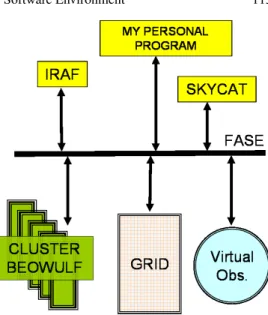
a) the reuse of the most important legacy soft-ware within a modern framework that al-lows to extend their functionalities (see Fig. 1) and
b) make easier the support and development of new interoperable and distributed appli-cations or simple computational tasks. Besides these foundamental targets FASE aims to:
c) increase software sharing and astronomical software development collaboration; d) support a simplified access to remote
re-sources as archives, Virtual Observatory and GRID;
e) define stable, controlled and open software interfaces;
f) realize a first minimal reference implemen-tation allowing future extended versions; g) specify the basic free and open source
sys-tem components, that could be well inter-faced with commercial software as well.
5. The architecture
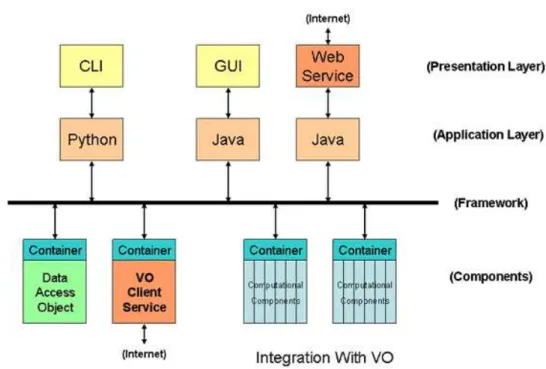
In order to achieve this ambitious goal, the ar-chitectural design foresees a modular approach (see Fig. 2). This way each single framework component (or set of components) can be de-veloped apart and included in the whole frame-work as a plugglable module (or package).
The development of new framework mod-ules is made easier thanks to the component container paradigm. A container is a sort of wrapper that connects any component (appli-cation or computational task) to the framework using standard, well defined and documented interfaces available for all the most common languages.
The main benefit of a modular architecture is the flexibility and extensibility. The basic framework capabilities can be expanded with
Fig. 1. FASE can be seen as a middleware that
allows common astronomical software like IRAF, Skycat or astronomers’ self-developed tasks to be interfaced with the new important distributed and interoperable technologies like Virtual Observatory, clusters and GRID.
new components added locally or distributed to the wide astronomical community.
The idea is to allow the addition of a num-ber of modules developed by an open commu-nity as already happens in other well known communities like Mozilla Foundation1, for
in-stance. All the new public modules should be freely distributed through a central plug-in portal connected to the framework via a package/plug-in manager.
6. The spiral lifecycle model
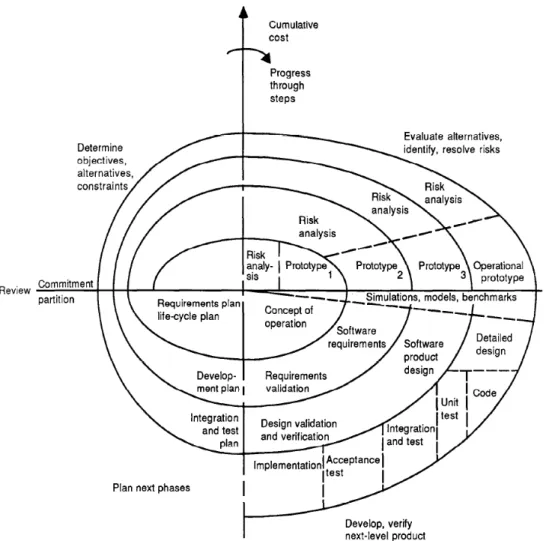
The software development process adopted by OPTICON working group 3.6 to carry out the design and realization of the FASE environ-ment is the spiral lifecycle model (Boehm 1988).
The spiral model is an evolution of the clas-sic waterfall model (Royce 1970), which de-fines a monolithic sequence of operations: re-quirements collection, product design, imple-mentation, verification and maintenance. The
Fig. 2. The modular architecture of FASE. It can be schematized with four layers: the presentation layer (what the user see), the application layer (what is locally working), the framework (the distributed execution engine) and at the final endpoint the components which live within their containes.
spiral model combines the waterfall model with a prototyping approach, resulting more ef-fective and suitable for large and complicated projects.
As shown in Fig. 3, the spiral model starts from the definition of general concepts which then must match with a set of requirements and user-cases. Just after these preliminary steps that must bring to a first software design, the prototyping is performed with the intention of producing feedbacks that can improve and re-fine the software design itself. In general this mutual interaction between design, develop-ment and prototyping is kept iterative along the whole software development process, up to the final software release.
So far, the preliminary steps have been almost completed producing a project TWiki site2 that contains the minutes of the
teleconferences done during the last five years, a set of pages and attachments containing
2 http://archive.eso.org/opticon/twiki/bin/view
the first design concepts and the detailed user-cases.
The most important resulting product of this preliminary work is the High-Level Requirement Document v1.00 (Grosbøl, Garilli et al. 2008), which de-fines in detail the requirements for:
1. the framework installation and run time processing;
2. the scripting language and execution envi-ronment;
3. the data access and data handling;
4. the applications lifecycle and development. Following the spiral model philosophy, al-most contemporary to the production of these documents, the development of two framework prototypes has been stared.
The USA NVO/NRAO prototype is mainly addressed to the Virtual Observatory access in-tegration, and in order to achieve this goal it
Fig. 3. Spiral model of the software process as originally described by Boehm (1988).
is focused around the NVO VOClient3
appli-cation. The technologies adopted are mainly
SAMP/PLASTIC protocol (Boch et al. 2009)
at host level and OpenRTE (Castain et al. 2005) at inter-host level.
The European prototype is developed by INAF-IASF Milan in collaboration with LAM. This prototype is mainly focused on the task launching system development and is being carried on using the VIPGI recipes (Scodeggio et al. 2005) as test-bench. In fact VIPGI recipes are compiled programs that per-form data reduction tasks based on sets of
pa-3 http://iraf-nvo.noao.edu/vo-cli/
rameters. This pattern has been generalized as
a global task/parameter paradigm that actually
addresses many of the user needs described in paragraph 3.
The present European prototype uses
DBus4 as messaging system but it is planned
to be moved to SAMP/OpenRTE in order to be
fully integrated with the USA prototype in the near future. A complete documentation can be
obtained visiting the project Trac site5.
As a result of the work described above, the next step in the spiral model the is the
prepara-4 http://www.freedesktop.org/wiki/Software/dbus 5 http://cosmos.iasf-milano.inaf.it/trac/fase
tion of a detailed architectural document and a document which defines the system interfaces.
7. Future developments
As mentioned above, OPTICON working group 3.6 is going to submit a proposal for FP7 to the European Union in order to obtain fund-ing to make more tangible what is still mainly theoretical (with the exception of the proto-types).
The proposal is meant to produce the fol-lowing deliverables:
1. Steering Committee Meetings (a) Face-to-face meetings; 2. Open Standards Design
(a) Software designer and engineer; (b) Support for travels for meetings etc.; 3. Reference Implementation Development
(a) Execution framework; (b) Parameter management; (c) Application language bindings; (d) User interface connection; (e) VO and Web Services;
(f) Access to legacy tasks.
If obtained, these fundings would be used by the European institutes involved in the project to actively contribute to the framework development, sharing the commitment with the USA partners.
References
Boch, T. et al. 2006, PLASTIC - a protocol for desktop application interoperabil-ity, Version 1.00, IVOA Note 01 June 2006. See also http://www.ivoa.net/ cgi-bin/twiki/bin/view/IVOA/ApplicationsMessaging for discussions regarding SAMP
Boehm, B.W. 1988, A Spiral Model of Software Development and Enhancement, IEEE, 0018-9162/88/0500-0061
Castain, R.H. et al. 2005, The Open Run-Time Environment (OpenRTE): A Transparent Multi-Cluster Environment for High-Performance Computing, Proceedings, 12th European PVM/MPI Users’ Group Meeting, available at http:// www.open-rte.org/papers/euro-pvmmpi-2005-orte/
Grosbøl, P., Garilli B.M. et al. 2008, High-Level Requirements for a Future Astronomical Software System, available at the OPTICON Network 3.6 Twiki site (see reference in paper)
Royce, W. 1970, Managing the Development of Large Software Systems, Proceedings of IEEE WESCON 26 August, 1-9
Scodeggio, M. et al. 2005, The VVDS Data-Reduction Pipeline: Introducing VIPGI, the VIMOS Interactive Pipeline and Graphical Interface, PASP, 117, 1284
Tody, D. et al. 2006, An Open Architecture and Framework for Astronomical Data Processing and Analysis, PASP, 351, 331