WHAT DO WE KNOW ABOUT
SERVICES OUTSOURCING?
Ronan McIvorWHAT DO WE KNOW ABOUT
SERVICES OUTSOURCING?
by
Ronan McIvor
Published by
First published 2013
© 2013
ISBN 978-1-904574-96-5 EAN 9781904574965
This report is published for the Research Committee of The Institute of Chartered Accountants of Scotland.
The views expressed in this report are those of the author and do not necessarily represent the views of the Council of the Institute or the Research Committee. No responsibility for loss occasioned to any person acting or refraining from action as a result of any material in this publication can be accepted by the author or publisher.
All rights reserved. No part of this
publication may be reproduced, stored in a retrieval system, or transmitted, in
any form or by any means, electronic, mechanical, photocopy, recording or otherwise, without prior permission of the publisher.
Printed and bound in Great Britain by Garnett Dickinson
CONTENTS
Foreword ... 1 Acknowledgements ... 3 Abbreviations ... 4 1. Introduction ... 5 2. Services outsourcing ... 63. Types of services outsourcing arrangements ... 8
4. Drivers of services outsourcing ... 11
5. Performance improvement and services outsourcing ... 16
6. Risk and services outsourcing ... 19
7. The outsourcing relationship ... 22
8. Business improvement and services outsourcing ... 24
9. Further research ... 30
10. Implications for practitioners ... 37
Endnotes ... 40
References ... 42
About the author ... 47
FOREWORD
Services outsourcing has become a common feature in the global economy. This review of existing outsourcing literature was undertaken as part of a wider research project involving case studies to illustrate how business improvement techniques can be used at various phases of the outsourcing process to improve performance and reduce risk. The main report arising from the project entitled “Employing business improvement techniques to improve performance and reduce risk in services outsourcing” is published separately from this review and is available to download on the ICAS website.
This review provides a useful overview of services outsourcing. The report describes the types of services outsourcing arrangements available, discusses the drivers of the services outsourcing phenomenon, explains how services outsourcing may be used to improve organisational performance, considers the different types of outsourcing relationships, investigates how business improvement techniques can be used in services outsourcing and identifies areas for further academic research. The report concludes with implications from both a client and vendor perspective for consideration by those involved in services outsourcing or those looking to promote this activity in their organisation.
This project was funded by the Scottish Accountancy Trust for Education and Research (SATER - see page 51). The Research Committee of The Institute of Chartered Accountants of Scotland (ICAS) has also been happy to support this project. The Committee recognises that the views expressed do not necessarily represent those of ICAS itself, but hopes that the report will provide a useful overview of services outsourcing.
Allister Wilson
Convener of ICAS Research Committee March 2013
ACKNOWLEDGEMENTS
I would like to thank ICAS for providing support for this research project. I would also like to acknowledge the support given by the organisations that participated in the research. The analysis presented involved carrying out interviews with a range of individuals in these organisations. I would like to thank the individuals in these organisations that facilitated the interviews and also participated in the interview process. I would also like to thank a number of colleagues who contributed support to this report. In particular, I would like to thank Paul Humphreys, Alan McKittrick and Tony Wall for their contribution to the collection and analysis of data in the financial services organisation. Students at the University of Ulster provided valuable feedback on various ideas and concepts in the report and also contributed to the development of the report.
Finally, the Research Committee and the researcher are grateful for the financial support of the Scottish Accountancy Trust for Education and Research, without which the research would not have been possible.
ABBREVIATIONS
BPO Business process outsourcing
HR Human resources
IT Information technology
BOT Build-operate-transfer
TQM Total quality management
ICT Information and communication technology
DMAIC Define-measure-analyse-improve-control
SLA Service level agreement
1. INTRODUCTION
Services outsourcing has become an important feature of the global economy. Globalisation and advances in technology have allowed companies to transfer information technology, human resource, legal, and accounting services to local and foreign vendors. Services outsourcing poses considerable challenges and is more complex than manufacturing outsourcing. The unique features of services such as the involvement of the customer in service delivery, service customisation, and the need for physical contact make services outsourcing extremely challenging. However, organisations have been pursuing a range of strategies to reduce the risks and achieve the benefits that services outsourcing offers. Organisations have been redesigning business processes to retain customer contact services locally and outsourcing routine, labour-intensive back office services. This has involved adopting sourcing models with vendors to maintain control over critical outsourced processes, whilst leveraging the lower costs of vendors in emerging economies. Moreover, organisations have been increasingly looking beyond labour cost advantages, and using global services outsourcing to access high qualified staff in knowledge intensive services.
This report provides an overview of the services outsourcing phenomenon. A background to the growth in business services is outlined. An overview of services outsourcing is presented, which includes the types of outsourcing arrangements being adopted by organisations, stages in the outsourcing process, drivers of services outsourcing, and the arguments for and against services outsourcing. The performance improvement benefits and the risks of services outsourcing are explored, and the link between services outsourcing and business improvement is examined along with a review of the relevant techniques than can be applied to services outsourcing. A number of areas for further research are highlighted including service design, performance management, and identifying and developing capabilities. This review of existing literature was undertaken as part of a wider research project involving case studies to illustrate how businesses improvement techniques can be used at various phases of the outsourcing process to improve performance and reduce risk. The main report arising from the project entitled “Employing business improvement techniques to improve performance and reduce risk in services outsourcing” is published separately from this review and is available at www.icas.org.uk/mcivor.
2. SERVICES OUTSOURCING
As the services sectors of developed economies have grown in importance, the trend towards services outsourcing, both domestically and globally, has become more prominent. Services outsourcing can be either task-oriented or business process-oriented. Task-oriented outsourcing involves the vendor completing tasks such as data entry and technical support for the client. Process-oriented outsourcing involves the vendor taking responsibility for executing a business process such as customer contact, and delivering it to the client as a service, often referred to as business process outsourcing (BPO). Organisations can pursue three different models for business process outsourcing:
• Selective outsourcing involves outsourcing a limited number of activities associated with the business process.
• Transitional outsourcing involves outsourcing the process to a vendor on a temporary basis.
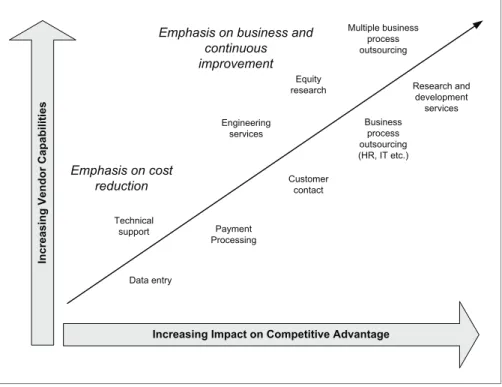
• Total outsourcing involves outsourcing the entire process to a vendor. BPO often involves outsourcing the infrastructure supporting the business process, including the IT infrastructure. BPO focuses on how the overall process methodology or function is effective, from manager to end user, rather than on the technology that supports the process. Services outsourcing also includes IT outsourcing, which involves the IT component of business operations, such as data centre and desktop operations. For example, outsourcing the data centre may involve back-office support to a number of business functions, such as human resources and finance and accounting. As well as outsourcing routine processes, such as data entry and transaction processing, to reduce costs organisations have increasingly been outsourcing processes that impact competitive advantage. Organisations have therefore been outsourcing more complex processes, as vendors have upgraded their initial capabilities to reduce costs, to offering specialist knowledge and business improvement capabilities to transform process performance for clients as shown in Figure 11.
Organisations have been outsourcing services to both local and foreign locations. Local outsourcing involves transferring a process previously carried out internally to a vendor located in the same country of operation. This can involve an organisation transferring parts of the process including staff, equipment and other assets to the vendor. Local outsourcing can also involve redeploying staff in the outsourcing
organisation or redundancies. However, the negative effects of this type of outsourcing are mitigated, as the displaced jobs still remain locally, and are only redistributed to another local vendor. Therefore, the impact of local outsourcing on those people in services mainly involves job transfers. In contrast, foreign outsourcing involves transferring a process previously carried out locally to a vendor or a subsidiary operation owned and managed by the client organisation in a foreign country.
Figure 1 The relationship between competitive advantage and increasing vendor capabilities in BPO
Increasing Impact on Competitive Advantage
Increasing Vendor Capabilities
Emphasis on business and continuous improvement Emphasis on cost reduction Data entry Technical support Customer contact Research and development services Equity research Business process outsourcing (HR, IT etc.) Engineering services Multiple business process outsourcing Payment Processing
The terms offshoring and near-shoring are often used in the context of global outsourcing. Offshoring involves outsourcing a process to a location that is both geographically and culturally distant. An example of offshoring is when a United Kingdom (UK) financial services organisation transfers its customer service contact process to an Indian vendor. Near-shoring involves outsourcing a process to a location that is both geographically and culturally close. An example of near-shoring is when a German company outsources software development to a vendor in Hungary.
3. TYPES OF SERVICES OUTSOURCING
ARRANGEMENTS
There is a vast array of terms used in the outsourcing literature, and there appears to be little convergence of the terminology used between academia and practice. This can often create confusion surrounding the subject. However, there are a number of configurations for managing outsourcing arrangements both locally and globally. Using the dimensions of level of ownership and location, a typology of sourcing arrangements can be created as shown in Figure 2.
Figure 2 Typology of sourcing configurations
Outsource to local vendors Sourcing Location Outsourcing Locally-based Foreign-based Level of Ownership Outsource to foreign vendors Local in-house sourcing Sourcing from foreign subsidiaries Internal Sourcing Examples Multi-sourcing, Shared services etc. Examples Fee-for-service, Build-operate-transfer (BOT) etc. Examples Captive model, Shared services etc.
Local in-house sourcing
This occurs when an organisation sources services internally from business functions such as human resources, information technology and finance and accounting.
Outsourcing to local vendors
This option involves an organisation sourcing services from vendors within its national boundaries. There are a number of configurations organisations employ for local outsourcing. Organisations are increasingly utilising multi-sourcing instead of moving directly to totally externally owned outsourcing arrangements. Multi-sourcing integrates in-house service provision with outsourced methods including either “out-tasking” some of the steps in a process, or total business process outsourcing. Out-tasking is often a practical way of exploring the potential benefits of total outsourcing without the risks of total dependency.
Sourcing from foreign subsidiaries
This involves establishing and managing a subsidiary in a foreign location to avail of local skills and lower labour costs. A common sourcing model associated with this arrangement is the captive model. With the captive model, the client builds, owns, staffs and operates the global facility. The captive model offers a high level of control through ownership, but also carries high levels of risk due to the inflexibility associated with ownership. Shared services arrangements involve centralising processes at a single location where the geographically dispersed units of an organisation share the services centrally, rather than have all the services provided locally (Meters and Verma, 2008). Multi-divisional organisations establish shared services arrangements for processes in functions, such as human resource (HR), finance and accounting (F&A), information technology (IT) and research and development (R&D) as shown in Figure 3.
Figure 3 Shared services arrangement Multi-Divisional Organisation Australia Site UK Site HR HR Shared Services Centre US Site
F&A R&D HR F&A R&D HR F&A R&D
F&A Shared
Services Centre Services CentreR&D Shared
Outsourcing to foreign vendors
This arrangement involves sourcing services from an independent vendor in foreign locations. Again, there are a number of models employed by organisations, which are largely influenced by the level of control required. Organisations can use external vendors on a contractual basis. This is the case with fee-for-service outsourcing in areas such as software development and customer contact where the client signs a contract with a foreign vendor who owns its own facility and employs its own staff. This is the most popular global outsourcing model as it offers the lowest level of risk (Rottman and Lacity, 2004). Another common model in global outsourcing is the joint venture where the client and vendor share ownership in the facility. Organisations often chose a joint venture over the captive model because they want to sacrifice control in exchange for the vendor taking on most of the risk. The build-operate-transfer (BOT) model is often associated with the joint venture model. This model provides an opportunity to leverage the capabilities of a vendor to establish operations in the foreign country, and then transfer the operations to the full control of the client after an agreed period of time. The BOT model has become increasingly prevalent in many industries where distinctive capabilities are built around unique knowledge bases such as design and engineering (Youngdahl and Ramaswamy, 2008).
4. DRIVERS OF SERVICES OUTSOURCING
Business process perspective
The business process view championed by Hammer and Davenport and consultancy firms such as Accenture and Genpact, has had a major influence on how organisations view their operations and outsource business processes. Process management is a structured approach to performance improvement that focuses on the disciplined design and careful execution of an organisation’s end-to-end business processes (Hammer, 2002). Hammer defines a business process as an organised group of related processes that work together to create value for customers. Previously, organisations developed their own processes, such as order fulfilment, customer support and order processing, which were company and location specific. These processes were constructed to meet the idiosyncrasies of individual organisations. However, as a result of business improvement, information technology implementations and total quality management (TQM) initiatives, organisations have employed process management approaches.
A major element of the business process perspective has involved standardising and outsourcing processes to specialist vendors (Davenport, 2005).
Standardisation facilitates outsourcing for a number of reasons. Standardising a process means it can be performed successfully using a set of consistent and repeatable tasks. For example, when a customer places an order for a product from a company, there are a number of pre-determined steps and a sequence involved in processing the order. The company will have a standard process for processing the order, which does not vary from customer to customer. The consistency of the process means that it is straightforward to transfer to a vendor.
Standardising processes makes it easier to compare in-house costs with those of outsourcing the process to vendors. In addition, standardising processes makes it easier for companies to outsource, as they can establish clear interfaces between their organisation and the vendor. This means that responsibility and performance for the processes can be clearly handed over to the vendor. Information technology can allow the client to implement standard interfaces with internal processes, and those of vendors. Many processes such as labour recruitment, payroll processing and debt collection are often performed in the same way by many organisations. Through outsourcing processes with standard requirements, vendors can achieve economies of scale and in turn reduce costs for clients.
Developments in information and communication technologies
(ICTs)
The advent of relatively cheap and reliable telecommunications and information technology has facilitated the trend towards services outsourcing. In the last number of decades, ICTs have transformed organisations internally, and the way in which they interact with customers and suppliers. In particular, developments in ICTs have enabled organisations to transfer responsibility for processes to vendors both locally and globally2. Networking, digitisation and storage technologies have
been transforming business services, particularly those with standard processes, into utility-type services that can be managed and delivered from anywhere at any time. The omnipresent nature of reliable and efficient communication networks like the Internet means that there is little difference whether many services are delivered from an adjacent room or from the other side of the world. In addition, ICTs are facilitating the standardisation of service processes and allowing vendors to benefit from economies of scale. Some have argued that information can be standardised, built-to-order, assembled from components, picked, packed, stored and shipped, all using processes similar to manufacturing (Karmarkar, 2004)). The work of Philip Evans and Thomas Wurster (Evans and Wurster, 1999a;1999b) provides a useful analogy for explaining how advances in ICTs are driving services outsourcing. They have argued that every organisation is composed of processes that have both physical and information elements. The consumer buying process is also composed of both physical and information elements. The physical element of the process involves purchasing the product or service, whilst the information element involves evaluating the options on offer. However, the advent of ICTs makes it possible for organisations to separate the information element from the physical elements of service processes. Service processes, such as market research, customer service and product support, are rich in information content and can be sourced from vendors both locally and offshore. For example, global vendors can offer IT-enabled customer support processes to customers anywhere in the world regardless of physical location. Separating the information element from the physical element of business processes allows an organisation to fundamentally re-think and re-engineer its operations in ways that reduce costs and enhance value for their customers (Youngdahl and Ramaswamy, 2008).
Advances in technology are also impacting highly knowledge intensive services. Radiology in the healthcare sector provides an interesting illustration. Highly skilled physician services, such as radiology, have been outsourced from the United States
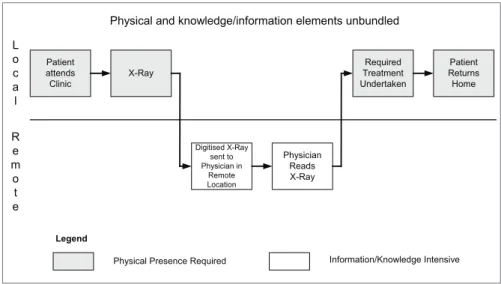
(US) to locations such as India. Advances in digital imaging equipment has allowed physicians to read scans remotely, which has meant that scans are now being read by English-speaking physicians anywhere in the world. Radiology services are particularly amenable to this arrangement, as they are highly knowledge intensive and the physician does not have to be physically present to read the scan. Figure 4 provides an illustration of how unbundling the information and physical elements allows the scan to be read remotely.
Figure 4 How ICTs drive knowledge-based services outsourcing
Legend
Information/Knowledge Intensive Physical Presence Required
R e m o t e Patient attends Clinic X-Ray Digitised X-Ray sent to Physician in Remote Location Physician Reads X-Ray Required Treatment Undertaken Patient Returns Home Physical and knowledge/information elements unbundled
L o c a l
Globalisation and emerging economies
The external business environment has become increasingly global for many industries with many organisations competing on a global basis (see Stiglitz, 2002; and Thompson, 2001). The globalisation of trade has led organisations in developed nations such as the US, Europe, and Asia to expand the geographical scope of their business operations in terms of the markets they serve, and the locations for the creation of their products and services. At the same time, emerging economies such as India, China and Brazil, have experienced economic growth and increased their position in the global economy. Many emerging economies have growing markets with large populations and more disposable incomes. These changes have presented organisations with significant opportunities. Organisations have been in a position to achieve greater economies of scale, share investments in research and development and marketing across their various markets, and access lower
cost labour sources for both the manufacture of their products and delivery of their services. Emerging economies, such as India, have proactively developed their competitiveness and encouraged large multinational firms to locate much of their back-office services, such as IT and customer contact, to their shores. These countries have developed their attractiveness through investments in their telecommunications infrastructure, low corporation taxes, favourable business legislation, growing labour markets, competitive labour costs and a strong emphasis on education3.
Consumers demanding more for less
Consumers are more demanding as they become more knowledgeable on issues such as price, reliability and availability. Consumers are more mobile in terms of ease of access to alternative sources of supply as a result of increased competition in many markets and the advent of the Internet. With global access through the Internet to more products and services than ever before and with instant communications, typical constraints such as time and distance, are rapidly disappearing. As a result, the loyalty of consumers to product and vendors is diminishing. Consequently, organisations are now being forced to be more responsive to customer needs in a range of areas. With the consumer demanding a more information-enriched and interactive relationship with commercial organisations, public sector organisations are also having to respond with innovations in the way in which they interface with citizens in order to achieve greater accessibility and efficiency. In the past, many public sector organisations have been protected from the harsh commercial reality of competition and an ever increasingly demanding citizen. However, in the future, the expectations of consumers will continue to rise with the increasing use of on-line trading which allows business to be conducted at any time of the day.
Corporate restructuring
Corporate restructuring has become an important strategy for organisations to improve performance. Since the 1980s, many organisations have used corporate restructuring programmes to refocus their operations, remove cost and generate revenue (Bergh et al., 2008; and Pettigrew, 2003). Outsourcing is a common element of many corporate restructuring efforts. Restructuring often involves focusing on core areas that are critical to competitive advantage, and outsourcing areas that are resource intensive and have little impact on competitive advantage. Back-office functions such as IT, HR, and finance and accounting have become targets for outsourcing as a result of corporate restructuring programmes.
Many back-office function tasks are duplicated across different geographical locations. This situation has been further compounded as organisations have embarked upon mergers and acquisitions and taken over larger numbers of support staff. Outsourcing and shared services arrangements in particular have allowed organisations to consolidate and re-engineer business processes from geographically dispersed business units into single service centres. Developments in ICTs and business process methodologies, combined with vendors with an increasing range of capabilities have further driven this trend.
5. PERFORMANCE IMPROVEMENT AND SERVICES
OUTSOURCING
As organisations outsource larger and more complex processes, performance management has become increasingly challenging. Performance management is more complex in business services compared with that of manufacturing. Whereas many manufacturing processes can be standardised and modularised, it is more difficult to standardise service processes, thus increasing the difficulties of developing effective performance measures for use in outsourcing arrangements. Services lack the tangible attributes of physical products, and include many attributes that are difficult to specify in measurable terms, which often leads to incomplete specifications of both requirements and service levels (Ellram et al., 2008). This makes it difficult to undertake meaningful comparisons across organisations, and understand the causes of variances in process performance. Organisations struggle to identify what should be measured and how to normalise data across different organisational contexts (Harman et al., 2006). Even when organisations know what to measure, they fail to achieve accuracy, as performance data is not defined or collected consistently.
Effective performance management is acknowledged as a critical influence on successful services outsourcing in the literature. There is a consensus in the literature on the need to link outsourcing and performance management with the
business strategy of the organisation4. Performance management and business
strategy are closely linked, as performance measures and management are critical elements in translating an organisation’s strategy into reality (Melnyk et al., 2004). The motives of organisations in outsourcing decision-making are often dominated by performance concerns. The use of the core/non-core logic by practitioners in outsourcing decisions is driven by performance considerations. Organisations should perform internally ‘core’ processes where they have a superior performance position that is difficult to replicate, whereas they should outsource ‘non-core’ processes where vendors have superior performance positions. Services outsourcing offers organisations a number of potential performance improvement benefits which are discussed below.
Cost benefits
This refers to the costs savings the client can enjoy from outsourcing. Outsourcing enables the client to benefit from vendor cost advantages such as economies of
scale, experience and location (Sako, 2006). Vendors may take on investment and development costs while sharing these risks among many clients, thereby reducing vendor costs for all clients. For example, in the financial services industry many banks have outsourced high-volume transaction processing functions, such as electronic payments and processing of cheques, to vendors with greater economies of scale in order to reduce the cost of each transaction (Lancellotti et al., 2003). Furthermore, by gradually outsourcing processes the client can reduce risks by converting its fixed costs into variable costs. In times of adverse business conditions, vendors will then have to deal with the problem of excess capacity. However, vendors should be better able to cope with demand fluctuations through economies of scale and have more scope for alternative sources for excess capacity.
Service quality benefits
This refers to the improvements in service and quality outsourcing can deliver. Vendors can often achieve much higher levels of performance in certain processes than can be achieved internally by the client. This performance advantage is based not only on reduced costs. Specialist vendors can often provide higher levels of service quality than those of internal functions within the client. The performance improvement that a vendor can deliver has given rise to terms such as transactional and transformational outsourcing (Linder, 2004). Transactional outsourcing involves the vendor delivering process efficiencies and process improvement. Alternatively, transformational outsourcing involves the vendor delivering business and process transformation. The outsourced process shares interdependencies with other business processes, is complex and is strategically important to the client.
Specialisation benefits
This involves focusing resource on internal processes that create value and allow the client to enhance its competitive position. Specialisation through outsourcing can allow an organisation to concentrate on areas of the business that drive competitive advantage and outsource peripheral processes enabling it to leverage the specialist skills of vendors. Some commentators have argued that specialists in supply markets can develop greater knowledge depth, invest more in software and training systems and be more efficient. Consequently, they can offer higher salaries and attract more highly trained people than can the individual staff of all but a few integrated companies (Quinn, 1999). These advantages can generate enough value to deliver a better service at a lower cost to the customer, whilst allowing
the supplier to make a profit. Moreover, specialisation means an organisation can invest in developing a capability and sustaining a superior performance position in the capability relative to competitors. This allows an organisation to invest scarce resource in areas where it has a superior performance positions (McIvor, 2008). Processes in which an organisation lacks the necessary resources or capabilities internally can be outsourced. Organisations can access complementary capabilities from external vendors where they can gain no advantage from performing such activities internally.
6. RISK AND SERVICES OUTSOURCING
One of the most common fears expressed by managers when considering outsourcing are the risks associated with using an external vendor. When
performing a process internally, organisations believe that they can exercise greater control over an internal function and there is less chance of failure of supply than when using an external vendor. Organisations have natural fears of being held to ransom by a powerful vendor and can become overly dependent upon opportunistic suppliers due to a lack of awareness of the issues involved in understanding the supply market. Therefore, when considering outsourcing a process, it is crucial that the organisation has an in-depth understanding of the relevant supply market. If supply markets were totally reliable and efficient, organisations would outsource all business processes except those that are regarded as a source of competitive advantage. However, most supply markets are imperfect and the buyer must incur some level of risk depending upon the characteristics of that market.
Clearly, the level of risk will have a significant influence on the decision to outsource. A high level of risk or uncertainty in the supply market makes keeping the process internally the preferred option, whilst a low level of risk or uncertainty in the supply market makes outsourcing the preferred option. On the surface, these guidelines appear plausible. However, there are other factors that can influence the decision. For example, consider an organisation that is experiencing high demand for its products in its customer markets. In this case, even though there may be a high level of risk in the supply market, this organisation may have no alternative than to outsource certain activities because it lacks the capacity internally to meet rapidly growing demand for its products. Alternatively, an organisation may develop a new product that involves a number of unique processes that are not accessible in the supply market. Therefore, it has no other choice than to perform the processes internally. Organisations face a number of potential risks with services outsourcing, and these are discussed below.
Financial risk
This refers to the client having to incur unanticipated additional costs from outsourcing. There is evidence to suggest that when organisations outsource to achieve cost reductions that costs do not decrease as expected and in some cases can increase (Kern et al., 2002). When organisations outsource to achieve cost reductions, there is normally an early anticipation of cash benefits and long-term
cost savings. However, many organisations fail to account for future costs and in particular that of managing the outsourcing process, sometimes referred to as the hidden costs of outsourcing (Barthelemy, 2001). There is a tendency to under-estimate the management resources and time that have to be invested in outsourcing. Some organisations fail to realise that resources have to be invested in managing the relationship with the vendor, which is particularly important in the case of critical business processes. Many organisations assume that labour arbitrage will deliver cost savings comparable with worker-to-worker substitution without consideration of the hidden costs of outsourcing (Shi, 2007). For example, outsourced workers absorbed elsewhere inside the customer organisation can dissipate the anticipated costs savings. In addition, extra project management resources allocated to managing the outsourcing arrangement will add to the overall costs.
Performance risk
This refers to the vendor failing to meet the required service levels of the client. Dependency on a vendor can lead to significant risks in terms of poor vendor service quality, which in turn can harm the reputation of the client organisation with its customers. Organisations often decide to keep processes in-house in order to guarantee quality and reliability of supply. A common cause of poor vendor service quality is a lack of vendor skills and experience in the process involved (Quelin and Duhamel, 2003). Opportunism on the part of the vendor can also lead to poor service quality. There are a number of indicators of opportunism5:
• The presence of investments in physical or human assets dedicated to a particular relationship will create switching costs for an organisation. • This problem is further exacerbated if there are a small number of capable
suppliers in the supply market. Such conditions make the organisation prone to opportunism during the contract and at the time of contract renewal.
• Uncertainty both in the business environment and in the requirements of the organisation may mean that it is not possible to write complete contracts and renegotiation and frequent amendments are required as circumstances change. • Complex interdependencies between processes increase the potential for
opportunism due to the need for co-ordination and mutual adjustment. • Difficulties with measuring supplier performance can also create problems
in the relationship, as the organisation must expend additional resource on monitoring supplier performance. Furthermore, differences in relation to the
interpretation of performance can also create difficulties in the relationship. For example, where effective performance measures have not been developed for the outsourced process, it will be difficult to determine whether the supplier has executed the process better than when it was performed in-house.
Strategic risk
This refers to the loss of critical skills and the potential for innovation in the future. Many organisations have unknowingly relinquished their core competencies by cutting internal investment in what they mistakenly thought were ‘cost centres’ in favour of external vendors (McIvor, 2005). In the long-term, an organisation needs to maintain innovative capacity in a number of key processes in order to exploit new opportunities in its respective customer markets. If an organisation has outsourced a number of critical processes its ability to innovate may be severely diminished. Innovation requires slack resources, organic and fluid organisational processes, and experimental competencies - all attributes that outside supply does not guarantee (Earl, 1996). These risks can become more pronounced when the objectives of the outsourcing company and the vendor are conflicting. For example, the customer organisation may decide to establish a short-term contract with a vendor in order to obtain the lowest price and keep the supplier in a weak position. However, this will seriously undermine any incentive for the supplier to pass on any of the benefits associated with innovation to the customer organisation.
7. THE OUTSOURCING RELATIONSHIP
In the case of processes deemed suitable for outsourcing, the client should adopt an appropriate outsourcing relationship, which will be influenced primarily by the potential for vendor opportunism. Factors such as complex process interdependencies, performance measurement difficulties, uncertainty in
requirements and high vendor dependency will influence the choice of the following generic outsourcing relationships available to the client (McIvor, 2009).
Non-specific contracting
In this case, the process can be readily sourced from a number of vendors in the supply market. The supply market for the process is extremely competitive with a high level of rivalry between vendors aggressively competing for business from clients who share similar sourcing requirements. The outsourcing arrangement is driven primarily by the contract, which involves relatively short-term, bargaining relationships between independent clients and vendors. The primary objective of this outsourcing relationship is to achieve cost reductions. Non-specific contracting is appropriate in a transactional outsourcing arrangement where the outsourced process is not critical to competitive advantage, has limited interdependencies with other processes, and low complexity. There are clearly defined service level agreements, and client requirements are relatively stable throughout the contract. The needs of the client are non-specific, which enables the vendor to achieve economies of scale on production costs. In addition, selecting a vendor in a location with lower labour costs will deliver further cost savings.
Recurrent contracting
In many cases, the needs of the client can be quite specific. In this case, recurrent contracting is an appropriate outsourcing relationship, involving repeated
exchanges of assets with moderate levels of asset transaction-specific investments (Williamson, 1985). The low potential for opportunism is indicated by the presence of a number of capable vendors in the supply market. Contracts can be employed in which future contingencies are specified and the impacts of unforeseeable events are limited by incorporating provisions for third party arbitration to resolve disputes. Recurrent contracting can allow the client to establish a contractual arrangement, which allows it to switch to other competing vendors that have become more capable, for example, as a result of changes in technology. Although the client may
have a number of specific requirements for the vendor, excessive dependence on a single vendor is avoided. In addition, the client can incorporate a number of mechanisms that allow it to switch to another vendor in the event of contract termination.
Relational contracting
This outsourcing relationship involves adopting a longer-term collaborative relationship. This approach is appropriate in the case of a process, which is critical to competitive advantage and for which there is high potential for opportunism indicated by the small number of vendors, and the inability to fully specify or control all elements of the process. Adopting this approach allows the client to establish and build a mutually advantageous relationship with the vendor. In relational contracting, the enforcement of obligations, promises, and expectations occurs through social processes that promote norms of flexibility, solidarity, and information exchange (Poppo and Zenger, 2002). The focus in a relational contracting arrangement is moving beyond a contractual mindset and developing a trust-based and mutually beneficial relationship6. Relational contracting
is appropriate where the client and vendor are attempting to achieve a rapid, sustainable, step change improvement in organisational and process performance7.
8. BUSINESS IMPROVEMENT AND SERVICES
OUTSOURCING
Business improvement techniques have become increasingly prominent in both manufacturing and services. As a result of an increasingly competitive and complex business environment, organisations have been attempting to compete on the basis of the ability to continuously improve business processes (Teece, 2007). Business improvement has its origins in the business process view, which is a structured approach to improving performance that involves the design and execution of a company’s end-to-end business processes (Hammer, 2002). The process view involves constant efforts to improve performance in order to increase customer satisfaction. Organisations achieve business improvement through the deployment of business improvement techniques such as:
• benchmarking; • Six Sigma;
• process mapping; and • knowledge management.
An overview of each of these techniques is now provided below.
Benchmarking
Benchmarking is a continuous process of measuring product, service and
processes against those organisations that are recognised as competitors or world leaders in their areas. The purpose of such comparisons is to enable companies to determine where and how performance can be improved. Benchmarking is concerned with searching for and implementing best practice and performance improvement. However, this does not mean imitating processes used by other companies. Rather, it is concerned with understanding why another organisation carries out activities more effectively than its peers do. Such an approach will then provide companies with a basis to determine how performance can be improved. Benchmarking should not just be focused on measuring outcomes but should be equally concerned with the processes employed to produce the outcomes (Wisniewski, 2001). Benchmarking can highlight those activities and internal processes in which the organisation has superior performance or cost advantage
in relation to competitors. In fact, companies are realising the benefits of combining the benchmarking of processes with business strategy. It can identify potential sources of competitive advantage that can be exploited more fully to develop capabilities that are difficult to replicate. Also, it assists in identifying weaknesses that need to be addressed for a company to become more competitive. The advantage of using benchmarking is that it aligns the operational activities at the lower level with the overall business strategy of the organisation. It is also important to note that the needs of the customers of the organisation can be linked to the benchmarking process. Benchmarking assists organisations in optimising their capability to meet the needs of customers by ensuring that processes are more superior, consistent and effective than competitors. Therefore, it can be used as a basis for building competitive advantage. A critical part of benchmarking is the selection and manipulation of metrics to represent the performance of the process under analysis.
Six Sigma
Six Sigma is an improvement programme for eliminating waste and improving performance in business processes (Betts, 2005; and Zu et al.,2008). Statistical and scientific methods are at the heart of Six Sigma, both in developing an optimum process specification, and reducing defects in the process to almost zero. Although Six Sigma was pioneered in manufacturing by companies such as Motorola, it has been widely applied in business services to improve service quality and customer satisfaction. There are three key practices associated with Six Sigma implementation:
(i) Role structure
Implementing Six Sigma involves a group of improvement specialists – normally referred to as champions, master black belts, black belts and green belts
(Linderman, et al., 2006). The logic of Six Sigma is that improvement initiatives are only successful if significant training and resources are devoted to implementation. Therefore, improvement specialists receive training to improve their knowledge and skills in areas such as statistical methods, project management, process design, and problem-solving techniques.
(ii) Structured improvement procedure
A structured approach to managing improvement activities is applied in Six Sigma. This is often represented by the Define-Measure-Analyse-Improve-Control (DMAIC) cycle used in process improvement which involves a number of steps (Pande et al., 2002).
• Define – identify an improvement area and define project scope and the process involved.
• Measure – determine which aspects of the process require improvement. Identify critical input variables that can be controlled and affect the output. Define unacceptable levels of process performance, and collect data on process performance.
• Analyse – use performance data to document current performance. Where possible, benchmark performance against internal or external processes. • Improve – eliminate causes of poor performance. Where no special causes of
poor performance can be found, the improvement effort may have to focus on the process design.
• Control – verify and embed the process change, and share experiences and knowledge with other process improvement teams.
(iii) Focus on metrics
Six Sigma incorporates quantitative metrics to set improvement objectives. Explicit and challenging improvement objectives can increase the scale of performance improvement, reduce the variability in project performance, and drive employee commitment to improvement and quality. Moreover, similar to other business improvement programmes, Six Sigma is a continuous process of repeatedly challenging the detailed working of processes in order to drive improvements.
Process mapping
Process mapping involves creating a visual map of workflows within a process with the aim of improving process performance and delivering value for customers (Winch and Carr, 2001). A process map can model the key business inputs and outputs, multiple works steps, links with different departments, supporting processes and input from external parties such as clients and vendors. It is
an effective way of understanding a business process and illustrating the interrelationships between activities in a process. The actual steps involved in building a process map can help clearly define roles at the level of both the function and individual. This can be particularly valuable in building a consensus on what currently happens in the organisation. Moreover, a process map can be a useful first step in a business improvement exercise as it identifies the important processes and potential areas for change. Some argue that process mapping is more than a tool for change as it can create a more holistic understanding of
how an organisation functions (Matsumoto et al., 2005). Moreover, process maps
can be employed as a radical approach to change which allows breakthrough advancements in process improvement initiatives through creating a better understanding of complex business processes.
Knowledge management
Knowledge management first emerged in the 1960s as companies began to recognise that knowledge was central to competitive advantage. Knowledge management involves creating, codifying, disseminating and applying knowledge that resides in an organisation. Managing knowledge enables effective and efficient problem solving, dynamic learning, strategic planning, and decision-making (Birkinshaw and Sheehan, 2002; and Greasley, 2006). Organisational knowledge can be divided into two forms – explicit and tacit (Nonaka, 1994).
Explicit knowledge can be formalised and codified, such as software code and production data. Explicit knowledge is codified in a form that can be shared with others or transformed into a process or strategy without requiring any inter-personal interaction. For example, explicit knowledge is embodied in a computer programme or set of procedures for staff recruitment.
In contrast, tacit knowledge is often difficult to formalise into procedures and is developed through personal experience. In addition, tacit knowledge is not easily communicated to others in an organisation. It includes scientific expertise, operational know-how, insights about an industry, business judgment, and technological expertise. Tacit knowledge can be embedded in the brain of an individual or in inter-personal interactions between employees within a function or across a number of functions. It can be slow and costly to transfer, and is often characterised by ambiguity.
Some authors have argued that a knowledge-creating company should attempt to convert tacit knowledge into explicit knowledge (Hansen et al., 1999). Often, tacit knowledge can be formalised and has not been formalised into to explicit knowledge because the individual is resistant to sharing the knowledge or does not recognise the value of the knowledge. Information technology can play an important role in formalising and storing knowledge. There are many knowledge management software applications with tools and techniques that enable organisations to codify tacit knowledge into formal systems. Tacit knowledge can be difficult to formalise and codify via software applications, as it is not possible to formalise the tacit knowledge into words. However, tacit knowledge can be shared or transferred through associations, meetings, brainstorming sessions, or other social and interpersonal interactions.
The link between business improvement and services outsourcing
Organisations have been increasingly employing business improvement techniques both to improve performance and reduce risk in outsourcing arrangements. Prior to outsourcing it is important that the client and vendor work together to identify and untangle any unwanted complexity from the process workflow. Business improvement techniques can be employed to eliminate redundant applications, tasks, systems, and communication channels from the process (Mani et al., 2006). For example, dynamic mapping tools such as visual process maps can provide insights in the working of complex processes and assist in identifying areas for performance improvement. Process mapping and cost analysis approaches can be used to understand cost drivers and potential ways of achieving efficiencies by re-designing processes. Benchmarking is particularly valuable in an outsourcing context and can be used to compare operations, work practices and business processes (Harris, 2007).Business improvement techniques can also be used to understand key sources of risk in outsourcing arrangements. For example, business improvement techniques can also be employed to reduce specific and idiosyncratic client requirements, and identify areas where standard vendor processes can be deployed. Understanding process requirements allows more effective performance measures to be derived and also amended throughout the contract as requirements change. When process complexities and interdependencies are more fully understood, it is less difficult to assign responsibility for execution of certain tasks between the client and vendor (Bahli and Rivard, 2005).
However, employing business improvement techniques is challenging, and impacts on a number of important aspects of the outsourcing process. In vendor selection, the client must ensure the vendor has the required business improvement capabilities, whilst at the same time meeting the minimum standards of performance in the contract (Feeny et al., 2005). This involves the client thinking carefully about which processes should be outsourced, the performance improvement objectives required from outsourcing, and how the vendor can meet these objectives. The nature of the client-vendor relationship is another important consideration. Where the client’s requirements are standard and involve little change, a more contractual arrangement is required where the client specifies clearly the requirements the vendor must meet (McIvor, 2008). However, in the case of complex outsourcing arrangements, the application of business improvement techniques and the associated process changes will require frequent amendment of service levels and requirements. Therefore, a more relational client-vendor relationship is appropriate, as this will allow some changes to be made without having to re-negotiate the contract. In addition, this should ensure that the benefits from any performance improvements are shared fairly between the client and vendor (Feeny et al., 2005).
9. FURTHER RESEARCH
Despite the increasing prominence of services outsourcing, little research has been undertaken which examines in-depth the implications of applying business improvement techniques in the services outsourcing process. Much of the work in this area has been carried out in the information systems field (Tanriverdi et al., 2007). For example, organisations can use business process tools and ICTs to standardise, codify, and modularise services processes to facilitate outsourcing (Mithas and Whitaker, 2007). The following sections highlight a number of areas where further research is required.
Service design
Service design involves a number of activities including specifying service quality, understanding customer needs and expectations, job design, selection and training of staff, service technology, and the detailed design of the service delivery system (Johnston and Clark, 2001). A key aspect of service design relevant to outsourcing is the concept of service dis-aggregation. The seminal contribution by Chase in 1981 to service dis-aggregation argues that the operating efficiency of a service system is based on the customer contact time and service creation time (Chase, 1981). Developing the customer contact construct allowed Chase to offer guidelines on the design of service delivery systems. In particular, this led to the distinction between front-office services where there was direct contact with the customer, and back-office services where the service was created.
There are a number of limitations with the current literature in this area. Many of the constructs in this area are based on the logic that low-contact back-office services are more amenable to outsourcing than front-office services, primarily as a result of efficiency and standardisation motives. Increasingly, high contact, front-office service processes are being outsourced, both locally and globally, primarily as a result of ICTs facilitating verbal and text-based communication regardless of geographic location. Existing constructs in the literature are insufficient for understanding the complexities of service design, and omit a number of important influences including transaction costs, and knowledge intensity which are now considered.
• Influence of transaction costs - Many of the existing approaches do not incorporate the influence of the transaction costs associated with dealing with
vendors, and further research is required examining the influence of transaction costs on existing constructs in the service design literature. Transaction costs influence the decision to outsource, and the most appropriate type of vendor relationship (Williamson, 1985; and 1975). Transaction costs include the presence of investments in physical or human assets dedicated to a particular relationship will create switching costs for the sourcing organisation. This problem is further exacerbated if there are a small number of capable vendors in the supply market.
Uncertainty, both in the business environment and in the requirements of the sourcing organisation, may mean that it is not possible to write complete contracts and renegotiation. Frequent amendments are then required as
circumstances change. Complex interdependencies between business processes can also increase the potential for vendor opportunism, increasing the need for co-ordination, joint problem solving and mutual adjustment (Mani et al., 2006). • Knowledge intensity - The issue of knowledge intensity requires further
study in the area of service design and outsourcing. There are many back-office services that cannot be outsourced because they are highly knowledge intensive, involving judgment that is accumulated through integrating specialised knowledge, professional expertise and experience in a particular area. A process composed of extensive specialised knowledge and experience is extremely difficult to transfer to vendors, particularly to those in foreign locations (Bannerjee et al., 2007).
Alternatively, well-structured processes with clearly defined outcomes that can be undertaken systematically through applying specific rules have low levels of knowledge intensity. Examples include standard production processes and transactional-oriented business processes. The level of knowledge intensity and impact on competitive advantage are closely linked. High knowledge intensity processes often have a considerable impact on competitive advantage, and transferring responsibility for such processes to vendors can lead to the relinquishing of important knowledge.
• Business process tools - An important area for further research is how business process tools such as process mapping and benchmarking, and ICTs are applied in the service design process. Many companies have been using business process tools along with ICTs to simplify, standardise, and automate services. This trend has been particularly evident in call centre services, where employees often carry out routine, monotonous tasks with a strong emphasis
on performance measurement by line management. In many cases, this has led to a lack of job satisfaction and motivation amongst employees, leading to high labour turnover (Bain et al., 2002). A fuller understanding is required of how companies deal with these problems. Some call centres have been using ICTs to allow customers to perform routine tasks via the Internet, which allows call centre employees to deal with more complex tasks, thus facilitating job enrichment.
Business process tools and ICTs have also been applied to highly skilled professional services such as medicine and legal services. ICTs have facilitated the dis-aggregation of some legal services into smaller standardised tasks, which has allowed non-lawyers to support the legal work (Sako, 2009). A greater understanding is required of the implications of applying business process tools and ICTs to professional services. It is important to understand how far professional services can be standardised without damaging service quality, and also the implications for skills levels in these services. Organisations are using these business process tools to apply scientific management principles to highly skilled professional services. Indeed, some have argued that the application of scientific management principles has the potential to deskill many professional services in the same way as craftsmen industries were deskilled at the beginning of the 20th century (Blinder, 2006).
Performance management
Effective performance management is acknowledged as a critical influence on successful services outsourcing in the literature (McIvor, 2009; and Klaas et al., 2001). Performance management has implications for both the decision to outsource, and implementing and managing the outsourcing arrangement. In making the decision to outsource a process, organisations often focus on processes with which they are experiencing performance problems. Mistakenly, organisations assume that external vendors can provide processes at a higher performance level than internal functions (Aron and Singh, 2005). However, analysing the causes of poor process performance in areas of cost and service quality can expand the range of sourcing options available – ranging from outsourcing to internal process improvement.
In the case of managing outsourced arrangements, effective performance
management is important for a number of reasons. A major source of difficulty for organisations when measuring outsourcing performance is that they have never effectively measured the performance of the process when it was performed
internally (Shi, 2007). A major risk of poor performance measurement in the outsourcing process is that organisations have no way of knowing whether the external vendor has performed the process better or worse than the internal department previously. There are two key areas of performance management and services outsourcing literature where further research is required.
How outsourcing can deliver performance improvement
A fuller understanding is required of how outsourcing can improve process performance. In particular, research is required on the performance improvement paths associated with outsourcing. Normally, the client has a number ofperformance improvement paths, each with its own set of benefits and challenges. • Make performance improvements internally prior to outsourcing the process –
this option offers the client a number of benefits including: retaining internal knowledge of service and process improvements; deriving clearer requirements and performance measures for the vendor; and therefore reducing the potential for vendor opportunism in the outsourcing contract. Moreover, improving performance in the process may alert the client to the potential for spinning off the service as a separate business, as an alternative to outsourcing to an independent vendor. However, the client often lacks the necessary resource and business improvement capabilities to improve performance internally, and has to rely on the vendor to improve performance.
• Outsource and allow vendor to improve performance in the process - this option means the client benefits from reallocating scarce internal resource, and accessing the specialist business improvement capabilities of vendors to improve process performance. In some cases, vendors can deliver significant performance improvements. However, this option leads to a greater dependence on the vendor, loss of important knowledge of the service process, and the need for skills to manage the contract and relationship to ensure performance improvements are delivered.
This issue raises another area that requires further research; that is, the practicalities of how performance improvement can be realised during the outsourcing relationship. There is much rhetoric from vendors on how they can deliver transformational outsourcing, often through applying specialist capabilities in areas such as business improvement. However, there is little research on how this can be achieved in practice. Achieving performance transformations and employing
business improvement techniques is challenging, impacting on a number of important aspects of the outsourcing process. In vendor selection, the client must ensure the vendor has the required business improvement capabilities, whilst at the same time meeting the minimum standards of performance in the contract (Feeny et al., 2005). This will involve the client thinking carefully about which processes should be outsourced, the performance improvement objectives required from outsourcing, and how the vendor can meet these objectives. Additionally, the client will have to assess how rapidly and effectively vendors can deploy their specialist capabilities to drive performance improvement. The client must also retain capabilities in business improvement to mitigate the potential for over dependency on the vendor and, where possible, retain important knowledge associated with the outsourced process.
How to measure performance in services outsourcing
When outsourcing manufacturing processes, companies often have controls and processes in place to ensure that the supplier meets the required performance levels (Ellram et al., 2008). Supply management and cost engineers and financial specialists work together to determine clear product specifications and performance measures, which then allows the client to measure performance and understand supplier costs throughout the relationship. However, this is not the case for the outsourcing of many services, making performance measurement a significant challenge (Aron and Singh, 2005). Vendor service quality is relevant in a number of services outsourcing contexts including: internal users of services provided by an external vendor; and customers of the client organisation receiving services such as technical support from vendor staff. In addition, vendors interact with both internal and external service users via a number of media including face-to-face meetings, telephone, and the Internet.
However, there is scope for carrying out further research in service quality measurement in outsourcing arrangements. Although research has been
undertaken on service level agreements (SLAs) and outsourcing, limited attention has been given to how organisations measure service quality in outsourcing contracts (Beaumont, 2006). Some authors have argued that the SERVQUAL model has potential for application in services outsourcing (Chase and Apte, 2007). The SERVQUAL model measures service quality on the basis of the perceptions and expectations of the customer (Parasuraman et al., 1988). Customer satisfaction depends on how the perception of service quality meets the expectations of the customer, and includes ten dimensions of service quality including: reliability;
responsiveness; competence; access; courtesy; communication; credibility; security; understanding the customer; and tangibles (such as physical facilities). Some of these dimensions can be employed to assess customer satisfaction levels with vendors, and internal employees’ service quality ratings of services provided by external vendors. Notably, service quality is found to be relatively contextual, rather than generic. For example, conceptualisations of service quality in a retail bank will be different from service quality in a professional services firm.
Moreover, there is a need to extend these models to include service interactions over the Internet. Guidelines for face-to-face service interactions are only partially applicable to Internet exchanges. Although the SERVQUAL model has been adapted for application in Internet services encounters, further work is required in this area, as outsourced services are increasingly being delivered over the Internet. For example, in the past, internal employees accessed services such as HR and procurement from internal departments located in the same building. In outsourced HR shared services models, employees access many HR services remotely both by telephone and digitally. Increasingly, companies are adopting more innovative forms of contracting for service delivery over the Internet such as outcome-based contracting, where the client only pays for services when they are delivered and meet measurable outcomes, thus creating a greater incentive for the vendor to deliver high quality service (Ng et al., 2009).
How to identify and develop capabilities
The motives of organisations in outsourcing decision-making are often dominated by performance concerns. The use of the core/non-core logic by practitioners in outsourcing decisions is driven by performance considerations. Organisations should perform internally core processes where they have a superior performance position that is difficult to replicate, and they should outsource non-core processes where vendors have superior performance positions. However, further research is required in this area and in particular how firms identify and develop capabilities. • Identifying capabilities – A greater understanding is required of how companies
identify capabilities in services when making the outsourcing decision. The development of capabilities is strongly influenced by competitive differentiators such as cost, quality, flexibility and delivery. Significant attention has been given to how companies identify capabilities in manufacturing outsourcing (McIvor, 2010a; Wu et al., 2005: Canez et al., 2000; Probert et al., 1993; and Venkatesan, 1992). Some of these studies have employed the resource-based view to
identify capabilities in the outsourcing decision, and there is potential to apply the resource-based view to the analysis of capabilities in services outsourcing. A resource-based view considers the firm as a bundle of assets and resources that, if employed in distinctive ways, can create competitive advantage (Peteraf, 1993; and Barney, 1991). The resource-based view is important to the study of outsourcing, as superior performance achieved in organisational processes relative to competitors, would explain why such processes are internalised within the organisation. Interest in the resource-based view has been growing in the outsourcing arena, as many exemplars of superior capabilities in the resource-based literature such as service excellence, innovation and rapid time-to-market cycles, are at the heart of seeking competitive advantage.
• Developing capabilities – The logic of outsourcing is that organisations should externalise non-core processes, and focus on developing stronger capabilities in retained processes. Further research is required to enhance our understanding of how organisations achieve this goal. Outsourcing non-core processes puts pressure on retained functions to focus on higher value, more complex processes, and achieve the benefits of specialisation. This can be quite a challenge for functions such as HR and procurement that in the past have been clerical in nature, rather than offering value-added services to the rest of the organisation. In addition, organisations must have mechanisms in place to assess whether retained functions are developing stronger capabilities, and improving performance. Many organisations have been using SLAs to measure the performance of the internal functions as well as external vendors. Indeed, outsourcing means that internal functions are competing with external vendors and can no longer assume they will retain their monopoly status within the organisation (Lacity et al., 2008).