MEDICATION ERRORS – A CASE STUDY
ABSTRACT
The case study emphasises on Medication errors in a hospital and this paper discusses the medication errors which occurred at a multi-speciality hospital, Patan, Gujarat. This is a record based retrospective study of sample of 500 inpatient records, focussing on adverse drug events (ADE). A total of 36 ADEs were recorded giving an ADER of 7.2%. A root cause analysis was done and steps for reducing/avoiding medication errors were suggested, based on findings.
INTRODUCTION
Medication errors that lead to iatrogenic injuries are a well-known worldwide phenomenon and are common, costly and clinically important. In 1910, Richard Clark published the first study that looked at error rates in clinical diagnosis. Since then, several studies have looked at the problem of medication errors. Medication errors are a common occurrence and continue to be a problem in the health care industry. It is estimated that the annual cost of drug-related morbidity and mortality is nearly $ 177 billion in the United States. Approximately 7,000 deaths occur each year and medication errors occur in just about 1 of every 5 doses given in hospitals. There is at least one death per day and 1.3 million people are injured each year due to medication errors.(1) Incidence rates of adverse drug events amongst adults admitted to the hospital have ranged from 2 to 7 per 100 admissions. Approximately, 28% of adverse drug
L. K. V. Reddy*, A. G. Modi**, B. Chaudhary***, V. Modi****, M. Patel*****
Keywords :
Medication Errors, Medical Negligence, Risk in Hospitals.
* Faculty, Dept, of Hospital Management, HNG University, Patan - 384265, Gujarat, India. ** Coordinator, Dept. of Hospital Management, HNG University, Patan - 384265, Gujarat, India. *** Faculty, Dept. of Hospital Management, HNG University, Patan- 384265, Gujarat, India. **** Consultant, Doctors House Hospital, Patan - 384265, Gujarat, India.
***** Manager, Apollo Hospital, Gandhinagar, Gujarat, India.
events (ADEs) are related to medication errors and are, therefore, judged to be preventable. This issue has also received considerable attention in the lay press.(2)
The National Coordinating Council for Medication Error (NCCMER) defines a medication error as being ‘‘any preventable event that may cause or lead to inappropriate medication use or patient harm, while the medication is in the control of the health care professional, patient or consumer.’’ Such events may be related to professional practice, health care products, procedures and systems including: prescribing; order communication; product labelling, packaging and nomenclature; compounding; dispensing; distribution; administration; education monitoring; and use.(3) Common causes of medication errors include incorrect diagnosis, prescribing errors, drug-drug related reactions, dose miscalculations, incorrect drug administration and lack of patient education. Other factors that can contribute are job-related stress, improper training or education and sound-alike look-alike packaging of medications.
Phillips J. et al did a retrospective analysis of medication errors between 1993 – 1998 and found that the most common types of errors were from administering improper dose (40.9%); overdose (36.4%), wrong drug (19%) and wrong route of administration (9.5%). The investigators also found that the most common causes of errors were performance and knowledge deficits (44%) and communication errors (15.8%)(4).
Medication errors directly impact the lives of the patients. It also leaves a lasting negative impression on the minds of the people about the hospital.
These can be broadly divided into four categories– • Prescription error
• Administration error • Transcription error • Dispensing errors Adverse Medication Event
It includes adverse consequences, adverse drug reactions and medication errors. Medication use is a complex process that includes a series of steps – medication prescribing, order processing, dispensing, administration and effects monitoring–any one of which could lead to medication error. Several national organizations whose missions are focused on enhancing the safe use of prescription medicines have developed practical guidelines and tips for healthcare professionals.
Different type of Adverse Medication Events : 1. Wrong drug
2. Wrong dose and/or frequency 3. Wrong form 4. Wrong route 5. Wrong rate 6. Wrong time 7. Wrong preparation 8. Wrong patient 9. Wrong documentation 10. Omitted drug or dose 11. Allergy information missing
12. Inadequate or inappropriate monitoring 13. Administered when ceased or withheld 14. Administered but not signed
15. Extra dose given on over dose. Objectives :
1. To identify the various types of Medication errors occurring in the Hospital.
2. To find the cause and streamline the medication process for in-patients to prevent life threatening medication errors.
3. To determine the reasons and cause for Medication errors in the hospital.
4. To find out at which level, these medication errors are occuring commonly.
5. To determine what are the common medication errors and how can be they be reduced or at least minimized.
6. To analyse the data and draw conclusions from the study.
7. To make recommendations on the improvement of quality service and motivate the staff to deliver and strive for patient satisfaction. RESEARCH METHODOLOGY
A literature review was undertaken to find out the various medication errors occuring all over the globe. To get familiarized with research, various aspects of Medication errors were studied. Thereafter, secondary data was collected from a multi specialty hospital, Patan, Gujarat, India to examine and evaluate the medication errors.
Data Source :
This study is based entirely on secondary data. This has been collected from the in-patient records of patients who were receiving the treatment in hospital at the time of study.
Sampling :
Sample size is 500 in-patient records of patients receiving treatment at the time of study.
Time Duration of Study :
3 Months (Aug. 2009 – Oct. 2009). Research Design :
Research technique is concerned with discovering the nature and cause of problems. A number of techniques have been used to study adverse medication event - the four research methods used in the study are :
• Direct observation.
• In-patient case sheet review.
• Attending medical rounds to listen for clues that an error has occurred.
• Medication administration record comparison to physician orders.
RESULTS :
For the purpose of study of Adverse Medication Events, 500 cases have been studied in hospital. The relevant data has been collected from patrent records and the process took around one month. For the study, the following types of adverse drug events are taken into consideration : 1. Omission 2. Wrong time 3. Wrong dose 4. Wrong drug 5. Unordered Drug 6. Wrong Route 7. Wrong Patient
1. Omissions : Omission of drug from the order. Drug which is prescribed by physician/duty medical officer which has not been given to patient. No of cases found are : 14
Omission of drug = 14 ×100=2.80% 500
2. Wrong Time : A condition where drug is administered to patient at wrong time i.e. before actual time or after the actual time which is prescribed by doctor.
No of cases found are : 7
Wrong Time = 7 ×100=1.40% 500
3. Wrong Dose : Administering a medicine at a dose different to that prescribed.
For example, if Doctor prescribed Injection. Taxim 1 gm and if nurse administered Injection. Taxim 500mg or 1.5, gm, then it is considered as wrong dose.
No of cases found are : 5
Wrong Dose = 5 ×100=1.0% 500
4. Wrong Drug : Administering a medicine that is different from that is prescribed is known as wrong drug.
No of cases found are : 5
Wrong Drug = 5 ×100=1.0% 500
5. Unordered Drug : is a drug administrated to patient by nurse which was ceased or withheld or not at all prescribed by physician/duty doctor. No of cases found are : 4
Unordered Drug = 4 ×100=0.8% 500
6. Wrong Route : defined as those situations where a medication is administered to the patient using a different route than was ordered. An example would be the oral administration of a drug ordered for intramuscular use. Also included in this category are doses given in the wrong site, such as the left eye instead of the right eye.
No of cases found are : 1
Wrong Route = 1 ×100=0.2% 500
7. Wrong Patient : Administering a medicine to a person that is not intended for him or her. The incrdence of during given the study hospital was 0%.
The incident rate of wrong Patient is : 0 Wrong Patient = 0%
Figure 1 : Types of Adverse Medication Events
Adverse Drug Event Rate (ADER)
= Τotal Adverse Drug Event× 100 Total number of patients
ADER = 36 ×100 500 ADER = 7.2%
Root Cause Analysis (RCA) method is used for analysis of data, as it is a way to identify the cause that is most directly responsible for errors. The Joint Commission on Accreditation of Health Care Organizations (JCAHO) now requires all institutions to undertake RCA (Root Cause Analysis) of all sentinel events. RCAs are multidisciplinary reviews of serious errors, which help to identify underlying causes or factors that may have contributed to the event.
Table–1 : Summary of Adverse Drug Events (ADE) : Type of Adverse Drug Event (ADE) No.
1. Omissions 14 2. Wrong Time 7 3. Wrong Dose 5 4. Wrong Drug 5 5. Unordered Drug 4 6. Wrong Route 1 7. Wrong Patient 0 Total 36
The total adverse drug events during the study in 500 bedded multi-speciality hospital was 36 from sample size of 500 patients studied.
Figure 2 : Depicts a cause and effect diagram that attempts of identify the various causes for medication incidents in a hospital setting.
DISCUSSION
1. Performance deficit : Major cause for performance deficit time was due to increased workload, high activity, stress environment and rushing. This accounted for lion’s share of errors as high as 38%.
2. Untrained nurses : Posting of junior untrained nurses is another major cause accounting for 13% of adverse medication events. Training imparts necessary skill sets and professionalism.
3. Poor communication between staff : Poor communication between staff is the leading cause of adverse medication events. After changing order in patient record by consultant, the same is not informed to resident doctor/nurse. Sometimes the Resident doctor changes the existing order which is not duly informed to nurse resulting in adverse medication error.
4. Unclear order : Physician must be explained of the need for clarity in prescription order. The prescription need to be clearly mentioned in capital writing with full name of drug, quantity and time of administration. Doctors sloppy handwriting kills more than 7,000 people annually.(5) This was found to be the fourth important cause of adverse event, accounting for 12%.
5. Increased workload on nurse : The majority of nurses felt overburdened by the amount of work they were assigned. ‘‘It often seems like I have too much work for one person to do,’’ Nurses in this hospital are found overburdened and overstretched with other work not related to the profession. Most of the time nurses are found busy attending to unnecessary and unrelated calls from other departments with very little help forthcoming from supervisor, housekeeping & other support staff. All this has ontributed to 6% of adverse medication events.
6. High activity & stress environment, rushing & distraction in work : Majority of nurses mentioned complexity of the patients needs, interruptions, stressful environment and rushing as a reason for adverse medication. A relative of patient rushing around nursing station causes distraction in the work. Nurses are found working overtime, overloaded and working in an environment where working relations between physicians and nurses are some what strained. The study has found out that the above cause has accounted for as high as 16% of adverse event.
7. Wrong order : Wrong order by physician/resident doctor due to hurried work & emergencies has contributed to 1% adverse medication event.
8. Pharmacy dispensing wrong drug : This results in due to confusion between similar drug names and drug looking same. It causes 1% of adverse medication event.
RECOMMENDATIONS
1. Training and education of nurses : Basic nursing education provides the foundation and necessary skills to be able to handle critical patient’s condition and safe medication administration. Practice and continued education programs have placed a heavy emphasis on the administration stage of the medication. They use process that includes types of medication orders, dosage calculations, new medications and applying appropriate equipment to deliver medications. However, the study reveals that errors are traced to the states of prescription and administration as root cause of error. Hence it is suggested that effort should be directed at the development of curricula that target various component of medication use system. In addition, nurses are also found reluctant to report errors to their superior. The reason behind reluctance stems from unfriendly environment and longstanding practices that have been existence in health care, Focused efforts therefore directed at ‘‘culture change’’ within the hospital can reduce this reluctance.
2. Performance deficit : All in-charge nurses must be periodically trained and should be encouraged to report a wide range of safety information and adverse medication events.
3. Drug name confusion : To minimize confusion between drug names that look or sound alike must be listed at the nursing station. Educate staff to be watchful of look-alike medications. Post facility-specific list at all nurses/medication stations.
4. Install computer system on nursing station : Control over the medication distribution system should start with entry of the order into the computer and continue through administration to the patient. The computer system must give signals at dosing times: In order to minimize omission errors and wrong time errors, the device should remind the nurse when a dose is due.
5. Computerized Physician Order Entry (CPOE) : Various studies have shown that CPOE is effective in reducing medication errors. It involves entering medication orders directly into a computer system rather than on paper or verbally. This avoids misinterpretation of prescription.
6. Pharmacist training : Pharmacists must be trained properly to dispatch proper drug. If prescription is unclear then pharmacist should not dispatch drug by judging the medicine. Computerisation will help eliminate many of the errors that occur when pharmacists misunderstand or mis record medication names or dosages conveyed messily on paper. Hence hospital must create a computerized program that will assist in detecting similar names and that will help adopt more scientific approach to comparing names,’’ or sound alike. 7. Measures taken to decrease work load on nurses : Nurses mentioned heavy workloads, stress environment & high activities complexity of the patients’ needs, interruptions and poor communication among health care providers as reasons linked to adverse medication event. The majority of nurses felt overburdened by the amount of work they were assigned. ‘‘It often seems like I have too much work for one person to do,’’ Of the workplace environment factors examined, statistically significant associations with medication error persisted for adequacy of staffing and resources, role overload, nurse-physician working relations, job security and co-worker support.
8. Motivating staff for effective communication : Between Nurses, Between Duty Medical Officer & Nurse, Between Consultant & Duty Medical Officer and Between Consultant & Nurse. Any changes in the patient medication order must be informed immediately by consultant/resident doctor to in-charge nurse.
9. Health-care workers : Who report adverse events, near misses and other safety concerns should not be punished as a result of reporting.
10. The identities of reporters should not normally be disclosed to third parties.
11. Reported events should be analysed promptly and timely.
12. Analysing Reports : Reported events should be analysed by experts who understand the clinical circumstances and care processes involved and who are trained to recognize underlying systems causes. 13. The entity that receives reports should be capable of making and disseminating recommendations. Participating organizations should agree to implement recommendations wherever possible. Recommendations for preventative strategies should be rapidly disseminated.
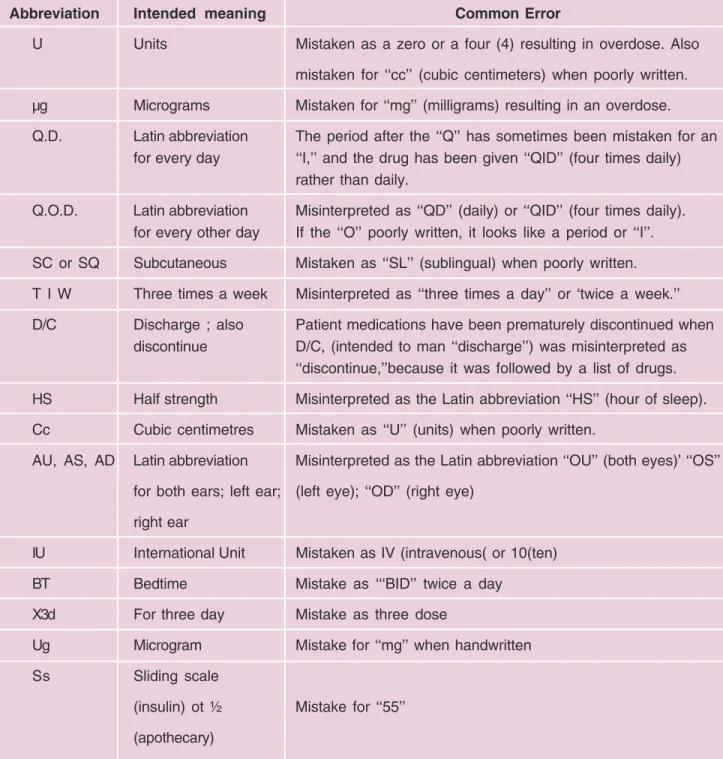
Table 2 : Dangerous abbreviations used
Abbreviation Intended meaning Common Error
U Units Mistaken as a zero or a four (4) resulting in overdose. Also
mistaken for ‘‘cc’’ (cubic centimeters) when poorly written. µg Micrograms Mistaken for ‘‘mg’’ (milligrams) resulting in an overdose. Q.D. Latin abbreviation The period after the ‘‘Q’’ has sometimes been mistaken for an
for every day ‘‘I,’’ and the drug has been given ‘‘QID’’ (four times daily) rather than daily.
Q.O.D. Latin abbreviation Misinterpreted as ‘‘QD’’ (daily) or ‘‘QID’’ (four times daily). for every other day If the ‘‘O’’ poorly written, it looks like a period or ‘‘I’’. SC or SQ Subcutaneous Mistaken as ‘‘SL’’ (sublingual) when poorly written. T I W Three times a week Misinterpreted as ‘‘three times a day’’ or ‘twice a week.’’ D/C Discharge ; also Patient medications have been prematurely discontinued when
discontinue D/C, (intended to man ‘‘discharge’’) was misinterpreted as ‘‘discontinue,’’because it was followed by a list of drugs. HS Half strength Misinterpreted as the Latin abbreviation ‘‘HS’’ (hour of sleep). Cc Cubic centimetres Mistaken as ‘‘U’’ (units) when poorly written.
AU, AS, AD Latin abbreviation Misinterpreted as the Latin abbreviation ‘‘OU’’ (both eyes)’ ‘‘OS’’ for both ears; left ear; (left eye); ‘‘OD’’ (right eye)
right ear
IU International Unit Mistaken as IV (intravenous( or 10(ten)
BT Bedtime Mistake as ‘‘‘BID’’ twice a day
X3d For three day Mistake as three dose
Ug Microgram Mistake for ‘‘mg’’ when handwritten
Ss Sliding scale
(insulin) ot ½ Mistake for ‘‘55’’ (apothecary)
REFERENCES
1. U.S. food and Drug Administration; http:// www.fda.gov/
2. Journal of Postgraduate Medicine, Vol. 51, No. 1, January-March, 2005; pg 22-25
3. The National Coordinating Council for Medication
Error (NCCMERP)
http://www.nccmerp.org/aboutMedErrors.html 4. J Phillips, S Beam, A Brinker, C Holquist, P Honig,
LY Lee, and C Pamer Retrospective analysis of mortalities associated with medication errors; http://www.ajhp.org/cgi/content/abstract/58/19/1835