Procedia Economics and Finance 35 ( 2016 ) 582 – 590
2212-5671 © 2016 The Authors. Published by Elsevier B.V. This is an open access article under the CC BY-NC-ND license (http://creativecommons.org/licenses/by-nc-nd/4.0/).
Peer-reviewed under responsibility of Universiti Tenaga Nasional doi: 10.1016/S2212-5671(16)00071-X
ScienceDirect
7th International Economics & Business Management Conference, 5th & 6th October 2015
The Effect of Islamic Work Ethics on Organizational Commitment
Shahrul Nizam bin Salahudin
a, Siti Sarah binti Baharuddin
a* Muhammad Safizal
Abdullah
b, Abdullah Osman
c.
aCollege of Business, University Tenaga Nasional, 26700 Muadzam Shah, Pahang
bSchool of Business Innovation &Technopreneurship, Universiti Malaysia Perlis, 01000 Kangar, Perlis, Malaysia. cKulliyah Muamalat, Insaniah University College, 09300 Kuala Ketil, Kedah
Abstract
Islamic work ethics is a concept of ethics that is based on Islamic teaching and principle which rely on faith. Meanwhile, organizational commitment is related to employees’ attachment and behaviour towards organization. A structural model was
constructed to test the effects of Islamic work ethics on organizational commitment. 156 respondents from randomly selected SMEs that involved in retail trade textile service located in Selangor, Kuala Lumpur and Johor were given six-point Likert scale questionnaire. The study found that the structural model is acceptable in term of validity and reliability thus can be used to measure the relationship between two variables. The study also found that Islamic work ethics affects organizational commitment and its three dimensions; affective, normative and continuance commitment.
© 2015 The Authors. Published by Elsevier B.V.
Peer-reviewed under responsibility of Universiti Tenaga Nasional.
Keywords:Islamic work ethics; organizational commitment; affective commitment; normative commitment; continuance commitment.
1.Introduction
Many organizations collapsed because of the ethical problem thus attracted many researches on ethical issues and the effectiveness of ethical theories. According to Sen (1987), there is a severe detachment between economic and ethics which cause one of the major deficiency of contemporary economic theory. Sharbatoghlie et al. (2013) stated that business ethics experienced many transformations to improve ethical behaviours and encouraging more transparency to avoid repetition of scandal and economic crisis. KPMG survey on fraud, bribery and corruption
* Corresponding author. Tel.: +6094552054; fax: +6094552006.
E-mail address:[email protected]
© 2016 The Authors. Published by Elsevier B.V. This is an open access article under the CC BY-NC-ND license (http://creativecommons.org/licenses/by-nc-nd/4.0/).
2013 in Malaysia shows that there is an increase by 16 percent of documented satisfactory ethical behaviours in organization as well as an increased in communicating ethics. However, experiencing unethical behaviour among respondents also increased even with guidelines of ethics were well documented and communicated.
Islamic work ethics are classified under divine command theory that uses religion as the foundation in identifying ethics. In Islamic study, right and wrong is clearly advocate through the word of Allah. Islamic perspective is more suitable in explaining ethics as it is comprehensive, moderate and realistic (al-Aidaros et al., 2013). One of the main rules in doing business in Islam is honesty and fair in business transaction thus every businessman must be a person with strong ethical principles (Kaliffa, 2003). According to Suzuki (2014), Islam allows market’s role and freedom
in trade but at the same time control the freedom involving business and financial transaction based on number of prohibitions, ethics and norms.
Organization with high organizational commitment has a stable human capital and is at the competitive advantage. Sheldon (1971) stated that the development of organizational commitment takes time and progress over years. Employee readiness to work hard to improve their companies, the match between the company’s and the employee’s values, lack of motivation to leave, and loyalty toward or pride taken in working for their employers are
the indicators of high organizational commitment (Maume, 2006).
The research on Islamic work ethics and organizational commitment previously, resulted on positive relationship between both variables. However, previous research is limited to few countries in Middle East and some in Malaysia. A research done in Malaysia is limited to banking industry in one area. Therefore this study focuses on the empirical evidence of the effect of Islamic work ethics on organizational commitment using structural model. The study seeks answer to the following research questions:
RQ1. What is the effect of Islamic work ethics on organizational commitment? RQ2.What is the effect Islamic work ethics on affective commitment?
RQ3. What is the effect Islamic work ethics on continuance commitment? RQ4. What is the effect Islamic work ethics on normative commitment?
2.Literature Review 2.1.Islamic Work Ethics
Islamic ethics is a principle of right and wrong which designate to demonstrate what human ought to do taught Quran and shown in the great life of Prophet Muhammad (Hashi, 2011). It views work as a ways to promote self-interest economically, socially and psychologically in order to sustain social prestige, to increase societal welfare and reaffirm faith (Ali and Al-Owaihan, 2008). Islam is a way of life that never takes apart every human activity from religion. Islamic law is based on four sources, in which two primary sources are the Quran and the Sunnah
(examples set by Prophet Muhammad) while the other two are consensus of scholars (Ijmaa’) and analogy (Qiyaas).
Analogy is a derivation of a ruling of a new situation based on the analogy with a similar situation dealt with in Quran and/or hadith (Beekun and badawi, 2005). Sunnah in the other hand is the way of life shown by Prophet Muhammad that can be use as a model and icon for human being and a well known business. Ali and Al-Kazemi (2007) list down four issues that the Prophet had emphasized before; work as the highest form of worshipping Allah, work that are not perform in the best ability is not sanction, work must be for the benefits of others too as part o f social dimension, and society can gain wealth and reasonable living standards by doing trade and business.
According to Al-Aidaros et al. (2013) Islamic work ethics is comprehensive, realistic and moderates. Ethics in islam is not only religious morality in certain acts but cover all facet of life either in physical, spiritual, moral or even in worldly form such as intellectual, emotional, individual and collective (Yaken, 2006). It also realistic as it considers the capabilities of human as Allah knows the strength and weaknesses of human (Al-Qaradawi, 1996). Finally, moderation is Islamic work ethics means a moderate approach in ethics compared to ultra-idealist who views human being as an angel and the ultra-realist that see human beings as an animal (Al-Banna, 1940). According to Al-Qaradawi (1985), Islam has a moderate view of this life compared to those who reject the reality of hereafter, or reject living in and developing this life (Al-Qaradawi, 1985).
2.2.Organizational Commitment
Commitment can be defined as a force that connects an individual to a step of relevance action to certain target or
targets and it involves ‘behavioural terms’ that explain an act of commitment (Meyer and Herscovitch, 2001).
Meanwhile, organizational commitment is a employees’ psychological attachment to an organization, and can be seen in employees’ loyalty towards the organization, motivation to incorporate goals of the organization and commit
oneself to the organization (Cook and Wall, 1980). Based on a study by Mowday et al. (1982), there are four factors that can influence organizational commitment such as personal characteristics, role characteristics, structural characteristics and work experience. Another research by Meyer et al. (2002) found that it is related to three background characteristic like personal variable, job and role characteristics and structural factors.
Yousef (2001) conducted a research in United Arab Emirates found that Islamic work ethics are strongly correlated to organizational commitment. Another study by Othman et al. (2004) in Malaysia shows that every dimension of organizational commitment is indeed correlated to Islamic work ethics. Ali and Al-Kazemi (2007) research in Kuwait found that the Islamic work ethics correlated to loyalty. Based on the previous research, it is highly expected that:
H1. Islamic work ethics has an effect on Organizational Commitment
Meyer and Allen (1990) introduced three dimensions model of organizational commitment to simplify various concept of organizational commitment namely affective commitment, normative commitment and continuance
commitment that illustrate emotional ties, obligation’s perception and obvious sunk cost in relation to the organization, respectively. The model has undergone many analysis and revision in order to improve the accuracy and validity of the model.
According to Jaros (2007), affective commitment based on emotional ties builds up by employees because of the positive work experience. Strong affective commitment signifies that the reason employees choose to stay with an organization because they want to do so. Haar and Spell (2004) stated that employees show great affective commitment because they meet the expectation of fulfilling their individual needs based on social exchange theory. Continuance commitment is initially correlated with turnover, and was based on an assumption of a financial exchange between the employee and the organization (Meyer et al., 2002). According to Allen (2003), employees must realize that they have to stay because of the related cost if leaving and not only because of the existence of the cost themselves. Normative commitment perceives staying in organization due to desperation on returning organizational investment into one and a result of socialization into organization culture (Meyer and Allen, 1991). At first, Wiener (1982) introduced normative commitment as part of social loyalty norms to organization. Meyer et al. (2006), further vary the concept by humanizing the mutual exchange argument by adding two dimensions namely indebted obligation and moral imperatives. Indebted obligation is the perceived need to meet other’s expectation.
Meanwhile, moral imperative is the need to meet valued outcomes which is correlated to affective commitment (Jaros, 2007). Therefore it is expected that:
H1a. Islamic work ethics has an effect on Affective Commitment. H1b. Islamic work ethics has an effect on Continuance Commitment. H1c. Islamic work ethics has an effect on Normative Commitment.
3.Methodology
Population for this study is 289,798 Small and Medium Enterprise in Malaysia (SMECorp, 2011) that involved in wholesale and retail trade service sub-sector. The enterprises were selected based on convenience sampling methods to ensure thorough research on the topic and random employees from all level of position were chosen as participants. Location chosen were Selangor, Kuala Lumpur and Johor states as it had the highest number of SMEs, constitutes 43.2 percents of overall SMEs in Malaysia (SMECorp, 2013). Based on the table of Sekaran (2003), 384 questionnaires were distributed and collected. A letter of introduction was given to the owner of enterprises or manager in charge to inform him/her with the study objectives and to get support for the distribution of the
questionnaires. Once approval obtained, respondent will be given questionnaires directly and collected afterwards. The respondents were given a choice either to answer English version or Malay version of questionnaires. A total of 156 collected afterwards with 40.6 percent response rates.
The following instruments were used in this research:
x Islamic Work Ethics Scale by Ali and Al-Kazemi (2007).
x Organizational Commitment by Sersic (1999).
Both instruments were measured using six points Likert scale with one indicating strongly disagree and six indicating strongly agree. The instrument for the Islamic Work Ethics was adopted from a journal Islamic work ethic in Kuwait. It has 17 items that focus on employee’s commitment to the job and their reason of such commitment
either for self-need or for society. The items also concentrate on the cause of accomplishment as well as the essence
of hard work. In this scale, only 1 item is reverse scored, “more leisure time is good for society”. The current
Cronbach’s alpha is 0.94. The Organizational Commitment Questionnaire by Sersic (1999) originally has 18 items with 6 items for each subscale namely affective, continuance and normative commitment. There is 4 reverse coded items. The reliabilities of the three subscales ranged between 0.785 and 0.842. The overall Cronbach’s alpha for organizational commitment is 0.835.
4.Findings
4.1.Confirmatory Factor Analysis
Confirmatory factor analysis (CFA) was used to test the validity of the scales and to test the hypothesis tahat Islamic work ethics affects organizational commitment. There are two models subject to the test. The first model tested hypothesis 1 whether Islamic work ethics affect organizational commitment. The second model tested hypothesis 1a, 1b, and 1c to see if Islamic work ethics affect 3 dimensions of Organizational Commitment.
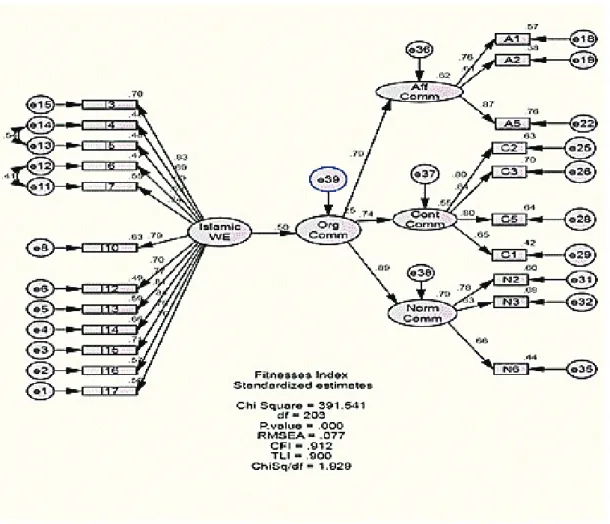
Table 1 show the results of the confirmatory factor analyses. The results of CFA indicated that both model fitted the data adequately well with a root mean square of error approximation (RMSEA) less than 0.08 (Brown and Cudeck, 1993), the comparative fit index and tucker-lewis index (TLI) were more than 0.90 (Bentler, 1990; Bentler and Bonett, 1980) and the ratio of chi square and degree of freedom which is less than 5.0 also suggesting adequate model fit (Marsh and Hocevar, 1985). According to Holmes-Smith (2001), three fit indexes with at least one index from each category of model fit must be above level of acceptance to reflect good fit. From the result, the structural model satisfied absolute fit, incremental fit and parsimonious fit. Figure 1 shows the measurement model used in confirmatory factor analysis and later on used in structural equation modelling.
Table 1. Results of confirmatory factor analysis.
Fitness Index RMSEA CFI TLI Chisq/df
Fig. 1. Measurement model of CFA
In term of validity, the analyses look into three types of validity namely construct, convergent and discriminant validity. The discriminant validity was achieved as the square root of AVE (0.75 and 0.76) is higher than the correlation value (0.50) between two latent construct (Fornell and Larker, 1981). It shows that the model is free from redundant items (Zainudin, 2012). The construct validity can be achieved if the goodness fit index (GFI) equal or exceeds 0.90, comparative fit index (CFI) 0.90 or higher, RMSEA equal or less than 0.08 and the ratio Chisq/df is less than 5.0. The structural model achieved the requirement of validity thru RMSEA (0.05), CFI (0.91) and ratio (1.39). The convergent validity was assessed to determine whether all items in the model are statistically significant.
Factor loading that less than 0.6 and R2 less than 0.4 were deleted (Zainudin, 2102). It provides evidence for
convergent validity. Based on criteria by Fornell and larker (1981), construct reliability (CR) should exceed 0.80 and average variance extracted should be greater or equal to 0.50.
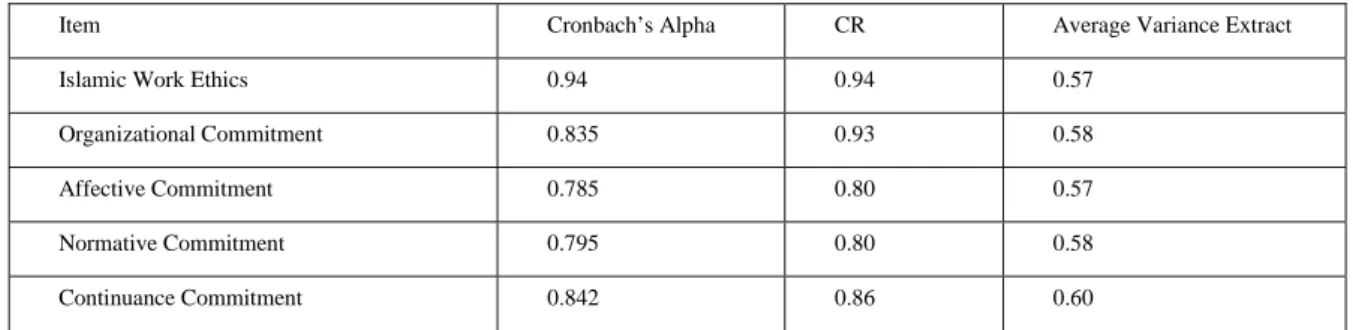
Reliability can be assessed using internal reliability, construct reliability and average variance reliability. The result of reliability is stated in table 2. In Cronbach’s Alpha reliability analysis; the closer value of Cronbach’s Alpha to 1.0, the higher the internal consistency reliability (Cronbach, 1946). According to Hair 2010, the minimum value of Cronbach’s Alpha recommended is at least 0.60 to indicate reliability. The Cronbach’s Alpha for Islamic work ethics and Organizational commitment is 0.90 and 0.835, respectively. For other two types of reliability, Bagozzi and Yi (1988) suggested that the value of CR should be 0.60 or higher, and AVE value should be 0.50 or
higher. The structural model meets the reliability requirement. CR value and AVE value for Islamic work ethics are 0.94 and 0.57, respectively. Meanwhile the CR value and AVE value for Organizational Commitment are 0.93 and 0.58, respectively. Therefore, the values of Cronbach Alpha, CR and AVE show that the model is reliable in measuring the intended latent construct.
Table 2. Results of Reliability
Item Cronbach’s Alpha CR Average Variance Extract
Islamic Work Ethics 0.94 0.94 0.57
Organizational Commitment 0.835 0.93 0.58
Affective Commitment 0.785 0.80 0.57
Normative Commitment 0.795 0.80 0.58
Continuance Commitment 0.842 0.86 0.60
4.2.Structural Equation Modeling
The result of CFA shows that the model is adequately well to test the entire hypothesis. Standardized beta, standard error and significant values of the model are shown on table 3. Based on these findings, Islamic work ethics is significantly different from organizational commitment at the 0.001 level (two-tailed). The standardized regression coefficient is positive at 0.50. Thus, it is proven that Islamic work ethics has a positive significant effect on organizational commitment. H1 is accepted.
For the next hypothesis, we determine the relationship between Islamic work ethics and three dimensions of organizational commitment. The standardized regression weight for the relationship between Islamic work ethic and affective commitment is positive and significantly different from zero (standardized E= 0.45; p<0.001). It proven another hypothesis that the relationship between Islamic work ethics and affective commitment is exists. The regression relation of Islamic work ethics on continuance commitment is significant at 0.001 level (standardized E= 0.42; p<0.001). Thus, the hypothesis, H1b is supported. The relationship between Islamic work ethics and normative commitment also positive and significant, supporting hypothesis H1c (standardized E= 0.45; p<0.001). Therefore, Islamic work ethics has a significant relationship with three dimensions of organizational commitment.
Table 3. Standardized regression weight
Path Standardized Beta Standard Error P
Islamic Work Ethics -> Organizational Commitment 0.50 0.13 *** Islamic Work Ethics -> Affective Commitment 0.45 0.15 *** Islamic Work Ethics -> Continuance Commitment 0.42 0.14 *** Islamic Work Ethics -> Normative Commitment 0.45 0.13 *** ***significantly different at 0.001 level (two-tailed)
5.Conclusion
As a conclusion, all hypotheses are accepted thus consistent with previous research by Yousef (2000) and research by Othman et al. (2004). It proves that high Islamic work ethics will resulting high in organizational commitment and indicates that the implementation of Islamic work ethics can help achieving great commitment among employees towards the organization. Jaros (2007) stated that affective commitment is an emotional bonds between employees and organization while from Islamic work ethics perspectives, emotional bonds are not only only developed towards the organization but also towards the society and mainly towards Allah, the Creator. The result also suggested that people with great Islamic work ethics also high in continuance commitment. Based on the theory, employees keep working with the organization because they need to, due to limited alternative employment and cost incurred. From Islamic work ethics viewpoint, work fulfilled the needs of man for self-respect, satisfaction and realization and help man to be independent. Many people choose to stay in employment rather than being unemployed so that they can be independent and able to contribute to society. According to Cho and Huang (2012), normative commitment is an employee moral obligation to maintain in organization. It parallels with the meaning of commitment in Islamic work ethics in which staying with organization is part of obligation and the obligation to contribute to the society drives the commitment to work. Based on the result, employees with high Islamic work ethics show a greater loyalty to the organization.
References
Al-Aidaros, A., Shamsudin, F. and Idris, K.M, 2013. Ethics and Ethical Theories From an Islamic Perspective. International Journal of Islamic Thought 4.
Al-Banna. 1940. Messages’ Group of Imam Hasan al-Banna1. Alexandria: Darul Al-D’aoah Publication.
Ali, A., 2005. Islamic Perspectives on Management and Organization. Edward Elgar, Cheltenham, Northampton, MA.
Ali, A.J, and Owaihan, A.A., 2008. Islamic Work Ethic: a critical Review. A Cross-Cultural Management:An International Journal 15(1), 5-19. Ali, A.J. & Al-Kazemi, A.A., 2007. Islamic Work Ethic in Kuwait.Cross Cultural Management:An International Journal14(2), 93-104. Allen, N.J., 2003. Organizational commitment in the military: A discussion of theory and practice. Military Psychology 15, 237-253.
Allen, N.J. and Meyer, J.P., 1990. The Measurement and Antecedents of Affective, Continuance and Normative Commitment to the Organization. Journal of Occupational Psychology 63, 1-18.
Al-Qaradawi, Y., 1985. The Iman (Faith) and Life.Doha.
Al-Qaradawi, Y., 1996. The General Characteristics of Islam9. Beirut: Darul Al-Ressalh Publication.
Bagozzi, R.P. and Yi, Y., 1988. On the evaluation of structural equation models. Journal of the academy of marketing science 16(1), 74-94. Becker, T.E., Billings, R.S., Eveleth, D.M., & Gilbert, N.L., 1996. Foci and bases of employee commitment: implications for job performance.
Academyof Management Journal 39(2), 464-82.
Beekun, R. And Badawi, J.A., 2005, Balancing Ethical Responsibility among Multiple Organizational Stakeholders: The Islamic Perspective. Journal of Business Ethics 60, 131-145.
Bentler, P M., 1990. Comparative fit indexes in structural models. Psychological Bulletin 107, 238-246.
Bentler, P. M., and Bonett, D. G., 1980. Significant tests and goodness of fit in the analysis of covariance structures. Psychological Bulletin 88, 588-606.
Browne, M. W., & Cudeck, R., 1993. Alternative ways of assessing model fit. In K. A. Bollen & J. S. Long (Eds.), Testing structural equation models (pp. 136-162). Newsbury Park, CA: Sage.
Bruhn, J. G., 2009. The functionality of gray area ethics in organizations. Journal of Business Ethics 89(2), 205–214.
Chen, Z. And Francesco, A., 2003. The relationship between Three-component Commitment and Employee Performance in China. Journal of Vocational Behavior 62, 490-510.
Cho, V. and Huang, X., 2012. Professional Commitment, Organizational Commitment, and the intention to leave for professional advancement: An empirical study on IT professionals. Information Technology and People25(1), 31-54.
Cohen, A., 2007. Commitment before and after: an evaluation and reconceptualization of organizational commitment. Human Resource Management Review 17(3), 336-54.
Cook, J. and Wall, T., 1980. New York attitude measures of trust, organizational commitment and personal need nonfulfillment. Journal of Occupational Psychology53, 39-52.
Cronbach, L. J., 1946. Response sets and test validity. Educational and Psychological Measurement 6, 475-494. Department of Statistics, Malaysia. Census report on SMEs 2011.
Department of Statistics, Malaysia. Small and Medium Enterprises, national accounts 2005-2013.
Elegido, J.M., 2000. Fundamental of Business Ethics: A developing Countries Perspective. Lagos: Spectrum Book Ltd.
Fornell, C. & Larcker, D. F., 1981. Evaluating structural equation models with unobservable variables and measurement error. Journal of Marketing Research 48, 39–50.
Gellatly, I., J. Meyer & A. Luchak., 2006. Combined Effects of the Three Commitment Components on Focal and Discretionary Behavior: A Test of Meyer and Herscovitch'sPropositions.Journal of Vocational Behavior 69, 331-345.
Haar, J.M. and Spell, C.S., 2004. Programme knowledge and value of work-family practices and organizational commitment. International Journal of Human Resource Management 15(6), 1040-1054.
Hashi, A.A., 2011, Islamic Ethics: An Outline of its Principles and Scope. Revelation and Science 1(3), 122-130.
Holmes-Smith, P., 2001. Introduction to structural equation modeling using LISREL. Perth: ACSPRI-Winter training Program.
Holmes-Smith, P., Coote, L., & Cunningham, E. (2006). Structural equation modeling: From the fundamentals to advanced topics. Melbourne: SREAMS.
Irving, P., Coleman, D., & Cooper, C., 1997. Further Assessments of a Three-Component Model of Occupational Commitment: Generalizability and Differences across Occupations. Journal of Applied Psychology 82(3), 444-452.
Jaros, S., 2007. Meyer and Allen Model of Organizational Commitment: Measurement Issues. The Icfai Journal of Organization Behavior 6(4), 7-25.
Komari, N. And Djafar, F. (2013). Work Ethics, Work Satisfaction and Organizational Commitment at the Sharia Bank. Indonesia International Business Research 6(12), 107-117.
Kaliffa, A.S., 2003. The Multidimensional Nature and Purpose of Business in Islam. The Islamic Perspective Journal 7, 1-25. KPMG Malaysia. Fraud, Bribery, and Corruption Survey, 2013.
Lambert, E.G. 2003. The impact of Organizational Justice on Correctional Staff. Journal of Criminal Justice 31, 278-300.
Langlois, C.C. and Schlegelmilch, B.B., 1990. “Do corporate codes of ethics reflect national character? Evidence from Europe and the United States”. Journal of International Business Studies 4, 519Ǧ36.
Maume, D. J., 2006. “Gender differences in taking vacation time. Work and Occupations”, 33(2), 161-190.
Marsh, H.W. & Hocevar, D., 1985. Application of confirmatory factor analysis to the study of self-concept: First- and higher-order factor models and their invariance across groups. Psychological Bulletin 97, 562–582.
Meyer, J.P , Becker, T. and Van Dick, R., 2006. Social Identities and Commitments at Work: Toward an Integrative Model. Journal of Organizational Behavior 27, 665-683.
Meyer, J.P and Allen, N.J., 1991, A three-component conceptualization of organizational commitment. Human Resource Management Review1, 61-89.
Meyer, J.P, Stanley, D.J, Herscovitch, L., Topolnytsky, L., 2002. Affective, Continuance and Normative Commitment to the Organization: A Meta-analysis of Antecedents, Correlates and Consequences. Journal of Vocational Behavior 61, 20-52.
Meyer, J.P. &Herscovitch L., 2001. Commitment in the workplace: Toward a General Model. Human Resource Management Review 11, 299-326.
Meyer, J.P.,Paunonen, S., Gellatly, I., Goffin, R. and Jackson, D., 1989. Organizational Commitment and Job Peformance: it’s the nature of
commitment that counts. Journal of Applied Psychology 74, 152-6.
Mohammed, A., 2011. The Role of Yemeni Accountants in Fighting Corruption. The Legal Accountant 15(9), 30-37.
Mowday, R.T., Porter, L.W., and Steers, R.M., 1982. Employee-Organizational Linkage: The Psychology of Commitment, Absenteeism and Turnover. Academic Press, New York, NY.
Ogbonna, G. &Ebimobowei, A., 2011. Ethical Compliance by the Accountant on the Quality of Financial Reporting and Performance of Quoted Companies in Nigeria.Asian Journal of Business Management3(3), 152-160.
Othman, A.S., Rahman, N.K, Malek, Z., and Osman , A.R., 2004. Organizational Commitment and Work Ethics: An empirical assessment in a Malaysian context.
Rousseau, D.M., 1995. Psychological Contracts in Organizations.Thousand Oaks, CA: Sage. Sekaran, U., 2003. Research method for business.A skill building approach4. John Wiley and Sons. Sen, A., 1987. On Ethics and Economics. Oxford: Basil Blackwell
Sersic, D., 1999. An empirical test of Meyer and Allen’s three-component model of organizational commitment in a Croatian Context. Review of Psychology6(1-2), 17-24
Sharbatoghlie, A., Mosleh, M., and Shokatian T., 2013. Exploring trends in the codes of ethics of the Fortune 100 and Global 100 Corporations. Journal of Management Development 32(7), 675-689.
Sheldon, M., 1971. Investments and involvements as mechanisms producing commitment to the organization. Administrative Science Quarterly 16, 143-150.
Shore, L.M. and Wayne, S.J., 1993. Commitment and employee behavior – comparison of affective commitment and continuance commitment with perceived organizational support. Journal of Applied Psychology 78(5), 774-780.
Small and Medium Enterprise Corporation. SME Census 2011.
Small and Medium Enterprise Corporation. Annual Report of SME 2012-2013.
Suzuki, Y., 2014. “Islamic Economics Ethics and Japanese Traditional Business Ethics”. Ritsumeikan International Affairs 12, 83-100. Tett, R.P. and Meyer, J.P., 1993. Job satisfaction, organization commitment, turnover intention and turnover: path analyses based on
meta-analytic findings. Personnel psychology 46 259-93.
Wiener, Y., 1982. Commitment in organizations: A normative view. Academy of Management Review 7, 418–428. Yaken. 2006. What is the Meaning of My Belong to Islam? Beirut: Darul Al-Ressalh Publication.
Yousef, D.A., 2001. Islamic work ethic-A moderator between organizational commitment and job satisfaction in a cross-cultural context. Personnel Review 30(2), 152-165.
Yousef, D.A., 2000.Organizational Commitment as a mediator of the relationship between Islamic work ethic and attitudes toward organizational change. Human Relations 53 (4), 513-37.