11-2019
Efficient Privacy-Aware Imagery Data Analysis
Efficient Privacy-Aware Imagery Data Analysis
Yifan TianFollow this and additional works at: https://commons.erau.edu/edt
Part of the Electrical and Computer Engineering Commons, and the Privacy Law Commons This Dissertation - Open Access is brought to you for free and open access by Scholarly Commons. It has been accepted for inclusion in Dissertations and Theses by an authorized administrator of Scholarly Commons. For more information, please contact [email protected].
Doctoral Dissertation
Efficient Privacy-Aware Imagery Data
Analysis
Author: Yifan Tian Advisor: Dr. Jiawei Yuan Committee Members: Dr. Radu Babiceanu Dr. Yantian Hou Dr. Remzi Seker Dr. Houbing Song Dr. Tianyu YangA dissertation submitted in fulfillment of the requirements for the degree of Doctor of Philosophy
in Electrical Engineering & Computer Science
Department of Electrical, Computer, Software, & Systems Engineering
that outcome. Once I am on that shortcut, probably I will miss the truth I am seeking as well as my passion for the truth. The critical thing is the will to seek the truth, even if I fail this time, as long as the will exists, I will find the truth someday because I will always keep going.”
The widespread use of smartphones and camera-coupled Internet of Thing (IoT) devices triggers an explosive growth of imagery data. To extract and process the rich contents contained in imagery data, various image analysis techniques have been investigated and applied to a spectrum of application scenarios. In recent years, breakthroughs in deep learning have powered a new revolution for image analysis in terms of effectiveness with high resource consumption. Given the fact that most smartphones and IoT devices have limited computational capability and battery life, they are not ready for the processing of computational intensive analytics over imagery data collected by them, especially when deep learning is involved. To resolve the bottleneck of computation, storage, and energy for these resource constrained devices, offloading complex image analysis to public cloud computing platforms has become a promising trend in both academia and industry. However, an outstanding challenge with public cloud is on the protection of sensitive information contained in many imagery data, such as personal identities and financial data. Directly sending imagery data to the public cloud can cause serious privacy concerns and even legal issues.
In this dissertation, I propose a comprehensive privacy-preserving imagery data analysis framework which can be integrated in different application scenarios to assist image anal-ysis for resource-constrained devices with efficiency,accuracy, and privacy protection. I first identify security challenges in the utilization of public cloud for image analysis. Then, I design and develop a set of novel solutions to address these challenges. These solutions will be featured by strong privacy guarantee, lightweight computation, low ac-curacy loss compared with image analysis without privacy protection. To optimize the communication overhead and resource utilization of using cloud computing, I investigate
overhead in cloud-assisted architectures. Furthermore, to boost the performance of my solutions under both cloud and edge deployment, I also provide a set of pluggable en-hancement modules to be applied to meet different requirements for various tasks. By exploring the features of edge computing and cloud computing, I flexibly incorporate them as a comprehensive framework to provide privacy-preserving image analysis ser-vices.
First of all, I would like to thank my Ph.D. advisor, Dr. Jiawei Yuan, for supporting me during the past four years. Dr. Yuan is a professional full of knowledge and wisdom and he’s one of the smartest people I know. He is a great advisor who always leads me with patience and also a good and warm friend in daily life. I am very fortunate to have worked with Dr. Yuan and I hope that I could be as lively, enthusiastic, and energetic as him and someday be able to flourish in academia works as he does.
I want to thank all my committee members for years of guidance and collaboration in my Ph.D. life. I am grateful that Dr. Radu Babiceanu provided me kind help with my career as well as his fantastic mentoring of system engineering related topics. Great thanks to Dr. Yantian Hou for his long-time collaboration starting from my very first full paper. I also want to give thanks to Dr. Remzi Seker for his encouragement on my dissertation and our discussion regarding network security and cryptocurrencies. It has been an honor to work with Dr. Houbing Song and his SONG Lab. They extended me a great helping hand when I was stuck on the antenna and hardware issues. I thank God for meeting Dr. Tianyu Yang on my first day at ERAU and being introduced to the local community physically and spiritually.
I also need to express my gratitude to everyone who gave me help in academia and industry. I highly appreciate Dr. Shucheng Yu for his feedbacks on our blockchain project and our discussion on all the other topics. Many thanks to Prof. Farahzad Behi, Dr. Keith Garfield and Dr. Timothy Wilson for the opportunity to work as a lab instructor for CS 225 and I really harvested a lot from the year-long instructing. I owe Jian Wang and Dr. Yongxin Liu a thank you for their “Build UAV from Scratch 101” series and “UAV Resurrection” series after rookie pilot Yifan crashed the experimenting
Ni, which showed me a different angle of machine learning from a statistic/mathematics perspective. I also want to recognize the best teammate, Ashok Vardhan Raja, best thank you for all your efforts in our Best of Session UAV paper. Kudos to all my other collaborators Dr. Laurent Njilla, Alexander Steinbacher, Thaniel Tong, and Jayson Tinsley in our UAV project. I would like to thank Yushan Jiang as well for his time and our discussion to optimize resource-constrained neural network implementation. Huge credit to Dr. Markus Jakobsson for his advising in our anti-phishing research and his lead during my internship. Cheers to all ACID team members at Agari Data, Inc., Crane Hassold, James Linton and Ronnie Tokazowski for the industry-level projects and insights on cybersecurity and software engineering areas. And I thank Agari and fellow Agarians for offering me an unforgettable internship experience.
I want to thank my mother, Wenwei Yuan, my father, Xiaodong Tian for their selfless support so that I am able to explore the world of cybersecurity and become a better me. I praise the Lord, my Father in heaven for all the wisdom, will and bless he granted me. Finally and most importantly, I would like to thank my wife, Mengxin Cui for all the late nights and early mornings, for all the life routines and occasional surprises, and for always being there for me throughout up and downs in my life. I want to dedicate this milestone of my life to them for their unconditional love and support.
Abstract iii Acknowledgements v Contents vii List of Figures x List of Tables xi Abbreviations xii 1 Introduction 1 1.1 Motivation . . . 1 1.2 Challenges . . . 2 1.3 Contributions . . . 6 1.4 Roadmap . . . 7 2 Problem Formulation 9 2.1 Cloud-assisted Privacy-preserving Descriptor Based Image Analysis . . . . 9
2.1.1 System Model. . . 9
2.1.2 Threat Model . . . 10
2.2 Edge-assisted Privacy-preserving Deep Learning Based Image Analysis . . 11
2.2.1 System Model. . . 11
2.2.2 Threat Model . . . 12
3 Privacy Protection for Descriptor Based Image Analysis 13 3.1 Introduction. . . 13
3.2 Related Works . . . 15
3.3 Preliminaries . . . 17
3.3.1 Image Descriptor Extraction . . . 17
3.3.2 Integer Vector Encryption (IVE) . . . 18
3.4 Privacy-preserving Distance Comparison . . . 19
3.4.1 Image Similarity Measurement . . . 19
3.4.2 P L1C: Privacy-preservingL1 Distance Comparison . . . 20
3.4.3 P KLC: Privacy-preserving KL-Divergence Comparison . . . 22
3.5 Cloud Assisted Privacy-preserving Image Annotation . . . 23
3.5.1 System Setup . . . 24
3.5.2 Dataset Encryption . . . 25
3.5.3 Secure Annotation Request . . . 25
3.5.4 Privacy-preserving Annotation on Cloud . . . 26
3.5.5 Final Keyword Selection . . . 27
3.6 Preliminaries of CPAR . . . 28
3.6.1 k-dimension Tree . . . 29
3.6.2 Order-preserving Encryption . . . 29
3.7 Privacy-preserving Distance Comparison with Randomized k-d Forest . . 29
3.7.1 Randomized k-d Forest Search . . . 30
3.7.2 P L1C−RF: Privacy-preservingL1Distance Comparison for Ran-domized k-d Forest . . . 32
3.7.3 P KLC−RF: Privacy-preserving KL-Divergence Comparison for Randomized k-d Forest . . . 33
3.8 Cloud-Assisted Privacy-preserving Image Annotation with Randomized k-d Forest . . . 36
3.8.1 Detailed Construction of CPAR. . . 36
3.8.1.1 System Setup. . . 36
3.8.1.2 RKDF Encryption . . . 37
3.8.1.3 Secure Annotation Request . . . 37
3.8.1.4 Privacy-preserving Annotation on Cloud . . . 38
3.8.1.5 Final Keyword Selection . . . 40
3.9 Conclusion . . . 40
4 Evaluation of Privacy Protection Modules for Descriptor Based Image Analysis 43 4.1 Security Analysis . . . 43
4.1.1 Security of OutsourcingSTL1Ss,L1 and STKLSs,KL . . . 44
4.1.2 Known Ciphertexts-Image Pairs . . . 45
4.1.3 Request Unlinkability . . . 45
4.2 Evaluation of CAPIA . . . 47
4.2.1 System Setup and Dataset Encryption . . . 48
4.2.2 Real-time Image Annotation . . . 49
4.2.3 Communication Cost and Storage Overhead . . . 51
4.3 Evaluation of CPAR . . . 52
4.3.1 RKDF Construction and Encryption . . . 53
4.3.2 Real-time Image Annotation . . . 53
4.4 Conclusion . . . 58
5 Privacy Protection for Deep Learning Based Image Analysis 59 5.1 Introduction. . . 59
5.2 Related Work . . . 63
5.3 Preliminaries - Convolutional Neural Network . . . 64
5.4 Privacy-preserving Compute-intense Layers . . . 66
5.4.1 P P CL: Privacy-preserving Convolutional Layer . . . 66
5.5 Edge-Assisted CNN Inference over Encrypted Imagery Data . . . 69
5.5.1 Offline Phase . . . 70
5.5.2 Online Phase . . . 72
5.6 Discussion - Storage and Update of Pre-computed Keys . . . 72
5.7 Discussion - Offloading Pooling Layers . . . 74
5.8 Enhancement - Integrity Check . . . 76
5.9 Enhancement - Fast Convolution . . . 78
5.10 Enhancement - Matrix Compression . . . 80
5.11 Conclusion . . . 81
6 Evaluation of Privacy Protection Modules for Deep Learning Based Image Analysis 82 6.1 Security and Performance Analysis . . . 82
6.1.1 Security Analysis . . . 82
6.1.2 Numerical Analysis. . . 85
6.1.2.1 Computational Cost . . . 85
6.1.2.2 Communication Cost . . . 90
6.1.2.3 Storage Overhead . . . 91
6.1.2.4 Resource Consumption of Integrity Check . . . 91
6.1.2.5 Analysis of Fast Convolution . . . 94
6.2 Evaluation. . . 97
6.2.1 Efficiency - Offline Phase . . . 97
6.2.2 Efficiency - Online Phase . . . 97
6.2.3 Energy Consumption. . . 101
6.2.4 Accuracy . . . 101
6.2.5 Evaluation of Sample Rate in Integrity Check . . . 102
6.2.5.1 Evaluation of Matrix Compression . . . 103
6.3 Conclusion . . . 104
7 Future Works and Conclusion 107 7.1 Extension of Descriptor Based Image Analysis. . . 107
7.2 Extension of Deep Learning Based Image Analysis . . . 108
7.3 A Privacy-preserving Hybrid Cloud-Edge Framework for Image Analysis . 109 7.4 Conclusion . . . 110
3.1 Randomized k-d Forest. . . 30
3.2 Construction of P L1C−RF . . . 34
3.3 Construction of P KLC−RF . . . 35
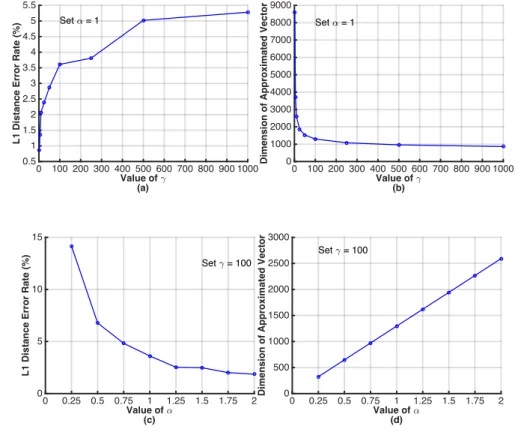
4.1 Error rate of Approximation and Dimension of Approximated Vector (P CA−32) . . . 46
4.2 (a) System Setup and Encryption Cost (b) Request Generation Cost (c) Distance Comparison Candidate Generation Cost on Cloud . . . 46
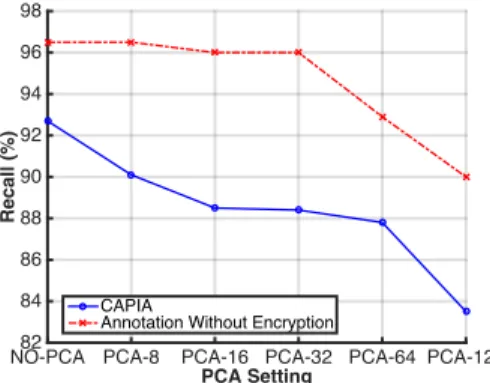
4.3 Precision of CAPIA and Annotation without Encryption . . . 50
4.4 Recall of CAPIA and Annotation without Encryption . . . 50
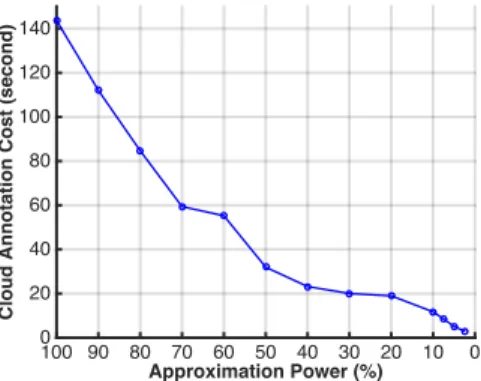
4.5 Privacy-preserving Annotation Cost on Cloud with Different Approxima-tion Power. . . 54
4.6 Speedup Rate with Different Approximation Power . . . 54
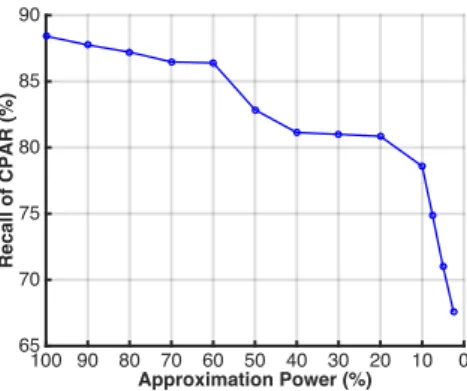
4.7 Accuracy (Recall) of CPAR with Different Approximation Power . . . 55
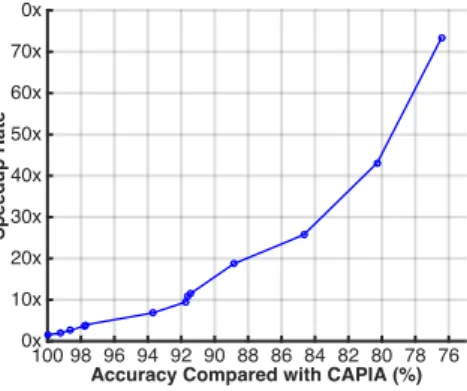
4.8 Speedup rate of CPAR with Different Accuracy Compared with CAPIA . 56 5.1 Examples of a Convolutional Layer and a Fully-connected Layer . . . 65
5.2 Key Update for Power Connected Devices . . . 73
5.3 Example of Pooling Layers. . . 75
6.1 Evaluation of Sample Rate r and Error Detection Rate. . . 102
6.2 Evaluation of Sample Rate r and Returned Data Size . . . 103
6.3 Evaluation of Convolutional Layers and Offloaded Computation Percentage103
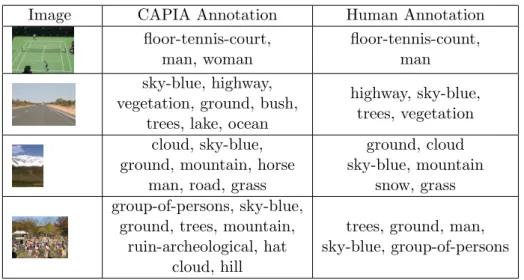
4.1 Sample Annotation Results . . . 52
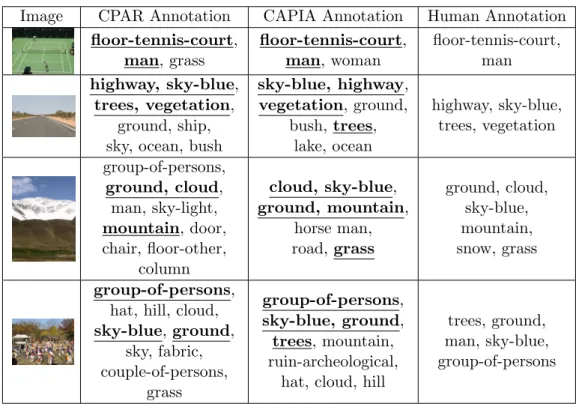
4.2 Sample Annotation Comparison between CAPIA and CPAR . . . 57
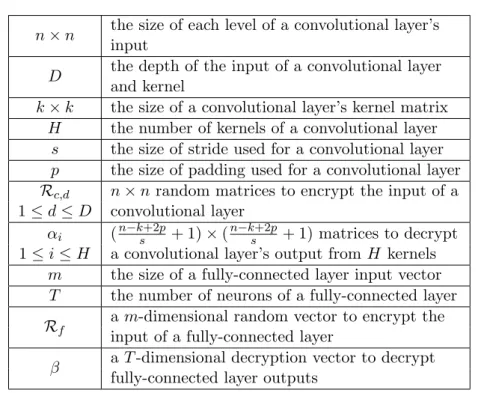
5.1 Summary of Notations . . . 67
6.1 Numerical Analysis Summary . . . 86
6.2 Example Numerical Analysis on AlexNet. . . 88
6.3 Example Numerical Analysis on FaceNet. . . 89
6.4 Numerical Analysis of Integrity Check . . . 92
6.5 Example Comparison with/without Integrity Check . . . 93
6.6 Efficiency Enhancement Analysis on AlexNet . . . 95
6.7 Efficiency Enhancement Analysis on FaceNet . . . 96
6.8 Experimental Evaluation Results on AlexNet . . . 98
6.9 Comparison Between My Scheme and CryptonNets in First Convolutional Layer of AlexNet . . . 99
6.10 Experimental Evaluation Results on Integrity Check . . . 100
6.11 Power and Energy Consumption Evaluation . . . 101
6.12 Communication Enhancement on AlexNet . . . 104
6.13 Communication Enhancement on FaceNet . . . 105
ANN ArtificialNeuralNetwork
CNN Convolutional NeuralNetwork
CAPIA Cloud-AssistedPrivacy-preservingImage Annotation
CPAR Cloud-assisted Privacy-preserving Image Annotation using
Randomized k-d Forest
DNN DeepNeuralNetwork
FLOP FloatOperation
FMV Full-Motion Video
GAN GenerativeAdversarial Network
HE HomomorphicEncryption
IoT Internet of Thing
IVE Integer Vector Encryption
JL Johnson-Lindenstrauss
KL Kullback-Leibler
LWE Learn with Error
LSTM Long Short-Term Memory MEC MobileEdgeComputing
MPC Multi-party Computation
OPE Order-preserving Encryption
OT Oblivious Transfer
PAHE PackedAdditiveHomomorphic Encryption
PCA PrincipleComponetAnalysis
PKLC Privacy-preservingKL-Divergence Comparison
PKLC-RF Privacy-preservingKL-Divergence Comparison for
Randomized k-dForest
PL1C Privacy-preservingL1DistanceComparison
PL1C-RF Privacy-preservingL1DistanceComparison for
Randomized k-dForest
PPCL Privacy-preserving ConvolutionalLayer
PPFL Privacy-preserving Fully-connected Layer
PPT ProbabilisticPolynomialTime
ReLU RectifiedLinearUnit
RCNN RegionalConvolutionalNeuralNetwork
RKDF Randomized k-d Forest
SE Searchable Encryption
SMID SingleInstructionMultiple Data
SVM SupportVector Machine
Introduction
1.1
Motivation
From the first digital picture was taken, various research efforts have been spent on image analysis, since imagery data contain a great amount of rich information. Image analysis techniques have been adopted in a spectrum of scenarios, including classification [1–5], annotation [6–8], segmentation [9–12], object detection [13–16], etc. These techniques greatly fulfill the semantic gap between low level image pixels and high level human perceivable concepts.
Meanwhile, the widespread use of smartphones brings the explosive growth in the number of pictures taken. Forever’s Strategy & Business Development team [17] has pointed out that the number of photos taken by smartphone is estimated to be 8.8 trillion in 2018. Alongside the thriving mobile computing and Internet of Things (IoTs), the demands of effective image analysis have become stronger ever. To perform effective imagery data analysis, there are two major types of approaches: Descriptor Based Approach andDeep Learning Based Approach.
• Descriptor Based Approach: In the descriptor based image analysis, a set of
fea-tures (also known as local descriptors), such as color space feafea-tures and texture features, will be extracted from images. These features describe images from differ-ent perspectives, and can be further analyzed to extract information from images using different algorithms. The descriptor based image analysis has been widely adopted in computer vision tasks such as image classification [18,19], annotation [6–8], object detection [20, 21] etc. For general image analysis without complex models and subsequent training, a set of global low-level image features including RGB, HSV, LAB, Gabor and Haar are chosen as the baseline image annotation technique [22]. Efficiency enhancement and privacy protection modules for these descriptors will be introduced in Chapter 3.
• Deep Learning Based Approach: Unlike the descriptor based approaches that
re-quire a specific descriptor, the deep learning [23] based approaches train artificial neural networks (ANNs) to automatically select features for specific image analysis tasks. One of the most commonly used artificial neural networks is convolutional neural network (CNN). Compared with descriptor based approaches, CNN based deep learning models has significantly enhanced the effectiveness in many image analysis application scenarios, including image classification [1–5], object detection [13–16], face recognition [24,25,25,26] etc.
1.2
Challenges
While these approaches provide decent functionalities for image analysis, they are re-source consuming for complex tasks, especially when being executed on rere-source- resource-constrained mobile and IoT devices. In the descriptor based approaches, large-scale
datasets are required to ensure the accuracy of image analysis tasks, such as object recognition, image annotation, etc. The involvement of these large-scale datasets in-evitably cause high computation and storage cost to fulfill the tasks. In deep learning based approaches, a request image needs to go through each layer of a deep neural net-work to complete the inference process. In prevailing CNN based deep architectures such as VGG [3] and ResNet [5], the analysis of an image costs billions of float operations (FLOPs). In addition, in these deep architectures, fully connected layers need to store millions of parameters, and thus resulting a considerable storage overhead.
Not only the image analysis task can bring huge burden to mobile and IoT devices, images per se can yield storage problem to these devices. On-board storage for mobile and IoT devices becomes limited as the image resolution grows higher. To facilitate the long-term storage and image analysis task of high-volume photos taken everyday, majority of smartphones today are synchronizing their photo albums with cloud storage, such as Apple’s iCloud, Samsung Cloud, and Google Photos. Besides the storage service, these cloud storage platforms also help analyze and provide a few decent features helping their users organize their photos. An example is that a large portion of cloud service providers annotate users’ photos with proper keywords, which is the key enabler for users to perform popular keyword based search and organization over their photos. In fact, offloading complex image analysis tasks to public cloud platforms has become a prevailing trend for resource-constrained devices [27,28]. Public cloud service not only offers sufficient computation and storage resources to guarantee the efficiency of image analysis and storage services, but also provides a higher portability for the deployment of services.
Despite these decent features brought by public cloud service, it also raises privacy con-cerns. One outstanding challenge with public cloud, however, is on the protection of
sensitive information involved in images while offloading the analysis tasks. As a matter of fact, many images are sensitive by nature and contain various sensitive information, such as financial information, personal identities/locations, and healthcare information [29]. Directly sending images to public clouds can raise not only privacy concerns, but also legal issues [30]. To protect the privacy of photos, encrypting them with stan-dard encryption algorithms, e.g., AES, is still the major approach for privacy protection in cloud storage [31, 32]. However, this kind of encryption also sacrifices many other attractive functionalities of cloud storage, especially for keyword based search and man-agement for imagery files. How to protect the privacy of imagery data while utilizing the fancy features brought by public cloud services becomes an open challenge.
Targeted at privacy-preserving image analysis in public cloud, existing researches have spent a significant amount of efforts to design solutions for descriptor based image anal-ysis [33–35] and deep learning based image analysis [36–44] respectively. While these solutions achieve various functionality of image analysis on public cloud in a privacy-preserving manner, expensive cryptographic primitives utilized in them (e.g., homomor-phic encryption and multi-party secure computation) introduce heavy encryption and communication overhead to mobile and IoT devices. As a result, their efficiency is restricted for complex tasks due to the intensive computation cost. Specifically, such a performance limitation makes these solutions far away from practical in support of time-sensitive deep learning inference tasks on IoT devices. For example, a quad-core Raspberry Pi, which outperforms most resource-constrained IoT devices in terms of computational capability, can perform only four Paillier homomorphic encryption per second [45]. Given a single input of a typical deep learning model, AlexNet [46], which has 227×227×3 elements, it requires more than 10 hours to complete the encryption,
existing schemes, e.g. CryptoNets [47], utilize approximation to meet security require-ment of homomorphic encryption and thus introducing an accuracy loss to the image analysis task.
In additional to the challenge of balancing privacy and computation costs in utilizing public cloud, another challenge is how to reduce the communication overhead during imagery data processing, especially for devices that requires real-time data analytics. Taking cloud-assisted unmanned aerial vehicles (UAVs) as an example, the real-time transmission of high-definition images or full-motion video (FMV) from UAVs to cloud is bandwidth demanding. This kind of bandwidth demanding constant transmission can quickly drain the battery life of UAVs. Moreover, high network latency is also intro-duced, which limits their applications in time-sensitive tasks that require fast-response for imagery data analysis, such as disaster detection and search-and-rescue. Motivated by such a fact, recent research introduced “edge-computing” to ameliorate the commu-nication cost when utilizing cloud-assisted architecture [48]. By deploying edge comput-ing resources that are close to devices, initial data processcomput-ing tasks can be carried out, and only critical information will be transmitted to the cloud. As a result, the “data drowning” issue that causes high network latency can be mitigated in cloud-assisted ar-chitectures. Nevertheless, existing researches either do not consider privacy issues when using edge devices, or place full trust on them. There still lacks research efforts to ad-dress privacy concerns when third-party edge computing resources is utilized, which is analogous to the use of public cloud. As a matter of fact, mobile-edge computing (MEC) [49] provided by third-party base station is one of the most important edge-computing resources. This is because MEC can easily offer one-hop communication for most mo-bile and IoT devices, and can host sufficient computational resources for required data processing.
1.3
Contributions
In order to address the aforementioned challenges and develop a generic methodology for imagery data analysis under different scenarios, three rubrics,efficiency,accuracy, as well asprivacy need to be taken into consideration at the same time. I made my contri-butions by figuring out a perfect balance among these three rubrics. Due to the nature of some deployment environment (e.g. resource-constrained IoT devices), I also evaluate other rubrics such as storage cost and energy consumption. In this dissertation, I design a few expendable modules to be plugged in to meet different requirements in various situations. With the knowledge that imagery data analysis tasks could be deployed in cloud/edge environments using either descriptor/deep learning based approaches, I ap-ply these modules and investigate their performance in the following research directions. Specifically, I make my contribution by demonstrating the practical use and performance of my modules in these directions.
• Direction 1: Cloud-assisted Privacy-preserving Descriptor Based Image Analysis.
Regarding the direction of descriptor based image analysis, I use one of the most important image analysis tasks, i.e., automatic image annotation as an applica-tion scenario to mys privacy-preserving soluapplica-tion for descriptor based image anal-ysis. Image annotation techniques extract appropriate keywords for an image, which serve as the fundamental part for in-depth image analysis, e.g., object de-tection and search in images, similarity measurement of images, etc. My privacy-preserving solution enables offloading complex automatic image annotation tasks to public cloud, which will be featured by high efficiency, strong privacy protec-tion, and low accuracy loss. Efficient data structures and indexing techniques are
also explored to further improve the efficiency of privacy-preserving computation. The results of this research direction are presented in Chapter3 and Chapter4.
• Direction 2: Edge-assisted Privacy-preserving Deep Learning Based Image
Analy-sis. In order to provide a privacy-preserving solution in the deep learning based image analysis direction, I tailor and deploy CNN models on edge devices to pri-vately assist real-time image analysis on resource-constrained IoT devices. I mainly focus on the inference stage of deep learning analysis, which directly fits real-time imagery data analysis nature for most IoT devices. In this task, I first seek to identify computational and storage intensive layers in the CNN based deep learn-ing. Then, efficient privacy-preserving offloading schemes will be developed for these layers to support image analysis. Privacy protection modules are designed independently for each type of CNN layers, which enables their flexible integration to support different image analysis tasks relied on various CNN structures. The research results of this task are presented in Chapter5 and Chapter6.
1.4
Roadmap
The rest of this dissertation is organized as follows:
• Chapter 2 defines the overall problem formulation, high level system model and
threat model.
• Chapter 3 presents my research results of a cloud-assisted privacy-preserving
im-age annotation scheme as demonstration of my privacy-preserving modules for descriptor based image analysis.
• Chapter 4 analyzes the security of privacy-preserving distance comparison modules
under cloud-assisted scenarios presented in Chapter 3 and evaluates their practical performance.
• Chapter 5 states my research results of an edge-assisted offloading scheme of deep
learning models as demonstration of my privacy-preserving modules for deep learn-ing based image analysis.
• Chapter 6 first discusses the security of edge-assisted privacy-preserving
compute-intense layer modules presented in Chapter 5 and then evaluates their practical performance.
• Chapter 7 illustrates future research directions and provides a conclusion for this
Problem Formulation
In order to dive deep into the two research directions mentioned in the end of last chapter, I formulate the underlying problems and define corresponding system and threat model for each direction.
2.1
Cloud-assisted Privacy-preserving Descriptor Based
Im-age Analysis
2.1.1 System Model
In the direction of cloud-assisted descriptor based image analysis, I consider two entities: a Cloud Server and a User. The user stores his/her images on cloud, and then, based on the extracted and processed image descriptors, the cloud helps the user to analyze his/her images without learning the contents of images. In this scenario, the user first performs a one-time system setup that prepares an encrypted large scale dataset, which is offloaded to the cloud server to assist future privacy-preserving image analysis. Later
on, when the user has a new image to be analyzed, he/she generates an encrypted request and sends it to the cloud. After processing the encrypted request, the cloud returns ciphertexts of analysis results and auxiliary information to the user. Finally, the user decrypts all the data returned from the cloud, and based on the decrypted data, the user is able to generate the final analysis result for the requested image.
2.1.2 Threat Model
In this cloud-assisted descriptor based image analysis scenario, I consider the cloud server to be “curious-but-honest”, i.e., the cloud server will follow a designated scheme to perform storage and image analysis services correctly, but it may try to learn sen-sitive information in user’s data. The cloud server has access to all encrypted images, encrypted descriptors, encrypted auxiliary information, the user’s encrypted requests, and encrypted analysis results. I also assume the user’s devices are fully trusted and will not be compromised. The research on protecting user devices is orthogonal to this research direction. These assumptions are consistent with major research works that focus on search over encrypted data on public cloud [50–52]. This scenario model fo-cuses on preventing the cloud server from learning following information: 1) contents of the user’s images; 2) extracted descriptors and analysis result for each image; 3) request linkability, i.e., tell whether multiple analysis requests are from the same image.
2.2
Edge-assisted Privacy-preserving Deep Learning Based
Image Analysis
2.2.1 System Model
For the research direction of privacy-preserving deep learning based image analysis, in my setting, there are two entities: IoT Device and Edge Computing Device. The IoT device collects imagery data and needs to utilize CNN inference over the imagery data to get analysis result. The edge device obtains a trained CNN model and contributes its computing capability to the CNN imagery data inference task. There are two scenarios for the offloading of CNN inference according to the provider of the trained model: (1) the data holder deploys its own trained model on a computing service platform and later on submits data for inference tasks [36]; (2) the computing service platform offers the trained model and performs inference on data submitted by the data holder, which is known as “machine learning as a service” [41–44]. When privacy is taken into consideration, both scenarios require the protection of imagery data and inference results against the computing service platform, and the second scenario also needs to prevent the data holder from learning the trained model.
In this dissertation, I focus on the first scenario. To be specific, I wish to design a scheme that the IoT device and edge device engage in, at the end of which the IoT device obtains the CNN inference result over its image analysis request, whereas the edge device only assists the computation without learning the details of the image as well as the analysis result.
2.2.2 Threat Model
Similar as the setting of last research direction, I consider the edge device to be “curious-but-honest”, i.e., the edge device adheres to the protocol that describes the computation, communication, and storage tasks, but attempts to infer information about the image input and output of the IoT device’s CNN inference task. Given a CNN based image analysis inference task, the edge device has access to the trained CNN model (offloaded convolutional layers and fully-connected layers only) as well as the encrypted image analysis request and the outputs of all offloaded layers. The IoT device is considered to be fully trusted and will not be compromised.
I aim at preventing the edge device from learning the IoT devices’ inputs and outputs of each offloaded layer. The overall purpose of the inference task is not going to be protected, since the CNN model is known to the edge device. For example, the edge device knows the CNN inference is used for object detection, but shall not learn the input image data and the corresponding detection result. I assume that the CNN model is trained by IoT device owner with data in the clear. To prevent privacy leakage of training data from the CNN model, a statistical database can be used for training as discussed in the differential privacy literature [53, 54]. The research on privacy-preserving training is orthogonal to this work.
Privacy Protection for Descriptor
Based Image Analysis
To sail in the first research direction regarding privacy-preserving descriptor based image analysis, I use one of the most important image analysis tasks, i.e., automatic image annotation in a cloud involved environment as an application. In this application, the user offloads his/her image to the cloud to get annotated with a set of keywords. My application scenario and problem formulation is the same as in the corresponding section of Chapter2, in which the cloud follows the designated algorithm to assist the annotation but is curious about the content of the user uploaded image.
3.1
Introduction
Automatic image annotation has been an important and challenging task in computer vision area. One of the critical contributions of image annotation is to establish a se-mantic link between imagery data and textual description so that such applications
as keyword-based image search on public cloud can become possible. In order to en-able keyword-based search and management on encrypted data in cloud, keyword-based searchable encryption (SE) has been widely investigated in recent years [50–52,55,56]. An SE scheme typically provides encrypted search indexes constructed based on proper keywords assigned to data files. With these encrypted indexes, the data owner can submit encrypted keyword-based search request to search their data over ciphertexts. Unfortunately, these SE schemes all assume that keywords are already available for files to be processed, which is hard to be true for photos taken by smartphones. Specifically, unlike text files that support automatic keyword extraction from their contents, key-words assignment for imagery files relies on manual description or automatic annotation based on a large-scale pre-annotated image dataset. From the perspective of user ex-perience, manually annotating each image from users’ devices is clearly an impractical choice. Meanwhile, automatic image annotation that involves large-scale image datasets is too resource-consuming to be developed on smartphones. Although currently several cloud storage platforms offer image annotation services [57,58], these platforms require access to unencrypted images. Therefore, how to provide efficient and privacy-preserving automatic annotation for smartphones’ photos becomes the foundation of SE schemes applications on smartphones.
To address this problem, I introduce a cloud-assisted privacy-preserving image an-notation scheme (CAPIA). By tailoring homomorphic encryption over vector space, I first design two privacy-preserving outsourcing schemes for L1 distance comparison
and Kullback-Leibler (KL) Divergence comparison respectively as building modules for CAPIA. As a result, CAPIA is able to offload the image annotation process to the public cloud in privacy-preserving manner. In addition, thanks to the underlying linear oper-ations, CAPIA can be easily parallelized for cloud computing environment. Meanwhile,
CAPIA achieves comparable annotation accuracy compared with existing no-privacy-preserving image annotation approaches. Furthermore, as the same keyword may have different importance for the semantic description of different images, I design a real-time weight to support accurate final keywords selection in the image annotation process.
To turbocharge CAPIA’s annotation efficiency with privacy protected, I further design a novel privacy-preserving randomized k-d forest structure for cloud assisted annotation (CPAR). I first combine operations for image annotation with the data search using randomized k-d forest [59]. Then, by proposing a set of privacy-preserving comparison schemes, my scheme enables the cloud server to perform image annotation directly over an encrypted randomized k-d forest structure. Compared with CAPIA, CPAR offers an adjustable speedup rate from 4×to 43.1× while achieving 97.7% to 80.3% accuracy of CAPIA. Note that besides imagery data analysis, my privacy-preserving randomized k-d forest design can also be used as independent tools for other related fields, especially for these requiring similarity measurement on encrypted data.
3.2
Related Works
To automate the keywords extraction process for images, a number of research works have been proposed with the concept of “automatic image annotation” [22, 60–62]. Chapelle et al. [63] trained support vector machine (SVM) classifiers to achieve high annotation accuracy where the only available image features are high dimensional his-tograms. In ref [64, 65], SVM was used to learn regional information as well as helped segmentation and classification process simultaneously. Different from SVM which works by finding a hyperplane to separate vector spaces, Bayesian network accomplishes the annotation tasks by modeling the conditional probabilities from training samples. In
ref [66,67], Bayesian networks were built by clustering global image features to calcu-late the conditional probabilities. However, all of these image annotation works raise privacy issues when delegated to the cloud since unencrypted images need to be out-sourced. Therefore, to address such privacy concerns, I propose CPAR, which utilizes the power of cloud computing to perform automatic image annotation for users, while only providing encrypted image information to the cloud.
As a follow-up issue of automatic image annotation, in order to solve the problem of how to search over encrypted data, the idea of keyword-based searchable encryption (SE) was first introduced by Song et.al in ref [55]. Later on, with the widespread use of cloud storage services, the idea of SE received increasing attention from researchers. In ref [50, 56], search efficiency enhanced SE schemes are proposed based on novel index constructions. After that, SE schemes with the support of multiple keywords and conjunctive keywords are investigated in ref [51], and thus making the search more accurate and flexible. Recently, fuzzy keyword is considered in ref [52], which enables SE schemes to tolerate misspelled keyword during the search process. While these SE schemes offer decent features for keyword-based search, their application to images are limited given the question that how keywords of images can be efficiently extracted with privacy protection. It is impractical for cloud storage users to manually annotate their images.
3.3
Preliminaries
3.3.1 Image Descriptor Extraction
According to [22], a common baseline image analysis method is based on Global low-level image features including RGB, HSV, LAB, Gabor and HAAR because they can be applied to general image analysis without complex models and subsequent training. In particular, RGB feature is computed as a normalized 3D histogram of RGB pixel, in which each channel (R,G,B) has 16 bins that divide the color space values from 0 to 255. The HSV and LAB features can be processed similarly as RGB, and thus I can construct three feature vectors for RGB, HSV and LAB respectively as VRGB,VHSV,
and VLAB. Texture features of an image are extracted using Gabor and Haar wavelets.
Specifically, an image is first filtered with Gabor wavelets at three scales and four ori-entations, resulting in twelve response images. Each response image is then divided into non-overlapping rectangle blocks. Finally, mean filter response magnitudes from each block over all response images are concatenated into a feature vector, denoted as
VG. Meanwhile, a quantized Gabor feature of an image is generated using the mean
Gabor response phase angle in non-overlapping blocks in each response image. These quantized values are concatenated into a feature vector, denoted as VGQ. The Haar
feature of an image is extracted similarly as Gabor, but based on differently config-ured Haar wavelets. HaarQ stands for the quantized version of Haar feature, which quantizes Haar features into [0,-1,1] if the signs of Haar response values are zero, nega-tive, and positive respectively. I denote feature vectors of Haar and HaarQ asVH and VHQ respectively. Therefore, given an image, seven feature vectors will be extracted as
[VRGB,VHSV,VLAB,VG,VGQ,VH,VHQ]. For more details about the adopted image
3.3.2 Integer Vector Encryption (IVE)
In this section, I describe a homomorphic encryption scheme designed for integer vec-tors [68], which will be tailored in my construction to achieve privacy-preserving image annotation. For expression simplicity, following definitions will be used in the rest of this chapter:
• For a vectorV (or a matrix M), define |max(V)|(or |max(M)|) to be the
maxi-mum absolute value of its elements.
• Fora∈R, definedacto be the nearest integer ofa,dacq to be the nearest integer of awith modulusq.
• For matrixM∈Rn×m, definevec(M) to be anm-dimensional vector by
concate-nating the transpose of each column of M.
Encryption: Given a m-dimensional vector V ∈ Zmp and the secret key matrix S ∈
Zmq×m, output the ciphertext ofV as
C(V) =S−1(wV+e)T (3.1)
where S−1 is the inverse matrix of S, T is the transpose operator, e is a random error vector, wis an integer parameter,q >> p,w >2|max(e)|.
Decryption: Given the ciphertext C(V), it can be decrypted using S and w asV = d(SC(wV))Tcq.
Inner Product: Given two ciphertextsC(V1),C(V2) ofV1,V2, and their
can be performed as vec(ST1S2)d vec(C(V1)C(V2)T) w cq=wV1V T 2 +e (3.2)
To this end, vec(ST1S2) becomes the new secret key and dvec(C(V1)C(V2)T)
w cq becomes
the new ciphertext ofV1VT2.
More details about this IVE encryption algorithm and its security proof are available in ref [68].
3.4
Privacy-preserving Distance Comparison
3.4.1 Image Similarity Measurement
In CAPIA, similarity of images is measured by seven low-level color and texture fea-ture vectors [Vi,RGB,Vi,HSV,Vi,LAB,Vi,G,Vi,GQ,Vi,H,Vi,HQ]. Specifically, given two
images Ia,Ib, their similarity can be computed as a combined distance
Disab=DL1RGBab +DL1HSVab +DL1Gab+DL1 GQ ab
+DL1Hab+DL1HQab +DKLLABab
where DL1 and DKL denote L1 distance and KL-Divergence of two vectors after
data normalization. I consider these seven basic distances contribute equally to the total combined distance Disab. Based on this observation, I first propose two privacy-preserving distance comparison solutions for L1 (namely, PL1C) and KL-Divergence
3.4.2 P L1C: Privacy-preserving L1 Distance Comparison
InP L1C, I consider a user has threem-dimensional integer vectorsVi, i∈ {a, b, c}that
will be outsourced to cloud after encryption. The cloud later compares L1 distances DL1ac and DL1bc directly over ciphertexts to figure out which one is smaller.
Data Preparation: Given a vector Vi = [vi1,· · · , vim], i∈ {a, b, c}, the user converts
it to amβ-dimensional binary vector ˜Vi= [F(vi1),· · ·, F(vim)], whereβ =|max(Vi)|,
andF(vij) = [1,1,· · ·,1,0,· · ·,0] such that the first vij terms are 1 and the restβ−vij
terms are 0. The L1 distance betweenVa and Vb now can be calculated as
DL1ab =Pmj=1|vaj−vbj|=Pmβj=1(˜vaj−˜vbj)2
Then, the user adopts an approximation method introduced in ref [69] to reduce the dimension of ˜Vi from mβ to ˆm=αmlogβγ+1 based on the Johnson Lindenstrauss (JL)
Lemma [70]. By denoting the approximated vector as ˆVi, I have DL1ab =Pmβj=1(˜vaj−
˜
vbj)2 ≈Pmjˆ=1(ˆvaj−vˆbj)2.
The correctness and accuracy of such an approximation have been proved in ref [69]. According to my experimental evaluation in Section6.2, I setα = 1 andγ = 100 in my scheme to achieve balanced accuracy and efficiency.
Data Encryption: Given an approximated vector ˆVi, i∈ {a, b}, the user appends two
elements to it as ˆVi = [ˆvi1,viˆ2,· · ·,vˆimˆ, r−12 Pmˆ
j=1ˆv2ij, i], where r is a random number
and i is a small random noise. Then, the user encrypts ˆVi using the Encryption
algorithm of IVE presented in Section 3.3.2as
where S is the secret matrix, ei is an error vector, andw is an integer parameter. Ca, Cb, and ware outsourced to the cloud.
Request Generation: Given the approximated vector ˆVc, the user selects a positive
random number rc and applies it to ˆVc as ˆVc = [rcˆvc1,· · · , rcˆvcmˆ, rc,1]. Vˆc is then
encrypted as Cc =S−c1(wVˆc+ec)T, where Sc is the secret key generated for ˆVc. Cc
and STScare sent to the cloud as request.
Distance Comparison: On receiving the request, the cloud computes dvec(CaCTc)
w cq,
dvec(CbCTc)
w cq, and decrypts them usingvec(S TS c) to obtain ˆVaVˆ T c and ˆVbVˆ T c as Eq.3.2.
Finally, the approximated L1 distance comparison is performed as
ˆ VbVˆ T c −VˆaVˆ T c (3.4) =rc ˆ m X j=1 ˆ vbjˆvcj− rc 2 ˆ m X j=1 ˆ v2bj+rcr+b −(rc ˆ m X j=1 ˆ vajvˆcj− rc 2 ˆ m X j=1 ˆ v2aj+rcr+a) = rc 2( ˆ m X j=1 (ˆvaj−ˆvcj)2− ˆ m X j=1 (ˆvbj−vˆcj)2) + (b−a) ≈ rc 2(DL1ac−DL1bc) + (b−a)
It is worth to note that P L1C is only interested in which distance is smaller during the comparison. Therefore, instead of letting the cloud get exactL1 distances for
com-parison,P L1C adopts approximated distance comparison result scaled and obfuscated by rc and b−a as shown in Eq.3.4. As rc is a positive random number, the sign of
rc
2(DL1ac−DL1bc) is consistent withDL1ac−DL1bc. Meanwhile, sincerc>> b−a,
the added noise term has negligible influence to the sign ofDL1ac−DL1bc unless these
related one, my CAPIA design will utilizeP L1C to figure out top 10 related candidates during the comparison. Such a design makes important candidates (say top 5 out of top 10) not be bypassed by the error introduced in b−a. This hypothesis is further
validated by my experimental results in Section 6.2.
3.4.3 P KLC: Privacy-preserving KL-Divergence Comparison
InP KLC, I consider a user has threem-dimensional vectorsVi, i∈ {a, b, c}, and wants
to outsource the comparison ofDKLac andDKLbc to the cloud without disclosing the
content of Vi, i∈ {a, b, c}. The definition of KL-Divergence for two vectorsVa,Vb is:
DKLab =
m X
j=1
vaj×log(vaj
vbj ) (3.5) = m X j=1 vaj×log(vaj)− m X j=1 vaj×log(vbj) wherelog(vaj vbj) =log(vaj) =log(vbj) = 0 if vaj = 0 or vbj= 0.
Data Encryption: The user first appends m+ 2 elements to Vi, i ∈ {a, b} as Vi =
[vi1, vi2,· · ·, vim, vi1×log(vi1),· · ·, vim×log(vim), r, i], whereris a random number and
i is a small random noise. Then, Vi, i ∈ {a, b} are encrypted with the Encryption
algorithm of IVE as
Ci=S−1(wVi+ei)T (3.6)
Ca andCb are outsourced to the cloud.
Request Generation: The user processes Vc to generate a privacy-preserving
• Replace elementsvcjwith−rc×log(vcj), and appendm+2 elements toVcasVc=
[−rc×log(vc1),· · ·,−rc×log(vcm), F(vc1),· · · , F(vcm), rc,−1], where F(vcj) =
rc, vcj6= 0
0, vcj = 0
,rc is a positive random number changing for every request.
• Encrypt Vc as Cc using the Encryptionalgorithm of IVE as Cc =S−c1(wVc+ ec)T.
Ccand STSc are sent to the cloud as request.
Distance Comparison: On receiving the request, the cloud first computesdvec(CaCTc)
w cq,
dvec(CbCTc)
w cq and decrypts them using vec(S TS
c) to get VaVTc and VbVTc as Eq.3.2.
Then, the cloud comparesDKLac and DKLbc by computing
VaVTc −VbVTc (3.7)
= rc(r+
m X
j=1
vaj×log(vaj)−
m X j=1 vaj×log(vcj))−a − rc(r+ m X j=1 vbj×log(vbj)− m X j=1 vbj×log(vcj)) +b = rc(DKLac−DKLbc) + (b−a)
Similar to my P L1C construction, I have rc > 0 and rc >> (b−a). Therefore, the
cloud can figure out which KL-Divergence is smaller based on the scaled and obfuscated comparison result.
3.5
Cloud Assisted Privacy-preserving Image Annotation
After the introduction of my privacy-preserving distance comparison design, in this section, I illustrate CAPIA by integratingP L1C and P KLC in image annotation task with cloud deployment. My designs consists of five major procedures. In the System
Setup, the user selects system parameters, extracts and pre-processes feature vectors of images in a pre-annotated dataset. Then, the user executes the Data Encryption procedure to encrypt these processed feature vectors. Both theSystem Setup procedure and the Data Encryption procedure are one-time cost in CAPIA. Later on, the user can use the Secure Annotation Request procedure to generate an encrypted annotation request. On receiving the request, the cloud server performs the Privacy-preserving Annotation on Cloud procedure to return encrypted keywords for the requested image. At the end, the user obtains final keywords by executing the Final Keyword Selection procedure.
3.5.1 System Setup
To perform the one-time setup of CAPIA system, the user first prepares a pre-annotated image dataset with n images, which can be obtained from public sources, such as IAPR TC-12 [71], LabelMe [72], etc. For each image Ii in the dataset, the user
ex-tracts seven feature vectors [Vi,RGB,Vi,HSV,Vi,LAB,Vi,G,Vi,GQ,Vi,H,Vi,HQ].
Com-pared with other five feature vectors that have dimension up to 256, Vi,H and Vi,HQ
have a high dimension as 4096. To guarantee the efficiency while processing feature vectors, Principal Component Analysis (PCA) [73] is utilized to reduce the dimension of Vi,H and Vi,HQ. According to my experimental evaluation in Section 4.3.2, PCA
based dimension reduction with proper setting can significantly improve the efficiency of CAPIA with slight accuracy loss. After that, L1 normalization will be performed
for each feature vector, which normalizes elements in these vectors to [-1,1]. Besides
Vi,LAB, the user also increases each element in Vi,k, k ∈ {RGB, HSV, G, GQ, H, HQ}
as vi,k,j = vi,k,j + 1 to avoid negative values. Next, each element in all feature
easy to verify that the sign of L1 distance comparison result DL1ab−DL1ac and
KL-Divergence comparison resultDKLab−DKLacwith processed vectors remain the same
as that using original vectors. Six feature vectors that use L1 distance for similarity
measurement are concatenated as a mL1-dimensional vector Vi,L1. Vi,LAB is denoted
as a mKL-dimensional vector Vi,KL for expression simplicity. It is easy to verify that DL1Lab1 =DL1abRGB+DL1HSVab +DL1Gab+DL1GQab +DL1Hab+DL1HQab .
3.5.2 Dataset Encryption
Given an imageIi in the pre-annotated dataset, its keywords{Ki,t}are first encrypted
using AES. Then, feature vectors Vi,L1 and Vi,KL are encrypted as Ci,L1 and Ci,KL
using theData Encryption methods in my proposedP L1Cand P KLCschemes respec-tively. During the encryption, same secret keys SL1, SKL, public parameter w, and
random number r will be used for all images. However, different error vector ei and
noise term i are generated for each image Ii correspondingly. The user also computes STL1Ss,L1 and SKLT Ss,KL, in which Ss,L1 and Ss,KL are secret keys for the encryption of
later annotation requests. TheseCi,L1,Ci,KL and encrypted keywords of each imageIi,
as well asSTL1Ss,L1 andSTKLSs,KL are outsourced to the cloud.
3.5.3 Secure Annotation Request
When the user has a new image Is for annotation, he/she first extracts seven feature
vectors as Vs, s∈[RGB, HSV, LAB, G, GQ, H, HQ]. These vectors will be normalized
and scaled to output Vs,L1 and Vs,KL as that in the System Setup procedure. Then,
the user processes and encryptsVs,L1 and Vs,KL asCs,L1 and Cs,KL using theRequest Generation methods in myP L1CandP KLCschemes respectively. For each annotation
request, the user generates a new positive random numberrsand a new error vectores. Cs,L1 and Cs,KLare sent to the cloud as the annotation request.
3.5.4 Privacy-preserving Annotation on Cloud
On receiving the request, the cloud first outputs Vi,L1VTs,L1 and Vi,KLVTs,KL for each
image in the pre-annotated dataset as
Vi,L1VTs,L1 =vec(STL1Ss,L1)d vec(Ci,L1CTs,L1)T w cq (3.8) Vi,KLVTs,KL=vec(STKLSs,KL)d vec(Ci,KLCTs,KL)T w cq (3.9)
where 1 ≤ i ≤ n. Then, the cloud ranks all the images according to their combined
distances to the request imageIs. Specifically, a distance comparison candidateCompi=
−2(Vi,L1VTs,L1) +Vi,KLVTs,KL can be generated for each image Ii. Given Ia and Ib for
example, the cloud can rank them as
Compa−Compb (3.10) = 2(Vb,L1VTs,L1−Va,L1VTs,L1) +Va,L1VTs,KL−Vb,KLVTs,KL =rs(DL1Las1−DL1Lbs1) + 2(b−a) +rs(DKLLABas −DKLLABbs ) + (b−a) =rs(Disas−Disbs) + 3(b−a)
As rs is a positive value and rs >> (b−a), the cloud can figure out which image is
more relative to Is according to the above distance comparison result. According to
the ranking of all pre-annotated images, the cloud outputs top related images to Is and
denotes them as a set RST. Finally, the cloud returns distance comparison candidates
Compi, i∈RST as well as corresponding encrypted keywords back to the user.
3.5.5 Final Keyword Selection
In this stage, the user first decrypts encrypted keywords and obtains Ki,t, i ∈ RST,
where Ki,t is the t-th pre-annotated keyword in image Ii. Then, the user computes
distancesDisis, i∈RST as Disis= (2r+ mL1 X j=1 v2s,L1,j) +Compi rs = (2r+ mL1 X j=1 vs,L2 1,j) +−2(Vi,L1V T s,L1) +Vi,KLVTs,KL rs
To achieve higher accuracy in keywords selection, I consider that keywords in images that have smaller distance to the requested one are more relevant. Thus, I define a real-time weightWt for each keyword based on distances Disis as
WIi = 1− Disis P i∈RST Disis (3.11) Wt=XWIi, f or Ii contains Ki,t (3.12)
Specifically, I first figure out the weight WIi of each image according to their distance
larger weight value. Then, considering the same keyword can appear in multiple images, the final weight Wt of a keyword Ki,t is generated by adding weights of images that
contain this keyword. Finally, the user selects keywords for his/her image according to their ranking of weightWt.
3.6
Preliminaries of CPAR
In CAPIA, for every single annotation request, linear processing of all encrypted records in a large-scale dataset is required, which hence becomes the performance bottleneck for practical usage. In order to bypass the latency brought by this linear processing strategy, I leverage randomized k-dimension forest (RKDF), a member from space partitioning tree family, as the parallel search index to boost CAPIA’s performance in terms of efficiency. Different from many other index structures that are only efficient for low-dimensional data, RKDF is featured by its performance in handling high-low-dimensional data. In CAPIA, data vectors are over 1300-dimension and thus making RKDF an ef-fective selection. To understand how the randomized k-dimension forest works, I first investigate its basic component, k-dimension tree (k-d tree), a space partitioning tree structure which boosts up nearest vector search speed [74]. I tailored it in my con-struction to achieve efficient vector search in privacy-preserving manner. Due to the top-down traversal algorithm underlying k-d trees, several single-element comparisons between a few vectors are required. In order to protect the privacy of these single elements, order-preserving encryption (OPE) is applied in CPAR.
3.6.1 k-dimension Tree
A k-d tree, is a data structure used for organizing some number of points in a space with k dimensions. It is a binary search tree with other constraints imposed on it. k-d trees are very useful for range and nearest neighbor searches. Each level of a k-d tree splits all children along a specific dimension, using a hyperplane that is perpendicular to the corresponding axis. At the root of the tree all children will be split based on the first dimension. Each level down in the tree divides on the dimension with the highest deviation. This procedure is performed recursively on both the left and right sub-trees until the max trees are only composed of one element. More details about this k-dimension tree structure and its evaluation are available in ref [74].
3.6.2 Order-preserving Encryption
Order-preserving symmetric encryption is a deterministic encryption scheme whose en-cryption function preserves numerical ordering of the plaintexts. Given two integers a
and b in which a < b, by encrypting with OPE, the order of a and b is preserved as
OP E(a) < OP E(b). More details about this OPE encryption scheme and its security proof are available in ref [75,76].
3.7
Privacy-preserving Distance Comparison with
Random-ized k-d Forest
In this section, I first introduce the top-down traversal and back trace search in an unprotected randomized k-d forest. In addition, in order to address the privacy concerns
when integrating the randomized k-d forest in the automatic image annotation, I propose two privacy-preserving distance comparison scheme with RKDF.
3.7.1 Randomized k-d Forest Search
a b c g d e f …… …… …… …… !"#$= [v"(, … … , v"+] -./01 = -2 v"34< v234 !2= [v2(, … … , v(+] -./01 = -6 !6= [v6(, … … , v6+] v"37< v637 h i j n k l m
closest leaf node
Fields Values node-data !8 split -8 left /98 right :98 parent .;:8 <8: v83>=!8[-8] ?0-!@AB,!C > ?0-!@AB,<E (a) (a) (b) Randomized k-d forest Example hyperplane representation of non-leaf nodes:
Top-down Traversal Path Back Trace Search Path Sibling Branch Top-down Traversal
Closest Leaf Node
k
?0-!@AB,!C > ?0-!@AB,<>
Figure 3.1: Randomized k-d Forest
Vreq is the request vector and each Vi is stored in each tree node i. Dis(·) is an arbitrary distance calculation function andDis(Vreq,Hi) is the distance between the request vectorVreq and Nodei’s hyperplane. VqL is the least closest vector to Vreq in priority queue Queue. (a) represents top-down traversal; (b) represents back trace search and (c) represents queue push process.
As depicted in Figure3.1, a RKDF is composed of a set of parallel k-d trees. For each Nodeiin a k-d tree [74], it stores a feature vectorViof dataset imageIi. In addition, each
non-leaf node also stores asplitfieldsi to generate a hyperplane that divides the vector
space into two parts. EachNodej in left sub-tree ofNodei hasNodej[si]≤Nodei[si] and
vice versa, as described in ref [74]. To search nodes that store vectors with top-smallest distances to a request vector Vreq, a parallel search among all trees in the forest is
performed. Specifically, each tree is traversed in a top-down manner by comparing the splitfield values ofVreq and the vectorVi stored in eachNodei as an example shown in
versa. Once the traversal reaches a leaf node, the vector stored in that leaf node is pushed into a priority queueQueueas a current close candidate toVreq. The queue push process
is shown in Fig.3.1(c). Note that during the search process, this Queuekeeps updating to hold L closest vectors to Vreq and is shared by all trees in the forest. After that, a
back trace search starts by iterating all the nodes in the path from the parent of the current node to the root node as an example shown in Fig.3.1(b). When reaching aNodei
during the back trace, a same queue push is executed to judge whether to addNodei to Queue as illustrated in Fig.3.1(c). For each Nodei in this path, a distance comparison
between Dis(Vreq,Hi) and Dis(Vreq,VqL) is compared, where Dis(Vreq,Hi) is the
distance betweenVreqand aNodei’s hyperplane. Hican be considered as the projection
vector of Vreq on Nodei’s hyperplane. VqL is the Lth vector in Queue which meets Dis(Vreq,Vqi) ≤ Dis(Vreq,VqL),∀Vqi ∈Queue. If Dis(Vreq,Hi) > Dis(Vreq,VqL),
the back trace continues to the next node in this path. Otherwise, the sibling branch ofNodei needs to be searched using the top-down traversal. In RKDF, once a node has
been searched in one k-d tree, it will be marked and does not need to be checked again in the other trees. To further enhance the search efficiency of a RKDF, approximated search strategy can be adopted. In particular, based on the hypothesis that feature vectors of similar images are likely to be grouped in the same branch, there is a high probability that the targeted optimal top similar vectors will be visited well before visiting all nodes in each k-d tree. In Section6.2, I will evaluate the relationship among the approximation strength, accuracy, and efficiency. The detailed search of a RKDF is provided in Algorithm1. For more details about the RKDF, please refer to ref [59].
To protect the privacy of user’s data during the cloud-based annotation, the image data associated with the RKDF need to be encrypted. Furthermore, these encrypted data shall support corresponding search operations in RKDF, which include:
• The comparison between Vreq[si] and Vi[si] in the top-down traversal for path
selection.
• The comparison betweenDis(Vreq,Hi) andDis(Vreq,VqL) during the back trace
process.
• The comparison between Dis(Vreq,Va) and Dis(Vreq,Vb), i.e., distances from
the request vector to two different images’ feature vectors, which is used in the queue push process.
In order to support these operations, a challenge needs to be resolved: The origi-nal privacy-preserving comparison scheme for L1 distance (P L1C) and KL-Divergence
(P KLC) in CAPIA cannot be simply re-used in CPAR. That’s because P L1C and
P KLC can only support the privacy-preserving distance comparison between two
vec-tors. However, while searching in a RKDF, the distance comparison between a vector and a hyperplane needs to be supported in the back trace process and queue push process of RKDF. In order to resolve this issue, I re-design P L1C and P KLC to get
P L1C−RF andP KLC−RF, standing forP L1C andP KLC for RKDF.P L1C−RF
and P KLC−RF enable the aforementioned privacy-preserving distance comparison
between two vectors as well as between one vector and one hyperplane. In addition, I integrate order-preserving encryption [75, 76] into CPAR to protect the comparison of splitfield values in the top-down traversal of RKDF.
3.7.2 P L1C−RF: Privacy-preservingL1 Distance Comparison for
Ran-domized k-d Forest
In P L1C−RF, I consider two types of L1 distance comparison that are required in
feature vectors Vi, i∈ {a, b, c}; 2) DL1hc and DL1bc for a hyperplane projected vector
Haand two image feature vectorsVb,Vc. DL1hcis measured by theL1distance between Ha[sa] andVc[sa], wheresais thesplitfield of theNodea. To be more specific,DL1hcis
calculated by projectingVconNodea’s hyperplane and then calculating theL1 distance
betweenVc and the projected vector Ha.
Data Preparation: The data preparation for P L1C −RF is the same as P L1C for
the reason that both of them use the same local descriptor in [22] and the JL-Lemma based approximation in [70]. Given threem-dimensional integer vectorsVi, i∈ {a, b, c},
an approximated vector ˆVi = [ˆvi1,vˆi2,· · ·,vˆimˆ], i∈ {a, b}is generated using JL-Lemma.
The detailed construction of the rest stages in PL1C-RF is presented in Fig.3.2. The user first encrypts the image feature vectors and its corresponding hyperplane projected vector (if exists), and then stores them in the cloud. Later on the user can generate en-cryptedL1distance comparison request and ask the cloud to conduct privacy-preserving
comparison. On receiving the request, the cloud can conduct two types ofL1 distance
comparison using ciphertext only according to user’s request.
Same as P L1C, P L1C−RF maintains its vector privacy protection by keeping the
approximated distance comparison result scaled and obfuscated byrc,b−aandb−
0
a
as shown in 3.7.2.
3.7.3 P KLC−RF: Privacy-preserving KL-Divergence Comparison for
Randomized k-d Forest
In P KLC −RF, I also consider two types of KL-Divergence comparison similar to
P L1C−RF: 1) DKLac and DKLbc for three image feature vectors Vi, i∈ {a, b, c}; 2)
Construction of P L1C−RF
Data Encryption:
1. The first step ofP L1C−RF’s encryption stage is similar as inP L1C. Three elements are added to ˆViand update it to ˆVi= [ˆvi1,ˆvi2,· · ·,vˆimˆ, r−12Pmjˆ=1ˆv
2
ij, i,−1], i∈ {a, b}.
2. If ˆVi is stored in a non-leaf node, generate a (2 ˆm+ 2)-dimensional hyperplane projected
vector as ˆHi= [0,· · ·,vˆisi,· · ·,0, r− 1 2ˆv 2 isi, 0 i,0,· · ·,0−1,0· · ·,0], wherer−12vˆ 2 isi is the ( ˆm+ 1)th element,−1 is the ( ˆm+ 2 +si)th element, andsiis thesplit field of nodei.
3. Encrypt ˆViand ˆHiusing theEncryptionalgorithm of IVE asC( ˆVi) =S−1(wVˆi+ei)T
andC( ˆHi) =S 0−1 (wHˆi+e 0 i) T
. C( ˆVi),C( ˆHi), andware outsourced to the cloud.
Request Generation:
1. In order to support the privacy-preserving RKDF search, compared toP L1C, one more element is required to be appended to ˆVc as ˆVc= [rcvˆc1,· · ·, rcvˆcmˆ, rc,1,12rcPmjˆ=1vˆ
2
cj],
in whichrc is a positive random number.
2. Generate ˆHc= [rcvˆc1,· · ·, rcvˆcmˆ, rc,1,12rcˆv2c1,· · ·, 12rcˆv 2
cmˆ] as hyperplane projected
vec-tor.
3. ˆVc and ˆHc are encrypted asC( ˆVc) =S−c1(wVˆc+ec)T andC( ˆHc) =S
0−1 c (wHˆc+e 0 c)T. C( ˆVc),C( ˆHc),STSc andS 0T
S0care sent to the cloud as request.
Distance Comparison: Type-1: CompareDL1ac, DL1bc
1. GivenC( ˆVa),C( ˆVb) andC( ˆVc), computedvec(C( ˆVa)C( ˆVc)
T) w cq,d vec(C( ˆVb)C( ˆVc)T) w cqand decrypt them as ˆVaVˆ T c and ˆVbVˆ T c as Eq.3.2.
2. Compare the approximatedL1 distance comparison as ˆVbVˆ T c −VˆaVˆ T c ≈ rc 2(DL1ac− DL1bc) + (b−a). Type-2: CompareDL1hc, DL1bc,
1. Given C( ˆHa), C( ˆVb), C( ˆVc) and C( ˆHc), compute dvec(C( ˆHa)C( ˆHc)
T)
w cq,
dvec(C( ˆVb)C( ˆVc)T)
w cq and decrypt them as ˆHaHˆ T
c and ˆVbVˆ T
c as Eq.3.2.
2. Compare the approximated L1 distance comparison as ˆVbVˆ T c −HˆaHˆ T c ≈ r2c(DL1hc− DL1bc) + (b− 0 a). Figure 3.2: Construction ofP L1C−RF
Vb,Vc. In addition, the KL-Divergence DKLhc between a image feature vector and
a hyperplane is measured by the KL-Divergence between Ha[sa] and Vc[sa], where sa
is the split field of Nodea. Similar as P L1C−RF,P KLC−RF is also calculated by
projecting Vc on Nodea’s hyperplane and then calculating the KL-Divergence between Vc and the projected vectorHa.
The detailed construction ofP KLC−RF is presented in Fig.3.3. In the data encryption
stage, the image feature vectors and corresponding hyperplane projected vector (if ex-ists) are encrypted and stored in the cloud. On receiving the encrypted KL-Divergence
comparison request from the user, the cloud conducts two types of privacy-preserving KL-Divergence comparison using ciphertext only according to user’s request. Similar to myP L1C construction, I haverc>0 andrc>>(b−a). Therefore, the cloud can
fig-ure out which KL-Divergence is smaller based on the scaled and obfuscated comparison result.
Construction of P KLC−RF
Data Encryption:
1. As P KLC, P KLC −RF appends m+ 2 elements as Vi = [vi1, vi2,· · ·, vim, vi1 ×
log(vi1),· · ·, vim×log(vim), r, i], where r is a random number and i is a small
ran-dom noise. If Vi is stored in a non-leaf node in RKDF, its corresponding hyperplane
projected vector is processed as Hi = [0,· · ·, visi,· · ·,0,· · ·, visi×log(visi),· · ·,0, r, 0
i],
where siis thesplit field of the node, visi,visi×log(visi) andrare thesith, (m+si)th and (2m+ 1)thelements respectively.
2. EncryptViandHiwith theEncryptionalgorithm of IVE asC(Vi) =S−1(wVi+ei)T
andC(Hi) =S−1(wHi+e
0
i)T.
Request Generation:
1. The request generation stage is exactly the same as inP KLC. UnlikeP L1C−RF which needs to add one more element for the L1 distance comparison between a vector and a
hyperplane, the data encryption stage inP KLC−RF does not append additional element compared withP KLC. CiphertextC(Vc) and keySTScare sent to the cloud as request.
KL-Divergence Comparison: Type-1: CompareDKLac, DKLbc
1. Compute dvec(C(Va)C(Vc)T)
w cq, d
vec(C(Vb)C(Vc)T)
w cq and decrypts them as VaV T c and
VbVTc using theDecryptionof IVE in Section3.3.2.
2. Compare KL divergence asVaVTc −VbVTc =rc(DKLac−DKLbc) + (b−a). Type-2: CompareDKLhc, DKLbc 1. Compute dvec(C(Ha)C(Vc)T) w cq, d vec(C(Vb)C(Vc)T) w cq and decrypts as HaV T c and VbVTc
using theDecryptionof IVE as Eq.3.2.
2. Compare KL divergence asHaVTc −VbVTc =rc(DKLhc−DKLbc) + (b−
0
a).