
Optimization and Guess-then-Solve
Attacks in Cryptanalysis
Guangyan Song
A dissertation submitted in partial fulfillment of the requirements for the degree of
Doctor of Philosophy of
University College London.
Department of Computer Science University College London
2
I, Guangyan Song, confirm that the work presented in this thesis is my own. Where information has been derived from other sources, I confirm that this has been indicated in the work.
Abstract
In this thesis we study two major topics in cryptanalysis and optimization: software algebraic cryptanalysis and elliptic curve optimizations in cryptanalysis. The idea of algebraic cryptanalysis is to model a cipher by a Multivariate Quadratic (MQ) equation system. Solving MQ is an NP-hard problem. However, NP-hard prob-lems have a point of phase transition where the probprob-lems become easy to solve. This thesis explores different optimizations to make solving algebraic cryptanalysis problems easier.
We first worked on guessing a well-chosen number of key bits, a specific opti-mization problem leading to guess-then-solve attacks on GOST cipher. In addition to attacks, we propose two new security metrics of contradiction immunity and SAT immunity applicable to any cipher. These optimizations play a pivotal role in recent highly competitive results on full GOST. This and another cipher Simon, which we cryptanalyzed were submitted to ISO to become a global encryption standard which is the reason why we study the security of these ciphers in a lot of detail.
Another optimization direction is to use well-selected data in conjunction with Plaintext/Ciphertext pairs following a truncated differential property. These allow to supplement an algebraic attack with extra equations and reduce solving time. This was a key innovation in our algebraic cryptanalysis work on NSA block cipher Simon and we could break up to 10 rounds of Simon64/128. The second major direction in our work is to inspect, analyse and predict the behaviour of ElimLin attack the complexity of which is very poorly understood, at a level of detail never seen before. Our aim is to extrapolate and discover the limits of such attacks, and go beyond with several types of concrete improvement.
Abstract 4
Finally, we have studied some optimization problems in elliptic curves which also deal with polynomial arithmetic over finite fields. We have studied existing implementations of the secp256k1 elliptic curve which is used in many popular cryptocurrency systems such as Bitcoin and we introduce an optimized attack on Bitcoin brain wallets and improved the state of art attack by 2.5 times.
Keywords: algebraic cryptanalysis, SAT solver, ElimLin, symmetric encryp-tion, GOST, Simon, Bitcoin brain wallets, Elliptic curves
Impact Statement
This thesis aims to make both acdemic and non acdemic research impacts. We aim to make contribution to the reasearch area in algebraic cryptanalysis. We proposed a few methods to improve algebraic attack, such as using well selected plaintext ciphertext pairs, guessing a selected set of key bits. We studied fisrt time in detail how ElimLin algorithm works and developed tools for analysising newly generated linear equations.
Our proposed methods are preformed on well known or widely used ciphers: Russian GOST cipher and new NSA block cipher SIMON. Both of them has been submitted to ISO in order to become an international standard. As an impact of our research, together with other people’s research work, ISO rejected both of the ciphers.
We also studied the security of Bitcoin brain wallets, and published a brain-wallet attack which improved the state of art by a factor of 2.5. Our work has been reported by a number of tech websites, also widely read within Bitcoin com-munity. We made Bitcoin brain wallets users relise it’s not a secure way to store their money. As a result, Brainwallet.org, the website which are used by Bitcoin comunity to generate brain wallets has permenantly closed.
Acknowledgements
I would like to express my sincere gratitude to my supervisor Dr. Nicolas Courtois for his guidance and advice throughout my research. He is an excellent example of codebreaker and a great mentor. His patience, motivation, enthusiasm and immense knowledge have been invaluable throughout my academic and personal develop-ment.
I would like to express my great appreciation to Dr. Daniel Hulme for his endless support, continuous encouragement, valuable suggestions and the working opportunity he offered from Satalia over the years. Furthermore, I thank my UCL colleagues Dr. Theodosis Mourouzis, Dr. Jie Xiong and Yongxin Yang for the sleepless nights when we were working together before deadlines, and for all the fun we have had in the last few years.
I extend my gratitude to Dr. Mark Herbster, Dr. David Clark, Dr. Earl Barr from UCL and Steven Poulson from Cisco, for their kindness and advice, offer-ing internship opportunities in their groups and leadoffer-ing me in workoffer-ing on excitoffer-ing projects.
Finally, and most importantly, a very special thank you goes to my parents and my wife for their love during all these years of my Ph.D. studies. It would have been impossible to have done it without them.
Contents
I
Background and Related Work
17
1 Introduction 18
2 Introduction to Cryptography 22
2.1 Symmetric and Asymmetric Encryptions . . . 23
2.2 Block Ciphers . . . 25
2.2.1 Substitution Ciphers . . . 26
2.2.2 Transposition Systems . . . 27
2.2.3 Product Ciphers . . . 28
2.2.4 Courtois Toy Cipher . . . 30
2.2.5 DES . . . 32
3 Cryptanalysis of Block Ciphers 34 3.1 Classification of Attacks . . . 36
3.2 Brute-force Attacks . . . 38
3.3 Linear Cryptanalysis . . . 38
3.4 Differential Cryptanalysis . . . 40
3.5 Algebraic Attacks . . . 43
3.5.1 Algebraic Attacks Solving Stage . . . 45
3.5.2 Algebraic Complexity Reduction . . . 48
3.6 Cryptanlysis of GOST Block Cipher . . . 49
3.6.1 GOST And ISO Standardisation. . . 50
Contents 8
3.6.3 The Internal Structure of GOST . . . 52
3.7 Cryptanalysis of SIMON Block Cipher . . . 54
3.7.1 SIMON Structure . . . 56
3.7.2 Key Schedule . . . 58
3.8 Summary . . . 58
4 Introduction to Elliptic Curves 60 4.1 Mathematical Foundations . . . 60
4.2 Elliptic Curves . . . 62
4.2.1 Elliptic Curves OverFp . . . 63
4.2.2 Binary Elliptic Curves . . . 64
4.3 Point Arithmetic . . . 65
4.4 ECDLP . . . 68
4.5 An Interesting Research Question - Semaev Cipher . . . 69
4.5.1 Summation Polynomials . . . 69
4.5.2 Solving Semaev Equations with Extra Variables . . . 71
4.6 Elliptic Curve in Cryptography . . . 72
4.6.1 Domain Parameters . . . 73
4.6.2 Key Pair Generation . . . 73
4.6.3 Elliptic Curve Digital Signature Algorithm . . . 74
4.7 Bitcoin and Brain Wallet Attacks . . . 75
4.8 Bitcoin Elliptic Curve . . . 76
4.9 Brain Wallets . . . 77
4.9.1 Related Work . . . 79
4.10 Summary . . . 80
II
The Path to Better Software Algebraic Cryptanalysis
81
5 Contradiction Immunity and Application to GOST 82 5.1 Contradiction Immunity and SAT Immunity . . . 82Contents 9
5.1.2 Contradiction Immunity and SAT Immunity . . . 84
5.1.3 Applications of UNSAT/SAT Immunities . . . 85
5.2 Applying SAT/UNSAT Immunity to GOST and DES . . . 86
5.2.1 Application to DES . . . 86
5.2.2 Contradiction Immunity of GOST . . . 87
5.2.3 SAT Immunity of GOST . . . 89
5.2.4 Low Data Complexity Meet-In-The-Middle Attack for 8 Rounds GOST . . . 89
5.3 Conclusions . . . 90
6 Algebraic Cryptanalysis of Simon 92 6.1 How to Write Simon Equations . . . 93
6.2 Differential-Algebraic Cryptanalysis of Simon . . . 93
6.3 Algebraic Attacks experiments and results . . . 95
6.3.1 Experiments with 2 P/C pairs . . . 96
6.3.2 Experiments with more P/C pairs . . . 97
6.3.3 ElimLin Results . . . 99
6.4 Conclusions . . . 99
7 Re-Designing Algebraic Attacks Beyond ElimLin 101 7.1 ElimLin Overview . . . 101
7.1.1 Phase transitions . . . 102
7.2 Experimental Setup and Notation . . . 103
7.3 Experiment Results . . . 105
7.3.1 The Big Picture . . . 105
7.3.2 On Growth Rate in ElimLin . . . 106
7.3.3 Predict The Success of ElimLin . . . 108
7.3.4 Phase Transition in Other Ciphers . . . 109
7.4 Deep Inspection . . . 111
7.4.1 Known Plaintext vs Chosen Plaintext . . . 114
Contents 10
7.5.1 Polynomial Approximation in Practice . . . 118
7.6 Conclusions and Future Work . . . 122
7.6.1 Algebraic Attacks Beyond ElimLin . . . 123
III
Speed Optimisation for Bitcoin Brain Wallet Attacks
125
8 Improving Brain Wallet Attacks 126 8.1 Bitcoin Elliptic Curve Implementation and Benchmarking . . . 1268.1.1 Dedicated Scalar Multiplication Method . . . 126
8.1.2 Point Representation . . . 129
8.2 On Cracked Brain Wallets . . . 135
8.2.1 Network Stress Test . . . 135
8.2.2 Disclosure of Results . . . 136
8.3 Summary . . . 136
9 Conclusions 138
Appendices 141
A Full Instruction for ElimLin Experiments 141
B Java Tool for Deep Inspection of ElimLin 143
C Examples of Cracked Brainwallet Passwords 144
List of Figures
2.1 Hybrid encryption . . . 25
2.2 Feistel network . . . 29
2.3 CTC Cipher . . . 31
2.4 DES Round Fuction . . . 33
3.1 Toy example for modelling Simon block cipher with a multivariate quadratic equation system . . . 44
3.2 Block cipher topology . . . 45
3.3 Algebraic Complexity Reduction from 32 to 8 rounds of GOST . . . 52
3.4 One Round of GOST And Connections in The Following Round . . 53
3.5 The round function of Simon . . . 57
4.1 Example of elliptic curve overF24 . . . 65
4.2 Elliptic curve point addition . . . 66
4.3 Elliptic curve point doubling . . . 67
4.4 Brainwallet generated by password “password” . . . 78
4.5 Password strength comparison between using password and passphrase . . . 79
5.1 Our best set of 78 bits for UNSAT . . . 88
5.2 Our best set of 68 bits for SAT . . . 90
6.1 Our three attack scenarios . . . 94
7.1 Number of variables when ElimLin terminatesVunbrokenfor 8 rounds of Simon 64/128 obtained with our experiments. . . 106
List of Figures 12
7.2 Number of linearly independent equations generated at step 1,2,3 of the ElimLin algorithm . . . 107 7.3 Number of linearly independent equations generated at step 4 . . . . 108 7.4 Number of linearly independent equations generated at step 1,2 of
the ElimLin algorithm for DES and CTC2 . . . 110 7.5 Number of linearly independent equations generated at step 3 for
DES and CTC2 . . . 111 7.6 Number of variables when ElimLin terminatesVunbrokenfor 4 rounds
DES and CTC2 . . . 112 7.7 Example of a non-trivial equation found by ElimLin . . . 114 7.8 Experiment results for 8R Simon64/128 for theoretical upper bound
on ElimLin attack . . . 121 7.9 Classification of cryptanalysis methods and their connections . . . . 123 8.1 Example of tagged brain wallet address . . . 136
List of Tables
2.1 CTC S-Box . . . 31
3.1 Key Schedule in GOST . . . 51
4.1 NIST’s recommendation for practical applications revision 4 [130] . 68 6.1 Best results obtained by a SAT solver using 2P/C pairs . . . 97
6.2 Best results obtained by a SAT solver for 8 rounds with 6 P/C pairs . 98 6.3 Best results obtained by a SAT solver . . . 98
6.4 Best results obtained by a ElimLin Algorithm . . . 99
7.1 Example of equations growing faster than linear as a function ofK . 113 7.2 Scaling down method results for 32 Rounds Simon . . . 116
7.3 Scaling down method results for 8 Rounds CTC2 . . . 116
7.4 Scaling down method results for 8 Rounds DES . . . 117
7.5 ElimLin vs Upper bound . . . 120
8.1 Time cost for different window width w, point addition method secp256k1 library [167] secp256k1 gej add ge . . . 129
8.2 Benchmarking OpenSSL and MPIR library for field multiplication, square and modular inverse in affine coordinate . . . 130
8.3 Operation counts for point addition and doubling. A = affine, P = standard projective, J = Jacobian [100, 29] . . . 131
8.4 Field operation counts and benchmark results . . . 133
List of Tables 14
A.1 Data gathered by running ElimLin on 7 rounds of Simon 64/128 . . 142 A.2 Data gathered by running ElimLin on 8 rounds of Simon 64/128 . . 142
List of Publications
• Courtois, N.T., Gawinecki, J.A. and Song, G., 2012. Contradiction immunity and guess-then-determine attacks on GOST. Tatra Mountains Mathematical Publications, 53(1), pp.65-79.
• Courtois, N., Mourouzis, T., Song, G., Sepehrdad, P. and Susil, P., 2014. Combined algebraic and truncated differential cryptanalysis on reduced-round Simon. In Proceedings of the 11th International Conference on Se-curity and Cryptography, pp. 399-404.
• Courtois, N.T., Mourouzis, T., Misztal, M., Quisquater, J.J. and Song, G., 2015. Can GOST Be Made Secure Against Differential Cryptanalysis?. Cryptologia, 39(2), pp.145-156.
• Mourouzis, T., Song, G., Courtois, N. and Christofii, M., 2015. Advanced differential cryptanalysis of reduced-round simon64/128 using large-round statistical distinguishers. Cryptology ePrint Archive, Report 2015/481 • Nicolas Courtois, Guangyan Song, Ryan Castellucci: Speed Optimizations
in Bitcoin Key Recovery Attacks, will appear in journal post-proceedings of CECC 2016, Central European Conference on Cryptology, Tatra Mountains Mathematic Publications.
• Courtois N., Sepehrdad P., Song G. and Papapanagiotakis-Bousy I. 2016. Pre-dicting Outcomes of ElimLin Attack on Lightweight Block Cipher Simon. International Conference on Security and Cryptography pp. 465-470.
List of Software Deliverables
• N Courtois, T Mourouzis, G Song. Simonspeck.https://github.com/
GSongHashrate/SimonSpeckNSA Simon and Speck C++
implemen-tation, equation generator for all versions of Simon cipher.
• Nicolas Courtois, Jason Papapanagiotakis, Guangyan Song, Chris Park: ”Fast Bitcoin data mining Tutorial” (used in GA18 and GA12 teaching/projects at University College London) http://www.nicolascourtois.com/ bitcoin/fast_bitcoin_data_mining.pdf
• DeepElimLin: “Java tool for DEEP INSPECTION of equations generated with ElimLin over GF(2) in Cryptalanalysis of Block Ciphers”, developed by Guangyan Song and Nicolas Courtois. Available at: http://www. cryptosystem.net/aes/tools.html
• How to crack bitcoin passwords at a very high speed: brainflayer cracker.
https://github.com/ryancdotorg/brainflayer written by
Ryan Castellucci. Nicolas Courtois and Guangyan Song contributed the code in ec pubkey fast.c which more than doubles the speed of public key computations.
• How to crack bitcoin and LinkedIn passwords at home (easy starter project for UCL students and GA18 code breaking competition, by Nicolas Cour-tois and Guangyan Song. Cf. https://drive.google.com/open?
id=0B0iephZbbC3uSU9WRUdWZVZfa1Uand database fileshttps://
Part I
Background and Related Work
Chapter 1
Introduction
Cryptography is the study of mathematical techniques that ensure the confidential-ity and integrconfidential-ity of information. Cryptography is one of the oldest fields of techni-cal study which we can find records of. Going back to 1900 BC, cryptography is found in non-standard hieroglyphs carved into monuments from the Old Kingdom of Egypt [108]. Modern cryptography started out as classified military technology, but now has become very common in our daily lives. Cryptography is not only used in banking cards, secure websites and electronic signatures, but also in public transport cards, car keys, and building passes.
Block cipher is one of the main tools in cryptography; It uses a secret key to transform a plaintext into a ciphertext in such a way that this secret key is needed to recover the original plaintext. During the last 30 years, the academic research on the security of block ciphers has evolved from an empirical way to solve the problem of designing a secure algorithm towards a list of understood and well-established security properties that a block cipher must fulfil in order to be secure. Unfortunately, the security of a block cipher is still heavily dependent on the talent, the intuition, and the time at disposal of the people attempting to break it!
Currently, because of the continuously growing impact of mobile phones, smart cards, RFID tags, sensor networks, and the rapid development in the In-ternet of Things (IoT), there is a huge demand to provide security and to design suitable cryptographic algorithms that can be efficiently implemented in resource-constrained devices. The area of cryptography that studies the design and the
secu-19
rity of such lightweight cryptographic primitives, called lightweight cryptography, is rapidly evolving and becoming increasingly important.
Most of the cryptographic primitives have been carefully designed, especially those that have been standardized. However, not all of them have been well studied by researchers. Special properties inside widely used cryptography schemes, which might lead to faster attacks, are discovered every year. Also, in real life cryptogra-phy applications, bad design, implementation or choice of parameters could lead to huge security issues.
The main aim of my PhD research is to investigate the use of and to develop various optimization tools and software, such as SAT solver and evolutionary al-gorithms, in the field of automated cryptanalysis; apply cryptanalysis techniques to modern block ciphers, (such as GOST [97], Simon [14] and even elliptic curve cryp-tography problems) with optimization tools or software; and check if such tools can improve the current best attacks and discover new attacks. We hope to contribute to future government standards and popular cryptography applications. In this thesis, our cryptanalysis targets are the Russian government standard cipher GOST, the NSA newly proposed cipher Simon, and Bitcoin Elliptic Curve.
The first part of this thesis gives the general introduction of cryptography, cypt-analysis and elliptic curve. We will review existing cryptcypt-analysis methods, also provide a review of related work on GOST, SIMON and Bitcoin brain wallets.
The second part focuses on software algebraic crytanalysis. Automated black box techniques, such as SAT solvers or Gr¨obner basis computations, have become increasingly sophisticated and powerful. In the domain of algebraic cryptanalysis, they are used to solve equation systems that are converted from the cipher. Solving such equation systems is an NP-hard problem. When the problem becomes larger (e.g., trying to solve a larger number of rounds), it becomes impossible to solve using a normal PC. This is the fundamental problem of software algebraic crypt-analysis. However, NP-hard problems normally have a “phase transition” point when the problem is suddenly changed from “hard to solve” to “easy to solve”. This phase transition also appears in software algebraic cryptanalysis, for example,
20
using chosen plaintext in a counter mode then solving by ElimLin [58]. In this thesis, we explore different ways to improve software algebraic cryptanalysis. We introduce two possible directions: guessing a set of well chosen key bits and using well-chosen samples. We study GOST and Simon for a concrete number of rounds, discover properties inside the cipher structure which will lead to more efficient at-tacks. We will then demonstrate how to make these attacks work better by:
• Inspection: Learn what is trivial and non-trivial behavior of ElimLin algo-rithm by inspecting the equations found by ElimLin.
• Guess-then-solve: With some “cost of guessing”, we can reduce the solving complexity. Selecting the right set of bits to guess makes the problem easier to solve.
• Selection of samples: Use specific plaintexts suggested by independent well-known attacks, such as [generalized] linear attacks, truncated differential properties and cube attacks.
The third part of this thesis is about understanding how elliptic curve cryp-tography can be efficiently coded for fast implementation and also cryptanalysis. We will discuss implemented a dedicated speed optimization for Bitcoin brain wal-let attack. Bitcoin is a cryptocurrency that was invented in 2008 and has become extremely popular since 2012. Bitcoin users can deterministically derive the pri-vate key used for transmitting money from a password. Such wallets are known as brain wallets. Brain wallets are appealing because they free users from storing their private keys. Unfortunately, brain wallets were not designed carefully enough and allowed attackers to conduct unlimited offline password guessing. In 2015, a white hat hacker published the implementation of the brain wallet attack. The results of this attack were later published in 2016 [164]. We believe that such an attack can be made faster to make brain wallets much more vulnerable. In order to optimize the attack, we study Elliptic Curve secp256k1, which is used in Bitcoin. We focus on the speed of the key generation process and provide the first detailed bench-marks for all the major implementations of this curve. The key generation process
21
is a fundamental part in the Bitcoin brain wallet attack, which is also the most part cost most time to compute. As a result, we are able to examine passwords in brain wallets 2.5 times faster than the state of the art.
Chapter 2
Introduction to Cryptography
Cryptology is the science of hiding and recovering secret information. It is mainly divided into two research areas: the areas of cryptography and cryptanalysis. Tra-ditionally, cryptography is the study and practice of techniques that are used to establish secure communication between two parties in the presence of unautho-rized third parties, usually called adversaries or attackers. Cryptography aims to prevent the adversary from learning anything about the original content of the com-munication, even if the adversary has some type of access to the communication channel.
In general, if two parties would like to share some confidential information, they will share some secret information in advance. The piece of secret information will be used to transfer the original ordinary message (plaintextP) into an unintel-ligible message (ciphertextC) by the senderS. Additionally,C can be transferred back toP by the receiverRusing the same piece of secret information. Formally, this secret information is called the key which is usually a short string of bits that needed to decrypt the ciphertext, while the transformations are called the encryption and decryption algorithms.
Cryptanalysis is the sophisticated analysis and study of the security that a given cryptographic scheme offers. It focuses on the techniques related to recovering ei-ther the original content of an encrypted message without the knowledge of the secret key or some fraction of information from the message. This analysis is per-formed under different scenarios related to the adversary’s resources, type of access,
2.1. Symmetric and Asymmetric Encryptions 23
and the adversary’s objectives. In general, the main purpose of cryptanalysis is to find the hidden weaknesses of a cryptosystem and develop a method of decryption. In this chapter, we will give a brief introduction to two types of encryption systems: symmetric encryption systems and asymmetric encryption systems. We will discuss in detail block ciphers in symmetric cryptography, which are widely used and primarily implemented in the real world.
2.1
Symmetric and Asymmetric Encryptions
Cryptographic algorithms are classified based on how key material is used and man-aged. Normally, they are classified into three groups. There are keyless algorithms, which do not use any key and do not need to trust anyone. Another type of algo-rithm uses a shared key, which needs to trust everyone that has the key. The third type is private-public key algorithm, in which the private key is only known by one person [38].
Generally, a cryptosystem has a sender S and a receiver R who want to send messages over an insecure channel. S and R are assumed to share a small amount of information beforehand, which is called the key. A cryptosystem is an encryption scheme that aims to protect the communication between S and R over an insecure channel.
A cryptosystem often contains an encryption functionE, which takes a plain-textpand a secret keyKwhich is composed of random bits and outputs a ciphertext
c=EK(p), and the decryption functionD(inverse ofE), which takes the ciphertext c and the secret keyK0 as input and recovers the initial plaintext, i.e. DK0(c) = p. The cryptosystem should be designed in such a way that even when adversaries obtain ciphertext, they cannot gain any information regarding the secret key or the plaintext.
In a cryptosystem, ifK=K0 which means the same secret key is used for both encryption and decryption, then the cryptosystem is called symmetric cryptosystem. Definition 1(Symmetric Cryptosystem). Let P be the finite set of plaintexts, C be the finite set of ciphertexts, and K be the finite key space. An efficiently computable
2.1. Symmetric and Asymmetric Encryptions 24
encryption function E takes one plaintext in P and a key k∈K returns a ciphertext in C. We write:
Ek:P→C
for the operation of executing E on k and P, and a corresponding efficiently com-putable decryption function is given byDk:
Dk:C→P
such that Dk(Ek(p)) =p for all plaintext p∈P.
If the keys used for encryption and decryption are different to each other, but related in a way such that decryption of a given ciphertextcresults in plaintext p, then the cryptosystem is called asymmetric cryptosystem.
Definition 2 (Asymmetric Cryptosystem). Let P be the finite set of plaintexts, C be the finite set of ciphertexts and K be the key space. An efficiently computable key generation algorithm keyGen()randomly generates a pair of public key pkand secret key sk; an efficiently computable encryption function E takes one pk∈K and a plaintext in P returns a cipher in C. We write:
Epk:P→C
and an sk∈K for the operation of executing E on pkand P, and the corresponding efficiently computable decryption function is given by Dsk∈D:
Dsk:C→P
such that Dsk(Epk(p)) =p for all plaintexts p∈P.
Note that symmetric cryptosystems have two algorithms: encryption and de-cryption. Asymmetric cryptosystems normally have at least three algorithms: key generation, encryption, and decryption. In a symmetric cryptosystem, if the key is compromised, then an adversary can decrypt any message passed from sender to
2.2. Block Ciphers 25
receiver and gains full control over the system. Asymmetric cryptosystems solve this problem by using different, but corresponding keys, for encryption and decryp-tion. However, modern cryptography sometimes requires a huge number of keys that must be distributed securely.
Researchers start to solve the problem by combining both types of cryptosys-tem, called a hybrid encryption scheme. This cryptosystem combines the conve-nience of asymmetric with the efficiency of a symmetric cryptosystem [153]. In hybrid encryption, symmetric cryptosystem is used for encryption, while the secret key is shared using a protocol based on public-key cryptography, cf. Figure 2.1. There are two main components of a hybrid encryption scheme, Key Encapsulation Mechanism (KEM) and Data Encapsulation Mechanism (DEM). The key feature is that the two parts are independent of one another. The framework was first formal-ized by Cramer and Shoup in 2003 and we refer the reader to their work [76] for more details.
Figure 2.1:Hybrid encryption
2.2
Block Ciphers
A block cipher is a type of symmetric encryption system. In block ciphers, the plain-text is divided into blocks of a fixed length, which are then encrypted into blocks of ciphertexts using the same key. Block ciphers are deterministic algorithms, which means that the same inputs result in the same outputs [79]. Block ciphers are con-sidered as highly secure cryptography. Normally block ciphers are designed to be used for 50 years, while asymmetric cryptosystems are usually obsolete after 10
2.2. Block Ciphers 26
years (for example, NSA no longer recommends NIST P-256 elliptic curve in 2016 [129]).
The efficiently computable encryption algorithm EK(P) and decryption algo-rithmDk(C)in a block cipher both use blocks ofn-bit as input andk-bit as a keyK.
Dk(C)is the inverse of the encryption mapEK(P). More formally, we have that:
C=EK(P):{0,1}k× {0,1}n→ {0,1}n
Dk(C) =EK−1(P):{0,1}k× {0,1}n→ {0,1}n such thatD(Ek(P)) =P ∀K∈ {0,1}k.
In general, for every key, a block cipher is a permutation of the form{0,1}n→
{0,1}nforn-bit block. So in total there are(2n!)'(2n−1)2n
possible permutations. A block cipher which operates onn-bit blocks and uses k-bit keys is equivalent to a collection of 2k distinct permutations on n-bit. A good design of a block cipher aims to choose the 2k permutations uniformly at random1 from the set of all(2n!)
permutations.
Historical ciphers can be divided into three groups: substitution ciphers, trans-position ciphers and product ciphers.
2.2.1
Substitution Ciphers
As indicated in the name, in substitution ciphers, every character in plaintext is sub-stituted by some ciphertext character. There are four types of substitution ciphers: simple substitution, polyalphabetic substitution, homophonic substitution and poly-gram substitution [116]. In this thesis, we only discuss simple and polyalphabetic substitutions:
Simple Substitution
In a simple substitution cipher, each plaint text character is transformed into a ciphertext character via the same encryption function E. More formally, let
P= p0, ...,pn−1 be an n-character plaintext and C = c0, ...cn−1 be a ciphertext,
2.2. Block Ciphers 27
∀i: 0≤i<n
E:P→C ci=E(pi)
Around 50 BC, Julius Caesar wrote to Marcus Cicero using a cipher that encrypted messages by shifting every letter in the plaintext three positions to the right in the alphabet. This cipher is based on shifted alphabets. For the Caesar cipher, the secret keykis +3 mod 26. In general, the cipher is easily broken by shifting the ciphertexts one position until the plaintext arises.
Polyalphabetic Substitution
In a polyalphabetic substitution, the characters in plaintext are transformed into ciphertext using a j-character key K =k0,k1, ...kj−1, which defines j distinct en-cryption functionsEk0,Ek1, ...,Ekj−1. In this case,∀i: 0≤i<n
Ekl :P→C ∀l: 0≤l< j
ci=Eki mod j(pi)
The Vigen`ere cipher [140], first published in 1586, uses polyalphabetic substitution and is defined as follows:
ci=Eki mod j(pi) = pi+ki mod j
2.2.2
Transposition Systems
Transposition systems are essentially permutations of the characters in plaintext. Therefore, a transposition cipher is defined as follows∀i: 0≤i<n
η :{0, ...,(n−1)} → {0, ...,(n−1)}, a permutation
2.2. Block Ciphers 28
Many transposition ciphers operate by blocks which permute characters with a fixed period j. In that case:
η :{0, ...,(j−1)} → {0, ...,(j−1)}, a permutation
ci=E(pi) =p(i div j)+η(i mod j)
The Vigen`ere and in general substitution ciphers can be broken when enough ci-phertext is available to the cryptanalyst using the index of coincidence, Kasiski’s method, etc. [78, 140, 108]. Transposition ciphers can be broken using the fre-quency distributions for bigrams, trigrams, and N-grams [78, 140, 108]. This knowledge about natural language is also very useful for our later work in pass-word cracking.
2.2.3
Product Ciphers
To produce much stronger ciphers than the ones we have currently seen, we can combine substitution and transposition ciphers. These ciphers are called product ciphers. Most block ciphers that are still used today are product ciphers. An iterated cipher is one kind of product ciphers in which the ciphertexts are computed by iteratively applying a round function several times to the plaintext. In each round, a round key is combined with the text input.
Definition 3. In an r-round iterated block cipher, the ciphertext is computed by iteratively applying a round function g to the plaintext, such that
Ci=g(Ci−1,Ki), i=1, ...,r
where C0 is the plaintext, Ki is a round key, and Cr is the ciphertext. Decryption
is done by reversing the above function. Therefore, for a fixed key Ki, g must be invertible when Kiis fixed.
Feistel Ciphers
In general, it is not easy to make an invertible function that makes the encryption and decryption process identical. One method was created by the German physicist
2.2. Block Ciphers 29
and cryptographer Horst Feistel, who was a pioneer in this area while working for American IBM. Feistel, together with Don Coppersmith, introduced the concept of Feistel networks while working on IBM’s “Lucifer” cipher in 1973 [91]. Their work gained the respect of the United States Federal Government who adapted it to the Data Encryption Standard (DES), which is based on the Lucifer project with some changes done by the NSA [135].
Figure 2.2:Feistel network
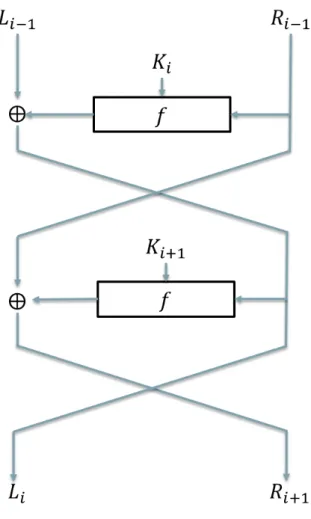
Definition 4(Feistel Network, cf. Figure 2.2). A Feistel cipher is an iterated cipher that maps a 2t-bit plaintext block (L0,R0) where L0 and R0 are the left and right
t-bit halves respectively, to a 2t-bit block (Lr,Rr) after r-rounds of encryption.
The result ofi-rounds encryption∀i: 1≤i<r−1 is computed as follows:
2.2. Block Ciphers 30
Ri=Li−1⊕f(Ri−1,Ki−1)
whereKiis theith subkey derived from the secret keyKand f the one-round func-tion which takes a subkey and a t-block as input to map into another t-bit block. We will assume that⊕is the bitwise exclusive-or operation, if not explicitly stated otherwise. This process is iteratively applied forr−2 rounds. In the last round, there is no swap between two halvesLi−1andRi−1. This makes the decryption of the Feistel network the same as the encryption process, only requires a reversal of the key schedule. The final output is given by the following:
Lr=Lr−1⊕f(Rr−1,Kr−1)
Rr=Rr−1
Since the encryption and decryption processes are identical (except for the key order), the software and hardware implementation of Feistel ciphers are much easier.
2.2.4
Courtois Toy Cipher
Courtois Toy Cipher (CTC) is a block cipher designed by Courtois, as a research tool cipher for performing experiments with algebraic attacks (see Section 3.5) us-ing a PC with a reasonable quantity of RAM [42]. CTC has a substitution layer followed by a diffusion layer in each round. This structure follows the concepts of confusion and diffusion originally described by Claude Shannon [151]. A very good description of confusion and diffusion properties is provided by Massey [109]: Confusion: The ciphertext should depend on the plaintext statistics in a manner too complicated to be exploited by the cryptanalyst
Diffusion: Each digit of the plaintext and each digit of the secret key should influence many digits of the ciphetext.
In CTC substitution layer is done by a common component in block cipher called substitution tables (S-boxes). Generally an S-box takes some number of input bits m, transforms them into some number of output bits n, where n is not
2.2. Block Ciphers 31
necessarily equal tom. The S-boxes used in the CTC are random permutations on three bits with no special structure (see Table 2.1).
Table 2.1:CTC 3-bits to 3-bit S-Box. It can be described by 14 quadratic equations in 22 monomials [42]
Input 0 1 2 3 4 5 6 7
Output 7 6 0 4 2 5 1 3
Figure 2.3:CTC Cipher - A toy cipher with B=2 S-boxes per round.
The structure of the cipher forNr rounds and withB=2 S-boxes is shown in Figure 2.3. The bits of the block size are ordered as 0, ...,Bs−1, wheres=3 is the S-box size. The bits in position 0,1,2 enter the first S-box, 3,4,5 enter the second S-box and so on. Each round consists of the XOR with the derived keyKi−1and a
linear diffusion layerD. The key size equals the block size. We donote byXi(j)for
i=1, ...,Nr, j=1, ...,Bs−1 as the input bits to thei-th round after XORing with the
dervied key. Yi(j) as the output bits of S-box andZi(j) as the corresponding output of diffusion layerD. Thei-th round derived keyKi is obtained from the secret key
K0by a simple permutation as follows:
Ki(j)=K0(i+jmodBs) (2.1) The diffusion partDof the cipher is as follows:
2.2. Block Ciphers 32
Zi(j·1987+257 modBs)=Yi(j)⊕Yi(j+137 modBs),∀i=1, ...,Nr,j6=0 (2.3) The idea behind the design of CTC is to demonstrate that it is possible to break a cipher with sufficiently good diffusion using a small number of plaintexts. Intuitively, if the input parameters (e.g. number of S-boxes in each round B and number of rounds Nr, ) are large enough, then the cipher is expected to be more
secure.
In 2007 Courtois suggested a tweaked version of CTC, named CTC2, which is expected to be more secure and flexible [40]. The main difference is that the key schedule of CTC2 has been extended to use keys of any size, independently of the block size. In CTC2, the key size of keyK, denoted byHk, is not necessarily equal to the block sizeBsand it is computed in the following way:
Ki(j)=K(j+i·509 modHk) (2.4) The diffusion partDof the cipher CTC2 is defined as follows:
Zi(j·1987+257 modBs)=Yi(j)⊕Yi(j+137 modBs)⊕Yi(j+274 modBs),if j=257 modBs
(2.5)
Zi(j·1987+257 modBs)=Yi(j)⊕Yi(j+137 modBs),otherwise (2.6)
2.2.5
DES
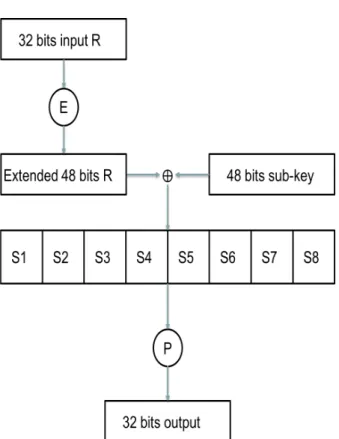
DES is a block-cipher based on the Feistel Network iterative structure. It was adopted in 1977 by the US Standards body National Institute of Standards and Technology (NIST) for federal agencies to use in protecting sensitive, unclassified information. It maps 64 bits to 64 bits using keys of 56 bits and consists of 16 rounds. It uses two 64-bit permutationsIP(·)andFP(·)before and after the round functions, respectively. These permutations satisfyFP=IP−1. These permutations have no cryptographic effect and they are used for facilitating loading blocks in and out of mid-1970s 8-bit based hardware [141].
2.2. Block Ciphers 33
Figure 2.4:DES Round Fuction
The key schedule of DES derives 16 48-bit sub-keys from the initial 56-bit key and each sub-key is introduced in a different round via XOR operation. The Expansion functionE takes as input a 32-bit half block and ex- pands it into a 48-bit block by repeating certain bits. The output of XOR operation is split into 8 consecutive 6-bit sub-vectorsx1,x2, ...,x8. Then eachxiis given as input to a 6-bit to 4-bit S-box. A permutation functionPis applied to the 32-bit output such that each set of S-box’s output bits are spread across 4 different S-boxes in the next round.
Nowadays, due to the 56 bits key size being too small, brute force attack is possible to break DES. In 2005, NIST withdrew DES from being the encryption standard.
Chapter 3
Cryptanalysis of Block Ciphers
The history of cryptanalysis is as long and as fascinating as the history of cryp-tography. For example, in 1917, an article in “Scientific American” claimed that the Vigen`ere cipher was “impossible of translation” [116]. Today, most cryptog-raphy classes at university use the Vigen`ere cipher as an exercise to illustrate that this claim is not true. When discussing the security of a cryptosystem, one needs to define a model that works in the real world for which we will use the model of Shannon [151].
The sender and the receiver share a common keyK over a secure channel in advance. The sender encrypts a plaintext P using the secret keyK, sends ciphertext C over an insecure channel to the receiver. The receiver then decrypts C to P using K. The attacker has access to the insecure channel and can intercept the ciphertext. In this chapter we assume that the sender and receiver use a secret key cipherEK(·)
of n-bits block size and k-bits size of keyK.
The definition of security is also strongly related to what type of attackers you are defending against. In chapter 5 of Bruce Schneier’s book [143], the author categorizes attackers along the following basic lines:
1. Adversarial goals and motivations.
2. Resources: money, human resources, computing power, memory, risk, exper-tise, etc.
35
A system could be secure against one type of attackers but not secure to another type. This reflects on the different types of security assumptions and classification of attacks which we will discuss later.
To evaluate the security of a cipher we assume:
Assumption 1. All keys are equally likely and a key K is chosen uniformly at ran-dom.
Also we will assume that the attacker knows all the details about the cryp-tographic algorithm used by the sender and receiver, except the secret key. This assumption is known as Kerckhoffs’s assumption [108].
Assumption 2.A. The enemy cryptanalyst knows all details of the enciphering pro-cess and deciphering propro-cess except for the value of the secret key.
This is not quite realistic if we look at the history of cryptography and crypt-analysis. As an extension of Assumption 2.A, we discuss the following two as-sumptions.
Assumption 2.B. The enemy cryptanalyst knows all the details of the enciphering process and deciphering process except the value of the key and the Substitution-box (S-Substitution-box) which is a core component of symmetric key algorithms that performs substitution.
Under this assumption, the S-boxes are like the master key or a high-level key, which is kept secret at a certain parameter (e.g., banks or country) and can be computed by the enemy, but at a high cost. This is similar to the rotors used in the German Enigma machine during World War II. The attacker has to recover the S-boxes first through silicon reverse engineering or try for different sets of known S-boxes, then perform normal cryptanalysis as in Assumption 2.A.
Assumption 2.C. The enemy cryptanalyst knows all the details of the enciphering and deciphering processes except that the cipher has been tweaked; for example 90% of the cipher is what we know.
3.1. Classification of Attacks 36
For example, the encryption algorithm used in Chinese Sim cards is known as COMP128-V0, which is defined by China Mobile and only used in China. In this case, the attacker has again two steps under this assumption: first to recover the cipher through reverse engineering and try different sets of known S-boxes; then performs normal cryptanalysis as Assumption 2.A.
3.1
Classification of Attacks
Regarding access to the system, Schneier classifies the possible attacks an attacker can perform as follows: [141]
1. Ciphertext-only Attack: The attacker processes a set of intercepted cipher-texts.
2. Known Plaintext Attack: The attacker obtains a set of s plaintexts
P1,P2, ...,Ps, and the corresponding ciphertextsC1,C2, ...,Cs.
3. Chosen Plaintext Attack: The attacker chooses a prior set of s plain-texts P1,P2, ...,Ps and obtains, in some way, the corresponding ciphertexts
C1,C2, ...,Cs.
4. Adaptively Chosen Plaintext Attack: The attacker chooses a set of s
plaintextP1,P2, ...,Psinteractively as he obtains the corresponding ciphertext
C1,C2, ...,Cs. That is, the attacker chooses P1, obtainsC1, and then chooses
P2etc.
5. Chosen Ciphertext Attacks: For symmetric ciphers, Chosen Ciphertext At-tacks are similar to the Chosen Plaintext Attack and the Adaptively Chosen Plaintext Attack.
6. Chosen Plaintext and Ciphertext Attack: The attacker has access to both encryption and decryption oracles and can choose both plaintext and cipher-text.
The chosen text attacks are the most powerful attacks. However, they are also unrealistic in many applications. If redundancy exists in plaintext space, it will
3.1. Classification of Attacks 37
be very hard for an attacker to find an encrypted non-meaningful plaintext sent by the sender, and to get the ciphertexts decrypted. However, if a system is secure against an Adaptively Chosen Plaintext Attack, then it is also secure against all other attacks.
Modern cryptanalysis of block ciphers has focused on finding the secret keyK
for any scenario, even unrealistic ones. Importantly, there are other serious attacks for public key cryptography, which do not find the secret key. Knudsen classifies the types of attacks as follows [115]:
1. Total break: An attacker finds the secret keyK.
2. Global deduction: An attacker finds an algorithmA, which is functionally equivalent toEK(·)(or DK(·))without knowing the keyK.
3. Instance (local) deduction: An attacker finds the plaintext (ciphertext) of an intercepted ciphertext (plaintext), which was not obtained from the legitimate sender.
4. Information deduction: An attacker gains some information about the key, plaintexts or ciphertexts, which was not obtained directly from the sender or before the attack.
This classification is hierarchical, i.e., if a total break is possible, then a global deduction is possible, etc.
Data Requirements
Attacks can also be characterized by the resources they require. These resources include time complexity, memory usage, and data requirements. Although the first two types of resources are very obvious, it is worth pointing out the data require-ment is also a key component that makes an attack able to work in practice. Full plaintext and ciphertext pairs are not easy to obtain in the real world. Some of the attacks work only if all possible plaintext and ciphertext pairs for a single key are known which is called single key scenario [21], and some of the attacks (which have only appeared in recent years) are specifically designed to take advantage of a so-called multiple key scenario, where the attacker has access to data encrypted with
3.2. Brute-force Attacks 38
more than one key (such attacks typically also work in standard single key scenario, however in this case they will be less advantageous) [44, 63].
3.2
Brute-force Attacks
A brute-force attack or exhaustive key search is the most general attack that can be applied to any block cipher. All block ciphers are totally breakable in a ciphertext-only attack, just simply by trying all the possible keys one by one, and checking whether the computed plaintext is meaningful. If the block size is equal to key size, in the worst case, this attack requires the computation of 2k encryptions. The dimension of the key spacek, which is the length of the key, determines the prac-tical feasibility of performing a brute-force attack. While in 2014 an paper written by Huang and Lai [103] described a brute-force-like attack, with a time complex-ity faster than the exhaustive key search by going over the entire key space, but performing less than a full encryption for each possible key. The time complexity of this attack is 2k(1−ε) (whereε >0) on average regardless the block size, cf. [103, 44]. For modern block ciphers, brute-force is always possible in theory, but computationally infeasible in practice.
3.3
Linear Cryptanalysis
Linear cryptanalysis is a Known Plaintext Attack on block ciphers. It was pop-ularised by Matsui in 1993 [123] and invented earlier by Gilbert and his student [163]. A preliminary version of the attack on FEAL was described in 1992 [124]. A year later, Matsui published another attack on DES [123]. Although the published attack on DES required 243known plaintexts which is not very practical, it still was a great improvement in experimental cryptanalysis.
In linear cryptanalysis the attacker exploits linear approximations of some bits of the plaintext, ciphertext and key. In the attack on the DES (or on DES-like iter-ated ciphers) the linear approximations are obtained by combining approximations for each round under the assumption of independent round keys.
The attacker hopes to find an expression (equation 3.1), which holds with prob-ability pL6= 12 over the keys [123], such thatε =|pL−12 |, called the bias, is
maxi-3.3. Linear Cryptanalysis 39
mal.
(P·α)⊕(C·β) = (K·γ) (3.1)
whereP,C,α,β,γ are m-bit strings and where ‘·’ denotes the dot product.
Given an approximation (equation 3.1) a linear attack using N plaintexts and theN corresponding ciphertexts goes as follows [123].
1. for all plaintexts, P, and ciphertexts,C, letT be the number of times the left hand side of equation 3.1 is 0.
2. ifT > N2 guess thatK·γ =0, otherwise guess thatK·γ =1 (majority vote). By using the above method, the attacker can find one bit of information about the secret key, K·γ. However, this is only one step in an attack, as it only finds one bit or a linear equation about the key. Matsui also showed an extended linear attack which finds more key bits [123]. Instead of approximating the first and last round, the extended linear attack simply repeats the attack for all values of the relevant key bits in those two rounds by using the following approximation equation:
(P·α)⊕(C·β)⊕(F(PR,K1)·α1)⊕(F(CR,Kr)·αr) = (K·γ) (3.2) wherePR,CR are the right halves of the plaintexts and ciphertexts. K1 andKR are the key bits affecting the linear approximation in the first andrth rounds. We refer the reader to Matsui’s paper [123] for more details.
Kaliski and Robshaw showed an improved linear attack using multiple linear approximations in 1994 [110]. In 1996, Knudsen and Robshaw introduced a linear attack using non-linear approximations in the outer rounds of a block cipher [112]. Both of these have not been able to show any significant improvement compared to Matsui’s linear attack. Kaliski’s and Knudsen’s attacks seem best suited for ciphers with large S-boxes, such as LOKI [28, 112]. However in 2004 as an extension of Knudsen and Robshaw’s work, new attacks were introduced by Courtois [59] to attack Feistel schemes, which makes this non-linear approximation “penetrate” inside the cipher and achieved a small improvement upon Matsui’s work.
3.4. Differential Cryptanalysis 40
3.4
Differential Cryptanalysis
Differential cryptanalysis is based on tracking changes in the differences between two messages as they pass through the consecutive rounds of encryption. It is one of the oldest classical attacks on modern block ciphers. In cryptographic literature, it was first described and analyzed by Biham and Shamir, and applied to the DES algorithm in the early 1990s [18]. However, Coppersmith, a member of the IBM team that designed DES [35, 36, 67], reported that this attack was already known to IBM designers around 1974. It was known under the name of T-attack or Tickle attack, and DES had already been designed to resist this type of attack. A detailed discussion of the specific original design criteria of DES can be found in the work done by Courtois et al [67]. Moreover, it appears that IBM had agreed with the NSA that the design criteria of DES should not be made public, precisely because it would “weaken the competitive advantage the United States enjoyed over other countries in the field of cryptography” cf. [35, 36]. In contrast, linear cryptanalysis seems more recent.
Today, differential cryptanalysis is extremely well known. Numerous authors studied various aspects of differential cryptanalysis extensively in the 1990s. Apart from DES, differential cryptanalysis has also been successfully applied to a wide range of iterated ciphers [114, 122]. Recent research work showed great success using differential cryptanalysis to break the Russian standard GOST [70, 52] and the NSA lightweight cipher Simon and Speck [19, 4].
Both linear and differential cryptanalysis require lots of data; however a major difference between these two type of attacks is that differential cryptanalysis works in a so-called multiple key scenario. In a multiple key scenario, where given 2X devices with distinct keys, 2Y of data per device, and M =2Z of memory, some keys can be recovered at the total cost of T =2Z [63]. This also appears in the original Biham and Shamir paper in 1993 [18]. But this attack scenario has only been discussed in recent years [63]. The fact that differential cryptanalysis works with data collected from multiple keys (where linear cryptanalysis requires data on a single key) makes differential cryptanalysis more practical than linear cryptanalysis,
3.4. Differential Cryptanalysis 41
as it’s easier for an attacker to get data from multiple keys than a single key in practice.
The main task of differential cryptanalysis is to studies the propagation of input differences from round to round inside the encryption system, and to find specific differences that propagate with high probability. Such plaintext and ciphertext pair (P/C pairs) can be used to recover some bits of the secret key. In general, differ-ential cryptanalysis exposes the non-uniform distribution of the output differences given one or several input differences. However, what really matters in differential cryptanalysis is that some special events can happen at least once within a given attack requirements.
Definition 5. A difference between two bit strings, X and X0 of equal length is defined as
4X =X⊗(X0)−1
where⊗is the group operation on the group of bit strings used to combine the key with the text input in the round function and(X)−1is the inverse element of X with respect to⊗
Generally, the selection of the operator⊗depends on the way the round sub-keys are introduced in each round. As many ciphers use XOR for the key application in round function, the operator in Definition 5 is usually exclusive-or (⊕).
The attacker then computes the differences of the corresponding ciphertexts, hoping to detect statistical patterns in their distribution. The resulting pair of differ-ences is called a differential. Their statistical properties depend upon the internal structure of the cipher. The attacker aims to find one particular ciphertext differ-ence that is especially frequent. In this way, the cipher can be distinguished from random.
Some differential cryptanalysis work study multiple input / output differences, such as truncated differentials (which we will discuss later), and the work presented in 2009 by Courtois [60] for cloning MiFare Classic building passes.
3.4. Differential Cryptanalysis 42
Truncated Differentials
Truncated Differential Cryptanalysis is a generalization of differential cryptanalysis developed by Lars Knudsen in 1995 [113]. Unlike differential cryptanalysis, which studies the propagation of the full difference between two plaintexts, truncated dif-ferential cryptanalysis considers differences that are partially determined, since in some ciphers it is possible and advantageous to predict the values of parts of the differences after each round. This technique has been successfully applied to many block ciphers, such as Camellia [159], TEA and XTEA [102], and Russian standard GOST [61, 126, 72]. Truncated differential cryptanalysis has also been extensively studied by Mourouzis in his PhD thesis [126]. Truncated differential is defined as follows [113].
Definition 6. Let a=a0a1...an−1 be an bit string, then its truncation is the n-bit string b given by b0b1...bn−1 = T RU NC(a0a1...an−1), where either bi=ai or
bi=∗, for all0≤i≤n−1and∗is an unknown value
Definition 7. A differential that predicts only parts of a n-bit value is called a trun-cated differential. More formally, let (a,b) be an i-round differential. If a0 is a truncation of a and b0 is a truncation of b, then (a0,b0) is called an i-round trun-cated differential.
A truncated differential can be considered as a collection of differentials. For example, for an i-round 64-bit block cipher, a truncated differential ∆ =
[0000022200000080]in hexadecimal (which appears later in Section 6.2) is a col-lection of 24−1 differentials (a,b) where a and b can take any of the following values: 00000200 00000000 00000020 00000000 00000002 00000000 00000000 00000080 00000220 00000000 00000202 00000000 00000200 00000080 00000022 00000000 00000020 00000080 00000002 00000080 00000222 00000000 00000220 00000080 00000202 00000080 00000022 00000080 00000222 00000080
3.5. Algebraic Attacks 43
3.5
Algebraic Attacks
In general, the security of a given block cipher will grow exponentially with the number of rounds and so does the number of required Plaintext/Ciphertext pairs that are needed in a linear and differential cryptanalytic attack. However, in most cases, only a few Plaintext/Ciphertext pairs are available for cryptanalysis, so linear or differential attacks are not expected to succeed. Thus, a new method needs to be invented that will be able to recover the secret key when only a very limited amount of data is available..
Claude Shannon, once suggested that the security of a cipher should be related to the difficulty of solving the underlying system of equations and deriving the key:
“if we could show that solving a certain system requires at least as much work as solving a system of simultaneous equations in a large number of unknowns, of a complex type, then we would have a lower bound of sorts for the work characteristic”[150].
This is the core concept behind algebraic attacks. An algebraic attack is a form of Known Plaintext Attack which consists of the following two steps:
1. Modelling: Describe the cipher as a multivariate system of polynomial equa-tions over a small finite field (likeF2) or logical constraints in terms of the
secret keyK, the plaintextPand the ciphertextC.
f1(K,P,C) =0, ...fr(K,P,C) =0⇐⇒E(K,P) =C
2. Solving: Solve the underlying multivariate system of equations and obtain the secret key. In order to reduce the complexity of solving the system, we substitute all known Plaintext/Ciphertext pairs. The more pairs that are sub-stituted, the more the equations we obtain involving the key bits. For many known attacks, this can make the problem easier to solve.
Generally, each module of a block cipher can be described with a set of alge-braic equations. By putting these algealge-braic equations together, we can get a large
3.5. Algebraic Attacks 44
precise system representing the whole cipher. The main idea of an algebraic at-tack is to establish a series of low complexity algebraic equations of initial plaintext and ciphertext, and then find the secret key by solving the equations. Such equation systems are normally very large systems of quadratic multivariate polynomial equa-tions overF2. Each variable represents a state-bit of the encryption algorithm. Then
the variables that represent state-bits from the initial round are set according to the corresponding actual values of the plaintext; similarly variables that represent state-bits from the last round are set according to the corresponding actual values of the bits of the ciphertext. Therefore, the security of a block cipher depends on whether an efficient algorithm exists to solve such large and sparse multivariate polynomial equations. If we can solve the equation system faster than an exhaustive key search attack, the cipher will be broken (in an academic sense).
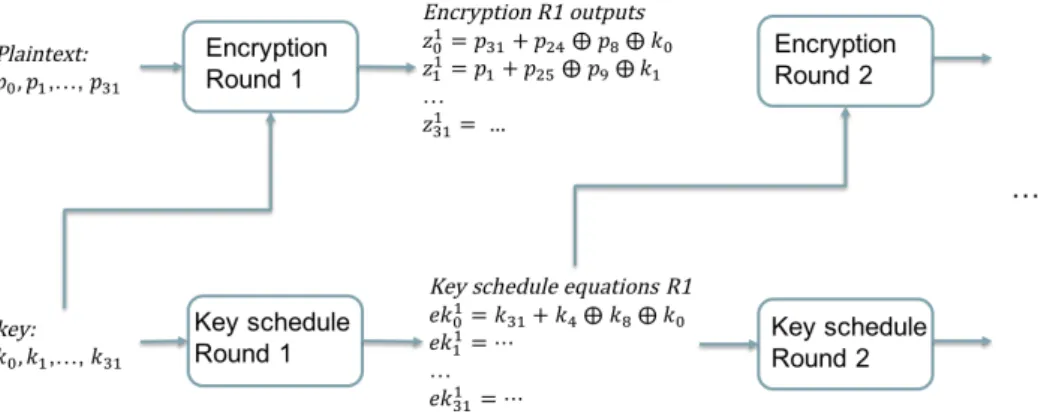
Figure 3.1:Toy example for modelling Simon block cipher with a multivariate quadratic equation system. The upper part is the main block encryption with extended keys generated by a key schedule1(lower part).
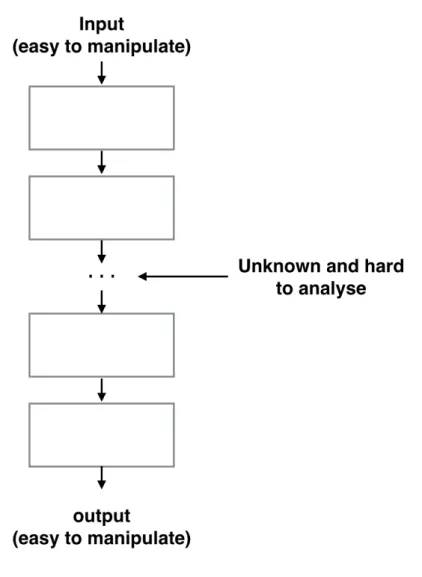
In addition, some high profile cryptanalysis problems in public key cryptogra-phy can be written in a form that contains ablock cipher topology2. Such equations have a similar structure to a block cipher, where the beginning inputs and final
out-1The key schedule here has a specific recursive form in popular ciphers such as DES, AES and Simon which optimizes storage or chip size and timing.
2This is basically a property of the equations proposed by Semaev in 2015 [145, 147], they have the same structure as on Figure 3.2 with variables progressively more and more remote from the constraints which make that the system of equations have a unique solution. The key point is that this sort of configuration leads to a system of equations which is really very hard to solve in the same way as in algebraic attacks on block ciphers.
3.5. Algebraic Attacks 45
puts variables are easy to get and the middle part of the equation system is very hard to analyse (see Figure 3.2). One example is Semaev’s summation polynomial equations studied in elliptic curve cryptanalysis [145, 147] see Section 4.5.2.
Figure 3.2:Block cipher topology: the attacker can control or manipulate the inputs and the outputs but it is quite hard to say anything about the variables in the middle
3.5.1
Algebraic Attacks Solving Stage
Solving a random system of multivariate non-linear boolean equations is an NP-hard problem [93]. As many cryptographic primitives can be described by a sparse multivariate non-linear system of equations overF2or any other algebraic systems,
several techniques were developed to tackle the problem of solving these equations. A classic approach is to use techniques from algebraic geometry, especially Gr¨obner
3.5. Algebraic Attacks 46
bases algorithms, to solve the system of equations [87]. But most of the time they do not lead to solutions in practice due to the extremely high memory requirements. Subsequently, some heuristic techniques were developed calledlinearization[51], where all the non-linear terms are replaced by an independent linear variable and the resulting linear system can be solved using Gaussian elimination [149]. However, this requires there to be enough linearly independent equations and that the initial system be highly over-defined and sparse. Then, the XL algorithm [51, 75] was developed to make the system over-defined by adding new equations to the current system. The XL proposal made it possible to solve the multi-order non-linear equa-tions within polynomial time, which accelerated the development of the algebraic attacks. Then researchers focused mainly on fast solutions to the algebraic equation systems.
Since 2006, Courtois and Bard discovered that this problem could be solved using tools and software [65], such as SAT solvers. SAT solvers are automated software solvers which aim to solve one of the original NP-complete problems, the so-called Boolean Satisfiability Problem.
Definition 8. [Boolean Satisfiability Problem] The SAT problem in Conjunctive Normal Form (CNF) consists of the conjunction (∧representing the Boolean AND connective) of a number of clauses, where a clause is a disjunction (∨representing the Boolean OR connective) of a number of propositions or their negations (liter-als).
If xirepresent propositions that can assume only the values True (≡1≡ >) or False (≡0≡ ⊥), then an example formula in CNF would be:
(x0∨x2∨x3)∧(x3)∧(x1∨ ¬x2)
where¬xiis the negation of xi. Given a set of clauses C0,C1, ...,Cm−1on the
propo-sitions x0,x1, ...,xn−1, the problem is to determine whether the formula
F = ^
j<m
3.5. Algebraic Attacks 47
has an assignment of truth values to the propositions such that it evaluates to True.
In the past decade, the rapid improvements in SAT algorithms has made SAT solvers increasingly popular. Modern SAT solvers have a significant impact on the fields of electronic design automation, software verification, constraint solving in artificial intelligence, and operations research, among others. Nicolas Courtois is the pioneer of bringing SAT solvers into action in the area of symmetric cryptanal-ysis. His paper [10] described how to convert a multivariate quadratic equation system to CNF which can be solved automatically by SAT solvers. The advantage of this technique is that SAT solvers can perform reasonably well and do not re-quire a lot of memory as compared with Gr ¨obner basis-based techniques [88]. The only disadvantage is the unpredictability of its complexity. The first algebraic attack on reduced-round block cipher DES was done by Courtois and Bard in 2007 [48]. Later in 2008, the first algebraic attack on full block cipher KeeLoq [66] took place. In the past 10 years, SAT solvers have been used for attacks on block ciphers, such as GOST [69, 44], KATAN32 [11] and the Chinese block cipher SMS4 [85], stream ciphers, such as Crypto-1, HiTag2 and Bivium [155, 73], and MiFare Classic smart cards [56].
Another method is to use the ElimLin algorithm [58]. ElimLin stands for EliminateLinear, and it is a simple algorithm for solving polynomial systems of multivariate equations over small finite fields. It was initially proposed as a single tool by Courtois to attack DES and CTC/CTC2 ciphers [48]. It is also known as the
inter-reductionstep in all major algebra systems. Its main aim is to reveal some hid-den linear equations existing in the ideal generated by the system of polynomials. ElimLin is composed of two sequential stages:
• Gaussian Elimination:To discover all the linear equations in the linear span of initial equations.
• Substitution: Variables are iteratively eliminated in the whole system based on the linear equations found until no linear equation is left.
3.5. Algebraic Attacks 48
then the ElimLin is formally described in algorithm 1. Algorithm 1ElimLin Algorithm
Input:S0={f1,f2, ...,fm} ∈F2[x1,x2, ..,xn]
Output:An updated system of equationsST and a system of linear equationsSL
1. SetSL←Ø andST ←S0andk←1 2. Repeat
For some ordering of equations and monomials performGauss(ST)to eliminate non-linear monomials
SetSL0←Linear Equations fromGauss(ST) SetST ←Gauss(ST)\SL0
for∀l∈SL0,l non-trivial (if l=1and unsolvable thenterminate)do Letxik be a monomial inl
Substitutexik inST andSL0 and replace byl−xi k InsertlinSL
end for
k←k+1
The study of ElimLin is interesting [160, 161] precisely because it is sim-pler to understand than more complex polynomial algebra techniques [51, 74, 168, 12, 101]. In recent years, ElimLin has been applied to NSA block cipher Simon, LBlock, KATAN32 and PRESENT [55, 137, 161, 127]. The main characteristic of ElimLin is that it quietly dissolves and makes non-linear equations disappear and generates linear equations. Non-linearity is the main and only thing which makes cryptographic schemes not broken by simple linear algebra. Intuitively, ElimLin seems to work better in cases where there is low non-linearity, since this implies the existence of more linear equations. Multiplicative complexity (MC) is another notion of non-linearity which was studied in Mourouzis’s PhD thesis [126] and pos-sibly Elimlin may work sufficiently well in cryptographic primitives with low MC. However, the complexity of ElimLin attack or software algebraic attacks in general is not well studied. It is not clear why this works and how well the ElimLin attack scales for larger systems of equations. This is a major topic of interest in this thesis.
3.5.2
Algebraic Complexity Reduction
In order to break a full cipher, algebraic attacks are normally combined with other cryptanalysis techniques to reduce the solving complexity. This attack scenario consists of two independent tasks: one is how a reduced-round cipher can be solved
![Table 2.1: CTC 3-bits to 3-bit S-Box. It can be described by 14 quadratic equations in 22 monomials [42]](https://thumb-us.123doks.com/thumbv2/123dok_us/1382560.2685195/31.892.173.766.272.579/table-ctc-bits-box-described-quadratic-equations-monomials.webp)
![Figure 4.1: Example of elliptic curve over F 2 4 [32]](https://thumb-us.123doks.com/thumbv2/123dok_us/1382560.2685195/65.892.286.643.133.530/figure-example-elliptic-curve-f.webp)
![Figure 4.2: Elliptic curve point addition [136]](https://thumb-us.123doks.com/thumbv2/123dok_us/1382560.2685195/66.892.329.595.116.455/figure-elliptic-curve-point-addition.webp)