Analysis of GLCM Parameters for Textures Classification on UMD Database Images
Original Citation
Mohamed, Alsadegh Saleh Saied and Lu, Joan (2015) Analysis of GLCM Parameters for Textures
Classification on UMD Database Images. In: Proceedings of The Fifth International Conference on
Advanced Communications and Computation. INFOCOMP (2015). IARIA, Brussels, Belgium, 111
-116. ISBN 978-1-61208-416-9
This version is available at http://eprints.hud.ac.uk/25417/
The University Repository is a digital collection of the research output of the
University, available on Open Access. Copyright and Moral Rights for the items
on this site are retained by the individual author and/or other copyright owners.
Users may access full items free of charge; copies of full text items generally
can be reproduced, displayed or performed and given to third parties in any
format or medium for personal research or study, educational or not-for-profit
purposes without prior permission or charge, provided:
•
The authors, title and full bibliographic details is credited in any copy;
•
A hyperlink and/or URL is included for the original metadata page; and
•
The content is not changed in any way.
For more information, including our policy and submission procedure, please
contact the Repository Team at: [email protected].
Analysis of GLCM Parameters for Textures Classification on UMD Database
Images
Alsadegh Saleh Saied Mohamed
Computing and Engineering. Huddersfield University Huddersfield, UK
Email: [email protected]
Joan Lu
Computing and Engineering. Huddersfield University Huddersfield, UK
Email: j.lu@ hud.ac.uk
Abstract— Texture analysis is one of the most important techniques that have been used in image processing for many purposes, including image classification. The texture determines the region of a given gray level image, and reflects its relevant information. Several methods of analysis have been invented and developed to deal with texture in recent years, and each one has its own method of extracting features from the texture. These methods can be divided into two main approaches: statistical methods and processing methods. Gray Level Co-occurrence Matrix (GLCM) is the most popular statistical method used to get features from the texture. In addition to GLCM, a number of equations of Haralick characteristics will be used to calculate values used as discriminate features among different images in this study. There are many parameters of GLCM that should be taken into consideration to increase the discrimination between images belonging to different classes. In this study, we aim to evaluate GLCM parameters. For three decades now, GLCM is popular method used for texture analysis. Neural network which is one of supervised methods will also be used as a classifier. And finally, the database for this study will be images prepared from UMD (University of Maryland database).
Keywords-GLCM Parameters; Haralick F eature Extraction; Texture Classification using window size.
I. INTRODUCTION
Analysis of the texture in images aims at finding characteristics of textures and representing them in distinctive forms to enable further processing. Extracting features from the texture by algorithm is used for various types of images from different disciplines including: medical images, analysis of aerial and satellite images, and in Remote Sensing Images [1]-[5].
There are four main types of methods that have been used for extracting features from the texture, which are: texture classification, texture segmentation, texture synthesis and shape from texture [6]. Classification of images into one of the classes, which have been prepared in advance, is the main purpose of texture classification.
Most methods used to analyse the texture may divide them into: statistical approaches and filtering based approaches. Statistical approaches such as Co-occurrence matrices and Local binary patterns [2][3][7][8] extract local features from the image depending on the spatial distribution of gray values in the particular image. Statistical methods
can be categorized into: first-order (just one pixel), second-order (couple of pixels) or higher-second-order (more than three pixels) statistics. Due to the complicated calculations and time involved when dealing with three or more pixels, higher-order is not commonly implemented. Filtering based approaches extract global features from the texture and examples of these are wavelet and Gabor filtering [9]-[12]. Filtering deals with the pattern of texture in the spatial frequency domain of the given image, which the energy distribution in the frequency domain identifies as a texture, and focuses on periodic patterns resulting in peaks in the spatial frequency domain.
In spatial texture analysis, the texture extraction methods analyse the spatial distribution of pixels in gray scale texture. Gray level co-occurrence matrix is a statistical method used to achieve second order statistical texture features. In addition, the texture features may be extracted from the GLCM by Haralick features, using several parameters which GLCM depends upon in its design. These features are: displacement value, orientation value, gray
level range „quantization level‟, and window size [13]-[19].
All of these features influence the accuracy of texture classification.
This section has been used to introduce the paper. The remainder of this paper is structured as follows: Section II examines works related to the study. Section III describes the general concepts of GLCM methods and Haralick features. Section IV proposes the methodology of texture classification. In section V, we give the experimental results and at the end in Section VI is the conclusion.
II. RELATED WORKS
Many techniques that have been proposed for texture classification depend upon GLCM for analysing the image as the main stage in classification.
It was established that using second order statistics to extract texture features such as Angular Second Moment, Homogeneity, Contrast, Angular Second Moment, Energy and Entropy are suitable for classification of color and high resolution images of cities and farmland which are important sources of information for the geographical sector [8]. Another method was established by using GLCM after applying window size 7 × 7 on the original image of Guizhou karst mountainous region taken by remote sensing
by the use of the synthetic aperture radar (SAR) process. The different characteristic values of GLCM were analysed from different directions of GLCM. This experiment concluded that by using SAR image, a texture can reflect important information of the different land entities [3]. We propose a new method for defining the direction in GLCM, which selects the main direction of the image by measuring the different directions. Characteristically, the value of the main direction in texture is calculated from an average of the three directions, where a set of characteristics which includes more information about the rotation invariance of the image are extracted [18]. On the contrary, using distinct displacements to classify any type of texture does not give good results, and the value of displacement between two pixels depends on Texel size. As a result, the new method tries to compute Texel size of texture [17]. The performance of GLCM was investigated on large database from breast lesions on ultrasound images for classification. The performance depends on a changing number of parameters such as quantization, orientations and distances [13]. Another investigation on GLCM involved testing a number of the parameters of GLCM on mapping sea ice patterns with synthetic aperture radar (SAR) for assessing which one of them had the most effect on mapping sea ice texture [14].
III. GLCM ANALYSIS METHOD AND FEATURE FUNCTION
This section explains the GLCM method and the functional features of Haralick that are used to extract features from GLCM.
A. GLCM
Texture feature can be calculated by GLCM, which is one of the most popular statistical methods used for the analysis of texture. It creates a new matrix dependent on gray level values of the original image matrix. The number of rows and columns in the origin image is equal to the gray tones of new matrix. The GLCM method gives information about the type of texture in the image from the relationship between pairs of pixels. The values inside the new matrix take two parameters into consideration. These are: distance and angle.
The gray level intensity value of two pixels with a particular spatial relationship computes the distance of GLCM. Angles determine the direction of the relationship between two pixels of the same gray-level which can be horizontal; vertical or diagonal.
GLCM determines differences between surface textures through the collection of elements around a diagonal in the matrix for example, rough and smooth surfaces will be different and can easily be classified using GLCM [20].
The dimensions of GLCM are calculated by the gray level of image. More levels give more accuracy in extracting the information from the texture, as the results increase the computation cost [14]. One of the most complicated issues with GLCM is texture size which is usually only estimated.
B. Feature Function of Haralick
Haralick texture features are a function for calculating values from GLCM [21]. They are used to discriminate between different textures in the classification of classes images to determine where they belong. Some of the Haralick texture features are more important than others and this is determined by surface texture where parameters such as second moment, contrast, entropy and correlation are mostly used.
(1) Second Moment
It evaluates the uniformity of an image and focuses on the partial characteristics of the image.
where Ng is gray tone, i,j coordinate of function P(i,j). (2) Contrast
It indicates the range of dissimilarity between pairs of pixels over the whole image so it reveals the clarity of the image by extracting the edge information of the objects.
(3) Entropy
It is a measure of disorderliness of intensity distribution in the image. If there were no textures in the image, the entropy value would be near to zero, and on the other hand, a bigger entropy value indicates a more complex texture.
(4) Correlation
It reflects a definite gray value along a certain direction of extended length. The correlation value will be larger if extended or if made longer.
µx, µy and σx, σy are the means and standard deviations
of px and py.
IV.METHODOLOGY OF TEXTURE CLASSIFICATION
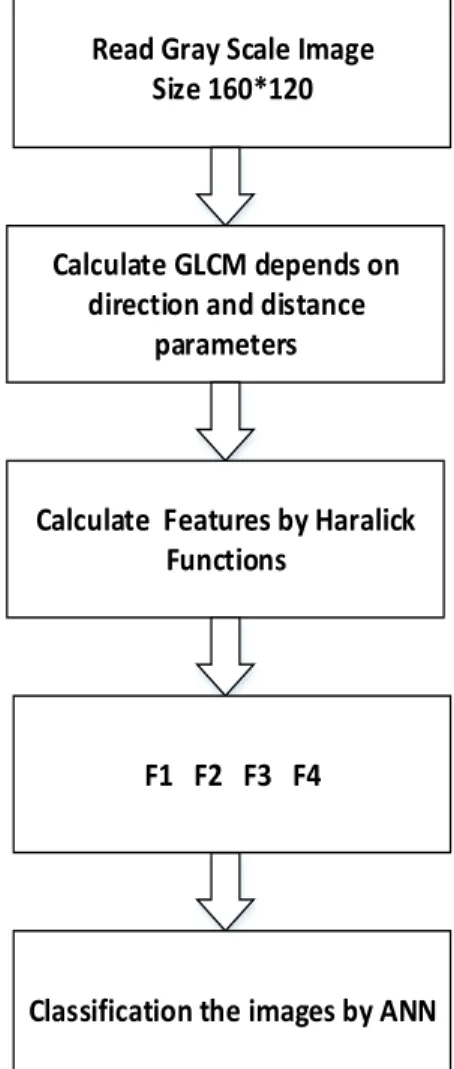
Texture classification is relevant to computer vision. The stages to be followed in classification will be as laid out in Figure 1. After applying multiple windows of different sizes
the stages of classification will be as laid out in Figure 2. Firstly, there is the preparation of the images or databases that are needed for classification which are originally 160*120 in size by dividing each original image into multiple windows of size (80*60 – 40*30 – 20*15). Secondly, we will implement GLCM using the different parameters, mentioned earlier on completed sizes of images and on specific window sizes. Thirdly, we will extract the features by Haralick, and use the average of features function when using multiple windows size for identifying sets of features that describe the visual texture of an image. Finally we will classify textures by their features using machine learning approaches such as Artificial Neural Network (ANN) [19].
Read Gray Scale Image
Size 160*120
Calculate GLCM depends on
direction and distance
parameters
Calculate Features by Haralick
Functions
F1 F2 F3 F4
Classification the images by ANN
Figure 1. Classification stages on origin image size
Neural Network consists of multi-layer preceptor (MLP) algorithm. It is used in ANN to update the weights through back-propagation and training of ANN, where the neural Network is divided into two stages:
1- Training stage: using the features vector which is extracted by Haralick functions, the MLP feed forward artificial neural network
2- Testing stage: the MLP feed forward artificial neural network using other samples of data from the image, which are extracted as vector of important feature. The sampling in training is typically more than in training stage in ANN.
Read Gray Scale Image Size 160*120
Calculate GLCM depends on direction and distance parameters of multiple windows
size
Calculate Features by Haralick Functions of each window size
F1 F2 F3 F4
Classification the images by ANN Divide the image to multiple
windows size 80*60 – 40*30 – 20*15
Calculate the Average of features function of each window size
Figure 2. Classification stages on multiple window size
V. EXPERIMENTAL RESULTS
The statistical GLCM are taken as texture features of a texture. Four of the most important statistical properties are calculated for describing image content: contrast, energy, entropy, correlation, and local stationary. The main objective of the experimental investigations was to compare the discriminatory power of GLCM as a method used for analyzing the texture as the main stage for classification, as well as the influence of GLCM parameters. It also divides the texture into multi-windows through extracting the features from the image. The classification accuracy rates on the database groups were compared using MATLAB 2014.
A. Data Preparation
The data used in the paper are from a UMD dataset [22]. The UMD (University of Maryland, College Park) consists of 25 high resolution texture classes, each one with 40 samples with resolution 1280*900 pixels (see Figure 3). Here, we divided the samples into four groups. Each group consists of another four groups: A, B, C and D.
Figure 3. Samples of texture of UMD database
B. Discussion and Analyses
We exploited the UMD database, by making a number of groups where each group consisted of two classes and each class contained 1000 texture of sizes 160 * 120 and each class was divided into 700 images for training and 300 images for testing. The results of the texture classification were as follows:
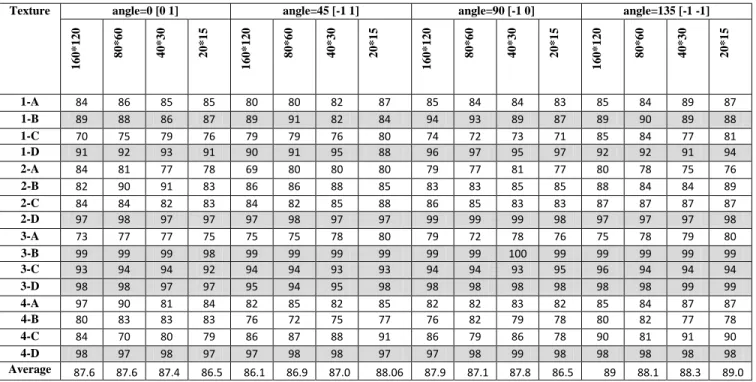
The changing in direction parameter of GLCM gives different results if applied on whole images or using multiple sizes of window. The results in Table I explain the influence of directions changing in GLCM on the classification accuracy in the number of image groups with resolution 160*120, after dividing these images to the number of regions by different window size.
In general, the GLCM has given somewhat good results in some groups especially in groups: 1-B, 1-D, 2-D, B, 3-C, 3-D and 4-D that used different angels and different windows sizes. Conversely, it gave somewhat low results in classifying textures in groups: 1-C, 2-A, 3-A and 4-B. The result in rest of the groups: 1-A, 1-C, 2-C, 4-A and 4-C kept fluctuating.
There is an increase in classification accuracy through dividing the original images into sub-images, by sliding windows such as in most groups when the angle equal 45 in which include groups: 1-A, 2-A, 3-A and 4-C. When the angle equals 135, the increase was noted in groups 3-A and 3-D, and the increase was in group 2-B when the angle was 90. On the contrary, there is a decrease in other groups mostly when the angle equals 0 such as groups 2B, 3-C and 2-D, and when the angle equals 135 in groups 2-A and 4-B. In other groups, there was no apparent change such as in groups 3-B with different angles, and in groups 2-C, 3-B and 4-D when the angle equals 135. The conclusion was that each image needed its own particular window size to obtain optimal information.
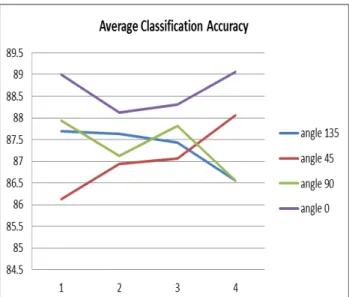
The direction parameter had a big effect on GLCM. The average classification accuracy as shown in Figure 4 explains the following: when the parameter angle equals to zero we
TABLE I.CLASSIFICATION RESULTS ON THE IMAGES BY CHANGING IN DIRECTION PARAMETER WITH DIFFERENT WINDOW SIZE
Texture angle=0 [0 1] angle=45 [-1 1] angle=90 [-1 0] angle=135 [-1 -1]
1 6 0 * 1 2 0 8 0 * 6 0 4 0 * 3 0 2 0 * 1 5 1 6 0 * 1 2 0 8 0 * 6 0 4 0 * 3 0 2 0 * 1 5 1 6 0 * 1 2 0 8 0 * 6 0 4 0 * 3 0 2 0 * 1 5 1 6 0 * 1 2 0 8 0 * 6 0 4 0 * 3 0 2 0 * 1 5 1-A 84 86 85 85 80 80 82 87 85 84 84 83 85 84 89 87 1-B 89 88 86 87 89 91 82 84 94 93 89 87 89 90 89 88 1-C 70 75 79 76 79 79 76 80 74 72 73 71 85 84 77 81 1-D 91 92 93 91 90 91 95 88 96 97 95 97 92 92 91 94 2-A 84 81 77 78 69 80 80 80 79 77 81 77 80 78 75 76 2-B 82 90 91 83 86 86 88 85 83 83 85 85 88 84 84 89 2-C 84 84 82 83 84 82 85 88 86 85 83 83 87 87 87 87 2-D 97 98 97 97 97 98 97 97 99 99 99 98 97 97 97 98 3-A 73 77 77 75 75 75 78 80 79 72 78 76 75 78 79 80 3-B 99 99 99 98 99 99 99 99 99 99 100 99 99 99 99 99 3-C 93 94 94 92 94 94 93 93 94 94 93 95 96 94 94 94 3-D 98 98 97 97 95 94 95 98 98 98 98 98 98 98 99 99 4-A 97 90 81 84 82 85 82 85 82 82 83 82 85 84 87 87 4-B 80 83 83 83 76 72 75 77 76 82 79 78 80 82 77 78 4-C 84 70 80 79 86 87 88 91 86 79 86 78 90 81 91 90 4-D 98 97 98 97 97 98 98 97 97 98 99 98 98 98 98 98 Average 87.6 87.6 87.4 86.5 86.1 86.9 87.0 88.06 87.9 87.1 87.8 86.5 89 88.1 88.3 89.0
obtain the best results between all texture classification groups and across all window sizes. Other angle values give different results depending on the texture types and window sizes used to divide the image. When the angle is equal to 135, it gives better results with the origin image as well as when using window size 80*60, whereas the accuracy percentage decreased with window size 20*15. In contrast, the classification accuracy increased significantly when the angle is equal to 45 and window size 20*15. There are fluctuations in the accuracy when the angle is equal to 90 through changing the window size from 160*120 to 20*15. In all results, the effect of angle parameter is clear on the classification accuracy between groups of textures.
A change in the distance value in GLCM leads to a change in the result of GLCM. This can be seen in Table II, which gives results about classification accuracy of images depending on different values of the distance parameter of GLCM. This was done by applying GLCM on the origin image size 160*120 and later, by dividing them to 4 regions with window size 40*30 we found that:
Accuracy of classifications in most groups has been affected by increase in distance in GLCM. For example there is a significant decrease in accuracy of origin image in groups 1-B, 2-C, 2-B, 3-D, and 4-D, whereas in window size 40*30 the decrease in the accuracy was in groups: 2-A, 2-B, 2-C, 3-B, 3-D and 4-C. In groups 1-A, 1-C, 1-D, 3-C and 4- C it is clear how distance caused the fluctuation of accuracy. It was noted that in the groups that have high accuracy such as 3-B, 1-D and 2-D, there was a slight decrease in accuracy.
Figure 4. Average Classification Accuracy of Different Angle Values
The distance has an impact on the features which are extracted from the texture, so its influence is clear on classification of the accuracy of images.
The impact of the displacement parameter of GLCM is clear in the average results of the accuracy on the images used in classification. In general, as show in Figure 5 there was a decrease in accuracy after increase in displacement value on classification of the original image, and after dividing it to sub-images by window size.
TABLE II.CLASSIFICATION RESULTS ON THE IMAGES BY CHANGING IN DISTANCE PARAMETERS AND DIFFERENT WINDOW SIZE
T ex tu re D =2 D =4 D =6 D =8 D =1 2 D =1 6 D =2 0 D =2 4 D =2 D =4 D =6 D =8 D =1 2 D =1 6 D =2 0 D =2 4 1 6 0 * 1 2 0 1 6 0 * 1 2 0 1 6 0 * 1 2 0 1 6 0 * 1 2 0 1 6 0 * 1 2 0 1 6 0 * 1 2 0 1 6 0 * 1 2 0 1 6 0 * 1 2 0 4 0 * 3 0 4 0 * 3 0 4 0 * 3 0 4 0 * 3 0 4 0 * 3 0 4 0 * 3 0 4 0 * 3 0 4 0 * 3 0 1-A 84 82 83 79 83 81 83 80 88 84 84 84 77 83 80 85 1-B 94 92 92 90 91 89 89 87 93 94 91 90 90 87 82 87 1-C 76 69 74 76 66 68 68 80 71 64 75 61 75 74 70 82 1-D 89 91 92 90 84 86 90 91 90 86 85 88 87 88 88 87 2-A 90 90 91 91 89 87 91 90 90 91 91 87 89 89 86 86 2-B 90 85 81 83 77 81 82 77 82 87 81 80 80 81 79 73 2-C 73 87 78 82 79 79 75 76 88 86 76 82 80 71 76 78 2-D 96 95 94 93 94 94 91 94 96 96 93 94 94 95 94 96 3-A 77 82 77 84 82 82 80 80 83 83 83 87 82 85 81 82 3-B 99 99 99 99 99 98 97 95 100 99 99 99 99 98 97 96 3-C 93 96 95 94 96 95 93 93 93 96 96 95 97 95 95 93 3-D 94 94 93 93 91 88 89 83 95 96 94 92 91 88 87 89 4-A 86 85 85 85 85 83 83 85 84 85 83 87 87 85 83 86 4-B 87 88 85 82 79 78 76 81 88 87 84 84 82 78 79 78 4-C 70 63 66 68 66 71 64 72 70 65 69 67 74 67 66 67 4-D 97 96 95 95 96 95 94 94 97 95 96 95 95 94 95 94 Avr 89 88.8 87.9 88.1 86.2 85.7 85.1 85.5 89.6 88.6 87.9 87.4 87.1 85.9 84.7 85.5
Figure 5. Average Classification Accuracy with displacement changing
VI. CONCLUSION
Extracting features from texture is considered an effective stage in image processing and is used in many tasks. In this study, it is applied for image classification. GLCM is one of texture feature extraction methods used in many applications. Features sets which are calculated by GLCM depend on many parameters. In this paper, we tried to evaluate clearly the impact some of these parameters have on classification of well-known database, and how the influence of these parameters differs from one to another. Distance and direction are the most important parameters of GLCM. We noticed from the experimental results, that direction has more influence than the distance, whose effects are unclear on the classification of accuracy of images. The impact of these parameters varies between the image groups. This can be observed in the fact that the impact is different based on the type of images in the group and the size of window used to divide the image. As a result, it is essential to select appropriate parameter values carefully to increase classification accuracy of each type of textures for maximizing the discrimination between images that belong to different classes. In future work, we look forward to introducing studies about the influence of other parameters such as quantization and types of features extraction functions on GLCM and finding out which of them has the most influence on the accuracy of image classification.
REFERENCES
[1] L. Nanni, A. Lumini, and S. Brahnam, “Local binary patterns variants as texture descriptors for medical image analysis,” Artificial Intelligence in Medicine, vol. 49, 2010, pp. 117-125.
[2] C. Song, F. Yang, and P. Li, “Rotation Invariant Texture Measured by Local Binary Pattern for Remote Sensing Image Classification,” Second International Workshop on Education Technology and Computer Science, vol. 37, 2010, pp. 3-6.
[3] J. Longhao, Z. Zhongfa, and L. Bo, “Study of SAR Image Texture Feature Extraction Based on GLCM in Guizhou Karst Mountainous Region,” Remote Sensing, Environment and Transportation Engineering, vol.1, 2012, pp. 1-3.
[4] R. P. Ramos, M. Z. Nascimento, and D. C.r Pereira, “Texture extraction: An evaluation of ridgelet, wavelet and co-occurrence
based methods applied to mammograms,” Expert Systems with
Applications, vol. 39, 2012, pp. 11036-11047.
[5] D. Fu and L. Xu, “Satellite cloud texture feature extraction based on Gabor wavelet‟ International Congress on Image and Signal Processing,” 2011, pp. 248-251.
[6] M. Tuceryan, “Texture Analysis,” Department of Computer and Information Science, 1998, pp. 207-248.
[7] Y. Zhao, W. Jia, R. Hu, and H. Min, “Completed robust local binary pattern for texture classification,” Neurocomputing, vol. 106, 2013, pp. 68-76.
[8] M. Umaselvi, S. Kumar, and M. Athithya, “Color Based Urban and Agricultural Land Classification by GLCM Texture Features,” Third International Conference on Sustainable Energy and Intelligent System, vol. 1, 2012, pp. 1-4.
[9] S. Arivazhagan and L. Ganesan, “Texture classification using wavelet transform,” Pattern Recognition Letters, vol. 24, 2003, pp. 1513-1521.
[10] A. Sengur, I. Turkoglu, and M. C. Ince, “Wavelet packet neural networks for texture classification,” Expert Systems with Applications, vol. 32, 2007, pp. 527-533.
[11] M. Idrissa and M. Acheroy, “Texture classification using Gabor filters,” Pattern Recognition Letters, vol. 23, 2002, pp. 1095-1102. [12] F. Riaz, A. Hassan, S. Rehman, and U. Qamar, “Texture
Classification Using Rotation- and Scale-Invariant Gabor Texture Features,” Signal Processing Letters, vol. 20, 2013, pp. 607-610. [13] W. Gómez, W. C. A. Pereira, and A. F. C. Infantosi, “Analysis of
Co-Occurrence Texture Statistics as a Function of Gray-Level Quantization for Classifying Breast Ultrasound,” Transaction on Medical Image, vol. 31, no. 10, 2012, pp. 1889-1899.
[14] L. Soh and C. Tsatsoulis, “Texture Analysis of SAR Sea Ice Imagery Using Gray Level Co-Occurrence Matrices,” Transactions on Geoscience and Remote Sensing, vol. 37, no. 2, March 1999, pp. 780-795.
[15] M. De Martino, F. Causa, and S. B. Serpico, “Classification of Optical High Resolution Images in Urban Environment Using Spectral and Textural Information,” Geoscience and Remote Sensing Symposium, vol. 1, 2003, pp. 467-469.
[16] B. Wang, H. Wang, and H. Qi, “Wood Recognition Based on Grey-Level Co-Occurrence Matrix,” International Conference on Computer Application and System Modeling, 2010, pp. 269-272.
[17] H. Nikoo, H. Talebi, and A. Mirzaei, “A Supervised Method For Determining Displacement of Gray Level Co-occurrence Matrix,” Machine Vision and Image Processing, vol. 1,2011, pp. 16-17. [18] Y. Hu, C. Zhao, and H.Wang, “Directional Analysis of Texture
Images Using Gray Level Co-occurrence Matrix,” Computational Intelligence and Industrial Application, 2008, pp. 277-281.
[19] M. Arebey, M.A. Hannan, R.A. Begum, and H. Basri, “Solid waste bin level detection using gray level co-occurrence matrix feature extraction approach,” Journal of Environmental Management, vol. 104, 2012, pp. 9-18.
[20] A. Al-Janobi, “Performance evaluation of cross-diagonal texture matrix method of texture analysis,” Pattern Recognition, vol. 34, 2001, pp.171-180.
[21] R. M. Haralick and K. Shanmugam, “Textural Features for Image Classification,” Transactions on Systems, vol. SMc-3, 1973, pp. 610-321.
[22] S. Hossain and S. Serikawa, “Texture databases – A comprehensive survey,” Pattern Recognition Letters, vol. 34, 2013, pp. 2007-2022.