Named Entity Recognition as Dependency Parsing
Juntao Yu Queen Mary University
London, UK [email protected] Bernd Bohnet Google Research Netherlands [email protected] Massimo Poesio Queen Mary University
London, UK
Abstract
Named Entity Recognition (NER) is a funda-mental task in Natural Language Processing, concerned with identifying spans of text ex-pressing references to entities. NER research is often focused on flat entities only (flat NER), ignoring the fact that entity references can be nested, as in [Bank of [China]] (Finkel and Manning, 2009). In this paper, we use ideas from graph-based dependency parsing to pro-vide our model a global view on the input via a biaffine model (Dozat and Manning,2017). The biaffine model scores pairs of start and end tokens in a sentence which we use to explore all spans, so that the model is able to predict named entities accurately. We show that the model works well for both nested and flat NER through evaluation on 8 corpora and achieving SoTA performance on all of them, with accu-racy gains of up to 2.2 percentage points. 1 Introduction
‘Nested Entities’ are named entities containing ref-erences to other named entities as in [Bank of [China]], in which both [China] and [Bank of China] are named entities. Such nested entities are frequent in data sets likeACE2004,ACE2005 andGENIA(e.g., 17% of NEs inGENIAare nested (Finkel and Manning, 2009), altough the more widely used set such as CONLL 2002, 2003 and ONTONOTESonly contain so called flat named en-tities and nested enen-tities are ignored.
The current SoTA models all adopt a neural net-work architecture without hand-crafted features, which makes them more adaptable to different tasks, languages and domains (Lample et al.,2016; Chiu and Nichols, 2016;Peters et al., 2018; De-vlin et al.,2019;Ju et al.,2018;Sohrab and Miwa, 2018;Strakov´a et al.,2019). In this paper, we in-troduce a method to handle both types of NEs in one system by adopting ideas from the biaffine de-pendency parsing model of Dozat and Manning
(2017). For dependency parsing, the system pre-dicts a head for each token and assigns a relation to the head-child pairs. In this work, we reformu-late NER as the task of identifying start and end indices, as well as assigning a category to the span defined by these pairs. Our system uses a biaffine model on top of a multi-layer BiLSTM to assign scores to all possible spans in a sentence. After that, instead of building dependency trees, we rank the candidate spans by their scores and return the top-ranked spans that comply with constraints for flat or nested NER. We evaluated our system on three nested NER benchmarks (ACE 2004, ACE 2005,GENIA) and five flat NER corpora (CONLL 2002 (Dutch, Spanish)CONLL2003 (English, Ger-man), andONTONOTES). The results show that our system achieved SoTA results on all three nested NER corpora, and on all five flat NER corpora with substantial gains of up to 2.2% absolute percentage points compared to the previous SoTA. We provide the code as open source1.
2 Related Work
Flat Named Entity Recognition.The majority of flat NER models are based on a sequence labelling approach.Collobert et al.(2011) introduced a neu-ral NER model that uses CNNs to encode tokens combined with a CRF layer for the classification. Many other neural systems followed this approach but used instead LSTMs to encode the input and a CRF for the prediction (Lample et al.,2016;Ma and Hovy,2016;Chiu and Nichols,2016). These latter models were later extended to use context-dependent embeddings such as ELMo (Peters et al., 2018).Clark et al.(2018) quite successfully used cross-view training (CVT) paired with multi-task learning. This method yields impressive gains for 1The code is available at https://github.com/
a number of NLP applications including NER. De-vlin et al.(2019) invented BERT, a bidirectional transformer architecture for the training of lan-guage models. BERT and its siblings provided bet-ter language models that turned again into higher scores for NER.
Lample et al. (2016) cast NER as transition-based dependency parsing using a Stack-LSTM. They compare with a LSTM-CRF model which turns out to be a very strong baseline. Their transition-based system uses two transitions (shift and reduce) to mark the named entities and handles flat NER while our system has been designed to handle both nested and flat entities.
Nested Named Entity Recognition. Early work on nested NER, motivated particularly by the GENIA corpus, includes (Shen et al.,2003; Beat-rice Alex and Grover,2007;Finkel and Manning, 2009).Finkel and Manning(2009) also proposed a constituency parsing-based approach. In the last years, we saw an increasing number of neural mod-els targeting nested NER as well. Ju et al.(2018) suggested a LSTM-CRF model to predict nested named entities. Their algorithm iteratively contin-ues until no further entities are predicted.Lin et al. (2019) tackle the problem in two steps: they first detect the entity head, and then they infer the entity boundaries as well as the category of the named entity.Strakov´a et al.(2019) tag the nested named entity by a sequence-to-sequence model exploring combinations of context-based embeddings such as ELMo, BERT, and Flair. Zheng et al.(2019) use a boundary aware network to solve the nested NER. Similar to our work,Sohrab and Miwa(2018) enumerate exhaustively all possible spans up to a defined length by concatenating the LSTMs out-puts for the start and end position and then using this to calculate a score for each span. Apart from the different network and word embedding config-urations, the main difference between their model and ours is there for the use of biaffine model. Due to the biaffine model, we get a global view of the sentence whileSohrab and Miwa(2018) concate-nates the output of the LSTMs of possible start and end positions up to a distinct length. Dozat and Manning(2017) demonstrated that the biaffine mapping performs significantly better than just the concatenation of pairs of LSTM outputs.
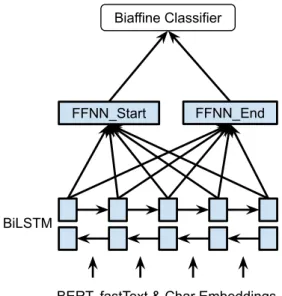
BERT, fastText & Char Embeddings BiLSTM
FFNN_Start FFNN_End Biaffine Classifier
Figure 1: The network architectures of our system.
3 Methods
Our model is inspired by the dependency parsing model ofDozat and Manning(2017). We use both word embeddings and character embeddings as in-put, and feed the output into a BiLSTM and finally to a biaffine classifier.
Figure1shows an overview of the architecture. To encode words, we use both BERTLargeand
fast-Text embeddings (Bojanowski et al.,2016). For BERT we follow the recipe of (Kantor and Glober-son,2019) to obtain the context dependent embed-dings for a target token with 64 surrounding tokens each side. For the character-based word embed-dings, we use a CNN to encode the characters of the tokens. The concatenation of the word and character-based word embeddings is feed into a BiLSTM to obtain the word representations (x).
After obtaining the word representations from the BiLSTM, we apply two separate FFNNs to create different representations (hs/he) for the start/end of the spans. Using different representa-tions for the start/end of the spans allow the system to learn to identify the start/end of the spans sep-arately. This improves accuracy compared to the model which directly uses the outputs of the LSTM since the context of the start and end of the entity are different. Finally, we employ a biaffine model over the sentence to create al×l×cscoring tensor (rm), wherelis the length of the sentence andcis
the number of NER categories+ 1(for non-entity). We compute the score for a spaniby:
hs(i) =FFNNs(xsi) he(i) =FFNNe(xei) rm(i) =hs(i)>Umhe(i)
+Wm(hs(i)⊕he(i)) +bm
wheresiandeiare the start and end indices of the
spani, Um is ad×c×dtensor,Wm is a2d×c
matrix andbmis the bias.
The tensorrm provides scores for all possible
spans that could constitute a named entity under the constrain thatsi ≤ei(the start of entity is before its end). We assign each span a NER categoryy0:
y0(i) = arg max rm(i)
We then rank all the spans that have a category other than ”non-entity” by their category scores (rm(iy0)) in descending order and apply
follow-ing post-processfollow-ing constraints: For nested NER, a entity is selected as long as it does notclashthe boundaries of higher ranked entities. We denote a entityitoclashboundaries with another entityjif
si < sj ≤ei < ej orsj < si ≤ ej < ei, e.g. in the Bank of China, the entitythe Bank of clashes boundary with the entityBank of China, hence only the span with the higher category score will be se-lected. For flat NER, we apply one more constraint, in which any entity containing or is inside an entity ranked before it will not be selected. The learning objective of our named entity recognizer is to as-sign a correct category (including the non-entity) to each valid span. Hence it is a multi-class classi-fication problem and we optimise our models with softmax cross-entropy: pm(ic) = exp(rm(ic)) PC ˆ c=1exp(rm(icˆ)) loss=− N X i=1 C X c=1 yiclogpm(ic) 4 Experiments
Data Set. We evaluate our system on both nested and flat NER, for the nested NER task, we use the ACE20042,ACE 20053, and GENIA(Kim et al., 2003) corpora; for flat NER, we test our system on theCONLL2002 (Tjong Kim Sang,2002),CONLL
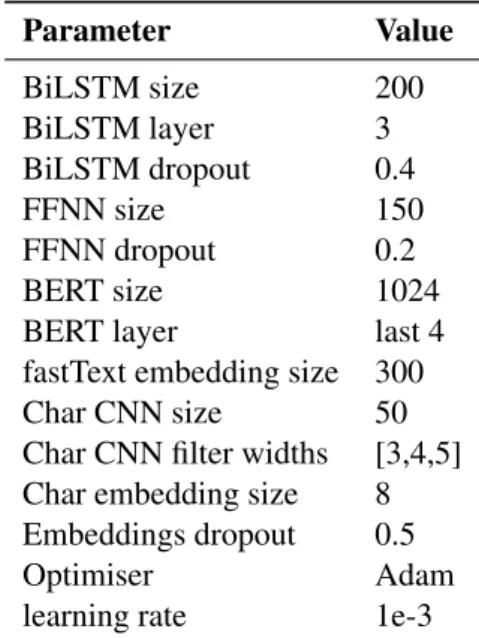
2 https://catalog.ldc.upenn.edu/LDC2005T09 3https://catalog.ldc.upenn.edu/LDC2006T06 Parameter Value BiLSTM size 200 BiLSTM layer 3 BiLSTM dropout 0.4 FFNN size 150 FFNN dropout 0.2 BERT size 1024
BERT layer last 4 fastText embedding size 300 Char CNN size 50 Char CNN filter widths [3,4,5] Char embedding size 8 Embeddings dropout 0.5
Optimiser Adam
learning rate 1e-3
Table 1: Major hyperparameters for our models.
2003 (Tjong Kim Sang and De Meulder,2003) andONTONOTES4corpora.
ForACE2004, ACE2005 we follow the same settings ofLu and Roth(2015) andMuis and Lu (2017) to split the data into 80%,10%,10% for train, development and test set respectively. To make a fair comparson we also used the same documents as inLu and Roth(2015) for each split.
ForGENIA, we use theGENIAv3.0.2 corpus. We preprocess the dataset following the same settings ofFinkel and Manning(2009) andLu and Roth (2015) and use 90%/10% train/test split. For this evaluation, since we do not have a development set, we train our system on 50 epochs and evaluate on the final model.
ForCONLL2002 andCONLL2003, we evaluate on all four languages (English, German, Dutch and Spanish). We followLample et al.(2016) to train our system on the concatenation of the train and development set.
For ONTONOTES, we evaluate on the English corpus and followStrubell et al.(2017) to use the same train, development and test split as used in CoNLL 2012 shared task for coreference resolution (Pradhan et al.,2012).
Evaluation Metric. We report recall, precision and F1 scores for all evaluations. The named en-tity is considered correct when both boundary and category are predicted correctly.
HyperparametersWe use a unified setting for all of the experiments, Table1shows
Model P R F1
ACE2004
Katiyar and Cardie(2018) 73.6 71.8 72.7 Wang et al.(2018) - - 73.3 Wang and Lu(2018) 78.0 72.4 75.1 Strakov´a et al.(2019) - - 84.4 Luan et al.(2019) - - 84.7 Our model 87.3 86.0 86.7 ACE2005
Katiyar and Cardie(2018) 70.6 70.4 70.5 Wang et al.(2018) - - 73.0 Wang and Lu(2018) 76.8 72.3 74.5 Lin et al.(2019) 76.2 73.6 74.9 Fisher and Vlachos(2019) 82.7 82.1 82.4 Luan et al.(2019) - - 82.9 Strakov´a et al.(2019) - - 84.3 Our model 85.2 85.6 85.4
GENIA
Katiyar and Cardie(2018) 79.8 68.2 73.6 Wang et al.(2018) - - 73.9 Ju et al.(2018) 78.5 71.3 74.7 Wang and Lu(2018) 77.0 73.3 75.1 Sohrab and Miwa(2018)5 93.2 64.0 77.1 Lin et al.(2019) 75.8 73.9 74.8 Luan et al.(2019) - - 76.2 Strakov´a et al.(2019) - - 78.3 Our model 81.8 79.3 80.5
Table 2: State of the art comparison onACE2004,ACE
2005 andGENIAcorpora for nested NER.
eters for our system.
5 Results on Nested NER
Using the constraints for nested NER, we first eval-uate our system on nested named entity corpora: ACE2004,ACE2005 andGENIA. Table2shows the results. BothACE2004 andACE2005 contain 7 NER categories and have a relatively high ratio of nested entities (about 1/3 of then named entities are nested). Our results outperform the previous SoTA system by 2% (ACE2004) and 1.1% (ACE2005), respectively. GENIAdiffers fromACE 2004 and 5InSohrab and Miwa(2018), the last 10% of the training set is used as a development set, we include their result mainly because their system is similar to ours.
6The revised version is provided by the shared task organ-iser in 2006 with more consistent annotations. We confirmed with the author ofAkbik et al.(2018) that they used the revised version.
Model P R F1
ONTONOTES
Chiu and Nichols(2016) 86.0 86.5 86.3 Strubell et al.(2017) - - 86.8 Clark et al.(2018) - - 88.8 Fisher and Vlachos(2019) - - 89.2 Our model 90.8 91.8 91.3
CONLL2003 English
Chiu and Nichols(2016) 91.4 91.9 91.6 Lample et al.(2016) - - 90.9 Strubell et al.(2017) - - 90.7 Devlin et al.(2019) - - 92.8 Strakov´a et al.(2019) - - 93.4 Our model 93.6 93.3 93.5 CONLL2003 German Lample et al.(2016) - - 78.8 Strakov´a et al.(2019) - - 85.1 Our model 88.2 84.7 86.4
CONLL2003 German revised6 Akbik et al.(2018) - - 88.3 Our model 92.3 88.2 90.2 CONLL2002 Spanish Lample et al.(2016) - - 85.8 Strakov´a et al.(2019) - - 88.8 Our model 90.5 90.0 90.3 CONLL2002 Dutch Lample et al.(2016) - - 81.7 Akbik et al.(2019) - - 90.4 Strakov´a et al.(2019) - - 92.7 Our model 94.2 92.7 93.5
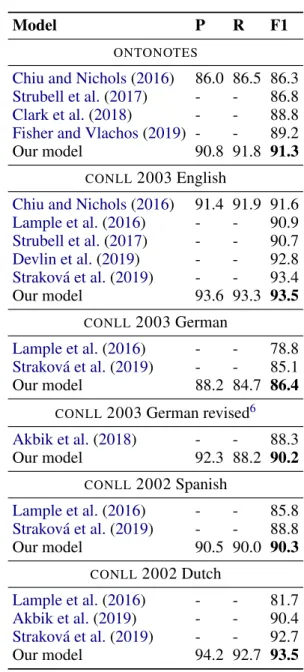
Table 3: State of the art comparison on CONLL2002,
CONLL2003,ONTONOTEScorpora for flat NER.
ACE2005 and uses five medical categories such as DNA or RNA. For theGENIAcorpus our sys-tem achieved an F1 score of 80.5% and improved the SoTA by 2.2% absolute. Our hypothesise is that forGENIAthe high accuracy gain is due to our structural prediction approach and that sequence-to-sequence models rely more on the language model embeddings which are less informative for cate-gories such as DNA, RNA. Our system achieved SoTA results on all three corpora for nested NER and demonstrates well the advantages of a struc-tural prediction over sequence labelling approach.
6 Results on Flat NER
We evaluate our system on five corpora for flat NER (CONLL2002 (Dutch, Spanish),CONLL2003 (En-glish, German) andONTONOTES. Unlike most of the systems that treat flat NER as a sequence la-belling task, our system predicts named entities by considering all possible spans and ranking them. The ONTONOTES corpus consists of documents form 7 different domains and is annotated with 18 fine-grained named entity categories. To predict named entities for this corpus is more difficult than forCONLL2002 andCONLL2003. These corpora use coarse-grained named entity categories (only 4 categories). The sequence-to-sequence models usually perform better on theCONLL2003 English corpus (see Table3), e.g. the system ofChiu and Nichols(2016);Strubell et al.(2017). In contrast, our system is less sensitive to the domain and the granularity of the categories. As shown in Table 3, our system achieved an F1 score of 91.3% on the ONTONOTES corpus and is very close to our system performance on theCONLL 2003 corpus (93.5%). On the multi-lingual data, our system achieved F1 scores of 86.4% for German, 90.3% for Spanish and 93.5% for Dutch. Our system out-performs the previous SoTA results by large margin of 2.1%, 1.5%, 1.3% and 0.8% on ONTONOTES, Spanish, German and Dutch corpora respectively and is slightly better than the SoTA on English data set. In addition, we also tested our system on the revised version of German data to compare with the model byAkbik et al.(2018), our system again achieved a substantial gain of 1.9% when compared with their system.
7 Conclusion
In this paper, we reformulate NER as a structured prediction task and adopted a SoTA dependency parsing approach for nested and flat NER. Our sys-tem uses contextual embeddings as input to a multi-layer BiLSTM. We employ a biaffine model to assign scores for all spans in a sentence. Further constraints are used to predict nested or flat named entities. We evaluated our system on eight named entity corpora. The results show that our system achieves SoTA on all of the eight corpora. We demonstrate that advanced structured prediction techniques lead to substantial improvements for both nested and flat NER.
Acknowledgments
This research was supported in part by the DALI project, ERC Grant 695662.
References
Alan Akbik, Tanja Bergmann, and Roland Vollgraf. 2019.Pooled contextualized embeddings for named entity recognition. InProceedings of the 2019 Con-ference of the North American Chapter of the Asso-ciation for Computational Linguistics: Human Lan-guage Technologies, Volume 1 (Long and Short Pa-pers), pages 724–728, Minneapolis, Minnesota. As-sociation for Computational Linguistics.
Alan Akbik, Duncan Blythe, and Roland Vollgraf. 2018. Contextual string embeddings for sequence labeling. In Proceedings of the 27th International Conference on Computational Linguistics, pages 1638–1649, Santa Fe, New Mexico, USA. Associ-ation for ComputAssoci-ational Linguistics.
Barry Haddow Beatrice Alex and Claire Grover. 2007. Recognising nested named entities in biomedical text. InProc. of BioNLP, pages 65–72.
Piotr Bojanowski, Edouard Grave, Armand Joulin, and Tomas Mikolov. 2016. Enriching word vec-tors with subword information. arXiv preprint arXiv:1607.04606.
Jason PC Chiu and Eric Nichols. 2016. Named entity recognition with bidirectional lstm-cnns. Transac-tions of the Association for Computational Linguis-tics, 4:357–370.
Kevin Clark, Minh-Thang Luong, Christopher D. Man-ning, and Quoc Le. 2018. Semi-supervised se-quence modeling with cross-view training. In Pro-ceedings of the 2018 Conference on Empirical Meth-ods in Natural Language Processing, pages 1914– 1925, Brussels, Belgium. Association for Computa-tional Linguistics.
Ronan Collobert, Jason Weston, L´eon Bottou, Michael Karlen, Koray Kavukcuoglu, and Pavel Kuksa. 2011. Natural language processing (almost) from scratch. Journal of machine learning research, 12(Aug):2493–2537.
Jacob Devlin, Ming-Wei Chang, Kenton Lee, and Kristina Toutanova. 2019. Bert: Pre-training of deep bidirectional transformers for language understand-ing. InProceedings of the 2019 Annual Conference of the North American Chapter of the Association for Computational Linguistics.
Timothy Dozat and Christopher Manning. 2017. Deep biaffine attention for neural dependency parsing. In Proceedings of 5th International Conference on Learning Representations (ICLR).
Jenny Rose Finkel and Christopher D. Manning. 2009. Nested named entity recognition. InProceedings of the 2009 Conference on Empirical Methods in Nat-ural Language Processing, pages 141–150, Singa-pore. Association for Computational Linguistics. Joseph Fisher and Andreas Vlachos. 2019. Merge and
label: A novel neural network architecture for nested NER. In Proceedings of the 57th Annual Meet-ing of the Association for Computational LMeet-inguis- Linguis-tics, pages 5840–5850, Florence, Italy. Association for Computational Linguistics.
Meizhi Ju, Makoto Miwa, and Sophia Ananiadou. 2018. A neural layered model for nested named en-tity recognition. InProceedings of the 2018 Con-ference of the North American Chapter of the Asso-ciation for Computational Linguistics: Human Lan-guage Technologies, Volume 1 (Long Papers), pages 1446–1459, New Orleans, Louisiana. Association for Computational Linguistics.
Ben Kantor and Amir Globerson. 2019. Coreference resolution with entity equalization. In Proceed-ings of the 57th Annual Meeting of the Association for Computational Linguistics, pages 673–677, Flo-rence, Italy. Association for Computational Linguis-tics.
Arzoo Katiyar and Claire Cardie. 2018.Nested named entity recognition revisited. In Proceedings of the 2018 Conference of the North American Chapter of the Association for Computational Linguistics: Hu-man Language Technologies, Volume 1 (Long Pa-pers), pages 861–871, New Orleans, Louisiana. As-sociation for Computational Linguistics.
J.-D. Kim, T. Ohta, Y. Tateisi, and J. Tsujii. 2003. GE-NIA corpus—a semantically annotated corpus for bio-textmining. Bioinformatics, 19(suppl1) :i180−
−i182.
Guillaume Lample, Miguel Ballesteros, Sandeep Subra-manian, Kazuya Kawakami, and Chris Dyer. 2016. Neural architectures for named entity recognition. In Proceedings of the 2016 Conference of the North Amer-ican Chapter of the Association for Computational Lin-guistics: Human Language Technologies, pages 260– 270. Association for Computational Linguistics. Hongyu Lin, Yaojie Lu, Xianpei Han, and Le Sun. 2019.
Sequence-to-nuggets: Nested entity mention detection via anchor-region networks. InProceedings of the 57th Annual Meeting of the Association for Computational Linguistics, pages 5182–5192, Florence, Italy. Associa-tion for ComputaAssocia-tional Linguistics.
Wei Lu and Dan Roth. 2015. Joint mention extraction and classification with mention hypergraphs. In Proceed-ings of the 2015 Conference on Empirical Methods in Natural Language Processing, pages 857–867, Lisbon, Portugal. Association for Computational Linguistics. Yi Luan, Dave Wadden, Luheng He, Amy Shah, Mari
Ostendorf, and Hannaneh Hajishirzi. 2019. A
gen-eral framework for information extraction using dy-namic span graphs. InProceedings of the 2019 Con-ference of the North American Chapter of the Associa-tion for ComputaAssocia-tional Linguistics: Human Language Technologies, Volume 1 (Long and Short Papers), pages 3036–3046, Minneapolis, Minnesota. Association for Computational Linguistics.
Xuezhe Ma and Eduard Hovy. 2016. End-to-end se-quence labeling via bi-directional LSTM-CNNs-CRF. InProceedings of the 54th Annual Meeting of the Asso-ciation for Computational Linguistics (Volume 1: Long Papers), pages 1064–1074, Berlin, Germany. Associa-tion for ComputaAssocia-tional Linguistics.
Aldrian Obaja Muis and Wei Lu. 2017.Labeling gaps be-tween words: Recognizing overlapping mentions with mention separators. InProceedings of the 2017 Confer-ence on Empirical Methods in Natural Language Pro-cessing, pages 2608–2618, Copenhagen, Denmark. As-sociation for Computational Linguistics.
Matthew E. Peters, Mark Neumann, Mohit Iyyer, Matt Gardner, Christopher Clark, Kenton Lee, and Luke S. Zettlemoyer. 2018. Deep contextualized word repre-sentations. InProceedings of the 2018 Annual Confer-ence of the North American Chapter of the Association for Computational Linguistics.
Sameer Pradhan, Alessandro Moschitti, Nianwen Xue, Olga Uryupina, and Yuchen Zhang. 2012. CoNLL-2012 shared task: Modeling multilingual unrestricted coreference in OntoNotes. In Proceedings of the Sixteenth Conference on Computational Natural Lan-guage Learning (CoNLL 2012), Jeju, Korea.
Dan Shen, Jie Zhang, Guodong Zhou, Jian Su, and Chew-Lim Tan. 2003. Effective adaptation of a Hidden Markov Model-based Named Entity Recognizer for the biomedical domain. In Proceedings of the ACL 2003 Workshop on Natural Language Processing in Biomedicine.
Mohammad Golam Sohrab and Makoto Miwa. 2018. Deep exhaustive model for nested named entity recog-nition. In Proceedings of the 2018 Conference on Empirical Methods in Natural Language Processing, pages 2843–2849, Brussels, Belgium. Association for Computational Linguistics.
Jana Strakov´a, Milan Straka, and Jan Hajic. 2019.Neural architectures for nested NER through linearization. In Proceedings of the 57th Annual Meeting of the Associ-ation for ComputAssoci-ational Linguistics, pages 5326–5331, Florence, Italy. Association for Computational Linguis-tics.
Emma Strubell, Patrick Verga, David Belanger, and An-drew McCallum. 2017. Fast and accurate entity recog-nition with iterated dilated convolutions. In Proceed-ings of the 2017 Conference on Empirical Methods in Natural Language Processing, pages 2670–2680, Copenhagen, Denmark. Association for Computational Linguistics.
Erik F. Tjong Kim Sang. 2002. Introduction to the CoNLL-2002 shared task: Language-independent named entity recognition. In COLING-02: The 6th Conference on Natural Language Learning 2002 (CoNLL-2002).
Erik F. Tjong Kim Sang and Fien De Meulder. 2003. In-troduction to the CoNLL-2003 shared task: Language-independent named entity recognition. InProceedings of the Seventh Conference on Natural Language Learn-ing at HLT-NAACL 2003, pages 142–147.
Bailin Wang and Wei Lu. 2018. Neural segmental hyper-graphs for overlapping mention recognition. In Pro-ceedings of the 2018 Conference on Empirical Meth-ods in Natural Language Processing, pages 204–214, Brussels, Belgium. Association for Computational Lin-guistics.
Bailin Wang, Wei Lu, Yu Wang, and Hongxia Jin. 2018. A neural transition-based model for nested mention recognition. In Proceedings of the 2018 Conference on Empirical Methods in Natural Language Process-ing, pages 1011–1017, Brussels, Belgium. Association for Computational Linguistics.
Changmeng Zheng, Yi Cai, Jingyun Xu, Ho-fung Leung, and Guandong Xu. 2019. A boundary-aware neural model for nested named entity recognition. In Pro-ceedings of the 2019 Conference on Empirical Methods in Natural Language Processing and the 9th Interna-tional Joint Conference on Natural Language Process-ing (EMNLP-IJCNLP), pages 357–366, Hong Kong, China. Association for Computational Linguistics.