House of Cards:
Code Smells in Open-source C# Repositories
Tushar Sharma, Marios Fragkoulis, and Diomidis Spinellis
Dept of Management Science and Technology
Athens University of Economics and Business
Athens, Greece
{tushar,mfg,dds}@aueb.gr
Abstract—Background: Code smells are indicators of quality problems that make a software hard to maintain and evolve. Given the importance of smells in the source code’s maintain-ability, many studies have explored the characteristics of smells and analyzed their effects on the software’s quality.
Aim:We aim to investigate fundamental characteristics of code smells through an empirical study on frequently occurring smells that examines inter-category and intra-category correlation be-tween design and implementation smells.
Method: The study mines 19 design smells and 11 implemen-tation smells in 1988 C# repositories containing more than 49 million lines of code. The mined data are statistically analyzed using methods such as Spearman’s correlation and presented through hexbin and scatter plots.
Results:We find thatunutilized abstractionandmagic number smells are the most frequently occurring smells in C# code. Our results also show that implementation and design smells exhibit strong inter-category correlation. The results of co-occurrence analysis imply that whenever unutilized abstraction or magic number smells are found, it is very likely to find other smells from the same smell category in the project.
Conclusions:Our experiment shows high average smell density (14.7and55.8for design and implementation smells respectively) for open source C# programs. Such high smell densities turn a software system into a house of cards reflecting the fragility introduced in the system. Our study advocates greater awareness of smells and the adoption of regular refactoring within the developer community to avoid turning software into a house of cards.
Keywords-Code smells, Implementation smells, Design smells, Code quality, Maintainability, C#.
I. INTRODUCTION
Code smells indicate the presence of quality problems impacting mainly the maintainability of a software system [1], [2]. The presence of an excessive number of smells in a software system turns it into ahouse of cardswhich is hard to maintain and evolve.
Code smells and their impact on various aspects of software development have been explored and discussed extensively [3]–[6]. Many source code mining studies have examined code smells [7]–[9]. Further, the impact of smells on dimensions such as change-proneness [10], [11], defect-proneness [12], [13], and systems’ quality [6] have been explored.
However, we observe the following gaps in the existing mining studies on smells:
• Existing mining studies on smells lackscale; the majority of the studies analyze a few subject systems (<10). To the best of our knowledge, Fontana et al. [6] analyzed 68 subject systems which are the maximum number of subject systems analyzed in this context. Generalizing a theory based on a few subject systems presents a considerable threat to validity.
• Existing mining studies also do poorly with respect to
breadthof the experimenti.e.,number of smells analyzed in the study. Most of the existing mining studies consider a small sub-set of known smells. This under-analysis makes a mining study incomplete or even incorrect.
• Most of the mining studies on code smells are per-formed on the Java programming language. The under-representation of other programming languages makes us wonder whether the results of the existing mining studies are applicable in other similar languages.
In this paper, we aim to fill these gaps and reveal fun-damental yet interesting characteristics of code smells in C# projects. These characteristics include — frequently occurring smells, inter-category and intra-category correlation between design and implementation smells, and the relationship of smell density with lines of code in each repository.
By exploring relationships between smell types we seek to find and comprehend models of smell occurrence and expansion. For instance, smell types with high probability may lead us to explore causal relationship among smells. Knowing the commonly occurring smells together may also be used to improve accuracy of smell detection mechanisms. This study can benefit software developers to help them understand the characteristics of relatively a wide range of smells and their potential implications. Raising the awareness is the first step towards cleaner code and less technical debt.
Based on the granularity and scope, smells can be clas-sified as implementation smells [1], design smells [2], and architecture smells [14]. We limit our discussion of smells to implementation and design smells in this paper.
II. OVERVIEW OF THE STUDY
We formulated the following research questions towards the quality analysis goal of C# projects.
RQ1.What is the distribution of design and implementation smells in C# code? We investigate the distribution of smells to find out whether there exists a set of implementation and design smells that occur more frequently w.r.t. another set of smells.
RQ2. What is the relationship between the occurrence of design smells and implementation smells?We study the degree of inter-category co-occurrence between design smells and implementation smells.
RQ3.Is the principle of coexistence applicable to smells in C# projects?It is commonly believed that patterns (and smells) co-exist [2], [15] i.e., if we find one smell, it is very likely that we will find many more smells around it. We investigate the intra-category co-occurrences of a smell with other smells to find out whether and to what degree the folklore is true.
RQ4. Does smell density depend on the size of the C# repository? We investigate the relationship between the size of a C# project repository and associated smell density to find out how the smell density changes as the size of a C# project increases for both the smell categories. Smell density is a normalized metric that represents the average number of smells identified per thousand lines of code.
III. STUDYDESIGN
In this section, we present the method that we employed to download and analyze source code repositories.
A. Mining GitHub repositories
We follow the procedure given below to select and down-load our subject systems.
1) We employ RepoReaper [16] to select curated GitHub repositories to download. RepoReaper assesses 10 di-mensions (architecture quality, community, continuous integration, documentation, history, license, manage-ment, state (active or dormant), unit tests, and num-ber of stars) of each repository and assigns a score corresponding to each dimension. We select all the repositories containing C# code where at least 8 out of 10 RepoReaper’s dimensions have favourable score. We consider a score favourable if it hastrue,active(for the state dimension), assigned stars greater than 10, or value greater than zero for rest of the dimensions.
2) With this criterion, we download more than 2400 repos-itories. We are able to analyze 1988 repositories using Designite [17]. Some of the repositories couldn’t be analyzed due to either missing external dependencies or custom build mechanism (i.e., missing standard C# project files).
3) We exclude test code from the analysis since test code contains a different type of smells (i.e.,test smells [18]) which is not in the scope of this paper.
Table I summarizes the characteristics of the analyzed repositories. In the table, LOC, WMC, NC, and DIT refers to Lines Of Code, Weighted Method per Class, Number of Children, andDepth of Inheritance Treerespectively [19].
TABLE I
CHARACTERISTICS OF THEANALYZEDREPOSITORIES— AVERAGES ARE COMPUTED PER TYPE;MEDIANLOCIS COMPUTED OVER REPOSITORY
Attributes Values Attributes Values
Repositories 1,988 Median LOC 4391
Type declarations 436,832 Average methods 5.86 Method declarations 2,265,971 Average fields 2.42 Lines of code (C# only) 49,303,314 Average properties 2.12 Average WMC 12.43
Average NC 0.28
Average DIT 0.31
B. Analyzing C# Repositories
We require a tool that detects a wide variety of design and implementation smells in C# code and at the same time allows us to perform smell mining on a large number of repositories automatically. We employDesignite1[17] (version 1.47.3) that supports detection of 19 design and 11 implementation smells. Further, it offers a customizable mechanism (i.e., console application and capability to specify projects to be analyzed in a batch file with other required parameters) to automatically analyze C# code in each repository.
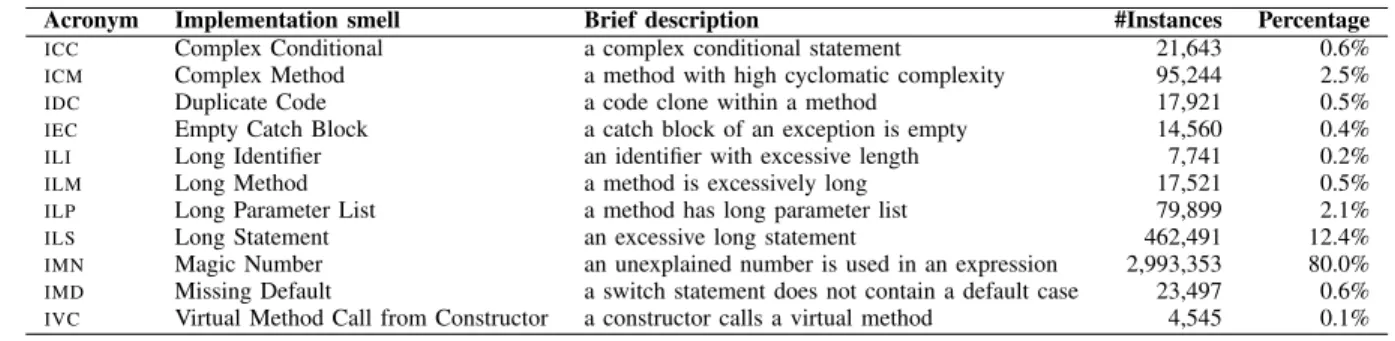
Tables II and III provide a brief description of detected design smells [2] and implementation smells [1], [20]–[22] respectively. We assign an acronym to each smell — design smell acronyms start with ‘D’ and implementation smell acronyms start with ‘I’ to make referencing easier.
C. Manual Verification
We chose two repositories randomly from the selected repositories and analyzed all the implementation and design smells detected by the tool manually. The selected reposito-ries were RestSharp2 (191KLOC) and rtable3 (12KLOC). We analyzed 261 design smells and 1863 implementation smells detected by Designite in these repositories manually. We found 11 instances of false positives (10 instances belonging to
complex method and one instance belonging to long method
smell) in implementation smells category and 2 instances of false positives (both belonging to unutilized abstraction) in design smells category.
The tool generates false positive instances of unutilized abstraction majorly due to the project which is using the abstraction is not included in the analysis (for example a test project). The reason behind the generated false positive instances belonging to complex method smell can be traced back to slightly different algorithm used to compute cyclo-matic complexity by the tool. In summary, the tool exhibits very low false positive rate and is suitable for a large scale mining study.
IV. RESULTS AND DISCUSSION
This section presents the results gathered from the analysis and our observationsw.r.t. each research question addressed.
1http://www.designite-tools.com 2https://github.com/restsharp 3https://github.com/Azure/rtable
TABLE II
DESCRIPTION OFDETECTEDDESIGNSMELLS ANDTHEIRDISTRIBUTION
Acronym Design smell Brief description #Instances Percentage
DBH Broken Hierarchy a supertype and its subtype conceptually do not share an “IS-A” relationship 20,332 4.8%
DBM Broken Modularization data and/or methods that ideally should have been localized into a single 15,624 3.7% abstraction are separated and spread across multiple abstractions
DCM Cyclically-dependent two or more abstractions depend on each other directly or indirectly 52,436 12.5% Modularization
DCH Cyclic Hierarchy a supertype in a hierarchy depends on any of its subtypes 4,342 1.0%
DDH Deep Hierarchy an inheritance hierarchy is “excessively” deep 179 0.04%
DDE Deficient Encapsulation the declared accessibility of one or more members of an abstraction is more 30,214 7.2% permissive than actually required
DDA Duplicate Abstraction two or more abstractions have identical names or identical implementation 73,992 17.6%
DHM Hub-like Modularization an abstraction has high incoming and outgoing dependencies 676 0.2%
DIA Imperative Abstraction an operation is turned into a class 11,790 2.8%
DIM Insufficient Modularization an abstraction exists that has not been completely decomposed, and a 26,429 6.3% further decomposition could reduce its size, or implementation complexity
DMH Missing Hierarchy conditional logic to explicitly manage variation in behaviour 2,598 0.6%
DMA Multifaceted Abstraction an abstraction has more than one responsibility assigned to it 1,236 0.3%
DMH Multipath Hierarchy a subtype inherits both directly as well as indirectly from a supertype 1,454 0.3%
DRH Rebellious Hierarchy a subtype rejects the methods provided by its supertype(s) 11,794 2.8%
DUE Unexploited Encapsulation client code uses explicit type checks 6,964 1.6%
DUH Unfactored Hierarchy there is unnecessary duplication among types in a hierarchy 20,962 5.0%
DUA Unnecessary Abstraction an abstraction that is actually not needed 44,583 10.6%
DTA Unutilized Abstraction an abstraction is left unused 90,786 21.6%
DWH Wide Hierarchy an inheritance hierarchy is “too” wide 3,140 0.7%
TABLE III
DESCRIPTION OFDETECTEDIMPLEMENTATIONSMELLS ANDTHEIRDISTRIBUTION
Acronym Implementation smell Brief description #Instances Percentage
ICC Complex Conditional a complex conditional statement 21,643 0.6%
ICM Complex Method a method with high cyclomatic complexity 95,244 2.5%
IDC Duplicate Code a code clone within a method 17,921 0.5%
IEC Empty Catch Block a catch block of an exception is empty 14,560 0.4%
ILI Long Identifier an identifier with excessive length 7,741 0.2%
ILM Long Method a method is excessively long 17,521 0.5%
ILP Long Parameter List a method has long parameter list 79,899 2.1%
ILS Long Statement an excessive long statement 462,491 12.4%
IMN Magic Number an unexplained number is used in an expression 2,993,353 80.0%
IMD Missing Default a switch statement does not contain a default case 23,497 0.6%
IVC Virtual Method Call from Constructor a constructor calls a virtual method 4,545 0.1%
RQ1.What is the distribution of design and implementation smells in C# code?
Approach:We compute the total number of detected smells for all the smells belonging to both implementation and design smell categories.
Results: Table II and III list the total number of instances detected for each smell.DTA(unutilized abstraction) andDCM
(cyclic-dependency modularization) are the most frequently occurring design smells. On the other hand,DDH(deep hierar-chy) is the least occurring design smell. To analyze it deeper, we computed the average number of children per class; a mere
0.28 indicates poor application of the principle of hierarchy in practice.
From the implementation smells side,IMN(magic number) and ILS (long statement) are the most frequently occurring smells. On the other hand, IVC (virtual method call from constructor) is the least occurring implementation smell.We observe that analyzed C# code on an average contains one magic number per 16 lines of code. It is surprizing to see a large number of magic number smells despite the fact that Designite excludes literals 0 and 1 while detecting the smell.
Interestingly, DDA (duplicate abstraction) is one of the most frequently occurring design smells butIDC(duplicate code) is one of the least frequently occurring implementa-tion smells.It is because the scope of both the smells differs significantly; clones belonging to DDA occur anywhere in a project (but not in the same method) and clones belonging to
IDC only occur within a method.
Implications: A high number of unutilized abstraction
indicates that developers don’t delete the obsolete code ei-ther knowingly or unknowingly. Such practices unnecessarily increase the cognitive load on the developers. Further, a large number of duplication also indicates poor application of the principle of abstraction and lack of refactoring.
RQ2. What is the relationship between the occurrence of design smells and implementation smells?
Approach: We compute the total instances of implemen-tation and design smells in each repository. We then com-pute Spearman’s correlation coefficient between the detected instances of implementation and design smells for each repos-itory. We also compute total types of smells detected in each repository belonging to both the categories and compute
Spearman’s correlation coefficient.
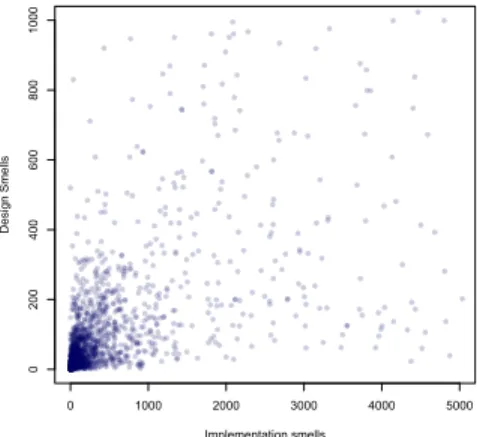
Results: Figure 1 presents a scatter graph showing the co-occurrence between total instances of detected implementation and design smells. The Spearman’s correlation coefficient between number of implementation and design smells detected
is 0.78059 (with p-value < 2.2e−16). It shows that high
volume of design (or implementation) smells is a very strong indication of the presence of high volume of implementation (or design) smells in a C# project.
0 1000 2000 3000 4000 5000 0 200 400 600 800 1000 Implementation smells D esi gn Sme lls
Fig. 1. Co-occurrence between detected implementation and design smell instances 0 5 10 15 20 0 2 4 6 8 10 12 Design Smells Imp le me nt at io n Sme lls 1 8 15 22 30 37 44 51 58 65 72 79 86 94 101 108 115 Counts
Fig. 2. Co-occurrence between detected implementation and design smell types
Further, we compute total types of smells, apart from total smell instances, detected in each repository belonging to both smells categories. Figure 2 shows a hexbin plot showing the co-occurrence between detected types of implementation and design smells. We get 0.80659 (with p-value<2.2e−16) as the Spearman’s correlation coefficient in this case.It strongly suggests that as the types of detected implementation (or design) smells increases, the types of detected design (or implementation) smells also increases.
Implications: Let us understand an implication of such a strong co-occurrence. Existing tools (such as NDepend4 and SonarQube5majorly detect implementation issues. Due to this limitation, a software development team using these tools perceive only a limited set of quality issues and thus issues at higher granularities go unnoticed. Our results shows that the presence of implementation smells is a strong indication of design smells and thus the results emphasize the need to pay attention to smells at all granularities.
RQ3.Is the principle of coexistence applicable to smells in C# projects?
Approach: We compute the average intra-category co-occurrence for each smell. Co-co-occurrence is commonly used in the biogeography; we use the co-occurrence index used by Connor et al. [23]. The following equation computes co-occurrence coefficient C between smellss1 ands2.
C(s1, s2) = n1×n2
N (1)
Here,n1andn2are the number of detected instances of smells
s1 and s2 respectively. N is the total number of detected smells in the repository.
Results:Figures 3 and 4 present the average co-occurrence for each smell for both the smell categories respectively.DTA
(unutilized abstraction) and DDH (deep hierarchy) show the highest and lowest co-occurrence respectively in the design smells category. Similarly, figure 4 shows that IMN (magic number) and IVC (virtual method call from constructor) ex-hibit the highest and lowest co-occurrence respectively in the implementation smells category.
0.31 1.18 0.03 2.4 1.96 0.8 0.18 0.410.70.02 1.39 0.08 0 0.04 0.11 0.31 0.55 0.07 0.54
Fig. 3. Average co-occurrence (intra-category) for design smells
It implies that wheneverunutilized abstractionormagic
numbersmells are found in C# code, it is very likely to find
other smells from the same smell category in the project. On the other hand, the smells deep hierarchy and virtual method call from constructor occur more independently. Co-occurrence of implementation smells (figure 4) show a large variation due to the huge difference in number of detected instances for each smell in the category.
Implications:These results reveal different smell expansion models where some smell types arise independently and others often occur as a group. This information is useful to developers when applying code refactoring with the purpose of removing
4http://www.ndepend.com/ 5https://www.sonarqube.org/
337.65 1257.03 1616.11 65.59 70258.65 356.79 55.32 242.24 293216.29 6764.83 161.9 ILM ICM ILP ILI ILS ICC IVC IEC IMN IDC IMD
Fig. 4. Average co-occurrence (intra-category) for implementation smells
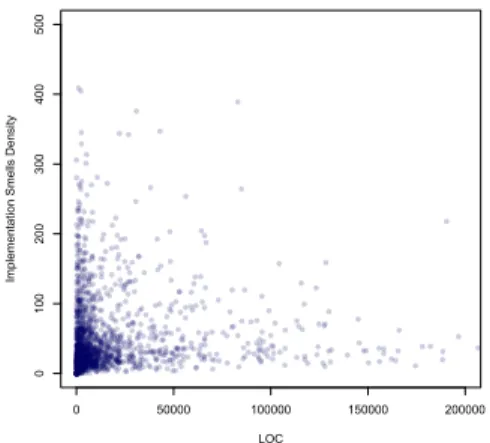
0 50000 100000 150000 200000 0 100 200 300 400 500 LOC Imp le me nt at io n Sme lls D en si ty
Fig. 5. Smell density for implementation smells against lines of code
smells because depending on the smell type they might have to expect other types of smells around it.
RQ4. Does smell density depend on the size of the C# repository?
Approach: We draw scatter plots between lines of code in a repository and the corresponding smell density for both the smell categories. We also computed Spearman’s correlation coefficient for both the categories.
Results:
Figure 5 and figure 6 show the distribution of smell density for implementation and design smells against lines of code. A visual inspection of the above graphs shows that distribution in figure 5 is more scattered and random than the distribution shown in figure 6. We compute Spearman’s correlation coeffi-cient between implementation as well as design smell density andLOC. The analysis reports0.27800 and−0.25426 as cor-relation coefficient (p-value<2.2e−16)w.r.t.implementation and design smell density respectively. The results show a weak positive correlation for implementation smell density and weak negative correlation for design smell density with size of the project. Given the low values for both the coefficients, it is undecidable whether smell density depends on the size of the project.
Implications: According to the current study no strong correlation is evident between the number of smell occurrences and project size. If we assume that our sample is representative
0 50000 100000 150000 200000 0 20 40 60 80 100 LOC D esi gn Sme lls D en si ty
Fig. 6. Smell density for design smells against lines of code
of the population of C# projects then this means that big projects do not necessarily suffer from higher smell density.
V. RELATEDWORK
Code smells [1], [2] are symptoms of software quality issues that affect a project’s maintainability and other quality attributes. Many aspects of smells have been investigated through empirical studies, such as the causes behind smells [3], the correlations between them [6], and the effect of refactoring actions on smells [9], [24]. The impact of smells on software quality has received considerable attention — some of the examined software quality dimensions are software mainte-nance [4], [5], change-proneness [10], [11], defect-proneness [12], [13], and systems’ quality [6].
Code smells can manifest in different scopes, that is, ar-chitecture [14], design [2], and implementation [1]. Usually smells are studied in categories according to the scope they manifest in. In this paper we mine design and implementation code smells from approximately two thousand C# repositories using static analysis.
Yamashita et al. [4] explored the co-existence of smells within the same as well as across categories and revealed their impact on maintainability. Similarly, the co-existence of the
God class andGod method smells and their effect has been investigated by Abbes et al. [25]. The relationship between smell density and project size has been previously studied in the context of configuration management code [22].
Our study examines the intra-category and inter-category co-occurrence of smells and smell density over project size for 30 smells in 49 million lines of C# code. The posed research questions combined with the scale of the study and the breadth of the analyzed smells differentiate it from the related work.
Finally, there have been a few attempts to study code smells for the C# language [26], [27]. However, they lack both scale in terms of the number of projects they process and breadth of analysis in terms of the number of smells they examine.
VI. THREATS TOVALIDITY
Construct validity concerns the appropriateness of the ob-servations made on the basis of measurements. False positives are always associated with static code analysis and so are applicable to the tool that we employed in this study. However, our manual verification (Section III-C) shows that the tool exhibits very low false positive cases.
External validity concerns generalizability and repeatability of the produced results. Our study analyzes only open-source C# projects. Given that majority of existing research target Java [7], [9], our study complements the current literature.
VII. CONCLUSIONS
In this paper, we analyzed 1988 repositories containing more than 49 millions lines of C# code and detected 30 types of smells (19 design and 11 implementation smells). The goal of this study is to reveal basic characteristics concerning code smells in C# projects when the scale (i.e., number of repositories) and the breadth (i.e.,number of detectable smells) of the analysis are large. We find that unutilized abstraction
and magic number are the most frequently occurring design and implementation smells respectively. We observe a high degree of correlation between the number of detected instances of implementation and design smells. We find that smells
unutilized abstractionandmagic numbershow the highest co-occurrence among the other smells in their category. Finally, our analysis observes that smell density and lines of code in a C# project do not show a strong correlation.
A house of cards is analogous to a fragile system which is very difficult to change and extend. Our experiment shows av-erage density of design smells14.7and implementation smells
55.8. Further, the highest recorded density for projects larger than1000LOCis95and1893for design and implementation smells respectively. A software system is turned into a house of cards with such high smell densities.
ACKNOWLEDGMENTS
This work is funded by the SENECA project, which is part of the Marie Skłodowska-Curie Innovative Training Networks (ITN-EID) under grant agreement number 642954.
REFERENCES
[1] M. Fowler, Refactoring: Improving the Design of Existing Programs, 1st ed. Addison-Wesley Professional, 1999.
[2] G. Suryanarayana, G. Samarthyam, and T. Sharma, Refactoring for
Software Design Smells: Managing Technical Debt, 1st ed. Morgan
Kaufmann, 2014.
[3] M. Tufano, F. Palomba, G. Bavota, R. Oliveto, M. Di Penta, A. De Lu-cia, and D. Poshyvanyk, “When and why your code starts to smell bad,” inProceedings of the 37th International Conference on Software
Engineering-Volume 1. IEEE Press, 2015, pp. 403–414.
[4] A. Yamashita and L. Moonen, “To what extent can maintenance prob-lems be predicted by code smell detection? – An empirical study,”
Information and Software Technology, vol. 55, no. 12, pp. 2223–2242,
2013.
[5] A. Yamashita and S. Counsell, “Code smells as system-level indicators of maintainability: An empirical study,” The Journal of System and
Software, vol. 86, no. 10, pp. 2639–2653, Oct. 2013.
[6] F. A. Fontana, V. Ferme, A. Marino, B. Walter, and P. Martenka, “Investigating the Impact of Code Smells on System’s Quality: An Empirical Study on Systems of Different Application Domains,” in
2013 IEEE International Conference on Software Maintenance (ICSM).
IEEE, Sep. 2013, pp. 260–269.
[7] G. Bavota, A. De Lucia, M. Di Penta, R. Oliveto, and F. Palomba, “An experimental investigation on the innate relationship between quality and refactoring,”Journal of Systems and Software, vol. 107, pp. 1–14, Jan. 2015.
[8] S. Fu and B. Shen, “Code Bad Smell Detection through Evolutionary Data Mining,” inInternational Symposium on Empirical Software
En-gineering and Measurement. IEEE, Nov. 2015, pp. 41–49.
[9] T. Saika, E. Choi, N. Yoshida, S. Haruna, and K. Inoue, “Do Developers Focus on Severe Code Smells?” in2016 IEEE 23rd International
Con-ference on Software Analysis, Evolution, and Reengineering (SANER).
IEEE, 2016, pp. 1–3.
[10] S. Olbrich, D. S. Cruzes, V. Basili, and N. Zazworka, “The evolution and impact of code smells: A case study of two open source systems,” in
2009 3rd International Symposium on Empirical Software Engineering
and Measurement (ESEM). IEEE, Aug. 2009, pp. 390–400.
[11] F. Khomh, M. Di Penta, and Y.-G. Gu´eh´eneuc, “An Exploratory Study of the Impact of Code Smells on Software Change-proneness,” in2009
16th Working Conference on Reverse Engineering, Ecole Polytechnique
de Montreal, Montreal, Canada. IEEE, Dec. 2009, pp. 75–84. [12] W. Li and R. Shatnawi, “An empirical study of the bad smells and class
error probability in the post-release object-oriented system evolution,”
Journal of Systems and Software, vol. 80, no. 7, pp. 1120–1128, Jul.
2007.
[13] L. Guerrouj, Z. Kermansaravi, V. Arnaoudova, B. C. M. Fung, F. Khomh, G. Antoniol, and Y.-G. Gu´eh´eneuc, “Investigating the relation between lexical smells and change- and fault-proneness: an empirical study,”
Software Quality Journal, pp. 1–30, May 2016.
[14] J. Garcia, D. Popescu, G. Edwards, and N. Medvidovic, “Identifying Architectural Bad Smells,” in CSMR ’09: Proceedings of the 2009
European Conference on Software Maintenance and Reengineering.
IEEE Computer Society, Mar. 2009, pp. 255–258.
[15] F. Buschmann, R. Meunier, H. Rohnert, P. Sommerlad, and M. Stal,
Pattern-Oriented Software Architecture Volume 1: A System of Patterns,
1st ed. Wiley, 1996.
[16] N. Munaiah, S. Kroh, C. Cabrey, and M. Nagappan, “Curating github for engineered software projects,” preprint available at PeerJ Preprints 4:e2617v1 https://doi.org/10.7287/peerj.preprints.2617v1.
[17] T. Sharma, “Designite: A Customizable Tool for Smell Mining in C# Repositories,” 10th Seminar on Advanced Techniques and Tools for
Software Evolution, Madrid, Spain, 2017.
[18] A. v. Deursen, L. Moonen, A. v. d. Bergh, and G. Kok, “Refactoring test code,” in Proceedings of the 2nd International Conference on
Extreme Programming and Flexible Processes (XP2001), M. Marchesi,
Ed. University of Cagliari, 2001, pp. 92–95.
[19] S. Chidamber and C. Kemerer, “A metrics suite for object oriented design,”Software Engineering, IEEE Transactions on, vol. 20, no. 6, pp. 476–493, Jun 1994.
[20] S. L. Abebe, S. Haiduc, P. Tonella, and A. Marcus, “The effect of lexicon bad smells on concept location in source code,” inProceedings - 11th IEEE International Working Conference on Source Code Analysis and
Manipulation, SCAM 2011, Fondazione Bruno Kessler, Trento, Italy.
IEEE, Nov. 2011, pp. 125–134.
[21] J. Bloch, Effective Java (2Nd Edition) (The Java Series), 2nd ed. Prentice Hall PTR, 2008.
[22] T. Sharma, M. Fragkoulis, and D. Spinellis, “Does your configuration code smell?” in Proceedings of the 13th International Workshop on
Mining Software Repositories, ser. MSR’16, 2016, pp. 189–200.
[23] E. Connor and D. Simberloff, “Species number and compositional similarity of the galapagos flora and avifauna,”Ecological Monographs, no. 48, pp. 219–248, 1978.
[24] G. Czibula, Z. Marian, and I. G. Czibula, “Detecting software design defects using relational association rule mining,”Knowledge and
Infor-mation Systems, vol. 42, no. 3, pp. 545–577, Mar. 2015.
[25] M. Abbes, F. Khomh, Y.-G. Gueheneuc, and G. Antoniol, “An empirical study of the impact of two antipatterns, blob and spaghetti code, on program comprehension,” in 15th European Conference on Software
Maintenance and Reengineering, ser. CSMR ’11. IEEE Computer
[26] S. Counsell, R. M. Hierons, H. Hamza, S. Black, and M. Durrand, “Exploring the eradication of code smells: An empirical and theoretical perspective,” Adv. Software Engineering, vol. 2010, pp. 820 103:1– 820 103:12, 2010.
[27] M. Gatrell, S. Counsell, and T. Hall, “Empirical Support for Two Refactoring Studies Using Commercial C# Software,” inProceedings of the 13th International Conference on Evaluation and Assessment in
Software Engineering, ser. EASE’09. British Computer Society, 2009,
![Table I summarizes the characteristics of the analyzed repositories. In the table, LOC , WMC , NC , and DIT refers to Lines Of Code, Weighted Method per Class, Number of Children, and Depth of Inheritance Tree respectively [19].](https://thumb-us.123doks.com/thumbv2/123dok_us/9955887.2488155/2.918.466.840.132.244/summarizes-characteristics-analyzed-repositories-weighted-children-inheritance-respectively.webp)