ISSN2338-7920 (O) / 2338-2619 (P)
Microfinance: Viable Approaches for Islamic Banking Implementation 1
Wan Noor Hazlina Wan Jusoh, 2Anita Md. Shariff 1
Academy of Contemporary of Islamic Studies Universiti Teknologi MARA Terengganu, Dungun Campus,
23000 Dungun, Terengganu, Malaysia.
Tel.: 6012-3595232 E-mail: [email protected] 2
Faculty of Business and Management
Universiti Teknologi MARA Terengganu, Dungun Campus, 23000 Dungun, Terengganu, Malaysia.
Tel.: 6019-2394490 E-mail: [email protected]
Abstract: Islamic banks have very much engaged in debt financing businesses the same way and as much as their conventional counterparts do. Debt financing businesses, as widely implemented, were specifically targeted for and tailored to the needs of middle and upper income group of people. The low income people remain left out and forgotten in most banking businesses while microfinance instruments, which are meant to help the poor and needy, remain unpopular among the banking institutions. There is indeed increasing calls for Islamic banks to seriously consider this type of instrument as part of their religious obligation embedded under their Islamic identity. This paper demonstrated that microfinance instruments are viable for Islamic banks to consider despite the claims that the contracts are less secured and hence, too risky to embark in. A number of microfinance instruments based on Islamic concepts namely Musyarakah, Murabahah, Mudharabah, Ijarah and Qard al-Hassan as well as operational frameworks such as SPV and wakalah, were being proposed and discussed to pave ways for its implementation by the Islamic banks.
Keywords: Islamic Microfinance, Islamic Banking, Poverty Alleviation, Risk Mitigation, Micro Entrepreneurs.
Introduction
At present, the access to microfinance to poor and low income people in Muslim countries is still low (Ali, 2014) DOWKRXJK ³PLFURILQDQFH´ which is an alternative term for ³PLFURFUHGLW´ (Businessdictionary.com, 2015) has a very close relationship with poverty alleviation. The term microfinance was first coined to label products or instruments created with an aim to provide a small scale financing for the poor. According to Segrado (2015), microfinance constitutes a range of financial services for people who are traditionally considered non target group of the banks since they lack guarantees that can protect a financial institution against a loss. Unlike most financial services that are exclusively available for the upper and middle income people, microfinance enables the poor to have access to financial resources needed to start a business. As their business grows, the entrepreneurs are able to generate a steady stream of income. Undeniably, microfinance is a powerful poverty alleviation tool (Obaidullah and Khan, 2008) DQG LQVWUXPHQWDO LQ D QDWLRQ¶V GHYHORSPHQW
There is a considerable number of successful stories across the globe which is related to microfinance institutions such as the Sanadiq project at Jabal al-+RVV LQ 6\ULD WKH 0X¶DVVDVDW
Rescue in Bangladesh (Obaidullah and Khan, 2008) and Akhuwat in Pakistan (Siddiqi, 2008). These institutions are, however, non-banking institutions.
Although microfinance is recognized as an influential poverty alleviation tool, there is agitation that microfinance has not been able to achieve its objective of fighting poverty, due to the shift that has taken place in the industry from poverty focused to profit oriented business (Hassan et al., 2013). In this development, a Muslim nation cannot just depend on zakat institutions or other non-banking institutions to play the role in helping the poor. Islamic banks should also play a role in reducing poverty rate in the country. This is proven when many writers such as Abdul Rahman (2007), Dusuki (2008), Shahinpoor (2009), Segrado (2005), Obaidullah and Khan (2008), Wilson (2007), Ahmed (2002), Dhumale and Sapcanin (1998) believe in the great potential of Islamic banking to be involved in microfinance programmes as an essential poverty alleviation approach to the non-bankable poor. Islamic banking should view their role in narrowing the gap between the rich and poor as part of corporate social responsibility agenda and more importantly, a religious obligation rendered unGHU LWV µ,VODPLF¶ labelling.
Microfinance and Poverty Alleviation
When discussing on microfinance, Grameen Bank in Bangladesh is a good example of a very successful microfinance institution. The award of the Nobel Peace Prize 2006 to the Grameen Bank and its founder, Prof. Muhamad Yunus has brought microfinance to international attention (Grameen Bank, 2010). The Grameen model holds to the views that many of the poor have potentials and necessary skills to be developed but lack financial resources and sustainable drive to move out of poverty. The poor should not be aided with charity money alone as it will only lead to dependency and lack of productivity or initiative to strive and earn a living.
It is undeniable that poverty alleviation remains the most important challenge amongst policy makers in the Muslim world that is predominantly characterized by high and rising poverty levels. These poverty levels are associated with high inequality alongside low productivity (Obaidullah and Khan, 2008). Obaidullah (2008a) further noted that more than three billion of the world population live in extreme poverty and in the matter of addressing the poverty issue, Muslim nations are far worse than the rest of the world. A large number of studies on poverty indicate that poor households are unable to participate in the development process due to being excluded from the financial system (Obaidullah, 2008b). With no access to financial services, these households find it extremely difficult to take advantage of the economic RSSRUWXQLWLHV EXLOG DVVHWV ILQDQFH WKHLU FKLOGUHQ¶V HGXFDWLRQ DQG SURWHFW WKHPVHOYHV DJDLQst financial shocks (Obaidullah and Khan, 2008).
There are various microfinance credit and saving instruments which are specifically tailored to the needs and conditions of poor entrepreneurs (Dhumale and Sapcanin, 1998). Through microenterprises, more jobs can be created to become source of income for this group. Thus, microfinance can be seen as a strong poverty alleviation tool which could empower people to finally carry out their own projects, ideas and businesses with the available resources, and therefore, escape assistance, subsidies and dependence (Segrado, 2005). Best practice experience around the world has shown that the poor are willing to pay a premium for quick, reliable and convenient financial services. Successful microfinance institutions have also demonstrated that, when managing in a business-like manner, transacting with entrepreneurs among the poor can be profitable and sustainable (Dhumale and Sapcanin, 1998).
Islamic Banking and Microfinance
Poverty alleviation, socio-economic justice and equitable distribution of income are among the primary goals of Islam and are considered part of the uncompromising features of an Islamic economy. The philosophical basis of Islamic financial system lies in µDGO (social justice) and ihsan (benevolencH DV LQIHUUHG IURP WKH 4XU¶DQ al-Nahl verse 90. The implication of these concepts is to care of those who are left behind in the market, unable to join economic forces or have no access to economic means which could enable them to further exploit the economic opportunities. Hence, the social role of Islamic financial institutions or Islamic banks is to provide finance to the poor so as to increase their income and wealth.
Historically, microfinance is not a new thing to Islamic bank. Mit Ghamr Saving Bank which was founded by Ahmad Al-Najjar in 1963 in Egypt was not only the first model of Islamic bank in the world (Haron and Wan Azmi, 2009) but was the first Islamic bank for the poor that initiated microfinance programme in the Islamic banking system. Since its goal was to industrialize Egyptian villages (El Naggar, 1978), most of its products offered during its successful period where tailored towards achieving this goal. The Mit Ghamr savings project was based on profit sharing concepts which are similar to certain concepts adopted by the modern microfinance institutions (Allen and Overy, 2009). This bank neither paid nor charged interest to investors or borrowers. With investments were mainly in trading and industrial activities, investors enjoyed certain rate of return in terms of shared profits generated from these business activities (Khir et al., 2008). The bank, however, lasted only until 1967 due to change in political climate (Haron and Wan Azmi, 2009).
Risk sharing, individual rights and duties, property rights, and the sanctity of contracts are all parts of the Islamic principles. Thus, many elements of the microfinance could be considered consistent with these extensive goals which Islamic banking must as well possess. The disbursement of collateral-free loans in certain instances is an example that Islamic banking and microfinance could share something in common. Thus, it is not impossible for Islamic banking to adopt large scale microfinance programmes since both complement one another in ideology and practice (Dhumale and Sapcanin, 1998).
These principles, however, are not embedded in conventional banking system which lack financial means and supports for microenterprises and farmers. Unlike larger producers, small manufacturers and farmers often face much greater difficulties in obtaining credit due to their inability to furnish tangible collaterals. Consequently, this creates a vicious circle whereby micro entrepreneurs cannot access to finance unless they can have sufficient collateral, which they can only possess through a strong productive base, which they can only build with an access to finance (Abdouli, 1991).
Islamic banks are supposed to behave like microfinance institutions that believe everyone in the economy is entitled to economic justice and that the poor is considered creditworthy. They should also be given the opportunity to participate in local economic activities through access to collateral-free loans. In reality, however, this is not happening since very few poor people are being aided by any institution to escape their dire economic circumstances (Shahinpoor, 2009).
Abdouli (1991) further highlighted that by taking intangible assets, such as education, skills, and experience, as collateral as opposed to tangible assets; Islamic banks can break this discriminative barrier and offer equal opportunities to all potential producers to improve their VRFLHW\¶V ZHOO-being. This approach is possible and doable through microfinance.
In spite of the wide acceptance of Islamic banking worldwide, the concept of financing for the poor or microfinance by Islamic banks was not well developed (Abdul Rahman, 2007). Islamic banks should endeavour to be the epicentre in the financial business system of promoting financial inclusive by engaging with community banking and microfinance
Bank Limited in Bangladesh have shown an exceptional example as Islamic commercial banks that provide microfinance schemes for poor entrepreneurs (Obaidullah and Khan, 2008).
Islamic Microfinance and Conventional Microfinance: A Comparison
Conventional microfinance and Islamic microfinance have much in common. Both emphasize the good of society as a whole, advocate entrepreneurship and risk sharing and believe that the poor should take part in such activities. Both microfinance institutions focus on developmental and social goals and advocate financial inclusion. Both involve participation by the poor (Obaidullah, 2008a). There are, however, some differences between these two.
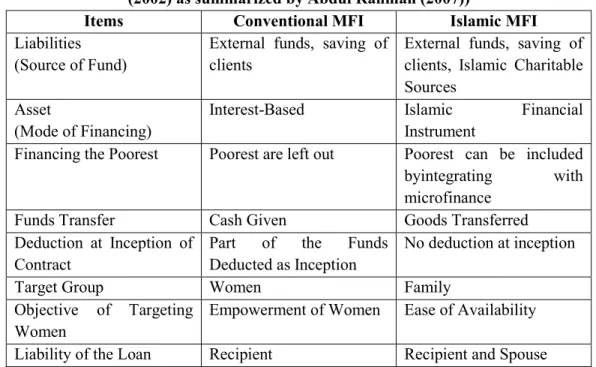
Ahmed (2002) pointed several dissimilarities that differentiate conventional microfinance from Islamic microfinance. First, the sources of funds of conventional microfinance come mainly from foreign donors, government and the central bank while that of Islamic microfinance mainly come from religious institutions such as waqf and other forms of charities. Islamic microfinance also maximizes social services by using zakat to fulfill the basic needs and to increase the productivity of the poor.
Second, unlike conventional microfinance that offers interest-bearing debt in its financing mode, Islamic microfinance offers profit sharing scheme. Islamic microfinance does not offer loan to their client since only interest-free loans (qardh al-hasan) are allowed in Islam. Therefore, profit sharing scheme is seen more viable and compatible with its main objective.
7KLUG ZLWK UHJDUGV WR WKH WDUJHW JURXS FRQYHQWLRQDO PLFURILQDQFH LQVWLWXWLRQ¶V FXVWRPHUV are mainly women since women are believed to be more creditworthy than men. Islamic microfinance institutions, on the other hand, target the family as a whole to encourage full participation and contribution of all family members in the business endeavour.
Fourth, conventional microfinance uses group financing as a way to mitigate risk in their operation. Although Islamic microfinance also use similar technique, most of the time they develop and educate Islamic ethical principles among their clients to ensure that borrowers will honour their debt payments when they fall due. The distinctions between Islamic and conventional microfinance are summarized in Table 1.
Table 1. Differences between Conventional and Islamic Microfinance (Source: Ahmed (2002) as summarized by Abdul Rahman (2007))
Items Conventional MFI Islamic MFI
Liabilities (Source of Fund)
External funds, saving of clients
External funds, saving of clients, Islamic Charitable Sources
Asset
(Mode of Financing)
Interest-Based Islamic Financial
Instrument
Financing the Poorest Poorest are left out Poorest can be included byintegrating with microfinance
Funds Transfer Cash Given Goods Transferred
Deduction at Inception of Contract
Part of the Funds Deducted as Inception
No deduction at inception
Target Group Women Family
Objective of Targeting Women
Empowerment of Women Ease of Availability Liability of the Loan Recipient Recipient and Spouse
(Which given to Women) Work Incentive of Employees
Monetary Monetary and Religious
Dealing with Default Group/Centre pressure and threat
Group / Centre / Spouse Guarantee and Islamic Ethic
Social Development Program
Secular (non Islamic ) behavioral, ethical, and social development
Religious (includes behavior, ethics and social)
Potential Approaches for Islamic Banking
Ibrahim (2003) highlighted that Islamic banks should be able to manage and utilize Islamic financing formula to provide venture capital to small entrepreneurs. Unfortunately, despite of a great deal of scholastic work being proposed on Islamic approach for financing, very little practical application is being carried out. Hence, this paper argues that there are viable approaches of Islamic microfinance programme for Islamic banking application in terms of instruments and operational frameworks which seem to be practical at the moment. Despite of many obstacles that might be faced by the Islamic banks especially in managing credit risk, there are indeed many approaches or solutions that could be considered. The obstacles should not deter any effort to offer a viable financing for the poor since microfinance has the potential to significantly alleviate poverty. However, to accomplish this goal the field needs to cater for different tastes and different levels of poverty (El-Komi and Croson, 2013).
Islamic Microfinance Instruments
Abdul Rahman (2007, 2010) pointed out the following concepts have great potentials to be developed and applied as Islamic microfinance instruments:
Mudharabah
Mudharabah has the potential to be adapted as Islamic microfinance instrument. Mudharabah is where the capital provider or Islamic bank (rabbul mal) and microentrepreneur (mudharib) become partners. The profits from the project are shared between capital provider and entrepreneur, but the financial loss will be incured entirely by the capital provider. This is due to the premise that a mudharib invests the mudharabah capital on a trust basis; hence it is not liable for the amount of capital unless there are negligence and breach of the terms of mudharabah contract.
In this light, the Islamic bank may face capital impairment risk since loss making operations of micro entrepreneurs may expose the Islamic bank to the risk of capital erosion. In addition, in mudharabah, the Islamic banks are not allowed to request collateral which may in turn expose Islamic bank to credit risk on these transactions. In order to mitigate equity investment risk, the Islamic banks need to play an active role in the process of monitoring, albeit that the entrepreneur exercises full control in managing the business (Iqbal and Mirakhor, 2007).
Musyarakah
Musyarakah can also be developed as a microfinance instrument where Islamic banking will enter into a partnership with micro entrepreneurs. If there is profit, it will be shared based on pre-agreed ratio, and if there is loss, it will then be shared according to capital contribution ratio. The most suitable technique of musyarakah for microfinance could be the concept of diminishing partnership or musyarakah mutanaqisah.
In the case of musyarakah mutanaqisah, capital is not permanent and every repayment of capital by the micro entrepreneur will diminish the total capital ratio for the capital provider. This will increase the total capital ratio for the entrepreneur until the micro entrepreneur becomes the sole proprietor for the business. The repayment period is dependent upon the pre-agreed period. This scheme is more suitable for existing business that needs new or additional capital for expansion.
Musyarakah capital may also be subjected to capital impairment risk, where the capital may not be recovered. The normal risk mitigation techniques that can be adopted by Islamic banks are also applicable in the microfinance i.e. through a third party guarantee (Ayub, 2007). This guarantee can be obtained and structured for the loss of capital of some or all partners through the active role of the so called Credit Guarantee Corporation (CGC) as practiced by SME financing in Malaysia.
Murabahah
Using
murabahah
as a mode of microfinance requires Islamic bank to obtain and
purchase asset or business equipment then sells the asset to micro entrepreneur at
mark-up price. Repayments of the selling price will be paid on instalment basis. The Islamic
bank will become the owner of the asset until full settlement is made. Through this
instrument, borrowers must form a group of micro entrepreneurs where all members
will act as guarantor if there is default among their group members. The advantage of
this mode of financing is continuous supervision, and entrepreneurs with a good
reputation of repayment will be offered extra loan.
Murabahah
could be easily implemented for microfinance purposes and can be
further exemplified with the use of deferred payment sale (
ED\¶ DO
-muajjal
).
Murabahah
, however, may expose microfinance institution to credit risk. This,
however, can be mitigated by requesting for an
urbun
(deposit), a third party financial
guarantee, or pledge of assets. Furthermore, Islamic bank can also institute direct debit
IURP WKH HQWUHSUHQHXU¶V DFFRXQW FHQWUDOL]H EODFNOLVWLQJ V\VWHP DQG PLQLPL]H QRQ
-compounded penalty to prevent delinquent entrepreneurs.
IjarahIjarah by definition is a long term contract of rental subject to specified conditions as prescribed by the Shariah. In this scheme, the lessor (Islamic bank) not only owns the asset but takes the responsibility of monitoring the use of asset and executes its responsibility to maintain and repair in case mechanical default that is not due to wear and tear.
Ijarah muntahia bittamlik is an elaborate concept of ijarah where the transfer of ownership will take place at the end of the contract and pre-agreed between the lessor and the lessee. This concept is more appropriate for microfinance scheme especially for micro entrepreneurs who are in need of assets or equipment. Islamic bank will purchase the assets required by the entrepreneurs and rent the assets to qualified entrepreneurs. In this case, the entrepreneurs can just rent the asset over an agreed period and pay the rentals at stipulated time.
The entrepreneur as lessee will be responsible to protect the asset whereas Islamic bank as the lessor will monitor their usage.
As a pre-emptive measure in facing default entrepreneurs who are unable to pay the rental as it falls due, Islamic banking can request an urbun from the entrepreneurs which also can be taken as an advanced payment of the lease rental. Alternatively, the Islamic banking as the owner of the asset should have the right to repossess the asset (Haron & Hock, 2007).
Qardh al-Hasan
Qardh al-hasan or simply means an interest-free loan or a benevolence loan is another concept that can be applied for microfinance purposes. Islamic banking can provide this scheme to the entrepreneurs who are in need of small start-up capital and have no business experience. The Islamic bank then will only be allowed to charge a service fee. The term of repayment will be on instalment basis for an agreed time. The instrument is also relevant for micro entrepreneurs who are in need of immediate cash and has good potential to make full settlement. In this case, the Islamic bank will bear the credit risk and they need to choose the right technique to ensure repayments to be received as agreed. In this regard, Saqib et al. (2015) proved that qardh al-hasan is a viable option for fulfilling this need and is beneficial for the small farmers as well as for the Islamic banks or financial institutions.
Suggested Operational Framework
Obaidullah and Khan (2008) noted that the formal banking system, as it is structured currently, is not designed to serve the financing needs of the poorer segments of the Muslim society. A strategic response to this would call for a review of Central Bank policies in Muslim countries to encourage banks to engage in microfinance. This would require formulation of modified banking regulations to accommodate special characteristics of the microfinance sector. This paper suggests two types of Islamic microfinance operational framework that can be formulated for Islamic banking application.
Financing through Special Purpose Vehicle
A main concern for banks to be involved in microfinance is how to manage their risk inherent in financing activities involving the poor and small entrepreneurs. The issue of risk is vital to ensure their viability and sustainability. Dusuki (2008) proposed one of the possible alternatives for banks to get involved in microfinance which is through a special purpose vehicle (SPV). An SPV is a legal entity created by a firm (known as the sponsor or originator) to undertake some specific purpose for which they were created (Gorton and Souleles, 2005). The proposed idea is applicable as it has an important feature which is bankruptcy-remote in nature, which makes it promising as a vehicle to offer microfinance (Dusuki, 2008).
Dusuki (2008) further suggested that Islamic banks may establish an SPV by allocating certain amount of funds for microfinance purposes. The Articles of Association of the SPV will limit its business activities to a particular activity of the deal, such as the microfinance. The SPV must be fully bankruptcy-remote institution. Hence, the Islamic bank is fully protected from the failure of the SPV and thus maintaining its viability and sustainability in banking business. This means, the SPV cannot be a subsidiary of the Islamic bank and therefore, is not a potential liability for Islamic banks.
Wakalah Model
Another option available for Islamic microfinance operational framework is by using wakalah model. Abdul Rahman (2007) proposed the idea of wakalah model as widely used in
IRU ,VODPLF PLFURILQDQFH LQVWLWXWLRQ¶V DSSOLFDWLRQ JHQHUDOO\ 8QGHU WKLV PRGHO ,VODPLFbank will act as an agent. The Islamic banks will be paid an administrative fee for managing the fund. They do not have share in the wakalah fund, whose sole beneficiaries are the participants or in this case, the micro entrepreneurs. The latter collectively donate to the fund referred as WDEDUUX¶ (a term that implies solidarity and stewardship). The micro entrepreneurs, as participants, will then disburse the fund, and repay them through instalments with no interest being charged (Wilson, 2007).
Revenue coming into wakalah fund originated from five sources i.e., the donations (WDEDUUX¶) from the participants, modest administrative fee, the repayments by those participants who have obtained funds, the subsidy either from an NGO donor agency or from zakat fund and any income made on the financial assets held in the fund (Wilson, 2007). In this regards, rather than utilizing the fund from shareholders and depositors, Islamic banks will generate funds contributed by the government or zakat institution. This will consequently reduce the inherent risks of the Islamic bank (Abdul Rahman, 2007).
Conclusion
The paper argues that Islamic banking has the potential to provide viable and sustainable approaches as well as find ways to mitigate risk in order to make various microfinance instruments available for the poor. Islamic financing instruments based on mudarabah, musyarakah, murabahah, ijarah etc. have the significant features and characteristics that will improve income distribution among poor by allowing them to become entrepreneurs.
In sum, the inherent risks and lack of tangible collaterals are among the pushing factors that obstruct the Islamic banks in embarking microfinance programmes. This, however, can be solved by a few options of operational framework available in this paper i.e., financing through SPV and using wakalah model.
With such an impressive growth of Islamic banking over the last 30 years, there is an urgent call for Islamic banks to be reoriented and to play greater roles in the socio-economic development of Muslim society particularly the poor. Rather than overemphasizing on making profits and meeting the bottom line alone, Islamic banks must help the poor who are in need to escape from the utter poverty which are achievable through micro financing. The issue now lies in how much and how far this responsibility is actually implemented and whether Islamic banks find it necessary to uphold Islamic principles and fulfil Islamic agenda.
References
Abdouli, A. H., 1991. Access to finance and collaterals: Islamic versus Western banking, Journal of King Abdul Aziz University Islamic Economics, 3, 57-64.
Abdul Rahman, A. R., 2007. Islamic microfinance: a missing component in Islamic banking, Kyoto Bulletin of Islamic Area Studies, 1, 38-53.
Abdul Rahman, A. R., 2010. Islamic microfinance: an ethical alternative to poverty alleviation, Humanomics, 26, 284-295.
Ahmed, H., 2002. Financing microenterprises: An analytical study of Islamic microfinance institutions, Islamic Economic Studies, 9, 27-64.
Ali, A. E. E. S., 2014. Islamic Microfinance: Moving Beyond Financial Inclusion, IRTI Working Paper Series, Islamic Research and Training Institute: Jeddah.
Allen & Overy, 2009. Islamic Microfinance Report for the International Development Law Organization, International Development Law Organization. Available online: http://www.assaif.org/content/.../Islamic%20Microfinance%20Report.pdf [Accessed 25 June 2010].
Ayub, M., 2007. Understanding Islamic Finance, John Wiley & Sons:England.
Businessdictionary.com., 2015. Microfinance. Available online:
http://www.businessdictionary.com/definition/micro-finance.html [Accessed 31
May 2015].Dhumale, R. & Sapcanin, A., 1998. An application of Islamic banking principles to microfinance, Technical Note. Regional Bureau for Arab States, UNDP, in cooperation with the Middle East and North Africa Region, World Bank.
Dusuki, A. W., 2008. Banking for the poor: the role of Islamic banking in microfinance initiatives, Humanomics, 24, 49-66.
El-Komi, M. & Croson, R., 2013. Experiments in Islamic microfinance, Journal of Economic Behavior & Organization, 95, 252-269.
El Naggar, A. A., 1978. Islamic banks: A model and the challenge, in The Challenge of Islam (Ed.)Gauhar, A., Islamic Council Of Europe: London.
Gorton, G. B. & Souleles, N. S., 2005. Special Purpose Vehicles and Securitization, Working Paper. FRB Philadelphia.
Grameen Bank, 2010. The Nobel Peace Prize 2006. Available online:
http://www.grameen-info.org/index.php?option=com_content&task=view&id=197&Itemid=197
[Accessed 25 June 2010].Haron, S. & Wan Azmi, W. N., 2009. Islamic Finance and Banking System: Philosophies, Principles & Practices, Mc Graw Hill: Kuala Lumpur.
Microfinance Products for Islamic Banks in Malaysia, Middle-East Journal of Scientific Research, 17, 359-366.
Ibrahim, B.-E.-D. A., 2003. Poverty alleviation via Islamic banking finance to micro-enterprises (MEs) in Sudan: Some lessons for poor countries, in Sudan Economy Research Group Discussion Papers (Eds.) Wohlmuth, K. & Knedlik, T. University of Bremen: Bremen, Germany.
Iqbal, Z. & Mirakhor, A., 2007. An Introduction to Islamic Finance: Theory and Practice, John Wiley & Sons: Singapore.
Khir, K., Gupta, L. & Shanmugam, B., 2008. Islamic Banking: A Practical Perspective, Pearson Longman: Petaling Jaya, Selangor.
Obaidullah, M., 2008a. Introduction to Islamic Finance, International Institute of Islamic Business and Finance: India.
Obaidullah, M., 2008b. Role of Microfinance in Poverty Alleviation, Islamic Research and Training Institute, Islamic Development Bank: Jeddah.
Obaidullah, M. & Khan, T., 2008. Islamic Microfinance Development : Challenges and Initiatives. Islamic Research and Training Institute, Islamic Development Bank: Jeddah. Available online:
http://www.imad.in/mf-obadullah1.pdf [Accessed 20
June 2010].Saqib, L., Zafar, M. A., Khan, K., Roberts, K. W. & Zafar, A. M., 2015. Local agricultural financing and Islamic banks: is Qard-al-Hassan a possible solution? Journal of Islamic Accounting and Business Research, 6, 122-147.
Segrado, C., 2005. Islamic Microfinance and Socially Responsible Investments. Available online: http://www.gdrc.org/icm/islamic-microfinance.pdf [Accessed 30 May 2010]. Shahinpoor, N., 2009. The link between Islamic banking and microfinancing, International
Journal of Social Economics, 36, 996-1007.
Siddiqi, K., 2008. Potential of Islamic microfinance in Pakistan. Master Thesis, Loughborough University.
Wilson, R., 2007. Making Development Assistance Sustainable Through Islamic Microfinance, IIUM Journal of Economics and Management, 15, 197-217.