July 2008, Volume 27, Issue 8. http://www.jstatsoft.org/
Regression Models for Count Data in
R
Achim Zeileis Wirtschaftsuniversit¨at Wien Christian Kleiber Universit¨at Basel Simon Jackman Stanford University Abstract
The classical Poisson, geometric and negative binomial regression models for count data belong to the family of generalized linear models and are available at the core of the statistics toolbox in the R system for statistical computing. After reviewing the conceptual and computational features of these methods, a new implementation of hurdle and zero-inflated regression models in the functionshurdle()andzeroinfl() from the package pscl is introduced. It re-uses design and functionality of the basic R functions just as the underlying conceptual tools extend the classical models. Both hurdle and zero-inflated model, are able to incorporate over-dispersion and excess zeros—two problems that typically occur in count data sets in economics and the social sciences—better than their classical counterparts. Using cross-section data on the demand for medical care, it is illustrated how the classical as well as the zero-augmented models can be fitted, inspected and tested in practice.
Keywords: GLM, Poisson model, negative binomial model, hurdle model, zero-inflated model.
1. Introduction
Modeling count variables is a common task in economics and the social sciences. The classical Poisson regression model for count data is often of limited use in these disciplines because empirical count data sets typically exhibit over-dispersion and/or an excess number of zeros. The former issue can be addressed by extending the plain Poisson regression model in various directions: e.g., using sandwich covariances or estimating an additional dispersion parameter (in a so-called quasi-Poisson model). Another more formal way is to use a negative bino-mial (NB) regression. All of these models belong to the family of generalized linear models (GLMs, seeNelder and Wedderburn 1972;McCullagh and Nelder 1989). However, although these models typically can capture over-dispersion rather well, they are in many applications not sufficient for modeling excess zeros. SinceMullahy(1986) andLambert(1992) there is in-creased interest, both in the econometrics and statistics literature, in zero-augmented models
that address this issue by a second model component capturing zero counts. Hurdle models
(Mullahy 1986) combine a left-truncated count component with a right-censored hurdle
com-ponent. Zero-inflation models (Lambert 1992) take a somewhat different approach: they are mixture models that combine a count component and a point mass at zero. An overview of count data models in econometrics, including hurdle and zero-inflated models, is provided in
Cameron and Trivedi (1998,2005).
In R (R Development Core Team 2008), GLMs are provided by the model fitting functions
glm()(Chambers and Hastie 1992) in thestatspackage andglm.nb()in theMASS package
(Venables and Ripley 2002) along with associated methods for diagnostics and inference. Here,
we discuss the implementation of hurdle and zero-inflated models in the functions hurdle() and zeroinfl() in the pscl package (Jackman 2008), available from the Comprehensive R Archive Network (CRAN) at http://CRAN.R-project.org/package=pscl. The design of both modeling functions as well as the methods operating on the associated fitted model objects follows that of the base Rfunctionality so that the new software integrates easily into the computational toolbox for modeling count data in R.
The remainder of this paper is organized as follows: Section 2 discusses both the classical and zero-augmented count data models and their Rimplementations. In Section 3, all count regression models discussed are applied to a microeconomic cross-section data set on the demand for medical care. The summary in Section 4 concludes the main part of the paper; further technical details are presented in the appendix.
2. Models and software
In this section, we briefly outline the theory and its implementation in R (R Development
Type Distribution Method Description
GLM Poisson ML Poisson regression: classical GLM, estimated by maximum likelihood (ML)
quasi “quasi-Poisson regression”: same mean func-tion, estimated by quasi-ML (QML) or equivalently generalized estimating equa-tions (GEE), inference adjustment via esti-mated dispersion parameter
adjusted “adjusted Poisson regression”: same mean function, estimated by QML/GEE, inference adjustment via sandwich covariances
NB ML NB regression: extended GLM, estimated by ML including additional shape parameter zero-augmented Poisson ML zero-inflated Poisson (ZIP), hurdle Poisson
NB ML zero-inflated NB (ZINB), hurdle NB
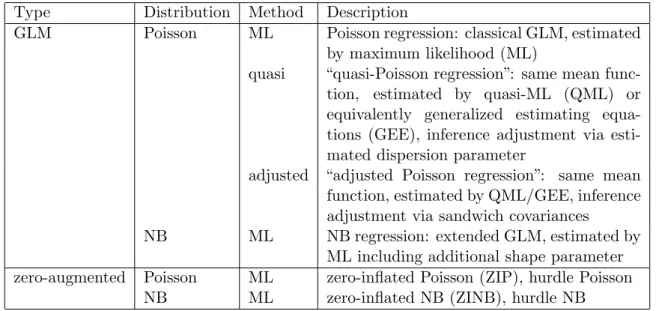
Table 1: Overview of discussed count regression models. All GLMs use the same log-linear mean function (log(µ) =x>β) but make different assumptions about the remaining likelihood. The zero-augmented models extend the mean function by modifying (typically, increasing) the likelihood of zero counts.
Core Team 2008) for some basic count data regression models as well as their zero-augmented extensions (see Table 1 for an overview). The classical Poisson, geometric and negative binomial models are described in a generalized linear model (GLM) framework; they are implemented in R by the glm() function (Chambers and Hastie 1992) in the stats package and the glm.nb() function in the MASS package (Venables and Ripley 2002). The hurdle and zero-inflated extensions of these models are provided by the functions hurdle() and zeroinfl()in packagepscl(Jackman 2008). The original implementation ofJackman(2008) was improved byKleiber and Zeileis(2008) forpsclto make the fitting functions and the fitted model objects more similar to theirglm()and glm.nb()counterparts. The most important features of the new hurdle() and zeroinfl() functions are discussed below while some technical aspects are deferred to the appendix.
An alternative implementation of zero-inflated count models is available in the currently orphaned packagezicounts(Mwalili 2007). Another extension of zero-inflated Poisson models is available in package ZIGP (Erhardt 2008) which allows dispersion—in addition to mean and zero-inflation level—to depend on regressors. However, the interfaces of both packages are less standard with fewer (or no) standard methods provided. Therefore, re-using generic inference tools is more cumbersome and hence these packages are not discussed here.
Two packages that embed zero-inflated models into more general implementations of GLMs and GAMs (generalized additive models) are gamlss (Stasinopoulos and Rigby 2007) and
VGAM (Yee 2008). The latter also provides hurdle models (under the name zero-altered
models). Both implementations allow specification of only one set of regressors.
In addition to zero-augmented models, there are many further extensions to the classical Poisson model which are not discussed here. Some important model classes include finite mixture models—implemented in Rin package flexmix (Leisch 2004)—and generalized esti-mating equations (GEE)—provided inR by packagegeepack (Halekoh, Højsgaard, and Yan 2006)—and mixed-effects models—available in R in packages lme4 and nlme (see Pinheiro
and Bates 2000). Further information about the models and alternative Rimplementations
can be found in the respective references. 2.1. Generalized linear models
Model frame
The basic count data regression models can be represented and understood using the GLM framework that emerged in the statistical literature in the early 1970s (Nelder and Wedderburn 1972). In the following, we briefly sketch some important aspects relating to the unifying conceptual properties and their implementation in R—for a detailed theoretical account of GLMs seeMcCullagh and Nelder(1989).
GLMs describe the dependence of a scalar variableyi (i= 1, . . . , n) on a vector of regressors
xi. The conditional distribution ofyi|xiis a linear exponential family with probability density function f(y;λ, φ) = exp y·λ−b(λ) φ +c(y, φ) , (1)
where λ is the canonical parameter that depends on the regressors via a linear predictor and φis a dispersion parameter that is often known. The functions b(·) and c(·) are known and determine which member of the family is used, e.g., the normal, binomial or Poisson
distribution. Conditional mean and variance of yi are given by E[yi|xi] = µi = b0(λi) and VAR[yi|xi] =φ·b00(λi). Thus, up to a scale or dispersion parameterφ, the distribution ofyi is determined by its mean. Its variance is proportional to V(µ) =b00(λ(µ)), also called variance function.
The dependence of the conditional mean E[yi|xi] =µi on the regressors xi is specified via
g(µi) = x>i β, (2)
where g(·) is a known link function and β is the vector of regression coefficients which are typically estimated by maximum likelihood (ML) using the iterative weighted least squares (IWLS) algorithm.
Instead of viewing GLMs as models for the full likelihood (as determined by Equation1), they can also be regarded as regression models for the mean only (as specified in Equation2) where the estimating functions used for fitting the model are derived from a particular family. As illustrated in the remainder of this section, the estimating function point of view is particularly useful for relaxing the assumptions imposed by the Poisson likelihood.
Rprovides a very flexible implementation of the general GLM framework in the functionglm()
(Chambers and Hastie 1992) contained in the stats package. Its most important arguments
are
glm(formula, data, subset, na.action, weights, offset,
family = gaussian, start = NULL, control = glm.control(...), model = TRUE, y = TRUE, x = FALSE, ...)
where formula plus data is the now standard way of specifying regression relationships in R/S introduced in Chambers and Hastie (1992). The remaining arguments in the first line (subset, na.action, weights, and offset) are also standard for setting up formula-based regression models in R/S. The arguments in the second line control aspects specific to GLMs while the arguments in the last line specify which components are returned in the fitted model object (of class “glm” which inherits from “lm”). By default the model frame (model) and the vector (y1, . . . , yn)> (y) but not the model matrix (x, containing x1, . . . , xn combined row-wise) are included. The family argument specifies the link g(µ) and variance functionV(µ) of the model, start can be used to set starting values for β, and control contains control parameters for the IWLS algorithm. For further arguments to glm() (including alternative specifications of starting values) see?glm. The high-levelglm()interface relies on the function glm.fit() which carries out the actual model fitting (without taking a formula-based input or returning classed output).
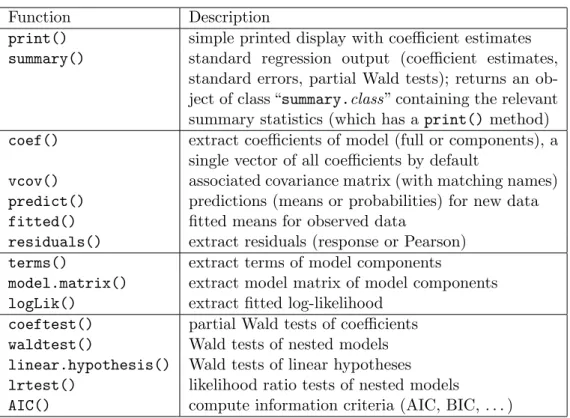
For “glm” objects, a set of standard methods (includingprint(),predict(),logLik() and many others) are provided. Inference can easily be performed using the summary() method for assessing the regression coefficients via partial Wald tests or the anova() method for comparing nested models via an analysis of deviance. These inference functions are comple-mented by further generic inference functions in contributed packages: e.g., lmtest (Zeileis
and Hothorn 2002) provides acoeftest()function that also computes partial Wald tests but
allows for specification of alternative (robust) standard errors. Similarly, waldtest() from lmtest and linear.hypothesis() from car (Fox 2002) assess nested models via Wald tests (using different specifications for the nested models). Finally,lrtest()fromlmtestcompares
nested models via likelihood ratio (LR) tests based on an interface similar towaldtest()and anova().
Poisson model
The simplest distribution used for modeling count data is the Poisson distribution with prob-ability density function
f(y;µ) = exp(−µ)·µ
y
y! , (3)
which is of type (1) and thus Poisson regression is a special case of the GLM framework. The canonical link is g(µ) = log(µ) resulting in a log-linear relationship between mean and linear predictor. The variance in the Poisson model is identical to the mean, thus the dispersion is fixed at φ= 1 and the variance function is V(µ) =µ.
In R, this can easily be specified in theglm()call just by setting family = poisson (where the default log link could also be changed in the poisson() call).
In practice, the Poisson model is often useful for describing the mean µi but underestimates the variance in the data, rendering all model-based tests liberal. One way of dealing with this is to use the same estimating functions for the mean, but to base inference on the more robust sandwich covariance matrix estimator. In R, this estimator is provided by the sandwich() function in the sandwichpackage (Zeileis 2004,2006).
Quasi-Poisson model
Another way of dealing with over-dispersion is to use the mean regression function and the variance function from the Poisson GLM but to leave the dispersion parameterφunrestricted. Thus, φis not assumed to be fixed at 1 but is estimated from the data. This strategy leads to the same coefficient estimates as the standard Poisson model but inference is adjusted for over-dispersion. Consequently, both models (quasi-Poisson and sandwich-adjusted Poisson) adopt the estimating function view of the Poisson model and do not correspond to models with fully specified likelihoods.
In R, the quasi-Poisson model with estimated dispersion parameter can also be fitted with the glm()function, simply settingfamily = quasipoisson.
Negative binomial models
A third way of modeling over-dispersed count data is to assume a negative binomial (NB) distribution for yi|xi which can arise as a gamma mixture of Poisson distributions. One parameterization of its probability density function is
f(y;µ, θ) = Γ(y+θ)
Γ(θ)·y! ·
µy·θθ
(µ+θ)y+θ, (4)
with mean µand shape parameterθ; Γ(·) is the gamma function. For every fixedθ, this is of type (1) and thus is another special case of the GLM framework. It also hasφ= 1 but with variance function V(µ) =µ+µθ2.
PackageMASS(Venables and Ripley 2002) provides the family functionnegative.binomial() that can directly be plugged into glm()provided the argumentthetais specified. One
appli-cation would be the geometric model, the special case where θ= 1, which can consequently be fitted in Rby setting family = negative.binomial(theta = 1)in the glm()call. If θ is not known but to be estimated from the data, the negative binomial model is not a special case of the general GLM—however, an ML fit can easily be computed re-using GLM methodology by iterating estimation ofβ given θand vice versa. This leads to ML estimates for bothβandθwhich can be computed using the functionglm.nb()from the packageMASS. It returns a model of class “negbin” inheriting from “glm” for which appropriate methods to the generic functions described above are again available.
2.2. Hurdle models
In addition to over-dispersion, many empirical count data sets exhibit more zero observations than would be allowed for by the Poisson model. One model class capable of capturing both properties is the hurdle model, originally proposed by Mullahy (1986) in the econometrics literature (see Cameron and Trivedi 1998, 2005, for an overview). They are two-component models: A truncated count component, such as Poisson, geometric or negative binomial, is employed for positive counts, and a hurdle component models zero vs. larger counts. For the latter, either a binomial model or a censored count distribution can be employed.
More formally, the hurdle model combines a count data model fcount(y;x, β) (that is left-truncated at y= 1) and a zero hurdle modelfzero(y;z, γ) (right-censored aty= 1):
fhurdle(y;x, z, β, γ) =
(
fzero(0;z, γ) ify= 0,
(1−fzero(0;z, γ))·fcount(y;x, β)/(1−fcount(0;x, β)) ify >0 (5) The model parameters β, γ, and potentially one or two additional dispersion parameters θ
(if fcount or fzero or both are negative binomial densities) are estimated by ML, where the specification of the likelihood has the advantage that the count and the hurdle component can be maximized separately. The corresponding mean regression relationship is given by
log(µi) = x>i β+ log(1−fzero(0;zi, γ))−log(1−fcount(0;xi, β)), (6) again using the canonical log link. For interpreting the zero model as a hurdle, a binomial GLM is probably the most intuitive specification1. Another useful interpretation arises if the same regressorsxi=zi are used in the same count model in both componentsfcount=fzero: A test of the hypothesisβ =γ then tests whether the hurdle is needed or not.
InR, hurdle count data models can be fitted with thehurdle()function from thepsclpackage
(Jackman 2008). Both its fitting function and the returned model objects of class “hurdle”
are modelled after the corresponding GLM functionality in R. The arguments of hurdle() are given by
hurdle(formula, data, subset, na.action, weights, offset, dist = "poisson", zero.dist = "binomial", link = "logit", control = hurdle.control(...),
model = TRUE, y = TRUE, x = FALSE, ...) 1
Note that binomial logit and censored geometric models as the hurdle part both lead to the same likelihood function and thus to the same coefficient estimates (Mullahy 1986).
where the first line contains the standard model-frame specifications, the second and third lines have the arguments specific to hurdle models and the arguments in the last line control some components of the return value.
If a formula of type y ~ x1 + x2 is supplied, it not only describes the count regression relationship ofyi and xi but also implies that the same set of regressors is used for the zero hurdle component zi = xi. This is could be made more explicit by equivalently writing the formula asy ~ x1 + x2 | x1 + x2. Of course, a different set of regressors could be specified for the zero hurdle component, e.g., y ~ x1 + x2 | z1 + z2 + z3, giving the count data modely ~ x1 + x2 conditional on (|) the zero hurdle modely ~ z1 + z2 + z3.
The model likelihood can be specified by the dist, zero.dist and link arguments. The count data distribution dist is "poisson" by default (it can also be set to "negbin" or "geometric"), for which the canonical log link is always used. The distribution for the zero hurdle model can be specified via zero.dist. The default is a binomial model with link (defaulting to"logit", but all link functions of the binomial()family are also supported), alternatively a right-censored count distribution (Poisson, negative binomial or geometric, all with log link) could be specified.
ML estimation of all parameters employing analytical gradients is carried out using R’s optim()with control options set inhurdle.control(). Starting values can be user-supplied, otherwise they are estimated by glm.fit() (the default). The covariance matrix estimate is derived numerically using the Hessian matrix returned byoptim(). See Appendix A for further technical details.
The returned fitted-model object of class “hurdle” is a list similar to “glm” objects. Some of its elements—such as$coefficients or$terms—are lists with a zero and count component, respectively. For details see AppendixA.
A set of standard extractor functions for fitted model objects is available for objects of class “hurdle”, including the usual summary() method that provides partial Wald tests for all coefficients. Noanova() method is provided, but the generalcoeftest(),waldtest()from lmtest, and linear.hypothesis() from car can be used for Wald tests andlrtest() from lmtestfor LR tests of nested models. The functionhurdletest() is a convenience interface tolinear.hypothesis()for testing for the presence of a hurdle (which is only applicable if the same regressors and the same count distribution are used in both components).
2.3. Zero-inflated models
Zero-inflated models (Mullahy 1986;Lambert 1992) are another model class capable of dealing with excess zero counts (see Cameron and Trivedi 1998, 2005, for an overview). They are two-component mixture models combining a point mass at zero with a count distribution such as Poisson, geometric or negative binomial. Thus, there are two sources of zeros: zeros may come from both the point mass and from the count component. For modeling the unobserved state (zero vs. count), a binary model is used: in the simplest case only with an intercept but potentially containing regressors.
Formally, the zero-inflated density is a mixture of a point mass at zeroI{0}(y) and a count dis-tributionfcount(y;x, β). The probability of observing a zero count is inflated with probability
π=fzero(0;z, γ):
where I(·) is the indicator function and the unobserved probability π of belonging to the point mass component is modelled by a binomial GLM π = g−1(z>γ). The corresponding regression equation for the mean is
µi = πi·0 + (1−πi)·exp(x>i β), (8) using the canonical log link. The vector of regressors in the zero-inflation model zi and the regressors in the count component xi need not to be distinct—in the simplest case,zi = 1 is just an intercept. The default link functiong(π) in binomial GLMs is the logit link, but other links such as the probit are also available. The full set of parameters ofβ,γ, and potentially the dispersion parameter θ(if a negative binomial count model is used) can be estimated by ML. Inference is typically performed for β and γ, while θis treated as a nuisance parameter even if a negative binomial model is used.
In R, zero-inflated count data models can be fitted with the zeroinfl() function from the pscl package. Both the fitting function interface and the returned model objects of class “zeroinfl” are almost identical to the correspondinghurdle()functionality and again mod-elled after the corresponding GLM functionality inR. The arguments ofzeroinfl()are given by
zeroinfl(formula, data, subset, na.action, weights, offset,
dist = "poisson", link = "logit", control = zeroinfl.control(...), model = TRUE, y = TRUE, x = FALSE, ...)
where all arguments have almost the same meaning as for hurdle(). The main difference is that there is no zero.distargument: a binomial model is always used for distribution in the zero-inflation component.
Again, ML estimates of all parameters are obtained from optim(), with control options set in zeroinfl.control() and employing analytical gradients. Starting values can be user-supplied, estimated by the expectation maximization (EM) algorithm, or byglm.fit() (the default). The covariance matrix estimate is derived numerically using the Hessian matrix returned by optim(). Using EM estimation for deriving starting values is typically slower but can be numerically more stable. It already maximizes the likelihood, but a singleoptim() iteration is used for determining the covariance matrix estimate. See Appendix Bfor further technical details.
The returned fitted model object is of class “zeroinfl” whose structure is virtually identical to that of “zeroinfl” models. As above, a set of standard extractor functions for fitted model objects is available for objects of class “zeroinfl”, including the usualsummary()method that provides partial Wald tests for all coefficients. Again, noanova()method is provided, but the general functionscoeftest()andwaldtest()fromlmtest, as well aslinear.hypothesis() fromcarcan be used for Wald tests, andlrtest()fromlmtestfor LR tests of nested models.
3. Application and illustrations
In the following, we illustrate all models described above by applying them to a cross-sectional data set from health economics. Before the parametric models are fitted, a basic exploratory analysis of the data set is carried out that addresses some problems typically encountered when
visualizing count data. At the end of the section, all fitted models are compared highlighting that the modelled mean function is similar but the fitted likelihood is different and thus, the models differ with respect to explaining over-dispersion and/or the number of zero counts. 3.1. Demand for medical care by the elderly
Deb and Trivedi(1997) analyze data on 4406 individuals, aged 66 and over, who are covered
by Medicare, a public insurance program. Originally obtained from the US National Medical Expenditure Survey (NMES) for 1987/88, the data are available from the data archive of the Journal of Applied Econometrics at http://www.econ.queensu.ca/jae/1997-v12.3/ deb-trivedi/. It was prepared for an R package accompanying Kleiber and Zeileis (2008) and is also available as DebTrivedi.rda in the Journal of Statistical Software together with
Zeileis (2006). The objective is to model the demand for medical care—as captured by the
number of physician/non-physician office and hospital outpatient visits—by the covariates available for the patients. Here, we adopt the number of physician office visits ofp as the dependent variable and use the health status variableshosp(number of hospital stays),health (self-perceived health status), numchron(number of chronic conditions), as well as the socio-economic variables gender, school (number of years of education), and privins (private insurance indicator) as regressors. For convenience, we select the variables used from the full data set:
R> dt <- DebTrivedi[, c(1, 6:8, 13, 15, 18)]
To obtain a first overview of the dependent variable, we employ a histogram of the observed count frequencies. In R various tools could be used, e.g., hist(dt$ofp, breaks = 0:90 -0.5) for a histogram with rectangles or
R> plot(table(dt$ofp))
(see Figure1) for a histogram with lines which brings out the extremely large counts somewhat better. The histogram illustrates that the marginal distribution exhibits both substantial variation and a rather large number of zeros.
A natural second step in the exploratory analysis is to look at pairwise bivariate displays of the dependent variable against each of the regressors bringing out the partial relationships. In R, such bivariate displays can easily be generated with the plot() method for formulas, e.g., via plot(y ~ x). This chooses different types of displays depending on the combina-tion of quantitative and qualitative variables as dependent or regressor variable, respectively. However, count variables are treated as all numerical variables and therefore the command
R> plot(ofp ~ numchron, data = dt)
produces a simple scatterplot as shown in the left panel of Figure2. This is clearly not useful as both variables are count variables producing numerous ties in the bivariate distribution and thus obscuring a large number of points in the display. To overcome the problem, it is useful to group the number of chronic conditions into a factor with levels ‘0’, ‘1’, ‘2’, and ‘3 or more’ and produce a boxplot instead of a scatterplot. Furthermore, the picture is much clearer if the dependent variable is log-transformed (just as all count regression models discussed above
Number of physician office visits Frequency 0 100 200 300 400 500 600 700 0 10 20 30 40 50 60 70 80 90
Figure 1: Frequency distribution for number of physician office visits.
● ● ● ● ● ● ● ● ● ● ● ● ● ● ● ● ● ● ● ● ● ● ● ● ● ● ● ● ● ● ● ● ● ● ● ● ● ● ● ● ●● ● ● ● ● ● ● ● ● ● ● ● ● ● ● ●●● ●●● ● ● ● ● ● ● ● ● ● ● ● ● ● ● ● ● ● ● ● ● ● ● ● ● ● ● ● ● ● ● ● ● ● ● ● ● ● ● ● ● ● ● ● ● ● ● ● ● ● ● ● ● ● ● ● ● ● ● ● ● ● ● ● ● ● ● ● ● ● ● ● ● ● ● ● ● ● ● ● ● ● ● ● ● ● ● ● ● ● ● ● ● ● ● ● ● ● ● ● ● ● ● ● ● ● ● ● ● ● ● ● ● ● ● ● ● ● ● ● ● ● ● ● ● ● ● ● ● ● ● ● ● ● ● ● ●● ● ● ● ● ● ● ● ● ● ● ●●● ● ●● ● ● ● ● ● ● ● ●● ● ●● ● ● ● ● ● ●●● ● ● ● ● ● ● ● ● ● ● ● ● ● ● ● ● ● ● ● ● ● ● ● ● ● ● ● ● ● ● ● ● ● ● ● ● ● ● ● ● ● ● ●●●●● ● ● ● ● ● ● ● ● ● ● ● ● ●● ● ● ● ● ● ● ● ● ● ● ● ● ● ● ● ● ● ● ● ● ● ● ● ● ● ● ● ● ● ● ● ● ● ● ● ● ● ● ● ● ● ● ●● ● ● ● ● ● ● ● ● ● ● ● ● ● ● ● ● ● ● ● ● ● ● ● ● ● ● ● ● ● ● ● ● ● ● ● ● ● ● ● ● ● ● ● ● ● ● ● ● ● ● ● ● ● ● ● ● ● ● ● ● ● ● ● ● ● ● ● ● ● ● ● ● ● ● ● ● ● ● ● ●●● ● ● ● ● ●● ● ● ● ● ● ● ● ● ● ● ● ● ● ● ● ● ● ● ● ● ● ● ● ● ● ● ● ● ● ● ● ● ● ● ● ● ● ● ● ● ● ● ● ● ● ● ● ● ● ● ● ● ● ● ● ● ● ● ● ● ● ● ● ● ● ● ● ● ● ● ● ● ● ● ● ● ● ● ● ● ● ● ● ● ● ●● ● ● ● ● ● ● ● ● ●● ● ● ● ● ● ● ● ● ● ● ● ● ● ● ● ● ● ● ● ● ● ● ● ● ● ● ● ● ● ● ● ● ● ● ● ● ● ● ● ● ● ● ● ● ● ● ● ● ● ● ● ● ● ● ● ● ● ● ● ● ● ● ● ● ● ● ● ● ● ● ● ● ● ● ● ● ● ● ● ● ● ● ● ● ● ● ● ● ● ● ● ● ● ● ● ● ● ● ● ● ● ● ● ● ● ● ● ● ● ● ● ● ● ● ● ● ● ● ● ● ● ● ● ● ● ● ● ● ● ● ● ● ● ●● ● ● ● ● ● ● ● ● ● ● ● ● ● ● ● ● ● ● ●● ● ● ● ● ● ● ● ● ● ● ● ● ● ● ● ● ● ● ● ● ● ● ● ● ● ● ● ● ● ● ● ● ● ● ● ● ● ● ● ● ● ● ● ● ● ● ● ● ● ● ● ● ● ● ● ● ● ● ● ● ● ● ● ● ● ●● ● ● ● ● ●● ● ● ● ● ● ● ● ● ● ● ● ● ● ● ● ● ● ● ● ● ● ●● ● ● ● ● ● ● ● ● ● ●● ● ● ● ● ● ● ● ● ● ● ● ● ● ● ● ● ● ● ● ● ● ● ● ● ● ● ● ● ● ● ● ● ● ● ● ● ● ● ● ● ● ● ● ●● ● ● ● ● ● ● ● ● ● ● ● ● ● ● ● ● ● ●● ● ● ● ● ● ● ● ● ● ● ● ●● ● ● ● ● ● ● ● ● ● ● ● ● ● ● ● ● ● ● ● ● ● ● ● ● ● ● ● ● ● ● ● ● ● ● ● ● ● ● ● ● ● ● ● ● ● ● ● ● ● ● ● ● ● ● ● ● ● ● ● ● ● ● ● ● ● ● ● ● ● ● ● ● ● ● ● ● ● ● ● ● ● ● ● ● ● ● ● ● ● ● ● ● ● ● ● ● ● ● ● ● ● ● ● ● ● ● ● ● ● ● ● ● ● ● ● ● ● ● ● ● ● ● ● ● ● ● ● ● ● ● ● ● ● ● ● ● ● ●● ● ● ● ● ● ● ● ● ● ● ● ● ● ● ● ● ● ● ● ● ● ● ● ● ● ● ● ● ● ● ● ● ●● ● ● ● ● ● ● ● ● ● ● ● ● ● ● ● ● ● ● ● ● ● ● ● ● ● ● ● ● ● ● ● ● ● ● ● ● ● ● ● ● ● ● ● ● ● ● ● ● ● ● ● ● ● ● ● ● ● ● ● ● ● ● ● ● ● ● ● ● ● ● ● ● ● ● ● ● ● ● ● ● ● ● ● ● ● ● ● ● ● ● ● ● ● ● ● ● ● ● ● ● ● ● ● ● ● ● ● ● ● ● ● ● ● ● ● ● ●● ● ● ● ● ● ● ● ● ● ● ● ● ● ● ● ● ● ● ● ● ● ● ● ●● ● ● ● ● ● ● ● ● ● ● ● ● ● ● ● ● ● ●● ● ● ● ● ● ● ● ● ● ● ● ● ● ● ● ● ● ● ● ● ● ● ● ● ● ● ● ● ● ● ● ● ● ● ● ● ● ● ● ● ● ● ● ● ● ● ● ● ●● ● ● ● ● ● ● ●● ●● ● ● ● ● ● ● ● ● ● ● ● ● ● ● ● ● ● ● ● ● ● ● ● ● ● ● ● ● ● ● ● ● ● ● ● ● ● ● ● ● ● ● ● ● ● ● ● ● ● ● ● ● ● ● ● ● ● ● ● ● ● ● ● ● ● ● ● ● ● ● ● ● ● ● ● ● ● ● ● ● ● ● ● ● ● ● ● ● ● ● ● ● ● ● ● ● ● ● ● ● ● ● ● ● ● ● ● ● ● ● ● ● ●● ● ● ● ● ● ● ● ● ● ● ● ● ● ● ● ● ● ● ● ● ● ● ● ● ● ● ● ● ● ● ● ● ● ● ● ● ● ● ● ● ● ● ● ● ● ● ● ● ● ● ● ● ● ● ● ● ● ● ● ● ● ● ● ● ● ● ● ● ● ● ● ● ● ● ● ● ● ● ● ● ● ● ● ● ● ● ● ●● ● ● ● ● ● ● ● ● ● ● ● ● ● ● ● ● ● ● ● ● ● ● ● ● ● ● ● ● ● ● ● ● ● ● ● ● ● ● ● ● ● ● ● ● ● ● ● ● ● ● ● ● ● ● ●● ● ● ● ● ● ● ● ● ● ● ● ● ● ● ● ● ● ● ● ● ● ● ● ● ● ●● ● ● ● ● ● ● ● ● ● ● ● ● ● ● ● ● ● ● ● ● ● ● ● ● ● ● ● ● ● ● ● ● ● ● ● ● ● ● ● ● ● ● ● ● ● ● ● ● ● ● ● ● ● ● ● ● ● ● ● ● ● ● ● ● ● ● ● ● ● ● ● ● ● ● ● ● ● ● ● ● ● ● ● ● ● ● ● ● ● ● ● ● ● ● ● ● ● ● ● ● ● ● ● ● ● ● ● ● ● ● ● ● ● ● ● ● ● ● ● ● ● ● ● ● ● ● ● ● ● ● ● ● ● ● ● ● ● ● ● ● ● ● ● ● ●● ● ● ● ● ● ● ● ● ● ● ● ● ● ● ● ● ● ● ● ● ● ● ● ● ● ● ● ● ● ● ● ● ● ● ● ● ● ● ● ● ● ● ● ● ● ● ● ● ● ● ● ● ● ● ● ● ● ● ● ● ● ● ● ● ● ● ● ● ● ● ● ● ● ● ● ● ● ● ● ● ● ● ● ● ● ● ● ● ● ● ● ● ● ● ● ● ● ● ● ● ● ● ● ● ● ● ● ● ● ● ● ● ● ● ● ● ● ● ● ● ● ● ● ● ● ● ● ● ● ● ● ● ● ● ● ● ● ● ● ● ● ● ● ● ● ● ● ● ● ● ● ● ● ● ● ● ● ● ● ● ● ● ● ● ● ● ● ● ● ● ● ● ● ● ● ● ● ● ● ● ● ● ● ● ● ● ● ● ● ● ● ● ● ● ● ● ● ● ● ● ● ● ● ● ● ● ● ● ● ● ● ● ● ● ● ● ● ● ● ● ● ● ● ● ● ● ● ● ● ● ● ● ● ● ● ● ●● ● ● ● ● ● ●● ● ● ● ● ● ● ● ● ● ● ● ● ● ● ● ● ● ● ● ● ● ● ● ● ● ● ● ● ● ● ● ● ● ● ● ● ● ● ● ● ● ● ● ● ● ● ● ● ● ● ● ● ● ● ● ● ● ● ● ● ● ● ● ● ● ● ● ● ● ● ● ● ● ● ● ● ● ●● ● ● ● ● ● ● ● ● ● ● ● ● ● ● ● ● ● ● ● ● ● ● ● ● ● ● ● ● ● ● ● ● ● ● ● ● ● ● ● ● ● ● ● ● ● ● ● ● ● ●●● ● ● ● ●● ● ● ● ● ● ● ●● ● ● ● ● ● ● ● ● ● ● ● ● ● ● ● ● ● ● ● ● ●● ● ● ● ● ● ● ● ● ● ● ● ● ● ● ● ● ● ● ● ● ● ● ● ● ● ● ● ● ● ● ● ● ● ● ● ● ● ● ● ● ● ● ● ● ● ● ● ● ● ● ● ● ● ● ● ● ● ● ● ● ● ● ● ● ● ● ● ● ● ● ● ● ● ● ●● ● ● ● ● ● ● ● ● ● ● ● ● ● ● ● ● ● ● ● ● ● ● ● ● ● ● ●● ● ● ● ● ● ● ● ● ● ● ● ● ● ● ● ● ● ● ● ● ● ● ● ● ● ● ● ● ● ● ● ● ● ● ● ● ● ● ● ● ● ● ● ● ● ● ● ● ● ● ● ● ● ● ● ● ● ● ● ● ● ● ● ● ● ● ● ● ● ● ● ● ● ● ● ● ● ● ● ● ● ● ● ● ● ● ● ● ● ● ● ● ● ●● ● ● ● ● ● ● ● ● ● ● ● ● ● ● ● ● ● ● ● ● ● ● ● ● ● ● ● ● ● ● ● ● ● ● ● ● ● ● ● ● ● ● ● ● ● ● ● ● ● ● ● ● ● ● ● ● ● ● ● ● ● ● ● ● ● ● ● ● ● ● ● ● ● ● ● ● ● ● ● ● ● ● ● ● ● ● ● ● ● ● ● ● ● ● ● ● ● ● ● ● ● ● ● ● ● ● ● ● ● ● ● ● ● ● ● ● ● ● ● ● ● ● ● ● ● ● ● ● ● ● ● ● ● ● ● ● ● ● ● ● ● ● ● ● ● ● ● ● ● ● ● ● ● ● ● ● ● ● ● ● ● ● ● ● ● ● ● ● ● ● ● ● ● ● ● ● ● ● ● ● ●● ● ● ● ● ● ● ● ● ● ● ● ● ● ● ● ● ● ● ● ● ● ● ● ● ● ● ● ● ● ● ● ● ● ● ● ● ● ● ● ● ● ● ● ● ● ● ● ● ● ● ● ● ● ● ● ● ● ● ● ● ● ● ● ● ● ● ● ● ● ● ● ● ● ● ● ● ● ● ● ● ● ● ● ● ● ● ● ● ● ● ● ● ● ● ● ● ● ● ● ● ● ● ● ● ● ● ● ● ● ● ● ● ● ● ● ● ● ● ● ● ● ● ● ● ● ● ● ● ● ● ● ● ● ● ● ● ● ● ● ● ● ● ● ● ● ● ● ● ● ● ● ● ● ● ● ● ● ● ● ● ● ● ● ● ● ● ● ● ● ● ● ● ● ● ● ● ● ●● ● ● ●● ● ● ● ● ● ● ● ● ● ● ● ● ● ● ● ● ● ● ● ●● ● ● ● ● ● ● ● ● ● ● ● ● ● ● ● ● ● ● ● ● ● ● ● ● ● ● ● ● ● ● ● ● ● ● ● ● ● ● ● ● ● ● ● ● ● ● ● ● ● ● ● ● ● ● ● ● ● ● ● ● ● ● ● ● ● ● ● ● ● ● ● ● ● ● ● ● ●● ● ● ● ● ● ●●● ● ● ● ● ● ● ● ● ● ● ● ● ● ● ● ● ● ● ● ● ● ● ● ● ● ● ● ● ● ● ● ● ● ● ● ● ● ● ● ● ● ● ● ● ● ● ● ● ● ● ● ● ● ● ● ● ● ● ● ● ● ● ● ● ● ● ● ● ● ● ● ● ● ● ● ● ● ● ● ● ● ● ● ● ● ● ● ● ● ● ● ● ● ● ● ● ● ● ● ● ● ● ● ● ● ● ● ● ● ● ● ● ● ● ● ● ● ● ● ● ● ● ● ● ● ● ● ● ● ● ● ● ● ● ● ● ● ● ● ● ● ● ● ●● ● ● ● ● ● ● ● ● ● ● ● ● ● ● ● ● ● ● ● ● ● ● ● ● ● ● ● ● ● ● ● ● ● ● ● ● ● ● ● ● ● ● ● ● ● ● ● ● ● ● ● ● ● ● ● ● ● ● ● ● ● ● ● ● ● ● ● ● ● ● ● ● ● ● ● ● ● ● ● ● ● ● ● ● ● ● ● ●● ● ● ● ● ● ● ● ● ● ● ● ● ● ● ● ● ● ● ● ● ● ● ●● ● ● ● ● ● ● ● ● ● ● ● ● ● ● ● ● ● ● ● ● ● ● ● ● ● ● ● ● ● ● ● ● ● ● ● ● ● ● ● ● ● ● ● ●● ● ● ● ● ● ● ● ● ● ● ● ● ● ● ● ●● ● ● ● ● ● ● ● ● ● ● ● ● ● ● ● ● ● ● ● ● ● ● ● ● ● ● ● ● ● ● ● ● ● ● ● ● ● ● ● ● ● ● ● ● ● ● ● ● ● ● ● ● ● ● ● ● ● ● ● ● ● ● ● ● ● ● ● ● ● ● ● ● ● ● ● ● ● ● ● ● ● ● ● ● ● ● ● ● ● ● ● ● ● ● ● ● ● ● ● ● ● ● ● ● ● ● ● ● ● ● ● ● ● ● ● ● ● ● ● ● ● ● ● ● ● ● ● ● ● ● ● ● ● ● ● ●●●● ● ● ● ● ● ● ● ● ● ● ● ● ● ● ● ● ● ● ● ● ● ● ● ● ● ● ● ● ● ● ● ● ● ● ● ● ● ● ● ● ● ● ● ● ● ● ● ● ● ● ● ● ● ● ● ● ● ● ● ● ● ● ● ● ● ● ● ● ● ● ● ● ● ● ● ● ● ● ● ● ● ● ● ● ● ● ● ● ● ● ● ● ● ● ● ● ● ● ● ● ● ● ● ● ● ● ● ● ● ● ● ● ● ●● ● ● ● ● ● ● ● ● ● ● ● ● ● ● ● ● ● ● ● ● ● ● ● ● ● ● ● ● ● ● ● ● ● ● ● ● ● ● ● ● ● ● ● ● ● ● ● ● ● ● ● ● ● ● ● ● ● ● ● ● ● ● ● ● ● ● ● ● ● ● ● ● ● ● ● ● ● ● ● ● ● ● ● ● ● ● ● ● ● ● ● ● ● ● ● ● ● ● ● ● ● ● ● ● ● ● ● ● ● ● ● ● ● ● ● ● ● ● ● ● ● ● ● ● ● ● ● ● ● ● ● ● ● ● ● ● ● ● ● ● ● ● ● ● ● ● ● ● ● ● ● ● ● ● ● ● ● ● ● ● ● ● ● ● ● ● ● ● ● ● ● ● ● ● ● ● ● ● ● ● ● ● ● ● ● ● ● ● ● ● ● ● ● ● ● ● ● ●● ● ● ● ● ● ● ● ● ● ● ● ● ● ● ● ● ● ● ● ● ● ● ● ● ● ● ● ● ● ● ● ● ● ● ● ● ● ● ● ● ● ● ● ● ● ● ● ● ● ● ● ● ● ● ● ● ● ● ● ● ● ●● ● ● ● ● ● ● ● ● ● ● ● ● ● ● ● ● ● ● ● ● ● ● ● ● ●● ● ● ● ● ● ● ● ● ● ● ● ● ● ● ● ● ● ● ● ● ● ● ● ● ● ● ● ● ● ● ● ● ● ● ● ● ● ● ● ● ● ● ● ● ● ● ● ● ● ● ● ● ●● ● ● ● ● ● ● ● ● ● ● ● ● ● ● ● ● ● ● ● ● ● ● ●● ● ● ● ● ● ● ● ● ● ● ● ● ● ● ● ● ● ● ● ● ● ● ● ● ● ● ● ● ● ● ● ● ● ● ● ● ● ● ● ● ● ● ● ● ● ● ● ● ● ● ● ● ● ● ● ● ● ● ● ● ● ● ● ● ● ● ● ● ● ● ●●● ● ● ● ● ● ● ● ● ● ● ● ● ● ● ● ● ● ● ●● ● ● ● ● ● ● ● ● ● ● ● ● ● ● ● ● ● ● ● ● ● ● ● ●● ● ● ● ● ● ● ● ● ● ● ● ● ● ● ● ● ● ● ● ● ● ● ● ● ● ● ● ● ● ●● ● ● ● ● ● ● ● ● ● ●● ●● ● ●● ● ● ● ● ● ● ● ● ● ● ● ● ● ● ● ● ● ● ● ● ● ● ● ● ● ● ● ● ● ● ● ● ● ● ● ● ● ● ● ● ● ● ● ● ● ● ● ● ● ● ● ● ● ● ● ● ● ● ● ● ● ● ● ● ● ● ● ● ●● ● ● ● ● ● ● ● ● ● ● ● ● ● ● ● ● ● ● ● ●● ● ● ● ● ●● ● ● ● ● ● ● ● ● ● ● ● ● ● ● ● ● ● ● ● ● ● ● ● ● ● ● ● ● ● ● ● ● ● ● ● ● ● ● ● ● ● ● ● ● ● ●● ● ● ● ● ● ● ● ● ● ● ● ● ● ● ● ● ● ● ● ● ● ● ● ● ● ● ● ● ● ● ● ● ● ● ● ● ● ● ● ● ● ● ● ● ● ● ● ● ● ● ● ● ● ● ● ● ● ● ● ● ● ● ● ● ● ● ● ● ● ● ● ● ● ● ● ● ● ● ● ● ● ● ● ● ● ● ● ● ● ● ● ● ● ● ● ● ● ● ● ● ● ● ● ● ● ● ● ● ● ● ● ● ● ● ● ● ● ● ● ● ● ● ● ● ● ● ● ● ● ● ● ● ● ● ● ● ● ● ● ● ● ●● ● ● ● ● ● ● ● ● ● ● ● ● ● ● ● ● ● ● ● ● ● ● ● ● ● ● ● ● ● ● ● ● ● ● ● ● ● ● ● ● ● ● ● ● ● ● ● ● ● ● ● ● ● ● ● ● ● ● ● ● ● ● ● ● ● ● ● ● ● ● ● ● ● ● ● ● ● ● ● ● ● ●● ● ● ● ● ● ● ● ● ● ● ● ● ● ● ● ● ● ● ● ● ● ● ● ● ● ● ● ● ● ● ● ● ● ● ● ● ● ● ● ● ● ● ●● ● ● ● ● ● ● ● ● ● ● ● ● ● ● ● ● ● ● ● ● ● ● ● ● ● ● ● ● ● ● ● ● ● ● ● ● ● ● ● ● ● ● ● ● ● ● ● ● ● ● ● ● ● ● ● ● ● ● ● ● ● ● ● ● ●● ● ● ● ●●● ● ● ● ● ● ● ● ● ● ● ● ● ● ● ● ● ● ● ● ● ● ● ● ● ● ● ● ● ● ● ● ● ● ● ● ● ● ● ● ● ● ● 0 2 4 6 8 0 20 40 60 80 numchron ofp ● ● ● ● ● ● ● ● ● ● ● ● ● ● ● ● ● ● ● ● ● ● ● ● ● ● ● ● ● ● ● ● ● ● ● ● ● ● ● ● ● ● ● ● ● ● ● ● ● ● ● ● ● ● 0 1 2 3+ 0 1 2 3 4 cfac(numchron) clog(ofp)
Figure 2: Bivariate explorative displays for number of physician office visits plotted against number of chronic conditions.
also use a log link by default). As there are zero counts as well, we use a convenience function clog()providing a continuity-corrected logarithm.
R> clog <- function(x) log(x + 0.5)
For transforming a count variable to a factor (for visualization purposes only), we define another convenience functioncfac()
R> cfac <- function(x, breaks = NULL) {
+ if(is.null(breaks)) breaks <- unique(quantile(x, 0:10/10)) + x <- cut(x, breaks, include.lowest = TRUE, right = FALSE)
+ levels(x) <- paste(breaks[-length(breaks)], ifelse(diff(breaks) > 1, + c(paste("-", breaks[-c(1, length(breaks))] - 1, sep = ""), "+"), ""), + sep = "")
+ return(x)
+ }
which by default tries to take an educated guess how to choose the breaks between the categories. Clearly, the resulting exploratory display of the transformed variables produced by
R> plot(clog(ofp) ~ cfac(numchron), data = dt)
(shown in the right panel of Figure2) brings out much better how the number of doctor visits increases with the number of chronic conditions.
Analogous displays for the number of physician office visits against all regressors can be produced via
R> plot(clog(ofp) ~ health, data = dt, varwidth = TRUE) R> plot(clog(ofp) ~ cfac(numchron), data = dt)
R> plot(clog(ofp) ~ privins, data = dt, varwidth = TRUE) R> plot(clog(ofp) ~ cfac(hosp, c(0:2, 8)), data = dt) R> plot(clog(ofp) ~ gender, data = dt, varwidth = TRUE)
R> plot(cfac(ofp, c(0:2, 4, 6, 10, 100)) ~ school, data = dt, breaks = 9)
and are shown (with slightly enhanced labeling) in Figure 3. The last plot uses a different type of display. Here, the dependent count variable is not log-transformed but grouped into a factor and then a spinogram is produced. This also groups the regressor (as in a histogram) and then produces a highlighted mosaic plot. All displays show that the number of doctor visits increases or decreases with the regressors as expected: ofpdecreases with the general health status but increases with the number of chronic conditions or hospital stays. The median number of visits is also slightly higher for patients with a private insurance and higher level of education. It is slightly lower for male compared to female patients. The overall impression from all displays is that the changes in the mean can only explain a modest amount of variation in the data.
● ● ● ● ● ● ● ● ● ● ● ● ● ● ● ● ● ● ● ● ● ● ● ● ● ● ● ● ● ● ● ● ● ● ● ● ● ● ● ● ● ● ● ● ● ● ● ● ● ● ● ● ● ● ● ● ● ● ● ● ●
poor average excellent
0 1 2 3 4 health
Self−perceived health status
Physician office visits (in clogs)
● ● ● ● ● ● ● ● ● ● ● ● ● ● ● ● ● ● ● ● ● ● ● ● ● ● ● ● ● ● ● ● ● ● ● ● ● ● ● ● ● ● ● ● ● ● ● ● ● ● ● ● ● ● 0 1 2 3+ 0 1 2 3 4 numchron
Number of chronic conditions
Physician office visits (in clogs)
● ● ● ● ● ● ● ● ● ● ● no yes 0 1 2 3 4 privins
Covered by private insurance
Physician office visits (in clogs)
● ● ● ● ● ● ● ● ● ● ● ● ● ● ● ● ● ● ● ● ● ● ● ● ● ● ● ● ● ● ● ● ● ● ● ● ● ● ● ● ● ● ● ● ● ●●●●●●●●● ● ● ● ● ● ● ● ● ● ● ● ● ● ● 0 1 2+ 0 1 2 3 4 hosp
Number of hospital stays
Physician office visits (in clogs)
● ● ● ● female male 0 1 2 3 4 gender Gender
Physician office visits (in clogs)
school
Number of years of education
Physician office visits (number of visits)
0 4 8 10 12 14 18 0 1 2−3 6−9 0.0 0.2 0.4 0.6 0.8 1.0
3.2. Poisson regression
As a first attempt to capture the relationship between the number of physician office visits and all regressors—described inRby the formulaofp ~ .—in a parametric regression model, we fit the basic Poisson regression model
R> fm_pois <- glm(ofp ~ ., data = dt, family = poisson)
and obtain the coefficient estimates along with associated partial Wald tests
R> summary(fm_pois)
Call:
glm(formula = ofp ~ ., family = poisson, data = dt) Deviance Residuals:
Min 1Q Median 3Q Max
-8.4055 -1.9962 -0.6737 0.7049 16.3620 Coefficients:
Estimate Std. Error z value Pr(>|z|) (Intercept) 1.028874 0.023785 43.258 <2e-16 *** hosp 0.164797 0.005997 27.478 <2e-16 *** healthpoor 0.248307 0.017845 13.915 <2e-16 *** healthexcellent -0.361993 0.030304 -11.945 <2e-16 *** numchron 0.146639 0.004580 32.020 <2e-16 *** gendermale -0.112320 0.012945 -8.677 <2e-16 *** school 0.026143 0.001843 14.182 <2e-16 *** privinsyes 0.201687 0.016860 11.963 <2e-16 *** ---Signif. codes: 0 '***' 0.001 '**' 0.01 '*' 0.05 '.' 0.1 ' ' 1 (Dispersion parameter for poisson family taken to be 1)
Null deviance: 26943 on 4405 degrees of freedom Residual deviance: 23168 on 4398 degrees of freedom AIC: 35959
Number of Fisher Scoring iterations: 5
All coefficient estimates confirm the results from the exploratory analysis in Figure 3. All coefficients are highly significant with the health variables leading to somewhat larger Wald statistics compared to the socio-economic variables. However, the Wald test results might be too optimistic due to a misspecification of the likelihood. As the exploratory analysis suggested that over-dispersion is present in this data set, we re-compute the Wald tests using sandwich standard errors via
z test of coefficients:
Estimate Std. Error z value Pr(>|z|) (Intercept) 1.028874 0.064530 15.9442 < 2.2e-16 *** hosp 0.164797 0.021945 7.5095 5.935e-14 *** healthpoor 0.248307 0.054022 4.5964 4.298e-06 *** healthexcellent -0.361993 0.077449 -4.6740 2.954e-06 *** numchron 0.146639 0.012908 11.3605 < 2.2e-16 *** gendermale -0.112320 0.035343 -3.1780 0.001483 ** school 0.026143 0.005084 5.1422 2.715e-07 *** privinsyes 0.201687 0.043128 4.6765 2.919e-06 *** ---Signif. codes: 0 '***' 0.001 '**' 0.01 '*' 0.05 '.' 0.1 ' ' 1
All regressors are still significant but the standard errors seem to be more appropriate. This will also be confirmed by the following models that deal with over-dispersion (and excess zeros) in a more formal way.
3.3. Quasi-Poisson regression The quasi-Poisson model
R> fm_qpois <- glm(ofp ~ ., data = dt, family = quasipoisson)
leads to an estimated dispersion of ˆφ = 6.706 which is clearly larger than 1 confirming that over-dispersion is present in the data.2 The resulting partial Wald tests of the coefficients are rather similar to the results obtained from the Poisson regression with sandwich standard errors, leading to the same conclusions. As before, they can be obtained via
R> summary(fm_qpois)
The output is suppressed here and is presented in tabular form in Table2. 3.4. Negative binomial regression
A more formal way to accommodate over-dispersion in a count data regression model is to use a negative binomial model, as in
R> fm_nbin <- glm.nb(ofp ~ ., data = dt) R> summary(fm_nbin)
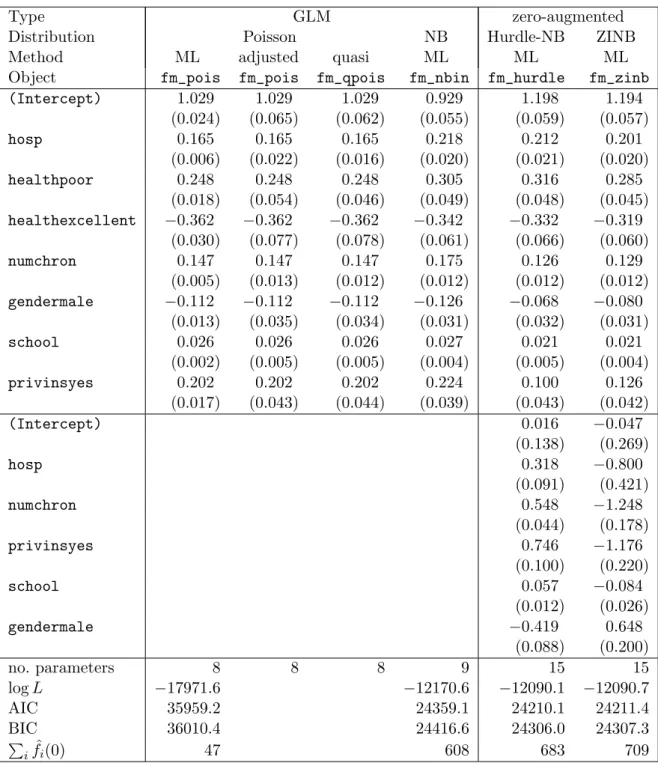
As shown in Table2, both regression coefficients and standard errors are rather similar to the quasi-Poisson and the sandwich-adjusted Poisson results above. Thus, in terms of predicted means all three models give very similar results; the associated partial Wald tests also lead to the same conclusions.
2
Alternatively, over-dispersion can be confirmed by comparison of the log-likelihoods of the Poisson and negative binomial model.
One advantage of the negative binomial model is that it is associated with a formal likelihood so that information criteria are readily available. Furthermore, the expected number of zeros can be computed from the fitted densities viaP
if(0,µˆi,θˆ). 3.5. Hurdle regression
The exploratory analysis conveyed the impression that there might be more zero observations than explained by the basic count data distributions, hence a negative binomial hurdle model is fitted via
R> fm_hurdle0 <- hurdle(ofp ~ ., data = dt, dist = "negbin")
This uses the same type of count data model as in the preceeding section but it is now truncated for ofp < 1 and has an additional hurdle component modeling zero vs. count observations. By default, the hurdle component is a binomial GLM with logit link which contains all regressors used in the count model. The associated coefficient estimates and partial Wald tests for both model components are displayed via
R> summary(fm_hurdle0)
Call:
hurdle(formula = ofp ~ ., data = dt, dist = "negbin")
Count model coefficients (truncated negbin with log link): Estimate Std. Error z value Pr(>|z|) (Intercept) 1.197699 0.058973 20.309 < 2e-16 *** hosp 0.211898 0.021396 9.904 < 2e-16 *** healthpoor 0.315958 0.048056 6.575 4.87e-11 *** healthexcellent -0.331861 0.066093 -5.021 5.14e-07 *** numchron 0.126421 0.012452 10.152 < 2e-16 *** gendermale -0.068317 0.032416 -2.108 0.0351 * school 0.020693 0.004535 4.563 5.04e-06 *** privinsyes 0.100172 0.042619 2.350 0.0188 * Log(theta) 0.333255 0.042754 7.795 6.46e-15 *** Zero hurdle model coefficients (binomial with logit link):
Estimate Std. Error z value Pr(>|z|) (Intercept) 0.043147 0.139852 0.309 0.757688 hosp 0.312449 0.091437 3.417 0.000633 *** healthpoor -0.008716 0.161024 -0.054 0.956833 healthexcellent -0.289570 0.142682 -2.029 0.042409 * numchron 0.535213 0.045378 11.794 < 2e-16 *** gendermale -0.415658 0.087608 -4.745 2.09e-06 *** school 0.058541 0.011989 4.883 1.05e-06 *** privinsyes 0.747120 0.100880 7.406 1.30e-13 *** ---Signif. codes: 0 '***' 0.001 '**' 0.01 '*' 0.05 '.' 0.1 ' ' 1
Theta: count = 1.3955
Number of iterations in BFGS optimization: 16 Log-likelihood: -1.209e+04 on 17 Df
The coefficients in the count component resemble those from the previous models, but the increase in the log-likelihood (see also Table 2) conveys that the model has improved by including the hurdle component. However, it might be possible to omit thehealth variable from the hurdle model. To test this hypothesis, the reduced model is fitted via
R> fm_hurdle <- hurdle(ofp ~ . | hosp + numchron + privins + school + gender, + data = dt, dist = "negbin")
and can then be compared to the full model in a Wald test
R> waldtest(fm_hurdle0, fm_hurdle)
Wald test
Model 1: ofp ~ .
Model 2: ofp ~ . | hosp + numchron + privins + school + gender Res.Df Df Chisq Pr(>Chisq)
1 4389
2 4391 -2 4.1213 0.1274 or an LR test
R> lrtest(fm_hurdle0, fm_hurdle)
which leads to virtually identical results. 3.6. Zero-inflated regression
A different way of augmenting the negative binomial count model fm_nbin with additional probability weight for zero counts is a zero-inflated negative binomial (ZINB) regression. The default model is fitted via
R> fm_zinb0 <- zeroinfl(ofp ~ ., data = dt, dist = "negbin")
This has just an intercept in the zero-inflation model, but—as the hurdle model fm_hurdle fitted above has shown—the available regressors can be used for distinguishing between zero and larger counts. Therefore, a second model
R> fm_zinb <- zeroinfl(ofp ~ . | hosp + numchron + privins + school + gender, + data = dt, dist = "negbin")
is fitted that has the same variables in the zero-inflation part as the hurdle component in fm_hurdle. This improves the ZINB fit significantly which can again be brought out by a Wald test
Type GLM zero-augmented
Distribution Poisson NB Hurdle-NB ZINB
Method ML adjusted quasi ML ML ML
Object fm_pois fm_pois fm_qpois fm_nbin fm_hurdle fm_zinb (Intercept) 1.029 1.029 1.029 0.929 1.198 1.194 (0.024) (0.065) (0.062) (0.055) (0.059) (0.057) hosp 0.165 0.165 0.165 0.218 0.212 0.201 (0.006) (0.022) (0.016) (0.020) (0.021) (0.020) healthpoor 0.248 0.248 0.248 0.305 0.316 0.285 (0.018) (0.054) (0.046) (0.049) (0.048) (0.045) healthexcellent −0.362 −0.362 −0.362 −0.342 −0.332 −0.319 (0.030) (0.077) (0.078) (0.061) (0.066) (0.060) numchron 0.147 0.147 0.147 0.175 0.126 0.129 (0.005) (0.013) (0.012) (0.012) (0.012) (0.012) gendermale −0.112 −0.112 −0.112 −0.126 −0.068 −0.080 (0.013) (0.035) (0.034) (0.031) (0.032) (0.031) school 0.026 0.026 0.026 0.027 0.021 0.021 (0.002) (0.005) (0.005) (0.004) (0.005) (0.004) privinsyes 0.202 0.202 0.202 0.224 0.100 0.126 (0.017) (0.043) (0.044) (0.039) (0.043) (0.042) (Intercept) 0.016 −0.047 (0.138) (0.269) hosp 0.318 −0.800 (0.091) (0.421) numchron 0.548 −1.248 (0.044) (0.178) privinsyes 0.746 −1.176 (0.100) (0.220) school 0.057 −0.084 (0.012) (0.026) gendermale −0.419 0.648 (0.088) (0.200) no. parameters 8 8 8 9 15 15 logL −17971.6 −12170.6 −12090.1 −12090.7 AIC 35959.2 24359.1 24210.1 24211.4 BIC 36010.4 24416.6 24306.0 24307.3 P ifˆi(0) 47 608 683 709
Table 2: Summary of fitted count regression models for NMES data: coefficient estimates from count model, zero-inflation model (both with standard errors in parantheses), number of estimated parameters, maximized log-likelihood, AIC, BIC and expected number of zeros (sum of fitted densities evaluated at zero). The observed number of zeros is 683 in 4406 observations.
R> waldtest(fm_zinb0, fm_zinb)
Wald test
Model 1: ofp ~ .
Model 2: ofp ~ . | hosp + numchron + privins + school + gender Res.Df Df Chisq Pr(>Chisq)
1 4396
2 4391 5 115.72 < 2.2e-16 ***
---Signif. codes: 0 '***' 0.001 '**' 0.01 '*' 0.05 '.' 0.1 ' ' 1
or an LR test lrtest(fm_zinb0, fm_zinb) that produces virtually identical results. The chosen fitted model can again be inspected via
R> summary(fm_zinb)
See Table2for a more concise summary. 3.7. Comparison
Having fitted several count data regression models to the demand for medical care in the NMES data, it is, of course, of interest to understand what these models have in common and what their differences are. In this section, we show how to compute the components of Table2 and provide some further comments and interpretations.
As a first comparison, it is of natural interest to inspect the estimated regression coefficients in the count data model
R> fm <- list("ML-Pois" = fm_pois, "Quasi-Pois" = fm_qpois, "NB" = fm_nbin, + "Hurdle-NB" = fm_hurdle, "ZINB" = fm_zinb)
R> sapply(fm, function(x) coef(x)[1:8])
The result (see Table2) shows that there are some small differences, especially between the GLMs and the zero-augmented models. However, the zero-augmented models have to be interpreted slightly differently: While the GLMs all have the same mean function (2), the zero-augmentation also enters the mean function, see (8) and (6). Nevertheless, the overall impression is that the estimated mean functions are rather similar. Moreover, the associated estimated standard errors are very similar as well (see Table2):
R> cbind("ML-Pois" = sqrt(diag(vcov(fm_pois))), + "Adj-Pois" = sqrt(diag(sandwich(fm_pois))),
+ sapply(fm[-1], function(x) sqrt(diag(vcov(x)))[1:8]))
The only exception are the model-based standard errors for the Poisson model, when treated as a fully specified model, which is obviously not appropriate for this data set.
In summary, the models are not too different with respect to their fitted mean functions. The differences become obvious if not only the mean but the full likelihood is considered:
R> rbind(logLik = sapply(fm, function(x) round(logLik(x), digits = 0)), + Df = sapply(fm, function(x) attr(logLik(x), "df")))
ML-Pois Quasi-Pois NB Hurdle-NB ZINB logLik -17972 NA -12171 -12090 -12091
Df 8 8 9 15 15
The ML Poisson model is clearly inferior to all other fits. The quasi-Poisson model and the sandwich-adjusted Poisson model are not associated with a fitted likelihood. The negative binomial already improves the fit dramatically but can in turn be improved by the hurdle and zero-inflated models which give almost identical fits. This also reflects that the over-dispersion in the data is captured better by the negative-binomial-based models than the plain Poisson model. Additionally, it is of interest how the zero counts are captured by the various models. Therefore, the observed zero counts are compared to the expected number of zero counts for the likelihood-based models:
R> round(c("Obs" = sum(dt$ofp < 1),
+ "ML-Pois" = sum(dpois(0, fitted(fm_pois))),
+ "NB" = sum(dnbinom(0, mu = fitted(fm_nbin), size = fm_nbin$theta)), + "NB-Hurdle" = sum(predict(fm_hurdle, type = "prob")[,1]),
+ "ZINB" = sum(predict(fm_zinb, type = "prob")[,1])))
Obs ML-Pois NB NB-Hurdle ZINB
683 47 608 683 709
Thus, the ML Poisson model is again not appropriate whereas the negative-binomial-based models are much better in modeling the zero counts. By construction, the expected number of zero counts in the hurdle model matches the observed number.
In summary, the hurdle and zero-inflation models lead to the best results (in terms of like-lihood) on this data set. Above, their mean function for the count component was already shown to be very similar, below we take a look at the fitted zero components:
R> t(sapply(fm[4:5], function(x) round(x$coefficients$zero, digits = 3)))
(Intercept) hosp numchron privinsyes school gendermale Hurdle-NB 0.016 0.318 0.548 0.746 0.057 -0.419 ZINB -0.047 -0.800 -1.248 -1.176 -0.084 0.648
This shows that the absolute values are rather different—which is not surprising as they pertain to slightly different ways of modeling zero counts—but the signs of the coefficients match, i.e., are just inversed. For the hurdle model, the zero hurdle component describes the probability of observing a positive count whereas, for the ZINB model, the zero-inflation component predicts the probability of observing a zero count from the point mass component. Overall, both models lead to the same qualitative results and very similar model fits. Perhaps the hurdle model is slightly preferable because it has the nicer interpretation: there is one process that controls whether a patient sees a physician or not, and a second process that determines how many office visits are made.
4. Summary
The model frame for basic count data models from the GLM framework as well as their implementation in the R system for statistical computing is reviewed. Starting from these basic tools, it is presented how hurdle and zero-inflated models extend the classical models and how likewise their R implementation in package pscl re-uses design and functionality of the corresponding R software. Hence, the new functions hurdle() and zeroinfl() are straightforward to apply for model fitting. Additionally, standard methods for diagnostics are provided and generic inference tools from other packages can easily be re-used.
Computational details
The results in this paper were obtained usingR2.7.0 with the packagesMASS7.2-42,pscl0.95, sandwich 2.1-0, car 1.2-8, lmtest 0.9-21. R itself and all packages used are available from CRAN athttp://CRAN.R-project.org/.
References
Cameron AC, Trivedi PK (1998). Regression Analysis of Count Data. Cambridge University Press, Cambridge.
Cameron AC, Trivedi PK (2005). Microeconometrics: Methods and Applications. Cambridge University Press, Cambridge.
Chambers JM, Hastie TJ (eds.) (1992). Statistical Models inS. Chapman & Hall, London. Deb P, Trivedi PK (1997). “Demand for Medical Care by the Elderly: A Finite Mixture
Approach.”Journal of Applied Econometrics,12, 313–336.
Erhardt V (2008). ZIGP: Zero-inflated Generalized Poisson Regression Models. R package version 2.1, URLhttp://CRAN.R-project.org/package=ZIGP.
Fox J (2002). An R and S-PLUS Companion to Applied Regression. Sage Publications, Thousand Oaks, CA.
Halekoh U, Højsgaard S, Yan J (2006). “TheRPackagegeepack for Generalized Estimating Equations.” Journal of Statistical Software, 15(2), 1–11. URL http://www.jstatsoft. org/v15/i02/.
Jackman S (2008). pscl: Classes and Methods forRDeveloped in the Political Science Com-putational Laboratory, Stanford University. Department of Political Science, Stanford Uni-versity, Stanford, California. Rpackage version 0.95, URLhttp://CRAN.R-project.org/ package=pscl.
Kleiber C, Zeileis A (2008). Applied Econometrics with R. Springer-Verlag, New York. ISBN 978-0-387-77316-2.
Lambert D (1992). “Zero-inflated Poisson Regression, With an Application to Defects in Manufacturing.”Technometrics,34, 1–14.
Leisch F (2004). “FlexMix: A General Framework for Finite Mixture Models and Latent Class Regression in R.” Journal of Statistical Software, 11(8), 1–18. URL http://www. jstatsoft.org/v11/i08/.
McCullagh P, Nelder JA (1989). Generalized Linear Models. 2nd edition. Chapman & Hall, London.
Mullahy J (1986). “Specification and Testing of Some Modified Count Data Models.”Journal of Econometrics,33, 341–365.
Mwalili SM (2007). zicounts: Classical and Censored Zero-inflated Count Data Models. R package version 1.1.5 (orphaned), URL http://CRAN.R-project.org/src/contrib/ Archive/zicounts/.
Nelder JA, Wedderburn RWM (1972). “Generalized Linear Models.” Journal of the Royal Statistical Society A,135, 370–384.
Pinheiro JC, Bates DM (2000). ”Mixed-Effects Models in S and S-PLUS. Springer-Verlag, New York.
RDevelopment Core Team (2008).R: A Language and Environment for Statistical Computing. RFoundation for Statistical Computing, Vienna, Austria. ISBN 3-900051-00-3, URLhttp: //www.R-project.org/.
Stasinopoulos DM, Rigby RA (2007). “Generalized Additive Models for Location Scale and Shape (GAMLSS) in R.” Journal of Statistical Software, 23(7). URL http://www. jstatsoft.org/v23/i07/.
Venables WN, Ripley BD (2002). Modern Applied Statistics with S. 4th edition. Springer-Verlag, New York.
Yee TW (2008). VGAM: Vector Generalized Linear and Additive Models. R package ver-sion 0.7-7, URLhttp://CRAN.R-project.org/package=VGAM.
Zeileis A (2004). “Econometric Computing with HC and HAC Covariance Matrix Estimators.”
Journal of Statistical Software,11(10), 1–17. URLhttp://www.jstatsoft.org/v11/i10/. Zeileis A (2006). “Object-oriented Computation of Sandwich Estimators.”Journal of
Statis-tical Software,16(9), 1–16. URLhttp://www.jstatsoft.org/v16/i09/.
Zeileis A, Hothorn T (2002). “Diagnostic Checking in Regression Relationships.” R News, 2(3), 7–10. URL http://CRAN.R-project.org/doc/Rnews/.
Zeileis A, Kleiber C (2008). AER: Applied Econometrics with R. R package version 0.9-0, URLhttp://CRAN.R-project.org/package=AER.
A. Technical details for hurdle models
The fitting of hurdle models via ML in hurdle() is controlled by the arguments in the hurdle.control() wrapper function:
hurdle.control(method = "BFGS", maxit = 10000, trace = FALSE, separate = TRUE, start = NULL, ...)
This modifies some default arguments passed on to the optimizer optim(), such asmethod, maxitand trace. The latter is also used within hurdle()and can be set to produce more verbose output concerning the fitting process. The argumentseparatecontrols whether the two components of the model are optimized separately (the default) or not. This is possible because there are no mixed sources for the zeros in the data (unlike in zero-inflation models). The argumentstart controls the choice of starting values for callingoptim(), all remaining arguments passed through... are directly passed on tooptim().
By default, starting values are estimated by calling glm.fit() for both components of the model separately, once for the counts and once for zero vs. non-zero counts. If starting values are supplied,start needs to be set to a named list with the parameters for the $count and $zeropart of the model (and potentially a$thetadispersion parameter if a negative binomial distribution is used).
The fitted model object of class “hurdle” is similar to “glm” objects and contains sufficient information on all aspects of the fitting process. In particular, the estimated parameters and associated covariances are included as well as the result from theoptim()call. Further-more, the call, formula, terms structure etc. is contained, potentially also the model frame, dependent variable and regressor matrices.
Following glm.nb(), the θ parameter of the negative binomial distribution is treated as a nuisance parameter. Thus, the $coefficients component of the fitted model object just contains estimates of β and γ while the estimate of θ and its standard deviation (on a log scale) are kept in extra list elements$theta and $SE.logtheta.
B. Technical details for zero-inflated models
Both the interface of thezeroinfl()function as well as its fitted model objects are virtually identical to the corresponding “hurdle” functionality. Hence, we only provide some additional information for those aspects that differ from those discussed above. The details of the ML optimization are again provided by azeroinfl.control() wrapper:
zeroinfl.control(method = "BFGS", maxit = 10000, trace = FALSE, EM = FALSE, start = NULL, ...)
The only new argument here is the argumentEMwhich allows for EM estimation of the starting values. Instead of callingglm.fit()only once for both components of the model, this process can be iterated until convergence of the parameters to the ML estimates. The optimizer is still called subsequently (for a single iteration) to obtain the Hessian matrix from which the estimated covariance matrix can be computed.