Drilling, Completion & Well
Intervention and its relation to
Geology
Kjell Kåre Fjelde
A more detailed presentation on drilling & geology can be found on the resource CD
Exercise related to the Festningen expedition Exercise related to the Storvola expedition
The different well phases
•
Drilling
–
Make the wells
•
Completion
–
Prepare the well for production
–
Different tools installed inside the well
•
Production
–
Earn money
•
Intervention
–
Fix well (damages or improve production)
•
P & A
Drilling
•
Main objective:
–
Drill a hole in the
ground as fast as
possible without
accidents
•
Expensive
–
Rig rate
–
Rate of
penetration
–
Uforseen events
–
+ +
West Phoenix – Dual ramrigg. Seadrill
www.nov.com - Rockforce www.nov.com
Must choose an appropriate drill bit depending on geology /formation hardness
Kymera Hybrid bit
Casing program
•
The well will be drilled in sections. When
a section is drilled, a steel casing is set to
protect the well before resuming drilling
with a reduced hole size
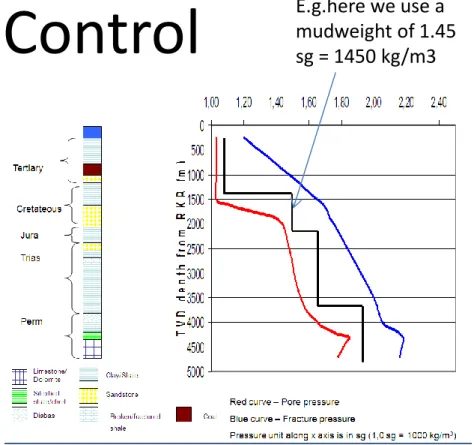
Control pressures
Pressure Control
• If Pwell < Ppore - > Potential kick
• If Pwell > Pfrac - > Potential losses
• i.e Ppore < Pwell < Pfrac
• Pwell (bar) = d x 0,0981 x Htvd
– d – density of mud i sg ( e.g 1500 kg/m3 =1.5sg)
– Htvd – True vertical depth of well
•
The different hole sections will
be drilled with different mud
densities in order to control
well pressures
•
This will also affect the casing
design
Figure to be found in drilling programs. The lithology column tells us what
formations that will be drilled through. The curves shows us the pore and
fracture pressures and the mudweight we should use in the different hole sections
E.g.here we use a mudweight of 1.45 sg = 1450 kg/m3
Bit Choice & ROP
•
ROP (rate of penetration) tells us how fast we drill.
–
(1 m/ hour – very slow, 60 m / hour – quite good)
•
Low ROP - > Expensive operations.
•
ROP will depend on formation hardness & bit choice
•
Bit change (wear, failure etc) is time consuming & costs
money
•
Important to choose the right bit for the formation to
ensure
–
As high ROP as possible
–
Avoid wearing out the bits too early.
Formation hardness
•
The choice of an approriate bit will depend on
formation hardness & abrasiveness
–
Soft/Medium soft formation
•
Shale, clay, limestone, sands.
–
Medium hard/hard formation
•
Hard limestone, sandstone, dolomite
–
Hard and abrasive formations
•
Granites, basalts, quartzite and chert
•
Check
www.adriatech.com
for appropriate rock
Roller Cone
•
Steel tooth
–
Top hole, Soft formations
•
Tungsten carbid inserts
–
Medium to very hard
formations
–
Formations where PDC
does not work
–
Drill out shoe (cement)
•
Rate of penetration –
Medium, Slow
•
Steerability – Good
•
More trips to change bit
due to wear compared to
using PDC bits.
www.nov.com - Rockforce
Be aware of:
Cones can be lost (fishing operations) The cutters will be worn down
Bearings is a weak point Gauge wear
PDC (fixed cutter bit)
•
Soft to medium hard formations
(not applicable in very hard &
abrasive formations)
•
Shales are easier to drill (ROP) than
limestone/sandstone and PDC bits
usually drills twice as fast in shale
compared to roller cone
•
Lower sections (12 ¼” hole ->)
•
Steerable and rotary applications
(motor & RSS)
•
High ROP (opposed to roller cones)
•
More expensive
•
More robust (fewer trips compared
to roller cone)
•
Steerability depends on design
Hybrid Bits (recent technology)
•
Combination of roller
cone and PDC bit design
(use the best of both)
•
Hard and interbedded
formations - handles
changes from soft to hard
rock
•
Less vibrations
•
Increased ROP potential
•
Chert drilling
Kymera Hybrid bit
Natural Diamond Bits
•
Applicable for hard
formations (e.g. where
roller cone is too slow or
har too short lifetime)
•
Not applicable for chert
and pyrite (will break
into pieces and may
destroy the diamonds)
•
Not applicable for very
hard broken formations
(may break the
Directional Drilling
•
Directional drilling
was a step change in
development of oil &
gas resources
•
Better drainage
–
Eg. the Troll field
(exploit a wide but
thin oil layer)
–
Drain several layers
Directional drilling
•
Avoid salt dome
structures
•
Faults or hard
formations
layers
–
Cross with
right angle
•
Multilaterals
•
Sidetracking
Drilling problems
•
Three major problems that can
occur during a drilling operation
–
Kick
• Inflow of gas/oil in the well during operation
• If not controlled, it can lead to a blowout
–
Lost Circulation
• Mud losses to formation
• Expensive
• Can lead to a kick
–
Stuck pipe
• If the drillstring is stuck, the worst case scenario might be to plug and make a sidetrack
• Very expensive
Deepwater Horizon – 21 April 2010.- Gulf of Mexico,
Kick
•
Kick - >
unwanted inflow of gas, oil or water, if not controlled - > Blowout•
Reasons
:
– Uncertainty in pore pressure
– Too low mudweight
– Swab (during tripping or heave effects)
– Lost circulation (mud disappear) caused by too high well pressures causing fractures or drilling into caves.
– Insufficient refill of well while tripping out.
Barrier drawing from NORSOK D010. It shows the BOP (blowout preventor) which is a classified as a secondary barrier element. It is closed in case of a kick. A well control procedure is initiated and the kick is circulated out of the well using the chokeline and choke.
Lost circulation
•
Can result in a reduced mudlevel in
the well which again can cause a
kick.
•
Reasons:
–
Naturally fractured formations (Karst,
dolomite, limestone)
–
Too high ECD -> Fracture pressure
exceeded
•
Reduce pump rate and mudweight
–
Surges
•
Avoid tripping to fast
•
Break mud gel before initiating
circulation.
Stuck Pipe
•
Stuck pipe is one of the more severe events
that can occur during drilling and can lead to
large costs
–
Fishing operation
–
In worst case, a sidetrack is the final solution.
•
Three main causes
–
Mechanical related
–
Formation related
Mechanical
•
Key seating
•
Poor hole cleaning
•
Undergauge
•
Wellbore geometry
–
Formation layers,
change in hardness
•
Collapsed casing
•
Junk
Formation related
•
Unconsolidated
formations (e.g sand)
•
Boulders
•
Fractured formations
(e.g. around a fault)
•
Mobile formations
(e.g. salt)
Formation related - Shale
•
Shale can cause som
special problems:
–
Geo pressured shale
(over pressured shale)
•
Requires a higher
mudweight to control
it.
–
Reactive shale (water
from mud inhibits the
shale and it swells) –
lack of inhibition
Completion
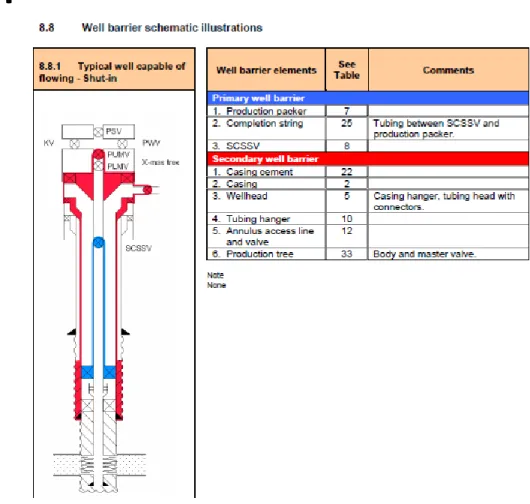
• After the well has been drilled it has to be completed and prepared for production
• A lot of equipment is installed in the well e.g.
– Production tubing
– Production packer (fixes the production tubing inside last set casing)
– Downhole safety valve (SCSSV)
– Etc
• The reservoir has to be prepared for production
– Different solutions exists
Figure from NORSOKD010 showing the barrier elements in a production well
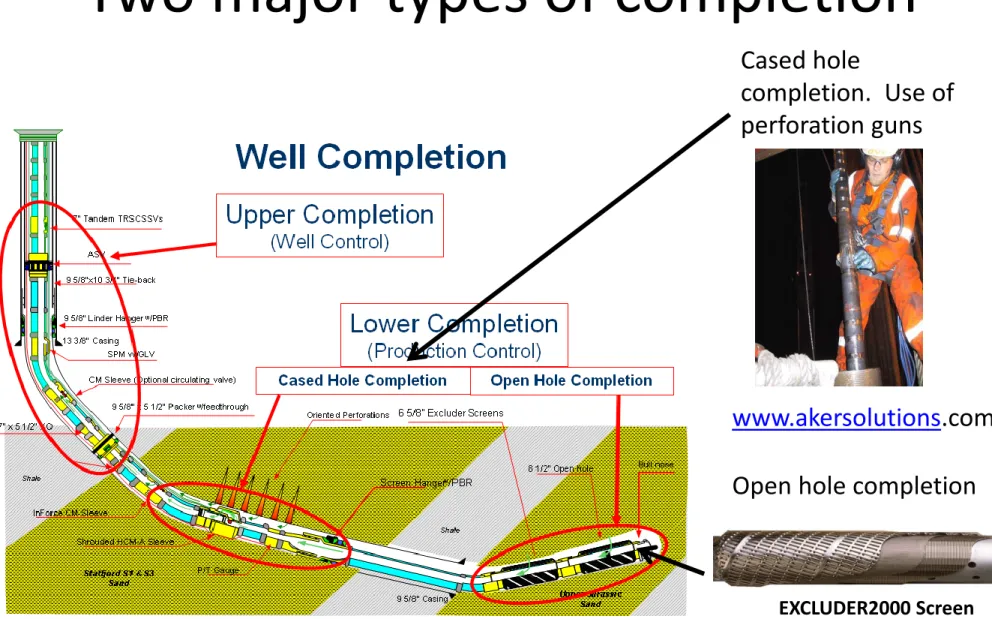
Two major types of completion
Figure from BakerHughes
Cased hole completion. Use of perforation guns www.akersolutions.com EXCLUDER2000 Screen (15-30%)
Open hole completion
Use of sandscreens to protect the well from eroding sand
Intelligent well completions
•
In these wells one
can install valves and
control lines which
can control the
production from
different zones in one
well.
•
Need less wells
•
Control water
production
–
Water production is
unwanted.
Intelligent well completions
•
Using an intelligent well
completion we can
control the water
production for instance
by closing zones or by
reducing water
injection in zones
where there is large
water cut.
Well Intervention
•
During the production phase there can be several
reasons for performing a live well intervention
operation:
–
Scale removal (salts forming in the well)
–
Azid stimulation (carbonates)
–
Removing sand/cleaning sand screens
–
Perform production logging to detect water producing
formations that should be sealed
–
+++
•
Most common methods (wireline or coiled
Wireline
Often used in conjunction with tractor to intervene in inclined
Wireline – example of application
•
One example could be to
intervene in the well to find
which formation layers that
are producing water
•
One would need a braided
(electric) wireline rig up,
tractor and a production
logging tool string.
www.akersolutions.com
The rotating speed will depend on which fluid that is present – Identify fluid type.
Fullbore & Inline spinner
Coiled Tubing
•
Use of a flexible string
that can be run in and
out of the well and fluids
can be circulated
•
Used for instance for:
–
Azid stimulation
(carbonates)
–
Sand cleanouts (e.g long
horisontal wells with
sand)/sandscreens
www.nov.com
The different well phases
•
Drilling
–
Make the wells
•
Completion
–
Prepare the well for production
–
Different tools installed inside the well
•
Production
–
Earn money
•
Intervention
–
Fix well (damages or improve production)
•
P & A
Casing desing depends on:
• Stratigraphic column
• Pore and fracture pressure profile
For each well section, we have to consider:
• Mud choice
• Type of bit & steering equipment
• Special operational challenges / Drilling problems
Rate of penetration (ROP) depends on:
• Stratigraphic column & hole section
Festningen Exercise
•
At Festningen we will have
the possibility to walk
along a stratigraphic
column from bottom and
upwards
•
Solve an exercise where
we
•
Get familiar with the
stratigraphic column
•
Identify rock types that can
give us drilling problems
•
Get familiar with the well
construction sequence.
Festningen Exercise – Part 1
•
Part 1 – Based on what
you observe during the
walk: Draw the
stratigraphic column
for the Festningen
profile
•
Use the PowerPoint
«StratigrahicColumn_F
estningen_HelpFigure»
for this (copy and
Festningen Exercise – Part 2
•
While walking along the profile, you shall identify rock
types etc that can cause drilling problems. Focus should
be on:
–
What type of bit would I use here and how will the ROP be
(high or low) ?
–
Is there potential for stuck pipe here ?
–
Potential for lost circulation ?
–
Drilling into caves/Karst ?
–
Layers/structures that can cause problems for directional
drilling ?
Festningen Exercise – Part 3
•
Part 3: In the last part, we will solve an exercise (a
case) that will give an introduction to the well
Important
•
The information/answers obtained in the
Festningen exercise (especially Part 1 &
2) will be needed in the Storvola project.
Festningen exercise
•
One exercise handed out to each group in
advance:
–
Can also be found in the «resource stick» along with
presentations on Drilling and Geology + help figure
•
Work with it during the excursion and
afterwards.
•
Prepare a short presentation addressing the main
issues related to each question
•
Two groups will be selected to present and go
through the assignment for discussion
–
Group X – addresses Part 1 & 2