Visual Tracking Algorithms using Different Object
Representation Schemes
Shreyamsha Kumar Bidare Kantharajappa
A Thesis
In the Department
of
Electrical and Computer Engineering
Presented in Partial Fulfillment of the Requirements
For the Degree of
Doctor of Philosophy (Electrical and Computer Engineering) at
Concordia University
Montr´
eal, Qu´
ebec, Canada
June, 2019
c
CONCORDIA UNIVERSITY SCHOOL OF GRADUATE STUDIES
This is to certify that the thesis prepared
By: Shreyamsha Kumar Bidare Kantharajappa
Entitled: Visual Tracking Algorithms using Different Object Representation Schemes
and submitted in partial fulfillment of the requirements for the degree of Doctor of Philosophy (Electrical and Computer Engineering)
complies with the regulations of the University and meets the accepted standards with respect to originality and quality.
Signed by the final examining committee:
Chair Dr. Rene Witte External Examiner Dr. Panajotis Agathoklis External to Program Dr. Terry Fancott Examiner Dr. Hassan Rivaz Examiner Dr. Wei-Ping Zhu Thesis Co-Supervisor Dr. M. Omair Ahmad Thesis Co-Supervisor Dr. M.N.S. Swamy Approved by Dr. Rastko R. Selmic,Graduate Program Director
Abstract
Visual Tracking Algorithms using Different Object
Representation Schemes
Shreyamsha Kumar Bidare Kantharajappa, Ph.D. Concordia University, 2019
Visual tracking, being one of the fundamental, most important and challenging areas in computer vision, has attracted much attention in the research community during the past decade due to its broad range of real-life applications. Even af-ter three decades of research, it still remains a challenging problem in view of the complexities involved in the target searching due to intrinsic and extrinsic appear-ance variations of the object. The existing trackers fail to track the object when there are considerable amount of object appearance variations and when the object undergoes severe occlusion, scale change, out-of-plane rotation, motion blur, fast mo-tion, in-plane rotamo-tion, out-of-view and illumination variation either individually or simultaneously. In order to have a reliable and improved tracking performance, the appearance variations should be handled carefully such that the appearance model should adapt to the intrinsic appearance variations and be robust enough for extrinsic appearance variations. The objective of this thesis is to develop visual object track-ing algorithms by addresstrack-ing the deficiencies of the existtrack-ing algorithms to enhance the tracking performance by investigating the use of different object representation schemes to model the object appearance and then devising mechanisms to update the observation models.
A tracking algorithm based on the global appearance model using robust coding and its collaboration with a local model is proposed. The global PCA subspace is used to model the global appearance of the object, and the optimum PCA basis coefficients and the global weight matrix are estimated by developing an iteratively reweighted robust coding (IRRC) technique. This global model is collaborated with the local
model to exploit their individual merits. Global and local robust coding distances are introduced to find the candidate sample having similar appearance as that of the reconstructed sample from the subspace, and these distances are used to define the ob-servation likelihood. A robust occlusion map generation scheme and a mechanism to update both the global and local observation models are developed. Quantitative and qualitative performance evaluations on OTB-50 and VOT2016, two popular bench-mark datasets, demonstrate that the proposed algorithm with histogram of oriented gradient (HOG) features generally performs better than the state-of-the-art meth-ods considered do. In spite of its good performance, there is a need to improve the tracking performance in some of the challenging attributes of OTB-50 and VOT2016. A second tracking algorithm is developed to provide an improved performance in situations for the above mentioned challenging attributes. The algorithms is designed based on a structural local 2DDCT sparse appearance model and an occlusion han-dling mechanism. In a structural local 2DDCT sparse appearance model, the energy compaction property of the transform is exploited to reduce the size of the dictio-nary as well as that of the candidate samples in the object representation so that the computational cost of the l1-minimization used could be reduced. This strategy is in contrast to the existing models that use raw pixels. A holistic image reconstruction procedure is presented from the overlapped local patches that are obtained from the dictionary and the sparse codes, and then the reconstructed holistic image is used for robust occlusion detection and occlusion map generation. The occlusion map thus obtained is used for developing a novel observation model update mechanism to avoid the model degradation. A patch occlusion ratio is employed in the calculation of the confidence score to improve the tracking performance. Quantitative and qualitative performance evaluations on the two above mentioned benchmark datasets demon-strate that this second proposed tracking algorithm generally performs better than several state-of-the-art methods and the first proposed tracking method do. Despite the improved performance of this second proposed tracking algorithm, there are still
some challenging attributes of OTB-50 and of VOT2016 for which the performance needs to be improved.
Finally, a third tracking algorithm is proposed by developing a scheme for collab-oration between the discriminative and generative appearance models. The discrimi-native model is explored to estimate the position of the target and a new generative model is used to find the remaining affine parameters of the target. In the generative model, robust coding is extended to two dimensions and employed in the bilateral two dimensional PCA (2DPCA) reconstruction procedure to handle the non-Gaussian or non-Laplacian residuals by developing an IRRC technique. A 2D robust coding dis-tance is introduced to differentiate the candidate sample from the one reconstructed from the subspace and used to compute the observation likelihood in the generative model. A method of generating a robust occlusion map from the weights obtained during the IRRC technique and a novel update mechanism of the observation model for both the kernelized correlation filters and the bilateral 2DPCA subspace are de-veloped. Quantitative and qualitative performance evaluations on the two datasets demonstrate that this algorithm with HOG features generally outperforms the state-of-the-art methods and the other two proposed algorithms for most of the challenging attributes.
Acknowledgments
I would like to express my deep sense of gratitude and reverence to my supervisors, Dr. M.N.S. Swamy and Dr. M. Omair Ahmad, for their unflagging support, encour-agement and invaluable guidance at the every phase of this research. Their patience, enthusiasm and cooperation have not just fueled this research, but also imbibed in me the need for perfection when performing research as well as when communicating the results.
I sincerely thank Dr. Wei-Ping Zhu, Dr. Hassan Rivaz and other members of my thesis examining committee for their feedback and support.
I am very grateful to my supervisors for the financial support that I received from their grants awarded by Natural Sciences and Engineering Research Council (NSERC) of Canada and the Regroupement Strat´egique en Microsyst`emes du Qu´ebec (ReSMiQ). I would like to acknowledge the financial support that I received during my doctoral studies from Concordia University through bursaries, awards, teaching assistantships and reimbursement of open access publication charges. I gratefully acknowledge Ministre de l’´Education, de l’Enseignement Sup´erieur et de la Recherche (MEESR) du Qu´ebec for awarding the Doctoral Research Scholarship to support my research work.
My passion to pursue the doctoral degree was sprouted during my M.Tech disser-tation work that was supervised by Dr. S.V. Narasimhan. I would like to offer my deep admiration and gratitude to him for motivating and influencing me to pursue the doctoral degree, and provided unlimited support and invaluable guidance when I was looking for opportunities to pursue the doctoral degree. Also, I am highly in-debted to Dr. Girish Chandra and Dr. S. D. Sudarsan for their kind support and co-operation, which helped me to secure an admission for the doctoral program at Concordia University.
I would like to thank all my fellow colleagues at the Center for Signal Processing and Communications, Concordia University, specially, Praveen Korrai, Soni
Pratti-pati, Mohamed Naiel, Mahdi Parchami, Mufleh Al-Shatnawi, Hamidreza Sadreazami, Marzieh Amini, Omid Saatlou and Masoumeh Abkenar. Much respect and apprecia-tion to my friends, Rajeev Yadav, Arun Venkatesan, Vijay Badagi, Sarath Somasekha-ran, Prashanth Venkataswamy, Durai Chelvan and Srinivasan Jayaraman, and their families for their kindness and invaluable support during my stay at Montreal.
Finally, I thank my family members and relatives for their love and support. My achievements up to this instant would not have been possible without the bless-ings of my parents (Smt. Jwalanamma and Shri Kantharajappa). I would like to specially thank them for their unconditional love, continuous support and constant encouragement to excel in my studies, career and life. Special thanks to my brother (Suchendra), his wife (Suma) and kids (Jinag and Sannidhi) for their every possible support and kindness. My deepest gratitude goes to my wife Pooja for her patience, abundant love, unlimited support and constant encouragement throughout my grad-uate life. Last, but not the least, I would like to express my deep love for my lovely son, Pratham, whose presence has given me the happiness, strength and peace of mind.
Contents
List of Figures xii
List of Tables xv
List of Symbols xvii
List of Abbreviations xxiii
1 Introduction 1
1.1 Literature Review . . . 2 1.2 Motivation . . . 8 1.3 Objectives and Organization of the Thesis . . . 9
2 Background Material 13
2.1 Merits and Demerits of PCA, 2DPCA, and B2DPCA . . . 13 2.2 Particle Filters . . . 15 2.3 Benchmark Datasets and the Performance Evaluation Measures . . . 16 2.4 Summary . . . 20
3 The Global Appearance Model using Robust Coding and its
Col-laboration with a Local Model for Visual Tracking 21
3.1 Introduction . . . 21 3.2 Object Representation via Global and Local PCA Basis Vectors, and
3.2.1 Global Appearance Model using Robust Coding . . . 26
3.2.2 Iteratively Reweighted Robust Coding . . . 28
3.2.3 Global and Local PCA Subspace Models . . . 30
3.2.4 Robust Coding Distance . . . 32
3.3 Proposed Tracking Algorithm . . . 35
3.3.1 Observation Model Update . . . 38
3.4 Experimental Results . . . 40
3.4.1 Quantitative Evaluation on OTB-50 . . . 43
3.4.2 Quantitative Evaluation on VOT2016 . . . 48
3.4.3 Qualitative Evaluation . . . 51
3.5 Summary . . . 54
4 Structural Local 2DDCT Sparse Appearance Model and an Oc-clusion Handling Mechanism for Visual Tracking 56 4.1 Introduction . . . 56
4.2 Structural Local 2DDCT Sparse Appearance Model . . . 59
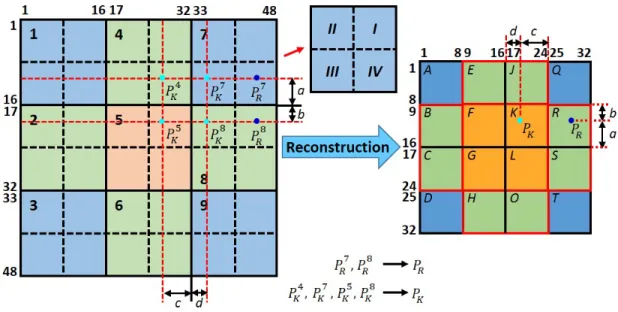
4.3 Holistic Image Reconstruction from an Overlapped Local Patches . . 63
4.4 Proposed Tracking Algorithm . . . 65
4.4.1 Observation Model Update . . . 66
4.5 Experimental Results . . . 74
4.5.1 Quantitative Evaluation on OTB-50 . . . 75
4.5.2 Quantitative Evaluation on VOT2016 . . . 79
4.5.3 Qualitative Evaluation . . . 83
4.6 Summary . . . 85
5 Collaboration of Kernelized Correlation Filters and the Bilateral 2DPCA Subspace for Visual Tracking 88 5.1 Introduction . . . 88
5.3 Object Representation based on Bilateral 2DPCA Projection Matrices
and 2D Robust Coding . . . 91
5.4 Proposed Tracking Algorithm . . . 95
5.4.1 Target Location Estimation using Kernelized Correlation Filters 96 5.4.2 Target State Estimation using Bilateral 2DPCA and 2DRC . . 97
5.4.3 Observation Model Update . . . 99
5.5 Experimental Results . . . 102
5.5.1 Performance Evaluation on OTB-50 . . . 106
5.5.2 Performance Evaluation on VOT2016 . . . 112
5.5.3 Qualitative Evaluation . . . 115
5.6 Summary . . . 118
6 Conclusion 121 6.1 Concluding Remarks . . . 121
6.2 Scope for Future Investigation . . . 124
List of Figures
3.1 Different appearance models of (a) IVT [1], (b) l1-tracker [2], (c) SPT [3], and (d) the proposed tracking algorithm, where⊙indicates Hadamard product (element-wise product). . . 24 3.2 Weights for inlier and outlier pixels during the iteration and
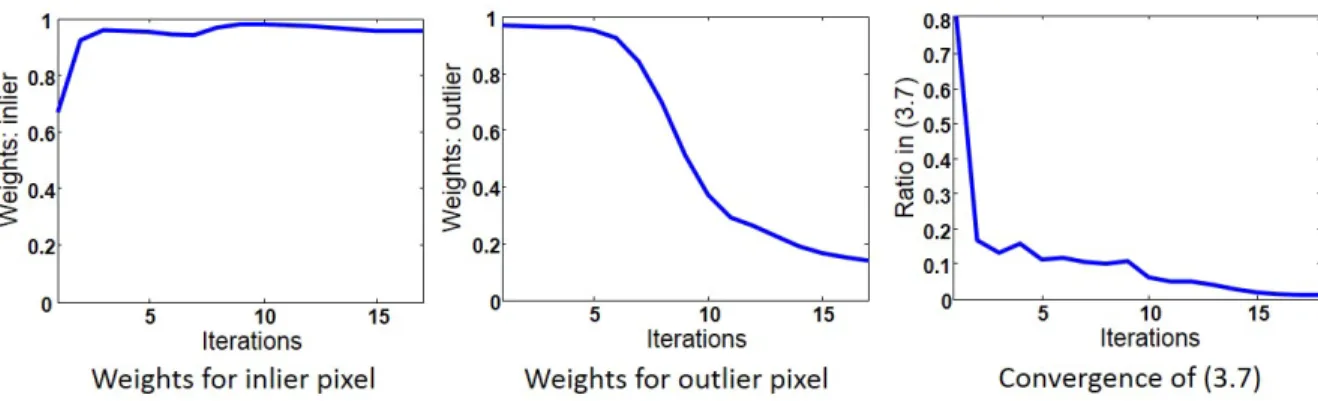
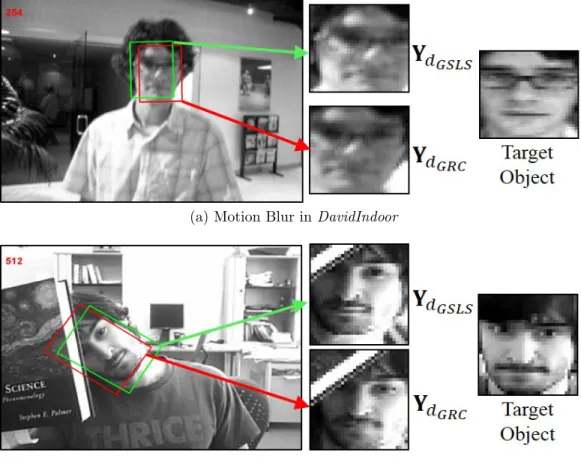
conver-gence of (3.7) for one of the OTB-50 benchmark sequences (Faceocc1, frame #52). . . 30 3.3 Block diagram to obtain local PCA basis vectors for the local model. 32 3.4 Candidates selected by dGSLS and dGRC. . . 35 3.5 Block diagram of the proposed tracking algorithm. . . 36 3.6 Performance evaluation of Algorithm 3.1 on OTB-50 sequences having
occlusion using (a) the precision plots of OPE, where the precision
score is shown along with the tracker name in the legend, and (b)
the success plots of OPE, where AUC is shown along with the tracker
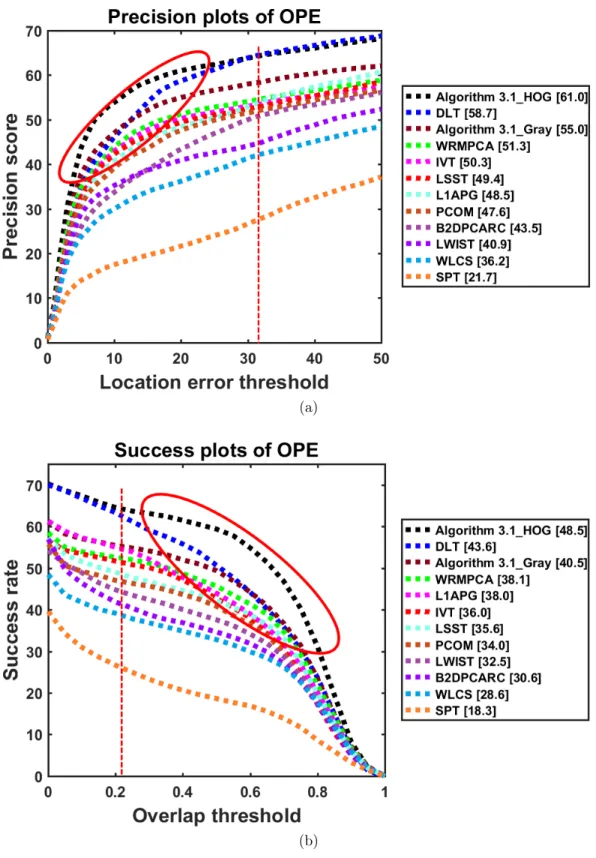
name in the legend. The number 29 appearing in the title denotes the number of sequences associated with the occlusion attribute of OTB-50 dataset. . . 49 3.7 Overall performance evaluation of Algorithm 3.1 on OTB-50 using (a)
the precision plots of OPE, where the precision score is shown along
with the tracker name in the legend, and (b) the success plots of OPE, where AUC is shown along with the tracker name in the legend. . . . 50 3.8 Examples of tracking results of the compared methods on the ten
4.1 Structural local 2DDCT sparse appearance model: illustration of a lo-cal patchPiextraction followed by 2DDCT, zigzag scanning, averaging of sparse coefficients obtained via the l1-minimization and alignment pooling of features. 2DDCT of each local patch yiOL (where the first patch is denoted in red, second one in blue, and the last one in brown rectangle) is sparsely represented by the patch dictionaryD(in 2DDCT domain) with a sparse vectorbi. These sparse coefficients bi are aver-aged to get feature vectors vi and then feature vectors vi from all the patches are pooled to represent a target object. . . 61 4.2 Holistic image reconstruction from overlapped local patches. . . 64 4.3 Some representative cases of Jogging-2 (#45) and Woman (#122)
se-quences to illustrate the effectiveness of the proposed holistic image reconstruction, the robust occlusion map generation (O1, O2, O), and the updated sample. . . 69 4.4 Template set for some representative cases of Faceocc1 (#700) and
Woman (#180) to illustrate the effectiveness of the proposed
observa-tion model update compared to that of ASLA. . . 70 4.5 Performance evaluation of Algorithm 4.1 on OTB-50 sequences having
occlusion using (a) the precision plots of OPE, where the precision
score is shown along with the tracker name in the legend, and (b)
the success plots of OPE, where AUC is shown along with the tracker
name in the legend. The number 29 appearing in the title denotes the number of sequences associated with the occlusion attribute of OTB-50 dataset. . . 80 4.6 Overall performance evaluation of Algorithm 4.1 on OTB-50 using (a)
the precision plots of OPE, where the precision score is shown along
with the tracker name in the legend, and (b) the success plots of OPE, where AUC is shown along with the tracker name in the legend. . . . 81
4.7 Examples of tracking results of the compared methods on the ten OTB-50 benchmark sequences. . . 87
5.1 Block diagram of the proposed tracking algorithm. . . 96 5.2 Some representative cases of (a) Faceocc1 (#92) and (b) Faceocc2
(#260) sequences showing the target appearance Xt, the resized oc-clusion map Ot and the modified target appearance ˜Xt. . . 102 5.3 Performance evaluation of Algorithm 5.1 on OTB-50 sequences having
occlusion using (a) the precision plots of OPE, where the precision
score is shown along with the tracker name in the legend, and (b)
the success plots of OPE, where AUC is shown along with the tracker
name in the legend. The number 29 appearing in the title denotes the number of sequences associated with the occlusion attribute of OTB-50 dataset. . . 113 5.4 Overall performance evaluation of Algorithm 5.1 on OTB-50 using (a)
the precision plots of OPE, where the precision score is shown along
with the tracker name in the legend, and (b) the success plots of OPE, where AUC is shown along with the tracker name in the legend. . . . 114 5.5 Examples of tracking results of the compared methods on the ten
List of Tables
3.1 Distance metrics comparison between the global PCA subspace(UGP,µGP)
and the candidates selected by dGSLS and dGRC. Lowest distances are in bold face, and the corresponding candidates are the best match. . . 36
3.2 Theprecision score of Algorithm 3.1 with that of the compared trackers
for different attributes of OTB-50. (red, bold), (violet, underline)
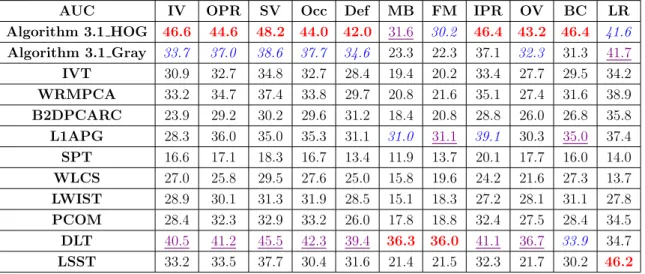
and (blue, italic) indicate first, second and third rankings, respectively. 46 3.3 AUC of Algorithm 3.1 with that of the compared trackers for
differ-ent attributes of OTB-50. (red, bold), (violet, underline) and (blue, italic) indicate first, second and third rankings, respectively. . . 46 3.4 Accuracy rank (A-Rank) and average overlap comparison of
Algo-rithm 3.1 with that of the compared trackers for different attributes of VOT2016. (red, bold), (violet, underline) and (blue, italic) indicate first, second and third rankings, respectively. . . 52 3.5 Robustness rank (R-Rank) and average failures comparison of
Algo-rithm 3.1 with that of the compared trackers for different attributes of VOT2016. (red, bold), (violet, underline) and (blue, italic) indicate first, second and third rankings, respectively. . . 52
4.1 Theprecision score of Algorithm 4.1 with that of the compared trackers
for different attributes of OTB-50. (red, bold), (violet, underline)
4.2 AUC of Algorithm 4.1 with that of the compared trackers for differ-ent attributes of OTB-50. (red, bold), (violet, underline) and (blue, italic) indicate first, second and third rankings, respectively. . . 78 4.3 Accuracy rank (A-Rank) and average overlap comparison of
Algo-rithm 4.1 with that of the compared trackers for different attributes of VOT2016. (red, bold), (violet, underline) and (blue, italic) indicate first, second and third rankings, respectively. . . 84 4.4 Robustness rank (R-Rank) and average failures comparison of
Algo-rithm 4.1 with that of the compared trackers for different attributes of VOT2016. (red, bold), (violet, underline) and (blue, italic) indicate first, second and third rankings, respectively. . . 84
5.1 Performance comparison of special cases of Algorithm 5.1 in terms of
the precision score and AUC on OTB-50. . . 107
5.2 Theprecision score of Algorithm 5.1 with that of the compared trackers
for different attributes of OTB-50. (red, bold), (violet, underline)
and (blue, italic) indicate first, second and third rankings, respectively. 109 5.3 AUC of Algorithm 5.1 with that of the compared trackers for
differ-ent attributes of OTB-50. (red, bold), (violet, underline) and (blue, italic) indicate first, second and third rankings, respectively. . . 110 5.4 Accuracy rank (A-Rank) and average overlap comparison of
Algo-rithm 5.1 with that of the compared trackers for different attributes of VOT2016. (red, bold), (violet, underline) and (blue, italic) indicate first, second and third rankings, respectively. . . 116 5.5 Robustness rank (R-Rank) and average failures comparison of
Algo-rithm 5.1 with that of the compared trackers for different attributes of VOT2016. (red, bold), (violet, underline) and (blue, italic) indicate first, second and third rankings, respectively. . . 116
List of Symbols
a, b, c and d Distances in pixels
A,D,Q,T No overlapping 8×8 sub-blocks
A, Amt Weight matrices obtained by the IRRC for Yand Ytm, respec-tively
bi Sparse code of thei-th local patch
B,C,E,H,J,O,R,S Two overlapping 8×8 sub-blocks
B Sparse codes of the image observation Y
ˆ
B Sparse codes of the tracked target candidate Yˆ
c1, c2, c3, c4,c5 Constants
Cm Confidence score of the candidate Ymt ˆ
C Confidence score of tracked target candidateYˆ
d(.) Distance metric
d2DRC(.) 2D robust coding distance metric
dg The dimension of the observation vector y,y
dGRC(.) Global robust coding distance metric
dGSLS(.) Global standard least squares distance metric
dGSLS RC(.) Distance metricdGSLS(.)computed using optimum PCA basis coefficients zopt obtained by the IRRC
dh, dw The size of an image patch Xin pixels
dl, dr The size of an imageY, Y, Yt and Ymt in pixels
do Number of elements in a overlapped local patch
D Patch dictionary
e Error or residual vector ˆ
et Error vector of the tracked target candidate at time t
{eiLP}Nn
i=1 Set of the local error or residual vectors
E Error or residual matrix ˆ
Et Error matrix of the tracked target candidate Yˆ at timet
Eh Holistic reconstruction error
fp Pooled feature vector of the candidate ˆ
fp Pooled feature vector ofYˆ
fΘ Probability density function
F,G,K,L Four overlapping 8×8 sub-blocks
F, F−1 Fourier transform and its inverse
g Response map of correlation filter
g1t, g2t Response maps of KCF-1 and KCF-2, respectively, at time t
˜gt Final response map at time t
ˆ
hj Contribution of j−th template in T
H Correlation filter I Identity matrix
ˆ
j Location of the template to be replaced inT
kg Number of the global and local PCA basis vectors
kl, kr Number of B2DPCA left- and right-projection basis vectors
lr,lc The size of a non-overlapped local patch
LΘ The objective function of error vector e, error matrix E
m Index to identify the samples/particles
M Number of samples/particles of the state variablest
nt Number of target templates
Nn Number of non-overlapped local patches inside the target re-gion
No Number of overlapped local patches extracted within the target region
O, O1, O2 Binary occlusion maps
Ot Occlusion map obtained for the tracked target candidate at time t
ˆ
Ot Updated occlusion map of Ot
Ot Resized occlusion map obtained from ˆOt
Ot hr Precomputed threshold to detect occlusion
p(st|st−1) State transition/dynamic model
p(Yt|st) An observation model representing the likelihood of the obser-vation Yt at state st
p(Ytm|stm) The likelihood of the observationYmt at statestm
p(st|Yt) Posterior probability
p Updated tracked target sample ˆ
p Estimated image of p using PCA subspace
Pi i−th overlapped local patch inside the target region
q Iteration index
R Real space
RT, RG Bounding boxes of the tracking result, the ground truth
st Target state
smt m-th sample of the state st
st Scale at time t
t Time
T Set of target templates, {Ti}ni=t1
TGP,TBP Time instants
UGP, UL D Matrix of PCA basis vectors
{UiLP}Nn
i=1 Set of matrix of local PCA basis vectors
vi Normalized feature vector of thei-th local patch
Vf Square matrix containing all the normalized feature vectors vi of the candidate
W, Wtm Global diagonal weight matrices of y and ymt , respectively ˆ
W Global diagonal weight matrix of tracked target candidate Yˆ
{WiLP}Nn
i=1 Set of the local diagonal weight matrices Wmap Weight map
xt,yt Horizontal and vertical spatial translations at time t
X, XD An image patch of size dh×dw cropped out from the frame ˆ
X The target appearance model
Xt Target appearance at timet ˜
Xt Modified target appearance at timet ˆ
X1t, ˆX2t Target appearance models of KCF-1 and KCF-2, respectively, at timet
Xi,j Circular shift ofXbyi and j pixels vertically and horizontally, respectively
y, yt, ytm An observation vector obtained from image observation matri-cesY, Yt and Ytm, respectively, of size dl ×dr
y Centered image observation vector of y ymt Centered candidate vector of ytm
{yiLP}Nn
i=1 Set of non-overlapped local patch vectors
{yiLP}Nn
i=1 Set of centered non-overlapped local patch vectors, {y i LP =
yiLP− µiLP}Nn
i=1
yiOL Vector obtained from the 2DDCT of local patch Pi
Y An image observation matrix of size dl×dr
ˆ
Y Tracked target candidate image
˜
Y Matrix obtained from the vectors yiOL Yr Reconstructed holistic image
Yt An image matrix of size dl×dr observed at time t
Ymt Candidate image sample of size dl×dr observed by smt
Y A set ofK image observations, {Y1, ...,YK}
z, zmt , q Global PCA basis coefficients of y, ymt and p, respectively
zopt Optimum global PCA basis coefficients Global PCA basis coefficients
{ziLP}Nn
i=1 Set of the local PCA basis coefficients
Z B2DPCA projection coefficients of size kl×kr
Zopt, Zmt,opt Optimum B2DPCA projection coefficients of Y and Ytm, re-spectively
αt Aspect ratio at time t
α Correlation filter coefficients in kernel space α1
t, α2t Learned coefficients of KCF-1 and KCF-2, respectively ˆ
α Learned coefficients model ˆ
α1 t, ˆα
2
t Learned coefficients’ models of KCF-1 and KCF-2, respectively, at timet
βGP, δGP, βBP, δBP Parameters of the weight function
γ Constant used in the observation likelihood p(Ymt |smt )
λGLP Penalty constant used in dGRC(.) and dL RC(.) λBP Penalty constant used in d2DRC(.)
µBP B2DPCA mean matrix µGP, µL D PCA mean vectors
{µi LP}
Nn
i=1 Set of local PCA mean vectors φt Skew direction at timet
ψGP, ψBP Small positive scalars used to terminate IRRC
ρΘ Negative logarithm of probability density function fΘ
Σ Diagonal covariance matrix σ2
x, σy2, σθ2, σs2, σα2, σφ2 Variances of the affine parameters xt,yt, θt,st, αt, φt τ Occlusion ratio
τ1, τ2, τKCF Thresholds used in the observation model update τpi Patch occlusion ratio
θt Rotation angle at timet
Θ The parameter that characterizes the distribution of error vec-tor e, error matrix E
List of Abbreviations
2DDCT Two dimensional discrete cosine transform 2DPCA Two dimensional principal component analysis 2DRC Two dimensional robust coding
3DDCT Three dimensional discrete cosine transform ACLE Average center location error
ACT Adaptive color attributes AOR Average overlap rate A-Rank Accuracy rank
ASLA Adaptive structural local sparse appearance AUC Area under curve
B2DPCA Bilateral 2DPCA
B2DPCARC Bilateral 2DPCA and robust coding BC Background clutter
CLE Center location error
CN Color names
CNN Convolutional neural network DCF Discriminative correlation filters DCT Discrete cosine transform
DDL Discriminative dictionary learning Def Deformation
DLT Deep learning tracker
DSL Discriminative subspace learning EM Expectation maximization
FM Fast motion
FOB Four overlapping blocks GMM Gaussian mixture model GSLS Global standard least squares HOG Histogram of oriented gradients
IL3DDCT 3DDCT based object representation and its incremental learning
IPR In-plane rotation
IRRC Iteratively reweighted robust coding IV Illumination variation
IVT Incremental visual tracking KCF Kernelized correlation filters
L1APG L1 tracker using accelerated proximal gradient algorithm LASSO Least absolute shrinkage and selection operator
LDSAM Local 2DDCT sparse appearance model LR Low resolution
LSGPR Locally structured Gaussian process regression LSST Least soft-threshold squares
LWIST Locally weighted inverse sparse tracker MAP Maximum a posteriori
MB Motion blur
MLE Maximum likelihood estimation NOB No overlapping blocks
Occ Occlusion
OPR Out-of-plane rotation OR Overlap rate
OTB-50 Object tracking benchmark-50
OV Out-of-view
PCA Principal component analysis
PCOM Probability continuous outlier model PDF Probability density function
RC Robust coding R-Rank Robustness rank RSC Robust sparse coding SLS Standard least squares SPT Sparse prototype tracker SV Scale variation
SVD Singular value decomposition SVM Support vector machine TOB Two overlapping blocks VOT2016 Visual object tracking 2016 WLCS Weighted local cosine similarity WLS Weighted least squares
Chapter 1
Introduction
Visual tracking has seen a flurry of research in the last two decades due to its wide range of real-life applications including activity detection, action recognition, human behavior analysis, sports video analysis, vehicle navigation, human computer interac-tion, video indexing and retrieval, medical imaging, robotics, security and surveillance [4–6]. Visual tracking, the task of finding the location of an object in the subsequent frames of a video given the initial location, is a critical intermediate step for identi-fying and analyzing the anomalous activity or behavior in a security and surveillance videos, or for an autonomous operation of robots in the dynamic environments. In spite of much progress in the last three decades, visual tracking still remains a chal-lenging problem due to the complexity involved in target searching as well as in handling intrinsic (e.g., pose changes, shape deformation) and extrinsic (e.g., varying viewpoints, rotation and scaling due to camera motion, illumination changes, occlu-sions, cluttered and moving backgrounds) object appearance variations [5–7]. These appearance variations should be handled carefully for a reliable tracking performance for which the appearance model should adapt to the intrinsic appearance variations and be robust enough for extrinsic appearance variations.
In this thesis, the focus is on single-camera, single-target, short-term, causal track-ing. Single-camera, single-target tracking means there is only one object of interest being tracked in a sequence of image frames/video that is captured by a single
cam-era. The short-term tracking is defined by considering the length of the video that is used for tracking and the length of the video is in the order of a few seconds or a couple of minutes. In causal tracking, the target location at time tk is estimated based on the information from earlier video frames at time t, wheret ≤ tk.
1.1
Literature Review
In the literature, based on the representation scheme used to model the appearance of the object, the tracking algorithms are categorized into either generative or dis-criminative methods. Generative methods extract information only from the target region to model the object appearance and search for a region that is most similar to the target model. These methods are based on holistic templates [2, 8–14], local patches/fragments [11, 15–17], subspace models [1, 3, 18, 19] or local subspace models [20, 21]. Black et al. [22] proposed an optical flow framework for tracking, by learn-ing a subspace model in offline mode to represent the target objects at predefined views and later on, extended their subspace representation to a mixture model to capture the object appearance effectively [23]. Jepson et al. [24] proposed an online appearance model using Gaussian mixture model (GMM) and expectation maximiza-tion (EM) algorithm for robust visual tracking. Kernel-based tracking using mean shift-based mode seeking procedure is proposed by Comaniciu et al [9]. Matthews
et al. [10] proposed a template update method with Lucas-Kanade algorithm [8] to
reduce the drifting problem by aligning with the first template. Wanget al. [25] pro-posed a GMM-based adaptive appearance model in a joint spatial-color space. Ross
et al. [1] proposed an online learning of adaptive linear subspace to model the target
appearance with a sample mean update and tracking the object in a particle filter framework. In visual tracking decomposition, the observation model is decomposed into multiple basic observation models to capture wide variations in illumination and pose [12]. As most of these methods use holistic model of target representation, they
cannot handle partial occlusion or background distracters.
On the other hand, the discriminative methods extract information not only from the target region, but also from the background to differentiate the target from the background within a local region by viewing the tracking as a binary classification problem (e.g., using boosting algorithms [26, 27], semi-supervised learning [28] and support vector machines (SVM) [29, 30]). Avidan [29] proposed an offline training of SVM classifier and extended it for object tracking in an optical flow framework. Collins et al. [31] proposed a variance ratio of the foreground and the background classes to find the discriminative features for object tracking. In ensemble tracking [32], a set of trained weak classifiers are combined to discriminate the target object from the background. Grabneret al. proposed an online boosting algorithm to update the discriminative features for tracking [26] and later on, proposed a semi-online boosting algorithm, which treats all the visual information from the tracking results as unlabeled data and adapts a classifier within the semi-supervised framework [28]. Further, a tracker based on multiple instance learning uses all the ambiguous positive and negative samples in the bags to learn a discriminative model to reduce the drifting problem [27]. The underlying structure of positive and negative samples are exploited in P-N algorithm to learn an effective classifier for the object tracking [33]. Wang et al. [34] proposed a superpixel tracker based on discriminative appearance model to distinguish between the target and the background. Further, an online discriminative feature selection algorithm is proposed which directly couples the classifier score with the sample importance, and optimizes the objective function in the steepest ascent direction for positive samples and steepest descent direction for negative samples [35]. Liet al. [36] proposed a compact Three Dimensional Discrete Cosine Transform (3DDCT)-based object representation and its incremental learning for robust visual tracking using a signal reconstruction-based similarity measure as the discriminative criterion to evaluate the likelihood.
to model the appearance of the object, they are not efficient in cluttered environ-ments, but they achieve a higher generalization performance with limited data [37]. In contrast to the generative methods, the discriminative methods perform better if the training set is large due to its capability of differentiating the target from the background [38]. The advantages of these individual methods are exploited by col-laborating both generative and discriminative methods to model the appearance of the object in [39–46].
Trackers based on Sparse Representation: The success of sparse represen-tation in vision applications, such as image denoising [47], image classification [48] and face recognition [49] has inspired Mei et al. to propose a l1-tracker [2, 50], where a set of target templates and trivial templates are used to model the object appear-ance, and the target location is determined by solving an l1-minimization problem. Further, the tracking robustness is improved by exploring the high-dimensional im-age features and group sparsity in [51]. In order to speed up the tracking process, the less expensive l2-minimization is exploited to bound the l1 approximation error without sacrifing the accuracy [52]. Further, L1 tracker using accelerated proximal gradient algorithm (L1APG) [13] was proposed to improve the l1-tracker [2] in terms of both the speed and accuracy. Similar to l1-tracker [2], the methods in [53, 54] use target template-based appearance model but with robust sparse coding (RSC) to account for non-Gaussian or non-Laplacian residuals by posing visual tracking as an iteratively reweighted residual minimization task. In [55], a two-stage online discrim-inative tracking algorithm with particle filter is proposed by representing the target object by local sparse codes and exploiting both the static and adaptive observation models.
Trackers based on Covariance Matrices: Although the above tracking meth-ods based on sparse representation handle partial occlusion and pose changes rela-tively well, sometimes they fail to track the object with drastic appearance changes and background clutter. This is because most approaches depend on appearance
at-tributes of the object that are highly sensitive to the appearance variations, such as pose, shape and scale variations, of the object. To overcome these issues, the covari-ance region descriptor, which captures the spatial attributes from pixel coordinate values as well as the combination of different appearance attributes, such as color, image gradients, is explored in detection and classification [56], and in tracking [57– 59]. Porikli et al. [57] employed an affine-invariant metric to find the best match by brute force search approach and to update the model by finding the intrinsic mean of the covariance matrices through Riemannian geometry. Further, Wu et al. pro-posed a probabilistic tracking on Riemannian manifolds [60] and later extended to fragments-based representation in [61]. Also, incremental covariance tensor learning is proposed to reduce the computational cost of the model update in [58]. Further, in Log-Euclidean Riemannian subspace learning algorithm [62], an eigenspace represen-tation for each mode of the target is learned incrementally by updating the sample mean and eigenbasis adaptively.
Trackers based on Subspace Representation: Most of the trackers based on sparse representation employ the target templates to model the appearance of the object. In contrast, the subspace representation-based trackers exploit the rich and redundant image properties of the target templates to compactly represent the object appearance via basis vectors. In incremental visual tracking (IVT) [1], the object is represented in a low dimensional principal component analysis (PCA) subspace, which is learned and updated efficiently to adapt the appearance variations of the object. Further, incremental two dimensional PCA (2DPCA) has been used for ob-ject appearance model in visual tracking based on maximum likelihood estimation (MLE) [63]. Even though the schemes in [1] and [63] are effective in handling illu-mination and pose variations, they are sensitive to partial occlusion. This is due to the fact that the assumption of Gaussian distributed residual with small variances does not hold for object representation in visual tracking during partial occlusion. To address this issue, Wang et al. have exploited the strength of both the subspace and
sparse representations in [3] and [19] by introducing l1-regularization into the PCA and 2DPCA reconstruction, respectively. Unlike [19], the method in [64] exploits the strength of both the subspace representation and RSC for visual tracking by in-troducing l1-regularization into the 2DPCA reconstruction. The difference between [19] and [64] is in modeling the occlusion/outliers, the former method uses trivial templates and the latter uses weights to model the occlusion/outliers. In contrast to the IVT that assume Gaussian distributed residual with small variances, the method in [65] assume that the residuals are i.i.d. Gaussian-Laplacian distributed (i.e., an additive combination of i.i.d. Gaussian and i.i.d. Laplacian components) to handle outliers/occlusion effectively.
Trackers based on Discriminative Correlation Filters: Recently, discrim-inative correlation filters have gained significance in visual tracking due to its com-putational efficiency and tracking accuracy. In [66], adaptive correlation filters are learned to model the target appearance by minimizing the output sum of the squared error. Danelljan et al. have exploited adaptive color attributes in [67], and adap-tive multi-scale correlation filters to handle scale variations of the object in [68, 69]. Henriques et al. have exploited the circulant structure of adjacent image patches in a kernel space based on intensity features [70], and histogram of oriented gradient (HOG) features [71] for visual tracking. Later, different variants of correlation filters have been proposed to increase the tracking performance using long-term memory components [72], target adaptation [73], complementary cues [74] and correlation particle filter [75]. In spite of the continuous improvement in tracking performance, standard discriminative correlation filter suffers from unwanted boundary effects due to the circulant assumption, thereby leading to a restricted target search region and a suboptimal training. The unwanted boundary problem has been addressed in [76–79] by learning a filter that has much smaller spatial support than the training sam-ples. Learning a filter using a large spatial size training samples not only reduces the boundary effects [76], but also provides a large number of background training
samples [77]. However, these methods are computationally expensive due to their approach in solving the optimization problem.
Trackers based on Deep Features/Learning: In contrast to the discrimina-tive correlation filter-based trackers [67, 68, 71, 80] that are learned using raw pixel values or handcraft features such as HOG [81], color attribute [82] or their combina-tion, the trackers [78, 83–86] learned using deep convolutional neural network (CNN) features are more robust against geometric and photometric variations of the target. This is due to the high discriminative capability of deep CNN features that are ob-tained by training CNNs using a large scale ImageNet dataset [87, 88]. Even though the trackers [78, 83–86] that use deep CNN features achieve superior tracking per-formance, they do not exploit the full benefits of end-to-end learning of deep CNNs. In order to exploit the power of deep CNNs in visual tracking, a large-scale dataset specialized for visual tracking covering a wide range of variations in the target and background is needed to train CNNs. Due to lack of specialized data for tracking, most of the deep learning-based trackers [78, 83–86] have adapted a pre-trained CNN, which is trained for classification task, to obtain the deep CNN feature maps for visual tracking. But the deep feature representations thus obtained may not be effective due to the fundamental difference between classification and tracking problem. Moreover, the feature representations obtained by a pre-trained CNN may be less discriminative for tracking specific objects. In addition to this, the superior performance of deep learning-based trackers is achieved at the cost of excessive complexity and memory requirements. Considering these facts, in this thesis, non deep learning-based track-ing algorithms are developed that do not rely on any external source of information or pre-trained model to obtain the features, but instead use the features obtained from the object itself to learn and update the object appearance model for tracking.
1.2
Motivation
In object tracking, the object representation schemes have received extensive attention from the research community along with the observation model update schemes in order to handle appearance variations of the object as well as occlusion. In general, the representation schemes are either generative or discriminative with each one having its own merits and demerits. As generative models exploit only the information from the target object and do not take the background into account, they are less effective in cluttered environments, but they achieve higher generalization with limited data. On the other hand, discriminative models distinguish the target region from the background and perform better provided the training set is large.
Most of the appearance models use raw pixels-based object representation except in some cases, where Haar features [26, 27], Gabor features [89–91], adopted features (e.g., intensity [1], color [92], texture [32]), description models (e.g., holistic histogram [9], part-based histogram [93]) are used. The exploration of other features/transform-domain features, which can reduce the dimensionality of the dictionary as well as the candidates in the object representation scheme have not been investigated. Further, during occlusion, the assumption that the residual/error follows either the Gaussian or the Laplacian distribution may not hold for object representation in visual track-ing, as the residual cannot be modeled with small variances [3]. But in practice, the distribution of the residual may be different from the Gaussian or the Laplacian dis-tribution especially during occlusions, corruptions and appearance variations of the object. In this regard, not much effort has been made to model the residual/error other than the Gaussian or the Laplacian distribution for the practical visual tracking scenarios. In the literature, only a few attempts have been made to combine both the generative and discriminative appearance models in a collaborative framework to harvest the benefits of these individual representation schemes [40, 41, 43–46]. These collaborative schemes have not yet matured enough to provide better tracking
per-formance, and hence, there is a need for a careful study on new ways of collaboration by considering the strengths of the generative and discriminative appearance models.
1.3
Objectives and Organization of the Thesis
The objective of the thesis is to develop visual object tracking algorithms by address-ing the limitations of the existaddress-ing methods to enhance the trackaddress-ing performance by exploring different object representation schemes for the object appearance modeling and then devising mechanisms to update the observation models. In this thesis, three visual object tracking algorithms are proposed to improve the tracking performance over that of the existing methods.
The first tracking algorithm is based on the global appearance model using robust coding and its collaboration with a local model. The global PCA subspace is used to model the holistic appearance of the object, and then the optimum global PCA basis coefficients and the global weight matrix are computed by developing an itera-tively reweighted robust coding (IRRC) technique. The global appearance model is collaborated with the local model to exploit the advantages of the individual models. Global and local robust coding distance measures are introduced to find the candidate sample having appearance similar to that of the reconstructed one from the subspace, and then these distances are used to define a novel observation likelihood. A robust occlusion map generation scheme and a mechanism to update both the global and local observation models are developed. Experiments conducted on the two popular benchmark datasets, the object tracking benchmark-50 (OTB-50) [7] and the visual object tracking 2016 (VOT2016) [94], show that this tracking algorithm with HOG features generally performs better than several state-of-the-art tracking methods do for most of the challenging attributes as per both quantitative and qualitative eval-uations. However, there is a need to improve the tracking performance on some challenging attributes of OTB-50 and that of VOT2016.
Therefore, a second tracking algorithm based on a structural local two dimen-sional discrete cosine transform (2DDCT) sparse appearance model and an occlusion handling mechanism is proposed. The energy compaction property of 2DDCT is exploited in the object representation by using only a few 2DDCT coefficients in both the candidate samples and dictionary, which reduces the computational cost of l1-minimization. The reconstruction of a holistic image from the overlapped lo-cal patches is presented, and the holistic image thus obtained is used along with the pooled feature vector to develop a robust occlusion map generation scheme. Using the occlusion map, a novel observation model update mechanism is developed to handle the appearance change of the object and to avoid the model degradation. A patch occlusion ratio is used in the confidence score computation to enhance the tracking performance. Experiments conducted on the two benchmark datasets bear out that the second tracking algorithm generally performs better than several state-of-the-art methods and the first tracking algorithm proposed in this thesis do, from both the quantitative and qualitative points of view. In spite of the improvement in the per-formance of the second tracking algorithm, still there are some challenging attributes of the two datasets for which performance is to be improved.
This issue is addressed by proposing a third tracking algorithm, where a collab-orative scheme of the discriminative and generative appearance models is presented. In the discriminative model, two kernelized correlation filters are used to estimate the position of the target, and the remaining affine motion parameters of the target are found using a new generative model. The idea of using the discriminative and generative models to find the location and the remaining affine motion parameters of the target, respectively, is based on the intuitions that (1) the discriminative ca-pability of a tracker plays an important role in estimating the location of the target rather than in finding the other affine motion parameters of the target and (2) the generative capability of a tracker plays a significant role in estimating the remaining affine motion parameters of the target. In the generative model, the robust coding
technique used in the first tracking algorithm is extended to two dimensions, and then employed in the bilateral 2DPCA reconstruction procedure to develop an IRRC technique. A 2D robust coding distance measure is defined to compute the similar-ity between the candidate and the reconstructed sample from the bilateral 2DPCA subspace, and then used in the observation likelihood computation. A robust occlu-sion map generation scheme and the observation model update mechanism of both the kernelized correlation filters and the bilateral 2DPCA subspace are developed. To evaluate the performance of the third tracking algorithm both quantitatively and qualitatively, experiments are conducted on the two datasets mentioned before and it is observed that the third algorithm outperforms the state-of-the-art methods and the first two proposed algorithms for most of the challenging attributes.
The thesis is organized as follows. Chapter 2 introduces the background material concerning particle filters, and the benchmark datasets and performance evaluation measures used for the performance comparison of the trackers.
Chapter 3 introduces a tracking algorithm based on the global appearance model using robust coding and its collaboration with a local model. A scheme to represent the object using the global and local PCA basis vectors, and robust coding is pre-sented. Global and local robust coding distances are defined to find the similarity between the candidate sample and the reconstructed sample from the corresponding subspace. A method to generate robust occlusion map and a mechanism to update both the global and local observation models are developed. The performance of the first tracking algorithm with that of the state-of-the-art methods is compared by conducting experiments on two popular benchmark datasets, OTB-50 and VOT2016. Chapter 4 presents the object tracking algorithm based on a structural local 2DDCT sparse appearance model and an occlusion handling mechanism. A struc-tural local 2DDCT sparse appearance model, which exploits the energy compaction property of 2DDCT to represent the object by using only a few 2DDCT coefficients, is presented. A procedure to reconstruct the holistic image from the overlapped local
patches is introduced. Experiments are conducted on the two benchmark datasets to analyze the performance of the second tracking algorithm with that of the state-of-the-art methods and that of the first tracking algorithm.
Chapter 5 introduces a tracking algorithm based on the collaboration of the dis-criminative and generative appearance models. The disdis-criminative appearance model is used to find the target location, and a new generative appearance model based on bilateral 2DPCA and 2D robust coding is used to estimate the remaining affine pa-rameters of the target. A 2D robust coding distance metric is defined to find the similarity between the candidate and the reconstructed sample from the bilateral 2DPCA subspace. The observation model update mechanism of both the kernelized correlation filters and bilateral 2DPCA subspace is presented. Experiments are con-ducted on the same two datasets mentioned above for performance comparison of the third tracking algorithm with that of the state-of-the-art methods and that of the first two proposed tracking algorithms.
Finally, Chapter 6 concludes by highlighting the contributions of the thesis fol-lowed by suggestions for possible future work.
Chapter 2
Background Material
This chapter covers the background information that is helpful in understanding the proposed tracking algorithms and their performance evaluation in later chapters of this thesis.
Section 2.1 discusses the merits and demerits of principal component analysis (PCA), two dimensional PCA (2DPCA) and bilateral 2DPCA (B2DPCA) from the perspective of image representation. Section 2.2 briefly explains the particle filter framework for visual tracking. Section 2.3 presents the benchmark datasets and the evaluation measures used to compare the performance of the proposed methods with that of the other trackers.
2.1
Merits and Demerits of PCA, 2DPCA, and
B2DPCA
PCA [95] is a well-established linear-dimension reduction technique and has been used extensively in the areas of pattern recognition [96], computer vision [97], signal pro-cessing [98] etc. PCA finds the projection directions by minimizing the reconstruction error in those directions and then projects the original data into a lower-dimensional space spanned by those directions corresponding to the top eigenvalues [99]. In image
representation, recognition and retrieval using PCA, a 2D image matrix is usually transformed into 1D long vector by concatenating either column by column or row by row that leads to a point in a high-dimensional vector space. In spite of many ad-vantages due to the conversion from 2D to 1D, it suffers from the following problems. First, there is a requirement of a large number of training samples for a reliable and robust estimation about the characteristics of the data distribution as each image sample is represented as a point in a high-dimensional space. Second, PCA suffers from small sample size problem due to the limited availability of data in real-life applications like face recognition and image retrieval. Third, the exploitation of the spatial redundancies within the image ensembles is not possible due to absence of spatial information [99]. Because of large size and relatively small number of training samples, accurate computation of the covariance matrix is difficult [100], and then finding the eigenvectors of a large size covariance matrix is very time consuming.
These problems have been addressed in 2DPCA [100] by directly computing the eigenvectors from the image covariance matrix, which is computed from the image matrix itself without matrix-to-vector conversion. Since both the number of rows and columns of the image covariance matrix is equal to the width of the image, the size of the covariance matrix of 2DPCA is much smaller than that of PCA. Hence, 2DPCA has a more efficient computation of the eigenvectors with less computational time. As the unilateral projection (right-multiplication) scheme is adopted in 2DPCA, it is also termed as unilateral 2DPCA. When compared with PCA, 2DPCA requires a larger number of coefficients for image representation than that required by PCA [100]. Moreover, 2DPCA is also viewed as performing PCA on the row vectors of the image matrix, where the correlation among the column vectors of the image matrix has not been exploited. The weaknesses of 2DPCA have been overcome by B2DPCA [99, 101], where two sets of projection directions are simultaneously constructed to project the row and column vectors of the image matrices to two different subspaces, respectively.
For adl×dr imageY and kl×kr projection coefficientsZ, the bilateral projection is given by
Z=UTBPY VBP (2.1) and
Y= UBPZ VTBP (2.2) where UBP ∈Rdl×kl and VBP ∈ Rdr×kr represent orthogonal left- and right-projection matrices, respectively, and kl and kr are the number of B2DPCA left- and right-projection basis vectors, respectively. Given a set of K image observations Y =
{Y1, ...,YK}, the projection matrices UBP and VBP are computed as in [63, 99]. As the redundancies among the rows and the columns of the images are removed in B2DPCA, it requires less number of coefficients to represent an image than that required by 2DPCA [100].
2.2
Particle Filters
Generally, in the tracking methods based on particle filter framework, the target motion is estimated using a Markov model with hidden state variables [102]. In this thesis, the target motion between two consecutive frames is assumed to be affine. Let st denote a state variable describing the affine motion parameters of a target at time t. Given a set of image observations Yt = {Y1, ...,Yt} at time t, the posterior probability is inferred recursively by the Bayes’ theorem [1]
p(st|Yt) ∝ p(Yt|st)
∫
p(st|st−1)p(st−1|Yt−1)dst−1 (2.3)
where p(st|st−1) represents the dynamic (state transition) model, p(Yt|st) represents the observation model and st is the target state.
In this thesis, an affine transformation with six parameters is adopted to model the target state st = (xt, yt, θt,st, αt, φt), where xt, yt, θt,st, αt and φt denote
horizon-tal and vertical translations, rotation angle, scale, aspect ratio and skew direction at time t, respectively. The dynamic model describes the target motion between two consecutive frames and is modeled by the Gaussian distribution assuming the affine parameters to be independent, i.e., p(st|st−1) = N(st;st−1,Σ), where Σ denotes a di-agonal covariance matrix whose elements are the variances of the affine parameters
(σx2, σy2, σθ2, σs2, σα2, σφ2). These affine parameters are used to crop a sub-image from the current frame and then normalized to the size dl×dr. The dynamic model randomly selects Msamples (particles) of the state variablest given the statest−1att−1, which are used to generate the target candidates Ymt , where m = 1,2, ...,M. The optimal state of the tracked target ˆst is determined by the following maximum a posteriori (MAP) estimation
ˆst =arg max sm
t
p(Ymt |smt )p(stm|st−1), m= 1,2, ...,M (2.4)
wheresmt denotes them-th sample of the statest, andYmt represents the image sample observed by smt . The observation model represents the likelihood of the observation Ytm at statestm. This will be defined in the subsequent chapters that use particle filter framework for tracking.
2.3
Benchmark Datasets and the Performance
Eval-uation Measures
For an exhaustive performance evaluation of the state-of-the-art tracking algorithms, to identify their strengths and weaknesses, and to draw future research directions for the development of robust tracking algorithms, the tracking experiments have to be conducted on the benchmark datasets and then evaluated using standard performance measures. Also, the benchmark datasets should contain all the individual challenging tracking scenarios and their combination including but not limited to illumination
changes, varying viewpoints, rotation and scaling due to camera motion, occlusions, cluttered and moving backgrounds etc. From this point of view, the experiments are conducted on two popular benchmark datasets, object tracking benchmark-50 (OTB-50) [7] and visual object tracking 2016 (VOT2016) [94], to compare the performance of the proposed trackers with that of other methods. The sequences from these benchmarks cover most of the real-life challenging situations in object tracking, such as motion blur due to fast movement, pose variation, complex background, varying lighting conditions, low contrast, scale change, heavy occlusion, in-plane and out-of-plane rotation.
The OTB-50 benchmark [7] consists of 50 challenging sequences (with 51 tar-get objects) that are fully annotated with bounding boxes as well as 11 different attributes, namely, illumination variation (IV), out-of-plane rotation (OPR), scale variation (SV), occlusion (Occ), deformation (Def), motion blur (MB), fast motion (FM), in-plane rotation (IPR), out-of-view (OV), background clutter (BC) and low resolution (LR). In OTB-50, there are 18 and 7 sequences with more than 500 and 1000 frames, respectively. The VOT2016 benchmark [94] consists of 60 challenging sequences that are fully annotated with rotated bounding boxes as per the target rotations. This is in contrast to the upright bounding boxes annotated in OTB-50. Further, VOT2016 dataset sequences are per-frame annotated with 5 visual attributes that reflect a particular challenge in appearance attributes, such as camera motion, illumination change, motion change, occlusion and size change. If a particular frame does not contain any of these five attributes, then it is denoted as empty. Again, this is also in contrast to OTB-50, where the sequences are annotated globally with attributes even though they may occupy only a few frames in a sequence. Recently, it has been shown that the performance measures computed from the global attribute annotations, like in OTB-50, are significantly biased toward the dominant attributes in the sequences, whereas the bias is significantly reduced with per-frame annotation, like in VOT2016, even in the presence of mis-annotations [103]. In VOT2016, there
are 14 and 2 sequences with more than 500 and 1000 frames, respectively.
In general, two frame-based metrics, namely, overlap rate (OR) and center location error (CLE), are employed to evaluate the tracker in a given frame. The OR is defined using a score in the Pascal visual object classes challenge [104] as OR =
ar ea(RT ∩RG)
ar ea(RT ∪RG)
, where RT and RG are the bounding boxes of the tracking result and the ground truth, respectively, and ar ea(R) denotes the area of the region R. In case of OR, its value should be as high as possible, approaching one for better tracking performance. CLE is the relative distance (in pixels) between the center positions of the tracking result and the ground truth. For better tracking performance, the value of CLE should be as close to zero as possible. Further, average OR (AOR) and average CLE (ACLE) are used to measure the overall performance of the tracker for a given sequence. However, when the tracker loses the target, the output location and size of the bounding box can be random, and hence, ACLE and AOR may not evaluate the tracking performance efficiently [105]. The authors of [7] and [94] have used other performance measures [105, 106] derived from the two basic metrics, OR and CLE, to analyze the performance of some existing trackers on their benchmark datasets, OTB-50 and VOT2016, respectively. Likewise, in this thesis, the performance measures used in [7] and [94] are employed to evaluate and compare the proposed trackers with the state-of-the-art methods on the OTB-50 and VOT2016 benchmark datasets, respectively.
In OTB-50, the performance of a tracker for a given sequence is evaluated using
the success rate and the precision score [105]. The former is the ratio of successful
frames whose OR is larger than a given threshold, to the total number of frames in a sequence. On the other hand, the later is the percentage of frames whose CLE is less than a given threshold distance of the ground truth. By using multiple thresholds, two curves are obtained showing how the threshold value affects the success rate and
theprecision score, and are called assuccess plot andprecision plot, respectively, for a
all the sequences to obtain the overallsuccess plot and precision plot, respectively. In order to quantify the overall performance of a tracker, the area under curve (AUC) of
the success plot or the precision score for the threshold of 20 pixels is employed. In
OTB-50, the trackers are evaluated on the test sequences with an initialization from the ground truth position in the first frame and the overall precision plot or success plot at the end is reported. This evaluation is referred as one-pass evaluation (OPE). In VOT2016, the performance of a tracker is analyzed using the accuracy and ro-bustness. The accuracy is the average overlap between the predicted and ground truth bounding boxes during successful tracking periods, whereas the robustness measures the number of times the tracker fails to track. In VOT2016, whenever a tracker pre-dicts a bounding box with zero overlap with the ground truth, a failure is detected and the tracker is re-initialized. All the trackers are evaluated 15 times on each sequence and then per-frame accuracy is obtained as an average over these runs. Averaging per-frame accuracies gives per-sequence accuracy. On the other hand, per-sequence robustness is computed by averaging failure rates over different runs [94]. Further, the tracking results are ranked according to the accuracy and robustness performance metrics, and are called accuracy rank and robustness rank, respectively. Note that as the trackers with statistically equivalent results are merged while ranking, the differ-ent trackers may have the same accuracy rank and robustness rank [94]. In order to quantify the overall performance of a tracker, different averaging methodologies are used in VOT2016. The averages of the per-attribute results in an equal or weighted manner are denoted as mean and weighted mean, and the per-frame averaging of the results of the super-sequence is obtained by concatenating all of the sequences as pooled.
2.4
Summary
In this chapter, the advantages and disadvantages of PCA, 2DPCA and B2DPCA from the image representation point of view has been explained. Also, the particle filter framework for visual tracking has been introduced. Finally, the benchmark datasets used for the experimentation and the evaluation measures used to compare the performance of the proposed trackers have been presented. A novel tracking algo-rithm based on the global appearance model using robust coding and its collaboration with a local model will be presented in the next chapter.
Chapter 3
The Global Appearance Model
using Robust Coding and its
Collaboration with a Local Model
for Visual Tracking
3.1
Introduction
In incremental visual tracking (IVT) [1], the object is represented by a low dimen-sional principal component analysis (PCA) subspace (Figure 3.1a), which is learned and updated efficiently to adapt to the object appearance variations. Even though the PCA subspace representation is effective in handling illumination and pose varia-tions, it is sensitive to partial occlusion. This is because the assumption of Gaussian distributed residual with small variances (i.e., small dense noise) does not hold for representation of the object in visual tracking during partial occlusion. Further, the IVT does not have a mechanism to detect and remove the occlusion/outliers while updating its observation model with new observations. Similar drawbacks are ob-served in other tracking algorithms based on Gaussian noise assumption or ordinary least squares method [62, 107]. The success of sparse representation has motivated
Mei et al. [2] to propose a novel l1-tracker using a set of target and trivial templates
Wang et al. [3] exploit the strength of both the subspace and sparse representations in sparse prototype tracker (SPT) by introducing l1-regularization into the PCA re-construction. Here, the target appearance and occlusion are modeled by PCA basis vectors and trivial templates, respectively, as shown in Figure 3.1c, and given by
y = µGP+UGPz+e= µGP+[UGP I] ⎡ ⎢ ⎢ ⎢ ⎢ ⎣ z e ⎤ ⎥ ⎥ ⎥ ⎥ ⎦ (3.1)
wherey ∈Rdg×1is an observation vector obtained from the observed image sampleY∈
Rdl×dr, UGP ∈Rdg×kg denotes a matrix of PCA basis vectors, µGP ∈Rdg×1 represents mean vector, z ∈ Rkg×1 represents the PCA basis coefficients, e ∈
Rdg×1denotes the error or residual vector, and kg and dg are the number of PCA basis vectors and the dimension of the observation vector, respectively.
The holistic/global appearance model provides a compact representation of the target object and deals with global appearance variation of the object, but it cannot handle occlusion, as the partial and spatial information is not exploited to the full extent, thus leading to a poor performance of the tracker [1]. On the other hand, the local appearance models [20, 21, 108] exploit the partial and spatial structural information of the target, and hence, perform well during occlusions and background clutter. However, they do not provide a compact representation of the target like the holistic model does, and fail during global appearance change.
In this chapter, a new tracking algorithm based on the global appearance model using robust coding (RC) and its collaboration with a local model is proposed [109]. To model the global appearance of the object, the global PCA subspace is used and an iteratively reweighted robust coding (IRRC) technique is developed to compute the optimum global PCA basis coefficients and the global weight matrix [110]. A col-laborative scheme of the global (holistic) and local (patch/block) appearance models is presented to capture their individual advantages. Global and local RC distances are defined to find the similarity between the candidate sample and its reconstructed
sample from the subspace. These RC distances are used to define the observation like-lihood, which is in turn used to find the tracking result by the maximum a posteriori (MAP) estimation. As the weights obtained during IRRC capture the outlier/occlu-sion information, they are exploited to detect outliers/occluoutlier/occlu-sions as well as to generate the occlusion map. The occlusion map thus generated is used to obtain occlusion-free samples that are accumulated for observation model update. Experiments conducted on the two popular benchmark datasets with comparison to the state-of-the-art track-ing methods bear out the effectiveness and competency of the proposed algorithm for visual tracking.
This chapter is structured as follows. Section 3.2 introduces the representation of the object via global and local PCA basis vectors, and robust coding. Section 3.3 presents the proposed tracking algorithm. Experimental results are given and discussed in Section 3.4 followed by in Section 3.5 a summary of the work presented in this chapter.
3.2
Object Representation via Global and Local
PCA Basis Vectors, and Robust Coding
In IVT [1], the residual is assumed to be Gaussian distributed with small variances, but this assum
![Figure 3.1: Different appearance models of (a) IVT [1], (b) l 1 -tracker [2], (c) SPT [3], and (d) the proposed tracking algorithm, where ⊙ indicates Hadamard product (element-wise product).](https://thumb-us.123doks.com/thumbv2/123dok_us/642898.2577481/49.918.236.751.106.686/figure-different-appearance-proposed-tracking-algorithm-indicates-hadamard.webp)