Policy, Research, and External Affairs
Macroeconomic Adjustment and Growth
Country Economics Department The World Bank
July 1991 WPS 732
Stabilization Programs
in East rn
Europe
A Comparative Analysis of the Polish
and Yugoslav Programs of 1990
Fabrizio
Coricelli
and
Roberto de Rezende Rocha
Two apparenitly similar programs launched at routghly the sarne
time by Yugoslavia and Poland yielded significantlyc different
initial results (outplt
fell
much more wvhile inflationi (decliniedmore slowly in Poland than in Yugoslavia).
IhcPocy, Research, and Extermal Affairs ('omplex di*:rhnttc, P'RIE Wo'rkir lrIg rs Io disscminatctnefinaingg of vork in prwgre s and Lo encourage thc exchangc of ideas amonig Plardr saflf anid a1 oihcrs. ni,r -s-ed ui descioprncnt ImsUS. lc rxprs cany thic ninIcs of
the authors, rtflect only their views, and sh.r-d he us d and ctlcd accordngly. I he findings, nJcrprctalolons, a:id conJusions drc thec authors' own. They should not bc atrihuicd to the 'A :ii 1 Is Ioird lDirors its .tac.agd ncin, or an) i Is rnmhen.,r cOinrimCS.
Public Disclosure Authorized
Public Disclosure Authorized
Public Disclosure Authorized
Macroeconomic Adjustment and Growth
WPS 732
This paper -a product of the Macroeconomic Adjustment and Growth Division, Country Economics Department-ispartofalargereffort in PRE toanalyzethedesign and theeffcctsofstabilization programns in Central and Eastern Europe. Copies are available i'ree from the World Bank, 1818 H Street NW, Washington DC 20433. Please contact Rebecca Martin, room NI 1-077, extension 39065 (67 pages).
Coricelli and Rocha compa.e the implementation stage of refonr '-hese include the unfreezing of of two apparently similar stabilization programs nominal variables and resolving the critical by two reforming socialist countries, launched structural problems affectinig both economies.
two weeks apart (December 1989 in Yugoslavia
and January 1990 in Poland). Coricelli and Rocha conclude that the
microfoundations of socialist and market ccono-They investigate possible differences under- mies are clearly dif'Tercnt. These dif'ferences lying the apparently similar programs that may imply that in socialist economnies the case for account for the better initial performance of including incomes policy in stabilization pro-Yugoslavia's program (a sharper reductioni of' grams may be stroniger. Dii'ffeent
inflation with smaller losses in output). microfoundations also imply tihat the model of sequencing traditionally applied to Lalin Ameni-The authors identify significant differences can countries - where structural issues are
in initial conditions in the two countries as cell relegated to later stages of Ihe adjustment
as the sequence and degree of some policy programs - does not seem to apply to rel'onring
measures. These differences may explain the socialist counlries, where stabilization and difference in the early results. structural reforms are much more closely
inter-twined.
They also identify the most importantl issues the two countries must address in the second
The PRE Working Paper Series disseminates thc fin(dings of work undier way in the Bank's Policy, Research, and Extemal AffairsComplex. An objectiveofthc scries is to get thcsc findings out quickly, even if prescntations a;e less than fully jxlished.
The findings, intcrprctations, and conclisions in thesc papers do not necessarily represent official Bank policy.
Introduction . . . .* . . . *****
Background
o.
...
o. . .
0 . .
*
0
0s
vv
6
Conditions Preceding Stabilization . . . .... 8
A Comparison of the Two Stabilization Programs . . . 14
Examination of the Initial Results . . ... . ... . s18 Assessment of the Main Iesues . e.s. ... 30
APPENIDIX A
o .o
..
..
..
.
.
.
.
o* ..
..
..
34
STABILIZATION IN
POLAND
. . . .... . 34Background . . . . ... ... . . . .. . .. . . 34
Preparation for the Stabilization Program and Other Developments in 1989. . . . .. 37
The
Stabilization
Program
of January
190 . . . .
. .40
Initial Results . . .
41
APPE'SDIX B . . . *. * .. . . ... . . 49
STABILIZATIONINYUGOSLAVA... ... ... 49
Background
. . . .. .. . * . . . .. . . 49Developments in 1989 and Preparations for the 1990 Program . . . 54
The Stabilization Program of 1990 . ... .... . 55
First
Results of the 1990 Program . . . .. 57An Assessment of the Main Issues ... ... ... 63
References . . . .. . . 4 4 * .. .. . . ...., 4 * 4. . . * *.. * 65
The authors are grateful to Guillermo Calvo, Vittorio Corbo, Alex Cuckierman,
Miguel Kiguel, Nissan Liviatan, Branko Milonovic and Jeffrey Sachs for their
helpful comments on an earlier verison of the paper. The authors are also
Dissatisfaction with their performance and concern over the acceleration
of inflation led the governments 3f Poland and Yugoslavia to implement
stabilization cum restructuring programs at the end of 1989. Their programs,
which they launched at approximately the same time (December 18 in Yugoslavia
and January
1
in Poland), comprise measures designed not only to stabilizeinflation at low levels but also to change the structure of their economic
systems.
The stabilization components of both programs would ordinarily be
classified as heterodox, since they include incomes policy measures in
addition to a significant fiscal adjustment, the imposition of credit controls
and the relaxation of exchange rate and trade controls. The restructuring
components of the two programs also share some similarities. Both attempt to
fose inefficient enterprises into bankruptcy, albeit through different
methods. However, in neither case is there a clearly defined strategy to deal
with bankrupt enterprises, including of the precise role of privatization in
the overall reform strategy. In fact, both countries are still elaborating
several aspects of their restructuring components.
Both programs brought about a substantial reduction in inflation in the
first semester of 1990 without recourse to widespread price controls. In the
case of Poland, inflation was reduced from a peak of 78 percent in January to
3.5 percent in June. In the case of Yuposlavia, inflation went from a peak of
60 percent in December 1989 to almost 0 percent in May and June 1990. The
performance of the two programs in the second semester of 1990 was less
satisfactory, with monthly inflation rates of around 5 percent in Poland and
ranging between 3 and 8 percent in Yugoslavia.
Both countries experienced a sharp contraction in economic activity
following the implementation of their programs. During 1990, real GDP fell by
of activity was particularly strong in the industrial sector, as indicated by
negative growth rates of 20 and 10 percent9 respectively. Although the output
contraction Was concentrated in the first semester of 19909 the prospects for
a sustained resumption of growth are still uncertain in both countries.
The implementation of two apparently similar programs by two reforming
socialist countries at almost the same time has produced great interest in a
comparative analysis of their design, performance and sustainability. Such ia
the objective of this paper. To this end, the paper investigates the possible
differences that underlie the similarities of the two programs, and that may
account for the better initial performance of Yugoslavia's program (a sharper
reduction of inflation with smaller output losses). The paper identifies
significant differences in initial conditions in the two countries, as well as
in the sequence and degree of some policy measures. These differences may
explain the differences in the early results. Finally, the paper identifies
the most important issues that the two countries will have to address in the
second stage of their programs. These include the unfreezing of nominal
variables and resolution of the critical structural problems affecting both
economies.
The next section provides some background iaformation on inflation in the
two countries during the 1980s. The following section examines the conditions
in the two economies before stabilization. A comparison of the components of
the two programs is presented in the subsequent section, followed by a section
that analyzes the initial results of the programs and points to the possible
causes of the more severe recession in Poland. It also identifies the likely
causes of the revival of inflation in Yugoslavia during the second semester of
1990. The final section assesses the main issues facing the second stage of
the reform in the two countries. Much more detailed analyses of the two
programs appear in the two appendices (appendix A deals with Poland, appendix B with Yugoslavia).
6
Background
The
histories
of inflation
in Poland
and
Yugoslavia
during
the last
decade
are
quite
different.
As shown
in figure
19
inflation
in Poland
was
more
erratic
than
that
in Yugoslavia.
The dominant
feature
in the
first
half
of the
decade
in Poland
was a jump
in 1981-82,
while
in the
second
half
inflation
showed
an upward
trend
until
1988,
followed
by another
jump
in 1989
when it reached
700
percent. In Yugoslavia
inflation
was
more or less
stable
until
1983. After
that
year it accelerated
almost
continuously,
reaching
2,700
percent
in 1989. In general,
the
rates
of inflation
in Yugoslavia
were
much
higher
than
in Poland
(except
in 1982)
and the
OECD
average
for
the
decade.
These
differences
in the
path
of inflation
reflect
in part
differences
in
the structure
of the two
economies.
Until
the
early
1980s
Poland
had
a
centrally
planned
economy,
when
it initiated
a gradual
decentralization.
Yugoslavia
had already
replaced
its
central
planning
with
a system
of
self-management
in the
early
1960s. As a result,
there
was
much less
interference
in the
price
system
in Yugoslavia.
Unlike
in Poland,
price
controls
in
Yugoslavia
were
rarely
strong
enough
to repress
inflation. In fact,
they
bore
a greater
resemblance
to the
controls
prevailing
in other
high
inflation
countries
such
as Brazil
(which
has
always
had controls
of some
sort).
The
phenomenon
of high
inflation
in Yugoslavia
was closely
associated
with the
turnaround
in the
current
account
during
the 1980s--typically
inflation
accelerates
as the
current
account
shifts
from
a deficit
to an
increasing
surplus. Two
major
factors
underlay
the
close
association
between
inflation
and
the
current
account
in Yugoslavia.
First,
the
need
to reduce
the
real
wage to levels
consistent
with a given
depreciated
real
exchange
rate
required
an increase
in the
rate
of inflation--the
Pazos-Simonsen
mechanism
(see
Dornbusch
1987;
Pazos
1978;
and
Simonsen
1989). This
factor
became
more
important
at the
end
of the
decade,
with
the increase
in real
wage
rigidity
occurring
after
the
formal
introduction
of wage indexation
in
1987.
Second,
the
conditions
that
prevailed
after
the
reversal
of the
flows
in
external
financing
considerably
woreened
the financial
situation
of Yugoslav
enterprises,
where
the fundamental
imbalances
of the
Yugoslav
economy
were
located
(the
non-financial
public
sector sn surpluses
throughout
the 1980.).
Large
losses
in foreign
exchange
as a result
of interest
and
principal
payments,
combined
with stagnant
output
and increasing
overstaffing,
resulted
in greater
enterprise
losses
in the 1980s. The
enterprise
imbalances
spilled
over
to the cAntral
bank,
since
the
latter
had
to absorb
large
amounts
of
foreign
liabilities
in an effort
to protect
the
enterprises
and
commercial
banks
from
even
greater
financial
difficulty.
As a result,
the
central
bank
ran a quasi-fiscal
deficit
that
became
an independent
source
of monetary
expansion.
The
various
attempts
at stabilization
failed
to address
the
hidden
losses
in the
system
and
were
abandoned
soon
after
implementation.
Unlike
in Yugoslavia,
the
non-financial
public
sector
in Poland
ran
deficits
during
che
19809,
while
enterprise
accounts
showed
small
surpluses.
The
fiscal
deficits
were,
however,
kept
at moderate
levels
(1-2
pes
-ent
of
gross
national
product
[GNP])
during
most
of this
period,
the
exceptions
being
1981
and 1989,
when
the
deficit
was
much larger
(10
percent
and
8 percent
of
GNP,
respectively).
In addition,
the
negative
transfer
of resources
from
abroad,
as measured
by the
non-interest
current
account
surplus,
was
much
smaller
in Poland
(2-3
percent
of GNP)
than
it
was in Yugoslavia
(5-7
percent
of GNP).'
These
numbers
indicate
that
the
underlying
rate
of inflation
consistent
with "fundamentals"
was lower
in the
case
of Poland. At the
same
time,
the
much
stricter
price
controls
in Poland
make
it more
difficult
to associate
the
movement
of inflation
with the
fundamentals.
2In addition,
there
is some
I
In fact,
Poland
managed
to run
current
account
deficits
throughout
the 1980s,
while
Yugoslavia
ran
increasing
current
account
surpluses
after
1983.
2
Even
in countries
with
open
inflation,
it
may be difficult
to
establish
a
continuously
close
relationship
between
budgetary
developments;
money
creation
and
inflation.
See
Sargent
and
Wallace
(1981),
Bruno
and
aesociation between price controls and budgetary performance via the
subsidies. For instance, the outburst of inflation in 1982 coincided with a
sharp reductior in the deficit from 1981 to 1982, a phenomenon that occurred
again from the first to the second half of 1989.
Conditions Preceding Stabillzation
Conditione in the Polish and Yugoslav economies preceding the two
stabilization programs are summarized in table 1. In Poland, the sharp
increase in inflation during 1989 was the result of not only the increased
fiscal deficit (7.9 percent of GNP, the bulk of which was incurred in the
first semester) but also the successive price shocks related to the
liberalization of food prices (August), the first round of adjustment of
energy prices (October) and repeated devaluations accompanied by the
introduction of formal wage indexation.
In Yugoslavia, various factors contributed to the open inflation of 2,700
percent in 1989. First, a large real devaluation in mid-1988 in the context
of formal wage indexation caused wages and prices to escalate. Second,
although the government abandoned its target for the real exchange rate in
mid-1989, an explosion in real wages in the second semester sustained the
inflationary pressure. Finally, the hidden losses in the system, which had
not been corrected, constituted a permanent source of monetary expansion and
inflation. Pressure on the money supply was further increased by the large
build-up in foreign exchange reserves over the year. In 1989, seignorage
revenues on base money reached 13 percent and 12 percent of GNP in Poland and
Yugoslavia, respectively.
the possibility of weak links in the short run and Kiguel and Liviatan (1990)
Inflation (1980-1990)
(% change p.a.)
Log 3cale 1000% 100% 10%1iosot11,111 toasl9ta$t isa4 I 1least ¶6110607 I¶0681 19698 19890Iloo
-Polanid YuolaI
Figure 2
Poland and Yugoslavia
Black Market Currency Premiums
1600% 1400%
[...
... ... ... 1200%. .' ' . 1000% ...L
...
800% . .. . .A...---.--600%
-
.I.I..I...
..
400% - ... 200% . ... ... ... 0% -200% | ... ,s|,, ...;.jlB,ll.,... ;, ,,,, WTr,llWl.luy,.ls. 1980 1981 1982 1983 1984 1985 1988 1987 98s8 1989 1990 - Poland -Yugoslavia10
The fiscal deterioration in Poland during 1989 was partly attributable to
the fall in real tax revenues, which in turn resulted in part from lags in the
collection of taxes--the Olivera-Tanzi effect (see Olivera 1967 and Tanzi
1977). As shown in table 2, the revenue loss amounted to 7 percent of GNP.
In Yugoslavia, on the other hand, the erosion of fiscal revenues in the
1980s tended to be offset by adjustments in the tax rates and contributions,
as well as by the partial indexation of some taxes. In the years when these
measures proved insufficient to stabilize real tax revenues, the government
adjusted expenditures so as to prevent a deficit. These factors make
estimation of the Olivera-Tanzi effect more difficult in the case of
Yugoslavia.
Yugoslavia enjoyed a more comfortable external position before 1990 than
did Poland. The large current account surplus of 1989--US$2.4 billion--and
the successful debt rescheduling of 1988 allowed foreign reserves to rise to
US$6.1 billion at the end of 1989. Poland, in contrast, ran a current account
deficit of US$1.8 billion in 1989 and ended the year with much lower
reserves--US$2.5 billion (much of which was not useable as pledged against
obligations). In addition, in Yugoslavia the excess demand for foreign
exchange at the official rate was mild, as suggested by a barely positive
black market premium (figure 2). In Poland, the black market premium was
still very large in 1989, despite the real devaluations after 1987. The size
of the premium there reflected the magnitude of the exchange rate misalignment
and possibly some residual money overhang.
It is important to bear such differences in mind when examining the
rationale £or some of the preparatory measures taken in 1989, especially in
Table 1
Initial Conditions in Poland and YugoslAvia
Poland Yugoslavia
BACKGROUNDs
Inflation 640% in 1l89. 2,700% in 1989.
Output 1.42 in the 1980s, 0.72 in the 1980s,
Growth 0S in 1989. 0.8S in 1989.
Rate of 02 in the 1980s, 132 in the 1980s,
Unemployment 0X in 1989. 142 in 1989.
OTHER CONDITIONS IN 1989:
GNP US$ 66.2 billion. US$ 67.0 billion.
Current US$ 1.8 billion US$ 2.4 billion
Account deficit. surplus.
Gross Debt US$ 40.6 billion. US$ 17.3 billion.
Reserves US$ 2.5 billion. US$ 6.1 billion.
Black Market 4002 average in 1989 102 avsrage in 1989
Premium 402 before the plan. 302 before the plan.
Fiscal/ Fiscal deficit Fiscal surplus of
Enterprise of 7.22 of GNP. 0.72 of GNP.
Balance
Enterprise losses
of 152 of GNP. Central Bank Losses of 4-52 of GNP. Large volume of non-performing loans. Seignorage 13.52 of GNP. 122 of GNP. Ratio of 47.8Z 33.12 M3 to GNP Share of 69..` 69.52 FX deposits in M3
Table 2. Total Fiscal Revenues in Poland and Yup_slavia. 1985j 89'
(percent of GDP)
1985 1986 1987 1988 1989
Poland n.a. 49.4 46.9 48.0 40.8
Yugoslavia 33.7 38.2 34.5 33.5 34.7
n.a. Not available.
a. Using a broad definition of the public sector in both countries.
Source: The World Bank.
rate and trade controls. As shown in figure 3, both countries devalued their
currencies in real terms in November and December 1989. However, in the case
of Poland, the more adverse external conditions and the large exchange rate
misalignment dictated the need for much sharper real devaluations. The same
factors seem to explain why Poland restricted the introduction of
convertibility to current account transactions, while in Yugoslavia
convertibility was also extended to the capital account.
Both countries adjusted public sector prices at the end of 1989.
However, in Poland some of the administered prices were so low that even after
the very sharp corrections made in that period (100 percent increase in energy
prices in October), the prices remained substantially below international
levels and had to be further corrected at the start of the program.
The two countries shared a severe problem of excess personnel in the
enterprise sector. In the case of Poland, the extent of the problem is
indicated by a rate of unemployment barely above 0 percent throughout the
1980s. In Yugoslavia the rate of unemployment was around 14 percent in 1989,
a slight increase over the 13 percent average for the whole decade. Although
this higher rate of unemployment (concentrated on new entrants) in Yugoslavia
seems to rule out the existence of overstaffing, a major cause of enterprise
losses was indeed excess personnel, estimated to have reached 20 percent of
Figiu
re 3
Poland and Yugoslavia
Real Effective Exchange Rate Indices
(1988 * 100)
180 _... ...
120 _...
'100 ... ... ...
60 _...I...
Jun Jan Jan De
use0
teas
¶990 19900-- Poland - Yugoslavia
Figure 4
Poland and Yugoslavia
Real Wage Indices (1985
*
100)
120 ... . . . . ...
J.n.J.n. Jan ...
rs ... ... ,r
Jan Jon Jan e
1984 19Po Yuo 0 1a90
14
The two
countries
also
shared
a problem
of flight
from
domestic
assets
end
increasing
velocity.
While
hardly
a novelty
in high
inflation
countries,
In both
countries
the
payment
of negative
real
intereet
rates
on domestic
deposits--a
policy
designed
to provide
subsidized
credits
to
enterprises--accelerated
the
flight
from
domestic
assets. In addition,
the
foreign
exchange
deposits
in the financial
systeme
of both
countries
are
also
likely
to have
facilitated
the
shift
out
of domestic
money. Between
1980
and 1989
the
share
of foreign
exchange
deposits
in M3 increased
from
20 percent
to 69
percent
in Poland
and
from
30 percent
to 65 percent
in Yugoslavia.
In 1989
the
ratio
of M3 to GNP in Poland
and
Yugoslavia
had
declined
to 47 percent
and
33 percent,
respectively.
A Comparison
of the
Two
Stabilization
Programs
A sumary comparative
description
of the
Polish
and
Yugoslav
stabilization
programs
is provided
in table
3. On first
examination,
the
two
programs
look
strikingly
similar.
The income
policy
components
are
basically
the same,
including:
(1)
a temporary
freeze
on the
exchange
rate
that
both
countries
extended
to one
year;
(2)
wage
controls
(with
a complete
freeze
in
Yugoslavia
and
partial
indexation
with
very
low
coefficients
in Poland);
and
(3)
a temporary
freeze
on public
sector
prices.
3However,
note
that
Yugoslavia
made all
its
price
corrections
before
the start
of its
program,
whereas
Poland
made
large
corrections
to its
energy
prices
(400
percent)
on
January
1, 1990.
Both
programs
included
a significant
fiscal
adjustment--7
percent
and
5
percent
of GNP in Poland
and
Yugoslavia,
respectively.
In the
case
of Poland,
the adjustment
was
designed to close the fiscal deficit, whereas in Yugoslaviait was essentially
designed
to cover
new,
non-traditional
expenditures.
These
included
the
quasi-fiscal
operations
of the
central
bank
(servicing
of foreign
liabilities
and
subsidies
to favored
sectors),
transfers
to the
bank
'
In July
both
countries
made
some
adjustments
to the
administered
Table
3
Sumarized
Description
of the
Polish
and
Yugoslav
Programs
Poland
Yugoslavia
Incomes
3-month
freeze
on the
6-month
freeze
on the
Policy
exchange
rate (Dollar),
exchange
rate
(Mark),
after
large
adjustment
in
after
some
adjustment
in
December.
Later
extended
December.
Later
extended
to
I
year.
to 1 year.
Partial
and
lagged
wage
6-month
freeze
on
indexation
with
very
nominal
wages.
small
coefficients.
6-month
freeze
on energy
6-month
freeze
on energy
prices, after large and other public sector
corrections
in January.
prices
(20
2 of CPI),
after
corrections
in December.
Fiscal
Expected
fiscal
adjustment Expected
fiscal
adjustment
Policy
of 72 of
GNP.
of 52 of GNP.
Monetary
Controls
on Net Domestic
Controls
on Net
Domestic
Policy
Assets
of the
Banking
Assets
of the
Central
Bank.
System.
Setting
of discount
rate
Setting
of discount
rate
at 362
p.m.
in January,
at 232
p.a;
Full
from 72 in December.
liberalization
of other
interest
rates.
Exchange
Partial
Convertibility
and
Trade
(current
account
only).
"Full"
Convertibility
Policies
(some
capital
restrictions
have
remained).
Elimination
of quotas
and
relaxation
of licenses.
Reduction
of quotas
and
relaxation
of licenses.
Enterprise/
Enforcement
of bankruptcies
Bank
Reform
through
"dividend
tax".
Enforcement
of bankruptcies
through
60-day
tolerance
limit
for
arrears.
Evolving
plans
for
enterprise
restructuring
Bank
restructuring
program.
and
privatization.
Evolving
plans
for
enterprise
restructuring
and
privatization.
16
restructuring pro8ram and the social program; and coverage of some enterprise
arrears,
Both programs set targets for the growth of net domestic assets. In the
case of Poland, the net domestic assets of the banking system were to grow at
20 percent in the first quarter and 8 percent in the second, whereas in
Yugoslavia, these assets were to expand at slightly negative rates in the two
first quarters. Both programs allowed for the monetization of foreign
exchange inflows.
A first reaction to these figures might be that the monetary program in
Yugoslavia was much tighter. However, two critical factors necessitate
modifying this conclusion. First, the Polish program allowed for an increase
in domestic credit in anticipation of the price jump that would result from
the large correction in energy prices in January 1990, a jump that later
proved to have been severely underestimated. Second, the Yugoslav program was
preceded by a substantial real monetary and credit expansion in December. As
shown in the next section, these and other factors resulted in a much tighter
monetary stance in Poland.
Both programs called for a substantial relaxation of the exchange rate
and trade controls, although Yugoslavia maintained some quota restrictions
(amounting to 12 percent of total imports). Yugoslavia also introduced full
currency convertibility, while Poland restricted convertibility to current
account transactions.
Interruption of the explicit or implicit subsidization of inefficient
enterprises and free operation of the Darwinian-Schumpeterian law of natural
selection were implicit in both programs. Thus, the programs contained
measures to preclude enterprise recourse to inter-enterprise credits and
arrears,4 so that inefficient enterprises would be forced into bankruptcy.
In the case of Yugoslavia, a limit of 60 days of arrears was established as
the trigger for bankruptcy procedures. The government was able to enforce
4 A common phenomenon in socialist countries that is known to weaken the
this rule by means of a centralized system of payments among enterprises and
banks. In Poland, enterprises were ordered to pay dividends to the government
based on the book value of their funding capital.
The two governments announced plans to restructure and privatize
enterprises and banks. Yugoslavia issued a banking restructuring program, to
be managed by a bank rehabilitation agency and supported by budgetary
resources. Although the agency was created in mid-1990, enterprise
restructuring moved slowly, pending the establishment of regional specialized
institutions. In addition, the strategy for linking restructuring and
privatization was still being debated during the course of 1990, partly as a
result of different positions among the various republics.
In Poland, the government made a commitment to a large-scale
privatization plan at the start of the program, and the legal framework for
the plan was spelled out in a privatization law passed in July 1990. However,
the legislation was "enabling" rather than "programmatic." Thus, no
significant cases of bankruptcy (40 to 50 minor cases of bankruptcies
occurred), restructuring or privatization were observed in the first nine
months following the initiation of the program. The recognition that further
delays in the privatization process could ultimately jeopardize the success of
the program, led to the introduction of a much more ambitious plan in December
1990. The objective of the plan is to privatize 50 percent of industry in
three years. To this end, the plan relies on a free distribution of vouchers
to the public and the creation of financial intermediaries to control the
enterprises (see Frydman and Rapaczynski 1990). Before moving on to an
examination of the initial results, some comments about the implementation of
the heterodox programs in the two socialist countries are in order. Incomes
support to stabilization is commonly justified on the grounds that it reduces
the unnecessary losses in output that are usually associated with purely
orthodox programs. The possible reasons for these losses have been
investigated extensively, including imperfect information (Lucas 1973),
indexation, coordination problems (Dornbusch and Simonsen 1988) or
monopolistic price setting (e.g., Rotemberg 1987 and Blanchard and Fischer
1989).
Although the microfoundations of socialist and market economies are
clearly different, the case for including incomes policy in the stabilization
programs of the former may be even stronger. In addition to the importance of
this policy in breaking the inflationary inertia in the Yugoslav and Polish
economies (both countries formalized backward indexation rules in the late
1980s), it has a role to play given the absence of markets for both labor and
capital, and it can counterbalance the influence of the workers' councils in
wage determination. Under these conditions, the link between aggregate demand
policies and the short-run behavior of wages and prices is likely to be weaker
than in market economies,5 making stronger the case for nominal anchors.
Examination of the Initial Results
Analysis of the initial results of the two programs reveals two
well-defined periods. During the first semester both programs achieved a
substantial reduction in the rate of inflation, as shown in figure 5. In the
case of Yugoslavia, the monthly inflation rates were reduced to zero at the
end of the semester, while in Poland they were around 3-5 percent.6 The
performance of both programs was more mixed after June. In the case of
Poland, monthly inflation remained at around 5 percent, proving more
persistent than anticipated. In Yugoslavia, there was a revival of
inflationary pressures, as indicated by monthly inflation rates ranging
between 3 and 8 percent in the second semester. Therefore it is useful to
5 This point is acknowledged by Kornai (1990), who also stresses the
importance of wage controls in the initial phase of reform programs. See also
Rocha (1991) for evidence on the absence of the Okun relationship in
Yugoslavia.
6 The newly computed calendar irdices for both countries show that
inflation actually declined faster than indicated by the regular indices. The
ezamine first the results for the first semester and then to identify the main
problems that emerged during the second semester.
A sharp contraction in economic activity followed the implementation of
the two programs in both countries, as shown by the deseasonalized indices of
industrial production in figure 6. The decline in industrial production
during 1990 was much more pronounced in Poland (-20 percent, with a decline in
socialized sector production of about 28 percent and an increase in private
sector production of about 24 percent) than in Yugoslavia (-10 percent).
Although the post-stabilization recession was severe in both countries, it
should also be noted that the decline in economic activity cannot be blamed
entirely on the stabilization, since it started in the second semester of
1989, after a "peak" of activity in the first half of that year.'
The more severe recession in Poland was also reflected in the relative
behavior of imports and the trade balance in the two countries, although in
this case a number of other factors were also at work, most notably the
sharper pre-plan real devaluation in Poland (figure 2). The immediate import
contraction was more severe in the Polish case, as shown in figure 7. In
addition, it was not followed by a recovery, unlike the case of Yugoslavia.
Whereas the Polish trade balance shifted into a surplus, in Yugoslavia the
trade deficit increased.8 The first reason for this difference in output
performance was the much stronger direct supply shock arising from the
increase in input prices in Poland. A second likely reason is the tighter
monetary stance in the Polish program in the first semester, even though a
first inspection of the two monetary programs suggests otherwise. Figure 8
illustrates the differences in the quarterly evolution of the real stock of
money (Mi and M3) in the two countries. Between December 1989 and June 1990,
7 It appears that private sector activity is more reflected in the
Polish figure than in the Yugoslav figure. If this is true, the difference in
output performance may be larger than indicated.
8 The large current account surplus in Yugoslavia is generated from
real Ml grew by 50 percent in Yugoslavia and 15 percent in Poland, as measured
by calendar price indices. In the case of M3, the difference is also large.
There was a decline of only 5 percent in Yugoslavia versus 40 percent in
Poland.'
In the second semester the situation is somewhat different. The process
of remonetization continues in Poland and is reversed in Yugoslavia. As
discussed in more detail below, that reflects essentially excessive credit
expansion in Yugoslavia in the second semester, resulting in a revival of
inflation and a loss of foreign reserves.
The comparative evaluation of the two monetary programs in the first
semester centers on four major points. First, in Yugoslavia, all exchange
rate and price corrections were carried out before the plan and were smaller
in magnitude than those in Poland. Therefore, the subsequent impact on prices
was also smaller. In Poland, the various prior price and exchange rate
adjustments combined with the large increase in energy prices in January 1990
(400 percent) resulted in a price increase in January whose magnitude (100
percent from the beginning to the end of the month) was not anticipated by the
monetary programo
Second, as mentioned above, the Yugoslav monetary program was preceded by
a large real increase in the stock of base money in December 1989 (25
percent), resulting from increased domestic credits and some increased foreign
exchange inflows in the last two weeks of the year. This growth in the
pre-plan stock of money was not observed in Poland.
Third, the net domestic assets of the central bank of Yugoslavia during
the first semester behaved according to the program--basically flat in nominal
terms. in the case of Poland, the net domestic assets of the banking system
did not rise to the targeted level, essentially because of the better than
expected budgetary performance. There was no attempt to divert credit within
the ceilings to the enterprises.
9 The real decrease in the Yugoslav M3 is a somewhat stronger 12 percent
when the foreign exchange assets held abroad by Yugoslav enterprises are
Fourth,
large
inflows
of foreign
exchange
resulted
in a substantial
increase
in the
net foreign
assets
in both
countries.
In the
case
of Poland,
the inflows
were generated
in the trade
account,
while
in the
case
of
Yugoslavia
they
were
generated
by
Increased
workers'
remittances
and
the
repatriation
of foreign
exchange
assets
held
abroad
by enterprises.
Although
the
increase
in net
foreign
assets
was even
greater
in the
case
of Poland,
the
other
factors,
most
notably
the
price
jump
in January,
produced
a
much
more
severe
monetary
crunch.
The conclusion
that
monetary
policy
was
tighter
in Poland
based
on
a
comparison
of real
money
stocks
may not
be valid,
however,
since
it implicitly
assumes
that
the real
demand
for
domestic
money
was
equally
strong
in the
two
countries.
The large
price
shocks
at the
start
of the
program
in Poland
may
initially
have
created
adverse
expectations
that
lowered
the
demand
for
money.
In any
case,
the
above
comparison
reveals
interesting
differences
in the
design
of monetary
policy
in the
two
programs.
In particular,
it shows
the
desirability
of carrying
out all
price
corrections
before
establishing
the
monetary
targets.
Another
interesting
point
is that
in neither
country
did
households
convert
their
stocks
of foreign
exchange
deposits
into
domestic
currency
deposits,
despite
the frozen
exchange
rate
and
higher
interest
rate
on domestic
deposits.
In the
Israeli
stabilization
program
such
a conversion
constituted
an important
source
of non-inflationary
monetary
expansion
(Liviatan
1988). The
absence
of conversion
in Poland
and
Yugoslavia
could
signal an initial lack of credibility of the program, particularly of the
exchange
rate
policy."'
10
In both
countries,
the
decline
in the
share
of foreign
exchange
deposits
in broad
money
was almost
entirely
due
to the
real
increase
in the
22
Table 4
Results of the Polish and Yugoslav Programs During 1990
Poland Yugoslavia
Inflation 1989: 640S 1989: 2,700Z
(Dec.-Dec.) 1990: 2502 1990: 1202
Output Industrys -20.02 Industry: -10.5Z
Grovth GDP: -12.52 GDP: -7.52
Rate of 1989: 0 1989: 14.2Z
Unemployment 1990 (December): 6.12 1990 (mid-year): 14.92
Trade 1989: US$0.2 billion surplus 1989: US$ 1.5 billion deficit.
Balance 1990: US$2.2 billion surplus 1990: US$ 4.7 billion deficit.
Current 1989: US$1.8 billion deficit 1989: US$ 2.0 billion surplus.
Balance 1990: US$0.7 billion surplus 1990: US$ 2.7 billion deficit.
Reserve Dec. 1989: US$ 2.5 billion Dec. 1989: US$ 6.1 billion
Position June 1990: US$ 3.9 billion June 1990: US$ 8.6 billion
Dec. 1990: US$ 6.8 billion Dec. 1990: US$ 6.7 billion
Black Market Reduced to zero. Reduced to zero in December.
Premium Increased to 20Z during the
year.
Monetary Cumulative Real Changes: Cumulative Real Changes:
Aggregates Ml M3 Ml M3
Dec.-June: -152 -422 Dec.-June: 492 -52
Dec.-Dec.: 582 -422 Dec.-Dec.: 402 -202
Share of Dec. 1989: 692 Dec. 1989: 652
PX deposits June 1990: 42X June 1990: 512
Figure 5
Poland and Yugoslavia
Monthly Price Changes
% Change tfrom proviua month
80SS
.... .... ... ... ... . . . .. . . '.;..'.. .. . .. .. .. .
60%.8''
40%.
Jan Jan Jan Jan
tsea l a9 1990 19a
…i
- II
F ig ure 6
Poland and Yugoslavia
Industrial Production Indices
(1985 * 100)
. ...106
...
....
86 .;;..;. .. .. .... .. . 1960 1007 1966 1969 1990 Poland Yugoslavia24
7
Yugoslav Convertible Currency Area
Trade Balance (1988-1990)
Ellllleel (US *) 6.0' -2.0 d .. r----... 0.0 a - .- ___ - _ -2.0 . . ... -4.0 - . . I 1 2 3 4 1 2 3 4 1 2 3 4I
6lo8 I 1980 ls 1901-4Immoorts Exports f Trade Balance
Polish Convertible Currency Area
Trade Balance (1988-1990)
BIllions (Us S* 4.0 .2.0.
. g...
1.0. 0.0'R -1.0 I 1a
3 4 1 2 3 4 t 2a
3 41oel ts l
isa,
I 19r0a1'_3_re ,3
Poland and Yugoslavia
Real MI Indices (1988.4-100) 1 20 100-., 80 1 40 -20 0 Poland Yugoslavia
Poland and Yugoslavia
Real M3 Indices (1988.4.100)
120 100 so ¶0 10 10 ieee 198P 1900 Polan -__geaIIt is natural to look at nominal interest rates as an indicator of
liquidity conditions that result from an immediate contraction in the supply
of money and the reshuffling of the portfolios of asset holders. However, in
both countries the exogenously determined discount rates influenced the
determination of interest rates considerably, making them poor ind4.cators of
liquidity conditions. In Yugoslavia, interest rates on short-term deposits
were relatively stable during the year (10-15 percent per year), in spite of
the large fluctuations in monetary conditions in this period. In Poland,
short-term deposit rates moved from 15 percent per month in January and
February to 5-6 percent per month in the following months, becoming slightly
positive in real terms. Lending rates were much higher in both countries, but
that situation to a large extent reflects the non-performing loans in the
banks' portfolios, and not just liquidity factors. Finally, the real
devaluation in Poland may also account for the stronger initial contraction of
activity relative to Yugoslavia." Indeed, the first indications are that
the unambiguously adverse supply-side effects of a real devaluation were not
offset by expansionary effects on the demand side. In the traded goods
sector, it is unclear whether the increase in foreign demand offset the
contractionary supply-side effects. In the case of non-traded goods, it is
most likely that the demand-side effects were also contractionary. The wealth
effect was largely negative, as indicated by the 40 percent real decrease in
M3, while some redistribution of real income from wages to profits is also
likely to have depressed demand."2
A complete comparative evaluation of the initial results of the
stabilization programs requires a more detailed analysis of the impact of
policies on real incomes in the two economies. In both countries, there was a
" In the case of Yugoslavia, the real exchange rate in the first
quarter of 1990 had already appreciated relative to the level in December.
12 The evaluation of the net impact of a real devaluation on output is
complicated by the notorious multiplicity of channels (see Lizondo and Montiel
1989 for a recent survey). When the devaluation is carried out in the context
of a stabilization program, it is further complicated by the simultaneous
substitution
of explicit
taxes
for
the inflation
tax. However,
the
increase
in explicit
taxation
was smaller
than
the
volume
of inflationary
taxation
in
1989,
especially
in Yugoslavia.
When
this
factor
is looked
at in isolation,
there
seems
to have
been
an increase
in the
net
real
income
of households
and
enterprises.
However,
real
wages
also
fell
substantially
in the
two
countries
(figure
4), In part
the
reason
was the
removal
of the
credit
subsidies
for
enterprises.
Thus
the
decline
in real
wages
indirectly
reflects
the
elimination of inflationary financing of enterprise losses.
It is difficult
to assess
the
net impact
of these
factors
on real
incomes.
In addition,
the situation
is likely
to be highly
differentiated
across
households
and
enterprises.
While
the
real
wage adjustment
may
have
allowed
several
enterprises
to operate
without
a loss
(without
meaning
that
they
became
efficient),
in other
cases
there
would
still
have
been
a loss
even
with
a further
substantial
reduction
in the
real
wage. In fact,
during
the
first
semester
the
wage
ceilings
became
non-binding
for
several
enterprises
in
both
countries.
The tightening
of credit
during
the
first
semester
had
a
strong
impact
on the
enterprise
sector. In Yugoslavia,
7,000
enterprises
had
difficulty
making
payments
to banks
and
other
enterprises,
3,000
had
accumulated
arrears
for
30 days
and
350
were
declared
bankrupt.
A large
number
of enterprises
was
reported
to have
interrupted
their
wage
payments
(especially
in May)
to postpone
bankruptcy.
At the
end
of the first
semester
the
situation
was,
however,
highly
differentiated,
with
a group
of enterprises
increasing
wages
above
the
ceilings
and
another
group
unable
to make
wage
payments
within
the
ceilings.
Pressure
to relax
the
monetary
policy
mounted
in the
first
semester
and
led
to a relaxation
after
June. The
shift
to a relaxed
monetary
stance
was
achieved
mostly
through
the implementation
of measures
to increase
the
multiplier.
These
measures
produced
a rapid
increase
in the
stock
of bank
credits
after
June (figure
9). The
easing
of monetary
policy
led
to further
increases
in wages
and
contributed
to
a
revival
of inflation
in the
second
semester.
It also
aborted
the
expected
shake-out
of the
industrial
sector
by
keeping loss-making enterprises afloat and allowing them to resume wage payments.
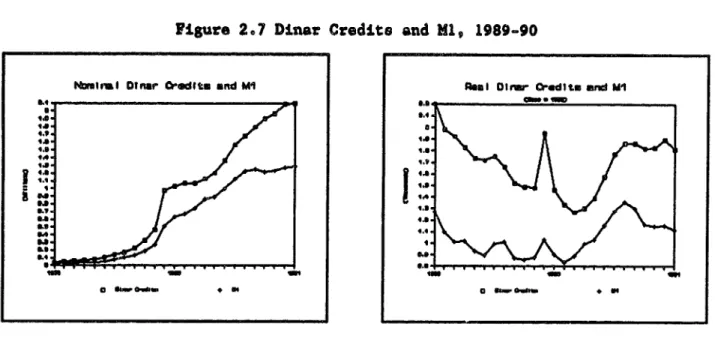
Concern over the revival of inflation led the central bank to return to a
tight monetary stance in early October. However, pressed by enterprises to
continue lending, commercial banks reduced reserves below the required levels,
thereby weakening the central bank's control over monetary policy." Further
evidence of the difficulties faced by the central bank to conduct monetary
policy was the unusual episode of December 1990, whereby one regional branch
of the central bank expanded credits by US$1.8 billion equivalent of Dinars to
finance the payment of wages and pensions (The Economist, January 12, 1991) in
the region, without notification to the board of governors. The monetary
impact of the domestic credit expansion was largely offset by a substantial
loss of foreign reserves during the same period. However, these events raised
obvious doubts about the sustainability of the stabilization program.
In Poland, despite the sharp contraction in industrial output, no
bankruptcies occurred. Nor did the expected shake-out of the industrial
sector, with inefficient enterprises sinking under the pressure of the
elimination of subsidies, take place."' The Darwinian-Schumpeterian process
of natural selection did not operate. As noted, the main trigger mechanism
for bankruptcy procedures is a failure to pay the dividend tax. The
appropriateness of this mechanism as the main trigger for restructuring and/or
bankruptcy is, however, questionable. First, the tax was not burdensome
(around 6 percent of total profits). Second, many enterprises paid the
dividend tax while also failing to meet obligations with other enterprises and
banks. However, neither creditor firms nor the banks initiated bankruptcy
1" This problem has arisen as a result of the control exercised on the
banks by the enterprises.
" An interesting simulation by de la Calle (1990), based on data on
domestic resource costs computed by Ronovalov (1989a), estimated that the
stabilization program would have led to a contraction of about 20 percent in
industrial output, a contraction led by the bankruptcy of enterprises in
particularly inefficient sectors. His predictions on the sectoral fall in
output display a recession much more uneven than the one that actually took
Fig-are 9
Yugoslavia: Nominal Dinar Credits and Ml
Billion New Olnaue
200.;<f 650. 100.o i 0 . . . .... . .... .. . . . .. . . . .. . . . .. . . . 60.
o
. _ = _ , lee,~~~~~~Ilea99
0inar Credits -4-MlYugoslavia: Real Dinar Credits and Ml
(Base
-
1986)
Million New DinArs 250
100
...
50 ... ...
a9o 1909 100t
30
procedures,
Implying
some
sort
of collusive
behavior
among
firms
and
banks.
The inefficiencies
arising
from
these
inter-linkages
among
enterprises
is one
of the
main
issues
that
has to be tackled
in the
second
stage
of the
program.
Both
fiscal
and
credit
policies
were relaxed
after
July,
in an attempt
to
stimulate the economy. The relaxation of credit policies opened the way to a
significant
increase
in real
wages
and
contributed
to a certain
revival
of
inflation. In an attempt to reduce these inflationary pressures, credit
policy
was tightened
in the fourth
quarter,
with
the
imposition
of strict
ceilings
on each
commercial
bank
on credit
to the
socialized
sector. However,
the overall
credit
expansion
largely
exceeded
the
targets,
mainly
bacause
of a
sharp
expansion
of credit
to the
non-socialized
sector,
which
was exempted
from
the
ceilings.
Despite
the
tightening
of credit
to the
socialized
sector,
wage pressures in this sector remained unabated, revealing the difficulties in
containing
wages
under
the
present
ownership
structure.
Developments in 1990 raise a more general issuet under the present
structure
of these
economies,
macroeconomic
policies
alone
cannot
generate
an
efficient
natural
selection.
Inter-enterprise
credits
link
"good"
and
"bad"
enterprises,
opening
the
way for
chain
of bankruptcies
involving
"good"
enterprises.
Also,
if the
banking
system
is inefficient
and,
in the
case
of
Yugoslavia,
controlled
by enterprises,
resources
are
not
necessarily
channelled
to the
more
efficient
uses. Under
these
conditions,
the attempt
to
enforce
hard
budget
constraints
may result
in a generalized
credit
crunch--as
seems
to have
happened
in the
first
semester
of 1990
in Poland--with
unclear
effects
on efficiency.
Assessmaent
of the
Main
Issues
The issues
that
policy-makers
in Poland
and
Yugoslavia
will
have
to address
include
some
that
belong
to the
stabilization
component
per se and
others
that
are
of
a
structural
nature. In the
first
group,
the
most
important
issues
are
the
unfreezing
of the
exchange
rate,
the
introduction
of
a
new
wage
policy
and
the
adequacy
of the fiscal
support
for
the
restructuring
component
of the
two
programs.
This
group
also
includes
the
need
to reduce
the servicing
of
external debt in order to avoid a drain of scarce resources that ideally
should
be channelled
toward
the
restructuring
of the
economy.
The second
group
comprises
the
restructuring
and
privatization
of enterpriees
and
banks
and
the
developments
of the labor
and financial
markets.
Recognition
that
the
real
exchange
rate
in
Yugoslavia
had severely
appreciated
led
to
a
30 percent
corrective
devaluation
in January
1, 1991.
In
the
case
of Poland,
the
real
appreciation
is probably
not so severe
as in the
case
of Yugoslavia,
given
the large
real
devaluation
at the
start
of the
program.
Obviously,
if inflation
does
not quickly
subside,
the extent
of
the
real
appreciation
is likely
to become
unsustainable
during
1991.
Although
the
exchange
rate
correction
in Yugoslavia
seemed
unavoidable,
given the rapid lose of foreign reserves at the end of 1990, it did result in
increasing
rates
of inflation
at the
start
of 1991
(5
and 10 percent
in
January
and
February,
respectively).
This
increase
in inflation
happened
despite
the
introduction
of a new package
of measures
designed
to contain
the
impact of the devaluation, which included a freeze on nominal wages paid by
loss-making enterprises, and new regulation designed to prevent other episodes
of monetary decontrol. Success at preventing the reemergence of an exchange
rate-wages-prices spiral will obviously depend on more effective
implementation
of wage and
monetary
policies,
requiring
a
high
degree
of
consensus
among
the
various
republics.
Despite
the
present
uncertainty
regarding
the
continuing
implementation
of these
measures,
they
do reflect
the
recognition
that
some
form
of wage
policy
is needed,
especially
while
labor
markets
are
not sufficiently
developed
and
the
ownership
rights
problem
is not
adequately
solved. The
design
of
a
wage
policy
for
the
transition
is indeed
a difficult
task. On the
one
hand
it has to counteract
the
excessive
influence
of
the
workers'
councils.
On the
other
hand,
it should
minimize
the
inefficiencies
arising
from
strict
and
generalized
wage controls,
which
can
hinder
the
recovery
of
32
This point io also relevant in the case of Poland, where a wage policy
has been
maintatned
for
the
first
half
of 19910 However,
several
changes
were
introduced. First, the control of wages shifted from the wage bill to the
wage
per
worker,
in order
to eliminate
constraints
on expanding
firms.
Second,
wage increases
became
conditional
on profitability
performance.
Finally,
private
firms
were
excluded
from
wage
ceilings
and
corporatized
firms
were partially exempted from tax penalties on wage increases above the
ceilings. However, monthly indexation of
wages
still
remains,with
adverse
effects on inflationary inertia.
Fiscal support for restructuring is another critical issue in the two
countries. While the fiscal adjustment has proven sufficient to close the
deficit in Poland and to absorb the central bank's deficit in Yugoslavia, it
does not seem to be consistent with the intention of implementing a serious
restructuring program in both countries. For instance, it has become clear
that the fiscal commitments to the social program in Yugoslavia would have
been
inadequate
had the
loss-making
enterprises
really
been
forced
into
bankruptcy.
The initial
fiscal
commitments
to the
financial
restructuring
also
proved
largely
insufficient
at the
end
of the
year.
In the area of restructuring, a wide range of issues needs to be
coneidered.
At the level
of each
enterprise,
restructuring
entails
laying
off
excess
personnel,
writing
off debts
in justified
cases,
making
selective
investments capable of improving the efficiency of existing capital, changing
manage ent and so one. It also entails closing enterprises that cannot become
profitable even with the above measures. At the level of each bank,
restructuring involves a detailed evaluation of its portfolio, the removal of
bad loans from the portfolios, a severing of the links between banks and
enterprises, and the introduction and enforcement of prudential financial
regulation and iupervision. A crucial question related to the restructuring
of the enterprises and banks is who will be in charge of this formidable task
and under what system of incentives. An approach to restructuring that is
to implement, given the institutional deficiencies, but may also produce an
undesirable selection of enterprises and sectors for restructuring. A more
rapid move toward large-scale privatization seems to be required to minimize
the risks of wasting resources during the restructuring and to enhance the
prospects of a sustained supply response. (For a detailed discussion of this
iesue, see Hindc. 1990, Lipton and Sachs 1990, and Frydman and Rapaczynski
1990.)
While forcing inefficient enterprises into bankruptcy is an important
step in the right direction, in the absence of well-functioning labor and
capital markets that permit an efficient reallocation of resources across
firms and sectors, a large pool of unemployed could be generated for a
protracced period. The impossibility of developing a true labor market
without developing in parallel a market for capital again raises the issue of
privatization (see Hinds 1990). In addition, the development of a labor
market will require that policy-makers address the issues of housing ownership
and financing, two notorious obstacles to labor mobility in socialist
countries.
While Poland and Yugoslavia acknowledge the importance of these issues,
they have been addresssing them too slowly. Failure to provide prompt
solutions to these problems could lead to a protracted stagnation of output
and a return to high inflation. In this regard, the model of sequencing
traditionally applied to Latin American countries, in which structural issues
are relegated to later stages of the adjustment programs, does not seem to be
applicable to reforming socialist countries, in which stabilization and
APPENDIX A STABILIZATION IN POLAND
BaSkground
The Polish stabilization program of January 1990 is undoubtedly one of
the most radical attempts to transform quickly into a market economy. In
addition to the severity of Poland's macroeconomic situation, the government
chose to pursue a "cold turkey" approach to stabilization (whence the label
"Big Bang"), because of the disillusionment with the gradualist reform
strategy followed in the 1980s. That strategy, which relied on increased
enterprise decentralization but within a context of continuing state
interference in the allocation of inputs, licensing of imports and exports,
and determination of prices, had not provided visible improvements in
efficiency. In fact, the partial decentralization of enterprise
decision-making--reminiscent of the idea of "market socialism"--in a context of absent
factor markets and persistent soft budget constraints actually contributed to
a widening of the macroeconomic imbalances in the 1980s. Several rescheduling
agreements of the external
debt partly
masked the severity
of the external
position
and allowed Poland to grow at relatively high rates in the period1983-88 and to maintain relatively high rates of investment growth (figure
1-1).
On the other hand, the rate of inflation averaged above 50 percent in the
1980s, a condition that prima facie put Poland in with the "chronic inflation"
countries (figure 1-1).' However, the persistent inflation during the 1980s
reduced significantly the stock monetary overhang, a point on which Poland's
experience differed from the typical experience of the centrally planned
economies with rigid price controls, such as Bulgaria and the Soviet Union.
Accordingly, the underlying inflationary pressures in the 1980s arose,
overall, more from flow than from stock factors (Lipton and Sachs 1990). In
this regard, cost-push factors, such as the cost of labor and the prices of
imports, played a fundamental role in the context of a price-setting system
dominated by "cost-plus" behavior. However, the widespread price controls
that prevailed until the end of 1989 and that affected about 50 percent of
total retail sales complicate the analysis of inflation. Although repressed
inflation does not seem to have been a "chronic" phenomenon in Poland in the
1980s, the mixed system of controlled and free prices tended to adjust slowly
to excess demand and to generate large gaps between the controlled and free
prices, with adverse effects on the budgtaet. Thus, an inflation that behaved
erratically, "stop-and-go" phenomena and the inertia elements in the catch-up
between controlled and free prices were not only important features of Polish
inflation in the 1980s but were also particularly important in the
acceleration of inflation in 1989,16 Large disequilibria did indeed precede
the "corrective" jumps in the price level, mainly in 1982 and 1988-89,
with
"' The Polish rate of inflation in the 1980s was extremely high by
European standards, even excluding 1989. The average for the period 1981-88
was ;3 percent, compared with 5 percent for industrial countries, 38 percent
for developing countries, 8 percent for Hungary and 1.3 percent for other
Eastern European countries, excluding Yugoslavia.
16 A macroeconomic analysis of the dynamics of inflation in a mixed
system of free and controlled prices can be found in Commander and Coricelli
Figure i,
POland Poland *
GOP Geowtht Budget O.fGP)
IPeteent CASngreo IPensent of 30Fs
8