University of South Florida
Scholar Commons
Graduate Theses and Dissertations
Graduate School
June 2018
Precise, General, and Efficient Data-flow Analysis
for Security Vetting of Android Apps
Fengguo Wei
University of South Florida, [email protected]
Follow this and additional works at:
https://scholarcommons.usf.edu/etd
Part of the
Computer Sciences Commons
This Dissertation is brought to you for free and open access by the Graduate School at Scholar Commons. It has been accepted for inclusion in Graduate Theses and Dissertations by an authorized administrator of Scholar Commons. For more information, please contact
Scholar Commons Citation
Wei, Fengguo, "Precise, General, and Efficient Data-flow Analysis for Security Vetting of Android Apps" (2018).Graduate Theses and Dissertations.
Precise, General, and Efficient Data-flow Analysis for Security Vetting of Android Apps
by
Fengguo Wei
A dissertation submitted in partial fulfillment of the requirements for the degree of
Doctor of Philosophy in Computer Science and Engineering Department of Computer Science and Engineering
College of Engineering University of South Florida
Major Professor: Xinming Ou, Ph.D. Jarred Ligatti, Ph.D. Yao Liu, Ph.D. Nasir Ghani, Ph.D. Robby, Ph.D. Date of Approval: May 25, 2018
Keywords: Static Analysis, Mobile Security, Android App Security Analysis Copyright c 2018, Fengguo Wei
DEDICATION
ACKNOWLEDGMENTS
I would like to thank my advisor Xinming Ou for all his guidance and encouragement through-out my Ph.D. journey. His spirit inspires me to always start from real-world cybersecurity problems and always outside-the-box to seek solutions. I am also thankful for him to provide me the oppor-tunity to work on research problems that I am interested in continually.
I would like to thank Sankardas Roy for always supporting me with faithful feedbacks. In retrospect, I feel that I have been fortunate to have someone who has such an experience and attitude in scientific research and guides me smoothly going through the first few years of my Ph.D. journey.
I would like to thank Robby for his guidance on the use programming analysis methods. His insightful suggestions helped immensely in carrying out the framework I built. This research would not have been possible without his continuous mentorship.
I would like to thank my other committee members, Jarred Ligatti, Yao Liu, Nasir Ghani, for spending the tremendous amount of time helping me improve the presentation of this dissertation. At last, I would like to thank my fellow Argus Lab members for the many memorable times and fruitful discussions.
This research was partially supported by the U.S. National Science Foundation under Grants No. 0644288, No. 0954138, No. 1018703, No. 1717862, and No. 1718214, and the U.S. Air Force Office of Scientific Research under Award No. FA9550-09-1- 0138.
TABLE OF CONTENTS
LIST OF TABLES iv
LIST OF FIGURES v
ABSTRACT vii
CHAPTER 1: INTRODUCTION 1
1.1 Android Security Issues and Vetting System 1
1.2 Previous Works on Android Security Analysis 2
1.2.1 Android Static Analysis 2
1.2.2 Dynamic and Hybrid Analysis 5
1.3 Android Static Analysis Challenges 6
1.4 Contributions 7
CHAPTER 2: ANDROID SYSTEM MODEL 10
2.1 Runtime Environment Model 10
2.1.1 Event-based System 10
2.1.2 Component-level Environment Model 12
2.2 System API Model 13
2.2.1 Heap Manipulation Summary Language 14
CHAPTER 3: DATA-FLOW ANALYSIS 16
3.1 Reaching Facts Analysis (RFA) 17
3.1.1 Notations 17
3.1.2 The BasicDFG Building Process 18
3.1.3 Handle Library APIs 22
3.2 Summary-based Bottom-up Data-flow Analysis (SBDA) 22
3.3 Discussion 25
CHAPTER 4: COMPONENT-BASED ANALYSIS 27
4.1 Motivating Example 27
4.2 Building the Component-level Data-flow Graph 30
4.3 Building the Component-level Data Dependence Graph 30
4.4 Linking Inter-component Data Flows 32
4.4.1 Intent 36
4.4.1.1 STConstruction 36
4.4.1.2 Stitching Intent Channels – Intent Destination Resolution 37
4.4.2 RPC 38
4.4.2.2 Stitching RPC Channels 39
4.4.3 Static Field 39
4.4.3.1 STConstruction 39
4.4.3.2 Stitching Static Field Channels 39
4.5 Building App-level Data Dependence Graph 39
4.6 Inter-app Analysis 40
4.7 Using Component-based Approach for Security Analyses 40
4.7.1 Data Leak Detection 40
4.7.2 Data Injection Detection 41
4.7.3 Detecting Misuse of APIs 41
4.8 Discussion 42
CHAPTER 5: NATIVE CODE RESOLUTION 43
5.1 Background and Example 43
5.1.1 Native Code Usage Modes in Android 43
5.1.2 Native Development Kit (NDK) 44
5.1.3 Binary Code Analysis 44
5.1.4 A Motivating Example 45
5.2 Resolving Native Method Calls 47
5.2.1 Dynamic Function Register Resolution 48
5.3 Leveraging Existing Binary Analyzer for Data-flow Analysis 49
5.3.1 Custom Annotations 51
5.3.2 JNI Function Model 51
5.3.3 Java Method Summary 54
5.3.4 Inter-component Communication (ICC) Resolution 54
5.4 Handling Native Activity 54
5.4.1 native activity.h 56
5.4.2 android native app glue.h 57
5.5 Discussion 58
CHAPTER 6: DESIGN AND IMPLEMENTATION 59
6.1 APK Preprocess 61
6.2 Environment Model 61
6.3 Intra-component Analysis 62
6.3.1 RFA-based Analysis 62
6.3.2 SBDA-based Analysis 62
6.3.2.1 Call Graph Builder 62
6.3.2.2 Bottom-up Summary Propagator 63
6.3.2.3 Java Method Summary Builder 63
6.3.2.4 Native Function Summary Builder 64
6.4 Inter-component Analysis 65
CHAPTER 7: EVALUATION 68
7.1 Performance and Scalability 68
7.1.1 Component-based Analysis 68
7.1.2 Inter-language Analysis 69
7.2 Intent Resolution Effectiveness 70
7.3 Statistics of Native Library Usage 72
7.4 Application to Security Analysis 74
7.4.1 Password Leakage Checker 74
7.4.2 OAuth Token Leakage Checker 75
7.4.3 Hiding-icon Checker 76
7.4.4 Crypto Library Misconfiguration Checker 76
7.4.5 SSL/TLS Misconfiguration Checker 77
7.4.6 Communication Data Leakage Checker 77
7.4.7 Intent Injection Checker 78
7.4.8 Inter-language Security Checker 79
7.4.8.1 Case Study 1: Inter-language Data Leakage 79
7.4.8.2 Case Study 2: Stealthy Command Execution 80
7.4.8.3 Case Study 3: Stealthy Command and Control Communication 80
7.4.8.4 Case Study 4: Malicious Identity Hiding 80
7.5 What it Takes to Build a New Analysis 81
7.6 Comparison with Existing Tools 81
CHAPTER 8: CONCLUSIONS 88
REFERENCES 90
LIST OF TABLES
Table 4.1 Communication points of an app component 35
Table 7.1 Intent resolution precision 72
Table 7.2 Native library statistics for datasets 73
Table 7.3 Password leakage checker report 75
Table 7.4 OAuth token leakage checker report 76
Table 7.5 Crypto library misconfiguration checker report 77
Table 7.6 SSL/TLS misconfiguration checker report 78
Table 7.7 Communication data leakage checker report 78
Table 7.8 Intent injection checker report 79
Table 7.9 Code size and running time (checkers and core) 81
Table 7.10 Results on DroidBench 83
Table 7.11 Results on ICC-Bench 84
LIST OF FIGURES
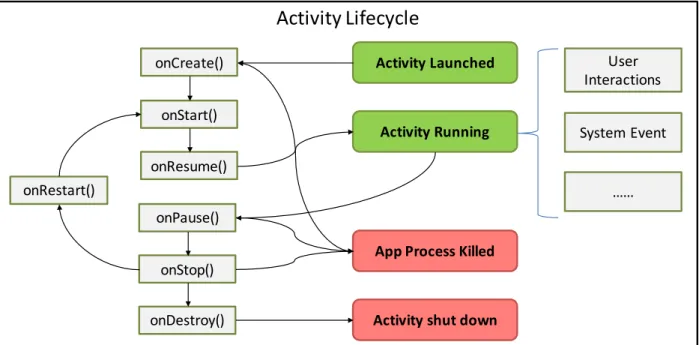
Figure 2.1 Activity lifecycle 10
Figure 2.2 Lifecycle example 11
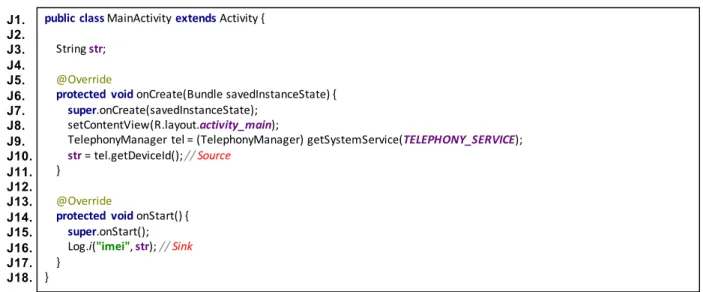
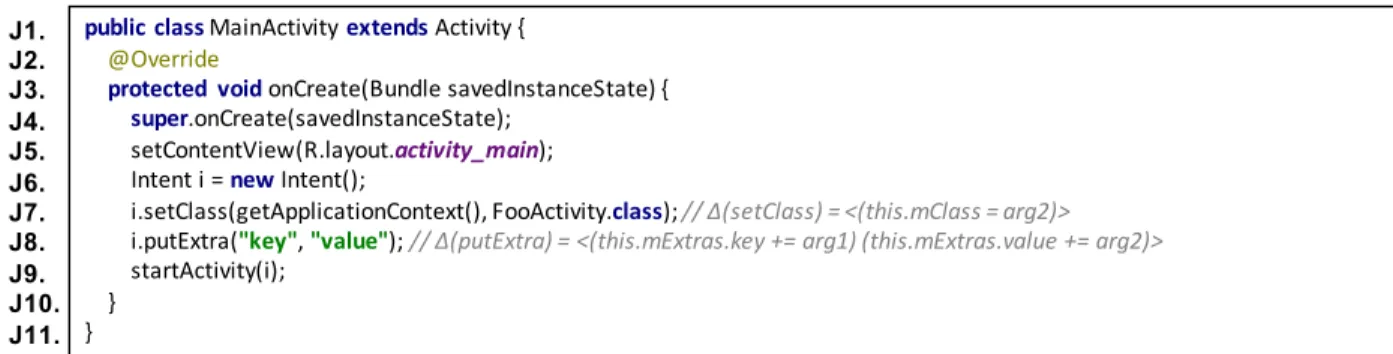
Figure 2.3 Library API call example 15
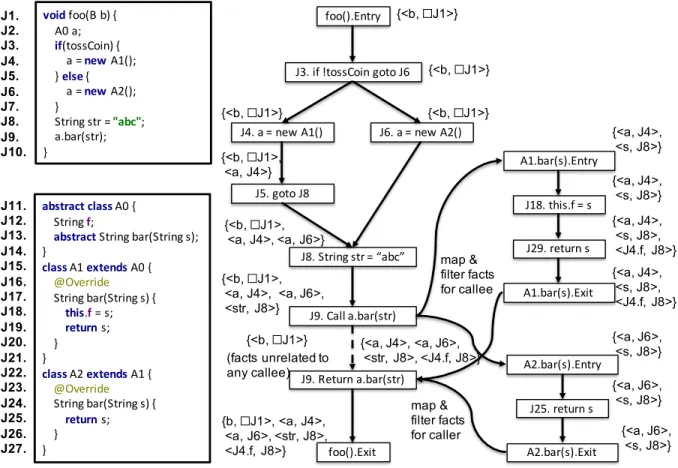
Figure 3.1 Building the DFGfor foo: The intra-procedural control flow graph (CFG) of
foois extended to a callee, bar 17
Figure 3.2 SBDA workflow 23
Figure 3.3 Heap manipulation summary example 24
Figure 4.1 The inter-component-leak App: The arrowed lines among the app components
highlight some of the inter-component communication 29
Figure 4.2 DFGs and STs of the components in App “inter-component-leak”: An excerpt 31
Figure 4.3 Data flow between app components via RPC and static field 33
Figure 5.1 The inter-language-leak App: The arrowed lines among the app components
highlight some of the inter-language-communication 46
Figure 5.2 JNINativeMethod structure 50
Figure 5.3 JNINativeInterface and JNIInvokeInterface structures 51
Figure 5.4 GetStringUTFChars function model 52
Figure 5.5 getCharFromString function source code and assembly 53
Figure 5.6 native activity.h example 56
Figure 5.7 android native app glue.h example 57
Figure 6.2 APK preprocess and environment model 60
Figure 6.3 RFA-based analysis 62
Figure 6.4 SBDA-based analysis 63
Figure 6.5 Inter-component analysis 65
Figure 6.6 Argus-SAF actor model 66
Figure 7.1 Time to build DFG 69
Figure 7.2 Time to run SBDA 70
Figure 7.3 Native code analysis performance 71
ABSTRACT
This dissertation presents a new approach to static analysis for security vetting of Android apps, and a general framework called Argus-SAF. Argus-SAF determines points-to information for all objects in an Android app component in a flow and context-sensitive (user-configurable) way and performs data-flow and data dependence analysis for the component. Argus-SAF also tracks inter-component communication activities. It can stitch the inter-component-level information into the app-level information to perform intra-app or inter-app analysis. Moreover, Argus-SAF is NDK/JNI-aware and can efficiently track precise data-flow across language boundary. This dissertation shows that, (a) the aforementioned type of comprehensive app analysis is utterly feasible in terms of computing resources with modern hardware, (b) one can easily leverage the results from this general analysis to build various types of specialized security analyses – in many cases the amount of additional coding needed is around 100 lines of code, and (c) the result of those specialized analyses leveraging Argus-SAF is at least on par and often exceeds prior works designed for the specific problems, which this dissertation demonstrate by comparing Argus-SAF’s results with those of prior works whenever the tool can be obtained. Since Argus-SAF’s analysis directly handles inter-component and inter-language control and data flows, it can be used to address security problems that result from interactions among multiple components from either the same or different apps and among java code and native code.Argus-SAF’s analysis is sound in that it can assure the absence of the specified security problems in an app with well-specified and reasonable assumptions on Android runtime system and its library.
CHAPTER 1: INTRODUCTION
1.1 Android Security Issues and Vetting System
The Android smart-phone platform is immensely popular and has by far the most siganificant market share among all types of smartphones worldwide. However, there have been widely reported security problems due to malicious or vulnerable applications running on Android devices.
Fuchset al. [1], Gibler et al. [2] described the sensitive data leakage issue frequently occurred for Android applications.
Luet al. [3], Wanget al. [4] discovered a paticular type of data injection problem in Android
domain, called intent injection vulnerability. This type of vulnerability allows the attacker to abuse capability provided by Android component and escalate their privilege.
Poeplauet al. [5] systematically studied the dynamic code loading functionality in an Android application. They revealed this capability often time being abused by benign apps, as well as leveraged by malware to execute the malicious payload stealthily.
Feltet al. [6], Zhou et al. [7, 8], Wei et al. [9] profiled the malicious behavior and technology
evolution for Android malware over the past years. Based on their description, the majority of An-droid malware targeted on malicious behaviors, such as, stealing device user’s sensitive information, damaging the device, or annoying the user.
Recent studies [8, 9, 10, 11, 12, 13, 14, 15] have shown that native code is a continuous threat which might stealthily leak sensitive information or utilize Android malware to evade AV detection. The current solutions to those security problems are mostly reactive (e.g., pulling an app off the market after potential damage may have already been done). There have not been effective vetting methods that market operators can rely upon to ensure apps entering a market (e.g.,Google Play) are free of certain types of security problems. Often, they have to resort to dynamic analysis
— running an app in a testing environment with the hope of identifying the problematic behaviors, if any, during the test run (e.g.,Google Bouncer [16]).
Many security problems of Android apps can be discovered by static analysis on the Dalvik bytecode of the apps, and there have been a number of earlier efforts along this line [3, 8, 10, 13, 17, 18, 19, 20, 21, 22, 23, 24, 25, 26, 27]. Compared with dynamic analysis, static analysis has the advantage that a malicious app cannot easily evade detection by changing their behaviors in a testing environment, and it can also provide a comprehensive picture of an app’s possible behaviors as opposed to only those that manifest during the test run. Due to the inherent undecidability nature of determining code behaviors, any static analysis method must make a trade-off between computing time and the precision of analysis results. Precision can be characterized as metrics on:
1) missed behaviors (app behaviors missed by the analyzer that may present security risks, also
referred to as false negatives), and
2) false alarms (behaviors that an app does not possess, but the analyzer fails to rule out, also
referred to as false positives).
1.2 Previous Works on Android Security Analysis 1.2.1 Android Static Analysis
There has been a long line of works on applying static analysis for Android security prob-lems [3, 17, 18, 19, 25, 26, 28, 29, 30, 31, 32, 33, 34]. Most closely related works are described below.
The design of Argus-SAF leverages a number of approaches from FlowDroid [19, 30] (e.g., callback collection algorithm during environment generation), but the two also have significant differences. FlowDroid does not handle ICC and as such cannot address security issues involving intent passing among multiple components. FlowDroid builds a call graph based onSpark/Soot [35], which conducts a flow-insensitive points-to analysis. FlowDroid then conducts a taint and on-demand alias analysis based on the above call graph, usingIFDS [36,37] which is flow and context-sensitive. The flow-insensitivity in the call graph construction may introduce spurious call edges (false positives), which could impact the analysis precision of the subsequentIFDS analysis. Argus-SAF computes the call graph at the same time as the data-flow analysis by computing the flow and
context-sensitive points-to facts; thus its call graph is more precise, which could lead to fewer false positives in the final analysis results. FlowDroid does not calculate alias or points-to information for all objects in both flow and context-sensitive way. This is a design decision from computing cost concerns [30]. Argus-SAF calculates all objects’ points-to information in both context and flow-sensitive way, with reasonable computing cost (ref. Section 7.1). This capability enables us to build the generic framework supporting multiple security analyses. Moreover,FlowDroid avoids to handle native method invocation and applies a comprehensive model for native method calls. Argus-SAF provides a comprehensive analysis scheme for inter-language data-flow analysis.
Epicc [18] computes Android Intent call parameters using the same IDE framework as
Flow-Droid, by modeling the intent data structure explicitly in the flow functions. To the best of our knowledge,Epiccdoes not use the Intent parameter analysis result to resolve the Intent call targets in the general case and has not used the result to perform the inter-component data-flow analysis. Argus-SAF’s approach to deriving Intent parameters is to simply use the flow and context-sensitive points-to information (including that for string objects) already computed in theDFG, without the need for a separate data-flow analysis just for Intent. Argus-SAF also uses the Intent call parameter information to link Intent call sites to call targets, resulting in aDFGthat includes data flow paths both within and across components. Moreover, recent work [38] shows that domain knowledge and probabilistic models can be leveraged in Intent destination resolution, which Argus-SAF could adopt. Moreover, Epicc cannot resolve Intent call parameters if it presents in the native code. Argus-SAF has the solution to capture intent calls in native code.
Recently,IccTA[26] andDroidSafe [25] made advancement in the state-of-the-art of Android app static analysis. IccTA extends FlowDroid and uses IC3 [33] as the Intent resolution engine, which can now track data flows through regular Intent calls and returns. However, IccTAis yet to track the information flow through remote procedure call (RPC).DroidSafe [25] tracks both Intent and RPC calls but does not capture data flows through “stateful ICC” nor inter-app analysis. None
Recent works [32, 34] explored various approaches to tracking Android inter-app communi-cation for security vetting. The new component-based analysis of Argus-SAF as discussed in this paper supports inter-app analysis naturally (see Section 4.6).
Luet al. [3] use a static-analysis scheme called CHEX to detectcomponent hijackingproblem
in Android, which is reduced to finding information flows. CHEX first constructs app-splits, each of which is a code segment reachable from an entry point. It then computes the data-flow summary for each split using Wala [39]. The split summaries are linked in all permutations that do not violate the Android system call sequences and could result in transitive information flow. Argus-SAF computes information flow differently – through the usage of an environment method for each component that calls the relevant callbacks in the right order (per Android system specification), and by building the DFG and DDG for the complete app. CHEX does not have the provision to track data flow through the ICC channels, which Argus-SAF does.
Chinet al. [17] first systematically studied the attack surface related to Intent. In particular,
they identified problems such as unauthorized intent receipt and intent spoofing. They also devel-oped a static analysis tool which can raise warnings for the above problems in an over-conservative manner. Their tool ComDroid performs flow-sensitive, intra-procedural static analysis, and the paper states that there is a limited inter-procedural analysis that “follows method invocations to a depth of one method call.” Argus-SAF performs a full-fledged inter-procedural data-flow analysis in a flow and context-sensitive way, and also tracks the data flows over the ICC channels. While the author would like to conduct comparison study between ComDroid and Argus-SAF, the link to the ComDroid tool (used to be http://www.comdroid.org) is no longer there.
Most of the existing works that leverage static analysis are focused on finding specific Android security problems, and the static analyses used do not seem to address some critical issues such as the inter-component and inter-language nature of Android app’s execution and the precise modeling of Android’s callback sequences. In contrast, Argus-SAF is a precise, general and efficient inter-component NDK/JNI-aware static analysis framework which can address a broad range of security issues in Android apps.
1.2.2 Dynamic and Hybrid Analysis
TaintDroid [21] is a dynamic (runtime) taint-tracking and analysis system to find potential
misuse of the user’s private information.
DroidScope [10] is an Android application dynamic analysis tool that reconstructs OS level
andDVM level information. DroidScope collects detailed native andDalvik instruction traces, pro-file API-level activity, and track information leakage through both the Java and native components using dynamic taint analysis.
NDroid [11] performs dynamic taint analysis based onQEMU and tracks information flows
through JNI. NDroid instruments important related JNI functions to resolve information flows, such as JNI entry, JNI exit, object creation. Moreover, It models the system library instead of instrumenting those standard functions to reduce overhead. However, similar to all dynamic analysis systems, NDroid has the path coverage issue, and it does not track control flows.
TaintART [40] applies dynamic taint tracking by instrumentation the ART compiler and
runtime. TaintART follows NDroid’s method to handle JNI calls.
Harvester [27] employs hybrid analysis for extracting runtime values. When encountered
with native methods,Harvester monitors them as logging points to extract runtime values instead of stepping into the native code to conduct the analysis.
Going Native [14] conducts static analysis to filter apps containing native code firstly and
then perform dynamic analysis to study the native code usage of real-world Android apps. Then it generates native code sandboxing security policy.
Malton [15] is a dynamic analysis platform aimed to do malware detection that runs on
ART runtime. Malton conducts multi-layer monitoring including native layer and information flow tracking to provide a comprehensive view of the Android malware behaviors.
DroidNative [41] utilizes specific control flow patterns to reduce the impact of obfuscations
and use it as semantic-based signatures to detect malware in ART runtime.
All dynamic analyses are subject to evasion attacks. For example, researchers have shown [42] that Google’s Bouncer [16] can be fingerprinted and hence evaded by a well-crafted app. On the other hand, static analysis investigates the code of the app (such as, along with the app’s manifest),
which determines the runtime behaviors of the app; this makes it attractive for security vetting. Recently Sounthiraraj et al. [22] showed that static and dynamic analysis could be combined to achieve more effective detection/confirmation of security problems. Our approach provides a precise and general static analysis framework that can complement dynamic analyses.
1.3 Android Static Analysis Challenges
A practical challenge in static analysis is to control the rate of false alarms while not missing any (potentially dangerous) behaviors of apps. This is especially significant due to a number of features of Android.
1) Android is an event-based system. The control flow is driven by events from an app’s envi-ronment that can trigger various method calls. How to capture all the possible control flow paths in this open and reactive system while not introducing too many spurious paths (false alarms) is a significant challenge. (Solution at Chapter 2.)
2) The Android runtime consists of a large base of library code that an app depends upon. The event-driven nature makes a large portion of the control-flow involve the Android library. While fully analyzing the whole library code could improve the analysis’ faithfulness, it may also be prohibitively expensive (or imprecise). (Solution at Chapter 2.)
3) Android is a component-based system and makes extensive use of inter-component commu-nication (ICC). For example, a component can send an Intent to another component. The target of an Intent could be specified explicitly in the Intent or be implicit and decided at runtime. Both control and data can flow through the ICC mechanism from one component to another. Capturing all ICC flows accurately is a major challenge in static analysis. (Solution at Chapter 4.)
4) Android provides a Native Development Kit (NDK) [43] which allows the developer to design app in native language (C/C++). NDK enables native Activity component, provides a set of native libraries to assist native code to access Android-specific features and uses Java Native Interface (JNI) as the communication bridge. Precisely tracking data flows in native Activity
component and modeling NDK libraries and JNI data structures are significant challenges. (Solution at Chapter 5.)
Prior research has attempted to address some of the above challenges. For example, Flow-Droid [19, 30] formally models the event-driven lifecycle of an Android app in a “dummyMain” method, but it does not address ICC. Epicc [18] statically analyzes Intent and uses an IDE [37] framework to solve for Intent call parameters, but does not link the Intent call sources to targets and does not perform data-flow analysis across component-boundaries. CHEX [3] uses a different approach to the modeling of the Android environment, by linking pieces of code reachable from entry points (called splits) as a way to discover data flows between the Android application compo-nents, but it does not address data flow through Intent channels. IC3 [33] is a composite constant propagation engine to solve Intent values in the whole application. IccTA [26] extends FlowDroid and uses IC3 as the Intent resolution engine, which can track data flows through regular Intent calls and returns. However, IccTA is yet to track a special category of ICC namedremote procedure call (RPC) that invokes a method in abound service component. DroidSafe [25] attempts to track both Intent and RPC calls. It performs an app-level analysis with flow-insensitive points-to information. None of the works mentioned above can capture data flows through “stateful ICC,” where compo-nent A sends data to B through one ICC, and later compocompo-nent A retrieves that same data from B through another ICC. Moreover, none of the works mentioned above can capture inter-language data-flow.
1.4 Contributions
I designed and built Argus-SAF– a precise, general and efficient data-flow analysis framework tailored for Android apps. The executable and source of Argus-SAF are publicly available.1 The main contributions from Argus-SAF are:
1) Argus-SAF computes points-to information for all objects and their fields at each program point and calling context. The points-to information is extremely useful for analyzing a num-ber of security problems that have been addressed in prior works using customized methods.
Argus-SAF can be used to address these wide-range security problems directly with very little additional work. This dissertation also shows that such comprehensive analysis scales to large apps.
2) As part of the computation of object points-to information, Argus-SAF can build a highly precise inter-procedural control flow graph (ICFG) of an app component , which is both flow and context-sensitive [44]. This is a side benefit of our approach compared to prior works that have adopted existing static analysis frameworks (e.g.,Soot [35] and Wala [39]), which build ICFGwith less precision [45, 46].
3) Argus-SAF adopts a summary-based bottom-up data-flow analysis (SBDA) approach to compute flow and context-sensitive inter-language data-flow information efficiently. The summary-based nature of SBDA enables us to design unified heap manipulation summary representation for both java world and native world data-flow analysis. The bottom-up ap-proach allows us only to visit each method exactly once to compute summary ∆ and reuse ∆ when a caller method invokes it.
4) Argus-SAF comprehensively models control and data-flow behavior for the Native compo-nent, NDK libraries, and JNI data structures to enable existing binary analysis tool, such as Angr [47] to understand Android-specific data flows.
5) For each app component, Argus-SAF builds a Data-flow Graph (DFG), which consists of the component’s ICFG together with each node’s (in ICFG) reaching (points-to) fact set. Then, Argus-SAF builds the data dependence graph (DDG) for each app component from its DFG. Furthermore, for each app component Argus-SAF builds a summary table (ST) listing its inter-component communication (control and data flow) activities over multiple channels, such as Intent, RPC, and static fields. Argus-SAF can conduct an elementary string analysis (due to its object-sensitivity) for inferring Intent/RPC call parameters and finds the correspondence between an ICC source and the ICC targets based on flow and context-sensitive matching algorithm. Using STs of multiple components, Argus-SAF can
stitch the component-levelDDGs into an app-level inter-componentDDG that supports both intra-app and inter-app analysis.
6) An analyst can add a security checker on top of Argus-SAF to detect the specific security problem he/she is interested. Through extensive experimentation, this dissertation demon-strates that a variety of security problems can be reduced to queryingDFGs andDDGs.
Argus-SAF is evaluated extensively on real-world apps. The experimental results show that Argus-SAF scales well. I used Argus-SAF to address security problems such as data leakage (e.g., SMS message leakage), injection (e.g., intent injection), and misuse/abuse of APIs (e.g., to hide app icon). The core framework of I evaluated takes several minutes to analyze one app on average. All the specialized security checkers require minimal additional coding effort (around 100 LOC) to leverage Argus-SAF’sDFGs andDDGs to address the specific problem, and the additional running time is negligible (typically in the order of tens of milliseconds).
Then, an experiment is conducted to compare Argus-SAF with three state-of-the-art static analyzers for Android apps: FlowDroid [19], IccTA [26] and DroidSafe [25], and show that Argus-SAF can address a broader range of security problems due to inter-component communications. Argus-SAF also found multiple crucial security problems in Android apps that were never reported before in the literature.
Some materials presented in this dissertation were published in 21st ACM Conference on Computer and Communications Security (CCS) in 2014 [48] and ACM Transactions on Privacy and Security (TOPS) in 2018 [49].
CHAPTER 2: ANDROID SYSTEM MODEL 1
2.1 Runtime Environment Model 2.1.1 Event-based System
An Android app is not a closed system; the Android system provides an environment in which the app runs. The code that may execute during the lifetime of an app is not all present in the app’s package. The Android system (which includes the Android runtime) does a bulk of the work in addition to that by the app’s code.
Activity Lifecycle
onCreate() onStart() onResume() Activity Running onPause()App Process Killed onStop()
onDestroy()
Activity Launched
Activity shut down onRestart()
User Interactions System Event
……
Figure 2.1: Activity lifecycle
In Android, numerous types of events (such as system events, UI events) can trigger callback methods defined in an app. As an example, while an Activity Ais running, if another Activity B comes to the foreground, it is considered an event. This event could trigger A.onPause(), which
1
This chapter is partially based on the authors CCS 2014 [48] and TOPS 2018 [49] papers. See Appendix A for permission.
is either defined in the app’s code, or in the Android framework if the developer did not override the default method. Figure 2.1 depicts the lifecycle of an Activity. There are seven lifecycle methods of an Activity, such as onCreate(), onPause(), onResume(); they each represent a state in the transition diagram of the lifecycle. Android documentation specifies other states such as
Activity running and Activity shut down. At Activity running state, the Activity is capable of
responding other types of events, such as button click, GPS location update. Similarly, other types of components have a well-defined lifecycle involving multiple lifecycle methods and can handle different kinds of events.
public class MainActivityextends Activity { String str;
@Override
protected void onCreate(Bundle savedInstanceState) {
super.onCreate(savedInstanceState); setContentView(R.layout.activity_main);
TelephonyManager tel = (TelephonyManager) getSystemService(TELEPHONY_SERVICE); str= tel.getDeviceId(); // Source
}
@Override
protected void onStart() {
super.onStart(); Log.i("imei", str); // Sink
} } MainActivity.java J1. J2. J3. J4. J5. J6. J7. J8. J9. J10. J11. J12. J13. J14. J15. J16. J17. J18.
Figure 2.2: Lifecycle example
Take Figure 2.2 as an example. The MainActivity has field str. The onCreate() method retrieves the device ID (sensitive information) and sets it to the str field, whereas the onStart() method leak thestr field into the log. IfonCreate() and onStart()execute independently, this ex-ample won’t have any information leakage problem. However, those two methods are running under the same MainActivity’s context and executed following the system-defined order. Therefore, to understand the data-flow betweenonCreate()andonStart()the static analyzer need to understand and model how the system works.
2.1.2 Component-level Environment Model
As demonstrates in Figure 2.2, a static analyzer needs to model the Android system to analyze the system-defined control flows in the app2.
Argus-SAF introduces a component-level model that captures the system-defined flows. The
environment of a component C represents the main method, Env C, which takes as
param-eter an incoming intent i and invokes C’s lifecycle methods (e.g.,onCreate, onBind, or
onRe-ceive) based on C’s type (Activity, Service, Broadcast Receiver, etc.) and other callback methods
(e.g.,onLocationChanged) so that all possible paths are included. This component-level model is
useful in capturing the impact of the Android system on both the control sequence and data flow of an app’s execution. Argus-SAF has a dedicated environment for each component that invokes the set of callback methods implemented in the component; this is the control part of modeling Android’s environment. Besides, the environment also keeps tracks of the intents received by the component; this is the data part of modeling Android’s environment. Env Calso passes the intent parameter when necessary for other relevant methods (e.g.,onReceive() of a Broadcast Receiver). Algorithm 1 Generating the environment method of component C
Input: The name of the componentC, manifest file, resource files, IR ofC. Output: C’s environment method,Env C
1: procedureGenEnv(C)
2: create a methodEnv Chaving one parameterIntent i, and anempty body;
3: callBacks←collectCallbacks(C);
4: addcallBacksinto the body ofEnv Cin the proper sequence emulating the reality;
5: returnEnv C;
6: end procedure
7: procedurecollectCallbacks(C)
8: callBacks←empty Set;
9: whilefixed-point is not reacheddo
10: perform reachability analysis to mark methods that are reachable fromC
11: callBacks←callBacks∪callBacks from the XML-resource files
12: callBacks←callBacks∪interface-based callbacks as registered inC’s source code
13: callBacks←callBacks∪other callbacks (system methods that are overridden) inC’s source
14: end while
15: returncallBacks;
16: end procedure
Argus-SAF generates the Environment Method (Env C) of each component C in the app automatically. Algorithm 1 shows the pseudocode for generatingEnv Cof a componentC. As the first step, an empty method with an Intent i as the parameter is generated. (Note that, Intent i
2
The alternative is to fully analyze the whole Android system’s code, which is both expensive and unnecessary as also observed by others [3, 25, 26, 30].
typically represents the Intent which starts the component – for instance, e.g., the parameter of Environment Method ofBarActivityis the intent that startsBarActivity) Then, Argus-SAF collect necessary information from the resource files in the apk and uses this information to collect layout callback methods. Argus-SAF then generate the body of Env Cwith lifecycle methods based on the type of C. Finally, Argus-SAF collect other callback methods (e.g.,onLocationChanged) in C (through a reachability analysis) in an incremental fashion. All of these are done before performing the data-flow analysis.
2.2 System API Model
Android has a large number of library APIs (that an app can call). Argus-SAF does not analyze system library APIs; thus, it needs to provide models for those methods that summarize how the data-flow facts may be changed. In general, Argus-SAF adopts the following strategy in modeling Android system library APIs:
1) For library APIs that provide essential information for static analysis (e.g., intent manipula-tion funcmanipula-tions), a precise heap manipulamanipula-tion summary model is built for them based on the function’s implementation and documentation.
2) For all other library APIs, a uniform conservative model is provided. The conservative model essentially assumes that for every object parameter, any of its fields may be modified and be-comesunknown; that is, the field can points-to a new object, or any existing object reachable from the method parameters (and static fields) that is type compatible. If the method also returns an object, the returned object is also considered unknown.
To construct a meaningful static analysis for Android application, Argus-SAF needs to pre-cisely model thousands of system API methods. Therefore, an effective way is required, such as design a domain specific language (DSL).
2.2.1 Heap Manipulation Summary Language
The following language presents a summary ∆ for a method m: h∆i ::= ‘<’hRulei* ‘>’
hRulei ::= ‘(’ [hAssignRulei | hActionRulei] ‘)’
hAssignRulei ::= hHeapLoci [‘=’|‘+=’|‘-’]hRHSi
hActionRulei ::= hActioni ‘(’hRHSi ‘)’ ‘@’hLoci
hRHSi ::= hHeapLoci | hInstancei
hActioni ::= ‘˜’|‘source’|‘sink’
hHeapLoci ::= hHeapBasei hIndexi
hHeapBasei ::= ‘arg’ Digits|‘ret’|ID
hIndexi ::= ‘.’ ID |‘[]’
hInstancei ::= ID ‘@’hLoci
hLoci ::= ID
∆ consists of a list of Rules. There are two types of Rule: AssignRule and ActionRule. AssignRule defines what kind of data propagation happened for the given HeapLoc at which Loc, whereas ActionRule defines what action should take for the HeapLoc. AssignRule allows three operations: 1) ‘=’ strong update for aHeapLoc; 2) ‘+=’ weak update for a HeapLoc; 3) ‘-’ kill facts from RHS. ActionRule has three Actions: 1) ‘∼’ clear all heap for RHS; 2) ‘source’ mark an RHS as sensitive data; 3). ‘sink’ mark an RHS as a leaky point. RHS consists of HeapLoc orInstance which represents right-hand-side values. HeapLoc is used to represent the heap location which consists ofHeapBaseandIndex. There are three types ofHeapBasea callee method could use to create heap manipulating side-effect: the heap of arguments, return value and global variables. Depending on the object type of HeapBase, field access or array access can be used to present the Index. Instance represents the object instance created at particular Loc. For example, the setClass() system API call in Figure 2.3 has a summary ∆(setClass) = h(this.mClass = arg2)i where the this.mClass is a HeapLoc which means the mClass field of “this” argument, and (this.mClass=arg2) indicates the mClass field of “this” argument will get whatever value from the second argument.
public class MainActivityextends Activity { @Override
protected void onCreate(Bundle savedInstanceState) { super.onCreate(savedInstanceState);
setContentView(R.layout.activity_main); Intent i = new Intent();
i.setClass(getApplicationContext(), FooActivity.class); // ∆(setClass) = <(this.mClass = arg2)> i.putExtra("key", "value"); // ∆(putExtra) = <(this.mExtras.key += arg1) (this.mExtras.value += arg2)> startActivity(i); } } MainActivity.java J1. J2. J3. J4. J5. J6. J7. J8. J9. J10. J11.
Figure 2.3: Library API call example
Take Figure 2.3 as an example. J7invokes setClass()to set FooActivityas the target com-ponent for Intent i. The setClass() is an Android system API; thus the ∆(setClass) is applied. ∆(setClass) sets a class value obtained from the second argument to its containingIntent’smClass field. J8inserts a key-value pair (“key,” “value”) into Intent i3’s mExtras3 field. TheputExtra() is an Android system API, and the ∆(putExtra) is applied. In this case, the summary tells the static analysis engine to assign the key-value pair to themExtrasfield ofIntent i.
3
ThemExtrasfield is an aggregate object that may store multiple key-value pairs. Argus-SAF currently does not model such aggregates and instead “flatten” all the elements in an aggregate into singleton instances. This will create two possible interpretations of multiple facts regarding an aggregate object: either they are different possibilities from different program branches, or they are part of a single aggregate in the same branch. Argus-SAF’s static analyzer conservatively assumes both are possible to ensure soundness, but this could lose some precision. Modeling aggregates is an engineering work that Argus-SAF will address in future work.
CHAPTER 3: DATA-FLOW ANALYSIS 1
Determining object points-to information is a core underlying problem in almost all static analyses for Android app security, such as finding information leaks, inferring Intent calls, identi-fying misuse of specific library functions, and others. Instead of addressing each of these problems using different specialized models and algorithms, it is advantageous to pre-calculate all object points-to information at once and use this as a general framework for different types of further analysis. This way the cost of computing points-to information is amortized across the large num-ber of specialized analyses one will likely need to perform on a given app.
Existing off-the-shelf static analysis tools such as Soot [35] (used by FlowDroid [19, 30] and Epicc [18]) and Wala [39] (used by CHEX [3]) have not provided capability of calculating all objects’ points-to information in both flow and context-sensitive way [45, 46]. This is due to concerns about computation cost. However, with the advancements in hardware (e.g., many-core machines), it opens new possibilities to perform a more precise analysis.
Generally speaking, the core task of Argus-SAF’s analysis is aimed to build a precise inter-procedural data-flow graph (DFG). The flow and context-sensitive data-flow analysis to calculate object points-to information is done at the same time with building inter-procedural control flow graph (ICFG). This is because, for one to precisely know the implementation method of a virtual method invocation, one needs to know the receiver object’s dynamic type; conversely, flow-sensitive data-flow analysis requires one to know how the program control flows. Thus, there is a mutual dependency between the two analyses. Such integrated control and data-flow analyses approach has been demonstrated to be both practical and effective for even analyzing temporal properties
ofconcurrentJava programs including the standard Java library codebase [50]. However, [50] does
not keep track of method calling context (typically termed monovariant calling context analysis
1This chapter is partially based on the authors CCS 2014 [48] and TOPS 2018 [49] papers. See Appendix A for permission.
or 0-calling context [44]). Argus-SAF generalizes the approach to precisely track the lastk calling contexts (polyvariant [44],a.k.a. k-limiting wherekis user-configurable, and the additional calling context beyondkis monovariant).
3.1 Reaching Facts Analysis (RFA)
Reaching Facts Analysis (RFA) computes points-to facts for each statement. Figure 3.1
illus-trates a complete analysis fromentry point (EP) methodfoo using RFA, and below the notations and algorithm is introduced.
J1. J2. J3. J4. J5. J6. J7. J8. J9. J10. abstract class A0 { String f;
abstract String bar(String s); } class A1 extends A0 { @Override String bar(String s) { this.f= s; return s; } } class A2 extends A1 { @Override String bar(String s) { return s; } } voidfoo(B b) { A0 a; if(tossCoin) { a = new A1(); } else{ a = new A2(); } String str = "abc"; a.bar(str); } J11. J12. J13. J14. J15. J16. J17. J18. J19. J20. J21. J22. J23. J24. J25. J26. J27. foo().Entry {<b, ☐J1>} J3. if !tossCoin goto J6
J4. a = new A1() J6. a = new A2()
J8. String str = “abc” J5. goto J8 J9. Call a.bar(str) J9. Return a.bar(str) foo().Exit {<b, ☐J1>, <a, J4>} A1.bar(s).Entry J18. this.f = s J29. return s A1.bar(s).Exit A2.bar(s).Entry J25. return s A2.bar(s).Exit {<b, ☐J1>, <a, J4>, <a, J6>} {<a, J4>, <s, J8>} {<b, ☐J1>, <a, J4>, <a, J6>, <str, J8>} (facts unrelated to any callee) map & filter facts for callee {<b, ☐J1>} {<b, ☐J1>} {<b, ☐J1>} {<b, ☐J1>} {<a, J4>, <s, J8>} {<a, J4>, <s, J8>, <J4.f, J8>} {<a, J4>, <s, J8>, <J4.f, J8>} {<a, J6>, <s, J8>} {<a, J6>, <s, J8>} {<a, J6>, <s, J8>} {<a, J4>, <a, J6>, <str, J8>, <J4.f, J8>} map & filter facts for caller {b, ☐J1>, <a, J4>, <a, J6>, <str, J8>, <J4.f, J8>}
Figure 3.1: Building the DFG for foo: The intra-procedural control flow graph (CFG) of foo is extended to a callee,bar
3.1.1 Notations
There are two sets of facts associated with each statement: the set of facts entering into a statement s is called the entry set of s (or just entry(s)); the set of facts exiting a statement s
is called the exit set of s(or just exit(s)). Statement smay change entry(s) by killing stale facts (kill(s)) and/or generating new facts (gen(s)). The gen and kill sets can be calculated using flow functions that are based on s’ semantics. In general, the flow equations have the following forms.
exit(s) = (entry(s)\kill(s))∪gen(s) (3.1)
RFAkeeps track of points-to facts, which provide information about what objects a variable (register in Dalvik), an object field, or an array element may point to at a particular program point. A points-to fact has the general form ofhlhs, rhsi.
The rhs may refer to either an object or an aggregate (usually key-value pairs). Objects are dynamically allocated in the Dalvik VM heap space at object creation sites (through a “new” statement). In our IR, each statement in the program is assigned a unique location N. Argus-SAF uses this to represent the new object created at the location, and refer to it as instance N. For example, (in Figure 3.1) location J4generates the points-to fact ha, J4i. Here J4represents
instance J4, the object created at location J6. From the object creation site, Argus-SAF can
directly find the precise runtime type of the instance.
Let us useNto indicate any possible value that is type compatible with the received objects at locationN. For instance, Argus-SAF does not know the possible values that will be received for an EP. As an example, locationJ1generates a points-to facthb,J1i, indicating that the object variablebpoints to an object that is passed to EP at locationJ1.
There are two types of lhs of a points-to fact, yielding two types of facts. A variable-fact is when thelhs is a variable. Aheap-fact is when the lhs is an object field or an array element. For example, location J18 generates a heap-fact h(J4, f ), (J8)i, meaning that the field f of instance J4 points to the string “abc” created atJ8.
3.1.2 The Basic DFG Building Process
A static analyzer simulates the program and keeps track of the fact sets until a fixed point is reached. The convergence to a fixed point (analysis termination) is guaranteed as long as the flow equations are monotone, and the number of facts is finite, which hold for Argus-SAF’s analysis. For a given app, it contains a finite number of object creation sites and variables/fields (and as
typically done, elements of an array are summarized as one); moreover, Argus-SAF keeps track of calling contexts up to a finite numberk.
Argus-SAF builds the DFG by flowing the points-to facts from the program’s entry points. Here the program is the IR of the app’s dex code augmented with the environment methods as discussed in Section 2.1. Unlike Java applications, there is no “main” method in an Android app; every component could be the starting point of an app. Our component-based environment model captures the full life cycle of a component and all of its possible execution paths, including those due to interacting with other components. Thus, if we assume one particular execution path starts from component C, we can use C’s environment method E C as the program’s entry point. To include all possible execution paths from all possible components, Argus-SAF does this for every component in the app, yielding multipleDFGs. Formally, let Cbe a component, the DFG fromC is denoted DFG(E C) where E C is the environment method of Cand is a tuple defined as the following.
DFG(E C)≡((N, E),{entry(n)|n∈N}), (3.2)
where N and E are the nodes and edges of the inter-procedural control flow graph starting from E C (denoted ICFG(E C)). entry(n) is the entry set of the statement associated with node n. Each DFG(E C) captures the execution that starts from component C and may involve other components due to ICC. Each statement node is annotated with the statement entry set (the exit set is not shown for presentation sake). In this example, Argus-SAF starts building the DFG from the entry point method foo with an empty fact set. Argus-SAF then simulates the program statically based on each statement’s semantics and transforms the fact sets along the way based on the flow equation (3.1).
As Figure 3.1 illustrated, at a control-flow join point, the exit fact sets from all incoming edges are unioned (e.g., atJ8); facts such asha, J4iandha, J6icoming from the different branches accumulate in entry(J8). Similarly, one can compute entry(J9). At this point, Argus-SAF needs to resolve the target forJ9’s virtual method invocation with static typeA0. The first argument of the call instruction, a, is the receiver object. Since we now have calculated the possible points-to values ofa—instance J4 orinstance J6, Argus-SAF can resolve the possible call targets precisely:
Algorithm 2 Building Data-flow Graph (DFG) Require: The entry point procedure,EP.
Ensure: DFG(EP)
1: procedureBuildDfg(EP)
2: icfg≡(N, E)←empty graph;
3: addCFG(icfg,CFG(EP));
4: ι←initial fact set;
5: entry←emptyMap;
6: worklist←emptyList;
7: entry(EntryNode EP)←ι;
8: worklist←worklist::EntryNode EP;
9: whileworklist6=emptydo
10: n←get (and deque)head fromworklist;
11: nodes←processNode(icfg, n);
12: worklist←worklist:::nodes;
13: end while
14: return(icfg,entry);
15: end procedure
A1.barforinstance J4 andA2.barforinstance J6 (because bothA1andA2overrideA0.bar). This
shows the advantage of doing a precise points-to analysis concurrently withICFG building — not only can Argus-SAF has more precise information on the call targets, but also it allows Argus-SAF to flow more accurate facts to the different call targets. All of these increase the precision and can potentially reduce the number of false alarms in the analysis results.
As shown in Figure 3.1, a call statement contributes a pair of CallNode and ReturnNode to the ICFG. TheCallNode connects to the callee’s EntryNode while the callee’sExitNode connects to the ReturnNode. In transferring facts between the caller and the callee, the variable-facts need to be remapped to the formal parameters of the callee (e.g.,strin the caller maps tosin the callee). This should be restored when the control returns to the caller. Only heap-facts reachable from the call parameters are passed to the callee. The unreachable heap-facts, as well as unrelated variable-facts, are transferred to the ReturnNode directly to improve efficiency. In the example of J9’s method invocation, there is one variable-fact hb,J1iwhich is unrelated to both argumentsa and str. The flow of such fact (which is unrelated to any callee) is represented as a double-head arrow from theCallNode to theReturnNode. Similarly, there can be some facts at the callee side that are unrelated to the caller (e.g., callee’s local variables and temporary objects), and Argus-SAF filters them out at the callee’s ExitNode to improve efficiency.
Consider the data-flow analysis for A1.bar or A2.bar, which is a callee for J9’s method invocation. Argus-SAF tracks the entry of each statement of A1.bar (or A2.bar). The author
Algorithm 3 processNode: Pushing facts to successors Require: ICFG,icfg≡(N, E) and anode,n∈N
Ensure: n’s successor nodes whoseentryare updated.
1: procedureprocessNode(icfg,n)
2: tempList←empty;
3: ifnis anEntryNodeor aReturnNode then
4: for allp∈successors(n)do
5: entry(p)←entry(p)∪entry(n);
6: tempList←tempList::p;
7: end for
8: else if nis anExitNode then
9: for allp∈successors(n)do
10: passRequiredFactsToCaller(n, p);
11: ifpgets any new factthen
12: tempList←tempList::p;
13: end if
14: end for
15: else if nis aCallNodeor aRegularNodethen
16: ifvisit(icfg, n) =true then
17: tempList←tempList:::successors(n);
18: end if
19: end if
20: returntempList;
21: end procedure
22: procedurevisit(icfg,n)
23: ifnis aCallNodethen
24: (fMapForCs,factsToR)←reslvCall(icfg, n);
25: update callees’EntryNodes withfMapForCs;
26: updateReturnNode(n) withfactsToR;
27: else if nis anRegularNode then
28: for allp∈successors(n)do
29: entry(p)←entry(p)∪exit(n);
30: end for
31: end if
32: ifanyp∈successors(n) gets any new factthen
33: returntrue;
34: end if
35: returnf alse;
36: end procedure
37: procedurereslvCall(icfg,n) . nis aCallNode
38: calleeSet←getCallees(entry(n),callSig(n));
39: for allM∈calleeSetdo
40: if(EntryNode M6∈N)then 41: addCFG(icfg,CFG(M)); 42: E←E∪(n,EntryNode M); 43: E←E∪(ExitNode M,ReturnNode(n)); 44: end if 45: end for 46: fToCallees←empty; 47: factsMapForCallees←emptyMap;
48: for allp∈successors(n) do
49: factsToCallee←filterFunc(n, p,entry(n));
50: factsMapForCallees(p)←factsToCallee;
51: fToCallees←fToCallees∪factsToCallee;
52: end for
53: factsToReturn←exit(n)\fToCallees;
54: return(factsMapForCallees,factsToReturn);
observes thatentry(Return J9) contains heap-facts which show that fieldfofInstance J4 points to the String “abc” at J8. This is the effect of J18. It is interesting to see that this is not true for the same field (i.e.,f) of Instance J6because no assignment likeJ18 happens inside A2.bar.
Now, we can getentry(J10), and continue to process until reaching the ExitNode.
The algorithm for theDFG building process is formally presented as Algorithm 2. This is a fixed-point algorithm ( ref. the while loop fromL9 toL13), which tracks whatpoints-to factsreach each statement from the given entry point (EP). The core of Algorithm 2 is L11, which processes different type of nodes in the control flow graph, and this is formally elaborated in Algorithm 3. Algorithm 3 presents how to process each type of node (e.g., CallNode,ReturnNode,etc.). As an example, if it’s a CallNode, theICFG will be expanded by including the callee graph based on the points-to facts flowing there. Algorithm 2 computes all the possible object point-to information for each program points; therefore it is sound with respect to conservatively model the side-effect could be introduced by library API calls.
3.1.3 Handle Library APIs
An app can call large number of library APIs (system or third-party), and it is not feasible to track the flow facts inside all those APIs. Argus-SAF modeled thousands of library APIs to cover critical data flows using the summary language discussed in Section 2.2.
3.2 Summary-based Bottom-up Data-flow Analysis (SBDA)
Android allows a developer to design a part or the complete app using native language (C/C++) and allows Java code to communicate with native code bi-directionally usingJava
Na-tive Interface (JNI). A comprehensive static analysis framework needs to be able to analyze both
languages and address there inter-language communication channels. However, there exists signif-icant challenges forRFA to work in such an inter-language analysis setup:
1) Difference in intermediate data representation: Java data-flow analysis typically tracks points-to facts, whereas binary data-flow analysis typically uses symbolic execution. Thus the two analysis engines use different data representations in the analysis process, making it hard to integrate. How to design a unified data-flow representation for both analyses is a challenge.
2) Efficiency: Both Java data-flow analysis and binary symbolic execution are computationally expensive. The traditional data-flow analysis requires propagating data-flow facts contin-uously over the complete program’s control flow graph until a fixed point is reached. For inter-language analysis, this means the analysis process need to switch between the java and binary analysis context continually. This further exacerbates analysis time.
EP EP
Topological Sort and reverse.
∆(D)
Generate heap manipulation summary left to right. Generate Call Graph
∆(C) ∆(B) ∆(A) ∆(EP) > > > > A B C D EP A B C D
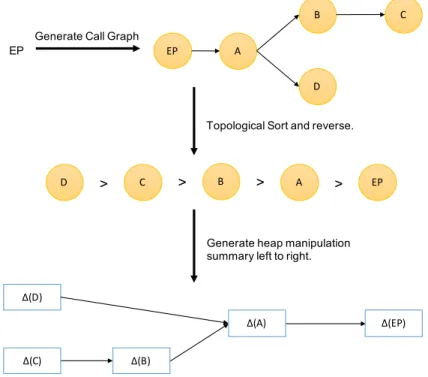
Figure 3.2: SBDA workflow
To address above challenges, Argus-SAF adopt the Summary-based Bottom-up data-flow
Analysis (SBDA) algorithm introduced in [51]. The benefit of this method is that Argus-SAF
only needs to visit each method exactly once to generate a unified heap manipulation summary for both Java and native procedures, while still preserving a flow and context-sensitive data-flow analysis result.
Figure 3.2 illustrates the workflow of SBDA. It takes the environment method as EP and generates a call graph G from it. From G Argus-SAF applies a topological sort algorithm with the reverse order to get a list of methodMList, which guarantees the callee method always comes before the caller method. If there is a cycle in the call graph, the algorithm will break the cycle
arbitrarily to make sure the topological sort will always hold. For each method Mi in MList,
Argus-SAF applies a heap manipulation summary generation algorithm to get summary ∆i. The
∆i is represented using the same DSL language as illustrated in Section 2.2.1. The callee method’s
summary will propagate to its caller methods until theEP is reached.
As discussed in [51], the soundness of a summary-based analysis is guaranteed if the summary ∆ over-approximates the heap manipulation side-effects. Therefore, SBDAis sound as long as the summary generation process is conservative, which means conservative consideration of input data and conservative model of library API calls.
∆(foo) = <(arg1.str = arg2) (sink(arg1.str)@C15)>
∆(bar) = <(sink(arg1)@C15)>
class Data {
public String str; }
public void ep() { String imei = source(); Data d = new Data(); foo(d, imei); }
Data foo(d, imei) { d.str = imei; n_1(d); } void bar(imei) { n_2(imei) } J2. J3. J4. J12. J17. J18. J19. J20. J21. J22. J23. J24. J25. J26. J27. arg1 arg1 ep foo bar Call Graph
Resolve J19. foo(d, imei)
d sink(source@J17)@C15 2 4 5 n_2
void n_1(env, obj, d) { jstringi = env->
GetObjectField(d , “str”); env->
CallVoidMethod(“bar”, i) }
void n_2(env, obj, imei) { sink(imei)); } C1. C6. C9. C11. C12. C15. C17. MainActivity.java multiple_interactions.cpp n_1 ∆(n_2) = <(sink(arg1)@C15)> arg1 1 sink@C15 ∆(n_1) = <(sink(arg1.str)@C15)> str arg1 3 arg2 imei source@J17 Data@J18 str
Figure 3.3: Heap manipulation summary example
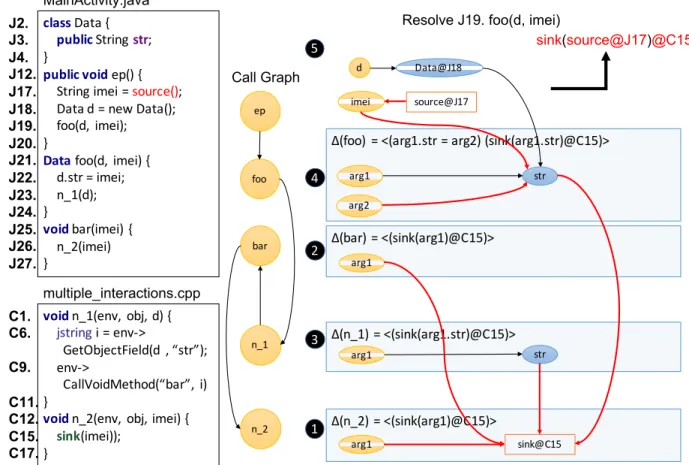
Let’s take Figure 3.3 as an example to walkthrough the heap manipulation summary gen-eration process and how to leverage the summary ∆ to resolve the data-flow problem for the motivating example. Start from method ep() Argus-SAF builds a Call Graph, and topological
sort it in reverse order. For building the Call Graph, Argus-SAF needs to address the native method call from Java code and Java method call (reflection style) from Native code, respectively. The details are discussed in Chapter 5. Argus-SAF starts generating the summary ∆ from the leaf function n 2(). Native function n 2() leaks the first argument 2 thus Argus-SAF generate a summary ∆(n 2) = h(sink(arg1)@C15)i and propagate it to java method bar(). bar() pass the first argument to n 2(), and the ∆(n 2) is applied. Therefore, Argus-SAF gets summary ∆(bar) =h(sink(arg1)@C15)i and propagate it to native function n 1(). n 1() read the str field from first argumentd and invokes methodbar(). Therefore, ∆(bar) is applied and Argus-SAF gets summary ∆(n 1) = h(sink(arg1.str)@C15)i. foo() puts second argument imei into the str field of first argument d and invokes native function n 1(). Argus-SAF applies ∆(n 1) and then get ∆(f oo) =h(arg1.str=arg2)(sink(arg1.str)@C15)i. Java method ep() assigns a sensitive data to variable imei atJ17 and creates a Data instance to d at J18. J19 of java method ep() invokes methodfoo(). ∆(f oo) tells us thestrfield of variabledgets data in variableimeiwhich is sensitive, and thisstrfield of variabled will flow to a leak point atC15. Therefore, Argus-SAF captures the data leakage problem.
3.3 Discussion
Currently, both data-flow analysis algorithms only do constant propagation for string values and have a conservative model for string operations. This limitation could introduce imprecision for the intent resolution and reflection call handling. Precise and general string analysis in static analysis is non-trivial, and the author leaves this for future research. For example, prior research [52, 53] could be applied. Moreover, recent work [38] shows that ICC resolution can benefit from domain knowledge and probabilistic models, which Argus-SAF could adapt to prioritize inferred ICC destination choices.
RFA does not currently handle Java reflection, dynamic class loading. Adding preliminary support for reflections and dynamic class loading is similar to handling ICC in Argus-SAF.
More-2
First two arguments of native functions are not counted in the summary asenvis not presented in java method andobjis “this”.
over, Li et al. [54] have proposed ways to handle Java Reflection and dynamic class loading in a reliable way, which might be able to leverage in the future.
Both data-flow analysis algorithms’ data and control flow analysis depend on the faithfulness of the models, including the models of the Android environment and its APIs. I designed a DSL as discussed in Section 2.2 to let researchers more easily model library APIs for their analysis purpose. Currently, there exist more than 1,000 API models using the DSL, which covers a significant portion of the real-world Android API usage. However, due to the size of the Android library and complexity of third-party libraries, it remains a challenge to reliably detect all library API and provide a precise and sound model for them. Recent work [55, 56, 57] offer approaches to detect third-party libraries. Prior work [58] shows that static analysis can compute accurate data-flow summary for the Android framework. They might be able to leverage in the future.
CHAPTER 4: COMPONENT-BASED ANALYSIS 1
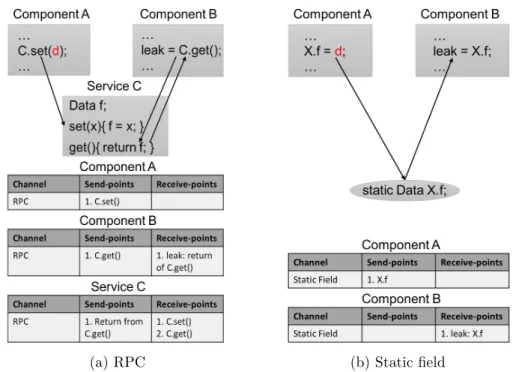
An Android app might have multiple components while the components can communicate with each other via various channels: Intent, RPC, static field. Thus, security sensitive data items can also flow through these channels. Moreover, in an inter-app communication, one component of app X interacts with one component of app Y; hence, communication across different apps can be considered as inter-component communication. Thus, our approach considers the component-based analysis as the basic building block for app vetting. Argus-SAF does both intra- and inter-component analysis (covering both intra-app and inter-app analysis, if necessary). Our analysis approach consists of the following phases:
1) Build data-flow graph (DFG) for each component (discussed in Section 4.2).
2) Build data dependency graph (DDG) for each component (discussed in Section 4.3).
3) Perform inter-component analysis (discussed in Section 4.4, 4.5, and 4.6). 4.1 Motivating Example
A malicious app can conduct bad behaviors by leveraging the design (e.g., event-driven and inter-component nature) of Android system and try to obfuscate its real objectives. Figure 4.1 shows an example app (named “inter-component-leak”), which consists of a few components while each one is a separate Java class. Android apps are component-based where each component is an independent entity and is typically responsible for a specific task. For instance, an Activity component implements the UI of the app, aService component typically performs a long-running task on the background, and a Broadcast Receiver component receives a broadcast message from one component (or the system) and takes specific actions and more.
1
An Android app does not have a “main” method; instead, components are invoked through the various callback methods (including lifecycle methods). Depending on the events, the system invokes the lifecycle methods of the components. It also remembers the recently sent intents and passes them around, which can be abstracted in a component-level environment. Furthermore, there can be control flow and data-flow among the app components through the Android system. For a comprehensive analysis, the app analyzer tool needs to track such control and data flows.
As an example, the following sequence of events (as labeled in Figure 4.1) can happen in reality:
1) FooActivity starts BarActivity (via “startActivityForResults” API) and waits for BarActivity to send back some result.
2) When the user clicks on a button of BarActivity screen, the onClickmethod is triggered.
3) BarActivity makes an RPC (Remote Procedure Call) call getImei() to a Service component named MyService, and MyService returns an inner field (which has already possibly stored theIMEI Id) to BarActivity.
4) BarActivitysends back an intent (via setResultAPI), which contains the IMEI Id.
5) Android system invokes the onActivityResult method of FooActivity with the above intent as a parameter, and the IMEI Id is extracted and leaked (to the attacker) through an SMS message.
To track the control and data-flow inside a component, a static analyzer needs a model of the Android system to track invocation of the callback methods including the component lifecycle methods as illustrated in the above example. Our model of the Android environment is inspired by FlowDroid [19,30], which uses a “dummyMain” method to capture all possible sequences of lifecycle method invocations as followed in Android. However, unlike an app-level environment model used in FlowDroid, Argus-SAF designs a component-level environment model. The motivation behind the component-level model choice is that Android apps work in this way.
Furthermore, Argus-SAF needs to track data and control flow through each type of inter-component communication channel (such as Intent, RPC). As an example, whenBarActivitysends
public class BarActivityextends Activity {
private MyServices;
@Override
protected void onCreate(@Nullable Bundle savedInstanceState) {
super.onCreate(savedInstanceState); setContentView(R.layout.activity_bar); Intent i2 = new Intent();
i2.setClass(getApplicationContext(), MyService.class); bindService(i2, mConnection, Context.BIND_AUTO_CREATE); }
...
public void onClick(View view) {
if(s != null) {
String imei2 = s.getImei(); Intent i3 = getIntent(); i3.putExtra("key", imei2); setResult(RESULT_OK, i3); finish();
} }
private ServiceConnectionmConnection= new ServiceConnection() {
@Override
public void onServiceConnected(ComponentName name, IBinder binder) { MyService.MyBinder b = (MyService.MyBinder) binder;
s = b.getService(); } … }; } J1. J2. J3. J4. J5. J6. J7. J8. J9. J10. J11. J12. J13. J14. J15. J16. J55. J56. J57. … J67. J68. J69. J70 J71. J72. J73. J74.
public class FooActivityextends Activity {
@Override
protected void onCreate(@Nullable Bundle savedInstanceState) {
super.onCreate(savedInstanceState); setContentView(R.layout.activity_foo); Intent i1 = new Intent();
i1.setClass(getApplicationContext(), BarActivity.class); startActivityForResult(i1, 1);
}
@Override
protected void onActivityResult(intrequestCode, intresultCode, Intent data) { String imei3 = data.getStringExtra("key");
SmsManager smsManager = SmsManager.getDefault();
smsManager.sendTextMessage("xxx", null, imei3, null, null); // sink, leak of device id }
}
public class MyServiceextends Service {
private final IBindermBinder= new MyBinder();
private String imei1 = null;
…
public void setImei() {
TelephonyManager m = (TelephonyManager) getSystemService(TELEPHONY_SERVICE);
this.imei1 = m.getDeviceId(); // source }
public String getImei() {
return this.imei1; } } J17. J18. J19. J20. J21. J22. J23. J24. J25. J26. … J35. J36. J37. J38. J39. J40. J41. J42. J43. J44. J45. J46. J47. J48. J49. … J53. J54.
Figure 4.1: The inter-component-leak App: The arrowed lines among the app components highlight some of the inter-component communication